Tag: Wohnprojekt

  • Beer, concrete and living – Baden builds on its history

    Beer, concrete and living – Baden builds on its history

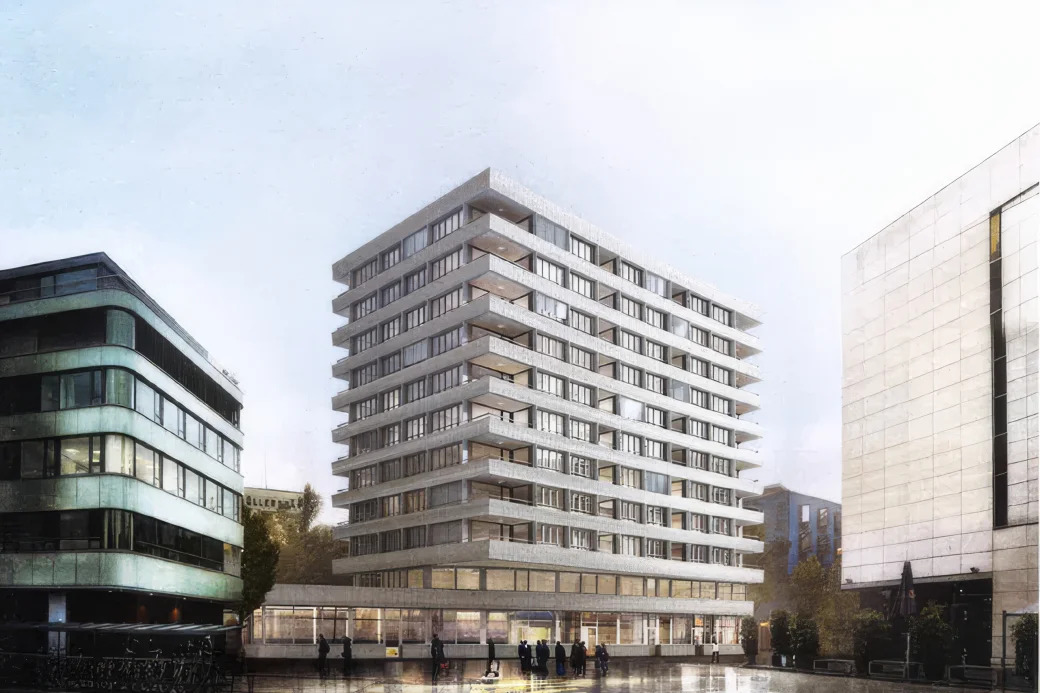
    Four new buildings are being constructed on around 8,000 square meters directly next to Baden train station, divided into two construction sites. Building site A is the responsibility of Frei Architekten AG from Aarau, building site B is the responsibility of the renowned Harry Gugger Studio from Basel. The volume is considerable: 81,888 cubic meters of enclosed space, 22,914 square meters of floor space and an investment of around 64.5 million Swiss francs. The general contractor is Gross AG from Brugg.

    Living where malt used to steam
    136 rental apartments with 1.5 to 4.5 rooms are being built in the heart of the city. On the first floor, a total of 2268 square meters of retail and restaurant space will characterize the quarter. In the inner courtyard, a 900 square meter beer garden invites you to linger. The motto of the building owner, the fourth-generation brewery H. Müller AG, sums it up: “brew – live – enjoy”.

    History remains visible
    Not everything makes way for the new building. The boiler house, brewhouse and malt silo remain as architectural witnesses to a brewing history that began in 1897. The Müllerbräu beer itself is now produced by the Falken brewery in Schaffhausen. However, there is still a specialty brewery on the site. The site’s past thus not only remains visible, it can still be experienced.

    Timetable and marketing
    The building permit dates from October 2023, with demolition starting in April 2024. The facades of the new high-rise buildings have been visible for the first time for a few days now. A milestone for the project. Marketing of the apartments is scheduled to start in summer 2026, with first occupancy planned for June 2027.

  • Condominiums between city life and nature

    Condominiums between city life and nature

    “Urban living meets nature” is how Halter AG introduces a post on LinkedIn about one of the company’s new-build projects. Specifically, the Schlieren-based property developer is constructing a building with 43 condominiums and around 80 square metres of commercial space at Leimbachstrasse 28 to 32. According to the project’s website, the 2.5- to 4.5-room flats will be the ideal home for “nature-loving city dwellers”. Interested parties can sign up to a list there, which will be used to send out information about the project before the official marketing launch.

    The total of 43 condominiums, including penthouses and garden flats, are divided into 10 flats with 2.5 rooms each, 30 flats with 3.5 rooms and three flats with 4.5 rooms. The description of the project cites excellent transport links, diverse infrastructure and nearby recreational areas as plus points. Construction work is scheduled to begin in spring 2026 and be completed two years later.

  • Start of construction of the forest town Im Pantli

    Start of construction of the forest town Im Pantli

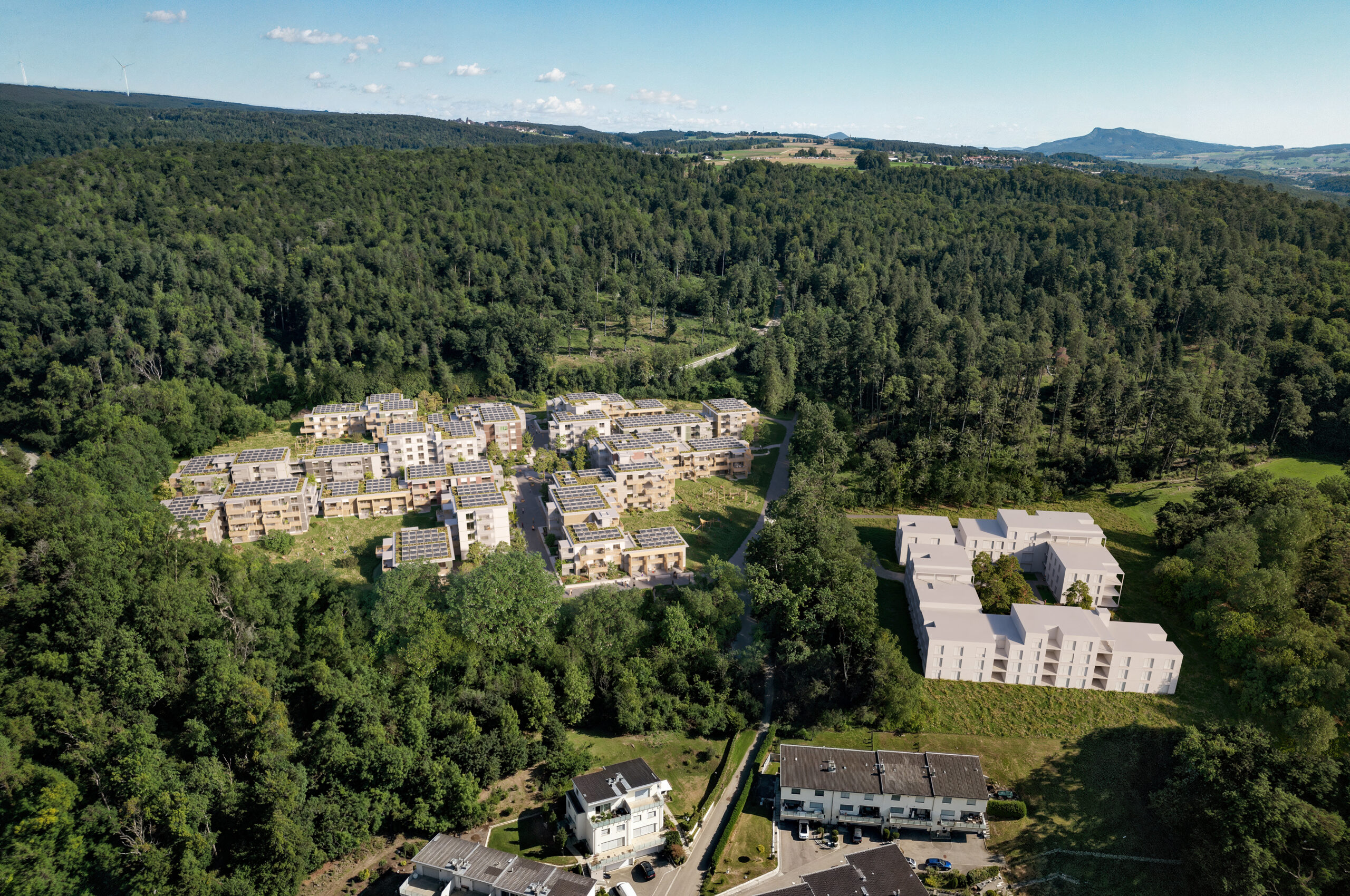
    Halter AG has begun construction of the Waldstadt in Pantli. The ground-breaking ceremony for the residential project in the Pantli forest clearing in Schaffhausen took place on 10 January, the Schlieren-based property developer announced in a press release. The 214 condominiums planned in Waldstadt are being realised by Halter in collaboration with DOST Architektur GmbH from Schaffhausen.

    “The Waldstadt project in Pantli is making a valuable contribution to urban development,” says Mayor Peter Neukomm in the press release, quoting from his speech at the ground-breaking ceremony. “The development should serve as a model for future construction projects and strengthen Schaffhausen as a location for sustainable and innovative living.” Waldstadt is designed as living space for different living models.

    Specifically, the residential project aims to appeal to families and couples as well as singles and commuters. A kindergarten and daycare centre are also planned. Open spaces and communal facilities are intended to create “ideal conditions for harmonious coexistence”, according to the press release.

    Planning and realisation are based on the requirements of the Swiss sustainability standard. Around two and a half years have been estimated as the construction period for the first stage. The first of the 2.5- to 5.5-room flats should be ready for occupancy as early as next year.

  • New home for senior citizens Greencity 2026

    New home for senior citizens Greencity 2026

    A visionary residential project is being built in the south of Zurich that offers older people a lively and safe environment. The development on construction site B6 in Greencity combines private and municipal involvement. Losinger Marazzi AG is developing the project for the investment foundations of Pensimo Management AG, which are providing a total of 179 flats for older people. Of these, the City of Zurich Retirement Homes Foundation (SAW) will take over 60 flats, while the remaining 119 flats will be let by Pensimo to tenants aged 55 and over. This collaboration represents a new partnership and gives all tenants access to SAW’s services.

    A green centrepiece for Greencity
    Construction site B6 is the latest chapter in the sustainable development of the Greencity district. Since 2014, Losinger Marazzi has been transforming the site of the former Sihl paper factory into Switzerland’s first 2000-watt site. The inner courtyard of the new building will feature green areas, trees and seating, inviting people to linger. Arcades on the ground floor create sheltered access areas to commercial spaces, which could offer facilities such as a medical centre, a fitness studio, a bakery or a café on 3,500 square metres, says René Büchi, the portfolio manager responsible at Pensimo.

    Comprehensive services from SAW
    The City of Zurich Retirement Homes Foundation provides all tenants with a comprehensive service package. This includes a 24-hour emergency call service, extended caretaking, laundry service, social services and various events on the estate. If required, tenants can also take advantage of home help and outpatient care services. Andrea Martin-Fischer, Director of SAW, emphasises: “Our aim is to enable tenants to live independently and safely well into old age.”

    Focus on sustainability
    Greencity’s sustainability goals are consistently applied to the new retirement housing project. Herbert Heinen, Project Manager at Losinger Marazzi, explains: “An optimised load-bearing structure, lightweight walls, a wooden façade and an energy concept with 100 percent renewable energy significantly reduce CO2 emissions and bring the building close to the net-zero target in operation.” Pensimo and Losinger Marazzi are also aiming for certification with the SNBS Gold label. Construction started in March 2024 and the building, designed by JSWD Architekten from Cologne, is scheduled for completion at the end of 2026.

    With this pioneering project, Greencity is setting new standards for sustainable, age-appropriate living and demonstrating how private and public partnerships can create forward-looking solutions.

  • Greencity Vergé sets new standards in sustainability

    Greencity Vergé sets new standards in sustainability

    Vergé is more than just a residential project, it is a response to the pressing issues of urban coexistence and ecological responsibility. Located in the south of Zurich on a former industrial site, Vergé stands for the transition to a new understanding of housing that both takes into account the needs of its older residents and actively contributes to the quality of urban life.

    Vergé’s design combines modern architecture with ecological sustainability. By using renewable and lightweight materials, the project not only sets design accents, but also makes an important contribution to reducing the ecological footprint. The design of the inner courtyard as a social meeting place and the careful selection of planting promote biodiversity and offer residents a place of retreat in harmony with nature.

    An often underestimated lever lies in the choice of materials for the interior walls. According to Lennart Rogenhofer, Chief Climate Officer at Losinger Marazzi AG, using non-load-bearing interior walls made of lightweight construction instead of concrete can lead to a reduction in CO2 emissions of around 50%. Similar savings can be achieved if a wooden façade is used instead of a concrete and plaster façade. This is in line with the aim of using sustainable and minimally processed raw materials. Losinger Marazzi has also decided to use CO2-reduced concrete in its projects as far as possible. The reduction in grey emissions with a slimmer supporting structure, which minimises the amount of concrete by optimising the slab thicknesses and column grids, is difficult to quantify. Rogenhofer explains: “This is because no ‘non-optimised’ project exists as a comparison.”. Greencity, with the last building site Vergé, impressively demonstrates that the property sector plays a key role in achieving the climate targets. Through the use of heat recovery technologies and integration into the local heating network, the aim is to achieve a largely autonomous energy supply, with certification in accordance with the SNBS Gold Standard.

    By focussing on sustainable and energy-efficient construction, not only can the quality of life of the residents be improved, but a decisive step towards a more sustainable future can also be taken.

    The project is being built by Losinger Marazzi, which has positioned itself as a pioneer in sustainability in the property and construction industry for almost 20 years and is consistently implementing its climate strategy, which follows the strategy of its parent company Bouygues Construction. The company has been SBTi certified since the end of 2023 and remains a leader in sustainability. This certification confirms that the company’s own CO2 reduction targets for direct and indirect corporate emissions (incl. Scope 3) have been calculated in accordance with international standards (GHG Protocol) and are in line with the Paris climate targets. An external, independent auditing company also verifies that the certified companies achieve their targets not through CO2 offsetting, but through actual CO2 reduction. For this reason, a CO2 reduction pathway was already drawn up in 2021 to guide strategic decisions.

  • Kloster Fahr launches the “experienceable” housing project

    Kloster Fahr launches the “experienceable” housing project

    With the project presentation "Area development Kloster Fahr" on September 24th, the residential project " experienceable " and the further development of agriculture and gastronomy were presented to the public in the Fahr monastery. According to a statement on kath.ch, a Christian communal "multi-generational living" is to be created in the former farmer's school. The residential project is being implemented by the Christian pension fund Prosperita as investor and builder. "We are very pleased to continue the realignment of the operations and buildings with a strong and trustworthy partner," said the prioress of the Fahr monastery , Irene Gassmann. “The monastery is a spiritual oasis. Everything that happens here should be based on Christian values,” the prioress continued. When the project was tendered, Prosperita was selected from among 26 projects submitted.

    Fahr Erlebnis AG took over the agriculture of the Fahr monastery at the beginning of 2021. It will now become an organic farm. Fahr Erlebnis also runs the gastronomy in the Fahr Monastery. According to a report by the Catholic Media Center, the restaurant Zu den Zwei Raben is already being renovated. In April, the company opened the summer pub in the monastery.

    The planning, clarification and building permit process for the redesign took around three years. For the conversion to communal multi-generational living, 16 residential units with one to six rooms will be installed in the former farmer's school. According to a statement on its website, the “erfahrbar” association is responsible for the right mix of tenants. The ecumenical community should be open to singles, couples, families, people of all ages and incomes and people of different nations.