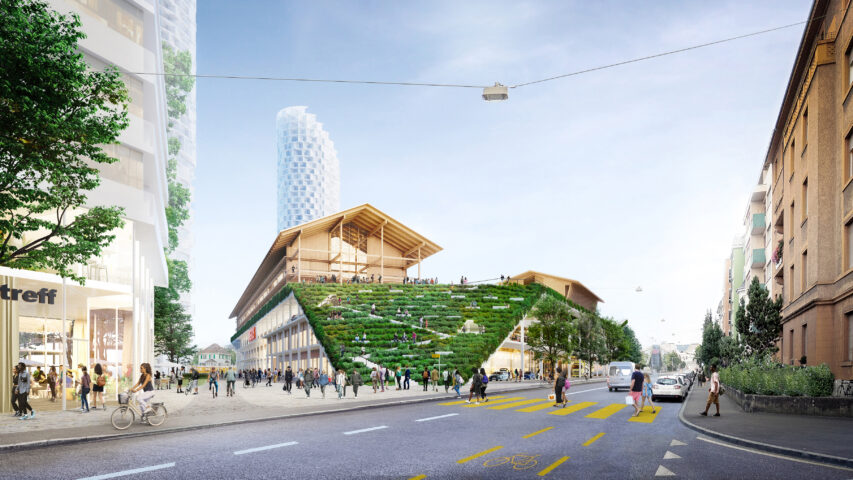
A consortium of three private landowners and the city of Baden is planning to transform the Schadenmühle Ost site into a place for sustainable, dense and mixed-use living. The current use of the site, which consists of individual buildings, car parks and unused areas, does not meet today’s requirements or the current building and usage regulations, the consortium explains in a press release. The Schadenmühle Ost transformation project aims to create an urban area with around 100 flats, flexible commercial space, green areas and an underground car park.
On 16 September, the consortium presented the project and its integration into the city’s urban development plans for Baden at an information event. This marked the start of a new phase for the flagship project, according to the press release: from 22 September to 21 October, interested parties can now submit comments and suggestions on or objections to the Schadenmühle Ost design plan. The consortium is providing detailed information on the project on an information portal.
“We are rooted in Baden and it is important to us to make the Schadenmühle Ost site attractive for the city,” Beni Schmocker, one of the four landowners, is quoted as saying in the press release. “Involving the local population is a matter of course for the landowners.”
Buchholz stands for a new urban beginning. On an area of around 36,300 m², an independent urban quarter is being created that combines living, working, exercise and socialising. The previously heterogeneous structure is giving way to a clearly organised mix of uses that combines spatial quality with ecological responsibility. The centrepiece of the development is the “green centre”. A centre with a school, sports facilities and open space, framed by high-rise residential and commercial buildings.
From industrial site to lively neighbourhood The development is the result of a successful study commissioned by the Zurich architecture and planning office helsinkizurich. This formed the basis for a finely balanced indicative project with a development strategy that provides for a staged, in-depth planning process. Realisation will take place in three phases – tailored to the different interests of the owners. Particular attention will be paid to the architectural heritage: elements such as the listed powder tower will be carefully incorporated and respectfully integrated into the urban context.
Neighbourhood life at the bottom, quality of life at the top Commercial uses and communal areas in the plinth zones along Buchholzstrasse characterise the public face of the neighbourhood. Above, light-flooded flats open up wide views of the landscape. Meeting spaces, courtyards and access axes promote social interaction. The graduated public realm allows both retreat and participation, a principle that does justice to urban life.
Blue-green infrastructure as the backbone In the Buchholz neighbourhood, sustainability is not a promise, but a reality. Well thought-out water management with rainwater retention and evaporation areas relieves the burden on the infrastructure and improves the microclimate. Green roofs, permeable paving and climate-active open spaces create quality of life, are ecologically effective and have a convincing design.
Strong identity, clear address The new promenade along Buchholzstrasse not only creates a functional access route, but also an identity-forming address for the new neighbourhood. The district thus positions itself between the scenic Linth area and the urban centre – open, permeable, forward-looking.
Urban development with impact Buchholz is an example of urban development that thinks long-term and takes a differentiated approach. The project creates new living space and a modern form of urban quality on the outskirts of Glarus – networked, sustainable and with a view to the big picture.
The renovated apartments in the heart of Locle were developed for older people and people with reduced mobility. The thirteen residential units, which are under the AE label, offer affordable rents that meet the requirements of AVS and AI supplementary benefits. In addition, residents have access to supervision services that enable assisted living.
Central location and comprehensive range of services The building is ideally located in the center of Locle, in close proximity to pharmacies, stores, restaurants and public transport. In addition to the apartments, residents also have access to a communal room that offers the opportunity to socialize.
Ceremonial award and great interest During the official part of the event, the building was ceremoniously awarded the AE label. Representatives of the canton of Neuchâtel, the town of Locle and the architect of the project, Sareg SA, were present to present the project and its significance for the region. Numerous visitors took the opportunity to view the apartments and find out more about what is on offer.
Successful presentation of an important residential project The project in Locle is an important step in the implementation of the cantonal strategy to create a total of 1,800 assisted living apartments for older people and people with reduced mobility by 2030. The open day offered a successful insight into the future of assisted living in the canton of Neuchâtel.
After lengthy discussions, the National Council and the Council of States have reached a compromise on noise protection regulations. In new flats, at least half of the noise-sensitive rooms – i.e. rooms in which people regularly spend time – must now have windows that comply with the noise limits.
If controlled ventilation is available, it is sufficient if the limit values are complied with in one room per flat or if a cooling system is installed. Alternatively, a building permit can also be granted if a quiet outdoor space and a quiet window are available.
Remediation of contaminated children’s playgrounds In addition to noise protection, the remediation of children’s playgrounds contaminated by fertilisers and air pollution was also discussed. Public playgrounds must be analysed and remediated in future. The federal government supports these measures through the so-called Vasa Fund and covers 60 per cent of the renovation costs.
In the case of private playgrounds and home gardens, remediation remains voluntary. Here, the Vasa Fund covers 40 per cent of the costs if the owners decide in favour of remediation.
With the revision of the Environmental Protection Act, Parliament has made important decisions concerning both noise protection in new residential areas and the renovation of contaminated playgrounds. These compromises promote a healthy living environment and at the same time contribute to the sustainable development of residential and play areas.
It only takes a few minutes’ drive to separate Zurich city centre from Zollikerberg, a part of the village of Zollikon. Having just stood on Sechseläutenplatz in front of the opera house, wide meadows and self-picking fields open up shortly afterwards. Just a stone’s throw away from Forchstrasse, which directly links the town and the countryside, two wooden apartment blocks were completed last year – on the site of a farm that is still inhabited and farmed.
Harmony between tradition and modernity Sheep used to graze regularly on the estate’s large meadow. Today, two four-storey buildings with a total of 22 rental flats tower above the grass. The two apartment blocks form a harmonious ensemble, which could possibly be supplemented by a third building at a later date, should densification be required. At the start of planning, it was not yet clear whether the buildings would be timber or solid construction. The clients had not made any specific specifications when they announced a private competition in 2018. However, chance favoured timber construction: the Zurich-based firm Merkli Degen Architekten, which was invited to take part in the competition and won, was working with Timbatec AG at the time. Together with the University of Applied Sciences Biel and ETH Zurich, the well-known Swiss engineering firm was developing a new connection technology to bridge larger spans with cross-laminated timber panels – without beams or additional intermediate supports.
The future of construction In future, it should therefore be possible to achieve with wood what was previously only possible with reinforced concrete. TS3 connection technology was still in its infancy in 2018, but is now well established. Solid timber panels that can form entire floor slabs open up completely new possibilities for timber construction. “It was purely by chance that we became aware of TS3,” explains Ueli Degen, one of the founders of Merkli Degen Architekten. “We were originally talking to the engineers at Timbatec about another timber construction project.”
They told us about the development of their latest connection system and presented us with an example. This ground-breaking technology has stayed with us ever since. At some point, we came up with the idea of using TS3 for the construction project in Zollikerberg. Before deciding whether to use timber or solid construction, thorough investigations and comparisons were carried out. In the end, the timber design prevailed, which was later realised by the company Holzbau Oberholzer GmbH. By using a timber building, it was possible to create a harmonious connection to the existing farmhouse, which is also made of wood.
The combination of a timber construction with TS3 technology also promised to be an economically attractive solution that would also significantly shorten the construction time. Nevertheless, it took a while before the clients decided in favour of timber construction. Five years ago, when the buildings were planned, a lot of persuasion was still needed to push through a timber construction of this size.
With the new target operating model, Wincasa is taking a significant step towards optimising its services. The organisational and spatial separation of the management of residential and commercial properties enables specialised and professional support for both areas. Philipp Schoch, emphasises that the TOM project is geared towards the current requirements of property management. This reorganisation benefits tenants and owners as well as employees.
Personal contact points for residential tenants In the residential sector, the company is planning to open a total of 18 walk-in locations that will enable residential tenants and other stakeholders to clarify their concerns in person and without prior appointment. These physical points of contact complement the existing digital channels, such as the tenant app and telephone customer service. Following the successful pilot project in Basel, all 18 locations will be gradually put into operation by the end of 2025.
Expert support for commercial tenants Eight specialised locations will be set up for the management of commercial properties. Commercial tenants benefit from highly professional support from proven specialists who cover all phases of the management process. As commercial properties have more complex requirements and require long-term tenancy agreements and vacancy management, the job profiles have been adapted accordingly and employees have received comprehensive training.
Career opportunities for employees The innovative management model offers Wincasa employees exciting career opportunities and new roles such as technical managers, letting specialists and site managers. The teams are given more responsibility, which strengthens loyalty to the company and employee satisfaction. In this way, the TOM also helps to position Wincasa as a modern and attractive employer and counteract the shortage of skilled labour.
Measurable success for owners Performance is measured in real time at all locations and displayed on dashboards to make key figures such as vacancy rates transparent. This enables the teams to react quickly and efficiently to changes and continuously optimise management. The new model should also deliver measurable success for the property owners.
Das Projekt «Rolf-Liebermann-Weg» entwickelt von Mettler Entwickler AG mit der Bauherrschaft Asga Pensionskasse, profitiert von seiner einmaligen Lage am Stadtrand von Zürich, zwischen dem Schulhaus Staudenbühl und den idyllischen Grünflächen des Hürst-Gebiets. Die Hanglage eröffnet spektakuläre Ausblicke auf den Zürichberg und die Alpen, während die gute Anbindung an das Verkehrsnetz und die Nähe zu Einkaufs- und Dienstleistungszentren urbanen Komfort bieten.
Die geplante Wohnsiedlung zeichnet sich durch ihre L-förmige Anordnung aus, die grosszügige Freiräume für Gemeinschaftsaktivitäten und individuelle Entfaltung lässt. Der vielfältige Wohnungsmix reicht von kompakten 1½-Zimmer-Wohnungen bis zu geräumigen 5½-Zimmer-Wohnungen, um ein breites Spektrum an Bewohnerinnen und Bewohnern anzusprechen – von Singles über Senioren bis hin zu Familien.
Architektonisch setzt das Projekt auf einen innovativen Hybridbau. Eine Kombination aus tragendem Mauerwerk im Inneren und einer ästhetisch ansprechenden, hinterlüfteten Holzfassade. Betonelemente in den Untergeschossen und den Erschliessungskernen sowie die Wohnungstrennwände garantieren Stabilität und Privatsphäre. Die begrünten Dächer fördern die Biodiversität und das Mikroklima der Siedlung und werden durch die Integration von Photovoltaikanlagen ergänzt, die nachhaltige Energiegewinnung unterstützen.
Mit der geplanten Fertigstellung Ende 2027 setzt der «Rolf-Liebermann-Weg» neue Massstäbe für modernes, nachhaltiges Wohnen in Zürich, indem er die Balance zwischen Natur und städtischem Leben meisterhaft gestaltet.
Researchers at the Vienna University of Technology have developed a wall paint that cleans itself through exposure to sunlight and can chemically break down pollutants from the air. It is common knowledge that wall paints get dirty quickly and need to be replaced regularly. In addition, we are still struggling with air pollutants in our interiors. The need to renew paint regularly is at odds with sustainable living and environmental principles. The research team from the Vienna University of Technology and the Università Politecnica delle Marche in Italy has developed a solution to this problem: A wall paint that cleans itself under the influence of sunlight and can also break down air pollutants.
Nano titanium oxide particles enable new breakthroughs Many people dream of a wall paint that cleans itself. This dream could now finally become a reality. The key to this groundbreaking innovation lies in the integration of specially modified titanium oxide nanoparticles into the paint. These tiny particles utilise the catalytic power of light to not only attract pollutants from the air, but also effectively break them down. This not only keeps the air cleaner, but the wall colour also retains its beauty and purity over a longer period of time. “For years, people have been trying to use special wall paints to purify the air,” explains Prof Günther Rupprechter from the Institute of Materials Chemistry at TU Wien. “Titanium oxide nanoparticles are particularly promising here, as they can bind and break down a variety of pollutants.” The pollutants that can be removed include household chemicals or emissions from building materials and furniture. Until now, conventional titanium oxide particles had to be activated with UV light in order to develop their cleaning effect – a requirement that is difficult to fulfil indoors. The research team has succeeded in modifying the particles so that they can already be activated by the broader spectrum of visible sunlight. This was achieved by adding phosphorus, nitrogen and carbon to the titanium oxide particles, which enables them to break down pollutants even without direct UV irradiation.
The UREK-S upholds the decision of the Council of States to build in areas subject to noise pollution, provided that controlled ventilation is installed and windows are used primarily for lighting purposes. In these cases, it is not necessary to comply with noise limits with open windows. The Commission is convinced that these regulations will favour the creation of living space in central locations and thus promote inward settlement development.
With regard to construction in the vicinity of airports, the Commission rejects a new specific aircraft noise limit, as proposed by the National Council. It favours the Federal Council’s regulation, which allows exceptions to the requirements for aircraft noise. In its opinion, this regulation allows denser construction despite aircraft noise.
The Commission proposes deleting the provision on maximum speeds on traffic-orientated roads from the law. Speed reductions should not be prohibited in principle, but should be implemented through measures that have already been adopted.
With regard to the remediation of contaminated playgrounds, the Commission confirms the decision of the Council of States on private children’s playgrounds and home gardens with pollutant contamination by a casting vote of the President. It rejects the idea that the federal government should be able to provide compensation from the VASA Contaminated Sites Fund for voluntary remediation. The Commission is in favour of the remediation of contaminated private playgrounds and gardens, but without using federal funds. Cantons can provide financial support for remediation if they so wish. Some members request that the National Council be followed, except with regard to the regulation that the owners must in principle pay for the remediation costs.
The vacancy rate for flats in the canton of Zurich has reached a new low. With a vacancy rate of just 0.53 per cent, availability has fallen further below the previous year’s already low figure of 0.61 per cent. Flats with up to three rooms are particularly scarce, while larger units tend to remain unoccupied. The greatest challenges exist in the urban centres of Zurich and Winterthur as well as in the Zurich Oberland.
In the city of Zurich, almost no flats are unoccupied – the rate is a marginal 0.06 per cent. Even among new builds, of which 2,900 units were completed, only seven flats were not immediately occupied. Winterthur also recorded an all-time low vacancy rate of 0.19 per cent, despite the completion of around 400 flats in new development projects.
The decline in the vacancy rate signals a discrepancy between the expansion of housing supply and rising demand. Although construction activity is continuing, it is not keeping pace with demand. Net housing production remains below the long-term average.
The challenge of providing sufficient living space to meet demand remains in the canton of Zurich. The current figures emphasise the need to further intensify construction activity and find innovative solutions to create more living space.
The situation on the housing market in the canton of Zurich requires continued and intensified efforts on the part of all stakeholders. Striking a balance between supply and demand remains a key task for the coming years in order to effectively tackle the housing shortage.
In der Schweiz stehen wir vor der Herausforderung, den Wohnungsmarkt zu erweitern und gleichzeitig die Lebensqualität der Bewohner zu gewährleisten. Insbesondere in städtischen Gebieten mit hoher Lärmbelastung ist es wichtig, einen Kompromiss zwischen innerer Verdichtung und dem Schutz vor Lärm zu finden. Der Nationalrat hat nun eine Lösung vorgeschlagen, die diese beiden Ziele in Einklang bringt.
Die neuen Bauvorschriften ermöglichen es, in lärmbelasteten Gebieten neue Wohnungen zu errichten, ohne die Gesundheit und das Wohlbefinden der Bewohner zu gefährden. Ein zentraler Punkt ist die Anforderung, dass in jeder Wohneinheit mindestens ein lärmempfindlicher Raum über ein Fenster verfügen muss, bei dem die Immissionsgrenzwerte eingehalten werden. Dies stellt sicher, dass Bewohner trotz der Nähe zu Verkehrswegen oder anderen Lärmquellen einen ruhigen Rückzugsort haben.
Darüber hinaus müssen die übrigen Räume entweder über eine kontrollierte Wohnraumlüftung verfügen oder es muss ein ruhiger, privat nutzbarer Aussenraum vorhanden sein. Diese Massnahmen tragen dazu bei, den Lärmschutz zu gewährleisten und gleichzeitig die Möglichkeiten für Immobilienentwickler zu erweitern.
Der Ständerat hatte im Dezember für noch grosszügigere Erleichterungen plädiert, während die Ratslinke eine vorsichtigere Herangehensweise bevorzugte. Letztendlich wurde ein ausgewogener Ansatz gewählt, der den Bedürfnissen sowohl der Bewohner als auch der Immobilienbranche gerecht wird.
Für Kadermitarbeiter im Fachbereich Immobilien und Standortförderung eröffnen sich durch diese neuen Regelungen interessante Perspektiven. Die Möglichkeit, in lärmbelasteten Gebieten zu bauen, erweitert den Handlungsspielraum und erfordert gleichzeitig eine sorgfältige Planung und Umsetzung. Es ist wichtig, die Bedürfnisse der Bewohner und die gesetzlichen Anforderungen gleichermassen zu berücksichtigen, um nachhaltige und attraktive Wohnprojekte zu realisieren.
Die Immobilienbranche sollte sich auf diese Veränderungen vorbereiten und die Chancen nutzen, die sich aus der ausgewogenen Balance zwischen innerer Verdichtung und Lärmschutz ergeben. Die Zukunft des Wohnungsbaus in lärmbelasteten Gebieten liegt in der intelligenten Integration von Architektur, Technologie und Nachhaltigkeit – eine Herausforderung, der sich Kadermitarbeiter mit Weitblick stellen können.
Prices for single-family homes fell by 1.0 per cent in February compared to January, according to the SMG Swiss Marketplace Group(SMG) in a press release on the current Swiss Real Estate Offer Index. This means that the significant rise in prices at the beginning of the year has been reversed, write the SMG experts. The SMG Swiss Marketplace Group combines the digital marketplaces of TX Group, Ringier and Mobiliar.
Over the last twelve months, prices for single-family homes have remained relatively stable with only a slight increase of 0.1 per cent. SMG’s experts have also registered a stabilisation in the market for condominiums. A zero round was observed here in February. Following significantly stronger increases in previous years, prices have risen by an average of just 2.9 per cent across Switzerland over the last twelve months.
Asking rents for flats fell by an average of 0.6 per cent across Switzerland in February compared to January. Within the regions, asking rents were lower than in the previous month, particularly in Central Switzerland, the greater Zurich region, Ticino and Eastern Switzerland. In contrast, asking rents in the Central Plateau and the Lake Geneva region rose slightly.
“After several months of increases, February brought a ray of hope for flat seekers”, Martin Waeber, Managing Director Real Estate at SMG Swiss Marketplace Group, is quoted as saying in the press release. According to him, this is partly due to the planned maintenance of the reference interest rate under rental law at its current level.
The property sector faces the challenge of reducing its carbon footprint. While institutional investors have already made progress, Fredy Hasenmaile points out that the next step is to consider grey energy – the energy used to construct properties and their materials. Previous efforts have focused mainly on the operational phase of properties, but including grey energy in the calculations could revolutionise the understanding of sustainability in construction.
In his analysis, Hasenmaile also points to a problematic misallocation of living space in Switzerland, caused by the current tenancy law, which leads to a large discrepancy between asking rents and existing rents. Older households in particular remain in flats that are too large, as moving to smaller units is financially unattractive. This leads to inefficient utilisation of living space and an increasing housing shortage.
The study by Raiffeisen Switzerland identifies enormous potential for improving the allocation of living space: if flats were distributed in such a way that each household had just one more room than people, 170,000 flats could be saved. This would not only alleviate the problem of housing shortages, but would also save considerable amounts of grey energy.
In view of the expected increase in new rents and the resulting increase in disincentives, which also lead to vacancies and low tenant mobility, Hasenmaile appeals to the need to address the causes of this misallocation under tenancy law and to find innovative solutions for a more effective transfer of living space.
Bälliz, located on the south-western edge of Thun’s old town, is home to four properties owned by the Frutiger Pensionskasse. Despite their poor condition, these historic buildings are worth preserving and some are still rented out. The special significance of the Bälliz area is reflected in its inclusion in the ISOS Federal Inventory, which characterises it as a site of national importance. As a result, its characteristic structure must be preserved as far as possible.
Previous challenges A feasibility study carried out in 2015 was rejected by various federal commissions. A new five-storey building was particularly controversial. In response, a workshop was organised to define new guidelines for the development of the area and prepare a project competition.
A winning concept emerges Several designs were submitted as part of a 2022 study commission. The team from Baumann Lukas Architektur impressed the judging panel with a design that ideally combined urban and atmospheric aspects. This design honours the historical structure of the region and shows respect for the typical belt-shaped parcelling. It integrates the main houses and outbuildings in a way that reflects the significance of the site. The ground floor will continue to offer areas accessible to the public, while the upper floors will mainly contain flats.
Diversity versus monotony The design by Baumann Lukas Architektur stands out for its diversity. The design makes reference to the characteristic structures of the Middle Ages and provides for innovative developments, such as the public “Gässlihof”, which retains its authenticity by preserving a historic building. In contrast, other submitted designs were not as differentiated in their proposals and were not able to convince the judging panel to the same extent.
The “Neue Freistatt” sustainable housing project, designed by Brügger Architekten and Studio Vulkan Landschaftsarchitektur, is taking shape in Thun. The aim of the project is to develop the town centre to provide affordable living space for a broad section of the population. The plans include 260 flats, a post office, a neighbourhood centre with a café, a kindergarten and a daycare centre. The city of Thun and the property developers, GBWG Freistatt and the Municipal Pension Fund, have jointly honed the project over the past year, and the indicative project is now available, which will serve as the basis for the actual construction project.
The Municipal Pension Fund of Thun and GBWG Freistatt have agreed on the division. The pension fund will take over the buildings on Länggasse up to the Mattenstrasse-Länggasse roundabout, while GBWG Freistatt will take over the buildings along Jägerweg and all buildings on Mattenstrasse and out of town from the roundabout. Both parties are working closely together on the infrastructure, outdoor areas and car parks.
The urban development concept is based on a garden city idea with a high proportion of greenery, optimised routing and high ecological standards. . The buildings along Jägerweg and Länggasse emphasise the structure of the site. Four- to seven-storey buildings are planned here, allowing for different types of housing. A public open space between the buildings and the Lindenplatz square with a community centre form the heart of the “Neue Freistatt”.
During further development, the focus was placed on issues such as volume staggering, roof design and shading, whereby the building heights and shadows were deemed acceptable. A revised traffic concept rounds off the project. The referendum is scheduled for spring – summer 2024 and the start of construction is planned for 2025. Realisation will take place in three successive stages, with the first flats expected to be ready for occupancy from 2027. Interested parties can be kept up to date via the neuefreistatt.ch website.
Dubai-based proptech company Realiste has integrated five Swiss cities into its global online platform. According to its media release, Realiste aims to digitise the real estate market of the most important cities on a global level. This is to facilitate analysis and transactions for investors.
“We have just added Tel Aviv and five new cities in Switzerland to our platform,” CEO and founder Alex Galtin is quoted as saying. His company has thus reached “the big milestone of 100 cities”. Realiste’s “Global real estate price index” lists Bern, Geneva, Lausanne, Lucerne and Zurich.
The artificial intelligence company, which specialises in real estate solutions, says it has grown exponentially in the past ten months, from just ten cities at the beginning of the year to over 100 by the end of the year. Now, users can view data on residential properties around the world on the Realiste platform. Realiste is expanding especially in real estate strongholds and established markets.
So far, only flats in Dubai and Bali can be booked directly via the platform. However, the company is optimistic about further development. After all, it has set itself the goal of creating the first complete online real estate experience.
A project team led by Schlierer Halter AG will construct two identical buildings in Rothenburg, according to a media release. There will be 16 flats with 3.5 rooms, eight flats with 4.5 rooms and six flats with 2.5 rooms. The flats with 2.5 rooms will be rented out as retirement flats. The complex will also have adjoining rooms and cellars as well as a parking garage with 31 parking spaces.
Following the recent ground-breaking ceremony, Halter AG is aiming to complete work on the building shell in the first half of 2024. The flats should then be ready for occupancy at the beginning of 2025. The developer is Lucerne-based Caranto AG.
One of the main reasons for the decline in construction activity is the complex and lengthy approval procedures. According to the ZKB study, it takes an average of 140 days from planning application to building permit in the country, which is 67 percent more than in 2010. It takes even longer in densely populated areas in particular: 500 days in the canton of Geneva and 330 days in the canton of Zurich, with this figure more than doubling since 2010. The increase in appeals and objections also lead to delays and blocked projects.
To solve these problems, the globally unique virtual reality (VR) solution from the Swiss PropTech company HEGIAS helps. Communication between the various stakeholders is improved through the use of VR, as all parties involved see and thus understand the same thing. Also, the imagination is less challenged by the authorities, and thus more correct urban planning decisions can be made.
Build faster, cheaper and more sustainably With the immersive solution, complex approval procedures can be reduced, as authorities and politicians can view the planned buildings from any perspective and at any time of day throughout the year in a realistic VR environment. This saves time, money and reduces the need for expensive and environmentally harmful façade samples or elaborate physical architectural models as well as 1:1 mock-ups.
HEGIAS VR also facilitates and speeds up the assessment of listed buildings, as for example HEGIAS VR was successfully used by Implenia in the Lokstadt in Winterthur. The VR models can also show neighbours how shadows cast or the position of the sun would affect their property at any time of day throughout the year. VR thus enables faster, cheaper and more sustainable construction.
On the former milk kitchen site at Winterthur station, directly next to the current signal box 1, the new signal box 2 is being built. It is a mixed-use, modern seven-storey building.
The first and first floors with a total of around 2200 square metres are intended for offices, medical practices and service businesses. The office space is designed for flexibility and can easily be adapted to new space requirements. On the ground floor, 700 square metres of retail space are planned, and in the basement, an expansion of the municipal bicycle station by around 500 parking spaces is planned.
On the upper floors, 66 flats ranging in size from 33 to 80 square metres are being built on 3200 square metres. These are especially tailored to people who appreciate the central location and optimal connections to public transport. In addition to the apartments, there is a range of collectively usable spaces, such as a shared office or a launderette.
The project competition took place in 2018 / 2019. First place went to Esch Sintzel Architekten.
They designed a building with a calm, symmetrical overall form and curved flanks that curve inwards. They wanted to create a building that appears to be more mobilia than real estate. Like the corners on railway or tram carriages, the ends of the building are bevelled.
The SBB relay room that already exists today gives signal box 2 its name. It is located at the level of the first basement floor and will be partially covered by the new building. The relay room is the heart of the interlocking system at Winterthur station. Countless cables, switches and motors converge here, which are used to set the points and routes of the trains.
The approval procedure for the construction took place in 2021/2022. Construction of signal box 2 is scheduled to begin at the end of 2024, and commissioning is planned for the beginning of 2027.
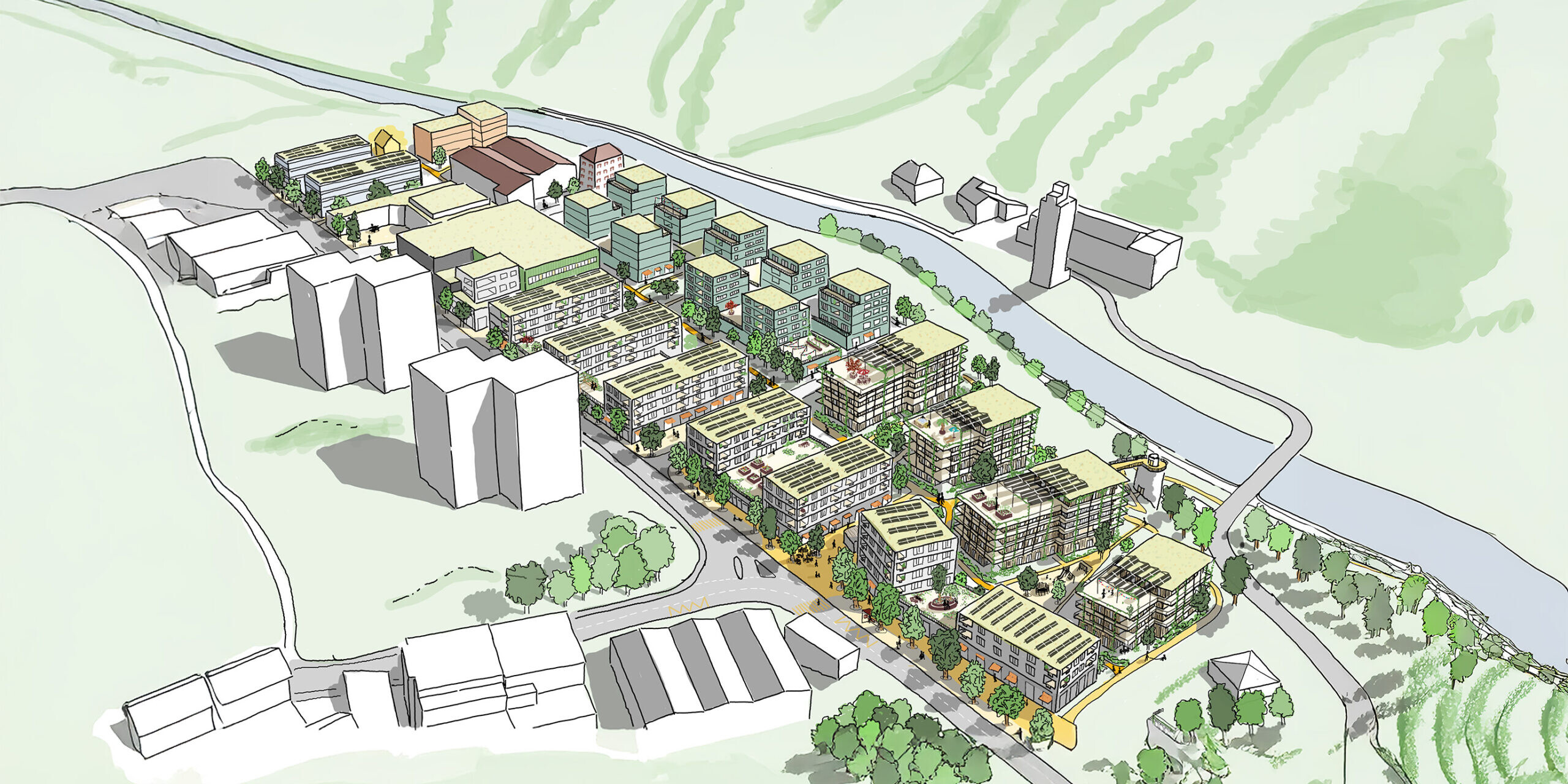
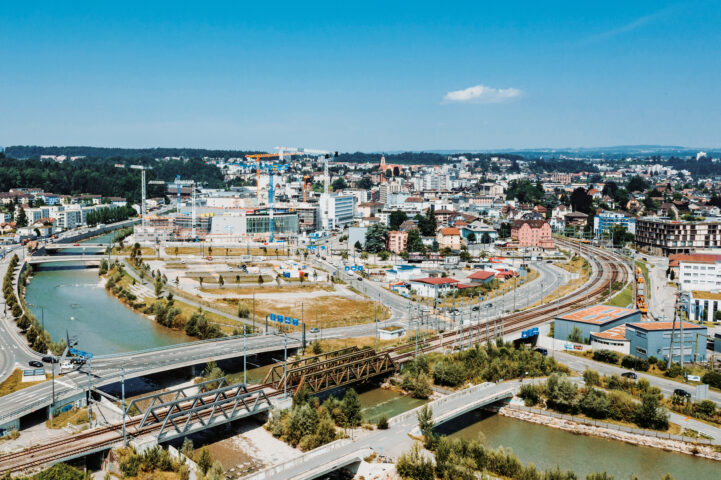
Lucerne North is a development focus of the Canton of Lucerne. In the coming years, 1,500 new flats, 4,000 additional jobs, 850 study places, two recreation zones and various cultural facilities are to be built here step by step.
In order to become a modern, ecological and lively centre on the river, Lucerne North is to develop as a Smart City. A Smart City uses technologies, innovations and data to improve people’s quality of life, make the location more attractive for businesses, use the infrastructure more efficiently and conserve resources.
So far, Central Switzerland has lacked concrete examples of the smart city approach in an area development. Lucerne North is to become a first practical example with a pioneering character – with the simultaneous developments of the city of Lucerne towards a Smart City as well as possible cooperations on the way to a Smart Region Lucerne. The municipality of Emmen, the city of Lucerne, the canton, the transport association, the business development agency, companies, site developers and the population are involved in this networked approach.
The partners involved are convinced that the Lucerne North area is particularly suitable as a smart city, as there are an above-average number of innovative companies, investors and organisations on site and cooperation already works well.
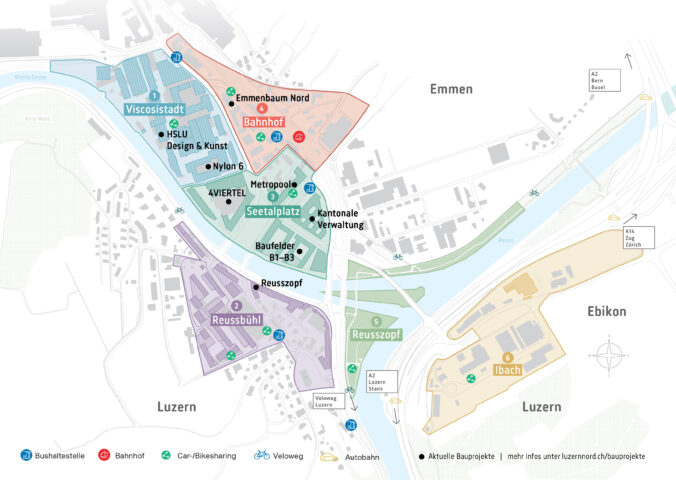
Lucerne North is divided into six sub-areas. The adjacent areas of Seetalstrasse and Littauerboden are also part of the development focus.
Smartness has many dimensions The Smart City approach is characterised by six dimensions: “Mobility”, “Living”, “Economy”, “Environment”, “Governance” and “People”. In the Smart City dimensions “Living” and “People”, the participatory pilot project “Quartiereffekt” was a milestone in Lucerne North. It enables the population to finance and implement their own ideas for neighbourhood design. But exciting projects were also developed on a smaller scale, such as a smart box from which the population can spontaneously borrow balls, badminton rackets and other games free of charge via an app.
The “Offcut” materials market in the Reussbühl area pursues the goal of a circular economy by recycling residual and used materials, in line with the “Environment” dimension. The “4VIERTEL” development on Seetalplatz provides new approaches in the “Mobility” dimension and provides its residents with a mobility station with sharing vehicles such as e-cars, e-scooters, e-cargobikes and e-bikes. In addition, all car-free households receive annual vouchers for public transport, a bicycle service or the in-house sharing service.
In the “Economy” dimension, a new research cooperation for sustainable textiles was established in 2022 with the Viscosistadt Lab. It aims to realign the textile competences at the location in Lucerne North.
Viscosistadt is gradually developing into the creative part of Lucerne North.
Transformation in full swing The transformation of Lucerne North is in full swing. While some projects are under construction, important planning decisions have been made for others.
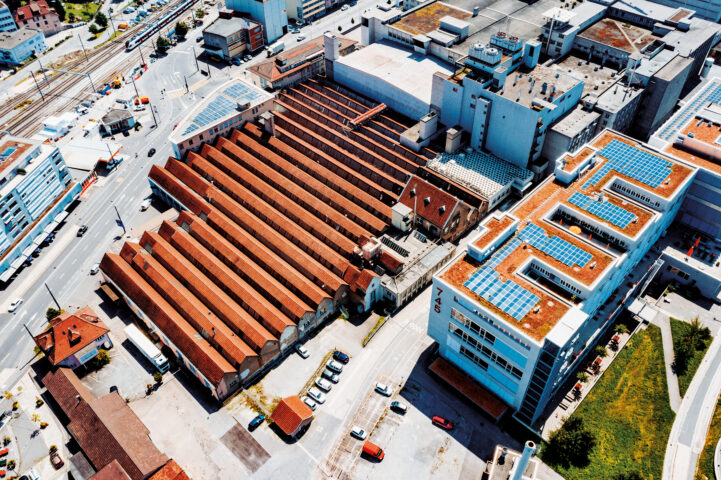
In Viscosistadt, a historic industrial building of the former Nylon-6 factory is currently being converted. This will create about 20,000 square metres of new space for office and commercial use. Right next door, the construction site for the “4VIERTEL” development is in the final phase. The first residents of Lucerne North will move in here from summer 2023.
Near Emmenbrücke station, 42 new flats will be built in “Gerliswil Central” by 2024. The Emmenbaum Nord building and the newly designed Schützenmatt district will give the area directly around Emmenbrücke station a fresh face.
An urban location with high density is being created around the new Seetalplatz.
The Rüüssegg housing cooperative’s development on Seetalplatz is about to receive the building permit for around 380 flats. Directly opposite the Kleine Emme in Reussbühl, 80 cooperative flats will also be built from 2024. The “Metropool” project of the Luzerner Kantonalbank and the cantonal administration on Seetalplatz are about to start construction.
The Reussbühl West area has a somewhat longer time horizon. The CKW site, which is used for commercial and industrial purposes, is to become an attractive and lively urban district in the coming years.
Even if no new flats have been occupied yet, Lucerne North is already alive today. Various temporary uses such as the cultural meeting place “NF49” (until November 2022) or the “Garage Emma” with studios for creative people, numerous events such as “Design Schenken” or the Swiss championship of bicycle couriers, cinemas and leisure facilities such as the “Adventure Room” brought around 105,000 visitors to Lucerne North last year. In addition, there are thousands of guests at the summer bar “Nordpol” on the Reuss.
The Dietiker real estate company Immoleo GmbH is expanding its portfolio, according to a media release. Properties in Spain are now being offered for sale. Immoleo is not entering the rental market. The almost 600 houses, flats and plots of land in the new offer are located on the Mediterranean coasts of the mainland as well as on the Balearic and Canary Islands. On its special website with the new offer, Immoleo describes itself as the market leader with 583 Spanish properties.
The offers are located on the three coastal sections Costa Blanca around Valencia, Costa Calida near Murcia and on the Costa del Sol in Andalusia with a focus on Marbella. Further properties are offered on Mallorca, Gran Canaria and Lanzarote.
Immoleo also wants to serve the seller’s market in these regions and sell properties on offer. Interested parties will be looked after by Immoleo employees and local partners on site, the company adds. This ranges from initial contact to handing over the keys and can be carried out in German.
The real estate company is also strengthening its domestic offering. Immoleo has been offering independent buyer support for new construction projects since autumn 2022. The consultation begins at the notary appointment and leads from the adjustment of the floor plan with regard to the room design to the materialisation for the interior fittings with the interior architect to the handing over of the keys.
The planning of Basel’s new Dreispitz Nord district in the “Gundeli” neighbourhood was penned by Basel architects Herzog & de Meuron. It fills the area with new life, the parking area disappears. On an area of about eight football pitches, space is created for a diverse further development of the neighbourhood.
The direct access from Gundeldingen to Dreispitz Nord is an eye-catcher: via a wide, green ramp, a footpath leads to the roof of the new MParc shopping centre, where there is a unique view over the roofs of Basel.
The new secondary school for about 600 pupils is also located on the roof of the shopping centre. There are sports fields, a triple gymnasium, green and open spaces and a youth club.
The new public parks, the size of two football pitches, offer space for play and recreation with their large, shady trees. Pedestrians and cyclists have priority here, and the public space is to be car-free.
800 flats are being built in Dreispitz Nord. In the far north, seven townhouses are planned with affordable or non-profit housing. In addition to attractive flats, the three round high-rises will also offer space for offices and other uses such as a library or a fitness centre.
A secondary school for 600 pupils will be built on the roof of the MParc shopping centre.
The area is already well served by public transport and is only three tram stops away from the SBB railway station. The new footpaths and cycle paths, car-sharing facilities and around 4000 bicycle parking spaces are intended to promote low-car living. Those who still need a car will have a parking space in separate parking facilities and will not have to search for parking spaces in the adjacent neighbourhood streets. A maximum of 662 parking spaces are planned for the new living and working areas. Access to the parking facilities on the northern edge will help keep the new district and the Gundeldingen neighbourhood car-free.
The district development wants to lead the way as a model example of sustainable spatial development: Instead of sealed car parks, new green and open spaces will be created. Due to the high level of use, the use of land is economical. Existing jobs are preserved and new ones are to be created. A balanced range of housing for all incomes allows for a mix of residents. As part of the construction work, the existing MParc building will be integrated into the new complex. The spacing in the development on the northern edge and the spaces between the high-rise buildings allow air to circulate and ensure good ventilation. The green and open spaces provide cooling through shade and evaporation, and water can seep back into the ground, thus improving the urban climate. In September 2020, those responsible for the project presented the Dreispitz North guideline project to the general public. This serves as the basis for the development plan, the environmental impact assessment and the urban development contract. In order to include the neighbourhood interests in the best possible way, the planning partners have maintained a dialogue with neighbourhood organisations since the start of the project.
In the first quarter of 2023, the public plan submission of the development plan and the environmental impact report should be ready. The parliamentary decision is expected in 2024. As soon as the decision is legally binding, construction project planning for the first stage can begin. Concrete construction measures can be expected from 2027.
With the project presentation "Area development Kloster Fahr" on September 24th, the residential project " experienceable " and the further development of agriculture and gastronomy were presented to the public in the Fahr monastery. According to a statement on kath.ch, a Christian communal "multi-generational living" is to be created in the former farmer's school. The residential project is being implemented by the Christian pension fund Prosperita as investor and builder. "We are very pleased to continue the realignment of the operations and buildings with a strong and trustworthy partner," said the prioress of the Fahr monastery , Irene Gassmann. “The monastery is a spiritual oasis. Everything that happens here should be based on Christian values,” the prioress continued. When the project was tendered, Prosperita was selected from among 26 projects submitted.
Fahr Erlebnis AG took over the agriculture of the Fahr monastery at the beginning of 2021. It will now become an organic farm. Fahr Erlebnis also runs the gastronomy in the Fahr Monastery. According to a report by the Catholic Media Center, the restaurant Zu den Zwei Raben is already being renovated. In April, the company opened the summer pub in the monastery.
The planning, clarification and building permit process for the redesign took around three years. For the conversion to communal multi-generational living, 16 residential units with one to six rooms will be installed in the former farmer's school. According to a statement on its website, the “erfahrbar” association is responsible for the right mix of tenants. The ecumenical community should be open to singles, couples, families, people of all ages and incomes and people of different nations.
Lonza AG is expanding its operational headquarters in Basel, which has been located on the Lindenhof site since 1962, the cantonal administration of Basel-Stadt informs in a press release . Two more high-rise buildings are to be built in the vicinity of the existing Lonza high-rise building, which is under a preservation order. In addition to commercial and service areas that are required by Lonza, apartments "for different needs" are also planned, according to the statement.
The extension buildings are intended to “develop the area into a green, mixed-use and publicly accessible district component of the St. Alban district,” writes the canton administration. The edge of the park is to be preserved and planted with more trees. Grounds previously sealed by parking lots and tennis courts will be "upgraded and greened in terms of biodiversity and climate compatibility".
The plan requirement for the necessary change to a development plan from 1991 that was never implemented can be viewed at the cantonal building and transport department until September 30th. On September 6, Lonza also wants to provide information about the project itself from 6 p.m. in the Hotel Victoria.
According to astatement by Mobimo Holding AG , the Lucerne-based real estate company booked rental income of CHF 60.0 million in the first half of 2022. In a year-on-year comparison, this corresponds to growth of 7.4 percent. Mobimo attributes the increase to the acquisition of new properties. In addition, the company was able to reduce its vacancy rate by 0.2 percentage points to 4.6 percent compared to the end of 2021.
At CHF 3.8 million, income from developments and the sale of properties was well below the previous year's figure of CHF 54.4 million. Here, the sale of a major project shaped the result, explains Mobimo. The operating result therefore fell year-on-year from CHF 115.4 million to CHF 81.4 million. At CHF 63.5 million, corporate profit was CHF 20.2 million lower than in the first half of 2021.
Mobimo was able to post a revaluation gain of CHF 29.0 million for its own investment properties under construction. The company writes that the demand for home ownership remains high. In Meggen LU, Mobimo sold 30 newly built apartments in the reporting period. Of a further 38 apartments under construction in Horgen ZH, 29 apartments have already been reserved, according to the announcement.
Mobimo sees itself well positioned for the future. The company is currently developing six projects with a total volume of CHF 370 million, writes Mobimo. In addition, twelve condominium projects are planned with a total volume of CHF 640 million.
The health organization Swica from Winterthur and Steiner AG from Zurich want to realize a mixed-use development in the Aarau district of Scheibenschachen. In a study order procedure carried out for this purpose, the project contribution Wohnen am Weinbergplatz by Atelier M Architekten was unanimously accepted, Steiner informed in a press release . The project approach envisages four new buildings with around 70 rental and owner-occupied apartments.
In addition, there is a commercial section at street level, which will offer the quarter an improved range of shops in the future, explains the Zurich-based project development, total and general contractor. The proposal by the winning Zurich architects' office also integrates the historic Kreuz building on the site "in an appropriately respectful manner".
The orientation of four buildings to an "urban figure" provided in the concept can cope well with the high urban density, is quoted in the communication from the appraisal committee. It certifies the approach of Atelier M Architekten as a "successful balance between urban elegance and good marketability". In the communication, Steiner also emphasizes the varied open spaces "with a neighborly character" envisaged by the draft.
The rental index of the online real estate marketplace homegate.ch in cooperation with the Zürcher Kantonalbank rose again in February. According to a press release , rental prices rose slightly by 0.26 percent. The index was thus slightly higher than in the previous month at 117 points.
Rental prices have risen in almost all cantons and cities, above all in the canton of Graubünden by 2.15 percent. There was a drop in rents there in January, which has now been offset by the increase in February. In addition to Graubünden, Appenzell, Glarus, Schwyz and Valais also recorded an increase of more than 1 percent in February.
With the exception of Bern and St.Gallen, rents rose in all cities in February, with the strongest increases in Lausanne at 1.7 percent and Lugano at 1.41 percent. In the respective cantons of Vaud and Ticino, on the other hand, prices rose less sharply or even fell.
Rents in the canton of Zug have fallen by 0.56 percent. Rents rose significantly here in January. “A comparison of the cantons shows that, in addition to the majority of increases in rents, there have also been fluctuations over the last few months,” says the press release.
With the demolition of buildings in the northern part of the planned new development, the Schliere-based construction company Halter AG has started to redesign the center of Wetzikon . According to the media release , a lively center with shops, services and apartments is to be built there by the end of 2025. In the past two years, Halter AG, as the developer, has brought the project to construction maturity together with the Wetziker architectural office meierpartner . The investor is Turintra AG Zurich, represented by UBS Fund Management. The investment volume on the 9013 square meter area amounts to around 138 million Swiss francs.
The shell construction work for the building construction of the first stage is to begin in the spring. Delivery is planned for November 2023. The second stage should be ready for occupancy in November 2025. According to a statement by Halter AG, the superstructure offers space for shops and restaurants, public-oriented uses and a medical center. Rental apartments ranging in size from 2.5 to 4.5 rooms for different target groups are being built on the upper floors. Some of the rental apartments are offered according to the MOVEment concept, in which electronically movable room elements create living comfort in a small space.
114 apartments and 35 MOVEment apartments are planned. 3,100 square meters are planned for the services area, and 4,600 square meters for sales and gastronomy. Garages for 176 cars, 34 motorcycles and 450 bicycles will be created.
A central city lane for pedestrians and passers-by and a city square are to be created in Wetzikon. A "Spanish Step" is intended to serve as a cross connection between Bahnhofstrasse and Jörg-Schneider-Park as well as the Wetzikon vocational school.
For thirty years there was a jumbo hardware store on the 8,600 square meter area in Arbon. It was demolished at the end of 2018. There are now two new buildings here: The Breeze residential complex offers a total of 63 apartments in two houses.
Breeze is located directly on Lake Constance, between the city's waterfront promenade, designed as a chestnut avenue, and Bahnhofstrasse, on a plot of land with a connection to the lake. The park-like surroundings, the proximity to the train station, the historic old town and the shopping facilities of Arbon are also intended to make the centrally located development an attractive place to live.
In modern apartments, classic, high-quality materials should convey style and comfort. The apartments with 2.5, 3.5, 4.5 and 5.5 rooms have large windows, spacious floor plans and bright rooms. Your terraces are large and partly all around. With its generously designed outdoor spaces, Breeze should blend in harmoniously with the surroundings and location directly on the water.
The architecture competition for Breeze took place in 2017. The jury decided in favor of the project by the Caruso St John Architects.
The two angular houses with receding outer corners each have five main floors and an attic floor. They are mirrored to each other and rotated 180 degrees. There is a shared underground parking garage under the two structures.
Towards the lake, the houses border a semi-private open space with seating and trees. The houses are accessed on Bahnhofstrasse. The re-entrant corner areas are transformed into clearly delimited, greened front zones by pavilions. From here, footpaths also lead to the open space on the lake side and on to Kastanienallee.
Breeze complies with the Minergie guidelines and uses environmentally friendly district heating. As a further contribution to sustainability, the flat roofs of the building are greened. The roof structure is chosen in such a way that the rainwater is largely retained.
Construction work started in early 2019. The development has been in place since December 2020. All 63 apartments have already been sold and will be ready for occupancy at the end of 2021.
The beginnings of the field mill, once a grain mill, go back to the Middle Ages. Towards the end of the 19th century, embroidery, fabric and adhesive foils were produced in the factories on the Feldmühle site. In 2015, the adhesive tape manufacturer Scapa (Schweiz) AG gave up the Rorschach production site.
Since then, it has been quiet on the Feldmühle site at Rorschach Stadt train station. Only the historical buildings are evidence of the once industrial boom. But in the coming years a new chapter will begin on the site.
In 2017 the Steiner Investment Foundation bought the Feldmühle site. Together with the city of Rorschach and the project developer Steiner AG, she developed a concept for the area based on the urban development program “Seestadt Rorschach” in order to ensure both quality and economic viability. The renovation of existing buildings and the construction of new ones should bring the area back to life. From 2026 the Feldmühle site will offer the population more than 300 new rental and owner-occupied apartments as well as commercial space, squares, green spaces and quiet inner courtyards.
The project for the Feldmühle is also the result of an architecture study competition in 2018. The winning project combines individual buildings that are valuable in terms of building history and create identity with new buildings. The original character of the former industrial plant should remain noticeable and is underlined by the equivalent urban planning address. A green outside space connects buildings and inner courtyards. The area can be crossed via alleys and stairs.
The lively west of the area creates meeting places for the population, space for business and is located directly at the Rorschach Stadt train station. A quieter, more individual world, on the other hand, is emerging in the east of the Feldmühle area. It contains mostly apartments and is characterized by a strong relationship to the inner-city green space. In addition, there is the future open stream and the free space in the direction of the Evangelical Reformed Church. The two worlds are closely interwoven and give the quarter a varied overall appearance.
The area is currently being used temporarily. Under this name, the former gluing factory serves as an event space for events for up to 100 people. When the weather is nice, the glue shop runs a garden restaurant. She has an open air area with a covered event stage and space for 300 people. In addition, the roofs of the Feldmühle area were home to a colony of bees from summer 2019 to summer 2020 – a collaboration with a local beekeeper.
Wir verwenden Cookies zur Unterstützung und Verbesserung unserer Dienste. Mit der Nutzung dieser Website erklären Sie sich mit der Verwendung von Cookies einverstanden. Weitere Informationen finden Sie in unserer Datenschutzerklärung.