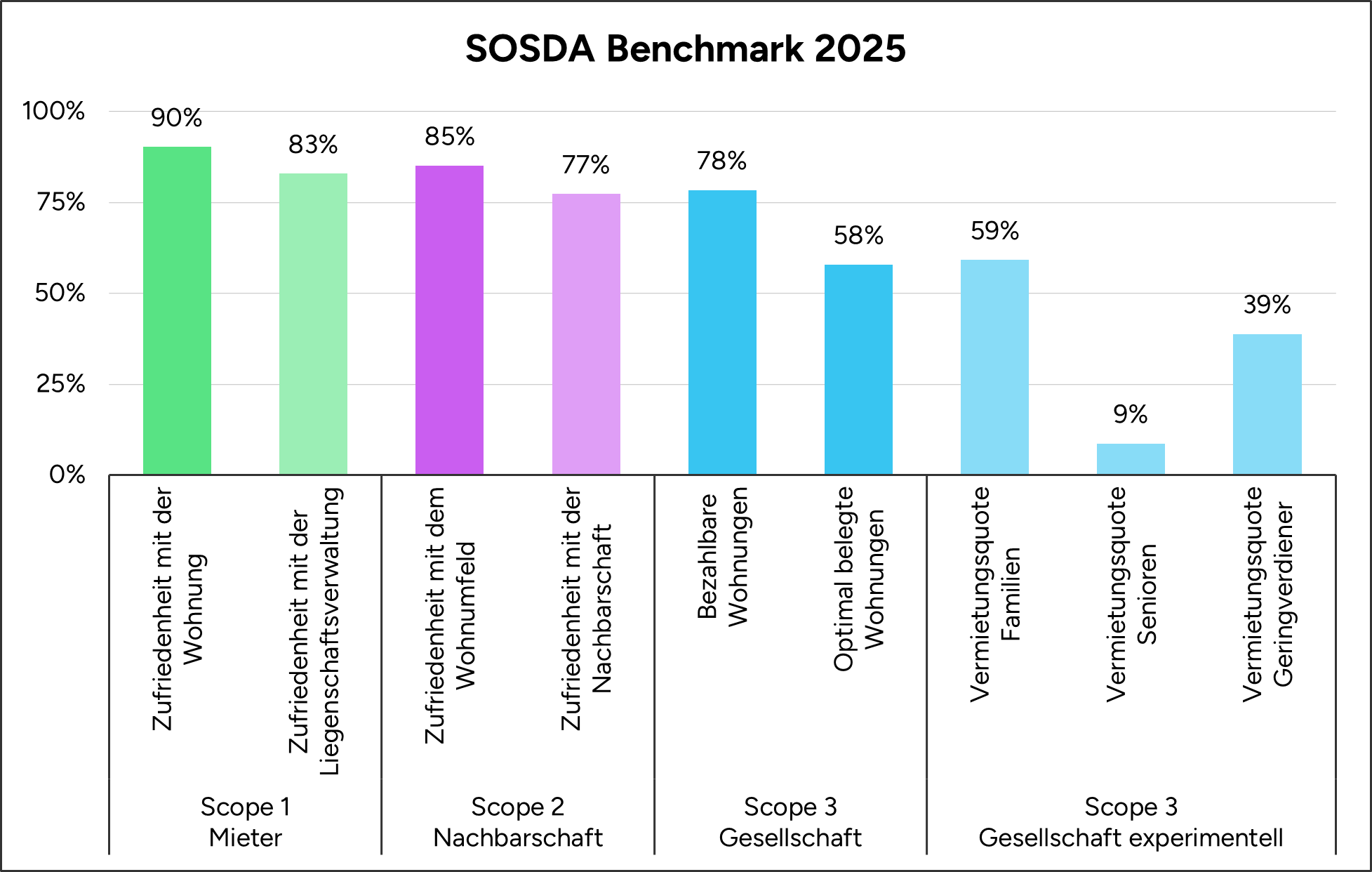
The SOSDA framework developed by Zimraum and Stratcraft records the social performance of residential real estate along nine key figures in three scopes: tenants, neighborhood and society. The data pool comprises 30 portfolios with around 68,500 apartments from 17 owners. These include pension funds, investment foundations, listed funds and non-profit housing developers. A database that allows comparisons to be made for the first time.
Affordability is holding up better than expected
78 percent of the apartments in the data pool are considered affordable according to the SOSDA definition. The net rent accounts for less than a third of the monthly taxable median income in the respective municipality. Even in the new-build segment, this figure is 58 percent. In institutional portfolios, 48 percent of new-build apartments reach this threshold. This contradicts the widespread view that new construction and affordability are fundamentally mutually exclusive.
High satisfaction, solid management quality
Tenant satisfaction is remarkably high. 90 percent of respondents are somewhat to very satisfied with their apartment. 83 percent also give their property management good marks. The residential environment is also impressive. 85 percent are satisfied with their neighborhood, 77 percent rate the neighborhood conditions positively. Quality is obviously not a product of chance in the Swiss housing market.
Family apartments remain under-occupied
When it comes to occupancy efficiency, the benchmark reveals a structural weakness. Only 58 percent of apartments fulfill the “room minus 1” rule. For family apartments with four or more rooms, this proportion drops to 41 percent. Although non-profit portfolios perform slightly better than institutional portfolios when it comes to family apartments, the difference remains small. This is a clear area for optimization for all market participants.
Letting practice under the magnifying glass
For the first time, the benchmark also documents to whom apartments are actually let. The range is considerable. Depending on the portfolio, between 46 and 100 percent of family apartments went to households with children. Only 9 percent of apartments were rented to senior citizens. The proportion of affordable apartments that went to low-income households varied between 30 and 50 percent. The database is still limited, but the direction is clear. Social performance can no longer be ignored in the future.
