Tag: Zinsen

  • Key interest rate trend revives property market

    Key interest rate trend revives property market

    The Swiss property market continues to prove resilient despite challenges, CSL Immobilien explains in a press release accompanying its 2025 property market report. Macroeconomic uncertainties and increasing regulatory requirements are cited as such. On the other hand, the gradual reduction in key interest rates by the Swiss National Bank had a positive effect on market dynamics.

    In the rental property market, CSL Immobilien continued to see strong demand in the past year with a shortage of supply. As a result, asking rents rose significantly faster than existing rents and the vacancy rate fell to a record low, according to the press release. Due to the particularly sharp rise in asking rents in cities such as Zurich and Geneva, households are increasingly moving to urban centres with good transport links.

    Prices for residential property also continued to rise last year. According to CSL Immobilien’s surveys, prices in the Zurich economic area rose particularly sharply.

    The office market developed differently in 2024. The supply of available space in the conurbations increased, while rental prices in the periphery fell. In the city centres, on the other hand, rents rose as the supply of space continued to fall. In general, there was increased demand for ESG-compliant office space and flexible utilisation concepts.

    CSL Immobilien anticipates moderate but solid further growth for the current year. “Investors who remain agile and adapt their strategies will be able to successfully capitalise on opportunities in 2025,” Thomas Walter, CEO of CSL Immobilien, is quoted as saying in the press release.

  • Owner-occupied homes remain very popular

    Owner-occupied homes remain very popular

    “The dream of owning a home is still very popular among the Swiss population,” writes the Lucerne University of Applied Sciences and Arts(HSLU) in a press release. This is based on the latest edition of the Retail Banking Study, which is compiled annually by the Institute of Financial Services Zug(IFZ) at HSLU. According to the study, four out of ten people in Switzerland would like to buy a property.

    The IFZ has identified two groups of people interested in property. In the first group, the majority are “dreamers” from the younger generations who are looking for their first home. They are primarily confronted with financial problems. In the second group, the majority are members of older generations who already own their own property. These “second-time buyers” have fewer financial problems than difficulties in finding a property that meets their current needs. Both groups rely primarily on personal recommendations and chance when searching for their own home.

    The interest rate plays an important role for home seekers both when taking out a new mortgage and when extending an existing one. The willingness to change mortgage provider is particularly low in the case of an extension, with three out of ten property owners refusing to do so regardless of the difference in interest rates. “In many cases, the house bank still enjoys great loyalty, especially if a change is associated with additional hurdles,” explains Andreas Dietrich, head of the study, in the press release.

  • Reaction of the Swiss interest rate markets to global and local inflation trends

    Reaction of the Swiss interest rate markets to global and local inflation trends

    In April of this year, the inflation rate in Switzerland surprisingly rose from 1.04% to 1.37%. This increase, which is reflected in almost all sub-indices, nevertheless remains below the critical level of 2.00%. This development indicates that inflation remains manageable and does not require any drastic measures. The Swiss National Bank had already expected a moderate rise in inflation and now appears to have been confirmed that this rise will not be permanent.

    Influence of global interest rate policy on Switzerland
    The latest US inflation data has brought calm not only to international markets, but also to the Swiss interest rate markets. The positive reaction to the US data has lowered interest rate swap rates in Switzerland and indicates that a rate cut in June is almost certain. The SNB’s monetary policy decisions depend heavily on how the European Central Bank (ECB) and the Federal Reserve (Fed) adjust their interest rates. Current developments show a synchronisation of interest rate policy at a global level, which influences the Swiss franc and inflation forecasts.

    Future expectations and monetary policy forecasts
    The SNB remains committed to the possibility of lowering the key interest rate by 25 basis points, with a potential further reduction by the end of the year, depending on the actions of the ECB and the Fed. These adjustments are essential to stabilise the Swiss franc in the context of global currency dynamics and prevent excessive appreciation, which could weigh on the export economy. Despite the current inflation expectations and the weaker position of the franc, the SNB remains proactive and adaptable in its monetary policy strategy.

  • Changing investment strategies due to rising interest rates

    Changing investment strategies due to rising interest rates

    Just as sailors avoid the Bermuda Triangle, investors must also consider the risks of their investments. The magic triangle of investment strategy – liquidity, profitability and security – is now being expanded to include ESG factors. This step is also supported by the “Lost in Transition” study by the Lucerne University of Applied Sciences and Arts. Institutional investors are placing greater emphasis on ensuring that their investments are sustainable in the long term, even if this leads to lower returns in the short term.

    A look at Swiss pension funds
    Swiss pension funds have diversified their investments, although the proportion of real estate varies from fund to fund. The analysis of the Swisscanto Pension Fund Study 2023 shows that real estate is gaining in importance compared to equities and bonds. This trend can also be observed among other institutional investors, whereby the real estate ratio in the portfolio should be between 10% and 25% in order to ensure optimal diversification.

    The impact of rising interest rates on the asset classes
    Rising interest rates have a negative impact on all three main asset classes – equities, bonds and real estate. For bonds, interest rate rises lead to price losses, while for equities they reduce their attractiveness. Real estate investments become more expensive, which leads to a decline in demand and thus to a fall in prices. Institutional investors are reacting to these developments by realigning their portfolios and reducing their real estate holdings in order to lower their leverage ratios.

    The difficult market environment and its impact on real estate investments
    Sentiment on the real estate market is subdued due to rising interest rates and uncertainty on the financial markets. This is reflected in the Swiss Real Estate Sentiment Index, which measures the expectations of market participants. Investments in real estate are becoming less attractive, but the current market environment also offers opportunities, especially for investors who are prepared to invest for the long term and weather the market fluctuations.

    Rising interest rates pose a challenge for institutional investors, especially those who have invested in real estate. A realignment of the investment strategy and prudent portfolio optimization are crucial to achieving long-term returns and minimizing risks.

  • The industrial revolution in the digital age

    The industrial revolution in the digital age

    At the beginning of October 2023, a remarkable shift began in the mortgage market. The benchmark rates for three- and five-year fixed-rate mortgages fell below the Saron rate. Ten-year mortgages followed suit in early November, with the average rate for these falling from 3.11% in June to 2.39% in December.

    Stability for Saron mortgages
    The Saron mortgage, which has remained stable since the Swiss National Bank (SNB) decided to leave the key interest rate at 1.75% in September, is currently at 2.63%.

    Results of the mortgage provider survey
    A survey of 50 mortgage providers revealed that over 90% expect the SNB to leave the key interest rate unchanged on 14 December 2023. Providers forecast stable interest rates for shorter terms of up to five years, while longer terms are expected to see more volatility and a downward trend in interest rates. The biggest concerns of those surveyed are inflation, a possible recession and the economic situation in Europe.

    Recommendations for mortgage holders

    • Switching to fixed-rate mortgages may be worthwhile at present, as they are more favourable than Saron mortgages.
    • Long-term fixed-rate mortgages are still recommended for customers looking for planning and budget security.
    • If flexibility is required, variable-rate mortgages or a combination of Saron and fixed-rate mortgages could make sense.
    • Comprehensive advice that takes various financial aspects into account is essential for a sustainable financing decision.

    Conclusion: These developments in the Swiss mortgage market emphasise the need for careful and informed decision-making for mortgage borrowers, especially in a rapidly changing interest rate environment.

  • Decline in orders continues

    Decline in orders continues

    In the first half of 2023, the main construction industry generated 11 billion Swiss francs in turnover, which is practically stagnant compared to the same semester last year. Building construction and civil engineering developed similarly. Accordingly, capacity utilisation is still high and the employment situation is good.

    Lower construction activity in the medium term

    In the medium term, however, the outlook is becoming gloomier. In the first half of the current year, orders in building construction were CHF 0.6 billion lower than in the same period last year, in civil engineering CHF 0.5 billion lower. Overall, this corresponds to a decline of 8.3 percent. Several companies even reported a negative order intake overall. This means that already planned construction projects were temporarily paused, redimensioned or completely put on hold.

    Accordingly, the work in progress has also decreased in the past quarters, standing at 15.9 billion Swiss francs at the end of June 2023, 2.6 percent lower than a year ago.

    From housing surplus to housing shortage

    The stock of housing orders has also declined. The trend is clear, too few flats will be built this year and next. In the last 12 months, the franc volume of approved housing applications has fallen by 9 per cent compared to the previous 12 months. The housing shortage could be solved more quickly with less regulation. In addition, appeals are often used to push through particular interests at the expense of the creation of new housing. SBC will lobby accordingly at the Federal Council’s next round table on the housing shortage so that construction activity can be accelerated again.

    SBC thanks Credit Suisse for very good cooperation – Construction Index to be continued

    The Construction Index predicts a 2% increase in turnover for the next quarter compared to the same period last year. This edition marks the end of SBC’s 14-year partnership with Credit Suisse on the Construction Index. SBC would like to thank Credit Suisse for the always very good cooperation, it has been greatly appreciated. SBC will continue the established forecasting tool, from the 4th quarter of 2023 in an adapted form and with a new look.

  • SBV erwartet das Zinserhöhung ein Prozent Umsatz jährlich kostet

    SBV erwartet das Zinserhöhung ein Prozent Umsatz jährlich kostet

    Am 22. Juni 2023 hat die Schweizerische Nationalbank (SNB) den Leitzins auf 1.75 Prozent erhöht. Damit nicht genug, die SNB dürfte den Zins im Laufe des Jahres weiter erhöhen, weil sich die Inflation hartnäckiger hält als bisher angenommen. Die Inflation wird in der nächsten Zeit etwa von den steigenden Wohnungsmietpreisen und höheren Stromkosten getrieben. Sowohl im 2023, aber auch in den nächsten beiden Jahren dürfte die Inflation gemäss der SNB-​eigenen Prognose bei etwas über 2 Prozent liegen, was über dem Zielkorridor der SNB liegt.

    Mittels fünf Schritten sind die Zinsen von -0.75 auf nun 1.75 Prozent gestiegen. Weitere Erhöhungen bis Jahresende sind absehbar. Da sich die Schweizer Konjunktur dieses Jahr abkühlt und die Wirtschaft nur noch schwach wächst, darf die SNB jedoch nicht über das eigentliche Ziel hinausschiessen. Daher sei an dieser Stelle davon ausgegangen, dass der Zins bis zum Jahresende noch zwei Mal um jeweils 0.25 Prozentpunkte angehoben wird. Es wird ausserdem angenommen, dass ab 2024 keine weiteren Schritte folgen, der Zins also mittelfristig bei 2.25 Prozent stabil bleibt.

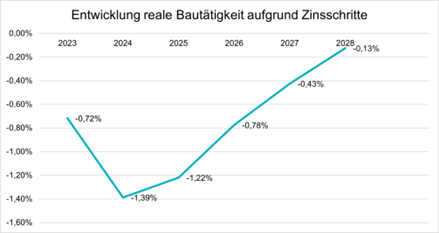
    Bis zu 1.4% tieferes Umsatzwachstum im Jahr
    Ein Rechenmodell des Schweizerischen Baumeisterverbands SBV zeigt, wie stark ein Zinsanstieg die Bautätigkeit negativ beeinflusst. Die Beeinträchtigung dehnt sich langsam und über die Zeit aus. In den ersten beiden Jahren wird das Umsatzwachstum am stärksten beeinträchtigt, aber selbst im fünften Jahr nach den Zinserhöhungen sind noch leichte, negative Auswirkungen spürbar. Die Aussagen beschreiben, wie sich der Umsatz entwickelt im Vergleich zu einer Welt, wenn die Zinsen nicht gestiegen wären.

    In den nächsten fünf Jahren dürfte der Umsatz im Bauhauptgewerbe deswegen kumuliert um 4.65% langsamer wachsen als wenn die Zinsen nicht gestiegen wären. Die grössten realen Umsatzeinbussen sind in den Jahren 2024 (-1.39%) und 2025 (-1.22%) zu erwarten.

    Positive Gegenkräfte könnten Umsatz wachsen lassen
    Die anhaltend starke Zuwanderung, der Nachholbedarf im Tiefbau sowie die Unterstützungsgelder für klimafreundliche Umbauten sind Faktoren, welche den Einbussen durch die Zinsen entgegenstehen und zumindest mittelfristig den Umsatz doch noch positiv wachsen lassen könnten.

    Insgesamt lässt sich also festhalten, dass sich die Leitzinserhöhungen auf den Geschäftsgang der Baufirmen auswirken, auch wenn die Auswirkungen insgesamt begrenzt sind. Das Bauhauptgewerbe bleibt unabhängig vom Zinsniveau eine wichtige Stütze der Schweizer Wirtschaft.

  • Selling a condominium? Top in the agglomeration, patience in the countryside

    Selling a condominium? Top in the agglomeration, patience in the countryside

    The latest edition of the Online Home Market Analysis by the real estate portals Homegate and ImmoScout24 in collaboration with the Swiss Real Estate Institute (SwissREI) analyses the listing data for condominiums for the year 2022. The listings analysed come from several large real estate portals in Switzerland and thus comprise the majority of all online listings for the period under review.

    Number and duration of listings declines
    While the listing duration of condominiums remained above 80 days during the Covid19 pandemic, it has now declined again by eight days to 77 days nationwide for 2022. At the same time, there was a five-percent decrease in supply to a good 70,000 properties. The combination of these two values shows that, viewed across Switzerland as a whole, demand for condominiums has increased in 2022.

    For Martin Waeber, Managing Director Real Estate at SMG Swiss Marketplace Group, the results of the current analysis show the robustness of the Swiss real estate market: “Home ownership is and will remain a sought-after but limited commodity in Switzerland. For despite significantly higher financing costs, condominiums sold faster again last year than in the previous year”. With the exception of the regions of Ticino and Geneva, the length of time for which condominiums are held has shortened, in some cases significantly, in the majority of the regions surveyed. “On the one hand, this shows the continuing and even increased demand for condominiums. On the other hand, real estate platforms such as Homegate and ImmoScout24 are the best possible way to avoid missing out on offers in a highly competitive market and to maintain an often time-critical lead,” Waeber continues.

    Listing times in the regions are levelling out – except in Ticino
    Looking at the individual regions of Switzerland, the range in listing times has narrowed over the past year. In other words, the Swiss real estate market is becoming more balanced in terms of condominium sales. Condominiums continued to sell fastest in the Zurich region, namely within 43 days. This value remained unchanged compared to 2021. In six other regions, the time it took to put an apartment up for sale fell by between five and 17 per cent. The situation is different in Geneva, where the average listing time increased slightly by just under two per cent. Ticino continues to be decoupled from the other regions. Here, the already longest duration of listings increased by another seven per cent last year.

    Almost nationwide increase in demand for condominiums
    The combination of changes in the duration of listings and the number of listings allows conclusions to be drawn about demand in Switzerland as a whole and in the individual regions. In the Zurich region, for example, a 13-percent increase in the number of advertisements was registered compared to the previous year. Since, despite this increase in supply, the duration of listings in Zurich did not increase to the same extent – but on the contrary remained unchanged between 2021 and 2022 – an increased demand for condominiums in this region can be deduced from this.

    With one exception – Ticino – the same picture emerges for the remaining regions of Switzerland: for 2022, they all record a combination of housing duration and number of units, which places them in the area of increasing demand. In Ticino, on the other hand, condominiums had to be advertised for nine days longer last year with an almost unchanged supply until sale. It can therefore be concluded that demand is decreasing in this region.

    Agglomerations clearly stronger in trend than rural communities
    Differences in the demand for condominiums are not only evident with regard to the regions, but a clear picture also emerges when comparing the types of communities: while in the communities in the first agglomeration belt (“suburban communities”) seven of the eight regions examined show an increased demand for residential property, in contrast, a weakening demand was frequently observed in the “rural commuter communities”. The rural communities in the regions of Espace Mittelland and Ticino suffered a particularly strong decline in demand. On the other hand, demand only increased in Zurich and central Switzerland. The situation is completely different in the suburban municipalities: here it is only Ticino where demand declined slightly, even in the agglomeration.

    For Peter Ilg, head of the Swiss Real Estate Institute, it is astonishing how quickly the real estate markets have developed “back to normal” after the Covid19 pandemic: “During the pandemic it was often claimed that an irreversible trend towards a new world of work had begun. Just one year later, we see that this is hardly the case. Home office is already being significantly reduced again in most, especially smaller, companies. This is also reflected in the change in demand for condominiums: rural communities are once again less in demand, while those around the centres are once again much more in demand.”

    Source: https://swissmarketplace.group/de/

  • Swiss real estate market – turnaround in interest rates, so what?

    Swiss real estate market – turnaround in interest rates, so what?

    After years of oversupply, the signs on the rental housing market are now clearly pointing to a shortage. Although demand will continue to exceed the supply of housing in the future, the real estate industry has so far not reacted with higher housing production. As long as rents do not rise sharply, there will be no incentive to expand residential construction in the current market environment. “The remaining vacancy reserves will soon be exhausted. Because the demand from immigration, individualization and demographic aging continues to increase,

    while at the same time fewer and fewer new homes are being built. Significant increases in asking rents are therefore only a matter of time and the topic will move up the political agenda,” says Neff.

    Densification progresses slowly
    It's getting tighter and tighter in Switzerland. The new buildings in this country are getting taller, the apartments in them are getting smaller and more and more people live in the residential zones. So the scarce land is being used more and more economically. However, because land use per person continues to rise and more and more people are living in Switzerland, the pace of densification is far from sufficient to stop urban sprawl. “High hurdles stand in the way of the faster densification demanded by spatial planning. The construction costs of projects with higher density are significantly higher than for a new building on a green field. In addition, strict, inflexible and inconsistent building and zoning regulations limit, complicate or make densification efforts impossible. A very liberal objection practice increases the planning effort for projects with high consolidation potential and leads to ever greater administrative effort," says Martin Neff. For example, the average time from the submission of a building application to the granting of a building permit for buildings with more than three apartments has increased significantly in the last 20 years from 92 days to 150 days.

    Bursting bubbles in the virtual world
    Trading in digital assets based on blockchain technology has experienced a real hype in the course of the cryptocurrency boom. In the meantime, land and real estate can also be purchased in the digital world, the so-called metaverse. The more attractive a piece of digital soil is, the more people will pay for it. The relative attractiveness is strongly defined by how many players are in the vicinity of the property on average. The market for digital real estate has experienced enormous price increases. At the beginning of January 2021, for example, in one of the best-known Mataverses "The Sandbox", the average plot of land was still being traded for less than 150 US dollars. By the end of the year, the price had risen to over $16,000, an increase in value of almost 11,000 percent. By the end of June 2022, prices had collapsed to $2,500. Such a bubble formation with subsequent bursting has been observed in many Metaverse projects in recent months. Among other things, this is favored by the fact that many projects are tied to cryptocurrencies for technical reasons, the future of which cannot yet be estimated either. "Due to the extreme volatility, the obvious tendency to bubble and the questionable intentions of many providers, virtual real estate remains primarily a playing field for speculators who are very willing to take risks," says Martin Neff.

    The “Immobilien Schweiz” study offers a detailed quarterly assessment of the Swiss real estate market. The current study and further information are available at raiffeisen.ch/casa.