Tag: Zinssenkung

  • Vaud economy between recovery and uncertainty

    Vaud economy between recovery and uncertainty

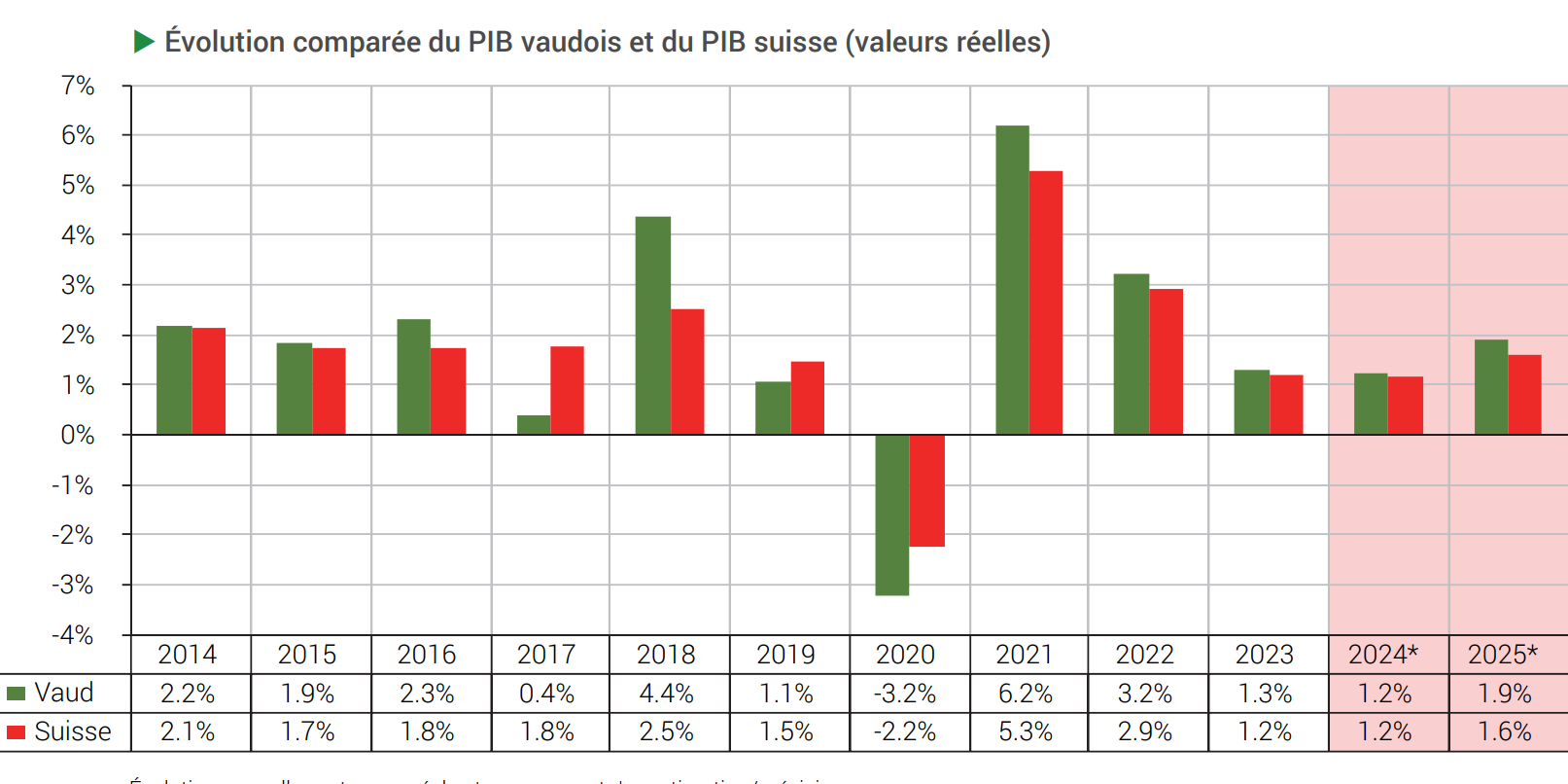
    Global economic tensions have increased in recent months. The OECD and the Swiss State Secretariat for Economic Affairs (SECO) point to risks, particularly from the new US administration and the unclear relations between Switzerland and the EU. While the US economy is growing more strongly than expected, the European economy remains weakened by structural challenges. The strong Swiss franc is slowing down export-orientated sectors, while domestic demand remains a stable pillar of the economy.

    Construction industry benefits from interest rate cuts
    The Swiss National Bank (SNB) has eased its monetary policy and lowered the key interest rate from 1.75% to 0.5%. This measure is creating a favourable investment climate, particularly in the construction industry, which is benefiting from falling financing costs. Forecasts for Switzerland as a whole predict growth of 1.5% this year and an acceleration to 1.7% next year.

    Sector development mixed picture
    While the industrial economy continues to be challenged, other sectors are showing mixed developments. The retail and hospitality sectors are struggling with a weak business climate, while the service sector is showing positive momentum. Particularly strong growth is forecast for the chemical and pharmaceutical industries, business services and the financial sector. The machinery and watchmaking industry could also benefit from the economic recovery in the medium term.

    Stabilisation with uncertainties
    The Vaud economy is looking forward to a year of opportunities, but also challenges. While key sectors are likely to benefit from a sustained recovery, geopolitical and currency policy uncertainties remain risk factors. The decisive factors will be how international trade relations and the domestic economy develop and the extent to which companies are able to react flexibly to changes.

  • Adaptation strategies for property professionals in a changing world

    Adaptation strategies for property professionals in a changing world

    The effects of the global pandemic are still being felt years later and have led us into a new reality. This requires property investors to re-evaluate their strategies in order to position themselves in a balanced way while remaining disciplined and flexible in responding to changing market conditions.

    The pandemic led to unprecedented, globally synchronised economic shutdowns, followed by a rapid restart. This resulted in a return of inflation, labour market bottlenecks and rising interest rates. At the same time, geopolitical upheavals, including conflicts in oil regions and the emergence of national industrial and environmental policies, are reshaping the global landscape.

    Against this backdrop, property investors should expect subdued growth in the USA, moderate growth in Europe and an adjustment to a new economic normal in China in 2024. These developments favour a focus on quality stocks, including in the technology sector, and a cautious stance towards government bonds as central banks are expected to start cutting interest rates.

    Political developments will also play an important role and could harbour both opportunities and risks for the global markets. Investors should therefore be prepared to adjust their market strategies accordingly and consider capital protection strategies.

    The next decade will be characterised by the ongoing development of artificial intelligence, a changing Chinese economy, the energy transition and persistently high levels of debt. These factors will have a far-reaching impact and offer investors new opportunities, particularly in sectors that benefit from technological innovation.

    In this new world, it is more important than ever for investors to have a clear plan, invest in a balanced way and remain flexible. Lessons from the past emphasise the value of diversification and the importance of patience and adaptability in an ever-changing environment.