Tag: zirkuläres Bauen

  • Circularity as the key to a climate-friendly building future

    Circularity as the key to a climate-friendly building future

    CircularHub, knowledge and exchange platform for circular construction, invites you to the MasterClass Circularity in the construction and real estate sector on 2 October 2025, as detailed in an announcement. The aim is to support specialists and managers in actively transforming the resource-intensive construction sector and contribute to achieving Switzerland’s net-zero targets.

    During the event, the role of circularity in sustainability and the strengths of circular design strategies and business models, best practice examples and existing Swiss approaches will be discussed. Participants will receive individual preparation by means of a briefing document and an optional follow-up telephone call with CircularHub specialists. “Solutions for a circular turnaround have long been on the table. Now it’s a matter of putting the knowledge, skills and will into practice – and that’s exactly what the MasterClass is for,” says Marloes Fischer, CEO of CircularHub and keynote speaker at the event. In addition to the technical content, the MasterClass enables active networking between specialists and managers, who can exchange ideas with experts and decision-makers and gain inspiration.

    According to CircularHub, the Swiss construction and property industry, which has high CO2 emissions and high resource consumption, is facing profound changes. The platform is therefore endeavouring to support industry players with innovative solutions and transform the construction industry towards a circular economy.

  • Craftsmanship meets digitalisation in the construction industry

    Craftsmanship meets digitalisation in the construction industry

    The Institute of Constructive Design at the Department of Architecture, Design and Civil Engineering at Zurich University of Applied Sciences(ZHAW), based in Winterthur, is the Swiss lead partner of the European Interreg programme Walz 4.0, which was launched in April 2025. According to a press release, the project around Lake Constance aims to synergistically exploit and further develop the potential of traditional craftsmanship and university teaching in combination with digitalisation.

    Partners in the project include the Institute of Constructive Design at the ZHAW, the ArchitekturWerkstatt of the OST – Ostschweizer Fachhochschule and the Denkmalstiftung Thurgau. The University of Liechtenstein is also involved in the project. The OTH Ostbayerische Technische Hochschule Regensburg and the FH Vorarlberg are also involved in the project. The HTWG Konstanz University of Applied Sciences is responsible for overall coordination.

    The aim of Walz 4.0 is to combine the expertise of universities with the experience of local tradespeople in a practical way. The aim is to find answers to the demands for sustainability in the construction industry as well as to the increasing shortage of skilled labour in the sector. This programme, which is based on the craft migration movement, is also intended to promote international cooperation and the exchange of experience between the craft trades and universities in the four countries of Switzerland, Germany, Liechtenstein and Austria. In addition to practical work on construction and renovation projects, new learning centres will also be created in which sustainable construction methods are developed and digital tools are created.

    “In view of the climate crisis, circular construction in the sense of building within existing structures and reusing building components is more important than ever. This is precisely where craftsmanship knowledge and skills, supplemented by the broad application of digital tools, are in demand,” Andri Gerber from the ZHAW is quoted as saying in the press release. “Walz 4.0 brings together craftsmanship, academia and new technologies, thus creating the conditions for a sustainable construction industry.”

    The project as part of the Interreg VI Alpenrhein-Bodensee-Hochrhein programme will run from 2025 to 2028 and is being funded to the tune of around 5 million euros. Funding is being provided by the European Regional Development Fund(ERDF), Switzerland and the Principality of Liechtenstein.

  • Milestone for modern clay construction

    Milestone for modern clay construction

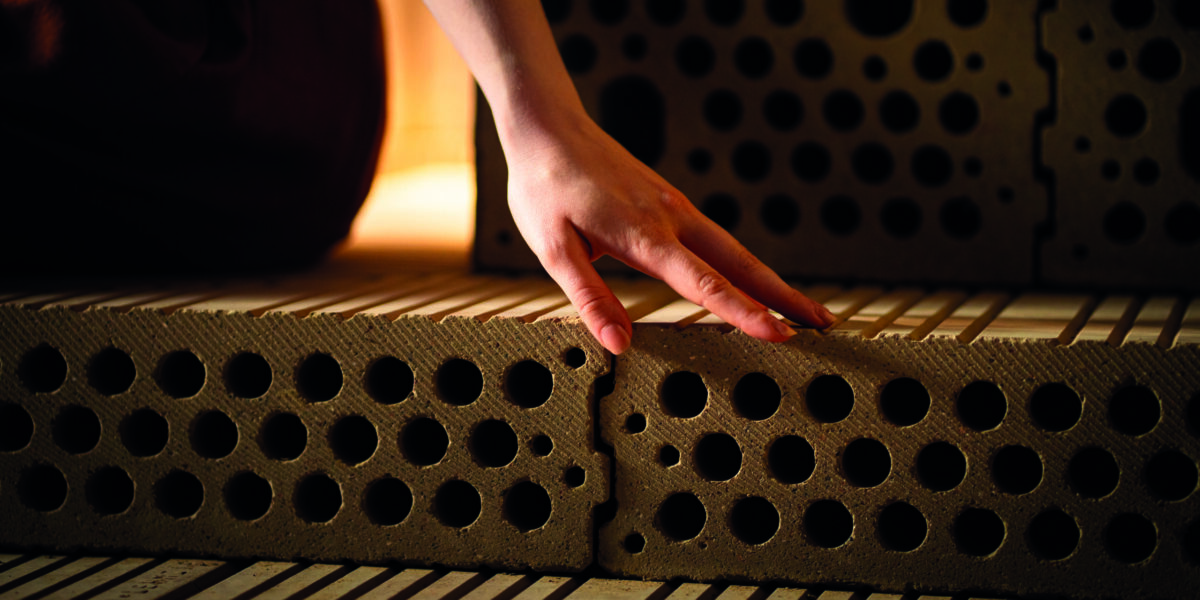
    This is based on the new DIN 18940 standard, which regulates load-bearing clay block masonry comprehensively for the first time. The thin-bed method saves over a third of the working time compared to the thick-bed method and reduces material consumption. In addition to the processing, clay also scores points ecologically. It is not burnt, is fully recyclable and ensures a healthy indoor climate thanks to its moisture-regulating properties.

    CO₂-neutral production and circular building system
    The production of clay bricks at GIMA is CO₂-neutral. Dried with solar power and waste heat. The wall structure can be completely dismantled. A double-skin construction is recommended for exterior walls: Clay bricks as the load-bearing layer, clay plaster on the inside and a curtain wall on the outside. All materials can be separated by type and recycled.

    Formats and possible applications
    The GIMA bricks achieve compressive strength class 5 and are available in widths from 115 to 365 mm, adapted to common brick formats. They can be processed using conventional tools and known methods.

    Pilot project “GreenConceptLehm
    The first project with the new system has already been realized in Meißen. Building contractors and scientists praise the healthy indoor climate and recyclability. This shows that earth building is ready for widespread use in the modern construction industry.

  • Circular economy: sustainable solutions for the construction industry

    Circular economy: sustainable solutions for the construction industry

    According to a statement from ETH Zurich, the Swiss construction industry currently accounts for 70 percent of domestic material consumption, 80 percent of waste and 24 percent of greenhouse gas emissions. To counteract this trend, Innosuisse, the Swiss innovation promotion agency, has launched two projects on the circular economy in the construction sector, which are being led by ETH Zurich.

    The Think Earth project uses building materials such as wood, clay and recycled concrete. One example of this construction method is the Manal Pavilion, which was opened on the Horw campus of Lucerne University of Applied Sciences and Arts. The project was realized by Oxara, a spin-off of the ETH.

    The Swircular project presents a digital ecosystem for circular construction. Digital building inventories and product passports for building materials are to be used to create a basis for circular construction processes. Registered building elements can be reused in the event of demolition.

    “Our vision is a network of stakeholders, digital tools and reliable data that makes it possible to track materials throughout their life cycle and exchange relevant information,” project manager Arabelle de Saussure is quoted as saying in the press release.

    A large number of institutions are involved in the projects, including the Swiss Federal Laboratories for Materials Science and Technology(Empa), the Zurich University of Applied Sciences(ZHAW) and the universities of applied sciences in Bern and eastern Switzerland.

  • Network meeting on the topic of sponge city and circular construction

    Network meeting on the topic of sponge city and circular construction

    The next TecLab network meeting on circular construction will focus on the concept of the sponge city. TecLab has invited a number of experts to speak at the event on October 28 from 6 p.m. at Jlcoweg 1 in Burgdorf. They will present the sponge city concept and answer questions about its implementation and the resolution of conflicting objectives.

    Michele Steiner from the Institute for Infrastructure and Environment and Moritz Gubler from the Institute of Geography at the University of Bern will kick things off. Pierre Papaux from Fribourg and Rudolf Holzer from Burgdorf will present examples of implementation in their municipalities. Anna-Gesa Meier from Holinger AG in Bern will explain how the concept works for companies and private landowners. Before the concluding discussion over an aperitif riche, a panel will discuss the path from concept to implementation.

    TecLab provides further details on the network meeting in the event announcement. There is also a link for registration.

    TecLab is the result of an initiative of the Bern University of Applied Sciences in collaboration with the Bern University of Applied Sciences, the Bern University of Teacher Education and other partners from the public and private sectors. It offers seminars and courses in mathematics, computer science, natural sciences and technology for school classes as well as events and further training for private individuals and companies on various topics. The focus is on the circular economy, energy and mobility.

  • Holcim acquires Belgian construction waste recycler

    Holcim acquires Belgian construction waste recycler

    Holcim is further expanding circular construction as a driver of profitable growth. Following the Cand-Landi Group in Switzerland, Land Recovery in the UK and Mendiger Basalt in Germany, the building materials producer has made its fourth acquisition this year with the family business Mark Desmedt, founded in 1989 and, according to Holcim, the leading recycler of construction demolition materials in Belgium.

    According to a Holcim statement, Mark Desmedt recycles more than 500,000 tonnes annually. In addition, the company is strategically located between Brussels and Antwerp and can therefore serve the country’s two largest conurbations. This will enable Holcim to expand its ECOCycle product range for circular construction solutions in Belgium and boost its profitable growth.

    This acquisition brings Holcim closer to its goal of recycling 10 million tonnes of construction waste per year. “With Mark Desmedt’s team, we are accelerating our vision to drive circular construction in the key metropolitan regions where we operate to build cities out of cities,” Holcim CEO Miljan Gutovic is quoted as saying.

  • Future Perfect launches project for circular construction

    Future Perfect launches project for circular construction

    The Future Perfect association, together with the Plavenir professional association, the Constructa Association of Teachers of Drawing Professions and the educational materials publisher LernMedien-Architektur GmbH, is realising a project to integrate circular construction into basic vocational training in spatial and construction planning. The Future Perfect Circular Building project aims to teach skills for the reuse and recycling of materials and components, Future Perfect explains in a press release. A test run is planned for the spring semester 2025. The courses will be available to schools on a regular basis from autumn semester 2025.

    The project is aimed at both students and teachers of spatial and construction planning. Teachers will be offered full-day training courses in which they will be introduced to circular construction and the use of Future Perfect’s digital teaching materials will be explained. Digital courses for basic education, advanced seminars, project work and project competitions will be made available to learners. The project is financially supported by the Minerva Foundation and the Federal Office for the Environment.

  • New player in the UK recycling market

    New player in the UK recycling market

    Holcim is acquiring the ballast recycling company Land Recovery, based in the British county of Cheshire. With its 85 employees, it uses railway ballast and demolition material for the production of ready-mix concrete, precast elements and asphalt.

    According to a press release, this acquisition expands Holcim’s access to construction waste. Land Recovery processed 300,000 tonnes of this material last year.

    “Land Recovery strengthens Holcim’s leading position in circular construction,” Holcim CEO Miljan Gutovic is quoted as saying. “This brings us closer to our Group target of recycling 10 million tonnes of construction waste in 2024.”

    Land Recovery was founded in 1982 by the Beecroft family. With four sites in the UK, the company’s services include the supply of primary ballast for rail transport, the handling and processing of spent ballast and its recycling into new construction solutions.

    The transaction follows Holcim’s acquisition last year of Sivyer Logistics, a manufacturer of recycled demolition materials for the London construction market.

  • FHNW gets professor for circular building

    FHNW gets professor for circular building

    For the Institute of Sustainability and Energy in the building of the University of Architecture, Building and Geomatics of the FHNW , circular economy is an important part of environmentally and resource-saving construction. In order to further develop research and education in the areas of energy-efficient and climate-neutral building, integral building technology, sustainable building and operation, resource-efficient and circular building as well as health aspects in buildings, the institute is establishing the professorship of circular building. The architect Andrea Klinge is to take over the corresponding chair.

    Klinge studied architecture at the Technical University of Berlin, the FHNW informs in a message about the new professorship. After further training in sustainable building at the London Metropolitan University, the designated professor worked in various architecture offices in London, Rome and Berlin. Klinge is currently active at ZRS Architekten Ingenieure Berlin. The architect and trained carpenter have established a research department here, according to the announcement.

    In her new position, Klinge wants to tackle “the current challenges in the construction sector”. "This is one of the most resource-intensive economic sectors in the world and contributes significantly to climate change," the professor-designate is quoted in the press release. “In order to meet the Paris climate goals, we urgently need consistent approaches that implement the necessary building turnaround in the construction sector.” According to Barbara Sintzel, Head of the Institute for Sustainability and Energy in Construction, Klinge “has specialist expertise in the use of ReUse components and renewable building materials to help achieve a breakthrough in practice with applied research and thus make the building turnaround possible ”.

  • New professor for circular building at the Institute for Sustainability and Energy in Building at the FHNW

    New professor for circular building at the Institute for Sustainability and Energy in Building at the FHNW

    The Institute for Sustainability and Energy at the University of Architecture, Building and Geomatics FHNW is actively involved in research, training and further education as well as services in the areas of energy-efficient and climate-neutral construction, integral building technology, sustainable construction and operation, resource-efficient and circular construction as well as health aspects in buildings. One of the fundamental concerns of this strategy is to strengthen building in the circular economy. In the area of training and further education as well as in research, the institute makes an important contribution to ensuring that more energy- and resource-efficient and sustainable construction methods are implemented in Swiss building practice. The expertise of the researchers working at the FHNW is in demand both nationally and internationally as well as within the FHNW.

    In order to strengthen this highly qualified team, the Institute for Sustainability and Energy in Building has succeeded in recruiting Andrea Klinge from ZRS Architekten Ingenieure Berlin as professor for circular building.

    Andrea Klinge studied architecture at the Technical University of Berlin and specialized in sustainable building at the London Metropolitan University. She worked in various architectural offices in London, Rome and Berlin, and has been with ZRS Architects since 2013, where she established the research department. Her main research interests are a holistic approach to building and include circular, low-tech building as well as the use of natural building materials (clay, wood, natural fibers) to improve the quality of the interior space in buildings.

    Due to her background as a carpenter, Andrea Klinge always works practically to bring research results into direct application. To this end, she has implemented several projects with wood, clay and bamboo with students from different universities but also with international colleagues.

    At the FHNW University of Architecture, Building and Geomatics, Andrea Klinge wants to make a difference: “What I associate with the professorship and want to address are the current challenges in the construction sector. This is one of the most resource-intensive economic sectors in the world and contributes significantly to climate change. In order to meet the Paris climate goals, consistent approaches are urgently needed to implement the necessary building turnaround in the construction sector. “

    Andrea Klinge has been a member of the Life Cycle and Circular Building Advisory Board of the German Society for Sustainable Building since September 2021. Since October 2021, together with Eike Roswag-Klinge, she has also headed the DIN Circular Economy Standardization Roadmap working group, Structures and Municipalities working group .

    Prof. Barbara Sintzel, Head of the Institute for Sustainability and Energy in Buildings, is looking forward to working with Andrea Klinge: “Andrea Klinge stands for the turnaround in construction. She brings the enthusiasm and versatility that this topic needs. She has technical expertise to help the use of ReUse components and renewable building materials in practice with applied research to achieve a breakthrough and thus make the building turnaround possible. We look forward to your active support in research and teaching. “

  • Madaster realizes circular building

    Madaster realizes circular building

    BIM Facility , GS1 and ZPF Ingenieure are the first three partners to sign an agreement with Madaster, the Swiss cadastre for materials in the built environment. "Your expertise and our platform make material data usable over the entire life cycle of buildings", managing director Marloes Fischer is quoted in a press release. "Together we can implement circular building."

    BIM Facility wants to contribute to this with its modeling of building data. The Zurich-based company uses drones to create digital twins of buildings. The digital twin can be transferred directly to Madaster and a material pass can be issued.

    Together with Madaster users, the non-profit organization GS1 wants to develop and implement solutions for the availability of reliable and precise data over the entire life cycle of a building, explains Uwe Rüdel, Sector Manager Technical Industries at GS1 Switzerland.

    ZPF engineers from Zurich support builders and property owners in carrying out circular construction planning. They also analyze existing buildings on the basis of a material pass. According to executive board member Jaqueline Pauli, this should save raw materials.

    Madaster's platform offers digital tools such as material passports and indexes on the economic and circular value of buildings. "Our job is to make materials available forever by giving them an identity on our platform," says Madaster's website. “If materials have an identity, they become a resource for reuse.” Every building is understood as a raw material store with a certain value.