
Tag: Zuwanderung

  • 10 million and then

    10 million and then

    On 14 June 2026, Switzerland will vote on the “No 10 million Switzerland!” initiative. It aims to keep the permanent resident population below 10 million in the long term and provides for additional measures from 9.5 million. The political focus is on immigration. However, the spatial effect could be much broader.

    After all, labour markets cannot simply be stopped at the national border. If companies continue to need skilled labour, but fewer people can or should live in Switzerland, the pressure on living and commuting areas close to the border will increase. This doesn’t just change statistics. It changes entire regions.

    The housing market is shifting
    The pattern has long been visible. In the Lake Geneva region, the labour market is growing strongly, while living space remains chronically scarce on the Swiss side. The result is an ever-increasing expansion of the metropolitan area towards France.

    The price difference explains the dynamic. In the canton of Geneva, asking rents recently stood at CHF 384 per square metre per year, while in France, which is close to the border, they were only CHF 190 to 260, depending on the location. The gap is even greater for residential property. In Geneva, asking prices are around 13,500 francs per square metre, in nearby France around 3,500 to 6,000 francs.

    When relief creates new burdens
    What is supposed to act as a brake for Switzerland can additionally fuel border regions. More cross-border commuters mean more demand for housing outside Switzerland, higher prices in neighbouring communities and growing pressure on schools, transport and municipal services. Voices from Haute-Savoie are already warning of precisely this.

    In terms of infrastructure, this is not a minor issue either. New transport services such as the Léman Express have made cross-border commuting much easier and triggered new development dynamics around the stops. The area is not growing any less. It is just growing differently.

    What this means for locations
    This is a tricky truth for location policy. Growth does not disappear just because you want to put a political cap on it. It seeks new paths via commuter axes, residential locations and functional economic areas.
  • Canton of Zurich continues to grow

    Canton of Zurich continues to grow

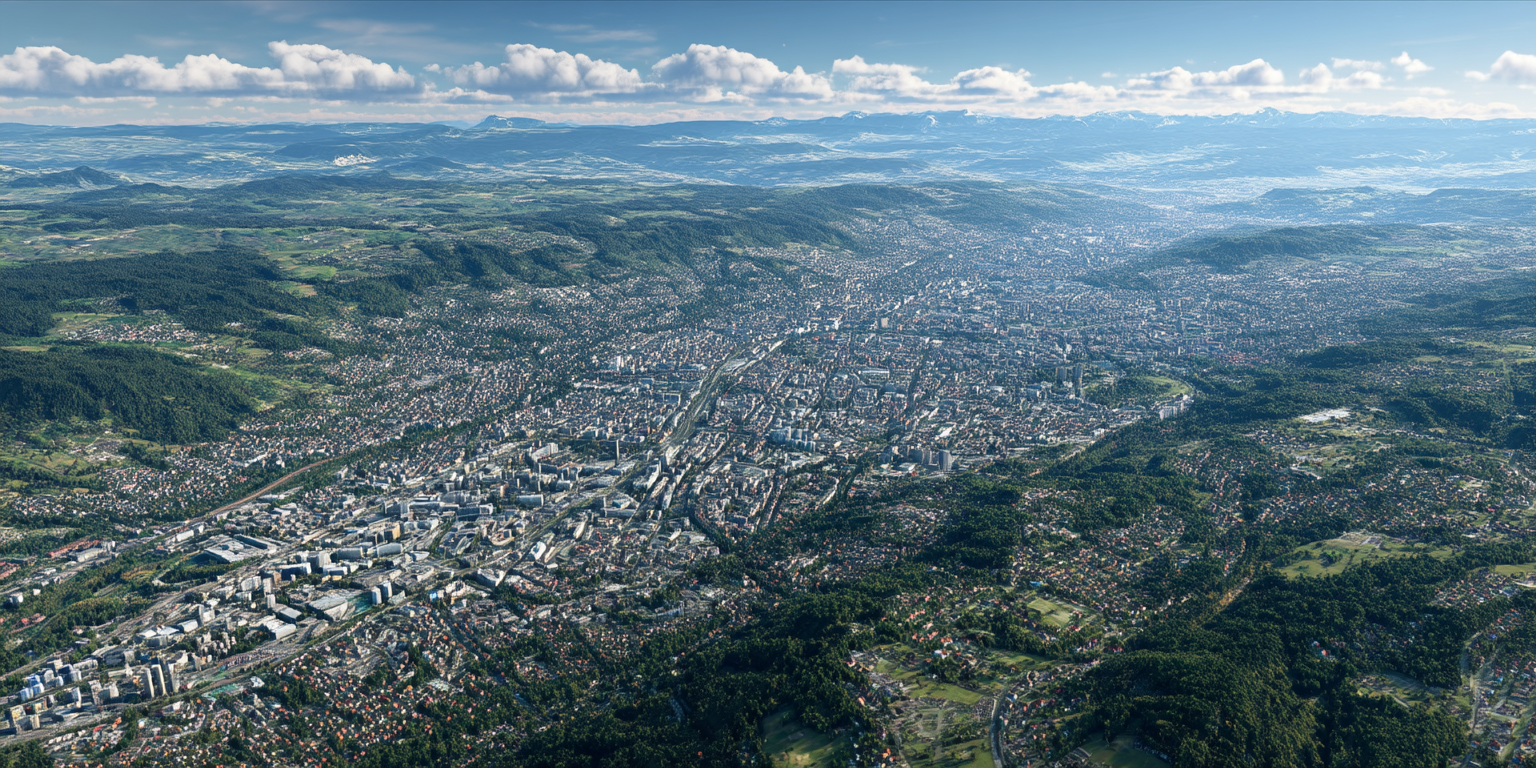
    The canton of Zurich continues to grow, but the major growth spurt of recent years is over for the time being. At the end of 2025, the civil resident population was 1,628,081 – an increase of just under 13,000 residents or 0.8 per cent compared to the previous year. Apart from the coronavirus years, this is the smallest increase since 2005 and thus a clear sign of a phase of more moderate momentum.

    Immigration most important growth driver
    Population growth continues to be driven primarily by immigration from abroad. Over 80 per cent of the increase is attributable to people of foreign nationality settling in the canton for the first time. Although net migration from abroad has fallen slightly compared to the previous year, it has returned to roughly the same level as before the war in Ukraine. The internal migration balance with the other cantons remains slightly negative and has hardly changed for several years. Zurich is losing about as many people within Switzerland as it is gaining.

    Births and deaths
    The birth balance accounts for less than a fifth of growth. Although initial estimates show a slight increase in births and a slightly lower number of deaths, the overall surplus remains low. This confirms the trend that the population is growing primarily “from the outside”, while the demographic momentum within the country is levelling off.

    Cities and small municipalities are growing the fastest
    The spatial picture is divided into two parts. Cities with a population of over 10,000 account for more than two thirds of growth. The city of Zurich alone accounts for almost a third of the cantonal increase, growing by 4,008 people. It was followed by Dübendorf and Uster, while Winterthur recorded the weakest growth since the turn of the millennium with an increase of 355 people.

    Relative to the size of the municipality, however, the small municipalities recorded the strongest growth. Flaach, Hüntwangen and Wila recorded growth rates of between 4 and a good 5 per cent, underlining the fact that even rural municipalities in the canton can benefit from the influx.

    Regions are shifting
    All regions in the canton are growing, but at different rates. Weinland and Furttal are leading the way with growth rates of 1.1 and 1.0 per cent respectively. Twice as high as in the Winterthur region, which will bring up the rear in 2025. While the areas close to the city in the north and east have recently seen above-average growth, the city of Zurich and the Limmat Valley are now above the cantonal average, while the Glattal and the Winterthur region are falling behind.

    Foreign population strongly characterised by Europe
    At the end of 2025, around 472,000 people of foreign nationality lived in the canton. This represents 29 per cent of the total population. Their number continues to grow, albeit at 1.5 per cent, the slowest rate since the introduction of full freedom of movement with the EU in 2007. Almost two thirds come from an EU or EFTA country, over 80 per cent from Europe.

  • Real estate prices remain high

    Real estate prices remain high

    Real estate prices will remain on an upward trend in 2026. Forecasts by Zürcher Kantonalbank(ZKB) predict a price increase of 4.5 percent. The abolition of the imputed rental value will have no impact on this, nor will the baby boomers change the situation, according to a press release on the latest Immobilien aktuell study.

    On the housing market as a whole, the pressure on owners, tenants and tradespeople is growing as a result of the housing shortage and immigration. Switzerland is dependent on immigration, but the influx is “exacerbating the demand for housing in already tight markets”. One in four newcomers move to the five largest cities – one in ten to Zurich.

    The ZKB experts expect the situation to remain tight as a result of a drop in demand for rental apartments. Vacancy rates are at a record low and are having a particular impact on the relocation behavior of young adults. In 2023, 15 percent fewer people between the ages of 21 and 25 will have moved than in 2020. “Many will stay in Hotel Mama because there is no suitable living space available,” they say.

    Demographic change will not have a price-reducing effect. “Baby boomers are expected to increase the supply of single-family homes by around 14% and condominiums by 10% by 2035,” it says. “Demographic change will change the market, but will not trigger a price slump,” Ursina Kubli, Head of Real Estate Research at ZKB, is quoted as saying. Prices for second homes rose by 40 percent in 2019 and 2024, but will remain at a high level after a slight decline in 2025.

    ZKB’s forecasts are based on studies of the abolition of the imputed rental value, the supply restriction for rental apartments, a possible wave of sales by the baby boomer generation, market influences due to immigration and the changed vacation apartment market.