Author: immovestuser

  • Sika is strengthening in Japan

    Sika is strengthening in Japan

    With Hamatite, Sika takes over one of the leading Japanese suppliers of adhesives and sealants. Its annual turnover was most recently 160 million francs. The tire manufacturer Yokohama Rubber has sold this business area as part of a reorientation towards its core business.

    With Hamatite, the Zug-based specialty chemicals company has expanded market access to all important Japanese automobile manufacturers, including those outside of Japan. According to a press release , Sika intends to significantly increase the proportion of its solutions per vehicle. In addition, Sika receives extensive global production capacities and can thus offer all car manufacturers long-term advantages in the supply chain.

    The acquisition also expands Sika's portfolio of high-quality adhesives and sealants that meet the high Japanese building standards. Sika's market penetration in the automotive and construction sectors will accelerate, said Sika CEO Paul Schuler. "With our global production capacities, we will be able to serve our customers in the automotive sector even better, both on a global and a local level."

    "We look forward to", says Mike Campion, Regional Manager Asia / Pacific at Sika, "to welcome the Hamatite employees at Sika and to develop our joint cross-selling potential together with them".

  • Zurich is the most sustainable city in Switzerland

    Zurich is the most sustainable city in Switzerland

    The British IG Bank has compiled a list of the most sustainable Swiss cities. According to this, Zurich is considered the most sustainable city in Switzerland. Lausanne, Bern, Lucerne, St.Gallen, Lugano, Geneva and Basel follow Zurich.

    For its ranking, the bank used government data sources from the eight largest cities. She then combined the results with evaluations from international agencies. The focal points in determining sustainability included air quality, the use of public transport, the proportion of recreational areas, the population density and the proportion of populated areas.

    IG Bank emphasizes that Zurich is not only the most sustainable, but also the largest city in Switzerland. This makes the top position all the more impressive. Zurich did well in all areas. However, the use of public transport was particularly decisive. According to the bank, 67.1 percent of residents use some form of public transport. This is one of the main reasons for the good air quality in the city. As a further highlight, IG Bank highlights the fact that Zurich has its own government department for sustainable building. This focuses on creating a 2000 watt society.

    IG Bank is convinced that current and future investments will be strongly oriented towards sustainability. The aim of their ranking is to "highlight Switzerland's commitment to sustainability". In addition, the data should serve as an “indicator for future trends and show what other big cities could do to repeat Switzerland's success”.

  • Circulit concrete will soon be available nationally

    Circulit concrete will soon be available nationally

    The ecological concrete called Zirkulit will be available throughout Switzerland in the coming months. The two companies Eberhard companies from Kloten and Kästli Bau from Rubigen have entered into a partnership for its production and distribution. Together they created a licensing system for the innovative building material and founded zirkulit AG based in Kloten. The two owners are the first two licensees.

    According to a media release by zirkulit AG, Zirkulit is characterized by "maximum circularity", a smaller CO2 footprint and the same static properties as primary concrete. The consumption of primary resources will be reduced to less than a third. In addition, the CO2 footprint will be reduced by a CO2 storage technology developed by zirkulit. As the first client, Swiss Prime Site Immobilien AG decided last autumn to use the JED area in Schlieren ZH circulit.

    "The building material has great potential for the construction industry," the managing director of zirkulit AG, Patrick Eberhard, is quoted as saying. He will "make an important contribution to the achievement of the ambitious environmental goals that we have set for ourselves as a society".

    Daniel Kästli, Chairman of the Board of Directors of Kästli Bau AG, is also convinced that the national expansion of this building material is "an important milestone on the way to circular and thus sustainable building throughout Switzerland". The experience and knowledge of both companies would "contribute to the fact that Zirkulit Beton will establish itself throughout Switzerland as a future-oriented building material."

  • Sika supports the introduction of Swiss eco-cement

    Sika supports the introduction of Swiss eco-cement

    LC3 stands for Limestone Calcined Clay Cement and was developed by the Swiss Federal Institute of Technology in Lausanne ( EPFL ). It is a sustainable cement product that has a clinker content that is up to 50 percent lower than that of traditional cement. Clinker makes a significant contribution to CO2 emissions during cement production. In LC3, a large proportion of clinker is replaced with a new additive, which means that overall less CO2 is emitted in cement production.

    The Zug-based construction chemicals group Sika wants to support the market launch of LC3, as he writes in a press release. He wants to develop and offer special cement additives and concrete admixtures that help customers adapt their materials to the properties of LC3. This should enable the water consumption, workability, hardening and durability of the LC3 concrete to remain the same compared to conventional products. According to its own statements, Sika is also ready for “comprehensive product tests with interested customers”.

    "With these new LC3 products, we are putting the goals of our sustainability strategy into practice," said Frank Höfflin, Sika's head of technology, in the press release. “Our aim is to act as an enabler for sustainability in the construction industry and to develop more environmentally friendly and more efficient products,” he emphasizes.

  • Holcim drives innovation from start-ups

    Holcim drives innovation from start-ups

    The Zug-based cement giant Holcim is teaming up with three young Swiss companies, according to a media release . The aim is to advance innovative technologies in the construction sector and promote sustainability.

    In cooperation with the Freiburg start-up Mobbot , for example, the integration of recycled building materials into 3D printing technology is to be promoted. Mobbot has developed the necessary 3D printing technology. Together with Holcim, it now wants to develop a concrete recipe that enables the use of recycled material in 3D printing.

    Holcim has entered into another cooperation with the Bern-based company Neuustark . The spin-off from the Swiss Federal Institute of Technology Zurich ( ETH ) is developing a technology with which CO2 from the atmosphere can be permanently stored in recycled concrete. For this purpose, liquid CO2 is introduced into the demolition material. As part of the collaboration, neustark is investigating the CO2 conversion potential of the demolition concrete recycled by Holcim. In turn, Holcim is optimizing the concrete produced by Neustark. Holcim believes it is possible to integrate the neustark solution into its recycling process in the future.

    The third collaboration between Holcim and the Ticino start-up company HeatNeutral has been agreed. This has developed an innovative combustion system that is intended to promote the decarbonization of production facilities. According to the information, the heating system works particularly efficiently and achieves an almost 100 percent combustion of fuels. This means that less fuel is required for the same output. In addition, the HeatNeutral system can also burn CO2-neutral oils such as vegetable oils, used cooking oils and biodiesel. Holcim is testing the solution in its concrete plant in Birsfelden BL.

  • PSP Swiss Property has a good start to the year

    PSP Swiss Property has a good start to the year

    According to a statement from PSP Swiss Property , the Zug-based real estate company generated real estate income totaling CHF 77.4 million in the first quarter of 2021. Compared to the same period in the previous year, this corresponds to growth of 4.6 percent. Operating expenses remained at the previous year's level at 13.2 percent.

    The operating result (EBITDA) excluding real estate successes and valuation differences amounted to 78.5 million francs in the quarter under review, 23.9 percent more than in the first quarter of 2020. The profit without real estate successes rose by 28.5 percent year-on-year to 61.8 million Francs too.

    At 88.8 million, net profit was 85.3 percent higher than in the previous year. The real estate company attributes the sharp rise to higher rental income, profits from the sale of development projects and condominiums, and a portfolio revaluation of CHF 33.2 million.

    The balance sheet value of the portfolio on the reporting date at the end of the quarter was CHF 8.641 billion, compared to CHF 8.577 billion at the end of 2020. In the quarter under review, PSP Swiss Property sold the Seestrasse development project in Kilchberg ZH and 13 floor units in the Residenza Parco Lago project in Paradiso near Lugano. The vacancy rate rose from 3.0 to 3.1 percent due to renovation work, among other things.

  • Real Estate Award 2021: These are the nominees!

    Real Estate Award 2021: These are the nominees!

    Outstanding achievements are honored, regardless of the size of a company. The presentation of the awards as part of the Real Estate Award on June 21, 2021 is then also a special occasion where the real estate and construction industries meet. In the past few years, over 2,800 people have taken part in the Real Estate Award ceremony, making the event an important fixture on the real estate industry's agenda.

    The jury of real estate experts and economists made a pre-selection from all the applications submitted: Based on criteria such as vision, strategy, pioneering spirit, originality, scalability and special service, the jury nominated three projects in each category for the Real Estate Award 2021.

    In the category management:
    – Credit Trust – "The digital alternative to the debt enforcement extract – especially for managers"
    – VERIT Immobilien AG – "VERIT thinks the tenant onboarding process digitally through to the end"
    – PRIVERA AG «Tenant concerns intelligently automated – fast, lean, smart – IMOFIX» In the category

    Project development:
    – NEST Interiors AG – "Idyllic residential area on the Fischingerbach"
    – Felix Partner Architektur AG – "West-Log"
    – CCTM Real Estate & Infrastructure AG – "Swiss Life Arena"

    In the Marketing category:
    – Tend AG – "Bear Tower"
    – Marti Gesamtdienstleistungen AG – "Schäferhöhe – Get out of the stables"
    – LIVIT AG – "Guggachpark"

    In the conversion / conversion category:
    Felix Partner Architektur AG – "From the ruin to the zero-energy balance house"
    – Credit Suisse Asset Manag. – «Transformation Schwarzenburgstr. Liebefeld »
    – Marazzi + Paul Architects AG – «Schönburg Bern»

    In the Real Estate / Construction Digital category
    SV Group AG – "Stay KooooK"
    – Price Hubble AG – "Property Tracker"
    – SBB – "Smart City Lab Basel"

    The real estate and construction industry now has the final say: From May 1 to June 15, 2021, the www. realestateaward.ch online for the nominated applications.

    The winners will then be presented with the awards on June 21, 2021 at the Real Estate Award ceremony in Zurich. If this date is not possible due to any BAG regulations, the event will take place on August 30, 2021.

    The real estate personality of the year, chosen by the jury, will also be honored on this evening.

    At the same time as the Real Estate Award is presented, the SVIT Switzerland Award "Innovation in Real Estate" will be presented. https://realestateinnovation.ch/

    Order tickets for the Real Estate Award ceremony at: www.realestateaward.ch or SVIT – https://realestateinnovation.ch/

  • Helvetia is investing in German real estate fintech

    Helvetia is investing in German real estate fintech

    The insurance group Helvetia continues to invest in the real estate sector. He has invested in the Hamburg company Baufi24 through the Helvetia Venture Fund. This started in 2006 as a search engine for mortgage lending. Since then it has positioned itself as a broker for real estate finance.

    Baufi24 raised a total of 6.7 million euros in its financing round. In addition to Helvetia, the St. Gallen risk capital company Btov has invested. With the fresh money, Baufi24 wants to further develop its technology and expand its branch network in Germany.

    “We believe in the experienced team at Baufi24 and see great potential for the digitization of real estate financing. Since the pandemic in particular, online offers in the area of finance have been in greater demand, ”said Michael Wieser, Managing Partner of the Helvetia Venture Fund, in a press release from Baufi24.

    In Switzerland, Helvetia acquired the real estate and mortgage broker Moneypark in 2017. Investing in Baufi24 would now result in "interesting exchange opportunities for both sides", said Patrick Scherrer, Head of Strategy & M&A at Helvetia, in a Helvetia press release.

  • Zurich is the most sustainable city in Switzerland

    Zurich is the most sustainable city in Switzerland

    The British IG Bank has compiled a list of the most sustainable Swiss cities. According to this, Zurich is considered the most sustainable city in Switzerland. Lausanne, Bern, Lucerne, St.Gallen, Lugano, Geneva and Basel follow Zurich.

    For its ranking, the bank used government data sources from the eight largest cities. She then combined the results with evaluations from international agencies. The focal points in determining sustainability included air quality, the use of public transport, the proportion of recreational areas, the population density and the proportion of populated areas.

    IG Bank emphasizes that Zurich is not only the most sustainable, but also the largest city in Switzerland. This makes the top position all the more impressive. Zurich did well in all areas. However, the use of public transport was particularly decisive. According to the bank, 67.1 percent of residents use some form of public transport. This is one of the main reasons for the good air quality in the city. As a further highlight, IG Bank highlights the fact that Zurich has its own government department for sustainable building. This focuses on creating a 2000 watt society.

    IG Bank is convinced that current and future investments will be strongly oriented towards sustainability. The aim of their ranking is to "highlight Switzerland's commitment to sustainability". In addition, the data should serve as an “indicator for future trends and show what other big cities could do to repeat Switzerland's success”.

  • Genome researchers at the Irchel campus get a new laboratory

    Genome researchers at the Irchel campus get a new laboratory

    The Functional Genomics Center Zurich (FGCZ) of the University of Zurich (UZH) and the Swiss Federal Institute of Technology Zurich (ETH) is getting a new building on the Irchel campus. The groundbreaking is in May. As general contractor, Implenia AG Switzerland and SAM Architects AG Zurich are responsible for the planning and implementation. With their project, they won a selection procedure from the cantonal building construction office in Zurich in March, according to a media release .

    Accordingly, a new laboratory building of 1300 square meters is planned. This offers space for 20 different room types. This should accommodate high-tech devices that have different requirements in terms of room climate, temperature, power consumption and availability.

    In addition to the laboratories, a new type of office concept is also being created, which offers different opportunities for community and privacy. This new working environment is intended to make work easier for genome researchers and external users, according to the press release. If everything goes according to plan, the 80 employees at the Functional Genomics Center Zurich could move in summer 2022.

    The old building of the genome researchers on the Irchel campus is meanwhile being cleared for temporary use. From 2023, three secondary schools in the canton of Zurich are to move in there. After about ten years, the buildings are to be renovated and handed over again for university purposes.

    Accordingly, the new laboratory building is a temporary solution. It consists of modules that can easily be dismantled and recycled. Because: After 15 years, the scientists should move back into their traditional building.

  • Ulrich Mogwitz strengthens the Patrimonium Private Equity team

    Ulrich Mogwitz strengthens the Patrimonium Private Equity team

    The Patrimonium Private Equity Team, which specializes in medium-sized companies in the DACH region, takes on board Ulrich Mogwitz as Senior Investment Director, who has been involved in numerous platform and add-on acquisitions and has led to success.

    The Patrimonium Private Equity Fund with a target size of EUR 200 million made its third acquisition with KTB in March 2021 and is about to close again.

    Ulrich Mogwitz, 46 years old, has been working in the private equity sector in Germany and Switzerland since 2005.

    Before that, he was Investment Manager at Hannover Finanz, Equity Partner at Ufenau Capital Partners and most recently Managing Director at Prorsum, a private equity impact investment company.

    Before his private equity career, Ulrich Mogwitz worked for a large baked goods company and in management consultancy, both in Germany.

    Ulrich Mogwitz holds a degree in industrial engineering from the Karlsruhe Institute of Technology and an Executive Master in Business Administration from the Westphalian Wilhelms University of Münster.

    Ulrich Mogwitz
  • Thomas Casata becomes the new CEO of PLAZZA

    Thomas Casata becomes the new CEO of PLAZZA

    Thomas Casata (1965, Swiss citizen) has been CFO for PLAZZA AG since 2016. He studied business administration at the University of Stuttgart and has many years of extensive experience in the financial sector. Among other things, he worked as a partner for EJ Capital AG and for around 13 years was CFO and member of the executive board of ExecuJet Aviation Group in Zurich, Ascom in Bern and Esec in Cham.

    For PLAZZA, the appointment of Thomas Casata as CEO means the continuation of the very successful and proven team of management. As CFO, he quickly familiarized himself with the specifics of the real estate sector, professionally managed the finance department and developed an exemplary basis for decision-making for the management and board of directors. In his new role he will play an even more important role in the further development of PLAZZA.

    Thomas Casata says: “I am delighted with the additional trust that the Board of Directors has placed in my work and in myself. PLAZZA is excellently positioned and has a promising pipeline. In my new leadership role, I would like to consistently pursue this path to success together with my team. "


    Ralph Siegle's tasks in the real estate area will in future be carried out by a real estate / portfolio manager as a member of the three-person management team. This position will be created as of January 1, 2022 as part of the succession plan. The Board of Directors has already initiated the relevant search.

  • Fundamenta Real Estate AG completes capital increase

    Fundamenta Real Estate AG completes capital increase

    Fundamenta Real Estate AG placed 5,010,472 new shares on the stock exchange as part of a capital increase. The existing shareholders exercised their subscription rights. They acquired the shares at a price of CHF 18.35 each. As a result, the Zug-based real estate company took in CHF 88.5 million and was able to successfully complete its capital increase to the maximum extent, according to a media release .

    The company intends to invest the proceeds in new and modernization of existing properties and to use them to consolidate the balance sheet structure.

    The first trading day for the new shares and the delivery of the shares against payment of the subscription and placement price is scheduled for April 27, 2021.

    Zürcher Kantonalbank acted as lead manager of the transaction and Luzerner Kantonalbank acted as co-lead manager. Fundamenta Group AG was responsible for project management and the placement of the shares.

  • LafargeHolcim reports record high quarterly results

    LafargeHolcim reports record high quarterly results

    According to a release from LafargeHolcim , the globally active Zug-based building materials group generated net sales of CHF 5.36 billion in the first quarter of 2021. In a year-on-year comparison and adjusted for portfolio changes, this corresponds to growth of 7.4 percent. The recurring operating result at EBIT level rose in the same period on a comparable basis by 130.7 percent to 528 million Swiss francs.

    "I am pleased to announce that we made an excellent start to the year with a record high Q1 result," said Group CEO Jan Jenisch in the announcement. "We are thus continuing our strong growth trajectory of the last few quarters."

    Jenisch expects to be able to strengthen the growth dynamic with the acquisition of Firestone Building Products , which was completed in the reporting quarter. The American company, which specializes in building envelopes and roof systems and is based in Nashville, Tennessee, had annual sales of $ 1.8 billion in 2020. The successful integration of the new acquisition should enable LafargeHolcim to achieve its targets for 2022 in the current financial year. Specifically, on a comparable basis, the Group is aiming for a growth in net sales of 3 to 5 percent and an increase in recurring EBIT of at least 10 percent.

    LafargeHolcim can also point to success in the area of sustainability. The group was named the most sustainable company in the construction industry by Vigeo-Eiris, according to the announcement. The rating agency for the environment, social affairs and governance has given LafargeHolcim the top grade A1 +. In addition, ten environmentally friendly products from the group, including the sustainable concrete from the ECOPact series, were recognized by the Solar Impulse Foundation . hs

  • Pop Up Shops receives funding

    Pop Up Shops receives funding

    Pop Up Shops has concluded a so-called post-seed financing round with an unspecified six-digit amount. As founder and Managing Director Chalid A. El Ashker explains in a press release, “existing and new investors from the real estate, retail and shopping center management sectors” have participated.

    The start-up's online platform brings providers of free retail and promotional space together with people who are interested in a temporary rental. Contracts and payments are also processed online.

    "The seed round enables us to further develop our marketing and booking platform and to meet the growing demand from landlords and tenants," continues El Ashker. COVID-19 is further accelerating this trend. For many retail properties, the building shell rent “over 10, 5 or even 3 years is no longer a viable long-term business model”. Pop Up Shops offer an efficient solution for their flexible and short-term management.

    The Swiss space providers include Migros, SBB, Swiss Post, Wincasa and SPG Intercity. "With the tools from POP UP SHOPS, we not only market and manage our flexible promotional and retail spaces more efficiently, but also reach new tenants," said the head of the Migros shopping center, Thomas Meyer, as quoted in the press release. "We can use the time gained for more targeted marketing and improved curation."

    The company, based in Zollikon, is not only active in Switzerland but also in Germany, Great Britain and the USA. Together with the cities of Zurich and St.Gallen and the University of Applied Sciences Eastern Switzerland, Pop Up Shops is part of the Pop-up City project funded by the Swiss innovation agency Innosuisse . In 2019, the young company was recognized as one of the most innovative proptech companies of the year at the German Proptech Pitch.

  • Global real estate event: Run & have fun!

    Global real estate event: Run & have fun!

    There are no special requirements for participation, only the will to complete 6 kilometers within 24 hours. Alone or with the family, at your own pace or with team support. Every participant is free to run or take a walk. A welcome occasion for a chat among work colleagues, for digital socializing in what seems to be eternal times of social distancing. A pleasant side effect: Exercising in the fresh air is not only good for the soul, one or the other kilogram of body weight due to the corona lockdown can also give way.

    Anyone can take part – anywhere in the world. Those interested can register online at globalrealestaterun.com until April 28th. After registering, the participant receives access to a geotagged app. The route can be chosen freely and regardless of location. With this initiative, the organizers want to draw attention to the need for innovations to achieve sustainability goals in the real estate industry. Everyone can contribute something to this. Because sustainability is not a local but a global issue. Just like the Global Real Estate Run. Thanks to the main sponsors Homegate, SPG Intercity Zurich AG and PropTechMarket, a tree will be planted for each participant as a “green” sign.

    Registration and more at: https://globalrealestaterun.com/

  • Three quarters of the population live in cities

    Three quarters of the population live in cities

    Swiss cities have experienced a “real renaissance” in recent years, according to a press release by the Swiss Association of Cities and the Federal Statistical Office on the occasion of the publication of their yearbook “ Statistics of Swiss Cities 2021 ” with the focus on “Living in the City”. In the 80s and 90s of the last century, many people moved from the city to the countryside, today three quarters of the Swiss population live in the cities again.

    Most of them are at home in three-room apartments. In contrast, the vast majority of owners in Swiss cities, at 86.5 percent, have an apartment with four or more rooms. The smaller the community, the higher the proportion of single-family homes. In the case of multi-family houses, the opposite is true: in the largest cities, they make up an average of more than 43 percent. For the remaining cities, this is less than 33 percent.

    The bigger the city, the more tenants there are. The age structure within a municipality or city is roughly the same everywhere in Switzerland. Also, only 5 percent more people are single in cities than in rural areas. A total of 31 percent of city dwellers are foreign nationals. Outside it is only 20 percent.

    In Switzerland as a whole, non-profit housing construction only accounts for 1.3 percent. In large cities, on the other hand, the average is 11.4 percent, and in the city of Zurich even 22.4 percent.

    In urban politics, the FDP (27.2 percent) and SP (20.6 percent) set the tone, followed by the CVP (15.1 percent, minus 0.2 percent compared to the previous year) and the SVP (11.4 Percent, minus 0.2 percent). The Greens gained 0.8 percent over the previous year and are now 7.7 percent.

  • Dietikon takes part in Zurich's image campaign

    Dietikon takes part in Zurich's image campaign

    The image campaign for Zurich's cities and municipalities starts on April 26th under the motto: There for you. Your Zurich communities. The city of Dietikon is also there, as a media release shows . The campaign is supported by the Association of Zurich Community Clerks and Administrative Experts (VZGV) and the participating cities and municipalities. It includes billboard advertising, videos and a special page on the Internet. The aim of the communication is to make residents aware of the wide range of services that city and municipal administrations provide on a daily basis. With “great commitment and a high level of quality awareness”, as it is called there.

    The campaign in Dietikon will also start on April 26th. The services are to be presented in striking motifs. For example, several symbols such as wedding rings, a voting envelope, but also a dome lid to cover a sewer pipe are shown on the online campaign page. The latter is accompanied by a video about the laying of such lines. If you click on one of the symbols, a new window opens with comprehensive information.

    The campaign is to run in three phases. After the first part, which is now starting, the VZGV wants to start the second part in autumn to present Zurich's cities and municipalities as attractive employers. The final third part of the campaign is to follow in 2022. In it, the municipalities will present themselves as companies and present their offers for training and any further training.

  • ESB promotes conversion to district heating

    ESB promotes conversion to district heating

    At the beginning of the month, ESB launched a program to promote a connection to heating networks in Biel, the energy company informed in a message . With this, ESB wants to support the Biel climate strategy, it says there. In particular, ESB wants to contribute to the city's goal of becoming climate neutral by 2050.

    Most of the buildings in the city of Biel are currently heated with fossil fuels, writes ESB. Switching to district heating therefore has "high potential for reducing greenhouse gas emissions". In order to reach as many property owners as possible, funding for connection to a district heating network is granted regardless of the current energy source.

    Applicants must meet a number of requirements for a contribution to the connection costs, as explained in the communication. On the one hand, the property in question must be located in the area of the city of Biel and be connected to a heating network that is operated with at least 80 percent renewable energies or waste heat. On the other hand, the heating energy must be drawn from the heating network as soon as it is available. Cold connections are therefore excluded from funding. In the case of a connection also funded by the canton of Bern, the ESB grant will also be reduced by the cantonal grant.

  • Federal government plans platform for major foreign projects

    Federal government plans platform for major foreign projects

    The federal government wants to help Swiss companies to get better contracts in connection with infrastructure projects. To this end, at the end of 2019 it decided to set up a coordination office at the State Secretariat for Economic Affairs ( SECO ).

    According to a statement , the Federal Council is now making a total of 7.8 million francs available for the years 2022 to 2024. The aim is to strengthen and expand the networking of actors such as the official foreign trade promoter Switzerland Global Enterprise , export risk insurance SERV and other federal agencies and interested business associations.

    The federal government is also planning a digital platform that will bring together the supply and demand for infrastructure projects abroad. SERV should also target general contractors and project sponsors who might be interested in Swiss suppliers.

    The federal government also assumes that the expansion of the infrastructure will increase the demand for innovative solutions for sustainable development. Therefore, employees of the external network are to receive more advanced training in the area of cleantech.

  • Homegate and MoneyPark cooperate

    Homegate and MoneyPark cooperate

    Homegate , a subsidiary of the media company TX Group , and MoneyPark have entered into a strategic partnership. The two companies are convinced that their new partnership offers property seekers added value. According to a press release , Homegate has now integrated digital tools from the mortgage provider MoneyPark directly into its real estate platform.

    If interested parties have found a suitable property on homegate.ch, they can have an immediate calculation of whether a purchase is financially feasible for them. If so, you will receive a confirmation of financing including a certificate. This is based on the award criteria of MoneyPark's 150 mortgage lenders. The price range shown also provides guidance when it comes to having to strike quickly in a potential bidding process. It also shows you how much this property would cost you per month.

    Homegate doesn't just want to support its users until they find their property, says Simon Herrmann, Business Owner Consumer Services at Homegate. Even after that, “all connection services should be available at one click”. "The fact that MoneyPark advises its customers independently and personally on such an important decision was crucial for us to enter into the partnership." a service environment that is unique in Switzerland, ”says Stefan Heitmann, CEO and founder of MoneyPark.

  • St.Gallen gets a new hotel

    St.Gallen gets a new hotel

    HRS Real Estate AG will start work on the renovation of the Villa Wiesental and a new hotel building on April 26, according to a media release . The building permit was recently received by HRS and the City of St.Gallen Pension Fund. Since the symbolic groundbreaking ceremony will not take place due to the corona situation, the initiators are planning a ceremonial laying of the foundation stone for June.

    The combination of Villa Wiesental renovation and new hotel building is an "excellent urban development solution", according to HRS Real Estate. Both the historical building and the urban development in the Bahnhof Nord district are taken into account. After the renovation, the Pension Fund Stadt St.Gallen would like to offer representative office space in the Villa Wiesental.

    After the planned construction period of two years, the new hotel will be operated by Hotel Wiesental St.Gallen AG. It will have around 100 rooms. Both the hotel's parking area and the publicly accessible ground floor should contribute to the revitalization and upgrading of the quarter.

  • Nyon builds district heating network

    Nyon builds district heating network

    Nyoner Stadtwerke and Romande Energie establish the joint venture thermorésÔ Nyon SA. This is to set up a district heating network in the city on Lake Geneva, to which up to 130 buildings can be connected, write the city and the Vaudois energy supplier in a message .

    The network is to be heated to 85 percent with wood chips from the region. Natural gas or biogas should only be used at peak times in winter. The initiators expect a reduction in CO2 emissions of more than 7,000 tons.

    Stadtwerke and Romande Energie are already working together on the EnergeÔ project. This is intended to promote the use of geothermal energy from medium depths. This geothermal energy should also be able to be used in the new district heating network in the future.

  • Sika raises the bar

    Sika raises the bar

    Sika closed the first quarter of 2021 with record sales of just under 2.0 billion francs, the Zug-based building materials group announced in a press release . In a year-on-year comparison, this corresponds to growth of 10.2 percent. Sika writes that growth of 12.6 percent was achieved in local currencies. The announcement puts organic growth at 11.1 percent.

    All market regions of the globally active group contributed to the positive development. In the EMEA region (Europe, Middle East, Africa), a year-on-year increase in sales of 13.2 percent in local currencies to 914.7 million Swiss francs was achieved. The Americas region grew by 6.2 percent in local currencies. In the Asia / Pacific region, sales in local currencies rose by 25.8 percent to 422.8 million Swiss francs. In business with the automotive industry (Global Business), growth of 2.7 percent in local currencies was achieved after a minus in the previous year.

    "In the new year we were able to seamlessly build on our strong performance from the fourth quarter of the previous year", Paul Schuler, chairman of the group management, is quoted in the announcement. As a consequence of the development, Sika is adjusting its growth targets for the year as a whole upwards. Instead of the 6 to 8 percent originally communicated, the aim is now to achieve double-digit sales growth in local currencies. The margin on the operating result (EBIT) is also to be increased to 15 percent for the first time this year. In the previous year, an EBIT margin of 14.4 percent was achieved.

  • Homeownership prices are rising sharply

    Homeownership prices are rising sharply

    In 2020, home ownership prices rose by 5 percent across Switzerland and by 4 percent in the canton of Zurich. Ursina Kubli, Head of Real Estate Research at Zürcher Kantonalbank ( ZKB ), sees one reason for this in the low mortgage interest rates. They are an important financial incentive to buy your own home, she is quoted in a ZKB press release , which summarizes the current issue of the ZKB specialist magazine " Immobilien aktuell ". On the other hand, the supply is scarce, "because the construction industry is still concentrating on rental apartments, while many older people willing to sell are hesitant to sell them." And thirdly, the personal living situation has become increasingly important in the pandemic.

    Despite the precarious economic situation and the corresponding uncertain prospects for the labor market, there are still many willing to buy when there is a shortage of supply. This allows the conclusion that the wage segments relevant for the home sector have so far been little affected by the economic slowdown.

    Because people over the age of 60 currently own more than half of all single-family houses and condominiums and even more than 80 percent of multi-family houses in the canton of Zurich, the ZKB expects an additional supply on the real estate market in the coming years and decades. Gaining more living space by reallocating vacant office space is attractive, but often proves to be a "resinous niche strategy" due to regulatory hurdles.

    As a result of the pandemic, the micro-location of a property is becoming increasingly important. Sunlight is one of the most important factors. Thanks to extensive computing power at 100 million geographical points, the ZKB real estate research team succeeded for the first time in evaluating the actual duration of sunshine at a wide variety of places. One result: the city of Zurich is clearly surpassed by other Swiss cities in the winter months.

  • Sustainable building network develops new standard

    Sustainable building network develops new standard

    The Zurich Sustainable Building Network Switzerland (NNBS) has published a new measuring and control instrument for sustainable building. As of April, a specially set up technical secretariat takes care of the announcement of the new standard, as stated in a press release . The department is intended to be the point of contact for engineers, planners and builders in all construction phases.

    The civil engineer and professor for sustainable building at the Bern University of Applied Sciences in Burgdorf, Stephan Wütherich, is in charge of the secretariat. Erdjan Opan from OPAN concept SA also brings his knowledge to the secretariat. He played a key role in developing the standard for sustainable building in the infrastructure sector.

    The standard measures the sustainability of a project using 75 indicators. It can be used in all project phases from the location decision through project development and construction to operation, maintenance and dismantling. The users use it to assess various topics such as health and safety, costs and benefits, energy and soil, as well as community, climate and landscape, like checklists.

    The catalog also helps to question established processes, raise funds and support communication with political actors and the population, according to the announcement.

    The standard is based on the SIA 112/2 "Sustainable Building – Civil Engineering and Infrastructures" standard and is compatible with other application systems.

  • Implenia wants to make construction sites CO2-free

    Implenia wants to make construction sites CO2-free

    The Norwegian subsidiary of the Implenia construction group, Implenia Norge AS, has signed a contract with Oslo-based TECO 2030 ASA for the development and testing of hydrogen-powered construction solutions. In doing so, Implenia is responding to the Norwegian government's goal of ensuring that all construction sites in the transport sector should be free of fossil fuels by 2025.

    “Our fuel cells can be used for large ships and other heavy-duty applications,” explains TECO 2030 CEO Tore Enger in a press release from his company, “why not also drive devices on construction sites? We are very pleased that an industry leader like Implenia has decided to work with TECO 2030 to develop and test the fuel cells that are necessary to achieve the climate targets. "

    “Our collaboration with TECO 2030 is an important part of our strategic plan and our corporate sustainability goal,” says Audun Aaland, CEO of Implenia Norge AS.

    The agreement between the two companies extends for a period of five years. It comprises the three steps of project financing, product development, and commercialization and use. The first fuel cells are to be delivered in January 2023.

  • Hotel Rotbuche: energy efficiency, ecology and comfort

    Hotel Rotbuche: energy efficiency, ecology and comfort

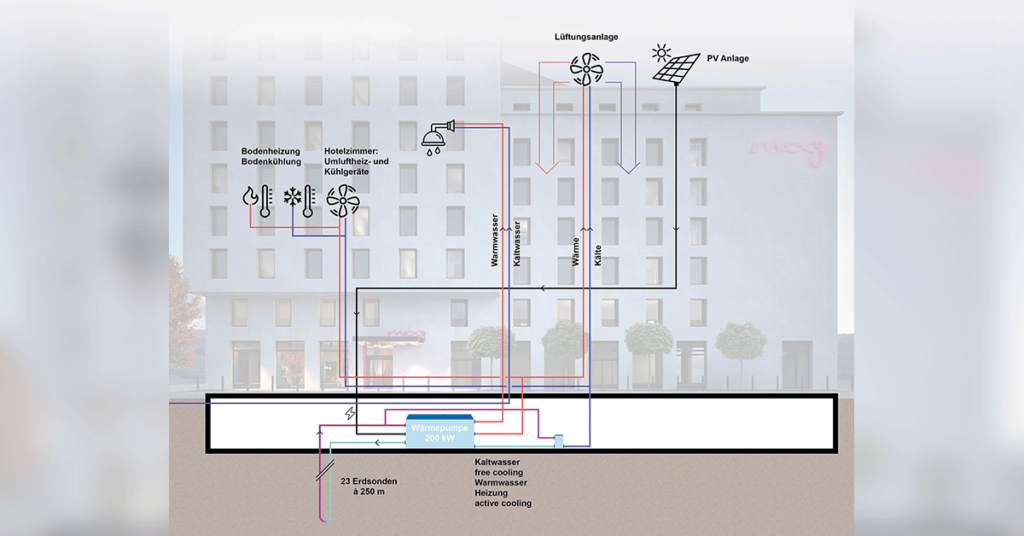
    The groundbreaking ceremony for the Hotel Rotbuche in Rapperswil-Jona took place in mid-February of last year. The three requirements and specifications for the energy supply and the energy system for the new hotel were clear: energy efficiency, ecology and comfort. In order to implement these requirements, geothermal probes were drilled as an energy source for the heat pump and a sustainable energy concept was developed in cooperation with Energie Zürichsee Linth (EZL). EZL will also operate and maintain the building technology as a contractor.

    Heat recovery measures
    "The reversible heat pump can be used to provide heat for heating purposes and for domestic hot water," explains Roman Fausch, project manager for energy services at EZL. In summer there is the possibility of cooling the building in an energy-efficient way using geothermal probes, according to the expert. If there is a high need for cooling, there is also the option of using cold from the reversible heat pump. Various heat recovery measures are also installed and, thanks to an intelligent control system, also regulated as required. "In connection with energy and sustainability, it is one of the most sustainable hotel projects that we have been able to plan and implement," says Stefano Ghisleni, general planner at Ghisleni Partner AG, based in Rapperswil, Zurich, St. Gallen and Zug.

    At the Moxy Hotel Rotbuche, the natural heat comes from a depth of around 200 to 250 meters. The 23 probes, distributed over the entire construction area, withdraw 10 to 15 degrees from the ground. The heat is fed into the heat pump in the building using a carrier fluid and converted. This is how it gets into the hotel's heating and air conditioning system. The entire length of the geothermal probe control system is more than five kilometers.

    Reduction of the room temperature by up to four degrees
    Those responsible for the project emphasize that the basic need for room cooling in the warmer seasons in the Hotel Rotbuche can be covered with the environmentally friendly free cooling system. This means that the room temperature can be reduced by up to four degrees. This has a positive side effect: the dissipated heat is in turn temporarily stored in the geothermal probes and can be used for hot water preparation or in winter for heat supply. A photovoltaic system is installed on the roof to operate the heat pump. With around thirty percent, it should provide sufficient coverage to cover part of the electricity demand. "The moderately controlled balancing of heat and cold makes a continuous room climate possible without massive temperature fluctuations," says project manager Roman Fausch. The first guests will be able to feel this for themselves from the coming autumn. At this point in time, the new “Rotbuche” hotel with its 86 rooms is due to open. ■

  • Photovoltaic expansion is in its infancy

    Photovoltaic expansion is in its infancy

    Photovoltaics should be next to the hydroelectric power to buttress a climate-friendly energy future, the association of independent power producers (writes Vese ) in a release . The specialist group of the Swiss Association for Solar Energy has developed an online map on which the development status of photovoltaics in the individual communities, districts or cantons is shown. The interactive map also optionally shows the nationwide status or the expansion of individual power plants.

    VESE explains that the map shows a very heterogeneous picture of the state of photovoltaics. Depending on the canton, the installed capacity per inhabitant is up to five times higher or lower. The cantons of Appenzell Innerrhoden and Jura have the highest level of development with more than 600 watts of power per inhabitant. In contrast, in the canton of Zurich, only 134 watts of power per inhabitant have been installed so far.

    This could not be due to a lack of space, explains VESE in the press release. Even the front-runner Appenzell Innerrhoden is only using its potential to an "infinitesimally small 5.2 percent". For VESE project manager Diego Fischer, the photovoltaic policy is more responsible. It is "a big patchwork in which the hot potato is pushed back and forth between the federal government, the cantons, the municipalities, the electricity companies and the investors, and in the end everyone is wondering why things are not moving faster".

    In order to promote the expansion of photovoltaics, the cantons and municipalities have to make better use of the instruments available to them, says Fischer. Specifically, the VESE project manager addresses the remuneration of solar power fed in and subsidies to supplement one-off payments. Fischer wants to increase the expansion of photovoltaics on the roofs of rental properties through building regulations.

  • New NEXPO leadership advertises state exhibition

    New NEXPO leadership advertises state exhibition

    Instead of concentrating on one region, the next state exhibition is to take place across the country until its climax in 2028: in all language regions, in cities, agglomerations and in the countryside. It should be sustainable and future-oriented. That is the vision of an initiative to which the ten largest cities in the country belong. Now, according to a media release , the specially founded association “ NEXPO – the new EXPO ” has given itself a new management. She should now promote a corresponding application to the federal government.

    The new board of directors consists of Christina Hanke, Fredi Fischli and Niels Olsen. Hanke, who has been the commercial director of the Zurich Film Festival since 2019, will also take over the commercial management of the association. Fischli and Olsen direct the gta exhibitions at the Architecture Department of the Swiss Federal Institute of Technology in Zurich ( ETH ). You teach at the ETH as well as at the HEAD art academy in Geneva and the Zurich University of the Arts .

    As stated on the initiative's website, the residents of Switzerland should use a digital NEXPO platform to develop new ideas and projects for living together in times of globalization, digitization, climate change and migration. "The best will be chosen as the new landmarks of Switzerland for the 21st century and should endure."

    The new management will discuss these and other ideas with interested parties in an online conversation on May 10th at 5.30 p.m. It is broadcast from the vacant Le Plaza cinema in Geneva. Registrations are possible by email .