Author: immovestuser

  • ETH Zurich helps with the construction of the Zug wooden high-rise

    ETH Zurich helps with the construction of the Zug wooden high-rise

    A ten-story office building with wooden components is to be built on the Suurstoffi site in Risch Rotkreuz. With a height of 80 meters, it will be one of the tallest wooden houses ever, as the Swiss Federal Institute of Technology Zurich ( ETH ) writes in an article. A lot of basic research is also required for the construction. Due to fire protection, this type of construction has only been allowed in Switzerland since 2015.

    According to the article, basic research for the new building is being carried out in the ETH building hall on the Hönggerberg. There, for example, it is simulated how the timber structure would behave in strong winds. Computer models are not always sufficient for such simulations. This is why experiments are carried out in the ETH building hall. "For us, testing something usually means loading it until it is destroyed," explains Dominik Werne, head of the construction hall, in the article. In the case of innovations in particular, computer models have to be validated through tests, adds Andrea Frangi, Professor of Timber Construction at the Institute for Structural Analysis at ETH.

    Tests on the structure of the Zug high-rise are currently being carried out in the building hall. This is planned by the Zurich engineering firm WaltGalmarini and built by the general contractor Implenia . After the tests at the ETH, the researchers decide together with engineers from WaltGalmarini which systems Implenia should use during construction.

  • Coop takes over Jumbo

    Coop takes over Jumbo

    Coop takes over the Dietlikon-based DIY store company Jumbo from Maus Frères SA. The chain with a total of 40 stores is an ideal complement to the Coop Group's locations, according to a media release . The purchase has to be approved by the Federal Competition Commission.

    Maus Frères SA now wants to focus on its core business, explained Didier Maus, Chairman of the Board of Directors, in the announcement. This includes the department store chain Manor and the brands under the name MF Brands Group. In addition, the company is strengthening its financial base with the sale and is thus preparing for possible acquisitions of other brands.

    Coop is convinced that with the acquisition “it has created an ideal basis for the future for all parties,” says Joos Sutter, CEO of the Coop Group Cooperative. With the current takeover of the DIY chain, Coop is buying the second part of Jumbo's business. In 2007 the retailer had already taken over the wholesale chain from Jumbo, in which Maus Frères and the French retail chain Carrefour each held half.

  • Implenia takes over BAM Swiss AG

    Implenia takes over BAM Swiss AG

    Implenia and BAM Swiss signed an agreement on March 29 for the takeover of BAM Swiss AG by the Dietlikon construction and real estate company, Implenia informed in a press release . The acquisition is intended to strengthen Implenia's competitive position in future tenders. In addition, this will make the company “a leading construction service provider in the healthcare sector,” writes Implenia.

    Both companies are involved in the realization of the Aarau Cantonal Hospital. Implenia, BAM Swiss AG and BAM Deutschland AG have so far been involved, explains Implenia in the press release. In the future, the project is to be implemented “from a single source”.

    The new acquisition also gives Implenia a stronger presence in north-western Switzerland. Specifically, Implenia's project portfolio will be strengthened with the construction of a laboratory and research building for biosystems science and engineering in Basel and the Felix-Platter Spital project in Basel. In Zurich, Implenia will also take on the construction of a student residence hall for the Swiss Federal Institute of Technology Zurich through the acquisition.

    "With this transaction, Implenia is strengthening its market presence and is becoming a leading construction service provider in the healthcare sector in Switzerland, an industry with great growth potential in terms of real estate," Implenia CEO André Wyss is quoted in the press release. "The acquisition is in line with our strategy and the goal of Implenia's Buildings Division to expand its market share as a total contractor for complex, large-scale projects."

  • High alpine solar system works highly efficiently

    High alpine solar system works highly efficiently

    The first large high-alpine solar system was set up last summer on the Albigna dam in Graubünden's Bergell. At an altitude of 2100 meters above sea level, 1200 photovoltaic panels were installed over a length of 670 meters at an angle of 78 degrees. The steep angle serves the better processing of the winter sun and prevents snow deposits on the modules, explains the electricity company of the city of Zurich ( ewz ) as operator of the system in a message .

    In the first six months after commissioning in September 2020, the high-alpine system has already produced 223 megawatt hours of electricity, ewz further informs in the press release. This fulfilled the “high expectation”, according to which high alpine locations have significantly better production conditions for solar power than the Central Plateau. The winter months have also shown that the system on the Albigna dam works just as efficiently in winter as it does in summer. Between October and March, the efficiency of a high-alpine system is more than a quarter higher than that of a flat-roof system in the Swiss Plateau, writes ewz.

    According to calculations, the system on the Albigna dam will generate around 500 megawatt hours of electricity annually with a total output of 410 kilowatts. Ewz customers can join the project via the ewz.solarzüri public participation model. Here, the 2170 square meters of the high-alpine facility are for sale at a price of 560 francs per square meter. The buyers are credited with 180 kilowatt hours of solar power annually for 20 years.

  • City of Baden starts revision of land use planning

    City of Baden starts revision of land use planning

    With the opening event on Saturday, May 29, the participation of the people of Baden in the revision of the land use planning of the city of Baden begins. According to the press release, this revision should take place in several phases and bring a result by 2025, which will then be submitted to the residents' council and the government council for approval.

    After 25 years in which various partial revisions have taken place, it is time to undertake an overall revision, the message says. It is about the structural development in view of the expected growth and the effects on settlement, traffic and open space. The guideline for the overall revision is the spatial development concept 2040 of the city of Baden. The structure plan of the canton of Aargau predicts a population growth of plus 34 percent or 6330 people for the city of Baden from 2013 to 2040. At the same time, Baden is listed on the structure plan map as an economic development focus of cantonal importance.

    The public should be actively involved in the revision of the land use planning, according to the announcement. Information events, dialogue events, walks and workshops take place regularly under the motto “Baden will”. All information on participation can be found on the wiewird.baden.ch website, which was activated on Wednesday.

    The revision of the land-use planning is currently in the first phase, which will determine the process and basis this spring. In the second, a good two-year phase, the draft of the new land use plan is drawn up. In the third phase from 2023 the formal participation and public edition will take place, with the possibility of submitting entries and objections. The third phase will be completed by the city council approving the land use planning revision, is explained in the press release. In phase four, the residents' council and the government council approve the revised land use plan.

  • The Zurich economic area remains attractive for new settlements in the corona crisis

    The Zurich economic area remains attractive for new settlements in the corona crisis

    Together with partners, the location marketing organization Greater Zurich Area AG (GZA) was able to relocate 86 companies despite the corona crisis, which corresponds to a decrease of 21 percent compared to the previous year. According to the GZA, the new settlements have already created 510 new jobs in the region, and 1599 new jobs are to follow in the next five years. GZA published these figures at a digital media conference. On this occasion, GZA managing director Sonja Wollkopf Walt commented: “In view of the global crisis, the result is very solid.” This is due to a well-filled project pipeline at the beginning of the crisis, but also to long-term networks abroad and the sustainable work of GZA and the partner of the location funding. According to Walt Wollkopf, the crisis has digitalized the work of the GZA even more: Existing instruments have been expanded and others newly developed.

    Almost half of the companies located here come from the information and communication technology (ICT) and life sciences sectors, with biotech accounting for the lion's share. Machine industry and financial services take third and fourth place. According to GZA, the origin of the companies by world region reflects the course of the pandemic in 2020. The US remains the leader with 20 companies, but the number of projects here has almost halved. With 14 settlements, Germany remains almost at the previous year's level and there are even two more projects from China than in 2019.

    The successful ICT settlement Speed U Up stands for the digitization boost caused by the pandemic and the strengths of GZA in the digital sector. The digital agency from Austria with a focus on alpine tourism founded a joint venture in Chur GR with the Swiss media company Somedia in October 2020. A technology hub with 75 new jobs is to be created. Somedia CEO Thomas Kundert said: "For us, the joint venture is a further step towards the growth market of digital services." This is playing an increasingly important role in the media company's strategy.

    Sven Thoenes, member of the Board of Directors of Speed U Up Suisse AG , emphasized: "In the Zurich economic area we find excellent talents to further develop our technologies in the areas of speech recognition, artificial intelligence and augmented reality." U-Up customers like Zermatt Tourismus benefit.

  • Kompotoi feels the spring

    Kompotoi feels the spring

    With spring comes the need for toilets in public spaces again. Kompotoi , the Zurich-based provider of composting toilets, has been back in the city of Zurich with over 20 of its toilets since last Monday in March. You can find them on the Saffainstel near Landiwiese, on Bullingerplatz and in Hohensteinpark on the Uetliberg, as the company reports.

    Kompotoi is also continuing its expansion into Germany this year. After the company delivered its toilet houses in Germany from Darmstadt, this year it is also represented in Munich. In Switzerland, Kompotoi supplies not only from Zurich, but also from Basel, Bern, Freiburg, Graubünden, Lausanne, Martigny and St.Gallen, and now also from Wohlen BE.

    Kompotoi toilets process the human legacy into a soil conditioner without using chemicals or flushing. They are handcrafted in Switzerland. Kompotoi sells and rents out the facilities.

  • Winning project from study contract for further development of Aeschbachquartier Aarau

    Winning project from study contract for further development of Aeschbachquartier Aarau

    Winning project known from the Rockwell site study contract

    The Rockwell area belongs to the western part of the Torfeld Süd and was acquired by Mobimo in 2001. Rockwell Automation GmbH intends to discontinue production at the Aarau location at the beginning of 2022. Only the research and development areas will remain at the long-standing headquarters. This will free a large part of the area – and the further development of the Aeschbach district can be tackled.

    As of today, the Aeschbachquartier comprises 167 rental apartments, 92 condominiums, the Aeschbachhalle, the Oehlerpark and commercial space. The urban planning guidelines designed by the renowned Dutch architect and retired ETH professor Kees Christiaanse and the associated vision of the “Urban Village” – an urban village – with diverse uses should also shape the further development steps.

    Mobimo has invited five renowned architecture firms to take part in a study. In addition to the high demands on the sustainability of the project – it should be made of wood and meet the SNBS Gold standard – the results of the participation process from 2020 were also part of the task package.

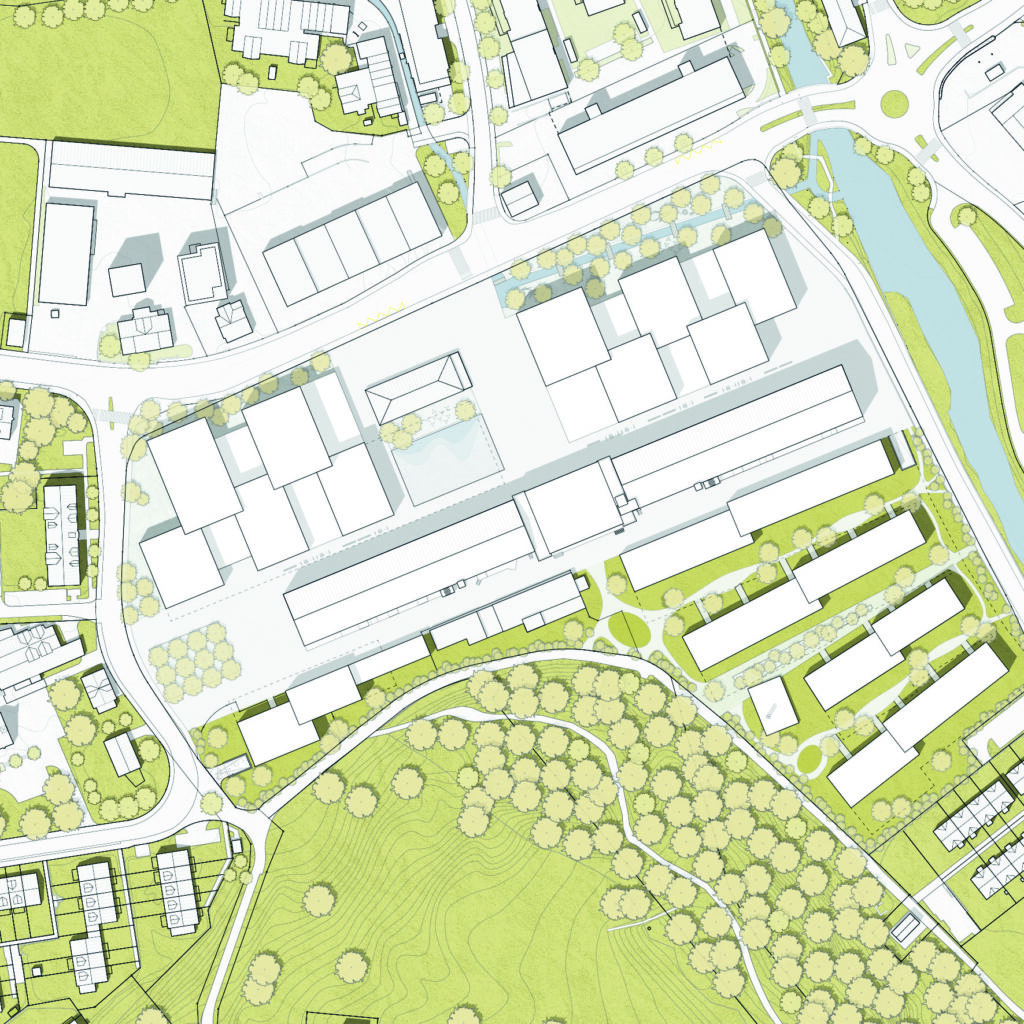
    The proposal by Baumberger & Stegmeier Architects from Zurich in collaboration with Hoffmann Müller landscape architects and Pirmin Jung timber construction engineers particularly impressed the jury and was chosen as the winning project. Your project envisages an increase in the historical Hall 5 and a new wooden building (see visualization). In addition to the ecological construction method, the winning project is characterized by many green areas with large trees. The project envisages 110 rental apartments of various sizes and suitable for families and senior citizens. Alternative forms of living such as cluster apartments are also to be created.

    Mobimo will invest around CHF 50 million (amount excluding land value). Realization can probably begin in mid-2023, which means that completion would be possible in mid-2025.

    Quote from project manager Thomas Schaz: “We are delighted to be able to open a new chapter in the Aeschbach district. Rockwell Automation remains an important and valued user of the quarter in a reduced space. "

  • Innosuisse aims to promote high-risk projects with a lot of potential

    Innosuisse aims to promote high-risk projects with a lot of potential

    The federal government has set the strategic goals for Innosuisse for the years 2021 to 2024. According to a media release , he expects the agency to focus on projects with a higher risk and "above-average economic potential". The selection should be made after “careful consideration” of the projects.

    Innosuisse should also focus on thematic tenders. The aim is to ensure that innovation topics of "great and cross-sectoral importance" are taken up. This includes the federal government, for example, key issues of digitization as well as challenges in connection with sustainability or coping with the corona pandemic.

    Innosuisse should also ensure that SMEs have easy access to the services of research institutions. The agency should attach great importance to young companies that come from the university environment.

    Innosuisse will also be commissioned to implement the Swiss Innovation Power Initiative in 2021 and 2022. The program is intended to help companies maintain their innovation activities despite the recession phase. This is not only in the interests of companies, but also important for the competitiveness of Switzerland as a business location.

    Innosuisse is a federal institution under public law with its own legal personality. Through the agency, the federal government promotes science-based innovation in Switzerland.

  • Unused potential in the cooperation between location promotion and the real estate industry

    Unused potential in the cooperation between location promotion and the real estate industry

    At first glance, business promotion and the real estate sector differ significantly. While location subsidies are usually borne by the public sector – federal government, cantons, cities, municipalities – real estate service providers are in the vast majority of cases private companies. This means that the former are non-profit organizations and the latter are for-profit companies. Location promoters want to win companies over to their sphere of activity and keep them for as long as possible; they are therefore interested in a long-term relationship. Real estate actors, on the other hand, are usually deal-oriented, which leads to comparatively short customer relationships. What is at the center of the activities is only clear from the naming: locations on the one hand, real estate on the other.

    More similarities than differences
    At second glance, however, there are important similarities. First and foremost, there are the customers, who are often the same, since a company looking for a new location is always looking for a new property. In the opposite case, the same is not always true, but in most cases. Because when a company needs a new property, for example because the existing one has become too small, the evaluation process usually also gives thought to the advantages and disadvantages of a change of location. The second thing in common is the property itself: no company can do without the four classic production factors of labor, capital, knowledge and land. Both location promoters and real estate players support their customers in optimizing the land or property factor. In doing so, they make an important contribution to their customers and support them in meeting their goals.

    Benefit from each other
    Due to the common ground there is great potential to benefit from each other. For example, both sides can gain advantages in marketing: The real estate industry can serve as a potent multiplier of the message of a location promoter, because real estate service providers are in direct contact with companies looking for new properties. This channel is still underutilized by location promoters. Conversely, real estate professionals are very interested in knowing the real estate needs of those looking for a location as precisely as possible in order to be able to provide a competitive offer. This information can in turn be provided by the location promotion.

    to create transparency
    In order to be able to create synergies, transparency is first and foremost necessary: Instead of staying among each other, the promotion of the location and the real estate industry have to merge, establish common platforms and exchange information. Both physical and digital platforms are available to them for this purpose. Real estate fairs are a good opportunity to meet face-to-face, maintain existing contacts and make new ones. At the international level, the MIPIM in Cannes in March and the EXPO REAL in Munich in October each year. For more than 20 years, there has been a Swiss joint stand at both trade fairs, which allows Swiss companies and locations to present themselves at a reasonable budget. The IMMO'Messe in Zurich, which is held in January each year, has established itself in Switzerland. This is where real estate investors present themselves and meet market participants of all kinds. Although the IMMO 'has long since established itself as a meeting point for the industry, locations and their representatives are still seldom to be found there. In addition to the trade fairs, there is a wide range of congresses that offer opportunities to maintain contacts around lectures and expert discussions. In addition, location promoters and real estate players can choose from a large number of network events. They are offered by associations, interest groups, locations and private companies.

    Online is catching up
    In today's pandemic-ruled times, online platforms have gained in importance. On the one hand, industry experts can make themselves heard by appearing at webinars and ensure broad awareness. Examples include the Real Estate Brains or Metropole Insights discussion platforms. On the other hand, online databases have become established that can be used by location promoters and real estate professionals alike. For example, companies can contact swisscircle-member.ch
    present. Realestate-experts.ch is ideal for individuals and top-projekte.ch for larger real estate projects. In addition to these offers, every market player is called upon to use social media tools such as LinkedIn or Xing for themselves.

    Networking
    There are hardly any projects that can be carried out on your own – be it as a location promoter or as a real estate professional. As a rule, every actor depends on useful information, benevolent market participants, efficient suppliers and / or cooperative partners. That is why a good network is essential. This requires personal commitment and a wise choice of platforms for maintaining and expanding one's contacts. Such networks are providers of such networks as SVSM, Swiss Circle, SVIT, RISC, ULI and Fiabci.

    Ideas to improve collaboration
    There are already numerous opportunities to intensify the cooperation between location promotion and the real estate industry. At the same time, however, there is also potential that is still largely unused. In this way, locations could present themselves on the major real estate portals and get in touch there with companies looking for a new property. Or more congresses or events could be organized that are aimed at both location promoters and real estate service providers. Ultimately, those offers will prevail which strengthen the participants' perception in the market, allow the exchange of experiences and support the maintenance of the personal network.

  • Shed Zug: "Every visit to us is unique"

    Shed Zug: "Every visit to us is unique"

    Can you even plan the construction and opening of a gastronomy concept like the Shedhalle in today's crisis-ridden times?
    Lina Fluri: The current situation certainly doesn't make planning the opening easy. However, we are adjusting to the originally planned opening date and are constantly watching how the situation develops. The construction was only marginally influenced by the pandemic and could therefore be carried out without major problems.

    In retrospect, what were the most important changes due to the corona pandemic?
    We recognize significant changes in the difficulty of planning certain projects and uncertainty about future developments. In addition, the home office has fundamentally shaken up the world of work. What was only possible physically in the past is now easily achieved digitally. This development will have far-reaching consequences for various industries and types of work.

    Can you give an example?
    In the catering industry in particular, people's consumer behavior has changed. Take-away food has become more important. The need of people to cultivate more social contacts again is great and will become noticeable in a rush to restaurants and bars after a relaxation. One or the other guest will probably spend an above-average amount of money to satisfy the appetite for social experiences.

    All are corona tired. Can you get something positive out of this long time without meetings and events?
    I believe that the corona pandemic caused a lot of suffering for many people. However, there are certainly branches and industries that have benefited enormously in these times of crisis. On a personal level, I notice that life has slowed down a bit, that we are increasingly focusing on the essentials again and appreciating the little things more, which is basically a very nice development.

    The Shedhalle is intended for smaller events. Is that an advantage nowadays?
    The Shed is characterized by its enormous flexibility. We can hold events for 6 to 300 people and always put together an attractive offer for the customer. However, the focus is on events between 20 and 100 people, which can be an advantage in the coming years. We close a big gap in the market with our private dining rooms, which can be booked for meetings of all kinds. The cozy rooms leave nothing to be desired and offer the customer the unique opportunity to combine business with high-quality cuisine.

    The special industrial charm of the Shedhalle is emphasized again and again. What do you mean by that?
    The Shedhalle will remain as one of two monuments from the industrial beginnings of Zug and is prepared for the next 50 to 100 years. We have tried to carry on the industrial touch with a lot of charm and passion and have created a place where industry meets contemporary and modern architecture. The industrial charm is noticeable in our attention to detail and in the respectful handling of the history of this place.

    Lina Fluri, Shedhalle project manager.
  • New life for the old spinning mill

    New life for the old spinning mill

    "The winning project was selected on the one hand because of the urban development strategy on the northern area, and on the other hand because of the respectful handling of the listed old buildings", says the lead architect Urs Oechslin from Zurich-based Lilin Architects. The two new building ensembles in the foreground of the spinning mill, which are intended for different uses, create a reference to the context through their urban planning anchored in place. The volumetric differentiation is derived from the existing settlement pattern of the urbanized village. The sub-volumes are staggered in terms of depth and height and allow different views of the spinning mill. The building typology thus mediates with great independence between the individual village buildings and the large-scale spinning mill building. In this way, the spinning mill area is given a new, urban face in which the various identities of the building history are superimposed.

    Desired longevity
    Immediately after the study contract, the overall project was concretized, accompanied by the client, the building authorities, the preservation of monuments and representatives from the assessment committee and the neighborhood: "We are about to submit the draft of the development plan and the guideline project to a first round of official consultation" , so Oechslin. It is not easy to build a building park around the spinning mill that can keep up with the quality of the monument and whose beauty and benefits guarantee the desired longevity. In the immediate vicinity of such a monument, the demands on the architectural quality are very high. The cultural acceptance associated with aesthetics is more decisive for the value of the property than some technical innovations. What is no longer publicly pleasing will sooner or later be torn down. What, on the other hand, enjoys a social and cultural status, remains. The real meaning of a house ultimately lies in the contribution it makes to public life in the long term. Urs Oechslin: “If the population, the Baar community and the owners are successful in promising a place of great attraction, then the project will be approved by all authorities. It will have a political majority and will be supported by the broader population. "

    Sustainable renewal
    For some time now, the «Spinni» has not served the purpose for which it was originally built. Since the end of production, a wide variety of uses have established themselves in the rooms. The clear and simple building structure of the spinning mill building is functionally sustainable because user extensions integrated in it can be easily adapted to changes. The high quality longevity of the basic structure achieved in this way is also aimed at for the new buildings. That is why it is being adapted for the new mixed-use buildings. As a result, the proposed building structure is not tied to a specific use and will survive future renovation processes.

    A coherent whole
    The historically and structurally established strong identity of the area is a large fund from which any number of ideas can be realized. Time and again it is important to find suitable means to further develop, reinterpret and supplement this identity. In this way, the high level of social acceptance that the area enjoys today is to be further expanded. "Our motivation is to design a new, staggered part of the settlement with the intelligent combination of architectural, landscape-architectural and usage-specific interventions on the area of the old spinning mill on the Lorze", says Oechslin. And further: “This takes over the existing qualities and complements them adequately and respectfully. The demanding cultural, social, economic, ecological and building law requirements should be combined in a coherent whole in the interests of all those involved. "

    The new use of «Spinni» needs to be carefully considered and planned.
  • From paper to quarters

    From paper to quarters

    “The construction progress of the five buildings of the first construction phase is on schedule despite the pandemic,” says the person responsible for communication, Kathrin Sonderegger. In the southernmost high-rise building with condominiums (Papieri-Suites), the shell is already up to the fifth floor. In the former PM1-4 paper machine halls, new staircases, floor ceilings and apartment partition walls are being installed, as well as the renovation of the facade for the spacious loft apartments and studios (Papieri-Lofts). The new building with 160 rental apartments running parallel to this – 30 of them in the inexpensive range – is also well advanced in terms of shell construction. The Maschinengasse that is emerging between the two buildings is also slowly becoming recognizable. This will be animated at the end of 2022 by the various users of the one or two-story adjoining studios. Underground car parks 1 and 2 are currently under construction, and their parking spaces can be equipped with charging stations for electric cars in a future-proof manner.

    Planning of the second construction phase is well advanced
    The newly renovated and listed Lokremise was handed over to its new owner at the end of the year. Sonderegger says: "After the renovation of the workshop building, the second commercial conversion of a historic building on the site became a reality." At the end of the year, the construction of the new Ringstrasse (Papieri-Ring) began, which is part of the main development of the area and encircles the buildings of the second construction phase. As part of the second construction phase, in addition to the commercially used replacement building for the silo building, two high-rise residential buildings with 61 owner-occupied and 36 rental apartments will be built. Commercial space and a day-care center are planned on the ground floors. 64 micro-apartments complete the housing offer.

    CO2-neutral energy system
    Those responsible for the site development pursue the goals of the 2000 Watt Society. It is worth mentioning the sustainable energy supply of the Papieri area with a self-sufficient, CO2-neutral heating and cooling supply. A significant amount of electricity is generated by the company's own river power plant and photovoltaic systems on the building roofs. The construction of the energy center has been completed and the installation of the technical systems is in full swing. Also as part of the energy system, around 100 geothermal probes have already been drilled and installed to a depth of 320 meters. The energy system will be put into operation in autumn 2021, so that the existing houses and the buildings under construction can already be supplied with sustainable heat this winter. “In addition to the building permit, the canton's concession for the operation of the run-of-river power plant is available, the renovation of which will start in early summer 2021. The area of the former wastewater treatment plant (ARA) will be completely renatured, landscaped and supplemented with a small river arm ”, says Sonderegger.

    Huge interest
    The Cham Group is already seeing a great deal of interest from the population: "The residents find out what is happening on the site and we try to get updates accordingly," says Sonderegger. Unfortunately, the corona pandemic is currently making events such as the open construction site day in 2019 for residents and interested parties impossible. The reactions at the time were overwhelming. “The same thing can also be seen in sales: there is great confidence in our site development and the quarter that is being created here. The first apartments that came on the market at the end of 2019 were reserved within a week. Over 3000 people have subscribed to our newsletter. » One reason for the trust is that the Cham Group will be there as the owner and builder. The team has its offices on the site and is on the pulse of what's happening. Suggestions can be reacted to, feedback and inputs flow directly, and any reservations are defused.

    On June 4, 2020, when the foundation stone was laid, a time capsule was filled with objects typical of the time and built into the foundation of the first construction phase. It should document the building project for future generations. What was the most special item? Sonderegger explains with a laugh: “In view of the fact that we can't even have lunch in a restaurant at the moment, and many people miss this time together in the team, the current menu cards from the surrounding restaurants are items of particular relevance. Who knows whether meat will still be eaten in 100 years' time – then minced meat tats might be part of a forgotten meal. "

  • Suurstoffi: Area development with a model character

    Suurstoffi: Area development with a model character

    «The Suurstoffi offers everything we need for our work. We can no longer be taken away so quickly here, ”says Sanofi Aventis CEO Andrea Meyer. A nice compliment for Zug Estates, which in the last ten years has developed a district in Rotkreuz that impresses with its architecture, greenery and energy efficiency. The once unattractive area has been revitalized. "The Rotkreuz community has an excellent macro location and is easily accessible by public transport," says Martin Jöri, Head of Strategic Site Management at Zug Estates. “The area is right next to the train station, but can also be easily reached by motorized private transport. The quarter is a kind of village within the village, and the campus concept is omnipresent. "

    A healthy mix
    All in all, Jöri appreciates the mix of living, business, research, school and gastronomy. He also likes the typical district infrastructure with a hairdresser or doctor. According to the latest construction status, the area is practically completed: “A construction site with two office buildings (Suurstoffi p. 18/19) has not yet been developed – but the building permit is available. The construction will be triggered in accordance with demand if sufficient occupancy has been achieved beforehand. " Looking back, Jöri regards the high construction speed with the aim of on-time commissioning as the greatest hurdle that had to be overcome.

    “Zero-Zero” goal
    The Suurstoffi is breaking new ground with an exemplary energy concept. On the site, solar use, several dynamic underground storage facilities and an anergy network form the basis for achieving the “zero-zero” goal. That means: the around 165,000 square meter Suurstoffi area is CO2-neutral. The energy for heating and cooling is generated by underground storage and building waste heat, electricity is provided by various solar power systems. The aim is complete self-sufficiency with primary energy for heating and water treatment. It was precisely this ambitious energy concept that particularly appealed to Jöri about the building: “It is a future-oriented vision of a CO2-free quarter with as much energy as possible, which is provided from our own production. But the architecture is also great. There is no uniformity here. Each construction site has a varied design. We also attached great importance to a green and high-quality outdoor space. "

  • The development of the Metalli is going according to plan

    The development of the Metalli is going according to plan

    The Metalli development is located in the core zone of Zug and is to be redesigned. Urban development projects are known to be protracted projects. Interventions in urban structures change the appearance of a city and affect many people accordingly. «We are aware of our responsibility. It is therefore important to find out what the needs of the population, residents and all other users of Metalli are, ”says Peter Wicki, Project Development Manager at Zug Estates. Politicians, interest groups and other groups or people also bring their concerns to the table. The aim is to create an intensely greened, sustainable and ecological metal. The building should have architectural and urban highlights. The current qualities and the wide range of products are to be retained. The interest groups advocate a meeting place where non-commercial activities are also possible. What is wanted is a new town square that will enliven the center near the train station between Zug and Baar, which has grown significantly in recent years. The existing glass passage is valued and should be retained in the same or a similar form. The aim is to expand non-motorized traffic – as well as affordable living space, more pop-up stores and other spontaneous or temporary uses of space.

    Dialogue with everyone
    "This balancing act of involving the various interest groups and yet developing a clear and strong idea that supports this place, which is so important for Zug and makes the city even more livable, is a great challenge and will remain so until the end," says Wicki. Two other key questions particularly stimulate him in this project: “How can we continue to grow without using up more land and still maintaining or even increasing the quality of today's settlement areas? At its core, it is about sustainable, high-quality interior compression ”. Just as important to Wicki is how the inner cities change as shopping behavior changes. "In the new Metalli habitat, we have to find an answer to these two central questions." This is an extremely relevant and exciting task.

    More sustainable and greener
    Nowadays, urban living spaces are designed differently than in the past. The Metalli was never developed as a pure shopping center, as the project development manager explains. Therefore, the area already brings numerous qualities of a modern living space with it. “Today it is already a lively quarter with a wide variety of uses and quality of stay. We want to further strengthen these qualities. " With the new Metalli-Platz, the district is being networked even further with the surrounding city. “The climatic conditions and awareness of sustainability have changed significantly in recent years. The new living space Metalli will become more sustainable and green. " Particular attention is paid to planting more trees and improving the quality of stay outdoors. The usage concept of the new living space should adapt to the current requirements of the Metalli visitors. «The trade will continue to change. The worlds of online and offline will merge. Companies have to find new ways to address consumers, ”summarizes Wicki. Metalli offers an ideal platform for this. In addition, they want to offer more products from the region.

    Last autumn, the structural project by Hosoya Schaefer Architects with Nyx Architects and the landscape architect Lorenz Eugster was submitted to the city of Zug. This project emerged as the winner of the urban planning competition. The development plan is currently being drawn up. A period of two years is planned for this phase. At the same time, the tender for the project competition is being prepared. "If everything continues to go according to plan, we will be able to start construction work in 2025," says Wicki.

  • Vogelwinkel: Family-friendly residential development in a preferred location in Baar

    Vogelwinkel: Family-friendly residential development in a preferred location in Baar

    The "Libelle" project is being implemented on the hillside, in Vogelwinkel, below the Himmelrich in Baar. The Zurich Park Architects were able to win the architecture competition with their four trumpet-like structures. Your project impressed the jury with its four finely graduated, two- to four-story buildings, which are integrated in a star shape into the topography of the rising slope. Seen from above, the new building resembles the wings of a dragonfly.

    The outside space opens up like a funnel into the center of the area. The new buildings are cubic so that they enter into dialogue with the existing buildings. The facade is striking: it should be kept in a brightly flamed shade of red. An underground car park connects the four buildings and offers 141 parking spaces. Instead of corridors, the 2.5 to 5.5 room rental apartments have a set of rooms that are offset at right angles. Construction is scheduled to start in early 2022. The first tenants are expected to move in in 2025.

    Thanks to its topography and traffic situation, the Himmelrich district in Baar is a sought-after place to live as well as a much sought-after local recreation destination. For this reason, the integration of the landscape into the Vogelwinkel development was a major concern for the client. A sustainable energy strategy has also been taken into account: the heat is generated using geothermal probes and solar collectors. Only proven, durable and ecological materials are used throughout the construction process. All apartments are designed to be barrier-free.

  • “Lindenpark” development: mixed living in the center

    “Lindenpark” development: mixed living in the center

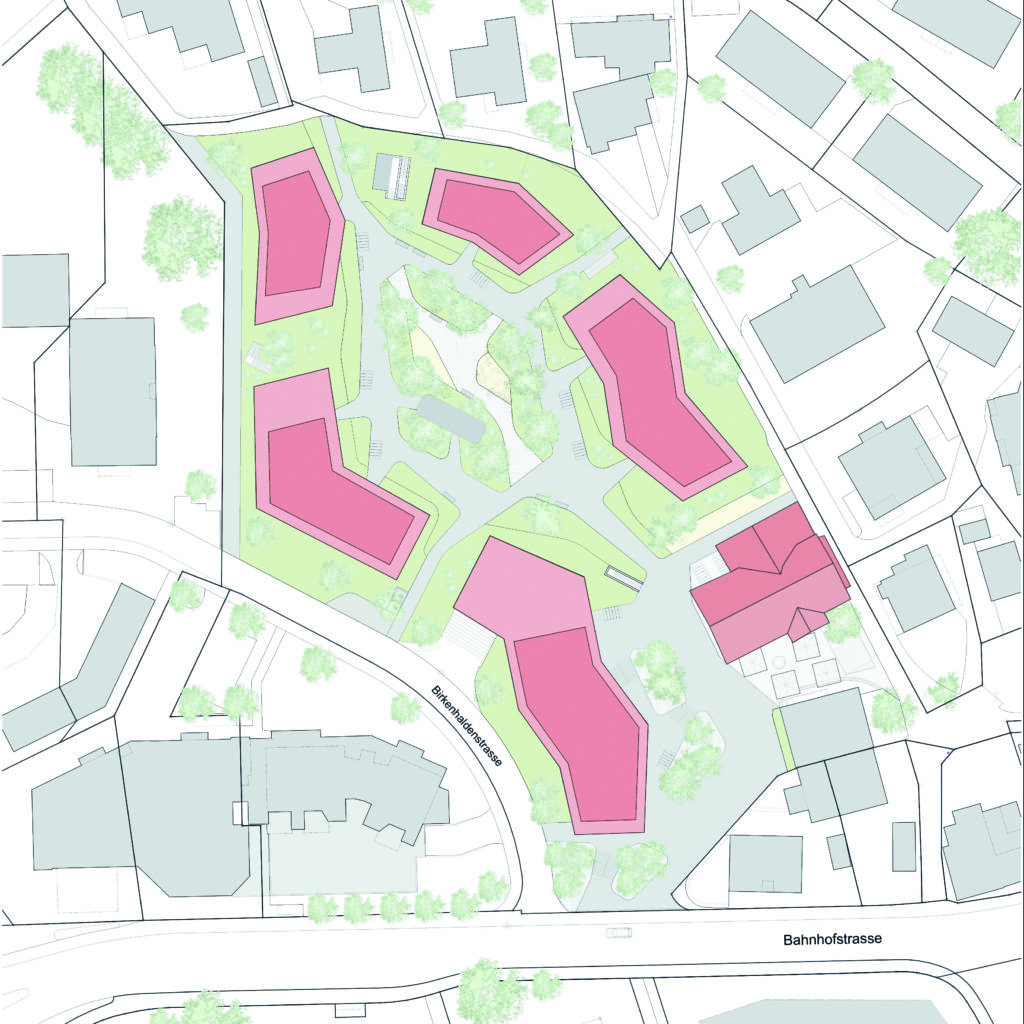
    The area between Erliweg and Birkenhaldenstrasse in Steinhausen is one of the last plots in the village center that can be built on. The landowner Viktor Jans – landlord of the Gasthaus zur Linde – has commissioned the architects Mächler und Töngi from Rotkreuz with the "Lindenpark" development. Since 2020, five buildings have been erected here, arranged in an oval shape. A green space is planned in the middle.

    The tallest building with seven storeys and the largest with 757 square meters is located in the south of the plot on Bahnhofstrasse. 26 apartments are being built here. The buildings are reduced in every dimension towards the north. Houses 2 and 3 still have five floors and houses 4 and 5 have four floors. This is a conscious reaction to the surrounding environment. Thanks to the staggered height, the structures are optimally fitted into the existing picture, and at the same time the tradition of large-scale buildings along Bahnhofstrasse is taken up. The facades are bent several times so that the new buildings appear softer and less angular. In addition, the entire development is given a dynamic movement towards the edge.

    Mostly small apartments are planned. Some larger apartments are intended to create new living space for families. The attic apartments are located in the southern area of the building. In this way they support the sloping movement of the buildings to the north. The project includes 148 parking spaces. A green courtyard with a play and lounge area and an open area with a garden restaurant to the south are planned in the center of the development. Photovoltaic systems on the roofs ensure an environmentally friendly power supply. The facades are uniformly materialized with a glued stone facade with a clinker look. In this way, they blend in harmoniously with the “Dreiklang” development on the opposite side.

    The existing barn, which is located in the south-eastern area of the "Lindenpark", is being converted into a multifunctional cultural space with a restaurant. Further public uses are planned on the ground floor level in the area facing Bahnhofstrasse.

    The planned development from above.
  • open2work is looking for investors

    open2work is looking for investors

    Many companies have too much space all the time or even temporarily. Moving to smaller premises would be too time-consuming. Conversely, other companies or sole proprietorships often need more space temporarily. Open2work GmbH wants to mediate between the two groups.

    The start-up founded in 2020 by Alexandre Roque and Lionel Ebener from western Switzerland handles the bookkeeping and payment transactions. New providers can activate their offices themselves on the open2work portal, and interested parties can book their workplaces there. There are currently a total of 22 offices around Zurich and Zug, two in Bern and one in Sion.

    "We are the solution for those who have too much space," says co-founder and CEO Lionel Ebener. Conversely, users of the offer can choose offices from companies that correspond to their own interests. "This cultural aspect is important to us."

    Open2work is currently in talks with investors. The company wants to grow faster with fresh capital. After the end of the Corona crisis, the two founders see a growing need for flexible solutions, both on the part of the providers of office space and among the users.

  • Implenia takes over BAM Swiss AG

    Implenia takes over BAM Swiss AG

    Implenia and BAM Swiss signed an agreement on March 29 for the takeover of BAM Swiss AG by the Dietlikon construction and real estate company, Implenia informed in a press release . The acquisition is intended to strengthen Implenia's competitive position in future tenders. In addition, this will make the company “a leading construction service provider in the healthcare sector,” writes Implenia.

    Both companies are involved in the realization of the Aarau Cantonal Hospital. Implenia, BAM Swiss AG and BAM Deutschland AG have so far been involved, explains Implenia in the press release. In the future, the project is to be implemented “from a single source”.

    The new acquisition also gives Implenia a stronger presence in north-western Switzerland. Specifically, Implenia's project portfolio will be strengthened with the construction of a laboratory and research building for biosystems science and engineering in Basel and the Felix-Platter Spital project in Basel. In Zurich, Implenia will also take on the construction of a student residence hall for the Swiss Federal Institute of Technology Zurich through the acquisition.

    "With this transaction, Implenia is strengthening its market presence and is becoming a leading construction service provider in the healthcare sector in Switzerland, an industry with great growth potential in terms of real estate," Implenia CEO André Wyss is quoted in the press release. "The acquisition is in line with our strategy and the goal of Implenia's Buildings Division to expand its market share as a total contractor for complex, large-scale projects."

  • A new business center for Neuhof-Baar

    A new business center for Neuhof-Baar

    The Neuhof business district is the second and final stage of the Neufeld project. A modern, five-storey building with an area of around 5750 m² is being built between Zug and Baar. The demolition of the existing building is expected to begin in April 2021. Completion is planned for 2023.

    The first stage of the new field project comprised the construction of the European headquarters of Emerson Process Management. The second building and the proximity to the A4 motorway junction and Baar Neufeld train station are intended to attract further international companies. HCI International Corporate Architects are responsible for both stages. In the basement of the new business center on the second stage there is a parking garage with charging stations for e-cars and e-bikes. A roof terrace is planned for the second stage as a relaxation area for the employees.

    The interior is bright and the entire construction is environmentally friendly. The Minergie-certified building will have a triple-glazed facade, energy-efficient air conditioning, raised floors and a fully automatic LED lighting system. Future tenants can plan tailor-made areas such as reception areas, C-Suite and conference rooms – the construction costs are financed by the owner as part of the rental package.

  • Live and work in stackable towers

    Live and work in stackable towers

    The plans of the association Vision Zukunft Bösch are ambitious: 3000 jobs for 600 companies are to be created on 30 hectares in Hünenberg on the Bösch site. The aim is to upgrade the area and make it a leading location for innovative SMEs in the service, trade and industry sectors. Keeas designed the first development model in 2018 on behalf of the Zugwest Economic Region Association. At the same time the club was
    Vision of the future of Bösch founded.

    The challenge in developing the area: space is limited. So that numerous companies can still settle, three high-rise buildings are to be built. These are not classic high-rise buildings, but stackable towers: Energy self-sufficient boxes are attached to large lifts. Companies could easily grow taller here: Additional boxes can be flexibly stacked.

    Creative SMEs in particular are likely to feel addressed by this location: there are slides instead of stairs. But the topics of energy and sustainability are also taken into account. Due to its high daily consumption, Bösch offers optimal conditions for the installation of photovoltaic systems on the roofs. The waste heat from the nearby Perlen paper mill could be used as heating and cooling energy.

    A range of e-cars, car sharing and e-bikes through to pooled company and visitor parking spaces is conceivable. The so-called energy and mobility hub works with large batteries. These optimize the energy consumption of the solar systems and charge electric vehicles at the same time. Truck and commercial ramps are to be built around existing commercial buildings. In addition, an autonomous bus is planned that will provide direct access to the IT campus and the Rotkreuz train station.

    The municipality of Hünenberg owns a piece of land in the immediate vicinity of the International School im Bösch, which it would make available for the construction of a reference company. This future “Campus Bösch” is likely to lay the foundation for the overall project. The vision is constantly being developed.

  • Second stage of the Quadrolith activated in Baar

    Second stage of the Quadrolith activated in Baar

    You cannot overlook it: the Quadrolith in Baar immediately catches the eye with its golden facade. The plans of the real estate company Alfred Müller based in Baar envisage two modern commercial buildings with space for 1000 workplaces on 30,000 square meters. The first building alone, which was completed in 2018, takes up 12,600 square meters. From the beginning, the aim was to build it in two stages.

    The remaining 17,250 square meters are currently being built on. The reference date is set for September 30, 2021. Marketing is already in progress. Companies of all sizes should be addressed with a flexible usage concept. The areas can be divided up and expanded individually. The U-shaped new building is then directly adjacent to the headquarters of Alfred Müller AG.
    The office complex has a modular structure and a functional architecture. Thanks to the design, the overall depth of both buildings, each with six floors above ground, could be deliberately kept low. This ensures optimal lighting conditions and space efficiency. Gold-colored, vertical metal strips give the facade its striking color. The overhang of the top two floors creates a futuristic appearance. Numerous trees and two green inner courtyards also characterize the exterior.

    Inside, the stairwells and toilet facilities are made of natural stone. The floors of the terraces on the 3rd and 5th floors are made of porcelain stoneware tiles. The height of the room varies from 2.40 to 2.54 meters depending on the floor. The windows are room high. An environmentally friendly heat pump heating system with energy piles and support from natural gas heating ensures reduced operating costs and reduced CO2 emissions. The concrete energy piles connected to the subsurface are provided with plastic pipes in order to exchange heat or cold with the subsoil. In addition, there are charging stations for electric vehicles in the open air and in the garage.

  • Tech Cluster Zug: A signal for the future

    Tech Cluster Zug: A signal for the future

    The Tech Cluster Zug (TCZ) is a commitment to Switzerland as an industrial location: "Currently, four large new buildings have already been built for the consolidation of V-ZUG or are in the process of being developed," says CEO Beat Weiss, not without pride. There were a number of hurdles to overcome: “On the one hand, there are building law restrictions. The industry often has to react quickly to new circumstances. On the other hand, we also want to be attractive to third parties, although they don't want to wait five years for building permits. But the high utilization and high density on the area also presented us with some challenges. " Every new building must be compatible with the city, neighborhood and neighborhood.

    So far, this has been an excellent success, especially since the development plan for the Zug Tech Cluster has been accepted without dissenting votes in the Grand City Council. There were no objections later either. The road to this goal was long: "It took five years to get the current planning law – from 2013 to 2018. But to this day, every new building application is, in spite of everything, a productive discussion with neighbors, the Zug Cityscape Commission and urban planning." Cooperation with well-known architects such as Diener & Diener from Basel, who, among other things, have realized the entrance building on the Novartis Campus, is definitely beneficial.

    Three new major customers in Zug
    For Weiss, it is exciting to bring all of the different interests under one roof: “A current key element is the Mobility Hub, which we are currently building. These include a multi-storey car park with around 600 potential electric parking spaces with options to switch to public transport or non-motorized traffic as well as shops and bistro space. This new infrastructure is located on the northern periphery of the city of Zug, which will be developed via the new connection axis to the motorway from mid-2021. " Such traffic management also contributes to the urban location advantages, which in turn attract more and more skilled workers to central Switzerland. The small area, the proximity to nature, but also the uncomplicated way of solving problems would make the city of Zug particularly attractive. This is also reflected in three new major projects that are being implemented for third parties: “There is SHL, for example. So far, it has exclusively produced in Taiwan and now wants to set up European production – not least because of the coronavirus. " It manufactures auto-injectors for insulin pumps and until now only had its main office in Zug. The second project concerns VZ DepotBank, which is part of the asset center in Zurich and accommodates a large part of its workplaces, particularly in the IT services sector, in the tech cluster. “Finally, we have the co-working space provider Westhive, who, after Zurich and other cities, is now also actively involved in our work,” says Weiss happily.

  • Green light for the Unterfeld project in Baar

    Green light for the Unterfeld project in Baar

    The subfield is one of the last large contiguous building land reserves and has been declared a cantonal agglomeration area. The location directly on the municipal boundary between Baar and Zug is adjacent to the Lorze recreation zone and offers a lot of development potential. But sometimes such comprehensive concepts need more than one try. This is also the case with the Unterfeld area planning: After the population of Baar had spoken out against cross-border planning in spring 2017, the “Unterfeld Süd” project was waved through in September 2020 in the second attempt by the voters with 65 percent yes-votes.

    The project was redeveloped under the leadership of the Baar municipality and in a team of 50. The team consisted of experts from the fields of urban development and landscape architecture, representatives of the authorities and landowners as well as residents, supporters and opponents of the earlier project, members of specialist committees and associations as well as local parties.

    Building on the district design plan, the zoning plan and the building regulations have been coordinated. An agreement has been reached on the construction of a sustainable quarter that enables new ways of living, living and working. Four building sites are being built over in stages. Rental apartments and condominiums are planned. The creation of office and service areas as well as public-oriented uses on some of the ground floors are also planned. A neighborhood square, a spacious boulevard for non-motorized traffic and a lot of green space ensure sufficient open space. Three high-rise buildings with heights of 60, 50 and 40 meters are to be built.

    The architecture competition for the first construction phase has already started. The Baar municipal assembly is expected to decide on the development plan in 2022. The first groundbreaking is unlikely to take place before summer 2023. First of all, the 60-meter high-rise near the Lindenpark S-Bahn station and the neighboring office building are to be built. The other construction areas are being developed further in parallel.

    The owners are Implenia Immobilien AG, Ina Invest AG and the Stocker heirs. Implenia is responsible for the site development. The company is developing plots 1A and 4 as the owner and plots 1B and 3 on behalf of Ina Invest. The two local housing cooperatives, the Baar family and the Liberale Baar cooperative, continue to show interest. The Zug corporation is planning a project in the city of Zug independently of the other landowners. How this will look is still open.

  • Unterfeld Nord: New headquarters for Partners Group Zug

    Unterfeld Nord: New headquarters for Partners Group Zug

    In the north subfield – it is functionally independent from the south subfield – the Partners Group Zug is planning a new headquarters building, which is to be relocated from Zugerstrasse to the Unterfeld. The north subfield covers an area of around 37,920 square meters.

    Three commercial buildings connected by bridges and a parking garage with 225 parking spaces on a total area of 21,000 square meters are planned on two plots. The straightening project was penned by Axess Architekten AG. The new headquarters of the asset manager will consist of three office complexes, two of which are designed as traditional factory buildings with brick facades. The “Entry Factory” leads on to the “Big Factory”. Both buildings have high windows that are reminiscent of a train station hall.

    The third building is planned as a “green building”: the green terraced house with seven floors has neither corners nor edges, but rather resembles a cake with several layers that extends along Nordstrasse to the roundabout. In the simple development plan it is referred to as "organically curved". The individual floors of the eye-catching building are stepped like a staircase towards the south, as can be seen in the building application. Not only the shape, but also the planned intensive greening should one day attract attention. The “Greenbuilding” is connected to the “Entry Factory” by a bridge. It has an extension with a chimney to further emphasize the industrial character of the building.

    In addition to office space, internal training rooms, a restaurant and recreational opportunities for employees are planned for the “green building”. A daycare center for the employees' children is planned in the factory to the east. All building types are conceptually based on the American headquarters in Denver and thus preserve the asset manager's corporate identity.

    A new north-south connection is planned between the factory buildings. At a later date, a new bus line is to be built here, which will connect the Unterfeld area to the train stations in Zug and Baar. For this reason, the street is built so wide that a bus line can later be set up without any problems. However, the structure plan must be awaited for the specific line to be drawn up.

  • New development at the Städtler Allmend

    New development at the Städtler Allmend

    The plans for the 30,000 square meter property owned by Coop Immobilien AG and Heinz Häusler Immobilien AG have now been finalized in the Städtler Allmend industrial estate. CST Architects and Iten Landscape Architects were able to win the project competition by invitation.

    Your project plans to supplement the existing office and commercial buildings in Städtler-Allmend with three new office buildings from Heinz Häusler AG. The development is intended to serve as the center of the Hinterberg area. For this purpose, a central, public square is planned as the heart of the new development. The buildings are arranged around it. The aim is to create a well-developed work and shopping district.

    The buildings of different sizes fit harmoniously into the existing buildings of the area. In the center of the new development there is a high-rise that is deliberately set apart from the Alpenblick development. The headquarters for possible new companies will be set back slightly at the Alpenblick junction. This creates a green area in front of the intersection. On the ground floors of the buildings directly on the square, public-oriented uses are planned.

    The Coop restaurant and the restaurants in the office buildings are also facing the square. Another restaurant with a bar could be set up in the high-rise building. The ground floors of the commercial buildings have freely divisible areas that are suitable for service providers. The buildings are accessed via the central square. This is characterized by two pergolas and two tree hills with swamp oaks.

    Coop will expand the existing specialist store: with a Coop Construction & Hobby, a Coop Livique supermarket, a fitness studio, a petrol station and a large outdoor car park. The Holcim AG concrete plant is being relocated to another location.

  • «Alpha»: a novelty in the canton of Zug

    «Alpha»: a novelty in the canton of Zug

    The windows of the Alpha office building, which has been under construction in Baar since summer 2020, are a novelty in the canton of Zug. Stephan Häusler, owner and CEO of Stephan Häusler AG and owner of Alpha, says: “We are foregoing classic sun blinds and relying on the SageGlass product for the glass facade. This adapts to the respective conditions depending on the amount of sunlight. " The glass darkens automatically, preventing the interior from heating up. Nevertheless, you can enjoy the view without restriction at any time. “This saves us energy as well as the maintenance and repair costs that are regularly incurred with classic sun blinds. The windows are a first in our canton. "

    The Alpha office building also has a lot to offer: An ideal location, a beautiful entrance area and timeless architecture. But these attributes alone are no longer enough to score points with the targeted clientele. Häusler: “In the Alpha, tenants benefit from exclusive advantages. There is, for example, the large garden, which is also ideal for outdoor meetings. There are also two cozy loggias on each floor, which are more familiar from apartments. " On the ground floor there is a lounge with direct access to the outside area. In addition, the construction of a larger meeting room is planned. This can be reserved selectively and is suitable for events with up to 30 guests.

    Fresh air thanks to ventilation blades
    The interior design of the individual office complexes can be freely designed. Two showers are already planned in the basement – if the employees want to jog, fit or bike over lunch and then continue working after having showered. Häusler emphasizes the careful interior design: “For example, we manufacture the interior doors that lead into the offices from high-quality wood. This looks homely and differs from the run-of-the-mill office groove. We value beautiful colors and shapes. " The entire planning is based on the “New Work” working model: Everyone works differently. “New Work” enables more independent and freer doing and letting go. New forms of creative activities are possible in the Alpha. And if your heads do smoke, fresh air can be supplied without any problems: “Thanks to the built-in ventilation blades, the facade windows can be opened manually. This is something that people really appreciate. You don't feel like you're in an office glass box in the Alpha. "

  • Steiner plans a new residential complex in Winterthur

    Steiner plans a new residential complex in Winterthur

    The real estate developer Steiner AG is planning to build a new residential complex in Winterthur, according to a media release . It is to be built on the KIM site at Winterthur Neuhegi train station. The so-called Haus Weiler is to be built on a plot of 3328 square meters and comprises 80 condominiums. Twelve of these will be built as studio apartments on the ground floor with private garden terraces. A further twelve are being built as attic apartments with private roof terraces.

    The design plan for the KIM area already became legally effective in September 2013. The newly emerging quarter combines living and working. It includes green areas, playgrounds and car-free zones. Grocery stores, cafes and restaurants are within walking distance. In addition, Zurich Airport can be reached in 25 minutes by car or train.

    According to the announcement, the building application was submitted to the city of Winterthur on March 25th. Steiner AG expects construction work to start in summer 2022. Completion is planned for spring 2025.

  • NaturLoop wins CHF 150,000 for composites made from coconut

    NaturLoop wins CHF 150,000 for composites made from coconut

    The start-up company NaturLoop from Biel BE won 150,000 francs from Venture Kick for its project to manufacture sustainable biocomposites, or composite materials, from coconut shells. According to a press release, NaturLoop wants to use the money to strengthen its marketing activities and to set up a new pilot project in the Philippines by the end of 2022. A factory for the production of cocoboard is to be built there. The natural fiber board is made from coconut shells. By using coconut shells instead of wood, the Biel-based start-up aims to limit deforestation, increase the local availability of furniture and building materials, improve farmers' livelihoods and promote a circular economy.

    NaturLoop wants to replace wood-based composite materials with Cocoboard. According to the communication, these release formaldehyde and other harmful gases, which leads to indoor air pollution. In addition, their production leads to excessive waste generation and energy consumption. The start-up now wants to use part of the around 21 million tons of coconut shells that are produced around the world every year and are either burned or thrown in the trash. NaturLoops Cocoboard is a natural fiber board made from coconut shells and pressed into boards with natural tannin glue. It can be used to make furniture, cupboards, floors or ceiling tiles.

    "What distinguishes Venture Kick from other startup programs are the people behind it: The feedback I got during the Kickers Camp was honest and unbiased," Daniel Dinizo, co-founder and CEO of NaturLoop, is quoted as saying.

    NaturLoop is a spin-off from the Bern University of Applied Sciences (BFH) and was co-founded by Daniel Dinizo (CEO) and Michail Kyriazopoulos (CTO). The team is currently working on exclusive supply contracts, pre-sales orders, the completion of the production concept and the opening of the seed financing round. According to the announcement, NaturLoop estimates the market for imported wood-based materials at $ 1 billion.