Author: immovestuser

  • A “grand projet” for Zug

    A “grand projet” for Zug

    Even the former French President François Mitterand described the conversion of large areas of the city of Paris as "grand projets". Christian Salewski & Simon Kretz Architects, pool Architects, Studio Vulkan Landschaftsarchitektur are planning just such a “big project” together with mrs partner: The Landis & Gyr area (LG area) is to be redesigned. Et voilà: After an urban development study contract and the transfer of the revised concept into a guide project, the next planning step can take place in summer 2021. According to the planning and building law of the canton of Zug, a development plan is required for the further development of the area. Because this ensures that the qualitative requirements for the urban and architectural design of buildings and open spaces are met.

    A family of places
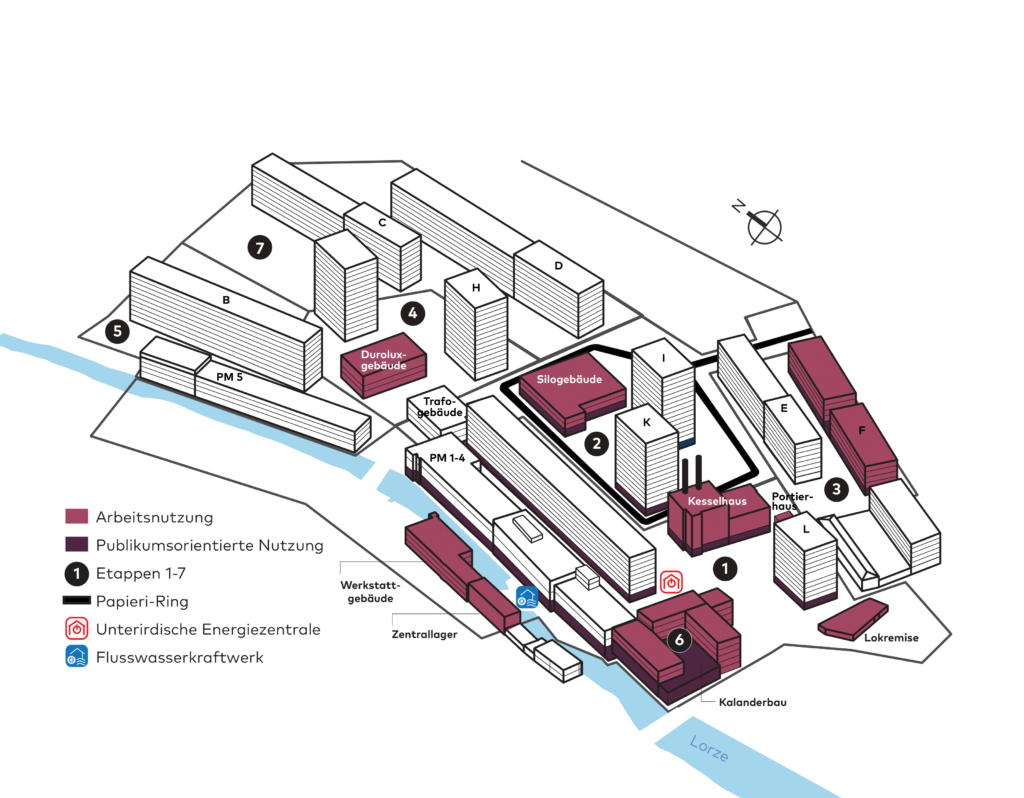
    The winning team convinced the five property owners Alfred Müller, Credit Suisse Funds, Park Lane Zug, SBB and Thoba Immobilien with four theses: The LG area has a radiance (1) and historical depth (2). It connects people (3) and represents a kind of family of places (4). Its urban planning concept enables a very high density and at the same time creates attractive open spaces. The height development mediates between the track area in the east and the garden city in the west. A free space ring connects the subareas and thus enables easy orientation. In addition, old industrial
    riebauten are preserved and become part of the new quarter.

    New old train
    Eliane Birchmeier, city councilor and head of the building department of the city of Zug, would like the quarter to open up: “We want a lively, tangible, very green quarter with a high quality of stay, in which inexpensive living and business are possible. A district that connects the city, including a new underpass for the railroad tracks, which will be good for the city. " There are already startups and large corporations that work from the LG area. But many Zug residents would hardly have the opportunity to enter the area if they didn't work here. "It is currently in a kind of deep sleep," says Birchmeier. That changes fundamentally with the presented project. "We are already seeing harbingers of how this area could be revitalized," says the city councilor. "For example in the Club Lounge & Gallery, in the Modi Lab Museum and especially in Freiruum, which the Zug population would no longer give up." The LG area has the chance of real change that meets the highest demands. A new piece of Zug will be created here, but it will still be Zug.

  • This is how the paper energy system works

    This is how the paper energy system works

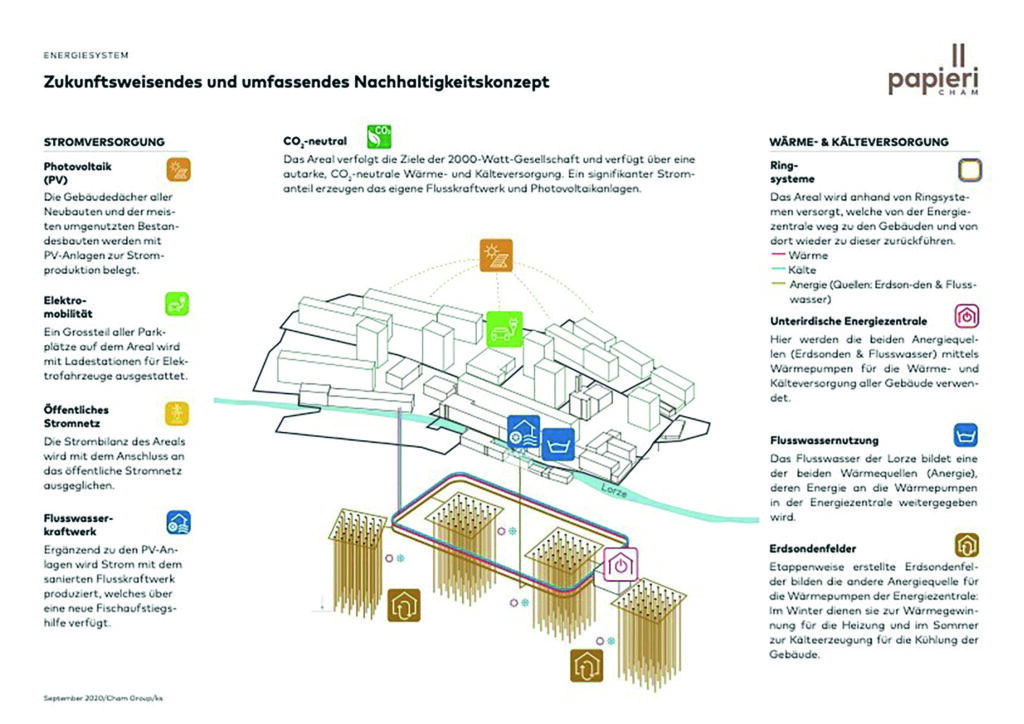
    The Papieri area is to be operated in a CO2-neutral manner and to play an important role in the implementation of the desired 2000 watt society. The sophisticated energy system consists on the one hand of its own river power plant, which has been producing electricity since 1890. Now it has been upgraded with the latest technology as part of the site development. In addition, the water from the Lorze is used as a heat source and electricity production is supported by photovoltaic systems on the building roofs. Newly installed heat pumps complete the advanced energy system. Not only is the CO2 neutral
    Real heating of the buildings in winter, but also the cooling of all residential and commercial units in summer.

    Modern technology also sets the tone when it comes to living: All apartments are equipped with fiber optic connections and a smart living system. The control of the heating, ventilation, shading or also the light and energy management can be controlled via a centrally installed touch panel or via mobile devices such as smartphones or tablets.

  • This is how blockchain is conquering the real estate industry

    This is how blockchain is conquering the real estate industry

    The term blockchain should be familiar by now. Most associate it with cryptocurrencies like Bitcoin. That's right, where blockchain is just the technology and Bitcoin is a resulting application. Even if the technology may seem complicated, the Swiss blockchain expert Michael Trübestein is certain: “Blockchain technology is comparable to the beginning of the Internet. It won't go away anymore. At the moment it is just uncertain how it will develop. "

    First you have to understand how a blockchain works: It consists of individual blocks – each of which stores data such as transactions. A blockchain works decentrally. In other words, anyone around the world can join a blockchain – virtually via a computer, of course. Every single computer stores all and exactly the same blocks that form a chain. Each block has its own «DNA». A new computer will only be admitted if it has been checked and verified by all other computers. Once programmed on a blockchain, it cannot be changed retrospectively by a single computer. For this, all computers would have to be involved – and that is exactly what makes the blockchain so secure. If a single computer tries to change the blockchain, the chain is immediately interrupted and the culprit is excluded.

    "Hello World" in Baar is the first property in the world to be tokenized
    The possibilities of blockchain technology are enormous for the real estate industry, as Michael Trübestein says. He is professor for real estate management at the Lucerne University of Applied Sciences, with a focus on real estate investment and real estate asset management. Numerous companies are currently researching possible areas of application. “Currently there are only a few applications, such as in the land register or in the investment / financing area. The world's first tokenization of a property, the “Hello World” property in Baar, ”says Trübestein, is an outstanding example. 20 percent of “Hello World” (CHF 3 million) of the property value was tokenized by the Zug-based company “Blockimmo” and sold to four investors.

    The company “Crowdlitoken” has also specialized in real estate: the start-up founded in 2018 sees itself as a digital real estate bond. «Investors can participate in selected Swiss real estate from 100 francs / euro. After the investment, our users can put together their own real estate portfolio by placing their purchased bonds (Crowdlitokens “CRTs”) individually on the various Crowdlitoken properties, ”says Domenic Kurt, CEO of Crowdlitoken, explaining the concept. By participating in the real estate, the investors generate returns of up to 7 percent per year. You can either have this paid out monthly to your bank account or receive it in CRTs.

    Access to the financial market is being liberalized
    A bank does not have to be interposed for a digital bond, which is cheaper for the investor. Crowd
    litoken already has 630 investors with a volume of 18 million CRTs. The real estate portfolio is constantly being expanded. The Swiss professional footballer Diego Benaglio is one of the prominent users of Crowdlitoken. Kurt defines what distinguishes Crowdlitoken from other companies that also rely on blockchain technology: “There is no comparable competitor who enables investors to invest such a low amount as an entry point for a stake in several properties. Investors can access the portal from their smartphone, where they can manage their entire investment. "

    It is clear to both Trübestein and Kurt that blockchain has disruptive potential. The CEO of Crowdlitoken says: “Banks are becoming obsolete for investment products like ours. New sales channels are emerging and access to the financial market is being liberalized. " On the one hand, the digitization of the capital market is inherently completely disruptive, as this leads to an opening of the market. «There are no entry barriers; Entry sums are reduced. " On the other hand, the digitization of securities is inherently disruptive: “This means that values are no longer transferred via third parties. With blockchain-based securities, it is possible to send values without duplicating them, ”explains Kurt.

    Trübestein adds: “Some applications such as crypto currencies have already influenced the world and the way market participants think. Nobody knows how the applications will develop in the future, but the advantages are already clearly visible. " The prerequisites are also in place in Switzerland: "We have target-oriented framework conditions and innovative companies here," says Trübestein. Cooperation between companies is important when implementing innovations. This is what happened, for example, with the “Hello World” property – the transaction results from a collaboration between Block-immo, Elea Labs and Swiss Crypto Tokens.

    Michael Trübestein
    Domenic Kurt

    What is a token
    Domenic Kurt, Crowdlitoken: A digital asset (token) based on the blockchain. It is a digital representation of a security. It contains property rights to the bond as well as the right to returns and represents a repayment obligation.

    What is blockchain?
    Michael Trübestein, Expert: A sequence (= chain) of information (= block). These are "time stamped" and are stored on several computers. This guarantees a high level of protection against forgery. There are also public and non-public systems. It can be used around the clock, seven days a week.

    What can blockchain technology do better than a bank?
    Domenic Kurt, Crowdlitoken: With blockchain-based securities it is possible to send values without duplicating them. It replaces the book of creditors and ensures that processes are designed and implemented in a leaner, more cost-effective and efficient manner.

  • Unique office and commercial space on the Papieri site

    Unique office and commercial space on the Papieri site

    Tailor-made office space and studios for every business idea
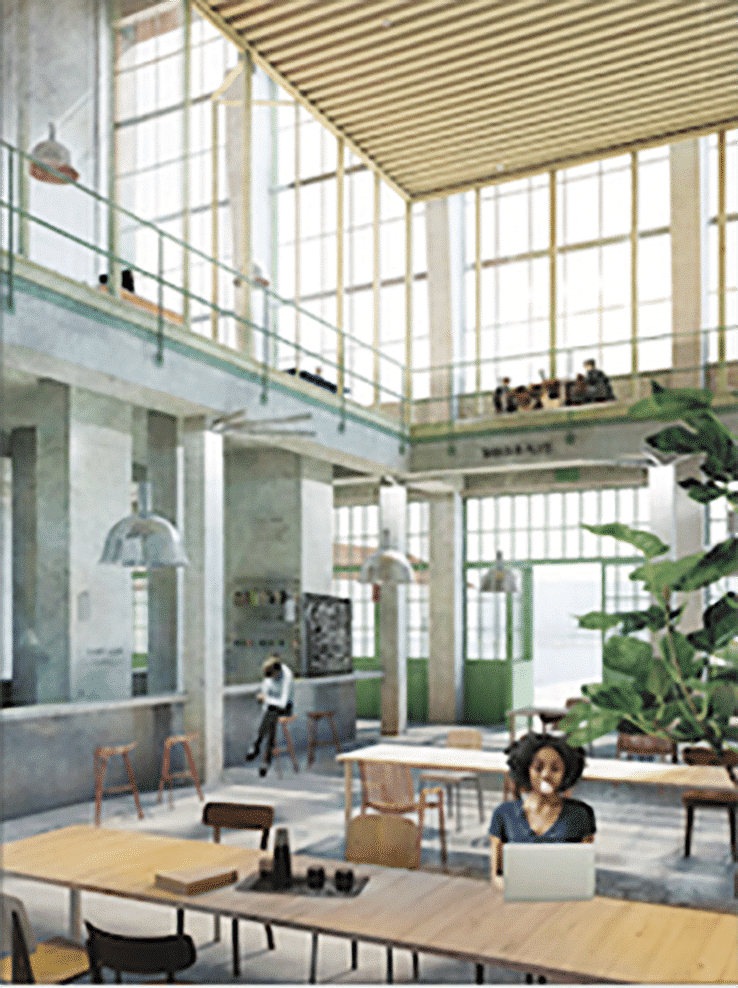
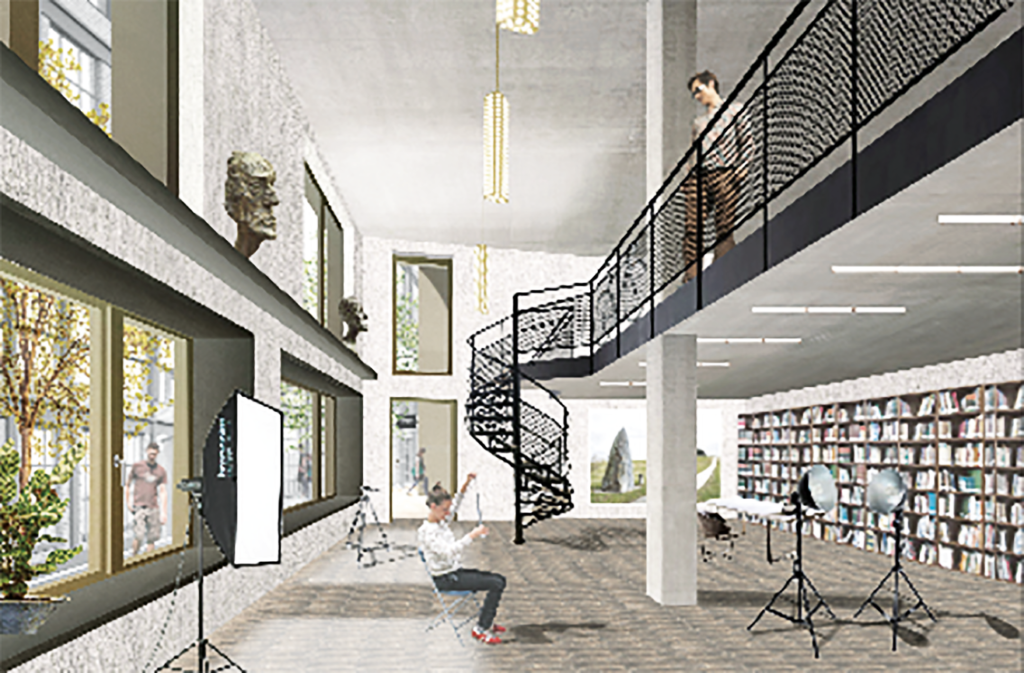
    Spread over the entire area, an extraordinary variety of areas will emerge over the next few years, which are suitable for the most varied of uses and sizes of businesses. Do you want 5m high rooms with industrial charm or something more modern in a contemporary new building with a representative appearance? Do you only need a small retreat to fine-tune your latest ideas, or as an anchor tenant would you like to play a key role in the planning process for your new headquarters? Everything is possible on the Papieri site and, thanks to the state-of-the-art infrastructure with fiber optic connections, you don't have to compromise anywhere. Areas from 50 m2 to 5,000 m2. Move-in from the end of 2022.

    Kesselhaus bistro with coworking.

    Lively ground floors for small businesses and services
    Lively ground floors are an important quality feature of any functioning quarter. Whether gastronomy, graphics office or physiotherapy, whether yoga room, flower shop or showroom: Innovative ideas with added value for residents and visitors are very welcome on the Papieri area. Areas from 100 to 1,000 m2. Move-in from the end of 2022.

    Sustainability is a top priority
    Thanks to our own hydropower plant on the Lorze and large-area photovoltaic systems on the roofs, all buildings are cooled and heated 100% CO2-neutrally. In addition, around a third of the electricity consumed is produced on site. All parking spaces are prepared for electromobility and are equipped as required. In addition, there are several quick charging stations available on the site. Don't own a car? Car and bike sharing offers ensure that you are still mobile.

    Maisonette studios in the new building.

    Become part of a lively neighborhood
    As a tenant, you can benefit from the attractive framework conditions on the Papieri site. Do you need a room for a new employee for a few months? Book a micro apartment directly on the area! Fancy a business lunch? The future Kesselhaus bistro is only a stone's throw away. Or do you feel like jogging or jumping into the cool water to clear your head? The attractive location of the Papieri area directly on the Lorze, not far from Lake Zug and the idyllic Villette Park, offers you countless opportunities to switch off and recharge your batteries and then start over.

    Get in contact with us and convince yourself of all the possibilities that are open to you here. Grow with us!

  • "Best overall package thanks to the Spirit of Zug"

    "Best overall package thanks to the Spirit of Zug"

    To person
    Beat Bachmann is lic.oec. HSG and has management experience in the areas of business development, sales, finance and project management in domestic and foreign markets. His industry experience includes life sciences / medical technology, wholesale / sales of consumer goods, real estate, information and communication technology.

    You are the head of the Business Contact Point in the Canton of Zug. How can you imagine a normal working day?
    Beat Bachmann: Every day is different. As a "one-stop-shop", we primarily support and advise local companies on a wide variety of issues. This also includes support in finding office space. With over 100 company visits per year and by networking the companies with one another in the industry clusters, we help ensure that the companies can operate successfully in a business-friendly location. In addition, we support many companies each year in setting up in the canton of Zug.

    How are the companies based in the canton with regard to the pandemic?
    The Zug economy with its strong international ties is also affected and cannot escape the structural changes. The effects are to be mitigated thanks to the measures taken by the federal government and the canton. Due to the strong constitution of Zug's economy before the Corona crisis and the broad diversification, I estimate that the negative effects will be slightly lower compared to the rest of Switzerland. Nonetheless, our team was able to look after the same number of relocations in 2020 as in previous years.

    In the Credit Suisse location ranking, Zug almost always ranks first – not least because of the low corporate income tax rate of 12 percent. What else do you offer more than other cantons?
    We primarily offer the best overall package of excellent location conditions: These include long-term financial and political stability, tax and finance policy, great innovative ability, high availability of skilled workers in important industry clusters and efficient infrastructure. The fascinating living space and thus the quality of life are also very important. Last but not least, we often hear that economic friendliness – our “Spirit of Zug” – is very much valued.

    What tasks does the Business Contact Point take on in site development?
    In particular, we help ensure that the needs and requirements of the economy and companies are incorporated into the site developments. And when the properties are completed, we offer support in arranging the space for new tenants or buyers.

    Does the site development show that the potential is being exhausted?
    We are very happy that the landowners and site developers have made a significant contribution to the sustainable and qualitative development of the canton for decades. It is in line with the long-term strategy of the government council that Zug should remain an attractive place to live and live. There is still enough arable land. I therefore think that the canton of Zug can continue to develop in this way over many generations.

    «Zug, Baar and Rotkreuz score points with the
    Companies"

    Several commercial buildings are under construction in the canton of Zug. In the wake of the pandemic, however, the trend is towards home offices. Still, are you confident that all of these projects can be brought to life?
    Yes, I am confident that these surfaces will be absorbed. Switzerland and the canton of Zug are and will remain a leading international economic area. In the case of new settlements, the availability of ready-to-move-in space is an important location factor. It is difficult to estimate the long-term impact of Covid-19 on office space demand. The trend towards more home offices is countered by a trend towards more space per capita, as well as co-working spaces / business centers.

    Besides Zug, which city in the canton is the most popular location for companies?
    On the one hand, the Lorzen plain (valley communities) has had the most companies and jobs for decades. Since the canton records around 40% train commuters on working days, the proximity to train stations with IC and express train connections is playing an increasingly important role. Accordingly, along with Zug, Baar and Rotkreuz have been the most popular locations in recent years; Cham follows behind.

    What makes the canton of Zug attractive as a place to live?
    Zug offers a good international infrastructure, excellent schools and political stability. The standard of living is high and the living spaces are intact. There are lakes, mountains and diverse landscapes in the smallest of spaces. Zug therefore offers an outstanding quality of life and the proximity to central Switzerland and Zurich.

    How do you assess the current demand on the housing market?
    It is consistently high in the canton of Zug. At the same time, the vacancy rate in the canton of Zug is only increasing minimally.

    How do you rate the building potential in the housing market?
    Since we at the Business Contact Point primarily deal with companies and, accordingly, with office and commercial space, I am not an expert on the housing market. However, I observe that many apartments have been built unchanged for decades and that they are constantly finding residents. As the smallest full canton in Switzerland in terms of area and due to our sustainable growth strategy mentioned above, we will continue to see a high proportion of commuters in the future.

  • "The city of Zug should become greener"

    "The city of Zug should become greener"

    To person
    Eliane Birchmeier (FDP) has been city councilor and head of the building department of the city of Zug since January 2019. The 58-year-old studied business administration and is federally certified. dipl. PR consultant and founded Birchmeier Communications AG based in Zug in 2005. She was a member of the Board of Directors of Kursaal-Casino AG from 2004 to 2017 and co-owner of C-Matrix Communications AG from 1992 to 2004.

    You are the head of the building department of the city of Zug. Where do you see your core tasks?
    Eliane Birchmeier: My core tasks include the classic areas of responsibility in construction: On the one hand, there are building permits and building projects for city-owned civil engineering and structural engineering projects. On the other hand, we deal with planning, design and legal aspects in town planning and urban planning. This is about the future development of the city of Zug in terms of urban development and spatial planning with settlement, landscape and traffic.

    The city of Zug is forecast to have around 10,000 population growth by 2040. What structural measures are planned to do justice to this development?
    The forecast growth depends on the development of the project by private owners and investors. We have already done our homework in many areas. For example, when it comes to infrastructure projects in the areas of drainage, energy and disposal. In education, we – like other communities in Switzerland – have a certain amount of catching up to do. Various plans are currently underway for expanded and new school facilities. But we also want to upgrade the green and open spaces and improve the network of footpaths and bike paths in the coming years.

    The economy should also continue to grow. Where do you see the greatest potential for new commercial buildings?
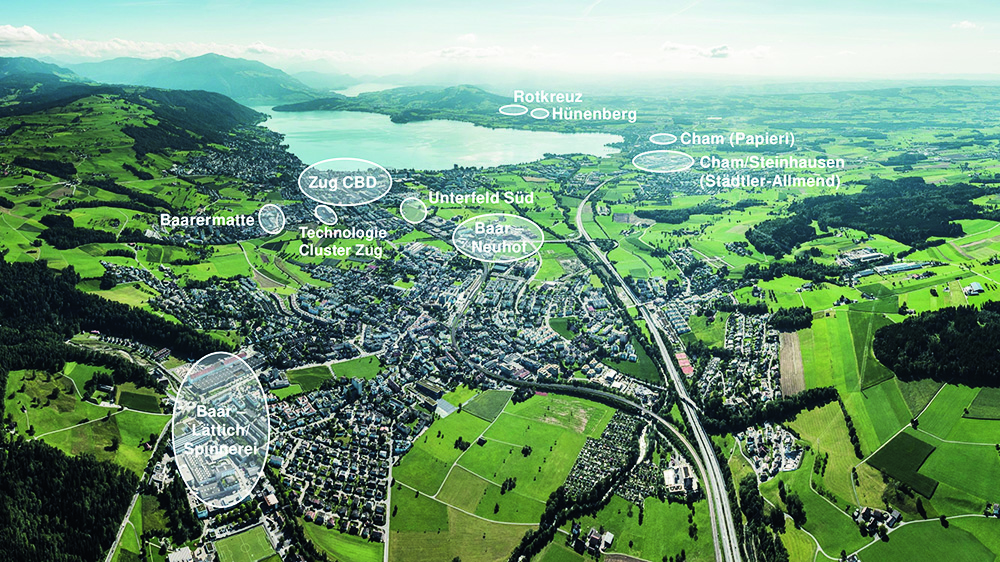
    There is still great potential for expansion for trade and services in various former industrial and urban areas. These include the technology cluster with the V-Zug area, urban areas east and west of the station such as Metalli, Baarerstrasse West and the LG area. Then there is the area on the Aa II, which is being developed by the Zuger Verkehrsbetriebe, the Hertizentrum and the outer Lorzenallmend. In the future, these areas will offer mixed, urban uses of living, leisure and work.

    Where in the canton can you find larger land reserves?
    As elsewhere in the canton, growth in the city of Zug will mainly take place in the interior through densification. In addition, there are a few construction areas that have not yet been built up, such as the outer Lorzenallmend, areas in the Herti and Unterfeld, in the Lüssi / Göbli and in a southerly direction in the Salesianum and in Oberwil. Actual zoning is not the focus of ongoing local planning.

    "We expect planning applications for the Lüssi / Göbli area and the area of the Salesianum country house soon"

    Which projects are planned there?
    In the outer Lorzenallmend, a development plan is being drawn up for a residential and work area and in Herti Süd one for a residential development. There are currently no plans in the Herti Nord, Unterfeld or Spielhof. In the Lüssi / Göbli and the Salesianum there are legally binding development plans for residential developments. We expect planning applications for this in the near future.

    What are currently the most important construction projects that you are involved in?
    City-owned projects are the construction of the recycling center and the Ökihof in the north of the city. School complexes are being planned and projected throughout the city. The project competition for the extension of the lido starts this year, and in summer the Zug population will be able to use the new emergency rooms in the Göbli district.

    The city of Zug is in the middle of the local plan revision process. Is there already an initial strategy for mobility and open space?
    The city's spatial development strategy will be drawn up in several stages and steps up to autumn 2021. The first thrusts based on the technical basis, the population survey and the first participation phase are clearly emerging: the city should become greener. In addition, a diverse and high-quality range of different open spaces should be available to the population.

    What does the population want?
    She would like the growth in mobility to be absorbed by expanding and promoting pedestrian and bicycle traffic as well as public transport. Traffic routing in the center is to be simplified and designed in a way that is compatible with settlement. Particular attention is paid to optimizing commuter traffic. In cooperation with the canton and neighboring communities, but also with employers, we are focusing on an increased shift towards public transport, which is already excellently developed, and non-motorized private transport.

  • The ZugerKB – the strong partner for professional real estate investors

    The ZugerKB – the strong partner for professional real estate investors

    In 2020, Zuger Kantonalbank financed over two thirds of all residential units approved for building in the canton of Zug and supported various important major projects in their development. This unrestricted market leadership of Zuger Kantonalbank in the financing of real estate is the result of a range of services that is consistently geared towards the specific needs of real estate investors.

    What can professional investors count on at Zuger Kantonalbank?

    Our extensive knowledge of the market
    Zuger Kantonalbank knows the Zug real estate market better than any other bank. We continuously analyze the development of the real estate market in the canton of Zug very precisely and comprehensively. We work with leading providers of real estate market data. In addition, the close exchange with professional investors in the canton of Zug gives us a valuable view of the market. With this knowledge we can provide you with a lot of important information for the development and planning of your projects: Which apartment sizes are in demand? How is building activity developing? Or what prices are marketable? We answer these and other questions together with the investors in a strategic dialogue. An experienced team of ten specialists is available at Zuger Kantonalbank for this purpose.

    Our reliability
    The ZugerKB is committed to its customers in the long term, and has been for over 125 years. Our senior consultants are personally at your side and do everything in their power to ensure that your construction project is successfully implemented. With our expertise, we can quickly carry out an initial project assessment and outline possible financing in an early planning phase. As soon as the project becomes more specific, our short decision-making channels allow quick and needs-based financing offers: from the first planning loan to a comprehensive and flexible financing structure.

    Our solution orientation
    Your construction project is also our project. That is why professional advice is important to us. We make the processing and support of the project as easy as possible for you. In addition, we support promoters along the entire sales process, for example. In addition to the prior plausibility check of the planned sales prices, we offer various sales support. For example, our website www.zugerkb.ch/bauprojekte, which is accessible to everyone, informs interested apartment buyers about future projects and enables a direct link to the websites of the respective providers. We would be happy to show you further sales support in a personal conversation.

    To person
    Peter Bucher has been Head of Real Estate Investors at Zuger Kantonalbank and a member of the Board of Directors of a listed real estate fund since 2015. The passionate rider and jogger has a profound knowledge of the real estate market in the Zug region.

  • Focus on qualitative development

    Focus on qualitative development

    Zug is one of the most popular economic and living areas. This is proven by numerous studies and rankings. The success is based on a long-term development strategy and attractive framework conditions. Zug offers a unique combination of excellent location factors such as the availability of skilled workers, stability, attractive taxation, central location, quality of life, level of education and economic friendliness.

    The Zug business center is dynamic, as evidenced by developments on the real estate market and in the transport infrastructure. The strong presence of value-added industries and service providers as well as a high concentration of high-growth sectors are important for the quality of economic development. The broadly diversified industry structure and the unique mix of small, large, local and international companies are an important driver for the innovative development of the canton. The focus of economic management by the Department of Economics is on the existing and established companies. Their growth makes the greatest contribution to the canton's economic development.

    Testimonials

    Silvia Thalmann-Gut, member of the government, economics director and governor of the canton of Zug

    The canton of Zug offers excellent location conditions for everyone. This includes the "Spirit of Zug" that is lived. The distances are short, the authorities work quickly and efficiently. Zug's success is based on a long-term strategy.

    Heini Schmid, lawyer, former Cantonal Councilor and long-time President of Zug Tourism

    Zug is in Switzerland what Switzerland is in Europe: small, surrounded by large neighbors and therefore open and adaptable. For us, changes are always an opportunity to do things differently and better. Zug is Switzerland to the power of two; it is the total package that counts.

    Matthias Rebellius, CEO Siemens Smart Infrastructure, Chairman of the Board of Directors Siemens Schweiz AG

    From Zug, we are driving digitalization at Siemens Smart Infrastructure. For us, Zug is an ideal location for our global headquarters, as we can attract and promote the best local and international talent here.

    Johanna Friedl-Naderer, President Europe, Canada & Partner Markets, Biogen

    Zug is the hub of our international headquarters. From here we coordinate our operational and administrative activities worldwide. The central location and high quality of life make Zug an attractive location for top talent.

    Contact point for the economy of the Canton of Zug
    Welcome to the canton of Zug. Our services are aimed directly at you as an entrepreneur. We are your partner and promote Zug as a business location.

    Business contact point, Aabachstrasse 5, 6300 Zug, T +41 41 728 55 04, economy@zg.ch

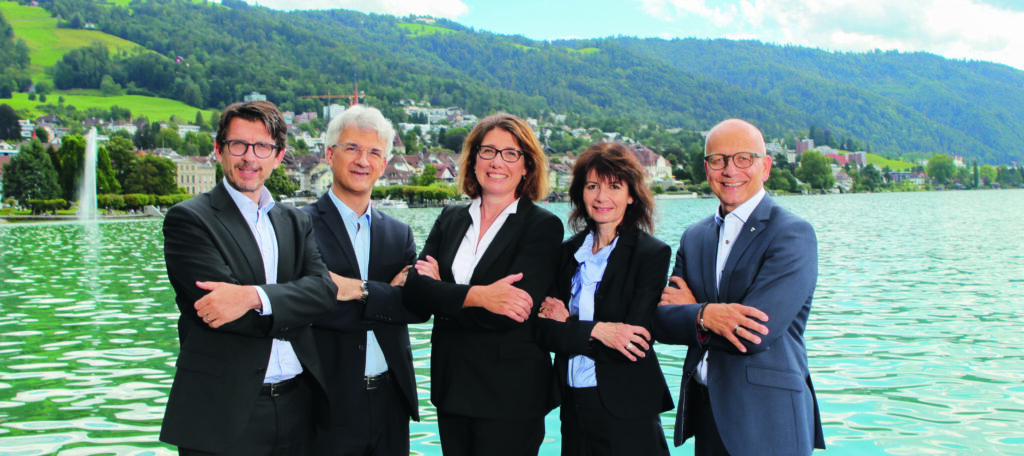
    Alberto Diaz, Deputy Ladder; Peter Müllhaupt, jur. Employee; Yvonne Valentino, assistant / back office manager; Ursula Kottmann Müller, Marketing / Communication; Beat Bachmann, Head (from left to right). Photographer: Peter Hofstetter
  • Swiss train stations perform moderately

    Swiss train stations perform moderately

    Of 50 train stations in Europe that were examined, the train stations in Bern and Zurich performed moderately to poorly in terms of passenger-friendliness. According to a press release, Bern train station landed in 40th place in the European Railway Index 2021, while Zurich train station was in 21st place.

    The consumer protection group Consumer Choice Center , based in Washington, has examined in its index, among other things, the shopping experience, the accessibility, the WLAN network, the number of national and international destinations as well as the choice of travel providers.

    The main train station in Bern, for example, has toilets for wheelchair users, but with six shops and eight restaurants only a very limited range of options for eating and shopping. The Zurich main station offers more than 53 shops and 39 restaurants, but does not provide barrier-free toilets for wheelchair users.

    Leipzig Central Station performed best in front of Vienna Central Station and St. Pancras in London. According to a media release, the train station in the German state of Saxony offers most domestic destinations, many shops and restaurants, and several railway companies.

  • Steiner celebrates the topping-out ceremony in the new industrial park in Basel

    Steiner celebrates the topping-out ceremony in the new industrial park in Basel

    The new Werkarena business park in Basel celebrated topping-out on Friday. After construction began in autumn 2019, Steiner AG was able to complete the shell of the building complex, according to a media release.

    The first tenants should be able to move in from autumn. The Werkarena is designed for different types of companies. The lower floors offer a ramp system for small vans especially for the storage and logistics industry. Tenants can also use the existing office, meeting and conference rooms jointly.

    The upper floors offer a marketplace, a forum and rooms for new business models. They are primarily intended to address startups and small and medium-sized companies that are expanding their network and looking for a place for inspiration and exchange. The trade association Basel-Stadt and the Business Parc Reinach operate part of the commercial and business park, which particularly want to promote start-ups.

    The Werkarena is being built near the border with Germany, the A3 motorway and the EuroAirport Basel-Mulhouse airport. It is an initiative of the trade association Basel-Stadt , Immobilien Basel-Stadt , Business Parc Reinach , Steiner AG, smeyers AG and Picard Angst AG as well as other large companies.

  • Basic report on the merger of Baden and Turgi is available

    Basic report on the merger of Baden and Turgi is available

    The basic and financial report on the opportunities and risks of a community merger , drawn up by seven working groups with representatives from Baden and Turgi, is now publicly available. According to a media release from the city of Baden, it can now be viewed publicly on the project website under Reports.

    According to the press release, the seven working groups from Baden and Turgi examined topics such as authorities, administration, spatial planning, schooling, the local community, forest, factories, and the fire brigade. An independent auditing company analyzed the financial situation and the prospects for the merger.

    In addition to the publication on the project website, several information events are planned. On April 7, the two ammen Markus Schneider and Adrian Schoop and the two women vice-men Regula Dell'Anno-Doppler and Astrid Barben will be discussing the knowledge gained in the first phase of the project in a live broadcast. After completing the basic work, those responsible for the project came to the conclusion that the chances of a merger outweigh the above.

    On May 6th, a Thursday, and on May 22nd, a Saturday, representatives of the working groups will be available for talks at market stalls on Baden's Schlossbergplatz. On May 7th, the information stand will be set up in Bahnhofstrasse in Turgi.

    On June 13, 2021, the citizens of both municipalities will vote on whether they want to commission the Baden City Council and the Turgi City Council to draw up a merger agreement in a second project phase. According to the media release, if both municipalities are yes, the merger agreement would come before the residents' council and the municipal assembly in autumn 2022. The second referendum would take place in March 2023. The merger would take place on January 1, 2024.

    If only one of the municipalities voted no on June 13, 2021, the project would end.

  • Graubünden pension fund receives investment award

    Graubünden pension fund receives investment award

    The Graubünden Pension Fund ( PKGR ) has received an IAZI Real Estate Investment Award 2021. It received an award in the “Best Pension Fund Portfolio” category. IAZI awards a total of nine awards. The basis for the selection of the winners is an assessment based on eight key figures from the Swiss Property Benchmark of the consulting and service company IAZI for the Swiss real estate sector. According to a press release by the PKGR, this is the most representative benchmark for Swiss direct real estate investments.

    PKGR's real estate portfolio claims to have a market value of CHF 654 million. As stated in the announcement, the pension fund understands this award as “confirmation of its real estate strategy, its successful implementation in the facilities and management as well as the further development of the portfolio”.

  • Rental deposit insurance is expensive

    Rental deposit insurance is expensive

    Rent deposit insurance is only advisable in the event of short-term financial bottlenecks. The online comparison service Comparis points this out. In contrast to a rent deposit payment, the premium payments are lost in any case. With a ten-year contract, they can amount to more than half of the deposit amount. In a press release , Comparis calculates this on the basis of a ten-year contract and a deposit of 6,000 francs.

    A good 20 percent of the Swiss population will have to make the right decision in the next twelve months. This is shown by a representative survey by Comparis on moving behavior in Switzerland .

    Rent deposit insurances give new residents the required amount of mostly three months' rent. In return, they ask for an annual premium. The cheapest and the most expensive would be 40 percent apart. "Rent deposit insurance should only be considered to bridge short-term financial bottlenecks," is the recommendation of Comparis expert Frédéric Papp.

    The definitely cheaper solution is to transfer the entire rental deposit to a rental deposit account. “You should pay attention to the choice of bank.” There are still banks that pay interest on deposits and others that charge opening fees of up to 150 francs or netting fees of up to 100 francs. Basically, the banking relationship can be negotiated.

  • Intelligent lighting convinces investors

    Intelligent lighting convinces investors

    LEDCity has secured 2 million francs in fresh capital as part of a financing round. A customer of the start-up and a group of business angels have invested, according to a media release. In addition to the financing by the investors, the company has also received a guarantee from the technology fund of the Federal Office for the Environment .

    LEDCity has developed a lighting solution that aims to reduce electricity consumption by up to 80 percent. The development is intended to replace classic motion detectors in commercial buildings. It uses up to 50 times more sensors on the same area. Algorithms also ensure that the lighting intensity is controlled automatically.

    With the fresh funds, LEDCity wants to enlarge its sales team in western Switzerland and at the same time expand to Germany. The start-up also wants to further develop its algorithms.

  • Bern is testing street lamps as charging stations

    Bern is testing street lamps as charging stations

    The municipal energy supplier Energie Wasser Bern (ewb) wants to convert street lamps in two Bern quarters into charging stations for electric vehicles. At the end of March, according to a press release, ewb will put two upgraded lanterns into operation at Thormannstrasse 62 and 64 and at Huberstrasse 16. The two masts will be equipped with type 2 sockets, the European standard for charging e-cars.

    ewb is responding to the growing demand for e-cars and thus also for charging points in Bern. The test stations are located on residential parking areas marked blue. According to the press release, this makes them particularly suitable for residents of Thormannstrasse and Huberstrasse who have an e-car and a resident parking card.

    ewb wants to expand the e-charging stations specifically in the blue zones, because this is where most people from Bern park. The energy supplier is technically supported for the project by Siemens and ubitricity as well as MOVE as an e-mobility service provider. The City of Bern and EnergieSchweiz are also involved.

    For owners of diesel and gasoline cars as well as e-vehicles that are not supposed to be charged, the areas will no longer be available until the end of the pilot phase in spring 2022. They should be able to recognize this from the corresponding signs. At the end of the test phase, ewb and its project partners want to evaluate the data and decide whether to introduce such charging lanterns across the board.

  • AEW takes a stake in the Aargau energy start-up

    AEW takes a stake in the Aargau energy start-up

    AEW Energie AG has entered into a strategic partnership with Virtual Global Trading , according to a media release . It will gradually acquire a stake of up to 35 percent in the start-up company based in Aarau.

    With eNet, Virtual Global Trading has developed a digital trading platform for the energy sector. It offers customers of energy suppliers various business models. For example, companies can present offers for battery storage or solar systems on the platform. These can then be used by private individuals – the customers of energy suppliers.

    The platform uses the daily updated data from the network operator's intelligent meters. The traded and processed energy data are automatically compared with the systems of the distribution network operator. When the platform registers a new smart meter, it creates a one-time token. Thanks to this token system developed and patented by Virtual Global Trading, the proof of origin of the energy is provided. Overall, the platform also enables all participants to react quickly to market developments.

    Together with the Liechtenstein power plants ( LKW ), the start-up is already implementing its system in Liechtenstein. The use of the platform there is also intended to serve as a model for other regions. The goal now is to roll out eNet continuously in Switzerland and Europe.

    “With our involvement in the start-up company, we are securing market experience from neighboring countries, where the regulation and liberalization of the electricity market are well advanced. We want to use this experience for our preparation for the complete liberalization of the electricity market ”, said Marc Ritter, Head of the Energy Business Unit at AEW, in an AEW announcement . Together with the start-up, AEW also wants to develop new market models for Switzerland.

  • Fritschi Fensterbau joins the Spycher Group

    Fritschi Fensterbau joins the Spycher Group

    In the future, Fritschi Fensterbau AG will operate under the umbrella of Spycher Group Holding AG from Vechingen BE, the two companies inform in a message . With the takeover, the holding company, which has subsidiaries and investments in various economic sectors, wants to strengthen its business in the construction industry.

    "Fritschi Fensterbau AG fits perfectly into our group, which already includes several other companies active in the construction ancillary trade", Matthias Spycher, owner and CEO of Spycher Group Holding AG, is quoted in the announcement. "We are also proud to be able to take over a prosperous company with excellent people."

    The previous owner and managing director of Fritschi Fensterbau AG will leave the company at the end of March. The previous project manager of Fritschi Fensterbau, Thomas Gisy, is to lead the fate of the window manufacturer from the Zürcher Unterland under the umbrella of the holding company. "In Thomas Gisy we have found an ideal internal successor for Sven Spitzli," explains Spycher. The management of the sales department at Fritschi Fensterbau will be taken over by Thomas Gisy's son and longstanding employee of the company, Tobias Gisy.

  • Basler Quartier will soon have climate-neutral heating

    Basler Quartier will soon have climate-neutral heating

    Work on the construction of a heating network is allowed to start around Lehenmattstrasse from July. According to a press release , the Lehenmatt Birs AG (WVLB AG) heating network, which was founded specifically for this purpose, has now received permission from the government council of the canton of Basel-Stadt.

    In the first expansion step, the client is laying 1.2 kilometers of new heat pipes. Up to 2900 households can be connected to it, the first probably from spring 2022. The heat that WVLB AG supplies should be up to 80 percent CO2-neutral. According to a press release, it is a by-product of the treatment processes in the nearby Birs wastewater treatment plant.

    The first owners have already expressed their interest. "In the last few months we have already been able to conclude numerous heat supply contracts with large heat consumers in the Lehenmatt district," WVLB managing director Urs Hodel is quoted in the media release. WVLB AG is a joint venture between Industrielle Werke Basel ( IWB ) and the energy cooperative ADEV .

  • Empa is replacing bitumen in road construction with string

    Empa is replacing bitumen in road construction with string

    Researchers at the Eidgenössische Materialprüfungs- und Forschungsanstalt ( Empa ) are currently examining a new method for stabilizing the amount of stone in road construction. Specifically, according to the press release, it is about replacing the bitumen binding agent in the production of the driving surface. Asphalt consists of stones of different shapes and sizes and only becomes a surface that can be used for roads when it is stabilized with the help of bitumen.

    Bitumen causes environmental problems. Air pollutants are released during production from crude oil and later during use. Asphalt is also prone to cracks and deformations and impermeable to rainwater, which pollutes the environment.

    The two Empa researchers Martin Arraigada and Saeed Abbasion from the concrete and asphalt department at Empa are currently implementing a method known from art for the production of road surfaces in a test arrangement. In such art objects, stone steles have been used, which are stabilized by a weave of twine and withstand loads of up to 20 tons at a height of 80 centimeters.

    In the experiment, an electronically controlled robot arm applies a string to a stone layer in a specific pattern. By “interweaving” the stones are fixed in five layers in their position in the “road bed”. In tests, these were already as strong as conventional bitumen asphalt under loads of half a ton. Inexpensive twine was used, such as are conventionally used for tying up packages.

    The trials have not yet led to a ready-to-use product that could be used in road construction. The basic work, however, provides a lot of innovation potential in order to get closer to a recyclable and perhaps rollable road surface using simple means, according to the Empa announcement. A video of the procedure can also be viewed on the website.

  • Switzerland is looking for sustainable tourism projects

    Switzerland is looking for sustainable tourism projects

    The innovation generator 2.0 is intended to help ensure that the upcoming change in Swiss tourism is sustainable. The Innotour project, supported by the State Secretariat for Economic Affairs ( SECO ), aims to trigger sustainable innovations for the tourism industry. Together with the project sponsors, the best ideas should be financed, professionally supported and further developed until they are ready for implementation. The sponsors include various tourism associations as well as the tourism institutes of the Lucerne University of Applied Sciences and Arts and the Western Switzerland University of Applied Sciences .

    According to a media release from one of the project sponsors, the Swiss Tourism Association, interested parties can benefit from various support offers. The two universities will be offering two workshops each from May 2021. Ideas should be concretized and the project input prepared in the innovation generator. In addition, individual coaching is offered by experienced specialists.

    The first deadline for submission on the innovation generator's website is July 15th. A jury of experts then selects the most original and sustainable ideas. In the subsequent second project phase, implementation steps are planned, including a cost and financing plan. At the end, the jury will vote for the most promising project plans.

  • Andermatt Reuss continues to grow

    Andermatt Reuss continues to grow

    Andermatt Swiss Alps AG notes a sustained high demand for residential property in the mountains. The company plans, builds and develops the year-round destination Andermatt. The new district of Andermatt Reuss will be built according to a master plan by 30 international architectural offices, it says on their website.

    Six apartment houses are currently under construction, according to Andermatt Swiss Alps AG in a media release. 36 of the 46 apartments are already reserved. After the snow melts, the construction of two more houses will begin. In the past few months, several houses around the Piazza Gottardo have grown in height. Some of them were already sold out in the shell construction phase or only had a few apartments left.

    In the coming months, the infrastructure base, known as the podium, on which the new buildings are located, will be expanded further. The next expansion will cover around 19,000 square meters and offer space for 16 houses. In addition, it is planned to start preparatory work for the third hotel in the summer.

  • Portal documents the development of charging stations

    Portal documents the development of charging stations

    More than a third of energy consumption occurs in traffic, writes the Federal Office of Energy ( SFOE ) in a press release . The increased use of electric cars is intended to increase efficiency here. The communication names the expansion of the corresponding charging infrastructure as an important factor in promoting e-mobility.

    In order to be able to document the development of the charging infrastructure, providers of charging stations and the SFOE have set up a joint data infrastructure, the SFOE explains further in the communication. With their help, the availability of public charging stations in Switzerland is displayed in real time on the www.ich-tanke-strom.ch portal. This data is used by the SFOE to generate key figures for the public charging infrastructure. They are made available on the portal as data visualization. The SFOE makes the underlying data available as open data on the opendata.swiss portal.

    20 providers are now taking part in the project to document the development of the public charging infrastructure, including the largest charging networks in Switzerland, evpass, MOVE, swisscharge and Plug'n Roll. Interested providers of public charging stations are invited to join the project.

  • Coconut fiber becomes a building material

    Coconut fiber becomes a building material

    As early as 2014, the Institute for Materials and Wood Technology (IWH) at the Bern University of Applied Sciences (BFH) started a research project in which inexpensive and sustainable building material based on coconut fibers was to be developed, the BFH informed in a message . The experience gained is being further developed by Michail Kyriazopoulos in a spin-off from the BFH. The former student and research assistant at the IWH founded the start-up NaturLoop together with Daniel Dinizo.

    As the first product, NaturLoop has launched a building board made from coconut fibers. Crop waste from Filipino coconut farmers is used for their production. "With Cocoboard we offer a sustainable, cheap and local alternative to conventional building materials", Kyriazopoulos is quoted in the communication. The next thing on the NaturLoop program is the opening of a production facility in the Philippines.

    The products of the young company from Bern are intended to reduce the Philippines' dependence on imported building materials. The sale of coconut fibers also offers local coconut farmers an additional source of income. "As a technology service provider, we want to offer complete solutions for the development of sustainable, natural biocomposites made from agricultural by-products," says NaturLoop CEO Dinizio. For him, sustainability means "taking into account the mutual dependence of nature and people."

  • Dietikons Bahnhofsplatz is being redesigned with the SBB

    Dietikons Bahnhofsplatz is being redesigned with the SBB

    The planned competition program for the redesign of the Dietikon station area can now be started. The Dietiker city council has approved a loan of 56,000 francs for the preparation of the "Bushof / Bahnhofplatz competition program" and the necessary clarifications, according to a message from the city chancellery. The contract for procedural support had been awarded to the Zurich consulting firm Eckhaus AG. In addition to upgrading the public space with quality of stay and a wheelchair accessible hub for public transport, an attractive location for living and working is to be created on the SBB site, according to the city of Dietikon about the project .

    The city of Dietikon and the SBB jointly awarded an urban planning study contract for the Dietikon station area in 2019. The "in-depth study of the Dietikon station area" was exhibited in plans and models in November and December 2020 on the window front of the Dietikon town hall. The results report was also available on the Internet.

    According to the plans of the city of Dietikon, the bus station is to be redesigned around two islands. This creates a largely traffic-calmed space in front of the train station, which is to be landscaped and planted with trees to create a lingering zone. According to the announcement, the SBB wants to develop a lively district from its parcels west of the track field. The station building is to be extended. Two construction sites for an office building and a complex with 200 apartments are planned on the parking lot.

  • There are plans for the Rorschacher Feldmühle site

    There are plans for the Rorschacher Feldmühle site

    The Zurich-based project developer as well as total and general contractor Steiner is planning, together with the Steiner Investment Foundation , to develop the largely fallow land of the Feldmühle site in Rorschach. A sub-zone and a design plan, which was drawn up together with the city of Rorschach, will be available to the public from Monday until April 21 at the Office for Building and Urban Development. They can also be viewed on the city's website. An identical press release from Steiner and the city provides information on this.

    On the 27,500 square meter inner-city area near the train station, 40 percent residential buildings for 760 people are planned, a total of 142 condominiums and 162 rental apartments. Commercial space is to be 20 percent or 9,000 square meters.

    An underground car park, e-parking spaces and a car sharing provider are also planned. Individual, historically valuable and identity-creating buildings are retained and placed in context with new buildings. The original character of the former industrial plant should remain noticeable. Completion of the project is planned for 2025 if everything goes smoothly.

  • Implenia is building tunnels on the Gotthard

    Implenia is building tunnels on the Gotthard

    The Federal Roads Office has awarded the ARGE secondo tubo (in German: second tube) the contract for the construction of a four kilometer long access tunnel to the second Gotthard tube. According to its press release , Implenia is in charge of this working group. It has a 40 percent stake in it, as does Webuild Group / csc . Frutiger holds a further 20 percent.

    According to the information, ARGE secondo tubo was able to prevail against four other offers and two additional variants in the tender with the highest number of points from the evaluation of all award criteria. The award is still subject to a 20-day complaint period. Construction work is scheduled to begin this spring and last two and a half years.

    "The Gotthard road tunnel is a central infrastructure project for Switzerland, to which Implenia, as the largest Swiss construction service provider with a lot of experience and concentrated specialist know-how, can make an important contribution," said the head of Implenia's Civil Engineering Division, Christian Late, quoted in the communication.

    Implenia had already been awarded the contract to relocate the north safety tunnel in November 2020. This is the current lot for the construction of the second tube in the Gotthard road tunnel. This award precedes the publication of the invitation to tender for the two larger lots by a few months, the announcement said. In 2001 and 2014, Implenia was already heavily involved in the construction of the Gotthard Base Tunnel for the railways. At that time, the total order volume was 2.84 billion Swiss francs.

  • Procimmo realizes capital increase

    Procimmo realizes capital increase

    Procimmo SA has raised around 64 million francs on the capital market for its real estate fund Procimmo Swiss Commercial Fund II, the asset manager of collective real estate investments informs in a message . According to her, the capital increase was significantly oversubscribed. The company sees this as "a clear vote of confidence on the part of investors in the fund," says the press release.

    On the one hand, the 64 million francs brought in are intended to reduce the fund's debt financing ratio. On the other hand, Procimmo wants to use the new capital for the continuation of existing construction projects, is explained in the communication. The company is also planning further property acquisitions.

    The Procimmo Swiss Commercial Fund II is scheduled to be listed on the SIX Swiss Exchange on March 24th. A total of 33 properties are currently held in the fund in the cantons of Aargau, Basel-Landschaft, Bern, Freiburg, Graubünden, Lucerne, Solothurn and Zurich. The report puts the fund's assets at around 557 million francs.

  • Schächen power plant supplies 3,600 households

    Schächen power plant supplies 3,600 households

    In its first, not quite full year of operation, the Schächen hydropower plant produced 14.8 million kilowatt hours of electricity to supply around 3,300 households. In full operation there will be 3,600 households. The new power plant will thus make an important contribution to the CO2-free supply of electricity from renewable sources, emphasized Werner Jauch, Chairman of the Board of Directors, at the general meeting of KW Schächen AG .

    According to a press release, he also highlighted that two of the three machine groups of the power plant commissioned in November 2019 started work six weeks ahead of schedule. This was not a matter of course, especially in Corona times. "This enabled us to make optimal use of the good water supply in winter and spring 2020."

    In general, the construction work in the middle of the lively Uri basin was “a great challenge”, says Jauch: “The project experienced many ups and downs in a planning and approval marathon of around eight years, and the construction phase was also very demanding.” It turned out to be very demanding however, "definitely worth it to accept and successfully master all challenges up to and including the corona pandemic at KW Schächen".

  • Implenia is building tunnels in Norway

    Implenia is building tunnels in Norway

    The entire Fornebubanen project includes the construction of a railway line from the Fornebu peninsula to connect to the Oslo subway. The construction work that began in December last year is expected to be completed in 2027. Under the project Fornebubanen has Implenia commissioned with the planning and construction of a tunnel for a distance of 2.3 kilometers, the construction and real estate company informed of Dietlikon in a release . The contract volume is stated there at 1.2 billion Norwegian kroner or the equivalent of 131 million francs.

    Audun Aaland, Head of Tunneling and Country President Norway at Implenia, is quoted in the press release as quoted in the press release. In addition to the construction of the tunnel and its cross sections, Implenia will also build excavation pits and rock shafts for the Flytårnet and Fornebuporten stations.

    "Those companies that invest the most in alternative fuel technologies and contribute to the electrification of machines and systems performed best in this competition," explains Grete Tvedt, project manager at Fornebubanen, in the press release. "The focus on sustainability seems to produce good solutions, not only in terms of environmental and climate protection, but also for the entire project."

    The contract is to be signed after a ten-day objection period has expired. Construction work is scheduled to start in May of this year.

  • The best sustainable house is in Switzerland

    The best sustainable house is in Switzerland

    This year's Häuser Award had the motto The best sustainable houses, explains the magazine “Häuser” in a message . In addition to new buildings, conversions and extensions were expressly included. With regard to the properties, the jury of the houses award primarily examined the handling of the land, the energy concept, the choice of materials, the construction methods and the technologies used.

    The small house in Jonschwil designed by Lukas Lehnherr was able to qualify as the winner. "With the renovation of a coach house, the architect Lenherr succeeded in squaring the circle," the message quoted from the jury's reasoning for the decision. “An amazingly spacious house was built on a tiny area that fits perfectly into the townscape.” Architect Lehnherr from Quinten SG can look forward to the prize money of 7,000 euros associated with the award. The builders will receive a further 1000 euros from the cooperation partner of the award, the Association of Private Builders eV

    The jury awarded second prize to the extension of a Munich town house by architect Anton Mang. The third prize went to the Binnewies house in Münsterland. The expansion of a farm in the Taunus was honored with the award for outstanding interior design. The Green Dwelling near Hanover won the readers' award in 2021 decided by the magazine's readers.