Real estate consultancy CBRE today announced the opening of its new office in Lausanne. The new office is located in the heart of Lausanne on Rue Saint-Martin and will be a strategic location to strengthen CBRE's proven presence in the real estate market in French-speaking Switzerland.
In autumn 2019, CBRE announced the acquisition of i Consulting SA, a renowned provider of valuations, market analyzes and consulting services for real estate. Around 20 employees will now work together in the new office in Lausanne. This physical merger of the two teams is an important step in the already successful integration. The new office in Lausanne relies on a modern room concept 'New Ways of Working', which enables flexible working.
Headed by Vincent Leroux, the Lausanne office advises investors, property users and developers on all property issues. In connection with the close proximity to the market and detailed knowledge of the structures within the region, ideal on-site consulting services can be offered. CBRE currently employs more than 120 people in Switzerland with headquarters in Zurich, Geneva, Basel and Lausanne.
The managing director of CBRE Switzerland, Florian Kuprecht, comments on the opening: "Understanding the market and customer needs is crucial for our business. The opening of the new office in Lausanne enables us to advise customers in this important market area with even greater local expertise . The continued expansion and diversification of CBRE in Switzerland reflects our claim to tailor our range of services more and more to the needs of our customers. "
Intershop creates a new assembly hall for Stadler Winterthur . According to a press release , the building permit is now available. The investment volume amounts to around 16 million francs. The start of construction is planned for the current week, the completion of construction for the end of 2021. As Stadler announced after the agreement with Intershop Holding was concluded, the Zugbauer will lease the plant from the Intershop subsidiary SGI City Immobilien AG on a long-term basis. The lease has a minimum term of 15 years, according to Intershop.
With the new building, Stadler Winterthur is expanding its competence center for bogies. On around 13,250 square meters of land, additional storage and assembly areas are being built for the construction of bogies for standard and broad gauge trains as well as for trams. The commissioning of the new hall is planned for 2022. In February, Stadler announced its intention to create up to 50 new jobs with the expansion of the production facility at the Winterthur location.
If the concrete industry were a country, it would be the third largest emitter in the world. It produces around four times as much CO2 as all global air traffic. The start-up Neustark , a spin-off from the Swiss Federal Institute of Technology in Zurich ( ETH ), is countering this with its concept: the mineralization of carbon dioxide from the air to obtain limestone.
Neustark binds CO2 in the pores and on the surface of concrete granulate. This upgraded granulate can then be mixed in fresh concrete as a substitute for sand and gravel. Thanks to these granules, less cement is required while the properties remain the same. This emerges from a communication from the ETH.
“What appealed to me was that the solution would not be available for five or ten years, but already now,” says business economist Valentin Gutknecht, who is responsible for the operational aspects of the business in the ever-growing Neustark team. Together with Johannes Tiefenthaler, he wants to turn this climate-positive business idea into reality. Tiefenthaler is doing his doctorate at the Department of Mechanical and Process Engineering ( MAVT ) on the next generation of technology for the mineralization of carbon dioxide.
There is a lot of research going on in the construction sector, but so far the industry has only achieved small reductions in emissions, so Tiefenthaler. The advantage of the concrete granulate is that it is highly reactive and the broken concrete forms a very stable chemical compound even without climate-damaging pre-treatment with carbon dioxide.
Your pilot plant for recycling concrete is funded by the Federal Office for the Environment ( FOEN ) and the Swiss Climate Foundation. The project is now intended to demonstrate the added value along the entire value chain. Neustark's goal: negative emissions for which there are only "very few technical approaches". The start-up wants to show "that negative emissions can not only bring costs but even economic benefits".
By increasing the energy efficiency of the sports center, the municipal administration of Mont-sur-Lausanne wants to reduce the loan required for the renovation of the complex, Siemens Switzerland explains in a press release . The company won the tender for a corresponding energy saving contract. In the contract, Siemens guarantees the municipality savings of 60,000 francs annually.
"For Siemens Switzerland this is a remarkable success and a project that we would like to implement in other municipalities as well," Stéphane Bovey, regional sales manager at Siemens Switzerland, is quoted in the press release. “We focused on the right concepts and suggested the most effective measures.” The communication cites the renovation of the ventilation and lighting systems and the installation of solar modules on the roof of the complex as examples.
Siemens is working with local companies to implement the project, the press release explains. The contract has a term of 15 years and comprises an investment volume of 809,000 francs. The work should be completed this summer.
"We are pleased to have found an experienced partner in Siemens who works with us to save energy," said Christian Menétrey, councilor responsible for construction and sustainability. According to her, Siemens has already received further orders after the energy saving contract. The communication specifically mentions the replacement of the water treatment system and the optimization of electrical systems.
Climeworks , the Reykjavik energy supplier ON Power and the Icelandic company Carbfix have agreed to combine their technologies for capturing CO2 from the air and for its permanent storage. Climeworks and Carbfix describe these agreements in their respective media releases as “groundbreaking” as well as a “milestone in the fight against climate change” and “turning point in climate protection”: “For the first time, the technologies for a project of this magnitude to remove carbon dioxide from the air combined with each other ”, it says there. The new facility will permanently remove 4,000 tons of carbon dioxide from the air every year.
At the site of the third largest geothermal power plant in the world, the Icelandic Hellisheiði, Climeworks is building systems for the separation of CO2 from the air. The Direct Air Capture Technology (DAC) from Climeworks is used for this. The geothermal energy and heat provided by ON Power ensures that DAC technology has a constant supply of renewable energy.
The Climeworks agreement with Carbfix ensures the safe and permanent storage of carbon dioxide through natural underground mineralization. According to Carbfix , the underground basalt rock formations in Iceland offer ideal conditions for this process.
"This collaboration with ON and Carbfix is a big step forward," said Jan Wurzbacher, co-founder and co-CEO of Climeworks, in a press release from Climeworks. "We can reach net zero."
ON Power is “immensely proud of this collaboration” between ON, Carbfix and Climeworks. It shows "how innovative projects can come together to create and expand one of the solutions to global warming". The company is pleased to "support the work of Climework in the future".
According to a media release , CKW has already used intelligent measuring systems in the past “in selected regions and specifically in larger new buildings”. Now all conventional electricity meters in the supply area are being replaced by smart meters. Accordingly, CKW will now replace 180,000 meters.
The intelligent measuring systems have several advantages for consumers, as CKW informs. In future, customers will be able to track their electricity consumption online and thus “identify potential energy savings more easily”. In addition, the meter reading no longer has to be read on site, which makes things easier when moving, for example. "Furthermore, the CKW customer service can answer questions about energy consumption or the electricity bill faster and more competently with the current measurement data," says the message.
CKW will benefit from the experience it has already gained with intelligent measuring systems. The company tested various communication technologies. "The radio technology used has proven itself particularly in the predominantly rural areas of Central Switzerland compared to other technologies in terms of stability," said CKW. This stability is "of central importance" for the operating costs.
According to the key figures of the Alpiq Group , the Lausanne-based energy group generated net sales of 1.83 billion francs in the first half of 2020. Compared to the previous semester, this corresponds to a decrease of 18.3 percent. The operating result (EBIT) reported a loss of 70 million francs, compared to a loss of 206 million francs in the first half of 2019. The net result improved from a loss of 206 million to a loss of 84 million francs.
The operating result at the EBITDA level before special items increased from 55 million to 116 million francs year-on-year, said Alpiq in a statement on the half-year results. All three Alpiq divisions contributed to the positive operational development.
Specifically, a result of 37 million francs was achieved in Swiss electricity production, compared to a loss of 56 million francs in the previous semester. International energy trading increased its result year-on-year from CHF 53 million to CHF 58 million. In international electricity production, after 60 million francs in the previous year, a positive result of 24 million francs was achieved “despite the coal phase-out”, writes Alpiq.
The coronavirus pandemic caused electricity prices to fall sharply, especially in April and May, Alpiq said in the press release. The Lausanne group was well protected against this development due to the safeguarding of electricity production for two to three years.
The Basel company Allthings offers a digital platform for tenants, via which they can communicate with property management and roommates, for example. Allthings is now teaming up with the Bern-based company Blockstrom , according to a press release . A solution from Blockstrom for measuring energy consumption in real time will be integrated into the Allthings platform. This means that tenants can also use the platform to track their electricity consumption.
"The interface between the two systems enables an overview of the consumption data in real time," explains David Gundlach, Product Manager at Allthings. “The cooperation with Blockstrom not only creates added value for the tenants, but also allows us to make a contribution to the very relevant topic of sustainability,” he adds.
The joint solution of the two companies is initially being tested as part of a pilot project on the Schöngrün residential area in the canton of Solothurn. There, AXA has converted a former penal institution into a housing estate. The new building with 160 apartments places a high value on sustainability. District heating from the waste incineration plant is used for heating. A solar system on the roof also provides 200,000 kilowatt hours of electricity per year. The apartments and shops on the site are supplied with solar power as part of an association for self-consumption (ZEV).
A ready-to-use multi-energy management system has evolved from an award-winning product idea from Soleco . It has already been put into operation in two single-family houses in Maur in the canton of Zurich. It will soon also be used in an apartment building there. According to a message from startupticker.ch, talks are currently underway about equipping a district under construction in Zurich.
In the year it was founded, Soleco, together with its partners Geminise and Vela Solaris , won the CSEM Digital Journey Award in the amount of 100,000 francs in 2018. The private and non-profit Swiss Electronics and Microtechnology Research Center ( CSEM ) claims to promote "added value for a sustainable world". CSEM provided Soleco with technological expertise in order to realize their "groundbreaking digital idea".
Together they developed an intelligent and predictive control system. The software intended for laypeople is based on weather forecasts, the available infrastructure, consumption habits of the residents and energy costs on the market. "The platform then functions like a conductor who manages the resources autonomously and reduces costs," the message says.
"All decisions that the control system makes are associated with an optimal cost," explains Tomasz Gorecki, one of the CSEM engineers. "If, for example, the photovoltaic system is in operation, the controller can determine whether it is better to charge your electric vehicle, store the energy or sell it to the grid." The platform works for individual households, but is above all suitable for self-consumption communities that jointly use different renewable energy sources for several apartments.
Energie Zukunft Schweiz and Holzfeuerungen Schweiz ( SFIH ) are promoting wood heating systems with a new climate bonus. This is intended to reward those who replace the fossil fuels oil or gas with local wood. Because, according to a press release , previous funding programs are aimed primarily at small residential buildings and not at industrial and commercial buildings, this premium is aimed at medium-sized and large heating systems.
“Thanks to the generous climate bonus from the funding program and the simple handling of Energy Future Switzerland, this gap has now been closed. And that is the same for the whole of Switzerland, ”says the announcement. This would mean that medium-sized and large wood heating systems would be “not only the most climate-friendly, but also the most economical variant”. Heating with wood protects the climate, promotes local added value and contributes to a healthy forest. This program is regulated by the Federal Office for the Environment ( FOEN ).
The subsidy amounts to 18 cents per kilowatt hour or 1.80 francs per liter of oil or cubic meter of natural gas saved. Energie Zukunft Schweiz calculates that “with correctly dimensioned heating” this corresponds to 360 francs per kilowatt of power. For example, for a block of flats with ten apartments, the investment costs could be reduced by 70 percent. According to Energie Zukunft Schweiz, the savings for large heating systems with an output of more than 200 kilowatts, for example for community buildings, industrial companies and large office buildings, are particularly interesting.
According to a media release , the craftsmen's portal Ofri again asked 339 tenants and owners about networked appliances in the household. According to this, awareness and use of the intelligent home in Switzerland have increased slightly compared to the previous year. Instead of two, three out of ten participants now use a so-called smart home device at home. A total of 69.3 percent and thus 12.3 percent more people said they had heard of it. Homeowners are on average more affectionate to these devices than tenants.
However, only 10.5 percent of them expressed their intention to buy a smart home device in the next twelve months. The main obstacles given by the participants were the rental accommodation, the renovation costs and the lack of benefits. From this, Ofri concludes that despite increased awareness, smart home manufacturers cannot expect a breakthrough anytime soon. The lockdown did not increase the usage rate either, said Corina Burri from Ofri. "There was no increase in smart home device ownership after March 16, 2020."
There was no change in the most popular smart home devices compared to the previous year. Most of the respondents use networked lighting systems, music systems and televisions. Dishwashers, smoke detectors, ovens and washing machines are rarely used.
In winter, the four-star AMERON Boutique Hotel with over 61 rooms and suites opens its doors in the city on the Limmat.
The German hotel company Althoff Hotels will take over the traditional hotel “Bellerive au Lac” in Zurich towards the end of the year. The historic building at Utoquai 47 has been completely rebuilt since January of this year and then opened as the third AMERON hotel in Switzerland – two hotels are located in Davos and Lucerne – and the first AMERON boutique hotel in Switzerland. "The size and the spatial plan are perfect for the conversion into an AMERON boutique hotel", Thomas H. Althoff, founder and owner of Althoff Hotels, is quoted in various media.
High quality hotel design As an interior concept, Monoplan – an architecture firm based in Zurich specializing in the hotel industry – has developed a modern interpretation of the existing hotel design, which can be read on their website. This mainly includes interior design, implementation planning and creative management. “A World of Many Worlds” – that is the hotel group's credo. All hotels are characterized by a cosmopolitan interior design, which at the same time has an individual character in each house. The house will have 61 rooms and suites, an event restaurant and various conference rooms. If everything goes according to plan, the four-star hotel is due to open this winter. ■
On Beatenplatz, not far from Zurich's main train station, a budget design hotel of the Munich hotel group Ruby with 208 rooms and a restaurant operated by Candrian Catering is being built in the listed former “Haus Du Pont” commercial building. For more than 100 years, the building housed the ABC cinema from 1913. Historically, the “Haus Du Pont” by Zurich architects Jakob Haller and Karl Schindler has been referred to as a palace-like building. Indeed: the comparison is appropriate.
Simple and representative appearance Now a look into the future: In the course of the conversion, the largely listed building will be completely renovated. This includes its supporting structure, stairwells, facade and roof structures. In order to achieve an elegant, simple and at the same time representative appearance, classic means are used, emphasize the project managers. These include, for example, a surrounding wall frieze. That means a linear, horizontal style element. This narrow strip, delimits, divides and decorates parts of the building. There are also structured wall surfaces, a terrazzo floor and seating niches in the lobby. The philosophy of the hotel group is "Lean Luxury – luxury in a small area".
The Zurich architects Monoplan are responsible for the architecture, the interior design, the overall planning and the construction management. The owner and builder of the historic building is PSP Swiss Property, which is investing 45 million francs in the total renovation. If everything goes according to plan, the two-year construction work will be completed by the end of 2021. ■
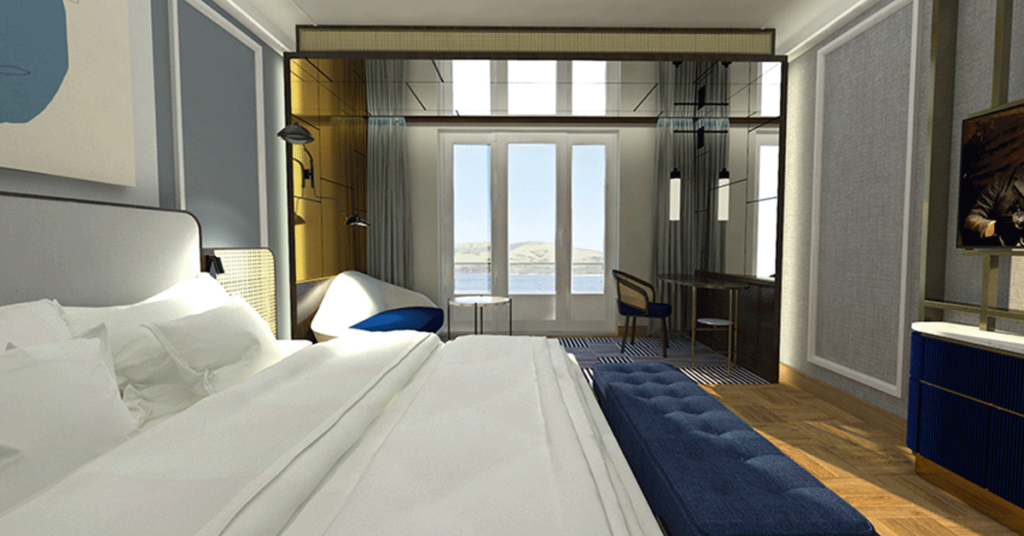
View into the dining room, in the background the fireplace by Alexandre Bigot and stained glass by Jacques Gruber. Image: S. Levaillant.
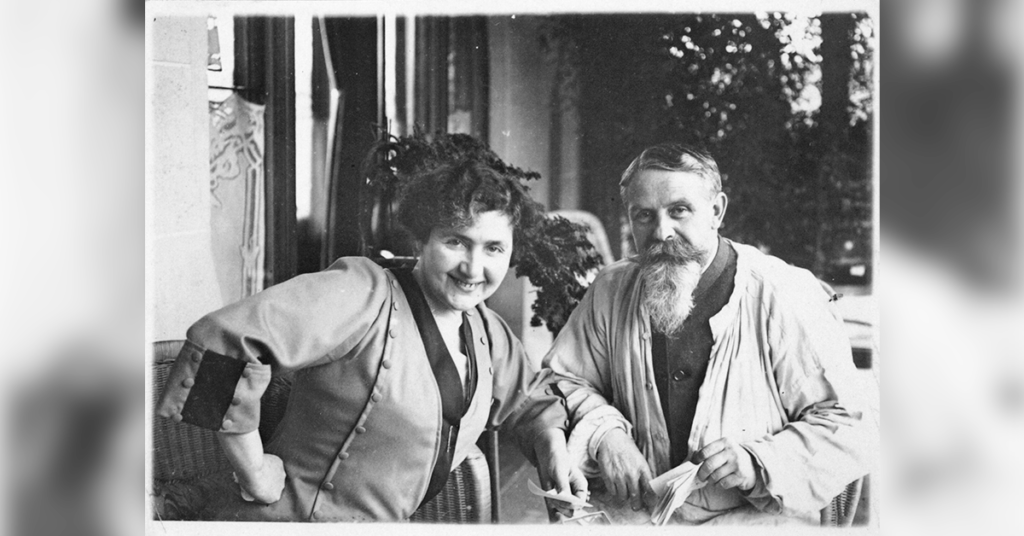
Jika and Louis Majorelle sitting on the terrace of the villa, photo from the Family album. Image: Musée de l'Ecole de Nancy.
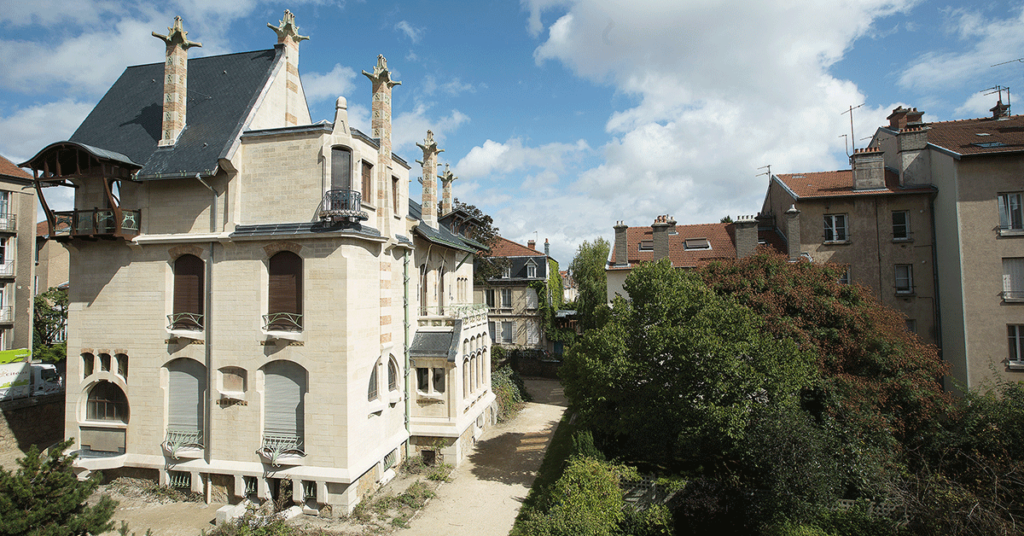
The Villa Majorelle in Nancy after the renovation. Image: P. Caron.
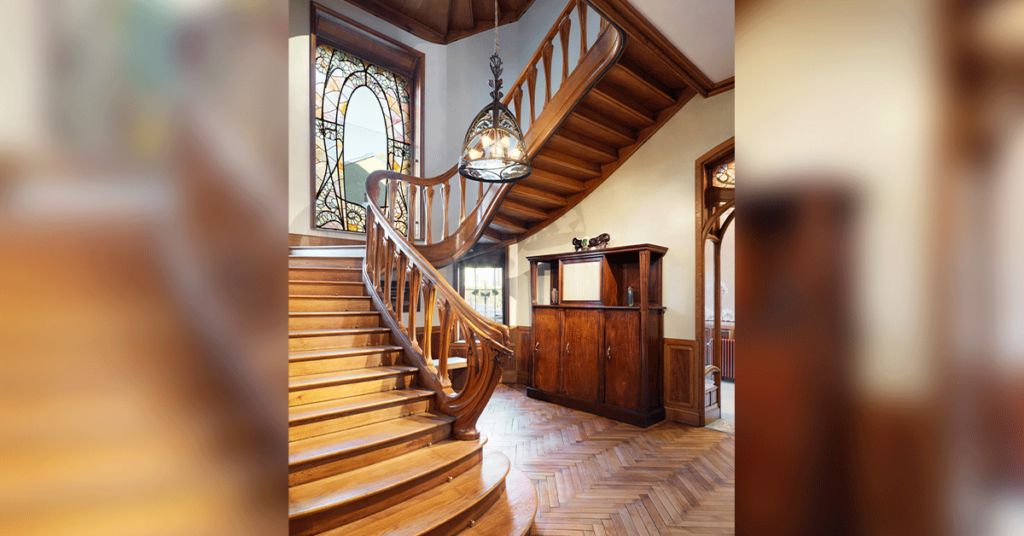
View from the ground floor on the stairwell. Image: S. Levaillant.
Under leadership, the company flourished and opened branches in Paris, London and Berlin, among others.
The Frenchman, born in 1859, was only 39 years old and was able to commission the construction of a magnificent villa. He relied on the then 26-year-old architect Henri Sauvage (1873–1932). The two gentlemen met in the house of their mutual friend – the sculptor Alexandra Charpentier. Sauvage had never worked on a project like this before. The only experience Sauvage could boast was working for a few months with the Brussels architect Paul Saintenoy. Majorelle liked the youthfulness and boldness of the architect as well as his good network in the art world. He preferred Sauvage to the experienced Nancy-based architect Lucien Weissenburger. Weissenburger was allowed to carry out the project on site.
The Majorelle family's photo album provided important information In the years 1901–1902 the villa was built according to Sauvage's plans. It was the first completely Art Nouveau house in Nancy and is considered a prime example. Sauvage did not build the villa single-handedly: he called on other renowned artists. For example his Paris friends, the ceramic artist Alexandre Bigot and the painter Francis Jourdain. Bigot carried out the ceramics, Jourdain designed the decorative paintings in the dining room. The furniture comes from Majorelle's own production. The landlord also took care of the ironwork and the railings. The stained glass windows in the main rooms (staircase, dining room, living room and bedroom) were designed by the master glazier Jacques Gruber. The majority of these artists belonged to the Ecole de Nancy, which Emile Gallé co-founded in 1901.
For four years, the Villa Majorelle was repaired internally and externally through extensive restoration work. The building, completely in Art Nouveau style, was commissioned in 1898 by Louis Majorelle, himself a cabinet maker, designer and blacksmith. Majorelle actually wanted to be a painter and studied at a young age at the School of Fine Arts in Paris. After the death of his father, he had to return to his hometown Nancy (F) early to take over the family business. He had modern furniture made and was inspired by nature and Emile Gallé. Gallé specialized in the material glass and did pioneering work in this area. He is one of the founders of Art Nouveau. Louis Majorelle's floral elements run from the facade to the interior of the house: they can be found in ornaments, carvings, mosaics and enamel work. Architect Sauvage arranged the windows and exterior doors to match the logic of the interior layout, breaking with the tradition of the horizontally symmetrical building. Flowing forms and decorative motifs run through the entire architecture. Sauvage played with the opposites: the bare Euville stone contrasts with the polychromy of bricks, stoneware, wood and ironwork. The constant presence of wood runs like a red thread through the interior design and creates a connection with the exterior of the villa.
The Villa Majorelle is considered a unique experimental work. Henri Sauvage later said: “I worked there for two years and I am deeply grateful to my first client for the incredible freedom he has given me. Despite my young age, he never imposed any budget restrictions on me or his personal ideas. " After completion, Louis Majorelle lived there with his wife Jane Kratz and their son Jacques. The building is also known under the name «Villa Jika» – after the initials of Jane Kratz.
Louis Majorelle died in 1926, the villa was inherited by his son, who sold the house to the state. He initially had offices built there. The gradual rediscovery of Art Nouveau led to the villa being classified as a historic monument in 1975 and finally a listed building in 1996. The city of Nancy has owned the villa since 2003. In the last few years the villa has been repeatedly renovated. In the most recent and most extensive renovation, the villa was returned to its 1926 state. The renovation work was carried out by the Atelier Grégoire André. Articles and publications from the time the villa was built provided important information about the original appearance of the house. The Majorelle family's photo album also served as a valuable source of information.
Some changes made afterwards were removed this time: For example, a bay window on the north facade was removed and the chimney hoods that were removed a few years ago for safety reasons were reinstalled on the roof. The facade was cleaned and damaged masonry replaced. The work on the outer facade and the roof only took two years.
Original Gruber window destroyed in bombing But the interior of the building was also completely restored in close collaboration with the Musée de l'Ecole de Nancy and a committee made up of Art Nouveau specialists and art historians. In order to create adequate reception areas for visitors, the cash register, cloakroom and souvenir shop are located in the kitchen and pantry area. A new elevator was installed, otherwise the wooden and mosaic floors as well as the glass work were completely redesigned.
The living room has an elaborate stucco decor with a pine cone motif, which can also be found on the furniture and the fireplace. The same motif was also used on Jacques Gruber's stained glass window. However, the Gruber window was destroyed in the bombing of Nancy in 1916 and replaced by another oriental-style window that can still be seen today.
Almost 100 pieces of furniture, paintings and art objects then found their way from the Musée de l'Ecole to the villa. Most of the furniture is original. Works were selected that were designed by Louis Majorelle and / or by companies with whom he had worked (Manufacture Daum, Manufacture Keller et Guérin, the ceramic workshops de Rambervillers and Frères Mougin). The choice depended mainly on the similarity to the objects visible in the old photos. In the same way, the museum has also selected from its collection paintings made by Louis Majorelle or his son Jacques.
Between 2021 and 2022, minor renovations will be carried out inside the villa, but these will not require the house to be closed. The works include recreating the bathrooms, creating teaching and educational areas on the first floor, and renovating Louis Majorelle's studio on the second floor. The costs so far amount to 2.5 million euros. ■
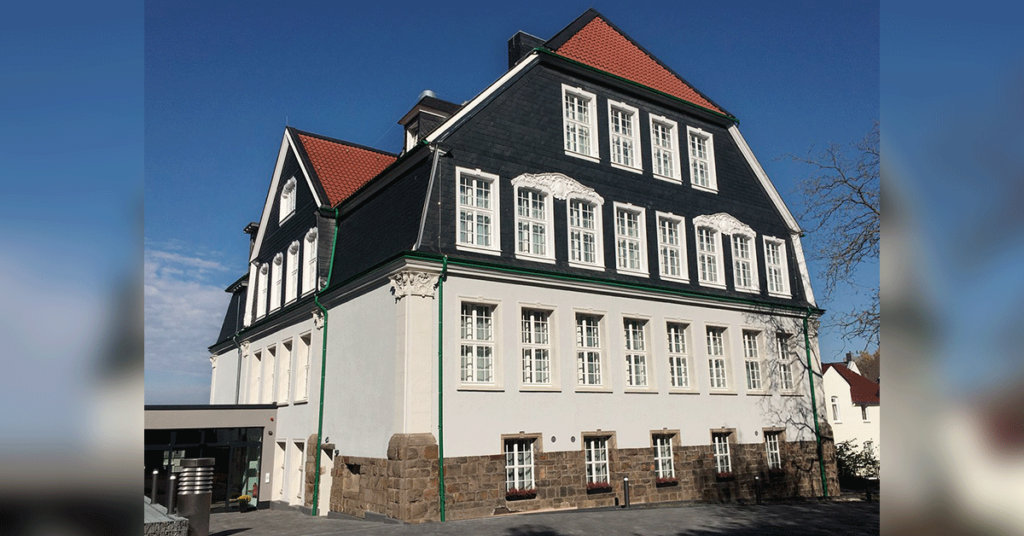
The original school house from the year 1915 shines as a hotel in new splendor.
The vision: A hotel is to be converted from a former school building, in which the original character of use and the original substance are to be retained. The Berlin hotelier Kurt Hermandung and his partner Marc Konopatzki have realized their dream of their own small private hotel. This is close to Düsseldorf, Cologne and the Ruhr metropolises. "We wanted a small, fine house with character that we can make something very special," say the owners. "After a long search, we came across this former elementary school – and an investor who could imagine turning it into a hotel and the former gymnasium into a restaurant." In terms of design and concept, the former schoolhouse from 1915 and the gymnasium added in 1980 were based on the original use of the building.
Classrooms became elegant hotel rooms The local architecture firm Wilde and Wehnau implemented this ambitious conversion concept, from the design to the implementation planning and construction management. Their services also included the concept of the monument protection concept, the planning of the interior design and the lighting design. The exterior facade with its typical slate shingles, the representative bay window and the green rain gutters were restored and preserved under the watchful eye of the listed building. The former classrooms of the primary school have been transformed into elegantly furnished single and double rooms with oak parquet and spacious bathrooms. A junior suite was installed in the attic. The minibars that used to be in the rooms are a thing of the past. The alternative is much more original and ecologically more sensible: A central “school kiosk” on the ground floor offers a variety of drinks.
A special feature in the house is the restored historical fountain with fresh drinking water, which extends over two floors, emphasize the hotel owners. Old certificates and photos are reminiscent of the earlier school days. You can find yourself in the whole building. Gym boxes serve as luggage racks in the rooms. The gym's old rung climbing wall was also given a new function. It serves as a partition to the stairs in the restaurant.
Former gym as a restaurant The rather unadorned gymnasium was completely dismantled in the course of the renovation work. The result is a modern building which now houses the “Die Turnhalle” restaurant, the lounge and the bar. In the historic school building, a lift provides barrier-free access to all floors and connects the hotel rooms with the restaurant. The latter is also open to the public. A newly installed ceiling divides the former gymnasium into two floors. This enabled the area to be doubled to 800 square meters. This made space for four conference rooms and a small bar for catering in the conference area. The extension with its large glass surfaces is a successful contrast to the old and lovingly restored school building and complements it in an ideal way. ■
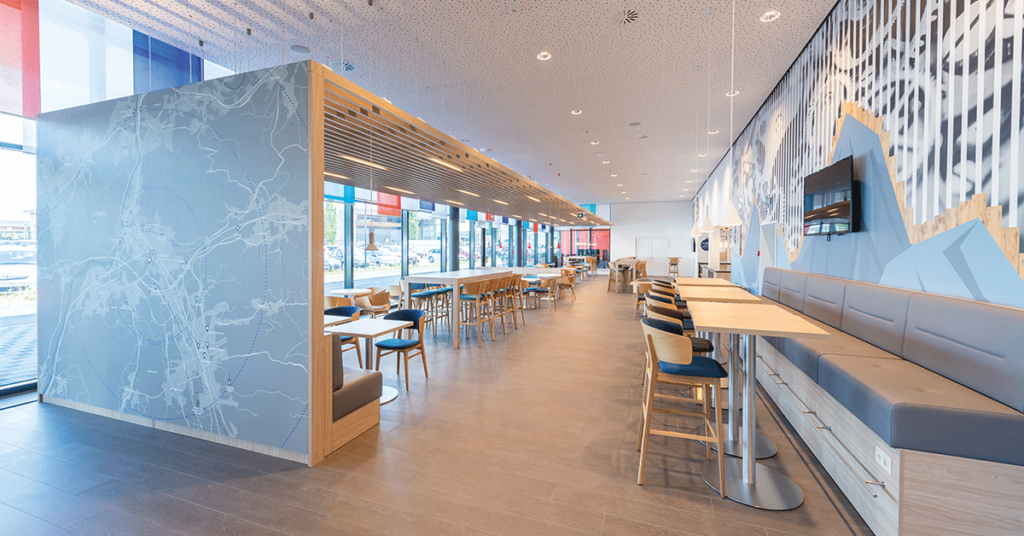
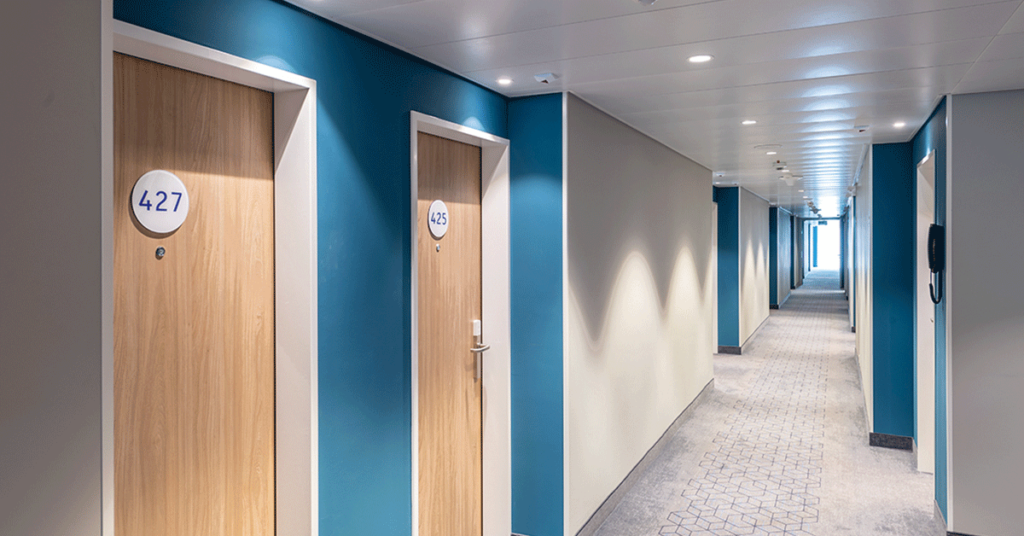
The 350 m2 acoustic Perforated ceiling on the first floor extends from the reception / lobby via the bar until Breakfast area.
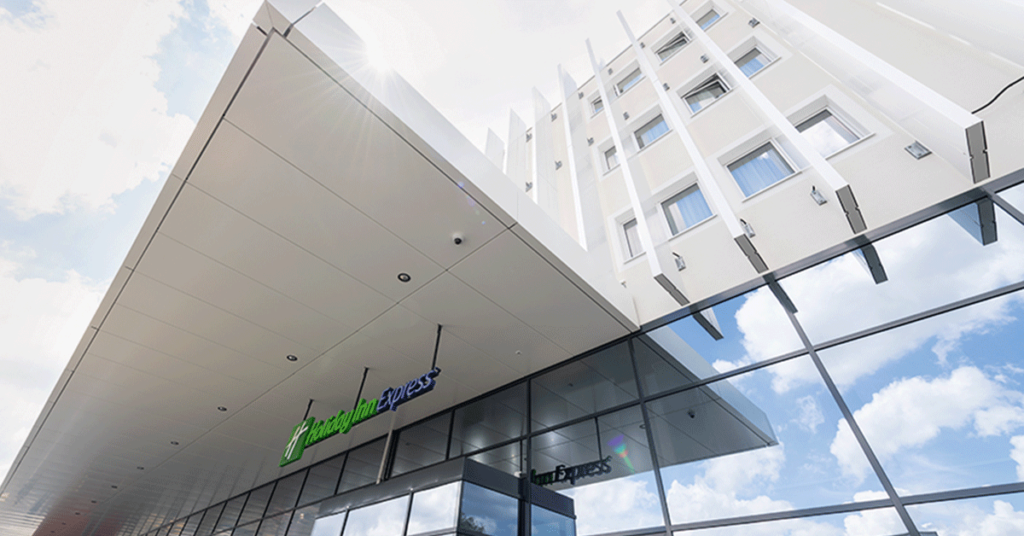
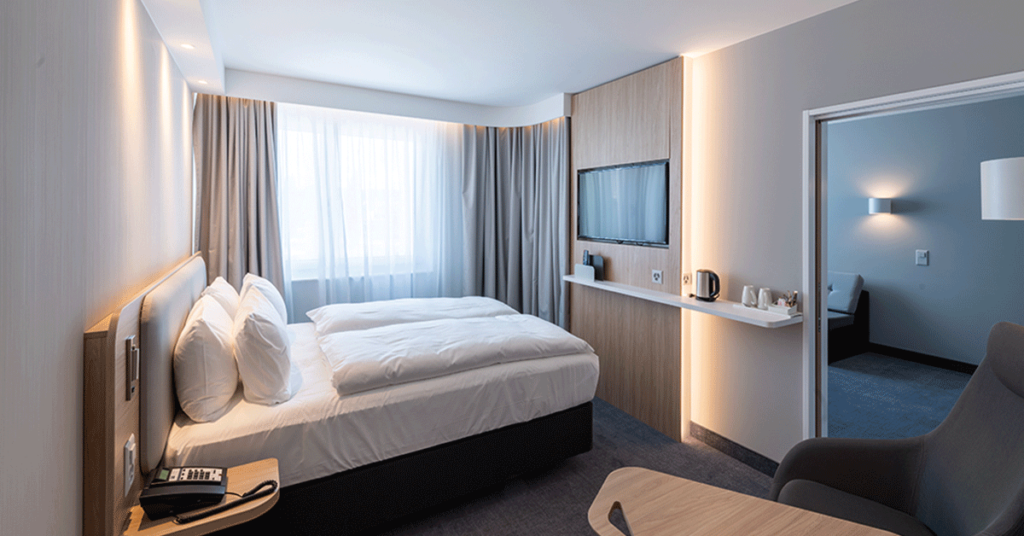
As part of the expansion of the Perry Center in Aarburg-Oftringen opened the Holiday Inn Express in early 2020 its sixth location in Switzerland.
The wooden grate ceiling above the dining tables is suspended from the special substructure of the acoustic ceiling, the Megastil® profiles, with threaded rods.
The corridor walls consist of conventional functional masonry with cladding made of plasterboard as fire protection.
The 80 guest rooms are separated by 205 mm thick plasterboard walls, which provide a sound insulation value of 65 dB and thus ensure peace and quiet.
The 3-star hotel offers 80 rooms. It has a breakfast room, a bar and a lounge. Guests can go straight to the Perry Center via a passageway, where they can shop and use the other range of restaurants and meeting rooms. It is primarily aimed at business people who are busy in the region and are looking for accommodation for one or more nights in this central location in terms of transport.
The physical possibilities of dry gypsum construction A hotel must above all meet two requirements: peace and security for its guests. The peace and quiet is made possible not least by the good construction quality, whereby dry gypsum construction systems are in no way inferior to conventional construction methods, on the contrary. In the Holiday Inn Express, among other things, a 350 m2 Rigiton® Ambiance acoustic perforated ceiling by Rigips spans a good five meters over the entire ground floor with reception, lobby, bar as well as breakfast and self-service area. The holes of different sizes (Ø 8, 15 and 20 mm) absorb the sound and provide a pleasant acoustic feeling of space. An elongated wooden slat ceiling that appears to float is built in over the tables in the breakfast room. It is mounted using threaded rods on the Megastil® special profiles from Rigips, which were used to reinforce the ceiling substructure in this section.
Sleep in peace and security The partition walls between the individual rooms consist of double-clad Rigips® double stud walls made of 12.5 mm plasterboard with a wall thickness of 205 mm and a sound insulation value of 65 dB. These constructions are of higher quality and yet more efficient to create than concrete or brick walls. And above all, they can be easily relocated should the spatial requirements change. The corridor walls are optimized in terms of sound and fire protection with cladding made of plasterboard, especially in the area of the shaft walls in which the building services are installed.
Standardized systems with tested performance values Rigips now has a catalog of hundreds of tested standard constructions for walls, ceilings and cladding. Their sound and fire protection, but also static and climatic properties vary depending on the height, structure and possibly the combination of systems with one another. It is therefore advisable to speak to drywall specialists from the earliest planning phase. In the case of larger projects in particular, Rigips' key project management, the consultant for planners and investors, can provide information on energy efficiency, life cycle assessment and moisture protection in addition to the relevant planning parameters for wall, ceiling and floor constructions. All construction variants can be called up in a clear system finder at www.rigips.ch. The systems are without exception in accordance with the applicable standards (EN, SIA) resp. Institutions (EMPA, VKF) tested and certified.
When space requirements change In our fast-paced society, space requirements are constantly changing. This can also be the case in a hotel. In order to remain attractive in the long term, a property must be able to react to changing needs and spatial dimensions. If you invest in a flexible construction method with as few load-bearing elements as possible, a wide variety of needs in the construction of the property, but also changes within the existing building envelope, can be implemented with little cost and time. Rigips® and Alba® drywall systems offer maximum freedom of planning and use. ■
Bringing building culture to life is the maxim of the Foundation for Monument Holidays. From 2021, for example, the renovation work on a former rectory in Valais, which is being converted into a holiday apartment, is to begin. The former rectory – called "Kaplanei" – is located in the Valais village of 400 people, Ernen. It was built in 1776 and used as a rectory until 1952. Since then, the property has been largely empty and is becoming increasingly dilapidated. That will now change because the Foundation Holidays in Monument was able to take over the building under construction law at the end of 2018.
The chaplaincy suffered from the long vacancy, says Nancy Wolf, who is responsible for marketing and communication at the foundation. Although the owners, in cooperation with the preservation of monuments, restored the outer facade, including the windows and the roof, there are neither modern kitchen facilities nor up-to-date sanitary and heating installations.
Building with its own house chapel The plan is to concentrate on the maintenance of the existing substance during the extensive renovation work – this mainly includes the repair of the interior. Only the fixtures in the kitchen and bathroom should be implemented cautiously in a contemporary design language. The well-proportioned pre-protection house is particularly impressive due to the alternation of wood and stone on its eaves and the doors and windows framed with red tuff stone. Those responsible for the project emphasize that they radiate wealth and dignity. Characteristic of this type of building, the rear part of the house with the kitchen was made of stone. Inside there is also its own house chapel. When entering the reception room, the benefice's parlor, one notices the neatly worked, strongly curved paneling with the deep bevelled edges, of which there are not many today, can be read in the project description. The cube-shaped stove shows Saint George on a horse, the patron saint of the church and the parish, as well as Saint Catherine with the wheel.
H out with a manorial character On the first and second floors you can find religious inscriptions in Latin, with which the residents probably wanted to give practical instructions on how to live, the preservationists suspect. One room on the upper floor has a vaulted plaster ceiling. In the middle is a painting. Painted, tulip-shaped flowers on the consoles and the arched portals to the cellar give the house its stately character. Future vacation home owners will soon be able to marvel at these treasures. ■
Building worthy of protection: medical practice withresidential building in Littau The original building – a residential building with an integrated doctor’s practice – was built by the Lucerne architect Josef Gasser in 1959. He was inspired by the well-known American architect Frank Lloyd Wright: In particular, by the prairie style influenced by Wright, which refers to the broad, flat landscape in the American Midwest. Accordingly, the architecture is characterized by an open room design, a horizontal, two-dimensional orientation and the use of natural materials. In cooperation with the Monument Preservation of the Canton of Lucerne, a prudent way of dealing with the building worthy of protection was found.
Clinker brick building inspired by Frank Lloyd Wright is being gently renovated Little was changed during the renovation of the external appearance of the existing clinker building. Interventions in the external appearance of the house were only carried out in the direction of the garden, in which the foundation had the extension built. The room layout and use was adapted for the necessary communal, administration, practice and care rooms. Work rooms, guest rooms and a “room of silence” were created on the existing upper floor. The whole house is now accessible with a lift.
Pavilion-like wooden structure for inpatient hospice A single-storey wooden pavilion with 12 rooms was created in the inner courtyard. Each room has its own wet room and a view of the garden. The two buildings are connected by a corridor that surrounds the new inner courtyard. The pavilion has a basement and is connected to the existing building underground. For a harmonious appearance, the new building was realized with a clinker brick and wooden facade and a roof edge made of pre-patinated copper.
Renggli AG supported the Central Switzerland Hospice Foundation as general planner. As part of the planning team, she helped design the architecture and coordinated the demanding specialist areas and partners involved. Renggli AG also acted as general contractor in the project. ■
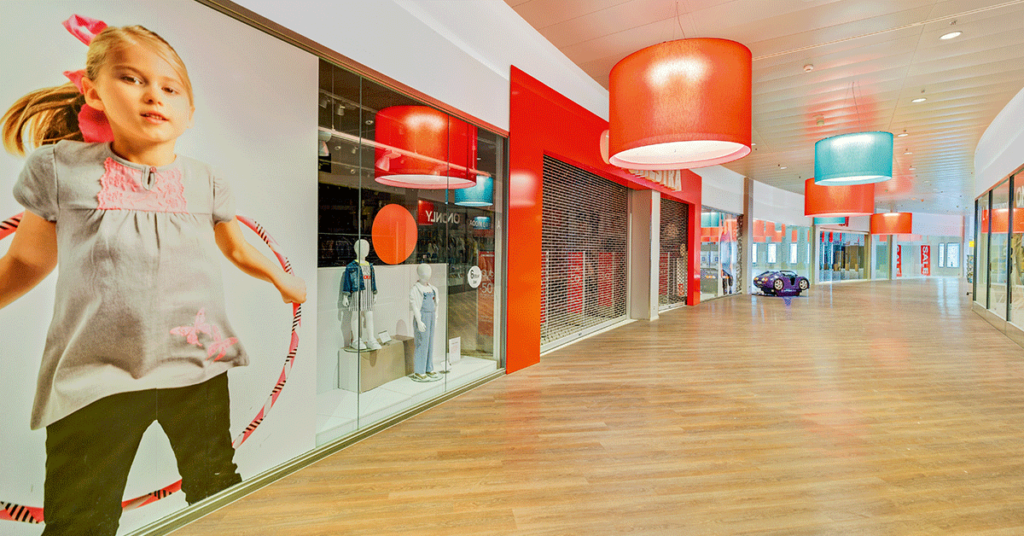
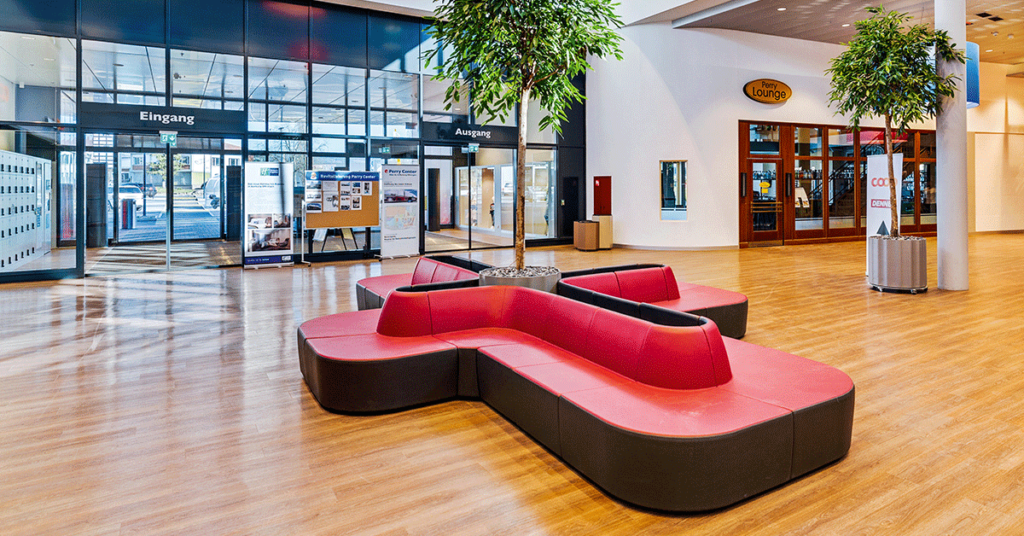
The project included not only adjustments to the sales and service areas as well as the catering offer, but also the construction of a modern hotel with 80 rooms. Today the Perry Center represents a new urban shopping experience.
Pure shopping pleasure Not only the bright and spacious areas, the expanded range of products and services in over 40 shops and a children's paradise ensure that visitors to the modernized Perry Center feel completely at ease. In order to ensure the most stress-free journey possible, a new parking system has also been introduced for the around 800 parking spaces. From the outside, the Perry Center will of course also have a new look after the work has been completed: a unique, 15-meter-high, illuminated lamellar facade makes the shopping center appear as high as the newly opened Holiday Inn Express Hotel. At night, the slender panels of the Perry Center are particularly noticeable when they shine in different colors. A total of 2600 running meters of LED strips are integrated into these slats. By the way, guests of the new hotel can access the shopping center directly via a walkway, where they can shop and eat.
Logistic masterpiece The client has commissioned Steiner AG as the executing total contractor. As a leading real estate developer as well as total and general contractor, it has already implemented numerous visionary projects throughout Switzerland. Since the entire revitalization of the Perry Center was carried out during ongoing operations, Steiner and all the subcontractors involved were faced with high requirements in terms of planning, implementation and logistics right from the start. Not only did the flow of visitors have to be optimally controlled during the construction phase, but existing tenants also had to move within the center. ■
There is a change at the top of the business location promotion department at the Zurich Office for Economics and Labor. Markus Assfalg is retiring after eleven years as head of location promotion, as announced by the office. He will be replaced by Fabian Streiff . The 35-year-old has been with the Basel Area Business & Innovation since the beginning of 2019 and heads the DayOne healthcare initiative. Prior to that, he was co-head of Basel-Stadt's economic development department.
One of the first to congratulate the cantonal location promotion and to Fabian Streiff is the location promoter of the city of Schlieren , Albert Schweizer. "We are very pleased with the choice of Fabian Streiff," he says. "We have known Fabian Streiff for a long time and have followed his work in the canton of Basel-Stadt very carefully."
The first apartment building in the canton of Basel to be certified according to the highest Swiss Minergie-A-Eco standard was moved into in 2015. As an investor, Immobilien Basel-Stadt commissioned the University of Applied Sciences Northwestern Switzerland ( FHNW ) to carry out a study three years ago. This long-term monitoring should clarify whether the demanding energy goals are being achieved and how the house is being accepted by the residents.
The new building at Basel Aescherstrasse 12 includes seven age-appropriate apartments with two and a half and three and a half rooms. According to a media release from Immobilien Basel-Stadt, the team of experts from the FHNW Institute for Energy in Buildings compared the calculated demand values from the planning with the actual consumption values in operation. The survey of the residents showed that the room temperature in most apartments is higher than the standard value from the planning.
Since the house should generate at least as much energy for the Minergie-A certification as is used all year round for heating, cooling and ventilation, it was then examined how the increased room temperatures affect heating energy consumption. The measurement results showed that, on the one hand, the heat pump was “much more efficient than assumed”. "On the other hand, the yield from the photovoltaic system on the roof was significantly higher than planned."
The energy production in the house today also exceeds the total electricity demand on an annual basis. There is potential for optimization through a partial waiver of building automation. This could improve the solar input in winter and night cooling in summer.
"The building concept has proven itself in operation", summarizes Immobilien Basel-Stadt. "The ambitious goals of sustainable building could also be achieved in practice without having to accept compromises in terms of comfort."
Primeo Energie intends to build two wind turbines by 2023 in one of the six wind farm areas that the district administrator identified in the Basel structure plan in 2015. The location is in the Muttenzer Hard between the A2 motorway and the tracks of the Swiss Federal Railways ( SBB ). According to a press release , the electricity provider will be working with the municipality of Muttenz and the canton of Basel-Landschaft .
With an annual output of 4.5 million kilowatt hours of electricity, the new wind turbine could supply an average of 1200 households with ecological energy. Primeo Energie is thus following the guidelines of the federal government's energy strategy and that of the canton of Basel-Landschaft.
"All necessary preliminary investigations" have already been carried out for the construction. "The location of the two turbines is ideal," says the message. The area is not in a landscape protection area. In addition, consumers in industrial and residential areas are close. Therefore, a network connection can be implemented with little effort.
In the trinational region of Basel there are not yet any wind farms except in the Black Forest. Primeo Energie cites the good ecological balance of wind turbines as a further plus point. In addition, they only had a minor impact on flora and fauna.
From September the first high-alpine solar project in Bergell will deliver natural electricity. As the operator Elektrizitätswerke der Stadt Zürich ( ewz ) announced in a press release , most of the more than 1200 photovoltaic (PV) panels have now been installed on the Albigna dam.
For the assembly work, a so-called bridge inspection device was transported to the dam wall with the Albigna cable car. Most of the construction work was carried out by ewz employees from Bergell.
Citizens from Zurich and Graubünden have the opportunity to purchase half, one, three or five square meters of the PV area and thus make a contribution to environmental and climate protection. The public participation model ewz.solarzüri provides that ewz customers are credited 180 kilowatt hours of solar power per square meter per year on their electricity bill. The term is 20 years. The one-off costs per square meter are CHF 560.
From August 14, interested parties can find out more and order panel space on the websites ewz.ch/solargrischun and ewz.ch/solar-für-alle . Until then, these links lead to the current page of ewz.solarzüri.
The construction service provider Implenia has received new building construction contracts in Germany. According to a press release , the order is worth around 108 million francs.
Implenia will construct three buildings with an area of around 25,000 square meters for Landmarken AG in an industrial park in Bochum-Laer. Construction is scheduled to start this fall.
As a European pilot project, the new construction of an innovative sports and leisure facility on an industrial wasteland in the Ruhr area "which is being built for the first time in continental Europe" is intended. The 60 systems of this type that already exist worldwide serve as a model. They should offer a mixture of entertainment, sport, music, gastronomy and events. Further systems are to follow, it says in the message. Construction will start in October and handover is planned for February 2022.
Prior exclusive partnership phases were decisive for the commissioning of both projects. Implenia worked with the customers and their planning teams to develop economic and technical suggestions for optimizing the project. "The result is cost and deadline security for the client as well as for Implenia."
In addition to these two projects in the Ruhr area, Implenia will build a residential complex in Mannheim-Waldhof and the expanded shell “for a well-known hotel chain” in Munich near the train station.
Previs Vorsorge is responsible for the new development in St.Gallen, according to a media release from the pension fund. The wooden superstructure will consist of two buildings with space for 110 rental apartments. The focus is on future viability and sustainability.
Certified wood and recycled concrete are used as building materials. Since the components are prefabricated, the construction time can also be reduced. It will be possible to move in as early as autumn 2021. There are numerous different apartment sizes available to those interested, from studios to 5.5 rooms.
A roof system contributes solar power, in principle the apartments are supplied with 75 percent renewable energy via district heating. There is a car sharing service available to residents, and they can also charge their electric cars in underground parking spaces. In addition, they can read their personal electricity consumption in real time via a so-called smart home system. A green space will be created between the two buildings, which will contribute to biodiversity with birdhouses and insect hotels.
Interested parties already have the opportunity to view the apartments in advance using VR (virtual reality) glasses.
So soll der Aussenbereich des Grand Hôtel & Centre Thermal nach dem Umbau aussehen.
Ein Projektbild des geplanten Neubaus.
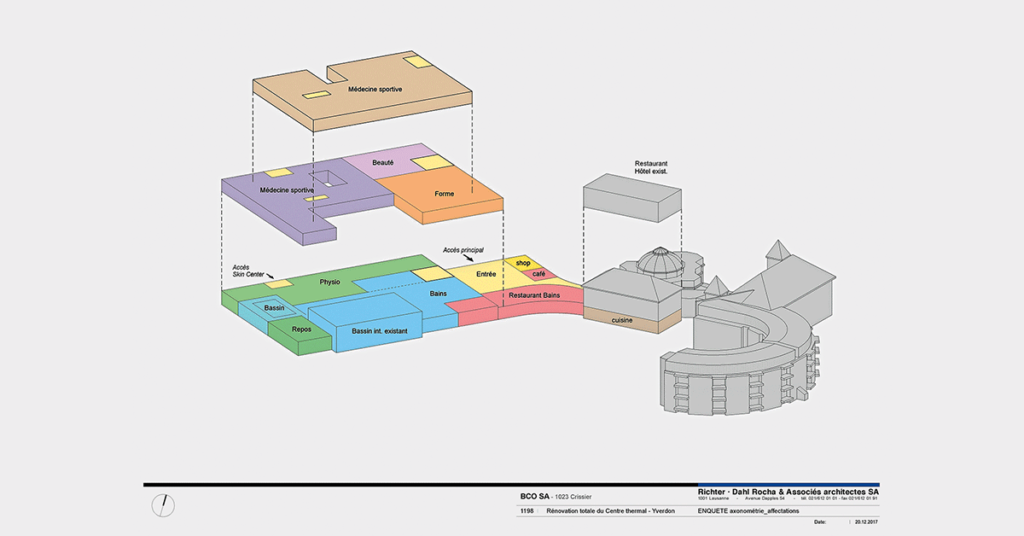
Seit Herbst 2019 wird das historische Hotel mit 116 Zimmern und Suiten während drei Jahren umgebaut. Das Gesamtbudget von rund 32 Millionen Franken enthält die Kosten für die vollständige Renovierung der Innenräume und des Aussenbereiches sowie des Thermalbades und des Grand Hôtels. Im Grand Hôtel werden die Zimmer und Bäder, die Küche und der Aussenbereich inklusive Schwimmbad renoviert. Der Eingang zu den Thermalbädern wird neu ausgestaltet und mit Geschäftsflächen und Restaurants erweitert. Die Umkleidekabinen werden renoviert.
Ein neues Café wird nur von den Bädern aus zugänglich sein. Die Zone um die Aussenschwimmbecken wird mit einem 350 m2 grossen Wellnessbereich mit Hamam und Sauna ergänzt. Der Fitnessbereich umfasst neu 700 m2. Während der gesamten Bauzeit wird das Thermalbad den normalen Betrieb aufrechterhalten. BCO SA, eine Tochter der BOAS-Gruppe, leitet die Bauarbeiten; das Architekturbüro Richter Dahl Rocha mit Sitz in Lausanne hat das Projekt ausgearbeitet.
Das Thermalbad von Yverdon-les-Bains besteht aktuell aus verschiedenen, zum Teil dreistöckigen Gebäuden, die untereinander verbunden sind. Im Aussenbereich stehen zwei grosse Schwimmbecken zur Verfügung. Das 4-Sterne-Superior-Hotel liegt inmitten eines prächtigen Parks mit altem Baumbestand. Aufgrund seiner langjährigen Geschichte strahlen die verschiedenen Räumlichkeiten des Grand Hôtels jeweils ihren eigenen, ganz besonderen Charme aus. So zum Beispiel die sogenannte Rotunde (kreisförmiger Bauteil), in der sich das Restaurant und die Lounge-Bar befinden oder der vor kurzem renovierte «Belle Epoque»-Saal und insbesondere auch das zum Hotel gehörende Schloss. Über einen Glastunnel ist das Hotel mit den Thermalbädern verbunden.
Neues Seedorf und neue Einrichtungen Der erste Schritt des gross angelegten Renovationsprojektes ist der Bau des Seedorfes im Park vor dem Hotel – am Ufer eines neu angelegten Weihers. Drei Holzbrücken führen die Besucher übers Wasser zu den Häusern, die verschiedene Wellnessbereiche wie Hamam, Sauna und Ruheräume beherbergen. Ein Barfussweg wird ebenfalls entstehen. Die bereits heute für die Physiotherapie und Arztpraxen genutzten Räumlichkeiten werden durch zwei Einheiten ergänzt: Entstehen soll ein Zentrum für Sportmedizin mit einem separaten Eingang. Weiter ist vorgesehen, die medizinischen Infrastrukturen räumlich zu konzentrieren, sodass die Patienten über eine grössere Privatsphäre verfügen. Durch die Verlegung des Thermalbadeingangs entsteht ein attraktiver, lebendiger Raum, durch den der Gast vom Hotel direkt zur Bäderzone gelangt.
Dieser Bereich umfasst 900 m2 und umfasst eine Empfangshalle, eine Boutique, ein Restaurant und ein Café. Der bislang für den Übergang genutzte, wenig ansprechende Glastunnel wird abgebaut. Renoviert werden zudem Küche und Restaurationsbereich. Die Fassaden und Dächer der Thermalbad-Gebäude werden abgerissen. Stattdessen wird einer äusseren Einfassung Platz gemacht, die den ganzen Komplex umfasst und vereinheitlicht. Die gesamte Fläche wird um eine Etage aufgestockt. Damit entsteht Raum für moderne, besser durchdachte, architektonisch homogen und stilvoll integrierte Inf- rastrukturen. Auch die Infrastruktur des Thermalzentrums wird optimiert: Das Hallenbad wird komplett renoviert und um ein neues Schwimmbad mit Spielbereich erweitert.
Infrastruktur des Neubaus in der Übersicht: Erdgeschoss Neuer Eingang, 600 m2 Boutiquen, Café / Restaurant, 360 m2 Bäder-Restaurant Bereich Physiotherapie (960 m2) mit unabhängigem Rehabilitationsbecken Neue Umkleideräume und Duschen Neues Innen-Schwimmbecken (Unterricht und Erholung) Inneres Becken vollständig renoviert Zwei Aussen-Schwimmbecken
Erste Etage Fitness-Raum, 700 m2 Schönheitspflege, 340 m2 Sportmedizinisches Zentrum (1160 m2) mit Anbindung an den Physiotherapiebereich und neuem separatem Eingang
Über BOAS Swiss Hotels Boas Swiss Hotels ist eine private Hotelgruppe mit Sitz in Crissier / Lausanne. Zur Gruppe gehören zehn Beherbergungsbetriebe in den Kantonen Wallis, Waadt und Genf. Die Hotels gehören mehrheitlich zur Kategorie der 3- und 4-Sterne-Superior-Betriebe. ■
At the beginning of the year, the Grand Hotel Geneva changed operators: Fairmont Hotels & Resorts, one of the luxury brands from the Accor Group, is taking over from the Kempinski Group. At the same time, the owner, Le Palace Genève SA, announced the extensive renovation of the hotel.
The Geneva 5-star hotel directly on the lake with a view of Mont Blanc is being remodeled by the French star architect Jean Nouvel. With his architecture office, he secured the contract in the context of an international architecture competition. Brigitte Jucker-Diserens' Geneva partner office is coordinating the project. The KKL Luzern, the Lyon Opera, the Galerie Lafayette in Berlin and the national museum in Doha all came from Nouvel's hands. He was awarded the Pritzker Prize in 2008 and has so far created over 200 structures.
Targeting the highest energy efficiency standards The renovation work should begin at the end of 2020 / beginning of 2021, once all permits have been received. One focus of the renovation is on the facade. It should be perfectly integrated into the environment and should be based on the design and materials of the other houses in the bay. The inner courtyard, the public areas and the restaurants are also being renovated. In addition, the hotel should meet the highest energy efficiency standards after the renovation. It is currently being clarified whether a thermal heating solution can be implemented. Then the hotel would be heated and cooled with water from Lake Geneva. This focus on sustainability is in line with the philosophy of the Fairmont brand.
The hotel has 412 rooms, including 33 suites and 14 apartments; three restaurants, a lounge and bar with a view of the lake, a heated indoor pool and a spa and fitness center. The number of rooms will be unchanged after the renovation, as the press officer at Fairmont Hotels & Resort, Philippe Eberhard, announced. The centrally located hotel will remain open during the renovation. According to Eberhard, the costs are likely to amount to tens of millions of francs.
Fairmont's portfolio currently includes 77 hotels in 29 countries, including the GrandHotel Geneva. The Fairmont Le Montreux Palace is also located on Lake Geneva. ■
The renovation work has been underway since September 2016: In St. Moritz, the former Hotel La Margna on Via Serlas is becoming the Grace Hotel. The owner is the internationally active Grace Hotel Group. She has the building carefully renovated and expanded with an annex. The opening was originally planned for 2017, was then postponed to autumn 2019 and is now to take place in 2022. The reason for the delay: the project was modified and expanded again after construction began. The number of hotel rooms was increased by a third to 56, as a correspondingly high demand is expected.
Upon completion, the hotel will include the historic “La Margna Wing” and the modern, newly built “Grace Wing”. In the "Grace Wing" an underground car park, a spa area as well as hotel rooms and suites are being built. In the “La Margna Wing”, the rooms on the upper floors are being completely renovated. The rooms on the lower floors are being restored so that the historical building fabric is preserved. Here guests will discover vaults, arches and other architectural features of Art Nouveau.
Art Nouveau meets modernity The former Hotel Margna was built in 1906 and 1907 according to plans by the architect Nicolaus Hartmann in the Engadin style. In 1911 the east wing was increased by three storeys. After that, renovations and renovations took place again and again, but the external appearance was never significantly changed. The striking facade is to be retained even after the current renovation.
The drafts for the project come from the pen of the architect Nikolas Travasaros from Divercity Architects. For him, the main challenge was to freshen up the original architecture and at the same time create a modern extension for additional rooms and a spa. In addition to taking into account the strict building regulations and the given restrictions due to the sloping terrain, Travasaros had to plan hotel rooms that can also be converted into long-term apartments.
His plans combine old and new by expanding the base of the existing building. The extension follows the natural gradient and fits seamlessly into the landscape. The new wing is deliberately kept discreet and does not overshadow the traditional architecture and the breathtaking alpine surroundings. Panoramic windows and adaptable, open interiors create a feeling of light and space.
Blarer & Reber Architects in Samedan are responsible for the planning and implementation on site. The preservation of monuments in Graubünden was included in the project development so that the greatest possible preservation of the historically valuable building fabric is guaranteed. The STW AG for spatial planning based in Chur was also included in the project team.
All rooms and suites of the boutique hotel Grace St. Moritz will offer lake or panoramic views. Three restaurants and a spacious spa area with swimming pool as well as a fitness center on over 800 square meters are planned. The hotel has a private car park and is just a 2-minute walk from the train station and the bus stop. A ski shop and ski room are also planned. Serviced apartments are also to be offered for sale in both wings. ■
Only photovoltaics can show Switzerland the way to a CO2-free future, writes the Deputy Director of the Federal Materials Testing and Research Institute ( Empa ), Peter Richner, in an article for Avenir Suisse . It is based on the so-called Kaya identity, which the Japanese scientist Yoichi Kaya used in 1993 to describe the total amount of anthropogenic CO2 emissions as a function of four factors. The fourth alone, a reduction in the CO2 footprint, has enough potential, according to Richner, to achieve Switzerland's climate goals – through massive expansion of photovoltaics.
If only 50 percent of all Swiss roofs were equipped with solar modules, electricity production from nuclear power plants would be superfluous. Richner demonstrates this in terms of electricity supply and demand for 2015. However, if all roofs and increasingly also building facades were equipped with solar panels, the output gap in winter could also be compensated for. At the same time, however, solutions would have to be found in order to be able to utilize the largest possible proportion of the electricity surplus in summer, both on a daily basis and at other times of the year.
For increased flexibility of use, day storage systems could shift loads, for example through batteries or hydrogen. Digitization offers opportunities for the necessary creation of flexibility in consumption and production. Excess electricity could be converted into hydrogen in summer and possibly, together with CO2 from the air, into methane or liquid synthetic hydrocarbons. These chemical energy carriers can be stored easily and used in a variety of ways. And finally, seasonal heat storage systems could be charged with excess electricity in order to reduce energy requirements in winter.
The potential of energy efficiency, another influenceable factor of the Kaya identity, is far from being exhausted, says Richner. However, achievements in this area would be compensated for by higher electricity demand, fossil electricity imports from abroad in winter or increased electricity consumption.
In order to achieve a climate-neutral Switzerland, one of the four factors in the Kaya identity must be zero or the remaining product is offset with CO2-negative technologies such as the separation of CO2 from the air and its storage. Politicians must provide a decisive framework for this, as long as the nuclear power plants are still running.
A team of researchers from the Eidgenössische Materialprüfungs- und Forschungsanstalt ( Empa ) has developed a new technology. This enables concrete to be produced and used more sustainably. For this purpose, the materials used in the manufacture of self-prestressed concrete elements are reduced.
With conventional prestressing, steel tendons are usually anchored on both sides of the concrete element, put under tension and then removed again. Because the steel is susceptible to rust, “the concrete layer around the prestressing steel must have a certain minimum thickness”, according to Empa in a press release . Researchers have therefore been working on replacing steel with carbon fiber reinforced plastic (CFRP) since the 1990s. However, this process is very expensive and also significantly more complicated than the prestressing process with steel.
Empa has now completely solved these problems. Thanks to her method, she can dispense with anchoring on the sides of the element. Instead, its recipe enables the concrete to expand as it cures. "As a result of this expansion, the concrete puts the CFRP rods inside under tension and thereby automatically pretensions them."
"Our technology opens up completely new possibilities in lightweight construction," said Mateusz Wyrzykowski, who heads the Empa team together with Giovanni Terrasi and Pietro Lura. "Not only can we build more stable, but we also need considerably less material."
The team recently received patents in Europe and the United States for its technology. It is now developing new applications together with industrial partner BASF.
Wir verwenden Cookies zur Unterstützung und Verbesserung unserer Dienste. Mit der Nutzung dieser Website erklären Sie sich mit der Verwendung von Cookies einverstanden. Weitere Informationen finden Sie in unserer Datenschutzerklärung.