Category: immoNews

  • Transformation programme proves effective at access technology specialist

    Transformation programme proves effective at access technology specialist

    Dormakaba generated total sales of CHF 1.362 billion in the first half of the 2025/26 financial year, i.e. up to 31 December 2025, representing a decline of 4.1 per cent compared with the same period of the previous year. While volumes were down, “consistent price realisation” resulted in organic growth of 2.0 per cent, according to a statement. Adjusted earnings before interest, taxes, depreciation and amortisation (EBITDA) amounted to CHF 211.9 million, 1.9 per cent less than in the same period of the previous year. The EBITDA margin, on the other hand, increased from 15.2 to 15.6 per cent.

    “In the first half of 2025/26, we continued to consistently implement our transformation and increased our adjusted EBITDA margin. We are on track with the implementation of our strategy and have realised the planned cost savings from our transformation programme ahead of schedule,” CEO Till Reuter is quoted as saying in the press release.

    The company confirms its forecast for the full year 2025/26. Dormakaba expects organic net sales growth of between 3 and 5 per cent, an adjusted EBITDA margin of more than 16 per cent and an adjusted operating cash flow margin of between 11.5 per cent and 12.5 per cent. This margin was 4.5 per cent in the first half of the year, compared with 7.4 per cent in the same period last year.

  • Foundation stone laid for mixed-use building in Frenkendorf

    Foundation stone laid for mixed-use building in Frenkendorf

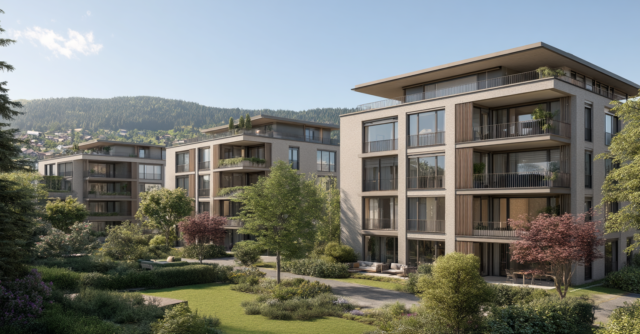
    According to a statement, Halter AG has laid the foundation stone for the Park3project. Also involved were the client Zurimo “B” Immobilien AG, represented by UBS Fund Management (Switzerland) AG, representatives of Reuter Architekten, the municipality of Frenkendorf and the planning, marketing and implementation teams involved.

    The mixed-use residential and commercial building will be a five-storey structure with an attic, combining living, working and commercial space under one roof. The plot size is 2,607 square metres and the construction costs amount to 14 million Swiss francs. Flexible commercial space will be created on the ground floor, with modern office units on the first floor. The upper floors will feature 22 apartments with 2.5 and 3.5-room floor plans. The project is being developed in an area with good infrastructure connections, which is increasingly gaining urban quality as part of urban development. The site is currently used primarily for commercial purposes.

    The building plans for the project, a UBS annual report and the current issue of the Halter Group’s KOMPLEX magazine were placed in the foundation stone as contemporary documents and permanently anchored in the foundations.

    The focus is now on the construction of the shell, which is scheduled for completion by the summer. The project is scheduled for completion in spring 2027.

    Halter AG is a real estate and construction company operating throughout Switzerland. The company handles a construction volume of around CHF 800 million per year at seven locations and currently has around 320 projects in development and execution.

  • Communities on Lake Zurich strengthen economic networking

    Communities on Lake Zurich strengthen economic networking

    The Gold Coast location promotion agency has published its first annual programme. The association was founded in September 2025 by the eleven municipalities of the Meilen district and the Office for Economic Affairs of the Canton of Zurich.

    According to a press release, members benefit from free participation in events, excursions and background discussions, direct access to decision-makers and increased visibility. The first general meeting will take place on 15 April in Stäfa, Zurich. Dr Moritz Lechner, co-founder and co-chairman of the board of directors of Sensirion, will speak as a guest speaker.

    The press release also mentions a members’ lunch with a workshop visit to Micro Mobility Systems AG in Küsnacht and a members’ morning snack at the Zumikon municipal administration. This will be followed in August by an after-work excursion to Seepark Uetikon, where apartments for around 600 people are being built on the site of a former chemical factory. An excursion to the Zurich Cantonal Council is also planned.

  • Research develops climate-friendly alternative to cement

    Research develops climate-friendly alternative to cement

    The production of cement as a binding agent for concrete accounts for 8 per cent of global carbon dioxide emissions. Researchers from various European universities and institutes are working under the leadership of the Karlsruhe Institute of Technology (KIT) in Germany to develop alternatives to cement. According to a press release, the Zug-based building materials manufacturer Holcim is involved in this research work as part of the European C-SINK project.

    The research focuses on magnesium-containing silicates, which react with CO₂ to form magnesium carbonate in a targeted, accelerated mineralisation process. This additive could be the new binder for concrete, replacing Portland cement clinker. The material is currently being tested in the KIT laboratories with the participation of all parties involved. This involves close integration of simulation, experimental research and large-scale, realistic testing at the Materials Testing Institute in Karlsruhe. “We can use simulations and machine learning to predict which concrete formulations will work,” says Frank Dehn, head of the Institute for Solid Construction and Building Materials Technology and the Karlsruhe Materials Testing and Research Institute at KIT, quoted in the press release. “We then use experiments in a targeted manner to verify these predictions. In this way, we want to develop reliable parameters that show that concrete with the new binder is climate-friendly and meets the requirements for load-bearing capacity, durability and safety.”

    The project is funded by the European Innovation Council (EIC) as part of the Pathfinder programme “Towards cement and concrete as a carbon sink”. In addition to KIT and the coordinating PAEBBL AB (Sweden), the Technical University of Delft (Netherlands), the Catholic University of Leuven (Belgium), the Agencia Estatal Consejo Superior de Investigaciones Científicas and PREFABRICADOS TECNYCONTA S.L. (both Spain) are also involved, with support from Holcim Technology. The project is funded with 4 million euros over a period of four years.

  • New technology extends the service life of old bridges

    New technology extends the service life of old bridges

    The bridges, which were built in the 1980s, are showing increasing signs of fatigue and need to be repaired. Researchers and engineers from the Structural Engineering Department at the Swiss Federal Laboratories for Materials Science and Technology (Empa) in Dübendorf are working on new methods for renovating these bridges. For their experiments, they are using a bridge deck made of ultra-high-performance fibre-reinforced concrete (UHPFRC) reinforced with shape memory steel, according to a press release. This steel is an iron-based steel made from an alloy containing manganese, silicon and chromium, among other elements. The fibre-reinforced concrete is bonded to this steel. When heated, the steel contracts and closes any cracks that have appeared in the concrete.

    The researchers led by Angela Sequeira Lemos and Christoph Czaderski carried out corresponding experiments in Empa’s construction hall. Five concrete slabs, each five metres long, simulate bridge elements. One of these remained unreinforced, while the others were reinforced with conventional reinforcing steel or shape memory steel. For the test, cracks were made in the slabs to simulate real-life wear conditions. The results showed that the combination of fibre-reinforced concrete and shape memory steel was more effective. It was able to close cracks and lift sagging bridge sections. “We were able to show that our system not only works, but can actually revive existing bridges,” Angela Sequeira Lemos is quoted as saying in the press release.

    The research project was funded by Innosuisse and supported by OST– University of Applied Sciences of Eastern Switzerland, re-fer, a spin-off of Empa in Seewen, and the Swiss Cement Industry Association cemsuisse. A practical test on a real bridge could spark interest from industry. “And with increasing demand, material costs are also likely to fall – then this technology could bring about lasting change in bridge renovation,” Sequeira Lemos is convinced.

  • Construction site for retirement home in Schlieren to be set up in March

    Construction site for retirement home in Schlieren to be set up in March

    From the beginning of March 2026, the construction site for the new Schlieren retirement home “Wohnen am Stadtpark”will be visible to the public. Preparatory work will then begin there. Two appeals had led to a one-year delay, but these were withdrawn in December 2025. The legal proceedings have now been concluded. According to a statement from the city of Schlieren, the construction site can now be set up and the initial construction and preparatory work can begin. The official ground-breaking ceremony is scheduled for April 2026. Construction work is expected to be completed by the end of 2028.

    As construction begins, the playground on the western edge of the city park will also be dismantled starting in early March. According to the city, a new municipal playground is already being built at Stürmeierhuus. It is scheduled to be completed in April.

    In the referendum on 12 March 2023, a loan of CHF 44.32 million for the construction of the new retirement home was clearly approved with 76.6 per cent voting in favour. As the city emphasises, it makes “an important contribution to ensuring modern, needs-based care and nursing for the elderly close to their homes”.

  • Cooperation aims to secure landfill capacity in the long term

    Cooperation aims to secure landfill capacity in the long term

    The cantons of St. Gallen, Thurgau and Schaffhausen are working together to plan new landfills for slag from waste incineration plants, according to a statement from the Department of Construction and Environmentof the Canton of St. Gallen. Over the next two years, the waste management authorities of the three cantons will develop a coordinated plan that identifies the need for landfill volume and landfill sites. The aim is to ensure secure waste disposal for the next 30 years and to exploit economic and ecological advantages.

    The starting point for the collaboration is the foreseeable shortage of suitable landfill volume. The incineration of waste in waste incineration plants produces waste incineration plant slag that cannot be further recycled and must be stored in specially secured type D landfills. Such facilities are in short supply both in the participating cantons and throughout Switzerland. Without additional capacity, there is a risk of bottlenecks in waste disposal in the medium term.

    Coordinated planning aims to optimise existing cantonal waste streams, exploit economic and ecological advantages and enable the rational use of individual sites. In this way, the three cantons want to offer long-term planning and disposal security for waste producers as well as waste incineration plants and landfills.

    With this project, the cantons are fulfilling their legal mandate for waste planning. This includes determining future landfill requirements and identifying suitable locations. The jointly developed planning basis will then serve as the foundation for cantonal planning instruments such as structure plans and other procedures.

  • Canton Zurich creates interface with innovation park

    Canton Zurich creates interface with innovation park

    According to a statement, the canton of Zurich has created the Zurich Innovation Park specialist unit. This implements a decision by the cantonal government in April 2025 to transform the coordination unit, which was previously managed by an external mandate, into a regular organisation. The specialist unit is based in the Office for Economic Affairs and began operations at the start of the year.

    The centre is responsible for ensuring the division of tasks between the Department of Economic Affairs, the Innovation Park Foundation, IPZ Property AG and IPZ Operations AG. It coordinates cantonal projects and involves various stakeholders in the local communities, the federal government, the business community and other partners.

    In addition to the Innovation Park as the most important area development project in the canton, the specialist unit will also focus on the active development of commercial space as a key location factor. This involves space for the growth, transformation and establishment of companies, particularly in or around the Innovation Park, but also throughout the canton.

    Benjamin Grimm is the first head of the specialist unit. The geographer has a Master’s degree in Spatial Development and Infrastructure Systems from the Swiss Federal Institute of Technology Zurich and a Master of Advanced Studies in Real Estate from the University of Zurich. He has worked for the Federal Office for Spatial Development and the Office for Spatial Development of the Canton of Zurich, among others.

  • Research project focuses on seasonal energy storage

    Research project focuses on seasonal energy storage

    According to a LinkedIn post, the University of Applied Sciences and Arts of Western Switzerland (HEIG-VD) and the engineering firmPlanairhave launched the BIG4HEAT project. BIG4HEAT will run for two years and is supported by the Swiss Federal Office of Energy (SFOE). Services Industriels de Genève (SIG), Groupe EausGranges-Paccot FR and Cadcime, based in Eclépens VD, are also industrial partners in the project.

    The main objective of the project is to develop an underground seasonal heat storage facility (Chemical Thermal Energy Storage, CTES). The heat energy is to be stored in summer and then used in winter. HEIG-VD and Planair want to use old cisterns for this purpose, which will be converted into heat storage facilities in line with the principles of the circular economy and retrofitting, i.e. the conversion of older facilities. According to HEIG-VD, “seasonal storage could reduce the electricity deficit in winter by almost 20 per cent”. With this project, HEIG-VD and Planair aim to reduce CO2 emissions and create space in urban areas from 2030 onwards by using underground storage facilities.

    Founded in 1956 and based in Yverdon, HEIG-VD conducts research in collaboration with companies, local authorities and national and international partners in various fields such as energy and sustainable development. Planair, based in La Sagne NE, is active in the fields of energy transition and renewable energies.

  • New cooperation improves precision in surveying and construction

    New cooperation improves precision in surveying and construction

    Fixposition announced a collaboration with Topcon Positioning Systems at the Geo Week 2026 trade fair. The fair is taking place in Denver, Colorado, until 18 February 2026. According to a press release, the Schlieren-based specialist in real-time kinematic (RTK) and visually assisted positioning will provide its solutions to the Californian company. The technologies developed by the spin-off of the Swiss Federal Institute of Technology Zurich, founded in 2017, are to be integrated into the high-precision satellite-based positioning systems of the Californian company Topcon.

    Topcon offers high-precision GNSS (Global Navigation Satellite System) positioning technologies for geomatics, construction and agricultural applications worldwide, according to Ron Oberlander, head of Topcon’s Geomatics platform. The integration of Fixposition’s visual positioning technologies will help his company create added value for its customers.

    “Fixposition has developed technology that improves satellite positioning and benefits users even when working inside buildings and transitioning between indoor and outdoor areas, without disrupting the workflow, by combining RTK-GNSS with artificial intelligence to ensure positioning accuracy. We see this AI-powered technology as an innovative integration into our next-generation GNSS solutions.”

    Zhenzhong Su, CEO and co-founder of Fixposition, says he is “proud to deliver Fixposition’s xFusion, Vision and multimodal fusion positioning technology to support Topcon’s next-generation GNSS solutions. We look forward to bringing this new solution to market and helping surveying professionals in geomatics, construction and agriculture achieve faster results and do more without compromising on quality, even in environments where GNSS connections are difficult.”

  • Relocation marks new stage of development

    Relocation marks new stage of development

    HKGhas decided to relocate within Baden-Dättwil. According to a press release, the engineering and consulting firm will be located at Täfernstrasse 14A in Baden-Dättwil from 1 March 2026. The new location offers more space than the previous address at Im Langacker 20.

    For HKG, this marks “a new chapter in the further development of the location,” according to the company. The relocation will create space for further growth and the future of the electrical engineering, building technology and energy consulting provider, which was founded in 1978 according to its own information.

    The additional space will create a better working environment “for creative ideas, efficient collaboration and future-oriented work”. Employees will be able to develop their full potential in a “modern home” and implement projects even more successfully.

  • Startup accelerates engineering simulations with AI

    Startup accelerates engineering simulations with AI

    Hardware development and material testing today rely heavily on physics-based simulations for design, validation and production. These calculations often take hours or days and incur high costs, which delays projects and pushes back production launches. Engineers therefore often reduce model complexity to shorten calculation times, at the expense of accuracy and proximity to real operating conditions.

    Physics-aware AI for faster workflows
    Fainite is developing a physics-aware AI platform that speeds up and simplifies existing simulation workflows. The engine learns from physics-based simulations and can derive accurate predictions without relying on large historical data sets. Engineers set up new workflows in minutes, run simulations much faster and can intelligently reuse previous results, even with limited amounts of data. An integrated AI agent guides them through complex steps, suggests settings and makes advanced analyses usable for broader teams.

    cHF 150,000 for scaling and market entry
    The CHF 150,000 from the Venture Kick programme will be used to expand the technology to additional engineering disciplines and use cases and to build a scalable platform with next-generation functionalities. At the same time, the funds will strengthen the team structure and go-to-market activities in order to accelerate deployment at industrial companies. The company is thus addressing around 9 million hardware engineers worldwide whose work is currently slowed down by slow, complex simulation processes.

    Founding team with physics and AI expertise
    The start-up was founded by researchers and engineers from Caltech, ETH Zurich, the University of Cambridge and Google, including CEO Alex Donzelli, Chief Scientist Prof Burigede Liu and ML Lead Matthias Bonvin. The team is complemented by former executives from established simulation software manufacturers, bringing together in-depth expertise in deep learning, computational physics and industrial simulation platforms. According to Alex Donzelli, Venture Kick’s funding, feedback and network have been instrumental in moving quickly from technical validation to the first industrial applications.

  • Why the real estate industry is tackling digitalisation

    Why the real estate industry is tackling digitalisation

    Mr Caspar, pom is regarded as one of the leading consulting companies in the areas of digitalisation, transformation and sustainable property development. How would you describe your role within this ecosystem?
    At pom, we see ourselves as an intermediary between research, development and practice in the property industry. Our role is to recognise new topics at an early stage, classify trends and develop an understanding of what will move the industry in the future. We translate this knowledge into concrete use cases, recommendations and a basis for decision-making for our clients. In doing so, we help companies to separate the important from the unimportant and to focus specifically on those methods, technologies and data that actually create added value for their role in the property industry.

    Which topics are your customers currently most concerned with: data, processes, organisation or technology?
    There is no simple answer to this question. In recent years, the focus has been very much on technology. Many companies have introduced new systems and launched numerous digitalisation projects. This has certainly brought progress, but has also led to a certain amount of disillusionment. Projects were more time-consuming, more expensive and more complex than expected. This was often due to the fact that data and processes were underestimated. We are currently observing a clear shift away from purely technology-driven projects towards more data- and process-orientated approaches. The current AI hype is further reinforcing this development.

    pom emphasises that data is the foundation of modern property management. Where do Swiss companies stand today in terms of data readiness?
    Basically, Swiss property companies are not in a bad position. Most of them have sufficient data readiness to operate their core processes reliably and answer relevant stakeholder questions, but we see a need for development in automation in particular. This requires data to be structured, consistent and available company-wide. Data-intensive topics such as ESG show where the limits lie. Another important point is collaboration across company boundaries. The property industry has always been highly networked. Greater data readiness is crucial to making this collaboration more efficient, digital and automated in the future.

    What are the most common misconceptions about the digitalisation of property portfolios?
    The effort and complexity are often underestimated. In particular, the provision and preparation of the required data is estimated too optimistically. Although data is available, it is often not of the necessary quality or structure. This leads to delays, additional costs and extra work for the specialist departments that should actually be doing their core business. Another misconception is that digitalisation projects can be implemented “on the side”. Professional project structures and the corresponding expertise are often lacking. This has a negative impact on motivation, acceptance and ultimately the success of the project.

    Which technological developments will change the property sector the most in the next 5-10 years?
    Basically, we distinguish between two levels: the digitalisation of the property itself and the digitalisation of the companies that operate these properties. At building level, we are seeing major advances in the cloud, IoT and digital models. The digital mapping of properties, often referred to as the digital twin, is increasingly becoming the standard and enables new forms of automation, while at company level, development will be strongly characterised by AI and process digitalisation. A small number of core applications, combined with flexible low-code platforms, will make it possible to automate processes efficiently and across companies.

    Many companies are experimenting with AI. Where do you see realistic fields of application in the next 24 months?
    In the short term, there is great potential in analysing and evaluating documents and unstructured data. Content can be summarised, evaluated and created more quickly. Another important step is the integration of AI tools into everyday working life, for example as assistance solutions. The next step will be to increasingly link these systems with company-specific data. Reporting and analyses will also change: instead of fixed reports, information will be compiled according to the situation and needs.

    What risks do you see in the use of AI in the property industry?
    We see the biggest challenges less in the regulatory area and more at a cultural and technological level. Many companies do not yet have the necessary skills and structures in place to deal with data and technology. In addition, the Swiss market is highly fragmented and heterogeneous, which makes it difficult to introduce standardised solutions. The property industry is project-orientated and has little serial logic. This further slows down the introduction of new technologies.

    Rate of adoption instead of technology: what are the biggest cultural hurdles?
    A key hurdle is that digitalisation is not yet anchored as a strategic topic in many companies. A lack of expertise, unclear responsibilities and the expectation of implementing digitalisation “on the side” are slowing down implementation. In addition, there is often a lack of willingness to consistently scrutinise and change existing ways of working.

    How is digitalisation changing roles in real estate companies?
    Digital skills will be part of the basic qualification of many roles in the future. The focus will be less on a deep understanding of technology and more on secure user knowledge. At the same time, new roles are emerging, for example for the management of digitalisation projects and digital platforms. These functions ensure that systems are used, developed and operated sensibly.
    This allows asset, property and facility managers to continue to focus on their core business.

    What makes a digitally mature company?
    A digitally mature company anchors digitalisation, technology and data at the highest management level. There is a clear strategic stance, defined goals and responsibilities. Digitalisation is not delegated to IT, but is seen as an entrepreneurial task.
    Such a company also has the necessary roles, processes and expertise to continuously develop digital solutions and adapt them to changing conditions.

    ESG and PropTech are growing together. Which technologies are already creating real impact?
    ESG is a strongly data-driven topic. There are now functioning solutions along the entire data chain, from measurement to key figures. Smart meters, automated analyses of energy bills and the consolidation of data across several buildings are technically feasible. The challenge lies less in individual components and more in end-to-end integration and automation within companies. We do not yet see a comprehensive all-in-one solution.

    Where do you see the biggest gaps between requirements and reality on the market?
    The biggest gaps arise where requirements are only implemented selectively without considering the entire value chain. Data-driven topics in particular show that technical possibilities are available, but organisational and structural requirements are often lacking.

    How do you assess the maturity of the Swiss PropTech market in an international comparison?
    Switzerland has a very lively and innovative PropTech scene. Many solutions are internationally successful. The biggest challenge lies in scalability due to the size of the market and the federal structures. Overall, however, the level of maturity is high and competitive.

    Which PropTech areas are underdeveloped and which are overheated?
    The ESG sector is currently very overheated. There are a large number of solutions, which leads to a certain disillusionment. In international comparison, the consistent use of BIM across the entire property life cycle is particularly underdeveloped. Other countries are further ahead here, especially when it comes to institutional investors.

    Where do you see potential for partnerships between established companies and start-ups?
    Partnerships offer great potential, but are challenging. Established companies think long-term, start-ups are dynamic and innovation-driven. Cooperations are successful where there is mutual understanding and clear expectations are defined, be it in projects, partnerships or targeted funding models.

    Which developments currently surprise you in particular, both positive and negative?
    The AI hype is both positive and challenging. Positive because it promotes innovation, efficiency and new ways of thinking. Negative because expectations are often overestimated in the short term. Sustainable success requires an in-depth examination of data, processes and governance.

    If you could change one thing in the industry immediately, what would it be?
    I would like to see more consistency across the entire property life cycle.
    The project-based, highly individualised way of working makes it difficult to use scalable digital solutions. Approaches such as prefabrication and standardised construction methods could help to enable technological leaps without losing quality and design freedom.

    What drives you personally to drive forward the transformation of the industry?
    I am motivated by change, new projects and the opportunity to develop things further.
    Property is a particularly exciting field because it shapes our daily lives, from living to working. I find shaping digitalisation and transformation in this context to be meaningful and highly relevant.

  • Industrial site makes way for hotel and modern office space

    Industrial site makes way for hotel and modern office space

    According to a statement, HGC, a building materials supplier operating throughout Switzerland, is relocating its Lucerne site. This move is in response to the development of the former industrial area of Tribschen into a central urban district.

    HGC already relocated its regional transport business to its new site in Inwil last September. The company will also serve all its regional customers from there over the next two years.

    The old site in Tribschen is being converted. The old building at Tribschenstrasse 7/9 was demolished last year. The new Boutiquehotel 6000 is being built here. The new headquarters of the Central Swiss Builders’ Association will be located in the attic.

    The building on the neighbouring property at Tribschentrasse 11 will be converted using the existing supporting structure. The upper five floors will be rented out as offices under the name Tribschen Office. Half of the space has already found tenants. A commercial enterprise and the HGC collection business will be set up on the ground floor.

    HGC has been using the Tribschen site since the early 1920s. The complete renovation and conversion will allow it to benefit from the development of the neighbourhood.

    HGC was founded as a cooperative in 1899 and has its headquarters in Zurich. It trades in building materials and related products. It belongs to its more than 3,000 cooperative members in all construction sectors.

  • Direct real estate strategies for family offices and investors

    Direct real estate strategies for family offices and investors

    Blacklake has founded Blacklake Investment Partners AG in Zug. Its aim is to provide real estate investors and family offices with direct access to real estate opportunities in Europe that are identified beyond traditional market offerings. “Blacklake Investment Partners focuses on real estate opportunities across Europe that are not accessible to the broader market due to their complexity or special circumstances,” said Christoph Schumacher, founding partner and new CEO of Blacklake Investment Partners, in a statement published by the investor portal “Trading View”.

    The business model covers all phases of the investment cycle, from analysis and transaction to the implementation of exit scenarios. The target group includes Swiss, German and international private clients, single and multi-family offices, and (semi-)professional investors. The founding team combines international investment, consulting and corporate management expertise, including at Credit Suisse, Swissair, Union Investment, KPMG and Ernst & Young Real Estate.

    The Zug-based company is affiliated with the Blacklake Group via Hamburg-based Blacklake GmbH and positions itself specifically as an interface between investment opportunities and capital. According to the information provided, the group has reorganised, repositioned, refinanced and transacted real estate and real estate financing with a transaction volume of around €3 billion for German clients since the end of 2022.

  • Rental prices rise only modestly in January

    Rental prices rise only modestly in January

    The Homegate rental index for advertised rents, which is compiled by the real estate marketplace Homegate in collaboration with Zürcher Kantonalbank (ZKB), measures the monthly, quality-adjusted change in rental prices based on current market offers. For January 2026, the index shows a slight increase of 0.2 per cent compared to the previous month. Compared to January 2025, advertised rents rose by 2.2 per cent across Switzerland.

    At the cantonal and municipal level, the picture is unusually varied. At the start of the year, rents were down in half of the cantons, particularly in Nidwalden (minus 2.7 per cent) and Schwyz (minus 2 per cent). In several cantons, this development followed a phase of one to three months of strong increases. Compared with the previous year, however, asking rents rose in all cantons, particularly in Graubünden (up 7.7 per cent), Glarus (up 6.4 per cent) and Valais (up 6.2 per cent).

    Cities also showed downward trends in January. Compared with December 2025, all cities showed unchanged or lower values. Rents fell particularly sharply in Geneva (down 1.2 per cent) and Lugano (down 1 per cent). Only Zurich recorded an increase in rents in January (up 0.5 per cent). As in the cantons, however, asking rents in all cities are above the previous year’s level. Rents rose particularly sharply in Lugano (up 7.6 per cent) and Lucerne (up 3.8 per cent) in 2025.

    Homegate is a platform of the SMG Swiss Marketplace Group. It brings together the digital marketplaces of TX Group, Ringier and Mobiliar.

  • International cooperation is gaining importance in digital construction

    International cooperation is gaining importance in digital construction

    The software provider Revizto, based in Lausanne, has announced its membership of buildingSmartin a press release. The international organisation buildingSmart, based in Hertfordshire, UK, is committed to improving work processes, for example through internationally valid and open standards for Building Information Modelling (BIM).

    By joining, Revizto is responding to the problem that construction projects are becoming increasingly complex and technically sophisticated. Greater interdisciplinary and international cooperation is needed. As a result, standards and rules must be adapted to the market situation. “Open standards are increasingly crucial to the way the AECO industry works,” said Arman Gukasyan, founder and CEO of Revizto, in the announcement regarding companies in the architecture, engineering, construction and operations (AECO) sectors. “As a Swiss company, joining buildingSMART organisations in Germany, Austria and Switzerland allows us to intensify our involvement in regional communities that are driving the adoption of openBIM. By working closely with project teams in ongoing programmes, we can help link standard development to the practical requirements of project delivery – improving team coordination, minimising risk and working more efficiently.”

    Revizto plans to participate in regional initiatives, working groups and knowledge-sharing activities as part of its memberships and to support the ongoing progress towards open, efficient digital construction practices in the DACH region.

  • Energy sales vary from region to region

    Energy sales vary from region to region

    Industrielle Betriebe Interlaken AG (IBI) sold around 96 million kilowatt hours of electricity in its distribution network in 2025. This represents a slight decrease of 0.9 per cent compared to the previous year. At 13.2 million kilowatt hours, own production was 12 per cent below the previous year’s figure. According to a statement by the energy and water supplier in the Interlaken area, this was due to warranty work on the hydroelectric power plant on the shipping canal.

    The decline was more pronounced in the case of gas. Sales fell to 35.9 million kilowatt hours, which corresponds to a decrease of 19.7 per cent. According to IBI, large customers in particular had optimised their systems or switched to alternative heating systems.

    Water sales in 2025, on the other hand, were 1.1 per cent above the previous year’s figure at around 1.8 million cubic metres. The proportion of spring water was 97 per cent, compared with 99.4 per cent in the previous year. The reason for the decline was cleaning and inspection work on the infrastructure facilities in the Saxettal valley.

    IBI reduced electricity prices by around 24 per cent in the reporting year. This was because the company was able to purchase energy for 2025 at a lower price following the price increases from mid-2022 onwards. In addition, the national grid company Swissgrid also reduced the costs for system services and electricity reserves.

    IBI switched from a dual tariff to a single tariff at the beginning of 2026. The dual tariff, which had been in place since the 1960s, shifted part of electricity consumption to night-time. The strong expansion of photovoltaics has now changed the logic of electricity production and consumption, with solar power being fed into the grid during the day.

  • Biogas plant to be converted to biomethane production

    Biogas plant to be converted to biomethane production

    Axpo Biomasse AG now operates a biogas processing plant in Aarberg instead of the previous combined heat and power plant. The fermentation plant in Aarberg processes around 20,000 tonnes of regional biomass into electricity and natural fertiliser every year. The biogas produced in this process is now processed into biomethane and fed directly into the existing gas network.

    Previously, the biogas was used to generate electricity and heat. The changeover is intended to make more efficient use of the energy content of the biomass used. “In this way, we are making another important contribution to the decarbonisation of the energy supply and to regional value creation,” says Daniel Gobbo, Head of Axpo’s Biomass Business Unit.

    The biomethane produced is purchased by Energie Wasser Bern (ewb), the energy supplier for the city of Bern. According to the announcement, ewb has signed a contract for the complete purchase of the production. Transport will be via the Seelandgas AG network. For possible surplus quantities, Gasverbund Mittelland (GVM) is also building a pressure boosting station so that the gas can be fed into the Gasverbund Mittelland high-pressure network.

    By purchasing the gas, Energie Wasser Bern is contributing to the promotion of biogas production in Switzerland. “By purchasing gas from the Aarberg plant, ewb is consistently pursuing its strategy for a CO2-neutral energy future and strengthening sustainable security of supply,” says Marcel Ottenkamp, Head of Energy Management at ewb.

  • Heating network in Aargau to undergo strategic development

    Heating network in Aargau to undergo strategic development

    AEW will take over the Hägglingen Zinsmatten heating network from the municipality of Hägglingen on 1 May, according to a press release. “We are delighted to continue providing reliable heating to the customers of the Hägglingen Zinsmatten heating network and to work together to develop the plant in a sustainable manner,” said Daniel Wernli, Head of Heat Production at AEW.

    The heating network, which has been in operation since 2007, supplies heat to 30 properties. Wood chips are used as the primary energy source. The plant’s wood boiler has an output of 450 kilowatts, and an oil boiler is also available. AEW estimates the average annual energy consumption at around 1,100 megawatt hours.

    With the Hägglingen Zinsmatten heating network, AEW now operates a total of 78 such plants in the canton of Aargau and neighbouring regions. The production capacity is more than 240 gigawatt hours per year, supplying a total of 17,000 households.

  • Swiss speciality chemicals drive expansion in the sealant market

    Swiss speciality chemicals drive expansion in the sealant market

    Sika has announced the acquisition of Akkim, a Turkish company specialising in adhesives and sealants. The Zug-based specialty chemicals group aims to expand its customer reach and strengthen its market position in the global adhesives and sealants industry. According to a statement, the acquisition is expected to be completed in the third quarter of 2026.

    Akkim, based in Istanbul with two production facilities in Turkey and Romania, distributes adhesives and sealants for the construction sector via a wide-ranging customer network. Established distribution channels in Eastern Europe, Central Asia, the Middle East and North Africa enable it to serve a broadly diversified customer base. According to the announcement, net sales in 2025 amounted to the equivalent of CHF 220 million.

    Sika expects the greater geographical reach to provide significant growth opportunities. “The acquisition will enable Sika to establish a highly efficient production and export hub for sales-oriented adhesives and sealants, which will support long-term growth in this segment,” the statement said.

    Sika also intends to use Akkim’s additional expertise and broad network to expand its e-commerce business and offer complementary products such as repair mortars and sealing solutions through cross-selling.

  • European network opens up new opportunities for Baden in health tourism

    European network opens up new opportunities for Baden in health tourism

    The city of Baden has become a new member of the European Historic Thermal Towns Association (EHTTA). According to a statement, its aim is not only to raise awareness of the importance of Baden’s thermal springs, which date back to Roman times, at a European level, but also to foster exchanges with other spas.

    Membership facilitates joint projects in cultural, health and medical tourism. With its membership, Baden is positioning itself “clearly as a modern cultural and spa town with international appeal,” Mayor Markus Schneider is quoted as saying in the press release.

    TourismusRegion Baden AG is responsible for the operational implementation. “EHTTA membership is much more than just a label for Baden,” Andrea Portmann is quoted as saying. “It is a strategic tool for further developing our positioning in the international market and establishing new partnerships in the field of medical and health tourism,” says the managing director of TourismusRegion Baden.

    The EHTTA is delighted to welcome Baden as a new member. “Baden is an important spa town with a strong history and a clear vision for the future,” says Riccardo Mortandello, EHTTA President and Mayor of Montegrotto Terme.

    The more than 50EHTTA members in 20 countries now include Baden-Baden and Baden bei Wien, as well as Budapest, Karlsbad, Spa, Vichy and Viterbo.

  • Industrial company once again ranks among the most sustainable worldwide

    Industrial company once again ranks among the most sustainable worldwide

    KONE has made it onto the A list in the sustainability ratings for companies just published by CDP, known as the CDP Scores 2025. This list comprises the top 4 per cent of the more than 22,100 companies from around the world that were assessed. The ratings range from D to A and show how ambitious and effective companies are in terms of climate, water security and forests.

    According to a press release, the lift manufacturer has been disclosing its data via CDP since 2009 and has now achieved a CDP rating of A or A- for the 13th consecutive time. At the end of January, KONE was ranked 54th in this year’s Global 100 Most Sustainable Corporations in the World list by Corporate Knights, placing it second among engineering companies.

    “This recognition reflects our systematic efforts to integrate sustainability into everything we do – from our products and services to our operations and partnerships,” said Kirsi Simola-Laaksonen. He is KONE’s Senior Vice President and responsible for sustainability and the environment.

    He goes on to explain that the proportion of renewable drives in KONE lifts will have increased significantly by 2025. This has improved the energy efficiency of the products and reduced both the company’s own CO2 emissions and those of its customers. As over 99 per cent of emissions come from the product and value chain, the company is “actively working with suppliers to identify opportunities to reduce emissions from the materials used in our products”.

    KONE has been headquartered in Espoo, Finland, since 1910. KONE (Switzerland) AG has been operating in Switzerland since 1996. The company employs over 60,000 people in more than 70 countries.

  • Parahotellerie drives overnight stays in Spiez to new record high

    Parahotellerie drives overnight stays in Spiez to new record high

    Tourism in Spiez reached a new record in 2025 with 198,000 overnight stays. However, according to a statement by Spiez Marketing AG (SMAG), this is solely attributable to growth in the non-hotel sector. This sector increased its overnight stays by 35 per cent to 63,000. At the same time, overnight stays in hotels fell by 2.5 per cent to 135,000.

    More than half of the overnight stays were attributable to visitors from Switzerland. China followed with a share of 9 per cent, Germany with 7 per cent and the USA with 5 per cent. Visitors from Switzerland accounted for 15 per cent of the non-hotel sector, followed by China with 11 per cent, the USA with 10 per cent and Germany with 9 per cent.

    The increase in overnight stays brings with it challenges. Last spring, the municipal council commissioned the local location promoter SMAG to set up a working group. Representatives from politics, the population, the hotel industry and para-hotels, as well as retailers and other tourism professionals, were tasked with identifying these challenges and finding solutions. The resulting 2026 action plan is now to be implemented.

    “It is not our goal to chase overnight stay records,” said Stefan Seger, managing director of Spiez Marketing AG, in the press release. The promotion of tourism should not be at the expense of residents. “We are committed to tourism that is as sustainable as possible.”

  • New platform provides early information on building applications

    New platform provides early information on building applications

    With Baugesuche Pro, Zurich-based Houzy AG has developed a “Switzerland-wide construction alert for your own neighbourhood,” as it describes the service in a press release. Owners, tenants or prospective buyers can use it to get an overview of building applications in their neighbourhood, which previously required studying official gazettes or municipal websites.

    “Transparency about the immediate environment is the basis for smart real estate decisions,” Houzy’s COO and CMO Nicolas Steiner is quoted as saying in the press release. “With Baugesuche Pro, we now offer everyone – from long-time homeowners to tenants planning to buy a flat – a tool to better understand the dynamics in their own neighbourhood without tedious research.”

    Users can register with Houzy and enter the location of their property or their desired neighbourhood. They will then receive a notification for every new building application within a relevant radius.

  • New process brings decorative high-performance wood into series production

    New process brings decorative high-performance wood into series production

    The Koster AG Holzwelten joinery, a family business based in Gossau, has developed what is known as marble wood in collaboration with Empa. Marble wood is characterised by a pattern of fine black lines caused by a fungus. This unique wood, once a rare chance find, is now produced in an annexe of the carpentry workshop using stainless steel containers, laboratories and climate and vacuum chambers. According to a press release, the product is now being marketed under the name Myrai.

    As part of a joint Innosuisse project, the carpentry workshop and Empa developed a standardised, scalable process for the targeted production of marbled wood. In a vacuum chamber, boards made from native hardwoods such as maple, beech or ash are brought to the correct moisture content, sterilised and inoculated with the fungus. They then spend several weeks in a climate chamber to allow the fungus to grow and the resulting patterns to develop. Finally, the wood is dried in a technical process and the fungus dies.

    “The special thing about this fungus is that it does not break down the highly lignified areas of the cell wall, so the wood retains a high degree of bending stiffness,” says Empa researcher and fungus expert Francis Schwarze, who works for the Cellulose & Wood Materials Laboratory in St. Gallen, quoted in the press release.

    The resulting marbled wood is particularly suitable for decorative applications such as furniture, interior design and musical instruments. As part of the project, the carpentry workshop has developed expertise in controlling and refining the appearance of the wood. Jakob Koster, former CEO of Koster AG Holzwelten, will now focus on the sale and further innovation of marbled wood. According to Koster, demand is already high. The carpentry workshop and Empa also already have new ideas for further collaboration.

  • Both Basel cantons want to support the ramp-up of hydrogen

    Both Basel cantons want to support the ramp-up of hydrogen

    The cantons of Basel-Stadt and Basel-Landschaft have presented their first joint hydrogen strategy. It aims to build on the region’s role as Switzerland’s energy hub and support the ramp-up of the hydrogen economy. According to a statement on the strategy, the region is well positioned to do so thanks to its trimodal transport infrastructure, the Rhine ports and large tank farms.

    The region intends to rely exclusively on hydrogen produced from renewable energies. This is mainly needed where high energy densities are required. The two cantons commissioned a study by the Zurich-based planning office EBP Switzerland to determine demand. According to the study, hydrogen demand in industry, heavy goods transport and shipping could account for between 0.4 and 3.4 per cent of the energy demand of both cantons in 2025.

    The regional infrastructure for green hydrogen and its derivatives, such as methanol, is to cover all stages of the value chain, from production to use. The strategy focuses on both hydrogen clusters and energy hubs in order to create industrial ecosystems.

    Economically, the production of green hydrogen makes sense above all in close proximity to the production of renewable energies. The municipal utility company IWB and Fritz Meyer AG are currently planning Switzerland’s largest electrolyser in the port of Birsfelden. It will have a capacity of 15 megawatts and will draw its electricity from the Birsfelden run-of-river power plant.  The hydrogen could be consumed by industry in the immediate vicinity. IWB also wants to offer the planned cluster to projects in Germany and France. However, the final investment decision has not yet been made. Part of the hydrogen pipeline is already under construction along the Rhine.

  • Positive employee reviews earn Top Company award

    Positive employee reviews earn Top Company award

    The ERNE Group has been named a Top Company three times by the German employer portal kununu. According to a press release, the awards went to ERNE AG Bauunternehmung and ERNE AG Holzbau from Laufenburg, as well as HUSNER AG Holzbau from Frick. The employer seal is awarded to companies that receive consistently positive ratings from their employees. According to the press release, this confirms the ERNE Group’s appreciative and development-oriented corporate culture.

    Kununu assesses employers in German-speaking countries based on independent employee reviews. Satisfaction, trust and continuity within the company are evaluated using clearly defined criteria. Overall, around 5 per cent of the companies assessed qualify for the kununu employer seal.

    “This award is only possible thanks to our employees. Their open feedback, daily commitment and active solidarity are what make ERNE the employer it is,” says the ERNE Group’s announcement. “Whether in everyday work or at joint events, team events and the ERNE Fäscht, our culture of togetherness is a central part of our identity.”

    The award also confirms the Group’s commitment to balancing tradition and innovation and working together to overcome challenges with creative solutions.

  • AI monitoring brings new precision to infrastructure planning

    AI monitoring brings new precision to infrastructure planning

    Innovation Zurich has published the latest report from its AI Innovation Sandbox. Under the title “Sensor-based bridge monitoring – data collection and predictions for infrastructure maintenance”, Innovation Zurich, a joint initiative of the Canton of Zurich Economic Development Agency, Greater Zurich Area and Switzerland Innovation Park Zurich, investigated what data-based monitoring can achieve in terms of risk assessment and modernisation strategies for infrastructure structures. Data-based monitoring approaches are not yet an integral part of established standard-based condition assessment, which is usually extremely conservative, according to the report.

    In a pilot project, Swiss South-Eastern Railwayfrom St. Gallen and irmos technologies AG, based in Technopark Zurich, examined the Reidholz Bridge on the Wädenswil-Einsiedeln line as an example. It was built in 1910 and rebuilt in 1953. The railway company wanted to clarify whether extending its use from ten to 20 years would be technically possible and economically viable. It also examined whether the methodology could be transferred to comparable bridges in its portfolio.

    Using easy-to-install sensors from irmos technologies, which are specially tailored to the requirements of bridge monitoring, the research partners collected data from real-world operations during a test phase lasting several months. Cameras were also used to document train types, speeds and compositions and to validate the modelled traffic loads.

    The results show that even short measurement periods enable robust statements to be made about fatigue and stiffness, facilitating the trade-off between extending the service life and replacing the structure. This is because “based on sensor data, the system supports infrastructure operators in identifying risks at an early stage and planning maintenance measures in a targeted manner,” summarises irmos founder and CEO Dr Panagiotis Martakis.

    The report concludes that it is crucial that data collection is not an end in itself and that data-based methods solve a specific operational problem, such as the question: How long will the bridge actually last compared to standard-based estimates? The method delivers the greatest added value when it goes beyond individual cases: monitoring entire bridge portfolios enables comparisons, prioritisation and long-term investment strategies. To achieve this, infrastructure operators need to build up their expertise.

  • Operational recovery shows effect in industrial environment

    Operational recovery shows effect in industrial environment

    According to a statement, the Schindler Group achieved sales of CHF 10.947 billion in the 2025 financial year, a decline of 2.6 per cent compared to the previous year. In local currencies, however, growth of 1.3 per cent was recorded. Order intake amounted to CHF 11.313 billion (-0.9 per cent, 3.1 per cent in local currencies). Adjusted operating profit in local currencies even rose by 12.3 per cent. Schindler generated a net profit of CHF 1.073 billion, an increase of 6.2 per cent.

    “2025 marks the final year of our operational recovery,” said Schindler CEO Paolo Compagna. “Four years after facing particular challenges in 2022, I am pleased to say that we have emerged from this phase as a stronger and more resilient company.”

    For the current year, Schindler expects “revenue growth in the low to mid-single-digit percentage range in local currencies.” The EBIT margin target is 13 per cent (2025: 12.6 per cent, adjusted EBIT margin 13.3 per cent). “Our priority for 2026 is to grow in a targeted manner and maintain our focus on further improving operating margins,” says Compagna.