Category: immoNews

  • Digitalisation drives strategic expansion

    Digitalisation drives strategic expansion

    According to a press release, pom Consulting AG is celebrating its 30th anniversary this year. The company was founded by Peter Staub and Professor Hansruedi Schalcher as a spin-off from the Swiss Federal Institute of Technology Zurich. It was based on a research project on the integration of tasks, data and processes in the construction industry.

    The consulting firm now offers its services in real estate, infrastructure and construction not only in Zurich, but also in Basel, Bern, Lausanne and St. Gallen, as well as in Berlin, Frankfurt and Cologne. It employs over 130 people, has advised over 800 clients and carried out around 8,000 projects.

    According to a press release, pom is now entering its “next strategic growth phase”. It intends to focus on the further development of its digital services, the automation of customer processes and the targeted expansion of its team.

    In doing so, it can rely on the Zurich-based investment company White Peaks Capital, which became an investor in the summer of 2025. The family-owned investor, which specialises in SMEs, is the ideal partner, Peter Staub, founder and chairman of pom, explained in a press release at the time. “This partnership gives us the basis to accelerate our growth in a sustainable manner while remaining true to our roots.”

  • Digital assistant makes everyday rental life easier

    Digital assistant makes everyday rental life easier

    Zurich-based LIVIT AG has launched a chatbot supported by artificial intelligence (AI). According to a press release, the chatbot, called Livio, is designed to guide tenants digitally through a catalogue of essential questions about renting and living. The real estate service provider, a subsidiary of Swiss Life, wants to expand its digital offerings with this innovation.

    The chatbot draws exclusively on verified content from the LIVIT website, which is constantly updated and expanded by an in-house team of experts from the fields of property management, communication and digital business. Livio is currently in a beta phase.

    “Livio enables us to assist tenants in a straightforward manner. Recurring enquiries are answered automatically, while employees can focus more on individual concerns,” said David Rivière, Head of Management at LIVIT AG, in the press release. Livit is collaborating with the Zurich-based AI company Typewise on the technical implementation of the chatbot.

  • Large area awaiting redevelopment for residential and commercial use

    Large area awaiting redevelopment for residential and commercial use

    HIAG Immobilien AG plans to transform the old Metalli industrial site on the Birs river in Dornach into a mixed-use area for living, working and leisure over a period of up to 20 years. The master plan for the new Wydeneck site envisages 70 per cent residential use for the area of over 130,000 square metres. At least 30,000 square metres are earmarked for commercial and business use. This creates the potential for 600 jobs.

    From the perspective of the Schwarzbubenland location promotion agency, this is not enough. According to a statement, it is calling for the site to be made attractive for the creation of as many high-quality jobs as possible. The focus on residential use carries “the risk of losing valuable commercial space for the future due to short-term profit considerations”.

    Representatives of the location promotion agency, HIAG Immobilien and the municipality have therefore met to discuss the future of the site. HIAG pointed out that “thanks to flexible and forward-looking building and zoning regulations, a higher proportion of commercial use is also possible in principle”.

    Swissmetal will leave the site by the end of 2026. The existing temporary uses can then be expanded. Major structural changes are to be carried out in line with the expansion of the infrastructure. From 2030, the new Dornach-Apfelsee S-Bahn station will connect the site directly to public transport.

  • New building in Gundeli creates living space near the railway station

    New building in Gundeli creates living space near the railway station

    According to a statement, Schlieremer Halter AG has completed construction of the Gundeli new build project and handed it over to the client, WIMAG Weibel Immobilien AG. The project is a rental property in the Gundeli district, directly adjacent to Basel SBB railway station. The new building at Güterstrasse 89/91 and Meret Oppenheim-Strasse 16 offers 66 new apartments as well as commercial and office space, replacing the former residential and commercial buildings on the site.

    The new building densifies the urban space in a central location with a variety of rental apartments. The apartments range from 1.5-room apartments to 3.5-room apartments and feature open floor plans and balconies with versatile views. A green inner courtyard serves as a retreat and enhances the quality of living.

    In addition, versatile commercial space for offices or retail outlets is being created on the ground floor, covering an area of around 1,250 square metres. This is complemented by two further office spaces, each measuring 80 square metres, on the first floor and storage facilities for businesses.

    The two basement levels offer 53 parking spaces that can be rented. These are supplemented by 158 bicycle parking spaces on the ground floor and first basement level.

  • Investor joins circular building materials developer

    Investor joins circular building materials developer

    Medley Ventures from Copenhagen is participating in a pre-Series A financing round for the building materials manufacturer Oxara, based in Dietikon. Medley Ventures is the venture capital fund of the founders ofTo Good To Go, an initiative against food waste. According to a press release, the investor is convinced by the combination of technological innovation, industrial scalability and real-world applicability.

    Oxara replaces CO2-intensive cement with circular binders generated from recyclable and previously unused construction waste. The company’s products can be easily integrated into conventional construction operations, according to the press release. Oxara intends to use the fresh capital to accelerate product development, certification pathways and industrial partnerships, enabling a broader market launch in Switzerland and international markets.

    “What convinced us was the vision behind Oxara: engineering excellence, real industrial impact and credible hope for a better future in construction. By making cement redundant and turning waste into a valuable resource, they are demonstrating that innovation can change the way we build,” Mathias Christensen, co-founder and CEO of Medley Ventures, is quoted as saying in the press release. Gnanli Landrou, CEO and co-founder of Oxara, sees the financing as strong endorsement from a company that is effectively committed to sustainability.

    As part of a Series A financing round, Oxara aims to raise CHF 20 million in fresh capital by March 2026.

  • Renewable energies drive long-term strategy

    Renewable energies drive long-term strategy

    The Zurich Cantonal Electricity Works (EKZ) has had a challenging financial year in 2024/25. According to the annual report, total output fell by only 4.2 per cent to 1,176.4 million Swiss francs. However, operating profit before interest and taxes fell by 64.9 per cent to 18.8 million.

    Nevertheless, profits rose by 24.9 per cent to CHF 186.3 million. According to astatement, this is a result of the company’s investments in the electricity producer Axpo and the Graubünden cantonal utility Repower. The canton and the municipalities with a stake in EKZ will receive a distribution of CHF 46.6 million, around CHF 9 million more than in the previous year.

    The decline in operating income is partly due to the drop in electricity production in Germany and France. Wind power production fell by 14.9 per cent to 517.9 gigawatt hours, while solar power production from photovoltaics fell by 11.5 per cent to 253.2 gigawatt hours.

    EKZ has continued to invest in the expansion of renewable energies in Switzerland. The Madrisa Solar plant in Klosters GR was partially connected to the grid. In Embrach ZH, construction began on the solar plant on the roofs of Embraport. In addition, 4,886 new private solar plants with a total output of 100.5 megawatts were connected to the grid. In the previous year, there were 3,839 systems with 77.7 megawatts. In addition, around 17,500 parking spaces in underground car parks were equipped with EKZ’s charging management system.

    Urs Rengel speaks of a strong annual result. “Uncontrollable fluctuations due to weather, prices, demand and market developments are part of today’s energy system and are likely to continue to increase significantly, both to the benefit and detriment of EKZ,” the EKZ CEO is quoted as saying in the press release. “Investments in production facilities have a long time horizon and we are convinced that they will make a valuable contribution in the long term.”

  • New innovation programme strengthens the canton of Jura

    New innovation programme strengthens the canton of Jura

    According to its announcement, the location and investment promoter Basel Area Business & Innovation is launching a comprehensive innovation programme for the canton of Jura. It is called InnoJura and expands the agency’s activities. In addition to the Switzerland Innovation Park in Allschwil and the one on the Novartis Campus in Basel, it has also been managing the Switzerland Innovation Park Basel Area – Jura in Courroux since 2019. Since 2022, Courroux has been hosting the Medtech Congress, the Accelerators i4Challenge and DayOne Tech, all of which promote the establishment and development of start-ups.

    According to the information provided, InnoJura builds on the experience gained in this process. The new programme is divided into three parts. It includes the InnoJura Accelerator, the entry point for start-ups. Young companies from industry-intensive sectors are prepared for partnerships with SMEs through coaching, group sessions and seminars.

    The programme also includes the InnoJura Academy. This is the entry point for SMEs. It is aimed at industrial companies that want to benefit from external innovations and collaborate with start-ups in expert-led workshops and practical modules. Finally, the InnoJura platform is the third element that brings start-ups and SMEs together. Sébastien Meunier, Director of SME Innovation at Basel Area Business & Innovation, has no doubt: “I am convinced that InnoJura will be met with great interest among companies in the Jura.”

  • Schlieren and Zurich cooperate on the expansion of Schlieren North-East

    Schlieren and Zurich cooperate on the expansion of Schlieren North-East

    The cities of Schlieren and Zurich have agreed in a letter of intent to jointly plan and develop Schlieren Nordost. According to a statement issued by the city administration, the agreement specifically concerns a 324,000 square metre area within the overall site. This area is located in Schlieren and belongs to the city of Zurich.

    The aim of the contracting parties is to establish a “binding mission statement by 2030”. This will set out strategic goals and framework conditions for the future urban development and use of the area.

    The area is of considerable benefit to both cities. For Zurich, it is “an important land reserve”, while for Schlieren it plays a role in future urban planning. The cooperation is therefore “a basis for further planning steps and decisions” for both cities.

    Zurich wants to use the cooperation to clarify the future approach to its site “at an early stage and on a solid planning basis”. Various building rights will expire there between 2043 and 2050.

    Schlieren has been working on the further development of several large sites for a number of years. “The north-east remains the largest contiguous development area in the municipality,” it says.

  • Modular furniture system optimises waste management in the office

    Modular furniture system optimises waste management in the office

    Lista Office LO is expanding its office furniture brand of the same name with a modular system for waste management. According to a press release, the LO Value modular system offers sliding and pull-out containers in various sizes, reversible doors and interchangeable magnetic or adhesive labels.

    Fronts that open at the touch of a finger and generous disposal flaps with handles or foot pedals are designed to reduce contact points and the risk of contamination. Freely integrable PET and can presses compress the volume of waste. This in turn reduces the effort required for storage, transport and management.

    According to the information provided, the available LO Value variants are designed to fit into any design concept. As a colourful counterpoint, it attracts attention, while in monochrome it can blend in with its surroundings – depending on “whether the call for waste separation is to be implemented discreetly or as a visual exclamation mark”.

  • Solar diesel to make construction machinery more climate-friendly

    Solar diesel to make construction machinery more climate-friendly

    The construction company Eberhard Bau from Kloten will in future operate its machinery with solar diesel from the Zurich-based cleantech company Synhelion. The long-term purchase agreement, which has now been announced in a press release, provides for the use of renewable diesel from 2027 onwards. According to Synhelion, this will reduce net CO2 emissions by up to 100 per cent compared to fossil fuels. The sustainable fuels can be used in all existing combustion engines.

    Eberhard Bau is Synhelion’s first customer in the construction industry, which has had little leverage to defossilise construction machinery and construction sites. Until now, solar diesel has been used by companies in the aviation, shipping and road transport sectors. Construction machinery, however, is heavy, is used in undeveloped terrain and is difficult to electrify due to its high power requirements. Solar diesel provides a sustainable solution for CO2 reduction “where there was previously no viable alternative,” says Silvan Eberhard, Head of Logistics at Eberhard Unternehmungen.

    According to its own information, Synhelion has been operating the world’s first industrial plant for the production of solar fuels since 2024 with DAWN, which manufactures in Germany. The construction of the first commercial plant is in the planning stage and is scheduled to go into operation in 2027.

    In addition to Eberhard Bau AG, Swiss International Air Lines, Pilatus Aircraft, Zurich Airport, AMAG Group and the Lake Lucerne Shipping Company have signed purchase agreements for renewable fuel with Synhelion.

  • New distribution centre strengthens fresh produce logistics

    New distribution centre strengthens fresh produce logistics

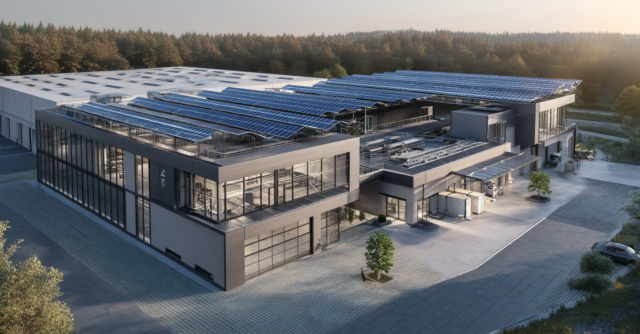
    Denner opened its third distribution centre for chilled products in Mägenwil on 2 February 2026. This is the food retailer’s response to the strong demand for these goods. According to a press release, it is the first chilled distribution centre to be certified according to the Minergie standard. Denner is creating 70 additional jobs there.

    The additional location will supply 250 of the 872 stores with fresh produce. Together with the three distribution centres for non-chilled goods, Denner will in future supply its branch network from six logistics locations.

    Denner is working on expanding its branch network and wants to add more fresh products to its range. The new building took two years to construct and, according to CEO Torsten Friedrich, “symbolises the growth” of Denner. The aim is to secure the logistics for the growing demand for fresh food. In addition, travel distances have been reduced. This could save 120,000 transport kilometres per year. A 10,000 square metre storage area has been created in Mägenwil. It allows more than 700 products to be stored and cooled at between 2 and 5 degrees Celsius.

    The Minergie certificate attests to the new building’s energy efficiency during operation. Waste heat from the energy-intensive operation of the cooling system is used for heating. The entire electricity requirement is generated by photovoltaic systems on the roof and on the south façade. In addition, eight charging stations for trucks and ten for passenger cars can be powered. Another new building for uncooled products is scheduled to go into operation in Aclens VD in 2027.

  • Steel profiles expand digital planning software

    Steel profiles expand digital planning software

    The steel profiles from Pestalozzi AGwill be available in LogiKal from April, according to a statement from the Dietikon-based company. The software was developed by the German company Orgadata and is used for planning window construction. According to the statement from Pestalozzi, it is also used for planning projects involving doors and façades.

    A total of more than 400 suppliers have stored their components in the software. Open interfaces allow LogiKal to be connected to machine control systems, enterprise resource planning (ERP) and computer-aided design (CAD) software. An integrated automatic error check also reduces costly calculation errors, according to Pestalozzi.

    The Dietikon-based company describes the integration of steel profiles into LogiKal as a “digital milestone”.

  • Generational change strengthens commitment to energy transition

    Generational change strengthens commitment to energy transition

    Reto Trittibach is the new owner and managing director of INES Energieplanung GmbH. According to a statement, André Joosten will be his deputy. With this new appointment, the Bern-based provider of energy supply solutions, founded 14 years ago, aims to maintain continuity.

    The aim of INES Energieplanung is to “support the energy transition with expertise and to the best of its ability”. Energy concepts for sites and district heating projects are developed. According to the company, INES contributes its expertise not only to the planning and construction of energy plants, but also to plant concepts. INES also acts as an energy consultant for the city of Bern.

    INES operates in the city and metropolitan area of Bern. Its main customers and cooperation partners include Marzili Wärmeverbund AG and the city of Bern.

    Founder Bruno Liesch shaped INES with a focus on sustainable energy solutions, heating networks and future-oriented energy planning. According to the announcement, he will continue to contribute his experience in project development on a part-time basis until the end of 2026.

  • New plants strengthen supply chains in growth markets

    New plants strengthen supply chains in growth markets

    Sika is manufacturing its products for the construction industry at five additional plants. According to its announcement, the specialty chemicals company, headquartered in Baar, sees this as an important step towards increasing production capacity and further strengthening its global supply chain in key growth markets.

    Sika has opened a new plant for concrete admixtures in Haines City, Florida. According to the information provided, the factory has the highest level of automation of all Sika admixture sites in the United States.

    In Puerto Tirol in the Argentine region of Chaco, Sika has inaugurated its eighth production facility in the South American country. After “several challenging years,” the local construction market has returned to a growth path, opening up new opportunities for Sika.

    In the Colombian city of Cali, a new factory produces mortar, tile adhesive, interior wall and acrylic coatings, and concrete admixtures. Production there will also be exported. Sika will also gain a foothold in the construction market in Bangladesh with a site in Narayanganj, benefiting from an estimated annual growth rate of over 7 per cent until 2029.

    In the Tanzanian city of Mwanza, Sika is banking on its location in an important and densely populated mining area. Accordingly, Sika produces special mortars for mining and construction, mortars, concrete admixtures and grinding aids for cement plants there. Sika serves local demand with the plant and exports to Burundi, Rwanda and the Congo.

  • Relocation creates development opportunity with lake view

    Relocation creates development opportunity with lake view

    Because it no longer meets the current requirements for a modern health centre, Lucerne Cantonal Hospital will be relocated to Schenkon together with the Seeblick nursing home. According to a statement, the canton, as the owner, and the city of Sursee want to plan an attractive future for the 47,000 square metre site.

    Initial assessments indicate that the site is suitable for mixed-use development with residential and commercial premises. This would allow for the creation of residential facilities for families, couples, singles and senior citizens, with services and restaurants completing the site. The site, located above Lake Sempach, is in close proximity to the old town of Sursee and already has good access to various modes of transport.

    “The move opens up a unique opportunity to repurpose the previous location in Sursee,” said Reto Wyss, member of the cantonal government, in the announcement. “This attractive site with lake views in a good location is to be rezoned for this purpose. The next planning steps will show what is feasible and where.” The planning phase for the new neighbourhood is set to begin in spring 2026, when the hospital starts to move. Various meetings with the local population and interest groups are planned. The site is expected to be vacant from 2034 and could be redeveloped. The possibility of incorporating the existing building fabric is also being considered.

  • Portfolio approach drives electric mobility in residential properties

    Portfolio approach drives electric mobility in residential properties

    According to a press release, Helvetia Baloise Holding AG, the insurance company formed in December 2025 from a merger between Helvetia and Baloise, is promoting e-mobility together with its partner Energie 360°. The energy and e-mobility company, which is 96 per cent owned by the City of Zurich, has already taken over more than 150 charging stations in 13 properties, mainly in western Switzerland, the Mittelland and Basel.

    As Reto Baschera, head of the mobility group at Energie 360°, emphasises, the expansion is “demand-driven and geared to the requirements of the tenants”. According to the information provided, six further properties are currently in the planning stage, with more to follow gradually. The focus is on a harmonised portfolio approach with a hardware-independent billing solution that takes into account different building types and product characteristics. Helvetia Baloise has a total of around 845 properties in Switzerland with approximately 30,000 apartments.

    “For me in strategic procurement at Helvetia Baloise, it was crucial to find a partner who sees electromobility not as a single product, but as an integrated part of a large real estate portfolio,” says Karin Hauser of Baloise Asset Management AG. “In our collaboration with Energie 360°, we particularly appreciate the structured approach, the reliable implementation and the ability to pragmatically map different starting points in our properties.”

  • New high-rise project boosts housing supply near the station

    New high-rise project boosts housing supply near the station

    Pensimo Management AG, based in Zurich, has acquired a building site from ABB in Oerlikon through its investment foundations Turidomusand Pensimo. According to a press release, the company plans to build a complex with 500 apartments, including a high-rise building and commercial premises, on the north side of Oerlikon railway station on the newly designed Max-Frisch-Platz.

    “We are very pleased with the acquisition of this property,” said Stefanie Krautzig, transaction manager at Pensimo, in the press release. “This is a very rare investment opportunity for a development project of this size in such a central location.” The building regulations for Neu-Oerlikon, which were partially revised in 2022, provide a good basis for planning and developing the area. “In order to evaluate an architectural solution for this central and prominent location that is attractive to the public and future residents, we will launch a competition among teams of planners,” said Krautzig.

    Construction is expected to begin in 2029. The seller, ABB, is also pleased with the sale of the former industrial site and is convinced that “this will contribute to the further development of Zurich Oerlikon into a lively and diverse neighbourhood,” said Nora Teuwsen, Chair of the Executive Board of ABB Switzerland.

  • Growth strategy in the building technology market continues

    Growth strategy in the building technology market continues

    The Burkhalter Group, a full-service provider of cross-trade building technology, is acquiring Enplan AG, which specialises in the planning of heating and ventilation systems and efficient energy concepts. The company has been operating in the regional market since 1984, employs five people and generates annual sales of around CHF 0.6 million.

    Enplan AG will be merged with Längle & Staub GmbH in St. Gallen, which belongs to the Burkhalter Group, and will continue to operate at its current location as Enplan, a branch of Längle & Staub GmbH. All employees will be retained.

    Secondly, the Burkhalter Group is acquiring Elektro Gasser AG, which has been active in the electrical and telecommunications (ICT) sectors since 1991. The company employs seven people and generates annual sales of around CHF 2 million. Elektro Gasser AG will be gradually integrated into TZ Stromag, which belongs to the Group. At the same time, a branch of TZ Stromag will be established at the Lalden site under the name Gasser Elektro ICT, while Elektro Gasser AG will continue to operate as an independent company until further notice.

    With these acquisitions, the Burkhalter Group is continuing its growth strategy. It provides services in the fields of heating, cooling, ventilation, air conditioning, sanitation and electrical engineering and is headquartered in Zurich.

  • New managing director takes over umbrella organisation of funding foundations

    New managing director takes over umbrella organisation of funding foundations

    The board of SwissFoundations, the association of Swiss grant-making foundations, has appointed Jasmina Ritz as its new managing director. According to a statement, she will replace Katja Schönenberger in mid-March, who is returning to an operational foundation after two years at SwissFoundations. Jasmina Ritz was co-initiator of the cross-cantonal location promoter Limmatstadt AG, where she served as managing director for many years. She thus brings with her extensive experience in advocacy, networking and managing an umbrella organisation.

    “The SwissFoundations board is delighted to have gained in Jasmina Ritz a strong leader with many years of experience at the interface between business, politics and society,” says the SwissFoundations press release.

    Ritz worked in the Limmat Valley for around 15 years. She was initially head of location promotion for the city of Dietikon and later co-founded Limmatstadt, where she served as managing director and vice-president of the board of directors. Most recently, she headed the Bern-based Deep Tech Switzerland Foundation, where she was responsible for developing an international fellowship programme.

  • Technology fund supports AI-based energy optimisation

    Technology fund supports AI-based energy optimisation

    Scandens can finance upcoming business developments with a guarantee from the technology fund. According to a statement by Dominik Bucher, co-founder and CCO of the Zurich-based cleantech company, receiving this guarantee confirms its approach: “Enabling the right investment decisions for real estate portfolios – economically sound and future-proof” while making the best possible decisions for the climate and the environment. “We are delighted to be part of the technology fund,” said Bucher.

    Founded in 2021 as a spin-off from the Swiss Federal Institute of Technology Zurich, the company launched software in 2023 that makes it easier to plan and implement energy-efficient building renovations. With this artificial intelligence-based internet application, owners of real estate portfolios as well as private homeowners can check whether and which renovation measures make economic and ecological sense.

    According to a statement from Scandens, the software displays over 500 renovation combinations and creates a plan that serves as a basis for implementation. This is intended to save time and promote sustainable decisions.

    With the technology fund, the federal government promotes innovations that reduce greenhouse gases or resource consumption, favour the use of renewable energies and increase energy efficiency. Guarantees make it easier for innovative companies to take out loans. The guarantee is granted to banks or other suitable lenders. To cover guarantee losses, a maximum of CHF 25 million per year from the proceeds of the CO2 levy is paid into a technology fund.

  • Digital marketplace promotes circular economy in construction

    Digital marketplace promotes circular economy in construction

    Zirkular GmbH, based in Basel, has launched its new platform , rematerial. According to a press release, the new online DIY store will offer high-quality, reusable building components. For example, it will offer LED lights that have been reconditioned by specialist companies and now come with a guarantee. Components can also be reserved for a month or stored temporarily for up to 24 months for just-in-time deliveries. The building components collected from demolition sites are stored in a systematic manner.

    The rematerial platform can be used in conjunction with thePlanularplanning tool, which was also developed by Zirkular. In this module, architects, planners and builders can select the components required for their respective projects from a database. The path of the building material can be traced through the steps of source object, component, warehouse and target object.

    With both modules, Zirkular GmbH supports sustainable construction through circular economy, as demonstrated, for example, in construction projects such as the Lysbüchel Süd neighbourhood in Basel.

  • New headquarters combines industrial history with modern architecture

    New headquarters combines industrial history with modern architecture

    Electrification and automation group ABBis planning a new global headquarters in Zurich Oerlikon, according to a press release. The 80 million Swiss franc project reflects the history of the company and the city of Zurich and will create a modern workplace for around 500 employees.

    The location chosen is the historic ABB building, which will be renovated and modernised in accordance with heritage protection requirements. The historic building will be complemented by a six-storey new building in the inner courtyard, replacing the Chicago Hall event venue, which is not listed.  The new building will have a brick façade in keeping with the existing architecture and will be constructed using a material-efficient wood composite construction method. Supported by ABB technologies and photovoltaic systems, low energy consumption is to be achieved. The new headquarters covers a total area of around 10,800 square metres. Plans include a 280-square-metre lobby with exhibition space and a 450-square-metre media area.

    For Morten Wierod, CEO of ABB, the choice of location is a commitment to Switzerland and the city of Zurich, “where our global headquarters have been located since the merger of BBC and Asea in 1988. One of our predecessor companies – Maschinenfabrik Oerlikon (MFO) – was also based here for many decades. The combination of a historic building and state-of-the-art facilities will create an inspiring environment for cooperation and innovation.”

    Detailed plans for the new headquarters are expected in 2026/2027. The building is scheduled to be completed and ready for occupancy by 2031. Until then, ABB will remain in the Cityport building in Zurich Oerlikon.

  • Historic thermal baths get a green future

    Historic thermal baths get a green future

    The city of Baden and the canton of Aargau have granted the Bad zum Raben cooperative planning permission to renovate the Bad zum Raben swimming pool. According to a statement issued by the cooperative, the renovation will combine monument preservation, water hygiene, fire and flood protection, and efficient operations. Once financing has been secured, the renovation is scheduled to start at the end of 2026 and be completed in early 2028.

    “We are very pleased about this important milestone. The building permit gives us planning security and is the basis for further fundraising,” said Andreas Rudow, co-president of the Bad zum Raben cooperative, in the press release. “With the project approved, it will be easier to find funding.”

    The total cost of the renovation will be around CHF 4.5 million. While CHF 1 million has already been covered by own funds, donations and initial funding commitments, the remaining financing is to be secured through contributions from the public sector, foundation fundraising, donations and the sale of cooperative shares. The Bad zum Raben cooperative is also continuing to seek additional members and is symbolically selling components of the future baths.

    The renovation aims to preserve the historic building fabric and enable the communication of history and culture through sustainable bathing operations and flexible use. In addition to four pools with natural thermal water, the Bad zum Raben will feature a small bistro, a stage for cultural events, rooms for art and relaxation, and a bathing media library. The entrance area will offer insights into the history of the old bathhouse and the historic water system. After the renovation, thermal water will also be used to heat the showers in the baths and the apartments on the former hotel floors.

  • Location promotion is being strategically realigned

    Location promotion is being strategically realigned

    The Lucerne Cantonal Council supports the further development of location promotion. According to a statement, it passed the corresponding bill during its January session and amended the law on economic promotion and regional policy. It now provides for a package of measures for location promotion worth around CHF 300 million per year.

    This is the canton’s response to the OECD minimum tax, which will require large international companies to pay more tax in future. According to an earlier press release explaining the motivation behind the package of measures and its contents, this means that the canton will lose its competitive advantage of low corporate income tax and fears that tax revenues and jobs could be lost.

    Accordingly, the measures now approved in favour of the economy focus on promoting innovation, improving the tax burden and framework conditions with regard to digitalisation, the development of commercial space, the availability of commercial and residential space, and a “customer-oriented” administration. The measures in favour of the population concentrate on improvements in the tax burden, work-life balance, culture and digitalisation.

    In addition, the Cantonal Council has decided that self-service shops without sales staff and with a maximum area of 30 square metres may be open daily from 5 a.m. to 10 p.m. A restriction to farm shops was rejected by an extremely narrow margin. Shops with at least four charging stations for electric vehicles, each with a minimum of 150 kilowatts and a simultaneous minimum total charging capacity of 300 kilowatts, are treated in the same way as petrol station shops. The SVP and SP announced a referendum against the proposal.

  • New technology paves the way for virtually CO2-free cement

    New technology paves the way for virtually CO2-free cement

    Holcim has agreed to acquire a strategic stake in Capsol Technologies, a specialist in post-combustion carbon capture solutions based in Oslo. This was announced in a statement by the building materials supplier. The focus is on HPC (hot potassium carbonate) technology, an energy-efficient chemical absorption process for capturing CO2 from gas streams, combined with an integrated heat recovery system. Holcim intends to use this technology to promote the large-scale production of virtually CO2-free cement and meet growing customer demand for climate-friendly building materials.

    “By combining Holcim’s expertise in cement production and on-site CO2 capture with Capsol’s safe and efficient technology, we have an additional lever to drive decarbonisation and achieve profitable growth,” said Ram Muthu, Head of Operational Excellence at Holcim. “This strategic investment brings us one step closer to large-scale production of virtually CO2-free cement.”

    The investment was preceded by a CapsolGo demonstration project at Holcim’s Dotternhausen plant in Germany in 2025, where Capsol successfully tested its technology in an industrial environment. The investment expands Holcim’s portfolio of decarbonisation technologies within its open innovation ecosystem. Through Holcim MAQER Ventures, the Group’s corporate venture capital unit, Holcim has made 19 investments to date and reviews more than 500 start-ups in the field of sustainable construction solutions each year.

  • Global ranking confirms long-term climate strategy

    Global ranking confirms long-term climate strategy

    KONE ranks 54th in this year’s Global 100 Most Sustainable Corporations in the World ranking by Corporate Knightsin Toronto, Ontario, Canada. In the Machinery industry group, the lift and escalator manufacturer even ranks second among 397 companies worldwide. In Finland, where KONE has had its headquarters in Espoo since 1910, it is the highest-ranked engineering company, as it is in Switzerland, where KONE (Switzerland) AG has been operating since 1996. The company employs over 60,000 people in more than 70 countries.

    In 2024, KONE was awarded the German Sustainability Award as the most sustainable company in the lifting and conveyor technology category. KONE is the first company in its industry to define ambitious and scientifically based climate targets for 2030, according to a press release. “For KONE, leadership in the industry always means leadership in sustainability,” said Kirsi Simola-Laaksonen, Senior Vice President for Sustainability and Environment. “This ranking is clear, independent proof of the progress we are making.”

    The company is committed to aligning its activities with the goal of limiting global warming to 1.5 degrees Celsius. “We understand that sustainable business is good business for our customers, their customers and for us,” said Simola-Laaksonen. “We continuously monitor how sustainable solutions impact our business and are increasing the share of our revenue from products and services that contribute to climate protection. Together with our customers, we develop smart and sustainable buildings, enabling better urban living.”

  • Swiss companies start the year on a more optimistic note

    Swiss companies start the year on a more optimistic note

    The KOF Business Situation Indicator rose for the second month in a row in January, signalling a much more favourable starting position than a year ago. The business situation in the manufacturing industry in particular has brightened considerably, indicating a revival in demand and capacity utilisation.

    financial and insurance services, wholesale, catering and construction are also reporting rising business situation indicators, while the retail trade is at least slightly improving. The situation in other services remains largely stable, with only the project planning sector reporting a slight slowdown. Overall, this shows a broad-based improvement across the Swiss economy.

    industry as an anchor of sentiment
    Looking ahead to the next six months, optimism prevails in many sectors. The manufacturing industry in particular is anticipating a further improvement in business activity, confirming its role as an anchor of sentiment at the start of the year.

    expectations have also brightened in the retail trade, construction, financial and insurance services and project planning sectors. By contrast, the hospitality, wholesale and other services sectors are somewhat more cautious about the coming months, although the majority of them remain moderately positive.

    more recruitment
    Many companies are planning to take on additional staff. This is particularly evident in the hospitality industry, which is looking to expand its workforce but is finding it increasingly difficult to find suitable employees.

    the construction industry and the project planning sector are the most likely to report a shortage of skilled labour, which brings existing capacity bottlenecks into sharper focus. For managers and HR managers, this means that competition for qualified labour is continuing to increase in several key sectors.

    moderate momentum without new signs of inflation
    Despite the economic upturn, wage expectations remain stable. As in the October survey, companies expect gross wages to rise by 1.3% on average over the next twelve months, with above-average increases in the hospitality industry, the project planning sector and the construction industry.

    companies are also not expecting a turnaround in consumer prices. The expected inflation rate now stands at 0.9%, practically the same level as in the October survey (1.0%). The picture for monetary and wage policy is therefore one of moderate, well-anchored price and wage developments.

    broad base in the real economy
    The survey is based on around 4,500 companies from the manufacturing, construction and central services sectors, which corresponds to a response rate of around 56%.

    the KOF Business Situation Indicator thus provides a robust picture of the mood among managers. The Swiss private sector is starting 2026 with a broad base, cautious confidence and no discernible inflationary momentum, while at the same time increasing pressure on the labour market in key construction and service sectors.

  • Political decision strengthens international location marketing

    Political decision strengthens international location marketing

    The canton of Aargau will rejoin the Greater Zurich Area (GZA) on 1 January 2027. This was decided by the Grand Council at its meeting on 13 January. It is providing CHF 5.5 million for membership of the location marketing organisation for the first four years. In its proposal, the cantonal government had requested CHF 8.5 million for six years.

    In its deliberations in November, the preliminary consultation committee pointed out that, compared to the rest of Switzerland, the canton’s population is growing at an above-average rate, but its economy is growing at a below-average rate. Joining the location marketing organisation was a “clear opportunity to attract new value-added jobs to the canton,” it wrote in a statement at the time. It justified its request to reduce the initial period from six to four years by citing concerns about competition among the member cantons. The shorter period would allow for careful assessment of the effectiveness of membership.

    The Greater Zurich Area includes the cantons of Glarus, Graubünden, Schaffhausen, Schwyz, Solothurn, Ticino, Uri, Zug and Zurich. It promotes the Zurich economic area in the USA and China in particular, with the aim of attracting high value-added companies to settle there. Aargau was a member of the GZA between 2007 and 2010.

    On 13 January, the Grand Council also approved economic development in areas with potential. This will allow groups of municipalities with economic potential to join forces to promote their location professionally. The focus will be on establishing business contacts and brokering sites and land. The canton will cover 50 per cent of the costs. The Grand Council has now approved CHF 4.5 million for this purpose.

  • Long-standing industrial partnership to continue

    Long-standing industrial partnership to continue

    Jansen, a steel system supplier based in the St. Gallen Lake Constance area, has agreed to extend its partnership with Schüco International KG, based in Bielefeld, Germany, which has been in place since 1978. According to a press release, Jansen will continue to be the exclusive distributor of Schüco aluminium systems in Switzerland and Liechtenstein. The German company will continue to be the exclusive distributor of Jansen steel systems in Germany, Luxembourg, the United Kingdom, Ireland, Scandinavia, Finland, Greece and the Baltic States.

    Since 1 January 2026, Schüco International S.C.S, based in Le Perray-en-Yvelines, has been distributing the steel systems of RP Technik Profilsysteme GmbH, which was taken over by Jansen, in France and the French overseas territories. The steel systems are used for windows, doors, fire protection and façade constructions, according to the press release.

    “We have shared these values with Jansen, a family-owned company like Schüco, for over 45 years. I am delighted that we will continue and further expand our trusting partnership in the future,” said Andreas Engelhardt, personally liable partner at Schüco International KG, in the press release. Christoph Jansen, Managing Director and Member of the Board of Directors of Jansen AG, considers the long-standing stable partnership to be extremely important, especially in “times of great change and uncertainty”: “Our partnership is based on shared goals and values, always with a focus on our mutual customers.”

  • Densification of housing stock is unpopular with the population

    Densification of housing stock is unpopular with the population

    Taller buildings in cities could alleviate the housing shortage, but they are unpopular with the general public. This is according to a survey conducted by the comparison portal Comparis. According to the survey, 50 per cent of those questioned by Comparis were against the construction of taller buildings with more than six storeys. In contrast, 45 per cent of the 1,039 adults surveyed across Switzerland in November 2025 were in favour.

    According to real estate expert Harry Büsser from Comparis, taller buildings in urban areas could be “a political path to more living space”. “Let’s get people in cities to take the lift instead of driving,” he is quoted as saying in a statement accompanying the study. It highlights a dilemma: rising rents affect everyone, but most people reject possible countermeasures. For example, 68 per cent of those surveyed are against densification with fewer green spaces and smaller distances between buildings. 66 per cent reject new building zones at the expense of agricultural or green spaces. Only the restriction of objections found a relative majority: 47 per cent are in favour, 43 per cent against.

    The study also shows that measures to create additional living space are assessed differently depending on gender and age. While 54 per cent of men are in favour of taller buildings, the proportion of women is 36 per cent. Denser development was approved by 33 per cent of men compared to 22 per cent of women. Thirty-nine per cent of the men surveyed said yes to new building zones, compared to 21 per cent of women. Büsser suspects that the reason for this lies in different roles and activities. Women often bear the brunt of family and neighbourhood responsibilities. Changes in the living environment would therefore “probably be perceived more strongly as a loss of quality of life”.

    The worsening housing shortage is particularly felt by 18- to 35-year-olds (65 per cent) and city dwellers (66 per cent). According to Comparis, this explains why the approach of building upwards met with the most approval among this group: 52 per cent of respondents in the young population group would agree to buildings exceeding six storeys. The survey also found that taller buildings are only accepted in the city centre (54 per cent). In the suburbs, only 39 per cent are in favour.