Category: People

  • Management change in the energy division of a large utility company

    Management change in the energy division of a large utility company

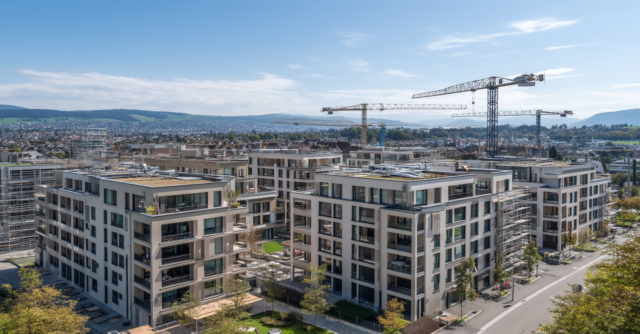
    Vertina Investment Foundation invested a total of CHF 74.3 million in four new-build projects in the first quarter of 2026. The fresh capital comes from the capital increase in the fourth quarter of 2025, according to a press release.

    The construction projects are located on properties in Oberglatt ZH, Kloten ZH, Seon AG and Zurich. These selected locations are characterised by good infrastructure connections and a solid market environment, according to the press release. After completion, the market value of the four properties will amount to CHF 131 million. This will increase the value of the total portfolio of the Vertina Residential investment group to CHF 350 million.

    In total, Vertina’s property portfolio consists of 13 properties with varying degrees of construction progress. The start of construction on four further projects is planned for the current financial year. As recently announced, Vertina will raise new capital of between CHF 60 and 80 million for this purpose in the second quarter.

  • From the construction group to the top of the railway

    From the construction group to the top of the railway

    After twelve years on the Board of Directors, ten of them as Chairwoman, Monika Ribar leaves behind an institution that has changed. The term limit ended her commitment, not her will. Together with her, Vice-Chairman Pierre-Alain Urech, Georg Kasperkovitz and Clara Millard Dereudre are leaving the Board.

    A lateral entrant with a system
    André Wyss was born in 1967, completed an apprenticeship as a chemical technician, studied economics part-time and furthered his education at Harvard Business School. Before joining Implenia as CEO in 2018, he was responsible for around 40,000 employees at Novartis. He brings 40 years of management experience in the construction, property and pharmaceutical industries to his new role. He has already been a member of the SBB Board of Directors since August 2024, so the handover went smoothly.

    Construction meets rail
    What seems like an unusual career move at first glance makes sense on closer inspection. SBB is not only a railway operator, it is also one of the largest property owners in Switzerland. Wyss has first-hand knowledge of complex infrastructure projects, sustainable construction and the political framework conditions in Switzerland. This is precisely why the Federal Council saw him as the right candidate.

    Stable course, new impetus
    Wyss has clearly communicated what he wants: to further develop SBB as the modern and sustainable backbone of Switzerland, focussing on stability and innovation. For its part, SBB is pursuing the goal of being climate-neutral by 2030. This is precisely where Wyss and the new composition of the Board of Directors come in.

    Four new members strengthen the Board
    Four new members were elected to the Board of Directors at the same time as Wyss: Anna Barbara Remund, Dino Cauzza, Dominique Pierre Locher and Maria-Antonella Bino. They are intended to complement the Board professionally and bring new impetus without changing course. The Board of Directors was constituted directly after the Annual General Meeting in Berne.

  • CEO becomes a partner in assembly group

    CEO becomes a partner in assembly group

    The ERNE Group is taking on its CEO Giuseppe Santagada as a shareholder. The CEO, who has been in office since the beginning of 2024, is also joining the Laufenburg-based construction and property group as a minority shareholder, the ERNE Group announced in a press release. The family business is held by the fourth generation of the founding family.

    “The collaboration with Giuseppe Santagada has been based on partnership, commitment and equality since day one,” Daniel and Christoph Erne, Chairman and Vice-Chairman of the Board of Directors, are quoted as saying in the press release. Mr Santagada, who holds a doctorate in economics, contributes to the strategic development of the Group with his entrepreneurial vision and management experience. “Becoming a minority shareholder is an expression of our mutual trust and our responsibility towards our employees, customers, partners and family.”

    The companies of the ERNE Group specialise in the entire construction industry, from the extraction of raw materials to the planning and implementation of projects through to dismantling, disposal and recycling. In addition to its headquarters in Laufenburg, the company has further locations in Switzerland and Germany and is active in Switzerland, Germany and Luxembourg.

  • New head of department to drive strategic development in the economy and labour market

    New head of department to drive strategic development in the economy and labour market

    According to a press release, the government of the Canton of St. Gallen has appointed Daniel Müller as the new head of the Office for Economic Affairs and Labour, effective 1 May. He succeeds Karin Jung, who has led the office since 2018 and announced her resignation at the start of the year. Müller is currently carrying out her duties on an interim basis.

    The 50-year-old has been working for the canton since 2018. Until now, he was head of business development. A qualified audio and video electronics technician and IT specialist, he studied business administration at OST– the University of Applied Sciences of Eastern Switzerland. Before joining the Department of Economic Affairs, he worked for the University of St. Gallen, amongst other roles.

  • New director to drive the energy supplier’s strategic development

    New director to drive the energy supplier’s strategic development

    The Board of Directors of Regio Energie Solothurn has appointed Martin Bucher as Director, thereby confirming him in his role. According to a press release, Bucher had already taken over the operational management of the regional energy supplier in July 2025 and has successfully led the company. It was particularly his high level of technical expertise, his strategic clarity and his inclusive and goal-oriented leadership that enabled Bucher to stand out in a multi-stage selection process involving over 100 candidates.

    Before joining Regio Energie Solothurn last year, Bucher gained many years of management experience in the energy and finance sectors, including at energy supply companies and in management consultancy. The new director thus combines technical, regulatory and business management expertise, which enables him to further develop Regio Energie Solothurn in a sustainable manner, the statement said.

    Regio Energie Solothurn supplies the city of Solothurn and surrounding municipalities with electricity, gas, district heating and water. The public-law company is wholly owned by the city of Solothurn. The mayor, Stefanie Ingold, serves as chair of the board of directors by virtue of her office.

  • Location marketing attracts 264 companies to Switzerland

    Location marketing attracts 264 companies to Switzerland

    According to a statement from the Conference of Cantonal Economic Affairs Directors, location marketing organisations have attracted 264 new businesses to Switzerland in 2025. These businesses have already created 919 jobs in their first year of operation. This figure is set to rise to a total of 2,687 jobs over the next three years.

    This represents significant growth for the cantonal, regional and national location marketing organisations. In the previous year, they had attracted 231 companies, which created 716 new jobs in their first year. This figure is set to rise to 2,135 jobs by 2027. In 2023, 206 companies were newly established, creating 640 jobs in their first year.

    Of the 2,025 newly established companies, 60 per cent come from Germany, France, China and the UK. Around 80 per cent operate in the strategic key technologies agreed upon by the federal government, cantons and regions for the years 2024 to 2027. These include the future of healthcare, digital technology, automation, food and the financial sector.

    The promotion of Switzerland as a business location is a joint task between the federal government and the cantons. They have commissioned Switzerland Global Enterprise to handle national location marketing.

  • From data to AI in the real estate world

    From data to AI in the real estate world

    This is precisely why it is worth looking back. Because the way in which real estate is planned, operated and managed has changed fundamentally over the last 30 years.

    Thirty years ago, many processes were still surprisingly analog. Data was stored in folders and paper documents, decisions were based heavily on experience and less on systematic analysis. A phase soon began in which the industry developed step by step: processes became more digital, data more important, buildings and companies increasingly networked.

    It was in this environment that pom was founded in the mid-1990s as a spin-off from ETH Zurich – with the idea of integrating tasks, data and processes in the construction and real estate sector more closely. Thirty years later, pom is celebrating its anniversary and the basic question is still very topical: How can real estate, organization and technology be meaningfully combined?

    In terms of technology, we are now at a new turning point. The digitalization of real estate continues to advance: cloud technologies, IoT and digital models are enabling ever more precise mapping of buildings. The so-called digital twin is increasingly becoming a reality and creating new opportunities for automating processes.

    At the same time, the way companies work is changing. Artificial intelligence will change many processes in the coming years – especially where large amounts of information have to be processed and decisions still have to be made manually. Different data can be analyzed more easily, finished results can be generated automatically and decisions can be massively accelerated, even with the involvement of humans. Assistance systems, known as agents, are becoming part of everyday working life.

    At the same time, a look at the industry reveals an interesting area of tension: technological development is progressing rapidly, while implementation in companies is much slower.

    Every year since 2016, pom Consulting AG has measured the digital maturity of the construction and real estate industry as part of the Digital Real Estate & Construction Study. The Digital Real Estate Index currently stands at 4.3 out of 10 points – a slight recovery compared to the previous year, but definitely not a quantum leap.

    Unsurprisingly, artificial intelligence is increasingly coming into focus. According to the latest study, Artificial Intelligence & Machine Learning is once again one of the most frequently used technologies, alongside Platforms & Portals and Data Analytics. However, the assessment of AI is much more differentiated than in previous years: Around two thirds of respondents see a high benefit in it. In last year’s survey, the figure was 75%. With more frequent use of AI, the possibilities of the technology, but also its limitations, are becoming much more visible, making expectations more realistic.

    Technology alone therefore does not determine success. The decisive factor remains the organization: data quality, implementation strength, clear responsibilities – and the willingness to question existing ways of working.

    Perhaps this is the real parallel to the last 30 years.

    Back then, too, it wasn’t just about new technologies, but about new ways of thinking. Artificial intelligence could therefore become the next big development step in the industry – not because it changes everything, but because it helps to better manage the growing complexity of real estate and organizations.

  • Succession planning launched at regional utility

    Succession planning launched at regional utility

    There is to be a change at the helm of Industriellen Betriebe Interlaken AG. According to a statement, CEO Helmut Perreten has informed the Board of Directors that he intends to step down from his role in mid-2027. He plans to pursue a career outside the energy sector thereafter.

    The search for a successor will begin in the coming months. The early announcement of the change will allow for a careful and structured succession plan, the statement said. The Board of Directors regrets but respects the decision.

    Perreten has been CEO of IBI since 2015. Prior to that, the trained mechanic and mechanical engineer was Head of the Oberland region at BKW Energie AG and, before that, Managing Director of the Grindelwald Electricity Works.

    In 2025, IBI sold a total of 96 million kilowatt-hours of electricity, 35.9 million kilowatt-hours of gas and 1.8 million cubic metres of water.

  • Strategic reorientation with a focus on energy and technology

    Strategic reorientation with a focus on energy and technology

    BKW is announcing a change in its Group Executive Board: On 1 April this year, Margarita Aleksieva will take over from Philipp Hänggi as Head of the Energy Production business area, the Bern-based energy supplier announced in a press release. At the same time, Aleksieva will join the BKW Group Executive Board. The designated Head of Business Area is currently Head of the Wind & Solar business unit at BKW.

    “Renewable energy production is very close to my heart”, Aleksieva is quoted as saying in the press release. “I am therefore all the more pleased to be able to play an active role in shaping the energy transition on the BKW Group Executive Board.” Before joining BKW, Aleksieva held “various management positions at international energy companies”, including Alpiq, according to the press release.

    Philipp Hänggi, who joined BKW in 2014, is stepping down from the Group Executive Board after six years as Head of Energy Production. According to the press release, he intends to focus on strategic tasks in the future, particularly in the areas of nuclear energy and radioactive waste disposal, and “increasingly devote himself to topics relating to artificial intelligence”. Hänggi was already involved in the design and utilisation of artificial intelligence at BKW during his time on the Group Executive Board.

  • PropTech remains invisible and indispensable

    PropTech remains invisible and indispensable

    Mr. Schwyter, you are one of the pioneers of the Swiss PropTech scene. How did your journey in the digital real estate market begin?
    After my time at Homegate, I asked myself how I wanted to use my knowledge further. The digitalization of the real estate industry was an obvious choice. Before the pandemic, however, hardly anyone was interested in this topic. It was Covid-19 that gave it a huge boost. From then on, digitalization was widely accepted and I found my place in the PropTech scene.

    What early experiences at Homegate still shape your view of PropTech today?
    Above all, the joy of experimenting and developing new approaches together. We wanted to create solutions that would advance the industry as a whole. This attitude is still with me today. Being open, working in an interdisciplinary way and testing boldly.

    How digital is the Swiss real estate industry really, if you leave out the marketing jargon?
    Pom’s Digital Real Estate Index has been below five on a scale of zero to ten for years. This clearly shows that the sector has a lot of potential for improvement. There is progress, but not a continuous digitalization push. Overall, we are more at the beginning of a professional digital transformation.

    Where does Switzerland stand in an international comparison? Pioneer or laggard?
    Switzerland has around 480 PropTech companies, which are small but qualitatively strong and diverse. Germany is significantly higher with more than 1,200 companies. We have areas where we are very good and others where there is potential for expansion. Overall, I would describe us as a solid, well-developed ecosystem.

    In your opinion, which PropTech segments are the most advanced?
    Platform solutions in the broad sense, i.e. not just marketplaces such as data platforms, service platforms and ecosystems. This is where we see the greatest professionalization and maturity.

    What kind of startups do you think will be the first to disappear and why?
    Startups that only cover one isolated process step and cannot be integrated. Real estate companies need solutions that combine several process steps or can be easily integrated into existing systems. Silo products will hardly be viable in the future, neither technically nor economically.

    Where do you see obstacles to digitalization in Swiss real estate companies?
    The industry is highly fragmented. A company with 20 or 30 employees is already considered large. Many have neither internal IT skills nor a budget for larger digitalization projects. This also means a lot of work for providers. Instead of five major customers, you have hundreds of small ones. This structure slows down digitalization.

    Which three megatrends will shape the PropTech landscape in the coming years and why?
    Clearly data, sustainability and artificial intelligence. Data is the basis for every well-founded decision. Sustainability is not possible without data, especially with ESG, and AI is a trend that is highly polarizing. However, the impact only comes when the data quality and organization are right.

    Are there technologies that have long been ready for the international market but have not yet arrived in Switzerland?
    No. Everything that is internationally relevant is generally available in Switzerland in high quality. The challenge lies not in the technology, but in its consistent application and integration.

    What does it take for administrations to become more open to technology and more courageous?
    A clear digitalization strategy, because without a target image, any tool introduction is pure actionism. Companies need to understand that digitalization is a cultural and transformation process and not an IT project. Employees need to be supported and motivated, especially in an environment with high staff turnover.

    How can you recognize the quality of a PropTech company?
    The team. The key question is: do the people have the skills, perseverance and openness to really implement an idea? Markets change, products change and only a strong team can support this change. The team is therefore more important than the idea.

    Which approaches manage to map the entire life cycle?
    Not individual all-in-one products, but integrated cycles. When condition analysis, refurbishment planning and facility management are linked via clean data flows, for example, a genuine life cycle is created. Integration is the key.

    In which phases do you see the greatest untapped potential?
    Clearly in the area of construction technology. How we build, what materials we use, how planning and construction processes work – major changes are imminent here. We are already much further ahead in terms of operations and marketing.

    Are the regulatory framework conditions more of a driver or a brake?
    Startups want fewer hurdles and some things have been improved. However, issues such as the tax treatment of founder shares remain complex. Overall, we should reduce regulation. Innovation does not come from new regulations, but from entrepreneurial freedom.

    What political steps would be necessary for the sector to digitalize faster?
    I am clearly in favour of less government. The real estate industry will digitize itself for economic reasons. If companies can win more mandates and improve quality with the same employees, they will use digital solutions. Without any new political requirements.

    What cultural and organizational stumbling blocks do you encounter most often?
    The misconception that digitalization is a tool issue. In reality, it’s about processes, collaboration and roles. Many underestimate the cultural change. High staff turnover also makes it difficult to establish a digital culture.

    Which developments will irreversibly change the industry?
    Anything that simplifies or automates repetitive tasks and thus creates productivity gains. Whether you call this digitalization or efficiency enhancement is irrelevant. AI is one component, but not the only one.

    If you had to found a new PropTech today, in which area would it be?
    Probably in the area of marketing, because there is a lot of creative potential there. At the same time, I would like to see existing solutions grow more strongly. We have enough good providers, we don’t necessarily need any more.

    Where will PropTech Switzerland be in 2030?
    PropTech will be indispensable, but not in the spotlight. It’s not “sexy” like climate or energy issues. PropTech doesn’t make the headlines, but it ensures that the industry functions digitally, data-based and efficiently. This is precisely why PropTech will play a central role in the long term.

  • New CEO to drive strategic development

    New CEO to drive strategic development

    The Board of Directors of Repower AG, based in Brusio, Graubünden, has appointed Michael Roth as its new CEO. According to a press release, he will take up the post on 1 June 2026, succeeding Roland Leuenberger, who is moving to the energy producer Axpo.

    Roth has headed Repower’s Production & Grid division since 2022. Prior to this, the 51-year-old spent nine years as Director of Engadiner Kraftwerke and ten years at the City of Zurich Electricity Works (ewz). “In recent years, he has demonstrated leadership, strategic insight and strong operational expertise at Repower,” said Barbara Janom Steiner, Chair of the Board of Directors.

    The CEO-designate lives in the Engadin, holds a degree in electrical engineering from ETH Zurich and has a Master’s degree in business law from the University of St. Gallen. “I look forward to further developing Repower together with our employees during this important phase,” he is quoted as saying.

    A successor is being sought to head the Production & Grid division; the process has already been initiated.

  • Change at the helm of a major business network

    Change at the helm of a major business network

    According to a statement, Hansjörg Brunner is stepping down as president of WirtschaftsPortalOst (WPO). The owner and CEO of Fairdruck AG, based in Sirnach, Thurgau, has chaired the Wil Greater Area Business and Economic Association since its foundation in May 2019. Brunner had previously chaired both the Hinterthurgau SME Trade Association and the Thurgau Trade Association. He served as a member of the Thurgau Cantonal Council and the National Council for the FDP.

    The Executive Board is proposing Marc Flückiger as the new president to the delegates’ meeting on 23 April. The 44-year-old grew up in Thurgau and lives in Wil. A trained cheesemaker, he worked at Züger Frischkäse AG, most recently as a member of the extended management team. Since 2014, he has been co-owner and managing director of SYGMA AG Liegenschaftenbetreuung in Wil, which employs around 170 people. He served as a member of the Wil City Council for the FDP and has been a member of the St. Gallen Cantonal Council since 2024.

    “As WPO President, I would be delighted to contribute my experience and my network in business, politics and association work, and to devote my full energy to our region,” Flückiger is quoted as saying in the press release.

  • Network Switzerland elects new members to the board

    Network Switzerland elects new members to the board

    According to a press release, the Netzwerk Standort Schweiz has renewed its board. Christina Doll and Andreas Zettel were elected to the board on 18 March. Christina Doll has been the business development officer for the town of Schlieren since 2025. Prior to this, she spent around ten years helping to develop the Zurich Airport region, amongst other roles. Andreas Zettel has been Head of Business Development since 2015 and Deputy Head of Lucerne Economic Development since 2020.

    The two new members replace Albert Schweizer and Jasmina Ritz. Schweizer was Schlieren’s first location promoter and co-founded Netzwerk Standort Schweiz – then known as the Swiss Association for Location Management – in 1998. He has also been a member of its board since 2007. Jasmina Ritz was the first Managing Director of Limmatstadt AG, the cross-cantonal location promotion agency in the Limmat Valley. She has also been a member of the board of Netzwerk Standort Schweiz since 2022. Since the beginning of March, she has been Managing Director of SwissFoundations, the association of Swiss grant-making foundations.

    The spring event organised by Netzwerk Standort Schweiz also addressed the changing landscape of location competition. “Whilst major economic blocs are putting pressure on one another through tariffs, massive support programmes and technological races, and military conflicts are creating new uncertainties, location competition is also entering a new phase,” Remo Daguati, President of Netzwerk Standort Schweiz, is quoted as saying in the press release.

    Vassiliki Riesen, Head of Economic and Location Promotion in Köniz, highlighted the consequences for Switzerland’s largest agglomeration municipality. She demonstrated how location promotion initiatives can respond to different stakeholder groups whilst also collaborating with numerous partners within the municipality and the canton.

    André Guedel, Director of International Business Development at KPMG, highlighted how the new competition is affecting Switzerland as a business location through both taxation and subsidies, and how companies are responding to this.

    Netzwerk Standort Schweiz is the umbrella organisation for location and business promotion agencies. Its current membership of around 110 comprises organisations active in location promotion, regional marketing, business development, site development, spatial planning and the property sector.

  • Successful job coaching from SVIT Zurich!

    Successful job coaching from SVIT Zurich!

    SVIT Zurich actively supports job searches in the real estate sector. Applicants are not left to their own devices: On request, they can receive targeted support when entering the real estate industry. An experienced real estate professional accompanies them as a personal coach, analyzes their initial situation together and defines effective measures for a successful job search. In this way, participants acquire additional skills that improve their application chances in the long term.

    The job placement service is free of charge for members and non-members alike, provided they have completed or are currently attending the “Career changer assistant in real estate management and marketing” or “Real estate management clerk” course at SVIT Zurich in Oerlikon. With this offer, the association is making an active contribution to combating the shortage of skilled workers and at the same time ensuring that the candidates placed have a sound basic education in the industry at SVIT Zurich.

    More and more members are making use of this qualified specialist resource – with consistently positive feedback. They benefit from the opportunity to build up new team members according to their needs and deploy them in the long term. In addition, many candidates bring valuable additional skills from their previous professional life.

    Interested parties can register by sending an e-mail to diana.waly@svit.ch. SVIT Zurich has an official permit from the Canton of Zurich for private employment agencies.

    Further information on the process and application videos of current candidates can be found at the following link:

    https://www.svit.ch/de/svit-zuerich/themen-services/einstieg-die-immobilienbranche-bewerbungsvideos-quereinsteiger

  • Global employer rating strengthens position in the competition for talent

    Global employer rating strengthens position in the competition for talent

    Holcim has secured the Global Top Employer award from the Top Employers Institute for the second year running. According to a press release, a total of 27 Holcim subsidiaries across all regions have been certified as Top Employers. With 27 certified markets, Holcim achieved a global score of 87 per cent, thereby exceeding the global benchmark.

    The Top Employers Institute rated Holcim particularly highly in the areas of Ethics & Integrity, Learning and Business Strategy. These results reflect the performance-oriented corporate culture that drives the Group’s NextGen Growth 2030 strategy, the press release states.

    “A strategic growth driver of our NextGen Growth 2030 strategy is our performance culture and the value we create for employees, customers and shareholders. We call this the Holcim Spirit, which is focused on purpose, people and performance,” CEO Miljan Gutovic is quoted as saying. “This award belongs to our more than 45,000 colleagues who embody the Holcim Spirit every day and make Holcim an outstanding place to work.”

    For the Top Employer award, companies are assessed against global standards in the areas of career development, learning, well-being and remuneration. Companies recognised as Global Top Employers must also be certified as regional Top Employers in a minimum number of countries and regions – including the country where their global headquarters are located.

    Holcim is headquartered in Zug, Switzerland, and employs more than 45,000 people globally across 43 markets, including Europe, Latin America, Asia, the Middle East and Africa.

  • Artificial intelligence: Absolutely, but..

    Artificial intelligence: Absolutely, but..

    Whether the English “AI” or the German “KI” – artificial intelligence is currently omnipresent. How its impact is assessed depends heavily on the perspective of the individual: For some, the opportunities outweigh the risks, while others primarily see risks. However, one thing is undisputed: the technology is here to stay.

    For us as a digital real estate platform, an open approach to technological innovation has always been part of our DNA. With ImmoScout24 and Homegate, we have been actively shaping the real estate market for over two decades. Our principle also applies here: AI must not be an end in itself, but should act as an unprecedented “enabler”. After all, the true potential of these two letters lies in the accelerated development, smart expansion and enhancement of innovative products that can create real added value and achieve daily efficiency gains.

    In the professional real estate sector in particular, the benefits of AI can be seen in its productive integration into existing, established processes. While this enables us as platforms to develop market-oriented products in a more agile way, it creates new efficiency gains for brokers and property managers in their day-to-day operations. The decisive factor is not the technology itself, but its real contribution.

    Two examples from the SMG Real Estate ecosystem illustrate this:

    • Our AI-based listing text creation saves an average of 14 minutes per listing. Extrapolated to an entire portfolio or a marketing campaign, this results in a substantial gain in productivity. The time saved can be invested specifically where it makes the biggest difference – in consulting, negotiation and customer relations. Anyone who instead advertises on ImmoScout24 or Homegate as a private individual can use this new intelligent function to partially compensate for a lack of marketing experience.
    • The new “Insight Hub” for real estate professionals provides AI-driven answers to questions about the potential and performance of listings that were previously difficult to narrow down. Every week, real estate agents and managers receive an overview of the listings with the greatest potential for improvement, including specific recommendations for action and the expected increase in visibility.

    This is just a small excerpt, plus numerous current developments at SMG Real Estate, including “Agentic AI”, a digital companion for real estate professionals in their day-to-day work – from the transcription of meeting notes to seamless CRM integration. But more on that in the near future. At the same time, technological innovation requires continuous investment – especially in cybersecurity. After all, it’s not just the right players who benefit from AI. State-of-the-art protection mechanisms, two-factor authentication, integrated access controls, etc. are essential to secure data and effectively prevent attempted fraud. Trust remains the central currency in the real estate market – especially in the digital one.

    But thanks to these targeted, ongoing investments in AI applications, we at SMG Real Estate are actively continuing to shape our role as the “digital shaper” of the Swiss real estate industry. Our goal is and remains first and foremost to make real estate professionals not only more efficient, but also more successful in the long term. This is also what our vision stands for: “Next-Gen Swiss Real Estate – digital and simple.”

  • New Head of Market and Policy at the Solar Association

    New Head of Market and Policy at the Solar Association

    According to a statement, Wieland Hintz has been head of market and policy at Swissolar since 1 March and is also its deputy managing director. The 45-year-old was previously responsible for solar energy at the Federal Office of Energy.

    Hintz studied physics at the Swiss Federal Institute of Technology in Zurich and earned his doctorate at the CERN nuclear research centre in Geneva. He has worked for Alpiq and the Association of Swiss Electricity Companies, among others. Together with his family, he operates six wind turbines and a solar park with a capacity of 1.2 megawatts in Germany.

    Hintz replaces David Stickelberger. Now 65, Stickelberger was the first managing director of swissolar from 1998 to 2023. Since 2023, he has been deputy to his successor Matthias Egli. In future, he will support the association as senior policy advisor.

    “Over the past ten years, photovoltaics has become a mainstay of Switzerland’s electricity supply, now covering over 15 per cent of electricity consumption,” Hintz is quoted as saying in the press release. “In my new role at Swissolar, I will devote all my energy to ensuring that photovoltaics is optimally integrated into the Swiss energy system and to driving forward the decarbonisation of buildings and transport.”

    Swissolar has created a new position of Director for French-speaking Switzerland. This will be filled by Anne Plancherel. She has been working since 2024, both as a strategic project manager and in setting up vocational training in western Switzerland. Plancherel will represent Swissolar in western Switzerland and further expand the regional network.

    The 44-year-old environmental engineer studied at the Swiss Federal Institute of Technology in Lausanne and continued her education in project management at the University of Geneva. “I am very much looking forward to working with our members, partners and authorities to further expand the potential of solar energy in French-speaking Switzerland and to strengthen the industry in the long term,” she is quoted as saying in the press release.

  • Architect takes over operational management of the company

    Architect takes over operational management of the company

    fsp Architekten AG has appointed Raman Misinovic as its new Chief Operating Officer. Together with CEO and owner Christoph Kaech and Selim Manjusak, Chief Digital Officer and Chief People Officer, he will be responsible for the strategic and operational development of the company, according to a press release. Misinovic previously spent several years as a project and team leader at fsp and later worked as an independent architect.

    “Raman has known us for many years,” the press release states. “His architectural experience, entrepreneurial vision and understanding of integrated processes shape his work. In recent years, he has further honed these perspectives and is now bringing them to bear in his new role at fsp.”

    Raman Misinovic completed his bachelor’s degree in architecture at the Zurich University of Applied Sciences (ZHAW) in 2012. He then continued his education at the University of Applied Sciences and Arts Northwestern Switzerland (FHNW) and Stanford University, receiving his master’s degree in virtual design and construction and digital building from the FHNW in 2016.

    Misinovic worked as a project and team leader at fsp between 2013 and 2021. He later worked as an owner and independent architect at RAUMKO GmbH and IMMOMIS GmbH. He now wants to contribute his in-depth knowledge of architecture, organisation and processes to the management of fsp Architects. “Together with Christoph Kaech and Selim Manjusak, we are shaping the further development of fsp – networked, entrepreneurial and with a clear commitment to quality and cooperation,” he explains in a statement.

  • New president elected for regional energy supplier

    New president elected for regional energy supplier

    According to a statement issued on 25 February, Limeco’s Board of Directors has been reconstituted for the term of office until 2027. It has elected Rolf Schaeren as its new Chairman. Schaeren will take up his post on 1 May. Schaeren was Chief Financial Officer of the City of Dietikon from 2006 to 2022.

    He is a professor of accounting and financial management at the University of Applied Sciences and Arts Northwestern Switzerland. He has been a member of the Board of Directors of Elektrizitätswerke des Kantons Zürich (EKZ) since 2014 and has chaired it since 2021.

    Schaeren succeeds Stefano Kunz. The Schlieren building committee member served on the board of directors for twelve years.

    “Limeco plays a central role in the region’s energy and waste disposal supply,” Schaeren is quoted as saying in the announcement. “I am very much looking forward to continuing Limeco’s successful development together with my colleagues on the Board of Directors and tackling future challenges in the interests of the supporting municipalities.”

  • Why the real estate industry is tackling digitalisation

    Why the real estate industry is tackling digitalisation

    Mr Caspar, pom is regarded as one of the leading consulting companies in the areas of digitalisation, transformation and sustainable property development. How would you describe your role within this ecosystem?
    At pom, we see ourselves as an intermediary between research, development and practice in the property industry. Our role is to recognise new topics at an early stage, classify trends and develop an understanding of what will move the industry in the future. We translate this knowledge into concrete use cases, recommendations and a basis for decision-making for our clients. In doing so, we help companies to separate the important from the unimportant and to focus specifically on those methods, technologies and data that actually create added value for their role in the property industry.

    Which topics are your customers currently most concerned with: data, processes, organisation or technology?
    There is no simple answer to this question. In recent years, the focus has been very much on technology. Many companies have introduced new systems and launched numerous digitalisation projects. This has certainly brought progress, but has also led to a certain amount of disillusionment. Projects were more time-consuming, more expensive and more complex than expected. This was often due to the fact that data and processes were underestimated. We are currently observing a clear shift away from purely technology-driven projects towards more data- and process-orientated approaches. The current AI hype is further reinforcing this development.

    pom emphasises that data is the foundation of modern property management. Where do Swiss companies stand today in terms of data readiness?
    Basically, Swiss property companies are not in a bad position. Most of them have sufficient data readiness to operate their core processes reliably and answer relevant stakeholder questions, but we see a need for development in automation in particular. This requires data to be structured, consistent and available company-wide. Data-intensive topics such as ESG show where the limits lie. Another important point is collaboration across company boundaries. The property industry has always been highly networked. Greater data readiness is crucial to making this collaboration more efficient, digital and automated in the future.

    What are the most common misconceptions about the digitalisation of property portfolios?
    The effort and complexity are often underestimated. In particular, the provision and preparation of the required data is estimated too optimistically. Although data is available, it is often not of the necessary quality or structure. This leads to delays, additional costs and extra work for the specialist departments that should actually be doing their core business. Another misconception is that digitalisation projects can be implemented “on the side”. Professional project structures and the corresponding expertise are often lacking. This has a negative impact on motivation, acceptance and ultimately the success of the project.

    Which technological developments will change the property sector the most in the next 5-10 years?
    Basically, we distinguish between two levels: the digitalisation of the property itself and the digitalisation of the companies that operate these properties. At building level, we are seeing major advances in the cloud, IoT and digital models. The digital mapping of properties, often referred to as the digital twin, is increasingly becoming the standard and enables new forms of automation, while at company level, development will be strongly characterised by AI and process digitalisation. A small number of core applications, combined with flexible low-code platforms, will make it possible to automate processes efficiently and across companies.

    Many companies are experimenting with AI. Where do you see realistic fields of application in the next 24 months?
    In the short term, there is great potential in analysing and evaluating documents and unstructured data. Content can be summarised, evaluated and created more quickly. Another important step is the integration of AI tools into everyday working life, for example as assistance solutions. The next step will be to increasingly link these systems with company-specific data. Reporting and analyses will also change: instead of fixed reports, information will be compiled according to the situation and needs.

    What risks do you see in the use of AI in the property industry?
    We see the biggest challenges less in the regulatory area and more at a cultural and technological level. Many companies do not yet have the necessary skills and structures in place to deal with data and technology. In addition, the Swiss market is highly fragmented and heterogeneous, which makes it difficult to introduce standardised solutions. The property industry is project-orientated and has little serial logic. This further slows down the introduction of new technologies.

    Rate of adoption instead of technology: what are the biggest cultural hurdles?
    A key hurdle is that digitalisation is not yet anchored as a strategic topic in many companies. A lack of expertise, unclear responsibilities and the expectation of implementing digitalisation “on the side” are slowing down implementation. In addition, there is often a lack of willingness to consistently scrutinise and change existing ways of working.

    How is digitalisation changing roles in real estate companies?
    Digital skills will be part of the basic qualification of many roles in the future. The focus will be less on a deep understanding of technology and more on secure user knowledge. At the same time, new roles are emerging, for example for the management of digitalisation projects and digital platforms. These functions ensure that systems are used, developed and operated sensibly.
    This allows asset, property and facility managers to continue to focus on their core business.

    What makes a digitally mature company?
    A digitally mature company anchors digitalisation, technology and data at the highest management level. There is a clear strategic stance, defined goals and responsibilities. Digitalisation is not delegated to IT, but is seen as an entrepreneurial task.
    Such a company also has the necessary roles, processes and expertise to continuously develop digital solutions and adapt them to changing conditions.

    ESG and PropTech are growing together. Which technologies are already creating real impact?
    ESG is a strongly data-driven topic. There are now functioning solutions along the entire data chain, from measurement to key figures. Smart meters, automated analyses of energy bills and the consolidation of data across several buildings are technically feasible. The challenge lies less in individual components and more in end-to-end integration and automation within companies. We do not yet see a comprehensive all-in-one solution.

    Where do you see the biggest gaps between requirements and reality on the market?
    The biggest gaps arise where requirements are only implemented selectively without considering the entire value chain. Data-driven topics in particular show that technical possibilities are available, but organisational and structural requirements are often lacking.

    How do you assess the maturity of the Swiss PropTech market in an international comparison?
    Switzerland has a very lively and innovative PropTech scene. Many solutions are internationally successful. The biggest challenge lies in scalability due to the size of the market and the federal structures. Overall, however, the level of maturity is high and competitive.

    Which PropTech areas are underdeveloped and which are overheated?
    The ESG sector is currently very overheated. There are a large number of solutions, which leads to a certain disillusionment. In international comparison, the consistent use of BIM across the entire property life cycle is particularly underdeveloped. Other countries are further ahead here, especially when it comes to institutional investors.

    Where do you see potential for partnerships between established companies and start-ups?
    Partnerships offer great potential, but are challenging. Established companies think long-term, start-ups are dynamic and innovation-driven. Cooperations are successful where there is mutual understanding and clear expectations are defined, be it in projects, partnerships or targeted funding models.

    Which developments currently surprise you in particular, both positive and negative?
    The AI hype is both positive and challenging. Positive because it promotes innovation, efficiency and new ways of thinking. Negative because expectations are often overestimated in the short term. Sustainable success requires an in-depth examination of data, processes and governance.

    If you could change one thing in the industry immediately, what would it be?
    I would like to see more consistency across the entire property life cycle.
    The project-based, highly individualised way of working makes it difficult to use scalable digital solutions. Approaches such as prefabrication and standardised construction methods could help to enable technological leaps without losing quality and design freedom.

    What drives you personally to drive forward the transformation of the industry?
    I am motivated by change, new projects and the opportunity to develop things further.
    Property is a particularly exciting field because it shapes our daily lives, from living to working. I find shaping digitalisation and transformation in this context to be meaningful and highly relevant.

  • Positive employee reviews earn Top Company award

    Positive employee reviews earn Top Company award

    The ERNE Group has been named a Top Company three times by the German employer portal kununu. According to a press release, the awards went to ERNE AG Bauunternehmung and ERNE AG Holzbau from Laufenburg, as well as HUSNER AG Holzbau from Frick. The employer seal is awarded to companies that receive consistently positive ratings from their employees. According to the press release, this confirms the ERNE Group’s appreciative and development-oriented corporate culture.

    Kununu assesses employers in German-speaking countries based on independent employee reviews. Satisfaction, trust and continuity within the company are evaluated using clearly defined criteria. Overall, around 5 per cent of the companies assessed qualify for the kununu employer seal.

    “This award is only possible thanks to our employees. Their open feedback, daily commitment and active solidarity are what make ERNE the employer it is,” says the ERNE Group’s announcement. “Whether in everyday work or at joint events, team events and the ERNE Fäscht, our culture of togetherness is a central part of our identity.”

    The award also confirms the Group’s commitment to balancing tradition and innovation and working together to overcome challenges with creative solutions.

  • Generational change strengthens commitment to energy transition

    Generational change strengthens commitment to energy transition

    Reto Trittibach is the new owner and managing director of INES Energieplanung GmbH. According to a statement, André Joosten will be his deputy. With this new appointment, the Bern-based provider of energy supply solutions, founded 14 years ago, aims to maintain continuity.

    The aim of INES Energieplanung is to “support the energy transition with expertise and to the best of its ability”. Energy concepts for sites and district heating projects are developed. According to the company, INES contributes its expertise not only to the planning and construction of energy plants, but also to plant concepts. INES also acts as an energy consultant for the city of Bern.

    INES operates in the city and metropolitan area of Bern. Its main customers and cooperation partners include Marzili Wärmeverbund AG and the city of Bern.

    Founder Bruno Liesch shaped INES with a focus on sustainable energy solutions, heating networks and future-oriented energy planning. According to the announcement, he will continue to contribute his experience in project development on a part-time basis until the end of 2026.

  • New managing director takes over umbrella organisation of funding foundations

    New managing director takes over umbrella organisation of funding foundations

    The board of SwissFoundations, the association of Swiss grant-making foundations, has appointed Jasmina Ritz as its new managing director. According to a statement, she will replace Katja Schönenberger in mid-March, who is returning to an operational foundation after two years at SwissFoundations. Jasmina Ritz was co-initiator of the cross-cantonal location promoter Limmatstadt AG, where she served as managing director for many years. She thus brings with her extensive experience in advocacy, networking and managing an umbrella organisation.

    “The SwissFoundations board is delighted to have gained in Jasmina Ritz a strong leader with many years of experience at the interface between business, politics and society,” says the SwissFoundations press release.

    Ritz worked in the Limmat Valley for around 15 years. She was initially head of location promotion for the city of Dietikon and later co-founded Limmatstadt, where she served as managing director and vice-president of the board of directors. Most recently, she headed the Bern-based Deep Tech Switzerland Foundation, where she was responsible for developing an international fellowship programme.

  • Group of 15: Joint plea for a united real estate industry

    Group of 15: Joint plea for a united real estate industry

    The Swiss real estate sector is viewed with suspicion in some places – especially when it comes to the housing market. Is there enough living space in central locations? Why are rents in metropolitan regions rising sharply and constantly? What influence do municipalities, cantons and the federal government have on the activities of the institutional real estate industry? And what voice does the sector speak with throughout the country?

    The professional, institutional and commercial real estate industry is undoubtedly under observation. It is undoubtedly caught between growing regulation, social change and, in many places, calls for innovation, renewal and fairness. The minds and planners of the 25th symposium of the Group of 15, the think tank of the Swiss real estate industry founded in 2001, posed the questions to be answered in the run-up to the event: What does sustainability mean in a market that is becoming increasingly controversial? How can economic incentives be combined with social responsibility and sustainable urban development? And: How much state intervention is necessary – or too much?

    “Curbing regulatory madness”
    For Basel-born Prof. Dr. Christoph A. Schaltegger, one thing is clear: the state’s influence on the construction and real estate industry is enormous – and needs to be curbed. The professor of political economy, director and founder of the Institute for Swiss Economic Policy (IWP) at the University of Lucerne and former member of the executive board of economiesuisse criticized Bern and its authorities. He said that subsidyitis and patronage politics were rampant there in their purest form. “The federal government is twice as big as the state quota implies,” he told the 300 or so guests at the symposium in Zurich’s Kunsthaus.

    The Swiss state is growing more than twice as fast as the productivity of the economy and is now accumulating “implicit debts of over 300 percent of economic output”, Schaltegger continued. His call: the “Sturzenegger approach”, a thorough cleaning of public finances à la Argentina. At the same time, he argued for a significant reduction in federal regulation. He referred to the sharp increase in the number of ordinances and decrees since the 1970s. Of course, many of these federal decisions also affect the local construction and real estate sector.

    Artificial intelligence as a remedy?
    Prof. Dr. Christian Kraft, Head of the Real Estate Competence Centre at Lucerne University of Applied Sciences and Arts, then turned his attention to the topic of structural (dis)order and the question of whether artificial intelligence could possibly promote investment security in the “chaos of Swiss-German building laws”. His answer: a clear yes and no. The current uncertainty, which is partly location-specific, is primarily due to longer approval periods for real estate projects at BZO level. Between 2011 and 2024, for example, the average approval period increased from less than 100 days to almost 200 days on average. In addition, there has recently (since 2020) been a sharp increase of 20 to 30 percent in the planning and construction costs of apartment buildings, according to Kraft.

    Successful neighborhood mix and fatal objections
    Dr. Sibylle Wälty, lecturer at ETH Zurich and founder of Resilientsy, then showed what added value the concept of “10-minute neighborhoods” can create in land use planning. Her research and consulting focus is on a balanced mix of residential and working populations as well as other important factors for liveable urban districts. Dr. Wolfgang Müller, Partner & Head Real Estate at MLL Legal Ltd, then shed light on the “room for contradiction”. He explained where current case law offers opponents and “project obstructors” a hand and what conclusions politicians and the real estate industry could and should draw from this.

    Decency and consideration in residential construction
    After the coffee break, Paolo Di Stefano’s symposium presentation entitled “More freedom and personal responsibility” dealt impressively with how real estate investors can move “from problems to prospects” and make residential real estate “fit for the future”. The experienced Head of Real Estate Switzerland at Swiss Life Asset Managers (with around 37,000 residential units in its portfolio throughout Switzerland) showed, among other things, a successful example of portfolio renovation without vacancy notices at the Schmiede in Zurich-Wiedikon. He also presented the Au-Park in Wädenswil, an almost completed major new construction project in which, in addition to around 200 rental apartments, many condominium units are being built by Swiss Life Asset Managers.

    At the symposium, he made a plea and at the same time urgently appealed to the representatives of the real estate industry to speak with one voice to both politicians and the general public. He also pointed out self-critically that the current representation of the farming community in the Swiss National Council and Council of States, for example, is far more important and influential than that of the construction and real estate industry. Di Stefano warned that speculative building investors and long-term institutional investors were sometimes lumped together in the “political power play”. It is important to work together to counter this with arguments and show that “decent building also means consideration”.

    “Simply make good and convincing projects”
    The major Group of 15 event at the Zurich Kunsthaus concluded with a slightly peppery future talk by conference host Rainer Maria Salzgeber with National Councillor Beat Walti (FDP) and Green Liberal Councillor Esther Keller (Canton of Basel-Stadt). They agreed that regulations in the construction sector should not continue to grow wildly and that, above all, discretionary leeway should be made possible for real estate projects. Both warned against an “unholy political alliance between left and right”, which could have counterproductive consequences for the real estate industry.

    Beat Walti, who has been President of the VIS Swiss Real Estate Association since 2023, which represents the interests of institutional investors such as pension funds, insurers and private real estate companies in federal Berne, called on the real estate industry, which he warned at the beginning with a “yellow card”: “Show what you are building and doing in order to create trust – among politicians and the general public”. Esther Keller, Head of Basel’s Department of Construction and Transport, agreed and summed up her demand succinctly in her closing statement: “Just do good and convincing projects”.

  • Chief Financial Officer temporarily takes over operational management

    Chief Financial Officer temporarily takes over operational management

    There has been a change at the top of the Griesser brand: Stefan Leitner has taken over as interim CEO. The former CFO of the Griesser Group, which specialises in sun protection solutions, succeeds Urs Neuhauser, who is leaving the company by mutual agreement on 12 January 2026, as the Griesser Group announced in a statement. “Urs Neuhauser has accompanied the company over the past seven years and helped shape various developments. We would like to thank him for this,” said Walter Strässle, Chairman of the Board of Directors. Stefan Leitner will receive support from Strässle and representatives of the owner family. This will ensure continuity and stability in the management team, according to the press release.

    The interim solution marks the start of the succession process. The process of finding a replacement has already begun. In the meantime, Griesser will continue to focus on the further development of sun protection solutions, proximity to customers and sustainable growth in existing and new markets in the production of sun protection solutions.

    According to the company, its 140-year history is the result of a pioneering spirit, quality and long-term thinking. Building on this, the family-owned company is looking to the future with confidence.

  • Lucerne Economic Development Wermelinger takes over

    Lucerne Economic Development Wermelinger takes over

    The Board of Trustees of Lucerne Economic Development has elected 54-year-old Patrik Wermelinger from Lucerne as its new Director. He comes from the canton of Lucerne, lives with his wife in Meierskappel and has known the regional economy at close quarters for many years. He has a degree in business administration and an Executive MBA in General Management, which he completed at Lucerne University of Applied Sciences and Arts.

    Wermelinger is currently Chief Investment Promotion Officer and a member of the Executive Board at Switzerland Global Enterprise. In this role, he supports international companies in setting up operations in Switzerland and operates at the interface between location marketing, investment decisions and global competition for projects. This profile predestines him to position Lucerne visibly in the competition between business locations. With a clear understanding of the requirements of international investors.

    Familiar head with a return bonus
    Patrik Wermelinger is no stranger to Lucerne. From 2006 to 2016, he was head of location promotion and marketing at the Lucerne Economic Development Agency. During this time, he built up a broad network of companies, municipalities, institutions and partners in Switzerland and abroad. He knows the strengths, but also the challenges of the economic region from practical experience. From industry to tourism and knowledge-intensive services.

    This return with additional international experience is a strategic advantage for the organization. Wermelinger brings in-depth relocation and promotion experience from Switzerland as a whole, combined with a clear view of Lucerne as an independent brand in the competition between locations. This creates good conditions for maintaining existing relationships and attracting new companies. Especially in an environment in which location decisions are more competitive.

    Orderly transition at the top
    Patrik Wermelinger will take over as Director on June 1, 2026. The current Director, Ivan Buck, will retain operational responsibility until the end of February 2026. He will then set up his own company in the field of relationship management. For the transition phase between March and the end of May 2026, Deputy Director Andreas Zettel will take over management on an interim basis and ensure a smooth transition.

    Lucerne Economic Development thus relies on continuity in ongoing operations and a clear handover. The combination of temporal overlap, internal interim solution and succession communicated at an early stage strengthens planning security for partners, municipalities and companies that work with the organization.

    Trust in expertise and personality
    The Board of Trustees is convinced that it has made the right choice in Patrik Wermelinger. President Erwin Steiger emphasizes both the high level of expertise and the international experience of the designated Director. At the same time, he emphasizes his trustworthy and winning manner. A combination that is central to the work at the interface between politics, administration and business.

    With this personnel decision, Lucerne Economic Development is positioning itself for the coming years with regional roots, an international network and a director at the helm who already knows Lucerne as a location.

  • Reorganisation of leadership in the kitchen and ventilation market

    Reorganisation of leadership in the kitchen and ventilation market

    The further integration of WESCO AG from Wettingen into the Franke Group, based in Aarburg, has resulted in a reorganisation of the management team: Gregory Oswald will return to Franke Home Solutions as Managing Director for the DACH market on 1 February 2026. As head of this division of the Franke Group, Oswald will be jointly responsible for the Franke brand and the WESCO brands berbel and Wesco – “an important basis for closer cooperation, while the brands continue to operate independently on the market,” according to a statement.

    Franke’s Home Solutions business unit is a global provider of intelligent systems and solutions for private kitchens. With 4,200 employees in over 30 countries, it generates net sales of CHF 932 million. Oswald, 45, already headed this division from 2022 to 2024. He then took over the management of the WESCO Group, which was acquired by Franke in September 2024. Founded in 1962, the WESCO Group is headquartered in Wettingen. The family-owned company specialises in extractor hoods and ventilation systems.

    Corrado Mura, interim CEO and President of Franke Home Solutions, explains that Gregory Oswald’s “deep understanding of the DACH market as well as product management and brand management, which he has gained in key positions within Franke Home Solutions,” will be crucial for the further development of the company. “His many years of experience will help us to optimally bundle our competencies and drive our growth in a sustainable manner.”

  • Three decades of engineering excellence in the field of wood and recycling

    Three decades of engineering excellence in the field of wood and recycling

    PIRMIN JUNG Schweiz AG is celebrating its 30th anniversary. It was founded in 1996 by trained carpenter Pirmin Jung as an engineering and planning office for timber construction. According to a statement issued to mark the company’s anniversary, the one-man business has now become an “SME with comprehensive knowledge management, modern workplaces and an agile organisational structure”.

    In order to retain proven employees, new locations have been established over time – “not in city centres,” as the company emphasises, “but in locations that are easily accessible by transport, liveable for employees and close to home”. Today, more than 150 people at seven locations in Switzerland and Germany are involved in structural design, fire protection, building physics, sustainability planning and circular construction.

    According to the information provided, PIRMIN JUNG’s projects have repeatedly included those “that have shaped timber construction and are still considered flagship projects today. New solutions were developed that are now considered standard in timber construction.” The company cites the Aquabasilea water park in Pratteln BL, the seven-storey C13 building in Berlin, the 60-metre BF1 high-rise in Rotkreuz ZG and the Knies Zauberhut event centre in Rapperswil-Jona SG as examples.

    More recently, the new company headquarters in Sursee, the House of Wood, has been added as a development and showcase project for digital, climate-friendly and recyclable planning and construction, as well as the latest plans for the new Dock A at Zurich Airport, which will be built from 2030. The jury of the Prix SVC Central Switzerland 2023, which PIRMIN JUNG won, said it was “particularly impressed by the pioneering Haus des Holzes construction project, which embodies the company’s vision for the future of timber construction”.

    Conscious use of resources has always been deeply rooted in the company’s values, Pirmin Jung is quoted as saying. “The demand for climate-friendly and recyclable construction will increase, and we want to play a key role in shaping this development.”

  • Expansion of strategic management with Daniel Kuster

    Expansion of strategic management with Daniel Kuster

    With the planned election of Daniel Kuster, Property One is specifically strengthening the strategic management and long-term orientation of the Group. Together with the entire Board of Directors, Kuster will shape the further development of the Group and closely support the implementation of key strategic initiatives.

    The collaboration goes beyond a traditional Board of Directors mandate. In direct exchange with the Executive Board and the organization, he will contribute to the conceptual sharpening, organizational development and implementation of the growth agenda. The election is subject to the approval of FINMA.

    Experience along the real estate value chain
    Daniel Kuster brings with him over twenty years of management experience in executive positions, boards of directors and investment committees, including many years as CEO of Fundamenta Group (Schweiz) AG and as managing director of a real estate investment foundation. His career thus encompasses both operational management and institutional capital market experience in the real estate sector.

    Today, he acts as an independent board member, foundation board member and strategic sparring partner and advises companies on governance issues, strategy development and the structuring of business models. This combination of market knowledge, governance expertise and investor perspective fits in well with Property One’s growth-oriented positioning.

    Added value for further development
    The Group not only wants to further expand its platforms, products and projects, but also take them to the next level of development in terms of strategy and organization. Kuster’s experience in corporate management, governance and structuring business models should help to balance growth, professionalism and a values-based corporate culture.

    The close involvement in the Board of Directors and operational discussions creates the basis for translating strategic ambitions into robust structures, clear decision-making processes and scalable business models. This strengthens the company’s position as an entrepreneurial, long-term thinking real estate and investment group.

  • Change in leadership provides impetus for the business location

    Change in leadership provides impetus for the business location

    According to a statement, the Board of Trustees of Lucerne Economic Developmenthas appointed Patrik Wermelinger as its new director. The 54-year-old Lucerne native succeeds Ivan Buck, who, after eight years in office, will now focus on his own company in the field of relationship management. Wermelinger, who holds a degree in business administration and an Executive MBA, previously worked as Head of Location Promotion and Marketing at Lucerne Economic Development Agency from 2006 to 2016. Since 2016, he has been Chief Investment Promotion Officer and a member of the Executive Board at Switzerland Global Enterprise.

    According to the announcement, his ten years of experience in economic development, his knowledge and network in the Lucerne area, and his expertise in the needs of foreign companies make him the ideal candidate. “Patrik Wermelinger impresses not only with his high level of expertise and extensive international experience, but also with his trustworthy and profitable manner,” said Dr Erwin Steiger, President of the Foundation Board. Ivan Buck will remain employed by Lucerne Economic Development Agency as acting director until the end of February 2026. Andreas Zettel will then take over as acting deputy director until Patrik Wermelinger takes up his post on 1 June 2026.

    Lucerne Economic Development is the central point of contact for companies in Lucerne as a business and residential location. Its service portfolio includes location promotion, business development, start-up support, and the expansion and maintenance of the network with the canton, municipalities and business community.