Category: Refurbishment

  • Renovation of the airport runway takes place during ongoing flight operations

    Renovation of the airport runway takes place during ongoing flight operations

    Walo Bertschinger AG, based in Dietikon, is participating in the renovation of the main runway at EuroAirport Basel-Mulhouse together with its partner TRBA from Péruwelz in Belgium. The large-scale project involves the dismantling and restoration of parts of the runway, according to a Facebook post.

    The work is being carried out at high intensity. Within 29 hours, 38,000 square metres of runway were dismantled. Over 15,000 cubic metres of concrete had to be demolished and replaced. At the same time, 500 people are working on the project at peak times. The work is being carried out in parallel with flight operations on the secondary runway 07/25. According to the airport, flight movements with larger A319 and A320 aircraft, which normally use the main runway, will also take place there. Work has been underway since 15 April and will continue until 20 May 2026, with the new runway due to reopen on 21 May.

  • Residential complex to be sustainably renovated and extended

    Residential complex to be sustainably renovated and extended

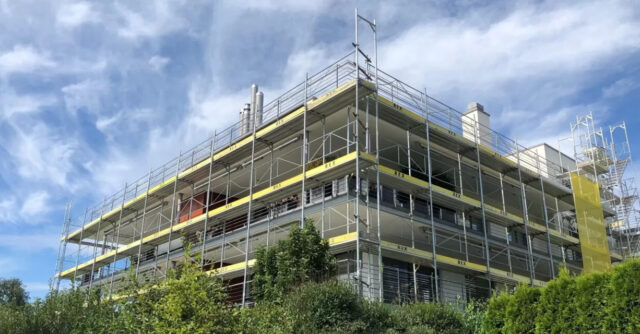
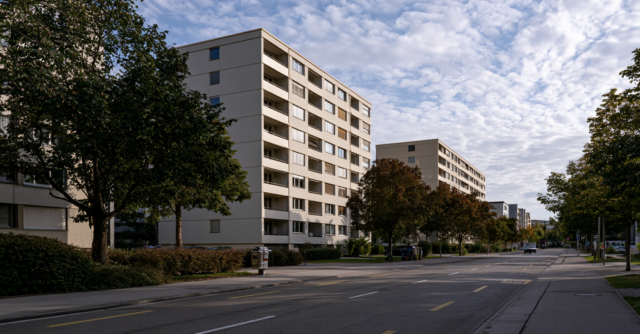
    The Schlieren-based real estate and construction company Halter is transforming the Clochettes site in the Champel district of Geneva. As part of the project, Halter was commissioned by Baloise to carry out the energy-efficient renovation, conversion and addition of storeys to three residential buildings from the 1970s. According to the press release, a total of 70 existing apartments will be modernized by January 2029 and 15 new apartments will be created by adding two more floors. The work will start in May and will take place while the apartments are occupied.

    As part of the refurbishment, Halter will replace the technical systems and refurbish the façades. Heat recovery and the installation of photovoltaic systems are also planned, according to the project description. The aim is to obtain a Minergie renovation label.

    The architectural design by the Grenier Coretra architecture firm maintains continuity with the existing buildings and harmonizes with the neighbouring residential complex. The new apartments will offer a variety of floor plans and room concepts tailored to modern living.

    New areas for residents and neighborhood-related uses will be created on the first floor of the buildings. The outdoor areas will also be enhanced with wooded areas to promote quality of life and biodiversity.

  • Spreitenbach municipal council adopts property strategy

    Spreitenbach municipal council adopts property strategy

    The Spreitenbach municipal council has adopted a new strategy for municipal properties, as detailed in a press release. The property strategy is of central importance for both the residents’ and the local citizens’ municipality. The decision serves as the basis for the medium to long-term development of publicly owned properties.

    The aim is to manage the municipality’s own property portfolios holistically rather than in isolation according to individual properties. The municipality of Spreitenbach expects this to lead to better harmonisation of the long-term needs of the population, school, administration, associations and other users.

    According to the press release, the new strategy is particularly relevant for the municipality of Spreitenbach, which as a public corporation has a portfolio of 69 properties and five developed building rights plots, in view of upcoming investment decisions. In the coming years, the focus will be on the further development of the school and sports infrastructure, the renovation and expansion of existing facilities, securing additional space for school administration and day-care centres and the development of a municipal park, among other things.

    The local community should also benefit from the holistic approach. It manages a portfolio of 130 properties with a land area of around 2.77 million square metres and a building insurance value of around CHF 13.6 million. The strategy focuses on the areas of housing, the local museum, building rights in the industrial area, agriculture and forests.

    The property strategy is to be reviewed at least every five years and adjusted if necessary. The planning horizon currently extends to the year 2040.

  • Modernised wastewater treatment plant enhances water protection and energy efficiency

    Modernised wastewater treatment plant enhances water protection and energy efficiency

    The refurbishment and expansion of the Basel Wastewater Treatment Plant have been completed. The wastewater treatment plant was officially inaugurated on 17 April. One of the region’s most important infrastructure facilities had been thoroughly modernised and expanded whilst remaining in operation since 2019. It is now one of the most modern facilities of its kind in Europe. Over the weekend of 18 and 19 April, the public can see it for themselves during the open days.

    According to a statement from the Canton of Basel-Stadt, the aim of the project was to significantly improve treatment performance, adapt the plant to future requirements and make a long-term contribution to water protection. It is now state-of-the-art and ensures legally compliant operation for several decades. It is designed to have a capacity sufficient for 520,000 residents until 2050. It can also receive pre-treated industrial wastewater from the ARA Chemie.

    Following the modernisation, the Basel WWTP is now also equipped for nitrogen removal and features a treatment stage for reducing micropollutants. This is complemented by sludge digestion and photovoltaic systems. Furthermore, biogas is produced from sewage sludge digestion and more waste heat is fed into the district heating network.

    The operator of the Basel wastewater treatment plant is Prorheno AG. The parliaments of the two Basel cantons approved CHF 325.1 million for the plant’s refurbishment. The final accounts are not yet available.

  • 300 apartments are being made fit – no one has to move out

    300 apartments are being made fit – no one has to move out

    Built in three stages between 1974 and 1990, the “Untere Bühl” still characterizes the old town center of Oberwinterthur today. The complex is considered worthy of protection and some of the buildings are still largely in their original condition. Some of them were already renovated in 2015, and the others are now being renovated. The planning application has been approved and construction is scheduled to start at the beginning of 2027.

    Nobody has to leave the field
    What makes the project stand out is its social consistency. As the asset manager of the AXA Investment Foundation, BNP Paribas designed the refurbishment from the outset in such a way that all tenants can remain in their apartments. The tenants were involved at an early stage, including workshops on outdoor space and design. “Our tenants have been an integral part of the development for years,” says Pascal Messmer, Asset Manager at BNP Paribas. This attitude runs through the entire project.

    Extensions that don’t impose themselves
    For the extension, AXA is relying on bernath widmer architects, who emerged victorious from a cooperative test planning process. The majority of the extensions and new buildings are made of wood and deliberately reflect the character of the existing buildings. Around 80 barrier-free apartments with 1 to 3 rooms will be created. An addition to the existing apartments, most of which are large today. Residential studios, communal areas and a commercial space are planned on the first floor.

    Park remains and becomes more lively
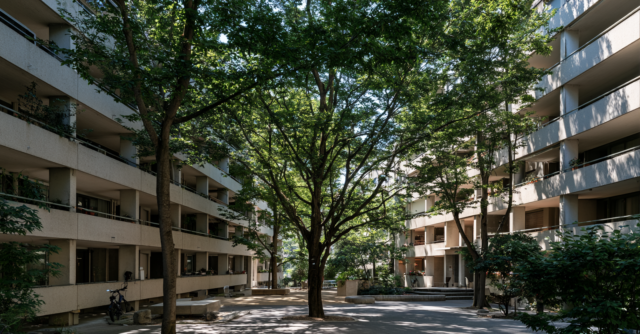
    The park-like outdoor space with communal gardens, playgrounds and the kindergarten from 1977 will be retained. The landscape architecture firm ghiggi paesaggi is taking Fred Eicher’s original open space concept and developing it further. New planting and green roof areas strengthen biodiversity and create habitats for small animals and insects. Greenery is planned on some of the roofs of the new buildings. The central pavilion is to be used by the public in future, for example as a daycare center.

    Into the future in stages
    The project will be implemented in stages, probably up to 2028, with the aim of creating a real estate portfolio with net-zero emissions by 2050. Winterthur is not only gaining refurbished existing buildings, but also 80 new apartments in a mature settlement that knows who it is.

  • Modernization of operations center secures long-term capacity

    Modernization of operations center secures long-term capacity

    Migros Eastern Switzerland has begun the renovation and modernisation of its operations centre in Gossau. According to a press release, the management of Migros Eastern Switzerland intends to make the building fit “for operation and expansion over the next 40 years” with the reconstruction, as Sandro Feltscher, Head of the Logistics and IT Directorate at Migros Eastern Switzerland, is quoted as saying.

    The work will mainly be carried out on Building C of the operations centre. This has been used since 1979 for the production and distribution of meat and charcuterie products as well as for the commissioning and dispatch of chilled food. In the first construction phase, an extension will be built on the southern side with additional docking points for delivery vehicles. In the coming year, parking spaces for trailers and car parks for employees will be renovated. In 2028 and 2029, new, modern rooms for employees will be built. Parallel to the overall construction measures, the refrigerated lines for order picking are to be replaced with modern ones. Construction work is expected to be completed in 2030.

    “The biggest challenge in the construction project is replacing the systems and modernising production without interrupting operations. Even during the replacement, our supermarkets and restaurants need daily deliveries of dairy products, meat and other chilled goods,” says Feltscher.

  • When architectural monuments pack their suitcases

    When architectural monuments pack their suitcases

    Two apartment buildings with 57 apartments ranging in size from 2.5 to 5.5 rooms are being built on a 6500 square meter site to the north of the historic station building. Commercial and restaurant space is planned on the first floors, as well as a small commercial building and an underground garage with 59 car and 92 bicycle parking spaces. A park-like open space with a playground will be created between the two buildings.

    Less, but social
    The project has become smaller. SBB originally planned four buildings with 90 apartments, a third of which would be affordable. However, the signal box next to the station building must remain, which means that an entire building is no longer needed. Of the remaining 57 apartments, 20 are to be offered at affordable prices. This corresponds to 35 percent and is even slightly higher than the original quota.

    Switzerland’s last goods shed
    What residential construction demands requires space. Four existing buildings have to make way, including the goods shed from 1928, designed by Meinrad Lorenz, SBB’s chief architect at the time, one of only four buildings of this type in the whole of Switzerland. Following the demolition of the identical shed in Heerbrugg, the one in Wollishofen is the last remaining example of its kind. It is listed in the cantonal inventory of listed buildings.

    A wooden building packs its bags
    Nevertheless, the goods shed will not disappear. It will be dismantled into individual parts, professionally refurbished and rebuilt at the Zurich Oberland Steam Railway Association in Bauma an der Töss. There it will be made accessible to the public and given a museum function as part of the “Bauma 2020 depot area” project. The approval documents for the dismantling are already largely in place.

    History repeats itself
    This move is not the first in the history of Wollishofen station. The current station building was once the first station building in the city of Zug, built in 1864 and moved stone by stone to Lake Zurich in 1897. What was forced by the scarcity of building materials in the 19th century is now a deliberate act of preservation. Wollishofen is thus writing another chapter in an unusual building history.

  • Lucerne cantonal government plans to set up a foundation for innovation

    Lucerne cantonal government plans to set up a foundation for innovation

    The Canton of Lucerne intends to establish the Innovation Lucerne Foundation. To this end, the Cantonal Government has now submitted a request for a special grant to the Cantonal Council. This comprises CHF 1 million in endowment capital and CHF 23 million to fund the foundation’s activities between 2026 and 2029.

    This foundation forms part of Lucerne’s location strategy, which aims to strengthen the canton’s competitiveness. According to the statement, the background to this is that whilst the Canton of Lucerne ranks in the top third in national competitiveness rankings, it consistently ranks lower in terms of its innovative strength. And “without strengthening its innovative strength, the Canton of Lucerne risks further losses in competitiveness”, the analysis states.

    The foundation is intended to counteract this and focus on supporting Lucerne as a hub for innovation and start-ups, with a particular emphasis on SMEs. As a key player, it is to coordinate the established partner organisations “and ensure that their services are better integrated, become better known and achieve greater impact”. In addition, the foundation can co-fund implementation projects such as feasibility studies.

    From 2026, the Canton of Lucerne intends to invest a total of between 250 and 300 million Swiss francs annually in “business- and population-oriented measures” to promote the region. Voters will be able to vote on these regional development measures in September 2026.

  • Schlieren is modernising its maintenance depot

    Schlieren is modernising its maintenance depot

    Schlieren Town Council has allocated 2.229 million Swiss francs for the refurbishment and modernisation of its municipal works site. According to a statement from the City Council, the city’s growth and increasing demands on public services make modernisation necessary. Key parts of the facilities have become too old and need to be replaced in order to meet legal standards for fire safety and occupational safety. The modernisation will also prevent structural damage and ensure proper operation in the long term.

    The works yard site houses the waste collection, building services, gas and water supply, green space maintenance and administration departments of the Works, Supply and Facilities Division. Due to the city’s ongoing growth, it is necessary to create the conditions to meet increasing demands on public services.

    The plans include replacing the gas heating system with an environmentally friendly heat pump system and refurbishing the roof surfaces. To increase capacity, the storage areas in the green space maintenance, gas and water supply, cloakroom and staff lounge sections are to be expanded.

    Parts of the project will include the modernisation of the ventilation and summer heat protection in the administration building, as well as the expansion of the charging infrastructure for the city’s electric vehicle fleet, it is reported.

    The awarding of construction contracts by a building commission appointed by the city council has already begun. The municipal council will now decide on the installation of a high-performance photovoltaic system.

  • DGNB certificate for deconstruction in Switzerland

    DGNB certificate for deconstruction in Switzerland

    The grain silo tower from 1939 was demolished, but its concrete was not disposed of. In the nearby concrete plant, the material was processed according to a specially developed formula and 75 to 95 percent of it was reused as recycled material in the new building. Around 60 percent of the new building consists of the old tower. The client is Gutgrün AG from Chur, which deliberately refrained from making short-term profits in order to consistently implement the sustainability concept.

    52 apartments, three certificates
    The project comprises 37 rental apartments on eleven floors in the new residential tower and 15 loft apartments in the renovated historic mill building. The architects from Ritter Schumacher have recorded all the materials used in a building resource passport. A forward-looking approach that makes future life cycles transparent today. The project was awarded three DGNB certificates for this achievement. DGNB Platinum for the demolition, DGNB Gold for the new tower and DGNB Gold for the refurbishment of the old building.

    Fire protection reinvented
    The 30-metre-high photovoltaic façade poses a problem for conventional fire protection regulations. They require partitions on every floor to prevent fire from spreading from floor to floor. This would have interrupted the façade and significantly reduced its efficiency.

    The PV surface is not interrupted anywhere by windows and is continuous from the floor to the roof. Specialist planners, contractors and the insurance company worked together to develop a tailor-made solution. Fire cannot reach the façade from the inside and the façade cannot reach the apartments.

    Alliance instead of conflict
    The project was built using the alliance model. The client, planners and contractors sat around the table together right from the start. Problems from construction practice were thus incorporated directly into the planning. The basic attitude was one of trust and fairness rather than pure risk hedging. One detail also testifies to the unconventional spirit: the graffiti that adorned the vacant building was retained as decorative elements in the stairwell.

    A signal for the industry
    There was not a single objection to the conversion project. This is unusual for a construction project of this size. Grüsch Mill shows that circular construction also works in a peripheral region and that sustainability is not a contradiction to economic viability.

  • What was considered a bargain becomes a billion-euro project

    What was considered a bargain becomes a billion-euro project

    When the city of Zurich announced the renovation of the armory on the barracks site in Zurich-Aussersihl, it still sounded like a manageable project. The initial cost estimate was around 55 million francs. Today, a figure of just under 200 million francs is on the table that makes even experienced city parliamentarians sit up and take notice. A multiplication that needs to be explained.

    Dilapidated fabric drives up costs
    The main driver is the fabric of the building itself. The historic arsenals are in a far worse condition than originally assumed. Pollutant remediation, structural interventions and monument conservation requirements add up to a cost that was simply underestimated in advance. Added to this are increased construction costs and an expanded usage concept that requires higher technical standards.

    Culture, commerce and community
    What is to be created after the renovation has substance. The city council is planning a mixture of cultural use, small businesses and publicly accessible spaces. A lively meeting place in the middle of Zurich-Aussersihl. The social mix is an explicit part of the concept. The aim is to enhance the barracks area as a whole, not just the arsenals themselves.

    Long road to opening
    The timetable is ambitious and the history of the project calls for caution. The renovated arsenals should be ready for occupation in 2034 at the earliest. Until then, the municipal council will need to approve a loan, an approved construction project and a smooth construction process. In Zurich, experience shows that these three factors rarely all work smoothly at the same time.

    Monument obliges
    The arsenals are part of the protected barracks area. An ensemble that makes the city’s history visible. Demolition is out of the question. If you want to preserve historic buildings, you have to be prepared to pay for them. The question is not whether, but how the city finances this task and communicates it transparently, comprehensibly and with clear added value for all Zurich residents.

  • Renovation project focuses on the circular economy and reducing CO2 emissions

    Renovation project focuses on the circular economy and reducing CO2 emissions

    According to its press release, Sika is participating as a funding partner in the three project phases – Exploration (2026), Synthesis (2027) and Transfer (2028) – of ETH’s Living Lab HIL. These phases will lay the groundwork for the refurbishment, energy-efficiency upgrade and extension of the teaching and research building for architecture and civil engineering (HIL) on the Hönggerberg campus. The major project is scheduled for completion by 2035.

    According to ETH, the need for renovation and the changed spatial requirements clearly called for a complete refurbishment involving demolition down to the load-bearing structure. Instead, the university intends to treat the existing building with greater care and focus on CO2 reduction, digitalisation and the circular economy. It is developing the construction project internally, drawing on knowledge and insights from its own teaching and research and working with industry partners.

    In this “globally unique flagship project”, as Sika describes it, the Baar-based specialty chemicals company for construction and industry is contributing more than just financial support. The project’s funding also encompasses an active and close technical exchange between Sika and the ETH project teams. This is facilitated through the ETH Foundation.

    Sika aims to help “drive the transformation towards sustainable construction methods”, says Patricia Heidtman, Head of Innovation and Sustainability. “The Living Lab HIL offers a unique platform that actively links research and practice and tangibly accelerates innovation.”

    Industry and science must act together to achieve climate targets, says Mathias Kohler, ETH Professor of Architecture and Digital Fabrication. “In cooperation with Sika, we are testing new solutions in the Living Lab HIL that will be implemented during the renovation phase of the ETH building from 2030 onwards.”

  • Historic Spa District gets a new perspective for use

    Historic Spa District gets a new perspective for use

    Verenahof AG, based in Baden, wants to revitalize the building complex in Baden’s Spa District. To this end, it concluded a contract with the city on February 5. According to a press release, this forms the basis for the development and use of the complex and is intended to provide planning security.

    Verenahof AG has developed a utilization concept in collaboration with the city and the cantonal monument preservation authorities. This envisages combining assisted living for older people with cultural offerings and publicly accessible uses. The technical feasibility has already been examined. Now a building application and a cost estimate are to be drawn up within twelve months under the management of Verenahof AG.

    “The concept for services in the areas of prevention, rehabilitation and healthy ageing is a perfect fit for this historically valuable location for Baden,” said Markus Schneider, Mayor of Baden, in the press release. “The Spa District has been investing in health since Roman times – it is important for Baden and the region that this offering continues to be expanded in the future.”

    The complex has been vacant since the closure of the Verenahof, Bären and Ochsen hotels in 1987 and 2004. It has been under national protection since 2019. As the owner of Verenahof AG, the Bad Zurzach Baden Health Promotion Foundation has examined several uses, including for a rehabilitation clinic. These possible uses came up against the economic and structural framework conditions as well as the requirements for the preservation of historical monuments.

  • Historic hotel complex is being repositioned in stages

    Historic hotel complex is being repositioned in stages

    Halter AG aims to breathe new life into the listed Sonnenberg complex in Seelisberg. The Schlieren-based property developer is currently in the process of gradually redeveloping the historic hotel complex, Halter states in a post on LinkedIn. According to the project description, the Hotel Sonnenberg is to remain as the core building and will once again be used as a hotel upon completion.

    In the former Hotel Kuhn, which will also remain largely unchanged, Halter plans to create apartments. Further apartments are to be built in two new buildings south of the hotel. Existing additional buildings to the north will be repurposed and incorporated into the hotel complex.

    The historic hotel complex attracted international attention in the 1970s. At that time, the Sonnenberg complex had been acquired by the Transcendental Meditation movement. From 1972 onwards, and for more than three decades, the Grandhotel Sonnenberg served as the headquarters of the movement led by the guru Maharishi Mahesh Yogi. Felice Zenoni’s documentary Namaste Seelisberg, screened for the first time at the 61st Solothurn Film Festival, explores this era. Halter supported the film project and facilitated filming on the site.

  • City wants to acquire industrial building for archive and temporary uses

    City wants to acquire industrial building for archive and temporary uses

    The Biel Municipal Council is proposing to the City Council that it purchase the industrial property at Mattenstrasse 133. According to the announcement, the building is intended to serve as the new city archives from 2033 onwards. Prior to that, it will be used as a temporary gymnasium and library.

    The industrial property at Mattenstrasse 133 was built in 1959 for Maveg AG, a trading company for construction machinery. The building comprises three large halls and an administration building and is listed as worthy of preservation in the building inventory.

    From winter 2026/27, the large hall of the property is to replace the Collège des Platanes’ gymnastics facilities. Since 2024, these have only been usable to a limited extent due to structural problems. Until the gymnasiums are renovated, the city wants to create a temporary solution by simply expanding the hall.

    Later, during the planned complete renovation of the city library on Neumarktplatz starting in 2031, the property will serve as a temporary library location. There are hardly any suitable rental solutions available in the city centre for the library’s approximately 1,700 square metres of floor space.

    After the library moves out, the building will be used permanently as the city archives from 2033 onwards. The city has been looking for a new solution for this for years, as the current premises no longer meet legal requirements and the archive holdings are spread across several locations.

    The municipal council is applying to the city council for two loans totalling CHF 3.890 million for the purchase of the property and the temporary provision of the gymnasium. The city council will make its decision on 19 March.

  • Renovating bridges with “smart” steel

    Renovating bridges with “smart” steel

    Many reinforced concrete bridges were designed for traffic loads and vehicle weights that are outdated from today’s perspective. At the same time, chlorides, water and frost have been causing problems for the structures for decades. Traditional refurbishments reach their limits where components are already severely cracked or permanently deformed.

    This is where the new Empa system comes in. It combines a proven method, the additional layer of ultra-high-strength, fibre-reinforced concrete, with an active reinforcing element that specifically builds up internal prestressing forces. The aim is not only to increase load-bearing capacity, but also to literally rebuild damaged bridge slabs.

    UHPFRC meets shape memory steel
    Bridges are already being retrofitted with a thin layer of ultra-high performance fibre-reinforced concrete, which is applied directly to the deck slab. The high-performance concrete is very dense, resists water and de-icing salts and can be easily reinforced. A robust “protective armour” with structural added value.

    The Empa team led by Angela Sequeira Lemos and Christoph Czaderski is now replacing the conventional steel reinforcement in this layer with bars made of iron-based shape memory steel. After installation, the bars are heated to around 200 degrees Celsius and attempt to contract, but are prevented from doing so by the concrete. The result is an internal prestress that closes cracks, reduces deformations and permanently puts the slab in a more favourable state of tension.

    Cracks close visibly
    In a first step, the team investigated the bonding effect between UHPFRC and shape memory steel. How well does the bond remain after heating? How reliably can forces be transferred? This was followed by large-scale tests with five concrete slabs, each five metres long, which simulated self-supporting bridge decks.

    One slab remained unreinforced, the others were given a UHPFRC layer, either with conventional reinforcement or with Fe-SMA bars. In order to simulate realistic conditions, the slabs were initially loaded until cracking occurred and only then reinforced. After heating the Fe-SMA bars, existing cracks visibly closed and sagging areas lifted up again. Significant improvements in deformation were already evident during this activation phase.

    Stiffer, stronger, longer-lasting
    The tests were accompanied by a dense measurement concept. Digital cameras observed the crack patterns, while fibre-optic sensors inside the panels recorded strains along the rods. Similar to fibre optic cables in telecommunications, except that here the backscattered light is used to measure deformation.

    Both the conventional reinforcement with UHPFRC and the new system with shape memory steel were able to at least double the load-bearing capacity compared to the unreinforced plate. However, under everyday loads, such as normal road traffic, the Fe-SMA variant proved to have a clear advantage. The panel became stiffer, permanent deformations occurred later or disappeared completely and existing cracks could be closed. The system thus acts like a “reactivation” of the existing load-bearing structure.

    Fields of application and next steps
    Both the ultra-high-strength fibre-reinforced concrete and the shape memory steel are still relatively expensive. The system is therefore most economically attractive where other reinforcement methods are no longer sufficient. For example, in heavily deformed, already damaged bridges or, in particular, sensitive structures with limited intervention space.

    The use of the system is not limited to bridges. Applications in building construction are also conceivable, for example in cantilevered balconies, flat roofs or sensitive components where compact reinforcement solutions and a very dense surface are required. The Innosuisse-funded project was developed in collaboration with OST, the Empa spin-off re-fer and cemsuisse. Following the successful trials, the team is now looking for a suitable bridge for the first pilot application. If this step is successful, the “smart” reinforced concrete could develop into an important tool for dealing with the ageing Swiss bridge infrastructure.

  • Gaudí’s hidden chalet in the Pyrenees

    Gaudí’s hidden chalet in the Pyrenees

    Neither original plans nor an official signature by Gaudí exist for the Catllaràs chalet. For decades, the attribution was based primarily on formal similarities to known works. The investigation commissioned in 2023 by the Gaudí Chair of the Polytechnic University of Catalonia therefore opted for a different strategy: geometric and constructive analyses instead of archival finds at the last moment.

    Under the direction of Galdric Santana, the building was measured in three dimensions, its supporting structure analysed in detail and compared with confirmed Gaudí buildings. The team also analysed historical photographs and the building history surrounding the projects for Eusebi Güell. The study concludes that the design was by Gaudí, but that the execution was the responsibility of third parties and deviated from the original concept.

    The logic of the vaults
    The core of the argument is the supporting structure. The chalet has a rectangular floor plan and a pointed vaulted roof that reaches almost to the ground. The roof and façade are structurally one unit; windows are located exclusively in the long walls and look like mansards cut into the vault. The end walls remain closed, statically consistent, formally radical.

    The decisive factor is the central longitudinal axis, which acts as a load-bearing backbone to support the storeys. Santana emphasises that this constructive logic is typical of Gaudí. The vault not only serves as a ceiling, it also supports the levels above it. This is based on working with a chain or cable model. The sagging line of a loaded chain provides the ideal pressure line of an arch. If this model is turned round, the result is a vault shape that is almost completely under pressure, a principle that Gaudí systematically utilised.

    Interventions during construction
    However, the study also shows that the load-bearing structure was altered during construction. Instead of consistently transferring the loads via the vault and the central axis, the builders inserted additional transverse walls. Longitudinal beams took over parts of the load transfer, which weakened the original radical clarity of the system.

    Santana sees this as a possible reason why Gaudí never openly claimed authorship. The “cable car”, working with the ideal chain line, was not consistently implemented in the chalet for the support of the floor slabs. The idea can be seen in the supporting structure, but its consistent application was only partially realised.

    Gaudí and Güell
    The chalet was commissioned by Eusebi Güell, Gaudí’s main patron. He ran a coal mine and the Asland cement factory in the region. The building served as accommodation for engineers and technical specialists and their families. As such, the house does not stand in the context of prestigious city palaces, but rather in the field of tension between industry, infrastructure and the harsh mountain landscape.

    The project coincided with a phase in which Gaudí was working on Park Güell and the Colònia Güell church at the same time. Against this background, it seems plausible that he did not take on the construction management of a remote chalet in the Pyrenees himself. After the mine and factory were shut down, the house was used as a country school for a time and many locals remember it from their childhood. Today it has been restored and is open to the public, and is an identity-forming building block for the municipality of La Pobla.

    Typical of the region and highly rational
    The chalet occupies a special place in Gaudí’s oeuvre. It is significantly smaller than icons such as the Sagrada Família, but it shows central motifs of his thinking. Santana speaks of a large-scale reinterpretation of the Gothic mountain huts of the Pyrenees. Gaudí takes up regional building traditions, but transforms them structurally and geometrically.

    The compact, self-contained form responds to the harsh climate and reduces construction costs. Materials are largely sourced from the surrounding area and the building blends topographically into the slope. The 45-degree distributors in the floor plan, which Gaudí also used in the Torre Bellesguard, are also characteristic. They create flowing spatial transitions and break up rigid orthogonal systems – another element of identification.

    How architectural science examines authorship
    The study of the Catllaràs chalet is not only a contribution to Gaudí research, but also a lesson in methods of architectural attribution. In contrast to painting, buildings rarely have a clear “signature”. Works are remodelled, extended or converted by employees, plans are lost or only exist in fragments. The researchers therefore combined geometric analyses, material investigations and digital 3D models with historical source work. Proportions, curvatures and structural logic were compared with verified Gaudí buildings, while photographs from the time of construction completed the picture. At the presentation, the Minister of Culture emphasised how indispensable such scientific certifications are in order to reliably determine authorship. Catllaràs’ chalet is thus transformed from a local special case into a clearly localised building block in the oeuvre of one of the most important architects of modernism.

  • New headquarters combines industrial history with modern architecture

    New headquarters combines industrial history with modern architecture

    Electrification and automation group ABBis planning a new global headquarters in Zurich Oerlikon, according to a press release. The 80 million Swiss franc project reflects the history of the company and the city of Zurich and will create a modern workplace for around 500 employees.

    The location chosen is the historic ABB building, which will be renovated and modernised in accordance with heritage protection requirements. The historic building will be complemented by a six-storey new building in the inner courtyard, replacing the Chicago Hall event venue, which is not listed.  The new building will have a brick façade in keeping with the existing architecture and will be constructed using a material-efficient wood composite construction method. Supported by ABB technologies and photovoltaic systems, low energy consumption is to be achieved. The new headquarters covers a total area of around 10,800 square metres. Plans include a 280-square-metre lobby with exhibition space and a 450-square-metre media area.

    For Morten Wierod, CEO of ABB, the choice of location is a commitment to Switzerland and the city of Zurich, “where our global headquarters have been located since the merger of BBC and Asea in 1988. One of our predecessor companies – Maschinenfabrik Oerlikon (MFO) – was also based here for many decades. The combination of a historic building and state-of-the-art facilities will create an inspiring environment for cooperation and innovation.”

    Detailed plans for the new headquarters are expected in 2026/2027. The building is scheduled to be completed and ready for occupancy by 2031. Until then, ABB will remain in the Cityport building in Zurich Oerlikon.

  • Historic thermal baths get a green future

    Historic thermal baths get a green future

    The city of Baden and the canton of Aargau have granted the Bad zum Raben cooperative planning permission to renovate the Bad zum Raben swimming pool. According to a statement issued by the cooperative, the renovation will combine monument preservation, water hygiene, fire and flood protection, and efficient operations. Once financing has been secured, the renovation is scheduled to start at the end of 2026 and be completed in early 2028.

    “We are very pleased about this important milestone. The building permit gives us planning security and is the basis for further fundraising,” said Andreas Rudow, co-president of the Bad zum Raben cooperative, in the press release. “With the project approved, it will be easier to find funding.”

    The total cost of the renovation will be around CHF 4.5 million. While CHF 1 million has already been covered by own funds, donations and initial funding commitments, the remaining financing is to be secured through contributions from the public sector, foundation fundraising, donations and the sale of cooperative shares. The Bad zum Raben cooperative is also continuing to seek additional members and is symbolically selling components of the future baths.

    The renovation aims to preserve the historic building fabric and enable the communication of history and culture through sustainable bathing operations and flexible use. In addition to four pools with natural thermal water, the Bad zum Raben will feature a small bistro, a stage for cultural events, rooms for art and relaxation, and a bathing media library. The entrance area will offer insights into the history of the old bathhouse and the historic water system. After the renovation, thermal water will also be used to heat the showers in the baths and the apartments on the former hotel floors.

  • Start of construction for double track expansion in Dietikon postponed to 2028

    Start of construction for double track expansion in Dietikon postponed to 2028

    There is a delay in the double-track expansion of the Bremgarten-Dietikon railway and the renovation of Bremgartnerstrasse. According to a statement by Aargau Verkehr AG, the building permit from the Federal Office of Transport (FOT), which was scheduled for the end of 2025, could not be granted due to ongoing appeal negotiations and a renewed partial suspension of the project in connection with compensation claims.

    The transport company now expects the start of construction, originally planned for summer 2026, to be postponed until summer 2028. Until then, a number of project adjustments will have to be made. This will require technical reviews and consultation with the authorities.

    According to Aargau Verkehr, the expansion is intended to increase the safety, punctuality and capacity of rail operations: “The construction of a centrally located double track will integrate the railway safely into road traffic, which will increase traffic safety and reduce traffic jams.”

    Planning approval is expected to be completed by the second quarter of 2027. Aargau Verkehr AG is in contact with the Civil Engineering Office of the Canton of Zurich, the client for the road construction project, the FOT, the city of Dietikon and affected residents to clarify outstanding issues and move the project forward.

  • New Center for Social Sciences

    New Center for Social Sciences

    The Alte Gewerbeschule, once built in the German Neo-Renaissance style, will remain architecturally and culturally significant following its extensive renovation. The Canton of Basel-Stadt is investing around 63 million francs in the renovation, which is based on strict monument protection regulations and current standards for accessibility and energy efficiency. Specialist departments and general planners are working closely with the cantonal monument preservation authorities to preserve the façade, interior and historical details.

    With the renovation, eight university departments, the dean’s office and central services will be concentrated at Petersplatz, which will strengthen academic dialog and the use of shared resources. The UVB Social Sciences will have a new, modern library in the inner courtyard and attractive learning and working areas on the mezzanine floor. This will create a university center for the humanities and cultural sciences with a high quality of stay and optimal infrastructure.

    Refurbishment under the banner of sustainability
    Construction work began in November 2025 and will last until summer 2029. The building will be modernized in terms of energy efficiency, made earthquake-proof and contaminated sites will be removed. The new interior design combines functionality and monument protection. Characteristic building elements will be restored and the technical infrastructure and flexibility of use will be brought up to the level of a modern campus. It is being carried out under the leadership of the cantonal monument preservation authorities and specialized architects, accompanied by federal expert committees, in order to ensure maximum protection of the historical substance.

    The Alte Gewerbeschule Basel will be an innovative bridge between academic excellence and historical identity. A strong signal for the future of urban learning.

  • Modernization and building mobility: Why we need to build on the existing infrastructure

    Modernization and building mobility: Why we need to build on the existing infrastructure

    This is particularly evident in ageing elevators and escalators. Around 10 million of these systems are in operation worldwide, most of them in densely populated city centers. They are more susceptible to faults and safety risks. Ageing elevators also often restrict the freedom of movement of people with disabilities, for example by making it difficult to open revolving doors.

    Modernization is not just a question of safety or comfort. It is also one of the most effective instruments for reducing emissions. The construction industry is already responsible for around 40% of global CO₂ emissions – a figure that could double within 25 years if nothing is done. The European Commission estimates that 85 to 95% of the buildings that will exist in 2050 are already standing today. Replacing these buildings is not an option. The key to reducing CO₂ is therefore not to build new buildings, but to retrofit the older but still functioning systems.

    For all those who want to keep their buildings and cities alive, modernization is a necessary investment in resilience, sustainability and general well-being. Today, networked, data-driven systems can detect wear and tear, predict maintenance requirements and extend the service life of systems – making cities not only safer, but also smarter and more environmentally friendly.

    For many building owners, modernization is still a challenge. High investment costs, long downtimes and uncertainty about where to start are common concerns. Partial modernization is often a sensible middle way. It combines the advantages of new technologies with the continued use of intact components and thus significantly reduces costs and operational interruptions – without having to accept the expense and downtime of a complete replacement. In the elevator sector, this can save up to 90 percent CO₂ compared to a complete replacement.

    Our cities cannot be redrawn, but they can be developed further. When we modernize the mobility systems that move millions of people every day, we create urban environments that are safer, more inclusive and more climate-friendly – and ready for the challenges of the coming decades.

  • Renovation combines functionality, comfort and alpine location

    Renovation combines functionality, comfort and alpine location

    Heller Gastro AG will open its newly renovated and converted Eiger Lodge Grindelwald on 19 December 2025. The work centred on the renovation of the Eiger Lodge “Easy”, the older of the two buildings that form part of the Eiger Lodge. It was modernised between April and December. According to a press release, the investment volume totalled 4.5 million Swiss francs. The two hotel sections “Easy” and “Chic”, located directly beneath the north face of the Eiger, offer a total of 220 beds.

    according to the statement, 70 per cent of the order volume was carried out with local companies, while the remaining 30 per cent was carried out with companies from Bern and the Bernese Oberland. The new breakfast area now offers more space and large window fronts with mountain views. New kitchen facilities are intended to simplify processes behind the scenes. The reception and entrance area has also been completely refurbished. A sauna has been installed on the upper floor. An adjoining terrace is still under construction. The communal showers, which are part of the “Easy” multi-bed, double and family rooms, have also been completely renovated.

    The hotel has been the base for numerous mountain enthusiasts since the 1990s under the name Mountain Hostel. in 2015, it was taken over by Heller Gastro and renamed the Eiger Lodge. The company also operates the Eiger Mountain & Soul Resort Grindelwald on site.

  • Modernized shopping center boosts usage and energy efficiency

    Modernized shopping center boosts usage and energy efficiency

    Schlieren-based Halter AG has completed the modernization and redesign of the Signy Centre in Signy-Avenex. The renovation included two buildings with administrative and commercial space, three floors with around 50 stores and five parking decks with a total of around 1,100 parking spaces. According to Halter, the project started in 2023 and has now been completed with the official handover to customers.

    As part of the renovation, the technical systems and security facilities in the Signy Centre were modernized. Halter also redesigned the shopping center and its outdoor facilities. According to the company, the completed renovations increase the comfort and safety of employees and customers in the shopping center. The site’s energy and environmental footprint has also been improved.

    The project also involved the companies Burckhardt and ARFOLIA, which were responsible for the architecture and landscape architecture respectively. While sd ingénierie was involved as the civil engineer, Caeli Ingénierie took on the role of technical engineer. The last fire protection engineer was srg engineering.

  • Renovation creates modern space for research and teaching in Zurich

    Renovation creates modern space for research and teaching in Zurich

    The Careum Tower was officially inaugurated in mid-November after around two and a half years of renovation work. According to a statement from the Careum Foundation, which is in charge of the project, the former nurses’ tower block of the University Hospital Zurich(USZ) has now become a modern working and meeting place for education and healthcare. According to the statement, this will create more space on 17 floors in Zurich for the planned expansion in the field of medicine. This was celebrated at the inauguration with the Director of Education of the Canton of Zurich, Silvia Steiner, and the Director of University Medicine Zurich, Beatrice Beck Schimmer, among others.

    The Careum Foundation has concluded a 40-year lease agreement with the USZ with an option to extend. There are now 6000 square metres of floor space available with the possibility of 350 workstations. The foundation itself, which offers training and further education in the healthcare sector, intends to use three of the 17 floors itself. The Careum Publishing House and the Careum Centre for Health Literacy, for example, will move into rooms. The remaining space has been let to institutes of the University of Zurich Medical School.

    “We are thus expanding our campus and creating additional space for networking and inspiration between disciplines and institutions. In keeping with the purpose of our foundation, we are utilising the potential in Zurich’s university district to further promote education and research in the healthcare sector and make a contribution to healthcare provision,” Careum Foundation President Hans Werner is quoted as saying.

    According to documentation, the historical character played a central role in the renovation. For example, two floors were left in their original state. According to the press release, the responsible experts from Bhend & Schlauri Architects worked closely with the City of Zurich’s monument preservation authorities.

  • The real estate sector is a support for the canton and the citizens

    The real estate sector is a support for the canton and the citizens

    Innovative’ housing projects that are economically, environmentally and socially sustainable could help stimulate the economy in Ticino.

    The conditions for becoming a landlord are becoming increasingly restrictive, and proportionally fewer families can afford to buy property. In Ticino, it is not only families belonging to the economically weaker segment of the population that have to cope with too many expenses to pay rent and ancillary costs. Inevitably, many families ask the State for financial support. By activating an active policy in favour of moderately rented housing we could create the conditions to reduce the demands on the state.

    Private actors in the real estate sector could play an active and decisive role in this direction, as is already the case in other parts of Switzerland, bringing a public benefit while reducing the vacancy rate in the medium term.

    By planning the renovation, refurbishment and conversion of existing buildings in a coordinated and careful manner, we could reduce land consumption by improving the housing stock and, at the same time, have a better social impact in respect of the environment.

    More attention and a sense of individual responsibility towards the community could lead to savings on the part of the state, which is currently under pressure to find solutions and meet citizens’ needs.

    More awareness of the advantages of sharing spaces and services would lead to an increase in quality of life and savings. By optimising expenditure on housing, families could better cope with increases in the cost of living, including healthcare costs.

    Among the many possibilities is the development of public utility housing (which can be non-profit corporations, foundations, housing cooperatives) with rents based on actual costs, taking advantage of funding from the
    Federal funding and sureties. These projects should mainly focus on renovations of existing buildings, realising quality projects, optimising space so that, if possible, there is less consumption of floor space per inhabitant.

    In order for the costs of realising housing projects, as mentioned above, also starting from existing buildings, to be low, it is important that the land cost is not excessive. To be reasonable, the cost of land should be around 20 per cent, or if in central areas 25 per cent, of the total cost. Often in urban areas this is the biggest obstacle.

    The housing stock in Ticino is old. Many owners have not invested in renovations, even with low mortgage rates, and when they decide to sell, the economic demands are too high to create income housing with rents affordable to a large segment of the population. It should not be forgotten that the effort rate for housing should not exceed 33% of the income of a family belonging to the upper-middle class of the population. This rate should not exceed 25% if it is in the lower social stratum. Properties for sale, therefore, are often purchased by developers with specific targets who do not always realise projects that correspond to the needs or economic possibilities of families taking into account that wages are low compared to the rest of Switzerland and that the population is ageing faster.

    The instrument of surface rights, mainly used for commercial real estate projects, is little used in Ticino for housing projects. Yet it could help to find alternative solutions to develop ‘innovative’ projects. It could be very interesting both for the owner of the land, who would regularly receive a rent (ground lease fee) and at the end of the contract would come back to decide how to use the property, and for the landowner, who would develop his project with his own capital according to his needs without having to find funds to buy the property, which is perhaps located in a well-serviced area. Not needing capital to buy the land, many more families would have the means to invest in housing to live in.

    North of the Alps, municipalities or other public authority actors lease out their property by putting bonds on it for private individuals, including Anonymous Societies, to invest capital in specific projects including adequate and affordable housing.

    There are also other avenues that could be pursued. The Soliterra Foundation could be of help if it were a project developed by a non-profit housing project developer, in fact, its aim is to promote the construction of affordable housing throughout Switzerland. This is done in particular through the purchase of land and the granting of surface rights to it. The Soliterra Foundation gives financial support to small or young residential housing cooperatives, in particular for the purchase of properties with existing buildings or for approved new construction projects. But what makes the Soliterra Foundation special? The land can be bought back as soon as the financial situation is stable and the loan capital has been sufficiently repaid. The costs for the land right are low because they correspond to the reference interest rate plus a surcharge for administrative costs and a 50% inflation adjustment.
    The formula is similar to that of the federal government’s revolving fund, which thanks to loan repayments, which are not a cost to the state because they are remunerated, over time funds are again available to buy more property and thus promote new housing projects of public benefit.

    Restructuring the housing stock in Ticino to meet the needs of all generations could bring new opportunities whose benefits would extend to the community. The whole of society would benefit.

  • Restoration brings Eaumorte Bridge back into the townscape

    Restoration brings Eaumorte Bridge back into the townscape

    The construction company MAULINI SA, based in Satigny, informs in a LinkedIn post about the completion of the restoration of the Eaumorte Bridge. The bridge between Avully and Cartigny was built in the mid-19th century and is considered one of the oldest in the canton of Geneva. Work began on June 2, 2025 and was completed at the end of October. The municipality of Avully described the bridge as being in an “advanced state of deterioration” before the restoration began.

    MAULINI carried out all the work, including the restoration, the removal of vegetation, the reconstruction of the stones according to the original and the design of the access to the bridge. According to the company, “the work consisted of repointing the stones with historic mortar, creating a new superstructure and installing a parapet made of local wood to give the bridge back its original stability and charm”. The aim of the restoration was to make the bridge accessible again for pedestrians, bicycles and horses. MAULINI worked together with the engineering firm EDMS from Petit-Lancy GE on this project.

    Founded in 1910, MAULINI SA specializes in building construction and civil engineering. This includes in particular projects for the construction of apartment buildings, industrial and administrative buildings as well as restoration projects such as the Conservatoire de Musique de Genève. The company is one of the five finalists for the Prix SVC Genève 2025, which will be awarded on November 27, 2025 at the Bâtiment des Forces Motrices in Geneva.

  • Electrical installations in the historic railway station combined with modern technology

    Electrical installations in the historic railway station combined with modern technology

    Ernst Selmoni AG is responsible for the entire electrical system in the new Migros shop in the historic Badischer Bahnhof railway station. The rooms in the former theatre of the Förnbacher Compagnie in the southern part of the station building are, like the entire building, a listed building. Badischer Bahnhof, one of six railway stations in Basel and today the second largest, was opened in its current form in 1913.

    The contract included the complete electrical installation, from the power supply and modern lighting to the technical systems that enable smooth operation. “The work in the listed building was particularly exciting,” said Selmoni in a company press release. The historical substance demanded creative solutions, careful planning and close coordination with the authorities to ensure that tradition and modern technology were in harmony”.

    Christophe Hassler, Business Unit Manager at Selmoni Installation AG, describes this project as “an exciting challenge: realising modern electrical installations in a listed building without compromising its historical substance. With great care and innovative solutions, my team proved that technology and history can harmonise perfectly.”

    Selmoni was founded in 1934. The approximately 600 employees serve global corporations as well as private individuals. The company focuses on innovative solutions and digitalisation in construction. New technologies such as prefabrication, drilling robots, building information modelling and Hololens are already part of Selmoni’s everyday work to make construction projects faster, safer and more sustainable.

    Selmoni is one of five finalists for the Prix SVC Nordschweiz. This prize from the SME network Swiss Venture Club(SVC) will be awarded on 13 November in front of around 1,000 guests at the Congress Center Basel.

  • Renovation of the Pérolles Bridge near Fribourg underway

    Renovation of the Pérolles Bridge near Fribourg underway

    Walo Bertschinger AG is involved in the ongoing renovation of the Pérolles Bridge between Fribourg and Marly FR. The 550 metre long and up to 70 metre high road bridge over the Saane is being repaired following damage to the road surface. Walo Bertschinger’s team is currently taking on a range of the work involved, as the fourth-generation construction company from Dietikon explains in a post on Facebook.

    Specifically, Walo is replacing the carriageway joints and renewing around 10,000 square metres of asphalt. The Walo team is also repairing damaged concrete and providing the bridge with modern waterproofing. The Pérolles Bridge will remain open to cars, buses, bicycles and pedestrians throughout the construction work.

  • Construction project becomes a learning laboratory for students and researchers

    Construction project becomes a learning laboratory for students and researchers

    The two ETH departments of Architecture and Civil, Environmental and Geomatic Engineering are turning the complete renovation and extension of the HIL building on the ETH Hönggerberg campus into a research project. Instead of handing over the construction planning to an external planning office, an internal planning team involving professors, mid-level staff and students will be responsible for it, according to an ETH report. They will use their diverse construction expertise to research interventions and constructions in the HIL Living Lab in order to advance sustainable, circular and resource-saving construction in existing buildings.

    The HIL building was constructed between 1972 and 1976 and serves as the main building for the two architecture and construction departments. It has 800 workstations, 1600 seats in lecture theatres and seminar rooms as well as large drawing rooms and has reached the end of its first life cycle. In particular, there is reportedly a considerable need for refurbishment in terms of fire protection and building services. In addition, the striking building envelope is insufficiently insulated.

    In addition, the building is to be significantly expanded and extended by around 2035, as the ONA architecture centre is to be abandoned and integrated. The project also addresses the central question of how work, teaching and research should be organised at the HIL in the future. The aim is to create a modern space that is more conducive to interaction and collaboration with so-called hybrid teaching and learning landscapes. Those involved still want to define what this means in concrete terms.

    “The Living Lab enables us to incorporate teaching and research directly into a building project,” says Professor of Architecture Matthias Kohler on the project website. He initiated the project together with the Director of the ETH Real Estate Department, Hannes Pichler. “The fact that we are researching our own ‘home’ makes it all the more exciting for us because we can help shape our future.”