In a densely built-up district such as District 2, the emergency services currently only reach the scene within the critical ten-minute mark in around 60% of cases. The planned expansion and redesign of the southern fire and ambulance station addresses this problem with a comprehensive approach aimed at shortening response times and increasing the efficiency of the services. At the same time, the project aims to enhance the urban development of the area, which is in line with the redesign of the urban space through the demolition of Weststrasse and the new construction of the “Hohe Haus West”.
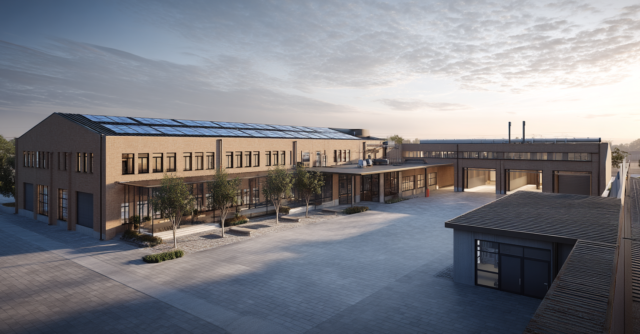
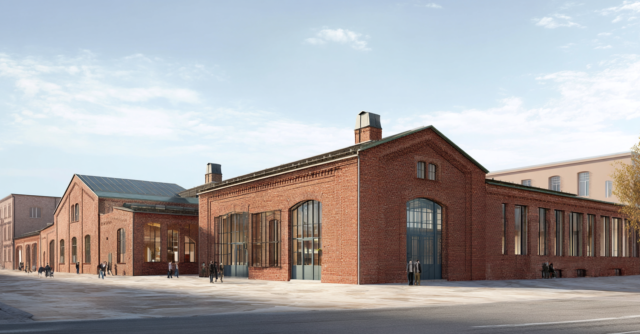
The winning project from the architectural competition, “FUCHS”, creates a seamless integration into the existing structure of the fire station. The extension blends in harmoniously with the existing building in terms of both height and alignment and harmoniously completes the perimeter of the block. Particularly noteworthy are the courtyard-side extensions with shed roofs and photovoltaics as well as a setback from the first floor, which give the new building a striking independence. These architectural features make it possible to master the balancing act between preserving the historical heritage and fulfilling state-of-the-art operational requirements.
The “FUCHS” project not only impresses with its aesthetic and functional integration into the existing building fabric, but also sets new ecological standards. Thanks to the environmentally friendly energy supply, which is based 100 per cent on renewable energies, and the generously dimensioned photovoltaic system on the shed roofs, a contribution is being made to climate protection. In addition, the design optimises the operational processes of Schutz & Rettung Zürich and creates a coherent unit of high spatial quality.
The project impressively illustrates how the challenges of modern emergency care can be mastered in a historical context through creative and innovative solutions. The careful balancing of the needs of the emergency services and the requirements of heritage conservation has resulted in a project that breaks new ground both functionally and aesthetically. The result is a sustainable infrastructure that meets the requirements of modern emergency services and at the same time makes a valuable contribution to the urban quality of the location.
Category: Refurbishment
-

Modernisation and expansion of the south station
-

Strategische Entwicklung des Papierwerd-Areals
Das direkt an der Limmat gelegene Papierwerd-Areal ist ein architektonisches Erbe von Karl Egender und steht an einem Wendepunkt seiner Nutzungsdauer. Der Sanierungsbedarf des Areals und seiner Infrastrukturelemente erfordert eine strategische Neupositionierung. Diese beinhaltet eine Aufwertung des zentralen Raumes und eine Erweiterung der Freiflächen. Im Dialogverfahren «Forum Papierwerd» entwickelten Fachleute, Bewohnerinnen und Bewohner sowie Vertreterinnen und Vertreter der Stadtverwaltung Szenarien für die zukünftige Gestaltung des Papierwerds.
Ziel der Umgestaltung ist es, das Papierwerd-Areal zu einem öffentlich zugänglichen Ort zu machen, der zum Verweilen und zur Interaktion einlädt. Dazu sind bauliche und nutzungsbezogene Anpassungen notwendig, um den Ort für die Allgemeinheit attraktiv zu gestalten. Die Wandelbarkeit und flexible Nutzbarkeit des Raumes ist dabei von zentraler Bedeutung.In einer Vertiefungsphase werden bis 2025 die bautechnischen Aspekte und die Schutzwürdigkeit des Bestandes weiter untersucht. Ebenso wird ein Nutzungskonzept erarbeitet, das im Rahmen eines Wettbewerbsverfahrens verschiedene Transformationsaspekte berücksichtigt. In einer anschliessenden Projektphase (bis 2026) sollen konkrete Vorschläge für das Areal erarbeitet werden.
Der Dialogprozess, der eine breite Beteiligung ermöglichte und in elf Kernaussagen mündete, bildet die Grundlage für den künftigen Entwicklungsprozess. Bereits Ende Frühling 2024 sind erste Sofortmassnahmen zur Verbesserung der Aufenthaltsqualität des Stadtraums geplant. -

Ein neues Kapitel des Jelmoli-Warenhauses beginnt
Das bekannte Warenhaus Jelmoli steht vor einem umfassenden Wandel. Bis Ende 2024 wird der Betrieb weitergeführt. Der Umbau startet Anfang 2025 und wird 2027 voraussichtlich beendet sein. Das Gebäude wird in eine moderne, multifunktionale Immobilie verwandelt. Swiss Prime Site investiert über 100 Millionen CHF, um das Jelmoli-Haus zu einer lebendigen, urbanen Begegnungsstätte zu machen.
Dabei reduziert sich die Verkaufsfläche auf das Erd- und Untergeschoss sowie allenfalls Teile des ersten Obergeschosses. Die Umgestaltung bringt Vielfalt in Form von Verkaufsflächen, Gastronomie, Büros und Freizeiteinrichtungen. Diese Transformation macht das Gebäude belebter für die Stadt, bewahrt die historische Bedeutung und setzt dabei auf Nachhaltigkeit.
Durch die Umgestaltung des bisher brachliegenden Dachs zu einem öffentlich zugänglichen Raum mit Grünflächen, wird das Jelmoli-Haus zu einer urbanen Oase mitten in der Zürcher Innenstadt. Die neu geschaffene Vielfalt an Verkaufsflächen, Gastronomie, Büros und Freizeiteinrichtungen zieht nicht nur Kunden an, sondern macht das Gebäude auch zu einem beliebten Treffpunkt. Die Investition in die Umwandlung des Jelmoli-Hauses zeigt das Engagement von Swiss Prime Site für eine nachhaltige und lebendige Stadtentwicklung. -

Modernisation of the Herzogenmühle health centre
After more than three decades of operation, the Herzogenmühle health centre is undergoing a fundamental modernisation. This measure takes into account the change in operational requirements and the changing needs of the residents. The project focuses on various structural optimisations that are to be implemented between July 2024 and July 2025. In particular, the aim is to create larger communal areas by merging various rooms. The aim is to improve mobility within the centre and increase the quality of stay for residents. Special niches for rollators and wheelchairs will make it easier to get around.
A major part of the conversion involves converting unused bathing facilities in the basement into a modern health and fitness room, including a physiotherapy facility. In addition, a previously unused nursing bath will be reactivated and the podiatry department will be relocated to a new area within the hairdressing salon. The outdoor areas of the health centre will be enriched by numerous newly planted trees, which will improve the local climate and contribute to increasing biodiversity.
In addition to these optimisations, necessary repairs are also planned. For example, the windows need to be refurbished due to leaks and the flat roof needs to be completely replaced. Photovoltaic systems are to be installed on the redesigned roof in order to increase the building’s energy efficiency. Furthermore, adjustments will be made to the exterior to increase accessibility and improve accident prevention. The energy and building technology will also be comprehensively modernised, including the installation of automated shading for the cafeteria, dining hall and multi-purpose hall to ensure better heat protection in summer. For these comprehensive measures, the city council approved new expenditure totalling CHF 1.664 million for the renovation and CHF 4.218 million for the partial refurbishment, including the usual reserves.
-

ETH researches natural thermal insulators
Researchers at the Swiss Federal Institute of Technology in Zurich(ETH) have tested natural insulating materials in a project. According to an article, the group led by Guillaume Habert, Professor of Sustainable Construction, and Bruno Sudret, Professor of Risk, Safety and Quantification of Uncertainties, have found new approaches to this. They analysed six buildings in need of renovation that were built between 1911 and 1988. In addition to the core issue of replacing fossil-fuelled heating systems with sustainable ones such as heat pumps or solar-powered ones, the main focus of the investigations was on thermal insulation. Various traditional insulation materials such as EPS, glass wool, rock wool and cellulose fibres were compared with natural materials such as straw and hemp.
“The CO2 emissions from the production of conventional insulation materials are sometimes very high, and their use in building renovations partially cancels out the positive effect achieved by reducing energy consumption,” Guillaume Habert is quoted as saying in the article. “Building materials made from renewable raw materials cause significantly fewer greenhouse gases. They also have the advantage that they bind CO2 from the atmosphere as they grow and this is then stored in the building in the long term.”
Both heating conversions and appropriate thermal insulation with natural materials can reduce greenhouse gas emissions by 87 per cent, according to the study.
The study was conducted in collaboration with the University of Applied Sciences Western Switzerland(HES-SO) in Yverdon-les-Bains VD and the Chalmers University of Technology in Gothenburg.
-

Dismantling for the Lymhof is complete
According to an article in the Lymhof newsletter, the demolition of the Vitis Sport Centre with tennis hall in the Rietpark district of Schlieren has been completed. The construction of the Lymhof can now begin after planning permission and preliminary work have been granted. The vertical farm planned by start-up Yasai in the hall building will not be realised. Yasai recently withdrew from the project because it is realigning itself as a company. The landowner Geistlich Immobilia is now planning to divide the hall into six sections. The rooms, which are up to 9 metres high, could provide space for creative uses such as an artists’ collective, a mixed studio community, cultural uses or neighbourhood offers.
In February 2024, Schlieren City Council granted planning permission for the Lymhof. The appeal period has now also expired, meaning that the realisation of the new neighbourhood near Schlieren station can begin, according to the press release. The next step is to finalise all official and cantonal requirements. Construction approval for the excavation is expected in summer 2024. The actual construction of the buildings will begin around autumn 2024 and will take around three years.
The Lymhof should then be ready for occupancy in 2027. In addition to a colourful mix of flats for a colourful mix of residents with different generations and lifestyles, ground floor uses along Wiesenstrasse and a restaurant with catering facilities and hotel rooms will also be built there. Although the 350 or so rental flats will not be ready for occupation until 2027, interested tenants can already register their interest online.
-

HKG remodels traditional Aarau garage
The engineering and consulting firm Herzog Kull Group Holding AG (HKG) is converting the Aarhof Garage in Aarau into a modern office building and will also use it itself, according to a press release. The garage was built in 1950 and will meet modern building standards following the renovation, according to the HKG press release. 45 office workstations are to be created on the ground floor. The project is being realised by HKG together with the Aarau architectural firm Schneider & Schneider. In addition to the offices, there will also be meeting rooms, a break room and a kitchen.
In its press release, HKG refers to a report in the “Aargauer Zeitung” newspaper, according to which the costs will amount to CHF 3.2 million. Work on the conversion is scheduled to begin in 2024, probably in late summer. The refurbishment, conversions and new buildings on the upper floor should be completed by mid-September 2025.
According to HKG, three two-and-a-half-room loft flats with high ceilings will be built on the upper floor. As the area around the Traditionsgarage was traditionally a green spot in Aarau, a green space is to be created again in memory of the historic gardens, according to the press release.
Founded in Aarau in 1978, HKG specialises in innovative building technology ranging from electricity planning to building automation. HKG also specialises in renewable energies such as photovoltaics.
In addition to its headquarters in Aarau, HKG has offices in Schlieren ZH, Baden, Bern, Chur GR, Crissier VD, Lucerne, Olten SO, Pratteln BL, Rotkreuz ZG, St.Gallen and Vilters SG. HKG employs around 200 permanent staff, including 89 with higher technical qualifications, 65 with technical qualifications, 23 commercial and administrative staff and 23 apprentices.
-

Winterthur forges ahead with development of the Obertor site
The city of Winterthur is tackling one of the four individual projects in the development of the Obertor site. The buildings at Obertor 11, 13 and 17, which were previously used by the city police, are to be extensively renovated and converted into new office, commercial and residential space. The properties will remain in municipal ownership and will be subject to the cost rent, the city administration announced in a press release. The costs for the structural remodelling are estimated at CHF 16.2 million in total.
The two four-storey buildings at Obertor 11 and 13, which were built before 1850, will be returned to their original use. Commercial space will be created on the ground floor and a total of seven flats will be realised on the upper floors. In addition to an energy-efficient refurbishment and the renewal of all building services installations, a new staircase and lift core is planned in the buildings. In addition, “the façades will be adapted to the new use where necessary”, writes the city administration.
The property at Obertor 17 is a rococo villa dating back to 1764, which has served as a police station since its renovation in 1947. Now the original room layout is to be restored and the building shell repaired. Inside, “new office space will be created, which will allow the historic interior to be emphasised again”. The Haus zum Adler is also to undergo an energy-efficient refurbishment and the renewal of the building services installations. Fire protection and earthquake safety are also to be improved.
-

Museum invites you to the Day of the Empty Langmatt
The two-year renovation of the Langmatt Museum in Baden begins on 1 March. The museum is inviting the public to visit on Sunday, 25 February, on Empty Langmatt Day. The public can circulate freely with free admission and view all the rooms, including those that were previously not open to the public, according to a press release. The Empty Langmatt Day offers spectacular insights from the cellar to the attic, it continues.
Director Markus Stegmann and assistant curator Daniela Minneboo will guide visitors on a 40-minute tour of the empty Langmatt at 2 pm, 3 pm, 4 pm and 5 pm. Children aged five and over can go on a 15-minute discovery tour of the house with art and culture mediator Vera Horat at 3 pm, 4 pm and 5 pm.
For the complete renovation, around 2,500 historical objects and paintings as well as countless everyday items had to be carefully packed and transported to an external storage facility, from Renoir’s famous “plait” to the last coffee spoon. All the rooms had to be emptied, even the historic libraries, curtains and crystal chandeliers had to leave their original places.
The ground-breaking ceremony for the renovation will take place on Friday, 1 March. Under the direction of Zurich architects Ernst Niklaus Fausch Partner AG, the Langmatt, including the park, will be transformed into a building site. During the two-year renovation, occasional public tours of the construction site and themed workshops for school classes are planned.
Before all the objects return to the newly renovated Langmatt in spring 2026, a day at the empty “new” Langmatt will give the public the opportunity to compare the differences to the “old” Langmatt, according to the museum’s press release.
-

“Little Marcel” leads Boudry’s road maintenance department into a new era
In June last year, the canton of Neuchâtel launched an architectural competition to find innovative solutions for the urgently needed expansion and renovation of the road construction centre in Boudry. The aim of the challenging search was to create a future-proof infrastructure that fulfils the requirements of sustainability and efficiency. The “Little Marcel” project by Julien Dubois Architectes SA from La Chaux-de-Fonds won over the jury out of fourteen entries and took first place.
The winning project is characterised by its holistic approach, which focuses on both architectural quality and functional excellence. In addition to the refurbishment of the existing building, the planned extension also includes the construction of new buildings that will enable the site to be utilised to the full. The sustainable concept, which emphasises the project’s commitment to the environment through the integration of solar modules and the use of timber constructions, is particularly noteworthy.
The realisation of “Little Marcel” promises to improve work processes while at the same time enhancing the landscape and architectural quality of the site. The targeted expansion of the workshop buildings and the creation of a spacious inner courtyard will serve to optimise logistics and promote cooperation between employees.
With a planned budget of CHF 12 million for the overall competition and a further CHF 1.5 million for the relocation of service buildings, the Government Council is laying the foundations for a modern and future-orientated infrastructure. The public exhibition of the competition entries gives the public an insight into the visionary plans for the Boudry depot.
This project marks an important step in the development of road maintenance in the region and sets new standards in terms of sustainability and efficiency in road maintenance in the Canton of Bern. The further development and refinement of the winning project is eagerly awaited with a view to a future application for a building loan.
-

Interim solution for Kleinhüningen primary school during the renovation phase
As part of its commitment to a modern and safe educational infrastructure, the Kleinhüningen primary school is undergoing a fundamental refurbishment. The necessary construction work includes the modernisation of the building services, fire protection measures, seismic retrofitting and the renovation of the facades and interiors. In order to maintain school operations for the duration of the renovation work, the school is temporarily relocating to a suitable plot on the Klybeck site.
After a comprehensive review of various options and taking into account feedback from the community, the canton decided in favour of the plot at Altrheinweg 3. In addition to the required proximity to the existing school, the selected plot offers good accessibility and a safe environment for pupils. The temporary school buildings that will be erected on the site will create an attractive learning environment without encroaching on existing green spaces.
Parents and neighbours were informed in detail about the planned measures and the temporary site at an information event. The renovation work is scheduled for summer 2025 and should be completed by summer 2027. During this time, Kleinhüningen primary school will move into its temporary building on Altrheinweg, which not only impresses with its traffic-calmed location, but also with its neighbouring tree-lined playground.
This project not only represents a solution to the current challenge, but is also an example of the adaptability and innovative spirit in the field of educational infrastructure. It demonstrates how thoughtful planning and community involvement can create temporary educational spaces that meet the needs of students while paving the way for an improved permanent school environment.
-

ABB modernises Untersiggenthal site
The technology company ABB has opened a new multifunctional building in Untersiggenthal. According to a press release, there are 500 workstations for employees in the areas of research and development, sales and service, project management and engineering. The Emotion building took two years to construct. At a cost of around 45 million Swiss francs, this is ABB’s largest investment in Switzerland for over ten years. It was built using over 2,200 cubic metres of Zirkulit, a recycled concrete that also stores CO2.
“With this investment, we are strengthening ABB’s presence in Switzerland and investing in high-growth technologies of the future. The new multifunctional building is an important step towards positioning ourselves as an employer of choice and attracting the best talent and experienced workers in an age of skills shortages,” said Nora Teuwsen, CEO of ABB Switzerland.
“The ABB site in Untersiggenthal is an impressive success story of constructive interaction between politics, business, education and research,” said Stephan Attiger, Head of the Department of Construction, Transport and Environment of the Canton of Aargau. The location demonstrates that the high-tech canton of Aargau “offers the best ground for innovation and technological progress, and how regional origins can lead to global success”.
In Untersiggenthal, ABB develops and manufactures efficient and sustainable technology solutions for drive technology in the areas of industrial processes, infrastructure and railways, as well as for applications in the field of renewable energy generation, for customers worldwide.
-

Waste incineration plant in Turgi to be renovated at a cost of 325 million Swiss francs
After 50 years of operation, the waste incineration plant in Turgi is to be renovated. According to a press release, the board of directors will propose a project credit of CHF 17 million at the next general meeting on 27 September. The total cost of the renovation is estimated at 325 million francs. According to the information, the necessity of a renewal is also reflected in increasing expenses for repairs and maintenance.
After a planning phase lasting several years, construction is not expected to begin until 2028. The new MWIP could then go into operation in 2033. The last renovation work on the plant was carried out in the 1990s.
In addition to the invitation to the general meeting, the MWIP has posteda collection of documents on its website, including the feasibility study for the projectand the detailed proposal by President Philippe Ramseier for the project planning loan.
According to these documents, the management and board of the MWIP have been working on the renewal of the outdated facilities since 2015. Cooperation with the neighbouring plants in Buchs AG and Dietikon ZH was examined. However, both rejected this. After the feasibility study of 2022, the MWIP board decided to locate the new plants on a neighbouring parcel of land belonging to the Abwasserverband Region Baden Wett ingen. This means that operations can continue during the renovation work.
The waste incineration plant in Turgi processes around 120,000 tonnes of waste per year. A moderate price increase is expected for the district heating generated from this waste because of the renovation costs.
-

AXA celebrates the completion of one of the largest occupied refurbishments
Aarau’s Telli shines in new splendour: with the official opening event on 25 August 2023, one of Switzerland’s largest energy-related renovations in an inhabited state came to an end.
Raise your glasses! The Telli building complex in Aarau was officially opened last weekend in a festive atmosphere. In addition to the opening ceremony on Friday, 25 August, the new neighbourhood meeting place was also inaugurated the following day.
The B and C wings of the building were renovated to bring them up to today’s energy standards while they were still occupied. The fact that the tenants did not have to leave Telli during the renovation makes the project one of the largest of its kind in Switzerland. “An occupied refurbishment of this magnitude presented us all with enormous challenges. The fact that we were able to master them together was something we wanted to celebrate properly with everyone involved,” says Frederick Widl, Head of Real Estate at AXA Investment Managers.
More living comfort – less CO2
In addition to new façade insulation and the installation of district heating, the flats also received modern ventilation. This will save around a thousand tonnes of CO2 per year. Residents also enjoyed 90 cm larger west-facing balconies. In addition, meeting zones and a neighbourhood meeting point with community rooms were created. The spacious green areas were designed in the spirit of the original park with native trees and flower meadows. “In the redesign, it was important to us to make the far-sightedness and power of the park perceptible again and to promote the community life of the residents in the outdoor space with new offerings,” says Rita Illien of Müller Illien Landscape Architects. The renovation also took into account the protection of historical monuments: although the buildings were given a new shell, the original appearance was preserved.
Sustainable in all areas
In addition to the energy-related refurbishment, social aspects also played an important role. It would not have been socially acceptable to strip the 581 flats of their tenants. Nevertheless, an inhabited refurbishment is a challenge for all involved. “A project of this magnitude required transparent communication right from the start,” says Manuela Gnehm, project manager at AXA Investment Managers. The entire tenant community was regularly informed and actively involved through various channels. “The
Among other things, the Tellicafé provided tenants with a place where they could share their concerns, questions and ideas with the administration and trained estate coaches,” continues Manuela Gnehm.
Telli Quartierstreff: Meeting place for big and small
On Saturday after the official event, the festivities continued in the form of a neighbourhood party. This was open to all residents, the entire city of Aarau and other curious people. In addition to a colourful programme and a variety of gastronomic offerings, guided tours through the Tellipark and visits to the newly renovated flats were also offered. The centrepiece of the event, however, was the inauguration of the neighbourhood meeting place, which forms the heart of the “Tellipark” and offers community rooms for the residents. “We look back on an eventful weekend and are happy about the enthusiasm with which the participants celebrated the opening of the new Telli with us,” says Manuela Gnehm.
-

Kriens: Old brickworks to shine in new splendour
The Old Brickworks below Bellpark in Kriens is well-known in the city. It was built during the economic boom at the end of the 19th century. Between 1889 and 1899, Lucerne expanded its housing stock by 25 percent, and the demand for fired bricks was high. However, insufficient clay deposits and unsteady management led the brickyard into bankruptcy in 1900.
After several changes of ownership, the building was converted into a residential house in the 1920s. Since then, it has undergone several structural changes and has grown historically as a result. In the meantime, it has been included in the list of buildings worthy of protection in the Canton of Lucerne. Until recently, young families, creative people, craftswomen and artists lived and worked in the Old Brickworks.
The building is in great need of renovation. As the landowner, Schmid Immobilien AG decided to redevelop the Alte Zieglei and develop a building project in an accompanied process.

The Alte Ziegelei is well-known in the city and has been in Kriens for over 100 years. An expert committee consisting of representatives of the client, the preservation of historical monuments and the city of Kriens as well as external architects and engineers evaluated the project designs of four invited architectural teams. The projects were to fulfil the reference to the history of the Old Brickworks, implement the interests of the preservation of historical monuments and take into account the economic interests of the owner. The winning project was designed by Seiler Linhart Architekten from Lucerne.
It envisages the removal of the historically grown three-sided extensions to the building and the reconstruction of the Old Brickworks to its core. The historic façades are to be renovated and the central element of the naturally lit inner courtyard restored. On the east and west sides, the residential building is to be supplemented with an arcade construction. A total of 18 flats are planned, distributed over the three upper floors, and four studios on the ground floor. Even after the renovation, the focus will be on communal living under one roof in the Old Brickworks.
Construction work will start in spring 2023 and should last until the end of 2024. The investment amounts to around eleven million Swiss francs.
-

The retaining wall of the cathedral platform will be renovated
The construction of the first retaining walls near the present cathedral platform began as early as the 14th century. Between 1479 and 1531, the walls were extended and took on their present appearance. The last major renovation work took place in the late 1980s. Today, the thirty-metre-high retaining wall is damaged in various places due to the weather and therefore needs to be renovated. The renovation work will be carried out in several stages until 2026.
Cleaning and mortar application
At the beginning of February, the renovation work will begin with the erection of the scaffolding at the eastern corner of the retaining wall. The work on the masonry will be of varying degrees of depth: Some larger areas of the wall will simply need to be cleaned and cleared of vegetation. On other parts of the wall, it will be necessary to apply mortar or fill in cracks and joints. The original structure is retained as far as possible. As part of the renovation, Energie Wasser Bern (ewb) is replacing the existing lighting on the wall with more economical LED spotlights. All the renovation work was planned in cooperation with the monument preservation service.The platformremains open
The platform remains open during the renovation work. The respective work areas will be closed to the public with barriers. In the Badgasse, which is located at the foot of the wall, some of the parking spaces must be temporarily removed to allow for the installation of scaffolding and construction equipment. Replacement parking spaces will be provided. However, due to the narrowness of the space in the Matte, only part of the parking spaces can be replaced.Preservation of a historical monument
The renovation of the retaining walls will preserve the cathedral platform as a historical monument in Bern’s old town and ensure safety. In March 2022, the City Council approved a construction credit of CHF 3.32 million for the renovation. -

Swimming fans buy the thermal bath Zum Raben in Baden
According to the press release , the realization of the Bad zum Raben cultural thermal baths planned by the Bagni Popolari association is getting closer. Buyers have already been found for over 600 cooperative shares at CHF 1,299 each for the purchase of the empty thermal baths on Baden’s Kurplatz. The search for further members of the cooperative for the future cultural and community pool continues, because according to the first estimate of the conversion and renovation requirements, an investment volume of around 1.3 million Swiss francs results.
It took just under six weeks to collect the required CHF 780,000, according to the club’s statement. With this equity, the cooperative property Bad zum Raben can now buy the bathing floor of the former bathing inn Zum Raben.
The association is “overjoyed that so many people have registered as Raben cooperative members in such a short time,” Andreas Rudow, co-president of the cooperative, is quoted as saying. “This is a strong sign that many people and organizations want a communal cultural thermal bath. And it makes us confident that we can also overcome the next, more difficult hurdle together: financing the upcoming conversion.”
In order for the unused thermal bath to be permanently filled with natural thermal water and art again, structural adjustments and extensive investments in the new bath technology are required. A non-profit cultural and community pool with four thermal pools is to be built by 2025.
The Bad zum Raben can be visited and bathed on Saturday, August 20, from 1 p.m. to 5 p.m. You can see the premises and the future room concept. Likewise on Saturday, September 3, for the same period.
-

Jaisli-Xamax completes work on Confiserie Speck
Jaisli-Xamax has completed the work on the electrical installation at the new production site of the traditional company Confiserie Speck . The confectionery remains in Zug, but moves to the Göbli area. There will be over 3,000 new jobs there in the future, which makes the area very attractive, confectionery owner Peter Speck is quoted as saying in a media release by Jaisli-Xamax. In a short interview published there, Speck emphasizes the special features of the electrical installation brought in by the Dietiker company. “We wanted to optimize the production process and make it as sustainable as possible. We are able to do this thanks to the cooperation with the Multi-Energy-Hub, which combines local energy sources into a CO2-neutral overall energy system with a maximum degree of self-sufficiency,” Peter Speck is quoted as saying.
In addition, one wants to bring visitors closer to the craft in the confectionery. This is achieved by looking into the well-lit production hall, which is also called the “aquarium”.
The new Confiserie Speck location is more than just a production hall. In addition to the bakery, there are also offices, apartments, a café and a shop at the new location.
The electrical manufacturer Jaisli-Xamax from Dietikon only opened a new branch in Zug in 2021. The company, which has been active in the entire electrical sector for over 50 years and specializes in innovative solutions, now has offices in Basel, Bern and Zug in addition to its headquarters in Dietikon. Jaisli-Xamax AG employs a total of around 400 people.
-

The Glattalbahn is getting longer
The transport system in the Kloten region is reaching its limits. The consequences are increasing hours of traffic jams and severe noise and air pollution. The Glattalbahn extension to Kloten promises a chance for improvement, which, in addition to the extension of the tram line between the airport and the Steinacker development area in Kloten, includes two other sub-projects: A main bicycle connection with a separate footpath and flood protection for Kloten and for the airport. The spatial proximity and the dependencies of these sub-projects require joint project planning and construction. This means that the canton of Zurich can effectively and sustainably master three challenges in one project and make optimal use of synergies.
On July 16, 2020, VBG Verkehrsbetriebe Glattal AG (VBG) submitted the application for the infrastructure concession to the Federal Office of Transport (BAV). The procedure examined whether there was a public interest in the construction and operation of the new tram connection and whether there were no significant public interests – for example environmental protection or nature and heritage protection – opposed to the granting of the concession. The Federal Council examined the application and decided to grant the license to the VBG. This decision cannot be contested. There will be opportunities for objections at a later point in time during the public approval of the plan.
The VBG is currently working on the construction project that forms the basis for the cantonal loan approval. The decision of the cantonal council is expected in 2024. This is subject to an optional referendum. The project was submitted to the federal government in June 2021 as part of the 4th generation agglomeration programme. This will probably decide on co-financing by the end of 2023. The approval process (plan approval process under the Railway Act) is expected to run in parallel from 2023. Construction is currently expected to start in 2026, subject to legally binding planning approval and secured funding from the canton and the federal government. The construction work will take around four years.

The Glattalbahn has big plans. -

Zurich Airport is rebuilding Dock A
Zurich Airport has chosen the Raumfachwerk project as the winner of its competition for the construction of the new airport terminal Dock A with tower and dock root. It prevailed against ten competitors and is intended to replace the existing and aging Dock A.
From 2030, according to a statement from Zurich Airport, “probably the largest airport dock to date made primarily of wood” will be built next to the existing Dock A while operations continue. The investments are estimated at around CHF 700 million.
The planning team for this project is led by the renowned architect Bjarke Ingels. In addition to his Copenhagen and New York-based architects’ office BIG , the largest architecture and engineering company in the USA, HOK , is also involved, as is the Zurich architects’ office 10:8 . For example, it was responsible for the conversion of Zurich Oerlikon station. The London engineering and consulting company Buro Happold , which is experienced in airport construction, is also part of this team, as is the engineering office Pirmin Jung from Rain, which specializes in timber construction.
According to Bjarke Ingels, the team tried to meet the complex global challenge of CO2 reduction with the simplest possible solution, a space structure made of solid wood: “A simple but expressive design that is rooted in tradition and committed to innovation and the cultural and natural elements of Swiss architecture.”
-

Walo installs new flooring in the Gübelin Museum
Walo Bertschinger has installed a new floor covering in Lucerne’s Gübelin Museum. According to a message from the Dietiker construction company on Facebook, the order was placed in the summer of 2021. The work is in the final phase, the message says. The goal is a floor covering that adorns the museum as an additional work of art.
The client imagined a warm floor with various rubber granules and a wooden frieze, according to the Walo report. The company ‘s own HALTOPEX rubber granulate was recommended to her. According to the company, this covering is particularly suitable for conversions, is very elastic, hard-wearing and easy to maintain. The optics are also inviting.
After inspecting a similar property, the client placed the order. From this April, work was carried out in the museum. The sub-floor was reprofiled and reinforced and a new sub-layer of epoxy mortar installed. The final installation of the HALTOPEX covering began in May. The work is nearing completion.
-

Konnex Baden wins two more tenants
On behalf of the co-ownership, SPGI Zurich AG has rented two additional areas in the Baden connection . The Konnex building complex in the center of Baden is currently being completely renovated. According to themedia release , a “city in a city” offer will be available there by mid-2023. A total of around 35,000 square meters of space will be rented for this purpose.
According to the press release, the new tenants are Casino Davos AG and SkySale. Casino Davos has already moved in as an interim tenant and will move into its new 495 square meter space once the refurbishment is complete. SkySale Schweiz GmbH, better known under its apple box brand, is also a new tenant. It will move into around 814 square meters of space in early summer 2023.
The interest in the innovative multi-tenant concept of the Konnex is great and negotiations are currently taking place for many other areas. The city-in-city concept envisages a range of services and amenities, including restaurants, convenience stores, fitness, childcare and co-working.
SPGI Zurich AG, based in Zollikon, is a subsidiary of the Intercity Group , an independent real estate service provider with group companies in Zurich, Lucerne, Bern, Basel, St.Gallen, Olten SO and Zug. Since 1993, SPGI Zurich AG has been an alliance partner of Cushman & Wakefield , a leading global provider of real estate services with headquarters in Chicago and 53,000 employees in 60 countries worldwide.
-

«Plaster and Paint» – Prize for the best objects
The Swiss Painters’ and Plasterers’ Association SMGV and Messe Luzern AG jointly award the “Swiss Prize for Plaster and Paint” under the umbrella of appli-tech. They advertise the prize for teams made up of planners and craftsmen. Concretely implemented projects can be submitted in the two categories plaster facade/color design and interior design. A great opportunity, the SMGV and the Lucerne Exhibition Center agree. «In the past editions, the creative potential in the areas of plaster and paint could be shown with the submitted projects. We are convinced that this time we will be able to make high-quality and exciting work known to the public,” explains Ursula Gerber, trade fair manager at appli-tech. Mario Freda, SMGV Central President, adds: “This year we want to continue to promote the very important cooperation between experts from the trades and planning and move the use of plaster and paint into the focus of public attention.”
Energy renovation as a focus
A well-known jury evaluates the objects. In addition to the prizes in the plaster facade/color design and interior design categories, a special jury prize will be awarded for energy-efficient refurbishment. Jury member and SIA President Peter Dransfeld knows how important the topic is: “Sustainable building and energy-efficient renovations are becoming more and more important, with the design of the facade also playing a key role. Innovative and sensible solutions can be achieved in close, trusting and professional cooperation between architecture and trade. This honors this award.”The jury awards a total prize money of CHF 35,000. The winning projects and selected works will be presented in a special show at appli-tech, the trade fair for the painting and plastering industry, drywall construction and insulation, from February 8th to 10th, 2023 and on the website. Reports in specialist media and the presentation in the jury report also beckon.
Registration until the end of September
Objects can be registered until September 30, 2022. The work must be submitted by October 20, 2022. The call for applications with detailed information and the option to register can be found at www.putz-color.ch . -

Art in the former “sack magazine”
In 2019, Christoph J. Hürlimann from the canton of Uri bought the former “Sackmagazin” by architect Robert Maillart on the Werkmatt site in Uri. Hürlimann, who founded the “Art Depot” foundation based in Göschenen with his family, previously owned the neighboring “Silomagazin” by the architect Eduard Züblin.
At a media briefing together with Uri’s director of economics, Urban Camenzind
Christoph Hürlimann gave an insight into his plans after his purchase in 2019: “My vision is to build an art path in Uri. This should begin at the Haus für Kunst Uri in Altdorf, continue to the Altdorf art silo and art depot in Werkmatt Uri, via the Göschenen art depot and end in the Sasso San Gottardo Museum on the Gotthard Pass. With the purchase of the former sack magazine, this vision has come a little closer.» Camenzind was also pleased with the sale: “The purchase of the building by Christoph Hürlimann is a stroke of luck for the canton of Uri.”Hürlimann now uses the two listed buildings on the Werkmatt site to store and exhibit various collections of art objects. In recent years he has developed the two historic buildings into a meeting place for cultural, artistic and social uses. This change of use enhances both the two historically significant buildings and the entire area.
A lot of work was required to prepare the former sack magazine for its new use: “We had to carry out a variety of work: expand the stairwell as an escape route, retrofit electrical installations, install many partitions, do various painting work, make security installations, attach burglary protection,” says Hürlimann .The Werkmatt Uri in the Eyschachen area southwest of the Altdorf train station is one of the last large land reserves in the Uri valley floor. The 12 hectare area is located between the railway tracks and the A2 Gotthard motorway. More than 100 years ago, the first uses that required a direct rail connection were created there: the most prominent examples are the two federal grain stores built in 1912 and 1913 by the architects Eduard Züblin and Robert Maillart.
-

Hächler refurbishes historic Posthorn inn
The Hächler construction company reports progress on the renovation project with a new building for the historic Posthorn inn in Neuenhof. According to the press release , the old building will be extensively renovated. Seven rental apartments are being built in the former hotel. There is also a new building with a further 16 rental apartments.
Since the building permit for the Posthorn superstructure was granted in 2019, the structural and civil engineering department of Hächler AG has been in charge of the construction work since spring 2021. According to Hächler, the project is not easy. The historic post horn was not allowed to be torn off. The building dates from 1834 and is a protected site. Gable and facade must be preserved.
According to Hächler, to ensure the statics and to support the facade that remains in place, a complex steel brace was installed. The rest of the post horn could only be broken off after the installation of this steel spline. When the historic building was gutted, the effective master builder work began. In the meantime, the erection work on the roof trusses of the Posthorn and the new building are scheduled for March and April.
According to the construction management, the work on the superstructure will be completed around May 2022. Then the interior work takes place. The move-in date for the new apartments in the Posthorn is planned for February 2023 and in the new building for April 2023.
-

Artisa Group restores Locarno's grand hotel
Artisa Group wants to renovate and expand Locarno’s Grand Hotel. A corresponding planning application has already been submitted, the Zug-based company, which specializes in real estate investments on the Swiss and European market, informed in a press release . For the project, Artisa Group is collaborating with architect Ivano Gianola.
Artisa writes that the design envisages the preservation of the existing substance and in particular the listed frescoes, decorations and facades of the historic building. The large hall, in which the peace conference took place in 1925, is to be restored in a contemporary way. A new SPA and wellness center will be set up.
“The new Grand Hotel Locarno will set standards worldwide in terms of excellence, sustainability and modern service,” explains Stefano Artioli, Vice President of the Artisa Group, in the press release. “In addition, we will take responsibility for 100 employees who will work in the hotel.”
Outside, the concept envisages a redesign of the more than 4000 square meter park. Together, the hotel and park should complement the tourist offer of Ticino, according to the statement. “The holistic hotel concept fits perfectly with the OTR strategy (Mendrisiotto and Basso Ceresio, Luganese, Bellinzonese and High Ticino as well as Lake Maggiore and valleys): wellness, food and wine, events, meetings, sustainability,” says Fabio Bonetti, Director of the Tourist Organization of Lake Maggiore , cite there.
-

Dutch central bank builds with new strength
The Dutch Central Bank uses CO2-neutral concrete in the renovation of its Amsterdam headquarters. This is made possible thanks to a collaboration between the Dutch New Horizon Urban Mining BV and the Swiss start-up neustark , according to a LinkedIn announcement .
New Horizon’s technology makes it possible to reduce the carbon footprint of concrete by 75 percent, they say. For this, cement is obtained from concrete recycling material. The remaining footprint is offset by neustark. The start-up has developed a technology with which CO2 from the atmosphere can be permanently stored in recycled concrete. For this purpose, liquid CO2 is introduced into demolition material.
Neustark is a spin-off from the Swiss Federal Institute of Technology in Zurich ( ETH ) based in Bern. The company works with Holcim , among others, to drive innovation and sustainability in the construction sector. As part of the collaboration, neustark is investigating the CO2 conversion potential of Holcim’s recycled demolition concrete. Holcim, in turn, optimizes the concrete produced by neustark.
-

Securecell expands its headquarters in Urdorf
The headquarters of Securecell AG in Urdorf has been expanded. The biotech company has been based in the Luberzen industrial area since April 2019. At that time, the move to an area of 1800 square meters with around 30 employees took place. According to the media release , the company, which specializes in the development of automation solutions for bioprocesses, has since doubled the number of its employees and has therefore now enlarged its workspace. At the turn of the year, the ground floor at the company headquarters became vacant. According to the press release, Securecell AG was able to move into an additional 2,000 square meters of office and production space at the end of 2021.
When moving into the 1st floor in 2019, modern offices, a research laboratory and a clean room for medical technology development as well as a production facility for small devices with an attached warehouse and workshop were set up. The newly added work area on the ground floor is perfectly tailored to Securecell’s needs and could be used immediately without much effort, according to the press release.
The previous tenant equipped the rooms with modern office workplaces and meeting rooms, an ESD-protected workshop suitable for electronics and production, and a large warehouse. ESD means protection against electrical discharges. In addition, the floor offers access to the loading dock and a spacious kitchen.
Securecell is a member of Bio-Technopark Schlieren-Zürich .
-

«The conversion and renovation market will show the strongest growth»
To person
dr Jens Vollmar is Head Division Buildings/Country President Switzerland and a member of the Executive Committee at Implenia AG. He is also Vice-President of Swiss Development and a member of the board of the umbrella organization «Bauen Schweiz». The 37-year-old studied at the University of St. Gallen (HSG) and the University of California in Berkeley and has a doctorate in Accounting and Finance. He is also a lecturer in the areas of construction & real estate management and mergers & acquisitions (mergers and takeovers) at the HSG.Which factors are important for the further successful development of the real estate market in our country from the point of view of Swiss Development?
From our point of view, the market parameters, i.e. the so-called fundamental data, continue to support the positive development of the Swiss real estate market in the short and medium term. We see important drivers such as population growth, low interest rates or the unemployment rate at a stable and good level. However, the real estate itself is also important for healthy development. In addition to the location of a property, the focus is on the quality of the investments. In doing so, we understand quality not only as the materialization, but rather the optimal balancing of the needs of all stakeholder groups. A property today must have the desired flexibility and adaptability for users and owners. But the deadline within which a property can be put on the market is also important. As an association, we are committed to greater planning security, faster approval processes and streamlining and standardization of planning legislation. In this context, we strive to sensitize the actors involved to these issues.What influence does climate change and the associated overheating of cities have on construction projects?
The frequency and intensity of heat waves are increasing and are already a reality. In addition, spatial planning calls for more dense building towards the inside, which contributes to the additional warming of the cities. As a direct result, temperatures in the unair-conditioned or uncooled interior spaces of properties will rise in the summer. We have to face this challenge. Our members work accordingly on technical and structural solutions. This includes, for example, thermal simulations in the early development phase or the option of activating floor heating for cooling. We are also seeing increased demand for greening buildings.Online trade is booming, which is likely to have an impact on commercial ground floor uses. How do you assess the future of these uses?
The uses of the ground floor actually pose major social and urban planning challenges for the municipality, urban planners, investors and project developers. Different uses are increasingly converging: Today, working, living and leisure time can no longer be separated from each other. The separation of uses provided for in zoning plans and in the building and zoning regulations is difficult to reconcile with this trend. From our point of view, new, flexible zoning based on alternative criteria is worth examining – this could make ground floor uses more attractive again.Are there already changes?
Yes, we are registering the advancement of innovative ground floor formats such as showrooms or parcel pick-up points. In the future, the restrictions on motorized private transport that are being asked for more and more, the creation of pedestrian zones and the discussion about wider sidewalks are likely to change the outdoor spaces of properties and quarters in the long term and thus also influence the use of ground floors. However, in our opinion, the latter should be defined in a needs-based manner, taking into account use and the environment, and not have to follow rigid legal requirements. In the long term, flexibility should also be a decisive point for ground floor uses.What factors influence the decision to convert/refurbish or build a new building?
In the past, replacement buildings were a big topic. However, we believe that the conversion and renovation market will show the strongest growth in the future. Especially with regard to the increasing sustainability considerations. Energy and space efficiency as well as regulatory requirements play an important role here. Various factors are relevant for a decision about new construction or conversions or a change of use: recording the condition of the building and where a property is in the life cycle, analyzes of location and local market development, financial/economic parameters or also the consideration of the property utilization reserves.«
inflexible
complicate regulations
the building at
Duration
»What efforts is Swiss Development making in digitization?
The planning and realization of buildings and infrastructure still have a strong unique character today. Topics such as industrialization, productivity and digitization are essential for Switzerland's competitiveness in the field of development. Thanks to the use of BIM and 3D printers, digital construction progress control or the use of drone or robotic technology, planning security in terms of costs, quality and deadlines can be greatly optimized. In our opinion, unification and standardization as well as simplification in application are very important here. Development Switzerland, together with the member companies, examines possible contributions to the promotion and improvement of standards and their application. We anticipate a decade that will transform our industry in terms of digitization and productivity like never before.Today, new buildings must be energy-efficient and preferably completely recyclable. How are these aspects taken into account in Development Switzerland?
Sustainability and ESG strategies are more relevant than ever in the real estate industry. Our members have long recognized these market needs and implemented them in their organization and range of services. For example, many companies already have sustainability departments. The greatest leverage is not in new buildings, but in spatial and energy-related renovations of existing properties. Development Switzerland always takes a holistic view of issues relating to energy sustainability, resource efficiency and the circular economy. This means that we try to take economic, social and ecological aspects into account in a balanced way. Our members work with start-ups, developers and research institutions to support and drive rapid market launch of innovative ideas.Agricultural land is still being built over in Switzerland. Do you think this is necessary?
No, the focus is clearly on inward settlement development. Various legal advances, such as the revision of the Spatial Planning Act of 2013, restrict the development of cultivated land in favor of densification. In addition, the conversion of agricultural areas into building zones is usually only possible by means of area compensation or exchange. In general, it can be said that the utilization reserves in the cities and agglomerations are still very high. For the creation of living and working space, these usage reserves should be realized in advance.What's the problem with this?
Less restrictive legal requirements would be desirable. The value-added tax, for example, makes it difficult or sometimes impossible to realize utilization reserves. But there are many other inflexible regulations that make building in existing buildings almost insurmountable challenges. Development Switzerland is working with the industry to sensitize decision-makers, authorities and politicians to this topic. We advocate more discretion so that good solutions can be developed taking into account the situation and user needs.Do you think the repeatedly forecast real estate bubble in Switzerland is a serious scenario?
The ongoing low-interest policy of the central banks and the market development make investing in real estate attractive. There are few investment alternatives that have a similar risk/return profile. Switzerland has also learned from the mistakes of the past and is in a much better position today than it was at the beginning of the 2000s – for example against the background of more restrictive mortgage lending. However, the noticeably louder calls for a return to a normalized monetary policy show that this situation can also change in Switzerland. Rising interest rates too quickly and the associated refinancing hurdles could lead to a fall in market values, which in turn would have an impact on capital requirements. Accordingly, Switzerland would do well to continue its stable monetary and interest rate policy and to think in scenarios. The more robust the business models and financing, the less our economy is exposed to risks. As an association, we are very confident about the short and medium-term future. -

The new old Maag site
Maaglive is a project on the Maag Areal near Zurich Hardbrücke train station. It complements the office uses that characterize the area today with attractive residential uses, cultural and gastronomic offers: "We got involved with the planning team in the preliminary project in the third quarter of 2021," says Johanna Gerum, project manager for the Maaglive project at Swiss Prime Site. “At the same time, we are developing a promising cultural vision for Maaglive together with the cultural organizer and producer Michel Pernet. Artists, representatives from the creative industries, those responsible for culture in the city of Zurich and interested interest groups from the neighborhood are involved in the use of these areas.»
The public-intensive uses distributed throughout the day enliven the Maag Areal and create a place in the middle of Zurich West where people like to spend time.
The Maaglive project consists of the residential tower, the cultural center and the future listed building K. The three buildings are arranged around a tree-lined square which, together with other green spaces, contributes to reducing the heat in Zurich West. In addition, Maaglive opens up the quarter and offers new non-motorised traffic connections. The three very different solitaire buildings should form an ensemble. In between there is a public space with a high quality of stay as the new center of the area. A pleasant microclimate can be created by planting tall trees. The coordinated uses on the ground floors will also enliven the space. The residential tower can be used flexibly, and where the noise pollution is too great, flexible work studios complement the small apartments.
"Sauerbruch Hutton implemented the guiding principles of the Swiss Prime Site for the Maaglive project most aptly," Johanna Gerum concludes: "Diversification of use: apartments, culture, gastronomy and in particular the so-called third places, which stand for future-oriented quality of use – this on the inside – like outdoor area.»

This is what the Maag Areal in Zurich should look like one day.