Category: Residential

  • Federal Council wants to accelerate residential construction

    Federal Council wants to accelerate residential construction

    According to its communication, the Federal Council is examining measures to accelerate residential construction. With its report of 22 April 2026, it is responding to five postulates from the National Council and Council of States. It is part of the federal government’s housing shortage action plan. The Federal Council has instructed the Federal Department of the Environment, Transport, Energy and Communications to submit a consultation draft by the end of 2026.

    One of these measures should create the legal basis for a national interest in housing construction. Such a legal basis would then take precedence over, for example, the protection of the townscape or listed buildings. The Federal Council is also having the restriction of the right of appeal for private individuals and the admissible complaints examined. In addition, the procedural costs for objections that are proven to be an abuse of rights could be imposed on the objectors, namely if the objection is clearly aimed solely at preventing or delaying a project.

    However, the sovereignty for planning and building authorisation procedures lies with the cantons. The Federal Council can therefore only recommend that they introduce a digital authorisation procedure and set binding deadlines in order to speed up the process. The Federal Council also recommends that planning applications should only be published once they are complete. It also points out that many licensing authorities do not have sufficient staff or expertise to process complex dossiers.

  • The Sonnenhof is to reinvent Bülach’s centre

    The Sonnenhof is to reinvent Bülach’s centre

    The Sonnenhof site is centrally located between Bahnhofstrasse and Schaffhauserstrasse and covers a good 20,000 square metres. Today, the site is dominated by a shopping centre from the 1970s, other commercial and residential buildings and a large sealed car park. It is precisely this structure that is now to be fundamentally changed.

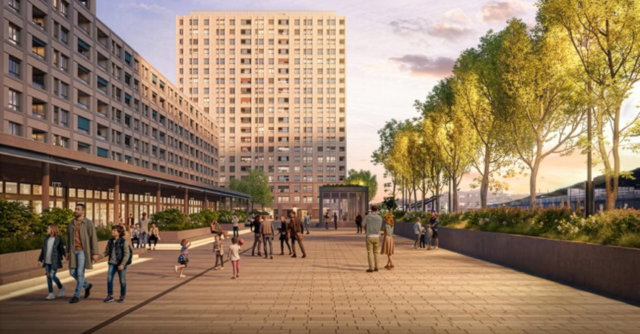
    The plan is to create a new, mixed-use district with a public passageway, green courtyards and squares, businesses, restaurants and a cultural and meeting centre. The existing shopping centre will not disappear, but will be modernised and integrated into the new structure.

    Urban densification
    At the heart of the project are around 240 rental flats in various price categories and with different floor plans. In addition, there are around 12,000 square metres for commercial, cultural and public uses on the ground floors and in the passages.

    In terms of urban planning, the project focuses on density and orientation. Four taller buildings will mark the site and give it a clearly recognisable address. The design plan allows for a maximum building height of 55 metres on the north-eastern corner. This shows how clearly the Sonnenhof will stand out from the previous scale.

    Open space instead of tarmac
    The message is particularly strong in the outdoor space. Where heat-retaining pavement dominates today, unsealed surfaces, trees, courtyards and climate-resistant planting will improve the microclimate in future. Rainwater will be able to seep away and evaporate, roofs will be greened and supplemented with photovoltaics.

    The project also aims to reorganise traffic flows. Most of the above-ground parking spaces will be moved to the underground car park, while paths and squares will be designed primarily for pedestrians and cyclists. Nevertheless, around 450 car parking spaces will remain on the entire site.

    Culture as part of the development
    The combination of property development and public use is striking. The planned KUBEZ cultural and meeting centre at Sonnenhof will not only be built, but will also create a regional meeting place for culture, education and leisure. The project is being developed in collaboration with the town of Bülach and neighbouring municipalities.

    This is what makes the Sonnenhof more than just a classic development. The site should not only provide living space, but also create a new centre that expands the everyday life of the town and strengthens the connection between the railway station, town centre and neighbourhood.

    A long road to the new centre
    Sonnenhof is still a planning project. the private design plan is due to be submitted in 2026, with approval scheduled for 2027. The first stage could start in 2029 and be completed in 2031, with overall completion scheduled for 2034 according to the project status.

    This shows the true scale of such projects. The transformation of a central site requires not only capital and design power, but above all time, procedures and political coordination. If Sonnenhof succeeds, Bülach will not simply gain new flats. The town will gain a new piece of urbanity.

  • Residential complex to be sustainably renovated and extended

    Residential complex to be sustainably renovated and extended

    The Schlieren-based real estate and construction company Halter is transforming the Clochettes site in the Champel district of Geneva. As part of the project, Halter was commissioned by Baloise to carry out the energy-efficient renovation, conversion and addition of storeys to three residential buildings from the 1970s. According to the press release, a total of 70 existing apartments will be modernized by January 2029 and 15 new apartments will be created by adding two more floors. The work will start in May and will take place while the apartments are occupied.

    As part of the refurbishment, Halter will replace the technical systems and refurbish the façades. Heat recovery and the installation of photovoltaic systems are also planned, according to the project description. The aim is to obtain a Minergie renovation label.

    The architectural design by the Grenier Coretra architecture firm maintains continuity with the existing buildings and harmonizes with the neighbouring residential complex. The new apartments will offer a variety of floor plans and room concepts tailored to modern living.

    New areas for residents and neighborhood-related uses will be created on the first floor of the buildings. The outdoor areas will also be enhanced with wooded areas to promote quality of life and biodiversity.

  • Spreitenbach municipal council adopts property strategy

    Spreitenbach municipal council adopts property strategy

    The Spreitenbach municipal council has adopted a new strategy for municipal properties, as detailed in a press release. The property strategy is of central importance for both the residents’ and the local citizens’ municipality. The decision serves as the basis for the medium to long-term development of publicly owned properties.

    The aim is to manage the municipality’s own property portfolios holistically rather than in isolation according to individual properties. The municipality of Spreitenbach expects this to lead to better harmonisation of the long-term needs of the population, school, administration, associations and other users.

    According to the press release, the new strategy is particularly relevant for the municipality of Spreitenbach, which as a public corporation has a portfolio of 69 properties and five developed building rights plots, in view of upcoming investment decisions. In the coming years, the focus will be on the further development of the school and sports infrastructure, the renovation and expansion of existing facilities, securing additional space for school administration and day-care centres and the development of a municipal park, among other things.

    The local community should also benefit from the holistic approach. It manages a portfolio of 130 properties with a land area of around 2.77 million square metres and a building insurance value of around CHF 13.6 million. The strategy focuses on the areas of housing, the local museum, building rights in the industrial area, agriculture and forests.

    The property strategy is to be reviewed at least every five years and adjusted if necessary. The planning horizon currently extends to the year 2040.

  • New development combines residential, commercial and local services

    New development combines residential, commercial and local services

    According to a press release, Schlieren-based Halter AG completed the AuPark plannmässig development at the end of March and handed it over to the client Swiss Life Asset Managers. The project involved the construction of five apartment blocks and commercial buildings with views of Lake Zurich and the Au peninsula.

    The AuPark development comprises a total of 300 flats, including 111 condominium units, according to the project description. There will also be commercial space and a Coop, which will serve as a local supplier for the neighbourhood. The eponymous AuPark lies at the heart of the project and serves as a central meeting point and recreational space for the residents with extensive lawns.

    “As part of our total contractor services, the project was specifically densified and the housing mix optimised,” the company said in the press release. “The result: a sustainable, marketable development with a high quality of living – including in the affordable housing segment.”

  • One million square meters new start for Lugano

    One million square meters new start for Lugano

    The Nuovo Quartiere Cornaredo is located to the north of the city center and is being developed as a new gateway to Lugano. The inter-municipal project, which Lugano is supporting together with neighboring municipalities, is intended to fundamentally reorganize the urban space. Housing, services, retail, leisure and an upgraded public space form the backbone of the project. Not a dormitory district, but an urban hub with everyday functions and economic dynamism.

    Where football and urban development meet
    The PSE with stadium, sports hall, administration and parking areas is being built in the same area alongside the residential and commercial areas. Construction site B1a alone covers around 55,000 square meters with mixed uses, buildings of different heights and commercial and tertiary facilities. This will make Cornaredo one of the most important real-world laboratories for urban development in Ticino. Rarely do sports and event infrastructure, private building construction and public space come together in such a small area.

    Complexity as a program
    The project is not an isolated real estate project. It is a transformation system in which urban planning, road space, public transport and private construction projects have to be coordinated. Delays, appeals and political debates are not the exception, but part of the process. This is precisely what makes the project so relevant for investors, developers and planners. It shows how difficult and valuable it is to develop large sites in topographically sensitive areas.

    A benchmark for Ticino
    Cornaredo is strategically central for Lugano. This is where the city’s approach to growth is decided. Densified, networked and functionally diverse or still small-scale and traffic-heavy. If the implementation succeeds with planning quality and a mix of uses, Cornaredo will be no ordinary district, but a reference project for the next development phase of the entire canton. Southern Switzerland is keeping a close eye on what is being created in the north of Lugano.

    What is still missing
    The real touchstone lies ahead of Lugano, not behind it. Ensuring planning quality over the years, bundling private and public investment and creating a reliable realization perspective. These are the three tasks by which Cornaredo will be measured. The course has been set. The next phases of development will show whether the project delivers what it promises.

  • Bellinzona dares to undertake a major renovation

    Bellinzona dares to undertake a major renovation

    There are hardly any inner-city transformation areas of this size in Switzerland. The FFS site in the heart of Bellinzona offers an opportunity that cities such as Zurich and Basel have long since lost. The new district will not be built on a greenfield site, but will interweave the historic city with the area around the railroad station and new development zones. Mixed use, biodiversity and generous open spaces are at the heart of the master plan.

    The international competition was won by the team sa_partners, TAMassociati and Franco Giorgetta. Their design breaks up the previously closed industrial area and organizes it around the “Almenda”. A 6.4 hectare central green space that structures the entire district as an ecological and social backbone. The listed “Cattedrale”, which has been a maintenance site for locomotives since 1919, will be retained as an identity-forming focal point and will become the anchor building of the new district.

    Innovation at the heart of
    The district will also be home to the Switzerland Innovation Park Ticino in future. The park was officially recognized as the location of the Switzerland Innovation Park Zurich in November 2024 and is supported by USI, SUPSI, BancaStato, the Ticino Chamber of Commerce and the employers’ association AITI. From 2032, the park and its headquarters will move to a 25,000 square meter area within the new quarter.

    Three competence centers are already active: Swiss Drone Base in Lodrino for drone technology, a hub in Bellinzona for life sciences and a location in Lugano for lifestyle tech. Together with postgraduate training courses offered by USI and SUPSI, an innovation cluster with supra-regional appeal is being created. Bellinzona is thus positioning itself as a location between administration, technology and urban quality of life and as a serious alternative to the major Swiss technology hubs.

    Setback in fall 2025
    The path is not clear. In October 2025, the cantonal administrative court annulled the municipal council’s detailed development plan from April 2023. The financial aspects were insufficiently explained, in particular the costs for the acquisition of public land and the remediation of contaminated sites, which are estimated at CHF 30 to 50 million. The planning process will have to start from scratch.

    At the same time, construction work is already underway on the new FFS plant in Arbedo-Castione, a major project costing CHF 755 million that is scheduled to open in 2028. The site will only become available once Officine has relocated. The first realization phase is expected to start between 2030 and 2035 at the earliest, and the overall transformation is likely to take 20 to 40 years. The time pressure is real and the complexity is high.

    Model for central Switzerland
    Porta del Ticino shows how medium-sized centers beyond the metropolitan areas can deal with large industrial sites. Not monofunctional overbuilding, but development as an urban transformation space with a long-term regional impact. What is being created in Bellinzona can be a benchmark for other cities of the same size. From Aarau to Chur, from Schaffhausen to Sion.

    The next few years will determine whether the planning quality can be secured for years to come, whether investments can be bundled and whether the vision can be translated into a resilient realization perspective. The real test has only just begun.

  • People aged 55 and over moving house could ease pressure on the housing market

    People aged 55 and over moving house could ease pressure on the housing market

    The moving patterns of the ‘Best Ager’ generation – those aged between 55 and 74 – are becoming increasingly important for a functioning housing market in Switzerland, as shown by the new Helvetia Housing Report, according to a press release from Helvetia Baloise. The study was conducted by the insurer in collaboration with the Sotomo research institute in Zurich.

    When this age group moves house, they usually relocate to less central areas or, increasingly, abroad. This frees up larger, centrally located flats, which are subsequently occupied by families much more frequently. According to the study, this helps to distribute existing housing more efficiently across different stages of life.

    Furthermore, emigration abroad increased by almost 50 per cent between 2014 and 2024. At the same time, moves within one’s own municipality remain comparatively rare. It is only from the age of 75 that the trend reverses: older people then move more frequently back to well-connected, central locations.

    “Additional moves by this age group make an important contribution to better utilisation of living space,” says Michael Hermann, Managing Director of Sotomo. This dynamic is driven in particular by the moving behaviour of foreign ‘Best Agers’, whose likelihood of moving is 50 per cent higher than that of Swiss nationals. However, this trend is being held back by the so-called lock-in effect: homeowners move significantly less often – their likelihood of moving is over 60 per cent lower than that of tenants. According to the report, however, the often-discussed influence of affordable existing rents is significantly lower than assumed and is not the decisive factor behind the low mobility of older households.

  • Whoever blocks, pays

    Whoever blocks, pays

    The majority of building permit procedures in Switzerland take place within reasonable time limits. However, there are exceptions and these have a serious impact. Objections and appeals can block projects for years or prevent them altogether. Today, even people who are not directly affected by a project can lodge an objection, for example because they don’t like the color of the neighbor’s planned façade. This is one of the structural weaknesses that the Federal Council is now addressing.

    Housing construction becomes a national objective
    The strongest lever in the reform package lies in the Spatial Planning Act. Housing construction as part of inward settlement development is to be enshrined there as a national interest. This sounds technical, but has a concrete effect. When weighing up interests, housing construction would be given more weight than the protection of the townscape or listed buildings. Projects that currently fail due to local protection interests would have a better chance of being realized.

    Objections with consequences
    Anyone who raises objections improperly, i.e. with the sole aim of delaying a project, should in future bear the procedural costs. The Federal Council is considering a legal obligation for the cantons to impose such costs on objectors. At the same time, the right of private individuals to appeal to the Federal Supreme Court is to be restricted. However, the Federal Council rejects flat-rate fees for rejected appeals. Access to legal protection should not depend on your wallet.

    The limits of the federal government
    Despite the political will, the federal government’s scope for intervention is limited. Building permit procedures are the responsibility of the cantons. The federal government cannot impose binding deadlines for cantonal procedures or the obligation to introduce digital approval processes. It recommends that the cantons introduce such measures on their own responsibility, as they have a demonstrably accelerating effect in the long term. The Swiss Construction Industry Association supports this approach and is calling for leaner processes while maintaining a high level of planning quality.

    Consultation
    The reform report fulfills five postulates from the National Council and Council of States and is part of the federal government’s housing shortage action plan. DETEC has now been instructed to draw up a consultation draft by the end of 2026. It is likely to be years before concrete legislative changes come into force.

  • 300 apartments are being made fit – no one has to move out

    300 apartments are being made fit – no one has to move out

    Built in three stages between 1974 and 1990, the “Untere Bühl” still characterizes the old town center of Oberwinterthur today. The complex is considered worthy of protection and some of the buildings are still largely in their original condition. Some of them were already renovated in 2015, and the others are now being renovated. The planning application has been approved and construction is scheduled to start at the beginning of 2027.

    Nobody has to leave the field
    What makes the project stand out is its social consistency. As the asset manager of the AXA Investment Foundation, BNP Paribas designed the refurbishment from the outset in such a way that all tenants can remain in their apartments. The tenants were involved at an early stage, including workshops on outdoor space and design. “Our tenants have been an integral part of the development for years,” says Pascal Messmer, Asset Manager at BNP Paribas. This attitude runs through the entire project.

    Extensions that don’t impose themselves
    For the extension, AXA is relying on bernath widmer architects, who emerged victorious from a cooperative test planning process. The majority of the extensions and new buildings are made of wood and deliberately reflect the character of the existing buildings. Around 80 barrier-free apartments with 1 to 3 rooms will be created. An addition to the existing apartments, most of which are large today. Residential studios, communal areas and a commercial space are planned on the first floor.

    Park remains and becomes more lively
    The park-like outdoor space with communal gardens, playgrounds and the kindergarten from 1977 will be retained. The landscape architecture firm ghiggi paesaggi is taking Fred Eicher’s original open space concept and developing it further. New planting and green roof areas strengthen biodiversity and create habitats for small animals and insects. Greenery is planned on some of the roofs of the new buildings. The central pavilion is to be used by the public in future, for example as a daycare center.

    Into the future in stages
    The project will be implemented in stages, probably up to 2028, with the aim of creating a real estate portfolio with net-zero emissions by 2050. Winterthur is not only gaining refurbished existing buildings, but also 80 new apartments in a mature settlement that knows who it is.

  • Investment foundation raises fresh capital for residential property

    Investment foundation raises fresh capital for residential property

    According to a press release dated 4 May, the Vertina Real Estate Investment Foundation is raising fresh capital until 6 July 2026. The target volume is set at between 60 and 80 million Swiss francs. This may be increased if there is sufficient demand. The funds are earmarked for additional property investments as well as for ongoing and planned developments.

    The capital raising is taking place after the foundation has fully and sustainably invested the funds entrusted to it as part of its seventh capital issue. Following the completion of four transactions in the first quarter of 2026, the portfolio currently comprises 13 properties, including four near-new existing properties, a new-build that is almost complete, and eight project developments. Upon completion of all ongoing projects, a market value of around CHF 350 million is expected. As at 31 March 2026, the residential share stands at 99 per cent.

    Launched in May 2022, the Vertina Investment Foundation invests directly in near-new residential properties in Switzerland that meet high sustainability standards. To this end, the foundation cooperates with the Markstein Group, a property services provider covering portfolio management, construction management, transaction management and marketing. The foundation focuses on providing marketable housing with the lowest possible environmental impact. With a consistent value creation approach, the investment strategy aims to generate stable and reliable long-term returns for investors.

  • New care home expands capacity in urban neighborhood

    New care home expands capacity in urban neighborhood

    Schlieremer Halter AG has handed over a new home for people in need of care in Bern’s Wyler district. The care home, which is operated by Domicil Bern as the general tenant, provides 112 new care rooms, according to a statement on LinkedIn.

    Each room has its own bathroom and balcony. The facility also has recreation and service rooms as well as publicly accessible areas. Employees have been provided with a modern working environment with optimal conditions. The completed facility was handed over to the Swiss Life Investment Foundation at the end of March.

    According to the press release, a further contract was agreed with Domicil Immobilien AG for the construction of a care home with 75 rooms, a dementia unit and a restaurant.

  • Where others park, you soon live

    Where others park, you soon live

    Christoph Schoop didn’t have to look far. The real estate investor from Baden looked out of his office window at the Dättwil industrial estate and recognized the obvious: huge flat roofs, completely unused. On the roof of the factory arcade at Mellingerstrasse 208, where McDonald’s, Spar and a bakery now provide for everyday life, eight so-called Wikkelhäuser are to be built from spring 2027.

    A new world on the roof
    The Wikkelhouse concept originated in Amsterdam and is now coming to Switzerland. Compact wooden housing units that are delivered ready-made by truck and erected with minimal effort. Each unit offers 30 to 35 square meters, its own terrace and ceiling heights of up to 3.5 meters. Architect Andreas Zehnder, who designed the project for Baden, clearly formulates the added value. Instead of adding another storey, an independent living space has been created on the roof.

    Swiss wood, Uri factory
    The houses are not produced on the building site, but in the company’s own factory in Flüelen UR on the shores of Lake Lucerne. The raw material is Swiss wood from sustainable forestry. Schoop is a co-founder and supporter of Wikkelhouse Switzerland and promotes the concept as a circular economy model. A unit costs from CHF 200,000 ex works; transportation and assembly are additional costs.

    Inexpensive, sunny, connected
    By Baden standards, rents should remain low. There is already a waiting list and, according to Schoop, inquiries have come from “a wide range of people”, including those of AHV age. And although the industrial area is not considered a residential location, the roof offers all-day sunshine and a direct public transport connection. The building itself provides noise protection.

    Pilot with scaling potential
    The project in Dättwil is explicitly designed as a pilot project. Schoop sees space for 50 to 70 Wikkel houses in the industrial area alone. The city of Baden is currently reviewing the suitability for planning permission. If everything goes according to plan, the first residents will move in in spring 2027. What sounds like a curiosity today could set a precedent tomorrow.

  • 270 reasons for Stans

    270 reasons for Stans

    The non-profit housing association Logis Suisse AG is planning a new housing estate in the west of Stans. Around 270 affordable apartments, around 1,000 m² of commercial space and two communal areas will be built by 2032 on a 12,700 m² site that the company acquired back in 2015. The study contract, in which seven general planning teams took part in 2025, was won by Studio Sintzel from Zurich and Uniola AG.

    Two buildings, eight courtyards
    The project, known internally as “Eight courtyards for Stans”, is based on two seven-storey buildings. Despite their volume, they appear from the outside as loosely placed point buildings. Head elements refer to existing buildings and structure the street fronts with front garden zones. Open courtyards with passageways structure the outdoor space and allow views of the surrounding mountains. A high-quality counterbalance to the adjacent highway. An existing old building in the center of the development will be retained and will serve as a social meeting point in the future.

    Mixed quarter with short distances
    The site is located opposite the Länderpark shopping center, on a multi-lane road and in the immediate vicinity of the freeway. Bicycle paths and footpaths should nevertheless link the new district well with Stans and Stansstad. With 0.8 parking spaces per apartment, Logis Suisse is below the usual standard, a clear commitment to sustainable mobility. The apartment mix ranges from compact 1.5-room apartments for singles and older people to spacious 5.5-room apartments for families and shared flats. On the first floor, studio apartments, care facilities and commercial space enliven the district.

    Built to conserve resources
    The client’s aim was to create a model project in terms of ecology, social space and economic efficiency. The load-bearing structure is designed to be material-efficient, the floor plans are compact and a photovoltaic system on the roofs covers a large part of the electricity requirements on site. A single-storey underground car park minimizes excavation work. Construction is scheduled to start in 2030 and be completed in 2032.

  • When architectural monuments pack their suitcases

    When architectural monuments pack their suitcases

    Two apartment buildings with 57 apartments ranging in size from 2.5 to 5.5 rooms are being built on a 6500 square meter site to the north of the historic station building. Commercial and restaurant space is planned on the first floors, as well as a small commercial building and an underground garage with 59 car and 92 bicycle parking spaces. A park-like open space with a playground will be created between the two buildings.

    Less, but social
    The project has become smaller. SBB originally planned four buildings with 90 apartments, a third of which would be affordable. However, the signal box next to the station building must remain, which means that an entire building is no longer needed. Of the remaining 57 apartments, 20 are to be offered at affordable prices. This corresponds to 35 percent and is even slightly higher than the original quota.

    Switzerland’s last goods shed
    What residential construction demands requires space. Four existing buildings have to make way, including the goods shed from 1928, designed by Meinrad Lorenz, SBB’s chief architect at the time, one of only four buildings of this type in the whole of Switzerland. Following the demolition of the identical shed in Heerbrugg, the one in Wollishofen is the last remaining example of its kind. It is listed in the cantonal inventory of listed buildings.

    A wooden building packs its bags
    Nevertheless, the goods shed will not disappear. It will be dismantled into individual parts, professionally refurbished and rebuilt at the Zurich Oberland Steam Railway Association in Bauma an der Töss. There it will be made accessible to the public and given a museum function as part of the “Bauma 2020 depot area” project. The approval documents for the dismantling are already largely in place.

    History repeats itself
    This move is not the first in the history of Wollishofen station. The current station building was once the first station building in the city of Zug, built in 1864 and moved stone by stone to Lake Zurich in 1897. What was forced by the scarcity of building materials in the 19th century is now a deliberate act of preservation. Wollishofen is thus writing another chapter in an unusual building history.

  • Ground-breaking ceremony marks the start of a new residential development in Baden

    Ground-breaking ceremony marks the start of a new residential development in Baden

    The first five foundation stones were laid on the Brisgi site, marking the official start of the approximately three-year construction phase. According to a statement from the City of Baden, the site will see the creation of around 220 units of sustainable and affordable housing. The symbolic laying of the foundation stones was carried out by Baden’s Mayor Markus Schneider, representatives of the non-profit developers – the Baden Housing Foundation, Logis Suisse AG and the Graphis Building and Housing Cooperative – as well as members of the local community.

    “These five stones come from the excavation and represent the core values of the future Brisgi site: together we are shaping the future with sustainable and affordable housing,” explains the City of Baden in the statement.

    By 2028, affordable flats and flexible housing options for single people, couples and families are to be built on the site. In addition, community life will be enhanced by studios, green spaces, a neighbourhood square and a playground.

    The project will be built in accordance with the Swiss Sustainable Building Standard (SNBS). “The site focuses on hybrid construction, renewable energy, biodiversity and minimal soil sealing,” the press release states. “In this way, the project demonstrates that high-quality construction, sustainability and affordable housing go hand in hand.”

  • Beer, concrete and living – Baden builds on its history

    Beer, concrete and living – Baden builds on its history

    Four new buildings are being constructed on around 8,000 square meters directly next to Baden train station, divided into two construction sites. Building site A is the responsibility of Frei Architekten AG from Aarau, building site B is the responsibility of the renowned Harry Gugger Studio from Basel. The volume is considerable: 81,888 cubic meters of enclosed space, 22,914 square meters of floor space and an investment of around 64.5 million Swiss francs. The general contractor is Gross AG from Brugg.

    Living where malt used to steam
    136 rental apartments with 1.5 to 4.5 rooms are being built in the heart of the city. On the first floor, a total of 2268 square meters of retail and restaurant space will characterize the quarter. In the inner courtyard, a 900 square meter beer garden invites you to linger. The motto of the building owner, the fourth-generation brewery H. Müller AG, sums it up: “brew – live – enjoy”.

    History remains visible
    Not everything makes way for the new building. The boiler house, brewhouse and malt silo remain as architectural witnesses to a brewing history that began in 1897. The Müllerbräu beer itself is now produced by the Falken brewery in Schaffhausen. However, there is still a specialty brewery on the site. The site’s past thus not only remains visible, it can still be experienced.

    Timetable and marketing
    The building permit dates from October 2023, with demolition starting in April 2024. The facades of the new high-rise buildings have been visible for the first time for a few days now. A milestone for the project. Marketing of the apartments is scheduled to start in summer 2026, with first occupancy planned for June 2027.

  • Laufenburg builds windmills at the train station

    Laufenburg builds windmills at the train station

    The Schützegärte site is located in a sensitive urban location. Three streets surround it, and building typologies from different decades clash all around. It is precisely this chaos that is the theme. AWW Architekten AG makes the “contrasting and bilateral” the basis of the concept. The architecture emerges from the tension of the location, not against it.

    Offset, rotated, anchored
    Two identical, four-storey buildings form the ensemble. They are not parallel, but offset and rotated in relation to each other on the slightly sloping terrain. This positioning is not an aesthetic conceit, but a precise reaction to the formation of edges and the flow of space in relation to the neighboring buildings. An ensemble that blends in while remaining independent. The total floor area is around 4,600 square meters, the building volume around 13,800 cubic meters.

    Windmill as a residential model
    The architectural concept is based on a compact four-span “windmill” building shape with a central staircase core. The projecting wings characterize the façade and make reference to typical bay window shapes in the district. Each apartment is oriented on three sides. At the heart of the building are the “four-season rooms” with spacious rooms that can be used as conservatories, studios or living and dining areas. Together with loggias, this creates a flexible range of spaces for a wide variety of lifestyles.

    Green, communal, grounded
    The open space between the houses is deliberately kept low-threshold. Accessible from inside and from the street. A green layer of native shrubs and perennials protects the first floor apartments and gives the development character. At one corner, the area opens up to a meadow-like situation with fruit trees, a reference to the local tradition of orchards close to settlements. The project considers housing and community as a unit.

    Next steps open
    The town of Laufenburg was not involved in the planning process. Town clerk Marco Waser confirms that the building authorities only clarified the building regulations in advance. The town has not yet made an assessment. The landowner Erne Immo AG has not yet commented on the time horizon for implementation.

  • DGNB certificate for deconstruction in Switzerland

    DGNB certificate for deconstruction in Switzerland

    The grain silo tower from 1939 was demolished, but its concrete was not disposed of. In the nearby concrete plant, the material was processed according to a specially developed formula and 75 to 95 percent of it was reused as recycled material in the new building. Around 60 percent of the new building consists of the old tower. The client is Gutgrün AG from Chur, which deliberately refrained from making short-term profits in order to consistently implement the sustainability concept.

    52 apartments, three certificates
    The project comprises 37 rental apartments on eleven floors in the new residential tower and 15 loft apartments in the renovated historic mill building. The architects from Ritter Schumacher have recorded all the materials used in a building resource passport. A forward-looking approach that makes future life cycles transparent today. The project was awarded three DGNB certificates for this achievement. DGNB Platinum for the demolition, DGNB Gold for the new tower and DGNB Gold for the refurbishment of the old building.

    Fire protection reinvented
    The 30-metre-high photovoltaic façade poses a problem for conventional fire protection regulations. They require partitions on every floor to prevent fire from spreading from floor to floor. This would have interrupted the façade and significantly reduced its efficiency.

    The PV surface is not interrupted anywhere by windows and is continuous from the floor to the roof. Specialist planners, contractors and the insurance company worked together to develop a tailor-made solution. Fire cannot reach the façade from the inside and the façade cannot reach the apartments.

    Alliance instead of conflict
    The project was built using the alliance model. The client, planners and contractors sat around the table together right from the start. Problems from construction practice were thus incorporated directly into the planning. The basic attitude was one of trust and fairness rather than pure risk hedging. One detail also testifies to the unconventional spirit: the graffiti that adorned the vacant building was retained as decorative elements in the stairwell.

    A signal for the industry
    There was not a single objection to the conversion project. This is unusual for a construction project of this size. Grüsch Mill shows that circular construction also works in a peripheral region and that sustainability is not a contradiction to economic viability.

  • Five stones, 220 apartments, one future

    Five stones, 220 apartments, one future

    The Brisgi has roots. In the 1940s, the site was home to a shanty town for up to 1500 employees of the former BBC industrial group. Many of them were guest workers with their families. In the 1960s, a high-rise building and two apartment blocks followed, which still stand today and are carefully embedded in the new development. What was once a workers’ housing estate is now becoming a modern urban building block.

    Three sponsors, one goal
    The project is backed by three non-profit organizations that are jointly developing the 6.5-hectare site: Wohnbaustiftung Baden, Logis Suisse AG and Graphis Bau- und Wohngenossenschaft. Each will take over one of the three buildings and design them independently. The rents are calculated to cover costs. Profit is not the goal, but affordable living is.

    Wood, concrete and sun
    Nine five- to six-storey buildings, pergolas, green inner courtyards and a central square will characterize the future Brisgi. The hybrid construction method combines wood and concrete. Concrete only where it is really needed. Solar panels will produce electricity on around half of the roofs and the site will be connected to the district heating network of Regionalwerke Baden. The aim is to achieve the gold certificate of the Swiss Sustainable Building Standard.

    Values carved in stone
    Five stones, found during the excavation of the building pit and engraved by a stonemason, represent the self-image of the development. Common ground, the future, sustainability, affordability and living. City President Markus Schneider, who carried the stone with the inscription “Future”, summed up the 14 years of planning work: “Now the lively Kappi is becoming even livelier. A neighborhood within a neighborhood is being created here.” The five stones will be clearly visible in the development in future.

    Milestones on schedule
    After years of objections and a planning process since 2012, things are now picking up speed. The building permit for all three courtyard buildings was granted in April 2025 and construction started on schedule in the fall of 2025. Letting will start in the second half of 2027, with occupancy scheduled for the first half of 2028. The design architects are the Baden-based firm Meier Leder Architekten together with the Zurich firm Müller Sigrist, whose “Kandalama” project was chosen as the winning project in 2016.

  • Historic Spa District gets a new perspective for use

    Historic Spa District gets a new perspective for use

    Verenahof AG, based in Baden, wants to revitalize the building complex in Baden’s Spa District. To this end, it concluded a contract with the city on February 5. According to a press release, this forms the basis for the development and use of the complex and is intended to provide planning security.

    Verenahof AG has developed a utilization concept in collaboration with the city and the cantonal monument preservation authorities. This envisages combining assisted living for older people with cultural offerings and publicly accessible uses. The technical feasibility has already been examined. Now a building application and a cost estimate are to be drawn up within twelve months under the management of Verenahof AG.

    “The concept for services in the areas of prevention, rehabilitation and healthy ageing is a perfect fit for this historically valuable location for Baden,” said Markus Schneider, Mayor of Baden, in the press release. “The Spa District has been investing in health since Roman times – it is important for Baden and the region that this offering continues to be expanded in the future.”

    The complex has been vacant since the closure of the Verenahof, Bären and Ochsen hotels in 1987 and 2004. It has been under national protection since 2019. As the owner of Verenahof AG, the Bad Zurzach Baden Health Promotion Foundation has examined several uses, including for a rehabilitation clinic. These possible uses came up against the economic and structural framework conditions as well as the requirements for the preservation of historical monuments.

  • Historic hotel complex is being repositioned in stages

    Historic hotel complex is being repositioned in stages

    Halter AG aims to breathe new life into the listed Sonnenberg complex in Seelisberg. The Schlieren-based property developer is currently in the process of gradually redeveloping the historic hotel complex, Halter states in a post on LinkedIn. According to the project description, the Hotel Sonnenberg is to remain as the core building and will once again be used as a hotel upon completion.

    In the former Hotel Kuhn, which will also remain largely unchanged, Halter plans to create apartments. Further apartments are to be built in two new buildings south of the hotel. Existing additional buildings to the north will be repurposed and incorporated into the hotel complex.

    The historic hotel complex attracted international attention in the 1970s. At that time, the Sonnenberg complex had been acquired by the Transcendental Meditation movement. From 1972 onwards, and for more than three decades, the Grandhotel Sonnenberg served as the headquarters of the movement led by the guru Maharishi Mahesh Yogi. Felice Zenoni’s documentary Namaste Seelisberg, screened for the first time at the 61st Solothurn Film Festival, explores this era. Halter supported the film project and facilitated filming on the site.

  • Regensberg fights for survival

    Regensberg fights for survival

    Regensberg has exactly 477 inhabitants at the end of 2024. Despite two tax increases in recent years, there is not enough revenue to finance the municipality’s tasks. The structural deficit threatens the independence of the medieval country town on the rocky spur above Dielsdorf. A merger with a neighboring municipality is on the cards, a scenario that many Regensberg residents want to avoid.

    A meadow as a turning point
    The impetus came in April 2024 at a Future Day, where the population openly discussed the fate of their municipality for the first time. On the agenda was the Pünt meadow, the last major building site in the village. This discussion gave rise to the idea of a cooperative. In July 2025, the Pünt Regensberg building cooperative was officially entered in the commercial register.

    40 apartments, 80 new people
    The project, a four-storey building with 41 apartments, is to be built on the Pünt, around three quarters of which will be large family apartments with 4.5 to 5.5 rooms, the rest smaller units with 2.5 to 3.5 rooms. The cooperative anticipates 60 to 80 new residents. For a community the size of Regensberg, this corresponds to a population increase of around 15 percent. A competition to find the project team was held back in 2025.

    More than taxes
    The goal is not just fiscal. Regensberg has the fourth-highest average age of all Zurich municipalities. Younger families should come and thus also secure the elementary school, because without a school there are no families and without families there is no village life. The flexible usage concept also allows older people to move from their single-family home to a suitable smaller apartment without having to leave the village.

    non-profit instead of speculative
    If the project had ended up in private hands, the apartments in the attractive location would have primarily been investment properties. In contrast, the cooperative lets on a cost-rent basis, i.e. without the intention of making a profit. The project is being financed via share certificates, member loans, state subsidies and bank mortgages, with a target equity ratio of 35 to 40 percent.

    the cranes will rise in 2028
    Because Regensberg is listed in the federal inventory of sites worthy of protection, particularly strict conditions apply to construction. The building permit is due to be issued in 2027, with construction scheduled to start in 2028. The first apartments could be occupied one or two years later. Whether the cooperative can solve the structural deficit on its own remains to be seen. But it proves that sometimes a village saves itself.

  • Tour Invictus new face for Fribourg

    Tour Invictus new face for Fribourg

    The Tour Invictus marks a turning point in Fribourg’s urban development. It increases the density of living space upwards instead of continuing to grow outwards. The project is a response to scarce land, changing household structures and an ageing population.

    At the same time, the tower raises the question of identity. How much “high-rise” can a medium-sized Swiss city tolerate? The building will be visible from the city and from afar. It will thus become a symbol of a new phase of urban development that rebalances density, mobility and quality of life.

    New forms of housing instead of classic perimeter blocks
    The mix of uses is clearly geared towards housing, but is finely graduated internally. On the lower floors, there will be apartments suitable for the elderly with assisted living facilities. On the upper floors are privately financed condominiums with expansive views and a high quality of living.

    This vertical mix replaces the classic perimeter block with separate buildings for different target groups. It brings people with different lifestyles together in the same building. For operators, owners and urban planners, this opens up new options for services, neighborhood connections and community building.

    Creating quality of stay
    A tower of this height always provokes the same question. Will density become a burden or a quality? The decisive factor is the design of the transitions. The street level, first floor and surroundings must maintain the scale for pedestrians. Green outdoor spaces, a clear address and legible entrances determine whether the tower is perceived as a foreign body or as a natural part of the neighborhood.

    What counts inside is the sense of spaciousness. Daylight, room heights, private outdoor spaces and views are the counterbalance to the large number of units. Where open spaces are deliberately moved indoors, for example with communal rooms, roof terraces or usable arcades, identification is created instead of anonymity.

    Opportunities for the city
    For the city of Fribourg, the Tour Invictus is both an opportunity and a test case. It shows how investors, planners and authorities deal with densification targets. The handling of traffic, development, shading and the neighborhood will be closely monitored. If the project is successful, it will strengthen the acceptance of further vertical densification.

    At the same time, the area of tension remains visible. A high-rise triggers discussions about the skyline, character and social mix. Managers in administration and the real estate industry are called upon to actively moderate this debate. Clear narratives are needed as to why density does not mean sacrifice, but rather enables new forms of urbanity.

  • Society for affordable housing aims to create permanently affordable living space

    Society for affordable housing aims to create permanently affordable living space

    The new real estate company GEW aims to raise private capital for permanently affordable housing for people with low to medium incomes in Switzerland. GEW was founded in December 2025 against the backdrop of an increasing shortage of affordable housing in Switzerland, according to a press release. It will develop, build, acquire and operate residential properties with rents in the affordable segment of the local market, which are to be below the 50th percentile in the respective municipality.

    GEW aims to contribute to social stability in Switzerland through its work. Rising rents, a lack of building land reserves, restrictive regulations and high land and construction costs have meant that housing production can no longer keep pace with demand. “When housing becomes a concern, new answers are needed,” said Reto Brüesch, Managing Director of GEW, in the press release. “We are convinced that the private sector can and must take on part of the responsibility with entrepreneurial thinking and a clear focus on the common good.”

    The GEW model is based on three pillars: efficient development and construction, cost-effective operation and low capital costs due to low risk. This creates an economically viable approach that combines affordable rents with entrepreneurially responsible investments. “Investing in GEW creates affordable housing in Switzerland while also generating a fair return and a positive social impact,” explains Daniel Kusio, Chairman of the Board of Directors of GEW. He is supported on the Board of Directors by real estate economist Donato Scognamiglio and Balz Halter, Chairman of the Board of Directors of the Halter Group.

    While municipalities can use GEW to create affordable housing without excessive financial burden, owners benefit from transparent models such as sale, building rights or contributions in kind. Investors, in turn, gain access to a long-term investment with a stable income structure.

  • Foundation stone laid for mixed-use building in Frenkendorf

    Foundation stone laid for mixed-use building in Frenkendorf

    According to a statement, Halter AG has laid the foundation stone for the Park3project. Also involved were the client Zurimo “B” Immobilien AG, represented by UBS Fund Management (Switzerland) AG, representatives of Reuter Architekten, the municipality of Frenkendorf and the planning, marketing and implementation teams involved.

    The mixed-use residential and commercial building will be a five-storey structure with an attic, combining living, working and commercial space under one roof. The plot size is 2,607 square metres and the construction costs amount to 14 million Swiss francs. Flexible commercial space will be created on the ground floor, with modern office units on the first floor. The upper floors will feature 22 apartments with 2.5 and 3.5-room floor plans. The project is being developed in an area with good infrastructure connections, which is increasingly gaining urban quality as part of urban development. The site is currently used primarily for commercial purposes.

    The building plans for the project, a UBS annual report and the current issue of the Halter Group’s KOMPLEX magazine were placed in the foundation stone as contemporary documents and permanently anchored in the foundations.

    The focus is now on the construction of the shell, which is scheduled for completion by the summer. The project is scheduled for completion in spring 2027.

    Halter AG is a real estate and construction company operating throughout Switzerland. The company handles a construction volume of around CHF 800 million per year at seven locations and currently has around 320 projects in development and execution.

  • From local entrance to networked residential address

    From local entrance to networked residential address

    The Neugut site marks the southern entrance to Rickenbach and is located in the municipality’s core zone. The project proposal by Fischer Architekten and Uniola groups seven new residential buildings around two courtyards, while an existing eighth building is integrated into the neighbourhood. A new building with commercial use on the ground floor will be constructed on the site of the existing restaurant, addressing the entrance to the neighbourhood and the village.

    urban planning classification
    The alignment of the new buildings is based on the existing building and Haus Wiesental on the one hand, and on the almost parallel alignment of the surrounding village buildings on the other. This creates a settlement pattern that takes up the existing structure instead of creating a foreign body.

    A narrow stream separates the residential area from the open field and at the same time forms a clear landscape edge. The large lime tree and the position of the “Wiesental” are retained in the new concept, which strengthens the continuity of the townscape.

    interlocking landscape and settlement
    Two use-intensive courtyards form the inner backbone of the new settlement. Opposite them, green spaces are pushed into the development structure from the west, linking the landscape and settlement areas.

    Thanks to the targeted arrangement of the underground car park, the majority of the green space remains unbuilt. This improves planting, infiltration and the water cycle and is in line with the spatial planning objectives of functionally securing and enhancing green spaces.

    Neighbourhood for pedestrians and bicycles
    Garage access, deliveries and above-ground visitor parking spaces are bundled together at the southern edge of the perimeter. There, the neighbourhood opens up to the street space with a square in front of Haus Wiesental, marking the transition from traffic to the residential-oriented inner area.

    The interior of the area is reserved for pedestrians and cyclists. The project thus sends a clear signal in favour of the quality of life within the neighbourhood and a traffic-calmed residential environment.

    Timber construction and expression
    With the exception of the basement floors and stairwells, the buildings are designed as timber structures. The façade consists of an insulated timber frame construction with rear-ventilated timber cladding, thus combining energy efficiency with reduced CO₂ emissions.

    vertical double supports structure the façades primarily in terms of height, but vary depending on the building type. In this way, the material appearance remains harmonious, while the structure subtly refers to the internal spatial system and gives the ensemble a lively character.

    from study commission to design plan
    The project was preceded by a study commission with five invited teams, from which Fischer Architekten and Uniola emerged as the winners. The jury particularly recognised that the proposal “naturally” fits into the existing development structure and strengthens the character of the entrance to the town.

    The next stage is the private design plan, which is expected to become legally binding in 2027. Only then will the specific construction project be developed – with the aim of transforming the Neugut site from a specialised use with equestrian facilities to a finely networked residential quarter with a clear address at the entrance to the village.

  • Railway station north Regensdorf

    Railway station north Regensdorf

    The “Baufeld N O” development comprises ten buildings with a total of around 283 rental flats and two inner courtyards. Four- and five-room flats are also planned, which are particularly attractive for families.

    The utilisation concept envisages a strong mix. The development will include a daycare centre and a kindergarten, a restaurant, a grocery shop and other shops and services. Two buildings are planned as purely commercial buildings, while the remaining eight will contain flats from the first to the seventh floor. An underground car park with 289 parking spaces and over 1000 bicycle parking spaces will provide underground access.

    Location and access
    The project is located between the SBB railway line and the Wehntalerstrasse cantonal road and replaces older commercial buildings on the edge of the municipality. This will continue the transformation of the former commercial area near Regensdorf railway station into a dense residential neighbourhood along the transport axis. The first high-rise building, currently the tallest wooden high-rise in Switzerland, and another residential tower have already been realised or are under construction in the immediate vicinity.

    Plots N and O are located on the edge of the settlement in front of the forest and Katzensee area, which emphasises the project’s role as a hinge between densification and landscape. A new road (Spange Althardstrasse) will run along the railway line to the cantonal road, bundling the traffic from the new buildings and routing it into the higher-level network. Plazza has already demolished a commercial building on the railway line for this purpose, and initial preparatory work is underway.

    Architecture and expression
    The design of the development builds on the industrial past of the site. The seven-storey residential buildings will have façades with ceramic and metal panels. Light-coloured profiled sheet metal façades are planned towards Kantonsstrasse, with darker ceramic façades in the inner courtyards, structured by light-coloured window frames and balcony balustrades.

    Two inner courtyards structure the dense development and offer sheltered outdoor spaces in an environment characterised by infrastructure. According to Plazza, visualisations of the various building types are currently being revised and will be published at a later date.

    Project status, costs and rental potential
    The design plan has been legally binding since August 2025 and the construction project is available. Plazza assumes that construction work will begin in 2026 and, according to the planning application, will last until spring 2029.

    According to Plazza, the investment volume is between CHF 220 and 240 million and the annual rental potential is likely to exceed around CHF 9 million. This makes the Bahnhof Nord project one of the most important development components in the company’s portfolio and one of the key growth projects on the outskirts of Zurich.

  • New building in Gundeli creates living space near the railway station

    New building in Gundeli creates living space near the railway station

    According to a statement, Schlieremer Halter AG has completed construction of the Gundeli new build project and handed it over to the client, WIMAG Weibel Immobilien AG. The project is a rental property in the Gundeli district, directly adjacent to Basel SBB railway station. The new building at Güterstrasse 89/91 and Meret Oppenheim-Strasse 16 offers 66 new apartments as well as commercial and office space, replacing the former residential and commercial buildings on the site.

    The new building densifies the urban space in a central location with a variety of rental apartments. The apartments range from 1.5-room apartments to 3.5-room apartments and feature open floor plans and balconies with versatile views. A green inner courtyard serves as a retreat and enhances the quality of living.

    In addition, versatile commercial space for offices or retail outlets is being created on the ground floor, covering an area of around 1,250 square metres. This is complemented by two further office spaces, each measuring 80 square metres, on the first floor and storage facilities for businesses.

    The two basement levels offer 53 parking spaces that can be rented. These are supplemented by 158 bicycle parking spaces on the ground floor and first basement level.

  • Return of the wild waters at Schänzli

    Return of the wild waters at Schänzli

    The Schänzli site marks the beginning of a new era in landscape planning along the River Birs. The winning project, “Aqua fera” by Berchtold.Lenzin Landscape Architects, Versaplan and Holinger, frees the river from its rigid form and gives it freedom of movement. Shallow water zones, low-water channels and near-natural banks create habitats for fish, birds and amphibians, strengthen groundwater protection and make the floodplain landscape accessible again.

    Visitor guidance via wooden walkways, piles of branches and defined paths protects sensitive areas, while a refreshment bar and small event areas at the northern entrance provide space for people to meet. Towards the south, the terrain becomes quieter, merging into the Vogelhölzli nature reserve and opening up new perspectives on a revitalised Birs. Noise barriers along the motorway shield the area and at the same time form a new connection to the Käppeli district.

    City on the river
    The new Am Schänzli quarter borders directly on the nature reserve. Three high-rise buildings with around 400 flats, offices, restaurants and leisure facilities, together with spacious open areas and commercial space, form a lively urban fragment at the gateway to Basel. The development meets the SNBS Gold Standard, focusing on photovoltaics, heat recovery, green roofs and a compact design with biodiversity zones between the buildings.

    The mobility strategy prioritises slow traffic. Cycle, foot and tram connections link the neighbourhood with Basel-Stadt, the Birspark recreational area and the Hagnau sites. The principle of “open space through density” demonstrates its power here: a better quality of life through compact, intelligently organised construction.

    Cooperation and implementation
    The site development is financed by value-added levies on landowners in Hagnau and through public-private cooperation with the municipality of Muttenz. The neighbourhood planning process, which was approved after intensive public participation, forms the basis for the coordinated overall development of Hagnau East, Hagnau West and the Schänzli site.

    Construction of the high-rise buildings began in spring 2025 and will be completed in stages by 2029. While Am Schänzli is growing, the southern river area remains undeveloped and is becoming the backbone of a coherent green network between the city and the countryside.

    A model for the future of cities and nature
    The Schänzli project is symbolic of the new generation of Swiss urban development: ecologically regenerative, architecturally precise, socially integrated. It proves that economic density and ecological diversity are not mutually exclusive, but can reinforce each other.

    With “Aqua fera”, the Birs is not only being renaturalised, it is being reintroduced into everyday urban life. Muttenz is thus demonstrating how forward-looking planning can harmonise open space, climate resilience and urban quality of life. The Schänzli is becoming a living transition between city and nature and a powerful symbol for the return of wild waters.