Category: Switzerland

  • The Sonnenhof is to reinvent Bülach’s centre

    The Sonnenhof is to reinvent Bülach’s centre

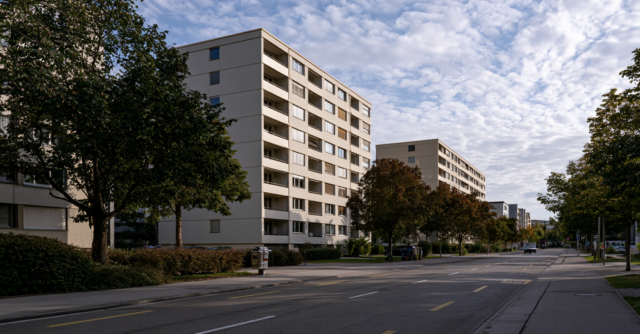
    The Sonnenhof site is centrally located between Bahnhofstrasse and Schaffhauserstrasse and covers a good 20,000 square metres. Today, the site is dominated by a shopping centre from the 1970s, other commercial and residential buildings and a large sealed car park. It is precisely this structure that is now to be fundamentally changed.

    The plan is to create a new, mixed-use district with a public passageway, green courtyards and squares, businesses, restaurants and a cultural and meeting centre. The existing shopping centre will not disappear, but will be modernised and integrated into the new structure.

    Urban densification
    At the heart of the project are around 240 rental flats in various price categories and with different floor plans. In addition, there are around 12,000 square metres for commercial, cultural and public uses on the ground floors and in the passages.

    In terms of urban planning, the project focuses on density and orientation. Four taller buildings will mark the site and give it a clearly recognisable address. The design plan allows for a maximum building height of 55 metres on the north-eastern corner. This shows how clearly the Sonnenhof will stand out from the previous scale.

    Open space instead of tarmac
    The message is particularly strong in the outdoor space. Where heat-retaining pavement dominates today, unsealed surfaces, trees, courtyards and climate-resistant planting will improve the microclimate in future. Rainwater will be able to seep away and evaporate, roofs will be greened and supplemented with photovoltaics.

    The project also aims to reorganise traffic flows. Most of the above-ground parking spaces will be moved to the underground car park, while paths and squares will be designed primarily for pedestrians and cyclists. Nevertheless, around 450 car parking spaces will remain on the entire site.

    Culture as part of the development
    The combination of property development and public use is striking. The planned KUBEZ cultural and meeting centre at Sonnenhof will not only be built, but will also create a regional meeting place for culture, education and leisure. The project is being developed in collaboration with the town of Bülach and neighbouring municipalities.

    This is what makes the Sonnenhof more than just a classic development. The site should not only provide living space, but also create a new centre that expands the everyday life of the town and strengthens the connection between the railway station, town centre and neighbourhood.

    A long road to the new centre
    Sonnenhof is still a planning project. the private design plan is due to be submitted in 2026, with approval scheduled for 2027. The first stage could start in 2029 and be completed in 2031, with overall completion scheduled for 2034 according to the project status.

    This shows the true scale of such projects. The transformation of a central site requires not only capital and design power, but above all time, procedures and political coordination. If Sonnenhof succeeds, Bülach will not simply gain new flats. The town will gain a new piece of urbanity.

  • Lucerne knocks Zug off its throne

    Lucerne knocks Zug off its throne

    Lucerne is lowering its effective corporate tax rate from 11.91 to 11.66 per cent in 2026, overtaking Zug, which is now at 11.71 per cent. According to PwC, this makes Lucerne the canton with the lowest corporate tax rate in Switzerland for the first time.

    The difference is small, but the message is all the greater. In tax competition, it is not only the absolute amount that counts, but also the symbolic effect. Whoever is at the top sends a clear signal to mobile companies and investors.

    Switzerland keeps moving
    Eight cantons are lowering their corporate taxes slightly, while four are increasing them minimally. Overall, the 2026 tax comparison shows a country that remains active in international competition and does not simply manage its attractiveness.

    It is striking that the OECD minimum tax introduced in 2024 has hardly changed the cantonal tax rates so far. PwC speaks of a rather wait-and-see attitude towards the new global framework conditions. This is precisely why competition within Switzerland continues to gain in importance.

    Zurich and Bern are coming under pressure
    At the other end of the scale are Bern and Zurich. According to PwC, Berne has an effective rate of 20.54 per cent, while Zurich is still at 19.47 per cent despite a slight reduction. Both cantons therefore continue to be among the most expensive locations for companies in Switzerland in terms of taxes.

    This is tricky from a location perspective. After all, high economic quality, good accessibility and strong labour markets are not always enough if the fiscal difference is almost twice as high as in Lucerne. The tax factor remains a tough lever in the competition for new relocations and expansions.

    More than just a tax ranking
    According to PwC, Central Switzerland maintains its role as a particularly attractive business location. In an international comparison, Lucerne and Zug rank at the lower end of the tax burden; in the EU, only Hungary taxes companies more heavily than Lucerne.

    This makes it clear what is really at stake. It’s not just about a difference in figures between two cantons, but about the strategic positioning of entire economic areas. Lucerne has taken a small step towards the top. This is precisely what can make the difference in the competition between locations.

  • Zurich sharpens its innovation profile

    Zurich sharpens its innovation profile

    The canton of Zurich is one of the strongest economic regions in Europe. However, even a top location comes under pressure when there is a shortage of skilled labour, development costs rise and global competition becomes tougher.

    This is precisely where the cantonal government comes in. It does not want to boost the innovation centre with individual actions, but rather strengthen it with reliable framework conditions. This Zurich approach is intended to bring research, entrepreneurship and application closer together.

    Five fields with a leverage effect
    The cantonal government has defined five key areas for the years 2027 to 2030. Semiconductors, space, environmental technologies, health and venture capital. The selection is no coincidence. All five areas combine technological dynamism with real growth opportunities.

    At the same time, they show where Zurich is heading. Not in short-term trends, but in fields in which industrial strength, research expertise and new markets overlap. This makes the strategy relevant in terms of economic policy.

    From the laboratory to the market
    The focus on implementation is particularly interesting. Innovation should be applied more quickly. This is precisely where many strong research centres are losing pace.

    For semiconductors, it is about access to chip design, clean rooms and technology transfer. In aerospace, Zurich wants to facilitate the development and scaling of new applications. In the healthcare sector, digital solutions are to be tested, validated and transferred to facilities more quickly. The ambition is clear. Not only invent, but also apply.

    Sustainability is becoming a location factor
    The focus on environmental technologies is also exciting. Sustainable mobility and recyclable construction are not only seen as an ecological task, but also as an economic opportunity.

    That is an important signal. Thinking about security of supply, climate targets and location quality together shifts sustainability from a niche to the centre of location policy. For Zurich in particular, this can create a new profile with international appeal.

    Capital is crucial
    Innovative companies need more than just good ideas. In the growth phase, they need capital that enables scaling. This is why the strategy also focuses on venture capital.

    For the first stage, the Government Council is applying for a framework credit of CHF 23 million. This is not a huge amount. But it marks a political decision of direction. Zurich not only wants to manage its innovative strength, but also translate it into added value and jobs.

  • The grid becomes Switzerland’s bottleneck

    The grid becomes Switzerland’s bottleneck

    By 11 votes to 0 with 2 abstentions, the Energy Committee of the Council of States adopted the amendment to the law to speed up the expansion and conversion of the electricity grids. The committee has thus made it clear that the expansion of the grid infrastructure should no longer be treated as a political sideshow.

    This is more than just a technical step. The Commission expressly emphasises the outstanding importance of a domestic, renewable energy supply and demands that the legal framework conditions finally reflect this importance. The electricity grid is thus being transformed from a companion into the strategic backbone of energy policy.

    Overhead lines before underground cables
    The Commission emphasises one key point. Transmission grid lines should primarily be realised as overhead lines. Underground cables remain the exception and should only be considered in special cases. However, this principle should not apply in construction zones.

    The political priority is thus visibly shifting towards speed and feasibility. The more complex the balancing of interests, the longer procedures take. This is precisely where the bill wants to start and streamline planning processes.

    More room for manoeuvre when replacing
    The focus on existing buildings is particularly relevant. In the coming years, a large part of the grid infrastructure will reach the end of its service life. According to Swissgrid, structural bottlenecks are already noticeable today and two thirds of the 6,700 kilometre-long transmission grid is over 40 years old.

    The Commission therefore wants to facilitate the replacement of existing high-voltage and extra-high-voltage lines, including on existing or directly neighbouring routes. This principle should now also apply to parts of the distribution grid above 36 kV. This is a signal with an impact. Not every grid expansion begins on a greenfield site. Much is decided by replacing the existing grid more quickly.

    The silent hurdle of the energy transition
    There is also a detail with a major impact. In future, transformer stations will also be possible outside the building zone under certain conditions if no suitable location can be found within the building zone. This also shows where the energy transition gets stuck in everyday life. Often not because of the strategy, but because of the land.

    The proposal therefore hits a sore spot. Switzerland has accelerated the production of renewable energy, but the grid is threatening to become a bottleneck. If procedures continue to take years, it is not a lack of ideas that will slow down the turnaround, but a lack of lines.

  • 10 million and then

    10 million and then

    On 14 June 2026, Switzerland will vote on the “No 10 million Switzerland!” initiative. It aims to keep the permanent resident population below 10 million in the long term and provides for additional measures from 9.5 million. The political focus is on immigration. However, the spatial effect could be much broader.

    After all, labour markets cannot simply be stopped at the national border. If companies continue to need skilled labour, but fewer people can or should live in Switzerland, the pressure on living and commuting areas close to the border will increase. This doesn’t just change statistics. It changes entire regions.

    The housing market is shifting
    The pattern has long been visible. In the Lake Geneva region, the labour market is growing strongly, while living space remains chronically scarce on the Swiss side. The result is an ever-increasing expansion of the metropolitan area towards France.

    The price difference explains the dynamic. In the canton of Geneva, asking rents recently stood at CHF 384 per square metre per year, while in France, which is close to the border, they were only CHF 190 to 260, depending on the location. The gap is even greater for residential property. In Geneva, asking prices are around 13,500 francs per square metre, in nearby France around 3,500 to 6,000 francs.

    When relief creates new burdens
    What is supposed to act as a brake for Switzerland can additionally fuel border regions. More cross-border commuters mean more demand for housing outside Switzerland, higher prices in neighbouring communities and growing pressure on schools, transport and municipal services. Voices from Haute-Savoie are already warning of precisely this.

    In terms of infrastructure, this is not a minor issue either. New transport services such as the Léman Express have made cross-border commuting much easier and triggered new development dynamics around the stops. The area is not growing any less. It is just growing differently.

    What this means for locations
    This is a tricky truth for location policy. Growth does not disappear just because you want to put a political cap on it. It seeks new paths via commuter axes, residential locations and functional economic areas.

  • 2000 jobs are on the line in Wettingen

    2000 jobs are on the line in Wettingen

    Wettingen has moved to the centre of an economic policy decision. The Aargau cantonal council wants to amend the structure plan in the Tägerhardächer area and thus create the planning conditions for a possible Hitachi Energy campus.

    This is a big step. Because it is not just about a single building project. It is about the question of whether Aargau can retain and at the same time expand its industrial substance. In the best-case scenario, around 1000 existing jobs will remain in the canton and up to 2000 new jobs could be created.

    Why Tägerhardächer
    The location is no coincidence. Hitachi Energy is looking at several options for expanding its capacities and relocating current jobs. The Tägerhardächer area is one of the favoured options.

    From a location promotion perspective, there are many arguments in favour of Wettingen. The site is located in the Zurich, Limmattal and Baden area, has good transport links and enables a coherent, expandable campus solution. It is also close to an existing cluster of companies from the energy sector. This increases the appeal of the location far beyond the municipal boundaries.

    The price of progress
    Wherever development becomes possible, conflicts arise. 10.7 hectares of settlement area would have to be designated for the project. The area is currently located in an agricultural area and is partially overlaid by a settlement separation belt.

    This is precisely where the criticism arises. In the consultation process, the loss of cultivated land, the reduction of crop rotation areas, encroachment on the settlement separation belt and traffic issues were criticised in particular. Nevertheless, the cantonal government maintains that the project is appropriate and spatially harmonised from a cantonal perspective. At the same time, attempts should be made to upgrade agricultural land elsewhere so that the loss remains limited.

    The region is thinking further ahead than the
    factory buildingThe
    decisive factor now is whether growth and quality of life can go hand in hand. After all, a campus of this size not only has an impact on the labour market. It changes traffic flows, settlement areas and expectations of the infrastructure.

    That is why accessibility should not only work for cars. Public transport as well as pedestrian and cycle connections should be designed in such a way that the impact on neighbouring communities remains as low as possible. This is more than just background music. It is a prerequisite for economic dynamism to be accepted regionally.

    Nothing has been decided yet
    The political will is visible. Wettingen and Baden Regio also support the amendment to the structure plan. However, the company has yet to make a final decision on the location. If it decides against Wettingen, the corresponding resolutions will become null and void.

    This is the real message of this dossier. The future does not just fall from the sky. It must be planned, politically supported and regionally balanced. Wettingen now has the chance to prove just that.

  • The silent ascent south of the Gotthard

    The silent ascent south of the Gotthard

    The EU’s Regional Innovation Scoreboard 2025 confirms Ticino’s “Innovation Leader” status. Only Zurich performs better in Switzerland. There are measurable drivers behind the ranking. The USI and SUPSI universities form the academic backbone, complemented by institutes such as the IDSIA for artificial intelligence and the national supercomputing center. At the same time, SMEs in the canton invest above average in research and development.

    Three competence centers, one park
    The Switzerland Innovation Park Ticino pools forces at three locations. The Swiss Drone Base Camp at Riviera Airport tests drone technology in real airspace. In Lugano, the Lifestyle Tech Competence Center is driving forward the digitalization of fashion, food and wellness. In Bellinzona, the Life Sciences Competence Center conducts research into biomedicine and oncology. From 2032, the park will move to the Nuovo Quartiere Officine, a 120,000 square meter urban development area in the heart of the cantonal capital.

    Lugano relies on digital infrastructure
    The city of Lugano has gone its own way in the area of crypto. Over 400 businesses already accept digital means of payment, and more than 100 fintech and blockchain companies have set up shop. Phase II was launched in March 2026 in collaboration with the company Tether. Five million Swiss francs will flow into digital resilience, AI ecosystems and decentralized urban infrastructure by 2030. Lugano is thus positioning itself as Switzerland’s third-largest financial center with technological ambitions.

    cHF 60 million and a clear signal
    The Grand Council sent a clear signal at the end of 2023. A credit line of CHF 60 million will secure the promotion of innovation, research cooperation and regional economic policy until 2027. CHF 25 million will flow directly into innovation and research synergies. Fondazione Agire, the canton’s innovation agency for over 10 years, supports 20 startup ideas every year via its Boldbrain accelerator and coaches SMEs on digitalization.

    What the real estate sector needs to learn from this
    Location promotion only develops its full value when it grows beyond strategy papers. Ticino is faced with the task of developing land availability, process reliability and urban quality at the same pace as its innovation projects. For investors, this means a region on the move with high potential and a simultaneous need for patience. Anyone who has the south of Switzerland on their radar today will find a location that wants to deliver and has the means to do so.

  • Change of ownership to accelerate growth in the geothermal market

    Change of ownership to accelerate growth in the geothermal market

    The investment company Dundee AG has acquired Bohrfix Erdsonden AG, according to a press release. The company is one of the most established and successful independent providers of geothermal probe drilling in Switzerland, with around 240,000 meters drilled annually and 1150 boreholes worldwide.

    With the new owner, the drilling company will have a slightly different management structure. Effective immediately, Hans Rosenberger, Chairman of the Board of Directors of Dundee AG, is Chairman of the Board of Directors of Bohrfix Erdsonden AG. Sascha Jordi will continue to manage the company operationally. Jordi has been a drilling foreman since 1998 and has worked as a project manager at Bohrfix Erdsonden AG since June 2025. Vinzenz Schönenberger will remain Commercial Director and Delegate of the Board of Directors. Despite the change in management structure, all existing employees will be retained. Nothing will change operationally for customers and clients.

    “With the acquisition of Bohrfix Erdsonden AG, we are investing in a company with an excellent market position, an experienced team and great growth potential in the geothermal and renewable energy sector. We are looking forward to this exciting partnership,” Hans Rosenberger is quoted as saying.

    The background to the takeover is the decision by the previous owner Alban Berisha to concentrate fully on the further development of his investment and real estate portfolio. The new owner plans to further develop the market-leading position of Bohrfix Erdsonden AG and also to invest in growth, technology and personnel in the future.

  • Bellinzona dares to undertake a major renovation

    Bellinzona dares to undertake a major renovation

    There are hardly any inner-city transformation areas of this size in Switzerland. The FFS site in the heart of Bellinzona offers an opportunity that cities such as Zurich and Basel have long since lost. The new district will not be built on a greenfield site, but will interweave the historic city with the area around the railroad station and new development zones. Mixed use, biodiversity and generous open spaces are at the heart of the master plan.

    The international competition was won by the team sa_partners, TAMassociati and Franco Giorgetta. Their design breaks up the previously closed industrial area and organizes it around the “Almenda”. A 6.4 hectare central green space that structures the entire district as an ecological and social backbone. The listed “Cattedrale”, which has been a maintenance site for locomotives since 1919, will be retained as an identity-forming focal point and will become the anchor building of the new district.

    Innovation at the heart of
    The district will also be home to the Switzerland Innovation Park Ticino in future. The park was officially recognized as the location of the Switzerland Innovation Park Zurich in November 2024 and is supported by USI, SUPSI, BancaStato, the Ticino Chamber of Commerce and the employers’ association AITI. From 2032, the park and its headquarters will move to a 25,000 square meter area within the new quarter.

    Three competence centers are already active: Swiss Drone Base in Lodrino for drone technology, a hub in Bellinzona for life sciences and a location in Lugano for lifestyle tech. Together with postgraduate training courses offered by USI and SUPSI, an innovation cluster with supra-regional appeal is being created. Bellinzona is thus positioning itself as a location between administration, technology and urban quality of life and as a serious alternative to the major Swiss technology hubs.

    Setback in fall 2025
    The path is not clear. In October 2025, the cantonal administrative court annulled the municipal council’s detailed development plan from April 2023. The financial aspects were insufficiently explained, in particular the costs for the acquisition of public land and the remediation of contaminated sites, which are estimated at CHF 30 to 50 million. The planning process will have to start from scratch.

    At the same time, construction work is already underway on the new FFS plant in Arbedo-Castione, a major project costing CHF 755 million that is scheduled to open in 2028. The site will only become available once Officine has relocated. The first realization phase is expected to start between 2030 and 2035 at the earliest, and the overall transformation is likely to take 20 to 40 years. The time pressure is real and the complexity is high.

    Model for central Switzerland
    Porta del Ticino shows how medium-sized centers beyond the metropolitan areas can deal with large industrial sites. Not monofunctional overbuilding, but development as an urban transformation space with a long-term regional impact. What is being created in Bellinzona can be a benchmark for other cities of the same size. From Aarau to Chur, from Schaffhausen to Sion.

    The next few years will determine whether the planning quality can be secured for years to come, whether investments can be bundled and whether the vision can be translated into a resilient realization perspective. The real test has only just begun.

  • Canton of Bern plans major construction in the Bernese Seeland

    Canton of Bern plans major construction in the Bernese Seeland

    The Road Traffic and Navigation Office has had its headquarters on Schermenweg in Bern for decades. The buildings there have structural defects and are in a condition that makes it impossible to completely renovate them without interrupting operations. In addition, there is a second location in Ostermundigen, where the canton pays over one million francs a year in rent.

    Move three times or build once
    The decision was made in favor of a new building. All three locations will be closed and the approximately 400 employees brought together in a single location. The new building on the Buechlimatt in Münchenbuchsee offers space for offices, test centers and the entire customer operations on one site. Vehicle registrations, driving tests, administrative processes: everything under one roof for the first time in decades.

    One competition, one winner, one timber construction
    in 2021, the canton announced an open project competition. Thirty teams submitted designs, and the Zurich planning team from Studiomori Architektur and KNTXT Architekten won over the jury. Their project bears the programmatic name “One for all”. It is based on a low-maintenance timber construction that blends organically into the rural outskirts of Münchenbuchsee. Not a statement made of concrete and glass, but a building that makes the Canton of Bern’s climate strategy visible. Wood as a building material reduces the CO2 balance over the entire life cycle.

    The politicians decide
    In April 2026, the Bernese government applied to the Grand Council for a commitment credit of 132.9 million francs. The latter is expected to make its decision in autumn 2026. The fact that the amount has risen from around CHF 104 million at the time to CHF 132.9 million since the 2021 competition phase is likely to raise questions in parliament. Construction costs and increased planning requirements are the main reasons. If you offset the rental costs and the renovation backlog, the business case for the new building is clear.

    Move in 2031 at the earliest
    If the parliamentary deliberations go according to plan, the building application will be submitted in mid-2026 and construction will begin in 2028, with commissioning planned for 2030 to 2031. For Münchenbuchsee, this means a new workplace center with several hundred employees on the edge of the village. For the canton of Bern, it means the end of a long period of administrative restructuring. And for the Swiss construction industry, the project exemplifies a trend that will gain momentum in 2026. Public buildings made of wood, built for the next generation.

  • 11. May on which Switzerland crosses its borders

    11. May on which Switzerland crosses its borders

    Since the ecological footprint was first recorded in 1961, Switzerland’s Overshoot Day has moved forward by more than seven months, from the end of December to mid-May. If the entire world population lived like Switzerland, it would need the resources of 2.8 Earths in 2026. Switzerland’s ecological footprint is 4.15 global hectares per person, while the available biocapacity is just 1.48 hectares. The gap is growing.

    Housing as an underestimated driver
    Housing is one of the strongest drivers of the Swiss overshoot, alongside mobility, food and imported goods. Between 1990 and 2021, living space in Switzerland increased by 54%, while the population only grew by 31%. Individual changes in behavior can only achieve around 20 percent of the savings. The big levers lie elsewhere.

    Buildings as raw material stores
    The building sector is responsible for over 40 percent of global greenhouse gas emissions. In addition to the operating energy for heating, cooling and electricity, it is primarily gray energy that determines how large a building’s footprint really is. It includes all energy from the extraction of raw materials to processing and dismantling. As long as demolition is cheaper than recycling, the potential of the circular economy remains untapped.

    Regulation is tightening
    The legal framework is tightening. The Climate and Innovation Act has been in force since January 2025 and creates incentives for the replacement of fossil heating systems and energy efficiency measures. The MuKEn 2025, adopted in August 2025, define limit values for gray energy in new buildings for the first time and increase the requirements for photovoltaics and renewable heating systems. However, they will only become binding once the cantons incorporate them into their energy laws.

    System change instead of symbolic policy
    The message of Overshoot Day is clear: small adjustments are not enough. Scalable solutions are needed in energy, mobility, materials management and site development. As a cross-sector industry, the construction and real estate sector can have an impact in all of these areas if data is recorded precisely, materials are documented and circular processes are standardized. Buildings as raw material stores instead of landfill suppliers – that is the direction.

  • Swiss wood to become mandatory

    Swiss wood to become mandatory

    Swiss forests produce 10.4 million cubic meters of wood every year, of which just 5 million is consumed. However, a total of 10 million cubic meters of wood ends up on Swiss construction sites. The rest comes from abroad because it is much cheaper. A resource potential that is lying idle, although the demand is there.

    What the National Council is calling for
    National Councillor Daniel Ruch (FDP/VD), a forestry contractor from Vaud by profession, has submitted a motion to amend the Forest Act. In future, Swiss wood should be used in buildings that are subsidized with federal funds, without incurring additional costs for the building owners. The National Council has accepted the motion, now the ball is in the Council of States’ court.

    The Federal Council puts the brakes on
    Federal Councillor Martin Pfister, who represented the convalescing Environment Minister Albert Rösti in the debate, opposed direct subsidies. The federal government already promotes sustainable wood in its own buildings and facilities. There has been a legal basis for this since the 2017 revision of the Forest Act, and there is no scope for new subsidies in view of the tight federal finances, and distortions of competition should be avoided.

    Not a new topic, but new pressure
    Back in 2021, the National Council adopted a similar motion on the complete value chain of the timber industry by 151 votes to 29, also against the will of the Federal Council. Individual cantons such as Thurgau and Zug have already integrated wood promotion into their legislation at cantonal level. The pressure to act is growing.

    What is at stake
    Wood is the only completely renewable building material in Switzerland. Those who use it consistently strengthen regional value creation, reduce transport emissions and protect the forest from ageing. Whether the Council of States supports the motion or puts the brakes on it will determine whether this logic is finally enshrined in law.

  • Zurich bundles economic development in one law

    Zurich bundles economic development in one law

    The road was long. The Department of Economic Affairs has been developing the legal basis since 2020, the consultation process began in 2022 and the Cantonal Council approved it by 114 votes to 59 in the fall of 2025. On April 30, 2026, the cantonal government put the Location Promotion and Business Relief Act into force on July 1, 2026. What was previously piecemeal now has a clear legal home.

    What the law bundles together
    The law brings together six central areas of responsibility under one roof: location development, strengthening innovative capacity, supporting established companies, attracting new businesses, location promotion and external economic relations. At the same time, the previous law on administrative relief will be repealed and fully integrated. This will put an end to a double-track race between two separate sets of regulations.

    The pressure behind it
    Energy shortages, a lack of skilled workers, the OECD minimum tax and the unresolved relationship with the EU are putting pressure on Zurich as a business location. Legally enshrined location promotion should increase the canton’s ability to react and ensure that measures can be implemented quickly and in a targeted manner. The law also provides a basis for the canton to quickly participate in federal crisis support programs.

    Business relief as the centerpiece
    The previous coordination office will be upgraded to a specialist office for business relief. In future, it will systematically examine all new and amended cantonal laws and ordinances for their impact on companies. The so-called regulatory impact assessment has a clear objective: business-friendly regulations and digitally processed enforcement that saves time and effort.

    Zurich as a role model
    Zurich is thus positioning itself as a canton that does not leave economic competitiveness to chance. Carmen Walker Späh, Director of Economic Affairs, played a key role in shaping the law, which is one of the last major projects of her twelve years in office. It will be launched on July 1, 2026, when Walker Späh is already completing her year as President of the Government.

  • Ticino economic area between energy, housing and investment

    Ticino economic area between energy, housing and investment

    [smartslider3 slider=”52″]

    At the 108th immoTable Ticino in Savosa, representatives from the real estate industry, energy, planning and investment discussed the future of the Ticino economic region. The focus was not only on individual projects, but also on the fundamental question of how Ticino can continue to develop as a modern business and real estate location.

    The discussion made it clear that Ticino today is much more than just a vacation and second-home region. A high quality of life, strategic location and exciting development potential meet challenges in terms of processes, living space, mobility and regional cooperation.

    Roberto Fantoni from Volta RE showed how much the energy market has changed. While the feed-in tariff for photovoltaic electricity has fallen massively in recent years, new models for property owners, municipalities and site developments are emerging in the form of energy communities, virtual associations and local electricity communities. The new CLE models from 2026 in particular could have a lasting impact on the real estate market. At the same time, it became clear that owners and administrations are increasingly looking for solutions that reduce energy costs, improve the energy efficiency of buildings and simplify investments.

    Monique Bosco-von Allmen from CASSI focused on the issue of housing. She made it clear that Ticino is lagging far behind the rest of Switzerland in terms of non-profit housing construction and that the discussion about affordable housing, demographic change and sustainable forms of housing is becoming increasingly important. The topics discussed included gentrification, rising rental costs, the low proportion of non-profit housing and the question of how politicians, municipalities and private stakeholders can work together to promote new housing models. At the same time, it was emphasized that housing is much more than just a roof over one’s head, but is closely linked to social balance, intergenerational dialogue and quality of life.

    Manuel Gamper from Leading Investors presented Ticino from the perspective of national and international investors. Ticino remains attractive, but finds itself in a more demanding market environment that requires significantly more professionalism, data competence and strategic thinking. Particularly important are predictability, speed, larger volumes and a professional ecosystem along the entire real estate value chain. At the same time, it became clear that Ticino, despite its limited market size, has interesting returns and considerable development potential if projects are of high quality, flexible and long-term.

    The future of the Ticino economic region will not be decided by individual construction projects or investments alone, but by cooperation, quality, innovation and the ability to think about economic development, energy, mobility and housing together.

    The next immoTable will take place on June 18, 2026 at the StartUp Space in Schlieren.

  • Rethinking building, Freiburg is looking for pioneers

    Rethinking building, Freiburg is looking for pioneers

    From 2029, new limits for greenhouse gas emissions and requirements for gray energy in the construction industry will apply in Switzerland. Defined by the revision of the cantons’ model regulations in the energy sector. The pressure on the construction industry is growing. Those who do not invest in new processes and materials today risk expensive adjustments under time pressure tomorrow. The canton of Fribourg has recognized this and is acting with foresight. As early as 2023, it adopted a roadmap for the circular economy that prioritizes structural changes in the construction industry.

    Innovation along the entire value chain
    The theme of this year’s call is “Rethinking construction, towards circular and environmentally friendly systems”. We are looking for projects that reduce the ecological footprint of buildings right from the planning phase, through local bio-based materials, deconstructable construction systems or digital tools for material tracking. The Swiss Charter for Circular Construction, which is supported by twelve leading organizations from the construction and real estate industry, clearly formulates the goal: “By 2030, the proportion of non-renewable primary raw materials should fall to 50 percent of the total mass.”

    Collaboration as a prerequisite
    Lone wolves have no chance here. Each project submitted must involve at least three companies, the majority of which must be based in the canton of Fribourg. Academic partners such as the School of Engineering and Architecture HTA-FR can be involved to ensure knowledge transfer and reproducibility of the solutions. Nicolas Huet from INNOSQUARE emphasizes that the challenges of circularity must be overcome and that innovation must take place jointly.

    Funding with personal responsibility
    The NRP funding covers a maximum of 65% of the total budget, the rest is covered by the participating companies, 10% in cash and 25% as personal contributions. This structure is not an obstacle, it is the program. It ensures that only projects that the companies really support are submitted. Alain Lunghi, Deputy Director of the WIF, sees foresight as the key to the competitiveness of Fribourg companies.

    Submit now
    Projects can be submitted individually or as part of a consortium via www.promfr.ch/de/nrp. The call is supported by the Economic Development Agency WIF, the Fribourg Chamber of Commerce and Industry, the HTA-FR and the INNOSQUARE innovation platform. The deadline is September 9, 2026. Anyone who sees the construction turnaround as an opportunity still has time to act.

  • Whoever blocks, pays

    Whoever blocks, pays

    The majority of building permit procedures in Switzerland take place within reasonable time limits. However, there are exceptions and these have a serious impact. Objections and appeals can block projects for years or prevent them altogether. Today, even people who are not directly affected by a project can lodge an objection, for example because they don’t like the color of the neighbor’s planned façade. This is one of the structural weaknesses that the Federal Council is now addressing.

    Housing construction becomes a national objective
    The strongest lever in the reform package lies in the Spatial Planning Act. Housing construction as part of inward settlement development is to be enshrined there as a national interest. This sounds technical, but has a concrete effect. When weighing up interests, housing construction would be given more weight than the protection of the townscape or listed buildings. Projects that currently fail due to local protection interests would have a better chance of being realized.

    Objections with consequences
    Anyone who raises objections improperly, i.e. with the sole aim of delaying a project, should in future bear the procedural costs. The Federal Council is considering a legal obligation for the cantons to impose such costs on objectors. At the same time, the right of private individuals to appeal to the Federal Supreme Court is to be restricted. However, the Federal Council rejects flat-rate fees for rejected appeals. Access to legal protection should not depend on your wallet.

    The limits of the federal government
    Despite the political will, the federal government’s scope for intervention is limited. Building permit procedures are the responsibility of the cantons. The federal government cannot impose binding deadlines for cantonal procedures or the obligation to introduce digital approval processes. It recommends that the cantons introduce such measures on their own responsibility, as they have a demonstrably accelerating effect in the long term. The Swiss Construction Industry Association supports this approach and is calling for leaner processes while maintaining a high level of planning quality.

    Consultation
    The reform report fulfills five postulates from the National Council and Council of States and is part of the federal government’s housing shortage action plan. DETEC has now been instructed to draw up a consultation draft by the end of 2026. It is likely to be years before concrete legislative changes come into force.

  • Zurich reinvents itself

    Zurich reinvents itself

    Government Councillor Carmen Walker Späh openly stated that many good ideas never make it to the market. It is not a lack of creativity, but a lack of the right support at the right time. The canton of Zurich has therefore taken the step this year of joining the international “MIT REAP” program. The aim is to channel funding in a more targeted manner, network players more closely and systematically promote scaling. Zurich has already established itself as a hotspot in the fields of AI, robotics, life sciences and the new space economy. The task now is to secure this lead.

    Nothing works without people
    Markus Müller, Co-Head of Location Promotion, put it in a nutshell with a quote from medtech entrepreneur Andy Rihs: “Nothing works without people.” Capital alone does not build a future. What makes Zurich strong is the ability to bring together new ideas with the right know-how and the right capacities. Zurich should take on a leading role in the new space economy. According to Müller, innovation is what turns “good” into “leading” in the long term.

    You can’t think about the future alone
    Futurologist Martina Kühne gave the guests three ideas to take away with them. Think beyond tomorrow, develop visions of the future in the majority and shape the future together. Every vision of the future is like a piece of gymnastics equipment on which you can let your mind run wild. Anyone who does this can develop ideas for a possible and desirable future. Because, according to Kühne, the future doesn’t just happen.

    Collaboration as a catalyst
    The ETH spin-off Sevensense shows how this theory translates into practice. in 2021, the young start-up impressed ABB with its 3D vision technology for autonomous robots. Today, around 80 percent of the autonomous robots sold by ABB come from Sevensense. Proof of how effective the combination of established capital and fresh inventive spirit can be.

    Organs in space, muscles in the lab
    Prometheus Life Technologies is even more daring. The start-up uses weightlessness in space to grow organs in three dimensions. This was made possible by a parabolic flight program at the Innovation Park, in close collaboration with the Center for Space and Aviation at the University of Zurich. No less ambitious is Muvon, which is working with the ZHAW on an automated method for muscle regeneration using the body’s own cells. If it can be scaled up, it could be used to treat stress incontinence, which affects a significant proportion of women over 40 in Europe.

    A platform that innovates itself
    Samuel Mösle, Co-Head of Location Promotion, drew a clear line in the final discussion. The three start-ups presented are at the limits of the imaginable future. The innovation platform will become more interactive and networked in future with the support of artificial intelligence. After five years, the initiative has reached the end of its own start-up phase. Samuel Mösle sums it up precisely: “It doesn’t just say innovation on it, it also has innovation in it.”

  • 300 apartments are being made fit – no one has to move out

    300 apartments are being made fit – no one has to move out

    Built in three stages between 1974 and 1990, the “Untere Bühl” still characterizes the old town center of Oberwinterthur today. The complex is considered worthy of protection and some of the buildings are still largely in their original condition. Some of them were already renovated in 2015, and the others are now being renovated. The planning application has been approved and construction is scheduled to start at the beginning of 2027.

    Nobody has to leave the field
    What makes the project stand out is its social consistency. As the asset manager of the AXA Investment Foundation, BNP Paribas designed the refurbishment from the outset in such a way that all tenants can remain in their apartments. The tenants were involved at an early stage, including workshops on outdoor space and design. “Our tenants have been an integral part of the development for years,” says Pascal Messmer, Asset Manager at BNP Paribas. This attitude runs through the entire project.

    Extensions that don’t impose themselves
    For the extension, AXA is relying on bernath widmer architects, who emerged victorious from a cooperative test planning process. The majority of the extensions and new buildings are made of wood and deliberately reflect the character of the existing buildings. Around 80 barrier-free apartments with 1 to 3 rooms will be created. An addition to the existing apartments, most of which are large today. Residential studios, communal areas and a commercial space are planned on the first floor.

    Park remains and becomes more lively
    The park-like outdoor space with communal gardens, playgrounds and the kindergarten from 1977 will be retained. The landscape architecture firm ghiggi paesaggi is taking Fred Eicher’s original open space concept and developing it further. New planting and green roof areas strengthen biodiversity and create habitats for small animals and insects. Greenery is planned on some of the roofs of the new buildings. The central pavilion is to be used by the public in future, for example as a daycare center.

    Into the future in stages
    The project will be implemented in stages, probably up to 2028, with the aim of creating a real estate portfolio with net-zero emissions by 2050. Winterthur is not only gaining refurbished existing buildings, but also 80 new apartments in a mature settlement that knows who it is.

  • Regional companies in the spotlight at the Central Switzerland awards ceremony

    Regional companies in the spotlight at the Central Switzerland awards ceremony

    Obrist interior is the winner of the Prix SVC Zentralschweiz 2025. Founded in 1895, the SME from Inwil specialises in high-quality shopfitting and interior design. According to a statement from the Swiss Venture Club(SVC), it employs around 120 specialists worldwide to realise exceptional interiors for luxury brands, business premises and private homes. As Urban Camenzind, jury president and economic director of the canton of Uri, emphasised at the award ceremony, the expert jury was “impressed by the successful combination of traditional craftsmanship and state-of-the-art technology. Working closely together, customer advisors, project managers, planners and production specialists process a wide variety of materials such as wood, metal and glass into high-quality shop and interior fittings – true works of art, created in Central Switzerland for the global market.”

    Second place went to the Axon Active Group from Lucerne. It supports companies and organisations in various industries with scalable digital solutions to transform and optimise their business processes. The company is characterised by agility, sustainability and customer proximity, according to the SVC jury.

    Third place went to Schiltrac Fahrzeugbau. The company from Buochs builds customised special transporters for various applications, from agricultural and municipal vehicles to fire engines. According to the SVC, Schiltrac is known for its high manufacturing quality and flexibility.

    The other winners were Stadler Form from Zug and Impact Acoustic from Lucerne. Stadler Form optimises the indoor climate with its humidifiers, dehumidifiers and aroma diffusers. Impact Acoustic develops recyclable products that improve room acoustics in offices, restaurants, hotels and public buildings.

  • Where others park, you soon live

    Where others park, you soon live

    Christoph Schoop didn’t have to look far. The real estate investor from Baden looked out of his office window at the Dättwil industrial estate and recognized the obvious: huge flat roofs, completely unused. On the roof of the factory arcade at Mellingerstrasse 208, where McDonald’s, Spar and a bakery now provide for everyday life, eight so-called Wikkelhäuser are to be built from spring 2027.

    A new world on the roof
    The Wikkelhouse concept originated in Amsterdam and is now coming to Switzerland. Compact wooden housing units that are delivered ready-made by truck and erected with minimal effort. Each unit offers 30 to 35 square meters, its own terrace and ceiling heights of up to 3.5 meters. Architect Andreas Zehnder, who designed the project for Baden, clearly formulates the added value. Instead of adding another storey, an independent living space has been created on the roof.

    Swiss wood, Uri factory
    The houses are not produced on the building site, but in the company’s own factory in Flüelen UR on the shores of Lake Lucerne. The raw material is Swiss wood from sustainable forestry. Schoop is a co-founder and supporter of Wikkelhouse Switzerland and promotes the concept as a circular economy model. A unit costs from CHF 200,000 ex works; transportation and assembly are additional costs.

    Inexpensive, sunny, connected
    By Baden standards, rents should remain low. There is already a waiting list and, according to Schoop, inquiries have come from “a wide range of people”, including those of AHV age. And although the industrial area is not considered a residential location, the roof offers all-day sunshine and a direct public transport connection. The building itself provides noise protection.

    Pilot with scaling potential
    The project in Dättwil is explicitly designed as a pilot project. Schoop sees space for 50 to 70 Wikkel houses in the industrial area alone. The city of Baden is currently reviewing the suitability for planning permission. If everything goes according to plan, the first residents will move in in spring 2027. What sounds like a curiosity today could set a precedent tomorrow.

  • Condensed, networked, liveable

    Condensed, networked, liveable

    Switzerland currently has over 9 million inhabitants and the population continues to grow. The pressure on the housing market is increasing, while building outside existing building zones has been severely restricted since the RPG revision of 2013. Cities and municipalities must develop inwards. According to Dita Leyh, Professor of Urban Development at the OST, there are sufficient reserves of space. Single-family home neighborhoods near train stations, brownfield sites or unused railroad areas offer great potential. A second revision of the RPG will further tighten the requirements.

    Densify where public transport is strong
    Inner development at public transport hubs makes particular sense. “Inner densification makes particular sense at public transport hubs,” says Dita Leyh. This is because optimal connections to the bus and rail network create more living space, but not automatically more traffic. Another key lies in the reorganization of stationary traffic. Collective garages on the edge of the neighborhood bundle car traffic, leaving the interior of the neighborhood largely car-free and thus gaining open space for people and nature. “The more densely you build, the more open spaces you have to create at the same time,” says Leyh.

    Mix of uses as a quality feature
    Densification is far more than just stacking up apartments. A diverse mix of uses, from bakeries and restaurants to green spaces, revitalizes neighbourhoods and creates added value. High-quality, interdisciplinary planning is needed to create this added value. Urban planning, transport planning and open space planning must sit together at the table from the outset, emphasizes Leyh. The updated Spatial Concept Switzerland 2050, which was adopted by the Federal Council in March 2026, confirms this approach and focuses on regional cooperation, landscape quality and climate-friendly mobility.

  • 270 reasons for Stans

    270 reasons for Stans

    The non-profit housing association Logis Suisse AG is planning a new housing estate in the west of Stans. Around 270 affordable apartments, around 1,000 m² of commercial space and two communal areas will be built by 2032 on a 12,700 m² site that the company acquired back in 2015. The study contract, in which seven general planning teams took part in 2025, was won by Studio Sintzel from Zurich and Uniola AG.

    Two buildings, eight courtyards
    The project, known internally as “Eight courtyards for Stans”, is based on two seven-storey buildings. Despite their volume, they appear from the outside as loosely placed point buildings. Head elements refer to existing buildings and structure the street fronts with front garden zones. Open courtyards with passageways structure the outdoor space and allow views of the surrounding mountains. A high-quality counterbalance to the adjacent highway. An existing old building in the center of the development will be retained and will serve as a social meeting point in the future.

    Mixed quarter with short distances
    The site is located opposite the Länderpark shopping center, on a multi-lane road and in the immediate vicinity of the freeway. Bicycle paths and footpaths should nevertheless link the new district well with Stans and Stansstad. With 0.8 parking spaces per apartment, Logis Suisse is below the usual standard, a clear commitment to sustainable mobility. The apartment mix ranges from compact 1.5-room apartments for singles and older people to spacious 5.5-room apartments for families and shared flats. On the first floor, studio apartments, care facilities and commercial space enliven the district.

    Built to conserve resources
    The client’s aim was to create a model project in terms of ecology, social space and economic efficiency. The load-bearing structure is designed to be material-efficient, the floor plans are compact and a photovoltaic system on the roofs covers a large part of the electricity requirements on site. A single-storey underground car park minimizes excavation work. Construction is scheduled to start in 2030 and be completed in 2032.

  • When architectural monuments pack their suitcases

    When architectural monuments pack their suitcases

    Two apartment buildings with 57 apartments ranging in size from 2.5 to 5.5 rooms are being built on a 6500 square meter site to the north of the historic station building. Commercial and restaurant space is planned on the first floors, as well as a small commercial building and an underground garage with 59 car and 92 bicycle parking spaces. A park-like open space with a playground will be created between the two buildings.

    Less, but social
    The project has become smaller. SBB originally planned four buildings with 90 apartments, a third of which would be affordable. However, the signal box next to the station building must remain, which means that an entire building is no longer needed. Of the remaining 57 apartments, 20 are to be offered at affordable prices. This corresponds to 35 percent and is even slightly higher than the original quota.

    Switzerland’s last goods shed
    What residential construction demands requires space. Four existing buildings have to make way, including the goods shed from 1928, designed by Meinrad Lorenz, SBB’s chief architect at the time, one of only four buildings of this type in the whole of Switzerland. Following the demolition of the identical shed in Heerbrugg, the one in Wollishofen is the last remaining example of its kind. It is listed in the cantonal inventory of listed buildings.

    A wooden building packs its bags
    Nevertheless, the goods shed will not disappear. It will be dismantled into individual parts, professionally refurbished and rebuilt at the Zurich Oberland Steam Railway Association in Bauma an der Töss. There it will be made accessible to the public and given a museum function as part of the “Bauma 2020 depot area” project. The approval documents for the dismantling are already largely in place.

    History repeats itself
    This move is not the first in the history of Wollishofen station. The current station building was once the first station building in the city of Zug, built in 1864 and moved stone by stone to Lake Zurich in 1897. What was forced by the scarcity of building materials in the 19th century is now a deliberate act of preservation. Wollishofen is thus writing another chapter in an unusual building history.

  • Zurich tests AI in the building permit process

    Zurich tests AI in the building permit process

    From April 2027, the canton of Zurich will require all municipalities to use the eBaugesucheZH platform. This lays the foundation for digitization, but only the foundation. The content of the applications will continue to be processed in different systems, depending on the municipality or canton. This historically evolved system landscape leads to media disruptions, manual coordination rounds and data inconsistencies.

    What the FHNW study shows
    The Building Directorate commissioned the FHNW Institute of Digital Construction to conduct a potential study along the entire process chain. 15 fields of action were identified, from initial digital information to building acceptance. The greatest short-term potential lies at the very beginning. Chatbots for the initial consultation, structured submission support and automated preliminary checks could immediately improve the quality of submitted applications and significantly reduce queries. Many improvements can already be achieved with rule-based systems, without generative AI.

    Prototype with the city of Kloten
    The Innovation Sandbox for AI of the Office of Economic Affairs tested an AI-based preliminary check for the notification procedure together with practice and technology partners, including the city of Kloten. For simple projects such as solar installations or heat pumps, a rule-based system automatically clarifies the admissibility and choice of procedure, and an AI then checks the completeness and quality of the entries. 3336 tests were evaluated. The results are encouraging, even if the reliable interpretation of complex plan representations remains an open challenge.

    Humans remain responsible
    Both studies agree that complete automation is currently not realistic. Where decision-making logic is clearly defined, rule-based systems are preferable to generative AI. The authority to make decisions remains with humans. Legal issues relating to data protection, liability, transparency and copyrighted blueprints as AI training material must be examined in depth before any implementation.

    The results are now being incorporated into the further development of eBaugesucheZH. Individual applications are to be tested in pilot municipalities. Zurich is thus demonstrating how the careful, step-by-step use of AI can work in a complex administrative domain.

  • Beer, concrete and living – Baden builds on its history

    Beer, concrete and living – Baden builds on its history

    Four new buildings are being constructed on around 8,000 square meters directly next to Baden train station, divided into two construction sites. Building site A is the responsibility of Frei Architekten AG from Aarau, building site B is the responsibility of the renowned Harry Gugger Studio from Basel. The volume is considerable: 81,888 cubic meters of enclosed space, 22,914 square meters of floor space and an investment of around 64.5 million Swiss francs. The general contractor is Gross AG from Brugg.

    Living where malt used to steam
    136 rental apartments with 1.5 to 4.5 rooms are being built in the heart of the city. On the first floor, a total of 2268 square meters of retail and restaurant space will characterize the quarter. In the inner courtyard, a 900 square meter beer garden invites you to linger. The motto of the building owner, the fourth-generation brewery H. Müller AG, sums it up: “brew – live – enjoy”.

    History remains visible
    Not everything makes way for the new building. The boiler house, brewhouse and malt silo remain as architectural witnesses to a brewing history that began in 1897. The Müllerbräu beer itself is now produced by the Falken brewery in Schaffhausen. However, there is still a specialty brewery on the site. The site’s past thus not only remains visible, it can still be experienced.

    Timetable and marketing
    The building permit dates from October 2023, with demolition starting in April 2024. The facades of the new high-rise buildings have been visible for the first time for a few days now. A milestone for the project. Marketing of the apartments is scheduled to start in summer 2026, with first occupancy planned for June 2027.

  • Laufenburg builds windmills at the train station

    Laufenburg builds windmills at the train station

    The Schützegärte site is located in a sensitive urban location. Three streets surround it, and building typologies from different decades clash all around. It is precisely this chaos that is the theme. AWW Architekten AG makes the “contrasting and bilateral” the basis of the concept. The architecture emerges from the tension of the location, not against it.

    Offset, rotated, anchored
    Two identical, four-storey buildings form the ensemble. They are not parallel, but offset and rotated in relation to each other on the slightly sloping terrain. This positioning is not an aesthetic conceit, but a precise reaction to the formation of edges and the flow of space in relation to the neighboring buildings. An ensemble that blends in while remaining independent. The total floor area is around 4,600 square meters, the building volume around 13,800 cubic meters.

    Windmill as a residential model
    The architectural concept is based on a compact four-span “windmill” building shape with a central staircase core. The projecting wings characterize the façade and make reference to typical bay window shapes in the district. Each apartment is oriented on three sides. At the heart of the building are the “four-season rooms” with spacious rooms that can be used as conservatories, studios or living and dining areas. Together with loggias, this creates a flexible range of spaces for a wide variety of lifestyles.

    Green, communal, grounded
    The open space between the houses is deliberately kept low-threshold. Accessible from inside and from the street. A green layer of native shrubs and perennials protects the first floor apartments and gives the development character. At one corner, the area opens up to a meadow-like situation with fruit trees, a reference to the local tradition of orchards close to settlements. The project considers housing and community as a unit.

    Next steps open
    The town of Laufenburg was not involved in the planning process. Town clerk Marco Waser confirms that the building authorities only clarified the building regulations in advance. The town has not yet made an assessment. The landowner Erne Immo AG has not yet commented on the time horizon for implementation.

  • DGNB certificate for deconstruction in Switzerland

    DGNB certificate for deconstruction in Switzerland

    The grain silo tower from 1939 was demolished, but its concrete was not disposed of. In the nearby concrete plant, the material was processed according to a specially developed formula and 75 to 95 percent of it was reused as recycled material in the new building. Around 60 percent of the new building consists of the old tower. The client is Gutgrün AG from Chur, which deliberately refrained from making short-term profits in order to consistently implement the sustainability concept.

    52 apartments, three certificates
    The project comprises 37 rental apartments on eleven floors in the new residential tower and 15 loft apartments in the renovated historic mill building. The architects from Ritter Schumacher have recorded all the materials used in a building resource passport. A forward-looking approach that makes future life cycles transparent today. The project was awarded three DGNB certificates for this achievement. DGNB Platinum for the demolition, DGNB Gold for the new tower and DGNB Gold for the refurbishment of the old building.

    Fire protection reinvented
    The 30-metre-high photovoltaic façade poses a problem for conventional fire protection regulations. They require partitions on every floor to prevent fire from spreading from floor to floor. This would have interrupted the façade and significantly reduced its efficiency.

    The PV surface is not interrupted anywhere by windows and is continuous from the floor to the roof. Specialist planners, contractors and the insurance company worked together to develop a tailor-made solution. Fire cannot reach the façade from the inside and the façade cannot reach the apartments.

    Alliance instead of conflict
    The project was built using the alliance model. The client, planners and contractors sat around the table together right from the start. Problems from construction practice were thus incorporated directly into the planning. The basic attitude was one of trust and fairness rather than pure risk hedging. One detail also testifies to the unconventional spirit: the graffiti that adorned the vacant building was retained as decorative elements in the stairwell.

    A signal for the industry
    There was not a single objection to the conversion project. This is unusual for a construction project of this size. Grüsch Mill shows that circular construction also works in a peripheral region and that sustainability is not a contradiction to economic viability.

  • Consumer confidence collapses

    Consumer confidence collapses

    The decline is abrupt. In January and February 2026, the index was still at around – 30 points, slightly above the previous year’s level. The slump in March to – 43 points is therefore one of the sharpest monthly declines in recent years. The turnaround came quickly and affected several areas simultaneously.

    Where sentiment has tipped the most
    Three of the four SECO sub-indices are clearly below the level of March 2025. Expectations regarding economic development have slumped the most. The expected financial situation of households and the willingness to make major purchases have also fallen significantly. Only the view of the past financial situation remained stable compared to the previous year.

    Geopolitics as a mood killer
    The war in Iran and the associated rise in oil prices are seen as the main triggers. Inflation expectations jumped sharply in March: from 98.3 to 121.4 points. At the same time, unemployment expectations rose. Both are having a direct and noticeable impact on household confidence.

    What this means for consumption
    Falling consumer sentiment is not just a statistical signal. It shows that households are postponing major expenditure and opting for security. For the retail trade, real estate market and construction industry, this means less stimulus from domestic consumption, at least in the short term. Trading Economics expects a gradual recovery to around – 34 points by mid-2026 and – 26 points by 2028.

    Whether sentiment recovers depends heavily on the geopolitical situation and price trends. The Swiss economy has been robust so far, but consumer confidence is a leading indicator. If the buying mood remains subdued, the growth figures usually follow with a delay.

  • The wood that protects itself

    The wood that protects itself

    Millions of tons of sawdust are produced worldwide every year. Most of it is burned, and the CO2 bound in the wood is released back into the atmosphere. This is precisely where the research team led by doctoral student Ronny Kürsteiner, under the direction of Ingo Bungert, Professor of Wood-based Materials at ETH Zurich, comes in. The aim is to keep the sawdust in the material cycle for longer.

    The trick with the watermelon seed
    The binding agent is struvite, a crystalline ammonium magnesium phosphate with known fire protection properties. The problem until now was that struvite was difficult to combine with sawdust due to its crystallization behaviour. The researchers found the solution in an enzyme from watermelon seeds. It controls crystallization in such a way that large struvite crystals are formed, which fill the cavities between the sawdust particles and bind them firmly together. The compressed material is then dried at room temperature.

    Three times longer than spruce
    The fire tests at the Turin Polytechnic speak for themselves. In a cone calorimeter, a standardized test method for heat exposure, untreated spruce wood caught fire after around 15 seconds. The struvite-sawdust composite took more than three times as long. Once burning, the material quickly forms a protective layer of inorganic material and carbon, which slows down the further spread of the fire. In addition, the struvite releases water vapor and ammonia under heat, which has a cooling effect and deprives the fire of oxygen.

    Lighter than cement, better for the climate
    Conventional cement-bonded chipboard, which is widely used in interior design today, consists of 60 to 70 percent cement by weight. They are heavy and climate-damaging to produce. The new struvite sawdust boards only require 40 percent binder. They are lighter, have a significantly better carbon footprint and do not end up in hazardous waste landfill after demolition.

    Recyclable and suitable for fertilizers
    The composite can be broken down into its components. Mechanically in the mill, then heated to just over 100 degrees, whereupon ammonia is released and the sawdust is sieved off. The mineral source material newberyite precipitates as a solid and can be reprocessed into struvite. If the material is not reused, it can be used as a long-term fertilizer. Struvite releases phosphorus, nitrogen and magnesium slowly and in a controlled manner into the soil.

    Sewage treatment plant as a source of raw materials
    Another cycle is emerging. Struvite is produced in large quantities as an unwanted by-product in sewage treatment plants, where it clogs pipes and is expensive to dispose of. “We could use these deposits as a base material for our building material,” says Kürsteiner. Whether the material will establish itself on the market depends primarily on the cost of the binder. A problem that could be solved with this source.

  • The construction site also wants flexibility

    The construction site also wants flexibility

    Adrian Dinkelmann, Managing Director of Infra Suisse, put it in a nutshell. Compatibility is not achieved through individual measures, but through a fundamental anchoring in the corporate culture. Two projects funded by the federal government highlight specific areas for action. The framework must be designed in such a way that it accommodates the different realities of employees’ lives.

    Not everyone wants the same
    Jan Malmström, CEO of the JMS Group, asked around in his company. The result is surprising. The desire for part-time work is strong in the office, but much less so on the construction site. But even there, there is a clear need for more flexibility in everyday life. Standard models fall short. Anyone who treats all employees the same is missing the point.

    Co-CEO as a reality check
    Sandra Werneyer and Lea Ott at werneyer ott architektur gmbh demonstrate what is possible: shared leadership in the co-CEO model. This works with high organizational and communicative requirements. Their presentation made it clear that new forms of work are not a sure-fire success. They require clarity about which responsibilities can really be shared.

    Stereotypes slow down the industry
    Dörte Resch, Professor of Applied Psychology at the FHNW, made it clear that image campaigns alone do not change anything. Stereotypes that no longer correspond to the reality of the construction professions must be actively addressed. Authentic career marketing is needed that makes the attractive aspects of the industry visible to everyone. Caroline Farberger, Swedish entrepreneur, added a personal perspective. Inclusion begins with questioning existing thought patterns.

    Culture beats concept
    The panel made it clear what makes the difference. Olivier Imboden, CEO of Ulrich Imboden AG, describes it like this. When employees share a company’s values, this has a direct impact on its attractiveness as an employer. Sven Stingelin from Frutiger AG added to the construction site perspective and addressed the framework conditions, which are different to those in the office. Thomas Weber from Walo Bertschinger pointed out that project processes have a significant impact on the scope for action. Cornel Müller, founder of Work-ID AG, showed how targeted career marketing opens up new target groups, including through early career guidance.