Category: Espace Mittelland

  • Canton of Bern plans major construction in the Bernese Seeland

    Canton of Bern plans major construction in the Bernese Seeland

    The Road Traffic and Navigation Office has had its headquarters on Schermenweg in Bern for decades. The buildings there have structural defects and are in a condition that makes it impossible to completely renovate them without interrupting operations. In addition, there is a second location in Ostermundigen, where the canton pays over one million francs a year in rent.

    Move three times or build once
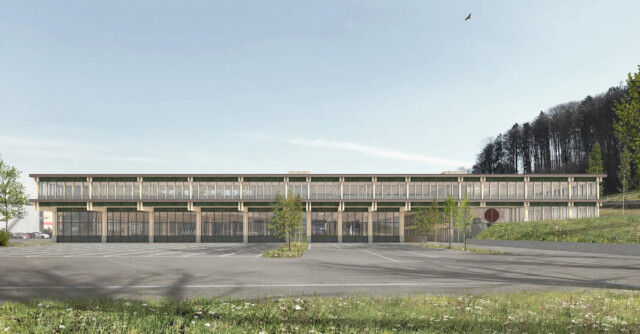
    The decision was made in favor of a new building. All three locations will be closed and the approximately 400 employees brought together in a single location. The new building on the Buechlimatt in Münchenbuchsee offers space for offices, test centers and the entire customer operations on one site. Vehicle registrations, driving tests, administrative processes: everything under one roof for the first time in decades.

    One competition, one winner, one timber construction
    in 2021, the canton announced an open project competition. Thirty teams submitted designs, and the Zurich planning team from Studiomori Architektur and KNTXT Architekten won over the jury. Their project bears the programmatic name “One for all”. It is based on a low-maintenance timber construction that blends organically into the rural outskirts of Münchenbuchsee. Not a statement made of concrete and glass, but a building that makes the Canton of Bern’s climate strategy visible. Wood as a building material reduces the CO2 balance over the entire life cycle.

    The politicians decide
    In April 2026, the Bernese government applied to the Grand Council for a commitment credit of 132.9 million francs. The latter is expected to make its decision in autumn 2026. The fact that the amount has risen from around CHF 104 million at the time to CHF 132.9 million since the 2021 competition phase is likely to raise questions in parliament. Construction costs and increased planning requirements are the main reasons. If you offset the rental costs and the renovation backlog, the business case for the new building is clear.

    Move in 2031 at the earliest
    If the parliamentary deliberations go according to plan, the building application will be submitted in mid-2026 and construction will begin in 2028, with commissioning planned for 2030 to 2031. For Münchenbuchsee, this means a new workplace center with several hundred employees on the edge of the village. For the canton of Bern, it means the end of a long period of administrative restructuring. And for the Swiss construction industry, the project exemplifies a trend that will gain momentum in 2026. Public buildings made of wood, built for the next generation.

  • Rethinking building, Freiburg is looking for pioneers

    Rethinking building, Freiburg is looking for pioneers

    From 2029, new limits for greenhouse gas emissions and requirements for gray energy in the construction industry will apply in Switzerland. Defined by the revision of the cantons’ model regulations in the energy sector. The pressure on the construction industry is growing. Those who do not invest in new processes and materials today risk expensive adjustments under time pressure tomorrow. The canton of Fribourg has recognized this and is acting with foresight. As early as 2023, it adopted a roadmap for the circular economy that prioritizes structural changes in the construction industry.

    Innovation along the entire value chain
    The theme of this year’s call is “Rethinking construction, towards circular and environmentally friendly systems”. We are looking for projects that reduce the ecological footprint of buildings right from the planning phase, through local bio-based materials, deconstructable construction systems or digital tools for material tracking. The Swiss Charter for Circular Construction, which is supported by twelve leading organizations from the construction and real estate industry, clearly formulates the goal: “By 2030, the proportion of non-renewable primary raw materials should fall to 50 percent of the total mass.”

    Collaboration as a prerequisite
    Lone wolves have no chance here. Each project submitted must involve at least three companies, the majority of which must be based in the canton of Fribourg. Academic partners such as the School of Engineering and Architecture HTA-FR can be involved to ensure knowledge transfer and reproducibility of the solutions. Nicolas Huet from INNOSQUARE emphasizes that the challenges of circularity must be overcome and that innovation must take place jointly.

    Funding with personal responsibility
    The NRP funding covers a maximum of 65% of the total budget, the rest is covered by the participating companies, 10% in cash and 25% as personal contributions. This structure is not an obstacle, it is the program. It ensures that only projects that the companies really support are submitted. Alain Lunghi, Deputy Director of the WIF, sees foresight as the key to the competitiveness of Fribourg companies.

    Submit now
    Projects can be submitted individually or as part of a consortium via www.promfr.ch/de/nrp. The call is supported by the Economic Development Agency WIF, the Fribourg Chamber of Commerce and Industry, the HTA-FR and the INNOSQUARE innovation platform. The deadline is September 9, 2026. Anyone who sees the construction turnaround as an opportunity still has time to act.

  • 47 million for a new heart in the Bernese Oberland

    47 million for a new heart in the Bernese Oberland

    The overall project will cost 47 million francs. Financing is being provided by a newly established site development company in which four partners are participating. The city of Thun is granting a mortgage-backed, interest-free loan of 16 million francs and is also guaranteeing a cantonal loan of 10 million francs as part of the new regional policy. Empa itself is investing CHF 16 million in laboratories and a technical center, while Halter AG is contributing CHF 5 million as a development partner. Once the project is completed, the company will be transferred to investors.

    Building permit is available
    The way was not clear. Objections delayed the process by around a year. The building permit for construction site B5 in Thun North has now been granted, with construction set to begin in spring 2027 and completion scheduled for the end of 2029. The city parliament will decide on the loan on 30 April 2026. A clear yes is needed to keep to the schedule.

    Empa in Thun since 1994
    The Swiss Federal Laboratories for Materials Science and Technology has been conducting research in the field of high technology and materials in Thun since 1994. The new building is not a relocation, but an expansion. Mayor Raphael Lanz puts it in a nutshell. Empa secures highly qualified jobs in research and development in the long term, generates regional added value and strengthens Thun as a location for technology and innovation in the Canton of Bern.

    From barracks site to urban quarter
    Thun North is the largest urban development project in the Bernese Oberland. On the 60-hectare site, research companies, businesses and housing are replacing military use. in the long term, 6,500 jobs are to be created; around 2,300 are already located there today. A new Thun Nord S-Bahn stop is included in the federal parliament’s 2035 expansion plan and will connect the district directly to long-distance transport.

    Halter as a lever
    It is no coincidence that Halter AG is contributing CHF 5 million to the project as a development partner for construction site B5. The company won the project competition in 2022 together with Bauart Architekten and Balliana Schubert Landschaftsarchitekten. The composition shows the concept. Private capital and the public sector are pulling together, and the location is sharing the risk because it is thinking about the return.

    What counts now
    April 30 is the date that decides everything. If the city parliament approves the loan, planning gets underway. If the loan fails, the entire timetable is thrown into disarray. This would be a setback for Thun North and a location issue for Empa. The city has already paid its share of the bill. Now it’s up to parliament.

  • New production facility strengthens international industrial location

    New production facility strengthens international industrial location

    The new global Toblerone competence center in Bern now covers 90 percent of global demand for the iconic triangular chocolate. Guy Parmelin officially inaugurated the expanded plant on March 10. “We are incredibly proud of the new Toblerone production line and the modernization of logistics and infrastructure,” said plant manager Thomas Kauffmann in a press release.

    Mondelēz International, the Chicago-based parent company of Bern-based Mondelez Schweiz Production GmbH and Mondelez Schweiz GmbH in Opfikon, has invested 65 million Swiss francs in the installation of this new, state-of-the-art production line. This is one of the largest investments in the company’s chocolate production network in the past ten years.

    “If there is one product that represents Switzerland worldwide, it is chocolate,” said Parmelin in his speech, according to the press release. “And Toblerone has a very special place among Swiss chocolates.” It is “a symbol of Swiss identity and quality par excellence. Identity and quality. As President of the Swiss Confederation and Minister of Economic Affairs, I am therefore particularly pleased that around 90 percent of Toblerone production will continue to be made here in Bern on this new production line.”

    Toblerone is exported from Switzerland to more than 120 countries around the world. As Mondelēz emphasizes, the iconic 118-year-old brand is well positioned to grow globally in the premium segment, benefiting from its high brand awareness and leadership position in the World Travel Retail business. “We have always been proud to manufacture here in Switzerland,” said Iain Livingston, President for Toblerone and World Travel Retail. “The investment underlines our strong commitment to the site and is a key milestone on our journey to lead global growth in the premium chocolate segment.”

  • Tour Invictus new face for Fribourg

    Tour Invictus new face for Fribourg

    The Tour Invictus marks a turning point in Fribourg’s urban development. It increases the density of living space upwards instead of continuing to grow outwards. The project is a response to scarce land, changing household structures and an ageing population.

    At the same time, the tower raises the question of identity. How much “high-rise” can a medium-sized Swiss city tolerate? The building will be visible from the city and from afar. It will thus become a symbol of a new phase of urban development that rebalances density, mobility and quality of life.

    New forms of housing instead of classic perimeter blocks
    The mix of uses is clearly geared towards housing, but is finely graduated internally. On the lower floors, there will be apartments suitable for the elderly with assisted living facilities. On the upper floors are privately financed condominiums with expansive views and a high quality of living.

    This vertical mix replaces the classic perimeter block with separate buildings for different target groups. It brings people with different lifestyles together in the same building. For operators, owners and urban planners, this opens up new options for services, neighborhood connections and community building.

    Creating quality of stay
    A tower of this height always provokes the same question. Will density become a burden or a quality? The decisive factor is the design of the transitions. The street level, first floor and surroundings must maintain the scale for pedestrians. Green outdoor spaces, a clear address and legible entrances determine whether the tower is perceived as a foreign body or as a natural part of the neighborhood.

    What counts inside is the sense of spaciousness. Daylight, room heights, private outdoor spaces and views are the counterbalance to the large number of units. Where open spaces are deliberately moved indoors, for example with communal rooms, roof terraces or usable arcades, identification is created instead of anonymity.

    Opportunities for the city
    For the city of Fribourg, the Tour Invictus is both an opportunity and a test case. It shows how investors, planners and authorities deal with densification targets. The handling of traffic, development, shading and the neighborhood will be closely monitored. If the project is successful, it will strengthen the acceptance of further vertical densification.

    At the same time, the area of tension remains visible. A high-rise triggers discussions about the skyline, character and social mix. Managers in administration and the real estate industry are called upon to actively moderate this debate. Clear narratives are needed as to why density does not mean sacrifice, but rather enables new forms of urbanity.

  • Canton of Jura updates list of industrial sites suitable for redevelopment

    Canton of Jura updates list of industrial sites suitable for redevelopment

    The canton of Jura is committed to revitalising its industrial wastelands. As part of theSwissRenovproject, it has now updated the cantonal register of industrial wastelands suitable for redevelopment, according to a press release. This first step is intended to provide up-to-date and reliable information to companies and investors who are looking for commercial space or are interested in the redevelopment and modernisation of industrial facilities.

    In the first phase of the project in 2019, around 90 industrial brownfield sites were identified, of which around half have been redeveloped to date. Now, 30 more brownfield sites are being added. The updated map, which can be viewed online, currently lists 70 industrial sites. 60 per cent of these are located in the district of Porrentruy, 36 per cent in the district of Delèmont and the rest in the districts of Franches-Montagnes and Moutier. In the current phase, the SwissRenov project in Jura is scheduled for completion by 2028.

    The SwissRenov project is being led by Haute École Arc in collaboration with the cantonal spatial planning departmentand is being driven forward byCreapole SAin Delèmont. It is supported by the Swiss Confederation through theInnosuisse flagship programme and byCleantechAlps, the cleantech promoter for French-speaking Switzerland.

    According to the press release, this project, which is unique in Switzerland, aims to promote the renovation and refurbishment of industrial buildings in line with the principles of the circular economy.

  • Renovation combines functionality, comfort and alpine location

    Renovation combines functionality, comfort and alpine location

    Heller Gastro AG will open its newly renovated and converted Eiger Lodge Grindelwald on 19 December 2025. The work centred on the renovation of the Eiger Lodge “Easy”, the older of the two buildings that form part of the Eiger Lodge. It was modernised between April and December. According to a press release, the investment volume totalled 4.5 million Swiss francs. The two hotel sections “Easy” and “Chic”, located directly beneath the north face of the Eiger, offer a total of 220 beds.

    according to the statement, 70 per cent of the order volume was carried out with local companies, while the remaining 30 per cent was carried out with companies from Bern and the Bernese Oberland. The new breakfast area now offers more space and large window fronts with mountain views. New kitchen facilities are intended to simplify processes behind the scenes. The reception and entrance area has also been completely refurbished. A sauna has been installed on the upper floor. An adjoining terrace is still under construction. The communal showers, which are part of the “Easy” multi-bed, double and family rooms, have also been completely renovated.

    The hotel has been the base for numerous mountain enthusiasts since the 1990s under the name Mountain Hostel. in 2015, it was taken over by Heller Gastro and renamed the Eiger Lodge. The company also operates the Eiger Mountain & Soul Resort Grindelwald on site.

  • Railroad modernization in the sensitive Alpine region

    Railroad modernization in the sensitive Alpine region

    STRABAG AG is carrying out the outstanding renovation work on the Zentralbahn line between Meiringen and Brienzwiler in the Bernese Oberland. The narrow-gauge line runs on a single track along the Hasliaare, which is part of the Aare flood plain. Out of consideration for several nature conservation areas, “maximum precision for logistics and coordination” is required for the new construction, according to a press release. Preparatory work began in March 2025 and the ten-week intensive phase has been underway since October 2025.

    Heavy rainfall events had repeatedly occurred in the area, causing the railroad embankment and superstructure to flood, resulting in damage to the railroad infrastructure and adjacent cultivated land. STRABAG already carried out track construction work there in 2022 and 2023 (lots 1 and 3). The modernization project will now be completed with a total reconstruction of the challenging middle section of lot 2 over a length of 2600 meters and in the middle of the Sytenwald nature reserve. This involves raising the railroad embankment. To allow surface and slope water to drain away, a continuous planned drainage system will be installed along the route. The area along the Hasliaare will receive a new flood protection wall.

    According to the press release, the “tight space conditions and local lack of redundant construction slopes in certain sections between the Hasliaare, the railroad line and several nature conservation areas” are a special construction feature, which requires special precautions for ecology and landscape protection. On the one hand, STRABAG is building 30 new foundations for the catenary masts on the side facing away from the river, and on the other, 37 crossings are to ensure the ecological continuity of the terrain. This means protection for wildlife and small animals when crossing the section.

    A particularly challenging component is the new construction of the Hüsenbach bridge made of ultra-high-strength and durable fiber-reinforced concrete (UHPC). During bridge construction, special consideration was given to the trout population present there at spawning time.

  • Modern logistics construction focuses on efficiency and sustainability

    Modern logistics construction focuses on efficiency and sustainability

    Transstahl AG, which belongs to Pestalozzi, is to be able to transport long and bulky goods even more efficiently and flexibly throughout Switzerland in future. The Pestalozzi Group is therefore building a new logistics center in Pieterlen, for which the ground-breaking ceremony has now been held, according to a press release. In addition to representatives from Pestalozzi and Transstahl, Beat Rüfli, Mayor of Pieterlen, and Simon Enderli, Head of Location Promotion for the Canton of Bern, as well as other guests also took part in the ceremony.

    The logistics center will be 100 meters long, 30 meters wide and 12 meters high. An energy-efficient heating system is planned, as well as a photovoltaic system and charging stations for electric trucks and cars. A large proportion of the materials used come from the Pestalozzi Group, which specializes in steel technology and building services.

    “With this ground-breaking ceremony, we are investing in the development of our group of companies and making a clear commitment to Switzerland as a business location and to working in partnership with municipalities and regions,” Matthias Pestalozzi is quoted as saying in the press release. He is the owner and Delegate of the Board of Directors of the Pestalozzi Group.

  • Double use of space increases solar power production

    Double use of space increases solar power production

    According to a press release, ARA Thunersee has inaugurated HORIZON, the largest movable solar folding roof in the world. It was realized by the cleantech company dhp Technology from Zizers. With an installed capacity of 3.6 megawatts peak and around 3 gigawatt hours of electricity, the system will supply 700 households.

    According to ARA Thunersee, the more than 20,000 square meter plant is based on technology from dhp Technology. dhp CEO Gian Andri Diem sees great potential in generating energy on existing areas. “This is how we create progress without taking up additional space,” he is quoted as saying.

    According to dhp’s project description, efficient use of space is relevant in order to make progress with the energy transition through photovoltaics. Wastewater treatment plants, logistics areas, waterworks and parking areas are particularly suitable for solar power production due to their previously unused areas. According to Ingo Schoppe, Managing Director of ARA Thunersee, “intelligent land use makes an active contribution to security of supply, economic efficiency and climate protection”.

    The solar folding roof spans several clarifiers and makes double use of existing infrastructure areas – for wastewater treatment on the ground and for solar power generation above. The electricity generated there is intended for wastewater treatment and local supply.

    Based on Swiss cable car technology, the roof is able to react to extreme weather conditions. It folds up automatically in the event of storms, snow or hail. This allows operational safety and energy production to be achieved without having to intervene in ongoing processes.

  • New impetus for the Schwarzbubenland region

    New impetus for the Schwarzbubenland region

    The Forum Schwarzbubenland has appointed a new location promotion officer for the districts of Dorneck and Thierstein. According to the association, it has entrusted National Councillor Christian Imark with the mandate. The aim is to better meet the needs of a dynamic economic situation.

    On the one hand, the location promoter should help to attract new companies in order to strengthen the economic base. On the other hand, he is to support local companies in overcoming current challenges and achieving growth. Finally, Imark is to intensify cooperation between business, education and politics.

    “As an experienced personality from politics and business, Christian Imark brings with him the ideal tools to make our region better known, position it successfully and provide new impetus,” Dieter Künzli, President of Forum Schwarzbubenland, is quoted as saying in the press release.

    Christian Imark (born 1982) has been a member of the National Council for the Swiss People’s Party (SVP) since 2015. He is also the owner of Airboxx GmbH, a company based in Fehren SO that specializes in the rental of marquees. The location promotion mandate comprises a 30 percent workload.

    Imark replaces Karoline Sutter, who took over location promotion in 2022. At that time, the mandate still consisted of the location promotion of Schwarzbubenland and the neighboring Baselbieter Laufental. Sutter took over the mandate together with Rita Stoffel-Meury.

  • New building strengthens Solothurn cantonal police force

    New building strengthens Solothurn cantonal police force

    The tasks of the police have become more diverse. Technology and society are changing rapidly. Legal requirements are becoming increasingly complex. KAPO Solothurn needs new structures to be able to react to this. Well-trained employees and ongoing training are more important than ever. Sufficient equipment is also a basic requirement for efficient work today.

    Lack of space, outdated infrastructure
    The existing infrastructure no longer meets current requirements. Many services work in cramped and unsuitable rented premises. There is a lack of special rooms for training and modern investigations. Forensics and the education and training service are particularly affected. Employees therefore have to move to external premises. This complicates processes and costs time.

    The new building as a solution
    A central unit for the police is being built at the Oensingen site. More than 150 employees from eleven different services will work under one roof in future. This will create better communication and shorter distances. Cooperation with the nearby heavy traffic control center will also be simplified. The new building offers enough space for current and future teams. Modern working and training conditions ensure greater efficiency and motivation.

    The focus is on training and quality
    A new on-site training center simplifies the training of police officers. Forensic technology will have modern laboratories and examination rooms. This increases the quality of work and improves conditions for everyone.

    More efficiency, lower costs

    The new structures will simplify processes and reduce costs. The internal synergies and proximity to the SVKZ lead to shorter deployment times. This makes the jobs for the police more attractive and increases their effectiveness.

    Facts, figures and outlook
    The building is planned to cost around 85 million francs. The floor space amounts to a good 10,400 m². The building offers rooms for all important police services. It has special training areas, laboratories and 204 parking spaces. Completion and occupation are scheduled for 2031. Luna Productions from Deitingen delivered the winning project in the competition. The costs are constantly being reviewed and optimized.

    The new building will position the Solothurn cantonal police for the future. Better working conditions, more efficient processes and modern technology will ensure that police work can continue to develop flexibly.

  • Discussion about security of supply and dependence on nuclear power

    Discussion about security of supply and dependence on nuclear power

    The Gösgen nuclear power plant(KKG) is modernizing its feed water system. It has therefore been off the grid since the end of June. The resumption of electricity production has now been delayed by a further six months, according to a statement.

    KKG blames this on the increasing safety requirements. The system needs to be strengthened at certain points. It also needs more time to provide evidence to the authorities. The KKG can only be restarted once the Swiss Federal Nuclear Safety Inspectorate(ENSI) has given its approval. The KKG is therefore expected to be able to return to the grid at the end of February 2026, according to the press release.

    The operators expect a loss of production during these eight months amounting to almost 6 terawatt hours and a loss of revenue of 500 million Swiss francs, Alpiq writes in a press release.

    Alpiq is the largest single shareholder with 40 percent and expects a loss of earnings of CHF 200 million. Axpo is the second-largest shareholder with 25 percent, followed by the city of Zurich with 15 percent, Axpo subsidiary CKW with 12.5 percent and Energie Wasser Bern(ewb) with 7.5 percent. On top of this, the shareholders must now procure the missing electricity on the free market in order to meet their supply obligations.

    KKG covers a good tenth of Switzerland’s electricity consumption. Critics of nuclear power such as the Swiss Energy Foundation SES point out the risks of centralized power generation. “Dependence on individual nuclear power plants represents a cluster risk for the secure supply of electricity,” Managing Director Nils Epprecht is quoted as saying in an SES press release. “We would do well to shift our electricity production to many decentralized, renewable plants as quickly as possible.”

  • Fribourg.swiss brand strengthens international position

    Fribourg.swiss brand strengthens international position

    The canton of Fribourg is sharpening its profile in global competition. With fribourg.swiss, the economic development agency is focusing on a clearer and internationally recognisable brand. The new platform is aimed specifically at companies, investors and innovation players in Switzerland and abroad. Thanks to the official domain extension “.swiss”, the affiliation to Swiss quality standards is emphasised in a compact, accessible and strong brand.

    Making excellence visible
    “fribourg.swiss is our strategic showcase to the outside world,” says WIF Director Jerry Krattiger. The focus is on companies, educational and research institutions as well as centres of excellence that shape the economy of the canton of Fribourg. Topics such as the bioeconomy, Industry 4.0, life sciences and technology transfer demonstrate the diversity and future viability of the location.

    Multi-channel communication for maximum reach
    The new brand is already active on all external channels, from the website to newsletters and international LinkedIn activities. The content is distributed worldwide via embassies, consulates and specialist networks. At the same time, the new brand identity also strengthens the internal perception of the economic strengths and creates a shared awareness within the canton.

    Visibility and identification
    With fribourg.swiss, the canton of Fribourg is opening a new chapter in location marketing. One that focuses on digital clarity, international reach and regional anchoring. The canton’s economic dynamism is thus becoming more visible and more widely recognised, both within and outside Switzerland.

  • New brochures promote the use of Bernese wood

    New brochures promote the use of Bernese wood

    The cantonal platform of the Bernese forestry and timber industry, Lignum Holzwirtschaft Bern, aims to promote awareness of the forest and encourage demand for local timber. To enable authorities and administrations to use forests sustainably, the association of Bernese forest owners, the Bernese Sawmill Association, the Swiss Timber Construction Section Bern and Bernese Oberland, the Master Carpenters’ Association Bern and Bernese Oberland and Holzenergie Canton Bern has published a series of brochures entitled “Forest and Wood Compass”. The practical documents were compiled with the support of the Wyss Academy for Nature, Lignum Holzwirtschaft Bern explains in a press release.

    The “Forest and Wood Compass” series is divided into an overview brochure and three topic-specific brochures. The overview brochure is entitled “Forest and Wood Compass for Bernese Regions”. The three topic-specific brochures deal with regional wood in public buildings, efficient forestry structures and financial incentives to secure certain forest services. All brochures can be downloaded at lignumbern.ch/wald-holz-kompass/.

    The mandate for Lignum Holzwirtschaft Bern is managed by Volkswirtschaft Berner Oberland.

  • Monument protection and technology in harmony

    Monument protection and technology in harmony

    According to a press release, the Schlieren-based construction company STRABAG AG and its building construction department are taking on “central tasks in the comprehensive renovation of the Landhaus Solothurn”. In addition to measures to modernize the building’s technical infrastructure, including plumbing, ventilation, lighting and stage technology, the focus is on modernizing the heating system.

    This will be converted to resource-saving energy generation by means of a heat pump. Water from the River Aare will be used as a heat source to supply both the Landhaus and adjacent public buildings such as the youth hostel, Kollegium school and municipal theater.

    The location between the old town and the River Aare requires logistical attention. Material deliveries and waste disposal had to take place in the morning so that the riverside promenade could be used as a promenade from midday.

    It was also necessary to take into account the stringent requirements of monument protection. The listed country house is like a “winding architectural work of art with six levels, each with its own renovation requirements”. The approach required “sensitivity” in order to preserve the historical character and the fabric of the building. In particular, the original Solothurn limestone staircases are to be preserved in their uniqueness, it is said. Special protective devices have been created for this purpose.

    Solothurn voters approved the renovation in October 2023. Construction work has been underway since January 2025. Construction is scheduled to end in October 2026. In January, construction site operations will be suspended in consideration of the Solothurn Film Festival 2026.

  • Campus in Biel/Bienne celebrates laying of foundation stone

    Campus in Biel/Bienne celebrates laying of foundation stone

    On 6 May, the foundation stone was laid for the new Biel/Bienne campus of Bern University of Applied Sciences on the former Feldschlösschen site near Biel railway station. An education and research centre for around 2,350 students and lecturers is to be built here by 2028, the Canton of Bern ‘s Department of Construction and Transport announced in a press release. Together with the federal government and a private partner, the Canton of Bern is raising around CHF 400 million for the construction of the new campus.

    The Bern University of Applied Sciences will unite its Departments of Engineering and Information Technology as well as Architecture, Wood and Construction at the Biel/Bienne campus. According to the press release, the open architecture of the new site will promote interdisciplinary exchange and creative collaboration. The campus is designed as a cloverleaf of three building wings around a common centre.

    “An inspiring environment is being created here that focuses on openness, interdisciplinarity and high standards of infrastructure and quality,” said Cantonal Councillor Christoph Neuhaus, Director of Construction and Transport of the Canton of Bern, in the press release. “The new campus is being built as a modern timber construction – a project that stands for sustainable, climate-friendly construction.” Glenda Gonzalez Bassi, Mayor of Biel/Bienne, sees the future campus “as a central location for the development of our region, for the education of our young generation and for attracting the talent that our economy needs now more than ever.”

  • Freiburg defies global uncertainties

    Freiburg defies global uncertainties

    Despite global turbulence, increased protectionism and new tariffs imposed by the US government, Fribourg’s economy is holding its own with impressive stability. The Economic Development Agency of the Canton of Fribourg supported a total of 32 business projects in 2024, including 16 new relocations. These projects secure over 1,000 jobs and create 527 new jobs in the medium term, combined with investments of CHF 116 million.

    Employment growth in the canton is now outstripping population growth. Fribourg’s gross domestic product rose by 27.5 % between 2011 and 2024. A clear sign of sustainable value creation despite global uncertainties.

    Successful location development and investments
    The new settlements are equally divided between Swiss and international companies, including those from Belgium, Brazil, Germany, France, Ireland, Italy and the USA. At the same time, the new cantonal implementation program 2024-2027 of the new regional policy was launched, which sets strategic priorities in the bioeconomy, digital transformation, Industry 4.0, tourism and entrepreneurship with 19 funded projects.

    For Olivier Curty, State Councillor and Director of Economic Affairs, these results underline the relevance of a consistently pursued economic strategy that strengthens Fribourg as a business location even in challenging times.

    bluefactory and EPFL as engines of growth
    The bluefactory innovation quarter is developing rapidly. With the inauguration of Building B and its almost complete occupancy by 17 companies and 340 workplaces, Fribourg is being further strengthened as a technology hub. At the same time, EPFL is expanding its commitment – six new chairs in the field of sustainable construction are to be created by 2030. Construction of the new Smart Living Lab experimental building is scheduled to begin in 2025.
    This dynamic consolidates Fribourg’s position in the field of the built environment and underlines the canton’s commitment to sustainability and innovation.

    Strategic successes in the life sciences sector
    A milestone in 2024 was the establishment of Cellap Laboratoire AG in Châtel-Saint-Denis. With more than 4000 m² of production space and ambitious growth targets in international markets, the company is providing new impetus in the cell cosmetics sector. The life sciences are becoming the mainstay of Fribourg’s economy and already account for 10% of the canton’s GDP – a result confirmed by a study by BAK Economics.

    Jerry Krattiger, Director of the WIF, emphasizes that the bioeconomy and life sciences remain strategic priorities. At the same time, other key areas such as Industry 4.0 are being actively promoted in order to further expand the canton’s economic diversity and resilience.

    Vigilance and adaptability as success factors
    The Department of Economic Affairs and Vocational Education and Training remains vigilant in the face of global uncertainties. With proven instruments such as short-time work compensation, Fribourg is able to react quickly to economic fluctuations and ensure the stability of the economic structure.

  • Historical technology meets modern research

    Historical technology meets modern research

    Researchers from the Mechanical Systems Engineering department of the Swiss Federal Laboratories for Materials Science and Technology (Empa) in Dübendorf have been involved in the construction of a water pumping wheel in Steffisburg. According to a press release, the construction became necessary after the Zulg was lowered by two meters to protect the village from flooding. The Mühlebach stream, which had supplied Steffisburg’s businesses with water energy for centuries, was in danger of drying up, as was the surrounding ecosystem.

    The challenge was to adapt the plant to the requirements near Steffisburg. “With a minimum Zulg outflow of one cubic meter per second, it must feed at least 125 liters of water into the Mühlebach,” Silvain Michel, project manager at Empa, is quoted as saying in the press release, “and even with lower inflows, at least 100 liters per second must still be pumped in order to preserve the biotopes.”

    The model for the water pumping system was the pumping wheel developed by Walter Zuppinger in 1849. The water wheel, whose efficiency was scientifically confirmed in extensive tests in 2016, has already been used in the Glattfelden project installed by Empa.

    In the current project in Steffisburg, the water wheel was modified again and fitted with a separate drive wheel. In addition to Empa, the EKZ design office in Thun and CFD-Schuck GmbH were involved in the technical implementation.

  • Tourism forum sheds light on changes in hospitality

    Tourism forum sheds light on changes in hospitality

    This year’s Bernese Oberland Tourism Forum was held under the motto “Hospitality in transition”, the Bernese Oberland economy announced in a press release. It organized the industry event on 2 April at the Thun Culture and Convention Centre together with the Bernese Oberland Hoteliers Association and Made in Bern AG. Around 150 participants, mainly from the tourism and hotel industry, discussed theoretical and practical issues relating to hospitality.

    In the theoretical part, Adrian Müller from the Tourism Research Center at the University of Bern presented the project Monitoring and Strengthening the Quality of Interaction in Swiss Tourism. Here, artificial intelligence is used to analyze the quality of interactions between guests and hosts. Specifically, content, moods and topics in posts on review portals are to be recognized and evaluated using natural language recognition.

    In the more practical part, David Romanto from Hauenstein Hotels presented the hotel group’s approach to the topic. For the General Manager of the hotels, hospitality is a competence that needs to be trained. Alice Leu from the Thun College of Tourism explained the extent to which this also includes the teaching of cultural skills.

    The panel discussion at the forum dealt with the involvement of the population. It was shown “that a differentiated approach to this topic is necessary and that the concerns and fears of the local population with regard to tourism development must be taken seriously”, according to the press release.

  • Heat from a depth of 2000 meters planned

    Heat from a depth of 2000 meters planned

    The Federal Office for Buildings and Logistics (BBL) has announced an exploratory borehole for a planned geothermal project in Magglingen. Provided the necessary credit approval from the Federal Assembly and drilling permits from the cantonal authorities are obtained, deep water should be detected at a depth of around 1,500 to 2,300 meters.

    According to a press release, “several potential deep water reservoirs” are suspected there, which are to be used for a geothermal plant at the Magglingen National Sports Center of the Federal Office of Sport (FOSPO). The plant could supply heat there from 2029.

    This was preceded by underground investigations in 2023 by the FOBL. These were intended to help obtain a “geological image of the subsoil that is as precise as possible”. The exploration step that has now been announced is intended to further clarify whether the deep water is suitable for the economic use of a geothermal plant in the event of positive evidence.

    Seismic investigations are the basis of many geothermal projects to clarify the exact location of the deep water and because key figures such as water temperature, water volume and flow rate are lacking. The planned exploratory drilling reduces uncertainties and project risks.

  • Real estate monitor creates market transparency in the canton of Fribourg

    Real estate monitor creates market transparency in the canton of Fribourg

    The Fribourg Real Estate Monitor is a pioneering example of how data-based analyses can make the rental housing market more transparent and controllable. In the cities of Fribourg, Bulle and Estavayer, the new monitoring system provides detailed insights into availability, rental price trends and fluctuation rates for the first time. Differentiated by apartment type and neighborhood.

    The monitor was developed by the Fribourg School of Business, which guarantees an independent scientific basis. The result is a tool that investors, planning authorities, location promoters and real estate developers alike can use to make well-founded decisions.

    Partnership for data quality
    The strength of the Real Estate Monitor lies in its public-private sponsorship. 18 players in the regional real estate industry have joined forces under the motto “More knowledge, better action”. This cooperation makes it possible to collect market data directly from letting practice. A novelty in this level of detail.

    The results are updated quarterly and made publicly available. Their flexible preparation allows for individual analyses for a wide range of user groups. This approach not only creates transparency, but also promotes trust, location development and future-oriented investments.

    Recognizing the changing housing market
    Since the second quarter of 2022, the monitor has shown a decline in the availability of rental apartments in all three pilot regions. Differences depending on apartment size and neighborhood are particularly striking. While smaller apartments are still relatively readily available in Fribourg, the situation is tighter for larger properties, particularly in the Schönberg district. In Bulle, on the other hand, rents for larger apartments are higher than in Fribourg, accompanied by higher fluctuation rates.

    This detailed depth of data makes it possible not only to track current developments, but also to identify future trends at an early stage. A decisive advantage for players operating in a changing market.

    Model for Switzerland
    With the support of the Federal Office for Housing, the project shows how regional markets can be analyzed on the basis of data and made transparent. A guideline based on the project is already available and offers other regions a structured template for imitation.

    The Fribourg Real Estate Monitor is therefore more than just a technical tool; it is a strategic instrument for sustainable location development and professional real estate management in Switzerland.

  • Automated production for sustainable energy use

    Automated production for sustainable energy use

    Libattion AG, based in Opfikon, has opened a new plant in Biberist for processing used batteries from electric cars. Here, the batteries are used to produce modular stationary energy storage units. According to the company, this is Europe’s largest plant of its kind. The production facility was set up on the site also used by battery recycling company Librec.

    The new facility has a high degree of automation. “Our new production hall enables us to respond flexibly to market requirements and make an important contribution to conserving resources in Europe,” said Stefan Bahamonde, CEO and co-founder of Libattion, in the press release. “By automating our production, we can not only operate efficiently, but also economically and adapt our capacities precisely to demand.”

    In 2022, Libattion produced stationary storage systems with a total capacity of 7 megawatt hours; last year, the company already achieved a total capacity of 27 megawatt hours. The company aims to increase its total capacity to 500 megawatt hours by 2026. Libattion’s storage systems have a modular design and can have capacities ranging from 97 kilowatt hours to 60 megawatt hours. Safety is the top priority, explains Bahamonde: “Thanks to automated production and strict quality controls, we can guarantee the highest safety standards for every storage system”.

  • Bern-Wabern heating network promotes energy transition and CO2 reduction

    Bern-Wabern heating network promotes energy transition and CO2 reduction

    The energy company Energie Wasser Bern(ewb) and the municipality of Köniz want to make a contribution to reducing CO2 emissions and achieving the climate policy goals of Köniz and Bern with the Bern-Wabern energy network, according to a press release.

    The ewb Board of Directors decided to build the Bern-Wabern heating network on March 7, 2025, based on the “great interest” of the population as determined by a survey. Construction of the production facilities is scheduled to start in 2027. The first heat supply is expected from 2028.

    Specifically, the heat production concept envisages using the energy from surplus water from the Schönau pumping station for thermal use. The production facilities will be installed in the existing heating center of the Morillon residential complex on Bondelistrasse.

    With the cooperation agreement that has now been signed, the heating and cooling supply in Wabern will be the responsibility of ewb, which is also responsible for the operational and financial responsibility for the construction.

    The heating network could help to promote the energy transition and climate protection. The sustainable energy project will create a replacement for many oil and gas heating systems in Wabern and the neighboring districts of Bern. “In densely built-up areas, a heating network is often the only solution for heating buildings with renewable energy in a CO2-free and economical way,” says Hansueli Pestalozzi, a local councillor in Köniz.

  • Company from Rapperswil BE wins prestigious business award

    Company from Rapperswil BE wins prestigious business award

    Gasser Ceramic has won this year’s Prix SVC Espace Mittelland. The family-run company based in Rapperswil in the Bernese Seeland produces tiles for roofs and façades as well as bricks and photovoltaic systems integrated into roof tiles. With around 200 employees, ten production lines and six kilns at four locations, the winning company is one of the leading Swiss companies in this sector, according to a statement from the Swiss Venture Club(SVC).

    “Nobody can get past Gassers,” jury president Jürg Schwarzenbach is quoted as saying in a statement from his laudatory speech. “During the jury’s visit, we felt the enthusiasm for the products and the pride of the employees in working for this traditional company.”

    Platit AG from Selzach followed in second place. The company manufactures high-tech systems for PVD coating. Its machines are used to emboss five-figure coins and gold medals and to coat the hinges and dials of luxury watches. Over 650 Platit coating systems are installed worldwide. The company also has branches in Europe, America and Asia.

    Third place went to Schwob AG from Burgdorf. The long-established company develops and manufactures high-quality table and bed linen for hotels, restaurants, clinics and residences with around 240 employees in its own Jacquard weaving mill. Schwob has five of its own laundries and 30 local partner laundries for cleaning. Schwob exports to facilities around the globe. Megasol Energie from Deitingen SO, a developer of solar modules and assembly systems, and Olwo, a production, trading and service company in the timber industry from Worb BE, were honoured with a diploma.

    The award ceremony took place in front of 1,300 guests in the Kursaal Bern. “The Prix SVC is far more than just an award,” said Reto Portmann, President of the SVC organising committee. “This prestigious event symbolises entrepreneurial spirit, innovative strength and the courage it takes to be successful in our dynamic and competitive world.”

  • Bernapark strengthens support for SMEs

    Bernapark strengthens support for SMEs

    The Centre for Innovation and Digitalisation (ZID) at ZID Bernapark AG is repositioning itself. Originally founded as a catalyst for early-stage start-ups, the centre’s scope of action will in future include SMEs and start-ups at all stages, the ZID announced in a press release. “The new strategy is an important step for the ZID”, Hans-Ulrich Müller, Chairman of the Board of Directors of ZID Bernapark AG, is quoted as saying. “It creates the basis for sustainable growth and strengthens our position as an innovation hub for SMEs in Espace Mittelland.”

    The ZID’s programmes are designed to offer practical solutions for current challenges in companies. In terms of content, the focus is on artificial intelligence, digital transformation and succession planning. In the first step of the transformation, the two formats KMU Update and KMU Upgrade will be introduced. KMU Update offers free networking formats such as skill share lunches and input workshops. KMU Upgrade is designed as a fee-based format for specific realisations.

    At the beginning of the year, the Swiss Venture Club also relocated its office to the ZID. The ZID is thus “expanding access to one of the largest SME networks in Switzerland”, according to the press release. “We are creating a platform that not only connects SMEs and start-ups, but also provides them with concrete tools for digital transformation,” explains Martin Hofer, Interim Managing Director of the ZID. “Our programmes are designed to implement innovations in a practical and efficient manner.”

  • Your opinion counts! – Creating living space together

    Your opinion counts! – Creating living space together

    One of the measures “B 2.1” aims to increase the level of knowledge about the prevalence and nature of objections and their effect on the approval process for construction projects. The Federal Office for Spatial Development and the Federal Office for Housing commissioned Dr Joëlle Zimmerli (Zimraum GmbH) and Dr Christian Brütsch (Stratcraft GmbH) to conduct the survey in order to create an empirical basis for reducing obviously abusive objections and speeding up procedures.

    Target groups of the survey

    • Lawyers who advise building owners or work at a court or in a licensing authority.
    • Clients, developers, architects and planners with experience in informal claims, objections and complaints.
    • Clients, developers, architects and planners who are willing to contribute case studies.

    Links for participation

    The links to the survey and the case studies can be found here:

    Survey: https://zimraum.limequery.com/267822?lang=de
    Case studies: https://zimraum.limequery.com/681486?lang=de

    Please allow approx. 20 minutes to complete the survey and approx. 15 minutes per case study. The survey and case studies can be completed anonymously and are open until 31 March 2025.

    Your support is needed
    We look forward to your participation and thank you in advance for your valuable time and commitment. With your help, we can create an empirical basis for measures to speed up authorisation processes and deal with abusive objections.

    Together we can pave the way for more living space! Thank you very much.

  • New investor for window and door manufacturer

    New investor for window and door manufacturer

    Nuavo Holdings AG has made its first investment together with Swiss entrepreneurs and acquired Domofen AG, based in Courgenay. Founded by Claude Beynon in 1999, the company manufactures PVC windows and doors and has been managed by his son Fabrice since 2018. Under his aegis, Domofen has expanded considerably over the past five years and invested in new production facilities and state-of-the-art equipment, according to a Nuavo press release.

    Fabrice Beynon wants to further expand the family legacy with this partnership: “Choosing Nuavo as a partner was a natural decision,” he is quoted as saying. “In addition to their financial commitment, their entrepreneurial thinking and practical approach make them the ideal partner for Domofen. They respect our heritage, our team and our vision for the future and I look forward to working with them.” As a co-shareholder and key member of the management team, Fabrice Beynon will continue to be actively involved in the day-to-day operations of the company.

    “Domofen is exactly the kind of company we founded Nuavo for,” says co-founder Philipp Ries. “We see Domofen as a solid company with incredible potential and our goal is to work with the team to create new opportunities while preserving the company’s unique identity.”

    Nuavo’s founding team of three also includes Raphael Gindrat, founder and former CEO of Bestmile. The start-up’s platform for orchestrating autonomous vehicle fleets was acquired by technology group ZF in 2021. As Gindrat now emphasises in a separate announcement, Domofen will continue its operations “with the same team, the same values and the same excellence”. And he emphasises: “At Nuavo, we do things differently. We are not just investors – we are entrepreneurs investing in entrepreneurs.”

  • Berner Kantonalbank focusses on climate-friendly mortgages

    Berner Kantonalbank focusses on climate-friendly mortgages

    Berner Kantonalbank wants to significantly reduce greenhouse gas emissions from its mortgage portfolio by 2030. To this end, BEKB is supporting energy-efficient refurbishments with the introduction of myky mortgages, BEKB announced in a press release. They are based on the renovation calculator of the myky online platform.

    “Our customers benefit from preferential conditions when renovating their homes in an environmentally friendly way”, BEKB CEO Armin Brun is quoted as saying in the press release. “At the same time, we as a bank are promoting the reduction of CO2 emissions in our market area.” By 2030, emissions from financed residential properties are to be reduced by 45 per cent and those from other properties by 35 per cent.

    The myky platform was launched at the end of 2021 by BEKB together with Energie Wasser Bern and Gebäudeversicherung Bern. The start-up specialises in practical tips and tools to support homeowners. In addition to BEKB, 16 other cantonal banks are currently involved, represented by NNH Holding AG.

  • Saane water to heat Freiburg

    Saane water to heat Freiburg

    By 2027 at the latest, water from the Saane will cover 10 per cent of the heat demand in the Fribourg area, Groupe E announced in a press release. The energy supplier from Granges-Paccot is planning to build a three-part infrastructure to generate around 60 gigawatt hours of renewable thermal energy per year. This is enough to cover the needs of around 7500 households.

    The PLACAD project provides for the expansion of the existing heating centre on the former Ritter site. In future, three water-to-water heat pumps will operate here. They will be supported by two gas boilers in winter or in an emergency.

    The associated pumping station is planned in the Magere Au dam building. The connection between the heating centre and the pumping station is via two parallel pipes, each 1.2 kilometres long. They run through the Perolles forest, under the tennis courts of the Heilig Kreuz college and across the Saane.

    The pipeline route will partly follow existing paths, but any environmental impact will be compensated for, Groupe E explains. This includes plans to extend the Lake Perolles nature reserve to include an island of old woodland. Groupe E will provide information online about any adverse effects on leisure activities in the Perolles forest. The corresponding website also provides an insight into the development of the project.