Tag: Arealentwicklung

  • Real Estate Meeting at the Schlierefäscht takes place on 7 September

    Real Estate Meeting at the Schlierefäscht takes place on 7 September

    Real Estate Meets Limmattal is the name of the new real estate meeting at the Schlierefäscht. According to a press release, it will take place on Thursday, 7 September, from 2 p.m. to 8 p.m. in the “Event Tent – Space for More in the Heart” of the Schlierefäscht. The target group is stakeholders from the Limmattal real estate sector Zurich-Aargau, including investors and students in the field of spatial planning, the Swiss Homeowners’ Association(HEV) and politicians, the announcement says.

    According to the programme, after a welcome by the Mayor of Schlierem, Markus Bärtschiger, a lecture by political geographer Michael Hermann of the sotomo research institute in Zurich is scheduled. He will speak on the topic: A region between valley and city – the somewhat different SWOT analysis. SWOT stands for Analysis of Strengths, Weaknesses, Opportunities and Threats and is called Strengths, Weaknesses, Opportunities and Threats Analysis in German. Afterwards, Dietikon’s mayor Roger Bachmann, Dieter Beeler, area manager of IG Silbern, and Dietikon’s building contractor Josef Wiederkehr will discuss development areas in Dietikon.

    In the invitation, Fabienne Hoelzel’s presentation is described as a highlight. The professor for design + urban planning at the State Academy of Fine Arts(abk) in Stuttgart will speak about “the crux of development”. Other presentations will also examine the energy transition and electromobility in the context of site development.

    The real estate meeting, which will be moderated by Mario Facchinetti of PropTechMarket, will conclude at 6.15 pm with an aperitif. Until the end of the event at 8 p.m., there will be an opportunity for participants to exchange ideas.

  • HRS strengthens regional development competence

    HRS strengthens regional development competence

    In line with the new organisational structure, the HRS Executive Board will be expanded. Four Executive Board members are now responsible for the area of site and real estate development in the top operational management body: Michael Breitenmoser for Eastern Switzerland and Ticino; Yves Diacon for Central Eastern and Northwestern Switzerland; Herbert Zaugg, who has just joined HRS, for Central Western Switzerland; and Thierry Müller, as before, for Western Switzerland.

    The rest of the Executive Board remains unchanged. As before, the strategic management of the company is carried out by CEO/owner Martin Kull and COO/owner Rebecca Kull. Peter Keller will continue to be responsible for the finances as CFO.

    Separate Managing Director for IPZ Property AG
    The Generation Project Innovation Park Zurich on the site of the former military airfield in Dübendorf, which is being driven forward by IPZ Property AG and in which HRS is a shareholder, will now be managed as a separate unit by Andrea C. Thöny as Managing Director. He was already responsible for the project as development manager for HRS.

    “We are convinced that this strategically conscious harmonisation will enable us to significantly strengthen our already extensive development competencies in all regions of Switzerland. This offers great advantages for the building owners. It generates synergies in development and construction projects at an early stage and creates more security and speed in the increasingly complex planning and approval processes,” CEO and owner Martin Kull is convinced.

    Michael Breitenmoser, born in 1980, is an architect FH and holds a Master’s degree in Real Estate Management. After working in two architecture firms, he joined HRS in 2011 as project manager for real estate development and, from 2015, head of the real estate development department. In addition to competition management, he is responsible for the development of the Saurer WerkZwei site in Arbon, the “Chez Fritz” high-rise in Buchs, Wankdorfcity 3 in Bern, Bundesplatz in Lucerne, the Stadler Rail Competence Centre in St. Margrethen and centre development on the Gschwend site in Steffisburg.

    Yves Diacon, born in 1986, is a construction economist FH and holds a Master’s degree in Real Estate Management. After three years with another real estate development company, he joined HRS in 2011 as a project manager for real estate development and became head of department for real estate development in 2015, where he was responsible for all investor and overall performance competitions in the Central-East region. His portfolio includes the Ensemble project on the Hardturm site in Zurich, the Rosentalturm in Basel, the Nova Brunnen site development in Ingenbohl, Aere in Aesch and Reinach, the C+D building sites in Regensdorf and Am Schänzli in Muttenz.

    Andrea Claudio Thöny, born 1985, is an architect ETH. After working as an architect and in real estate consulting, he joined HRS in 2018 and has been Head of Real Estate Development since 2020. His focus is on the development of special projects in the field of research and development, commercial and special uses, as well as business development, M&A and restructuring. Since 2019, he has been responsible for the Zurich Innovation Park as overall project manager. Other important projects at HRS were the New Festival Hall at BERNEXPO and the Baden East high-rise.

    Herbert Zaugg, born in 1972, is an HF architecture technician and has completed further training in real estate trusteeship and business administration. He has many years of experience in project development, realisation, refurbishment and the acquisition of development projects up to total service contracts. In his last function of many years, he developed visions and strategies and was responsible with his team on a conceptual and structural level for many acquisitions, real estate and business developments in the Bern Mittelland region. He has been heavily involved in the area of non-profit housing, but also in site development, and is particularly interested in forward-looking forms of living and working.

    Source: www.hrs.ch

  • Municipality of Hochdorf buys and develops Südi site

    Municipality of Hochdorf buys and develops Südi site

    At the end of August 2021, the management of the Hochdorf Group, known in the region as “Südi”, informed that it wanted to sell its 86,000 square metre site in Hochdorf. Shortly afterwards, the Hochdorf municipal council decided to participate in the bidding process.

    The acquisition of the site by the municipality for over 60 million Swiss francs required, among other things, the approval of the Hochdorf electorate. With 87.6 percent of the votes in favour, the project met with great support.

    Since the beginning of 2022, the municipality of Hochdorf has owned the land, which previously belonged to the Hochdorf Group and its pension fund. The Hochdorf Group has leased the site back until the end of 2025, with the option to extend it by one year. The municipality would like to use this time to plan the development of the site.

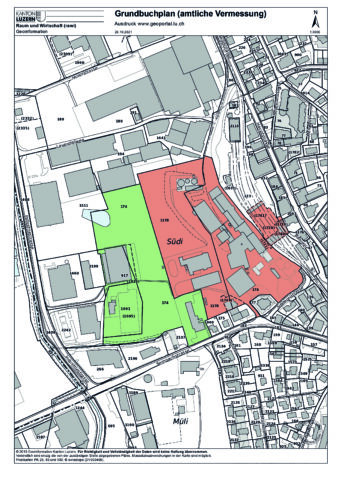
    Since the beginning of 2022, the municipality of Hochdorf has been the owner of the land, which previously belonged to the Hochdorf Group (red) and its pension fund (green).
    .

    The people of Hochdorf are to play a decisive role in this. The project began with a three-stage participation process. In a first step, qualitative focus discussions were held with interested parties until mid-September 2022. In a second step, the input from these discussions was discussed at a public participation event at the end of September 2022. In a third step, at the end of October 2022, the population was given the opportunity to evaluate and weight the inputs from the first two steps in an online survey and to further sharpen the emerging idea.

    Thanks to the many responses, those responsible gained a clear picture of the ideas of the people of Hochdorf. A large majority wants a central meeting place with inviting squares and paths. A broad housing mix and attractive office and commercial space are important to them. Ecological measures should also be a central factor in further planning.

    The findings and the vision derived from them were summarised in a report and presented to the population at the end of February 2023. They form the basis for the test planning due in summer 2023, where topics such as urban development, traffic planning or building density will be examined for the first time.

    The municipality would like to complete the utilisation planning, including the revision of the zoning plan, for part of the site by the end of the leaseback contract at the end of 2025 or 2026.

  • Transfer of ownership of the Schützengütli site for residential development takes place

    Transfer of ownership of the Schützengütli site for residential development takes place

    In February 2022, Halter AG acquired the Schützengütli site in Bischofszell with two areas of around 6500 and 1000 square metres. The property, which had served the Schiffli embroidery factory from 1907 and later the glass rectifier construction, passed into the ownership of the Laumann & Co. malt factory and fruit pressing plant in 1946. Essences and syrups were produced here until a few years ago. On 10 February 2023, the revised building and zoning plan of the city of Bischofszell came into force, allowing residential use with a design plan obligation on the site.

    For a lively and attractive Bischofszell
    “With this site development in an intact neighbourhood, we will create attractive living space in a very well-developed location right next to the railway station,” says Rolf Zäch, project manager at Halter Entwicklungen, with conviction. “The development of the site makes a valuable contribution to an attractive Bischofszell.” Thomas Weingart, mayor of Bischofszell, is also pleased about the upcoming development: “The centre of our town continues to develop positively. The town council is pleased about that. We are particularly honoured that Halter AG, a well-known company, will be active in Bischofszell and can contribute its great experience in urban development.”

    Harmonious integration into the neighbourhood and the city
    Around 50 owner-occupied flats are planned, for which the existing buildings will be removed except for individual elements. In a two-stage study contract, the aim is to achieve a high-quality site development that offers future residents a high quality of living and blends harmoniously into the surrounding neighbourhood. Taking economic criteria into account, an urban planning concept for the site will be developed, which will be followed by the architectural design in a second step. The study commissioning process already initiated by Halter Entwicklungen will start this spring.

  • Steiner sells Immo-Projekt to Fortimo

    Steiner sells Immo-Projekt to Fortimo

    Steiner AG has decided to “adjust the portfolio”. As a result, it sells the entire Widacher project in Fischbach-Göslikon to Fortimo Invest AG . According to a press release , Fortimo will begin with the implementation of the first construction phase in the coming year. There is already a building permit for this.

    Initially, 16 terraced houses are to be built on an abandoned industrial site. This first stage also includes a further 42 apartments in three apartment buildings and two listed buildings. A total of 165 residential units in ten multi-family houses and 46 row single-family houses are planned on this site. They are to be built in three sections.

    “With Fortimo we can hand over this great project to a long-standing partner company, which ensures the successful implementation and further development of this attractive residential complex,” Steiner CEO Michael Schiltknecht is quoted as saying.

  • Suurstoffi: Area development with a model character

    Suurstoffi: Area development with a model character

    «The Suurstoffi offers everything we need for our work. We can no longer be taken away so quickly here, ”says Sanofi Aventis CEO Andrea Meyer. A nice compliment for Zug Estates, which in the last ten years has developed a district in Rotkreuz that impresses with its architecture, greenery and energy efficiency. The once unattractive area has been revitalized. "The Rotkreuz community has an excellent macro location and is easily accessible by public transport," says Martin Jöri, Head of Strategic Site Management at Zug Estates. “The area is right next to the train station, but can also be easily reached by motorized private transport. The quarter is a kind of village within the village, and the campus concept is omnipresent. "

    A healthy mix
    All in all, Jöri appreciates the mix of living, business, research, school and gastronomy. He also likes the typical district infrastructure with a hairdresser or doctor. According to the latest construction status, the area is practically completed: “A construction site with two office buildings (Suurstoffi p. 18/19) has not yet been developed – but the building permit is available. The construction will be triggered in accordance with demand if sufficient occupancy has been achieved beforehand. " Looking back, Jöri regards the high construction speed with the aim of on-time commissioning as the greatest hurdle that had to be overcome.

    “Zero-Zero” goal
    The Suurstoffi is breaking new ground with an exemplary energy concept. On the site, solar use, several dynamic underground storage facilities and an anergy network form the basis for achieving the “zero-zero” goal. That means: the around 165,000 square meter Suurstoffi area is CO2-neutral. The energy for heating and cooling is generated by underground storage and building waste heat, electricity is provided by various solar power systems. The aim is complete self-sufficiency with primary energy for heating and water treatment. It was precisely this ambitious energy concept that particularly appealed to Jöri about the building: “It is a future-oriented vision of a CO2-free quarter with as much energy as possible, which is provided from our own production. But the architecture is also great. There is no uniformity here. Each construction site has a varied design. We also attached great importance to a green and high-quality outdoor space. "

  • The area between St.Gallen and Gossau receives the green light

    The area between St.Gallen and Gossau receives the green light

    The area between St.Gallen and Gossau is already home to numerous companies. Thanks to the motorway, the S-Bahn and the bus connections, it is already well developed today. Now both cities want to develop the 1.7 million square meter area between St.Gallen and Gossau. It should be upgraded in terms of traffic technology, attract new companies and give existing companies room for further development.

    The St.Gallen city parliament gave the green light for the development planning on October 27th, the Gossau city parliament followed on November 3rd, as the association Areal St.Gallen West – Gossau Ost writes in a message .

    The decision was made unanimously in both city parliaments. In the debate on October 27th, according to an article in the “Tagblatt”, the green St.Gallen city parliamentarian Andreas Hobi emphasized that the area has a high added value and that public transport should have its own route. Ivo Liechti emphasized on behalf of the CVP / EPP group that the area represents the largest contiguous work zone in the canton.

    The cost of development planning is budgeted at CHF 1.734 million. The two cities each contribute 611,200 francs of this. The canton takes on 20 percent of the remaining 30 percent, the neighboring municipality of Gaiserwald SG and the economy 5 percent each. The also adjacent Herisau AR does not contribute to the costs of the development.