Der Schweizerische Ingenieur- und Architektenverein (SIA) hat für seinen erstmalig vergebenen Preis eine Shortlist von neun Projekten und Prozessen veröffentlicht. Emanuel Christ, der Jurypräsident, erläutert den Auswahlprozess und die Kriterien, die für die Nominierungen ausschlaggebend waren.
In intensiven Diskussionen an zwei Jurytagen wurden 169 Projekte begutachtet und bewertet. Dank einer sorgfältigen Vorbereitung und der Aufteilung der Jury in Arbeitsgruppen konnte jedes Projekt eingehend analysiert werden. Diese Herangehensweise ermöglichte eine effiziente und gründliche Prüfung der Einreichungen.
Für die Bewertung der Projekte griff die Jury auf die acht Kriterien des Davos Qualitätssystems für Baukultur zurück. Diese umfassenden Kriterien ermöglichten eine multidimensionale Analyse der Projekte und unterstützten die Jury in ihrer interdisziplinären Arbeit. Diese Herangehensweise gewährleistete eine umfassende Betrachtung jedes Projekts, was essenziell für die Bewertung im Bereich Planung und Bau ist.
Die nominierten Projekte zeichnen sich durch ihre klaren Konzepte, qualitativ hochwertige Umsetzung und überzeugende Präsentation aus. Sie umfassen eine breite Palette von Entwürfen, von kleineren bis zu großangelegten Projekten, die sowohl mit der Landschaft und Natur interagieren als auch klassische Bauprojekte umfassen. Trotz ihrer Vielfalt teilen alle Projekte ein gemeinsames Verständnis für zirkuläres Bauen. Sie reflektieren die Idee, dass Bauen Teil eines ökologischen Kreislaufs ist, unabhängig davon, ob mit neuem oder altem Material gearbeitet wird.
Christ betont, dass zirkuläres Bauen nicht zu zurückhaltenden Projekten führt, sondern im Gegenteil zu solchen, die einen starken und leidenschaftlichen Gestaltungswillen zeigen. Für ihn persönlich war die Mitwirkung in der Jury eine bereichernde Erfahrung, die ihm neue Einblicke in die aktuelle Baupraxis und die Vielfalt der Planungs- und Bauprojekte in der Schweiz vermittelte.
Building materials producer Holcim has joined the London Sustainable Markets Initiative ‘s Circularity Task Force, according to a press release. The task force, which was founded at the UN Climate Change Conference in Dubai, aims to accelerate the global transition to a circular economy in the construction industry in order to promote climate protection, conserve natural resources and respect planetary boundaries.
The founding members are Holcim Dubai Airports, First Abu Dhabi Bank, Gemini Corporation, Investcorp and LGT Group. According to a statement from the Sustainable Markets Initiative, the Circularity Task Force will be coordinated by Gemini Corporation and its CEO Kunaal Patawari. The task force is guided by the principles of Terra Carta, an association founded in 2021 by King Charles of England, which proposes a series of measures for sustainable global value creation by 2030.
“In view of the growing world population and urbanisation, we need to build better with fewer resources,” Holcim’s President and CEO Jan Jenisch is quoted as saying in the company’s own press release. “At Holcim, we are driving circular construction in all the metropolises where we operate to build cities out of cities by recycling demolition materials for new construction solutions.”
Holcim already processes almost 7 million tonnes of demolition material per year, or around 1,000 truckloads per day, into new construction solutions. By 2030, the company wants to expand its ECOCycle recycling technology to 150 sites in Europe and then recycle more than 20 million tonnes of construction waste every year.
One of the main reasons for the decline in construction activity is the complex and lengthy approval procedures. According to the ZKB study, it takes an average of 140 days from planning application to building permit in the country, which is 67 percent more than in 2010. It takes even longer in densely populated areas in particular: 500 days in the canton of Geneva and 330 days in the canton of Zurich, with this figure more than doubling since 2010. The increase in appeals and objections also lead to delays and blocked projects.
To solve these problems, the globally unique virtual reality (VR) solution from the Swiss PropTech company HEGIAS helps. Communication between the various stakeholders is improved through the use of VR, as all parties involved see and thus understand the same thing. Also, the imagination is less challenged by the authorities, and thus more correct urban planning decisions can be made.
Build faster, cheaper and more sustainably With the immersive solution, complex approval procedures can be reduced, as authorities and politicians can view the planned buildings from any perspective and at any time of day throughout the year in a realistic VR environment. This saves time, money and reduces the need for expensive and environmentally harmful façade samples or elaborate physical architectural models as well as 1:1 mock-ups.
HEGIAS VR also facilitates and speeds up the assessment of listed buildings, as for example HEGIAS VR was successfully used by Implenia in the Lokstadt in Winterthur. The VR models can also show neighbours how shadows cast or the position of the sun would affect their property at any time of day throughout the year. VR thus enables faster, cheaper and more sustainable construction.
The Feld school in Azmoos has won first place in this year's Constructive Alps architecture prize, the Federal Office for Spatial Development ( ARE ) reports in a statement . It represents Switzerland in the competition organized jointly with Liechtenstein. Constructive Alps recognizes sustainable building and renovation in the Alps. With the competition, the two countries want to promote the implementation of the Alpine Convention for the sustainable development of the mountain region.
The Feld schoolhouse was built on the site of the old schoolhouse in Azmoos. It offers space for more than twice as many children as the old school building on the same built-up area. The socially and ecologically sustainable timber construction also impressed with its own photovoltaic system, among other things.
The second prize was awarded jointly to the headquarters of the heating specialist ÖkoFEN France in Saint-Baldoph and the Ghiringhelli residential development in Bellinzona. Third place went to the renovated Falkenhütte in Hinterriss in the Austrian Karwendel Mountains.
Switzerland will hold the presidency of the Alpine Convention in 2021/22. The internationally binding agreement between the eight Alpine states and the European Union has set itself the goal of developing the Alps into a model region for climate protection and adaptation to climate change. Under the aegis of Switzerland, the focus was on climate, sustainable mobility, Alpine towns, sustainable construction and modal shift.
The Reformed Church Wettingen-Neuenhof wants to build a smaller community center in Wettingen. The reason for this is declining membership, which is forcing the church to make savings. According to the municipality on Facebook, the winner of the architectural competition for the project is the Architeke office from Brugg. The Facebook message refers to a report by the "Badener Tagblatt" with the details of the project and the reasons for the decision.
The conclusion of the project competition is considered an important milestone in the church on the way to implementing the real estate strategy 2030. This states that the church congregation is concentrating on one location. In doing so, they dispensed with the two existing parish houses in Wettingen (built in 1969) and Neuenhof (built in 1956) and built a smaller one instead. The repair of the existing church community buildings would be disproportionately expensive and the available space would be oversized.
The jury report quoted the following about the winning project by Architheke: "Overall, the project impresses with its independent, clear concept with the spacious and versatile outdoor spaces and an appropriateness and lightness." In addition, it can also be implemented economically and sustainably. The new parish hall should form a new, smaller ensemble with the existing church and rectory.
From now on, preparations are underway to be able to submit a loan application for the project planning to the parish assembly.
According to a press release , real estate service provider Steiner celebrated the laying of the foundation stone for the Gupfengarten residential area. With the official starting signal, the construction project for a “family-friendly development in the Zurich Unterland” will be initiated. Steiner took over development, consulting and sales. The general contractor Eiffage Suisse AG , headquartered in Glattbrugg ZH, the architects Graf Biscioni based in Winterthur and the client Evostate Immobilien AG from Zurich are involved in the implementation.
By the end of 2023, 36 terraced single-family houses and three multi-family houses with 21 condominiums are to be built on the Gupfengarten site south of the center of Niederweningen. The housing estate meets a contemporary living and development standard and covers the strong demand for high-quality living space.
The planning meets the criteria for sustainable construction. The heat is generated almost entirely by means of a heat pump, geothermal probes and photovoltaic system. An energy management system enables “efficient and intelligent” use of energy. According to the announcement, the wooden building envelope has optimal thermal insulation.
The Swiss National Science Foundation ( SNSF ) is funding a five-year project by the Swiss Federal Laboratories for Materials Testing and Research ( Empa ) to research CO2 binding in cement. As part of the SNSF Advanced Grant, the scientists working with project manager Barbara Lothenbach will receive 2.2 million francs for their research project, according to a press release .
With the help of the funding, the Empa experts will carry out basic research in the field of CO2 binding in cement together with partners from the Finnish University of Oulu.
The background to the project called Low Carbon Magnesium-Based Binders is that the cement industry releases large amounts of carbon dioxide. At the same time, concrete is considered a beacon of hope for binding CO2 and thus as a potential reducer of climate-damaging greenhouse gases if it is based on magnesium and not on lime as is usually the case.
Starting in 2023, the researchers will find out how stable magnesium concrete is in the long term, how it can best be produced on construction sites and how temperature, pH value and other factors affect the molecular level.
Building materials producer Holcim has announced the takeover of Belgian building materials dealer Cantillana . With Cantillana’s presence and portfolio, Holcim can advance the expansion of the solutions and products division, which is expected to account for 30 percent of Group net sales by 2025, according to a press release .
For Holcim, the decision in favor of the provider of special solutions means a further optimization of its market position in facade construction systems and thermal insulation composite systems. “This expansion further strengthens our presence in Europe, particularly in the area of building renovation and energy efficiency,” said Miljan Gutovic, head of Holcim’s Europe, Middle East and Africa region.
The investment ties in with the adopted strategy of “green growth”. Both companies announce that they aim to “take a bigger role in providing innovative and sustainable solutions for energy-efficient buildings”.
After acquiring the French PRB Group , the Belgian PTB-Compaktuna and Izolbet in Poland, Holcim is adding Cantillana, a privately held company, to the “Holcim family”. Originating as a branch of a construction company, Cantillana has specialized since it was founded in 1875 in the sale of and trade in building materials and building material accessories for the construction and related trades. Today, Cantillana is part of the Stadsbader Group and employs more than 200 people at nine production sites in Belgium, France, Germany and the Netherlands.
Holcim AG has focused on innovative and sustainable construction solutions in building construction, civil engineering and infrastructure. At 55 locations across Switzerland, the company produces concrete, gravel and cement suitable for all construction projects and recycles demolition materials into resource-saving products.
The Swiss Environmental Arena is opening a new special exhibition. According to a message on Facebook, it is about the recycling of old insulating materials in the construction industry. Instead of old insulating materials ending up in the dumpster and then in the landfill during renovations and demolitions, they are taken back and processed again, according to Facebook on the subject. The Flumroc company based in Flums is showing how this is done in the new exhibition in the so-called Recycling City in the Umwelt Arena. Flumroc is a “pioneer in the field of insulation recycling”, according to the press release.
On its website , Flumroc advocates the sustainable use of insulating materials. “Rockwool becomes rockwool”. it says there. Flumroc stone wool is 100 percent recyclable. This “closed cycle” should be maintained as far as possible. The company therefore appeals not to simply throw away construction site cuttings and construction site waste made from Flumroc stone wool during demolition, renovation or conversion work. “We’re happy to take them back in the bags or containers provided and recycle them,” says the company.
The new exhibition provides information about the procedure for reprocessing.
Jaisli-Xamax has completed the work on the electrical installation at the new production site of the traditional company Confiserie Speck . The confectionery remains in Zug, but moves to the Göbli area. There will be over 3,000 new jobs there in the future, which makes the area very attractive, confectionery owner Peter Speck is quoted as saying in a media release by Jaisli-Xamax. In a short interview published there, Speck emphasizes the special features of the electrical installation brought in by the Dietiker company. “We wanted to optimize the production process and make it as sustainable as possible. We are able to do this thanks to the cooperation with the Multi-Energy-Hub, which combines local energy sources into a CO2-neutral overall energy system with a maximum degree of self-sufficiency,” Peter Speck is quoted as saying.
In addition, one wants to bring visitors closer to the craft in the confectionery. This is achieved by looking into the well-lit production hall, which is also called the “aquarium”.
The new Confiserie Speck location is more than just a production hall. In addition to the bakery, there are also offices, apartments, a café and a shop at the new location.
The electrical manufacturer Jaisli-Xamax from Dietikon only opened a new branch in Zug in 2021. The company, which has been active in the entire electrical sector for over 50 years and specializes in innovative solutions, now has offices in Basel, Bern and Zug in addition to its headquarters in Dietikon. Jaisli-Xamax AG employs a total of around 400 people.
Swisspor wants to set up a production plant for mineral insulating materials and a service center in Reiden Mehlsecken. The internationally active company based in Stans has secured the area of 200,000 square meters designated by the canton of Lucerne as a strategic work area, according to the Lucerne State Chancellery in a press release . The establishment of a building and environmental technology cluster planned by swisspor is supported by the canton of Lucerne and the municipality of Reiden .
swisspor will use 145,000 square meters of the total area of the site for its own facilities. The remaining area is reserved for research institutions and other companies active in the field of building and environmental technology. The Lucerne University of Applied Sciences and Arts wants to expand its existing cooperation with swisspor in Reiden Mehlsecken.
In addition, other industry-related companies and research partners are to be recruited. The coordination for this was taken over by the Switzerland Innovation Park Central , according to the statement. The Federal Materials Testing and Research Institute ( Empa ) was also addressed.
“We support the creation of a building and environmental technology cluster with swisspor and the Lucerne University of Applied Sciences and Arts,” government councilor Fabian Peter is quoted as saying in the statement. The head of the construction, environment and economic department sees a double opportunity for the region and canton: “On the one hand, jobs, innovation and value creation are created and on the other hand, the cluster makes a contribution to achieving our climate goals”.
The assessment committee for the study contract for the redesign of the CKW site in Reussbühl, which is now used for commercial and industrial purposes, unanimously decided in favor of the “Habitat – Quartier im Hain” project. It was developed by the Zurich architects Salewski Nater Kretz in collaboration with the Office of Living Things and the Dudler office for space and traffic planning.
According to a CKW press release , the 27,000 square meter area is to be “transformed into an attractive, lively and distinctive city quarter”. The energy service provider will give up its location there “in a few years”. In the call for tenders, requirements were made with regard to heat generation and rainwater management. In addition, at least half of the CKW shed hall, a former silk mill, was to be retained. Residential buildings will primarily be built on the remaining area.
The winning project “convinces in the reinterpretation and further development of the historical landscape”, which was once characterized by floodplains and water-using industry. The design based on the so-called sponge city principle “cleverly” incorporates these historical references. This project will be further developed in the coming months and will then form the basis for the Reussbühl West development plan. The designs of all planning teams are on display at CKW in Rathausen from June 21st to July 4th.
Since the summer of 2020, the civil engineering office in Zurich has been running a pilot project to reduce heat. According to a press release from the city of Zurich , differently colored road surfaces were applied to Roggenstrasse in Zurich-West in order to measure the effect on the temperature. The results show that the light-colored coverings – in contrast to shadows from trees and houses – only have a minor influence on the temperature.
For these measurements, new surfaces were installed on Roggenstrasse and the road was divided into three areas: a reference area made of conventional, street-gray asphalt and two areas with a beige and a reddish surface, according to the city’s statement. Cameras and embedded probes recorded the surface temperature and heat storage of the pads.
The results now available show a minor effect of the light-colored deposits on the surface temperature. The reference surface in conventional gray was even about 2 degrees cooler on average than the two bright surfaces. This result can be explained by the shadow that trees and a high building temporarily cast on the reference area, it is said. It therefore heated up less.
The differences between the two light surfaces were small. The beige covering stayed a little cooler than the reddish one. Calculations showed that if all surfaces had been exposed to the same amount of sunlight, the light surfaces would have been 2 degrees cooler than the reference area.
The results of the pilot project clearly show how important shade and trees are for reducing heat in cities, according to the civil engineering office.
The federal government has presented a reference work for new buildings and buildings to be renovated that shows the effect of building materials on the heat in urban and densely populated areas. It was created by the University of Applied Sciences Northwestern Switzerland on behalf of the Federal Office for Housing ( BWO ).
According to a media release by the BWO, the catalog compares materials for outdoor use such as floor coverings and facades and explains their effect on the outside temperature. It also takes into account other properties of the materials, such as how they reflect sunlight or how much water floor coverings allow to seep away.
The BWO calls on planners, developers and house owners to consult this material catalog when choosing suitable materials. In addition, the Office invites the scientific community to further develop and research the topic. Because according to the latest climate scenarios, the average temperatures in Switzerland will be 2.5 to 4.5 degrees higher by 2060 than in the period from 1981 to 2010. This means that the buildings that are being built or renovated today will be the microclimate of tomorrow shape.
The Institute for Digital Building at the FHNW has won Eder Martinez as a professor. According to a press release , the focus of his teaching will be on digital twins and the information lifecycle. “Anyone who wants to build with digital support and needs-oriented in the future must be able to collect, automate, map and process information in a targeted manner,” explains Manfred Huber, head of the institute, explaining the background to the focus.
Martinez received his master’s and doctorate degrees in Civil and Environmental Engineering from the University of California, Berkeley (UCB). Among other things, he worked as a civil engineer and specialist for cooperation processes on construction sites in Chile and Ecuador. He has also supported companies such as Hilti and Implenia in digital construction projects.
The FHNW only founded the Institute for Digital Building in 2018. According to the university, it has grown significantly since then. With Martinez, the second professorship in the field of information management will be filled this year.
Holcim Switzerland wants to do more for the circular economy in the construction industry. In this context, the building materials company has entered into a partnership with Madaster , according to a press release .
Madaster is working on so-called material passports for new and existing buildings. With these material passports, construction waste is given an identity and can be cataloged and reused as resources. The aim is to avoid waste and promote the circular economy in the construction and real estate sector.
The Madaster platform can also be used during the design phase of buildings to compare different construction methods and material options. Manufacturers of building materials – such as Holcim – can compare and present their products with the product databases on Madaster. They can also trace their products to enable reuse if necessary. Madaster’s services are marketed in Switzerland by Madaster Services Switzerland AG, based in Zurich.
Holcim Switzerland has set itself the goal of producing only climate-neutral and fully recyclable building materials by 2050. The new partnership should now help to achieve this goal. “By using Madaster when planning buildings, the right decisions for recyclable and resource-saving materials can already be made today,” says Christophe Berset, Team Lead New Solutions at Holcim Switzerland, in the press release. “The more transparency there is at the product level, the more future-proof buildings can be planned, built and dismantled, and materials and products can be used in further phases of use,” he adds.
According to a message on Facebook, the Dietiker construction company Walo Bertschinger is introducing the digital ordering and delivery process with Q Site for all 13 business areas of asphalt road construction. From planning the paving process and coordinating the ordering of mix with the asphalt plant to controlling the paving process, Walo employees will use the Q Site software in the future.
The software application Q Site has been developed by Q Point in Langenthal BE. There are several fields of application. Q Asphalt says on Q Point’s special website that the system offers support both in the office and on the construction site with the construction site app over the entire cycle of a construction project. From planning to execution to the final documentation, it provides helpful key figures to build easier, faster and more successfully.
Project planning is given as an example. According to Q Point, the system automatically delivers a ready-to-use installation and logistics concept including a complete employee and equipment deployment plan as well as a calculation of the trucks required.
According to the Facebook message, Walo Bertschinger assumes that even more efficient work processes can be achieved with this “upgrade”.
The building materials group Holcim , headquartered in Zug, is reporting positive economic figures for the first quarter of 2022. According to a press release , net sales rose from 5.36 billion francs to 6.44 billion francs. Sales thus increased by 20.1 percent. Operating profit (EBIT) rose by 16.3 percent compared to the same quarter last year to CHF 614 million. According to the announcement, EBIT and sales have reached a “record high”. According to the announcement, the roof systems segment developed particularly positively with an EBIT margin of 17 percent.
“I am very confident about the record start to the year, which creates a solid basis for our ‘Accelerating Green Growth’ strategy 2025,” CEO Jan Jenisch is quoted as saying. For the first time, Holcim has published a sustainability report on the aforementioned “accelerated green growth”. “The report is a first in our industry and provides an overview of our decarbonization measures, which range from climate-friendly construction solutions to circular construction and next-generation technologies,” Jenisch continues.
In the global overview of Holcim’s activities, North America with the USA and Canada is highlighted as growth markets. Argentina, Colombia and El Salvador also recorded good market growth in the Latin America region.
Europe did extremely well. Strong pricing has allowed the company to contain the effects of cost inflation. There was also good market demand in Eastern Europe.
In the Middle East and Africa, cost inflation has been absorbed well, the report says. Asia and Oceania was difficult given cost inflation. Better business in China and improved profitability in Australia helped partially offset weaker cement demand in the region.
The Limmattal Hospital Association completes the LIMMIviva new construction project for the acute hospital. The construction was realized between 2014 and September 2018. This was followed by relocation and commissioning. The project can now be considered completed. According to the media release, less was spent on the costs than estimated. The approved commitment credit of 275.7 million francs, including two supplementary credits, was undershot by around 0.8 million francs.
In a construction project lasting several years, adjustments to the original project are quite common, according to the hospital association. This also applied to the new building project for the Limmattal hospital. The high dynamics of the healthcare system meant that the project was continuously adapted to changing requirements in over 100 supplements. Such supplements usually lead to significant additional costs. During the construction of the Limmattal hospital, together with the Bern-based construction company Losinger Marazzi AG , which was commissioned as general contractor, additional costs that caused additional costs were compensated for by optimizations in other areas.
With the hospital financing introduced in 2012 and an amendment to the municipal law, the Limmattal Hospital Association was able to finance the investments of around 270 million francs itself, without the help of the municipalities and thus without burdening the taxpayer. 220 million francs of outside capital was raised through the issue of two bonds.
The study contract for the construction of the Rocket and Tigerli houses has been completed, as informed by Ina Invest in a press release . A jury made up of representatives from the city of Winterthur and architects selected the concept by the architecture offices of Cometti Truffer Hodel Architects from Lucerne and Schmidt Hammer Lassen Architects from Copenhagen from nine designs.
The winning design shows an “outstanding architectural completion” of the former industrial site. As can be seen in the media release, the decision is based on a “non-anonymous study order in the form of a digital, one-step process with pre-qualification and interim discussion”. In addition to urban planning and architectural aspects, the focus was on sustainability and innovation. At the heart of Lokstadt, on Dialogplatz, the Rocket high-rise with a terracotta facade is to reach a height of 100 meters into the sky.
Mixed use is planned for the entire residential area. In the Rocket high-rise, a diverse range of residential properties is to be created over 32 floors. According to the Lokstadt development team, the architectural concept is characterized by flexible planning.
The base building Tigerli is intended for student apartments and non-profit housing. A Radisson Red Hotel is to be housed on part of the area, including the listed industrial halls.
Bouygues Energies & Services uses work robots and a version of the digital planning method Building Information Modeling (BIM) on a construction site in Zuchwil, BIM-to-field. According to the press release , both will be used as part of the new RiverNest building in Zuchwil. The center of excellence for renewable energy, which will also be the headquarters of the Helion business unit of Bouygues ES, is currently being built as a timber structure on the site on the Aare.
On the basis of the coordination and execution plans, the basics for the prefabrication of the pipeline construction and the fastening points were modeled. A logistics concept was also drawn up in order to order all materials for the construction of the systems in the desired quantity and in the required dimensions. According to the press release, planning risks can be minimized and sources of error avoided in this way.
The Jaibot , a semi-autonomous drilling robot developed by Hilti , was also used for the first time in timber construction at the construction site in Zuchwil. Based on the digital planning data, the Jaibot worked its way through the premises and drilled all the holes required for mounting the suspensions. In doing so, he operated independently within a specified radius and also marked the drilled holes for the respective trade, according to the statement. The robot works much faster than a worker and avoids misinterpretation of the planning data.
This "does not mean that we no longer need the fitter on the construction site," says Yves Kessler, HVAC Division Manager at Bouygues ES in the Jürasüdfuss region. But he no longer has to be used for "low-quality work" such as drilling holes on suitable construction sites.
The Paperwerd Forum was launched on April 11 under the direction of the Office for Urban Development. Here, 55 experts from various disciplines, representatives of politics, clubs, organizations and associations as well as the residents are to work out “the basics for the future of the Papierwerd area”, writes the building department of the city of Zurich in a statement . “We would like to have a broad debate with the interest groups and the population about the possible scenarios for the Papierwerd area,” Corine Mauch, Mayor of Zurich, is quoted there as saying. The scenarios range from preservation to partial preservation and demolition to new construction.
The results of the dialogue process should form the basis for the city council’s strategy for the development of the area. The handling of the provisional globe will also be discussed, according to the statement. “Even if the Globus provisional is not listed as a historic monument, the building is definitely relevant in terms of architecture, urban planning and social history,” André Odermatt, head of the building department, is quoted as saying.
The Papierwerd area is part of the area around the main station and the Central. For this, the civil engineering office creates a master plan as a superordinate consideration. Richard Wolff, Head of the Civil Engineering and Waste Management Department, explains that it will be “incorporated into the strategic process for the Papierwerd site”, but will not anticipate it.
Sika closed the first quarter of 2021 with record sales of almost CHF 2.40 billion, the Zug-based building materials group, which operates worldwide, announced in a press release. In a year-on-year comparison, this corresponds to growth of 20.0 percent. In local currencies, growth of 21.9 percent was realized, writes Sika.
All of the Group’s market regions contributed to the good development with double-digit growth rates in local currencies. The strongest growth was realized in the Americas region at 36.2 percent. In the region with the highest sales, EMEA (Europe, Middle East, Africa), sales increased by 18.1 percent to CHF 1.04 billion.
For the year as a whole, Sika is aiming for sales growth of well over 10 percent in local currencies to total sales of more than CHF 10 billion for the first time. The operating result is to be increased disproportionately by at least 15 percent.
Sika sees the construction sector being shaped “by the megatrend of climate change” and the associated shift to sustainable construction. According to its own statements, the group is well positioned here. “With our environmentally friendly and innovative solutions, we are positioning ourselves as a sustainability champion and, together with our customers, are making an important contribution to climate neutrality in the construction and vehicle industries,” said Group CEO Thomas Hasler in the statement. According to the announcement, the takeover of the former construction chemicals business of the BASF Group (MBCC Group), which was launched in November 2021, should also make Sika a “key player for more sustainability”.
It’s literally a beer idea: Two friends chat after work about the garden, barbecuing and cosiness. A floor in a two-family house has just been bought and the first child is born. The existing open shelter would probably no longer offer enough protection to spend any more time in the garden. Reto Schär is a master plasterer, his contact person is a technical consultant for dry construction systems. What goes together comes together.
The place was given The farm’s grounds offer the necessary open space for a stately garden house, on the concrete slab where the dung heap once steamed. A very concrete and measured hand sketch gradually turned into construction plans for the 5 x 5 meter room with a pent roof. The whole thing stands 10 cm higher on heavy-duty consoles so that the underbody insulation has space. After all, you want to feel good on cooler days, even when there is no heating.
Completely made by Gipser The choice of system is of course no coincidence. Thanks to the use of Rimodul ® , Glasroc X, Habito, Rigiton ® Ambiance and the right accessories, the builder, project manager at the plastering company carrying out the work, can build his garden house himself from the first profile to the top layer of plaster. The decisive factor for this solution was actually the new fleece-reinforced Glasroc X gypsum board from Rigips ® , because thanks to the low water absorption and integrated UV protection, it can also be used where gypsum boards previously did not belong: outdoors. The RiModul ® lightweight steel construction system is used as the substructure, which is extremely light but still fulfills a full load-bearing function. This allows dimensionally stable, i.e. walkable and resilient and therefore also free-standing buildings to be erected. The system is based on the principle of prefabrication, which reduces the overall construction time by up to 60%.
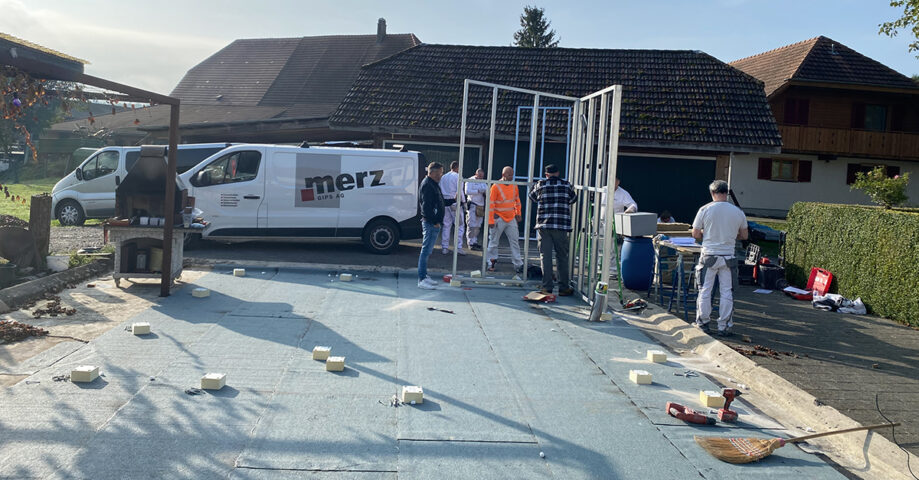
The prefabricated RiModul®elements are assembled according to an assembly plan.
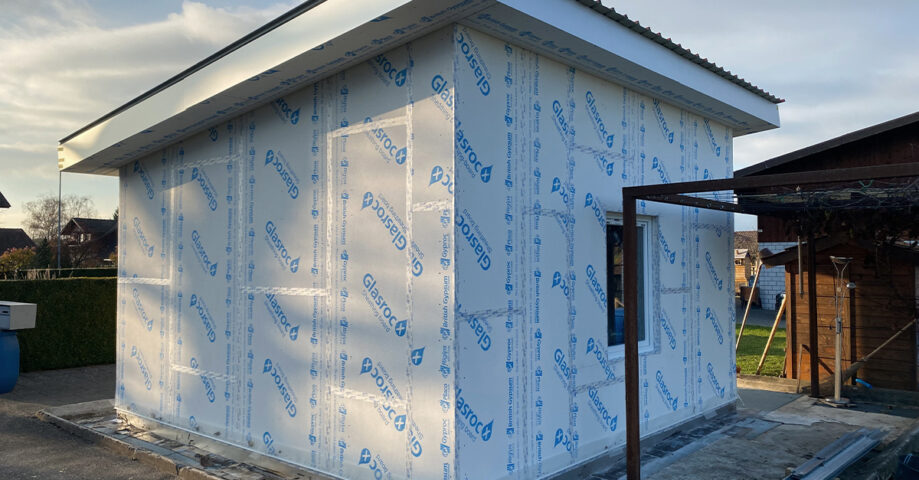
Process as usual The on-site assembly of the steel profiles was carried out according to the “assembly kit principle”. The plastering team then paneled the supporting structure on the outside with Rigips Glasroc X, with the cavities in the steel frame then being insulated with mineral wool. The entire outer skin, including the window reveals and roof soffits, were designed in this way. All panel joints and corners were taped with weather-resistant Glasroc X joint tape that can be plastered over. This ensured a driving rain-proof surface until further processing.
Protection against all weather influences Rigips ® Glasroc X is a fleece-reinforced gypsum board of type GM-FH1 with extremely low water absorption. Even short-term direct exposure to the weather cannot harm it; Water that could freeze in the event of frost does not get into the plate in the first place. Since gypsum boards can lose their strength properties at high temperatures, the lightness value of the surface coating for external walls with Rigips ® Glasroc X is set at >20. Shades in this range have proven themselves in long-term tests; With proper maintenance and care, facades designed in this way remain permanently free of damage.
Really strong when used correctly With correct planning and execution, the Rigips ® Glasroc X can withstand even the heaviest storms thanks to the preliminary design tables.
With the cladding using Rigips ® Glasroc X, the statics of the construction are retained even under the influence of fire. Thanks to the excellent fire-retardant properties of the gypsum boards, Rigips exterior wall systems can also provide load-bearing components with a fire resistance period of up to 90 minutes. System structures with Glasroc X also achieve a significant reduction in sound transmission.
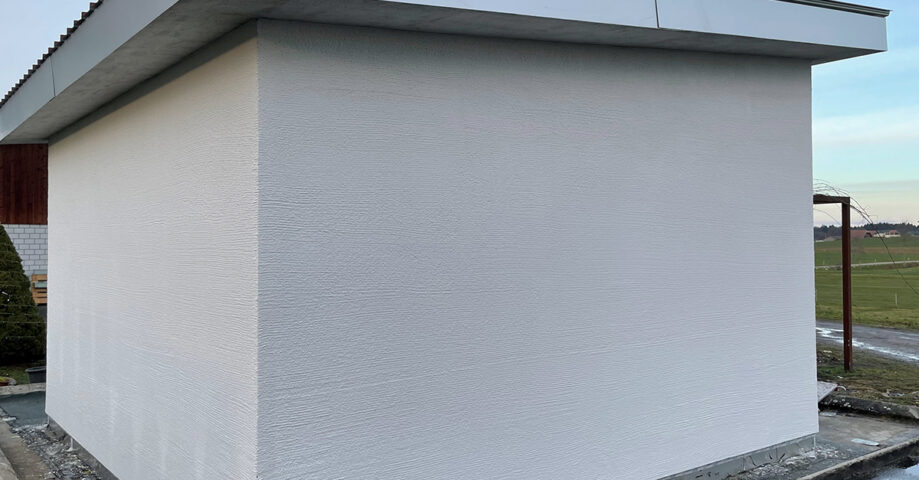
Completely planked with Rigips®Glasroc X, the garden house is optimally protected against wind and weather, fire and noise.
Inside comes the all-rounder By choosing Rigips ® Habito H, the builder keeps all options open. The board has a much denser gypsum core that is mixed with a special formulation. It gives the plate a high degree of surface hardness, makes it shockproof and allows a load capacity of up to 30kg per screw. Schär is now completely free to hang all sorts of useful and decorative items on the interior walls, without the need for drills, dowels or wooden inserts. Simply screw in the chipboard screw – and you’re done. The suspended acoustic ceiling consists of a double grid and Rigiton ® Ambiance perforated panels, which are designed using Primeline technology. So it can get a little louder at the garden party with friends and children.
Cut dust-free as usual Reto Schär, himself a seasoned master plasterer, didn’t want a wooden house from the catalogue. The idea with RiModul ® and the new Glasroc X immediately appealed to him: “Exactly the right solution for a real garden house. The best thing about the board is that you can cut it without a machine and like any plasterboard with a cutter, very efficiently and without creating dust. It’s amazing what we’ve done out here with systems that were previously reserved for interior design!»
Reto Schär’s summer house in Inkwil BE was built from A to Z with dry construction systems.
Amberg Engineering won the drawing of lots for planning the new railway line between Innleiten and Kirnstein near Rosenheim in Bavaria. In a joint venture with Obermeyer Infrastructure , the consulting company based in Regensdorf is to process the order from Deutsche Bahn (DB) in the Brenner Nordzulauf project , according to a press release . Both companies are already working together on an ongoing project on the Brenner Base Tunnel.
The Innleiten-Kirnstein planning section in the Brenner-Nordzulauf rail network expansion project includes, among other things, the planning of the two Ringelfeld and Steinkirchen tunnels, including the technical tunnel equipment, the planning of the rails and roads as well as the planning for the new construction of flyover structures, troughs, noise protection walls and supporting structures.
The digital process Building Information Modeling (BIM) is contractually mandatory. “We are very pleased to be able to show our planning expertise in such an exposed overall DB planning project. In addition, together with those involved in the project, we can further develop the BIM methodology in infrastructure planning,” Christoph Heiter, an engineer at Obermeyer Infrastructure, is quoted as saying.
Baumer will add a development center to its Frauenfeld site. The company is investing 20 million francs in its new Innovation Center. It will offer space for around 120 employees on 5,000 square meters. According to a press release , the teams should move in in late summer 2023.
Baumer is investing in its innovative strength for the second time in just a few years, following the opening of the new high-tech center in Stockach in southern Germany in 2018. The central location between the Swiss Federal Institute of Technology in Zurich , the University of Excellence in Konstanz and the OST – Ostschweizer Fachhochschule is “optimal”. “The new building enables us to expand the development capacities at the headquarters in order to expand our position as a driver of innovation,” says Dr. Oliver Vietze quoted, CEO of the company from the St.GallenBodenseeArea.
When it comes to sustainability and energy efficiency, the Innovation Center is set to become a showcase project. A complete solar building envelope is planned for power generation. Geothermal probes and a heat pump are to temper the building. Baumer will obtain further CO2-neutral electricity from Swiss hydropower.
The leisure, sports and event center Tägi in Wettingen invites you to the Bauen+Wohnen Aargau trade fair again this spring after a two-year break. According to the press release , it will take place from Thursday, April 7th to Sunday, April 10th and will present offers for everything to do with building, living, gardening and energy. More than 180 exhibitors present products and services in four halls as well as on Tägerhardstrasse, the Tägi forecourt and in the event arena. There are also several specialist lectures in the Limmatraum on topics such as light, heat pumps, kitchen planning or solar power.
The fair is open on Thursday and Friday from 1 p.m. to 8 p.m. and on Saturday and Sunday from 10 a.m. to 6 p.m. There is paid parking on the circus meadow.
This weekend the Tägi also opens the mini golf season. The 18-hole mini golf course is open daily from 1 p.m. to 8 p.m. Provided the weather is nice and allows the game to play.
From 2026, extreme flood peaks in the Sihl are to be channeled into Lake Zurich via a relief tunnel, according to a statement from the Canton of Zurich ‘s building department. For this purpose, a 2 km long underground tunnel with a diameter of 6.6 m is planned between Langnau am Albis and Thalwil. The start of construction for the project took place on March 18th with the groundbreaking ceremony.
Extreme flooding of the Sihl could cause severe flooding in the lower Sihl valley and in the city of Zurich, the statement said. The possible damage for the city of Zurich alone is estimated at up to 6.7 billion Swiss francs. They should be averted by the relief tunnel.
The costs for the planning and construction of the tunnel as well as for the ecological replacement measures on the Sihl and on Lake Zurich are estimated at around 175 million francs. They are largely borne by the canton of Zurich. In addition, the federal government, the city of Zurich, the SBB and the Sihltal Zurich Uetliberg Bahn SZU AG share in the costs. The Canton of Zurich is making further information on the project available on the internet .
According to a message on Facebook, the Dietiker construction company Walo Bertschinger AG has been awarded bronze certification in the sustainability ranking of the international independent agency EcoVadis . The company received the bronze award in its very first application. According to the statement, the certification is a motivation for further improvement in the area of sustainability.
Walo, headquartered in Dietikon, operates internationally and is a fourth-generation family business. According to the company’s website , Walo has been combining consistency and innovation for 105 years. The Walo Group employs 2,450 people at 21 locations in three countries.
EcoVadis evaluates the sustainability performance of companies in the areas of environment, working conditions, procurement and ethics. According to the announcement, over 90,000 companies have already been assessed.
The construction services company Implenia has won the general contractor contract for the EUREF campus in Düsseldorf . According to the client EUREF AG , “a visible place of the future will be created as a real model on this innovation campus for the energy and mobility transition, which can be implemented in many major cities around the world”. EUREF has already set up a first campus of this kind in Berlin .
The Düsseldorf campus will offer 3,500 employees from established companies, start-ups, science and research an inspiring environment on 105,000 square meters of gross floor space. In addition, it is to become part of a network of environmentally friendly energy producers and storage facilities in the region and meet all of the federal government’s CO2 climate protection targets for 2045 from the start. The project volume amounts to CHF 186 million.
“Sustainability is one of Implenia’s five corporate values,” CEO André Wyss is quoted as saying in a press release . “We are therefore very pleased that we can build a research and development campus whose work focuses on sustainability and which is itself geared towards CO2-neutral operation.”
According to Implenia, the schedule is “ambitious”: The first phase of construction should be completed and ready for occupancy by mid-2024. The second construction phase will run continuously with a time delay and will be completed by mid-2025. In order to be able to keep to this schedule, Implenia has been working with BIM (Building Information Modeling) right from the start, i.e. with digital modelling, combining and recording all relevant planning, construction and management data. In addition, a so-called lean cycle plan is used for execution.
Wir verwenden Cookies zur Unterstützung und Verbesserung unserer Dienste. Mit der Nutzung dieser Website erklären Sie sich mit der Verwendung von Cookies einverstanden. Weitere Informationen finden Sie in unserer Datenschutzerklärung.