Four projects will receive support from the EKT Energy Foundation. According to a press release, 20 applications were submitted to the foundation board for consideration in the second round of awards. All of the projects are working towards a secure, sustainable energy supply and the realisation of climate targets. They were convincing due to their high practical orientation and their connection to the canton of Thurgau. They are also “good examples of how both the Thurgau economy and Thurgau agriculture can benefit from the EKT”, according to Foundation Board President Fabian Etter.
One of the research projects is in the field of agrivoltaics. Ways of dual utilisation of agricultural land are being investigated, both for the production of crops and solar power. A test plant with semi-transparent photovoltaic modules from the Arenenberg Agricultural Competence Centre is intended to provide insights into the suitability of varieties, weather protection, irrigation and light management.
Two other projects relating to energy storage are also being funded, as these are central to the restructuring of the energy supply. One is being carried out at the animal carcass collection centre in the city of Frauenfeld, which is involved in the pilot project. The prototype of a sorption heat pump is being investigated. This will allow the waste heat generated during cooling to be stored thermochemically together with the electrical energy from the photovoltaic system during the summer months. The second energy storage project is a preliminary study investigating the opportunities and framework conditions for using modular sand batteries as heat storage systems.
The EKT Energy Foundation sees further innovative approaches for the energy transition in the Thurgau Energy Utilisation from Underground 2023 project. The funding will be awarded in combination with a loan and is intended to support the basic research and planning work required to apply for funding from the canton and the federal government. The aim of the research is to gain insights into the utilisation of geothermal energy sources.
Thurplus takes positive stock of PV expansion over the past seven years. Between 2016 and 2023, Frauenfeld’s municipal energy supplier was able to increase its output more than tenfold from 144 to around 1500 kilowatt peak. In 2023 alone, over 700 kilowatt peak were added, according to a press release.
In total, these solar systems produce around 1.5 million kilowatt hours of electricity per year. This corresponds to the average consumption of around 330 households. Between 2016 and 2023, the number of shareholders in the PV citizen participation models also increased from 50 to 240, according to the press release.
“By actively shaping and successfully implementing many sustainable PV projects, Thurplus has managed to achieve this”, says Fabrizio Hugentobler, City Councillor and Head of the Thurplus, Leisure and Sport Department. “Thurplus is well positioned with its solar power, SolarInvest, PV contracting and other solutions.”
According to the municipal PV strategy for Thurplus, an additional 5 per cent of the total electricity consumption of around 150 gigawatt hours is to be added annually by 2027. This corresponds to a total installed PV capacity of 8 megawatt peak or an electricity production of around 7.5 gigawatt hours per year. Thurplus is looking for suitable roofs from companies and institutions. “Together, we want to make progress and do our bit to ensure that the PV expansion targets are achieved,” says Thurplus Managing Director Peter Wieland.
In summer 2022, Energie Kreuzlingen, KVA Thurgau and Stadtwerke Kon stanz announced their plans to build a cross-border district heating pipeline. The project is now entering the next phase, Stadtwerke Konstanz announced in a press release. The three partners have agreed to define the key points of the project and to draw up a preliminary project. The realisation decision will then be made on this basis.
The planned district heating pipeline will run from the future waste incineration plant in Weinfelden to Kreuzlingen and on to Constance. In a memorandum of understanding, the partners have defined the roles and distribution of tasks in the planning process. KVA Thurgau will then take over the financing and realisation of the work required for the project planning. Energie Kreuzlingen and Stadtwerke Konstanz will contribute the technical and planning fundamentals.
KVA Thurgau is to update the feasibility study already carried out on the basis of the specified technical and operational parameters and initiate the planning of the route. At the same time, the partners want to hold talks with potential partners for financing the project. In a second stage, the basis for obtaining a realisation credit is to be developed. According to current planning, the replacement waste incineration plant could supply its first heat by the end of 2031. The district heating pipeline should also be in place by this time if possible.
The 101st immoTable, the renowned event for the property industry at Signatur Rhône in Geneva, focused on important topics that will have a significant impact on the future of the property world. From sustainable spatial development and geothermal energy as part of the energy transition to health risks in water and legal issues relating to renovations in Geneva, the event provided a comprehensive platform for dialogue on current challenges and innovations in the sector.
The Director of the Department of Territory of the Canton of Geneva, Marta Alonso, presented pioneering urban development and spatial planning projects. By 2060, over 12,000 new residential units, 6,000 workplaces, schools, a large park and revitalised river areas are to be built on an area of 230 hectares. Modern visualisation techniques and 3D models enable a transparent presentation of the development scenarios.
David Faehndrich, Head of the Western Switzerland division at EKZ Contracting SA, emphasised the role of sustainable and economical energy supply systems. Several important projects have already been realised, such as the geothermal energy supply for the new flats in the “Jardins du Bourg” in Châtel-St-Denis. These measures reduce CO₂ emissions and promote the energy transition.
In his presentation, Pierre Descloux, CEO of Dipan SA, emphasised the importance of treating hydraulic systems, particularly with regard to rust, limescale and legionella. He emphasised the importance of ensuring the hygiene and efficiency of these systems.
Cosima Trabichet-Castan, a specialist in property law at MLL Legal, spoke about the challenges of obtaining planning permission and complying with local building regulations. She also spoke about the complex regulatory requirements in Geneva, which according to a recent UBS study has the longest waiting times for building permits in Switzerland. Her presentation highlighted the importance of integrating sustainable practices in this context-rich regulatory environment.
Fabio Nairi from IWG Switzerland spoke about measures to reduce commuting times and CO₂ emissions as well as the transition to hybrid working models.
The 101st immoTable once again proved why the event is one of the top platforms for the property industry. The topics discussed are of key importance for the future development of the industry and offer valuable solutions for current challenges.
Further information on the event and future dates can be found at www.immotable.ch
Houzy, the Zurich-based platform for homeowners, has commissioned and published a recent study. According to a press release, the company wanted to collect data on the current and future behaviour of homeowners in Switzerland. Houzy surveyed 80,000 households online for the representative study. 1906 house and apartment owners answered the questionnaire from January to the end of March 2024. Three quarters of them were house owners and one quarter flat owners.
The study focussed on the areas of renovation, heating and energy supply. It revealed that 69.4 per cent of all homeowners used tradesman services in the past year. The average order volume was CHF 15,000.
In addition to renovations, the focus was also on alternative heating systems. 5 per cent of homeowners plan to modernise their heating systems and find alternatives to fossil fuels in 2024. At the same time, 33.5 per cent of households that still use oil and 8.85 per cent of those that use gas want to change their heating systems. One tenth of Swiss homeowners are planning to install solar panels this year in order to produce at least some of the electricity they need themselves.
Another focus was on intentions to sell residential property. A seventh of the homeowners surveyed expressed such intentions. of these, 20 per cent would still like to sell their home in 2024. Extrapolated, this means that 3.2 per cent of all houses and flats in Switzerland will come onto the market this year, according to the press release.
In response to the imminent introduction of a global minimum tax for large international companies from 2024, which could potentially affect the canton’s competitiveness, the canton of Zug has developed plans to compensate for any locational disadvantages. The planned measures include the complete reinvestment of the expected additional revenue of around CHF 200 million per year in three priority areas: social infrastructure, innovative projects and sustainable development initiatives.
Focus on social and innovative projects The planned social measures are aimed at making life more attractive for the population and the local economy. These include investments in needs-based childcare provision, higher contributions to public schools and measures to improve the living and working environment. In the area of infrastructure and innovation, the focus is on future-oriented projects. Initiatives such as the “Blockchain Zug Joint Research Initiative” and the “ETH Learning Factory Zug” are intended to increase competitiveness and quality of life in the canton by promoting sustainable energy supply and storage.
Legal framework and financial planning In order to achieve these goals, the cantonal government is proposing a new “Location Development Act” that will introduce an efficient and flexible system of subsidies for sustainability and innovation. From 2026, CHF 150 million per year is earmarked for subsidies, with the maximum subsidy amount being approved annually by the Cantonal Council from 2029. This approach is intended to provide companies in the canton of Zug with planning and legal certainty.
Finance Director Heinz Tännler emphasises that the planned measures are essential in order to maintain Zug as a preferred residential and business location. The public consultation on the new law will run until 15 September 2024 and the law is due to come into force on 1 January 2026. These strategic decisions demonstrate Zug’s commitment to maintaining its leading position despite global tax changes and remaining an attractive location for companies and skilled labour.
The centrepiece of 247Solar’s technology is a high-temperature heat exchanger developed by David Gordon Wilson, Professor Emeritus at MIT. By integrating this heat exchanger into a conventional turbine similar to a jet engine, efficient and emission-free energy generation becomes possible. The turbine utilises hot air, which is heated to around 1,000 degrees Celsius by solar energy, to produce both electricity and heat.
Solar power plant with integrated energy storage An innovative component of this system is combined heat and power generation, supplemented by thermal energy storage. These store heat in solid materials, which can then drive the turbine when solar radiation is not available. This enables a continuous energy supply, regardless of the time of day and weather conditions. The generation capacity of the model presented is 400 kilowatts of electricity and 600 kilowatts of heat.
The modular design of the system offers a wide range of possible applications, especially for remote or self-sufficient communities. This technology is ideal for combining with other renewable energy sources such as wind power to provide a holistic and sustainable energy supply.
Bruce Anderson, Managing Director of 247Solar, emphasises that the main aim of developing this system was to overcome the intermittency issues of conventional renewables. The ability to provide uninterrupted energy represents a significant advance in the utilisation of renewable energy sources and could play a key role in the global energy future.
Energie 360° and Vantage Data Centres have entered into a partnership to set up an energy network. The data centre operator based in the US state of Colorado is planning to build a new data centre campus in Volketswil. According to a press release, the planned utilisation of waste heat at the new site will create the “ideal energy source for an energy network”. “We are delighted about this partnership and the fact that we can make a contribution to the decarbonisation of the energy system,” Wolfgang Zepf, Country Manager of Vantage Switzerland, is quoted as saying.
Construction of the energy centre is scheduled to begin in summer 2025. From the end of 2028, 70 megawatts of neutral thermal energy are to be generated for 7,000 households in the municipalities of Volketswil, Greifensee, Schwerzenbach and Effretikon.
Consumers will probably not have to wait that long. In order to be able to supply heat from the energy network as soon as possible, work has begun on creating a climate-friendly interim solution, according to the statement: “In order to utilise synergies with other construction work, Energie 360° is already building part of the transport pipeline between Volketswil and Effretikon. The first properties could be supplied with climate-friendly heat as early as the end of 2026.
In a six-month research project, a team of researchers from the Energy Science Centre at the Swiss Federal Institute of Technology in Zurich has attempted to find out what role synthetic fuels could play in the Swiss electricity system. With the help of the Nexus-e modelling platform, three main scenarios for the Swiss electricity system in 2050 were designed, according to a press release: the potential role of hydrogen and e-methane for the Swiss electricity supply if they are imported, the seasonal storage of electricity in Switzerland and the potential costs of producing hydrogen and e-methane in Switzerland.
The researchers conclude that hydrogen and e-methane imports can only be part of a cost-effective electricity supply in Switzerland if import prices are low. At very low prices, hydrogen could cover up to 12 per cent of the annual electricity demand. They do not see domestically produced hydrogen or e-methane as a cost-effective solution for seasonal electricity storage.
The results of this study are intended to provide an insight into the role of synthetic fuels in a net-zero emissions electricity system in Switzerland, but are not intended as forecasts. It was commissioned by Heinz M. Buhofer, former Chairman of the Board of Directors of Metall Zug, and co-financed by the electricity supplier Eniwa. The project advisory board consisted of members of the Swiss Federal Laboratories for Materials Testing and Research, the Tech Cluster Zug, the Association of the Swiss Gas Industry and the Zug-based management consultancy Steinmann Consulting.
The Basel-based energy supplier IWB is launching the nano-network as a new solution for heating outside the district heating supply in the canton of Basel-Stadt. According to a press release, when heating systems are replaced in houses or terraced houses that are close together, the heating systems are connected to each other and equipped with a central control system. IWB presented the nano-network to interested owners from the Mausacker district in Reinach for the first time on Wednesday, 6 March.
As a rule, each property owner takes care of their own heating system. According to the press release, the individual heating systems are often oversized for safety reasons. Installation and heating costs are higher than necessary. In a nano-network, the heating systems of two to eight properties are physically connected and supplemented by an intelligent control system. All types of heating systems can be connected together.
The control system ensures that the systems that provide environmentally friendly heating are used first. All connected owners can obtain an overview of energy production, consumption and costs at any time via an Internet application. In a second step, old, fossil-fuelled heating systems can be decommissioned.
In a pilot project, the merger of three properties resulted in financial savings of up to 15 per cent. In addition, the three properties, in which a heat pump, solar thermal systems and gas heating systems were installed, were able to heat 90 per cent renewably as a result of the merger.
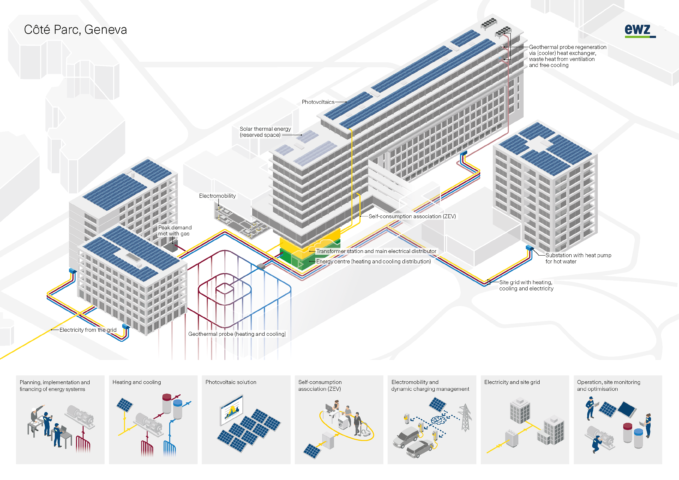
Integrated energy solutions for sites and complexes generate added value for all stakeholders. They intelligently network all of the energy supply components for an ideal interaction of production, consumption and storage within an overall system. This unleashes efficiency potential, increases the degree of self-sufficiency and secures long-term supply to new and existing properties. The new ewz and Faktor Journalisten white paper entitled ‘Integrated energy solutions for sites and complexes’ offers property owners a knowledge base they can use during the planning process.
Components of integrated energy solutions To exploit synergies, you need to plan the energy solution as a networked system from the beginning.
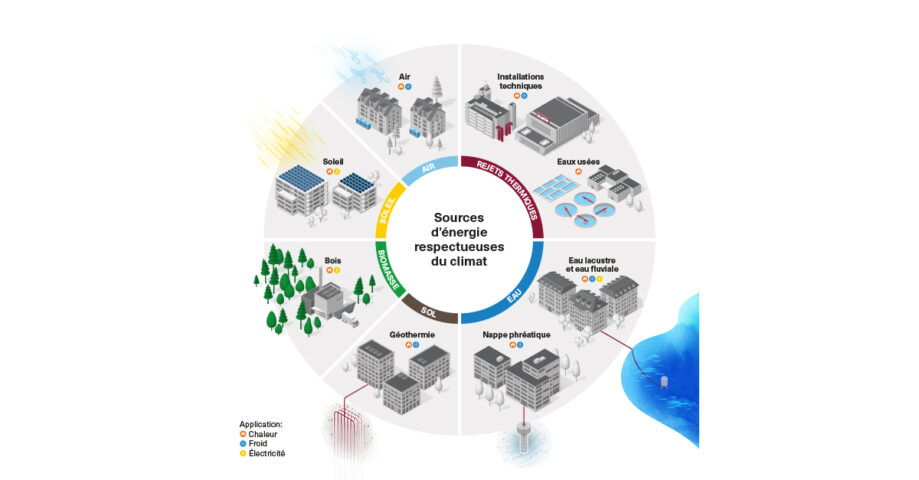
Heating and cooling from local, renewable sources Thermal networks are a good way of supplying sites or complexes with carbon-free or carbon-neutral local heating and cooling. They can be implemented and operated on different scales (for complexes, sites or entire neighbourhoods) and at different temperature levels. The energy for high-temperature networks largely comes from wood or the waste heat generated by waste incineration plants, while networks with low to medium temperature levels often use geothermal heat, lake and river water, ground water and waste heat (from computing centres, for example). The lowest operating temperatures are achieved by anergy networks or low-temperature networks, which also cool buildings in summer with the free cooling method. Various network types can be combined for greater efficiency (see Côté Parc and Greencity).
Harness solar power with a high rate of self-consumption A self-consumption association (ZEV) maximises the amount of energy consumed on site, which means that the photovoltaic installation is paid off quicker. What’s more, solar power is often cheaper than electricity from the public grid for ZEV participants. Local electricity communities (LEG), which are expected to be introduced in 2025 or 2026, enable solar power supply across properties and use the distribution grid.
Microgrids for security in planning and supply Site electricity grids can be used to supply complexes, sites or neighbourhoods with electrical energy. Microgrids, or smart grids fitted with smart components, incorporate both generators and consumers of electricity. They help to ensure grid reliability by selectively switching on consumers, charging storage systems or throttling production.
Charging infrastructure and electromobility – the new standard Electromobility is another important aspect of sustainable sites. To meet the growing demand for electric charging stations, it is a good idea to address construction of the charging infrastructure early on. Load management can help coordinate the electricity requirements of the charging station(s) with that of the other consumers in the building, and to regulate charging.
Storing energy for enhanced efficiency With the share of renewable energies set to increase in the future, energy storage will become increasingly important. For example, electric car batteries configured for bidirectional charging can be used for storage purposes. Stationary battery storage systems are another means of absorbing surplus solar power and making it available again as required. Thermal storage units can be charged with solar power that would otherwise have to be fed into the public grid. This helps prevent peak loads, and also means that heat generators can set up in smaller dimensions. Geothermal probe fields can absorb excess heat (e.g. from solar panels or waste heat) to regenerate the ground and to cool spaces.
Reducing emissions and cutting costs in the long term Continuous energy monitoring is a good way to cut energy costs and reduce greenhouse gas emissions in the long term. Continuous monitoring of the electricity, heating and cooling consumption values in a property, for example, can serve as a basis for adjustment. Energy monitoring is also important for ESG reporting, which is already mandatory for certain companies. By constantly reviewing consumption data and ensuring professional operation, companies have an opportunity to reach their efficiency and environmental targets and to create transparency in their dealings with various stakeholder groups.
‘Energy as a service’ The ‘use, don’t own’ principle is ideally suited to integrated energy solutions for entire complexes or sites. For customers, this not only reduces their investment of time, but also the financial risk, while ensuring a significantly higher security of supply. When a client chooses an‘energy as a service’ model, they outsource the planning, construction, operation and/or financing of the entire energy infrastructure for decades. This also ensures that the systems are operated reliably and efficiently.
Learn more in our new white paperentitled ‘Integrated energy solutions for sites and complexes’.
The two electricity suppliers to the town of Kriens, Energie Wasser Luzern(ewl) and Centralschweizerische Kraftwerke(CKW), are also becoming heating suppliers: according to a press release, the Kriens town council has decided in favour of the Kriens heating network consortium with ewl and CKW following a public tender for the construction and planning of a heating network.
The heating network will help to supply additional properties in Kriens, namely the Obernau, centre and Kupferhammer-Kehrhof areas, with thermal energy. According to the city council, this is in line with the goals of the city’s climate strategy to achieve net-zero greenhouse gas emissions from buildings by 2045.
According to the information provided, the winning project assures Kriens a high level of territorial coverage and provides for transitional solutions that guarantee the population a high degree of planning security for the changeover in their heat supply. CKW and ewl are planning their project with a broad mix of different renewable energy sources, including regional wood. According to City Councillor Maurus Frey, this will create an attractive offer “so that together we can take a step towards our climate targets”.
In the upcoming construction work in Hergiswaldstrasse, the renovation work is to be carried out at the same time as the pipeline construction for the heating network, if possible. The city and ARGE intend to announce further details once the legally prescribed deadlines have expired.
The population of Frauenfeld is showing great interest in participating in large solar power plants. According to the municipal energy supplier Thurplus , it was able to sell all shares in a new photovoltaic plant planned for the roof of Keller-Stahl AG within just over a month.
The plant consists of 300 modules on an area of 700 square metres. It has a capacity of 140 kilowatts/peak and is expected to generate 140,000 kilowatt hours of electricity per year. Two years ago, a similar plant was built on the roof of Keller-Stahl, which was also financed by private investors.
The new plant is Thurplus‘ seventh investment plant. These have a total area of 3500 square metres and a capacity of 690 kilowatt/peak. Thurplus customers can participate in solar power plants for as little as 300 Swiss francs. In return, they receive 100 kilowatt hours of electricity per square metre of solar area per year for 20 years.
Thurplus CEO Reto Lüthy sees the active participation of the city’s residents as confirmation of the company’s strategy. “For them, we are the key player in achieving the local energy turnaround,” he is quoted as saying in the press release. Thurplus is now looking for other solar projects that can be realised through the participation model.
The real estate developer Halter from Schlieren has won the tender for the development of the ewb site in Bern’s Ausserholligen district. A “sustainable, lively and diversely mixed working and living environment” is to be created there, according to a media release.
According to the statement, the Halter team’s plans call for three high-rise buildings on the site, which was previously used primarily for industrial purposes, between the Weyermannshaus sports and leisure facility and Europaplatz. One high-rise is to become the new ewb headquarters. In the other two buildings, the newly founded Viadukt cooperative plans to house 220 flats.
Public transport as well as pedestrian and bicycle traffic will be given priority over private motorised transport. This will be ensured, among other things, by three S-Bahn stops as well as trams and buses.
The electricity for the neighbourhood will come from photovoltaic systems on roofs and facades. Foundation piles, groundwater and waste heat sources are to be used for local heat and cold production and storage.
“The concept of the winning project gives us the opportunity to realise our new headquarters in a newly created environment that meets the high sustainability standards of the city of Bern and ewb,” said Cornelia Mellenberger, CEO of ewb, according to a media release at the presentation of the winning project on 3 April in the presence of Mayor Alec von Graffenried and other stakeholders.
All the competition projects can be viewed at the Forsthaus energy centre from 22 to 26 May.
Energie 360° can begin the conversion of its headquarters in Zurich Altstetten. The energy provider, which is majority-owned by the city of Zurich, is investing almost 28 million Swiss francs in the redesign and expansion of its offices into an open office landscape, the construction of a large-scale photovoltaic system and the optimisation of the building services, according to a media release.
According to the release, Energie 360° received the building permit in January. The construction site can now be set up from the end of March. The renovation work should be completed by late autumn 2024. In the meantime, the employees will move their workplaces to a temporary headquarters in Zurich Altstetten.
The building is already fully supplied with renewable energy and is energy-optimised. In the course of the conversion, it will receive additional solar panels designed by Jessenvollenweider Architektur from Basel. The office is reportedly a pioneer in the field of photovoltaic systems. In future, the modules will produce around half of Energie 360°’s electricity requirements.
“The additional photovoltaic systems on the façade and the extension on the roof turn the headquarters into a green power plant with an exemplary function and a strong external impact,” Jörg Wild, CEO of Energie 360°, is quoted as saying in the media release.
The company wants to offer its customers exclusively renewable energy by 2040. As a sustainable energy and mobility service provider, it therefore also has its own energy consumption in mind.
Climate change is causing summer temperatures to rise in Switzerland. This is particularly apparent in densely built cities with extensive sealed surfaces. Buildings and their surroundings must be designed to offer a comfortable quality of life in the climate of the future. ewz’s new white paper on ‘Climate-conscious building’ offers an overview of this topic. The publication serves as a knowledge base and inspiration for construction in the context of climate change and is free to download here.
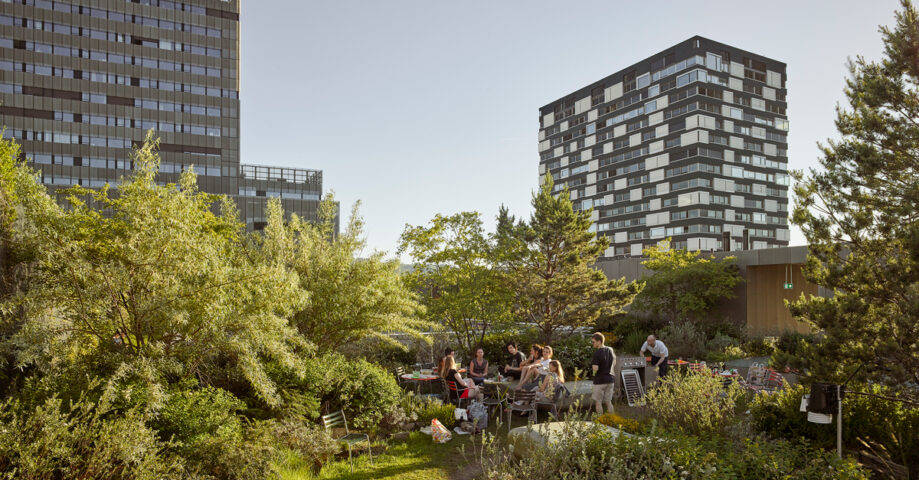
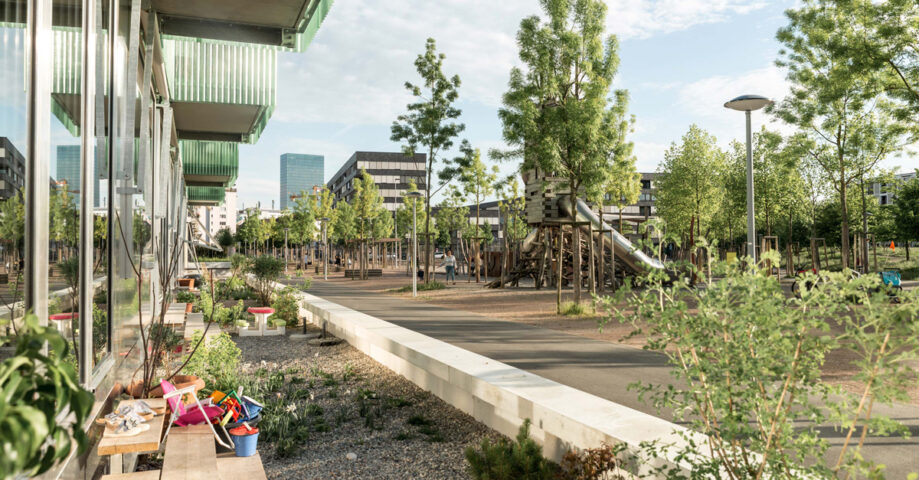
Focus on cities Green spaces with shady trees and cold air corridors intended to bring cooling are often either entirely absent or inadequate, meaning heat islands form in urban areas – where temperatures can be up to ten degrees higher at night than in surrounding areas. A catalogue of measures tailored to each specific location is needed to counteract this heat island effect. Important principles for eco-friendly urban planning and building include building position and sizing, green areas, facades and roofs, and shading.
Copyright Roland Bernath
Moderate window proportions It’s not just exterior spaces that need to be planned and built in a climate-conscious way, but also the buildings themselves. To keep interiors as cool as possible when external temperatures rise, parameters such as building orientation, window surface areas and the building’s retention capacity are critical, starting at the design stage. Solid ceilings and floors, for example, store heat due to their mass and the room temperature rises more slowly. Windows also need special attention. Large-scale glazing is beneficial in that it lets abundant natural daylight into the interior and keeps solar heat input high in winter. In summer, however, this heat is undesirable. It is therefore recommended to avoid floor-to-ceiling windows as far as possible, and to strike a balance between aesthetics and comfortable temperatures. A window proportion of up to 30 per cent in residential buildings and up to 40 per cent in office buildings is a benchmark.
Ventilation and cooling During long periods of hot weather, even a well-planned building heats up. It is extremely effective to dissipate the accumulated heat at night. This can be achieved by cross-ventilation, for example. Even better is to design a building that develops a chimney effect. Ventilation flaps in the façade – adjacent to the windows, for example – allow cool outside air to enter the interior and then discharge through an opening in the roof by way of the stairwell. Solutions like this entail no or minimal additional costs and work more efficiently than air conditioning units.
Unlike residential buildings, today’s office buildings are often equipped with cooling systems. This is due to the high internal loads produced by users and IT infrastructure, not to mention the high proportion of glass in the façades. There are office buildings whose requirements for cooling and heating energy are now already identical. By 2100, office buildings could require up to ten times more energy for cooling than for heating, depending on climatic developments. This would presumably increase operating costs significantly and make it more difficult to operate buildings economically.
An array of local energy sources Environmentally friendly passive cooling is ideal for meeting the basic cooling requirements of office and residential properties. Known as free cooling, there are various energy sources in Switzerland that are suitable for this.
Geothermal heat accessed via probes is often used. In winter, thermal energy from the ground is used as a heat source, while in summer it serves also for cooling, because required temperatures are significantly below room temperatures. Lake water is another particularly suitable energy source, as the many Swiss lakes provide a valuable thermal storage mass. Because their shores are often densely populated, the lake water can be efficiently used to supply numerous buildings.
Whether it comes from geothermal probes, lake water or other sources, it is crucial that cooling uses as little energy as possible. So it’s a good idea for building owners, investors and architectural specialists to discuss this issue with an energy service provider such as ewz as early as possible and see which options are feasible. This enables the construction of buildings that can offer high comfort levels even in the hot summers of the future, without placing an additional burden on the environment.
Environmentally friendly heating remains important It is important to bear in mind that the cooling energy needed for residential buildings is relatively low compared to the heating required. Decarbonisation of heat supply must therefore remain a priority in order to achieve net zero. Sustainable heating is not a problem nowadays, with various technically mature and economically attractive renewable heating systems available.
The ‘Climate-conscious building’ white paper provides in-depth information, detailed insights and a range of best-practice examples highlighting specific solutions for tackling this issue. The new white paper is free to download for all interested parties.
IWB takes a 30 percent stake in Sympheny . The young company based in Dübendorf has developed software that can compare possible energy solutions for buildings in a matter of seconds. IWB wants to use the knowledge gained from this in its own planning for the climate-friendly conversion of the energy supply.
“Affordable climate protection requires optimized energy supplies,” IWB introduces a post on LinkedIn about joining Sympheny. According to him, the company for energy, water and telecommunications in the canton of Basel-Stadt wants to support the spin-off of the Federal Materials Testing and Research Institute ( Empa ) with the fresh capital in the further development of their software. IWB writes that they are looking forward to working more closely with Sympheny co-founders Andrew Bollinger, Matthias Sulzer, Boran Morvaj and Julien Marquant.
According to a report on startupticker.ch, the software from the young company, which was only founded in 2020, has already been used in more than 20 major planning projects. Sympheny’s customers include “energy suppliers and general contractors from all over Switzerland,” it says. The energy planning software developed by Sympheny simulates the energy system to be examined with a digital twin. Algorithms and standardized geographic information data (GIS data) can be used to simulate the production, storage and consumption of energy.
With Polysun, Vela Solaris AG from Winterthur has developed a solution that should facilitate the planning of energy systems for buildings and neighborhoods. It makes it possible to simulate energy systems in these environments. In this way, possible energy systems can be displayed for an initial examination and compared with one another.
Based on Polysun, Vela Solaris and the building technology association suissetec set up the building technology calculator web app. The association is now making the solution available to its members and customers, as stated in a message .
“With the building technology computer, we enable our customers to take the step towards the digital conception of energy systems”, Lars Kunath, responsible for digital solutions at suissetec, is quoted as saying. He also emphasizes the “reliability of the simulation results and the high level of professionalism of Vela Solaris as a development partner”.
“The cooperation with associations as well as manufacturers and dealers represents a real enrichment for Vela Solaris”, says Angela Krainer, Managing Director of Vela Solaris. “We always strive to make our solutions available to as large a user group as possible”.
Stadtwerk Winterthur is consistently pursuing the conversion of the energy supply to renewable energies, explains the energy company of the City of Winterthur in a communication on the 2020 annual financial statements . In the year under review, Stadtwerk Winterthur installed 14 new photovoltaic systems, among other things. Since April, only biogas and CO2-compensated natural gas have been offered as basic gas products.
In order to promote the switch to district heating, the company also refrains from actively selling new gas connections. The basic supply of electricity has been offered exclusively through electricity from renewable energy sources since the beginning of 2020.
Stadtwerk Winterthur explains in the press release that biogas is currently around 13 percent of the total sales volume. This year the share is to be increased to 33 percent. The company also plans to install 100 new photovoltaic systems by 2025. In addition, it is planned to renew incineration line 2 of the waste incineration plant in the Grüze. This means that additional areas can be supplied with district heating, writes Stadtwerk Winterthur.
In the year under review, Stadtwerk Winterthur generated total sales of 239 million francs, slightly below the previous year's figure. The profit, on the other hand, has increased significantly to 33 million francs, explains the company. The communication cites very good purchase prices for electricity and gas as a background.
The Chroobach Windenergie project community consists of the two regional energy suppliers Elektrizitätswerke des Kantons Schaffhausen AG ( EKS ) and SH POWER . Your goal is to exploit the potential for wind energy on the Chroobach. In total, it wants to produce 25 to 27 million kilowatt hours of renewable electricity there per year, according to a press release . That is roughly twice as much electricity as is currently used by the population of the upper part of the canton each year.
In 2019, the federal government approved the cantonal structure plan for wind energy. With the establishment of the wind energy area on the Chroobach in the municipality of Hemishofen, he laid an important basis for the project. According to the information, the planning work has been successfully advanced since then. The next step is to apply for a partial revision of the land use planning to the municipality of Hemishofen. The project community is already in dialogue with the community to discuss the next planning steps.
The project community also wants the local population to participate in the new project. It should be able to participate in the wind farm with a wind share. The project group intends to publish further details on this "shortly".
IWB continues to grow with renewable energies. According to its own information, it joins the heating network of Agro Energie Schwyz AG ( AES ). Since 2006, it has built a modern network of over 100 kilometers in the Schwyz valley basin with state-of-the-art production facilities. A wood-fired thermal power station , an ORC system and a biogas system supply around 1,500 customers. The aim of AES is to build and operate a regional, independent and CO2-neutral energy supply in the region. The operator also attaches great importance to local added value.
IWB takes over shares from the largest shareholder, the Profond pension fund. Profond was looking for an investor with proven expertise in heat supply and a credible ecological focus. With this investment, IWB is following its strategy of decarbonising the heat supply, also outside the canton of Basel-Stadt.
"Agro Energie Schwyz is an innovative, rapidly growing company with a clear focus on renewable energy supply," explains IWB CEO Dr. Claus Schmidt choosing his company. "As the operator of the largest Swiss district heating network, IWB can contribute its vast experience in the heating network and at the same time expand its leading position in renewable heating."
Wir verwenden Cookies zur Unterstützung und Verbesserung unserer Dienste. Mit der Nutzung dieser Website erklären Sie sich mit der Verwendung von Cookies einverstanden. Weitere Informationen finden Sie in unserer Datenschutzerklärung.