Tag: Forschung

  • Green light for digitally manufactured concrete staircase

    Green light for digitally manufactured concrete staircase

    It is one of the big challenges in the upcoming NEST unit “STEP2”: a concrete staircase whose shape is reminiscent of a human spine. Although the unit is still in the planning stage, parts of the stairs have already been produced as prototypes. Because the unit pursues a great goal: only what has a future in the construction industry will be built. Together, the partners work consistently towards market readiness – and this is also the case with the staircase.

    “Over the past two years, the project team has jointly developed a completely new concept for the production of customised concrete components. This was only possible because the experts along the entire value chain worked together at eye level,” says Enrico Marchesi, innovation manager at NEST and project manager of “STEP2”, with conviction. The interdisciplinary project team was put together together together with the scouting and incubation experts of the main partner BASF. It is made up of the architectural firm ROK, which is responsible for the project management, the ETH Chair of Digital Building Technologies, 3D printing experts from the BASF subsidiary BASF Forward AM and the 3D printing company New Digital Craft, experts from the precast concrete manufacturer SW Umwelttechnik, engineers from the engineering firm WaltGalmarini and the experts from the Empa spin-off “re-fer”.

    Customised solutions
    The “STEP2” staircase impressively demonstrates how concrete structures can be realised with the help of computer-aided design and the latest 3D printing technologies. By using 3D-printed formwork, it is possible to create more complex shapes than with previous special formwork. At the same time, the amount of material required can be significantly reduced.

    The process enables customised concrete solutions that can be optimally adapted to the respective application and have a high level of detail. In addition, it also holds great potential in restoration, for example in the renovation of historical buildings.

    High complexity
    The design of the staircase comes from the ETH Chair of Digital Building Technologies. Based on this, the project team developed a complex, parameter-based formwork system for the individual steps, which is produced using 3D printing. “It was important for us to use digital fabrication in such a way that we can produce extremely filigree concrete elements. A key criterion for the system was the reusability of the formwork for the production of multiple steps. At the same time, we had to take into account the requirements of 3D printing and the material, as well as the conditions when filling the formwork,” explains Benjamin Dillenburger, head of the “Digital Building Technologies” team. In order to meet all these requirements, the exchange within the entire project team was of central importance.

    “In order for the 3D-printed formwork to be used for several stages, we used a suitable coating. In terms of sustainability, we opted for a material that can be detached from the formwork again. This is the only way we can ensure that the material is separated by type,” says Jörg Petri from “New Digital Craft”. He and the “Virtual Engineering” team from “BASF Forward AM” brought their years of know-how in the 3D printing field to the project.

    “For BASF Forward AM, the project is an important milestone in demonstrating that the materials used can withstand the high demands. It pays into our strategy to realise formwork using 3D printing as an alternative to conventional mould making,” says Anke Johannes, Director Sales Europe at BASF Forward AM. For the formwork material, the team chose Ultrafuse® PET CF15 filament because of its excellent properties for concrete formwork applications. In the end, the concept for manufacturing and assembling the formwork elements was ready.

    The endurance test
    Now the time had come to turn the stairs into reality. SW Umwelttechnik produced the steps in its own factory with the help of the formwork. Ultra-high-strength fibre-reinforced concrete was used as the material. “Our concrete allows for very thin, complex shapes that could not be realised with normal reinforced concrete. It’s great that we can demonstrate this so impressively with the staircase in the “STEP2″ unit,” says a pleased Klaus Einfalt, CEO of SW Umwelttechnik.

    The WaltGalmarini engineering office is responsible for calculating and assessing the statics. To check whether the calculated values correspond to reality, the steps were sent to Empa. There they were subjected to various load tests by Empa experts under the supervision of the engineering office. The first prototype consisting of three stages, which were all tested individually, largely fulfilled expectations and at the same time provided new findings for optimising the system.

    In the subsequent prototype, not only the statics but also the construction of the staircase system was put to the test. Three steps were threaded on top of each other and clamped together using “memory-steel”, an innovative prestressing technique developed by Empa spin-off “re-fer”. In the process, bars of the type “re-bar R18” were placed in predefined cavities and mechanically anchored. The pre-stressing was done by heating with electricity. Afterwards, further tests were carried out to analyse how loadable the steps are individually and the system as a whole. The result: the engineers deemed the overall system reliable.

    “I am very pleased that the staircase could not only convince on paper, but now also in practice. This represents an extremely important milestone in the project for us,” says Michael Knauss from ROK. With this “proof of concept”, the production of the final staircase can now take place – another important step towards the realisation of the NEST unit “STEP2”.

  • ETH Campus Hönggerberg continues to develop

    ETH Campus Hönggerberg continues to develop

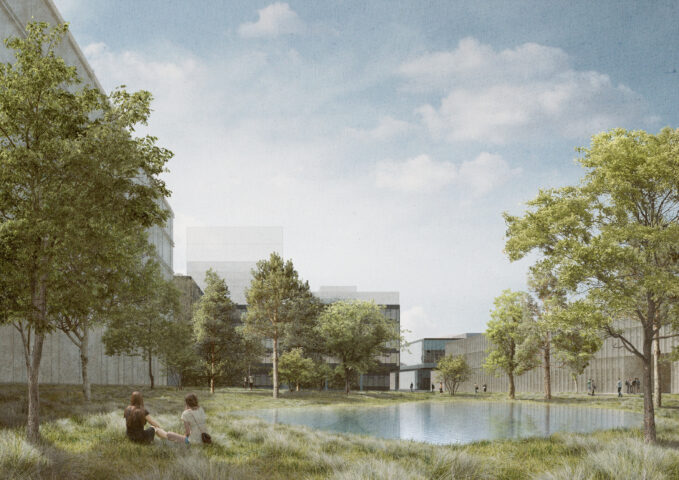
    The core mission of ETH Zurich is teaching and research as well as the transfer of knowledge to the economy and society. A modern infrastructure is a key factor in this. In order to cope with the increasing number of students and researchers and to create the necessary space for new research areas and innovative teaching methods, ETH Zurich is working on the further development of its main locations Zurich Centre and Zurich Hönggerberg. With regard to future space requirements, the Hönggerberg campus plays a central role. As a basis for its further development, ETH Zurich, together with the City and Canton of Zurich, has drawn up the master plan “Campus Hönggerberg 2040”. It describes the long-term spatial development goal. The structural densification and further development of the campus should preserve the current conditions of the site, such as the sensitive embedding in the local recreation area as well as listed buildings and gardens, and only take place in accordance with the emerging demand. In the next few years, a new building for quantum physics, a computer centre and a centre for student and entrepreneurial initiatives will be built, among other things. The central Wolfgang-Pauli-Strasse will also be renovated and upgraded as an important master plan element. Until the campus is fully developed, a conversion, new construction, extension or renovation of around a dozen buildings is planned, including four new high points. Various green areas are to be expanded. With the new master plan, ETH is building on the previous “Science City” master plan from 2005. ETH Zurich wants to develop its campus sustainably on various levels: ecologically, economically and socially. Among other things, it wants to take a big step towards climate neutrality and is focusing on energy supply without fossil fuels. A central element of this is the expansion of the current energy grid. Projects are also planned with regard to sustainable building, local climate, biodiversity as well as retention and drainage. For the further development of the campus, ETH Zurich is in dialogue with internal and external interest groups and involves selected people in a participatory manner on a selective basis.

    Attractive open spaces should ensure a high quality of stay and support biodiversity on the campus.

    In order to protect the surrounding landscape, the campus will be developed inwards and densified within the existing area. A green ring road around the campus symbolises this development and serves as a transition from the campus to the landscape. Attractive open spaces will ensure a high quality of stay and further promote biodiversity on the campus. The campus should be easily accessible by environmentally friendly means of transport such as public transport or bicycle. To relieve the local public transport system, a direct electrically powered bus, the so-called eLink, already runs between the Hönggerberg Campus and the Campus Zentrum for ETH members. Other local services such as bike sharing are available and are being continuously expanded. The current urban district character of the Campus is to be further strengthened. The central Wolfgang-Pauli-Strasse will become a lively and green promenade with versatile ground floor uses for the public. The central “piazza” will also gain in importance in the future and will invite people to meet and exchange ideas.

  • Confederation introduces new guide for location promotion

    Confederation introduces new guide for location promotion

    The Federal Department of Economic Affairs, Education and Research(EAER) has launched a new advisory platform for companies and other forms of organisation. According to a press release, the platform, which will be available from 16 February, is intended to support users in their search for business locations and funding. In doing so, the advisory tool currently being introduced expands the existing portals on the website of the State Secretariat for Economic Affairs(SECO).

    The multilingual location promotion guide that has now been announced brings together various promotion projects and is intended to be easily accessible via the internet for interested parties and applicants. The current range comprises 16 promotion instruments with around 50 different offers. The primary target groups are entrepreneurs, authorities at all federal levels and individuals. According to the EAER, the new guide should make Switzerland even more attractive and transparent as a business location. It can be accessed at promotion.guide.

  • NEST data center helps with heating

    NEST data center helps with heating

    The ECO-Qube project examines how the electrical and thermal worlds can be brought together with IT infrastructure. For this purpose, the waste heat potential of micro data centers for building heating is to be examined. The field tests are taking place in the newly installed data center in Empa ‘s NEST research building and at two other locations in Turkey and the Netherlands.

    ECO-Qube is designed for three years. After that, the team wants to provide guidelines for planners and operators of buildings. The project is supported by the EU funding program Horizon 2020. It brings together research and industry partners from Switzerland, Turkey, Spain, Germany, Sweden and the Netherlands. “Our goal is to reduce both the energy requirements and the CO2 emissions of small data centers by a fifth,” says Çağatay Yılmaz, Innovation Manager at the Turkish IT solution provider Lande and project manager of ECO-Qube, in an Empa press release quoted.

    With the help of big data structures and artificial intelligence, sensor data from the individual IT components is accumulated and combined with air flow simulations for precise cooling. At the same time, the computing loads would be distributed in such a way that the systems work as energy-efficiently as possible.

    The three data centers will also be integrated into the energy systems of the surrounding districts. If possible, they should be powered by renewable energy. “It is interesting for us to consider the micro data center not just as an electrical consumer, but as a dynamic component in the overall system,” explains Philipp Heer, head of the Energy Hub energy research platform at Empa.

  • Strengthen Switzerland as a location for innovation and expand the lead

    Strengthen Switzerland as a location for innovation and expand the lead

    The Swiss economy is characterized by an enormously high level of innovation and has been able to secure its leading position worldwide in recent years despite the strong Swiss franc. The vocational training system, the close interaction between research and business, start-ups and corporations as well as the high willingness to found new companies are the cornerstones of the recipe for success. The pandemic and the associated restrictions have put great pressure on the economy in all European countries.
    This is a valuable opportunity for Switzerland to further expand its lead in key areas through targeted funding with existing or new instruments.

  • Bauwerk Schweiz is under pressure

    Bauwerk Schweiz is under pressure

    Five Swiss experts have worked out why Switzerland is facing major challenges and how they can be tackled sensibly and efficiently. To this end, they have drawn up a so-called roadmap entitled “The Swiss structure is under pressure to adapt”.

    With its bird's eye view of the entirety of buildings, streets, supply and disposal networks, traffic and much more, according to a report by the Federal Materials Testing and Research Institute ( Empa ), the group wants to give a new impetus to the Swiss construction project that began ten years ago, and thus research and advance practice. Today Switzerland is facing massive challenges, for example due to climate change, natural hazards and population growth.

    Under the direction of Peter Matt, Fritz Hunkeler, Hans Rudolf Ganz, Laurent Vulliet, Professor at the Swiss Federal Institute of Technology in Lausanne , and Empa Deputy Director Peter Richner identified five segments that are particularly affected by the upcoming challenges: the building stock, the Infrastructures for freight and passenger traffic as well as drinking water and sewage networks. They rate the need for action and the potential for impact in passenger transport and buildings as particularly high.

    According to Richner, the group is pursuing several goals with the roadmap: “To show the importance of Switzerland as a structure for our society, to specify the need for action and, above all, to raise awareness that we can only develop a target-oriented strategy from an overall perspective. "

  • Park Ost: Entrepreneurship meets research

    Park Ost: Entrepreneurship meets research

    A lot of innovation is already happening three kilometers from the city center of St. Gallen. This is where Empa is located, the ETH Domain's interdisciplinary research institute for materials science and technology. Right next to it is a 35,000 square meter commercial property, where a community of start-ups, SMEs and technology-oriented companies has developed over the past ten years. The Startfeld association, a network for innovations and start-ups, is also located here. It provides managed premises – event rooms, meeting rooms, meeting points, a makerspace and a co-working space. There is also a publicly accessible canteen.

    The Switzerland Innovation Park Ost aims to establish itself in this area by 2022. There are currently reserves of 9,000 square meters of commercial and industrial building land here. With a standard construction method of 18 meters high, this results in development potential of almost 18,000 square meters of usable space. For an initial expansion phase, there are plans to initially have around 6500 square meters of usable space. It is expected that this could be achieved by 2025. Two further expansion stages can be implemented as required.

    The areas that are already available are suitable as clean rooms, laboratories and rooms for industrial production. Most of the available spaces have plenty of natural light and are therefore also suitable as offices, meeting rooms or for events.

    Park Ost is to become a globally recognized center where companies in Eastern Switzerland promote innovations in selected areas on the basis of research by Empa, the St. Gallen Cantonal Hospital and the University of St. Gallen. The focus of innovation at Park Ost is dedicated to the development of technologies for health and medical technology as well as in the machine, electrical and metal industries. With regard to these technologies, he also deals with digitization – in particular artificial intelligence and the “Internet of Things”.

    How does Park Ost actually create synergies between business and research? Companies can bring their projects to Park Ost. Depending on the scope of the projects, they also send employees to the park's location. The research institutions can also send employees to the park and thus bring research expertise into project operation. You support the project team of a company or work as your own project team.

    Park Ost is run by a private stock corporation. Switzerland Innovation Park AG was founded at the beginning of September 2021. She gives herself ten years to make the Innovationspark Ost financially self-sustaining.

    An external location of Park Ost is RhySearch in Buchs. A campus is planned there, where the University of Applied Sciences in Eastern Switzerland, the Buchs vocational and advanced training center and the Alpine Rhine Valley Precision Industry Center are located. The Buchs campus has 8,000 square meters of industrial building land reserves.

  • Empa is researching underground storage

    Empa is researching underground storage

    Empa is setting up an experimental, seasonal energy storage facility under its new research campus in Dübendorf, the research institute informs in a message . The waste heat from ventilation and laboratory equipment is to be stored in the ground below the area. The aim is to supply the entire Empa area with energy, writes Empa.

    A geothermal probe field with a temperature gradient serves as a heat store, in which 144 geothermal probes anchored up to 100 meters deep in the ground are installed. With their help, the Empa researchers want to set an optimal mix between temperature, efficiency and energy storage. The temperatures in the underground storage can fluctuate by up to 50 degrees in the center and 10 degrees in the peripheral areas. At a depth of 100 meters, the storage system works particularly effectively and loses very little heat to the environment, explains Empa.

    The research institute can use the heat storage system for ten years, primarily for its own research purposes. On the one hand, an underground storage facility is very effective, but due to its large mass it is also sluggish, according to the press release. The researchers assume that it will take about three to four years to set the final operating temperature.

  • Innovationspark Dübendorf is one step further

    Innovationspark Dübendorf is one step further

    The airport area in Dübendorf is to develop into a lively urban quarter in the coming years. A center for innovation, research and jobs is to be created. The aviation infrastructure is to be secured as a strategic reserve.

    The Zurich Government Council has now submitted a synthesis report to the Cantonal Council, as stated in a communication . This was drawn up by the federal government, the canton, the local authorities and other parties involved. It forms the basis for the further development of the area. It is now to be advised first by a special commission set up by the Cantonal Council.

    The government council intends to submit three proposals to the cantonal council by spring 2022. These deal with the creation of planning rights, a revision of the structure plan and a planning loan.

  • NEST office unit demonstrates potential for circulation

    NEST office unit demonstrates potential for circulation

    A new unit went into operation on Tuesday in the NEST research and innovation building of the Federal Materials Testing and Research Institute ( Empa ) and the ETH Domain's water research institute ( Eawag). As Empa in a message emphasized the office module called is Sprint was completed in just ten months. This demonstrates that building with reused materials and components is “a viable alternative to building with new material”. It “meets the market requirements for flexible and fast building”.

    The entire unit follows the so-called design for disassembly approach. If necessary, the flexible partitions could be dismantled. This enables flexible use of space and the recycling of built-in materials.

    The still existing skepticism of the construction industry about the reuse of materials is unjustified. Contrary to initial concerns about the tight schedule, "we were even able to find the re-use materials faster than new material," is quoted from Kerstin Müller, architect and business service member at the Basel construction office in situ , which planned the sprint unit.

    In addition, reuse is not yet cheaper given the current market situation. However, that will change as soon as a competitive market has developed, believes component hunter Oliver Seidel from in situ. In addition, there is a need for CO2 taxation, "which relieves the cost of new materials and used materials in order to be able to quantify the ecological added value."

  • ETH model paves the way for the energy transition

    ETH model paves the way for the energy transition

    At the Energy Science Center ( ESC ) of the Swiss Federal Institute of Technology in Zurich ( ETH ), an interdisciplinary research group is working on the Nexus-e platform. It is intended to help answer the fundamental questions that the energy transition that has been adopted will raise for politics, business, science and society now and in the years to come. The project is supported by the Federal Office for Energy .

    As a video from ETH shows, Nexus-e is supposed to map the entire complex Swiss electricity system. “In order to find solutions for the future, you need more flexibility,” project manager Marius Schwarz is quoted in an article by the ETH. "With Nexus-e we want to provide a platform with which we can model different scenarios and thus facilitate the transformation of the energy sector in the coming decades."

    This transparent platform is supposed to be a kind of toolbox. Its flexible modules are intended to represent the Swiss economy as a whole and the electricity market as well as the electricity market, investments in decentralized and centralized energy systems, network security and network expansion.

    It also serves as a modeling infrastructure that is continuously used in research and teaching. This will make it a modeling platform for interdisciplinary research within the university. But it should also be used outside as a test environment and further developed. "We are therefore open to new collaborations in the academic field, but also with political decision-makers or representatives from industry," said ESC director Christian Schaffner.

  • Empa steel adhesives last 50 years

    Empa steel adhesives last 50 years

    In the large test laboratory of the Eidgenössische Materialprüfungs- und Forschungsanstalt ( Empa ) in Dübendorf, a test has been running for 50 years to examine the long-term behavior of bonded steel reinforcement on a concrete beam. In this long-term test, which is unique worldwide, according to the media release , several reinforced concrete girders were reinforced with steel lamellas glued to the underside. One of the girders, which has been subjected to 87 percent of its predetermined breaking value for 50 years, has so far held out without any problems.

    “After 50 years below 87 percent of the average breaking load, the epoxy resin bond shows no weaknesses. This means that bonded steel lamellar reinforcements have passed the long-term test, ”says engineer Christoph Czaderski, who has overseen the test over the past few years.

    According to the announcement, the carrier is one of originally six identical specimens, all of which were subjected to different tests. The five other reinforced beams fell victim to fairly successful static fracture and dynamic fatigue tests that exceeded their load limits. The aim of the tests was to find out how well epoxy resin works as an adhesive for attaching a steel lamella to a concrete beam. According to Czaderski, the long-term test shows "practically no shifts" in the adhesive joint after 50 years.

    What was new territory at the beginning of the test is now state of the art. The process is important because it allows older buildings to be reliably reinforced instead of being torn down and replaced by new buildings.

    Empa's “Engineering Structures” department has been developing and researching new, simple and inexpensive reinforcement methods with modern materials such as epoxy resins, carbon fiber-reinforced plastics and shape memory alloys for many years.

  • Empa presents three innovation awards

    Empa presents three innovation awards

    The Eidgenössische Materialprüfungs- und Forschungsanstalt ( Empa ) has honored three of its groundbreaking projects and achievements with the Empa Innovation Award. The prize, endowed with CHF 5,000, has been awarded every two years since 2006. In doing so, Empa honors the efforts of its researchers to build further bridges between science and business with applied, market-oriented research.

    According to a press release by Empa, the first prize goes to the novel tissue adhesive technology Nanoglue. It was developed by researchers at the Particles-Biology Interactions Laboratory at Empa in St.Gallen in collaboration with the Nanoparticle Systems Engineering Lab at the Swiss Federal Institute of Technology in Zurich . Their radically new approach uses the wound-healing properties of inorganic nanoparticles. The inexpensive materials could be manufactured on a large scale. The “unique technology” is now being brought to market maturity by the Zurich start-up anavo medical , which has yet to be founded.

    The transparent face mask from the Hello Mask project by Empa and the Swiss Federal Institute of Technology in Lausanne ( EPFL ) also received an award. It consists of a fine membrane with a pore size of around 100 nanometers. This membrane allows air to pass through, but holds back viruses and bacteria. “The fully see-through mask was developed primarily with the aim of improving the relationship between caregivers and patients,” says researcher Joshua Avossa. The Geneva start-up HMCare has been working on the market launch of the Hello Mask from Empa and EPFL since 2020. It should be available in mid-2021.

    The software platform Urban Sympheny for planning sustainable energy systems is the third winner. The Empa spin-off of the same name, based in Dübendorf, helps planners to identify optimal solutions for their location and their customers. The goal is energy and cost efficiency. The innovative platform was developed in Empa’s Urban Energy Systems department. Last year Venture Kick awarded Urban Sympheny 50,000 francs.

  • Association for sustainable building is founded

    Association for sustainable building is founded

    The newly created Association for Sustainable Building Biological Building (VNBB) aims to make the construction industry more sustainable and climate-friendly. To this end, knowledge and skills are to be promoted and integrated into vocational training.

    As stated in a press release, the non-profit organization was initiated by Dr. Thea Rauch-Schwegler from the Baubioswiss Association over the past few years. Timber construction Switzerland , building envelope Switzerland , JardinSuisse , Lignum – Holzwirtschaft Schweiz and the Swiss Association of Painters and Plasterers have joined as founding members. Its new office in Wallisellen is also the seat of the VNBB. The management of the VNBB office is advertised. New club members and partners are expressly welcome.

    In 2019, the examination regulations for the advanced specialist examination for experts in healthy and sustainable building were recognized by the State Secretariat for Education, Research and Innovation. In this way, according to the VNBB, “the gap in higher vocational training in the field of sustainable building can be closed”. The first preparatory course for the diploma will start in 2022. At the same time, professional associations have also recognized the importance of the topic and decided to tackle the issue of sustainability in vocational training together.

  • The Zurich economic area impresses with its access to talent

    The Zurich economic area impresses with its access to talent

    The Greater Zurich Area offers companies access to a large pool of first-class talent. Sonja Wollkopf Walt, CEO of the location marketing organization Greater Zurich Area ( GZA ), describes this as one of the most important attractions of the location in an interview with The Place Brand Observer ( TPBO ). Switzerland is listed as the world champion for innovation in several rankings. This has also been recognized by companies such as Google, IBM, Disney or Biogen, which have set up their research locations in the greater Zurich area.

    First-class technology, Swiss reliability and stability meet in the Greater Zurich Area, emphasizes Wollkopf Walt in an interview. Especially against the background of global trade conflicts or the corona pandemic, this is an important added value for companies.

    Despite the negative effects of the corona pandemic as a whole, it has also brought about new developments at some companies or accelerated research activities. Wollkopf Walt highlights, for example, HeiQ . The spin-off from the Swiss Federal Institute of Technology Zurich ( ETH ) is developing a technology that can protect textiles against viruses. Fabrics treated with the technology can block the corona virus by 99.9 percent.

    The costs in Switzerland are higher than in many European countries. At the same time, however, it is fair to say that the price-performance ratio in the Zurich economic area is good, according to Wollkopf Walt. Workers in Switzerland have one of the highest productivity levels in the world, she adds.

    When it comes to start-ups, the three most important factors that are necessary for a flourishing start-up ecosystem are present in the Greater Zurich Area: talent, capital and customers. Wollkopf Walt also points out that 2019 was a record year for start-up investments. In addition, four start-ups from the Greater Zurich Area have achieved unicorn status – that is, they are valued at more than 1 billion dollars.

  • Discounts for research strengthen locations

    Discounts for research strengthen locations

    "With the Swiss tax reform and AHV financing (TRAF), instruments for tax relief for research and development activities were introduced at the beginning of 2020," explains BAK Economics in a press release . The economic research institute has examined the effects of these concessions on the tax burden of companies in the individual cantons.

    According to the results, they reduce the effective average tax burden of a company on the Swiss average from 13.5 to 12.2 percent, explains BAK Economics. Very research-intensive companies could even reduce their exposure by an average of 4.3 percentage points to 9.2 percent. For the cantons, the benefits for spending on research and development (R&D) represented an internationally accepted substitute for the tax privileges abolished by the TRAF in addition to promoting innovation.

    With the flexible implementation of the requirements by the cantons, the ranking of the cantons in the tax burden for very research-intensive companies has shifted, explains BAK Economics. The low-tax cantons of Nidwalden and Obwalden continued to occupy the top positions here. "However, some high-tax cantons with a generous design of the R&D instruments can significantly reduce their burden," writes BAK Economics.

    Specifically, “the bottom three in ordinary taxation”, Bern, Zurich and Aargau, “for companies with very high R&D intensity towards the middle of the ranking”. The canton of Geneva has the highest average tax burden for companies with high R&D expenditure.

  • Graubünden luxury residences should be vacant less often

    Graubünden luxury residences should be vacant less often

    The University of Applied Sciences of Graubünden has examined how the added value of luxury residences that are often vacant can be improved. In this context, the Institute for Tourism and Leisure ( ITF ) investigated the question of how their owners can become convinced renters. In Graubünden they have been “neglected”, writes the FH in a press release . However, because the trend is moving from overnight stays in a hotel to one's own holiday home, this clientele should not be neglected.

    However, the existing data is too thin for a needs analysis. Therefore, in their study, the researchers examined the willingness to rent similar prestige properties. In the global yacht charter market, they identified high administrative hurdles as well as psychological motives as an obstacle to renting out. These include encroachments on privacy and limited flexibility in personal use.

    The most important finding from this needs analysis, however, is "that both the rental of superyachts and luxury residences are a matter of trust". So that the potential of the often vacant luxury properties in the high-priced Alpine destinations can be used, "all tasks that arise must be managed by a coordinator role". It is your job to guarantee that all service participants work together as smoothly as possible. “The rest then comes naturally, because satisfied landlords generate satisfied tenants,” says the message.