CSS is planning to start construction work on the extension of its headquarters on Tribschenstrasse in Lucerne in the fourth quarter of this year. The building application will be submitted at the beginning of April, the Lucerne-based health, accident and property insurer is quoted as saying in a report in the Luzerner Zeitung newspaper. The new building and renovation of the commercial building acquired by CSS in 2015 should be completed by the end of 2027.
CSS intends to use almost all of the space in the new building and the commercial building for its own needs. A bistro is only planned on the ground floor of the commercial building. The amount of the construction costs is not being communicated by CSS, at least not at the moment.
The concept for the extension of the CSS headquarters is based on a design by Diener und Diener Architekten. The Basel-based architectural firm won a competition organised by CSS against nine competitors. The winning Lambris design envisages that the commercial building, which is classified as worthy of protection, will be enclosed by the extension.
Despite moderate price trends compared to the rest of German-speaking Switzerland, residential property in the Basel region remains in demand. Prices are rising significantly in rural communities in particular, which is increasingly prompting potential buyers to extend their search radius. According to Marco Pirelli from Basellandschaftliche Kantonalbank, the fall in mortgage interest rates over the past two years has also fuelled demand. However, this has been accompanied by growing affordability problems. While prices for detached houses have remained stable, condominiums have risen slightly. The result is a 35 per cent increase in mortgage enquiries within one year.
Examine financial options at an early stage Pirelli advises prospective buyers to consider financing at an early stage. “The choice of mortgage products and terms varies from person to person. Clarifying the financial scope with the bank in good time creates planning security.” For many people today, this is crucial in order to be successful in the tense market environment.
Despite housing protection, prices are rising The rental market in Basel is also showing signs of continuing inflation. Fabian Halmer from Holinger Moll Immobilien AG points to structural causes such as an outdated building stock with a high need for renovation. Despite housing protection, rents are continuing to rise, particularly in Basel-Stadt, where 84 per cent of the population live in rented accommodation. Although the situation is not as tense as in Zurich or Geneva, the low vacancy rate of 0.7 per cent signals an acute housing shortage.
Bottleneck due to too few building applications The number of building applications submitted in the canton of Basel-Stadt is particularly alarming. While an average of 784 building applications were recorded each year from 2014 to 2020, the figure fell to just 190 between 2021 and 2023. Halmer believes the new Housing Promotion Act is one of the causes. It protects existing tenants, but hinders new construction projects and makes it more difficult to move in or relocate. The resulting supply bottleneck is likely to lead to further increases in rents.
Need for reform in legislation and planning The experts agree that without targeted adjustments to the Housing Promotion Act and accelerated authorisation procedures, the housing market in Basel is at risk of coming under further pressure. Development sites such as Klybeckplus or Dreispitz Nord could provide relief. Provided they are pursued consistently. A sustainable housing policy must not only focus on protecting existing properties, but also actively consider future growth.
With a height and width of 400 metres each, the Mukaab will surpass the Empire State Building in New York almost twenty times over. Construction work has now begun in the desert state and the megaproject is due to be completed by 2030. The cube will offer a variety of flats, shops and leisure facilities, strengthening Riyadh’s position as an up-and-coming tourist metropolis. Saudi Arabia is investing 50 billion dollars in the north-west of the capital to create a new urban landscape.
Virtual reality and artificial intelligence The outside of the Mukaab is to be equipped with virtual reality technology to transport visitors to fascinating landscapes. Inside, artificial intelligence will create holograms and simulations that project different places and times at breathtaking scale. The building will thus become a kind of digital adventure park that will attract visitors from all over the world.
Prestigious projects with challenges Mukaab is part of Crown Prince Mohammed bin Salman’s “Vision 2030”, which aims to turn Saudi Arabia into a global tourist destination and business centre. The city of Neom and the linear megaproject “The Line” are also part of this ambitious plan. However, the plans for “The Line” have already been scaled back considerably due to logistical and financial hurdles. Instead of 170 kilometres, the structure will only be 2.4 kilometres long by 2030. It is uncertain whether it will ever reach the planned capacity for 9 million people.
The Jeddah Tower – a long construction history Another mega project, the Jeddah Tower, was originally planned to be the tallest building in the world. After years of delays, the height was reduced from 1600 metres to 1007 metres. Construction began in 2013, but after a five-year break, the project is progressing slowly. The Jeddah Tower could be completed in 2029 at the earliest and become the new record holder.
Criticism and controversy The Mukaab has already caused controversy. The design of the giant cube reminds many of the Kaaba in Mecca, the central shrine of Islam. This similarity is causing criticism in the conservative kingdom, as some citizens consider the construction to be disrespectful.
It remains to be seen whether the Mukaab project will be realised on time or, like other Saudi megaprojects, run into difficulties. However, the size and ambition of these construction projects show the transformation that Saudi Arabia is undergoing. A transformation that is set to turn the country into a global tourism and business centre and will extend far beyond the oil era.
Mobimo has laid the foundation stone for the Hofhaus and Hallenhaus buildings in Aarau’s Aeschbach neighbourhood with representatives from the authorities and its project partners, according to a press release. As part of the overall Torfeld Süd development area, the next stage in the expansion of the neighbourhood, which was revitalised in 2019, is thus being realised.
Based on plans by Baumberger Stegmeier Architekten from Zurich, 126 rental flats with 1.5 to 5.5 rooms will be built there. The courtyard house is being realised as a timber construction with a garden courtyard in a future-oriented, ecological design. According to Mobimo, the hall building stands out positively in terms of sustainability and grey energy because as much of the existing façade of the former Hall 5 has been retained as possible. It will serve as the ground floor for the extension of the historic building.
Completion is planned for autumn 2026, with occupancy scheduled for the second quarter of 2026. Marketing will begin in the third quarter of 2025. The Aeschbachquartier will then have a total of around 260 rental and owner-occupied flats. It will also offer around 4600 square metres of commercial space for 1400 people working there.
Timber buildings are experiencing an upswing in Switzerland. With their sustainability and aesthetics, they are becoming increasingly popular, even for multi-storey buildings. But how can it be ensured that these structures can withstand the forces of wind and earthquakes? This is a question that occupies building researchers, especially when planning timber buildings up to 75 metres high. This is because the right bracing and supporting structures must be in place to ensure that timber buildings remain stable even under extreme conditions.
Research in this field has made considerable progress in recent years. One particularly exciting tool is the shaker, a two-tonne device that is used in Empa’s largest laboratory in Dübendorf. The shaker simulates earthquakes and strong winds by causing building models to vibrate. In this way, the vibration behaviour of the buildings is examined under real conditions and the models for calculating stiffness are refined.
The shaker in action For the open day on 14 September 2024, the shaker will be demonstrated in Empa’s construction hall in Dübendorf. This is not just about scientific research – visitors will get a direct insight into the work of the engineers. René Steiger, Pedro Palma and Robert Widmann, structural engineers at Empa, will give an impressive demonstration of how the shaker causes a structural model to vibrate, thereby analysing the behaviour of the weight and stiffness distribution.
This research is of great importance, as ever taller timber buildings are being erected in Switzerland. While most buildings remain in the 4- to 5-storey range, projects with more than 20 storeys demonstrate the potential of timber as a building material. However, ensuring the stability of such buildings requires precise calculations and practical tests such as those carried out with the Shaker.
Complex requirements for timber construction The challenge with multi-storey timber buildings lies not only in the load-bearing capacity of the walls, but also in the balance between rigidity and flexibility. Whilst thicker components and additional load-bearing walls are often seen as a solution, they can lead to increased costs. Sometimes it is even more favourable if a structure reacts flexibly to earthquake shocks to a certain degree. These nuances must be taken into account in the computer calculations, and this is precisely where the shaker provides valuable data from practice.
The experiments in the construction hall and on real buildings, such as in Oberglatt in the canton of Zurich, show how the supporting structure gains rigidity during various construction phases. For example, the researchers were able to observe exactly how the load-bearing capacity of the buildings changed when load-bearing walls, non-load-bearing walls and windows were installed.
Practical data for planners and architects For a long time, planners relied on mathematical approximations to determine the dynamic properties of timber structures. These values were often based on tests from Japan and North America, but due to different building regulations and requirements, they are not readily transferable to Switzerland. This is where the work of the Empa researchers comes in: The shaker and the measurements on real buildings provide precise data on stiffness and damping that is specifically tailored to local building requirements.
This provides construction engineers and architects with reliable information to optimise their planning and use wood as a material efficiently and sustainably. The knowledge gained will help to further develop standards and guidelines and strengthen timber construction as a competitive solution for multi-storey buildings.
Wood as a building material of the future Empa’s research results show that wood has enormous potential as a building material for multi-storey buildings. The use of the shaker provides construction engineers and architects with practical data that makes it possible to design timber buildings more safely and efficiently. By combining modern technology and scientific expertise, Empa is making a decisive contribution to advancing timber construction in Switzerland and establishing it as a sustainable alternative in the construction industry.
The French architecture firm KOZ is one of the main architects commissioned to build the Olympic Village in Paris. For the shading in the Belvédères neighbourhood of the village, KOZ relied on the Thurgau-based company Griesser. The internationally active developer of solar shading products for buildings has equipped various buildings in Belvédères with three different solar shading solutions.
On the one hand, 265 slat blinds of the Lamisol 70 model were used, explained Griesser in a press release. A total of seven units of the Grinotex III slat blind model were installed. The sun protection was completed by 108 Tradi PUR roller shutters. Together, the sun shading solutions create a pleasant indoor climate and help to save heating and cooling energy.
“Griesser has prevailed with its quality products,” the architectural firm KOZ is quoted as saying in the press release. “In addition, the solar shading products have already proven their worth in other projects.” For the Olympic Village, KOZ decided in favour of a metallic pink shade of slat blinds and roller shutters specially developed by Griesser for the project.
At the Regensberg Bridge in Zurich Oerlikon, SBB is planning an office building around 40 metres high with public uses on the ground floor. The winning project, developed by “Team Esch Sintzel”, makes skilful use of the challenging site shape and topography. It also achieves a high degree of energy self-sufficiency, which makes it particularly forward-looking.
Focus on efficient use and sustainability The planned high-rise building will be 80 per cent energy self-sufficient. Thanks to advanced building technology, passive cooling and solar cells on the roof and façade, the building will be able to cover most of its own energy requirements. This fits in perfectly with SBB’s ambitious climate targets.
Eight office floors and public uses on the ground floor The new building is being realised as a nine-storey commercial building, with flexible floor plans that are ideal for services, health and education. The ground floor will be enlivened by catering and retail spaces, while the outdoor space concept with a near-natural track level and barrier-free urban level will ensure a high quality of stay.
Public exhibition of the competition entries The competition entries will be exhibited from 12 to 15 July 2024 on the 8th floor of the Franklinturm at Hofwiesenstrasse 349 in Zurich-Oerlikon. Interested parties can visit the exhibition from Friday to Sunday from 2 pm to 6 pm and on Monday from 11 am to 3 pm.
Framework plan for Zurich Oerlikon railway station south-west development site The basis for the project is the “Zurich Oerlikon railway station south-west development site” framework plan drawn up in 2012 together with the City of Zurich. This defined an eight-storey building to the west of the Franklin Tower in terms of urban planning. The building permit requirements have been met and construction is scheduled to begin in 2027.
The planned expansion of the YOND Campus to include the YOND.02/03 buildings with a total usable area of around 31,000 m2 takes up the concept of YOND.01 and adapts it more specifically to the requirements of manufacturing companies. The focus is on providing robust and efficient buildings, flexibility through large, divisible areas and optimised logistics. These adaptations include efficient delivery, loading ramps, a logistics-friendly basement and advanced vertical access to the building. In addition, mezzanine floors made of wood enable flexible use of space that can be adapted to the individual needs of the companies.
At the same time, the historic laboratory and workshop building at 203 Albisriederstrasse is being converted into a centre for small and creative businesses. The planned renovation and extension of one floor are aimed at preserving the history of the site and creating a workspace for the creative industries. The transformation of the boiler house into a vertical garden and the establishment of a bistro on the ground floor emphasise the ambition to create a campus that harmoniously combines quality of life and the world of work.
The publicly accessible catering facilities along Albisriederstrasse and in the adjacent park will establish the site as an attractive location for businesses and visitors. The use of the ground floor will position the YOND Campus as a place for socialising and contribute to the activation of the space. This extension will create a forward-looking space that supports both the dynamic requirements of modern companies and the need for social interaction and creativity.
The ambitious project envisages the construction of new buildings for medical care, education and research as well as an overall upgrading of the university area. The redevelopment includes the former underground drinking water reservoir on Rämistrasse at the heart of the area, which will be converted into a café with indoor and outdoor seating. This project, overseen by SQUADRAT Architekten, integrates parts of the historic water halls and creates an inviting public space.
Another highlight is the redesign of Rämi and Gloriastrasse, which will offer more space for pedestrians in future and reduce noise levels through traffic calming measures. The aim of redesigning these axes is to improve mobility and at the same time increase the quality of life.
The FORUM UZH, a new university building opposite the main UZH building, will house teaching and research on nine floors and will also include a canteen and shops. The building is due to be completed by the end of 2029 and will provide a modern workplace for around 6,000 students and staff.
Preliminary work has already begun on the construction of the University Hospital’s new MITTE campus. This renewal of the medical infrastructure will revolutionise patient care and set the course for the medicine of the future.
These and other projects in the HGZZ underline Zurich’s commitment to education, research and healthcare. They not only contribute to urban development, but also promote scientific excellence and strengthen Zurich’s position as a leading centre for innovation and knowledge.
At a time when sustainable energy management is becoming increasingly important, the unused waste heat from IT systems in buildings represents a considerable waste. Hospitals, universities and office complexes have extensive IT infrastructures that not only consume energy but also produce a significant amount of heat that remains largely unutilised. The Horizon Europe project HEATWISE addresses this challenge and brings together twelve research and industry partners from eight countries to develop innovative solutions for utilising this waste heat.
The project, which was launched in early 2024 and will run for three years, is funded by the European Union under Horizon Europe and by the Swiss State Secretariat for Education, Research and Innovation. A key element of HEATWISE is the development of predictive control algorithms that not only link the IT infrastructure and building technology, but are also designed to enable energy-efficient, low-carbon and cost-effective operation.
One example of the practical realisation of these goals is Empa’s “NEST” research building in Dübendorf, which serves as a real pilot plant. Here, the waste heat from a microcomputing centre is already being successfully used for heating, supported by innovative cooling technologies such as the “on-chip liquid cooling” system from Israeli project partner ZutaCore. This enables optimum heat recovery and the utilisation of the recovered heat for high-temperature-intensive applications, such as hot water supply.
For specialists from the property and location development sector, HEATWISE not only offers insights into pioneering heat recovery and energy efficiency technologies, but also concrete application examples that show how IT infrastructures and building technology can be used synergistically for more sustainable energy management.
At a time when the fight against global warming and the housing shortage is becoming increasingly urgent, everyone working in the construction sector is more challenged than ever. The building stock is responsible for a significant proportion of CO2 emissions and the need for new housing is growing faster than ever before. It is therefore essential to act quickly.
Despite numerous initiatives and political initiatives, progress in solving these problems still seems to be too slow and the fronts are becoming increasingly hardened. Bernhard Lanzendörfer argues in favour of a joint search for quick, innovative, affordable and social solutions instead of getting lost in ideological standpoints.
One example of an ideological standpoint is the petition by the Countdown 2030 association, which vehemently opposes the demolition of buildings. Bernhard Lanzendörfer argues that rigid ideas such as these will not solve the problems and calls for a differentiated view from a structural, ecological and social perspective.
In view of the housing shortage, a substantial densification of living space is often only possible through the construction of replacement buildings. The building-within-existing-buildings approach quickly reaches its limits here, especially when it comes to modernising and adding storeys to existing buildings.
In order to promote ecological and social construction, Lanzendörfer suggests that politicians should create concrete incentives. This could be done, for example, through rewards for the ecological upgrading of buildings or a higher utilisation rate for ecological flagship projects.
In view of rising population figures and increasing urban sprawl, it is essential to build upwards. Although this may meet with resistance, according to Lanzendörfer it is the simplest solution for making better use of every square metre.
It is important not to hinder innovative concepts with ideological barriers. The construction industry has already made great progress in the development of climate-friendly products, and politicians are also supporting the use of environmentally friendly building materials through new regulations in environmental protection legislation.
MAG is set to realise its first international project in Switzerland. The Dubai-based luxury property developer is planning the Stabio Garden Living by Keturah project in the municipality of Stabio in the Ticino district of Mendrisio. MAG will be working with the globally active A++ Group, based in Massagno TI, which MAG describes in a press release as a “recognised market leader in real estate design and development”.
The project, estimated at 185 million Swiss francs, will comprise 180 units in 14 buildings to Minergie standard, including a fitness area, children’s playground and co-working space. Completion is planned for 2026.
“We are combining our extensive engineering and property experience with the Group’s excellence in design and development,” MAG CEO Talal Moafaq Al Gaddah is quoted as saying. This collaboration will produce “remarkable results and innovative solutions” that will “elevate the lifestyle of residents and redefine the property sector worldwide”.
The new Keturah project follows the launch of The Ritz-Carlton Residences, Dubai, Creekside, which is part of the Keturah Resort, the luxury residential building Keturah Reserve and the soon-to-be-built urban residential complex Keturah Downtown. All are located in the urban area of Dubai.
Andermatt Swiss Alps AG is setting new standards in the tourism development of Andermatt-Sedrun with the planned Resort Dieni. The resort will consist of 13 buildings with a total of 1,800 beds, divided into hotel rooms and residential units. The concept comprises 410 hotel rooms, including 204 hostel rooms and 206 double and triple rooms, as well as 119 residential units for sale, which will be managed as tourist accommodation.
Raphael Krucker, CEO of Andermatt Swiss Alps AG, emphasises the importance of the project for the region and the canton of Graubünden. The Dieni resort will not only increase the number of hotel beds in the Surselva by over 20 per cent, but also expand the tourist offer with affordable flats and hotel rooms for families and groups. The location of the resort allows direct access to the ski slopes (ski-in/ski-out) and thus contributes to strengthening tourism in the region.
Sustainability plays a central role in the development of the resort. The aim is for construction and operation to be CO2-neutral, supported by wood pellet heating and an extensive photovoltaic system. Resort Dieni Development AG, a subsidiary of Andermatt Swiss Alps AG, is responsible for the project.
Andermatt Swiss Alps AG is planning to invest a total of around CHF 350 million in real estate and tourism infrastructure in order to realise its vision as a leading Alpine destination. This includes a partnership with Vail Resorts, Inc. and additional investments totalling CHF 149 million to further enhance the mountain experience.
After the major fire, which left the building in danger of collapsing and caused damage totalling 25 million Swiss francs, it was a long road to reopening. The building insurance company of the Canton of Zurich described the incident as the “most expensive fire damage in the 200-year history of the GVZ”.
The now revitalised building offers 5,000 square metres of space on the top six floors for 76 private offices and 600 state-of-the-art workstations. IWG has thus secured its largest location in Switzerland and offers a range of extras in addition to workspaces: a rooftop terrace with panoramic views of Zurich, a fitness centre with personal trainer, a private members’ club with Italian restaurant and bar, a gaming centre and even a meditation and breastfeeding room.
Patrizia Statelli, Managing Director of IWG Switzerland, Monaco and Gibraltar, emphasises the importance of hybrid working models in the post-pandemic era and the changing demands on workplaces. The flexible offices, meeting rooms and networking zones can be booked on an hourly or long-term basis, with the cost of around CHF 1,500 per person per month including all ancillary costs as well as use of the fitness centre and entertainment facilities.
The fire delayed IWG’s move in by two years, but the company already had plans for this building before the accident. The ground floor is now home to a DQ Solutions shop, Yumi Hana with Korean and Japanese products and the new Club Mini Market.
With the ambitious goal of growing from 53 to 70 locations in Switzerland over the next two years, IWG is also planning to cover the suburbs of major cities. Statelli is convinced that new, more flexible working models will characterise the future and reduce commuting, a concept that Europe’s most luxurious coworking space in Zurich now embodies.
The Switzerland Innovation Park Basel Area in Allschwil will more than double in size in stages by 2028. The private investor Senn Resources from St.Gallen is investing around 350 million Swiss francs in the four new buildings planned. Together with the main building, which opened a year ago, they will form the Main Campus site. The Switzerland Innovation Park Basel Area also has two other sites: the Jura site in Courroux and the Novartis Campus in Basel.
As with the main building, three of the four new buildings will be designed by architects Herzog & de Meuron, according to a press release from the Innovation Park. The “radically sustainable” Hortus office building is already under construction and is scheduled for completion in 2025. The All and Cloud laboratory and office buildings are in the planning stage. The public-facing Hope building was developed in collaboration with the Swiss Tropical and Public Health Institute. Senn is building it with Basel architects Felippi Wyssen, who won the anonymous competition.
“It is extremely gratifying that the partnership of a public and private institution has made it possible to build an innovation district of this size,” said Raymond Cron, Managing Director of the national umbrella organisation Switzerland Innovation. “This means that not only the life sciences location of Basel, but also the nationwide network of Switzerland Innovation ‘s six parks is gaining in importance.” “With Senn,” says Christof Klöpper, CEO of Basel Area Business & Innovation and CEO of Switzerland Innovation Park Basel Area, “a private partner is making a major contribution to attracting innovative companies to the region and supporting the objectives of Switzerland Innovation.”
The “Neue Freistatt” sustainable housing project, designed by Brügger Architekten and Studio Vulkan Landschaftsarchitektur, is taking shape in Thun. The aim of the project is to develop the town centre to provide affordable living space for a broad section of the population. The plans include 260 flats, a post office, a neighbourhood centre with a café, a kindergarten and a daycare centre. The city of Thun and the property developers, GBWG Freistatt and the Municipal Pension Fund, have jointly honed the project over the past year, and the indicative project is now available, which will serve as the basis for the actual construction project.
The Municipal Pension Fund of Thun and GBWG Freistatt have agreed on the division. The pension fund will take over the buildings on Länggasse up to the Mattenstrasse-Länggasse roundabout, while GBWG Freistatt will take over the buildings along Jägerweg and all buildings on Mattenstrasse and out of town from the roundabout. Both parties are working closely together on the infrastructure, outdoor areas and car parks.
The urban development concept is based on a garden city idea with a high proportion of greenery, optimised routing and high ecological standards. . The buildings along Jägerweg and Länggasse emphasise the structure of the site. Four- to seven-storey buildings are planned here, allowing for different types of housing. A public open space between the buildings and the Lindenplatz square with a community centre form the heart of the “Neue Freistatt”.
During further development, the focus was placed on issues such as volume staggering, roof design and shading, whereby the building heights and shadows were deemed acceptable. A revised traffic concept rounds off the project. The referendum is scheduled for spring – summer 2024 and the start of construction is planned for 2025. Realisation will take place in three successive stages, with the first flats expected to be ready for occupancy from 2027. Interested parties can be kept up to date via the neuefreistatt.ch website.
The properties of the Canton of Basel-Stadt at Hirtenweg 16 to 28 in Riehen have won this year’s international prize for sustainable architecture, the cantonal finance department informs in a statement. Every year, the Faculty of Architecture of the University of Ferrara and the building materials company Fassa Bortolo award the prize to projects “that are geared to the needs of people and serve as role models in the careful use of natural resources”, it continues. In this year’s competition, the cantonal properties prevailed over numerous other projects from all over the world.
The international jury was particularly impressed by two aspects of the properties in Riehen. One was the socially acceptable densification of living space. Of the five buildings already on the plot, the canton renovated three. The remaining two were demolished and replaced by three new buildings. This almost doubled the number of flats from 32 to 63.
On the other hand, the resource-saving solid wood construction method was the decisive factor in the project realised by the project team Harry Gugger Studio AG, Erne AG Holzbau and Fontana Landschaftsarchitektur. The wooden modules were prefabricated in a production hall and then assembled on site within a very short time. During the entire construction work, the residents of the properties were able to stay on site. Residents of the deconstructed buildings moved into an already completed new building before their old house was demolished.
Steiner AG has started building 17 condominiums in Ostermundigen, near Bern. The marketing of the studios and the 2.5- and 4.5-room flats is already “in full swing”, writes the Zurich-based real estate developer in a post on LinkedIn. The NIDO project envisages a building in timber construction with flats accessed by an arcade.
“Equipped with modern building technology such as a geothermal probe with heat pump and a photovoltaic system, this progressive wooden building will be a forward-looking home for people who are concerned about sustainable living,” Steiner says. According to the project description, the flats have balconies and terraces facing west. The flats on the ground floor each have a garden area. In addition, “meeting zones for all residents” are to be created in the outdoor space.
Ecospeed, the Zurich-based software developer specialising in environmental accounting, has integrated new functions into its software. According to a media release, these were developed as part of a relaunch of the Enercoach software and will be available to the company’s customers before the end of the year.
The software shows users the energy status of buildings and provides an accurate picture of the development of consumption, emissions and costs over a certain period of time. Until now, when calculating the consumption of electricity, heating oil, gas and district heating, the difficulty arose that the accounts did not follow the course of the calendar year. With the software renewal, this problem is to be solved and the calculation simplified.
“You simply enter the raw data in the corresponding mask, i.e. the current meter reading or the consumption value and the date of recording,” Thomas Herzberger, managing director of Ecospeed, is quoted as saying in the statement. “The software converts the values to the calendar year.”
Thus, an exact comparison including descriptive visualisation is possible. The data can be displayed in the form of tables, graphs and over a period of several years. Likewise, the effectiveness of improvement measures can be precisely determined.
A broad-based portfolio study by Implenia shows how climate-neutral buildings can be realised. For this study, the construction company’s Real Estate Division examined 36 of its own development projects in Switzerland. According to a press release, this study reveals the most important levers for decarbonising buildings over their entire life cycle, both in terms of emissions during their construction and during operation.
Implenia has compiled these influencing factors in a white paper. It is aimed at investors, developers and clients who want to bring their project onto a net-zero target path.
According to this analysis, the most effective levers for decarbonisation can be found in the early planning phase, starting with site selection. This is because if the site conditions are unfavourable in terms of renewable energies, it is much more difficult to achieve net-zero use.
In addition, building parameters set early on also have “a significant impact on emissions targets”. These include shape, compactness, orientation, basement and support structure. “With the right combination of location, design, the use of renewable energies, intelligent systems and ecological materials, we develop buildings in which future generations can live and work sustainably,” says Marc Lyon, Head Real Estate Development Switzerland at Implenia.
Sales of heat pumps have stabilised at a high level. This is shown by a look at the market figures recorded by GebäudeKlima Schweiz. In 2021 and 2022, the Swiss association of manufacturers and suppliers of heating, ventilation and air-conditioning technology regularly recorded over 20 percent growth in sales of heat pumps. In the second quarter of 2023, it was still up ten per cent compared to the same period last year. “This has brought some calm to the market and allows us to gradually reduce the pent-up heat pump order intake from last year,” says Luigi Di Cola, managing director of Hoval Switzerland and board member of GebäudeKlima Schweiz. In fact, delivery times of up to twelve months have been experienced in some cases over the past two years. The heat pump market has grown by more than 50 per cent since 2020 against the backdrop of higher prices for fossil fuels and the targeted energy turnaround, explains Luigi Di Cola. At the same time, the numbers for fossil heat generators dropped sharply, especially in the small output range. “However, there is still demand for larger oil and gas heaters, among other things in connection with bivalent heating systems.”
Increase in district heating In response to the explosion in demand, Hoval, for example, has expanded its production of heat pumps by 300 per cent, which is now having an effect. In addition, the supply chains have also stabilised somewhat, although not yet completely. “Unfortunately, not all suppliers kept up with the expansion of capacities. The result is that sometimes specific elements, such as plate heat exchangers, are suddenly missing and we can no longer produce individual heat pump models. Or there is a lack of water storage tanks, so that the entire system cannot be installed.” According to Luigi Di Cola, however, the supply chains should continue to normalise in the coming months. The managing director of Hoval Switzerland also does not expect the growth figures for heat pumps to be as high as in recent years in the foreseeable future. On the one hand, because many system owners with lower financial and/or planning hurdles have already switched. “On the other hand, we are now seeing a strong increase in sales of district heating stations in urban areas, which of course has an influence on other heating technologies.”
Continue to plan early As a homeowner, you should still think about the future of your own heating early on. The situation has calmed down on the part of manufacturers and suppliers. “But now the ordered systems are being implemented, and the workload of the installation companies is correspondingly high,” observes Luigi Di Cola. Manufacturers and suppliers are therefore doing everything they can to simplify the work of planners and installers as much as possible with good documentation and other assistance. At the same time, the Managing Director of Hoval Switzerland appeals to end customers for understanding for any installation bottlenecks that may arise and continues to advise that planning be tackled in good time with all those involved and that under no circumstances should the gas or oil heating system be removed too early.
Falling prices for solar installations have fuelled the construction of new photovoltaic systems in the canton of Zurich, as an analysis by the cantonal statistics office shows. According to this, there were at least 12,600 active photovoltaic systems in the canton at the end of 2021. Almost all of them were installed after 2010, according to the data. They produced about 0.3 terawatt hours of solar electricity per year, which is roughly equivalent to the annual electricity consumption of the canton of Appenzell Ausserrhoden.
Despite the increase in installations, the analysis finds that there is still a great deal of untapped potential for solar power. About half of all Zurich systems are installed on single-family homes. There is still a need to catch up with multi-family houses and buildings that are not used for residential purposes. The latter also offer space for larger systems with a higher installed capacity.
The analysis identifies further potential in new buildings. When the new cantonal energy law comes into force in September 2022, all new buildings will have to contribute to covering their electricity demand. It can therefore be assumed that new systems will be installed in the coming years.
The Canton of Zurich wants to achieve zero greenhouse gas emissions by 2040 – or by 2050 at the latest. Accordingly, according to its own information, it attaches great importance to the use of the existing potential for renewable electricity production. ce/ssp
ABB has acquired Eve Systems GmbH. Financial details of the transaction were not disclosed. Founded in 1999, the specialist in products for a smart home is based in Munich and has subsidiaries in Europe and the US. It employs a total of around 50 people.
With this acquisition, ABB becomes a leader in Matter and Thread, the new standard for smart home connectivity, according to a media release. The wireless protocol is supported by all major technology companies.
It said Eve’s complementary product range, which is tailored to the retrofit market, will allow ABB to deliver solutions for safe, smart and energy-efficient buildings faster. ABB said the acquisition comes at a time when demand for smart home technology is increasing in response to growing consumer interest in energy efficiency and as regulators look to incentivise retrofitting of existing buildings. After all, they account for almost 40 per cent of global carbon emissions.
Integrated and intelligent Integrated energy solutions combine different energy sources and technologies to achieve high energy efficiency and flexibility. Intelligent energy management systems are used to optimise energy consumption and reduce CO2 emissions. They help to reduce operating costs and increase property value. IWB offers companies in the construction and real estate sector carefree packages for a high return on investment. Customers can choose between centralised, decentralised or combined solutions depending on their location and portfolio strategy. To achieve an optimal sustainable energy supply and use, the early involvement of the energy partner is crucial.
Sustainable and economical Implementing renewable energies and intelligent energy management systems not only saves costs and increases the value of properties, but also achieves environmental sustainability. A good ESG score is becoming increasingly important and can also influence financing options. Property owners can reduce CO2 emissions and optimise the energy consumption of buildings by using photovoltaic systems and climate-friendly heating solutions such as heat pumps or district heating from renewable sources. Intelligent energy management systems monitor energy consumption in real time and regulate it by automatically controlling heating, ventilation and cutting off energy peaks.
Sensible and profitable Investing in good energy solutions and intelligent energy management is sensible and profitable for a sustainable real estate portfolio. With IWB as a partner in the field of energy and sustainability, companies in the real estate sector can benefit from customised, efficient and smart solutions. The focus is on developing individual solutions tailored to the specific needs and goals of the customers. Together, they can invest in a sustainable future that offers not only ecological but also economic benefits.
In reality, however, the cantonal and municipal planning instruments are incomplete, rigid, purely quantitative and do not pursue a three-dimensionally developed picture of the future. The consequences are well known: Inconsistent cityscapes, insufficient densification potential, growing traffic volumes, uncoordinated infrastructural facilities and, finally, a dissatisfied population.
Forward-looking spatial planning with new concepts is indispensable, because the current sluggish planning instruments of spatial planning are obviously at odds with the dynamic process of urban planning and to date fail to achieve the goals defined in the RPG.
With the use of the already existing GIS data, the potential impacts on all relevant topics such as interior densification, land use, transport, energy consumption, greenhouse gas emissions and many others could be visualised, evaluated and communicated in a participatory manner throughout Switzerland on the basis of qualitative future scenarios – and beyond the cantonal borders.
Buildings in the context of spatial planning Spatial planning also creates the framework conditions for the development of neighbourhoods and ultimately of the building stock. When we talk about sustainable buildings, it is not enough to look at them in isolation and focus solely on their substance. Buildings are to be understood in their context and thus in consideration of their contribution to the reduction of traffic volume, to densification and to social integration. Following this logic, the two standards SNBS Building Construction for Building and SSREI for Existing Buildings have been developed in Switzerland. In terms of their content, both are unique in an international comparison.
Glazed building elements are a popular method in architecture for letting light into a building. This makes better use of environmentally friendly daylight, and less artificial lighting is needed. However, in order to maximise this advantage, the glass elements should preferably be used to construct entire walls for the building envelope, which requires that the elements have effective thermal insulation and can bear a certain load – a combination that has not been available on the market in this way until now.
Both requirements fulfilled: highly insulating and translucent Silicate aerogels are high-performance thermal insulation materials that are becoming increasingly popular in the building sector. The most common are opaque insulation mats and plasters. Empa researcher Jannis Wernery and his colleagues from the “Building Energy Materials and Components” department already had the idea in 2017 to integrate the insulating material directly into a building block and presented a new type of brick filled with aerogel, the so-called “Aerobrick”. Thanks to its excellent thermal insulation, this brick saves heating costs – without the need for an additional insulation layer on the masonry.
However, aerogel can also be almost transparent, which enables a translucent, insulating building system. To take advantage of this and further improve the insulating performance of the “aerobrick”, Wernery, Michal Ganobjak and Co. developed a new type of modular component based on float glass and silicate aerogel granulate that combines both properties – it is translucent and thermally insulating: the aerogel glass block.
The glass blocks filled with translucent aerogel granulate allow the construction of aesthetically pleasing and even load-bearing façade elements that allow daylight to enter over a large area. The Empa researchers achieved this combination of strength, insulation and light transmission by using staggered spacers between the glass panes within the glass block, which ensure static stability with minimal heat transmission.
The glass block has a measured thermal conductivity of 53 mW/(m∙K) and a compressive strength of almost 45 MPa. This is the highest insulating performance of a brick to be found in the technical literature, let alone on the market. At the same time, there is also the property of light transmission.
Multiple applications in view The aerogel glass block is suitable for applications in which there are simultaneous requirements for high daylight input, glare protection and privacy protection, for example in offices, libraries and museums. An important aspect here is that a building envelope made of such glass blocks couples the inside of the building with the outside in terms of daylight. This can have a positive effect on the daily rhythm of the building users. Possible applications include:
Rooms that should not have a line of sight to the outside, for example for reasons of privacy, security or to avoid disturbances, but should still allow diffuse daylight into the interior, such as libraries, galleries, museums, foyers, offices, staircase cores, gymnasiums, multi-purpose halls, residential buildings or art workshops.
Spaces where daylight is necessary for a healthy circadian rhythm, such as dormitories, hospitals and sanatoria, but also zoos, stables and animal breeding facilities up to greenhouses
Places where a maximum of daylight is to be brought in and space is to be saved, for example in densely built-up city quarters with high-rise buildings and many city apartments
Architectural elements such as Trombe walls in solar architecture, courtyards or atriums that generate heat from the infrared radiation of sunlight
An analysis of material costs shows that the insulating glass block can be quite competitive in such applications. The glass block thus offers architecture new design possibilities for more daylight in buildings – both for new buildings and for renovations. The researchers have now applied for a patent for the aerogel glass block and are looking for possible industrial partners.
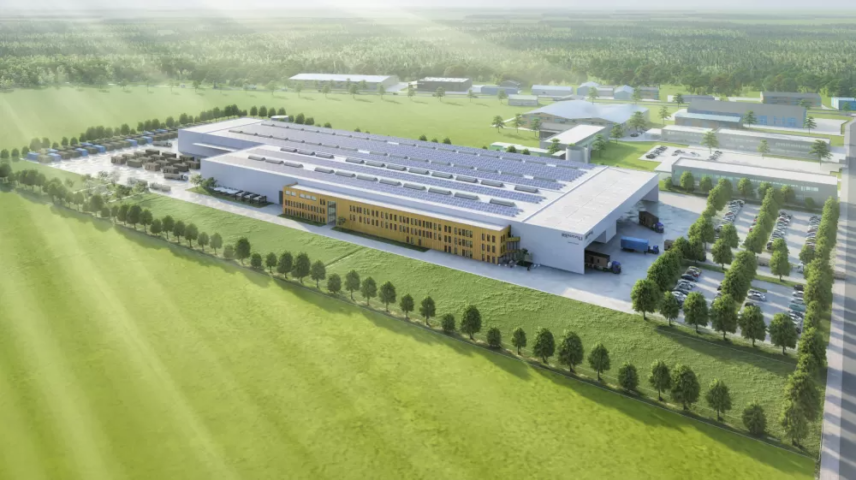
The potential for serially and industrially produced timber modular construction in the greater Berlin area is great. In modular construction, entire room units are prefabricated in the production plant and assembled on the building site. Today, modular buildings meet all the requirements of modern and sustainable real estate and offer a solution for the realisation of attractive, affordable and climate-friendly living space. According to Samuel Renggli, “We want to meet the great demand for timber construction capacities in the Berlin/Brandenburg area in line with demand and thus make a significant contribution to resource-friendly and climate-neutral construction. With the performance of this modern production plant, we meet the high demands on quality, efficiency and reliability.”
Market development in Germany – further development in Switzerland The investment is based on the long-term business plan of Renggli AG and is the consistent strategic further development of the activities in Germany. The commitment in Germany will not affect the activities in Switzerland. Parallel to the development in Germany, Renggli AG will continue to strengthen its market position in Switzerland as planned and invest in the digitalisation and further development of the company. At the production plant in Schötz (LU), Renggli AG will continue to realise industrially manufactured, high-quality and climate-friendly buildings in prefabricated and modular construction. It thus meets the demand from Switzerland for architecturally sophisticated, multi-storey timber buildings for residential developments, office and commercial buildings or kindergartens and schools.
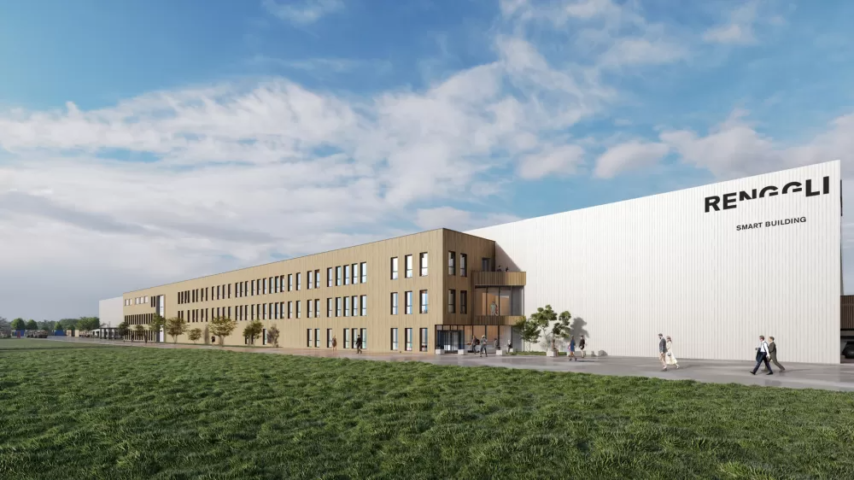
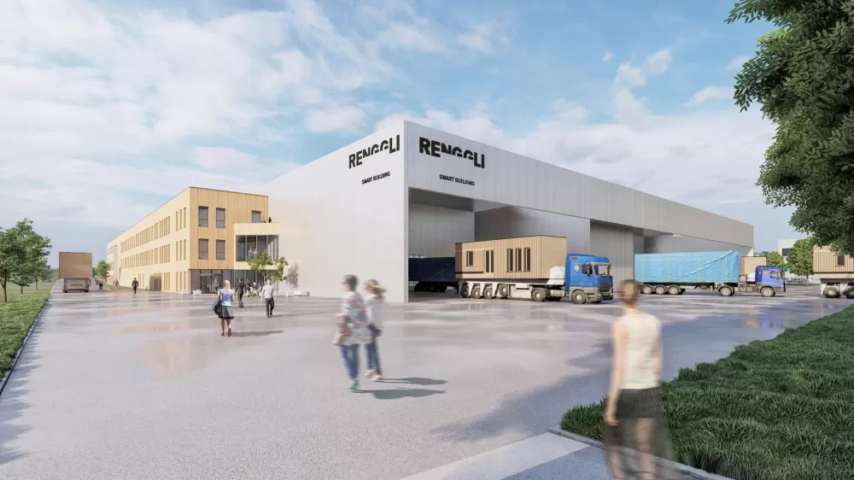
Timber module factory in Eberswalde – aerial view (Render-Manufaktur, Berlin)Wooden module factory in Eberswalde – visualisation (Render-Manufaktur, Berlin)Wooden module factory in Eberswalde – logistics (Render-Manufaktur, Berlin)
Infotech Automation is moving from Solothurn to Grenchen. The land purchase for a large new building in the new industrial park on Lebernstrasse took place a few days ago, and the building permit has been issued. Construction work will begin on 5 April. They should be completed in one and a half to two years. The company provides information about this in an article in the “Grenchner Tagblatt” of the “Solothurner Zeitung”, which it has published on its website.
Infotech designs, produces and implements highly automated production systems, primarily for the manufacture of semiconductor power electronics. For this purpose, the new location will have 9600 square metres of office and production space on three floors instead of the previous 4400 square metres.
The company, which is considered a so-called hidden champion and is growing continuously, could even add another storey later. The building, designed by SSM Architects of Solothurn, will reportedly be mostly glazed. The material regulates its own light transmission. Heating and cooling will be provided by geothermal probes fed by photovoltaics on the roof.
According to its co-founder, CEO and shareholder Ernest Fischer, the recipe for success of the continuously growing company lies in quality, innovation, support and, without exception, customised developments: “The customers’ expectations must be exceeded in every respect. We are usually the most expensive in quotations and yet our customers remain loyal to us.” Personnel is sought for all departments.
Climate change is causing summer temperatures to rise in Switzerland. This is particularly apparent in densely built cities with extensive sealed surfaces. Buildings and their surroundings must be designed to offer a comfortable quality of life in the climate of the future. ewz’s new white paper on ‘Climate-conscious building’ offers an overview of this topic. The publication serves as a knowledge base and inspiration for construction in the context of climate change and is free to download here.
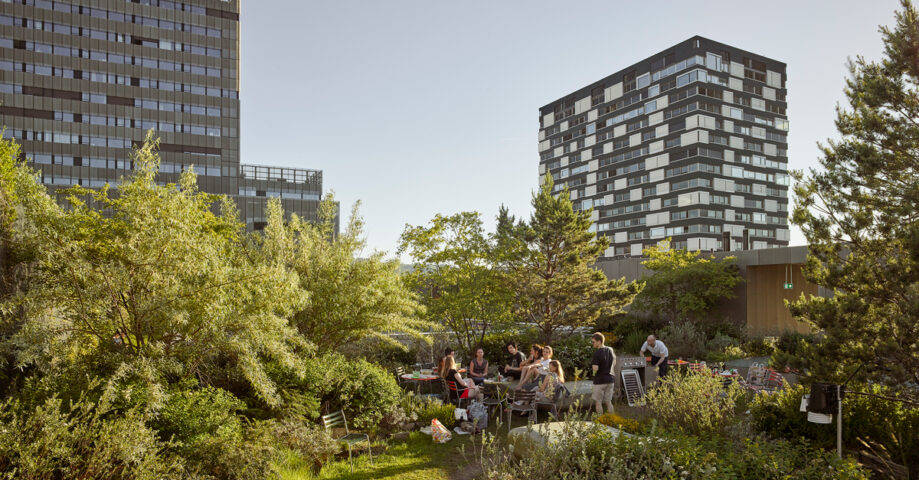
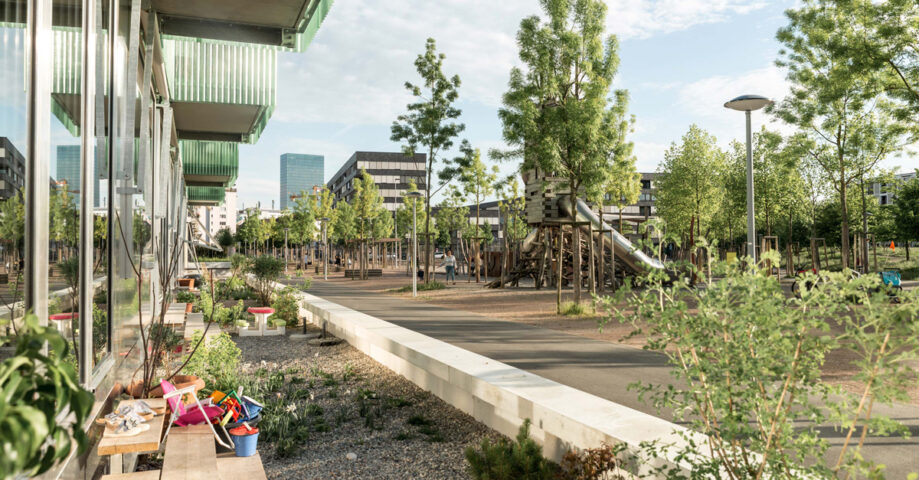
Focus on cities Green spaces with shady trees and cold air corridors intended to bring cooling are often either entirely absent or inadequate, meaning heat islands form in urban areas – where temperatures can be up to ten degrees higher at night than in surrounding areas. A catalogue of measures tailored to each specific location is needed to counteract this heat island effect. Important principles for eco-friendly urban planning and building include building position and sizing, green areas, facades and roofs, and shading.
Copyright Roland Bernath
Moderate window proportions It’s not just exterior spaces that need to be planned and built in a climate-conscious way, but also the buildings themselves. To keep interiors as cool as possible when external temperatures rise, parameters such as building orientation, window surface areas and the building’s retention capacity are critical, starting at the design stage. Solid ceilings and floors, for example, store heat due to their mass and the room temperature rises more slowly. Windows also need special attention. Large-scale glazing is beneficial in that it lets abundant natural daylight into the interior and keeps solar heat input high in winter. In summer, however, this heat is undesirable. It is therefore recommended to avoid floor-to-ceiling windows as far as possible, and to strike a balance between aesthetics and comfortable temperatures. A window proportion of up to 30 per cent in residential buildings and up to 40 per cent in office buildings is a benchmark.
Ventilation and cooling During long periods of hot weather, even a well-planned building heats up. It is extremely effective to dissipate the accumulated heat at night. This can be achieved by cross-ventilation, for example. Even better is to design a building that develops a chimney effect. Ventilation flaps in the façade – adjacent to the windows, for example – allow cool outside air to enter the interior and then discharge through an opening in the roof by way of the stairwell. Solutions like this entail no or minimal additional costs and work more efficiently than air conditioning units.
Unlike residential buildings, today’s office buildings are often equipped with cooling systems. This is due to the high internal loads produced by users and IT infrastructure, not to mention the high proportion of glass in the façades. There are office buildings whose requirements for cooling and heating energy are now already identical. By 2100, office buildings could require up to ten times more energy for cooling than for heating, depending on climatic developments. This would presumably increase operating costs significantly and make it more difficult to operate buildings economically.
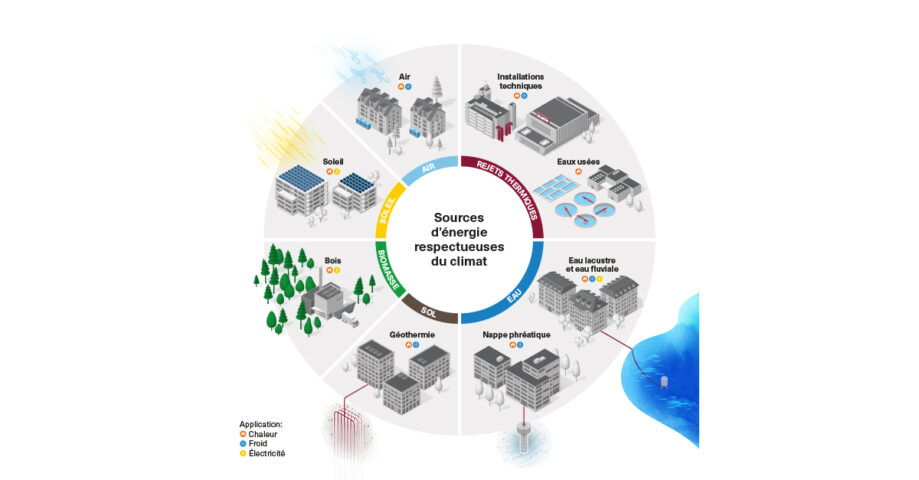
An array of local energy sources Environmentally friendly passive cooling is ideal for meeting the basic cooling requirements of office and residential properties. Known as free cooling, there are various energy sources in Switzerland that are suitable for this.
Geothermal heat accessed via probes is often used. In winter, thermal energy from the ground is used as a heat source, while in summer it serves also for cooling, because required temperatures are significantly below room temperatures. Lake water is another particularly suitable energy source, as the many Swiss lakes provide a valuable thermal storage mass. Because their shores are often densely populated, the lake water can be efficiently used to supply numerous buildings.
Whether it comes from geothermal probes, lake water or other sources, it is crucial that cooling uses as little energy as possible. So it’s a good idea for building owners, investors and architectural specialists to discuss this issue with an energy service provider such as ewz as early as possible and see which options are feasible. This enables the construction of buildings that can offer high comfort levels even in the hot summers of the future, without placing an additional burden on the environment.
Environmentally friendly heating remains important It is important to bear in mind that the cooling energy needed for residential buildings is relatively low compared to the heating required. Decarbonisation of heat supply must therefore remain a priority in order to achieve net zero. Sustainable heating is not a problem nowadays, with various technically mature and economically attractive renewable heating systems available.
The ‘Climate-conscious building’ white paper provides in-depth information, detailed insights and a range of best-practice examples highlighting specific solutions for tackling this issue. The new white paper is free to download for all interested parties.
Today, real estate has to meet a multitude of requirements. As a significant driver of CO2 emissions in Switzerland, they play a central role in Swiss climate and energy policy. The requirements for economical and efficient energy use in buildings are correspondingly high. On the other hand, there are ever-increasing demands for safety and comfort on the part of the users – with a simultaneous reduction in the complexity of the application. One component for solving these sometimes seemingly contradictory requirements lies in the digital networking of sensors and devices in buildings.
Valuable partnerships as innovation drivers The cooperation with the Swiss Federal Laboratories for Materials Testing and Research (Empa) in Dübendorf is proving to be an extremely valuable and fruitful partnership with regard to the development of intelligent and sustainable buildings. In the modular research and innovation building NEST, Empa develops and tests technologies, systems and materials together with partners from research, industry and the public sector.
Bouygues Energies & Services supplied prefabricated HVAC components as part of the NEST unit HiLo (“High Performance – Low Emissions”). Using Building Information Modelling (BIM), a factory and assembly plan including manufacturer’s specifications were created, allowing materials to be ordered directly from the model. In the NEST unit “Sprint”, Empa has successfully put circular construction and “urban mining” into practice. Recycled materials and components were used to create flexible office space in a very short time, while conserving resources.
In the field of predictive control, learning algorithms enable considerable energy savings compared to conventional, rule-based control algorithms, while at the same time increasing the comfort and user-friendliness of building systems.
Wir verwenden Cookies zur Unterstützung und Verbesserung unserer Dienste. Mit der Nutzung dieser Website erklären Sie sich mit der Verwendung von Cookies einverstanden. Weitere Informationen finden Sie in unserer Datenschutzerklärung.