Tag: immobilien

  • Bühler opens Energy Center for employee development

    Bühler opens Energy Center for employee development

    Bühler has inaugurated the Bühler Energy Center. With the newly created location, the technology group completes the Innovation Campus Uzwil and the Cubic, which will open in 2019. According to a media release, Bühler is investing “in a healthy cycle, because if the employees are doing well, the company is also doing well”.

    Against the backdrop of growing demands on companies, the personal well-being of employees is becoming increasingly important. “Positive energy and knowledge are crucial resources and form the basis for well-being, performance and resilience,” it says. To make the company fit for the challenges of the future, the Energy Centre was designed for the future fields of health management, vocational and adult education as well as series production and prototyping.

    The Energy Center offers support for independent learning and personal recreation. According to the motto “Make you fit!”, employees should be equipped with fresh energy to master the “complex and dynamic demands” of the private and working world. The Energy Centre is also open to other groups of people. It is designed “for our employees as well as for the employees of our partners and customers,” Stefan Scheiber, CEO of the Buhler Group, is quoted as saying.

    Construction of the Energy Center began in 2021. “The most resource-conserving and sustainable implementation possible included, for example, the reuse of concrete from the previous building and the use of low-CO2 cement,” Elvis Pidic, architect and Head of Corporate Real Estate Management at Bühler, is quoted as saying.

  • Megasol wants to bring scaled solar roofs to Europe’s rooftops

    Megasol wants to bring scaled solar roofs to Europe’s rooftops

    Megasol wants to benefit from the current strong demand for solar energy in Europe. The Deitingen-based manufacturer is relying on its Level in-roof system. Especially in Germany, Level is very popular, Michael Reist, head of communications, is quoted as saying in a press release. “Every building owner also asks their roofing partner for a solar system when renovating their roof or building a new one – thanks to Level, roofers and carpenters have the right answer to the requests.”

    The Level solar roof is shingled, the solar modules do not need frames. The roof system can be adapted to all roofs so that the entire roof area can be used for the production of electricity. Thanks to the fastening hooks and short sealing rails, it can be installed quickly. The solar modules themselves have hail protection class 5; even 5-centimetre hailstones do not damage them.

    Megasol is one of Europe’s leading manufacturers of solar modules and mounting systems. Founded in 1993 by Markus Gisler, the company specialises in the customised mass production of building-integrated photovoltaics. Megasol develops and produces in Deitingen and has another site in Ningbo, China. 2022 French building materials manufacturer Saint-Gobain entered into a partnership with Megasol and took a minority stake. In April, it won the 2023 Export Award from Switzerland Global Enterprise.

    Megasol will also be present at Intersolar, which will take place in Munich from 14 to 16 June.

  • Wincasa switches debt collection to cloud software from Tilbago

    Wincasa switches debt collection to cloud software from Tilbago

    Wincasa AG is switching the handling of debtor processes to the real estate software Garaio REM from the Lucerne-based fintech Tilbago. According to a media release, both the debt collection process and communication with the debt collection offices will be handled using modern cloud software. The real estate service provider based in Winterthur is thus equipping itself for future requirements in debt collection.

    Tilbago knows “the challenges as well as the peculiarities of real estate service providers”, it says. The real estate package of the cloud software provider is tailored to the industry-specific requirements of legal debt collection.

    The software solution’s intuitive usability and location-independent use are arguments in its favour. This fits in with Wincasa’s so-called #weworksmart work culture. “The overall package of complete coverage of the collection process, compliance with the latest eSchKG requirements and the elimination of expensive maintenance contracts convinced us,” Michael Wittwer, Legal Operations Specialist at Wincasa AG, is quoted as saying.

  • National Council decides on offensive for wind energy

    National Council decides on offensive for wind energy

    The National Council has joined the amendments of the Council of States and followed it with regard to the bill on the accelerated approval of wind power plants by 136 votes to 53. Originally, this bill came from the National Council’s Committee for the Environment, Spatial Planning and Energy. The background to this is the goal of making Switzerland less dependent on electricity imports in times of low sunshine.

    According to a parliamentary press release, energy minister Albert Rösti (SVP) said that an increase in capacity was therefore necessary. However, this would have to be realised “without severely eroding the usual rights of co-determination”. According to the information, there was fundamental opposition to the wind power offensive in parliament only on the part of the SVP. The other parliamentary groups agree that wind energy makes a valuable contribution to the electricity supply in the winter months.

    Therefore, the tenor was that it was unacceptable that projects had to wait more than 20 years for approval. The bill stipulates that the accelerated procedures may only be applied if the municipalities have already approved the installation as part of the land-use planning. According to Rösti, this applies to 39 turbines that are to supply 250 gigawatt hours of electricity annually. These include the Grenchenberg wind farm in the canton of Solothurn, the Eoljorat Sud and Sur Grati projects in the canton of Vaud and the Crêt Neuron project in the canton of Neuchâtel.

    The accelerated procedures are to be applied to wind energy projects in the national interest until an additional capacity of 600 megawatts has been installed. For these projects, the canton will now be responsible for the building permit. In addition, the legal remedies against this decision will be limited: it will only be possible to challenge it before the highest cantonal court.

  • Energie 360° equips Regensdorf with fast-charging stations

    Energie 360° equips Regensdorf with fast-charging stations

    Since 6 June, visitors to the Zänti shopping centre in Regensdorf have been able to charge their electric vehicles at seven fast-charging stations, Energie 360° informs in a press release. The Zurich-based energy service provider installed the charging stations with a capacity of up to 120 kilowatts as part of a long-term partnership with the Regensdorf centre. “Together with the Regensdorf Centre, we are providing our customers with what is currently the fastest charging solution in a Zurich shopping centre,” Rami Syväri, Head of Mobility at Energie 360°, is quoted as saying in the press release.

    The new charging stations charge the battery of an electric car within 30 to 60 minutes with ecologically produced direct current, depending on the model. “With the new fast-charging stations, we want to meet the needs of our customers and at the same time actively reduce CO2 emissions,” explains Sandro Engeler, head of the Regensdorf centre. Two existing AC charging stations complement the range of charging solutions at Zänti.

    According to Syväri, Energie 360° already operates over 200 locations with charging stations throughout Switzerland. The company finances, plans, builds and maintains the charging stations in cooperation with the owners of suitable sites. All of Energie 360°’s public charging stations can be used with a QR code, app or RFID card and are integrated into the Swisscharge network.

  • The new Lokstadt: urban, versatile, steeped in history

    The new Lokstadt: urban, versatile, steeped in history

    With Lokstadt, Implenia is developing a new, urban and diverse neighbourhood with 750 flats for around 1500 people. Lokstadt is located south-east of Winterthur railway station. In the past, this area was home to the workshops of the Swiss Locomotive and Machine Factory (SLM) – the most important locomotive forge in Switzerland. The neighbouring Sulzer factory took over SLM in the 1960s.

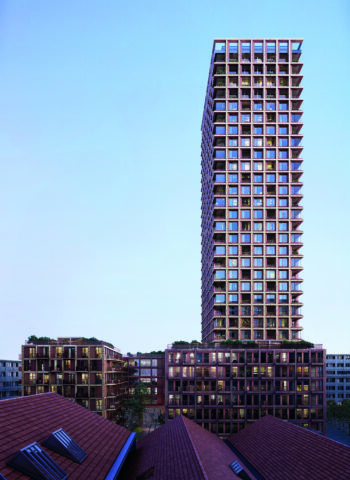
    The Rocket skyscraper is the tallest wooden residential building in the world being planned at
    .

    Some of the locomotives produced by SLM serve as namesakes for the various building plots. For example, the “Tender”: condominiums were realised here, which have been ready for occupancy since the beginning of 2023, as well as commercial space. The flats in the 17 “townhouses” were also for sale: these are four- to five-storey maisonette flats that have already been completed. In a second construction phase, six four-storey “townhouses” were built: these comprise a total of 24 flats and have been ready for occupancy since spring 2023. The “Elefant” office building, which is located directly on Zürcherstrasse, will also soon be ready for occupation.

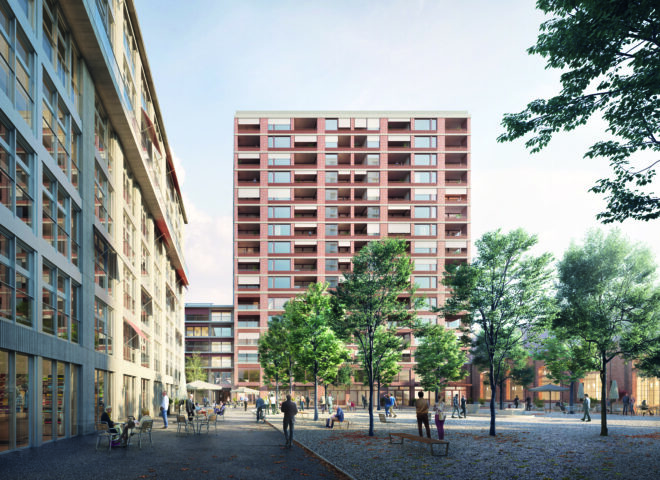
    The central dialogue square will be framed by three buildings in future. The first is the “Krokodil” in timber construction. Here, 254 flats have been created to fulfil the diverse housing needs of three cooperatives and individual homeowners. Vertical bands of windows are reminiscent of the former industrial halls and give the building a clear structure. BIGBOY” is located at the front of Dialogplatz: the building, which is over 50 metres high and has 16 floors, is home to 125 rental flats and five office and commercial spaces of between 55 and 370 square metres. The roof terrace offers a unique view over Lokstadt and the whole of Winterthur. The industrial past of the site is honoured by the brick façade. Bigboy will be ready for occupancy in summer 2023. The third building is still under development and is currently the tallest planned timber high-rise in the world: “Rocket”, developed and realised on behalf of Ina Invest, will be 100 metres high and, with 32 storeys, will become the landmark of the new district and the Winterthur skyline. There are plans for 255 flats. Charitable flats are also planned in the “Tigerli” plinth building. A hotel is also planned. The move-in date is planned for 2027.

    BIGBOY offers 125 flats and a roof terrace for residents.

    Lokstadt stands for the sustainable use of resources, a carefully planned variety of uses and the innovative revitalisation of listed buildings. These include the former factory buildings. Under the leadership of Implenia, these are being transformed into experience spaces that reflect local history and modern city life. The neighbourhood is being developed step by step in accordance with the requirements of the 2000-watt society. Despite the dense construction, emphasis is placed on sufficient open spaces and a high quality of stay. The site will be developed with an underground car park for motorised traffic across all building plots. Above ground, pedestrians and cyclists have priority thanks to a generously designed pedestrian zone.

    With Lokstadt, Winterthur connects the 19th century with the 21st century: Here, the city’s industrial history is brought together with Winterthur’s future as a residential, educational and service city. The neighbourhood is being built for people who love city life and care about sustainability. In future, a Lokstadt app will serve as a communication and interaction channel for all tenants, owners and employees.

  • Using climate simulation to combat heat islands

    Using climate simulation to combat heat islands

    The heating of asphalted city centres – so-called heat islands – is a well-known problem in urban development. However, it can be noticeably improved with smart measures. This is demonstrated by the city of Winterthur in cooperation with the spatial planning office Berchtoldkrass Space & Options and the office GEO-NET Umweltconsulting GmbH, which specialises in climate analyses, by means of a computer-assisted climate modelling for the Lokstadt. The current planning status was compared with two climate-optimised scenarios. Thanks to the simulation, it is possible to see how the design of the buildings and open spaces affect the outside temperatures and thus influence the quality of stay in the area. At the same time, it was tested which measures are particularly feasible and effective. The pilot study is part of the Smart City Winterthur programme and was made possible by its innovation loan. It was commissioned by the Office of Urban Development.

    Numerous residential units and workplaces will be built on the Lokstadt planning perimeter. In order for the neighbourhood to have a high quality of life later on, planning based on climate aspects makes sense. A climate-adapted and thus heat-tolerant design is possible despite dense construction: bioclimatically effective compensatory measures in Lokstadt include trees, unsealed, light-coloured and greened surfaces and shaded areas. Large green roofs – ideally in combination with shady photovoltaic systems – have a positive effect on the urban climate. In addition to façade greening, water areas and drinking fountains improve the quality of stay.

    The evaluation shows: The Lokstadt was already well positioned in terms of urban climate in the original planning in the design of the public space. In order to further optimise the climate, additional tree locations as well as light-coloured, infiltration-capable surfaces are being examined. The technology offers all the prerequisites for optimising the urban design of the future in terms of climate.

  • Reto Zeidler becomes Head of Cyber Security at Inventx

    Reto Zeidler becomes Head of Cyber Security at Inventx

    As an IT and digitalisation partner for Swiss banks and insurance companies, Inventx addresses the steadily growing customer demand for security expertise with a comprehensive solution portfolio. The company advises customers in the areas of information security, cyber crime, cyber risks, secure enterprise architectures and zone concepts as well as future-oriented risk management. Thanks to its independent Cyber Resilience Centre with highly trained analysts, it keeps its finger on the pulse of current cyber-crime trends around the clock.

    Reto Zeidler joins Inventx from process and digitalisation consultant Pragmatica, where as Head of Information and Cyber Security he was responsible for the company’s consulting expertise in these areas and led security projects as Principal Consultant. Before that, Reto Zeidler was Chief Managed Services Officer and a member of the executive board at the IT security service provider ISPIN. Other stations in his career included Associate Partner / Executive Advisor for IBM Security and Head of Cloud Security Services at Swisscom.

    As an active member of the cyber security community, he is involved in the Information Security Society Switzerland (ISSS) and the Cloud Security Alliance. He is also a lecturer and expert in information security at the Lucerne University of Applied Sciences and Arts.

    At Inventx, Reto Zeidler is responsible for the entire cyber security cluster, ensures sustainable and high-quality service provision and strategically aligns it with customer needs. He continuously develops the area and expands it in terms of personnel and technology.

    Fabio Cortesi, CTO and Member of the Executive Board of Inventx AG, welcomes the new Head of Cyber Security: “We are pleased to have gained an experienced and highly competent security expert. Reto combines technical and leadership expertise at the highest level, always with a clear view of current and future customer needs.”

    Reto Zeidler on his new role: “I am very much looking forward to taking the Cyber Security Cluster even further forward for our customers together with my team. We can build on an excellent foundation. Now we want to take the next development step.”

    Source www.inventx.ch

  • Lucerne through station: major project reaches milestone

    Lucerne through station: major project reaches milestone

    The Lucerne through station is intended to eliminate bottlenecks in the Lucerne rail hub with new, underground approaches and an underground station. The project, which is currently in the planning phase, is intended to create capacity in today’s fully utilised railway system and thus enable new, more direct and faster rail connections in the future. “The underground station and the new, underground access routes will improve the accessibility and attractiveness of Central Switzerland,” says Massimo Guglielmetti, SBB overall project manager for Lucerne through station. “Without infrastructure expansion, further development of rail services in Lucerne is no longer possible.”

    In the preliminary project, SBB presents the technical feasibility of the large-scale project, which consists of the sub-projects underground station, three-lane tunnel and Neustadt tunnel:

    • With the underground station, a total of 44 metres wide platform hall for four tracks will be built below the existing station. This will create more space at Lucerne station, which is currently used by around 100,000 passengers every day
    • The 3.8-kilometre-long three-lane tunnel will create an underground, direct line from Ebikon to Lucerne, crossing under the lake basin over a length of 400 metres. This second access removes the bottleneck situation in the railway network and enables more frequent and faster train connections
    • The 2.1-kilometre-long Neustadt Tunnel connects the underground station to the existing access road. This will enable through connections and eliminate the need for a majority of trains to turn around in the Lucerne terminus station

    In order for the planned improved service to be of benefit to the whole of Central Switzerland, the railway infrastructure in the catchment area must also be expanded at certain points. In addition, parking facilities are needed outside Lucerne station to be able to park trains overnight and outside peak times

    Lowering tunnel under the lake basin
    Compared to previous plans, a lowering tunnel is now planned for the subway of the lake basin. Five prefabricated elements of the tunnel tube will be lowered into the bottom of Lake Lucerne. This means that it is not necessary to drain the lake basin in sections. The environment and landscape are less affected. This construction method has never been used in Switzerland before.

    The costs for the three project parts, the underground station, the Dreilinden tunnel and the Neustadt tunnel, are estimated at 3.3 billion Swiss francs. For the realisation, SBB expects a construction period of 11 to 13 years

    Additional studies on howto proceed
    SBB is now clarifying possible implementation sequences for the major project on behalf of the Federal Office of Transport (FOT). The results should be available by the end of 2023. A decision will then be made on the next steps in the project. “All the work is going according to plan. I am convinced that the Federal Council will be able to present a well-studied and advanced project to parliament in 2026,” Anna Barbara Remund, FOT Vice Director and Head of the Infrastructure Division, told the media in Lucerne. The federal parliament will ultimately decide on the implementation

    Great importance for Lucerne and Central Switzerland
    The expansion of the Lucerne railway junction is one of the most important infrastructure projects in the region. “Central Switzerland has been waiting for the urgently needed infrastructure upgrades at the Lucerne hub and in the direction of Zurich for 50 years,” held Cantonal Councillor Fabian Peter, Director of Construction, Environment and Economic Affairs and President of the Central Switzerland Public Transport Directors. “An attractive public transport offer is crucial if we are to be able to cope with mobility growth at all and handle it sustainably,” said Fabian Peter. “In order for the through station to unfold its full benefits, Central Switzerland expects it to be realised and financed from a single source.”

    For the city of Lucerne, there will be the opportunity to make the space around the station attractive, to make the station more accessible and to increase the quality of stay. “The city will also work to ensure that the construction period of over ten years is as compatible with the city as possible,” said City Councillor Manuela Jost, Director of Construction. “Even during this time, open spaces must be preserved and the city centre must remain accessible.”sBB is planning the through station on behalf of the Federal Office of Transport. It is working with the canton and city of Lucerne, Zentralbahn, the Lucerne transport association and the cantons of Obwalden and Nidwalden, and is involving the LuzernPlus association of municipalities.

    Source www.sbb.ch

  • Holder wants to combat housing shortage

    Holder wants to combat housing shortage

    Halter AG wants to tackle an emerging housing shortage. The Schlier-based construction and real estate company is committed to sustainable and viable solutions, Halter explains in a press release. To this end, the company has prepared a position paper. Halter also presented the solutions proposed in this paper for discussion at the round table with Federal Councillor Guy Parmelin in May.

    In the position paper, Halter makes a number of demands. For example, additional use in residential zones and residential use in pure workplace zones should be permitted. Half of the additional living space created here must be realised as living space at cost rent. Halter also wants the potential of the cost rent financing model to be better exploited.

    The politicians are called upon to simplify the quality assurance procedure and to limit the digital building permit to use and architecture. Halter expects his own industry to reduce construction costs by increasing productivity.

    “The provision of affordable housing represents a similarly significant social challenge as climate-friendly conversion and new construction,” explains Halter CEO Markus Mettler in the statement. He says his company is ready to make innovative contributions to solving both tasks. “This goes hand in hand with the introduction of sustainable framework conditions for the construction and real estate industry that strengthen entrepreneurship and competitiveness in the sector and counteract the trend towards inefficient and costly regulation and nationalisation.”

  • Population supports expansion of renewables

    Population supports expansion of renewables

    The energy crisis, electricity price increases and the risk of an energy shortage have not diminished the approval of the population, informs the Association of Swiss Electricity Companies(VSE) in a press release. According to a representative survey conducted on its behalf by gfs.bern, approval has even risen by 3 percentage points year-on-year to 59 percent. The domestic expansion of renewable energies plays a major role in the energy transition.

    Thus, 97 percent of respondents are in favour of solar installations on buildings and facades. Hydropower is supported by 89 percent and wind power by 76 percent. Large solar plants in the mountains and on open spaces, on the other hand, are viewed critically. Only a minority of 34 percent can imagine new nuclear power plants.

    For many of the respondents, the expansion of renewable energies offers solutions to a number of challenges of the energy transition. For example, it can strengthen security of supply and reduce dependence on imports from abroad. In addition, around 80 percent of those surveyed consider the promotion of renewable energies to be environmental protection in practice. According to the majority, nature and landscape should not be sacrificed without compromise, but six out of ten respondents are in favour of cutting back on environmental protection.

    For the VSE, the results of the survey show the necessity of pushing ahead with the expansion of renewables. “We all have to prove to the population that we can actually realise all the projects for the expansion of renewable energies that are currently blocked or in the pipeline, and the further development of the electricity grids that is necessary for this,” VSE President Michael Wider is quoted as saying in the statement.

  • Construction industry gets fewer orders

    Construction industry gets fewer orders

    Incoming orders in the construction industry were 8.1 percent lower in the first quarter of 2023 than in the same quarter of the previous year, the Swiss Association of Master Builders(SBA) informed in a statement. It assumes that this decline will have a negative impact on construction activity over the next one to two years. The SBC attributes the decline in new orders to higher interest rates and construction costs as well as a slowdown in economic growth.

    In residential construction, the SBC believes that lower construction activity could lead to a shift from a housing surplus to a housing shortage. As countermeasures, the association calls for “a bundle of practice-oriented measures”. Specifically, the communication mentions, among other things, curbing objections and shorter objection periods as well as reducing “overregulation” in structure plans and laws. Housing promotion should be based on market economy criteria and not on state intervention.

    In the short term, the SBC sees a positive outlook for the construction industry. Although turnover in the main construction sector in the first quarter was 150 million francs or 3.1 per cent lower than in the same quarter of the previous year, the SBC is forecasting a slight increase in turnover in the second quarter. For the second quarter, however, the construction index compiled by SBC in collaboration with Credit Suisse forecasts turnover growth of 1.1 percent.

    The shortage of skilled workers remains one of the biggest challenges facing the industry. At the Construction Industry Day on 30 June in Lugano, the SBC wants to show solutions here.

  • Baumer intensifies commitment to solar power

    Baumer intensifies commitment to solar power

    Baumer has announced the installation of more than 800 photovoltaic modules on facades and roofs of factory buildings at its headquarters in the St.Gallen-Lake Constance area for June 2023. The solar power technology is expected to generate a nominal output of 340 kilowatts peak, according to a statement. Together with the Innovation Centre currently under construction, which will generate 130,000 kilowatt hours of electricity per year, a power yield of 305,000 kilowatt hours per year is expected. This means that the sensor specialist will be able to cover 11 per cent of its electricity needs with solar power in the future.

    With the investment in the solar building envelope, the Frauenfeld-based sensor specialist is continuing its Baumer Blue innovation initiative. With this, the company is focusing on sustainability, energy efficiency and modern infrastructure.

    In Frauenfeld and at all locations in Germany, the company already purchases exclusively green electricity, it says. On the way to optimising consumption, Baumer is also implementing energy-saving measures and a heating and cooling concept based on geothermal probes and a heat pump at the Innovation Center. ce/heg

  • Canton of Zurich to get new law on location promotion

    Canton of Zurich to get new law on location promotion

    The Government Council of the Canton of Zurich wants to strengthen the competitiveness of the business and innovation location with a new Location Promotion and Business Relief Act. The essential goals and principles of location promotion are anchored in the law. In addition, an already existing regulation for the administrative relief of companies will be integrated.

    The corresponding bill was drafted by the Department of Economic Affairs and passed by the cantonal government at its meeting in May for the attention of the cantonal council, the cantonal state chancellery informs in a statement. “Our goal is to further develop the Canton of Zurich as an economically, ecologically and socially sustainable location for business, research and innovation with a variety of attractive jobs,” Director of Economic Affairs Carmen Walker Späh is quoted as saying. The new law should make it possible to take measures adapted to economic developments.

    In future, the consequences of regulations are to be examined both for companies and for the business location as a whole. Responsibility for the regulatory impact assessment is transferred to the Directorate of Economic Affairs.

    The new law also contains a provision that enables the canton to quickly participate in federal programmes to support the economy. “With the new law, we will be able to decide as quickly as possible on financial aid to companies in the event of a possible future crisis with the participation of parliament,” Walker Späh explains.

  • ImmoTrack digitises home maintenance with artificial intelligence

    ImmoTrack digitises home maintenance with artificial intelligence

    The start-up ImmoTrack is launching an automated scheduling system for home maintenance. The Baar-based start-up is thus adding a module to its web-based software, according to an article by startupticker.ch.

    ImmoTrack has been developing a software-as-a-service solution for the digitalisation of caretaking processes since 2019. This is because, according to the information, work in this area is still often done manually. “Scheduling is done by hand with pen and paper, and property reports for clients recorded on the computer are printed out and sent by post.”

    As a result, there is no overview of the results and services provided. This leads to dissatisfied clients and tenants as well as high maintenance costs. Founder Ofer Becker, himself a former manager of a caretaker company, wanted to change this and developed a solution based on artificial intelligence with his team. Through self-learning algorithms, work scheduling can be constantly improved.

    “Over the past three and a half years, we have steadily developed the web-based solution and will be offering our latest achievement – automated work scheduling – from June,” founder Becker is quoted as saying in the article.

    A financing round is currently underway. So far, the company has been able to collect 2.5 million Swiss francs in investments. 20 customers are using the software. another 60 want to test it. ImmoTrack expects an increasing demand for a digital solution in the field of facility management.

  • UBS sees holiday flats at a turning point

    UBS sees holiday flats at a turning point

    The prices for holiday flats in Switzerland have risen by an average of 7 per cent year-on-year in 2022, UBS informs in a press release on its current “UBS Alpine Property Focus“. The real estate experts of the big bank have identified the biggest jumps with increases of 15 to 20 percent in the destinations of Arosa, Hoch-Ybrig, Flims/Laax and Engelberg. With prices of around 20,500 Swiss francs per square metre, the Engadin/St.Moritz destination currently leads the ranking of the most expensive second homes in the upscale segment.

    Since autumn 2022, however, experts have observed a slowdown in the price increase. According to Maciej Skoczek, real estate economist at UBS CIO GWM and lead author of the study, it will continue in the coming quarters. “A period of stagnating prices is on the horizon,” Skoczek predicts.

    According to UBS’s findings, the demand drivers from the pandemic years have now lost their power. “Hybrid working, coupled with a relocation of the primary residence to the Alpine region” was only used during the pandemic, and the holidays shifted to the home country will be replaced by trips abroad again when the restrictions are lifted.

    The pandemic left behind around 20 per cent higher prices for two-flats, UBS writes. According to their surveys, the total cost of buying an average flat has also risen to twice the cost of 2019 due to higher interest rates. “Some holiday home owners will consider selling to realise capital gains while escaping the increased costs,” Skoczek says.

  • UBS sees holiday flats at a turning point

    UBS sees holiday flats at a turning point

    The prices for holiday flats in Switzerland have risen by an average of 7 per cent year-on-year in 2022, UBS informs in a press release on its current “UBS Alpine Property Focus“. The real estate experts of the big bank have identified the biggest jumps with increases of 15 to 20 percent in the destinations of Arosa, Hoch-Ybrig, Flims/Laax and Engelberg. With prices of around 20,500 Swiss francs per square metre, the Engadin/St.Moritz destination currently leads the ranking of the most expensive second homes in the upscale segment.

    Since autumn 2022, however, experts have observed a slowdown in the price increase. According to Maciej Skoczek, real estate economist at UBS CIO GWM and lead author of the study, it will continue in the coming quarters. “A period of stagnating prices is on the horizon,” Skoczek predicts.

    According to UBS’s findings, the demand drivers from the pandemic years have now lost their power. “Hybrid working, coupled with a relocation of the primary residence to the Alpine region” was only used during the pandemic, and the holidays shifted to the home country will be replaced by trips abroad again when the restrictions are lifted.

    The pandemic left behind around 20 per cent higher prices for two-flats, UBS writes. According to their surveys, the total cost of buying an average flat has also risen to twice the cost of 2019 due to higher interest rates. “Some holiday home owners will consider selling to realise capital gains while escaping the increased costs,” Skoczek says.

  • Dormakaba supplies Hörmann with CO2-neutral products

    Dormakaba supplies Hörmann with CO2-neutral products

    The companies dormakaba in Rümlang and Hörmann in Steinhagen, Germany, have agreed to cooperate in the area of sustainability. According to a media release, Hörmann will purchase CO2-neutral products from dormakaba Germany from 1 June 2023. This measure is an important step in the climate protection commitment of the door and gate manufacturer Hörmann, it continues.

    The company Hörmann wants to strengthen its climate protection commitment, it says in the press release. The company is aware that emissions in the upstream or downstream supply chain are the most difficult to influence. However, this area, known as Scope 3, accounts for the largest share of all emissions. For this reason, Hörmann also wants to include suppliers and partners in its climate protection commitment. In dormakaba, Hörmann has found a partner who is considered a pioneer in sustainability in the industry.

    “With this step, we at dormakaba are sending a clear signal of how important the topic of sustainability is to us and are taking responsibility as a company,” Michael Hensel, Managing Director of dormakaba Deutschland GmbH in Ennepetal, is quoted as saying.

    “Our long-standing partner dormakaba is already known as a pioneer in the industry in the field of sustainability and climate protection,” Martin J. Hörmann, personally liable partner of the Hörmann Group, is quoted as saying. “Its achievements there have been recognised by leading bodies. We are therefore pleased that dormakaba will be supplying all products with an environmental product declaration in a CO2-neutral manner from 01.06.2023.”

  • Dormakaba supplies Hörmann with CO2-neutral products

    Dormakaba supplies Hörmann with CO2-neutral products

    The companies dormakaba in Rümlang and Hörmann in Steinhagen, Germany, have agreed to cooperate in the area of sustainability. According to a media release, Hörmann will purchase CO2-neutral products from dormakaba Germany from 1 June 2023. This measure is an important step in the climate protection commitment of the door and gate manufacturer Hörmann, it continues.

    The company Hörmann wants to strengthen its climate protection commitment, it says in the press release. The company is aware that emissions in the upstream or downstream supply chain are the most difficult to influence. However, this area, known as Scope 3, accounts for the largest share of all emissions. For this reason, Hörmann also wants to include suppliers and partners in its climate protection commitment. In dormakaba, Hörmann has found a partner who is considered a pioneer in sustainability in the industry.

    “With this step, we at dormakaba are sending a clear signal of how important the topic of sustainability is to us and are taking responsibility as a company,” Michael Hensel, Managing Director of dormakaba Deutschland GmbH in Ennepetal, is quoted as saying.

    “Our long-standing partner dormakaba is already known as a pioneer in the industry in the field of sustainability and climate protection,” Martin J. Hörmann, personally liable partner of the Hörmann Group, is quoted as saying. “Its achievements there have been recognised by leading bodies. We are therefore pleased that dormakaba will be supplying all products with an environmental product declaration in a CO2-neutral manner from 01.06.2023.”

  • Real estate fund from Swiss Life Asset Managers generates stable income

    Real estate fund from Swiss Life Asset Managers generates stable income

    The Swiss Life REF (CH) ESG Swiss Properties real estate fund closed the first half of the 2022/23 financial year “with low vacancy rates and stable income”, Swiss Life Asset Managers announced in a statement. Specifically, income of CHF 20.26 million was realised. In addition, there was a capital gain of CHF 3.81 million from the sale of a residential portfolio consisting of five smaller apartment buildings. The rent default rate was reduced from 2.97 to 1.76 per cent compared to the end of March 2022.

    The net asset value rose year-on-year from 112.01 francs to 114.34 francs. The fund currently holds 161 properties with a total value of 2.562 billion francs. At the end of 2022, Swiss Life Asset Managers had acquired 15 properties with a total market value of CHF 242 million.

    Since the fund’s launch in November 2015, Swiss Life REF (CH) ESG Swiss Properties has posted an annualised performance of 6.04%. This means that the price performance and distributions are 2.01 percentage points above the SXI Real Estate Funds TR benchmark index, explains the asset manager, which is part of the Swiss Life Group.

  • Holcim receives award for biodiversity

    Holcim receives award for biodiversity

    Several former quarrying sites of the building materials group Holcim have received an award from the Nature & Economy Foundation for their ecological value. As the company informs in a media release, the gravel pits Sézegnin GE, Bernex GE and Böttstein AG as well as the quarry Gabenchopf AG were awarded on the World Day of Bioversity. The new valuable habitats for flora and fauna created there show that mining activities and species protection complement each other well, they say.

    Many of Holcim’s former quarrying sites now have the status of nature reserves. “Contrary to the clichés about quarrying sites, gravel pits and quarries are oases of biodiversity,” Joaquim Golay of the Nature & Economy Foundation is quoted as saying.

    At the quarrying sites, it is precisely the human intervention over many years that has had a positive effect on increasing and promoting biodiversity. For example, many rare and endangered animal and plant species have become native to the quarries and gravel pits awarded by the foundation after the quarrying activities. In the Gabenchopf quarry, the living conditions are particularly favourable for the biodiversity typical of the Aargau Jura. “This is evidenced by the large population of midwife toads and the numerous yellow-bellied toads, which are among the most threatened amphibians in our country, as well as one of the largest herds of chamois in Switzerland at this altitude, which finds refuge in the quarry to give birth to its young,” the foundation emphasises one of the special features.

    Holcim has been working for years to implement nature conservation projects at its quarrying sites, the statement says. “We are pleased that our contribution to biodiversity has been rewarded,” Robert Nothnagel, Head of Quarrying Areas at Holcim Switzerland, is quoted as saying about the renewed certification.

  • Daetwyler relies on solar power

    Daetwyler relies on solar power

    Nine of Daetwyler ‘s 27 production sites already cover their electricity needs entirely from renewable energy sources, the Uri-based industrial group says in a statement. Most of the energy is sourced from local electricity suppliers. However, Daetwyler also produces its own solar power for self-consumption at six locations.

    A start was made in 2021 on the roofs of the Indian plant in Kesurdi. Some 8000 square metres of solar panels installed there will reduce the Group’s CO2 emissions by 1500 tonnes annually, Daetwyler writes. Last year, another five production sites in Switzerland, Italy and Germany were equipped with photovoltaic systems. In total, the systems at the six sites are expected to supply around 4.4 gigawatt hours of solar power annually for Daetwyler’s own consumption.

    The switch to electricity from renewable sources, combined with measures to improve energy efficiency, has led to a 4.7 percent reduction in CO2 emissions in 2022 compared with the previous year. Daetwyler aims to achieve climate-neutral production worldwide by 2030. To this end, the Group is currently examining further projects, such as the installation of solar cells on the façade of the plant in Schattdorf UR. Daetwyler also intends to increase the share of electricity from renewable sources at the sites of Xinhui and QSR, acquired in 2022.

  • NEST receives aviary for drone research

    NEST receives aviary for drone research

    A DroneHub is being set up on the NEST. As the Swiss Federal Laboratories for Materials Testing and Research(Empa) illustrates in a short video, it resembles an aviary. On a floor space of 90 square metres, a construction of metal tubes and mesh forms a cage with a height of up to eleven metres. According to an Empa release, the final construction will provide test environments for three research fields.

    For the first, 3D printing in flight, an experimental wall with interchangeable modules will be used to develop drones that fly and carry out inspection and repair work vertically. “The drones can, for example, detect and repair cracks without the need for elaborate scaffolding or endangering the safety of people,” explains Mirko Kovac, the head of Empa’s Sustainability Robotics research laboratory and director of the Aerial Robotics Lab at Imperial College London.

    The second application area, robotic environmental sensing, focuses on the interaction between drones and the environment. “You can place targeted sensors in nature and read the data with regular flights,” says Kovac. This is “very relevant” especially for energy plants such as wind turbines or dams, but also for collecting climate data in impassable and wide-open spaces.

    The third research area wants to develop rules and technological standards for the coexistence of robots and humans, for example for interfaces between buildings and flying robots. This concerns, for example, landing sites on or near buildings or the positioning of charging stations.

  • Sensor gate from dormakaba receives iF Design Award

    Sensor gate from dormakaba receives iF Design Award

    The new Argus V60 sensor interlock from dormakaba has won an award in the building technology category at this year’s iF Design Awards, the globally active locking technology group from Rümlang informs in a press release. The Argus V60 is designed for foyers with lift systems or office buildings.

    The sensor barrier can also be used to separate floors or parts of the entrance area of buildings. Here, the airlock, which can be integrated “in the smallest of installation spaces”, “blends into the architecture like a piece of furniture”, writes dormakaba. As further advantages of the Argus V60, dormakaba lists “security, elegance and efficiency in the smallest of spaces”.

    With the iF Design Award, the iF International Forum Design GmbH annually honours outstanding achievement in the design of products in a variety of categories. For this year’s iF Design Award, almost 11,000 entries from 56 countries competed for the quality seal for excellent design.

    The iF Design Award is not the first award for the Argus V60. In February, the sensor-equipped personal interlock from dormakaba had already convinced the jury at the German Design Award of the German Design Council.

  • Start-up Beyoul sells holiday homes to several owners

    Start-up Beyoul sells holiday homes to several owners

    The Zurich-based proptech start-up Beyoul makes holiday homes and flats available to several parties via a platform. In this way, two to eight owners can buy a property together, according to a media release.

    This so-called co-ownership model reduces the costs for the purchase as well as for the maintenance. In addition, the maintenance costs and expenses associated with a second home are included in the price at Beyoul. Another advantage is that the properties are less likely to be vacant. This benefits the local economy.

    According to the press release, every tenth household in this country owns at least one holiday home. However, it is only used for an average of ten weeks a year. With the co-ownership approach, Beyoul wants to “adapt the ownership relationship to its own use”.

    A property at Beyoul is acquired by “two to eight parties with as complementary a use as possible”. The owners can dispose of the property according to their share. They reserve stays via an app. According to Beyoul, a fair distribution is ensured by a credit system in connection with a smart algorithm.

    Like an administration, Beyoul also takes care of the cleaning after each stay, the maintenance as well as the upkeep of the furnishings and the house.

    Beyoul is a concept of the Zurich-based Aquilas Company Builder AG. The consultancy company launches and scales innovative concepts in the field of global urban trends.

  • IWB tests alpine solar plant on Melchsee-Frutt

    IWB tests alpine solar plant on Melchsee-Frutt

    IWB has concluded a cooperation agreement with the Kerns Alpine Cooperative outside the stone bridge. According to a press release, the agreement provides for the feasibility of a solar plant on the Melchsee-Frutt plateau to be examined. In addition to the technical details, the effects of a photovoltaic system on the existing management and the environment will also be analysed.

    The good accessibility, the high altitude and the snow favour the production of electricity, especially in winter, according to the statement. The plant would be connected to the Obwalden electricity company.

    The two contract partners have already begun talks with the municipality of Kerns and the canton of Obwalden. Other stakeholders and environmental organisations are also to be included in the talks.

    Markus Ettlin-Niederberger, president of the Kerns Alpine Cooperative, welcomes the expansion of the project. “We can make an active contribution to a renewable and secure energy supply and even increase local added value,” he is quoted as saying in the press release. Pascal Semlitsch also sees great potential in the project. “Melchsee-Frutt offers very good conditions for an alpine solar plant,” the head of investments at IWB is quoted as saying. “We have the goal that more renewable, domestic solar power can be produced very locally and in an environmentally friendly way.”

    IWB has already built an alpine solar plant at the Muttsee dam in the canton of Glarus together with Axpo.

  • AMAG launches charging option for short-stay parkers

    AMAG launches charging option for short-stay parkers

    The AMAG Group is expanding the range of its multi-storey car parks to include charging facilities for short-term parkers. Last summer, the Cham-based car dealer group partially converted the Utoquai, Kongress and Messe car parks in Zurich into charging stations. Initially, the parking spaces with charging facilities were rented out exclusively on a monthly basis. The focus of the first phase was on charging solutions for tenants and condominium owners, AMAG stated in a press release.

    Now the offer is being expanded to include hourly or daily use. The new type of use is already possible at the Utoquai loading bay, and the Messe loading bay will follow suit on 16 May. Short-term parkers have to take out a parking ticket when entering the loading bay. The charging process itself is activated with a charging card or by scanning the QR code on the charging station in a charging app. Alternatively, it is also possible to leave credit card details. The price depends on the corresponding charging card provider or operator.

  • Owner-occupied housing market shows cooling

    Owner-occupied housing market shows cooling

    The market for residential property is not impressed by inflation and the turnaround in interest rates, writes Raiffeisen Switzerland in a press release on the current edition of its “Immobilien Schweiz” study. According to the banking group’s surveys, prices for single-family homes in the second quarter were 6.1 per cent higher than in the previous year. Prices for condominiums rose by 7.5 per cent in the same period.

    Now, however, there are signs of a cooling of the market, writes Raiffeisen. Specifically, the experts of the banking group observe a slow closing of the gap between supply and demand. “However, it will probably not be enough for more than a weakening of the price dynamics on the owner-occupied housing market,” Martin Neff predicts in the press release. according to the chief economist of Raiffeisen Switzerland, “major price declines or even a crash” are unlikely: “The signs on the owner-occupied housing market point to a soft landing.”

    In the rental housing market, on the other hand, Raiffeisen sees rising demand and an increasingly scarce supply. In view of dynamic immigration and stagnating construction activity, there is no relief in sight. “In the environment of rising construction prices, increased financing costs, ever higher administrative hurdles and significantly increased opportunity costs, the signs of heating up are not enough to sufficiently increase the attractiveness of new construction projects,” says Neff. He expects an “acute housing shortage” already observed in various regions to spread to other regions.

  • Property prices in the mountain region are on the rise

    Property prices in the mountain region are on the rise

    The ZWG, which was passed in 2015, has now largely halted the construction of new second homes in mountain areas, the Federal Office for Spatial Development(ARE) informs in a press release. In cooperation with the State Secretariat for Economic Affairs, the ARE regularly monitors the effects of the law. According to the current monitoring, the impact of the ZWG on the construction industry and the hotel industry in the mountain region is low.

    “On the other hand, it has become difficult for locals and workers in the mountain area to find affordable housing,” writes the ARE. However, the experts at the Federal Office do not attribute this exclusively to the ZWG. Rather, the low interest rate environment and the possibility of working independently of location have also increased the demand for second homes. As a result, the supply overhang of second homes identified in the first monitoring in 2021 has disappeared in many places. Instead, an increasing number of so-called old-law flats that are free for use are being put on the market as second homes.

    The difficulties for the resident population, newcomers and employees to find affordable housing have led to “displacement and migration”, explains the ARE. Older people tend to move to more central valley communities, employed people to communities with affordable housing and the possibility to commute to work. Municipalities can restrict the conversion of primary to secondary residences with requirements for the creation of affordable housing. The Federal Office of Housing supports municipalities in an active housing location policy with the guide “Attractive Housing in Mountain Areas“.

  • Magog distributes Meyer Burger solar modules

    Magog distributes Meyer Burger solar modules

    Meyer Burger Technology AG and Schiefergruben Magog GmbH & Co. KG have concluded a cooperation agreement on the distribution of the new Meyer Burger Slate product. This is a product variant that is suitable for listed buildings and is intended for slate-covered houses. Meyer Burger will supply Magog with it from August.

    This small-format, uniformly slate-grey solar roof tile “fits harmoniously into slate roofs and thus makes the energy turnaround possible for listed houses as well”, the responsible division manager Frank Hötzsch is quoted as saying in a media release. “We are very pleased about the cooperation with Magog, a proven expert in the field of slate applications.”

    “The new Meyer Burger Slate – Magog Slate Edition is characterised by a high energy yield,” said Georg Guntermann, managing partner of Magog. In addition, he said, it is easy for roofers to install and maintain. Thanks to the use of glare-free, structured solar glass, it can be integrated inconspicuously into the building. According to the information, the first pilot projects will be finalised soon.