Forschende der Eidgenössischen Materialprüfungs- und Forschungsanstalt (Empa) haben eine neuartige Wärmedämmung für Fenster entwickelt. Laut Medienmitteilung ist der Dämmsteg eine Art Sandwich, mit einer umweltfreundlichen Füllung. Im Inneren befindet sich aus wiederverwerteten PET-Flaschen geformter Schaumstoff mit mikroskopisch kleinen Luftbläschen. Dieser sogenannte gefüllte Energiesparriegel für Fenster hat einen sehr hohen Wärmedämmwert.
Entwickelt wurde der Riegel von einem Empa-Team um Michel Barbezat und Giovanni Terrasi von der Abteilung Mechanical Systems Engineering zusammen mit Experten des Metallbauunternehmens Hochuli in Wigoltingen TG. Frank Hochuli hat für das Vorhaben eigens die Tochterfirma hochuli advanced gegründet. Hochuli bietet den Dämmsteg unter dem Markenzeichen Alpet an. Verglichen mit heutigen hochwertigen Ausführungen liesse sich die Wärmdämmung, etwa in einem neuen Bürogebäude, durchaus um bis zu einem Fünftel verbessern, wird Frank Hochuli zitiert.
Das neue Produkt ist von den Empa-Forschenden auf Verschleissfestigkeit bei Dauerbeanspruchung wie auf die Eigenschaften der Wärmedämmung geprüft worden. Eine weitere Prüfung des neuartigen Dämmstegs ist beim Prüfinstitut ift im bayerischen Rosenheim vorgenommen worden. Das ift gilt laut der Medienmitteilung in der Branche seit Jahrzehnten als Referenz. Die Fachleute dort setzten laut der Empa-Mitteilung die Prototypen auch Brandversuchen, Bruchtests und anderen Belastungen aus, wie auf nicht sichtbare Mikrorisse nach 1000-stündiger Lagerung in Öl oder leichter Säure oder nach starkem Zug in Querrichtung.
Nach Angaben von Frank Hochuli liegen offizielle Zertifizierungen zum Brandverhalten und zur statischen Belastbarkeit vor. Das Attest zur Wärmedämmung steht noch aus.
Die Statistik Sonnenenergie 2020 des Schweizerischen Fachverbands für Sonnenenergie, Swissolar, belegt, dass der Photovoltaikzubau in der Schweiz gegenüber dem Vorjahr um 48 Prozent gestiegen ist. Damit ist ein Rekordwert von 493 Megawatt erreicht. Die Leistung von nahezu 3 Gigawatt deckte 4,7 Prozent des Strombedarfs im Land.
Laut einer Medienmitteilung von Swissolar sind die Zuwächse bei Anlagen auf Industrie-, Gewerbe- und Dienstleistungsbauten sowie bei Photovoltaik (PV)-Anlagen über 100 Kilowatt besonders hoch. Die durchschnittliche Anlage war 24,5 Kilowatt gross. Im Vorjahr waren es noch 22,5 Kilowatt. Rund 15 Prozent der PV-Anlagen auf Einfamilienhäusern werden mit einem Batteriespeicher kombiniert. Deren Verkaufszahl wuchs gegenüber dem Vorjahr um 65 Prozent.
Weltweit wurden im vergangenen Jahr 18 Prozent mehr Gigawatt PV-Leistung installiert als im Vorjahr. Die jährliche Stromproduktion entspricht etwa der von 115 Atomkraftwerken (AKW) von der Grösse Gösgens. Sie deckte 3,7 Prozent des weltweiten Strombedarfs. Gemäss Swissolar-Statistik ist alle 20 Tage die Produktionskapazität eines AKW hinzugekommen.
Der Verkauf von Kollektoranlagen zur Nutzung der Solarwärme ist um rund 18 Prozent gesunken. Gründe seien unter anderem in der Dominanz von Wärmepumpen im Neubau und bei Heizungssanierungen zu suchen.
Für die Dekarbonisierung des Energiesystems und für den Ersatz von Atomkraft bedarf es laut Swissolar eines massiven Ausbaus der Solarenergie auf rund 50 Gigawatt, mit einer jährlichen Stromproduktion von 45 Terawattstunden. Dazu müsste die Schweiz jährlich etwa 1500 Megawatt zubauen. Das entspreche dem Dreifachen des jetzigen jährlichen Zubaus.
Doch gemäss der bundesrätlichen Botschaft vom 18. Juni zum Bundesgesetz über eine sichere Stromversorgung mit erneuerbaren Energien solle dieser Zubau von 2023 bis 2035 lediglich bei 700 Megawatt pro Jahr liegen. Ausserdem enthalte die Gesetzesvorlage Elemente, die den weiteren Ausbau der Solarenergie gefährden.
„Das Parlament muss hier rasch korrigieren“, fordert Swissolar. Als Wegweiser könne der Beschluss des österreichischen Parlaments dienen, bis 2030 eine hundertprozentig erneuerbare Stromversorgung zu erreichen. Ausserdem sei „auf unverantwortliche und den Volkswillen missachtende Bestrebungen zur Verlängerung der AKW-Laufzeiten zu verzichten“. Nach dem knappen Nein zum CO2-Gesetz sei es nun an den Kantonen, den Ausstieg aus Öl und Gas in Gebäuden zu betreiben.
According to UBS , the pandemic has sparked a sharp surge in demand for luxury real estate. As their recently published study “ UBS Luxury Property Focus 2021 ” shows, demand rose by more than half compared to the previous year. This is about three times as high as the five-year mean. As a result, prices also rose above average: "The excess demand caused prices in the luxury segment to skyrocket by 9 percent in 2020 – significantly more than the 4.4 percent in the average Swiss home market," said UBS real estate expert Katharina Hofer in a press release quoted.
UBS is making a “gold rush” on Lake Geneva. The municipality of Cologny remains the most expensive luxury real estate market in Switzerland. In the luxury communities near Geneva, prices rose by an average of around 16 percent over the course of a year. The highest-priced properties in Gstaad can be found on the second home market. In the Upper Engadin, the luxury segment begins just below the purchase prices there. Luxury properties in mountain communities were also 10 percent more expensive. In contrast, the price increases in the Lake Zurich region and in Central Switzerland were more moderate with an average of 6 percent.
The UBS report cites the positive development of the financial markets as the reasons for the high demand. In addition, the long-term intrinsic value was particularly attractive in view of the uncertain economic development. In addition, the study notes an increased interest from abroad. "Because the local measures to contain the pandemic were far less restrictive than, for example, in France, Italy or Great Britain." A large part of the foreign demand comes from these countries. UBS also cites the low risk of higher taxes in this country for top earners and the good health system as motives.
UBS expects that current demand drivers will also remain in effect in the second half of the year. Accordingly, an above-average number of transactions and local price increases can still be expected. And the trend should continue beyond the year, so Hofer: "Anyone looking for a place with stable institutions and established luxury locations in global luxury markets should increasingly focus on Switzerland."
Häuselmann Metall GmbH has officially opened its new headquarters in Embrach. The metal trader, which had existed since 1947, moved with its 60 employees from Dietlikon to the Zürcher Unterland in May. At the new location, he has built a new production hall and warehouse as well as offices for sales, administration and ordering on an area of 10,000 square meters. The company invested 16 million francs in this.
"The cooperation with the community is sensational", CEO Franz Thür is quoted in a message from the Zürcher Unterland location. Embrach had made the land available to him under construction law. In return, the company created new jobs. On the occasion of a tour of the grounds, Embach mayor Erhard Büchi expressed his admiration for the ultra-modern new company location and congratulated Thür on his entrepreneurial courage.
Thür also sees the new building as “a good opportunity to improve the culture”. All employees have moved with them, but "resentment can still be felt here and there, for example because of the now somewhat longer commute". A cafeteria and a roof terrace with a grill and seating should also contribute to a pleasant working atmosphere.
A joint venture run by Implenia has received an order from Tunnel Euralpin Lyon Turin ( TELT ). This involves the planning and construction of part of the Mont Cenis base tunnel in France. The affected section of the 57.5-kilometer tunnel is around 4 kilometers long and runs from the Villard-Clément portal.
Implenia's partners in the project are NGE , Itinera and Rizzani de Eccher . Implenia holds 34 percent of the joint venture. According to the information, the project partners won the contract due to the technical optimizations that they introduced during the tendering phase. They took first place in the evaluation of the technical solutions. The order volume is around CHF 248 million. The project will take about four and a half years.
"Implenia is proud to be able to plan and build such an important part of the future European rail network", Erwin Scherer, Global Head Tunneling at Implenia, is quoted in the press release. “We can use our vast experience in all areas of extensive infrastructure projects as a strength in such projects,” he adds.
The client TELT is a Franco-Italian company that is responsible for the construction and management of the cross-border section of the new Lyon-Turin line at the Mont-Cenis base tunnel. This section is to become a central ring of the Mediterranean Corridor – one of the nine axes of the European transport network TEN-T (Trans-European Transport Network). The expansion is intended, among other things, to promote the relocation of transport goods from road to rail.
Construction investments fell by 0.3 percent year-on-year in 2020, as the Federal Statistical Office ( FSO ) writes in a press release. This is understood to mean the construction expenses without public maintenance work. If these are also factored in, the total construction expenditure will be roughly at the level of the previous year.
Investments in new construction projects have decreased by 0.6 percent year-on-year. In contrast, 0.1 percent more was invested in renovation projects. The federal government, cantons and municipalities invested more in both new construction and renovation projects than in 2019. In 2020, private clients were more cautious.
According to the FSO, a positive development was observed in civil engineering investments. These increased by 3.2 percent in 2020. In contrast, investments in building construction projects decreased by 1.1 percent. While the federal government, cantons and municipalities have invested more in building construction as well as in civil engineering than in the previous year, the amount invested by the private sector only increased in civil engineering.
Jürgen Marc Volm has started his two-year term of office as the new chairman of the Urban Land Institute (ULI) Switzerland. He succeeds Birgit Werner. As it is said in a media release , it has increased the number of members and increased activities significantly.
She acknowledges that Volm's “passion for real estate” is reflected in his career, “in which he has combined academic know-how with the successful development of a company. He is an enrichment for us as we want to continue growing and strengthen contacts with current and future industry leaders. "
In addition to his work as a partner and board member of pom + Consulting AG , based in Technopark Zurich , Volm is also the program manager of the master's degree in International Project Management at the Stuttgart University of Applied Sciences (HFT). As a Master of Engineering in International Project Management from HFT Stuttgart and Master of Business Administration from Liverpool John Moores University , the graduate civil engineer has extensive business management knowledge.
According to his own information, as chairman the focus is on promoting the sustainability debate according to the so-called ESG (environmental, social, governance) criteria, "especially with regard to the areas of circular economy and social responsibility". In addition, he wants to introduce the ULI UrbanPlan at Swiss schools and universities. The participants receive basic knowledge of urban renewal. He is also planning a ULI NEXT program. It is intended to connect the next generation of managers between the ages of 35 and 45 in the DACH region.
"ULI Switzerland has developed rapidly in the DACH region," says Marnix Galle, chairman of ULI Europe . “And we look forward to the next phase of growth under Jürgen's leadership. He will use the ULI platform to help shape the future of the built environment in Swiss communities and to inspire a new generation of real estate experts. "
A corporate mission statement has been developed for the Pestalozzi Group. In an interview with “ KMU Magazin ”, Matthias Pestalozzi names the main areas: corporate culture of continuity, development of digitization and networking, and cross-generational corporate management. The delegate of the board of directors to the company's management is quoted as saying that the most interesting and most important aspect of the formulation of the mission statement was the broad discussion with the employees who worked on it in workshop teams. Pestalozzi: "In the end there weren't many differences to the old model, but it is formulated in more detail, especially the topic: How do we work together?" One consequence is that the company has introduced the you culture.
Pestalozzi, who runs the family business founded in 1763 in the ninth generation, emphasizes in the interview the importance of digitization for the company that specializes in trading in everything related to construction. Digitization and networking are a "huge topic, we are constantly working on it". Digitization is important in customer contact. The group has invested a lot in the e-shop in recent years to enable digital orders. Around 40 percent of orders for finished products already go through electronic trading. Digital marketing has also been expanded, with the use of platforms such as LinkedIn or the distribution of a newsletter. According to Pestalozzi, security problems in the digital sector are often underestimated, especially by SMEs. At Pestalozzi, employees are therefore trained on an ongoing basis.
The Pestalozzi Group wanted to motivate young people to train in the building and construction industry with the 39th prize awarded this year for good apprenticeship qualifications. It is often difficult to find apprentices there. The pen prize is awarded in the building envelope, building services, metal construction and metal processing sectors.
Commuting to work not only loses time and quality of life, according to a media release from Regio Appenzell AR-St.Gallen-Bodensee . Local and cantonal added value also suffers. Therefore, Regio Appenzell AR-St.Gallen-Bodensee would like to establish three coworking spaces in Appenzell Ausserrhoden. VillageOffice has identified the greatest potential for the joint offices in Herisau, Teufen and Trogen in the canton and will now also support the project. It is also supported by the canton itself.
“REGIO is committed to competitive and attractive framework conditions in the region. Central challenges include reducing the so-called brain drain and the shortage of skilled workers in Eastern Switzerland, "Leila Hauri, director of the Appenzell AR-St.Gallen-Bodensee region, is quoted in the message. According to her, the coworking spaces in rural areas should help to address these problems.
In the next phase, the pilot operation is to be prepared and optimized for all three locations. "If everything goes according to plan, we should be able to start all three pilot operations within the next six months," says project manager Clarissa Zurwerra.
TX Markets is expanding its portfolio of real estate marketplaces. The company belonging to the TX Group has taken over the real estate portal Acheter-Louer.ch from La Tour-de-Peilz VD, informs TX Markets in a message . Acheter-Louer.ch specializes in digital marketing for real estate agents. To this end, the company provides customers with its customer relationship management system, Publimmo, among other things.
"We have been following the development at Acheter-Louer.ch in French-speaking Switzerland for a long time," said Olivier Rihs, CEO TX Markets AG, in the press release. According to her, co-founder Philippe Schyrr will continue to operate the real estate portal, which was founded in 2010, “largely independently” under the umbrella of TX Markets. "As a successful real estate portal and family business, the company is an ideal addition to our portfolio and strengthens our growth strategy at TX Markets," says Rihs. The company responsible for all marketplaces of the TX Group already has a portal for the digital search, financing and marketing of real estate in its portfolio, homegate.ch. Acheter-Louer.ch is intended to complement and strengthen TX Markets' portfolio of real estate marketplaces, particularly in French-speaking Switzerland.
As part of the renovation project of the Kongresshaus and Tonhalle Zurich, the latest technology has been installed, according to a communication from HKG Engineering . The company's Schlierem representative was entrusted with the electrical engineering. The challenge was to keep the original as much as possible, while new parts and additions were to be adapted to the existing stock.
Thanks to the renovation, the Kongresshaus, which opened in 1939, and the Tonhalle Zurich are now ready for the next 50 years. An area of 5300 square meters is available for events. There is space for 4500 visitors in the premises. The flexible space available means that various events such as specialist congresses or meetings can be held. According to HKG, the congress center is also climate neutral.
The major bank UBSand the Baloise insurer from Basel are entering into a strategic partnership. According to almost identical media releases, both are planning to merge their respective solutions and services for property owners.
The joint ecosystem Home & Living is to emerge from the Atrium and key4 mortgage platforms from UBS and Home from Baloise, which broadly covers the living and everyday needs of its customers. In addition, the partners intend to include existing and possible company holdings of both companies. In addition, they also express their intention to integrate the offers of various start-up companies.
"Baloise has in recent years greatly in expanding its ecosystem Home invested", is Yannick Hasler, Head of Retail Banking Baloise Switzerland, cited . "With the cooperation and investments in innovative Swiss start-ups such as Houzy , Devis , MOVU , Bubble Box or Batmaid , the foundation stone was laid for a service network that makes our customers' everyday lives easier."
With Atrium and key4, UBS laid the foundation for its platform business in Switzerland, says Sabine Magri, COO of UBS Switzerland AG. “The continuous expansion through partnerships with and investments in innovative start-ups and intermediaries is central to the further development of our ecosystem. The planned strategic partnership with Baloise is complementary, we can complement each other perfectly. "
The portal Die Deutsche Wirtschaft wants to award the innovation location in Switzerland, Germany and Austria for the year. Six locations were nominated for this. These are not cities, but rather universities, business development agencies or regions, for example. The goal is to find “exemplary examples of new thinking in various fields”, according to the portal's website.
The Greater Zurich Area is also among the nominees. It competes against KölnBusiness, Munich Urban Colab, Reutlingen INNOPORT, MCCI Innsbruck The Entrepreneurial University and d.velelop Campus Münsterland.
Anyone interested can vote for a location on the website of Die Deutsche Wirtschaft. The result of the vote will be communicated at the end of July. People who vote can win prizes.
The new building of the Biozentrum Basel is nearing completion. Jaisli-Xamax also made a contribution to this, as can be seen from a message from the Dietiker electrical company. In addition to the electrical installations, Jaisli-Xamax also took on work on the switchgear assemblies. The basic lighting is already installed. Jaisli-Xamax is currently still working on the special lighting. Different special lighting is installed for each room to enable research work under special lighting conditions. Jaisli-Xamax is also on the home stretch for the rest of the electrical work.
The new building for the University of Basel is a high-rise building 72 meters high. The 16 upper and three basement floors have a total of 23,000 square meters of usable space. After completion, 400 researchers will work there and 900 students will be trained. The first researchers have already moved into the building.
The health organization Swica from Winterthur and Steiner AG from Zurich want to realize a mixed-use development in the Aarau district of Scheibenschachen, Steiner informs in a press release . Three buildings with a total of around 90 rental and owner-occupied apartments as well as commercial space are to be erected on an area of around 4,000 square meters. A building worthy of protection that is already on the site will be integrated into the project, explains the Zurich-based project development, total and general contractor.
In a first step, the two partner companies want to carry out a study contract for the development of a project plan. It should then be specified and submitted for approval. Construction is scheduled to start in 2023. The construction work should be completed by the end of 2025.
The Scheibenschachen district, which is within walking distance of the historic center of Aarau, has developed "into a popular residential area" over the years, Steiner writes in the press release. According to her, the Zurich-based company has already built two more large residential developments in Scheibenschachen.
Those who want to live in their own four walls have to dig deeper into their pockets. The prices for owner-occupied residential property rose to new record levels in the second quarter, informs Raiffeisen Switzerland in a statement on the current transaction index of the cooperative banking group. "Despite the rampant pandemic and historical economic upheavals, the desire for home ownership remains strong," Martin Neff is quoted as saying. For the chief economist at Raiffeisen Switzerland, the “unchecked price increases” are signs of a “very tight supply” demand for residential property.
The prices for single-family homes in the second quarter of 2021 were 2.1 percent above those of the previous quarter, the announcement further explains. In a year-on-year comparison, prices rose by 6.1 percent. An increase of 2.4 percent compared to the previous quarter was observed for condominiums. In a year-on-year comparison, prices were 4.9 percent higher.
In terms of regions, the analysts at Raiffeisen Switzerland recorded the highest year-on-year increase in single-family homes with 11.3 percent in the Lake Geneva region. In Eastern Switzerland and Central Switzerland, too, prices were more than 9 percent higher than in the same quarter of the previous year. The prices for condominiums rose within the year by 7.9 and 7.0 percent respectively in the regions of southern Switzerland and Bern. Far higher prices than in the previous year were achieved for condominiums, especially in tourist communities.
The Oslo-based cleantech company TECO 2030 and the Norwegian subsidiary of the construction company Implenia will receive the equivalent of 16.77 million Swiss francs from the state enterprise Enova of the Norwegian Environment and Climate Ministry for the development of hydrogen-powered solutions for construction sites. The funds will be granted from September over a period of two and a half years. Part of Norway's climate strategy is that from 2025 onwards, no more fossil fuels will be used on construction sites. According to a press release from Implenia, these “generous subsidies” will enable both companies to achieve the goal set by the Norwegian government.
Implenia and TECO 2030 had already signed a contract to develop and test such building solutions in April. "Our fuel cells can be used for large ships and other heavy-duty applications, then why not for driving devices on construction sites," Teco had 2030 CEO gates Enger then explained . "By using hydrogen-based fuel cells instead of diesel generators, emissions on construction sites can be completely prevented, making them more climate-friendly," said Enger in the current press release.
As Implenia emphasizes, this initiative is in line with its own twelve sustainability goals, which are to be achieved by 2025. "We are of the opinion that hydrogen will play an important role as an energy source on the construction sites of the future," says the CEO of Implenia Norway, Audun Aaland. "And we are proud that we can advance this sustainable innovation together with TECO 2030."
The catering and hotel management group SV Group , based in Dübendorf, has been operating a new hotel under the Courtyard by Marriott brand since July 5th. It is located in a new building designed by Hadi Teherani on Bismarckallee in Freiburg and will in future offer families, individual and business travelers overnight and stay opportunities on 5000 square meters, according to a media release .
It is the first Courtyard by Marriott hotel in the Black Forest region and the fourth of this brand after hotels in Zurich, Basel and Munich. With an interior design inspired by the Black Forest region, the hotel differs from the others. "Starting with the lighting in the entrance, through the carpets in the hallways to wall wallpapers with subtle tree patterns, our guests keep coming across our topic", Johannes Frank, hotel manager at SV Hotel, is quoted in the press release.
In the hotel's restaurant, international cuisine with seasonal and regional products from the Black Forest is served all day. There is also a fitness room and lobby that are open around the clock. The rooms have WiFi, flat-screen TVs, ergonomic work areas and Marriott beds.
The SV Group has been working as a franchisee with Marriott International since 2004. She also teamed up with Volksbank Freiburg to run the hotel in the new building project on Bismarckallee. "With SV Hotel we have found an experienced and reliable partner with whom we can use the commercial space of the area attractively", Uwe Barth, spokesman for the board of Volksbank Freiburg, is quoted in the media release.
According to a statement from Procimmo SA , the Immo56 fund managed by the asset manager of collective real estate investments achieved a good result in the financial year ended March 31. Specifically, the return on investment has risen from 5.78 to 7.54 percent year-on-year, it says there. The net asset value per unit rose from CHF 148.30 to CHF 154.00 over the same period.
In the year under review, the fund generated total income of CHF 22.91 million. This was offset by expenses totaling 9.98 million francs. The overall success has increased by 51 percent year-on-year to 23.59 million francs, writes Procimmo.
The fund's rental income in the year under review was CHF 20.20 million, up 5.3 percent on the previous year. At the same time, the rent default rate was reduced from 3.49 to 3.15 percent. The fund's EBIT margin improved from 65.82 to 68.81 percent year-on-year, explains Procimmo. The total net fund assets are stated in the notification at CHF 358.8 million as of the end of March 2021.
The Riedtli housing estate will receive 14 charging stations for electric cars from mid-July. In the course of re-letting the residential parking spaces, the City of Zurich is also setting up four parking spaces for car sharing offers and additional areas for electric cargo bikes. The pilot project is intended to promote environmentally friendly mobility in residential areas and later be transferred to other areas, according to a media release .
For the residents of the Riedtli settlement on the border between Zurich-Unterstrass and -Oberstrass, four of the 20 parking spaces will be eliminated. The 16 remaining still meet the demand, according to the media release. In future, three e-vehicles from the car sharing provider Mobility and a gasoline-powered rental car from enterprise will be parked in the four newly leased spaces. There are also three new electric cargo bikes from carvelo2go. A total of 14 of the 23 parking spaces will be converted into charging stations for e-cars.
The pilot project is a step towards a 2000 watt society, which has been anchored in Zurich's municipal code since 2008. Its aim is to make the city climate neutral by 2040. “In order to achieve our climate goals, traffic has to be reduced, relocated and electrified in a targeted manner. The switch to electromobility is also to be promoted with the expansion of charging stations. By sharing cars and only using them when they are really needed, people contribute to environmentally friendly mobility, ”City Councilor Daniel Leupi is quoted as saying in the press release.
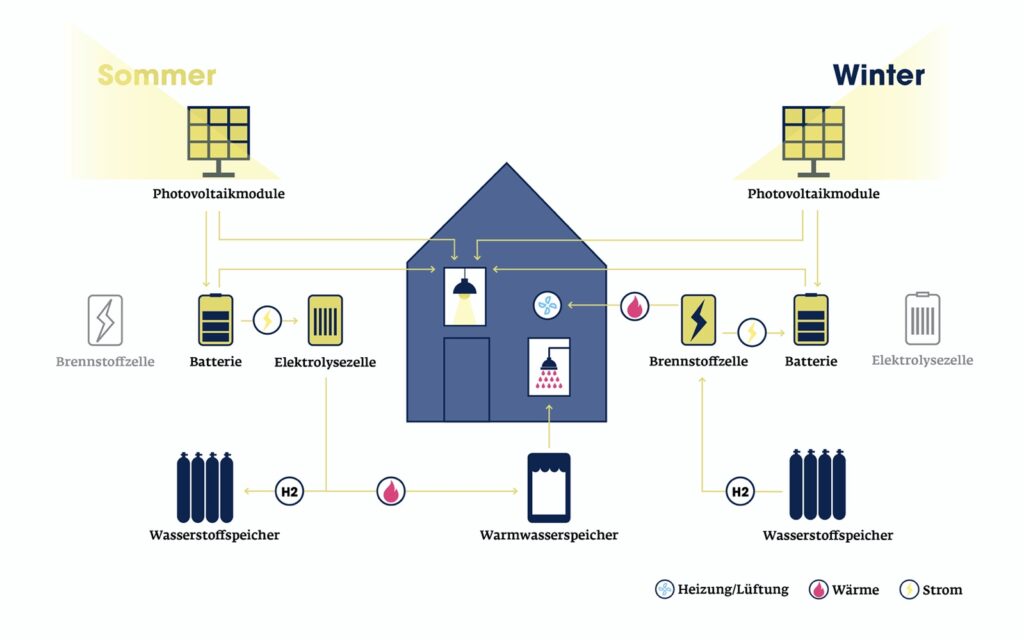
Buildings are increasingly becoming small power plants, since photovoltaic modules capture solar energy on more and more roofs. But the sun doesn't always shine and the demand for electricity fluctuates greatly over the year. Storage technologies are therefore in demand. Geothermal probes provide heat in winter, but no electricity. Batteries, on the other hand, make technical sense, but they are short-term storage devices and therefore not seasonal electricity storage devices. With the Seebrighof development in Hausen am Albis, the electricity works of the canton of Zurich are therefore taking a different, new approach. The 28 apartments in the attached farmhouse and the new building draw solar energy from the roof of the house. So that this is also available in winter, EKZ is installing a hydrogen storage facility – one of the first of its kind in Switzerland.
If, on summer days, the solar system delivers more electricity than the residents consume, it does not get back into the grid. Instead, the power-to-gas plant uses it to make hydrogen. In winter, when the energy requirement is higher, the system converts the hydrogen back into energy. "In the fuel cells of the plant, around 55 percent of this electricity is generated," explains Georg Putzi, Product Manager Energy Contracting at EKZ. The remaining 45 percent of the stored energy escapes as waste heat, which heats the building.
Seasonal electricity storage offers several advantages. The system is environmentally friendly because it only needs tap water and locally produced solar power. The public power grid is relieved. A battery compensates for short-term fluctuations, so the P2G system can be operated more efficiently.
In summer, the power-to-gas system uses solar energy to make hydrogen; in winter, it converts it back into energy.
The system in Hausen am Albis is based on a standardized concept that EKZ developed. This makes the technology cheaper, more adaptable and scalable. It can also be used for larger residential complexes or retrofitted in old buildings. "If there is already a solar system with an association for self-consumption (ZEV), the hydrogen technology can be supplemented," says Putzi. The technology can also be easily combined with heat pump systems, as in Hausen am Albis. In winter the environment supplies the heat (e.g. geothermal probes, groundwater or air), the hydrogen storage system supplies the electricity.
The P2G system has no particular influence on the building services; it just needs space near the heating center. In contrast, the gas storage facility is architecturally relevant. For safety reasons, it must be positioned outside the building so that the volatile hydrogen can escape in an emergency. The gas storage consists of gas cylinders, which are grouped as a bundle and covered with a housing that the architects can adapt.
With the system, the client increases the energy self-sufficiency and saves electricity costs in winter. "The P2G system is currently not yet cost-covering," says Georg Putzi. If the electricity prices rise in the future and the costs for the system fall, it will become significantly more economical. “Such pioneering work is important in order to gain experience and develop the market further,” says Putzi. Switzerland currently imports a lot of electricity in winter. If Germany switches off the coal-fired power plants, the winter shortage will be even greater. Storage technologies based on gases and liquids are therefore given high priority in the Federal Council's Energy Strategy 2050. With a P2G system, the buildings can help alleviate the challenges in terms of power supply in winter.
Whether renting or selling – the demand for visualization solutions in the real estate and construction industry is increasing noticeably. Depending on whether it is an existing property or a new construction project, different solutions are used. With the former, 360 ° tours are often used – increasingly interactive, with the latter often virtual reality solutions – adapted to the property and the target group.
Not every buyer or tenant can imagine an empty room furnished. This is where virtual home staging solutions help to make the sparks jump. With this tool, inexpensive condominiums or rental properties can also be designed in a visually appealing way and thus conveyed more quickly. Further solutions enable the virtual inspection of rooms that are yet to be built. Using stand-alone virtual reality glasses, planning errors can be seen virtually and thus avoided later. In addition, planned trades can be inspected together – for example with the client or architect. The "immersion" and actual experience of the premises gives security and a good feeling.
In addition, there are also complete virtual solutions on the market that digitally map different phases of the real estate cycle: from the outlined project vision and prototyping to visualization concepts for marketing and management.
You can find an overview of quality-checked visualization solutions here: https://proptechmarket.net/tools
The monthly rent index compiled by the digital real estate marketplace homegate.ch from TX Group in cooperation with Zürcher Kantonalbank closed at 115.4 points in June. Compared to the previous month, the asking rents have fallen by an average of 0.09 percent, explains homegate.ch in a corresponding message . In contrast, an increase in rental prices of around 0.7 percent has been observed over the past twelve months.
“As usual,” the asking rents have developed differently in the individual cantons and cities, explains homegate.ch. The analysts of the index observed the greatest declines with 1.29 percent in the city of Lausanne and with 0.99 and 0.49 percent in the cantons of Schwyz and Geneva. The strongest price increases, at 0.68 and 0.65 percent, were registered in the city of Bern and in the canton of Zug.
In most of the other cantons, the analysts observed a rather inconspicuous development in rental prices. The communication provides an interactive overview of developments in the cantons and metropolises.
In the quality-adjusted recording of rental price changes for the rental index, the rental prices are corrected for the different quality, location and size of the apartments. This makes it possible to record the actual rental price development, it says in the message.
"Renting and buying in Switzerland is getting more expensive", is how ImmoScout24 wrote a message on the current Swiss Real Estate Offer Index . It is prepared monthly by ImmoScout24 and the real estate consultancy IAZI AG . According to the surveys, the prices for rents and residential real estate rose on average across Switzerland in the first half of 2021.
The prices for residential property have only risen for months, explains ImmoScout24 in the message. Since the beginning of the year, prices for single-family houses have risen by a total of 3.8 percent, with a price increase of 1.4 percent compared to May being observed in June alone. The corresponding values for condominiums were 4.7 and 1.0 percent, respectively.
The index analysts have observed an ups and downs in rents over the past few months. There was an increase of 0.7 percent over the first half of the year. In June, an average increase of 0.6 percent compared to May was registered.
Renting has not become more expensive everywhere, it says in the message. Specifically, monthly rents dropped between 3.0 and 0.1 percent in Ticino, the Central Plateau, the Lake Geneva region and northwestern Switzerland.
Martin Waeber is quoted in the press release as saying that "the record price increase in the residential property market" has contributed to the fact that many people did not even ask themselves whether to rent or buy. “If you don't necessarily want to rent in the center”, you can “still get a bargain in some regions”, says the Scout24 Group's CFO.
The Scout24 group belongs to the insurance group Mobiliar and the media group Ringier . In addition to the real estate platform ImmoScout24, the network of online marketplaces operates the platforms AutoScout24, FinanceScout24, MotoScout24, the classified ads platform Anibis and the marketer Scout24 Advertising.
The expansion of solar systems in Switzerland in 2020 was around 30 to 39 percent higher than in the previous year and thus at a record level. That is at least the estimate of the Swissolar association based on the figures already available on the statistics for solar energy 2020, which will be published in July.
In a communication on the occasion of the National Photovoltaic Conference in Bern, Swisssolar points out that the pace of the expansion must be further accelerated. The Federal Council's Energy Perspectives 2050+ anticipate annual solar power production of 34 terawatt hours by 2050. Swissolar would even aim for 45 terawatt hours. However, the annual expansion for both goals must be increased by a factor of three to four compared to the previous year, according to Swissolar.
According to Swissolar, the framework conditions would also have to be optimized for a faster pace of expansion. According to the association's assessment, the expansion of photovoltaic systems in Switzerland will mainly take place on the roofs and facades of buildings. An evaluation by Swissolar shows that small and medium-sized systems of less than 150 square meters on the roofs of single and multi-family houses hold almost half of the “easily accessible” solar potential. The association therefore demands that investment security should be created for these systems as a priority. In the medium term, the winter production of electricity is likely to become increasingly important. According to the association, alpine solar systems in particular are likely to play an important role here.
The Manufakt8048 business park has been completed. On Thursday, the building owner Swisscanto , the developer and general contractor Steiner AG , architects, project partners and future tenants celebrated the opening of the new modular building complex in Zurich-Altstetten. In a media release , Steiner AG also announced that in the coming years, with Manufakt8820 and Manufakt8409, two more industrial parks will be built in Wädenswil ZH and Winterthur based on the same concept.
Steiner AG describes its special manufacturing concept as sustainable and multidimensional. It offers shared meeting rooms that can be used as required, as well as so-called flex offices and meeting areas. In order to make commercial rents affordable, especially for young companies, Steiner AG has improved space efficiency with areas that can be used jointly, for example. This can be "implemented well in reception areas, meeting rooms or lounges", says her Head Real Estate, Michael Schiltknecht. This is particularly interesting for start-ups, "who don't have to rent everything right away".
As it is said, the Manufakt8048 commercial property benefits from the attractive environment in the “up-and-coming urban quarter” in the west of Zurich in the immediate vicinity of the Zurich-Altstetten train station. It thus offers "ideal conditions for companies from a wide variety of industries".
Swiss Life Asset Managers has successfully completed a capital increase for the real estate fund Swiss Life REF (LUX) German Core Real Estate SCS, SICAV-SIF, informs the asset manager belonging to the Swiss Life Group in a message . A total of 108.7 million euros were raised, it continues. The funds are to be used to acquire sustainability-oriented properties in Germany.
Among other things, Swiss Life Asset Managers will acquire contractually secured residential properties that are characterized by energy efficiency and earnings potential, the company explains in the press release. In general, at least 50 percent of residential real estate should continue to be held in the fund. However, part of the newly brought in funds will be used to acquire commercially used properties in good to very good locations in German cities.
Swiss Life Asset Managers signed the UN Principles for Responsible Investment as early as 2018, the announcement further explains. According to her, the company applies appropriate environmental, social and corporate management criteria to both the purchase and management of real estate.
Madaster wants to strengthen the circular economy in the construction and real estate sectors. To this end, it offers digital tools such as material passports and indices for recording the economic and circular value of buildings on its platform, Madaster explains in a press release . According to her, Madaster Services Schweiz AG has won a new colleague in Allco AG. Together, Madaster and Allco want to make it easier for companies to access building passes and promote their use.
"As a general contractor for complex construction, conversion and renovation projects, we have a great responsibility", Allco managing director Urs Meier is quoted in the press release. "It is clear to us that Madaster is an important part of systematic and always transparent sustainability planning over the life cycle of a building." The company uses the Madaster tool, among other things, for the renovation of a property in Zurich for Swiss Prime Site .
In building passports, data about the materials used in a building are recorded. In this way, future recycling of the material is made possible. Allco's specialist knowledge should help Madaster make “material data usable over the entire life cycle of buildings”, explains Marloes Fischer in the press release. "This is how circular building works", says the managing director of Madaster Services Switzerland.
The construction company Strabag Switzerland has been awarded the contract for the renovation of a road section in difficult terrain in the municipality of Küsnacht as well as the renewal of the gas, water and electrical lines of the local electricity supplier Werke am Zürichsee AG . According to the media release , the project will be digitally controlled from planning through construction to subsequent maintenance. For this purpose, so-called Building Information Modeling (BIM) is used. Strabag AG has been awarded the contract as general contractor. The start of construction is scheduled for the end of August and completion around October 2022, according to the announcement.
The renovation project of the municipality of Küsnacht on the upper part of the Schiedhaldensteig is considered difficult. There, on the one hand, the renovation work has to be done in a very narrow and steep traffic area and, on the other hand, the sewerage pipes have to be replaced.
BIM manager Stijepan Ljubicic from Strabag is quoted as saying that, on the one hand, “the construction site will be handled completely digitally” with regard to the use of BIM in the planning and implementation of the two construction projects. In addition to planning and execution, all work would be digitally documented and ultimately handed over to the client in a so-called as-built model. This data offers many advantages with regard to quality management, operation and maintenance as well as a planning basis for follow-up projects.
The technical division manager for traffic route construction east at Strabag, Michael Graber, is quoted as saying that one of the main criteria for the award was the company's digital performance. The contract confirms Strabag's own competence and specialist knowledge in the field of BIM.
The press release also gives facts about the construction. The excavation will make up 1,500 cubic meters, 240 meters of raw material will be laid. The road is being built over a distance of 750 meters, using 500 tons of rolled asphalt.
ImmoScout24 wants to offer customers residing in Germany a rental loss insurance. To this end, the real estate platform of the Scout24 Group is working together with the white label insurer iptiQ from Swiss Re , the Zurich insurance group informs in a message . The offer launched under the ImmoScout24 brand covers the complete or partial loss of up to six monthly rents including ancillary costs. The insurance can be taken out and managed online.
"With the digital ImmoScout24 loss of rent insurance, we are providing private landlords with an innovative service that makes renting safer for them," Ralf Weitz, Managing Director of ImmoScout24, is quoted in the press release. This could be particularly relevant in times of the pandemic, says Weitz. ImmoSout24 takes on the role of the registered agent in the partnership.
IptiQ is responsible for covering all insurance-related aspects of the community offer, is further explained in the communication. "With ImmoScout24 we have the ideal partner in Germany to be able to offer customers tailor-made insurance products in the household sector online exactly when it matters", Andreas Schertzinger, CEO iptiQ EMEA P&C, is quoted there.
The Scout24 group belongs to the insurance group Mobiliar and the media group Ringier . In addition to the real estate platform ImmoScout24, the network of online marketplaces operates the platforms AutoScout24, FinanceScout24, MotoScout24, the classified ads platform Anibis and the marketer Scout24 Advertising.
Wir verwenden Cookies zur Unterstützung und Verbesserung unserer Dienste. Mit der Nutzung dieser Website erklären Sie sich mit der Verwendung von Cookies einverstanden. Weitere Informationen finden Sie in unserer Datenschutzerklärung.