Tag: Innovation

  • Kengo Kuma in Vals more than architectural innovation

    Kengo Kuma in Vals more than architectural innovation

    Kengo Kuma, an architect known for the artistic fusion of buildings with their surroundings, has realised a building in Vals that can be interpreted as a homage to nature. The building rises organically out of the landscape and almost appears to be interwoven with the mountains. This approach of fusion is a constant theme in Kuma’s work and reaches its peak here.

    The architectural style is based on the traditional timber construction of the region, but with a modern twist. The façade combines stone, wood and glass in a way that captures light and shadow. As a result, the building changes its appearance depending on the time of day and weather, creating a dynamic atmosphere.

    Another notable element of the project is the close collaboration with the local community. This participatory approach has resulted not only in an aesthetically pleasing building, but also one that meets the needs and sense of identity of the locals. In Vals, the building stands not only as an architectural landmark, but also as a place that represents the community and its identity.

    Inside, the building fascinates with its careful use of natural materials such as wood and stone, which create a warm, welcoming atmosphere. The design is conceived in such a way that the boundaries between indoor and outdoor space almost disappear. Large windows provide breathtaking views of the surrounding mountain landscape, while at the same time promoting an inner calm and harmony.

    Functionally, the building significantly expands the village’s social and cultural offerings. It not only houses public meeting rooms and exhibition spaces, but also provides space for local art and gastronomy. In this way, regional culture is effectively integrated into the design and the building becomes a lively centre for the community.

    Finally, Kuma’s new building in Vals is not only an architectural achievement, but also a testament to the possibility of a profound connection between people, nature and the built environment. Through this seamless integration and the strong involvement of the local community, Kuma has created a monument that is significant not only locally, but far beyond its borders. It reminds us that architecture can be emotionally resonant as well as functional, and emphasises the need to take a holistic approach to modern design.

  • ETH and Climate Foundation cooperate on innovations in construction

    ETH and Climate Foundation cooperate on innovations in construction

    The Chair of Building Technology and Construction(BUK ETHZ) at ETH Zurich and the Swiss Climate Foundation will be working together in future on climate-friendly building materials and methods. According to a joint press release, the cooperation includes the assessment of funding applications received by the Swiss Climate Foundation as well as publicising the funding opportunities and the innovations being supported.

    New climate-friendly materials and construction methods are necessary for the climate adaptation of the property sector. Innovative solutions need to be tested and demonstrated in pilot projects in order to make them marketable and publicised. The BUK ETHZ will assess the practicability of innovations in addition to the Swiss Climate Foundation and thus help to minimise the residual risk. The Climate Foundation could compensate for financial weaknesses.

    “Initial applications in the construction sector are always a difficult and risky phase for new products and methods,” the two lecturers Daniel Studer and Daniel Mettler from BUK ETHZ are quoted as saying. “With this collaboration, we can make an important contribution to the transformation of the construction industry. This is demonstrated by spin-offs such as FenX or Oxara from the ETH environment, which were supported by the Climate Foundation.”

    FenX transforms mineral waste into high-performance and sustainable insulating materials for the construction industry. Oxara develops cement-free admixtures and binder technology that enables the upcycling of construction waste and excavated materials in a variety of concrete and block applications.

  • Home of Innovation opens coworking space in Effretikon

    Home of Innovation opens coworking space in Effretikon

    Startup & Innovation Space AG operates two coworking areas in Winterthur under the name Home of Innovation. Another location has now been opened in Effretikon. According to a media release by the location, tourism and economic development agency House of Winterthur, the rooms are located in the former building of ewp AG directly at the railway station in Rikonerstrasse 4.

    On the initiative of the Economic Development Agency and financially supported by the City of Winterthur, “well-equipped meeting rooms, modern coworking spaces and individually designable offices” have been created. Supplemented by advice on setting up and developing businesses, regular events and a lively community, an “economic ecosystem” has been created.

    Start-ups and small businesses in particular could find many opportunities for flexible forms of work and network. The project could act as a “hub for coworking, innovation, sustainable entrepreneurship and digital transformation”, Marco Nuzzi, Mayor of Illnau Effretikon, is quoted as saying.

  • Austrian Hasslacher Group relies on urb-x

    Austrian Hasslacher Group relies on urb-x

    The internationally active Hasslacher Group from Sachsenburg in Carinthia is taking a stake in urb-x. The young company from Basel-Landschaft develops innovative cycle paths that are assembled from lightweight wooden elements. “With its cycle highways, urb-x offers a real revolution in urban cycling,” Christoph Kulterer, CEO and owner of the Hasslacher Group, is quoted as saying in a corresponding statement by the Austrian timber construction company. “The renewable raw material wood is also a central element in the mission of our two companies, through which we create innovative products and solutions for the challenges of modern cities

    The urb-x cycle lanes are made of prefabricated wooden hollow box elements mounted on steel supports. The anti-slip coated lanes can also be used by ambulances and street cleaning machines. In addition, the paths are equipped with heating elements, sensors and control computers. The energy needed to operate them is supplied by solar panels on the side borders.

    “We are very pleased to have gained a partner with leading production expertise and a clear strategic vision in the Hasslacher Group,” Klaus Kirchmayr, CEO of urb-x, is quoted as saying in the statement. “Our focus is now on making our product known throughout Europe for the first projects.”

  • Zug Cantonal Bank promotes young companies in Central Switzerland

    Zug Cantonal Bank promotes young companies in Central Switzerland

    The Zug Cantonal Bank wants to support young Central Swiss companies with sustainable product innovations. To this end, it is participating in the establishment of buildify.earth, the cantonal bank says in a statement. The newly founded public limited company plans to invest in young companies in the Switzerland Innovation Park Central.

    The innovation park, located in the Suurstoffi in Rotkreuz, focuses on sustainable product innovations in the building and energy sectors as well as mobility. The investments of buildify.earth are intended in particular to attract appropriate young companies in early stages, so-called early-stage start-ups, to the innovation park and keep them in the region. The Zug Cantonal Bank will initially contribute one third of the share capital of buildify.earth. It is represented on the board of directors by Martin Neuhaus, head of corporate client consulting.

    “Zuger Kantonalbank is the bank of entrepreneurs in the region,” Hanspeter Rhyner, CEO of Zuger Kantonalbank, is quoted as saying in the statement. “With our commitment to buildify.earth AG, we are advocating for the best possible framework conditions so that start-ups can develop successfully locally and bring sustainable product innovations from Zug out into the world.”

  • InCube Challenge comes to the FHNW in Aargau

    InCube Challenge comes to the FHNW in Aargau

    The InCube Challenge 2023 is also coming to Aargau: from 9 to 13 October, a 25-square-metre glass box will stand on the Brugg-Windisch campus of the FHNW. Inside, a group of students will eat, sleep and work on an innovative solution to a real challenge posed by ABB, Microsoft and the Canton of Aargau’s location promotion in 100 hours.

    According to a statement from the FHNW, the exact problem will be announced to the participants on the first day of the competition. Until then, it will remain secret. The cube can be visited at any time and the students will also be able to exchange ideas with the surrounding area, for example by asking for feedback on their ideas. According to a statement from the Aargau Economic Development Agency, the cube on the FHNW campus will be about developing resource-saving innovations, products and services. The InCube helps to make innovation visible.

    InCube is an international innovation competition organised by the ETH Entrepreneur Club. The two-week challenge begins this year on 2 October. During the PrepCube phase, participants meet online for the first time. During OutCube, they come to Switzerland to a retreat to train and connect with the others. During InCube, they live in a glass cube as a team for five days. This year, four will be in Switzerland and one will be in China.

  • Frischknecht Holzbau-Team AG wins the Innovation Award Zürcher Unterland 2023

    Frischknecht Holzbau-Team AG wins the Innovation Award Zürcher Unterland 2023

    This year’s Innovation Award Zürcher Unterland has gone to Frischknecht Holzbau-Team AG. The company from Kloten “has shown a lot of courage with the introduction of a four-day week to combat the shortage of skilled workers and has gained new and valuable experience for the construction industry”, writes the association Standort Zürcher Unterland in a statement. It has organised the competition to honour innovations from the Unterland region every year since 2021.

    Comtag AG from Wil ZH came in second with its innovative cleaning process for coffee grinders. Third place went to Green Datacenter AG from Lupfig AG. It was awarded for its Metro Campus Dielsdorf. The waste heat from the data centre in Unterland can be used by households and businesses in the surrounding area.

    The prize money of 5000 Swiss francs for the first-placed company and 2500 Swiss francs each for the second and third-placed companies was donated by the sponsors Zürcher Kantonalbank and Vetropack. The award ceremony took place on 14 September as part of the innovation event at Vivi Kola in the premises of the former mineral springs in Eglisau. The 50 or so participants were also offered a programme of presentations and seminars as well as a tour of Vivi Kola’s factory facilities.

    This year’s Innovation Award Zürcher Unterland went to Frischknecht Holzbau-Team AG. The company from Kloten “has shown a lot of courage with the introduction of a four-day week to combat the shortage of skilled workers and has gained new and valuable experience for the construction industry”, writes the association Standort Zürcher Unterland in a statement. It has organised the competition to honour innovations from the Unterland region every year since 2021.

    Comtag AG from Wil ZH came in second with its innovative cleaning process for coffee grinders. Third place went to Green Datacenter AG from Lupfig AG. It was awarded for its Metro Campus Dielsdorf. The waste heat from the data centre in Unterland can be used by households and businesses in the surrounding area.

    The prize money of 5000 Swiss francs for the first-placed company and 2500 Swiss francs each for the second and third-placed companies was donated by the sponsors Zürcher Kantonalbank and Vetropack. The award ceremony took place on 14 September as part of the innovation event at Vivi Kola in the premises of the former mineral springs in Eglisau. The 50 or so participants were also offered a programme of presentations and seminars as well as a tour of Vivi Kola’s factory facilities.

  • Schlieren continues to make progress with solar expansion

    Schlieren continues to make progress with solar expansion

    According to its press release, the city of Schlieren is taking another step towards sustainable energy supply and mobility: by the end of August, it will have put six new charging stations for electric vehicles into operation, as well as the largest municipal photovoltaic system at the IJZ Innovation and Young Entrepreneurs Centre on Rütistrasse.

    Each of its 1278 latest-generation modules has an output of 425 watts peak. The solar power generated is not only fed into the grid, but is also used for self-consumption: “The project at the IJZ exemplifies the progress in the energy turnaround, to which we attach great importance in this and many other projects,” Dr. Martin Nicklas, who heads energy contracting at the Canton of Zurich’s electricity utility(EKZ), is quoted as saying. This is because the solar power produced there is used to supply the IJZ and the commercial businesses located there as well as the surrounding flats. “This means that the PV electricity is produced and used at the same location – you can’t get more local than that.”

    Schlieren wants to set a positive example, especially in view of the solar targets that have so far been missed in the canton. The city is pushing the expansion of solar energy on its own municipal properties, especially on flat roofs, says Albert Schweizer, Head of Real Estate and Location Promotion at the City of Schlieren. “Our own municipal authorities, as well as the protection of historical monuments and our grid provider EKZ, provide us with significant support in promoting solar energy

  • Of people, technologies and organisations

    Of people, technologies and organisations

    The right use of innovations makes the difference between successful and less successful companies. Numerous practical examples show that the effects of innovative work equipment quickly fizzle out if investments are not also made in the users and in operational processes.

    A holistic approach to corporate development is the MTO concept, which focuses on the interaction of the three aspects of people, technology and organisation. The model is based on the insight that companies must continuously find new ways to remain competitive. However, innovative technologies prove to be useless if they are not supported by people or are not embedded in the processes within the organisation as a whole.

    The link between people, technology and processes is that people use technology to carry out processes and achieve their goals. Technology can improve the efficiency and productivity of processes, while people contribute their knowledge and skills to make the best use of technology and manage the processes.

    The MTO model strives to design work systems to meet both the individual needs and capabilities of employees and the needs of the organisation. Optimal alignment leads to better work outcomes, as every interaction between people, technology and the organisation has a significant impact on the efficiency, performance and satisfaction of employees.

    The combination of holistic corporate development with a strong innovation orientation is the prerequisite for long-term success. Companies that integrate people, technology and organisation into their strategic direction are better positioned to meet the challenges of the ever-changing business world and achieve sustainable growth.

  • Energie 360° steigt bei Solarmotion ein

    Energie 360° steigt bei Solarmotion ein

    Energie 360° steigt mit einer Minderheitenbeteiligung bei Solarmotion ein. Die Mehrheit des Ostschweizer Solarunternehmens verbleibe bei Gründer Stefan Merz, informiert Energie 360° in einer Mitteilung. Über den Kaufpreis der Beteiligung werden dort keine Angaben gemacht.

    Mit dem Einstieg bei Solarmotion will Energie 360° in den Ausbau von Photovoltaik investieren. „Die Beteiligung an Solarmotion leistet einen Beitrag zur konsequenten Umsetzung unseres Leitsterns: Energie 360° will bis 2040 ausschliesslich erneuerbare Energie liefern“, wird Ruth Happersberger, Bereichsleiterin Strategie und Beteiligungen bei Energie 360°, in der Mitteilung zitiert. Gemeinsam wollen die beiden Unternehmen Energie- und Mobilitätslösungen weiterentwickeln. Als Beispiele werden in der Mitteilung Contracting-Modelle oder Kombinationen von Ladeinfrastruktur für Elektrofahrzeuge mit Photovoltaik genannt.

    Im Zusammenspiel mit weiteren Beteiligungen sowie innovativen Unternehmen aus dem Start-up-Fonds von Energie 360° sind zudem Projekte im Bereich Energiemanagementsysteme geplant. „Ich bin glücklich, dass ich mit Energie 360° die ideale Partnerin gefunden habe“, erklärt Merz in der Mitteilung. „Sie zeichnet sich nebst grossem Netzwerk und Fachexpertise auch durch denselben starken Innovationsgeist aus – wir ergänzen uns auf ideale Weise.“

  • Record attendance at the 9th Real Estate Summit

    Record attendance at the 9th Real Estate Summit

    On Tuesday, 4 July 2023, the 9th Real Estate Summit took place at The Hall in Dübendorf, organised by FRZ Flughafenregion Zürich – Wirtschaftsnetzwerk & Standortentwicklung. Under the motto “Mobile. Sustainable. Collaborative.” experts and interested parties from the construction and real estate sector met to discuss the future of the industry and exchange views on current trends and challenges. With 640 registered guests, the 9th Real Estate Summit had a record turnout.

    The event began with “meet & match” talks and a barbecue lunch, which provided ideal opportunities to make contacts and network: 434 1:1 conversations took place. The Real Estate Summit opened at 1:30 p.m. with a musical warm-up featuring Carole Brunner (singer of the band Ginger and the Alchemist).

    André Ingold, President of the FRZ Zurich Airport Region and Mayor of Dübendorf, gave an overview of current topics and the largest construction projects in the region. In an interview with the new FRZ Managing Director Rahel Kindermann Leuthard, the future focus topics of the FRZ Zurich Airport Region were discussed.

    Sylwina Spiess (Ringier AG) moderated the FRZ flagship event. The guests enjoyed exciting presentations by experts from various fields, such as real estate market analysis, construction projects, green urban development and digitalisation.

    The future of the real estate market
    Ursina Kubli, Head of Real Estate Analytics at Zürcher Kantonalbank, opened the expert presentations with an insight into the current demand and supply trends in the real estate market. The following three topics would shape the real estate market: Digitalisation, demographics and decarbonisation. Office buildings with high accessibility – such as in the airport region – are comparatively well utilised. Overall, the major consolidation on the office market in the canton of Zurich has so far failed to materialise.

    In the airport region, office space in older buildings is increasing more strongly than those in the middle age range of 10 to 30 years. But new buildings are also increasingly remaining empty. Another trend: residential space is becoming increasingly scarce – also in the airport region. Conversion of offices into living space is therefore increasingly being examined.

    According to Kubli, measures against climate change are more topical than ever. Even if artificial intelligence (AI) is asked for the three driving factors for office real estate in the next 75 years, sustainability is one of the top three topics – along with technological progress and new working environments. The long-term increase in demand for office space results from a growing global economy. Kubli: “Companies prefer the proximity to Zurich Airport for international business travel and access to global markets.”

    New forms of collaboration in the construction sector
    Marco Faiss, co-founder of em2, shed light on new forms of collaboration in the construction sector. Innovative strategies and practices improve the efficiency and effectiveness of construction projects. Special emphasis is placed on teamwork, communication and tapping the potential of all participants. Inspiring organisations and individuals think, communicate and act in the same way – they operate from the “inside out”. This implies emphasising the “why” over the “how” and the “what”. He refers to Simon Sinek’s Golden Circle concept.

    According to Faiss, the interaction of people, values and concerns creates unpredictable new, emergent phenomena. Established patterns of thought are replaced in the process. Marco Faiss refers to methodical phase thinking, a process for partner acquisition, role development, a remuneration model (open book), and communication at eye level serve as instruments for structuring the process. His advice: “Run a construction project like a business.”

    The method includes identifying specific requirements, finding the best partners for these requirements, unrestricted investment in these partners without unilateral hedging, communication at eye level, investment in the organisation, and alignment with the principle that those who can do something best should do it. Everyone defines their own service specifications, every hour worked is paid for and successes are celebrated together.

    The lever of neighbourhood mobility
    Bernd Hofer, CEO of Freo Switzerland AG, and Sophie Stigliano, Director at Urban Standards GmbH, then spoke about “Green Only Development and the lever of neighbourhood mobility”. FREO focuses on sustainable construction and operation of buildings with a focus on the needs of future generations and respect for planetary impact limits. Their “Green Only Development” concept significantly reduces energy demand and greenhouse gas emissions and optimises costs by focusing on climate architecture and efficient, tailor-made solutions. It also integrates advanced mobility management that optimises traffic flow and promotes sustainable transport options, and uses a digital platform to manage these services.

    Involving users at an early stage
    After an extended coffee break, Hannes Pichler, Director of Real Estate at ETH Zurich, continued the series of lectures and spoke about integrated project management in the context of the circular economy and digitalisation. He presented the Real Estate department of ETH Zurich, which manages a real estate portfolio worth around 5 billion Swiss francs, including around 200 buildings with a main usable floor space of approximately 540,000 m². Between 2022 and 2029, a new physics building will be constructed on the Hönggerberg campus.

    Pichler spoke about the advantages of integral project delivery models and the challenges that can arise due to information asymmetries and different goals between client and contractor, also known as the principal-agent problem. He presented approaches to minimise these problems, including the early involvement of users and the definition of a functional specification.

    He also emphasised the importance of an early, integral approach to overcome the challenges posed by the megatrends of circular economy and digitalisation. Pichler showed various examples of successful projects and emphasised the need for integrated planning across all life cycles of a project and the importance of digitalisation to improve transparency and error analysis.

    Reset strategies in the decade of radical change
    The last presentation of the day came from Jens-Uwe Meyer, MBA Meyer, a book author and digital entrepreneur. He spoke about “Reset! Strategies for the Decade of Radical Change”. Today, more than ever, we would live in a “VUCA world”. VUCA stands for “Volatility, Uncertainty, Complexity, Ambiguity”. New artificial intelligence tools promote this ambiguity. Meyer highlights both positive and negative aspects – from its role in education and business to its potential dangers and impact on jobs. He provides an overview of the development of AI technology and applications from 2011 (with IBM’s Watson) to 2023 (with ChatGPT4).

    Among the most pressing issues are climate change and sustainability per se. Due to the demographic situation, the fight for the best talent is intensifying. In order to remain competitive, innovation management is crucial. He points to innovation barriers, including lack of processes, lack of strategies, openness and enthusiasm, and lack of courage and creativity. Meyer appeals to “discontent” – as an incentive for continuous improvement and innovation.

    The information part of the summit ended with another performance by Carole Brunner and then offered space for further exchange at the concluding Apéro Riche.

  • Grisons architect impresses in Los Angeles

    Grisons architect impresses in Los Angeles

    According to a report by LA Weekly, Chur-based architect Roger Kurath is one of the ten most innovative entrepreneurs in Los Angeles who are pushing boundaries in their respective industries. With innovative and sustainable design methods, Kurath is influencing the architecture of the West Coast metropolis, the article says.

    The work of the architecture firm Design21, founded in 2000, is represented in Switzerland as well as in the United States and Shanghai. Thoughtful design combined with cutting-edge technology have led to the firm’s buildings winning many awards. For example, Design21 received the Award of Merits at the prestigious PCBC Gold Nugget Awards for an 8000 square foot (about 750 square metre) custom house.

    As the article points out, Roger Kurath demonstrates not only exceptional talent but also a love of craftsmanship, with which he aims to create “sustainable dream homes for his discerning clients”. The aim is to create architectural masterpieces that also carry the climate of his homeland to various corners of the world.

  • Cantonal location promotion launches platform for business model innovations

    Cantonal location promotion launches platform for business model innovations

    The Canton of Aargau Economic Development Agency offers companies in the canton support in developing resource-saving innovations and products. For this purpose, it has launched the platform for business model innovations. The range of examples, tools and checklists available there can be used by companies free of charge after registration, the location promotion agency informs in a statement.

    The platform and services were developed by the Institute for Corporate Management at the University of Applied Sciences Northwestern Switzerland(FHNW) and further developed in cooperation with the Canton of Aargau Location Promotion. The FHNW experts also offer interested companies webinars and workshops via the platform. The kick-off will be on 26 June with a webinar on the topic of resource-conserving business models: a source of long-term success. Registrations for this and already a number of other webinars are open online.

    The promotion of resource-saving innovations is a focus of the programme Aargau 2030: Strengthening the residential and business location, explains the location promotion agency. The programme is part of the 2021-2030 development model drawn up by the cantonal government of Aargau.

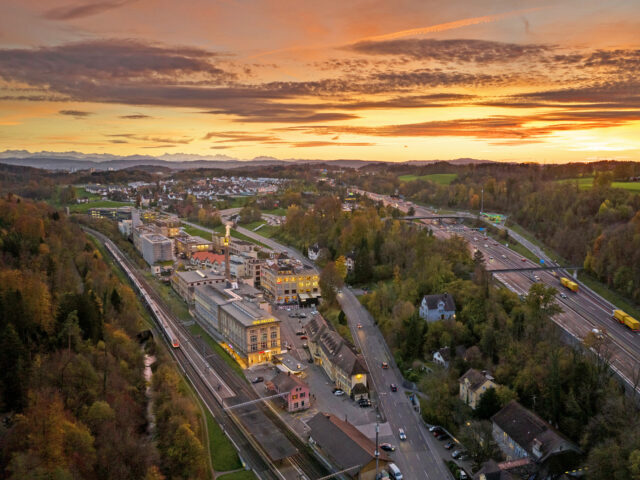
  • The Valley Kemptthal: Industry meets modernity

    The Valley Kemptthal: Industry meets modernity

    At the beginning of The Valley is one of Switzerland’s best-known “start-ups”: in 1872 Julius Maggi founded the company J. Maggi & Cie on what was then a sparsely developed site in Kemptthal and gradually expanded the site in the years that followed. in 1886 he developed Maggi seasoning – which became world famous.

    A lot has happened since then. in 1947, Maggi merged with Nestlé. in 2002, Givaudan took over Nestlé’s flavour business and the associated properties in Kemptthal. in 2003, most of the Maggi production was relocated to Germany. in 2017, Givaudan sold two-thirds of the site to the real estate developer Mettler2Invest.

    Since the beginning of 2018, Metler2Invest and the Motorworld Group have been developing the site with the joint company MA Kemptthal Besitz AG, based on a master plan by the architectural firm Ernst Niklaus Fausch Partner.

    Since 2019, the area has a new name: The Valley. Today, it comprises office, commercial and production space. Currently 1100 people work here in over 130 companies. The area has a modern village character. Among other things, there is a post office, a bakery, numerous restaurants, bars, shops, health practices, art studios, a car-sharing company for business vehicles and a fitness centre.

    Food still plays an important role on the site today – a high-quality food cluster is to develop in the Valley. Many of the resident companies produce or develop food: for example, the well-known manufacturer of plant-based meat substitutes Planted, a contract cheese dairy, a chocolate manufacturer, a bouillon producer and a coffee brewery. Givaudan with its highly specialised research centre and Nestlé with its retail shop are also still present in the area. By 2025, the first new building will house laboratory space for food development and, with The Cultured Hub (Migros, Bühler, Givaudan), a highly specialised research centre for the production of meat from animal cells.

    The Valley is located directly at Kemptthal railway station.

    A second thematic focus of The Valley is on motor vehicles. The Motorworld Manufaktur Region Zürich in the heart of the area is a meeting place for people with a passion for classic and high-quality mobility. Various event rooms among vintage cars, supercars and electric racers are the hub for mobility topics and offer space for numerous events.

    With events, those responsible also want to enliven the area, which is easily accessible with its own railway station and the nearby motorway connection, but does not directly border on a city, for hours and days at a time. To this end, they have founded their own event company. The area offers 10 to 10,000 square metres of event space for seminars, congresses, readings, meetings, banquets, concerts, markets and festivals. As a supporting programme, for example, guided tours, various team-building activities or rides in racing simulators are possible.

    Since 2018, the historic, listed industrial buildings have been extensively renovated and supplemented with additional new buildings that architecturally blend in with the historic building stock. Currently, one of the existing halls is being expanded as an event hall, and the first new building will go into realisation this spring.

    A multi-storey car park on an adjacent plot is currently in the approval phase. A pedestrian bridge will later connect it with Valley Square – the central square of the area. A hotel is also planned in one of the existing buildings. A corresponding adjustment of the structure plan is currently underway at the cantonal level for the non-zoned use.

    Another new building could be realised from 2026 or 2027. Another four new buildings are possible; these are to be realised depending on demand.

  • In the middle lies KIM

    In the middle lies KIM

    Neuhegi, the former Sulzer site in Oberwinterthur, has changed in recent years from an industrial district to a dynamic development area. It is a varied mix of flats, businesses, shopping facilities, schools, a wide range of leisure activities, meeting zones and a local recreation area that includes the Eulachpark.

    With KIM Winterthur, a lively and multi-layered quarter with commercial and residential buildings of different sizes is being created directly at Winterthur-Neuhegi railway station. Each of them is modern, but has its own character. The overall composition consists of a total of seven buildings, variedly planted inner courtyards and a landscaped park.

    On the one hand, KIM is intended to become a hub for fresh entrepreneurial spirit and innovation. It wants to bring people, companies and educational institutions together in an inspiring way. The commercial spaces can be used in a variety of ways and are intended to appeal to companies of different sizes and from a wide range of industries.

    On the other hand, KIM in Neuhegi will create several hundred modern rental flats, many of which have already been occupied. The 1.5 to 5.5 room flats have floor plans between 41 and 135 square metres. Living comfort is also reflected in the above-average heights of up to 4.7 m on the ground floor and 2.6 m on the upper floors. All buildings comply with the Minergie-P standard and are built in solid construction on the one hand and in ecological wood-concrete hybrid construction on the other.

    The Vivale Neuhegi senior citizens’ centre, which opened in 2020, is also part of the quarter. It fits in with the philosophy of KIM, which aims to promote heterogeneous coexistence.

    The KIM buildings are surrounded by green retreats. The area is broken up by trees, bushes, green spaces and paths. Car-free promenades and a network of paths for walkers and cyclists invite people to linger in the fresh air on the site and in the nearby Eulachpark. Together, they form an essential part of the public green belt. in 2018, construction began on Ida Park and Sulzer Park. These connect the Neuhegi school building via Sulzerallee with the Hegi railway station as a public park strip. Half of the design of this park strip was determined by the residents.

    In summer 2019, construction began on the northern half of the plot for the u-
    shaped residential building “Haus Furrer” with a public-oriented use on the ground floor. At the end of 2019, construction work began directly next to it on the second residential building, “Haus Bill”. The two buildings were completed at the end of 2021 and in mid-2022. With the residents, KIM’s public-oriented commercial sector received many potential new customers. The two southern commercial buildings are to be home to established companies and start-ups from the high-tech sector, among others, on 18,600 square metres. The start of construction has not yet been determined.

    KIM Winterthur is a joint project. The investors and real estate developers involved are Ina Invest, Steiner, Swiss Life and Mobiliar, as well as Reliva, which manages the Vivale Neuhegi senior citizens’ centre.

  • NEST receives aviary for drone research

    NEST receives aviary for drone research

    A DroneHub is being set up on the NEST. As the Swiss Federal Laboratories for Materials Testing and Research(Empa) illustrates in a short video, it resembles an aviary. On a floor space of 90 square metres, a construction of metal tubes and mesh forms a cage with a height of up to eleven metres. According to an Empa release, the final construction will provide test environments for three research fields.

    For the first, 3D printing in flight, an experimental wall with interchangeable modules will be used to develop drones that fly and carry out inspection and repair work vertically. “The drones can, for example, detect and repair cracks without the need for elaborate scaffolding or endangering the safety of people,” explains Mirko Kovac, the head of Empa’s Sustainability Robotics research laboratory and director of the Aerial Robotics Lab at Imperial College London.

    The second application area, robotic environmental sensing, focuses on the interaction between drones and the environment. “You can place targeted sensors in nature and read the data with regular flights,” says Kovac. This is “very relevant” especially for energy plants such as wind turbines or dams, but also for collecting climate data in impassable and wide-open spaces.

    The third research area wants to develop rules and technological standards for the coexistence of robots and humans, for example for interfaces between buildings and flying robots. This concerns, for example, landing sites on or near buildings or the positioning of charging stations.

  • Core statements of the research paper “Sustainability in the mortgage business

    Core statements of the research paper “Sustainability in the mortgage business

    The importance of mortgages to achieve the 2050 climate targets

    1. The building sector is a major contributor to energy consumption and CO2 emissions, so sustainable retrofits and energy-efficient design are necessary to achieve the 2050 climate targets.
    1. Mortgages are crucial for energy retrofits and efficiency improvements of buildings. By aligning mortgage terms with sustainability goals, banks and lenders can incentivise owners to green their properties and thus contribute to achieving climate goals.
    1. Within the framework of self-regulation, banks undertake to create better incentives for more sustainability in the areas of loan-to-value, affordability, amortisation and interest rates, especially for private owners. A large proportion of mortgages are granted to private owners.

    The role of private owners

    1. Private owners are fundamentally worse off in terms of sustainability compared to institutional owners, although for a long time the problem was at the level of “will”. Increased energy prices and interest costs, as well as increased regulation and public interest, have likely increased willingness.
    1. Cognitive barriers need to be broken down through comprehensive advice in order to increase the renovation rate among private owners. Many owners do not realise that sustainability can be financially rewarding as it can lead to higher occupancy rates, rental income, lower operating costs, higher liquidity and lower risk premiums, which in turn increases the value of the property.
    1. Financial barriers need to be removed to increase the rate of renovation among private owners. Attractive mortgage conditions can ultimately persuade them to act after readiness and education.

    Offering green mortgages

    1. Mortgage financing that financially rewards and encourages sustainable behaviour already exists and is integrated into the product offerings of many lenders. There is currently no standard taxonomy and various certificates are used to classify sustainability.
    1. Green mortgages include advantageous terms but can be criticised for inefficiencies and potential greenwashing. In addition, positions and environmental impacts are rarely communicated externally.
    1. Lenders that are actually engaged can finance their lending of green mortgages by issuing green bonds and thus be more efficient and transparent. In doing so, they also increase their competitiveness and enhance their credibility.

    What should be expected as a private owner?

    1. Owners should be aware that green practices can increase property values in different ways, while less sustainable buildings risk becoming stranded assets due to future regulatory measures and market changes.
    1. In the future, an improved database and more accurate tools may allow for a more precise recording of CO2 emissions and grey energy of real estate, which would lead to more efficient and symmetrical pricing in lending. This would allow green properties to be financed at more favourable conditions, while non-green properties might receive less favourable conditions.

    More detailed info at www.avobis.ch/wp-content/uploads/esg-im-hypothekargeschaeft_final.pdf

  • Winterthur promotes five new Smart City projects

    Winterthur promotes five new Smart City projects

    In 2023, the city of Winterthur will support a total of five innovative projects that can contribute to sustainable development and to increasing the quality of life in the city. For this purpose, the city is providing a total of 200,000 Swiss francs from the Smart City Winterthur innovation credit, informs the city administration in a corresponding statement. Since the launch of this credit, Winterthur has supported a total of 18 Smart City pilot projects.

    This year, WinEnerGIS is one of the projects that can look forward to receiving funding. In this project, a prototype for a public information platform in the energy sector is being developed. Here, building-specific information on available energy sources will be made available. The project Together on the Trail of the City Climate integrates the population into Winterthur’s temperature measurement network.

    In the Digital Mobility Lab API project, Stadtbus Winterthur and the Digital Mobility Lab of the Zurich University of Applied Sciences are working together. The aim is to develop an interface with which questions from practice can be solved with real data in the future. The first step is to optimise connections when changing trains.

    The Winterthur@Metaverse project is looking into the question of beneficial applications for Winterthur in the Metaverse. If necessary, a first prototype will be developed in the metaverse. Finally, the RPA@DigiWin project is about digitising repetitive tasks of the city administration.

  • CEO Yonas Mulugeta Resignation at the end of September 2023

    CEO Yonas Mulugeta Resignation at the end of September 2023

    CSL Immobilien has already begun the search for a suitable successor to ensure a smooth transition and uninterrupted business operations.

    “On behalf of the Board of Directors, I would already like to thank Yonas Mulugeta for his many years of tireless commitment to CSL Immobilien. He has done an outstanding job together with the management and has made the company a leading player in the real estate industry,” says Markus Schawalder, VRP of CSL Immobilien. “We are confident that we will find a suitable successor who will further develop the company into the next phase on the successful path that Yonas Mulugeta has taken. Our goal is to continue to drive innovation and growth at CSL Properties.”

    Yonas Mulugeta will remain closely connected to the real estate industry after his retirement as an active entrepreneur and will take on new entrepreneurial challenges.

  • The shell of the QUBO think tank is complete

    The shell of the QUBO think tank is complete

    The shell of the two interconnected buildings of QUBO in Sarnen North is complete. Sixteen months have passed since the groundbreaking ceremony. According to a media release from Obwaldner Kantonalbank(OKB), this think tank will offer established companies, innovative start-ups and co-workers space for meetings and interactive inspiration.

    OKB is constructing a new building there that will provide a new home for innovative companies in Obwalden. The bank will make most of the premises in the new building available to the Startup Pilatus association for the promotion of start-ups as early as October 2023. OKB itself will set up an Innovation Lab there for itself and others. Eberli AG is modernising and expanding its existing headquarters there. Its two conversion and expansion partners, werkunion ag and Orfida Treuhand + Revisions AG, will each occupy one floor as future co-owners of the building.

    The QUBO will have the QULT bistro on the ground floor and the QLUB room for events with up to 100 people. The OKB describes the official opening, planned for March 2024, as an “important milestone for Sarnen as a business location and for entrepreneurs in the region”.

  • Innovation Park Zurich wins Angst+Pfister as investor

    Innovation Park Zurich wins Angst+Pfister as investor

    The Innovation Park Zurich(IPZ) has gained Angst+Pfister as an investor. The globally active Zurich-based manufacturer of high-performance components and engineering solutions has acquired a significant stake in IPZ Property AG, which is responsible for realising the project, the Zurich Innovation Park Foundation informs in a statement. “For the first time, a well-known industrial partner from Switzerland is participating as an investor in the Innovation Park Zurich,” foundation president Peter Bodmer is quoted there.

    For Christof Domeisen, CEO and Delegate of the Board of Directors of Angst+Pfister, the Zurich Innovation Park is “by far the most exciting development project in Switzerland”. His company is convinced “that the close interlocking of research and development in one place creates an ideal platform to be successful in the future”. Domeisen sees precisely these conditions fulfilled at the Zurich Innovation Park on the grounds of the Dübendorf airfield.

    The implementation of the project has successfully completed its political process with the now legally binding approval of the commitment credit by the Zurich Cantonal Council. Next, the Swiss Federal Institute of Technology Zurich and the University of Zurich are to take over the existing aircraft hangars on the site. An architectural competition is already underway for the new buildings in the first phase of development. In addition, “more and more companies are interested in locating on the IPZ,” explains Andrea Claudio Thöny, head of IPZ Property AG. “Since the political decisions have been made, things are now moving ahead quickly.”

  • The industry is hungry for change

    The industry is hungry for change

    The Branch was founded in 2020. What exactly is the association and what does it do?
    W.S. Seidel: The Branch is a non-profit association that develops new processes and solutions for the further development and increased productivity of the construction and real estate industry and thus promotes the transformation of the industry. The association is broadly based: on the one hand, among its members – organisations from the entire sector, private and public building owners, entrepreneurs, planners, logistics experts and IT specialists. On the other hand, at the level of federal policy: The Branch aims to contribute to the implementation of the goals set by the Federal Council in its 2030 Agenda for Sustainable Development and in its 2050 Energy Strategy.

    What are the goals of The Branch?
    Y.Körber: The Branch is committed to process-related and integrated cooperation within the construction industry. The industry today is very discipline-based, sometimes almost with blinkers. People think mainly in phases, and there is a conspicuous separation between planning and execution. However, cross-disciplinary cooperation would be enormously important. By this we mean, for example, that the different players work together much more closely from the beginning, and that the execution is already taken into account much earlier in the planning. We are working intensively to establish integrated models in the market and to develop basic principles, solutions and answers. Ultimately, this should also lead to more productivity and innovation as well as better results.

    St. Zanetti: We want to use concrete projects to show that new models work. We want to build up a rich inventory of tried and tested instruments. In addition, we organise events where we discuss practice-related questions with the participants.

    How does the cooperation within the association work?
    St. Zanetti: The association is currently organised in eight working groups, which are composed dynamically and deal with different assignments in different subject areas. One of the working groups, for example, deals with the question of how to improve the handling of data in construction projects. We are currently in the process of creating templates, for example for the legally compliant exchange of data. Such templates can save a lot of effort because not every company has to reinvent the wheel.

    How will the success of The Branch be measured in the long term?
    Y. Körber: In the changes that take place in the construction industry.Körber: By the changes we can create in the industry: more innovation, more sustainability, a very concrete change in culture. We can also see that our idea is well received from the growth of the association – in the first three years we have gained over 500 members in German-speaking and French-speaking Switzerland and our board of directors comprises almost 20 people. This also shows that the industry is hungry for change.

    The topic of grey energy and the circular economy is currently very present. What role does it play at The Branch?
    W.S. Seidel: This is one of our core topics. Finding a better way of dealing with grey energy and making building projects more sustainable is only possible through innovation. And innovation needs collective know-how – and thus the cooperation of different disciplines at an early stage.

    St. Zanetti: In the end, you will only be able to achieve a sustainable real estate industry if you think in integrated cycles. Because only then will we know what has happened, what has been built and what emissions are produced. The sustainability goals of the Federal Council can also only be achieved with an integrated view.

    What significance does digitalisation have for The Branch?
    St. Zanetti: Only when we are on the move in an integrated way can we as an industry optimally use and exploit technologies. Digitalisation then in turn supports integrated cooperation. When using technologies, the compatibility of different software and technologies is central. For example, we are dealing with the question of how the interfaces of the systems of different players and in different phases look and how companies must select their software so that data continuity is guaranteed. We also want to set standards for the industry in this area.
    The criticism of proptech companies is often that they do not know the needs of the industry and only provide individual pieces of the puzzle.

    Y. Körber: One of the big challenges for young proptech companies is precisely this fragmented and non-integrated process view in the construction industry. This makes it difficult for start-ups to develop scalable solutions. They develop a solution for one project – and everything is supposed to look different again for the next one. The work of The Branch will also lead to standardisation in this area and make it easier for young companies to develop suitable solutions.

    One question in conclusion: Why are you personally on the board?
    St.Zanetti: I find it exciting to advance topics in a pragmatic format with people from the most diverse companies using very concrete practical examples.

    Y.Körber: I am fascinated by the fact that The Branch shapes innovation and makes it accessible to everyone. The real estate industry is an important pillar of the Swiss economy – our approach therefore serves not only at industry level, but also at national level. That’s what I like to be involved in.

    W.S.Seidel: I am on the board in order to further develop the conflict-laden situation between the various players in the construction industry, as a result of which a lot of added value is lost, into a proactive production and cooperation-promoting culture in the long term, from which everyone benefits.

    Wolf S. Seidel is a lawyer and a proven expert in construction, planning and real estate law. The practical, legal design of integrated project development models is a focus of his current studies and work. He is involved in various committees and organisations that make collaborative and process-optimised forms of realisation available in practice, particularly for Swiss building owners – both public and private.

    Yvette Körber is co-founder of several companies, including Amberg Loglay AG. She has been working successfully in the construction industry for several years and helps the industry to become more efficient with smart and digital construction logistics. She is involved in “The Branch” with the Design Build and Ordering Competence groups.

    Stefan Zanetti has spun off several spin-offs from ETH Zurich; most recently Allthings Technologies AG, an integration and orchestration platform for the real estate industry that seamlessly links numerous systems. He is involved in various committees for a permeable and seamlessly networkable software landscape in the real estate industry in Switzerland and Europe, and is also a regular lecturer on various CAS and MAS training courses.

  • Switzerland Innovation Tech4Impact supports six start-ups

    Switzerland Innovation Tech4Impact supports six start-ups

    The Switzerland Innovation Tech4Impact program was carried out for the third time this year. Six sustainability-focused young companies are being supported with funding of CHF 85,000 each and access to a network of industrial partners.

    The winners include two start-ups from the canton of Zurich, Openversum and Aseptuva . Openversum from the city of Zurich is developing new types of filters for drinking water. Aseptuva from Winterthur is developing a device that protects the skin from infections thanks to special UV rays. It wants to reduce the risk of hospital infection.

    The company Gaia Technologies from Bern has also won. The start-up is developing a novel technology for recycling agricultural waste into biocomponents and other resources. These are to be used, for example, in cosmetics or in the food sector.

    Rematter AG from Zug, TOSA swisstech SA from Courroux JU and a project at the Swiss Federal Institute of Technology in Lausanne ( EPFL ) also received awards.

    Rematter develops recyclable floor tiles for use in apartment buildings. TOSA swisstech is working on a new type of device that converts hydrogen into electricity particularly efficiently. The EPFL project is developing a graphene-based nanoporous membrane for use in the capture of CO2 in combustion processes.

    Switzerland Innovation Tech4Impact is a joint initiative of Bern-based Switzerland Innovation , E4S Tech4Impact and collaboratio helvetica .

  • Viboo wins Empa Innovation Award

    Viboo wins Empa Innovation Award

    Every two years since 2006, Empa has honored in-house innovations or successful technology transfers from science to industry with the Empa Innovation Award. This year, the CHF 5,000 prize went to the Empa spin-off viboo , the research institute said in a statement . The young company based in Dübendorf has developed a self-learning algorithm that uses weather and building data to calculate the optimum energy use of a building several hours in advance.

    The algorithm developed by Felix Bünning and Benjamin Huber together with Empa Senior Researcher Matthias Sulzer in Empa's Urban Energy System Lab has already been tested in pilot tests in the NEST innovation building and in an Empa administration building. It has been shown that the approach can save around a quarter of the heating energy, according to the statement.

    For the application, only the analogue thermostats have to be replaced by intelligent thermostats. Here, viboo is already working with Danfoss and wants to get other manufacturers of such thermostats, such as ABB and Schneider Electric , on board for further pilot projects. Huber wants to reciprocate the award with a contribution that “empa will get through the coming heating period well”, the viboo co-founder is quoted as saying in the press release.

  • Canton of Zurich initiates pilot project for innovation potential of SMEs

    Canton of Zurich initiates pilot project for innovation potential of SMEs

    In a press release , the canton of Zurich announced the pilot program for SMEs and innovation to strengthen innovative strength in SMEs. It was developed over a three-year period by the cantonal location promotion department on behalf of Economics Director Carmen Walker Späh and in conjunction with the Canton of Zurich Location Promotion Network and the Zürcher Kantonalbank , the Zurich Chamber of Commerce ( ZHK ) and the Canton of Zurich SME and Trade Association ( KGV ) . The location support program provides for SMEs to receive guidance and support from specialists, especially from the private sector, and from innovation specialists in the early stages of planned innovations, so that they can apply for national funding.

    The innovative strength in companies with fewer than 100 employees harbors potential for improvement and is showing a downward trend compared to large companies and start-ups that are showing innovative activities. A lack of access to knowledge and low resources for the implementation of planned projects are given as reasons for the backlog. Many SMEs are also reluctant to join forces with other companies and universities. According to a study by the economics department in the Office for Economics and Labor in the Economics Directorate, there is also room for improvement in “networking and collaboration between SMEs”. The Corona crisis has additionally weakened the innovative power.

    Economics director Carmen Walker Späh wants to ensure that SMEs make a step forward in their innovation activities and thus ensure the diversity of industries “especially in times of crisis”. “Switzerland is an SME country. It is all the more important that our SMEs continue to provide jobs and training positions,” she is quoted as saying in the media release. heg

  • Houzy doubles the number of users

    Houzy doubles the number of users

    Houzy is growing rapidly. Recently the 100’000. Apartment owners are registered on the platform of the same name from the young PropTech company from Zurich, writes Houzy in a statement . Just a year ago, the start-up founded in 2017 reported that its users had increased to 50,000. The number of houses and apartments digitally recorded on the platform increased from 70,000 to 144,000 in the same period.

    Data is intelligently linked on the Houzy platform and recommendations for homeowners are derived from it. For example, it can be calculated there when the heating system should be renovated and how much money should be put aside for it. Houzy also offers a real estate appraisal. Free advice is also available to registered users.

    In the past few weeks, the company has revised its platform and integrated new digital tools, explains Houzy. In concrete terms, homeowners can now check the demand for their property, optimize the corresponding sales price and calculate the real estate gains tax for all Swiss cantons. Houzy emphasizes the platform’s new property search function as the most important innovation. All major real estate platforms would be searched here and the advertisements would be supplemented with “valuable additional information”. As examples of such additional information, a neutral market value estimate as well as energy efficiency, energy saving and solar potential and the need for refurbishment of the property are given in the notification.

  • Siemens launches AI-based suite for carbon-neutral buildings

    Siemens launches AI-based suite for carbon-neutral buildings

    Siemens Smart Infrastructure is launching an open, interoperable and fully cloud-based smart building suite, the Zug-based Siemens subsidiary announced in a press release. The various interest groups such as building users, real estate investors, real estate companies and facility managers can digitally combine their building data from different sources on Building X. The smart building suite can integrate third-party software, has a range of applications based on artificial intelligence and has built-in cyber security.

    “We can now bring together all the data generated by systems in intelligent buildings in a single data pool,” Matthias Rebellius is quoted as saying in the statement. According to the board member of Siemens AG and CEO of Smart Infrastructure, this would allow “intelligent buildings to be implemented more quickly”, bringing the “vision of autonomous, climate-neutral buildings” closer. “Building X creates measurable data-based results in terms of efficiency, performance and user experience.”

    An energy manager, an operations manager, a security manager and a 360° viewer are currently available on Building X. The suite can be obtained in the form of software as a service on a subscription basis. In addition, Siemens offers the Xcelerator Building Services, a program based on Building X, in which Siemens assumes responsibility for achieving customer goals. The report mentions the reduction of energy costs and the optimization of systems as examples.

  • Google opens innovation center in Zurich

    Google opens innovation center in Zurich

    Google officially inaugurated its completed Europaallee campus on June 27, according to a media release. Google moved into the first parts of the campus in 2019. The complex, which consists of several buildings, is now complete.

    The Californian IT giant has had a presence in Zurich since 2004. Around 5,000 people from more than 80 nations now work for Google in Switzerland. Some of them are also housed at the second Google location on the Hürlimann site. In 2023, Google intends to move into another 15,000 square meter office building on Müllerstrasse in Zurich. The Zurich branch is already the IT giant’s largest development center outside of the USA.

    Federal President Ignazio Cassis was also present at the opening of the office. “I congratulate you on opening the Innovation Center for two reasons: Firstly, because you do it and you attach such great importance to innovation. And secondly, because you do it in Switzerland,” he says, according to the text of the speech . The fact that Google is investing in Zurich also underscores the fact that the location is developing from a banking metropolis into a digital hub.

    Among other things, Google Switzerland is involved in the development of Internet services such as search, Google Assistant, Google Maps, Gmail and YouTube. Zurich is currently the largest headquarters of the YouTube development team next to the headquarters in San Bruno, California. In addition, Google Maps, for example, was essentially created in Switzerland. Google is also working with partners such as SBB or PubliBike to better map mobility services on Google Maps. By 2030, Google wants to operate all of its services CO2-free. Google itself has been CO2-neutral since 2007.

    “Quality work is done in Zurich and that is the main reason for the sustainable, organic growth of the site. Switzerland in particular has so far offered very good framework conditions,” Google technology chief Urs Hölzle is quoted as saying. Google wants to continue growing in Zurich in the future.

  • Popety.io is expanding into German-speaking Switzerland

    Popety.io is expanding into German-speaking Switzerland

    Popety.io specializes in digital solutions for real estate acquisition. Specifically, the PropTech based in Plan-les-Ouates has developed a digital tool for collecting and processing real estate data. After successfully establishing itself in French-speaking Switzerland, Popety.io now also wants to open up the German-speaking Swiss market. To this end, Popety.io has already set up its first office in Zurich.

    The Vaudoise Insurance Group supports Popety.io in its expansion plans. “Popety.io is revolutionizing the Swiss real estate market with the help of artificial intelligence,” says Stefan Schürmann, Head of Corporate Development and M&A at Vaudoise, in a statement by the insurance company. “We keep a close eye on innovations in the real estate sector and are convinced of the development potential of the young company in the German-speaking Swiss market.”

    Two years ago, Popety.io won first prize at the Real Estate & New Technology Awards, the statement said. “With Vaudoise Insurance, we can develop further and gain credibility,” Popety.io founder Thibault Clément is quoted there as saying. The PropTech also takes part in The Big Handshake . The congress for real estate professionals will take place on June 21st in Schlieren ZH.

  • Miromico manufactures 26,000 climate sensors for Ecco2

    Miromico manufactures 26,000 climate sensors for Ecco2

    Ecco2 is increasing its production volume from over 11,000 in the past two years to 26,000 climate sensors. As a provider of intelligent solutions for buildings, the company based in Givisiez wants to reduce the consumption of heating energy. These sensors are manufactured by the Zurich high-tech company Miromico , which focuses on development services for integrated circuits, electronic systems and the Internet of Things. As stated in amedia release , Miromico has been Ecco2’s “trustworthy hardware manufacturer” for years.

    With the increased production volume, Ecco2 wants to tackle energy savings of up to 4,000,000 square meters of heated space from 2023, according to its Head of Operations, Alain Wagnières. With this production capacity, Ecco2 can fulfill its vision of saving 50,000,000 kilowatt hours of energy annually by next winter.”

    In Switzerland this year, Ecco2 won the Prix d’Innovation in the digital category at the annual event for real estate professionals, Rent Switzerland . The company was also awarded the Swisscom IoT Climate Award 2022 in silver.