Tag: Investition

  • Schlieren concludes planning contract for new retirement centre

    Schlieren concludes planning contract for new retirement centre

    In March, Schlierem’s voters approved a loan of 44,317,000 Swiss francs for the construction of the retirement centre Wohnen am Stadtpark. The new building in the middle of the city is to replace the Sandbühl retirement centre. Now the city council has awarded Liechti Graf Zumsteg Architekten from Brugg AG the contract for the corresponding architectural work, the Schlieremer city administration informs in its current city council news. The volume of the planning contract is 3.7 million Swiss francs.

    Wohnen am Stadtpark is designed as a building complex with contemporary and affordable flats for older people. The concept by Liechti Graf Zumsteg Architekten envisages a two-storey base with concrete elements housing the restaurant and nursing rooms. Four upper floors for the flats for the elderly will be built in timber. According to the city administration’s information on the project, the new building will “meet the requirements of a healthy and ecological construction method according to Minergie-P ECO and be certified accordingly”. The completion of the new retirement centre is planned for 2026.

  • Pension funds: Out of bounds with real estate

    Pension funds: Out of bounds with real estate

    Everything is relative: for pension fund managers, the quote attributed to Nobel Prize winner Albert Einstein may have a special ring at the moment. Their investments in shares and bonds have lost a lot of value in the past year. Positions in real estate, on the other hand, suffered less. As a result, these have – relatively speaking – often gained significantly in weight in the investment portfolio of the pension funds. This has not only theoretical but also tangible consequences.

    At the end of last year, market observers warned that a quarter of the pension funds in Switzerland would have to sell or devalue real estate investments because their weight exceeded the requirements of the Ordinance on Retirement, Survivors’ and Disability Pension Plans (BVV2). The ordinances prescribe a fixed quota for real estate investments that may not exceed 30 per cent.

    “A few pension funds had bandwidth violations
    Heinz Rothacher, CEO of the well-known St.Gallen pension fund consulting firm Complementa, now tells finews.ch that the quota violations at the end of 2022 turned out to be even more extensive than feared. “More than a third of the pension funds have reported a real estate quota of over 30 percent,” says the market expert (see chart below). And he notes, “There are a few pension funds that had a bandwidth violation due to the increase in ratios.”

    In fact, the OOB2 ordinance allows certain bandwidths in the portfolio shares according to which the pension funds can design their investment strategy. But even this leeway has limits. When the edge of the bands is touched, there are therefore two tactics: Sit it out or correct it.

    Maintain quota for now
    The pension funds have apparently opted for the former as a first step. “Since it is a passive violation of the bands, they tolerated it and decided to maintain the existing quota,” Rothacher reports. The same applies to violations of the BVV2 limit of 30 percent, he adds.

    Complementa has asked a good 150 decision-makers in occupational pension schemes specifically about the problem; the CEO therefore knows pretty well in which direction the industry is heading. As of the end of 2022, the real estate ratio averaged 24.1 percent, 3 percentage points higher than the previous year.

    The wait-and-see approach has not worked badly for the pension funds so far. The real estate quota has been reduced again this year due to the positive performance of the stock markets, Rothacher reports. As a result, “the breach of the bandwidths has been partially remedied.”

    Current surveys by Credit Suisse show that the Swiss pension funds generated an average investment return of 3.86 percent by the end of last June; the major bank UBS comes to an average performance after deduction of fees of 3.51 percent in its measurements. This means that the funds have already exceeded the statutory minimum distribution of 1 per cent per year.

    The crux with illiquidity
    Nevertheless, the problem has not disappeared, and the pension funds must be concerned about keeping within the defined bandwidths in the medium term due to their investment strategy. Another sticking point arises: Due to the illiquidity of the asset class – for example, directly held properties or investment foundations – it is difficult to adjust the ratio in the short term.

    Accordingly, the funds have to tackle where liquidity is most likely to be available: in listed real estate investments. As Rothacher from Complementa reports, there is now movement to be seen there. “37 percent of the funds that participated in the survey are planning to reduce listed real estate funds,” explains the financial professional. As many as 11 per cent of the respondents are also thinking about reducing non-listed vessels.

    Redemption fees increased
    As it turns out, the prices of Swiss real estate funds have already fallen sharply in 2022. The relevant SIX Real Estate Funds Broad Index (SWIIT) lost more than 15 percent of its value last year. This year, the counter stagnated. Meanwhile, a lower demand for additional investments is noticeable among the non-listed investment groups, explains Rothacher.

    Various real estate funds have also received significantly fewer commitments than planned for capital increases. “Not long ago, oversubscriptions were the norm,” he recalls.

    The Complementa CEO does not expect major sales of such vehicles. On the other hand, he knows of individual investment groups that have already increased redemption fees this year – also with the reference to wanting to protect existing investors. This can have a deterrent effect on sellers. “The redemption fees for the various investment vehicles vary greatly and can sometimes account for a large part of an annual performance,” Rothacher knows.

    When do appraisers resort to red pencils?
    But even those who stubbornly hold on to their real estate positions may have to let down their guard. This is the case if there are valuation corrections because the real estate appraisers would be forced to raise the discount rates due to further interest rate steps.

    At least on the Swiss market, the current low level of construction activity, immigration and rising rents make such measures appear premature. However, further interest rate hikes by the Swiss National Bank could still lead the appraisers to apply the red pencil.

    Local pension funds often have a pronounced “home bias” in their real estate investments and would probably be sensitive to a decline in valuations.

  • “Buy-to-let” A model calculation from the perspective of private investors

    “Buy-to-let” A model calculation from the perspective of private investors

    “Buy-to-let provides Swiss private investors with a way to participate in the real estate market and has enjoyed growing popularity in the wake of the low interest rate environment. The share of rented condominiums and single-family houses accounted for 17.0% of all newly concluded residential property financing in 2019 on a volume-weighted basis. This means that almost every sixth property was purchased with the intention of subsequently renting it out. In most cases, investments are made in condominiums and thus in smaller lot sizes due to the financial assets available.

    The aim of the final thesis was to show private investors the main risks associated with a buy-to-let investment and to establish a relative comparison with alternative capital market investments. To this end, an investment analysis model was developed that looked at the profitability of a 3.5-bedroom condominium from its purchase in 2000 to its sale in 2020. Based on studies in various markets in the Bern area and by means of different sensitivities regarding the use of debt capital, their effects on the profitability ratios were illustrated.

    Result
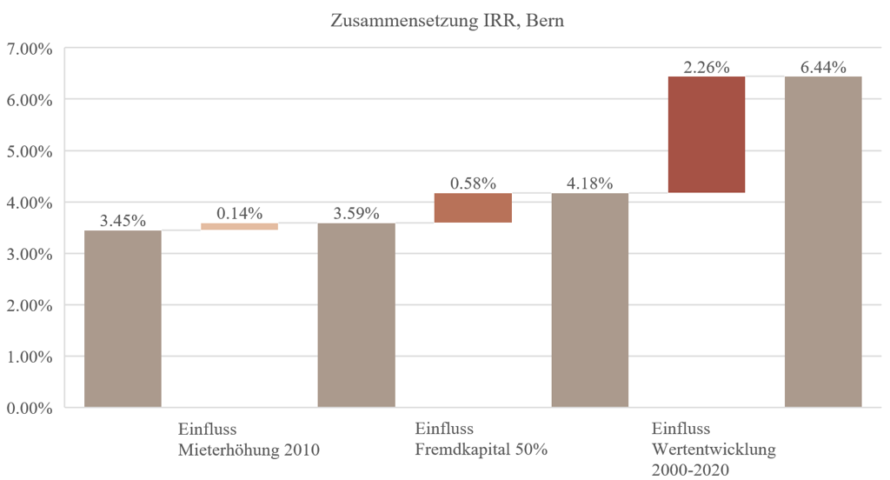
    Risky investment strategy: With regard to the holding phase, it became clear that in particular the choice of the degree of debt financing and the prevailing interest rate level determines the achievable return on equity and at the same time also forms the highest expenditure item. In the first years of the holding period, a high leverage ratio of 75% and an average interest rate of 3.70% resulted in exclusively negative net returns. With regard to the sale of the property, it became apparent that the value development was the most significant determinant for the success of the buy-to-let investment (see Fig. 1). The potentially realisable market value is subject to cyclical fluctuations. Combined with an increased leverage ratio and the associated debt risk in terms of rising interest rates and possible losses in value, these factors constitute the main risk of the buy-to-let investment. If, in addition, a large proportion of the assets is tied up in a single property, this creates a considerable cluster risk, which is further increased by the effect of rising interest rates and losses in value. It is important to note that passing on rising interest rates to the tenant is only possible to a limited extent due to legal restrictions and the sluggishly reacting reference interest rate. In addition, higher interest rates are usually accompanied by rising inflation rates. Since residential rents are usually not fully linked to the consumer price index, inflation leads to a partly real reduction in rental income.

    Fig. 1: Composition of IRR, using the example of the city of Bern.

    The consideration of the different markets – depending on the location of the property – also made it clear that the regional disparities can lead to large differences in the profitability and investment risk of the private investor and represent a further risk for the buy-to-let investment. With regard to the value retention of the property, the private investor should therefore primarily assess the location quality and the property.

    Comparison of capital market investments
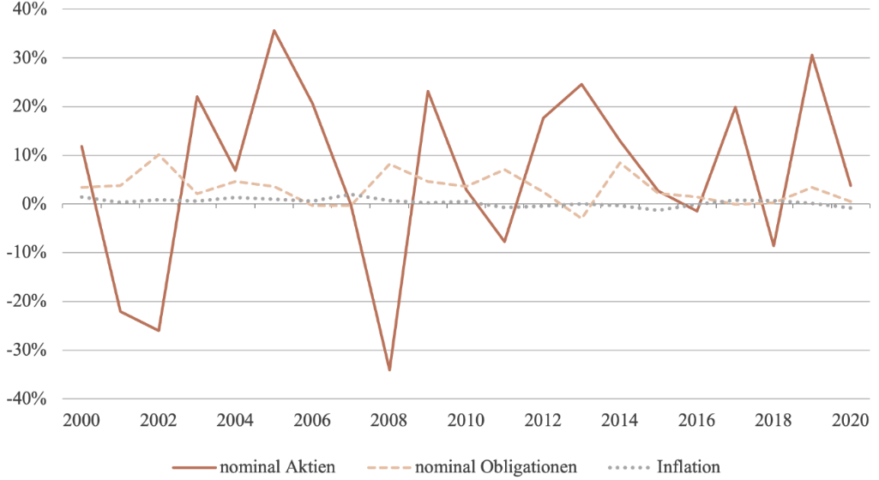
    The comparison with the two asset classes Swiss equities and Swiss government bonds showed that the buy-to-let strategy could certainly represent an attractive alternative (cf. fig. 2+3). It was possible to further improve the return on the property over the period under consideration by using debt capital, but this was accompanied by a significantly higher risk (see Fig. 3). It should also be noted that the risk-return characteristics must be extended to include the variable of liquidity: In a weak economic environment, the sale of a property is only possible under timely circumstances and is usually associated with financial losses.

    Fig. 2: Annual returns on equities and bonds, observation period 2000-2020.

    Conclusion
    The decision for a buy-to-let investment should not be made lightly. A property purchase financed out of a lack of alternative asset classes and low financing costs often does not take into account the risks assumed at the same time. The property must remain effectively affordable in a higher interest rate environment and further capital gains should not be relied upon as an investment strategy. It can be concluded that rental income in particular determines the success or failure of the buy-to-let investment.

    Personal details
    Anissa Kühni, born 1991. Studied architecture at the Bern University of Applied Sciences, graduating in 2016. Master of Advanced Studies UZH in Real Estate, graduating in 2021. From 2016, active at Frutiger AG in project development for various site developments with a focus on “residential” as well as acquisitions. Since 2023 employed as project manager for real estate developments at Swiss Prime Site Solutions AG for the real estate fund “Akara Swiss Diversity Property Fund PK”.

  • Window manufacturer 4B achieves highest net sales in its history

    Window manufacturer 4B achieves highest net sales in its history

    The window and façade manufacturer 4B, headquartered in Hochdorf, achieved the highest net sales in its company history in the 2022 business year. Despite a slightly lower order volume of 191 million Swiss francs, the traditional company was able to increase net sales by 14.7 per cent to 204.2 million Swiss francs, according to a media release.

    According to the statement, 4B’s supply chains proved to be “pleasingly crisis-resistant” even in times of an “extremely difficult geopolitical situation” due to the Ukraine war. The reason for this is the company’s focus on suppliers from Switzerland and nearby European countries.

    This ensured a high level of supply security, prevented production stoppages and “positively mastered the 2022 business year”, CEO Jean-Marc Devaud is quoted as saying. He did not provide any information on profits.

    Furthermore, the company invested more in 2022. Thus, investment activities increased by 45.5 per cent to 4.8 million Swiss francs. By commissioning new equipment, it was able to reduce the time it takes to produce an order by more than two days.

    It also reportedly made progress in the areas of digitalisation and automation. Instead of paper folders, employees now use iPads on construction sites. This allows them to organise building inspections more efficiently. Quotations for window renovations can also be calculated more quickly and easily during the first consultation.

    In addition, the company moved into its eleventh location in 2022. It is located in Wallisellen ZH. At the end of 2022, 4B employed 703 people in Switzerland.

  • Swiss AI is in the final of the Elevator Pitch Competition

    Swiss AI is in the final of the Elevator Pitch Competition

    Swiss AI has been nominated for the Elevator Pitch Competition(EPiC) 2023 in Hong Kong. The Zug-based start-up is one of 24 finalists in the Proptechs category, according to a statement from the organiser, the Hong Kong Science and Technology Parks Corporation(HKSTP). Another 26 finalists were named in the Fintechs category. The 50 young companies were selected from 618 applications from 55 countries.

    Swiss AI uses optimisation algorithms to help multinational companies and other clientele from around the world plan their investment decisions. A digital twin combines the financial, technical, environmental and quality of life impacts of planning to enable informed decision-making. Swiss AI is about “promoting sustainable societal change in terms of energy, mobility and urbanisation while creating investment opportunities around the world”. The company is based in Zug and the development department is in Zurich.

    The EPiC finale will take place on 28 April at Hong Kong’s tallest building, the International Commerce Centre. The centrepiece of the event is a 60-second lift ride during which participants present their business model.

    According to the announcement, EpiC, with the Science Park’s network of more than 1,000 investors and 300 corporate partners, offers “the best platform available for start-ups” to achieve “real business success”. All 50 finalists would have the chance to be considered for direct investments of up to $5 million from the HKSOP Venture Fund and receive support for market expansion across Asia. In addition, the overall winner will receive $90,000.

  • Voters approve credit for district heating in Chur

    Voters approve credit for district heating in Chur

    Chur’s energy supplier Energie Wasser Chur(IBC) can massively expand its district heating network. The electorate approved a corresponding municipal proposal by 60.85 per cent. It states that the city will contribute 80 million Swiss francs to the total costs for the expansion of the heating network over a period of twelve years. These costs amount to 314 million francs.

    According to its message to the polls on 12 March, the municipal council supported the proposal with 17 votes in favour and 4 against. Now Chur is supporting the generation project of the IBC, which is an independent institution under public law in the sole ownership of the city, with 60 million francs to increase the endowment capital and in the form of a loan. The city is holding a further CHF 20 million in reserve for any guarantee that may be required.

    In the view of the municipal council, the investment is necessary to ensure the conversion to a renewable heat supply within the city. “At the same time, the loss of the previous added value from the sale of gas can be absorbed and the revenues increased elsewhere,” the message continues. “The money that flows out today for the purchase of oil and gas will remain in the region in the future.”

    According to the information, IBC wants to borrow a total of 160 million Swiss francs from financial institutions. In addition, a contribution of 56 million francs from the federal government and the canton is expected. The company intends to invest 38 million francs of its own funds.

  • Swiss construction, sales and operating company plans 1800 beds in the Surselva

    Swiss construction, sales and operating company plans 1800 beds in the Surselva

    At the Dieni valley station of the SkiArena Andermatt-Sedrun, a new tourist village is to be built by 2027. According to a press release , Andermatt Swiss Alps (ASA) intends to invest CHF 170 million in this area of the municipality of Tujetsch. This is the first time the company is planning a project on the Grisons side of the Andermatt-Sedrun winter sports area.

    The planned resort will include 13 sustainably constructed buildings with 410 hotel rooms of different categories. 119 additional residential units are for sale and are managed for tourism. A total of 1,800 beds are planned, as well as three restaurants, two bars, various retail areas and leisure facilities.

    The number of hotel beds in Surselva will thus increase by 20 percent. "This major project is a milestone for the municipality of Tujetsch and the whole of Surselva," said Mayor Martin Cavegn. There will be an information evening for the public on August 19th.

    With the Dieni resort, the tourist offer will be "supplemented in the direction of inexpensive apartments and hotel rooms geared towards families/groups", according to ASA. The client is Resort Dieni Development AG. It is a 100% subsidiary of Andermatt Swiss Alps. The company acts as operator with its partner company Orascom Hotels Management . The latter has offices in Altdorf UR and Cairo and belongs to the Egyptian Orascom group .

  • What is the ideal building age for an investment?

    What is the ideal building age for an investment?

    In order to answer the question of the ideal age of a real estate investment, PriceHubble first examined the development of market prices and rents for buildings of different ages for its analysis. “Buildings, like cars, tend to depreciate faster in the early part of their life cycle than in later years. However, since a property usually also includes a plot of land that does not wear out, the value of the property then approaches the value of the land,” says Dr. Nima Mehrafshan, Head of Research at PriceHubble.

    The analysis was carried out based on the PriceHubble valuation model. For each of these, a location in a major Swiss city was selected and a typical apartment in this location was evaluated. The year of construction was varied for each apartment assessed, while all other influencing factors were kept constant – including the time of the assessment. “In this way, we can determine how the market value and market rent of a typical apartment decrease with age, ignoring market-wide price changes over time,” adds Dr. Mehrafshan.

    Biggest loss in value in Bern and sharpest drop in rent in Basel – real estate in Geneva with the smallest loss in value
    The majority of the price loss occurs across all the cities examined in the first 40 years after construction and then levels off between 17 and almost 26 percent. Real estate in the city of Bern experienced the greatest loss in value at around 26 percent. In contrast, real estate in Geneva only lost around 17 percentage points.

    A similar picture emerges when it comes to rents, with the decline in market rents already having largely taken place after 20 to 30 years. After this time, rents are between -12 and -25 percent compared to a new building. Rents in the city of Basel are falling the most at around 25 percent, while rents in Geneva are only falling by just under 12 percent.

    Lowest rental yield after 10 to 20 years
    Basically, rental yields are only slightly influenced by the age of the building. The rental yields for new buildings are only slightly lower than for older buildings. The rents fall slightly in the first few years, since the market rents fall a little faster than the market prices with the age of the building. In general, rental yields are lowest for buildings that are 10 to 20 years old and range between 2.3 percent and just under 3.0 percent. After almost 60 years, returns reach their zenith and remain between 2.6 percent and 3.4 percent.

    The city of Bern is the leader in terms of rental returns with a rental return of around 3.4 percentage points after 60 years. The city of Zurich has the lowest average rents and shows a return of 2.6 percent after 60 years.

    10-year return: Bern is the leader
    A similar picture emerges when looking at 10-year returns (combination of rental returns and market value loss through wear and tear). Here, too, the yields level off from an age of just under 60 years. The city of Bern is also the front runner with a total return of around 33 percent. Real estate in the city of Zurich meanwhile has the lowest average return of around 26 percent.

    In principle, the return on buildings under 20 years of age also falls to 16 percent to 23 percent over a 10-year period. «In order to answer the question of the best building age for an investment, investors must also consider the maintenance costs in addition to our analysis. Here, of course, the faster depreciation early in the property’s life is offset by the higher maintenance costs for most older buildings. Nevertheless, investors can use the results of the study to review their investment strategy,” says Dr. Mehrafshan.

    Detailed information at: https://bit.ly/3tzmpt6

  • The foundation stone for the Rieter Campus has been laid

    The foundation stone for the Rieter Campus has been laid

    With its construction project for the Rieter Campus, Rieter is committed to the Winterthur location and to Switzerland as a business location, according to a press release from the textile machine manufacturer. The foundation stone for the new customer and technology center as well as the administration building was laid on Wednesday. The company, which has been based in Winterthur for 225 years, is investing around 80 million francs in this

    From 2024, the Rieter campus is to offer space for around 700 workplaces on a floor area of over 30,000 square meters. To this end, the company developed an open room concept with a specialist in office architecture. With heat generation via geothermal probes and a 1,300 square meter photovoltaic system, Rieter is relying on renewable energies. “The entrepreneurial focus on sustainable and energy-efficient solutions for yarn production is thus reflected in the overall concept of the campus,” CEO Norbert Klapper is quoted as saying.

    In the course of its company history, Rieter has helped shape the city of Winterthur, said Chairman of the Board of Directors Bernhard Jucker. “Now, with the new campus, the foundation is being laid for the future as a leading technology company.”

  • Construction investments are falling slightly

    Construction investments are falling slightly

    Construction investments fell by 0.3 percent year-on-year in 2020, as the Federal Statistical Office ( FSO ) writes in a press release. This is understood to mean the construction expenses without public maintenance work. If these are also factored in, the total construction expenditure will be roughly at the level of the previous year.

    Investments in new construction projects have decreased by 0.6 percent year-on-year. In contrast, 0.1 percent more was invested in renovation projects. The federal government, cantons and municipalities invested more in both new construction and renovation projects than in 2019. In 2020, private clients were more cautious.

    According to the FSO, a positive development was observed in civil engineering investments. These increased by 3.2 percent in 2020. In contrast, investments in building construction projects decreased by 1.1 percent. While the federal government, cantons and municipalities have invested more in building construction as well as in civil engineering than in the previous year, the amount invested by the private sector only increased in civil engineering.

  • Sika invests in Qatar

    Sika invests in Qatar

    Sika has increased the production capacities for concrete admixtures at its location in Qatar's capital Doha, informs the Zug-based building materials group in a press release . In addition, the production of epoxy resins has now also started there, it says there. They are needed for the production of floor coverings and adhesives.

    The expansion investments are intended to put Sika in a better position in the competition for major government contracts in Qatar. Here, the national procurement policy stipulates that primarily domestically manufactured products are procured, explains the group. According to the announcement, high investments in the supply infrastructure for energy and water are pending in Qatar.

    "Our latest investment in Qatar positions us for further growth and strengthens our competitiveness in the country", Sika Regional Manager EMEA Ivo Schädler is quoted in the press release. "As a result of the expanded production, we are assuming a significant increase in demand and volume for our high-quality adhesive and flooring solutions for our business."

  • Madulain hydropower plant is back in operation

    Madulain hydropower plant is back in operation

    Repower has put the Madulain hydropower plant back into operation. According to a press release , the company invested around 2.3 million francs in its comprehensive renovation. Among other things, the control system, the control technology, the electrical installations and the entire medium-voltage switchgear were replaced. In addition, the turbine and generator had to be overhauled.

    The Madulain hydropower plant produces around six gigawatt hours of electricity annually. This corresponds to the average annual consumption of 1,300 households.

    The hydropower plant, built in 1903, was last renovated in 1980. It uses the tributary of the Ova d'Es-cha mountain stream on a slope of around 400 meters.

  • Groupe E invests in Neuchâtel

    Groupe E invests in Neuchâtel

    The new operations center is to be built in the Sécherons II industrial area of Boudevilliers in the municipality of Val-de-Ruz, Groupe E informed in a press release . The Freiburg energy supplier has already acquired an area of 18,300 square meters. An administration building, a warehouse, a washing facility, a yard for recycling and parking spaces are to be built there within two years. The communication puts the investment volume at around CHF 22 million.

    Immediately after completion, Groupe E plans to relocate the company’s employees, who are currently based in Corcelles-Cormondrèche, Neuchâtel and responsible for the operation and expansion of the electricity network in the canton of Neuchâtel, to Boudevilliers. The new location will also be used to expand the group’s activities and as an overarching competence center, explains Groupe E. In the announcement, the company refers in particular to the subsidiary Vuilliomenet Électricité AG based in Boudry NE. Through this, Groupe E in the canton of Neuchâtel also offers services in building technology or electrical systems and home automation.