The Economic and Location Promotion FRZ Airport Region Zurich, based in Glattbrugg, invites you to the 9th Real Estate Summit in Dübendorf. On 4 July, speakers from the construction and real estate industry will deal with new forms of cooperation, sustainability, energy and mobility, according to a media release.
Accordingly, Ursina Kubli, head of real estate analytics at the Zürcher Kantonalbank, will speak from 1.30 p.m. about the development from abundance to scarcity on the real estate market and how the demand for office space is shaping up in times of home office. Afterwards, Marco Faiss, co-founder at em2, will show new ways of cooperation in construction projects.
Bernd Hofer, CEO of Freo Switzerland, and Sophie Stigliano, Director at Urban Standards, will address sustainable building and the question of climate-friendly mobility as an integral part in their presentation “Green Only Development and the Leverage of Neighbourhood Mobility”.
After a coffee break and opportunities for networking, the second part of the programme continues at 4.30 pm. Here Hannes Pichler, Director of Real Estate at the Swiss Federal Institute of Technology Zurich(ETH), will speak about integrated project management against the background of the circular economy and digitalisation.
Jens-Uwe Meyer, management mastermind, book author and digital entrepreneur, will address the audience with the last paper of the day, “Reset! Strategies for the Decade of Radical Change”, he looks to the future. The evening will conclude with an aperitif and the opportunity to network.
Admission to The Hall is from 11 am. Registration for participation is possible online.
As part of an extensive survey of over 1,600 energy suppliers in the DACH region, AEW impressed with its impressive portfolio in the area of mobility. In particular, the products from the mobility sector convinced the jury. The quality model developed by EUPD Research evaluates the offers of energy suppliers in the context of the energy strategy and AEW was able to achieve outstanding results in the mobility category.
The data collection was carried out from the customers’ point of view, whereby the internet presence of the energy suppliers was examined by means of mystery shopping. The model covers the four key areas of electricity, heat, energy efficiency and mobility. Within each area, the extent to which the energy suppliers provide high-quality products and services for customers was examined. AEW has already received an award in the “Electricity” category in 2018 and in the “Energy transition” category in 2021.
The winners of the award were announced at an official ceremony in Munich on 15 June 2023. Arian Rohs, Head of Mobility Solutions, and Adrian Lerch, Team Leader E-Mobility, proudly accepted the coveted award for AEW in the Mobility category. Their presence at the award ceremony in Munich underlines the company’s commitment and success in promoting sustainable mobility. “For us, the award is a great honour and confirmation of our efforts to drive forward the energy strategy in the area of mobility. This award is an incentive for us to continue offering high-quality products and services and to shape the mobility of the future,” says Arian Rohs.
The first bus line in Switzerland to be served by a self-driving bus with dual-mode technology has now also aroused curiosity in Baden-Württemberg, according to a media release from the Swiss Transit Lab. Winfried Hermann, the transport minister of the south-west German state, visited the Swiss Transit Lab’s STL Line 13 in Schaffhausen with a high-ranking delegation.
According to its media release, the delegation discussed “with great interest” the benefits, previous experiences and opportunities of the new technology and saw for themselves the driving comfort of the minibus. The line was opened on 28 April and runs in an initial pilot phase from Monday to Saturday between 10 a.m. and 2 p.m. three times an hour between the North Station and the Stahlgiesserei.
Hermann sees the development of autonomous buses as an important component for cost-efficient and demand-oriented public transport in rural areas in the long term. “As part of on-demand services, these can ensure that people always remain well connected and are flexibly transported to their destination, even outside of rush hours,” he is quoted as saying in the statement. “In Schaffhausen, the Swiss Transit Lab is already demonstrating the impressive potential of the technology.” The state of Baden-Württemberg is involved in several pilot projects that are advancing research on autonomous buses, he said.
The “House of Energy” at the Museum of Transport Lucerne is a new, long-term platform on the subject of energy. Not only transport and mobility are connected with energy – energy is needed for every form of locomotion. But it also plays a key role in the burning issue of climate change: transport alone accounts for more than a third of CO2 emissions in Switzerland.
Many people still do not understand the complex interrelationships. The Swiss Museum of Transport wants to change this with its new exhibition. On an area of 600 square metres, the interrelationships and their effects on society are to be shown: How do housing and mobility interact? What might innovative solutions and Switzerland’s energy future look like in 2050? Visitors will be able to view exhibits and interactive attractions that illustrate and bring to life the past, present and future of energy. In addition, various conferences and events on the topic of energy are planned from 2023.
The purpose-built building by Gigon Guyer Architekten from Zurich, which replaces the former “Schienenverkehr 1” hall, was designed with the latest generation of energy technology equipment: Minergie P is the standard, the energy centre runs on water, and photovoltaic systems have been installed on the roof and the façade. Thanks to this energy centre, the entire Swiss Museum of Transport will be able to run largely on renewable energy in the future. In realising the project, the Swiss Museum of Transport worked together with partners from politics, administration, science and business. The “House of Energy” is intended to serve as an educational venue for schools and universities as well as an experimental laboratory and innovation location for initiating and accompanying activities and projects in the context of sustainable mobility.
The Swiss Museum of Transport in Lucerne, with its strong visitor numbers of 500,000 to 600,000 people per year at the museum, sees itself as a partner in the transformation process towards the targeted net-zero climate neutrality in 2050. The new energy platform is intended to promote interest in and discussion of the topics of energy and mobility with a focus on Switzerland. The goals include imparting knowledge, creating a strong connection to the everyday lives of visitors, and transparently presenting the challenges along with possible solutions and communication in relation to schools and the professional world. The interactive exhibition will open in April 2023. The new building, which does not include the energy centre and tenant improvements, cost around 37.8 million Swiss francs.
Lucerne station is the sixth-largest railway station in Switzerland: around 100,000 passengers board and disembark here every day. The problem: the double-track access has reached its capacity limit and is prone to disruptions. The forecast growth in public transport mobility in the canton of Lucerne is around 40 percent by 2030. Rail mobility has already increased by 50 to 100 percent in the last ten years – especially on the canton’s main development axes.
The Federal Office of Transport, the Swiss Federal Railways (SBB), the cantons of Lucerne, Nidwalden and Obwalden, the city of Lucerne, the regional development agency LuzernPlus, the Lucerne Transport Association and the Zentralbahn (Central Railway) therefore want to expand rail services with the Lucerne through station (DBL) and implement various infrastructure projects. The planned through station is considered a generation project in Central Switzerland.
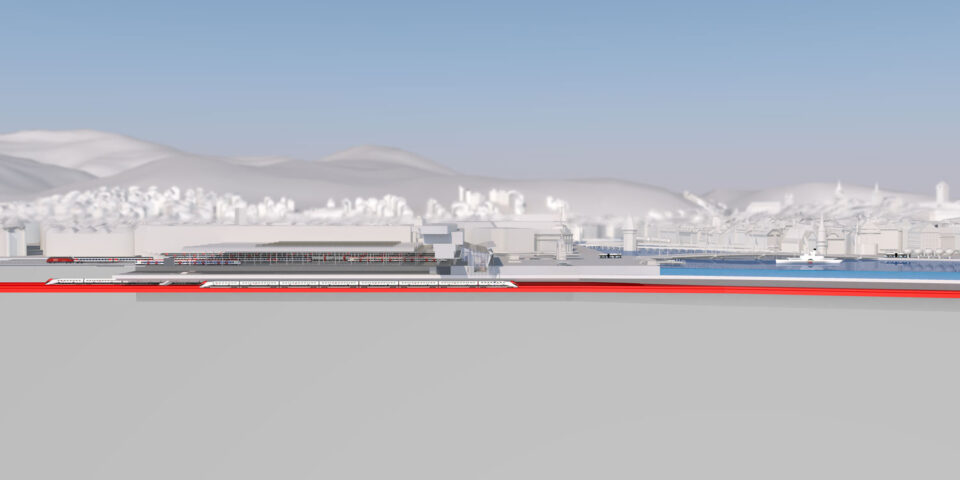
The visualisation shows the side view of the through station.
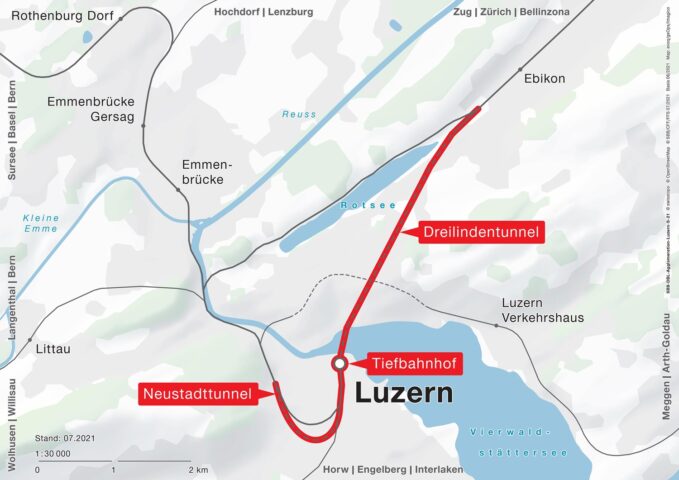
An underground through line with four lowered tracks is planned under the existing terminus station. This will be supplemented by a 3.5-kilometre-long underground double-track access and exit from Ebikon (three-lane tunnel) and a likewise underground double-track access and exit to the Heimbach area (Neustadt tunnel). The existing above-ground parking facilities at Lucerne station will be partly relocated, as they will then no longer be directly connected to the underground through station.
The DBL creates the conditions for faster connections in the region’s S-Bahn system as well as a faster north-south connection via Lucerne. This not only sets the course for more mobility, but also for achieving the climate goals in terms of sustainable mobility development. After all, the greatest potential for switching to public transport lies in the agglomerations and in connections between regional centres.
The planned route.
But the DBL will also optimise economic and urban development opportunities: The population will become more mobile, and in the centre of the city of Lucerne new space for urban development will be created thanks to the release of above-ground track infrastructure. The popular tourist cantons of Obwalden and Nidwalden will also benefit from better access.
The Zurich-Zug-Lucerne-Sursee-Olten axis in particular will benefit from the improved services. The Lucerne-Zug-Zurich line is the busiest railway line in the Lucerne region. With the addition of six long-distance trains from Lucerne to Zurich, the DBL will increase the timetable, enable a basic 30-minute interval for long-distance services and a quarter-hourly interval for regional services.
The DBL offers the possibility of managing the travel time between Lucerne and Milan envisaged in the NRLA concept and brings Ticino closer to German-speaking Switzerland: 20 minutes of travel time can be saved thanks to the DBL. The north-south connection via Lucerne will thus be faster than the one via Zurich, which passes through the busy Zurich main station.
The federal parliament approved the 2035 expansion step for the railway infrastructure in 2019. SBB is currently working on the preliminary project, which is expected to be completed in the first months of 2023. This will be followed by the examination of the results of a study on the implementation sequence, which should take about another six months. in 2027, the federal parliament will decide whether the DBL can be realised after 2030. If everything goes smoothly, the through station could be opened in 2040 at the earliest after a construction period of about ten years.
The costs will be available when the preliminary project is completed. The project will be financed through the Railway Infrastructure Fund (BIF). The client for the DBL project is the Federal Office of Transport (FOT). SBB is responsible for planning and implementation. The railway infrastructure will be expanded step by step – the expansion steps are determined every four years by the National Council and the Council of States.
After the first 100 days of operation, Aargau Verkehr AG(AVA) is taking positive stock of the new Limmattalbahn in terms of user numbers and punctuality. According to a media release, around 1.5 million passengers have used the railway since the start of regular service on 11 December 2022. On a weekday, the light rail system carries 16,000 passengers.
The busiest stations include Dietikon and Zurich Altstetten stations, the Zentrum stop in Schlieren, Oetwilerstrasse in Dietikon and at the Shoppi Tivoli shopping centre in Spreitenbach. The AVA emphasises the high punctuality: 97 percent of the light rail vehicles arrive at their destination with less than three minutes delay.
The commissioning was preceded by a good twelve years of planning and construction. Before the start of regular service in December, test and training runs were carried out in the second half of 2022 to ensure a functioning interaction between infrastructure, control and information systems. In daily passenger operations with higher loads, there were isolated disruptions and delays in the first weeks of operation, according to the AVA’s statement. These irregularities could be remedied by technical adjustments and optimisations to the vehicles and the systems. The initially tight transfer times were optimised in the first weeks of operation.
The railway operates on 92 per cent of its route on its own track independently of the rest of the traffic. Where it shares the route with individual traffic, traffic lights and barriers ensure safe operation. Since the start of operations, there have reportedly been seven collisions between passenger cars and light rail vehicles. In all cases, the cause was misbehaviour or inattention on the part of the motorists.
The Zug start-up Jarowa has secured 12.4 million francs in a Series A financing round, according to a press release . The round was led by London-based venture capital firm Eos Venture Partners. In addition, moyreal holding AG from Sarnen, Helvetic Trust AG from Zurich and a Zurich family office have invested.
Jarowa operates a platform with services for claims management. This is primarily aimed at insurance companies, real estate managers and leasing companies. The services listed cover the areas of mobility, buildings and trades, healthcare and legal advice. In the event of a claim, insurance coverage is automatically checked and a suitable service provider selected. The damage repair is processed digitally for all parties involved.
Jarowa intends to use the financing to expand its presence in Europe, explains CEO Andreas Akeret in the press release. The start-up's platform is currently accessible to companies from Switzerland, Germany, Italy and Great Britain.
A team led by Professor Nikolas Geroliminis, head of the Laboratory for Urban Transport Systems ( LUTS ) at the Swiss Federal Institute of Technology in Lausanne , is measuring traffic with unprecedented accuracy. It uses swarms of drones to do this. It converts the video images into algorithms and analyzes the data. “Our goal is not to monitor traffic, but to find the causes of traffic jams and offer fact-based solutions,” postdoc Manos Barmpounakis is quoted as saying in a statement .
The LUTS tested its multidisciplinary approach in 2018 and 2019. Last summer it was tested in the monitoring and evaluation of parking areas in the port of Pully VD. In mid-May 2022, a new experiment was conducted in Nairobi, the city ranked 4th in the world in terms of congestion. It turned out that cultural peculiarities such as the minibuses called Matatus, “which drop off and pick up passengers as required in an indescribable traffic chaos” also have to be taken into account. Traditional modeling approaches are not directly applicable to this.
For further experiments, the laboratory received a grant from the innovation agency Innosuisse . This technology, called CityDronics, is to be further developed into a marketable solution by a start-up based in Switzerland. It will be the first to integrate drones into urban mobility. With multi-sensors, the drones could also measure exposure to CO2 and noise. Several cities are already interested in CityDronics.
The SBB wants to build a new plant in Bellinzona’s Arbedo-Castione suburb. The Federal Office of Transport has defined a planning zone of around 150,000 square meters for this purpose. In March 2019, complaints were filed with the Federal Administrative Court. The complainants argued that crop rotation areas had been sacrificed too much and also wanted another location in the Bodio/Giornico TI area to be better examined.
The Federal Administrative Court has now declared the complaints inadmissible due to “lack of legitimation on the part of the complainants”, according to a statement . The judgment can still be appealed to the federal court.
According to SBB plans , the Ticino plant should be completed by 2027. The total investments amount to 580 million Swiss francs. A total of 360 employees and 80 trainees are to be employed at the plant.
Shared micromobility is more harmful to the climate than expected. This is shown by a study by the Swiss Federal Institute of Technology in Zurich ( ETH ). This becomes clear if the evaluation of the climate impact of micromobility also includes how electric scooters and bicycles are actually used: “At first glance, e-scooters and e-bikes are climate-friendly because they do not have internal combustion engines,” says Daniel Jan Reck from the Institute for Transport Planning and Systems at ETH Zurich in a report by ETH. “Ultimately, however, what is decisive for their carbon footprint is which modes of transport they typically replace.”
The transport researchers working with Reck were able to show in their study that shared e-scooters and e-bikes in the city of Zurich mainly replace sustainable modes of transport: walking, using local public transport and cycling. They do more harm than good to the climate. “I think the sharing principle makes sense,” said Reck. “With micromobility and its climate impacts, however, the situation actually seems to be the other way around.”
The picture is different for privately used e-scooters and e-bikes. These replace more frequent journeys with one’s own car. This is why private micromobility reduces CO2 emissions “and benefits the climate on balance”. That is why it makes sense for authorities to promote commuting by means of private micromobility.
For his research, Reck received the Young Researcher of the Year Award from the International Transport Forum of the OECD in summer 2021. The think tank of the industrialized countries, based in Paris, awards the prize to young researchers whose work is important in matters of transport policy.
A project group set up by the government council of the canton of Zurich has been creating an overview of the Dübendorf airfield area since September 2020. The state chancellery of the Canton of Zurich informs in a statement that the members of the delegation of authorities have now signed the synthesis report. The airfield area is to be used as an innovation park, airfield and for military purposes.
“For reasons of economy and sustainability” and “with consideration for the population”, “only what is needed will be built in stages,” explains the State Chancellery. According to her, the project should become “a beacon for innovative urban development, especially in the areas of environmental compatibility, sustainability and careful use of resources”.
Specifically, the overall view provides for the area to be subdivided into four sub-areas. The innovation park with a focus on mobility, robotics, aviation, space travel as well as modern production technology and materials research is to be built in sub-area A. In sub-area B, the innovation park and a research and works airfield will combine to form an aviation cluster. Area C is reserved for uses with high security requirements. The aviation infrastructures are located in sub-area D, in which nature conservation will play a central role. A circular airfield path is intended to make the area usable for recreation and leisure for the population.
In the next step, planning rights are to be created for all sub-areas, according to the communication. Specifically, a cantonal and a regional structure plan as well as the communal structure and land use planning are named there. The cantonal structure plan will be made public from September 6th to November 5th.
The Zurich Chamber of Commerce ( ZHK ) welcomes the commitment to triple use as an innovation park, civil and military airfield. The vision of an internationally leading location for research and development on mobility solutions is worth supporting, she writes in a press release . However, she regrets the renunciation of business aviation. This is important for the attractiveness of the economic area. Therefore, the doors should not be permanently closed for them.
The Riedtli housing estate will receive 14 charging stations for electric cars from mid-July. In the course of re-letting the residential parking spaces, the City of Zurich is also setting up four parking spaces for car sharing offers and additional areas for electric cargo bikes. The pilot project is intended to promote environmentally friendly mobility in residential areas and later be transferred to other areas, according to a media release .
For the residents of the Riedtli settlement on the border between Zurich-Unterstrass and -Oberstrass, four of the 20 parking spaces will be eliminated. The 16 remaining still meet the demand, according to the media release. In future, three e-vehicles from the car sharing provider Mobility and a gasoline-powered rental car from enterprise will be parked in the four newly leased spaces. There are also three new electric cargo bikes from carvelo2go. A total of 14 of the 23 parking spaces will be converted into charging stations for e-cars.
The pilot project is a step towards a 2000 watt society, which has been anchored in Zurich's municipal code since 2008. Its aim is to make the city climate neutral by 2040. “In order to achieve our climate goals, traffic has to be reduced, relocated and electrified in a targeted manner. The switch to electromobility is also to be promoted with the expansion of charging stations. By sharing cars and only using them when they are really needed, people contribute to environmentally friendly mobility, ”City Councilor Daniel Leupi is quoted as saying in the press release.
Of 50 train stations in Europe that were examined, the train stations in Bern and Zurich performed moderately to poorly in terms of passenger-friendliness. According to a press release, Bern train station landed in 40th place in the European Railway Index 2021, while Zurich train station was in 21st place.
The consumer protection group Consumer Choice Center , based in Washington, has examined in its index, among other things, the shopping experience, the accessibility, the WLAN network, the number of national and international destinations as well as the choice of travel providers.
The main train station in Bern, for example, has toilets for wheelchair users, but with six shops and eight restaurants only a very limited range of options for eating and shopping. The Zurich main station offers more than 53 shops and 39 restaurants, but does not provide barrier-free toilets for wheelchair users.
Leipzig Central Station performed best in front of Vienna Central Station and St. Pancras in London. According to a media release, the train station in the German state of Saxony offers most domestic destinations, many shops and restaurants, and several railway companies.
Federal Councilor Simonetta Sommaruga discussed with those involved in electromobility what would be beneficial for its rapid expansion. At a top meeting with high-ranking representatives from the automotive, electricity, real estate and vehicle fleet sectors as well as the cantons, cities and municipalities, new objectives were outlined.
One of the proposals provides information and advice as well as more attractive and attractively priced services relating to the purchase of plug-in vehicles. In addition, the number of public charging stations should increase faster. This requires suitable measures to accelerate planning and construction. In addition, use and billing systems should become simpler and more transparent. Ultimately, it is important to create more charging options in the parking lot in front of the house or in the underground car park of apartment buildings.
The actors in the Electromobility Roadmap would work out these goals in the coming months and derive suitable measures from them. Implementation should begin quickly. "The success in electromobility shows that the population wants to live in a climate-friendly way and be clean on the road," said Sommaruga. "Together we make it possible."
The city of Zurich wants to promote environmentally friendly mobility. To this end, it is now providing the tenants of their apartments with an annual subscription to the Mobility auto parts service free of charge, the city and Mobility write in a joint message . Anyone who lives in one of the 9,200 city apartments and has a category B ticket has been able to take advantage of such an annual subscription since March. Users then only have to pay for the duration or range of use of the Mobility vehicles.
The city pays Mobility a flat rate of CHF 12,000 for this. The issue has no impact on rents or taxpayers, she writes in her communication.
Mobility pricing with different tariffs for peak and off-peak times could defuse traffic problems, explains the Federal Council in a communication . This was shown by a theoretical impact analysis for the canton of Zug, they said. The Federal Council therefore wants to have the process tested in practice.
To this end, the Federal Council has drawn up a ten-year law that legally enables pilot projects on mobility pricing and lays the foundations for their financial support. This law will now be sent for consultation, informs the Federal Council in the communication.
In the template, cantons and municipalities are given the opportunity to carry out pilot projects to influence mobility behavior in private and public transport. If the projects provide for a tax obligation, they must be approved by the canton. In addition, the responsible canton must obtain approval from the Federal Department of Environment, Transport, Energy and Communications . Projects in which participation is voluntary can also be carried out by organizations, it says in the communication.
As part of a request from the federal government last February, various cities and cantons had already expressed interest in a pilot project, the Federal Council informed in the message. For some of these projects, feasibility studies are now to be drawn up. When the new law comes into force, feasible projects could then be started.
Parquery has completed a successful financing round, according to a message on LinkedIn. The spin-off from the Swiss Federal Institute of Technology Zurich ( ETH ) was able to win the Dutch construction and plant engineering company VolkerWessels as an investor.
Parquery has developed software that analyzes images from street cameras in real time. This enables drivers to find out, for example, whether there are free parking spaces in their vicinity. The platform can also be used, for example, to analyze the flow of traffic in cities. Overall, it helps build smart cities.
With the fresh money, Parquery wants to strengthen its platform on the one hand in the area of intelligent parking. On the other hand, it is to be further developed for new solutions in the field of intelligent cities.
Parquery has also been working with Hyrde , a subsidiary of VolkerWessels, for a number of years. Hyrde uses the Parquery solution, for example, for security applications at airports and for intelligent mobility projects in cities.
ABB and Oceanco have decided to collaborate in the field of sustainable marine propulsion. Initially, ABB will supply two 2.5 megwatt Azipod units as well as drive and control units for a super yacht from Oceanco, according to a media release .
According to the company, the Azipod system from ABB is based "on a controllable drive system, the electric drive of which is installed in a nacelle below the ship's hull". It can reduce fuel consumption by up to 20 percent compared to conventional shaft drives.
This first delivery is the start of a more intensive cooperation with Oceanco, as ABB writes in its press release. The company expects the sustainable electric powertrain market to grow to more than $ 10 billion by 2025.
“We are very pleased to have signed this first contract with Oceanco and look forward to future cooperation. As an important basis of our relationship, our two companies are united by the claim to sustainably develop our business, ”said Thomas Hackman from ABB Marine & Ports.
NeoVac now uses the NeoVac my Charge app to bill the consumption-based costs for e-charging stations in apartment buildings and areas. According to a media release , the specialist for building and environmental technology based in Oberriet is reacting to the increasing demand for e-charging stations in buildings.
The app was developed by eCarUp AG from Zug. The young company offers a comprehensive software solution for setting up charging infrastructure. Its backend enables billing, monitoring, load management and maintenance of e-charging stations.
With its Switzerland-wide service network, NeoVac prepares the consumption-based energy and water bills for over 400,000 apartments every year. The Rheintaler company has set itself the goal of offering a solution for every billing-relevant measuring point in a building. "The number of new registrations of electric vehicles is increasing significantly and tenants are asking for more and more charging options," says Pascal Welti, Head of Energy Consulting at NeoVac. That's why his company has now launched an app for it.
It enables drivers of electric cars to activate charging stations and pay for the electricity they use. In addition, the charging data is transferred directly to the NeoVac myEnergy app. There, users receive an overview of their personal consumption and a directly accessible energy cost bill.
NeoVac also offers complete solutions for e-mobility infrastructure projects with a nationwide sales and service network. In addition, charging stations could "also be controlled depending on the PV system, battery storage or heat pump". This increases self-consumption and the profitability of photovoltaic systems.
According to a press release,BKW wants to become a full-range supplier in the field of electromobility. A new competence center is to be set up for this purpose. The services of this new center will according to the information include the planning, installation and integration of charging infrastructures. However, BKW will also be responsible for accounting, for example.
With the competence center, BKW is responding to the increasing demand for electric vehicles. This also leads to increasing interest in integrated e-mobility solutions. According to BKW, vehicle manufacturers, garages and the real estate industry are particularly interested in such offers.
"Coupling renewable energy production with the transport sector is one of the opportunities to integrate renewable energies into a reliable energy supply system", Suzanne Thoma, CEO of BKW, is quoted in the press release. "With the expansion of our competencies in the field of electromobility, we are supplementing our existing solutions for decentralized, renewable energy and heat production in buildings and thus offer cross-sector, integrated full-service energy solutions", Thoma continues.
Urban Connect AG was able to successfully conclude a seed financing round, according to a media release. The Mobility-as-a-Service company took in 2.5 million francs.
According to the announcement, Urban Connect is Europe's first multimodal mobility platform that enables companies to operate low-emission fleets. Urban Connect offers all vehicles – from electric bikes and electric scooters to electric cargo bikes and electric cars for shared use. They can be booked via an app. In addition, the app allows the "simple" integration of existing vehicle fleets. This offer helps companies "to create greener, smarter and healthier work environments – and cleaner cities for everyone," CEO Judith Häberli is quoted in the press release.
Part of the financing round that has now been concluded is a loan guarantee from the technology fund of the Federal Office for the Environment . According to its website, this “guarantees loans to Swiss companies whose innovative products enable a sustainable reduction in greenhouse gas emissions”. This support “allows us to intensify our activities”, says Judith Häberli.
The fresh funds would flow into the further development of the digital mobility platform, "especially for the control of large vehicle fleets", it says in the announcement. Furthermore, the development of our own data analysis software is planned. With their help, Urban Connect can give its customers data-based recommendations for the effective utilization of their vehicle fleets.
Juice Technology AG and Athlon Germany GmbH are promoting the electrification of car fleets. The manufacturer of charging stations and software based in Cham and the Düsseldorf leasing provider and fleet manager have jointly developed a mobile charging station. It should make charging company vehicles as convenient as possible in different situations.
The Juice Booster 2 could cover all areas of application, explains the founder and CEO of Juice Technology, Christoph Erni, in a press release : as a mounted wallbox, as a mobile charging station and as a type 2 charging cable for public charging stations. "The Juice Booster 2 is the ideal charging option, especially for field staff, sales and transport services who usually cover long distances through supraregional areas of use and cannot charge at home or in the company every evening", says André Girnus, Managing Director of Athlon Germany same passage quoted. "With Juice Technology we have found an innovative partner to equip our customers in the best possible way."
The charger is compatible with all electric cars with type 1 and type 2 connections. According to the company, the integrated DC and AC fault detection effectively triggers at the prescribed value. As a result, the supply line does not require an additional expensive FI-B circuit breaker. With a cable length of five meters and a theft-proof adapter lock, the electric car can be parked flexibly for the charging process.
In addition, the TÜV-certified Juice Booster 2 is the world's first mobile charging station with up to 22 kilowatts that corresponds to the currently valid IEC 62752 standard and enables one to three-phase charging of e-vehicles with up to 32 amperes. The mobile charger is also ideal for international use.
According to a press release by the Federal Office of Energy ( SFOE ), Switzerland signed an international declaration for the zero-emissions target in transport on Thursday as part of the Global e-Mobility Forum 2020 . This declaration is entitled " Katowice Partnership for E-Mobility ". She was born in December 2018 at the World Climate Conference in Katowice, Poland. Today it consists of 44 states and around three dozen sub-national administrative units, city associations and non-governmental organizations.
According to the organizers, 38 countries from five continents as well as organizations and alliances had already joined this declaration, as well as 1,500 cities and regions and 1,200 companies. Overall, they represented over a third of the world's population. Switzerland did not sign the declaration at the time because of the “pending legislative and political work”, according to the SFOE in the communication.
However, in December 2018, the Federal Department of the Environment, Transport, Energy and Communications ( DETEC ) and “numerous Swiss players” launched the Electromobility Roadmap 2022 “very successfully”. The aim of this roadmap is to increase the share of electric vehicles in new registrations to 15 percent by 2022. "Nothing stands in the way of signing the 'Katowice Partnership for E-Mobility'."
It brings "no rights and obligations" with it. But the undersigned countries and organizations should promote zero-emission vehicles, set fleet targets and work together internationally. Further goals are the promotion of green public transport, the expansion of an intelligent infrastructure, the improvement of air quality as well as research and development in these areas.
In Bellinzona, a new model district will be built right in the center. From the five proposals submitted, a jury of experts from the city has now decided on the Porta del Ticino (Gateway to Ticino) project. It pays a lot of attention to the topics of sustainability, intergenerationality and slow mobility. In particular, an innovation park is planned there, writes the city in a media release .
In addition, living space for 2500 people is planned, writes the Ticino newspaper “La Regione”. The urban development project described by the city in its communication as "epochal" and "profound" has now been presented to the public by the partners Bellinzona, SBB and Canton Ticino. All designs are on display in Piazza del Sole until November 7th.
The project convinced with "its courageous urban development and landscape design approach to leave the central area of the area undeveloped in order to provide the entire population with free green space and to open up the new district as a natural and attractive addition to the city", it says on the part of the city.
The 120,000 square meter area that is intended for the new quarter is currently still occupied by the historic SBB workshops. Once they have been relocated, they will start operating in Arbedo-Castione in 2026. Then the realization of the model quarter should be tackled. The vision for this should become reality in 20 years at the earliest, reports the online newspaper ticinonews.ch. Further development steps are planned in 30 and 40 years.
As a video of the development project published on YouTube shows, the district is to be built around the 101-year-old so-called cathedral, the listed heart of the SBB workshops. 500 old and new locomotives are serviced there every year to this day. It is considered to be one of the most important industrial buildings in Ticino.
This urban development project was developed by a team made up of sa_partners from Zurich, TAM associati from Venice and the Milanese landscape architect Franco Giorgetta.
Susanne Zenker, member of the management board of SSB Immobilien , reminded “La Regione” that the workshops were “always closed to the outside”. In the future, however, this area will “open up to its population and become an attractive space. With regard to the rapprochement between private and public actors, which is particularly targeted in the technological area, the new area will be “a calling card for the Bellinzona of the future”.
In future, Coop will increasingly supply its sales outlets with hydrogen trucks. According to a media release on Wednesday, the food cooperative put one of the world's first mass-produced fuel cell electric trucks into operation. A total of seven of these will be in use by the end of the year. Because there are no other emissions besides water vapor, Coop is assuming potential savings of 80 tonnes of CO2 per truck per year. In addition, Coop is establishing additional hydrogen filling stations in Switzerland.
As the message goes on to say, Coop is working together with the Swiss company H2 Energy AG and the Hyundai Motor Company . Hyundai is considered a world leader in the development of hydrogen fuel cell technology. The performance, refueling time and range of their hydrogen trucks are comparable to those of conventional trucks.
Coop has set itself the goal of being CO2-neutral in the relevant areas of the company by 2023. This is why the food wholesaler and retailer is doing “pioneering work” for electromobility with green hydrogen. In 2018, the H2 Mobility Switzerland association was founded on the initiative of Coop. It includes seven large operators of petrol stations and truck fleets.
"The H2 Mobility Switzerland association promotes clean, CO2-free motorized individual traffic in Switzerland and implements the technology of hydrogen mobility in road traffic on a private basis," says Jörg Ackermann, member of the Coop management and president of the association. The aim of the association is to create a nationwide network of hydrogen filling stations throughout Switzerland by 2023.
The V-Locker bicycle parking tower is starting pilot operations together with SBB at Münchenbuchsee station. According to a media release from V-Locker AG, the parking tower will initially offer test users "the desired level of security for parking high-quality bicycles". There is also space for a helmet, rain protection and luggage.
The pilot operation will provide first insights into user expectations and experiences. The operators want to promote the development of a comprehensive network of V-Locker bicycle parking towers. The establishment of bicycle parking towers at strategic points is intended to encourage commuters to switch to local public transport. The aim is to motivate motorists in particular to use the bike for the daily commute to the train station.
The Swiss Climate Foundation is an important partner in this project, emphasizes V-Locker in the press release. Thanks to your support, the first milestones could have been realized on time. The fruitful discussions on the social benefit of the system were helpful in formulating a modern, future-oriented solution for current problems in micromobility.
Beat Christen and his co-pilot Peter Morf from the Hightech Center Aargau ( HTZ ) have successfully completed their first participation in the Wave Trophy , according to a media release. The e-mobile team Mission Innovation Aargau covered 1818 kilometers without breakdowns in eight days in its Tesla Model S P85D. The start was in Brugg-Windisch, the final in Entlebuch. In the overall ranking, it came second out of around 30 participating teams. It also won the audience award given by students.
This year's route led along the Grand Tour of Switzerland through all four language regions and over nine Alpine passes. The teams did not only advertise electromobility in action, but also during their planned stays in 23 towns and at a further 23 stops, according to the announcement. Most of the information meetings with authorities, schools and the population were well attended. Interested parties could follow the travel blog of the two drivers on the HTZ website.
Because the motto of this year's Wave rally was “Energy Tour”, numerous energy projects were also visited, including the first floating solar power plant in the Alps on the Lac des Toules in Valais and the wind turbines on the Rengg Pass in Entlebuch. "Renewable energies go well with e-mobility and the Wave has shown that this combination works," said Peter Morf, co-pilot and head of energy technologies and resource efficiency at HTZ, quoted in the communication. Only the “consistency of the various charging systems” is “still a challenge,” says pilot Beat Christen.
Basler Verkehrs-Betriebe ( BVB ) are planning to procure a total of 126 electric buses by 2027. The BVG are thus implementing the statutory mandate to operate their public transport services in the canton of Basel-Stadt with 100 percent renewable energy by 2027. In the coming days, BVB will tender the first procurement phase for 62 e-buses. They are scheduled to go into operation in 2022. "I am pleased that after a long planning phase we can finally take the first concrete steps towards an environmentally friendly and modern e-bus system", BVB director Bruno Stehrenberger is quoted in a media release .
The services for the general planner of Garage Rank are also being put out to tender these days. It will be completely rebuilt between 2023 and 2027 because it no longer meets today's requirements. At a later point in time, living space is also to be realized there. During this construction phase, the buses will be parked on two replacement areas.
Industrielle Werke Basel ( IWB ) is responsible for setting up a corresponding charging structure in Garage Rank and in the provisional parking areas. In addition, the IWB will install so-called occasional charging points at five terminal stops, where buses can recharge electricity while they are waiting. This increases their range and makes the entire bus network more flexible.
Converting the bus fleet will cost a total of around 360 million francs. Of this, around 147 million Swiss francs go to the procurement of the e-buses. The construction of the new Garage Rank, the temporary fixtures and other minor infrastructure adjustments cost around 161 million francs. The costs for setting up the charging infrastructure by IWB amount to around 52 million francs. The corresponding loan application is now with the Grand Council.
Basler Verkehrs-Betriebe ( BVB ) are planning to procure a total of 126 electric buses by 2027. The BVG are thus implementing the statutory mandate to operate their public transport services in the canton of Basel-Stadt with 100 percent renewable energy by 2027. In the coming days, BVB will tender the first procurement phase for 62 e-buses. They are scheduled to go into operation in 2022. "I am pleased that after a long planning phase we can finally take the first concrete steps towards an environmentally friendly and modern e-bus system", BVB director Bruno Stehrenberger is quoted in a media release .
The services for the general planner of Garage Rank are also being put out to tender these days. It will be completely rebuilt between 2023 and 2027 because it no longer meets today's requirements. At a later point in time, living space is also to be realized there. During this construction phase, the buses will be parked on two replacement areas.
Industrielle Werke Basel ( IWB ) is responsible for setting up a corresponding charging structure in Garage Rank and in the provisional parking areas. In addition, the IWB will install so-called occasional charging points at five terminal stops, where buses can recharge their batteries while they are waiting. This increases their range and makes the entire bus network more flexible.
Converting the bus fleet will cost a total of around 360 million francs. Of this, around 147 million Swiss francs go to the procurement of the e-buses. The construction of the new Garage Rank, the temporary fixtures and other minor infrastructure adjustments cost around 161 million francs. The costs for setting up the charging infrastructure by IWB amount to around 52 million francs. The corresponding loan application is now with the Grand Council. mm
Representatives from Graubünden, South Tyrol, Tyrol and Lombardy have agreed to improve cross-border mobility in the triangle between Switzerland, Austria and Italy, especially by rail. At a meeting in Graun im Vinschgau, they signed a letter of intent to this effect, according to a press release from the Canton of Graubünden .
Accordingly, the four regions want to coordinate their measures to create an integrated mobility system in what is known as the Terra Raetica. With an attractive alpine railway hub and the connection to the international rail network, the transalpine road traffic is to be reduced. This also reduces the environmental impact, "which in turn brings a touristic upgrade with it", it says in the message.
"Today we are laying the foundation for intensive cooperation and a vision for the future, a rail-alpine cross between Austria, Italy and Switzerland", the Tyrolean governor Günther Platter is quoted as saying. "The mobility of the future needs a courageous approach and this must not stop at national borders." For years, the motto has been "Boundless mobility – and that is car-free", says his deputy and Tyrolean regional traffic councilor Ingrid Felipe.
According to the Vice President of the Graubünden government, Mario Cavigelli, this agreement will create a valuable platform for exchanging information on needs and measures in public transport across borders. In the interests of the population and the economy, transport chains and transfer options between the various public transport systems in the four neighboring regions could be coordinated “as best as possible”.
In November, a group of experts will start planning a rail link in the Terra Raetica. It is accompanied by a steering committee made up of government representatives from the four neighboring regions.
Wir verwenden Cookies zur Unterstützung und Verbesserung unserer Dienste. Mit der Nutzung dieser Website erklären Sie sich mit der Verwendung von Cookies einverstanden. Weitere Informationen finden Sie in unserer Datenschutzerklärung.