Tag: Nachhaltig

  • Foundation stone laid for new Tösstal campus in Winterthur

    Foundation stone laid for new Tösstal campus in Winterthur

    The ground-breaking ceremony for the new building of the Winterthur Vocational College marks the beginning of a new era in educational infrastructure. The modern campus will provide space for a growing number of students and enable modern training in the specialist areas of retail and care. Thanks to well thought-out planning, construction work has been progressing rapidly since the start in February 2024.

    The new school infrastructure, right next to the Wiesental and Mühletal sites, allows previously separate school locations to be brought together. The “Campus Tösstal” will provide space for up to 1000 students in the future. In addition to traditional classrooms, open learning niches will provide space for individual and collaborative work. The flexible building structure makes it possible to easily integrate future spatial requirements.

    Sustainable architecture sets standards
    The building meets the Minergie-P-Eco standard and the Gold Standard for Sustainable Building Switzerland. A green roof and photovoltaic system contribute to an ecological balance and a better urban climate. The building will also be connected to the city’s district heating network, combining energy efficiency and sustainability. Completion is scheduled for spring 2027.

  • Strüby Unternehmungen receives first certificate for realised Minergie site

    Strüby Unternehmungen receives first certificate for realised Minergie site

    Energy efficiency, energy self-sufficiency and heat protection are currently major issues and will become even more important in the future. Since 2023, not just a single house, but an entire site can be certified by Minergie, meaning that the surrounding area can also be increasingly included in the planning of residential construction projects. On 2 September 2024, the “Fischermätteli” in Burgdorf BE received the first definitive site certificate from Minergie in Switzerland and thus reached a new level in sustainable construction.

    Label with high requirements
    The new, comprehensive Minergie site standard is supported by the Minergie Association, the cantons, the business community and the Swiss Federal Office of Energy. The Minergie site is characterised by very low energy consumption, minimised greenhouse gas emissions during construction and operation and maximum self-sufficiency with renewable energies. The buildings have above-average heat insulation and controlled air exchange. The design of the outdoor space increases climate resilience and the quality of stay, for example through suitable planting and shading. The Minergie site also incentivises climate-friendly mobility.

    Over 6600m3 of Swiss wood
    The Fischermätteli residential construction project was successfully completed by Strüby Unternehmungen in autumn 2023 after a construction period of around three and a half years. The ten apartment blocks with a total of 168 condominiums were built on a former commercial site in Burgdorf BE. They were built using over 6600m3 of Swiss timber, making “Fischermätteli” the largest project in Switzerland to combine the Minergie-A-ECO standard and Swiss timber.

    Climate-friendly environmental design

    One hundred per cent of the energy for the entire site comes from renewable sources: the electricity from the photovoltaic systems on the building roofs, the heat for heating and hot water from a heating centre supplied with Swiss pellets. The finely meshed mobility concept focuses on electromobility, car sharing, bicycles and public transport. A co-working space promotes working from home and thus indirectly relieves traffic congestion. In addition, the climate-friendly environmental design based on the sponge city principle ensures natural and efficient cooling in summer and makes the “Fischermätteli” a hotspot of biodiversity thanks to the countless native plants.

    Success thanks to a climate-friendly overall concept
    Pius Kneubühler, Managing Director Real Estate Development & Construction at Strüby Unternehmungen, can confirm that the climate-friendly overall concept in line with the Minergie site standard pays off not only for the residents, but also for the investor. “The success has already manifested itself in the marketing of the condominiums. Demand was so pleasing that all flats were sold by the time construction was completed.”

  • Alpine solar plant planned at the Madrisa mountain railway

    Alpine solar plant planned at the Madrisa mountain railway

    The planned Madrisasolar alpine solar plant would be located at around 2000 metres above sea level and would cover an area of around 150,000 square metres when completed. The approximately 30,000 modules would all face south and, with a production capacity of 12 MW, would deliver an average annual output of probably over 17 GWh. This amount of electricity could supply around 3,500 households.

    The yield of solar electricity, especially in the important winter months, is particularly high at this location. And the electricity is produced where it is partly needed. The consumption and production profiles of the mountain railway and Madrisasolar are an ideal match, so that the Madrisa mountain railway could be powered entirely by solar electricity. The production of locally generated, renewable energy is an important issue for Klosters-Madrisa Bergbahnen AG and Madrisasolar would be a big step towards more sustainability on the mountain. In addition, the plant would also cover local and regional needs.

    Area with existing infrastructure and use
    Madrisasolar would be located in an area with existing infrastructure and use. An environmental impact assessment is currently being carried out. The landowner of the site is the political municipality of Klosters; the right of use currently lies with the alpine cooperative. The owner and operator of Madrisasolar would be the Graubünden energy provider Repower AG, while Fanzun AG would be responsible for the technical project management. The participation of the municipality and the further framework conditions are currently still being examined and worked out.

    The Klosters municipal council and Klosters-Madrisa Bergbahnen AG support the project. All parties involved consider the addition of production facilities for renewable energies to be imperative and judge the planned location to be possible and well compatible from an environmental, landscape and tourism point of view. In the light of the Energy City label, a corresponding production plant also fits in perfectly with the energy strategy of the municipality of Klosters. There are still a number of political and technical hurdles to overcome before the licensing procedure can be initiated. In addition to the municipal parliament and the electorate, the civic assembly is also responsible for the progress of this large-scale plant. A public information event on the project is planned for August 2023. The vote is planned for 22 October 2023.

  • Mineral oil importers promote electric mobility

    Mineral oil importers promote electric mobility

    Member companies of the Swiss AVIA Association of Independent Swiss Importers and Suppliers of Energy are committed to sustainable electromobility. To this end, they founded AVIA VOLT Suisse AG, headquartered in Lucerne, on 29 June, the newly founded company informs in a press release. The aim of AVIA VOLT Suisse is to promote electromobility, electricity production and energy optimisation in buildings.

    “By founding AVIA VOLT Suisse AG, we are doing the only right thing for the development of electromobility: we are joining forces and investing jointly in the future,” Martin Osterwalder, Chairman of the Board of Directors of AVIA VOLT Suisse AG, is quoted as saying in the press release. In a first step, AVIA shop filling stations will be equipped with fast-charging stations for electric vehicles. At a later stage, charging stations are planned at other AVIA filling stations as well as at partner companies and customers.

    “With AVIA VOLT Suisse AG, we are providing a broad and reliable range of services for e-mobility throughout Switzerland,” explains Alexander Streitzig, Managing Director of AVIA VOLT Suisse AG. “This is an important step towards CO2-reduced mobility of the future.” In addition to promoting electromobility, the new foundation also wants to get involved in the expansion of solar and wind power plants. Member companies of the AVIA association are also active in the production and distribution of green hydrogen.

  • “A big city with small-town charm”

    “A big city with small-town charm”

    Where do you currently see the biggest challenges for the city?
    Winterthur is experiencing strong growth. This brings opportunities, but also challenges. More and more people want to move to Winterthur. This requires a greater number of available jobs, because short commutes mean quality of life. In addition, we have to provide more transport and educational infrastructure. This entails costs – even if we generate more tax revenue due to the growing number of residents. Nevertheless, larger investments are necessary to absorb the growth. With “Winterthur 2040” we have defined where densification is to take place. We expect around 135,000 residents by 2040.


    You have already mentioned it: the city of Winterthur currently has over 120,000 inhabitants. Last year you recorded the strongest population growth in decades. Why is that?

    Winterthur is simply a great city! We are excellently located. We offer a lot of green spaces, a high quality of life and a wide range of cultural activities. Our educational institutions also attract young people in particular. This brings well-trained professionals to the regional labour market. Of course, we also benefit from our affiliation with the Zurich economic region.
    And we are a modern technology city, which is interesting for companies. In short: Winterthur is a big city that offers everything, but still retains its small-town charm.

    How is the city’s housing market doing in view of the sharp rise in the number of inhabitants?
    Like all cities, we are struggling with a very low vacancy rate. But we still have a few municipal and some private building reserves to fall back on. The current building and zoning regulations still allow for a lot. There is a lot of building going on, as we can see from the number of building permits. Basically, we are striving for a well-mixed city. That’s why we try to offer both affordable housing and housing for higher incomes. In my opinion, however, the housing market should not be regulated by the city, it should function as independently as possible.


    You have set up the Smart City office. What does it deal with and how does it work?

    We were the first city in Switzerland to have a Smart City strategy at the city council level. The Smart City uses social and technological innovations in a targeted way to ensure quality of life, conserve resources and promote sustainable development. In other words, it is about using modern technologies to simplify everyday life for the population and to make the city well connected. For this purpose, we have founded the Smart City Winterthur office. In addition, the city of Winterthur is positioning itself as a Living Lab (WinLab), a real laboratory or test city, in which social and technological innovations for the benefit of sustainable urban development can be tried out, systematically tested and, if successful, scaled up. Partners from research and development, business and civil society are invited to actively participate.


    Sustainability is an important keyword in this context.
    True. Researchers from a wide range of disciplines agree that the city of the future must be a sustainable city. This means that the city must be designed in such a way that it can adapt to changing conditions. This concerns not only the “hardware” such as infrastructure, buildings and open spaces, but also the “software”, i.e. the social and economic structures. A sustainable city is therefore economically successful, ecologically compatible, socially stable and thus: resilient. The sustainable Winterthur should therefore also be an ecological city, in the sense of quality of life for its inhabitants. This includes as few emissions as possible, sufficient green spaces, open space and flexible and diverse mobility. With regard to social resilience, it is important for us to strengthen networks and address existing disadvantages.


    What has been done specifically in the area of digital transformation of the city administration and what is still planned?
    In order to be able to approach the digital transformation in a targeted and holistic manner, the city is currently developing a digitalisation strategy. This is geared to the needs of the various stakeholders and is based on the available means and resources. Our goal is to create a faster and as low-threshold contact to the population as possible. Currently, the city offers over 90 e-services that can be accessed via a central portal. We also want to make our internal work processes even more efficient. The highest priority is not only ease of use, but also data protection and data security. The greatest challenge, however, is and remains the speed at which digitalisation is advancing. It is important to keep pace here. We have not yet reached our goal, but we are well on our way.


    In 2017 you initiated the merger of the associations Winterthur Tourism and Location Promotion Winterthur Region. The result is the new organisation House of Winterthur. What is your conclusion some six years later?
    With House of Winterthur we have founded an association that allows us to conduct integrated location marketing. At the time, we were the first city to try this. We want to do marketing for the city and the region of Winterthur from a single source, so to speak, and generate a higher added value. We got off to a good start with a very broad sponsorship. The sponsorship is very broad with the canton, municipalities, companies, hotels, restaurants, cultural institutions and the city; meeting the different demands was a very big challenge. We certainly haven’t done everything optimally here. We have had a new director for a year and a half and are in the process of reorganising the board. I am still convinced of the idea, but we still have to optimise and adjust it.

  • Recycling Centre Ostschweiz sets new standards with innovative processing plant

    Recycling Centre Ostschweiz sets new standards with innovative processing plant

    A new soil washing plant has been built at Niederstettenstrasse 28 in Niederstetten near Wil SG. With the fully automated plant, RCO now also processes contaminated construction waste and returns it to the building materials cycle as high-quality materials. RCO expects about 200,000 tonnes of processed building material per year that can be reused in this way. This means that more than 500 single-family homes could be built each year from sustainable building materials.

    Washing instead of landfilling
    The wet-mechanical processing plant replaces the dry-mechanical plant that has been in operation for about two decades. “With the soil washing plant, we can now accept and process materials that previously had to be landfilled. This includes, for example, contaminated excavated materials,” says Samuel Graf, a member of the RCO board of directors. “This not only saves valuable landfill space, but also conserves natural gravel resources.” The materials are then widely used in civil engineering, for example as sand or gravel for concrete production.

    Taking building materials recycling to the next level
    The state-of-the-art process technology sorts, classifies and doses the various material components. “In addition, pollutants and foreign substances can be removed efficiently, which ensures a significantly improved quality of the products,” explains Stefan Eberhard, Delegate of the Board of Directors. “The building materials produced in this way are of high quality and conform to standards – this is also demonstrated by our company building.” This consists to a very large extent of recycled building material and serves RCO as a showroom to visually demonstrate the many advantages of sustainable building materials to customers and the public.

    About the R CO
    The RCO was founded in 2018 by the two companies Holcim Kies und Beton AG and Zürcher Kies und Transport AG. With their joint know-how, Holcim and Zürcher are driving innovations in building materials recycling, closing material cycles even more consistently and serving the eastern Swiss market with high-quality building materials.

  • Planet Horizons equips 100 public buildings with Aqua4D

    Planet Horizons equips 100 public buildings with Aqua4D

    The Valais-based water treatment specialist Planet Horizons Technologies has equipped 100 public buildings with its sustainable water treatment system called AQUA4D. According to its media release, the company from Sierre has so far been active in the cantons of Basel, Bern, St.Gallen and Valais. According to another statement, these systems have been installed in 50 buildings in Valais alone.

    The technology uses electromagnetism according to a patented method to remove limescale deposits and protect against corrosion and bacteria. The system can be used especially in old buildings with long existing pipelines and in areas with high lime content in the water.

    With the experience of more than 5,000 installed systems in 45 countries, the company says it is now also finding increasing resonance in Switzerland. The systems have been installed in schools, barracks, clinics and administrative buildings. Not only has the drinking water quality been improved, but also the costs for maintenance and servicing have been reduced. The company is now counting on the support of the city of Sierre, the canton of Valais and the Federal Office for the Environment to be able to further distribute its innovative project throughout the country.

  • New business card for Sursee

    New business card for Sursee

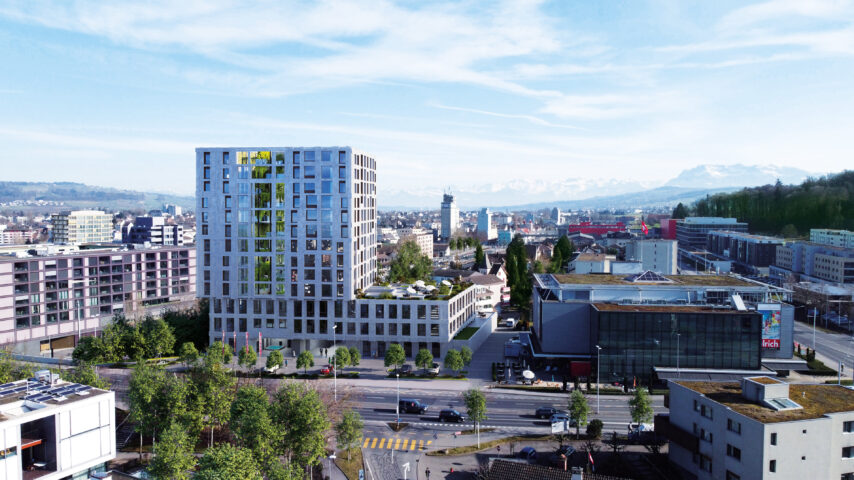
    Möbel Ulrich AG and Truvag AG, which have been based in Sursee for around 60 years, are jointly planning an office, commercial and residential building on the Ulrich site between Ringstrasse and Pilatusstrasse, which will complement and revitalise the existing furniture store. The project, called ALEA, is intended to become the new calling card for the location: The plan is to build 70 affordable rental flats with between 2.5 and 4.5 rooms using timber construction. In addition, there will be 2400 square metres of commercial and 1600 square metres of retail and restaurant space. The project scores not least with its central location directly at the railway station.

    The approximately 49-metre-high CO2-neutral timber construction was developed by the planning consortium Leuenberger Architekten AG from Sursee and Deon AG from Lucerne. The flats will have visible wooden beams and partly also wooden walls. The environmentally friendly material is breathable, insulating, very stable and load-bearing. In ancient Greek, ALEA means “warmth and protection” – these features should be visible and tangible for the future residents and employees. For fire protection reasons, only the façade design had to do without domestic and sustainable wood.

    But ALEA also does justice to its Latin meaning with its cube shape. The lower part of the building comprises three storeys – this is integrated into the slope. The silhouette is thus visible at a height of around 41 metres. While the upper part of the building is intended for residential use, the base area is available for offices, shops, commerce and gastronomy. A walkway creates a safe and fast pedestrian connection between the Kotten quarter and the railway station. All squares and connections in the new building are open to the public.

    The carefully thought-out traffic concept is intended to keep motorised individual traffic to a minimum: to this end, sharing services for cars, bicycles and e-scooters are planned. Accordingly, the parking garage will be equipped with a minimum number of parking spaces. The rental price structure is also intended to offer incentives for a life without a car. Generous parking spaces for bicycles have been designed to encourage non-motorised traffic.

    ALEA combines living and working.

    So that the tenants do not live anonymously, togetherness and mixing are to be promoted: A public square with a restaurant on the same level as the railway station creates meeting opportunities with various seating options around the building. The residents also have access to a green roof terrace for common use. Furthermore, several green terraces are planned.

    It is important to the initiators, who have strong regional roots, that “Surse residents build for Surse residents”:

    Not only were the partners chosen to carry out the construction work based on regional roots, but preference was also given to people who live or work in Sursee when renting out the apartments. In addition, Truvag AG, with around 80 employees, will relocate its headquarters to the new building. With the building planned by Möbel Ulrich AG and Truvag AG, the two traditional companies want to create added value for Sursee and enrich the area. The construction costs are expected to be in the double-digit millions.

  • Lausanne station will be adapted to future needs

    Lausanne station will be adapted to future needs

    Together with its agents, SBB intensively sought solutions for the elements that had prevented the start of several construction sites in December 2022. In addition, the FOT had requested clarification regarding the statics in October and issued a partial plan approval order for passenger flows where questions were still open. Over the past six months, numerous technical and political consultations have taken place to find sustainable solutions.

    Solutions for the anchorages in the south of the station
    Additional information was requested for the new anchorages that reinforce the retaining wall and the statics of the south façade of the station. Test anchorages were built to check the geological conditions of the site. Now the dossier will be revised accordingly and submitted to the BAV for review in spring 2024.

    Solutions for the basement of Bahnhofplatz
    The FOT has requested additional information on the structural analysis of the basement of Bahnhofplatz. The structural analysis and the dossier will be revised by the end of the year so that the FOT can examine them in 2024.

    Solutions for the platforms and subways
    Aspects relating to the platforms and subways were objected to in the partial planning approval ruling. For this, the SBB project teams looked for improvements. In view of the increasing passenger volumes and services at Lausanne station, congestion-free and safe passenger flows represent a major challenge. In order to avoid the demolition of further buildings south of the station, perrons were defined for the project in 2012 that were narrower than ideal. Now SBB is planning wider platforms with more space for customers, partly due to the development of rail operations and the standards for track spacing in the station. At the same time, the new track geometry also provides the additional information required by the BAV with regard to structural engineering. Thanks to these improvements, Lausanne station can be used for longer without causing congestion.

    The new project requires over 1000 new plans, technical reports and calculation documents. The entire track and platform geometry of the station must be revised. The SBB and its agents need 2.5 years to prepare the documents, the FOT 12 months to review and approve this partial dossier. First, the consistency of the overall planning is assessed, then the various sub-projects are continuously checked and approved, provided they meet the technical and legal requirements. With the approximately 12 months delay that the project already has today, the work should be completed in 2037, i.e. 4.5 years later than originally planned. The additional costs for the new planning will be analysed in the coming months.

    New staging of the construction site
    The release of the planning approval dossiers in three phases leads to a new staging of the construction site. The planners tried to keep the burden on the customers as low as possible. The new planning also minimised the dependence on the metro project. Services at Lausanne station will be maintained during the work.

  • Empa is researching climate-friendly concrete

    Empa is researching climate-friendly concrete

    The Swiss National Science Foundation ( SNSF ) is funding a five-year project by the Swiss Federal Laboratories for Materials Testing and Research ( Empa ) to research CO2 binding in cement. As part of the SNSF Advanced Grant, the scientists working with project manager Barbara Lothenbach will receive 2.2 million francs for their research project, according to a press release .

    The grant replaces funds from the European Research Council of the European Commission , to which Swiss researchers currently have no access.

    With the help of the funding, the Empa experts will carry out basic research in the field of CO2 binding in cement together with partners from the Finnish University of Oulu.

    The background to the project called Low Carbon Magnesium-Based Binders is that the cement industry releases large amounts of carbon dioxide. At the same time, concrete is considered a beacon of hope for binding CO2 and thus as a potential reducer of climate-damaging greenhouse gases if it is based on magnesium and not on lime as is usually the case.

    Starting in 2023, the researchers will find out how stable magnesium concrete is in the long term, how it can best be produced on construction sites and how temperature, pH value and other factors affect the molecular level.

  • Holcim buys Belgian building materials specialist Cantillana

    Holcim buys Belgian building materials specialist Cantillana

    Building materials producer Holcim has announced the takeover of Belgian building materials dealer Cantillana . With Cantillana’s presence and portfolio, Holcim can advance the expansion of the solutions and products division, which is expected to account for 30 percent of Group net sales by 2025, according to a press release .

    For Holcim, the decision in favor of the provider of special solutions means a further optimization of its market position in facade construction systems and thermal insulation composite systems. “This expansion further strengthens our presence in Europe, particularly in the area of building renovation and energy efficiency,” said Miljan Gutovic, head of Holcim’s Europe, Middle East and Africa region.

    The investment ties in with the adopted strategy of “green growth”. Both companies announce that they aim to “take a bigger role in providing innovative and sustainable solutions for energy-efficient buildings”.

    After acquiring the French PRB Group , the Belgian PTB-Compaktuna and Izolbet in Poland, Holcim is adding Cantillana, a privately held company, to the “Holcim family”. Originating as a branch of a construction company, Cantillana has specialized since it was founded in 1875 in the sale of and trade in building materials and building material accessories for the construction and related trades. Today, Cantillana is part of the Stadsbader Group and employs more than 200 people at nine production sites in Belgium, France, Germany and the Netherlands.

    Holcim AG has focused on innovative and sustainable construction solutions in building construction, civil engineering and infrastructure. At 55 locations across Switzerland, the company produces concrete, gravel and cement suitable for all construction projects and recycles demolition materials into resource-saving products.

  • Umwelt Arena shows new exhibition on insulating materials

    Umwelt Arena shows new exhibition on insulating materials

    The Swiss Environmental Arena is opening a new special exhibition. According to a message on Facebook, it is about the recycling of old insulating materials in the construction industry. Instead of old insulating materials ending up in the dumpster and then in the landfill during renovations and demolitions, they are taken back and processed again, according to Facebook on the subject. The Flumroc company based in Flums is showing how this is done in the new exhibition in the so-called Recycling City in the Umwelt Arena. Flumroc is a “pioneer in the field of insulation recycling”, according to the press release.

    On its website , Flumroc advocates the sustainable use of insulating materials. “Rockwool becomes rockwool”. it says there. Flumroc stone wool is 100 percent recyclable. This “closed cycle” should be maintained as far as possible. The company therefore appeals not to simply throw away construction site cuttings and construction site waste made from Flumroc stone wool during demolition, renovation or conversion work. “We’re happy to take them back in the bags or containers provided and recycle them,” says the company.

    The new exhibition provides information about the procedure for reprocessing.

  • Walo awarded by EcoVadis

    Walo awarded by EcoVadis

    According to a message on Facebook, the Dietiker construction company Walo Bertschinger AG has been awarded bronze certification in the sustainability ranking of the international independent agency EcoVadis . The company received the bronze award in its very first application. According to the statement, the certification is a motivation for further improvement in the area of sustainability.

    Walo, headquartered in Dietikon, operates internationally and is a fourth-generation family business. According to the company’s website , Walo has been combining consistency and innovation for 105 years. The Walo Group employs 2,450 people at 21 locations in three countries.

    EcoVadis evaluates the sustainability performance of companies in the areas of environment, working conditions, procurement and ethics. According to the announcement, over 90,000 companies have already been assessed.

  • Minergie and SNBS adopt labels for 2000-watt areas

    Minergie and SNBS adopt labels for 2000-watt areas

    The label for 2000-watt areas will disappear at the end of 2023. According to a statement from the Federal Office of Energy (SFOE), the suppliers of labels for sustainable buildings in Switzerland have agreed on this. The label was previously offered by the SFOE Swiss Energy program.

    In return, the Minergie association will in future also offer a Minergie area label for areas that comply with climate protection. The Swiss Sustainable Building Network , as the sponsor of the Swiss Sustainable Building Standard (SNBS), will create the SNBS-Areal label for the sustainability of sites in all their dimensions.

    At the building label level, there will also be the cantonal building energy certificate (GEAK), the various Minergie categories and the SNBS.

    The bearers of the various labels want to achieve a greater impact by pooling resources. “Sustainable real estate makes a major contribution to climate protection. The trend is positive, but the potential is far from being exhausted,” Marc Mächler, District President of the Canton of St.Gallen and President of the Minergie Association, is quoted as saying in the statement. “The labels complement each other, are better coordinated with each other and builders and planners can find out more easily which label meets their needs.”

  • Whitepaper: Energetic renovations as an opportunity

    Whitepaper: Energetic renovations as an opportunity

    Knowing that the building sector is responsible for around a quarter of emissions, there is an urgent need to renovate the building stock. Because the few climate-friendly and energy-efficient new buildings will not have a major effect on the entire sector. At the moment we are in a renovation backlog. The current renovation rate of one percent must be doubled in order to achieve the climate targets.

    Practical experience shows that during renewal processes, too little attention is paid to energy-related refurbishment compared to replacement new buildings. The landowners often lack basic information that shows them the economic, ecological and social potential of energy-related renovations. The whitepaper is intended to make a contribution to precisely this. There is a basic overview of the urgency, legal framework, benefits, opportunities and possible strategies of energy-related renovations.

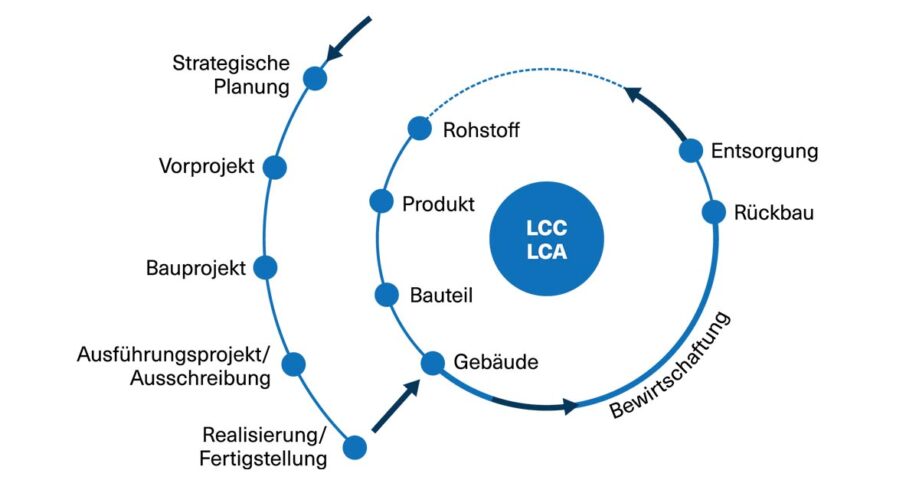
    The results of an ecological balance sheet (life cycle analysis, LCA) and an analysis of the life cycle costs (LCC), for example, form an excellent basis for decision-making. These quantitative assessment methods take into account the entire building life cycle.

    To the white paper

    Comprehensive redevelopment of the Webermühle housing estate
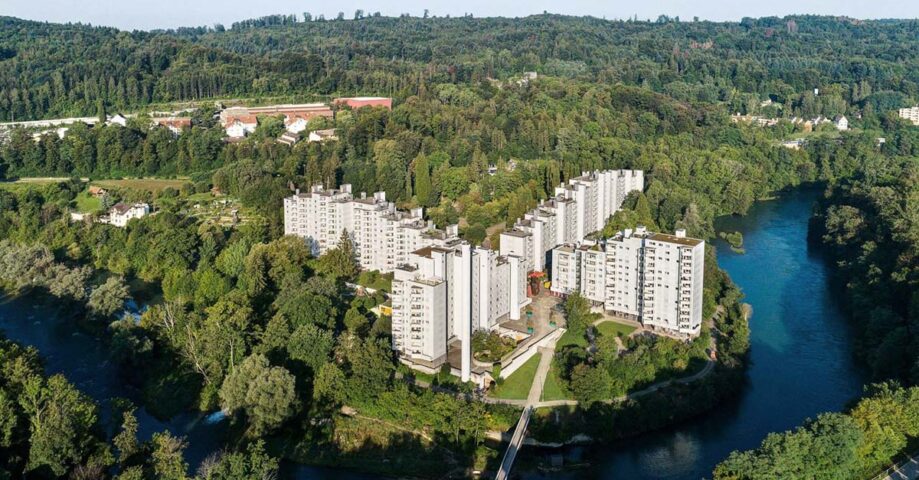
    One example of a successful renovation is the large Webermühle development in Neuenhof. The former Göhner settlement, which was occupied in 1984 and has been owned by a real estate fund from Credit Suisse Asset Management since 2008, houses 368 rental apartments with around 1,500 residents.

    The core of the energetic renovation of the Webermühle is the reorientation of the heat supply. To this end, the client defined a clear goal right from the start: in the future, the heat supply should be at least 70% CO₂-free. Due to the size of the facility, Credit Suisse Asset Management wanted to have the heating system replaced by a contractor instead of producing heat itself. The sustainability of the solution proposed by ewz with a river water heat pump convinced the client.

    Find out more

  • Paperi's first "2000-watt area" in the canton of Zug

    Paperi's first "2000-watt area" in the canton of Zug

    The paper mill shaped the community of Cham and the Zug West region for more than 360 years. A new living and working quarter with industrial charm is now being built on the former industrial site. Formative existing buildings are being supplemented with striking new buildings directly on the Lorze and implemented sustainably. The story continues and bridges are built between past and future, between people and nature, between living and working. “Sustainability” has played an important role as an overall topic since the beginning of the site development. As the client, the Cham Group committed itself to the goals of the 2000-watt society early on in the planning process and made the decision to use fossil-free heat supply out of conviction and even before the intention of certification. As the crowning glory of the ongoing sustainability efforts, the Papieri was the first area in the canton of Zug to be awarded the “2000 Watt Area” certificate today. On behalf of the Swiss Federal Office of Energy, Daniel Kellenberger thanked the Cham Group for their commitment and perseverance in not only talking about energy and CO 2 targets, but actually implementing them with the “2000 Watt Area” certificate, among other things.

    Zero CO2 emissions
    The Papieri area offers completely new foundations for an energy-efficient, climate-neutral and sustainable society. This makes it a pioneering project throughout Switzerland. Practically from the beginning of the development of the site, the Cham Group decided to completely dispense with fossil fuels for heat generation and to rely fully on the favorable location factors with hydropower, geothermal probe fields and photovoltaics. The highlight of the area is the completely CO 2 -free energy system. The entire energy supply on the site is based on 100% renewable energies. This is achieved by means of geothermal probes and a river water catchment, which each serve a central heating and cooling network via heat pumps. Thanks to a ZEV (association for self-consumption) with the renovated small hydroelectric power plant on the Lorze and large-scale photovoltaic systems of 6,500m2 on the new buildings, around 40% of the total energy required can be generated on site. “Moreover, other aspects of comprehensive sustainability are explored in practically every project, be it through “building recycling”, ie intelligent conversion of the existing building, the use of CO 2 -optimized construction principles such as timber construction, or through intelligent sharing offers in the field of mobility,” explains Lukas Fehr, Head of Development at the Cham Group.

    Lighthouse character for municipality and canton
    So far, only 43 areas in Switzerland have been certified with this label by the Swiss Federal Office of Energy –
    26 of them as a 2000-watt area “in development”. Government Councilor Florian Weber is also pleased that the canton of Zug is playing a role in this. “100 percent for 2000 watts: the Cham Group is opening up a new era of comprehensive and sustainable energy concepts for large-scale developments at the Papieri site,” says the construction director. As Energy City Gold, the municipality of Cham also celebrates the award of the papers as a “2000-watt area”. “The award is a seal of quality for the Cham Group’s site development, an incentive for others and at the same time corresponds to the community’s commitment to climate protection. After all, Cham wants to become climate-neutral internally by 2030; by 2050, “net zero” greenhouse gas emissions should even be achieved for the entire municipality,” explains Drin Alaj, Head of Traffic and Safety for the Cham municipality. And Mayor Georges Helfenstein adds: “We see the developments on the Papieri site as an opportunity and are pleased about this certification and about the new, vibrant and now also certified sustainable quarter”.

    Marketing start of the first office and commercial space
    On February 10, 2022, the rental of the shop, office and commercial space on the ground floors of the properties in the first construction phase, which will be ready for occupancy at the end of 2022, will start on the papieri-cham.ch website. The Papieri area offers space for every business model and company of different sizes. Not interchangeable and arbitrary, but sustainable, well thought out and in the middle of a lively district.

  • «When it comes to energy, the construction and real estate industry must reinvent itself»

    «When it comes to energy, the construction and real estate industry must reinvent itself»

    Zur Person
    Pascal Bärtschi,
    Bauingenieur ETH, ist
    Vize-Präsident von
    Entwicklung Schweiz und seit 2015 CEO der Losinger Marazzi AG. Der 52-Jährige leitete zuvor bei Losinger
    Marazzi die Region Mitte (Bern-Freiburg-Basel).

    Wo sieht der Branchenverband Entwicklung Schweiz seine Kernaufgaben?
    Wir vertreten Unternehmen, die in der Lage sind, Gesamtleistungen zu übernehmen. Also solche, die von der Projektentwicklung bis und mit Realisierung alles abdecken können. Unsere Hauptaufgabe sehen wir darin, mit unseren Kunden, Investoren, den zuständigen Behörden wie auch mit politischen Verantwortlichen übergeordnete Themen wie etwa Verdichtung und Raumplanung auf einer entsprechenden Flughöhe zu besprechen. Unsere Mitglieder erhalten so die Möglichkeit, via Entwicklung Schweiz mit den zuständigen Personen in Dialog zu treten. Darüber hinaus haben wir als Verband verschiedene Positionspapiere verfasst – derzeit entsteht zum Beispiel gerade ein Positionspapier zur Frage, was man unter Qualität eines Bauprojekts versteht.

    Von welchen Vorteilen profitieren Ihre Mitglieder?
    Wir organisieren für unsere Mitglieder und assoziierte Partner regelmässig Anlässe, bei denen sie sich mit Stakeholdern wie Politikern oder Investoren austauschen können. Darüber hinaus ist es deutlich einfacher als Verband, Gespräche zu übergeordneten Themen mit Kantonen oder auch Instanzen wie zum Beispiel dem Bundesamt für Bauten und Logistik (BBL) zu führen, als wenn dies jedes Mitglied für sich tun müsste. Gerade bei regulatorischen Themen profitieren unsere Mitglieder von der direkten Schnittstelle zur Politik, die wir dank unserem Präsidenten, Ständerat Martin Schmid (FDP), haben. Er ist Rechtsanwalt und somit nicht in der Branche tätig, was wir als weiteren Vorteil sehen.

    Welchen Einfluss hat der Verband in der Schweiz und insbesondere auch in Bundes-Bern?
    Wir bieten den Ämtern, Investoren und unseren Kunden eine bewährte Schnittstelle. Ich bewerte unseren Einfluss als gut. Wir haben uns als Gesprächspartner der grossen Instanzen sehr gut etablieren können. Die Immobilienbranche ist dezentralisiert aufgestellt. Für uns ist es deshalb wichtig, dass wir nicht nur in Bern Gehör finden, sondern auch bei den Kantonen und Gemeinden. Denn ein Projekt wird von einer Gemeinde oder einem Kanton bewilligt. Dank unserem Präsidenten und den Kontakten der Geschäftsstelle haben wir einen guten Draht zu Bundes-Bern, was natürlich hilft, wenn es um Themen wie etwa das Raumplanungsgesetz geht.

    Braucht es so einen Verband zwingend für eine erfolgreiche Zukunft der Baubranche?
    Ich würde sagen, es ist wichtig und notwendig, dass ein solcher Verband existiert. Die Zahl der Schweizer Gesamtdienstleister in der Immobilienbranche ist überschaubar. Unser Verband kann diese Unternehmen optimal auf den verschiedenen Ebenen vertreten.

    Welche Verantwortung nimmt Entwicklung Schweiz in Bezug auf die Wohn- und Lebensqualität bei Bauprojekten wahr?
    Wir setzen unseren Mitgliedern keine Rahmenbedingungen. Die Wahrnehmung der Wohnqualität ist jedoch auf jeden Fall gegeben, da wir uns als Entwicklung Schweiz mit damit zusammenhängenden Themen wie Lärmschutz, Verdichtung nach innen und Raumplanung intensiv auseinandersetzen. Aber bei uns ist jedes Mitglied selbst dafür verantwortlich, die Projekte entsprechend zu entwickeln und die nötige Qualität zu liefern. Man darf nicht vergessen, dass sich die Mitglieder in einer Wettbewerbssituation befinden.

    «
    CO2-arme
    Baumaterialien, flexiblere
    Umnutzungen
    »

    Welche Bedeutung hat die Energiestrategie 2050 für den Verband?
    Die Energiestrategie hat eine grosse Bedeutung für uns. Wir versuchen, Partner und Kunden dafür zu sensibilisieren. Der CO2-Verbrauch in der Immobilien- und Baubranche ist immer noch relativ hoch. Der eine Teil fällt beim Bau an, der andere während des Lebenszyklus einer Immobilie. Geht man von einem Lebenszyklus einer Liegenschaft von 60 Jahren aus, haben Entscheidungen, die heute für einen Neubau getroffen werden, langfristige Auswirkungen. In diesem Zusammenhang wird sich die Immobilien- und Baubranche neu erfinden müssen.

    Wie meinen Sie das?
    Vor zehn Jahren fielen etwa 50 Prozent der CO2-Emmissionen bei der Herstellung der Baumaterialien sowie in der Bauphase selbst an. Die anderen 50 Prozent fielen auf den Unterhalt einer Liegenschaft. Heute sind wir, was Unterhalt und Betrieb eines Gebäudes betrifft, bei etwa einem Drittel des CO2-Ausstosses; bei der Herstellung der Baumaterialien sowie dem Bau selber bei zwei Dritteln. Wir müssen uns Gedanken machen, wie wir den CO2-Fussbadruck einer Immobilie reduzieren können. Eine Lösung besteht darin, dass man wirklich nur die für ein Gebäude notwendige Fläche bebaut. Ein anderer Ansatz ist die Wahl der Materialien – heute gibt es bereits CO2-armen Beton oder die Möglichkeit des umweltfreundlichen Holzbaus. Ausserdem müssen bestehende Strukturen später umgenutzt werden können. Schauen wir uns die Investitionen in der Immobilienbranche an, fallen 99 Prozent auf Neubauten und nur 1 Prozent geht in Sanierungen. Hier sehen wir Handlungsbedarf.

    Wie hat die Bau- und Immobilienbranche die Pandemie bis jetzt bewältigt?
    Die Baubranche ist relativ gut durchgekommen – es gab wenig Umsatzeinbussen, da die Baustellen mit Ausnahme des Kantons Genf auch während des Lockdowns offengeblieben sind. Etwas schwieriger gestaltete sich die Immobilienentwicklung. Die Entwicklung eines Projekts startet in der Regel mit einem Quartierplan und einer Baubewilligung. Die Pandemie hat vieles ausgebremst. So mussten Gemeindeversammlungen, bei denen beispielsweise über ein Vorhaben abgestimmt werden sollte, häufig verschoben werden. Damit verschiebt sich automatisch auch das Projekt. Bei der Bearbeitung der Baugesuchdossiers hat man die Verlagerung zur Arbeit im Home-Office gespürt: Der Austausch wurde erschwert; es hat alles etwas mehr Zeit in Anspruch genommen, was wiederum zu Verzögerungen geführt hat.

    Zeichnet sich beim Arbeitsleben durch die Pandemie eine Veränderung ab?
    Die Pandemie hat Tendenzen, die sich schon vorher abgezeichnet haben, beschleunigt. Ein Beispiel hierfür ist die pro Person weniger benötigte Bürofläche. Bei der Konzeption von Wohnungen dürfte die Berücksichtigung des immer öfter benötigten Home-Office langfristig Einfluss haben. Wobei dies nicht zwingend in einem zusätzlichen Arbeitszimmer in der Wohnung selber resultieren muss. Ich kann mir gut vorstellen, dass man innerhalb eines Quartiers verschiedene kleine Co-Working-Spaces entwickelt. Diese könnten auch Mischnutzungen aufweisen, also beispielsweise über Mittag als Restaurant fungieren.

    Wohnen die Menschen in der Romandie anders als in der Deutschschweiz?
    Die Nachhaltigkeitsaspekte werden zurzeit in der Romandie noch weniger wahrgenommen als in der Deutschschweiz. Ich vermute, das kommt daher, dass die grünen Tendenzen zunächst aus Deutschland kamen und somit zuerst die Deutschschweiz erreicht haben. Auch im Bereich des Öffentlichen Verkehrs hat die Deutschschweiz einen gewissen Vorsprung – wobei die Romandie hier am Aufholen ist.

    Welche Meilensteine hat Entwicklung Schweiz in den letzten Jahren erreicht?
    Der wichtigste Punkt ist sicher, dass wir heute etablierte Ansprechpartner für übergeordnete Themen auf Stufe Kantone und Bund sind.

  • Synhelion and Cemex produce the first solar concrete

    Synhelion and Cemex produce the first solar concrete

    Synhelion and Mexico’s Cemex , the world’s fifth largest cement producer in 2020, have produced the world’s first solar clinker. As both companies write in a media release of the same name, this “revolutionary innovation” is a “first step towards the development of completely solar-powered cement plants”. dr Gianluca Ambrosetti, CEO and co-founder of Synhelion, is proud to “join with Cemex to demonstrate a concrete, industrially relevant application of our fully renewable high-temperature solar heating”.

    Synhelion emerged from the Swiss Federal Institute of Technology in Zurich in 2016. The company’s technology aims to replace all types of fossil fuels with solar fuels. According to the information, it converts concentrated heat from the sun into “the hottest process heat available on the market”. Cemex wants to supply CO2-neutral concrete worldwide by 2050. A key part of this strategy is CEMEX Ventures and its research and development center in Brügg BE.

    Research teams from both companies installed a pilot plant on the premises of the Madrid Regional Government’s Imdea Energy Research Institute . There, the solar receiver from Synhelion delivered “record-breaking” temperatures of over 1500 degrees with concentrated sunlight. A gaseous heat transfer medium is thus heated. This provided the heat needed to melt limestone, clay, and other materials together.

    The clinker obtained in this way was used to manufacture cement and then processed into concrete. In the next phase of their joint research and development project, Synhelion and Cemex intend to work towards an industrial-scale pilot plant.

  • Implenia receives five building construction contracts in Germany

    Implenia receives five building construction contracts in Germany

    For Implenia ‘s Buildings Division, the new year begins with an attractive building construction contract worth CHF 227 million in Germany. According to a press release , the Opfikon-based construction and real estate specialist has been awarded the contract to build several sustainable residential and commercial buildings in five German cities.

    According to the announcement, Implenia’s Buildings Division is constructing two residential and commercial buildings in Kiel , a high -rise apartment building for the Franklin site in Mannheim, which according to the announcement is “currently the largest site development project in Germany”, and the partially modular construction of a new rehabilitation center in Mosbach am Neckar Residential district in Neunkirchen am Brand and a school center in Delitzsch near Leipzig.

    The model-based and software-supported working method Building Information Modeling (BIM) is to be used in the planning and execution of the new construction projects. Lean construction should guarantee the coordination of all processes and trades during the construction phase.

  • Holcim issues first sustainable bonds

    Holcim issues first sustainable bonds

    Holcim has issued two bonds in Swiss francs that are geared towards sustainability and put climate protection at the heart of the financing strategy. The bonds raised CHF 325 million and CHF 100 million, with maturities in 2026 and 2032 and carrying an annual interest rate of 0.35 and 0.90 percent, respectively.

    If Holcim does not achieve its climate target, investors are entitled to a higher coupon. "We are proud to be the first company to issue a sustainability-related bond on the Swiss franc market," CFO Géraldine Picaud is quoted as saying in a company statement. "The bond has attracted new ESG investors who have demonstrated their confidence in Holcim's financial strength, strategy and ability to achieve sustainability goals."

    With the current transactions, Holcim is expanding its global leadership position in this area. To date, the company has concluded around 6.7 billion in sustainable financing agreements. This current transaction represents a significant step on the way to more than 40 percent sustainable financing contracts as part of "Strategy 2025 – Accelerating Green Growth".

    This was Holcim's third transaction in the Swiss public bond market in the last ten months. They allowed the company to raise a total of 1.1 billion Swiss francs.

  • Availability of wood has stabilized

    Availability of wood has stabilized

    A major strength of building with wood is the great planning security. High quality and adherence to schedules are motivating more and more builders to implement extensive projects with wood. In 2021, however, price turbulence and long delivery times did not go unnoticed by the material wood.

    Market is returning to normal
    In the meantime, the warehouses at various retailers are full again. Suppliers can once again serve the Swiss market on schedule. "In Switzerland, the costs for the most common products such as glued laminated timber, construction timber C24 or multi-layer panels have stabilized at a slightly higher level than in the previous year," notes Hansjörg Steiner.

    inflation in construction
    «The changed material prices have only a minor impact on the total costs in construction. In the case of conversions, which require less material compared to new buildings, the price increase is not significant,” says Hansjörg Steiner. Building has basically become a little more expensive – caused by the price increase of almost all building materials.

    Regional use
    According to Florian Landolt from Wald Schweiz, the Swiss forestry industry is benefiting from the slightly higher prices, and is now able to cover its costs. The availability of Swiss wood products remains a major challenge. The Swiss timber construction companies are dependent on neighboring countries for 70% of the material. Targeted support for construction projects that use locally harvested wood would create efficient incentives to promote the entire Swiss wood chain and reduce dependency on other countries.

    Building with the renewable raw material wood
    Wood is the material of choice for energy-efficient and climate-friendly projects. Wood stores CO2 in the biomass – one ton of CO2 per cubic meter of wood used. Building with wood makes a significant contribution to achieving climate goals. In order to make the Swiss real estate park more climate-friendly, promoting timber construction is obvious, both for new buildings and conversions.

  • Innovative Swiss platform for space and real estate development

    Innovative Swiss platform for space and real estate development

    Luucy AG, based in Lucerne, was founded in 2019 by the architect and entrepreneur Mark Imhof. He describes himself as a visionary who has been dealing with the complex issues of the internal development of villages and cities for a long time. It struck him that he was repeatedly reaching limits with the usual methods and procedures. Imhof decided to develop a solution that strengthens and simplifies communication and cooperation between all parties involved: “Luucy combines the relevant data for the spatial and real estate development of all Swiss municipalities in one central location. The planning platform also provides intelligent tools for development and supports the exchange with all stakeholders through the understandable 3D visualization, ”explains Mark Imhof, CEO of Luucy AG.

    Data and information from all stakeholders could be easily found, further developed and made available via the comprehensive platform. To make this possible, Luucy was constructed as a digital twin of built Switzerland. Imhof: “The topography of the Swiss landscape with all existing buildings is available in 3D as a basis. Thanks to the web solution, no software needs to be installed to use it. Initial building volumes and variant studies can be modeled directly in Luucy and compared with one another. Additional apps from third-party providers, for example for calculating investment costs, provide valuable additional information for decision-making. “

    The official survey data, maps and access to the building laws can also be called up directly on the platform. “Luucy enables all interested third-party providers to connect additional solutions and thus offers space for new business models and value chains,” says Imhof. The solution met with great interest in the real estate industry: “Having all the relevant data and tools for room and real estate development available online in one place increases efficiency considerably,” explains Imhof.

    Make feasibility studies much easier
    Luucy isn’t the only platform that makes data accessible in a digital twin. «The specialty of our solution is the platform concept. We don’t work out everything ourselves – we integrate and work with the best. As a result, the platform is growing steadily, ”says Imhof, explaining the advantages. The interactive platform also differs from other solutions, because it acts as an intermediary builder of bridges between the authorities, which often do not know enough about the needs of the private sector, and the private sector, which the overarching goals of spatial development in the sense of a sustainable and holistically functioning organism Too little consideration of “living space”.

    “Today, for example, many steps in different systems are necessary to create a feasibility study. The analysis of the legal basis in the building laws of the 2172 municipalities in Switzerland and their interpretation is often a challenge. A lot of time is lost here, ”says Imhof. Luucy has all of these basics ready in a single system. The platform would primarily be used by specialists from architecture or site development. In this way, they can check meaningful development scenarios in just a few hours. “Authorities and spatial planning offices can also use our solution to display local planning revisions and potential spatial developments over a large area. Investors can easily make their own initial potential assessments of properties and areas,” explains Imhof.

    The modeling of own building volumes and the quick calculation of the corresponding rough costs are currently most in demand. “Here, the entire settlement context is taken into account, and the influence on neighboring buildings in terms of shadows and views can be quickly checked. In addition, Luucy is often used for digital competitions in which the different project ideas are simply evaluated and compared with one another, ”says Imhof.

    In 10 years the most used planning and coordination platform for the space and real estate industry
    The main focus of Luucy AG is initially on Switzerland. “But it is quite conceivable that the solution will also be offered in the DACH region and Europe in the next few years,” says Imhof. The basic costs for the platform are CHF 3,000 per year. This means that three administrators can create any number of projects, and unlimited users can work in these projects.

    In the coming months, the start-up plans to continuously expand its offerings: “In five years, Luucy will be so extensive that all room-relevant data and functions can be accessed via the platform. Simulations, for example on noise, mobility and climate, can be displayed »,
    says Imhof. And he is convinced: “In ten years, our solution will be the planning and coordination platform for the space and real estate industry. And with Luucy, cooperation with the private sector will also be greatly simplified for the authorities. Planning applications can then be published in 3D format. “

    In addition to a further developed geometer system, Luucy will one day ensure that an up-to-date digital twin is available to all planners on a daily basis. The spatial strategies and the associated development of the infrastructure of the cities and municipalities should be available. The solution is disruptive and is likely to play a key role in replacing complicated and less dynamic processes in the construction industry, as Imhof explains.

    Mark Imhof, CEO Luucy.
  • Delta School relies on LEDcity

    Delta School relies on LEDcity

    The Delta School in Zurich has brought the lighting in its classrooms up to date with the latest technology. The old luminaires were replaced by the energy-efficient, sensor-controlled lighting from LEDcity , informs LEDcity in a message .

    As part of the Eco Schools project carried out by the school, the pupils were also involved in retrofitting the lighting. Yves Jungo from LEDcity, on the other hand, had to prove himself as a teacher: the customer advisor for the Zurich start-up company introduced the children and young people to the basics of electricity and lighting in two teaching units.

    For LEDcity, the cooperation with the school is a role model, the message goes on to say. “If you can convey to children the importance of careful use of our resources – and especially of the ‘invisible’ resource of electricity – this contributes a lot to a greener future,” Jungo is quoted there as saying.

    According to the company, users of the innovative lighting system saved up to 93 percent of energy costs compared to conventional lighting. To this end, LEDcity uses algorithms optimized by artificial intelligence, which control the light sources autonomously and as required.

    In the Delta School, the students were able to calculate the actual energy savings themselves: the interaction of LED technology, algorithms and sensors reduces costs by 60 francs per year and lamp.

  • Swissolar wants more sun in standard electricity

    Swissolar wants more sun in standard electricity

    Around 5 percent of annual electricity consumption in Switzerland is currently covered by domestically produced solar electricity, explains Swissolar in a press release . In the standard electricity products of the energy suppliers, however, the proportion of solar electricity is only 1.85 percent on average. The Association of the Swiss Solar Energy Industry is working together with the power comparison service myNewEnergy to increase the solar proportion of standard products to this 5 percent in a first step.

    “This value should be increased annually by at least the amount of additional construction in question,” Swissolar managing director David Stickelberger is quoted in the announcement. “Around 1 percent would correspond to the necessary expansion of photovoltaic systems.”

    The majority of households do not choose a special electricity product and therefore receive the standard offer from the respective energy supplier, explains Swissolar in the press release. If the proportion of solar power in the standard product is increased to the proportion of power consumption, the comparatively expensive power is divided among a large number of consumers, argues Swissolar. This keeps the product price low and opens up new sales markets for providers of solar power who have been “sitting on their clean electricity” up to now.

    “It is important that these certificates come exclusively from Swiss solar systems, because only such certificates make an effective contribution to a safe and clean power supply in our country,” explains Stickelberger. “To replace the nuclear power plant alone, we need 20 terawatt hours of solar power.”

  • Sto AG replaces crude oil with pine oil

    Sto AG replaces crude oil with pine oil

    Sto AG replaces a third of the binding agent in the coatings of its StoTherm AimS facade insulation system with a renewable raw material based on pine oil. This saves around 43 liters of crude oil in a single-family house with a facade area of 200 square meters, according to a press release.

    A complete replacement of crude oil with pine oil was not possible. This would have had a negative effect on quality and durability.

    According to a media release, StoTherm AimS is the only facade insulation system with under and top plasters and a facade paint that is partly based on renewable raw materials. It is certified with the German Blue Angel eco-label. In addition, it is crack and impact-proof and cannot burn. Therefore, it is also suitable for high-rise buildings.

  • Holcim launches CO2-reduced cement

    Holcim launches CO2-reduced cement

    With ECOPlanet, Holcim is bringing a green cement onto the market. According to a press release by the company, this causes 30 percent less CO2 emissions than conventional products. According to CEO Jan Jenisch, this will be the world's first cement that consists of 20 percent recycled construction and demolition waste. In addition to the use of low-emission raw materials, the CO2 reduction is achieved, among other things, by decarbonising the production process.

    ECOPlanet is already available in Switzerland as well as in Germany, Romania, Canada, Spain, France and Italy. In the current year, the product is to be launched in a total of 15 European countries. Holcim plans to double its market presence with ECOPlanet by the end of 2022.

    "In view of the increasing world population and rapid urbanization, solutions like ECOPlanet are of crucial importance to create greener cities and smarter infrastructure and to build more with less effort," Jenisch is quoted in the press release.

  • UZH wants to generate electricity on a green roof

    UZH wants to generate electricity on a green roof

    The University of Zurich is to have a new teaching and learning center, the FORUM UZH, by 2028. According to a message on Monday, the cantonal building construction department submitted the building pre-submission. Afterwards, the seven-story building designed by the Basel architects Herzog & de Meuron will be erected as a wood hybrid construction with a concrete structure. The use of wood is supposed to save as much CO2 as is needed to build 77 single-family houses.

    The roof is to be greened intensively, thereby improving cooling in summer and thermal insulation in winter. At the same time, the roof will have a photovoltaic system. This should generate around 150 megawatt hours per year, enough electricity for 50 households.

    Construction is scheduled to begin in 2024. In the future, the building will have 700 workplaces for students and work space for 6000 members of the university.

  • Innovative quarter on the Henz site

    Innovative quarter on the Henz site

    At the Suhr Süd train station, an innovative quarter is being created that combines living and working. To this end, the Henz area – the former location of the steel trading company of the same name – is being completely converted. Condominiums and rental apartments are being built here, some of which can be moved around at the push of a button. The four to twelve storey buildings are characterized, among other things, by their open courtyards. The new quarter connects to the urban train station quarter in the north. In the south, according to the SSA Architekten AG commissioned with the project, the “scale transition to the Helgenfeld and Frohdörfli developments” is successful.
    59 condominiums and 143 rental apartments as well as studios and movements – these are furnished apartments with movable modules – as well as commercial, restaurant and service areas are to offer residents a meeting point for young and old after completion in autumn 2023. A 40 meter high building with 12 floors will be particularly striking. Here, on areas of 72 to 119 square meters, 2.5 to 5.5 room apartments with loggias are being built that are for sale. A restaurant and at least two should be on the ground floor
    Service companies settled
    will.

    The garden house has four floors. The condominiums are designed as 2.5 to 5.5 room apartments. With living areas of 68 to 129 m2, loggias, terraces or garden seats, the larger apartments are particularly suitable for families. The so-called courtyard building provides for 15 condominiums. Two more buildings with rental apartments and studios are being built along Gränicherstrasse and Bernstrasse West.

    A public square with a café and playground as well as various open spaces connect the area with the surrounding quarters via a network of paths. The property on the southwest corner of the area offers additional outside space. On the other side of the street, a green area belonging to the Henz area with a playground and pavilion is being built. Various commercial and service areas are planned on the ground floors of the building. These uses are intended to enliven and enrich the quarter. The studio areas allow flexible use of living and working.

    The sustainable energy strategy includes the supply of district heating from the Buchs waste incineration plant. The energy for the gentle cooling of the apartments in the high-rise is generated by solar energy. Photovoltaic systems on the site generate part of the household electricity. The parking garage is equipped with a charging infrastructure for e-bikes and electric cars.

    Condominiums can be configured online by their future residents. Visiting your own four walls in the future is already possible thanks to virtual reality (VR). Halter AG is continuously registering bookings for this offer: "Customers are thrilled with how well they can imagine the premises and, in particular, the view and the ceiling height of 2.60 to 2.80 meters," says Agathe Siffrin from Primus Property AG who takes care of sales for Halter AG. “The combination of VR, configurator and showroom is the optimal solution for showing apartments that will only be ready for occupancy in around two years”, she continues. As of today, over 50 percent of the condominiums are already reserved. The rental starts next year. Interested parties can register for the one to two-hour VR and advisory tour free of charge via the website.

  • Army real estate only uses renewables

    Army real estate only uses renewables

    The properties of the Federal Department of Defense, Civil Protection and Sport (DDPS ) used by the armed forces only use electricity that is generated from renewable energies, especially hydropower, the DDPS informs in a message on the current sustainability report of the Federal Office of Armaments (armasuisse ). According to her, the CO2 emissions caused by the VBS properties have also been significantly reduced compared to the previous year. Specifically, 36,600 tons of CO2 were emitted last year.

    The current sustainability report shows "how armasuisse real estate builds resource-intensive military infrastructures sustainably and operates them economically over the entire life cycle," the press release goes on to say. The report also provides important key figures. One example is the share of expenditure on planning and construction work that is attributable to local suppliers. It is estimated in the communication at 85 percent.

    In addition, the report contains a conversation with division general Thomas Kaiser, is further explained in the communication. In this, the head of the army's logistics base presented “his vision of a sustainable future for the army's logistics base”.

  • Enerdrape wins with climate panels for buildings

    Enerdrape wins with climate panels for buildings

    Enerdrape has 150, 000 francs under the support of Venture Kick obtained as from a message stating. The spin-off from the Swiss Federal Institute of Technology in Lausanne ( EPFL ) is developing a sustainable solution for air conditioning in buildings. The start-up's system consists of modular panels that are installed indoors. These use the existing thermal energy and waste heat to heat and cool the building.

    According to Enerdrape, heating and cooling buildings alone are responsible for around 40 percent of CO2 emissions in Europe. According to the start-up, sustainable alternatives often require a complex installation process and are also expensive. In contrast, the solution from Enerdrape is cheap and easy to implement. The company's panels are particularly intended for installation in underground garages and commercial buildings. In Europe, Enerdrape sees a potential market of CHF 40 million here.

    The Venture Kick funding initiative supports young companies from the idea to the establishment of a company. The Venture Kick Foundation mandated the institute for young companies , which is represented in Schlieren ZH, St.Gallen and Lausanne, to carry out the initiative.