Tag: PropTech

  • How Switzerland is training the PropTech specialists of tomorrow

    How Switzerland is training the PropTech specialists of tomorrow

    Interdisciplinarity is the key
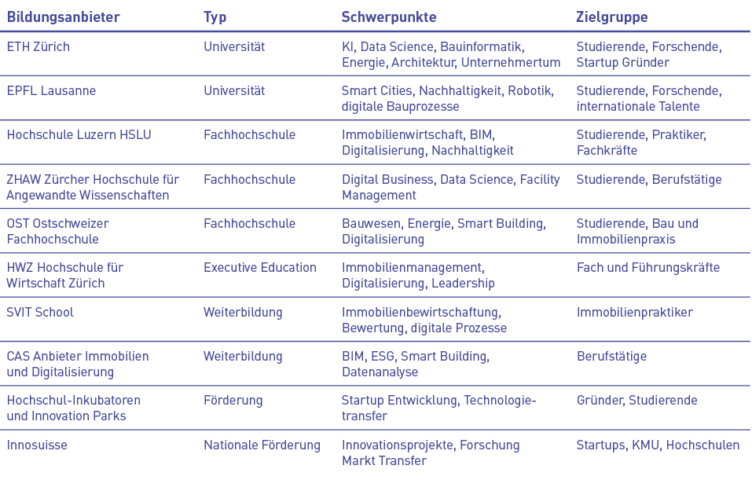
    PropTech is not a traditional field of study. Rather, expertise is created by combining different disciplines. In Switzerland, training programmes combine subjects such as property economics, construction, IT, data analysis, sustainability and management.

    This interdisciplinarity reflects the reality of the industry. PropTech specialists need to understand technical solutions, categorise regulatory frameworks and think economically at the same time. Swiss educational institutions are responding to this with modular programmes and practice-oriented formats.

    Universities as drivers of innovation
    ETH Zurich and EPFL Lausanne form the academic foundation of many technological developments. Degree courses and research programmes in civil engineering, architecture, computer science and data science provide expertise that flows directly into PropTech solutions.

    Universities of Applied Sciences such as HSLU, ZHAW or OST complement this offering with a strong practical focus. Projects in collaboration with companies, start-ups and public institutions enable students to work on real-world problems. This results in a direct transfer of knowledge into application.

    Further education for property practice
    In addition to academic education, in-service training is becoming increasingly important. Many specialists in administration, valuation, development or management need to catch up on or deepen their digital skills.

    In Switzerland, there are a growing number of CAS and MAS programmes with a focus on digitalisation, BIM, data analytics, sustainability and real estate management. These programmes are aimed specifically at practitioners and impart applicable knowledge for everyday working life.

    Collaboration with the industry
    A key success factor is the close cooperation between educational institutions and the property industry. Companies act as practice partners, provide use cases or participate in the content design of training courses.

    This keeps training content up-to-date and close to the market. Students and further education participants benefit from real insights into ongoing transformation processes and establish relevant networks at an early stage.

    Entrepreneurship and start-up promotion
    Many training programmes integrate entrepreneurial elements. Incubators, innovation programmes and student initiatives promote a spirit of entrepreneurship and experimentation. Students are encouraged to develop their own ideas and pursue them as start-ups.
    This combination of education and entrepreneurship is an important driver for the Swiss PropTech scene. Numerous successful companies have emerged from university projects and have been able to establish themselves on the market thanks to targeted support.

    Challenges and outlook
    Despite the strong educational landscape, the shortage of skilled labour remains a challenge. The demand for specialists in the fields of data analysis, software development, BIM and ESG is outstripping supply.

    At the same time, the need for hybrid profiles that combine technology and property practice is increasing. Educational institutions are therefore faced with the task of continuously developing their programmes and addressing new target groups.

  • PropTech remains invisible and indispensable

    PropTech remains invisible and indispensable

    Mr. Schwyter, you are one of the pioneers of the Swiss PropTech scene. How did your journey in the digital real estate market begin?
    After my time at Homegate, I asked myself how I wanted to use my knowledge further. The digitalization of the real estate industry was an obvious choice. Before the pandemic, however, hardly anyone was interested in this topic. It was Covid-19 that gave it a huge boost. From then on, digitalization was widely accepted and I found my place in the PropTech scene.

    What early experiences at Homegate still shape your view of PropTech today?
    Above all, the joy of experimenting and developing new approaches together. We wanted to create solutions that would advance the industry as a whole. This attitude is still with me today. Being open, working in an interdisciplinary way and testing boldly.

    How digital is the Swiss real estate industry really, if you leave out the marketing jargon?
    Pom’s Digital Real Estate Index has been below five on a scale of zero to ten for years. This clearly shows that the sector has a lot of potential for improvement. There is progress, but not a continuous digitalization push. Overall, we are more at the beginning of a professional digital transformation.

    Where does Switzerland stand in an international comparison? Pioneer or laggard?
    Switzerland has around 480 PropTech companies, which are small but qualitatively strong and diverse. Germany is significantly higher with more than 1,200 companies. We have areas where we are very good and others where there is potential for expansion. Overall, I would describe us as a solid, well-developed ecosystem.

    In your opinion, which PropTech segments are the most advanced?
    Platform solutions in the broad sense, i.e. not just marketplaces such as data platforms, service platforms and ecosystems. This is where we see the greatest professionalization and maturity.

    What kind of startups do you think will be the first to disappear and why?
    Startups that only cover one isolated process step and cannot be integrated. Real estate companies need solutions that combine several process steps or can be easily integrated into existing systems. Silo products will hardly be viable in the future, neither technically nor economically.

    Where do you see obstacles to digitalization in Swiss real estate companies?
    The industry is highly fragmented. A company with 20 or 30 employees is already considered large. Many have neither internal IT skills nor a budget for larger digitalization projects. This also means a lot of work for providers. Instead of five major customers, you have hundreds of small ones. This structure slows down digitalization.

    Which three megatrends will shape the PropTech landscape in the coming years and why?
    Clearly data, sustainability and artificial intelligence. Data is the basis for every well-founded decision. Sustainability is not possible without data, especially with ESG, and AI is a trend that is highly polarizing. However, the impact only comes when the data quality and organization are right.

    Are there technologies that have long been ready for the international market but have not yet arrived in Switzerland?
    No. Everything that is internationally relevant is generally available in Switzerland in high quality. The challenge lies not in the technology, but in its consistent application and integration.

    What does it take for administrations to become more open to technology and more courageous?
    A clear digitalization strategy, because without a target image, any tool introduction is pure actionism. Companies need to understand that digitalization is a cultural and transformation process and not an IT project. Employees need to be supported and motivated, especially in an environment with high staff turnover.

    How can you recognize the quality of a PropTech company?
    The team. The key question is: do the people have the skills, perseverance and openness to really implement an idea? Markets change, products change and only a strong team can support this change. The team is therefore more important than the idea.

    Which approaches manage to map the entire life cycle?
    Not individual all-in-one products, but integrated cycles. When condition analysis, refurbishment planning and facility management are linked via clean data flows, for example, a genuine life cycle is created. Integration is the key.

    In which phases do you see the greatest untapped potential?
    Clearly in the area of construction technology. How we build, what materials we use, how planning and construction processes work – major changes are imminent here. We are already much further ahead in terms of operations and marketing.

    Are the regulatory framework conditions more of a driver or a brake?
    Startups want fewer hurdles and some things have been improved. However, issues such as the tax treatment of founder shares remain complex. Overall, we should reduce regulation. Innovation does not come from new regulations, but from entrepreneurial freedom.

    What political steps would be necessary for the sector to digitalize faster?
    I am clearly in favour of less government. The real estate industry will digitize itself for economic reasons. If companies can win more mandates and improve quality with the same employees, they will use digital solutions. Without any new political requirements.

    What cultural and organizational stumbling blocks do you encounter most often?
    The misconception that digitalization is a tool issue. In reality, it’s about processes, collaboration and roles. Many underestimate the cultural change. High staff turnover also makes it difficult to establish a digital culture.

    Which developments will irreversibly change the industry?
    Anything that simplifies or automates repetitive tasks and thus creates productivity gains. Whether you call this digitalization or efficiency enhancement is irrelevant. AI is one component, but not the only one.

    If you had to found a new PropTech today, in which area would it be?
    Probably in the area of marketing, because there is a lot of creative potential there. At the same time, I would like to see existing solutions grow more strongly. We have enough good providers, we don’t necessarily need any more.

    Where will PropTech Switzerland be in 2030?
    PropTech will be indispensable, but not in the spotlight. It’s not “sexy” like climate or energy issues. PropTech doesn’t make the headlines, but it ensures that the industry functions digitally, data-based and efficiently. This is precisely why PropTech will play a central role in the long term.

  • A panorama of the digital property industry

    A panorama of the digital property industry

    PropTech stands for digital, technological and data-based solutions that improve, automate or transform processes, products or business models in the property sector. These include software platforms, AI analyses, smart building systems, digital transaction models, data-based refurbishment and valuation tools, energy optimisation solutions and immersive technologies such as 3D visualisations, augmented reality and digital twins. PropTech thus spans the entire life cycle of a property. From planning and development to management, refurbishment and transaction.

    Blurred boundaries of the term
    With the growing awareness of PropTech, the desire of many start-ups to be part of this field is also growing. Companies from neighbouring areas such as FinTech, GreenTech, Bau-Tech, InsurTech or generic software providers are increasingly positioning themselves as PropTech, even if real estate is only a peripheral topic. As a result, tools are subsequently framed as property solutions and the sector appears larger in maps, reports and rankings than it actually is in the narrower sense. The PropTech Map Switzerland thus not only shows the strength of the ecosystem, but also its conceptual vagueness.

    Clusters, categories and regional hotspots
    The map reveals a clear geographical concentration. PropTech companies are particularly densely represented in the regions of Zurich, Zug, Lausanne and Basel. These are all locations with universities, technology parks and a high economic density. Many companies are spin-offs from ETH and EPFL, which emphasises the strong research and technology focus of the Swiss scene. In terms of content, the map spans a broad spectrum from asset management, construction and development to digital marketplaces, rental and sales platforms, 3D and smart building technologies, energy and climate tools, blockchain applications, financial platforms and specialised software services.

    Growth, internationalisation and more professionalism
    The continuously increasing number of entries shows that dozens of new companies are added every year, along with established market players that are digitally expanding their business model and international providers that are tapping into the Swiss market. Many PropTechs have long been operating beyond national borders and are scaling their solutions into European and global markets. At the same time, the ecosystem is professionalising. The PropTech Map not only depicts logos, but also the thematic orientation and positioning of the companies. The map thus becomes a central point of orientation for investors, property companies, administrations and universities.

    You can find the PropTech Map Switzerland here

  • sfb course in building automation HF increases efficiency in companies

    sfb course in building automation HF increases efficiency in companies

    Students on the Building Automation HF programme at sfb – Höhere Fachschule für Technologie und Management develop innovative projects for practical application, almost all of which are implemented, according to the press release. This benefits the Swiss economy, for example in the context of the Energy Strategy 2050 or other efficiency improvements. According to the sfb, the programme, which focuses on energy efficiency and building informatics, provides knowledge on how to operate the trades in a complex building as energy-efficiently as possible. 90 per cent of the final theses have a practical relevance, and it is not uncommon for students to make a career leap as a result. This is demonstrated, for example, by alumni Fabian Haist, who has completed further training to become a qualified building automation engineer HF and was available to answer questions for a series of sfb interviews.

    Based on his experience as an electrical planner, Fabian Haist prepared for his next career step with the sfb further training programme. “It played a key role in helping me to reach my current position, as a lot of the content was a perfect fit for my job profile,” he is quoted as saying. As an energy engineer at the Office for Environment and Energy of the Canton of Basel-Stadt (AUE), he is now responsible for implementing the cantonal energy law.

    In his diploma thesis, he planned an energy-related operational optimisation in a Basel school building and further developed the enforcement practice. According to Fabian Haist, the analysis has shown that even simple energy optimisations can lead to considerable savings: Energy savings of 15 per cent and cost savings of 17 per cent had been achieved in the Basel school building. The measures he has defined should now simplify the verification of operational optimisation.

    According to the sfb, the further education programme in building automation takes six semesters to complete, provided that the student has completed relevant vocational training. In addition to building automation, the module content includes data security, digital construction, renewable energies and fire protection. Skills in leadership, communication and teamwork are also taught. Details are available at information events in person and online as well as from a further education counselling service. The next start date is 13 August 2025.

  • New course director for Real Estate Management at the HWZ – focus on digitalisation and AI

    New course director for Real Estate Management at the HWZ – focus on digitalisation and AI

    Facchinetti brings with him extensive experience in digitalisation, innovation and PropTech. “We are convinced that he will offer students great added value thanks to his broad network and expertise,” says Markus Streckeisen, Head of Real Estate Programmes at the HWZ.

    In future, the new programme director will be responsible for three practical CAS programmes, which can be completed individually or in modules over several years up to a Master’s degree:

    • CAS Smart Real Estate Business (start: March 2025)
    • CAS Smart Real Estate AI, Data & Value (start: September 2025)
    • CAS Smart Real Estate Life Cycle Management (start: September 2025)

    “I am looking forward to working with experts from the field to impart future-oriented skills that are necessary for the challenges of our time,” says Facchinetti.

    The part-time continuing education programme, centrally located at Zurich Main Station, is aimed at specialists and managers who want to strengthen their digital skills in the real estate sector – practical, modern and future-proof.

  • PropTech Innovation Challenge 2024

    PropTech Innovation Challenge 2024

    On 19 November 2024, the Swiss start-up was named the winner of the PropTech Innovation Challenge 2024 by the Urban Land Institute (ULI) at the C Change Summit in Barcelona. The competition, which is aimed at leading innovators from the property and technology world, was held this year under the motto of reducing Scope 3 emissions. These emissions, which are generated along the entire value chain, are considered one of the biggest challenges facing the property industry.

    The challenge initiated by the Young Leaders was looking for pioneering solutions that can be implemented regionally, are scalable and sustainable. Particular attention was paid to retrofitting, the circular economy and the integration of ESG platforms.

    AI meets decarbonisation
    The ETH spin-off presented an AI-supported SaaS solution that supports asset managers, investors and consultants in the decarbonisation of building portfolios. The software creates precise, time-coordinated and cost-optimised renovation plans for property portfolios. This enables the industry to comply with strict net-zero targets without having to resort to inefficient, manual approaches.

    The expert jury particularly praised the scalability and efficiency of the solution, which makes it possible to implement complex investment and renovation strategies with minimal effort. The company is thus setting new standards for the reduction of carbon emissions in the property sector.

    A look into the future of the industry
    The PropTech Innovation Challenge shows how important innovative technologies are for the future of the property industry. Solutions play a key role in achieving sustainability goals and leading the industry towards a more climate-friendly future. With its combination of high-tech and practical applications, the company offers a tool that not only increases efficiency, but also strengthens collaboration between stakeholders.

    The success at the PropTech Innovation Challenge 2024 is a clear signal of the relevance of technological innovations in the property sector. The start-up’s AI-supported solution underlines how sustainability and profitability can go hand in hand. The industry is facing a paradigm shift and the company shows how this can be successfully shaped.

  • Digital voice assistant revolutionises documentation for construction projects

    Digital voice assistant revolutionises documentation for construction projects

    Benetics has integrated a digital voice assistant into its digital application for the coordination of construction projects. The assistant, which is based on ChatGPT, can create construction reports, protocols and measurements using free voice input in more than 30 languages and dialects and transmit them to the office in real time, the Zurich-based proptech company explains in a press release. According to the press release, the new function is now available in the Benetics app. There are no additional costs for existing subscriptions.

    “Tradespeople want to build – and not waste time on paperwork,” says Ferdinand Metzler, CEO of Benetics AG, in the press release. For them, documentation becomes a minor matter with the new voice assistant. The digital assistant also “significantly simplifies work for everyone involved in the project and enables companies to generate more revenue thanks to seamless documentation”.

    The Zurich-based proptech was founded in 2022 by Metzler together with Aaron Shon and Johan Tibell. Its app, which was launched in October 2023, is already being used by 50 construction companies in Europe, according to the press release. Benetics worked with 15 tradespeople from various sectors to develop the digital voice assistant that has now been integrated into the app.

  • Millions invested in expansion and development secured

    Millions invested in expansion and development secured

    Spacewise has received fresh capital to further invest in its product development and expansion in North America. According to a press release, an undisclosed seven-figure sum was raised in a post-seed financing round. The round was led by Zug-based investor Sandermoen with the participation of Zürcher Kantonalbank(ZKB) as well as several family offices and business angels.

    The Zurich-based proptech software-as-a-service company operates an award-winning platform for the temporary letting of retail properties. The Chairman of the Board of Directors, Brad Peppard, describes this platform as a “first-class solution for sales automation”. Spacewise is “well on its way to doing for short-term commercial lettings what online booking services have done for hotel reservations”.

    Customers can opt for either a comprehensive end-to-end solution or specific modules. This flexibility, says Spacewise, “increases effectiveness and efficiency in presenting property portfolios, managing space inventory and maximising revenue”.

    In Europe, Spacewise works with Migros, Swiss Post, Coop, Wincasa and SBB, among others, which handle thousands of rental contracts. In North America, it has partnerships with major players such as Regency Centres and Oxford Properties.

    “Spacewise has recognised a critical market need and has achieved impressive market momentum in Switzerland,” investment manager Yves Becker from ZKB is quoted as saying. “The company’s unique white labelling solution and strong network of partnerships positions it well for international expansion.”

  • Council of Europe and Switzerland set standards for AI

    Council of Europe and Switzerland set standards for AI

    The new Convention on Artificial Intelligence was officially adopted at the 133rd session of the Committee of Ministers of the Council of Europe, which took place in Biel/Bienne. Swiss Federal Councillor Ignazio Cassis, Head of the Federal Department of Foreign Affairs, was present at this historic moment. Switzerland, known for its precise and prudent approach in international negotiations, played a decisive role in the one and a half years of intensive discussions and development work.

    The agreement not only emphasises the importance of AI in our future society, but also establishes a solid, legally binding framework to ensure that AI systems are developed according to the highest ethical standards. The core principles include transparency, robustness, non-discrimination and the protection of privacy. These measures are crucial to strengthening public trust in the new technology while safeguarding the rights of every individual.

    Promoting international cooperation
    The timing of the adoption coincides with the 75th anniversary of the Council of Europe, which further emphasises the importance of this convention. From September 2024, the document will be submitted to all member states for signature. Once ratified by Switzerland, which requires its transposition into national law, it will serve as a key component of international AI governance.

    In practice, the Convention will serve as a guide that promotes a harmonised approach to the responsible development and use of AI systems not only in Europe, but also worldwide. By creating this framework, the Council of Europe is making a significant contribution to ensuring that AI is used as a force for good, strengthening and advancing the foundations of our democratic societies.

  • HWZ teaches artificial intelligence in the property sector

    HWZ teaches artificial intelligence in the property sector

    The new MAS Digital Real Estate Management HWZ course at the Zurich University of Applied Sciences(HWZ) is designed to provide further training in the opportunities that process optimisation offers the real estate sector. The part-time continuing education programme is aimed at managers and specialists in real estate management.

    In a press release, study director Dr Peter Staub points out that the real estate sector is still lagging behind almost all other sectors in terms of digitalisation, “in some cases significantly”. The entire sector would be “well advised to adapt new technologies now and quickly catch up in terms of digitalisation and AI”. Otherwise, relevant cost and earnings optimisation and a clear strategy against the shortage of skilled workers “can hardly be achieved”.

    Artificial intelligence is the key to modernising the industry, Markus Streckeisen is quoted as saying. He has overall responsibility for real estate products at the HWZ and is head of the existing MAS in Real Estate Management HWZ programme. “Data management, platform solutions and automation steps reduce running costs and drive innovation,” including in terms of sustainability and the circular economy.

    The programme, which can be booked in three modules, focuses on smart business models, data-based value creation and sustainable lifecycle management. Collaborations with lecturers from universities such as the University of St.Gallen and the Swiss Federal Institute of Technology in Zurich are planned. Start date is September 2024.

  • Who is a PropTech?

    Who is a PropTech?

    Who is a PropTech? Levent Künzi and I don’t see eye to eye. Whereas Levent is promoting his company everywhere as a PropTech, I reject this classification. Properti is a broker who uses digital tools. I am probably the only one in the scene who sees it that way. But sometimes you have to swim against the tide.

    The word from inside Properti is that they have another, larger capital requirement. At one point, the core business, the sale of real estate, is said to be far from great. I went to the Properti, Betterhomes and RE/MAX websites to try and find out the number of properties advertised. Properti is way behind in sales with 452 properties (Betterhomes = 1,186, RE/MAX = 1,586). Properti is also behind Betterhomes with 571 properties to rent (RE/MAX = 126).

    According to its own information, Properti employs 160 experts. If they were to earn, say, 4,000 francs a month, Properti would need over 600,000 francs for wages alone. And this per month. Would the commissions from the sales be enough? More than 70 % of the properties advertised are between 0 and 1,000,000. Properti is also sporty about commission, which according to his own website is 2 % (although this is supposed to include extras).

    Properti is just as aggressive when it comes to management. It is also reported from an internal source that Properti has struck especially with condominium owners. However, the necessary staff is lacking to be able to handle all mandates professionally. It seems that Properti is in a difficult spiral.

    Properti has a top-class board of directors and well-known names on its advisory board. So the broker does not seem to lack know-how. Looking at the board of directors, Christoph Tonini stands out. He is CEO of the Swiss Marketplace Group SMG. The real estate industry is already dissatisfied with SMG. This personal connection does not make things any better. As a precaution, the portrait does not mention Tonini’s current job. One doesn’t want to be too transparent.

  • BIM2SAP: Why a door is not just a door

    BIM2SAP: Why a door is not just a door

    Building Information Modelling (BIM) has established itself over the last few years as an effective method for the planning, execution and management of construction projects. With the understanding of model-based collaboration, the connections and links to other systems are increasingly expanding. This is because experience with BIM has in the meantime shown many property owners that the need for correct, up-to-date and easily accessible data by no means ends with the completion of a building.

    “On the contrary,” says Patrick Pick, Head of Service Unit BIM/LCDM at pom+. “The handling of data only becomes really demanding during operation. That is, when I want to use it for specific applications within the framework of efficient property management.” Here, the flawless transfer of data from the BIM model into the operational and property management systems is of particular relevance, says the trained architect and project manager.

    Optimising building management
    It is not uncommon for BIM to come up against a comprehensive, complex system architecture – such as SAP. The ERP software is used by many companies as a universal tool to link systems, applications and products and thus connect different business sectors and processes. This is particularly exciting for companies that own and manage their own buildings. Even if real estate is often not part of the core business, as is the case with a hospital or airport, for example, it is essential for the security and success of a company, such as pension funds or banks. For this reason, it is no longer just real estate specialists in facility, property and asset management who have been making their claim to data from real estate management for a long time, but also the finance, controlling, sustainability or IT departments.

    SAP has developed a special real estate module – SAP RE-FX – for this purpose. It stands for ‘Flexible Real Estate Management’ and enables a holistic view of the building from different perspectives: “On the one hand, information on the structure of the building, such as office or floor space, is displayed in the architectural view. On the other hand, the usage view contains information on typical business cases in the area of leasing, such as rental agreements, conditions and contractual partners,” explains Stefan Pallier, Consultant Facility & Project Management at Novo. This enables SAP RE-FX to seamlessly integrate the real estate data into the SAP core and to link different SAP modules.

    Reduction to the essentials
    Against this background, the combination of BIM and SAP provides considerable added value. This is because a data-driven planning method meets an application for information management in building operations. BIM thus generates the data, while SAP provides a platform for its use and maintenance. For this, it is crucial that the data can be transferred from project planning to operation with as little loss as possible. “The fragmentation of the processes usually turns out to be the biggest challenge. Project management is not based on object management. Instead, the planning and construction phases are treated as separate units,” says Patrick Pick.

    This makes the integration of BIM and SAP complex. It requires a correspondingly careful, expert transfer, transformation and structuring of the data from the BIM model in the target system. Patrick Pick likes to refer to this as ‘data-to-target’. In this approach, the data from the BIM model is analysed and reduced to the necessary information that is relevant for the SAP system. This process involves identifying the relevant data requirements, mapping this data to the appropriate fields and structures in SAP, and converting and transferring the data to the SAP system.

    Stefan Pallier adds with an example: “In the BIM model, 120 attributes must be defined so that a single door is ordered correctly. In building operation, however, we are only interested in a part of it – for example, whether it is a revolving door, sliding door, fire door or escape route doors. So we need certain information about it in SAP, for example about the locking mechanism, smoke protection or the legal maintenance standard.”

    If the relevant attributes are integrated correctly in SAP, this makes technically and commercially efficient property management possible. Before the actual data mapping, the necessary interfaces must be prepared and the responsibilities for individual data records clearly defined.

  • PropTech investors score with quality and industry know-how

    PropTech investors score with quality and industry know-how

    Despite interest rate increases, declining transactions, rising construction costs and tighter regulations, the construction and real estate industry is experiencing a wave of innovation. This is due in particular to the PropTech scene, which set a new record last year with an investment volume in the high triple-digit millions in the DACH region.

    A survey conducted in June 2023 on the brand awareness of PropTech investors revealed a growing diversity of funders active in different regions. The 90 real estate executives and professionals surveyed concluded that brand awareness is increasingly important in this dynamic environment. It can be assumed that in the future investors will increasingly deal with branding and marketing in order to expand their own visibility and strengthen their reputation.

    Quality and number as criteria for cooperation
    Around 42 percent of the participants stated that they knew PT1 – PropTech1 Ventures. The company was rated as a leading investor by the respondents both in terms of overall perception and along individual criteria. Multiple responses were possible. It is followed by Bitstone Capital (approx. 33 percent), BeyondBuild (approx. 26 percent) and High Rise Ventures GmbH (approx. 22 percent).

    In the case of interest in a collaboration, the choice of an investor depends on various criteria. The quality of the investments made proved to be important or very important for around 90 percent of the survey participants. The number of previous investments was also rated as important or very important by three-quarters of respondents. Other relevant criteria are the level of awareness, quality (network, industry know-how) and expected returns.

    Advice, mentoring and expertise as the most important services
    Nevertheless, the survey shows that the market shares of PropTech investors are not solely due to financial support. The range of services and the fulfilment of service expectations are also decisive, whereby the latter differ according to the recipient group: For example, real estate decision-makers primarily expect a good market overview, advice, expertise and a strong network. PropTechs, on the other hand, value capital, business development support, access to resources as well as advice and mentoring.

    These findings suggest that expertise, industry knowledge and service quality are becoming more important for PropTech investors to gain competitive advantage in the future. The diversity of investors also highlights the importance of regional expertise.

    Survey results at www.pom.ch

  • ESG platform for efficient management of sustainability data

    ESG platform for efficient management of sustainability data

    Die Arealentwicklung «Pra Roman» der Genossenschaft Codha und des Vereins «Sur le Pra» hat den Binding Preis für Biodiversität 2023 gewonnen, weil die Überbauung die ökologischen wie sozialen Vernetzungsfunktionen für das Quartier und die Stadt äusserst vorbildhaft übernimmt und das Projekt von Anfang an partizipativ angegangen wurde. Der Preis 2023 war zum Jahresthema «wegweisende Arealentwicklungen» ausgeschrieben worden.

    Die Formulierung von Absenkungszielen und die nachvollziehbare Berichterstattung über deren Erreichung wird von Investoren und Politik gefordert. Wincasa begleitet seine Kundinnen und Kunden proaktiv auf dem Weg hin zu Netto-Null. Als Immobiliendienstleister verfügt Wincasa über viele Daten aus dem Betrieb von Immobilien und dank einem dedizierten Team über sehr viel Know-how im Bereich Nachhaltigkeit. Die Quantifizierung und das Reporting von Nachhaltigkeitsthemen ist aufgrund der Vielzahl an unterschiedlichen Datenquellen komplex. Eine weitere grosse Herausforderung ist zudem die Qualität der Daten und der manuelle Aufwand, der zu ihrer Überprüfung und Verbesserung erforderlich ist. Zudem existieren verschiedene ESG-Frameworks und Berichtstandards, wie z.B. die Global Real Estate Sustainability Benchmark (GRESB), deren Messkriterien und Anforderungen sich voneinander unterscheiden. Diese Herausforderungen machen es für die Kundinnen und Kunden von Wincasa schwierig, die gestiegenen Anforderungen an die Nachhaltigkeit und deren transparente Berichterstattung zu erfüllen.

    Integrierte Aufbereitung von ESG-Daten
    Als führender Schweizer Immobiliendienstleister möchte Wincasa gemeinsam mit dem Data Science PropTech-Unternehmen Novalytica Nachhaltigkeits-Reportings einfacher und transparenter machen – so die Vision. Zu diesem Zweck wurde eine Plattform zum Management von ESG-Daten entwickelt. Mit dieser wird unter anderem die Erstellung eines GRESB-Reportings deutlich erleichtert. Dr. Niklas Naehrig, Leiter Strategie & Nachhaltigkeit Wincasa sagt dazu: «Unsere Plattform erlaubt es, unterschiedlichste Datenquellen zu integrieren und Daten nach internationalen Reporting-Standards auszuwerten. Neben der Nutzung von Datenquellen aus der Bewirtschaftung ermöglicht die ESG-Plattform auch die Einbindung von öffentlich verfügbaren Daten und die automatisierte Prüfung der Datenqualität mit einer smarten Verbindung aus künstlicher und menschlicher Intelligenz.»

    Automatisierte Prüfung der Datenqualität
    Derzeit wird die von Wincasa und Novalytica entwickelte Lösung als Pilotprojekt im Portfolio eines namhaften Schweizer Immobilieneigentümers erprobt. Für den Eigentümer ist Nachhaltigkeit ein bedeutender Bestandteil der Unternehmensstrategie. Der Einsatz der Plattform wird den Aufwand zur Erhebung und Auswertung der Nachhaltigkeitsdaten für die verschiedenen Benchmarks und Standards beträchtlich verringern und die Datenqualität signifikant erhöhen. Zugleich ermöglicht die Plattform detailliertere Einblicke in das Nachhaltigkeits-Potenzial des Portfolios.

    Quelle www.wincasa.ch

  • Digital operators: A perspective for future property management

    Digital operators: A perspective for future property management

    The digital challenge in real estate portfolios
    Digitalisation has fully arrived in the real estate industry. Great potential is seen in particular in management. Regulatory requirements, e.g. from the sustainability/ESG environment, pressure for efficiency and new user requirements or utilisation concepts really only lead to one conclusion: in the future, it will no longer be possible to operate real estate the way it was done in the last century.

    Digital solutions promise relief in very different areas of management. However, these potentials are not easy to realise: Property portfolios are acquired over years and decades. Accordingly, the process and software landscape for operating these portfolios also grows over years. Moreover, this spans numerous process steps: Systematically digitising the operation of real estate is therefore a challenge whose solution is becoming increasingly urgent.

    Instead of building more applications step by step and trying to patch up a grown overall system, various real estate owners and managers have taken a different approach in the past two years, namely that of a “greenfield approach”: How would one design a maximally digitised real estate operation if one could start all over again – on a greenfield site?

    Against this background, the first thing to consider was which “jobs” will actually have to be done in the future. It can be assumed that some traditional jobs will continue to exist, some will be eliminated by digitalisation and some will be added. The aim was to identify individual large blocks of tasks that can be understood in themselves.

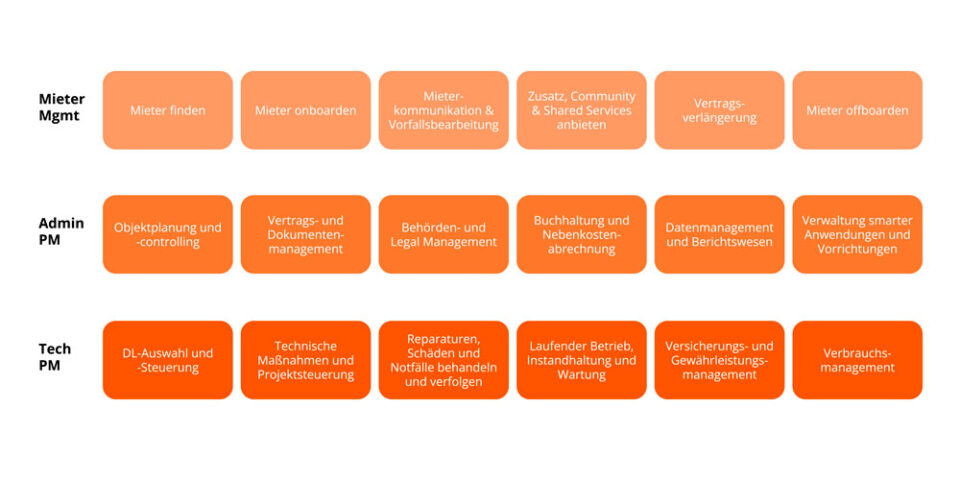
    It is helpful to divide the jobs into three large categories: Tenant management, commercial property management and technical property management. It has been shown that all essential jobs-to-be-done in real estate operations can be mapped in a 3×6 matrix.

    Building a digital operator on a greenfield site then follows the logic of supporting these individual jobs-to-bedone FIRST with modern software components in such a way that a seamless platform is created in which as many processes as possible are automated. Only THEN is it considered for which activities employees are deployed, who can then achieve all the greater added value for the users of these properties. The goal is therefore not primarily to increase efficiency, but to use the increasingly scarce personnel in management for those activities that really create added value.

    Of course, the potential benefits are not equally large in all process steps and implementation is therefore not equally urgent everywhere. Prioritisation along the dimensions of efficiency and revenue impact, influence on sustainability dimensions, tenant satisfaction and transparency is important. A toolbox that shows the possible tools in all process steps and allows prioritisation according to different functions helps to create an actual roadmap.

    It is equally important to have suitable tools at hand that connect the different systems with each other, for example an integration or orchestration platform like the one from Allthings. The goal is precisely to prevent the separate use of isolated solutions. If you make the right choice of partners capable of integration at an early stage, you establish a networked ecosystem.

    Pragmatic implementation using the example of UBS
    But how do you put this into practice? Once the vision is clear – to establish a maximum digital operator with an integrated platform via various software components – then a step-by-step approach is suitable for implementation. A whole series of real estate owners and service providers have embarked on this path in recent years.
    UBS, one of the largest real estate investors in Switzerland, is also pursuing such approaches in its digital innovation projects in real estate operations.

    UBS has chosen the path of first testing and validating individual jobs-to-be-done via individual new construction projects, which will play an essential role for an integrated platform in the future.

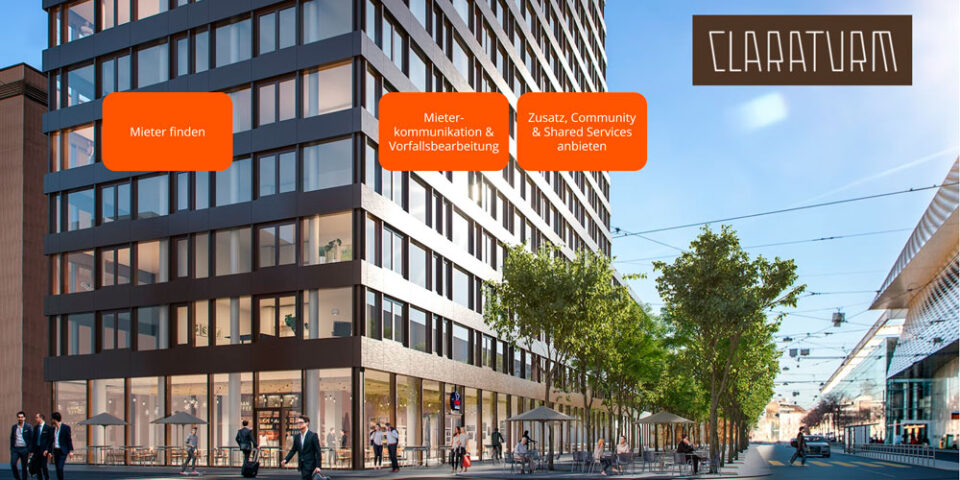
    For example, the processes “finding tenants”, “tenant communication”, “incident processing” and offering additional community services were tested on the Claraturm in Basel.

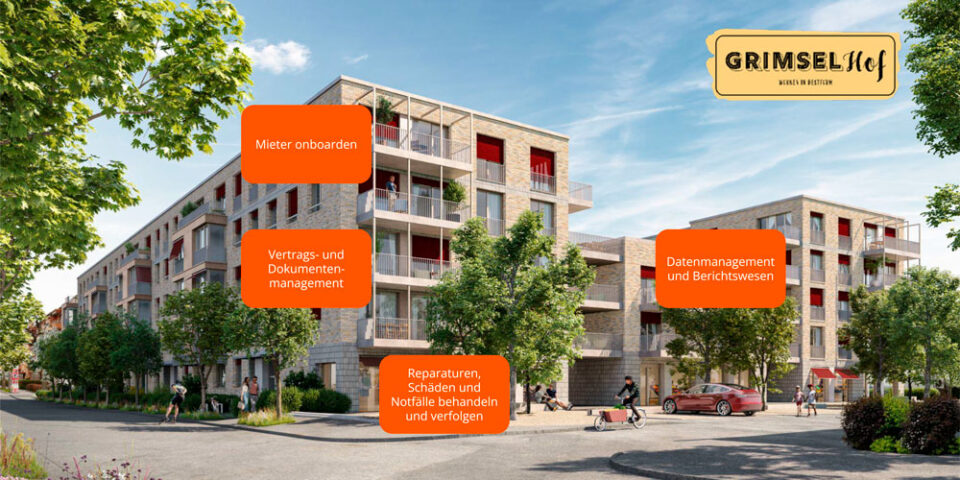
    On the combined renovation/new construction project Grimselhof in Altstetten, on the other hand, the processes “onboarding”, “contract and data management”, “document management and reporting” and new ways of processing repairs and damages were to be implemented. In this way, the various jobs-to-be-done can be validated over time and combined into an overall platform.

    The design of a plan to build digital operators is usually easy to map out in a series of 3-4 workshops. The process depicted in the diagram shows an ideal-typical sequence of a planning project for establishing a digital operator.

    Previous experience with greenfield approaches shows that a systematic implementation of a digital operator in cooperation with real estate owners and service providers makes the operation of real estate up to 30% more efficient, 100% more tenant-centred, and sustainability-oriented from day 1 – and also eliminates a lot of classic conflicting goals that result from conventional business models.

  • Artificial intelligence to achieve gas reduction by 15%

    Artificial intelligence to achieve gas reduction by 15%

    Die meisten Energie-Sparmaßnahmen verursachen einen erheblichen Kapitalaufwand – die KI von Arloid kann dagegen kostenlos implementiert werden, bis notwendige Einsparungen erzielt werden. Dies macht die KI-Lösung zu einer der günstigsten und einfachsten Möglichkeiten für EU-Staaten, den Energieverbrauch ohne Vorabkosten erheblich zu senken. Sobald Einsparungen festgestellt werden – dies ist üblicherweise nach 30 Tagen der Fall – kann eine prozentuale Gebühr berechnet werden.

    Eine Reduzierung des Energieverbrauchs lässt sich durch eine Reihe einfacher Schritte erreichen: Zunächst wird ein virtuelles Gebäude erstellt, das zu dem identisch ist, in dem Einsparungen erzielt werden sollen. Der digitale Gebäude-Zwilling verfügt dabei über gleiche Baumaterialien, Lage, Klima und Personal-Eigenschaften. Die KI erstellt daraufhin eine Reihe von Simulationen auf Grundlage der Live-Daten des realen Gebäudes. Der komplette Vorgang benötigt rund einen Monat.

    Die KI reguliert daraufhin selbstständig und kontinuierlich die Heiz-, Lüftungs- sowie Kühleinstellungen und führt so zu direkten, realen Einsparungen. Bisher wurden dafür notwendige Einstellungen von Gebäudetechnikern oder Hausverwaltern vorgenommen, was im Vergleich deutlich mehr Zeitaufwand erfordert. Die Automatisierung durch KI spart damit nicht nur Energie und Geld ein, sondern verbessert zugleich auch die Steuerung und den Bedienkomfort.

    Die KI von Arloid nutzt Deep Reinforcement Learning, um den Betrieb von HLK-Systemen in einer Vielzahl von Gebäuden über ein sicheres Virtual Private Network (VPN) automatisch zu verwalten. Die von der KI ausgeführten Regulierungen basieren dabei auf der Grundlage von Verstärkungsverhalten und Echtzeitdaten, um eine schnellere Optimierung und bessere HLK-Leistung zu erreichen. Durch die Steuerung jedes HLK-Geräts im System und die Aufteilung des Gebäudes in Heiz- und Kühlmikrozonen stellt arloid.ai mehr Kontrolle über die Umgebung und besseren Benutzerkomfort bereit.

    Die Technologie gewinnt nicht nur in Europa, sondern weltweit an Bedeutung, mithilfe der sich direkte Einsparungen auf schätzungsweise über 56 Mio. qm2 Fläche erzielt lassen. Dazu zählen Immobilien und Geschäftsgebäude wie u.a. Einzelhandel, Hotels, medizinische Zentren bis hin zu Lagerhäusern. Durch die Reduzierung des Gebäude-Energieverbrauchs kann so unmittelbar den Auswirkungen von Energieversorgungsproblemen, höheren Preisen und Inflation entgegengewirkt werden.

    KI sollte deshalb EU-weit weit oben auf der politischen Agenda stehen, um die Mitgliedsstaaten dabei zu unterstützen, ihre freiwilligen Gasreduktionsziele von 15 % zu erreichen. Es ist nicht so schwer zu erreichen, wie es zunächst erscheint, weil neue Technologien mit sehr wenig Aufwand eine wichtige Rolle dabei übernehmen können. In jeden Fall ist es ein offensichtlicher und erreichbarer erster Schritt in Richtung EU-Ziele und bietet jenen Ländern eine bessere Option an, die gedimmtes Licht und kürzeres Duschen empfehlen.

    Weitere Information unter: arloid.com

  • Houzy doubles the number of users

    Houzy doubles the number of users

    Houzy is growing rapidly. Recently the 100’000. Apartment owners are registered on the platform of the same name from the young PropTech company from Zurich, writes Houzy in a statement . Just a year ago, the start-up founded in 2017 reported that its users had increased to 50,000. The number of houses and apartments digitally recorded on the platform increased from 70,000 to 144,000 in the same period.

    Data is intelligently linked on the Houzy platform and recommendations for homeowners are derived from it. For example, it can be calculated there when the heating system should be renovated and how much money should be put aside for it. Houzy also offers a real estate appraisal. Free advice is also available to registered users.

    In the past few weeks, the company has revised its platform and integrated new digital tools, explains Houzy. In concrete terms, homeowners can now check the demand for their property, optimize the corresponding sales price and calculate the real estate gains tax for all Swiss cantons. Houzy emphasizes the platform’s new property search function as the most important innovation. All major real estate platforms would be searched here and the advertisements would be supplemented with “valuable additional information”. As examples of such additional information, a neutral market value estimate as well as energy efficiency, energy saving and solar potential and the need for refurbishment of the property are given in the notification.

  • The Swiss proptech company Immowise offers its solution in German-speaking Switzerland

    The Swiss proptech company Immowise offers its solution in German-speaking Switzerland

    Condominiums in Switzerland: An industry that only gains from digitization
    Swiss real estate is feeling the direct effects of the turn to digitization, as the most important players in the industry have accelerated the pace of increasing efficiency every year. Switzerland, with its 1.4 million owners* (including more than 445,000** condominiums), ultimately represents an important market for Immowise.

    Immowise's digital solution is easy to implement and adapts to any type of condominium. By connecting to the most important ERPs used in the industry, the platform is fully integrated into the digitization strategy initiated by the agencies. The lean cost management is also suitable for small structures and self-governing condominium associations.

    An office in Zurich serving condominium owners' associations in German-speaking Switzerland
    With the office opening in Zurich, Immowise wants to offer administrations, self-managed condominium associations or independent local administrators a solution to simplify and reduce the workload with a platform that has already proven itself in western Switzerland. By 2022, around 20 general meetings for over 500 condominium owners had already been held. Immowise wants to cover all Swiss regions by 2023. In addition, the platform will be expanded with additional modules such as the internal news service for condominium owners, the comparison of cost estimates and budget management.

    Immowise's development in German-speaking Switzerland is rounded off with the appointment of Teresa Astorina as Director, based in the Zurich region. As a recognized expert in the real estate sector, in which she has been active for over 25 years, she takes over the proptech leadership with the declared goal of converting the management of condominium associations throughout Switzerland using digital technology.

    Sebastian Chiappero, Managing Director of Wise.swiss, Immowise's parent company, adds: "20 months after the founding of Immowise, the appointment of a director marks a further step towards ensuring the nationwide rollout of Immowise. I am very pleased that Teresa will be part of this Position has joined us. Her many years of experience in the real estate industry and her skills in the area of strategy development are all plus points for Immowise". Among other things, she was also active in the management or in leading positions in companies such as Credit Suisse, m3 Real Estate, Privera or EPM.

    Teresa Astorina emphasizes: "The future of the real estate industry lies in digitization. I am very proud to be able to accompany the development of a "Swiss made" solution that offers a real service in the management of condominiums in Switzerland."

    Portrait of Teresa Astorina here for download

    About Immowise
    Immowise was founded in 2021 and is the first Swiss solution for the digitization of condominium meetings. Developed and hosted in Switzerland, this application helps administrators and condominium owners prepare, manage and follow up on meetings. It complements the wise.swiss software from EPwise AG, which was launched in 2020 and offers public administrations and companies a range of digital communication and event organization tools (eventwise, partnerwise and fundwise). https://wise.swiss/de/immowise/
    Immowise headquarters: Neuchâtel
    Offices: Geneva, Zurich

  • MIPIM 2022: Between desire and reality

    MIPIM 2022: Between desire and reality

    [smartslider3 slider=”4″]

    MIPIM 2022 took place from March 15th to 18th – and it was far from the industry euphoria of three years ago under the impression of a conflict almost 2,000 kilometers away. While the Ukraine was at least visually represented with a mostly deserted stand, there was hardly a trace of Russia or Russian cities. Only a few obvious gaps in the trade fair room allocation indicated that there had also been cancellations at short notice.

    Interest rates are rising again…
    The industry buzzwords ESG, impact investing and interest rates were also part of the discussions in many places. From the Federal Reserve Bank in the USA alone, further interest rate hikes are expected this year, which would result in key interest rates of just under two percent at the end of the year. The market assumes that other central banks (UK, EU, CH) will follow suit, albeit with a time lag. For Switzerland, this means that negative interest rates will soon be a thing of the past. In the case of ten-year federal bonds, a value of 0.425 percent was already reached on the Wednesday of the fair (March 16, 2022) – a level that was last recorded at the end of 2014.

    … and what next for decarbonization?
    The topic of sustainable or green investments was also represented in many MIPIM panels and discussions. But even if there are now many options for measuring sustainability as well as certificates and labels: the coming years will challenge the construction and real estate industry on many levels. On the side of the energy sources alone, the change away from fossil fuels to renewable ones has added another dimension with the Ukraine-Russia conflict. It is now time to reassess the oil and gas factors in the real estate industry’s decarbonization efforts. It remains to be seen whether this will ultimately lead to oil and gas heating systems being discarded sooner in this country.

    Farewell to old braids
    Other significant changes are also becoming apparent in the traditional asset classes. The traditional real estate classifications such as residential, office and retail are becoming more diverse. This has already been shown in recent years thanks to online shopping, coworking and coliving. The hospitality forum on the Thursday of the trade fair, for example, showed that there is also something new happening in the hotel industry. Swiss Life Asset Managers announced the new camping investment class there and is even considering launching its own fund product in this area. In general, it can be said that the star classifications are becoming less important for hotel users, with the focus increasingly being on the extraordinary experience, special locations and trips close to nature and the local people.

    Propel Awards for newcomers
    The four winners of the PropTech competition Propel were also chosen this year at the real estate fair in Cannes: From the 20 finalists, centralF (optimization tool for workplaces) in the data category, Apricot (leasing for homebuyers) in the investment category, OakTree Power ( Demand optimization for building energies) in the sustainability category and Parametric Solutions (software solution for project developments) in the user experience category. A Swiss proptech startup was not represented in the global competition.

    Swiss project wins MIPIM competition
    On the evening of the Thursday of the fair, however, there was an award for an outstanding Swiss construction project: the Musée Atelier Audemars Piguet in Le Brassus received an award in the “Best Cultural and Sports Infrastructure” category. The museum extension designed by the Danish Bjarke Ingels Group (BIG) includes a new glass structure that integrates into the landscape by means of two spiral structures. Inside, the museum offers a glimpse into the history of watchmaking in the Vallée de Joux.

    25th anniversary of Swiss exhibition stands
    The two Swiss networks Swiss Circle for German-speaking Switzerland and Horizon Léman for western Switzerland also had something to celebrate this year. The exhibition stand organizers and initiators Roman H. Bolliger and Yves de Coulon were delighted to receive congratulations and two “birthday cakes” from the MIPIM organizer RX on their 25th anniversary. The handover took place after the MIPIM event “Forum Suisse”, where Swiss industry players from Swiss Prime Site, Mobimo, M3 and Wüest Partner discussed the topic of “mobility and its consequences for the real estate industry”. In 2022, more than 50 companies from Switzerland used the two trade fair platforms Swiss Circle and Horizon Léman for international exchange on the Côte d’Azur.

  • Data literacy: a no brainer!

    Data literacy: a no brainer!

    “Data is the new gold” – that’s what we’ve been hearing for years. Against the background of an increasing complexity of issues and requirements, data analysts are being recruited in companies across all industries and corresponding teams are being set up. However, data per se does not lead to any solutions. Rather, it is necessary to derive a strategy from it – this not only requires the intelligent linking of data but also appropriate market knowledge and analysis in a specific context.

    How can market needs be better determined and suitable living space developed and built? Digitization has created many possibilities for the planning and construction of real estate. With the appropriate tools – for example from Luucy, Archilyse or PriceHubble, to name just a few – processes and decisions along the entire value chain can be simplified and accelerated: from the acquisition of suitable plots of land, through development and marketing, to the management of the properties. AI-based technology is being used more and more here.

    The “hard facts” are certainly the basis for data-based evaluations. But developers are also increasingly wanting “soft key figures” to supplement their decisions, for example information on the satisfaction of residents. Ultimately, of course, it is the experience that counts – the best decisions are, as is well known, the ones where the “subjective gut feeling” is right. Because even with the best data, it is always the human who decides in the end.

    You can find more impulses on the subject here: https://proptechmarket.net/impulse

  • PropTechs in western Switzerland

    PropTechs in western Switzerland

    Prize de l’innovation

    At the beginning of April, RENT Switzerland 2022 will take place at the Swiss Tech Convention Center of the EPFL in Lausanne. proptechnews.ch will be there and will report later on the event. As part of the Prix de l’innovation, the nine companies selected for the final introduce themselves:

    • Digital solutions: ecco2 building intelligence, sparrow, DOMO
    • Solutions construction: auprès de mon arbre, FenX, AETERNUM enabling circular buildings
    • Solutions énergétiques: enerdrape, ExerGo, STEEN sustainable energy

    ePotek is realigning itself

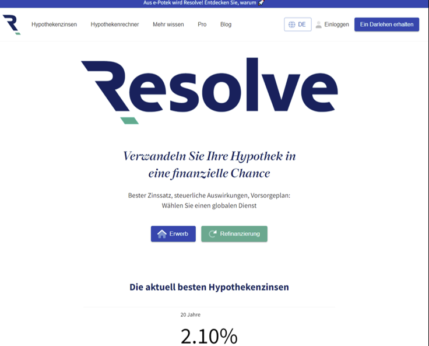
    Let’s stay in western Switzerland, where Prop/FinTech ePotek is realigning itself. The platform is now called Resolve . As CEO Romain Desquesne told my dear friend Mathias Rinka from domblick.eu, Resolve aims to become the reference partner in Switzerland for optimized financial decisions relating to mortgage financing. The name was changed and new services were developed. The aim is to mutate from startup ePotek to scaleup Resolve.

    Stena joins Swiss Immo Lab

    Stena, one of Sweden’s largest family companies with global activities in shipping, ferries, offshore, real estate and finance, has joined Swiss Immo Lab (SIL) as the fifth founding partner through its Swiss subsidiary. Andy Böhm, Managing Director at Stena (Switzerland), became a member of the Board of Directors of SIL, and Per Hellberg, Investment Director at Stena (Switzerland), became a member of the Investment Committee of SIL. Stena Property owns and operates more than 25,700 residential properties and 4,000 commercial premises in Swedish metropolitan areas.

    “With Stena (Switzerland), Swiss Immo Lab has found a fifth founding partner who ideally complements the expertise of the four others and brings an international perspective,” says Alexander Seel, Managing Director of Swiss Immo Lab. “Having established our track record, we are now working on the next step to bring proptech investing to a broader international investor base,” he adds.

    Coop works with hausheld.ch

    Coop Bau + Hobby works together with hausheld.ch . A craftsman service for Coop’s DIY store customers is to be launched together. Herisauer Vermando AG is behind hausheld.ch. The customer buys the products such as floor coverings, paints, plants or lamps from Coop Bau + Hobby and can then have these professionally installed by the craftsmen who have been provided.

    PropTechs in western Switzerland.

    Selected events

    From 18th to 20th March 2022 the Zurich Real Estate Days will open in the Kongresshaus.

    On March 24, 2022, Alpha IC Schweiz AG invites you to the Office Lab in Zurich-Altstetten on the subject of “The Swiss FM market 2022”.

    Anyone who wants to face a large audience will get their money’s worth at the REAL PropTech Pitches 2022 . These will take place digitally and on site on April 6th and 7th, 2022.

    If Germany is too far away for you, you can make a pilgrimage to Lausanne. RENT Switzerland 2022 will take place there from April 6th to 7th. RENT SWITZERLAND 2022 will take place at EPFL’s SwissTech Convention Center , a symbol of innovation.

    Swissbau has been postponed to May 2022. Between May 4th and 6th, startups will present themselves as part of the “Swissbau Challenge”.

    The Big Handshake will take place on June 21, 2022 in the event hall JED in Schlieren.

    On September 13, 2022, The HALL will host the 8th Real Estate Summit in Dübendorf.

  • That was the (PropTech) year …

    That was the (PropTech) year …

    The money seems to be on the street at the moment. A number of well-known financing rounds were closed and numerous seed funding was obtained. In addition to the professional venture capital companies, there were increasingly also corporates who want to cut a piece of the (PropTech) pie here – among other things, to secure appropriate product know-how and digital competence in the company.

    More and more insurance companies and banks have used the past twelve months to build their own “living” ecosystem. What was planned and designed in the “Corona year” 2020 was implemented in 2021 – with the aim of strengthening the company’s own market position, for example in the mortgage business, in real estate marketing or in the area of insurance solutions.

    Mobiliar made the most of the talk with its ecosystem ventures. The insurance company has set up the Liiva joint venture with Raiffeisen, among other things, in order to use this platform to give its customers access to the living ecosystem and to establish a continuous value chain. But Credit Suisse, the mortgage specialist Moneypark and the data specialist PropTech Pricehubble also recently announced their partnership with the aim of creating a service and information platform for homeowners. And for the cantonal banks, who have been on the market for a long time with the newhome.ch platform, real estate is part of their core business. With a substantial participation of three cantonal banks in the PropTech company emonitor, a leader in the digitization of letting and marketing processes, a further step towards the living ecosystem has been taken.

    The past year was also marked by mergers and amalgamations of existing business models – such as the portal and solution provider Flatfox and the management solution Aroov. The announcement of the merger of several real estate portals such as homegate.ch and ImmoScout24 under the Swiss Marketplace Group (SMG) brand, a joint venture between TX Group, Ringier, Mobiliar and General Atlantic, has really hit the mark.

    So it will be exciting to see how things will continue in the new year and what concrete successes we will observe. The basis has been created in many ways, but there is certainly still a lot to be done at the level of organization, restructuring and governance. And the topic of sustainability will probably also be mentioned more often in the new year …

    You can find more impulses at PropTechMarket: https://proptechmarket.net/impulse

  • Smart new (real) world

    Smart new (real) world

    So what are the areas of competence in which we should operate safely in the future?
    A lot can be subsumed under the term tech knowledge : The increasingly software-based solutions require, among other things, to deal with interface adaptation and web integration. Mastering programming languages could become an individual competitive advantage. No more targeted marketing campaigns without data analytics know-how. And it is certainly not wrong to deal with blockchain technology and terms like DeFi and NFT …

    However, it is not just about technological knowledge itself, but also about the correct use of technology and the new digital possibilities. Cloud-based application programs and virtual team applications are springing up like mushrooms – without conscious effort and targeted handling, these helpers can quickly become time wasters and burnout accelerators. “Ordinary employees” will also have to deal more and more with the topic of cyber security.

    Last but not least, a new understanding of leadership and collaboration is also required. The often traditional hierarchical thinking in the group certainly does not have the potential of a modern leadership model. However, the pure startup peer-to-peer culture without procedural rules is not the golden way either. Above all, it requires mindfulness and participation, sensible autonomy and personal responsibility as well as a new culture of error. Plans and activities must be able to be adapted quickly and flexibly – from this point of view, agile methods are therefore a must in (project) management in the future.

    You can find more impulses here: https://proptechmarket.net/impulse

  • PropTech Map is growing strongly again

    PropTech Map is growing strongly again

    PropTech Map is growing strongly again. Some of the new additions to the PropTech Map Switzerland come from RENT 21, the real estate event from Lausanne. The “Marketplaces” category recorded a decline. The PropTech Map Switzerland has grown by 16 entries. A total of 350 PropTechs will soon be found in 11 categories.

    Various PropTechs, akenza.io , PriceHubble , architrave and realcube , gave themselves a new look, including a new logo.

    The new report Swiss Venture Insights shows where all the money went in the 3rd quarter of 2021. PropTechs have also received crumbs.

    Here are the new additions

    • Construction: medusoil.com and raumpioniereai.com
    • Finance: The mortgage broker Moneypark was previously not to be found on the PropTech Map Switerland. With the new activities related to real estate brokerage, they are now part of it. tilbago.ch has specialized in the one solution for debt enforcement and loss certificates. Migros Bank is said to be behind the mortgage broker cactous.ch.
    • Floorplan AR / VR 3D: uzufly.com , mytourlive.com, visualreality3d.ch and backbone. As recently announced, the western Swiss startup backbone was able to successfully close a financing round.
    • Marketplaces: The Avobis Group launched a new property marketplace with propertycaptain.ch. With the integration of Neue Aaargauer Bank into Credit Suisse, the regional marketplace nabhome.ch has disappeared. According to a well-informed source, the CS is planning new activities in the area of living. The lookmove marketplace is active in western Switzerland. This PropTech says of itself that they have the largest range of properties. lookmove could be an interesting alternative for all financial service providers in Switzerland who (now) want to jump on the bandwagon of the “living” ecosystem. lookmove is currently planning a financing round to finance international expansion.
    • Services: Swiss AI, mybeppo.ch, immowise and iNCH
    • Smart Building: Another PropTech from western Switzerland is called local-energy.ch, while zevvy.ch comes from Central Switzerland.
    • Software: ziffu.io and prozessfux.com

    PropTech Map is growing strongly again. Compared to Germany, Switzerland has an extremely attractive, diverse and, above all, much larger PropTech scene.

    Source: Heinz M. Schwyter , https://proptechnews.ch/2021/10/11/proptech-map-waechst-wieder-stark/

  • 2. Global Real Estate Run

    2. Global Real Estate Run

    Autumn is approaching with great strides and with it, unfortunately, the time of increasing corona case numbers again. A decentralized team event outdoors provides planning security and does not require a certificate or the associated organizational effort. Companies can register as an entire company or only participate with individual teams. An ideal opportunity for a strategy walk away from the hectic everyday life – or just for a nice chat among work colleagues.

    For this purpose, some companies used the event last spring for additional team building measures and spontaneously organized an aperitif reception, started their own slack channel to strengthen the (international) team spirit or decided to collect waste along the entire route Communicate this good deed through social media. Interested parties can find more impressions of the past event here .

    There are no special requirements for participation, only the will to complete 6 kilometers within 24 hours. Whether jogging or ambitious walking is up to each participant. After registering, the participant receives access to a geotagged app. The route can be chosen freely by the private persons / teams regardless of location.

    With this initiative, the organizers want to draw attention to innovation and sustainability in the real estate industry. Everyone can contribute to this. Because sustainability is not a local but a global issue. Just like the Global Real Estate Run . As a “green” sign, thanks to the main partners Unispace , Immo! Nvest and PropTechMarket , a tree is planted for every kilometer covered.

  • 2. Global Real Estate Run

    2. Global Real Estate Run

    Autumn is approaching with great strides and with it, unfortunately, the time of increasing corona case numbers again. A decentralized team event outdoors provides planning security and does not require a certificate or the associated organizational effort. Companies can register as an entire company or only participate with individual teams. An ideal opportunity for a strategy walk away from the hectic everyday life – or just for a nice chat among work colleagues.

    For this purpose, some companies used the event last spring for additional team building measures and spontaneously organized an aperitif reception, started their own slack channel to strengthen the (international) team spirit or decided to collect waste along the entire route Communicate this good deed through social media. Interested parties can find more impressions of the past event here .

    There are no special requirements for participation, only the will to complete 6 kilometers within 24 hours. Whether jogging or ambitious walking is up to each participant. After registering, the participant receives access to a geotagged app. The route can be chosen freely by the private persons / teams regardless of location.

    With this initiative, the organizers want to draw attention to innovation and sustainability in the real estate industry. Everyone can contribute to this. Because sustainability is not a local but a global issue. Just like the Global Real Estate Run . As a “green” sign, thanks to the main partners Unispace , Immo! Nvest and PropTechMarket , a tree is planted for every kilometer covered.

    Registration and more at: www.globalrealestaterun.com

  • Far superior to drones

    Far superior to drones

    New construction projects can be digitally modeled using drone recordings. With the help of software, the planned object is, so to speak, “inserted” into the property and surroundings images received by the drone. This Building Information Modeling (BIM) creates realistic visualizations of a new building project in two or three-dimensional views. Object-strategic statements can thus be made reliably, quickly and cheaply.

    Drones are also used for construction-related work themselves. One of the most recent applications is the computer-controlled use of drones for painting facades. The flying robotic helpers can be controlled very precisely and can fly very close to a wall. So it is possible to paint facades without work preparation and erection of scaffolding. In addition to saving time, this is also a step forward in terms of safety on the construction site.

    Another area of application is that for inspections and damage tests of buildings and structures – for example the use of drones for roof inspections. Due to the high altitudes and good stabilization in flight, drones can also be used in historic buildings, such as churches. But drones can also be used comfortably and safely to check building cracks, glass damage or hard-to-reach areas. Thanks to the high resolution of the images, even the finest damage can be detected and these images can be saved for later documentation purposes.

    You can find impulses around innovations in the real estate and construction industry here: https://hubs.li/H0RQl480

  • Focus on ecosystems

    Focus on ecosystems

    An ecosystem is basically the interaction between different stakeholders in a defined area of a human need – for example mobility, health or living. The increasing trend towards ecosystems can be seen in different areas of life. Depending on their relationship with the end consumer, the various players in an ecosystem can assume three different roles: that of the “orchestrator”, that of the “implementer” or that of the “enabler”.

    The orchestrator has direct contact with the end customer and takes over the management of the customer interface via a digital B2C platform. Well-known examples are Amazon or Airbnb. Put simply, these companies are responsible for identifying the needs of customers and matching them with the right products and services from companies. In this context, the latter are the implementers – in the “living” ecosystem, for example, providers of PropTech solutions or insurers and banks themselves with their respective products and services. The companies that act as supporters for the other two groups are enablers . These do not come into direct contact with the end consumer. In fact, most companies in an ecosystem are enablers – such as suppliers of product components or software. They form the backbone of the ecosystem, so to speak.

    This interaction is essential in the increasing battle for market share. That is why more and more insurance companies and banks are also participating directly in PropTech companies – among other things, in order to be able to offer their services in a more user-friendly and cost-efficient manner by means of digitizing their own value chain. The extent to which insurers and banks will play the role of orchestrators in the future remains to be seen. What is certain is that you can secure customer interfaces through a functioning ecosystem – because many experts agree: In the future, the focus will be on digital ecosystems.

    You can find more impulses on the topic here: https://proptechmarket.net/impulse

  • 5 good reasons for a tech check

    5 good reasons for a tech check

    There are several reasons why it is worthwhile for a company in the real estate business to embrace new technologies.

    Attractiveness for employees: High potentials and well-trained employees want to work in companies that are agile and digital. In order to be able to keep up with the future “war for talents”, digital company DNA is almost a “hygiene factor”.

    Creation of efficiency and transparency: With new solutions – for example in the field of artificial intelligence and data analytics – resources can be bundled correctly, investment decisions can be made well-founded, and rental and sales processes can be processed faster and more cost-effectively.

    Minimizing risks: Through the targeted use of technologies, data can be generated, structured and analyzed in order to improve the basis for decision-making and thus minimize risks.

    New options for monetization: Disruptive new technologies such as blockchain technology are “business enablers” and promote the development of new business models, ecosystems and collaborations.

    Improvement of the user experience: New technologies such as virtual or augmented reality enable a completely new user experience. This type of convenience will become standard in the future and customers will probably no longer want to do without it.

    You can find an overview of new technologies and PropTech solutions here: https://hubs.li/H0RQjYL0

  • Visualization solutions: an emotional stimulus

    Visualization solutions: an emotional stimulus

    Whether renting or selling – the demand for visualization solutions in the real estate and construction industry is increasing noticeably. Depending on whether it is an existing property or a new construction project, different solutions are used. With the former, 360 ° tours are often used – increasingly interactive, with the latter often virtual reality solutions – adapted to the property and the target group.

    Not every buyer or tenant can imagine an empty room furnished. This is where virtual home staging solutions help to make the sparks jump. With this tool, inexpensive condominiums or rental properties can also be designed in a visually appealing way and thus conveyed more quickly. Further solutions enable the virtual inspection of rooms that are yet to be built. Using stand-alone virtual reality glasses, planning errors can be seen virtually and thus avoided later. In addition, planned trades can be inspected together – for example with the client or architect. The "immersion" and actual experience of the premises gives security and a good feeling.

    In addition, there are also complete virtual solutions on the market that digitally map different phases of the real estate cycle: from the outlined project vision and prototyping to visualization concepts for marketing and management.

    You can find an overview of quality-checked visualization solutions here:
    https://proptechmarket.net/tools