Houzy continues to grow rapidly. As the PropTech start-up of the same name reports, the number of users of the platform has risen from 5,000 to 50,000 since the beginning of 2020. According to a press release, this growth is due to the strong need of homeowners for more transparency and well-founded information about their house or apartment.
Therefore, Houzy integrated a Switzerland-wide mortgage comparison in the first half of 2021. Other functions such as the plant manager, the neophyte checker and the solar calculator have been updated and expanded. At the same time, the development team has simplified and improved all tools, including the renewal fund analysis and the heating and renovation calculator.
From the available data and results, Houzy derives recommendations for planning any renovation work that is due or reminds them that it is time to change the windows. In addition, the Houzy network now has more than 700 craftsmen. To celebrate the milestone, the company is offering CHF 5,000 for a residential project as part of a competition.
PriceHubble is planning to focus on Central and Eastern Europe, the Zurich-based PropTech company, which specializes in real estate valuations for companies, informs in a press release . To this end, PriceHubble has taken over the Czech PropTech Realtify. The start-up company founded by Vladislav Kochetov in Prague in 2019 offers services for residential property professionals. Kochetov should manage the company, which will now operate as PriceHubble Czechia, also under the PriceHubble umbrella and, in particular, be responsible for the growth of the Zurich-based PropTech company in Central and Eastern Europe, PriceHubble writes.
The takeover is intended to strengthen and expand PriceHubble's position, Julien Schillewaert explains in the press release. "PriceHubble is without a doubt one of the fastest growing PropTech companies in Europe," the PriceHubble CEO is quoted as saying. "There is strong growth potential in Central and Eastern Europe and the integration of Realtify into our team enables us to accelerate our market expansion in the region." With the takeover, PriceHubble is now in Switzerland, France, Germany, Austria, the Netherlands and Belgium , Czech Republic, Slovakia and Japan are active.
The corona pandemic has also posed challenges for the proptech industry, as a new report from Credit Suisse shows. Globally, for example, 25 percent less risk capital has flowed into such start-ups. However, the reluctance to invest has not left any major mark on the industry. Almost 80 percent of Proptechs were able to increase their number of employees in the past twelve months. Only 3 percent reported a decrease in the workforce. In addition, 87 percent expect a further increase in staff in the next twelve months.
Furthermore, only around 10 percent of proptechs suffered a setback in sales. In contrast, 80 percent were able to increase their sales during the Corona crisis. According to the report, the industry is aiming to double sales in 2021. In 2022 and 2023, too, higher sales growth is expected than in 2020.
Credit Suisse also looks at the Swiss proptech industry in the study. Accordingly, the number of proptechs active in Switzerland also increased last year. With over 320 companies, Switzerland has an extremely high density of proptechs in an international comparison, it is said.
However, the bank also points out that many proptechs with similar business models appear in the market. She assumes that not all companies will be able to position themselves successfully. Credit Suisse sees the quality of the management team and the scalability of the business model as the most important success factors of a Poptech.
According to the Gartner Hype Cycle, every new technology is initially subject to high or exaggerated expectations. After a “cycle of disappointment” follows a “phase of enlightenment”, from which solutions then arise at a realistically increasing level of productivity. Data science, robots and drones, virtual and augmented reality or artificial intelligence are just a few of these basic technologies. The blockchain is one of the last technological hype triggers. We will see promising developments and use cases in these areas over the next few years.
The challenge for a PropTech company is to develop a successful business model or product or service with the corresponding problem-solving potential and scalability from one of these basic technologies. In this context one often hears terms like SaaS or DSaaS. “Software as a Service” (SaaS) is a cloud service model in which applications and data are located in the cloud and thus on the PropTech provider's servers. With “Data Science as a Service” (DSaaS), the data supplied to the cloud is processed by the provider, analyzed using an algorithm and fed back to the customer as findings.
But this is only one side of the coin. The established companies in the real estate industry must also recognize the added value of these products and services and be prepared to pay for them. The driver for real estate entrepreneurs will certainly be the cost and efficiency side, but also or above all the needs of their customers. Anyone who aligns their business model to a megatrend – such as sustainability, big data or future work – is fundamentally not wrong here.
You can find out more about successful business models here: https://proptechmarket.net/loesungen
The trading cooperative of the Swiss Builders' Association ( HGC ) participates in Cloudworks AG , based in Urdorf. The company operates the PropTech start-up umbaumanager.ch, which was founded in 2019. The digital platform carries out the entire conversion process in digital form, according to the media release on the partnership. She leads the homeowner through the entire process of the construction project, from the first cost estimate, through the obtaining of offers, the award of contracts and construction management to any defect management.
Umbaumanager.ch has been working with a network of qualified craftsmen and suppliers since the start. The HGC was one of the first partners of umbaumanager.ch and is now participating in the operating company Cloudworks, according to the announcement. "With the network and know-how of HGC as a service provider for everything to do with construction, our platform can be expanded further," the founders of Cloudworks AG and developers of umbaumanager.ch, Faton Mati and Christian Vogt, are quoted as saying:
The HG Commerciale cooperative, founded in 1899, supplies the Swiss construction industry with materials. "We at HGC are further expanding our digital competence with our participation and can thus offer our craft customers a clear added value", Martin Tobler, CEO of HGC, is quoted in the announcement. The HGC has around 800 employees.
A lot of capital is currently flowing into startups. In 2020, over CHF 2 billion flowed into Swiss start-ups. Across Europe, more than 500 million euros per year have recently been invested in startups dedicated to digitizing the real estate industry (source: Swiss Venture Capital Report 2021, European PropTech Trends 2020). In addition to professional venture capital companies, it is increasingly corporate investors and business angels who want to cut a piece of the (PropTech) pie here. This is due, on the one hand, to the situation on the financial markets – keyword negative interest rates – but on the other hand it is certainly also due to the digital transformation and the efforts of companies to secure appropriate product know-how in the company.
But how does a startup actually define itself? Not every young entrepreneur is automatically a startup entrepreneur. According to the definition of the Swiss Startup Radar, a scalable business model and ambitious growth plans must be in place and the focus must also be on international sales markets. The business model is based on a science and technology-based approach and a focus on innovation. Last but not least: the donors are return-oriented, their investments should pay off.
Funding generally takes place in different financing rounds. Depending on the development stage, one speaks of seed investments, Series A and Series B financing rounds for the early phases, Series C, D, E, etc. for the later stages – until a possible exit follows at some point, for example through an IPO or the sale to a large investor. An exit is, so to speak, an indicator of the “maturity” of a startup ecosystem and is important for the system’s own dynamism: it produces selling (previous) investors and founders who, in turn, reinvest in new startups or re-establish startups.
The use of fossil fuels still dominates, especially in the area of heating living space. Thanks to innovative technologies, new climate-friendly alternatives are emerging here – for example, heating with sea thermal systems or the use of waste heat from computers. Both approaches use existing heat sources to heat buildings.
Lake thermal energy is one of the youngest forms of energy generation and makes use of the lakes as huge heat stores. In summer, the lakes absorb the sun's warmth and give it off slowly. Even when it is below zero, the lake water retains a certain temperature in the depths – ideal for extracting heat from the water in the lower layers and using it as a natural source of heat. The water is then returned to the lake in a cooler condition. This is harmless to the ecosystem and to a certain extent even counteracts climatic warming. With this technology, the largest lake thermal project in Switzerland is successfully launched in Lucerne.
The Paris startup “Qarnot” takes a different approach and relies on the waste heat from computers. Instead of laboriously cooling computers in large server rooms, they are built into radiators. In this way, data flows in the radiators instead of water. The decentralized computing power is sold to large companies, the digital radiators themselves to private households. After the initial investment, they no longer have any heating costs. The more heat is desired, the more data power is generated. The data is encrypted and is not saved, so it is not possible to trace which data is flowing. The same thing works with hot water boilers – an entire residential complex in Bordeaux has already been equipped with this technology. Due to the increasing amounts of data around the world, the future potential seems enormous.
The word sustainability is on everyone's lips. More and more companies are putting on the “green” hat – either to be attractive to investors, to score points as an employer with a more environmentally conscious generation, or simply because sooner or later the legal situation makes it necessary. PropTech companies are becoming the means of the hour, because a significant change is needed, especially in the real estate industry. According to a study by PwC (2019), 40% of global energy consumption and 30% of all carbon dioxide emissions are attributable to the real estate industry. PropTechs can offer innovative tech solutions for established companies in the real estate industry in order to minimize their CO2 footprint.
Nevertheless, in the future, PropTechs will not only have to provide “lasting” proof, but also show that the use of the technology is economically viable. With visualization solutions in particular, companies can get closer to the goal of climate neutrality and at the same time increase efficiency. Understanding projects in the construction and real estate industry and imagining exactly what the end result will look like based on plans is often difficult. This is where the virtual reality solution HEGIAS comes into play: 3D plans and IFC files can be entered and materialized in an internet browser at any time during the planning and construction phase by one or more people regardless of location and be furnished.
The pandemic has also shown us that an initial inspection of a property does not have to take place on site so that a buyer or tenant can get a general picture. Well thought-out solutions with a good user interface (UI) and a great user experience (UX), which also offer absolutely "sustainable" added value, score here: SAM, for example, is a service robot positioned on site and enables interested parties to move freely and live through the property. REMOTELY360 ° is an online-based tool for first visits, with which a prospective customer is accompanied through the property in real time. And VIEW2GO enables live inspections of properties and their surroundings – documentation included – and thus saves time, money and CO2.
The topic of artificial intelligence has definitely left its “laboratory status ” behind. AI-based solutions are increasingly being integrated into everyday work. In essence, it is not about the “ learning ” technology itself, but about the data behind it. The technological solution takes over the collection, storage, processing and use of the data entered. The interplay between human and artificial intelligence will be decisive for future innovations. Those companies that use AI sensibly will be prepared for the challenges of the future and will gain decisive competitive advantages.
AI-based solutions have also found their way into facility management. Building cleaning is a very expensive subject and cleaning agents, energy and time are often used more than necessary – this is not only unecological, but also uneconomical. With the help of artificial intelligence, the use of resources can be optimized and costs can be significantly reduced.
The Swiss startup Soobr offers a usage-oriented AI solution here. The existing performance and building data are read into the software, whereupon the AI plans the daily tours based on factors such as room distances, room priority, number and duration of cleaning. The occupancy of the individual rooms can also be integrated into the operational planning via room sensors, so that cleaning can be carried out precisely where it is really necessary. The cleaning staff are guided through the respective tours by means of an app on mobile devices, whereby you can feed the AI with feedback and documentation. Dynamic route planning increases efficiency, saves time and money in route planning and increases transparency for data evaluation.
Facchinetti is targeting the DACH region (Switzerland, Austria and Germany) with his new idea: "Our aim is to support small and medium-sized companies in innovation management," explains Facchinetti.
This decision is based on the finding that in companies with a manageable team size, day-to-day business does not leave the necessary resources to obtain the necessary information about the fast-moving innovation landscape and to make well-founded decisions. On the one hand, a selection of quality-tested innovations is intended to simplify the selection of value-adding solutions in the innovation jungle that has become opaque. On the other hand, PropTechMarket is building a qualitative talent pool with motivated and innovation-minded specialists who want to contribute their skills in the real estate and construction industry.
«Above all, we want to buy our customers time. Time so that specialists can use their skills again where they contribute to the successful future of the company. We believe in the conscious interaction between people and technology, ”says Facchinetti. "With the right coordination, the possibilities for efficiency increases, new customer experiences and sustainability-promoting measures are enormous, especially for smaller companies." PropTechMarket's offerings are currently focused on the areas of object visualization and facility management. In a next step, further business areas of the real estate cycle are to be added.
Soobron artificial intelligence. The existing performance and building data are read into the software, whereupon the tour planning takes care of the planning of the daily tours based on factors such as room distances, room priority, number and duration of cleaning. The occupancy of the individual rooms can also be integrated into the operational planning via room sensors, so that cleaning can be carried out specifically where it is really necessary. The cleaning staff performing the work are guided through the respective tours by means of an app on mobile devices, whereby you can feed the AI with feedback and documentation. Dynamic route planning increases efficiency, saves time and money in route planning and increases transparency for data evaluation.
Thingdust also relies on sensor-based data for its Smart Office product. With this simple plug & play solution, companies can measure the definitive utilization of their office space and analyze what will be a great need after returning from the home office. The anonymous data collected by sensors at the workplace is transmitted via an independent LoRa network and is displayed on the dashboard for analysis and statistics. At the same time, the flow of people is directed by means of a real-time display on a monitor placed at the entrance and the distribution of people in the building is optimized. In addition, reservations can be made quickly and easily using QR codes in order to increase the occupancy of meeting rooms, for example.
The Service on Demand devices, which facility management only call for use when required, also ensure that personnel are deployed as required. Planned tours to filled water dispensers and empty file containers, intact coffee machines or functioning printers are a thing of the past. The service-on-demand devices can be installed in any number of locations and devices in order to report faults, events or services quickly and easily. Instead of these points being constantly checked, the building users report that there is a need for a service at the push of a button.
You can find more about digital helpers in the real estate and construction industry at: https://proptechmarket.net/
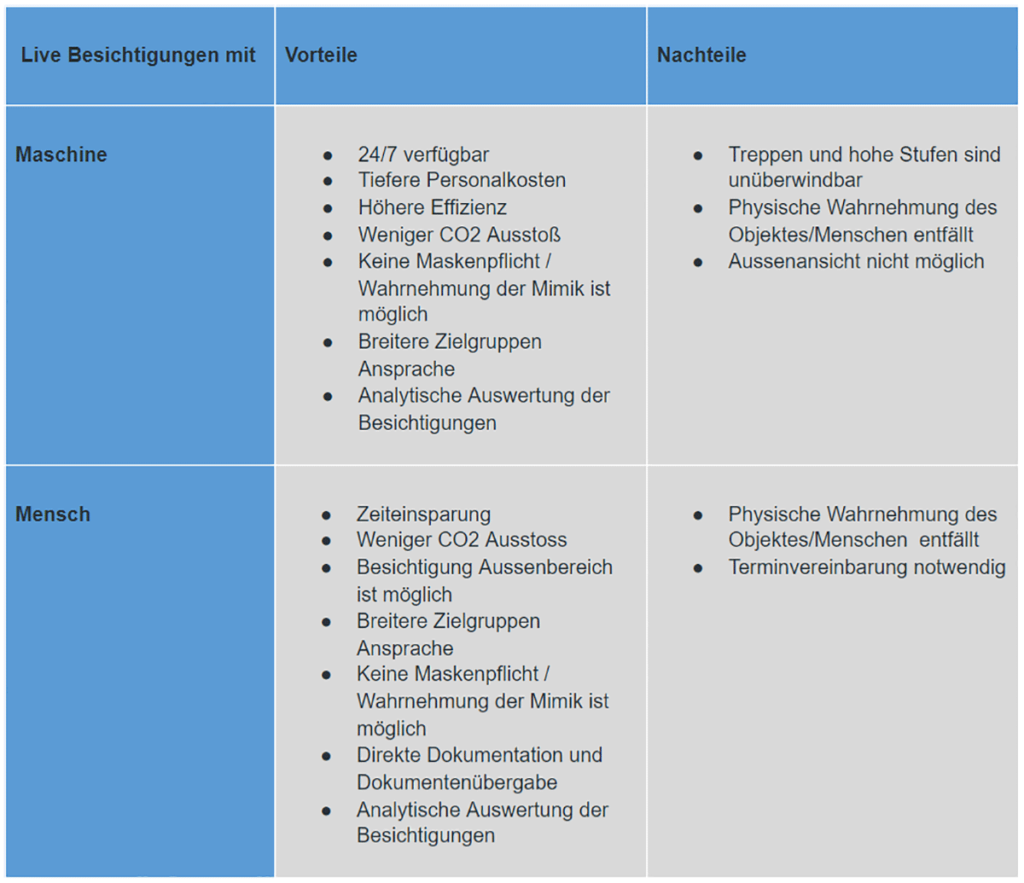
As mentioned in our last article, a variety of virtualviewing solutions offer a welcome alternative to physical on-site appointments, especially in times of pandemic. These range from static 3D tours, video tours and virtually realistic representations, which users can put themselves into with the help of VR glasses (virtual reality), to live broadcasts that are available at all times. We want to take a closer look at the latter in this article.
In the case of live broadcasts , the objects to be viewed are displayed in real time compared to static videos, photos or 360 ° recordings. The greatest advantage of this is that, apart from a viewing appointment, there are no pre- or Post-processing is required. A fully autonomous, 24/7 available variant is the tour with a robot stationed in the property to be visited . This specially developed machine can be conveniently controlled through the object from anywhere in the world, including from home, using a standard Internet browser with the arrow keys on the keyboard. The visit can take place at your own discretion and regardless of the tours and perspectives that have been created. An integrated video conference solution also offers the opportunity to establish a dialogue between the parties during the tour.
Another variant does not completely do without on-site personnel . While one party (marketer, landlord, owner, facility manager, etc.) is on site and ensures the live transmission via a mobile device (e.g. smartphone, tablet), interested parties can participate in the tour via web browser and with the Interact with the person on site. Due to the high degree of personalization, the automatic documentation of the transmission as well as the possible data exchange, this solution offers far more application possibilities than pure property inspections.
Even with the current state of the art, digital viewing solutions offer a useful alternative to physical appointments on site. In some points, such as higher efficiency, lower costs and lower environmental impact, the advantages over physical tours even outweigh the advantages. Nevertheless, the solutions presented here do not “yet” succeed in transferring the sensation of a physical encounter with people in digital space. Accordingly, we come to the conclusion that there are valid arguments for tours with man and machine that need to be weighed up according to the situation. In our next article you can read how startups are working on virtual reality to make the aforementioned lack of sensation tangible in the digital world.
In order to master the challenges, digital visualization solutions can be welcome tools. A simple application as well as a quick and uncomplicated implementation are decisive for the selection. With overcrowded appointments, it is certainly not an easy task to give yourself the necessary time for this. In addition, there is an almost unmanageable number of solution providers , which make a well-founded selection difficult. From virtual inspections, to digital live tours with or without robots, to interactive 3D tours or digital twins, there are a variety of PropTech solutions that allow companies to break new ground and adapt to changing needs. If you choose the right provider , this not only leads to a new customer experience and benefits, but also brings significant increases in efficiency as well as cost and CO2 savings.
From 3D tours with and without robots to drone recordings and automated interior design, there are a variety of PropTech solutions that have become irreplaceable, especially in times of Corona. Get to know these tools and use them to optimize your sales, rental, management and construction processes! Click on the banner and register free of charge for the online seminar on January 7, 2021 at 9 a.m.
Wir verwenden Cookies zur Unterstützung und Verbesserung unserer Dienste. Mit der Nutzung dieser Website erklären Sie sich mit der Verwendung von Cookies einverstanden. Weitere Informationen finden Sie in unserer Datenschutzerklärung.