The municipality of Horw wants to gradually optimise the energy efficiency of its municipal properties. The first step will be taken by 2028 with the Kastanienbaum and Hofmatt school buildings, the fire station building, the works yard, a council-owned apartment block on Roseneggweg and the cloakroom building at the Seefeld sports centre, the municipal administration announced in a press release. Further buildings, including the other municipal school buildings and the community centre, are to follow by 2036. Optimisation measures are already planned for a total of 17 buildings.
The municipal council wants to fulfil the residents’ council’s mandate to reduce the CO2 emissions of the municipal building stock as much as possible before 2040. The plans for the 17 properties that have now been selected are specified in the supplementary report Climate-friendly building stock in the municipality of Horw. According to the report, the CO2 emissions of the 17 properties can be reduced by around 75 per cent. The costs for the corresponding measures are estimated at a total of CHF 17 million.
When it comes to energy-efficient refurbishments, properties and measures should be prioritised appropriately. “The potential for reducing greenhouse gases, as well as the structural condition of the properties and the life cycle of the individual parts of the building, are essential for prioritising the properties,” the press release states. Thermal insulation, a switch to climate-friendly energy sources or the installation of solar systems are mentioned as possible measures. The costs should “remain at an acceptable level and be spread over the planned period”.
The construction work at the indoor swimming pool in Geroldswil cannot be realised as planned because the renovation concept could not be implemented on schedule. In order to ensure the safety of pool visitors, the municipal council is now working on a new renovation plan, according to a press release.
The refurbishment concerns the supporting structure of the indoor pool roof. The original plan was to replace the old support heads with new ones. In the course of this construction measure, the cavity beams were opened up. Corrosion was found to be so severe in some of them that the existing renovation plan could not be realised. The renovation measures are now being re-planned.
It is currently not clear whether a completely new roof will have to be built. Further clarifications and investigations are needed first. “The municipal council is giving itself the necessary time to consider all eventualities, which could take until the end of March 2024,” it says. Swimming operations in the indoor pool have been suspended since 19 June 2023 due to renovation work.
The two-year renovation of the Langmatt Museum in Baden begins on 1 March. The museum is inviting the public to visit on Sunday, 25 February, on Empty Langmatt Day. The public can circulate freely with free admission and view all the rooms, including those that were previously not open to the public, according to a press release. The Empty Langmatt Day offers spectacular insights from the cellar to the attic, it continues.
Director Markus Stegmann and assistant curator Daniela Minneboo will guide visitors on a 40-minute tour of the empty Langmatt at 2 pm, 3 pm, 4 pm and 5 pm. Children aged five and over can go on a 15-minute discovery tour of the house with art and culture mediator Vera Horat at 3 pm, 4 pm and 5 pm.
For the complete renovation, around 2,500 historical objects and paintings as well as countless everyday items had to be carefully packed and transported to an external storage facility, from Renoir’s famous “plait” to the last coffee spoon. All the rooms had to be emptied, even the historic libraries, curtains and crystal chandeliers had to leave their original places.
The ground-breaking ceremony for the renovation will take place on Friday, 1 March. Under the direction of Zurich architects Ernst Niklaus Fausch Partner AG, the Langmatt, including the park, will be transformed into a building site. During the two-year renovation, occasional public tours of the construction site and themed workshops for school classes are planned.
Before all the objects return to the newly renovated Langmatt in spring 2026, a day at the empty “new” Langmatt will give the public the opportunity to compare the differences to the “old” Langmatt, according to the museum’s press release.
In June last year, the canton of Neuchâtel launched an architectural competition to find innovative solutions for the urgently needed expansion and renovation of the road construction centre in Boudry. The aim of the challenging search was to create a future-proof infrastructure that fulfils the requirements of sustainability and efficiency. The “Little Marcel” project by Julien Dubois Architectes SA from La Chaux-de-Fonds won over the jury out of fourteen entries and took first place.
The winning project is characterised by its holistic approach, which focuses on both architectural quality and functional excellence. In addition to the refurbishment of the existing building, the planned extension also includes the construction of new buildings that will enable the site to be utilised to the full. The sustainable concept, which emphasises the project’s commitment to the environment through the integration of solar modules and the use of timber constructions, is particularly noteworthy.
The realisation of “Little Marcel” promises to improve work processes while at the same time enhancing the landscape and architectural quality of the site. The targeted expansion of the workshop buildings and the creation of a spacious inner courtyard will serve to optimise logistics and promote cooperation between employees.
With a planned budget of CHF 12 million for the overall competition and a further CHF 1.5 million for the relocation of service buildings, the Government Council is laying the foundations for a modern and future-orientated infrastructure. The public exhibition of the competition entries gives the public an insight into the visionary plans for the Boudry depot.
This project marks an important step in the development of road maintenance in the region and sets new standards in terms of sustainability and efficiency in road maintenance in the Canton of Bern. The further development and refinement of the winning project is eagerly awaited with a view to a future application for a building loan.
The fourth “Aerogel Architecture Award” is looking for inspiring examples of the use of aerogel in architecture and construction. The competition, which takes place in the categories “Realised Solutions” and “Student Designs”, offers a unique platform to present and honour innovative ideas and projects. An expert jury will select the finalists from all submissions, who will compete for the “Aerogel Architecture Award 2024” at an event on the Empa campus in Dübendorf on 12 July 2024.
Architecture and civil engineering firms with projects in the areas of renovation, refurbishment or new construction can take part. Students of architecture and civil engineering are also invited to submit their designs and proposals for the use of aerogel. All projects will be assessed in a selection process that will be held in English. Realised renovation projects for listed buildings that have been improved with aerogel insulation materials will be particularly recommended.
The award ceremony on 12 July 2024 in the NEST building on the Empa campus in Dübendorf will be available as a public livestream. The winning projects will not only receive recognition and public attention, but will also be published in international journals and on online platforms.
Interested parties are invited to submit their projects in the form of a ZIP or RAR file by the closing date. Submissions should include a PDF poster in A1 format, JPEG images of the project, details of the use of the aerogel insulation and a registration form with a detailed description of the project. By entering the competition, participants agree to the publication of their project and confirm that they respect the rights to images, graphics and drawings of their submissions.
Rhenus Switzerland is putting a total of 2511 photovoltaic modules into operation on the roof of the logistics building in Schaffhausen, which has been fitted with a special film. This system is expected to generate around 1,100,000 kilowatt hours of electricity. According to a press release, this is roughly equivalent to the consumption of 220 households.
The building was renovated in just under four months. The solar power generated on 6700 square metres will be fed directly into the Rhenus grid. Rhenus intends to use this to operate three buildings with office, warehouse and rental space. This will ensure that the logistics areas with a total of 23 loading bays and over 15,000 pallet spaces as well as block storage and picking areas are supplied with energy.
“When it comes to sustainable logistics, we at the Rhenus Group prefer to be two steps ahead,” said Andreas Stöckli, CEO of Rhenus Alpina. “We are laying the foundations for more efficient and climate-friendly goods handling with the latest addition to our photovoltaic system in Schaffhausen and also at logistics centres in Basel and Spreitenbach. We need innovative solutions that not only benefit the environment and society, but also our customers.”
The German Rhenus Group is one of the world’s leading logistics service providers with 39,000 employees at 1120 sites and an annual turnover of EUR 8.6 billion. The company has 15 sites in Switzerland.
Meier Tobler can look back on a good half-year, according to a media release. The Schwerzenbach-based company, which specialises in air-conditioning technology, increased its turnover by 7 per cent to 276.4 million Swiss francs compared to the previous year. Net profit rose by 38.7 per cent to around 16 million Swiss francs.
The “essential basis” for the growth was reportedly the continuing momentum in heating renovations. At the same time, sales of heat pumps also increased in the double-digit percentage range. Business with air conditioning systems improved only slightly compared to the previous year. Here Meier Tobler benefited mainly from large projects such as the delivery of two absorption chillers with 3.4 megawatts each for the Shoppi Tivoli in Spreitenbach AG.
Furthermore, Meier Tobler was able to put its new service centre in Oberbuchsiten SO into operation in the first half of the year. Among other things, automated high-bay and small parts warehouses or autonomous mobile robots are in use in the newly built centre. According to Meier Tobler, operations are being ramped up continuously.
Federal Councillor Albert Rösti opened the third tube of the Gubrist Tunnel on 3 July. “Functioning national roads relieve cities and villages of alternative traffic and enable economic growth and prosperity. The network must also be able to fulfil this task in the future,” said the Transport Minister at the opening ceremony, according to a statement from the Federal Roads Office(FEDRO). “Here we are building for the mobility of tomorrow.”
Zurich’s Director of Economic Affairs Carmen Walker Späh stressed the importance for the economic region. “With the opening of the third Gubri tube, traffic will flow much better in the direction of Bern and Lucerne – that is good for the nerves of motorists and for our national economy,” she was quoted as saying.
Zurich city councillor Michael Baumer pointed to the relief of traffic in Switzerland’s largest city. “It’s important that the infrastructure in and around the city can keep pace with population and economic growth, while relieving congestion in the city centre, so that efficient and sustainable mobility is possible for the whole population.”
The president of the Weiningen municipality, Mario Okle, praised the cooperation of the administrations involved. “The exchange with the cantonal and federal authorities has noticeably improved.”
Project planning for the third tube began in 2001. Construction of the tube started in 2016. A total of 1.55 billion Swiss francs will be invested in the construction of the new tube and the renovation of the two existing tubes. The renovation work will continue until the end of 2027. After that, the tunnel will have seven lanes.
Dietiker-based construction company Walo Bertschinger is rehabilitating one of the most important bridges in the eastern United States. According to an announcement on Facebook, Walo is rehabilitating the roadways of the twin Delaware Memorial Bridge over the Delaware River with its ultra-high strength and fibre-reinforced concrete (UHPC). It is the largest application of its kind in North America to date, extending the life of the bridge by decades, Walo’s announcement says. Three-quarters of the surface was completed in time for the summer break, it said. The final phase will be tackled in the autumn and completed in December.
In its statement, Walo recalls that the bridge between the states of New Jersey and Delaware was designed 71 years ago by Swiss engineer Othmar Ammann. The bridge builder also designed and built the George Washington Bridge in New York City. The suspension bridge over the Hudson River connects Manhattan with New Jersey.
The Delaware Memorial Bridge, currently being repaired by Walo Bertschinger, bears its name “Memorial” in memory of the fallen from World War II, the Korean War, the Vietnam War and Operation Desert Storm to liberate Kuwait after its occupation by Iraq.
The Delaware Memorial Bridge connects Pennsville in New Jersey and New Castle in Delaware. On the website of the operating company Delaware River and Bay Authority in New Castle, the double bridge with a length of more than 3 kilometres is described as an important link in the transport system for the entire eastern United States.
At its meeting on 4 May, Dietikon ‘s parliament approved a construction loan of CHF 83,372,746 for the Wolfsmatt school building. This means that the renovation and expansion of the aging building can begin next year, according to a media release. The prerequisite is that the voters of Dietikon also approve the project in September.
The building was constructed in 1962 as a typical pavilion school of the 1950s and 1960s and is now in serious need of renovation. The listed building neither meets the legal requirements nor the demands of modern teaching or the increased number of pupils. Therefore, it is to be renovated and extended by two primary classes, group, after-school and multi-purpose rooms as well as a gymnasium. The existing buildings are to be ready for occupancy in 2028.
The corresponding plans were drawn up by a general planning team under the leadership of the Zurich architectural firm Bünzli Courvoisier. They won the city’s project competition four years ago from a total of 59 submissions. The winning project, called Im Grünen, “occupies a top position among the competition entries from both an economic and an ecological point of view,” according to a media release. The new buildings will be certified according to the Minergie-ECO standard. In terms of construction costs, it was among the most favourable.
Im Grünen retains the basic idea of a pavilion school. The cohesive overall architectural effect remains. Extension buildings complement the existing ensemble in a southerly direction. Parallel to the Vogelaustrasse, the new buildings will form a new second entrance to the school complex. The limited existing open space will be preserved.
FinanceScout24 and Abilect have entered into a strategic partnership and are now offering digital solutions for the renovation and financing of real estate.the cooperation offers Abilect customers attractive financing solutions for their renovation projects. In return, FinanceScout24 customers benefit from a simple and efficient solution for organising, managing and implementing modernisation and renovation projects via the Abilect platform.
Partnership meets key need in construction This partnership brings two key requirements in the construction sector under one common denominator: financing options for property refurbishments and digital solutions that ensure the seamless awarding, management and execution of these works by suitable and vetted providers in the region. FinanceScout24 and Abilect jointly meet these needs for the benefit of customers. Thanks to the strategic partnership, clients can now not only create a project dossier, find qualified providers, manage and implement their projects, but also receive the best financing solution tailored to their needs.
Great potential for all involved “The new offer means considerable added value for our customers. By partnering with FinanceScout24, we are expanding our ecosystem, which now includes financing solutions,” said Esha Indani, founder and CEO of Abilect. “It’s never been easier for our customers to get the work they want or need done on their home seamlessly and without any nasty cost surprises.”
Jochen Pernegger, Managing Director at FinanceScout24, SMG Swiss Marketplace Group, also sees great potential in the new partnership for all parties involved: “Especially today, when energy efficiency and sustainability are increasingly in the foreground when renovating residential properties, the feasibility and not least the realisation of a project depend decisively on the financing.” He is convinced: “This partnership will further drive the growth of FinanceScout24 and offer an even wider range of customers the opportunity for simple, fast and independent comparisons for all their financing needs. This will make their lives even easier, in line with our vision – ‘as digital as possible, as personal as desired’.”
The Zurich Opera House needs more space for its approximately 800 employees. The solid reinforced concrete extension built in 1984 is no longer sufficient. According to a statement by Opernhaus Zürich AG, there is an additional space requirement of 60 per cent. It refers to a study by the German theatre planner Kunkel Consulting.
The structural engineering office of the Canton of Zurich is examining whether the existing extension building can be raised. The study should be available in autumn. In any case, the new extension is to “attract international attention with its site-specific and visionary architecture as a model in terms of energy efficiency, sustainability and resource-saving construction methods”, according to the statement. An additional laboratory stage is also planned. Construction would take place in the first half of the 1930s at the earliest.
The opera house itself is also to be renovated. The seating and technical systems are to be renewed and barrier-free access created.
A temporary structure is to be erected on the roof of the extension building as early as summer 2024. The design comes from the Zurich architectural firm EM2N.
“One aim of the structural development is to remedy the fundamental deficiencies of the property so that the opera house can continue to fulfil its mission,” Markus Notter, Chairman of the Board of Directors Opernhaus AG, is quoted as saying in the statement. “In order to be able to maintain and expand this standard, the listed opera house and the adjacent extension building … must be renovated – in terms of energy and operations.”
According to a press release from the Swiss Federal Office of Energy ( SFOE ), around 361 million francs in subsidies for energy-efficient building refurbishment were approved by the federal government and the cantons in 2021. This is the highest amount that has been invested in renovation and new construction projects since the program was launched. Compared to 2020, the funding amount has increased by CHF 62 million.
Thermal insulation projects, which were funded with CHF 126 million, received the largest amount. The highest increase of 70 percent compared to 2020 was achieved by building services projects, which received CHF 106 million in grants. The commitments for energy-related measures that will be implemented over the next five years have reached a new high of CHF 490 million.
The high demand for subsidies can be attributed to the broad approval of owners for energy-efficient renovation of their properties or new builds. According to calculations, the measures approved in the year under review will lead to a reduction in energy consumption in buildings throughout Switzerland by 6.5 billion kilowatt hours and lower CO2 emissions by around 1.8 million tonnes over their lifetime.
According to the statement, the building program has proven to be an effective instrument of Swiss energy and climate policy. A total of around CHF 2.7 billion has been paid out under the funding program since its introduction in 2010. The building program also has a positive effect on the economy. In 2021, 2,300 full-time jobs and around CHF 97 million in additional domestic value were created.
The Federal Roads Office has awarded the Gubri consortium (ARGE Gubri) the third lot for the renovation of the two existing tubes of the Gubrist tunnel, Implenia reports in a statement . The construction and real estate company from Opfikon has a 40 percent stake in the consortium and is in charge. The remaining 60 percent are held equally by the Dietiker construction company Walo Bertschinger and Anliker based in Emmen LU. The total order volume is estimated at CHF 184 million in the announcement. Implenia will account for CHF 74 million of this.
As part of the contract, the partner companies will set up 22 new SOS niches in the second tube and refurbish the existing 24 SOS niches in the first tube. In addition, the roadway in both tubes will be lowered by 30 centimeters and a new, higher intermediate ceiling will be installed, explains Implenia. The aim is to adapt the driving space to today's requirements.
The refurbishment of the two tubes is planned to follow the establishment of a third tube of the Zurich northern bypass, which is currently under construction. The start of the preparatory work for the renovation of the two existing tubes is dated autumn. The takeover of the project is in line with Implenia's strategy of "focusing on large, complex infrastructure projects with the Civil Engineering Division," the statement said.
Many homeowners cannot afford a renovation. Long-term loans are now intended to support builders who want to make their property climate-friendly but do not have sufficient financial resources or prefer to invest their money in their core business. At least that's what the state wants. Whether and how this can be done remains questionable. Because the financial institutions intended for this, such as banks and insurance companies, are hardly interested in loans with terms of more than 30 years. The federal government therefore wants to act as a security guarantor. A pilot project in Berne is now to examine whether this financing idea is realistic.
The Zuger Energeek Group AG proposes another way. "With Energeek®, the solar panel with rental for you", she gets people to invest in solar energy, whether they own real estate or not. Energeek provides the solar panels and the real estate projects. Anyone who wants to invest can buy one or more panels online and then rent them out to a project company. Upon purchase, the buyer also benefits immediately from the one-time payment (EIV), the federal subsidy for solar systems. The panels acquired will be integrated into a larger panel network that generates electricity sustainably; the buyer of these panels thus becomes a producer of electricity through renewable energy with the right to rental income. A minimum rental price is guaranteed when the contract is signed. However, upward rent adjustments are possible at any time. For example, when the price of electricity rises with inflation. The purchased solar panels can also be resold, inherited or given away at any time together with the rental agreement and the associated rental income.
Another big advantage: so that solar panels and the projects work very efficiently, solar trackers are used whenever possible and in addition to the permanently installed PV area. With these, the panels are not permanently installed, but rotate according to the sun. This means that, for example, the morning and evening sun is also optimally used. Or discover the smallest gap in the cloud on a cloudy day and use it to generate electricity. This achieves an increase in production of an additional + 63% kWh on average. This in comparison to permanently installed solar panels.
Energeek Group AG presents the projects for which solar panels can be purchased on its website. The buyer can decide for himself which project the acquired panels should be rented to. For example, a project on a horse farm and hotel in the Freiberge is currently on offer. There, the group, together with its certified partners, will set up photovoltaic systems on a planned area of 1,590 square meters and thus supply the hotel building infrastructure, neighbors, heat pumps and e-charging station(s) with electricity. A panel in this project currently costs a little more than CHF 900, the annual rental income is CHF 82.50. A respectable return. More information at www.energeek.biz
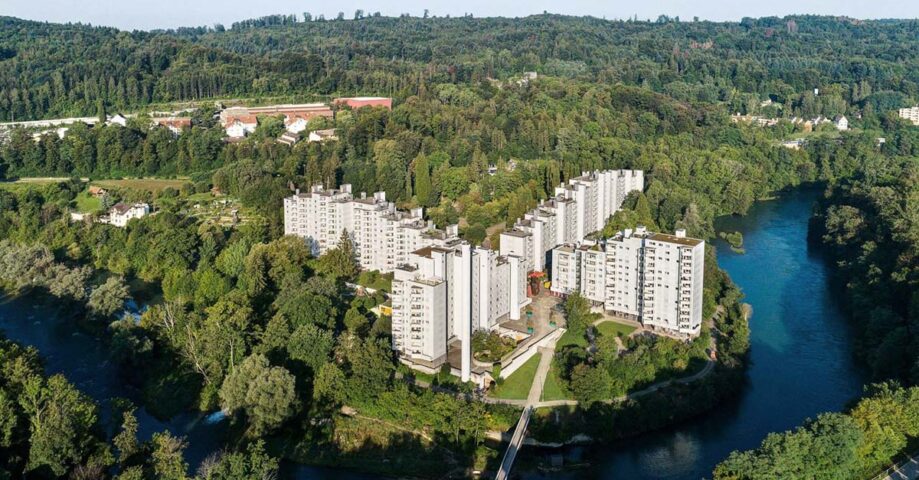
The Webermühle development in Neuenhof houses 368 rental apartments. The settlement on a peninsula in a loop of the Limmat was built on the industrial site of a former weaving mill and was ready to move into in 1984 after ten years of construction. Planned by the architectural office Steiger Partner AG and built by Ernst Göhner AG, the Webermühle with its different volumes offers living space for up to 1,500 residents. Despite the very high density, the apartments with the four rows of high-rise buildings arranged in a cross shape are characterized by a surprising foresight. Since 2008, the buildings realized in the “Göhner 3” modular construction system have been owned by a real estate fund from Credit Suisse Asset Management.
Ecologically and economically sustainable renovation A good 40 years after moving in, the apartments no longer met today’s standards – neither in terms of appearance nor in terms of comfort. With an analysis of the building structure, the client started planning an extensive partial renovation in 2009, which was implemented in stages between 2012 and 2014. The portfolio strategy of Credit Suisse Asset Management attaches great importance to ecologically and economically sustainable solutions. With the modernization of the Webermühle, one wanted to make the living and green space more attractive for the tenants and to maintain the value of the property. On the other hand, the building technology should be brought up to date and thus the energy consumption should be significantly reduced. Better connections to public transport were also an important goal: Since the construction of a new inclined lift in 2015, Wettingen train station can be reached within a few minutes on foot.
Heat supply: switch to flow heat The core of the energetic renovation is the reorientation of the heat supply. To this end, the client defined a clear goal right from the start: in future, the heat supply in the Webermühle should be at least 70 % CO 2 -free. Due to the size of the facility, Credit Suisse Asset Management wanted to have the heating system replaced by a contractor instead of producing heat itself. The sustainability of the solution proposed by ewz with a river water heat pump convinced the client even after a detailed examination by specialists.
White paper on the topic of energy-efficient refurbishment In addition to the practical example “Webermühle”, the white paper “Energy-related renovations as an opportunity for the real estate industry”, which was created in close cooperation between ewz and the research and consulting company intep, offers insights into the relevance of energy-related renovations.
Knowing that the building sector is responsible for about a quarter of emissions, there is an urgent need to renovate the building stock. Because the few climate-friendly and energy-efficient new buildings will not have a major effect on the entire sector. At the moment we are in a renovation backlog. The current renovation rate of one percent must be doubled in order to achieve the climate targets.
Practical experience shows that during renewal processes, too little attention is paid to energy-related refurbishment compared to replacement new buildings. The landowners often lack basic information that shows them the economic, ecological and social potential of energy-related renovations. The whitepaper is intended to make a contribution to precisely this. There is a basic overview of the urgency, legal framework, benefits, opportunities and possible strategies of energy-related renovations.
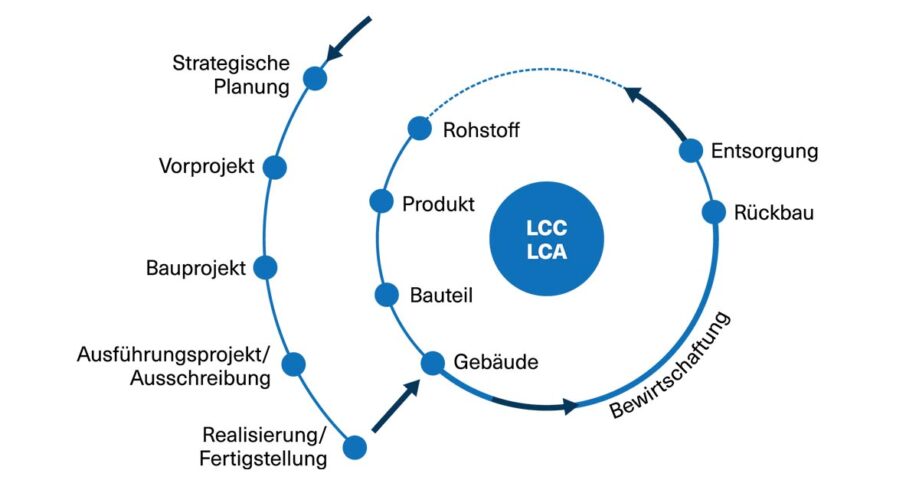
The results of an ecological balance sheet (life cycle analysis, LCA) and an analysis of the life cycle costs (LCC), for example, form an excellent basis for decision-making. These quantitative assessment methods take into account the entire building life cycle.
The life cycle analysis (LCA) to determine the environmental impact and the analysis of the life cycle costs (LCC) offer quantitative decision bases for energy renovation. (Source: Kellenberger (intep), 2021)
Artisa Group wants to renovate and expand Locarno’s Grand Hotel. A corresponding planning application has already been submitted, the Zug-based company, which specializes in real estate investments on the Swiss and European market, informed in a press release . For the project, Artisa Group is collaborating with architect Ivano Gianola.
Artisa writes that the design envisages the preservation of the existing substance and in particular the listed frescoes, decorations and facades of the historic building. The large hall, in which the peace conference took place in 1925, is to be restored in a contemporary way. A new SPA and wellness center will be set up.
“The new Grand Hotel Locarno will set standards worldwide in terms of excellence, sustainability and modern service,” explains Stefano Artioli, Vice President of the Artisa Group, in the press release. “In addition, we will take responsibility for 100 employees who will work in the hotel.”
Outside, the concept envisages a redesign of the more than 4000 square meter park. Together, the hotel and park should complement the tourist offer of Ticino, according to the statement. “The holistic hotel concept fits perfectly with the OTR strategy (Mendrisiotto and Basso Ceresio, Luganese, Bellinzonese and High Ticino as well as Lake Maggiore and valleys): wellness, food and wine, events, meetings, sustainability,” says Fabio Bonetti, Director of the Tourist Organization of Lake Maggiore , cite there.
The Dutch Central Bank uses CO2-neutral concrete in the renovation of its Amsterdam headquarters. This is made possible thanks to a collaboration between the Dutch New Horizon Urban Mining BV and the Swiss start-up neustark , according to a LinkedIn announcement .
New Horizon’s technology makes it possible to reduce the carbon footprint of concrete by 75 percent, they say. For this, cement is obtained from concrete recycling material. The remaining footprint is offset by neustark. The start-up has developed a technology with which CO2 from the atmosphere can be permanently stored in recycled concrete. For this purpose, liquid CO2 is introduced into demolition material.
Neustark is a spin-off from the Swiss Federal Institute of Technology in Zurich ( ETH ) based in Bern. The company works with Holcim , among others, to drive innovation and sustainability in the construction sector. As part of the collaboration, neustark is investigating the CO2 conversion potential of Holcim’s recycled demolition concrete. Holcim, in turn, optimizes the concrete produced by neustark.
The Sargans canton school has been in operation in its existing form for over 50 years and is in need of renovation. It can no longer meet today's structural requirements in terms of earthquake security, building technology and insulation. There is also a lack of around 1900 square meters of school, preparation and group rooms that ensure modern teaching in the long term. In addition, central facilities such as the cafeteria are too small and there are only a small number of student and teacher workplaces.
The plan is to demolish the west and south wings dating from 1963 and 1969. They will be replaced by contemporary new buildings. L-shaped extensions are to be built, which together with the east and north wings form a rectangular structure. At the center is an identity-creating courtyard.
The new west wing will house the cafeteria with outdoor seating, a kitchen, foyer, auditorium and some classrooms. In the new south wing there is space for additional class, subject and group rooms as well as rooms for administration and teaching staff. In the east and north tracts, there are mainly renovations with regard to earthquake security. Continuous access corridors on the upper floors ensure short connecting routes with common areas.
A loan of CHF 49.9 million was granted for the project. Of this, 3 million are for the existing buildings and 46.9 million for the new buildings. Construction work is scheduled to begin in summer 2023 and will last three years. School operations in the east and north wing will continue – temporary arrangements will be built for the south and west wing.
The St. Gallen electorate approved the building project in 2014. A total of 17 objections were received in 2018. These were rejected by the municipality of Sargans, but a resident filed an appeal against the decision with the Department of Economic Affairs. This also rejected the objection, whereupon the recurrent filed the complaint before the federal court. In May 2021, the latter also rejected the complaint in the last instance. Now nothing stands in the way of the planned renovation and expansion of the canton school.
As part of a renovation work in the Bad Ragaz SG thermal baths, the Dietiker construction company Walo Bertschinger renewed the floor coverings. According to a message from Walo on Facebook, the Walo bedding Haypanol D was laid with a special system constellation.
According to the company announcement, high demands were placed on slip resistance, UV resistance and optics in the thermal baths. In the system constellation used by Walo, these conditions of the client Grand Resort Bad Ragaz were met. The multi-layer structure of the covering and its technical properties also showed high chemical resistance, so that various cleaning agents, greases, other deposits and chemical solutions cannot harm the covering.
According to Walo, the architecture of the famous thermal baths with its special appearance corresponds to the snow-white surface.
Most of the buildings in the National Sports Center in Magglingen are currently heated with gas, according to a press release from the Federal Office for Buildings and Logistics (BBL). The BBL is currently realizing a number of new construction and renovation projects for the Federal Office for Sport at the sports center. For the first time, the federal government is using geothermal energy to supply heat to buildings. A new district heating network will supply both the existing and the new buildings.
Geothermal energy from a depth of 1,300 meters is used for the heat supply. It is expected that the extracted water has a temperature of 30 to 50 degrees Celsius. For this purpose, two wells are being built. The warm water is pumped up via one, the cooled water is let down again via the other. In between, a heat exchanger on the surface takes the heat from the water and uses it to supply the building.
While the gas supply currently emits 1,300 tonnes of CO2 annually, this should only be 70 tonnes in the future.
2020 was a record year for the federal and cantonal building program. A total of CHF 299 million has been paid out for renovation and new construction projects, more than in any previous year, according to a federal media release.
Of this, 119 million francs went to thermal insulation projects. At 72 million francs, system renovations make up the second largest share. This involves extensive renovation of the building envelope, which can be combined, for example, with renovation of the heating systems. Around 62 million francs in funding have been awarded for projects relating to heating changes, solar and ventilation systems. In these projects, known as building services, an increase of 65 percent was achieved compared to the previous year.
The building program also has successes in terms of climate protection and employment. The measures funded in 2020 will save 5.7 million kilowatt hours of electricity and 1.4 million tons of CO2 over the entire service life. However, since the subsidy rates were increased compared to 2019, the proportion of francs paid out per ton of CO2 saved rose from 205 francs to 207 francs. The employment effect is 2,100 full-time equivalents, the additional domestic added value is 88 million francs.
The Dübendorfer Urban Energy Systems Laboratory of the Eidgenössische Materialprüfungs- und Forschungsanstalt ( Empa ) has developed measures to reduce the greenhouse gases of the 1.8 million buildings in the country. The laboratory wants to show what the appropriate steps are and in which order they should be taken, it says in a message . The goal is a decisive reduction in CO2 emissions for heating and cooling in order to achieve Switzerland's net zero target by 2050. If the ecological renovation of the building stock progressed at the current pace, it would take another 100 years, Empa calculates.
Led by Kristine Orehounig, the researchers used data mining to divide all residential and commercial buildings in Switzerland into over 100 archetypes, depending on the year of construction, heating type, location and number of users. Then all of them were checked for their suitability for photovoltaics and connection to a heating network.
According to Empa, this sorting work has shown that it is worthwhile to start renovating the roofs and windows of older buildings particularly quickly. This should be followed by the renovation of heating systems in almost all house types. It is important to replace fossil fuels as quickly as possible with photovoltaics on roofs and facades. The research team recommends generating heat using heat pumps and biomass heating. "If the proposed measures are taken," believes Kristine Orehounig, "the greenhouse emissions in Switzerland's existing building stock can be reduced by 60 to 80 percent".
The four existing main buildings and other auxiliary buildings in the Läbespark retirement home in Biberist are getting on in years: they were built between 1969 and 1995. In order to improve the quality of life for around 100 residents, the cooperative had a refurbishment project drawn up. Phalt Architekten AG, Wam Planer und Ingenieure AG and Neuland ArchitekturLandschaft GmbH were commissioned for this. A committee consisting of representatives of the Biberist community, the responsible cooperative and various experts accompanied the process.
The alignment project forms the basis for the design plan process and the further project elaboration. The oldest house at Blümlisalpstrasse 12 will be replaced by a new building. The height of this is based on the existing building. Compact small apartments based on the Bonacasa building standard are planned. The 1.5 to 3.5 room apartments will have a wet room with a laundry tower and a loggia facing the park-like inner courtyard. A reduit complements the larger apartments. «The existing restaurant / café Pintli will move into the new building. To do this, we are revitalizing the premises of the former Pintli with commercial and service uses, ”says Ronny Fluri from Bonainvest AG, which takes on the building owner function for the cooperative. A common room is also planned, which should also promote social contact among the residents. The new building will have a parking garage.
So the previous parking lot can give way to a piazza. “We are thus creating another meeting zone and upgrading the area. Our green park with a small pond will have a herb garden, more seating and various exercise elements that are intended to provide incentives for the residents, ”explains Fluri. The surrounding quarter will be better networked by footpaths. But there is still one problem to be solved: “The building that is being replaced has heating for two more houses. We would like to work with geothermal probes in the future. However, various investigations are still ongoing, ”says Fluri. When this has happened, the other buildings can at least be refurbished in terms of energy. There is still some time until construction begins: work is scheduled to start in 2023. The new building should be ready for occupancy at the end of 2024.
In three consecutive winters, the Solothurn outdoor pool is transformed into a construction site. In the first winter, 2019/20, the sports pool at Badi Solothurn was renovated. In the second and third winter, it is the turn of the outdoor swimming pool to be built.
The two stages of renovation of the buildings were preceded by a municipal council decision, a municipal assembly decision and a referendum. In the latter case, the people approved the restructuring loan of 7.8 million francs in February 2020 with 86.7 percent yes-votes.
The renovation is intended to remedy safety deficiencies, the swimming pool is to be made more accessible, processes are to be optimized and visitor flows are to be unbundled, and there should be more showers and toilets. Overall, the outdoor pool should offer guests more comfort after the renovation. Since it is a listed building, the visible changes must be subtle.
With the start of the 2021 bathing season in mid-May, the first phase of renovation in the Solothurn outdoor pool was completed. In this first phase of renovation, underground technical work was the main task. The building structure was repaired and safety deficiencies were corrected. In addition, the northern parts of the extension from 1964, where the entrance area and cloakrooms are located, were renewed in this phase. The construction of new showers and a new cloakroom area also started, which will continue in the second stage.
The second stage of the building construction will begin this year after the end of the bathing season in September 2021. Then the southern part of the extension building with a restaurant, kiosk, cloakrooms, showers and toilets will be renewed. A new lift will enable people with walking difficulties to access the restaurant.
Some preparation and follow-up work may overlap with the end or the start of the bathing season. The outdoor swimming pool should always be possible. The renovated Solothurn outdoor pool is due to go into operation in mid-May 2022.
The electrical company Jaisli-Xamax from Dietikon carries out all electrical installations for the overall renovation and expansion of the Stämpbach school complex in Vechigen. According to a report in the employee newspaper Brilli's News , the work will be carried out during the three implementation phases while the school is still running. “One of the challenges was to carry out the work while the school was still in operation,” the construction fitter Adrian Thürig is quoted as saying. Nevertheless, it was possible to "produce a clean performance".
The work will be carried out in three stages. According to Jaisli-Xamax, the new construction of the kindergarten, the day school, the special wing and the intermediate wing as well as the renovation of the two gyms were realized in the first construction phase. The renovation of the east class wing and the expansion of the group rooms were implemented in the second construction phase. The work on the third construction phase is still ongoing. The West class wing will be renovated.
According to project manager Luciano Matturro from Jaisli-Xamax, the cooperation with everyone involved in the construction and with the school went smoothly. Matturro was quoted as saying that he was proud that the on-site team did its job well while the school was in operation. Matturro: “We are now on the final spurt to successfully complete the third construction phase.” Two apprentices from Jaisli-Xamax also worked on the project in the canton of Bern.
The Federal Roads Office has commissioned ARGE Stadtautobahn with the renovation of the St.Gallen urban motorway between the St.Gallen West and St.Gallen East connections, Implenia explains in a press release . The construction and real estate company from Dietlikon has a 30 percent stake in ARGE Stadtautobahn. In addition to construction work, Implenia will take over the commercial management of the project for the renovation of the St.Gallen city motorway.
The repair work should start at the end of May and be completed by the end of 2024, Implenia further explains in the communication. During this period, coverings, drainage, edge closures and noise barriers will be renewed and some bridges, galleries, support structures and the Stephanshorn tunnel will be renovated. In addition, the construction of a new passerelle is planned.
"The renovation of the St.Gallen city motorway is a complex, large-scale project," Christian Späth is quoted as saying in the communication. The Head Civil Engineering Division Implenia is looking forward to being able to “combine Implenia's accumulated expertise in bridge, tunnel and road construction with our extensive experience in managing large infrastructure projects”.
In Switzerland, less than 1 percent of the building stock is energetically renovated every year. Romande Energie wants to increase this share in the canton of Vaud. For this he launched, according to a release , the program commune Renove . As part of the program, the energy supplier accompanies the individual renovation projects step by step. He acts as a contact person for all parties involved, for the owners and administrations as well as for the craftsmen and the authorities.
The program builds on the experiences of the Onex-Rénove project. The Geneva municipality Onex started this program in 2014 and was able to use it to sevenfold the renovation rate.
For its program, Romande Energie works with the Center de Recherches Energétiques et Municipale in Martigny VS, with the building energy specialist Signa-Terra in Geneva and with Pierre Olivier. The energy project consultant was one of the leaders of Onex-Rénove. "The renovation of the building stock is one of the levers for reducing CO2 emissions", Christian Petit, General Manager of Romande Energie, is quoted in his company's announcement.
The federal government and the canton of Vaud support the Commune Rénove program. Two municipalities have already decided to participate.
4B and Somfy have entered into a strategic partnership in the development of intelligent home controls, the two partner companies inform in a joint communication . With the Somfy TaHOme-Box, house and apartment owners should be able to create the conditions for the digitization of the building during construction or renovation, it says there. Joint products are launched under the Smart Home Ready by Somfy label.
"Intelligent windows and facades are proof that we have been combining tradition, Swiss quality and innovation for over 100 years and that we are developing from a pure product to a solution provider", says Jean-Marc Devaud, CEO of Lucerne window manufacturer 4B , quoted in the communication. "With the Smart Home Ready cooperation, 4B can offer quality windows in combination with high-quality, radio-controlled privacy and sun protection as a smart, expandable package," explains Hannes Naef, Managing Director of Somfy Switzerland, in the press release.
An intelligently controllable, motorized sliding door from 4B is to be brought onto the market this summer. The partners explain in the press release that the door can be integrated into intelligent building systems via both io radio and wired controls.
The Foundation for Age-Appropriate Living in Bergdietikon (AGW) built the facility in Schlittental 25 years ago according to the then modern standards of equipment and technology. The Bergdietikon municipality made the area available at the time. Today demands and needs have evolved. That is why the Board of Trustees wants to analyze the situation by examining not only the mix of apartments and the standard of construction, but also the question of pricing and, last but not least, the individual types of housing that are particularly suitable for handicapped people, as stated in a communication . A proposal for the renovation of the building to meet contemporary needs should be available by the end of the year.
The rental apartments, which, unlike in old people's homes, are offered without services, are "a little old" and no longer meet today's standards. Some of the total of 18 apartments could therefore no longer be rented out despite the overall clear demand.
In order to determine the real needs, residents and interested parties should be asked about their ideas. But one thing is certain: services such as those offered in old people's homes or larger institutions are not economically viable.
The residential building for age-appropriate living is located directly in the center of Bergdietikon. The post office, the center, the Volg store, the cemetery and the bus stop can be reached in a few minutes, the foundation describes the property. And adds: With a distant view of the Limmat Valley and a view of the hilly landscape on the mountain side.
Wir verwenden Cookies zur Unterstützung und Verbesserung unserer Dienste. Mit der Nutzung dieser Website erklären Sie sich mit der Verwendung von Cookies einverstanden. Weitere Informationen finden Sie in unserer Datenschutzerklärung.