Tag: Standortentwicklung

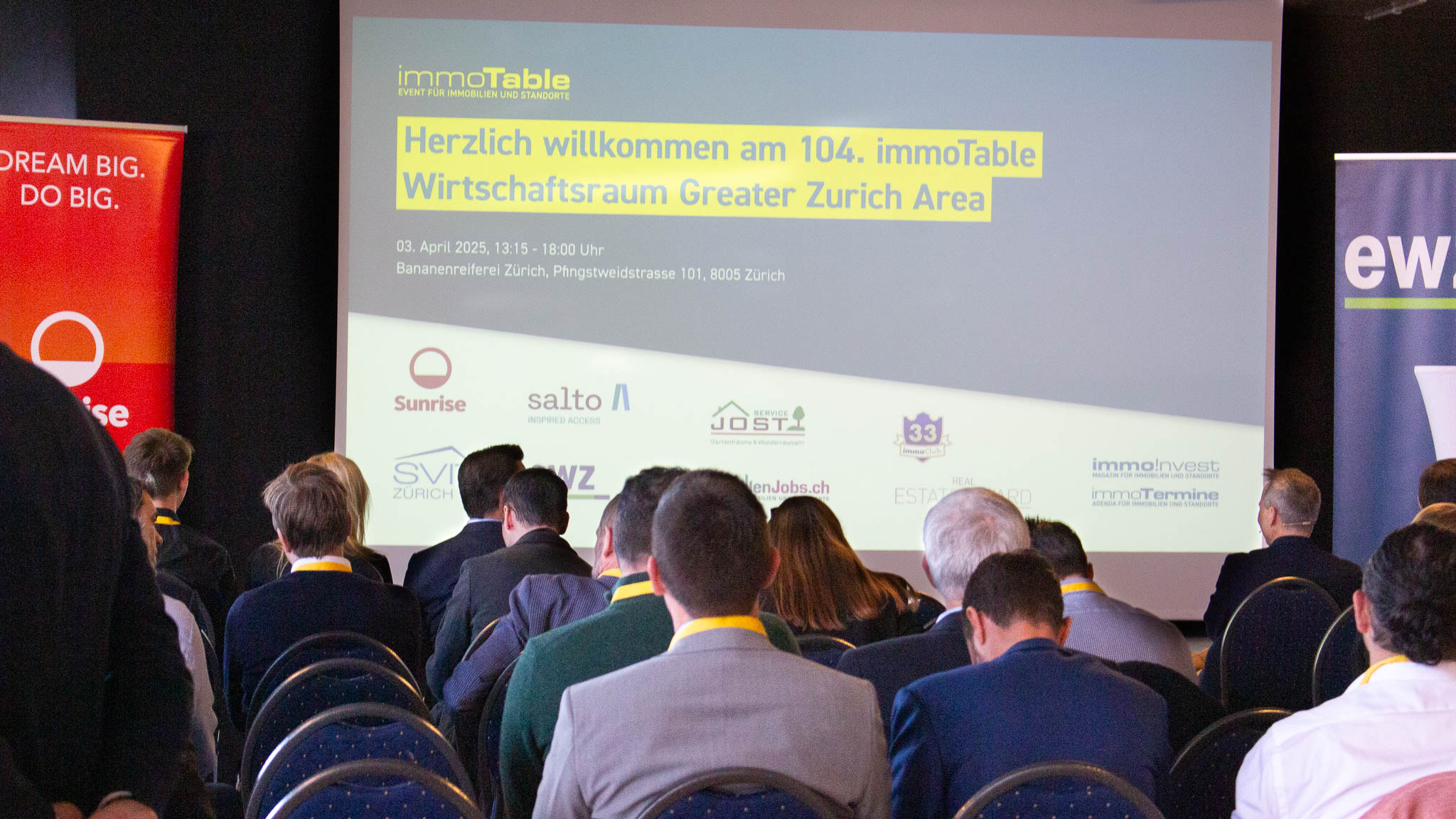
  • The 104th immoTable focuses on energy, location attractiveness and innovation

    The 104th immoTable focuses on energy, location attractiveness and innovation

    [smartslider3 slider=”46″]

    Setting the course for strong locations
    Samuel Mösle, Co-Head of the Zurich Cantonal Economic Development Agency, opened the event with a comprehensive overview of the situation. He outlined the current challenges in a global context and emphasized the role of the construction industry in the further development of Zurich as a business location. Topics such as digitalization, artificial intelligence and securing affordable housing play a central role in this. The aim is to further raise the profile of the canton of Zurich as an innovative and competitive economic area.

    Björn Slawik and Frank Koster from ewz presented the prospects for a decentralized and sustainable energy world. The focus was on the dynamic development of the Swiss solar market and new regulatory framework conditions from 2026. The introduction of local electricity communities, such as the ewz.solarquartier concept, will strengthen self-consumption of solar power at district level. The aim is to make efficient use of surpluses and promote the construction of new solar power plants in a market-oriented manner.

    Jan Frenzel from SMG illustrated how AI-supported systems are revolutionizing the world of customer relationship management. In addition to comparing CRM and ERP systems, he highlighted the potential of SaaS solutions for automating business processes. With intelligent tools, customer needs can be identified even more precisely in future – a key factor for positioning on the market.

    Location development and future trends
    Under the title “How can locations remain attractive?”, Beat Bachmann (Canton of Zug), Jakob Bächtold (House of Winterthur), Marc Lyon (Implenia Schweiz AG) and Albert Schweizer (City of Schlieren) discussed the future viability of locations. The topics ranged from demographic change and new forms of living and working to the question of how innovation and sustainability can be specifically incorporated into site development. The discussion showed that successful locations today have to offer more than just infrastructure. They need identity, networking and visions for the future.

    Outlook for the Real Estate Award 2025
    Mara Schlumpf provided information about the upcoming Real Estate Award, which will take place on October 2, 2025 at Trafo Baden. Outstanding projects and personalities from the real estate and construction industry will be honored in five categories. The event promises not only a gala with a networking character, but also exclusive visibility for innovation and quality in the industry.

  • Canton of Lucerne plans investments in living and business location

    Canton of Lucerne plans investments in living and business location

    The canton of Lucerne is planning an investment offensive to promote the location. Due to international tax developments such as the OECD minimum taxation, the canton is “losing its competitive advantage of low corporate profit taxes for large international companies”, explained the cantonal state chancellery in a press release. Specifically, there are fears that affected companies will relocate or limit their investments in the canton. The cantonal government wants to counteract this with targeted investments in the canton as a place to live and do business.

    A proposal submitted for consultation by the cantonal government on 10 March envisages investing CHF 300 million a year in a broad package of measures from 2026. “The canton of Lucerne is doing well, so we have the opportunity to invest in our living and economic environment and remain attractive in the long term,” said Fabian Peter, Head of the Cantonal Department of Building, Environment and Economic Affairs, in the press release. “That is the aim of this bill.”

    Two thirds of the funds will be used to strengthen the business location. The focus here is on promoting innovation and improving the framework conditions for digitalisation, the availability of business premises and customer-oriented administration. Of the remaining CHF 100 million in favour of the people of Lucerne, the lion’s share of CHF 70 million is earmarked for a reduction in the tax rate for natural persons.

  • Three new members strengthen regional location promotion on the Limmat

    Three new members strengthen regional location promotion on the Limmat

    Limmatstadt AG has three new members in its ranks. According to a press release, Bolderlounge, Menu and More AG and buchstäblich AG have joined the regional location promotion organisation. The location promotion organisation already counts more than 100 companies and organisations among its members.

    The Boulderlounge Schlieren has been active since November 2021. “We offer Limmatstadt an attractive sports centre right in the heart of Schlieren, five minutes from the train station,” says Managing Director Lena Stürm in the Members section of limmatstadt.ch. “The hall is open 365 days a year for climbing enthusiasts of all ages and offers a great place to network, meet people and have fun.”

    Menu and More AG specialises in healthy catering for children. “82 satisfied and dedicated employees from 28 nations” are committed to the well-being of the little ones, according to the website of the provider of children’s and youth catering. “By moving to the Ecopark Tivoli in Spreitenbach, we are anchoring ourselves in a dynamic region full of innovation and entrepreneurial spirit,” explains Managing Director Markus Daniel in the members section.

    Buchstäblich AG writes, organises and networks, thinks and implements, writes the agency for marketing and communication based in Weiningen ZH on its website. The company communicates digitally or conventionally “literally for everyone who has something to say”. In the Members section, owner Brigitte Becker describes the Limmat Valley as a dynamic “economic and living space with great potential”.

  • Location promotion of the Canton of Zurich gets dual leadership

    Location promotion of the Canton of Zurich gets dual leadership

    The Canton of Zurich is reorganising the Economy and Labour Division as of 1 January 2024. In future, location promotion will be managed by a co-head. According to a press release, Samuel Mösle and Markus Müller will form this dual leadership. The current head of location promotion, Fabian Streiff, will become head of the new Office of Economic Affairs. According to thecantonal press release, the current Office of Economic Affairs and Labour will be transformed into two independent organisational units in 2024: an Office of Economic Affairs (AWI) and an Office of Labour (AFA). Hans Rupp becomes head of the Labour Office.

    According to the press release, 52-year-old Markus Müller gained professional experience in process and product development after completing his studies and subsequent dissertation in materials science at the Swiss Federal Institute of Technology in Zurich. He was Manager Advanced Materials and Technologies in the medical industry. Since 2021, Müller has been a high-tech project manager in the location promotion team and a part-time lecturer at the OST – Ostschweizer Fachhochschule in Rapperswil-Jona SG.

    Regarding the second co-head, Samuel Mösle, the press release states that the 36-year-old completed his Master’s degree in economics at the University of Zurich and worked at a Swiss economic research and consulting institute after graduating. At the beginning of 2016, he worked as a project manager for the Canton of St.Gallen’s location promotion organisation in the area of business relocation and tourism. Since 2019, Samuel Mösle has held the positions of team leader for location development and tourism as well as deputy head of location promotion in the Canton of St.Gallen. His work focuses on projects and tasks in the area of economic policy, such as site development, start-up and innovation promotion as well as regional and intercantonal cooperation.

  • ZKB modernises network of locations

    ZKB modernises network of locations

    ZKB plans to invest a three-digit million amount in the modernisation of its network of locations over the next few years. “The physical presence on site and the proximity to our clientele is part of our DNA,” Steve Zurschmitten, Project Manager Sales and Market Area Manager Winterthur in Private Banking at ZKB, is quoted as saying in a statement from the bank. “That’s why we are also relying on the densest location network in the canton in the long term and are redesigning all of our 51 branches along a newly developed location concept.”

    At the centre of the new concept is personal advice for private individuals and companies on important events. For everyday business, the branches offer digital self-service support. At some locations, the establishment of a so-called event zone is planned for events on topics such as owning a home or starting a business. Seminars on how to use the Twint payment solution, eBanking or mobile banking are intended to make it easier to get started with the digital implementation of banking transactions. Starting next year, all branches are to be converted by 2030.

    The ZKB informs that the findings from the two pilot branches in Stettbach and Winterthur have been incorporated into the development of the location concept. Here, the cantonal bank evaluated which services will continue to be in demand in branches in the future and which will be shifted to the digital world. “By creating a new, contemporary offering with inviting meeting and advisory opportunities on site, we want to remain locally anchored and close to our customers and the population,” explains Zurschmitten.

  • Urban Manufacturing!

    Urban Manufacturing!

    More than ten years ago, we prepared an internal study on user-centred location development for an economic region. The core focus was on high-tech companies whose needs were to be taken into account in settlement processes. By high-tech companies we did not just mean the “Googles” and “Facebooks” of today’s economy, but companies in general that operate with the most modern means, i.e. also manufacturing industry. Larger companies looking for a new location were interested in having a university close to them geographically. This was in order to ensure an exchange with science and teaching and to be able to attract graduates with attractive offers in relative proximity. Google leads the way: in 2004, the American company started in Zurich with two employees. Today, the high-tech company offers around 5,000 jobs in Zurich. This is not only because Zurich is a beautiful city, but above all because the renowned “Eidgenössische Technische Hochschule” (ETH) is at home in Zurich. The study also showed that employees of such companies look for a wide range of local leisure and cultural activities, i.e. short distances. Even if land prices are higher in the city than in the countryside: many companies attach importance to “exciting” buildings for their corporate base (see exemplary article picture). The city often offers interesting brownfield sites where industrial companies used to be located. As a PR effect and from the perspective of good employer branding, this should not be underestimated.

    So why should urban locations consider creating more offers for manufacturing industry again in the future? The answer: underused areas are functionally mixed and thus upgraded. The municipality contributes to shorter distances, relieves the sometimes overburdened local transport system, the commuter volume is reduced, which leads to an increased sustainability of a location. By creating jobs in the municipality, purchasing power is increased, which in turn increases business tax revenues. Urban manufacturing is a megatrend that distinguishes between “urban industry”, “urban manufactures” (handicrafts) and “urban agriculture” (urban farming). A future topic that is very interesting for every city and urban region and should be kept in mind as a topic in location development. Why not create a picture of the future that shows what a sustainable location could look like in the future with a healthy mix of manufacturing, leisure and housing?


    Swiss Association for Location Management SVSM – the umbrella organisation for location and business development
    The SVSM is a practice-oriented and independent contact point for questions on the topic of location management and business development. As an umbrella association, it has around 80 members from the fields of location management, regional marketing, business development and real estate. The association promotes the interdisciplinary exchange of experience and networking and is committed to professionalism in location management. With the event series “SVSM Dialog”, the SVSM organises a semi-annual hybrid specialist conference with a changing focus on location management or economic development. Since 2007, the organisation has presented the SVSM Awards for innovative projects in location and business development and elected a deserving personality as location manager of the year.

    www.svsm-standortmanagement.ch
    info@svsm-standortmanagement.ch

  • SVSM Award 2022: projects are nominated

    SVSM Award 2022: projects are nominated

    The Swiss Association for Location Management SVSM has been presenting the SVSM Awards annually since 2007. These are awards for particularly innovative projects in the areas of location marketing, location development and business promotion. 14 applications were received for this year's awards – from municipalities, cities and organizations from Lake Constance to Upper Valais. A jury evaluated these based on defined criteria and nominated the following six projects for the 2022 awards:

    • “Big Air Chur” city event – submitted by the city of Chur's business contact point

    • Conversion of the old spinning mill in Lichtensteig – submitted by the Stadtufer cooperative

    • "valais4you" project to promote the immigration of skilled workers –

    submitted by the regional and economic center of Upper Valais

    • Joint project "BIGNIK" to strengthen identification –

    submitted by REGIO Appenzell AR-St.Gallen-Bodensee

    • “Werkstadt Zürisee” to develop the Rütihof workplace area –

    submitted by the city of Wädenswil

    • Launch of the integrated location promotion for the Zurich Oberland –

    Submitted by the Zurich Oberland Promotion Association

    With the nomination, however, the applicants are not yet guaranteed an award: At the end of August, all nominees have the opportunity to present their projects to the jury. The jury consists of the following experts: Katharina Hopp, jury president and board member SVSM; ambassador dr Eric Jakob, Head of the Directorate for Business Promotion SECO; Pascal Jenny, President of Arosa Tourism; Karin Jung, Head of Office for Economy and Labor Canton of St.Gallen; Prof. Dr. Markus Schmidiger, Head of the Real Estate Competence Center

    University of Lucerne; Sonja Wollkopf-Walt, CEO Greater Zurich Area.

    The awards will be presented on Wednesday, November 2, 2022, as part of the hybrid conference "SVSM Dialogue Economic Promotion" in the Capitol cinema in Olten. Incidentally, the location manager of the year is also honored at this event.

  • Settlements reach pre-corona level

    Settlements reach pre-corona level

    Company settlements are increasing again after the Corona dip. The Greater Zurich Area AG (GZA), as the location marketing organization for nine cantons, was able to settle a total of 125 companies in 2021, an increase of 36 companies compared to the first Corona year 2020. According to a statement by the GZA, 42 companies came from the USA (+20 ), 19 from Germany (+4), ten from Italy (+5) and five each from China (-6), Great Britain and Singapore.

    Overall, the companies created 582 jobs in the economic area, an increase of 11 percent compared to the previous year. In the next five years there should be a total of 1843 jobs.

    The ICT sectors are most strongly represented with 42 companies, followed by the life sciences with 25 companies and the machine industry with 18 and financial services with 13 companies. The life sciences companies created 235 jobs, followed by the ICT companies with 154 jobs.

    However, the importance of the companies for the location goes beyond the number of new jobs. “We specifically address those companies that achieve high added value and strengthen the existing ecosystem,” said GZA Managing Director Sonja Wollkopf Walt at a digital media conference.

    One of the newly settled companies is Benchling . The American provider of cloud solutions for life sciences wants to create up to 150 jobs in the Circle at Zurich Airport. The Chinese pharmaceutical company Hengrui already has its European headquarters in Basel and is now setting up a research and development site in Zurich.

    The German RegTech company targens will sell its software for compliance solutions to banks in Switzerland and Liechtenstein from Schwanden GL. Ruedi Becker, the Swiss head of the Landesbank Baden-Württemberg subsidiary, was able to convince his superiors of the advantages of Glarus together with the GZA.

    That pleases the Glarner location promoter Christian Zehnder. So far, Glarus has been strong in manufacturing and food production. “We want to get away from our traditional image,” he said. “When companies settle here, however, we depend on the strong partner GZA, who markets the location internationally.”

    Sonja Wollkopf Walt sees it similarly: the settlement of targens strengthens the ecosystem as a whole and sends the signal that the economic area extends beyond Zurich and Zug. “In the Greater Zurich Area there is the ideal location for every company.”

    The Greater Zurich Area includes the cantons of Glarus, Graubünden, Schaffhausen, Schwyz, Solothurn, Ticino, Uri, Zug and Zurich.

  • Innovationspark Dübendorf is one step further

    Innovationspark Dübendorf is one step further

    The airport area in Dübendorf is to develop into a lively urban quarter in the coming years. A center for innovation, research and jobs is to be created. The aviation infrastructure is to be secured as a strategic reserve.

    The Zurich Government Council has now submitted a synthesis report to the Cantonal Council, as stated in a communication . This was drawn up by the federal government, the canton, the local authorities and other parties involved. It forms the basis for the further development of the area. It is now to be advised first by a special commission set up by the Cantonal Council.

    The government council intends to submit three proposals to the cantonal council by spring 2022. These deal with the creation of planning rights, a revision of the structure plan and a planning loan.

  • Schaffhausen extends contract with Generis AG

    Schaffhausen extends contract with Generis AG

    Generis AG will continue to run the economic development agency for the canton of Schaffhausen until 2024. The same applies to the office for the promotion of regional and location development. The government council decided this at its meeting on Tuesday.

    The service contract currently runs until the end of 2022. After that, it can be extended for a further two years for the last time. At the beginning of 2015, Generis AG was awarded the contract to manage both facilities.

    As stated in a communication from the government council, Generis AG has “so far fulfilled its mandate very well. The results achieved to date in the field of business development represent a real success story. ”That is why the service contract is now being extended.

  • Solothurn further strengthens location development

    Solothurn further strengthens location development

    The Department of Economics of the Canton of Solothurn wants to strengthen the development of the location, according to a media release . In this context, the business development department is renamed the business development department. Organizationally, the department changes directly to the department secretariat.

    The new name of the department is intended to express that it will deal more intensively with site development in the future. In addition, it should, for example, be more networked and cross-departmental when implementing projects within the framework of the location strategy or the new regional policy of the federal government (NRP).

    In addition to site development, the support of companies in Solothurn and the processing of settlement projects will continue to be part of the core business of the department.