AMAG Zug now also has a photovoltaic system (PVA). On 1301 square metres, 667 solar modules are expected to produce 263,040 kilowatt hours of electricity per year. According to a media release, this will be used on site for the car dealer’s own needs. Another PVA each is planned on the roof of AMAG Zug’s VW showroom and on the public AMAG car park in Cham, it said.
In the past two years, PVA has already been installed on roofs of AMAG operations, including in Basel, Wettswil ZH, Lupfig AG, Chur, Baden AG, Etoy VD, Oftringen AG, Buchrain LU, Winterthur and Maienfeld GR. “We are proud that we are now also one of the companies within the AMAG family that have a photovoltaic system and can thus produce a large proportion of the electricity we use ourselves,” CEO Herbert Sommerhalder is quoted as saying.
By 2025, the AMAG Group will have equipped a total of around 75,000 square metres of its roof area with solar panels as part of its sustainability and climate strategy. This corresponds to an area of around ten football pitches. According to the information provided, this will enable the company to produce more than 20 percent of its current electricity consumption itself.
BKW Energie AG is getting support for the conversion of its meter technology from the metering technology supplier Kamstrup, with its Swiss headquarters in Glattbrugg, and from the Cham-based companies Ensor and Semax. Together with the project partners now presented, the energy supplier wants to introduce more than 400,000 electronic meters in the grid area by 2028, according to a media release.
Legislation requires the installation of the new meters as part of the Energy Strategy 2050. For this forward-looking infrastructure project, BKW is counting on the expertise of the technology partners selected by tender. In future, data encryption and data collection will be based on secure cloud technology from Kamstrup. BKW is purchasing high-quality smart meters from Ensor and Semax, which are designed to meet the requirements of industry.
According to BKW, the digital meter technology allows consumption to be measured every quarter of an hour and data to be transmitted directly to the energy supplier. Customers get a more detailed insight into their electricity consumption, it says. The communication company Sunrise will take over the transmission of the data. According to the press release, Hansen is responsible for data management.
Since 6 June, visitors to the Zänti shopping centre in Regensdorf have been able to charge their electric vehicles at seven fast-charging stations, Energie 360° informs in a press release. The Zurich-based energy service provider installed the charging stations with a capacity of up to 120 kilowatts as part of a long-term partnership with the Regensdorf centre. “Together with the Regensdorf Centre, we are providing our customers with what is currently the fastest charging solution in a Zurich shopping centre,” Rami Syväri, Head of Mobility at Energie 360°, is quoted as saying in the press release.
The new charging stations charge the battery of an electric car within 30 to 60 minutes with ecologically produced direct current, depending on the model. “With the new fast-charging stations, we want to meet the needs of our customers and at the same time actively reduce CO2 emissions,” explains Sandro Engeler, head of the Regensdorf centre. Two existing AC charging stations complement the range of charging solutions at Zänti.
According to Syväri, Energie 360° already operates over 200 locations with charging stations throughout Switzerland. The company finances, plans, builds and maintains the charging stations in cooperation with the owners of suitable sites. All of Energie 360°’s public charging stations can be used with a QR code, app or RFID card and are integrated into the Swisscharge network.
The inauguration ceremony for the Palanggenbach power plant took place on 3 June. This means that the latest hydroelectric power plant in Uri is now officially open, around six months after commissioning, completed tests and some optimisation work, informs EWA-energieUri in a statement. The energy service provider realised the Palanggenbach power plant together with aventron AG, Korporation Uri and the municipality of Seedorf.
“We can be proud of what we have realised with the Palanggenbach power plant,” Werner Jauch, Chairman of the Board of Directors of Kraftwerk Palanggenbach AG, is quoted in the statement from his speech at the inauguration. “With its annual production of 11.5 gigawatt hours of electricity, the Palanggenbach power plant will contribute to the security of supply in the future, and it will do so in a CO2-free, sustainable and renewable manner.” In addition, Jauch pointed out that over 85 per cent, or about 18 million Swiss francs, of the investment in the project benefited the canton of Uri in the form of contracts. Even during operation, the power plant generates “considerable contributions to the corporation of Uri, the canton of Uri and the municipality of Seedorf”.
For the official inauguration, the doors of the power plant were open to the interested public. There was an exclusive opportunity to explore the 1.3-kilometre-long tunnel down to the water intake. The power station control centre and turbine were also open to the public.
The municipality of Grengiols and five energy companies are planning to set up one of the largest solar plants in Switzerland: 910,000 solar modules with a total output of around 440 megawatts peak are to be installed on the southern slope of the Saflis Valley in the Valais, inform Industriellen Werke Basel(IWB) in a statement. In addition to IWB, the two Valais energy companies Energie Brig-Aletsch-Goms(EnBAG) and Forces Motrices Valaisannes(FMV), as well as the Zurich Cantonal Electricity Works(EKZ) and the French-speaking Swiss energy company Groupe E are involved in the project. A feasibility study completed at the beginning of the year has already confirmed the potential of Grengiols-Solar.
The plant is planned in an area that receives around 1500 hours of sunshine per year, which is considerably more than the Unterland. According to IWB, 42 per cent of the 600 gigawatt hours of electricity that are possible per year will be generated in winter. In combination with the Chumensee storage power plant planned by Gommerkraftwerke(GKW), 1200 gigawatt hours of electricity could be generated annually “in a plannable manner and available at any time through storage”.
The project partners are planning several years for the realisation of the plant. By the end of 2023, they want to have prepared the environmental impact report and the construction project. The investment costs are also to be calculated in connection with the latter.
By the end of 2025, the partners want to connect Grengiols-Solar to the grid with the capacity required by law. Initially, the electricity will be supplied via a temporary overhead line to a 65-kilovolt line in the Rhone Valley.
Online trade has been booming since Corona at the latest. More and more huge goods transshipment halls are springing up all over the country. Until now, the ordered goods and merchandise have been transported to their end users via roads and railways. The Federal Roads Office (FEDRO) and the Federal Office for Spatial Development (ARE) estimate that the volume of goods traffic in Switzerland will increase by around 31 percent by 2050. However, the above-mentioned common freight transport routes cannot be expanded without limits.
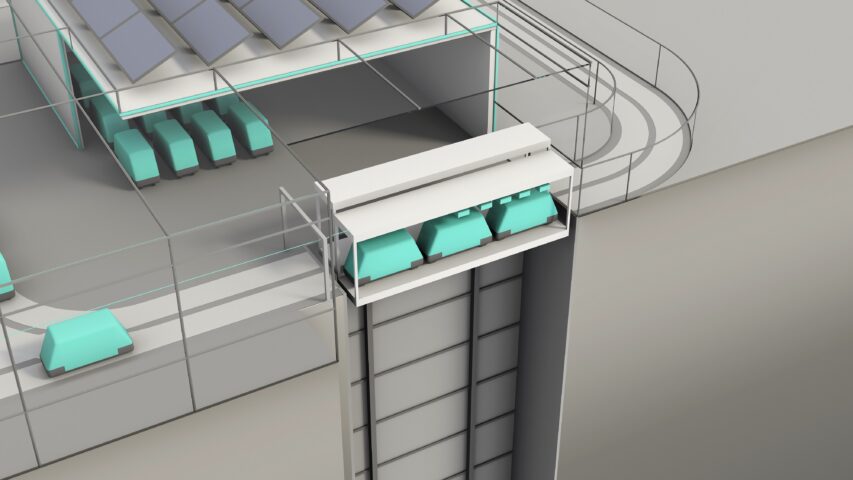
New transport solutions were sought – and found with Cargo Sous Terrain (CST): By 2045, a 500-kilometre network of three-lane tunnels, each 6 metres in diameter and 20 to 100 metres deep, will be built between Lake Constance and Lake Geneva, with spurs to Basel, Lucerne and Thun. These will be connected to above-ground loading and unloading stations called hubs. In the hubs, the autonomously driving, unmanned vehicles are loaded and unloaded fully automatically via vertical lifts.
The futuristic-looking cars travel at a constant 30 kilometres per hour on induction tracks around the clock. They hold goods the size of pallets. Fresh and refrigerated goods can also be transported. The system sorts and bundles the goods already in the tunnel so that the subsequent delivery to sales outlets and end customers takes place in a coordinated manner.
At the hubs, the delivered goods are continuously picked up and delivered by manned vehicles powered exclusively by renewable energy. “It is possible that we provide our own fleet of energy-powered vehicles or also work with appropriate logistics partners,” says Patrik Aellig, Communications Officer CST. The disposal of waste and recyclables is also an integral part of the concept. Aellig explains: “Goods movements primarily take place from the logistics centres to the cities. But the system naturally runs in both directions and is predestined to pick up waste and recycling materials or even construction waste and transport it out of the cities.” One vehicle can pick up to two pallets or boxes and containers of this dimension.
CST reduces noise emissions by 50 per cent and enables the transport of small quantities The advantages of such an underground network are obvious: national roads are relieved of heavy traffic by up to 40 per cent, cities by about 30 per cent. At the same time, noise emissions will be reduced – by about 50 percent in the cities. CO2 emissions can also be significantly reduced: The eco-balance is up to 80 percent better compared to today’s transport systems, as CST is powered 100 percent by electricity from renewable sources.
The first stage is scheduled to be operational in 2031 and includes the 70-kilometre route from Härkingen-Niederbipp to Zurich Airport with 10 hubs. The hubs will be located in existing logistics centres and ensure connections to all transport systems (rail, road, water, air freight). The overall transport network is scheduled for completion in 2045. The sophisticated system includes innovative software that enables intelligent control. The IT behind CST and the automatic loading and transport of goods form the core of this system. As of today, the software has not yet been developed. But: “The IT team is in place – the first step involves developing the very extensive IT platform,” explains Aellig. With its customised technology, CST is aimed at the smart cities of the future and also takes care of the fine distribution of goods. In addition, CST enables the economy to transport small quantities in individual pallets or containers for the first time. This eliminates the intermediate storage of small-volume goods.
The total costs amount to more than 30 billion Swiss francs. CST is privately owned and has its headquarters in Olten. Its 83 shareholders, investors and project partners include well-known Swiss names such as the insurance company Vaudoise, SAP, Siemens, Swiss Post, Coop, Migros, Mobiliar or the Zurich Cantonal Bank, Credit Suisse and Swisscom. These include numerous logistics, energy and construction companies, engineering firms and bicycle courier services or even the high-tech start-up Hyperloop One from California (USA). The infrastructure that is being created is available to all market participants. CST is being developed in close cooperation with the authorities, the federal government and the cantons. The federal government is not contributing to the costs.
The planned, largely underground freight transport facility across cantonal borders is possible thanks to the Federal Underground Freight Transport Act (UGüTG) passed by the National Council and Council of States in December 2021. CST is being advanced in several parallel sub-projects. The cantons will include the exact locations and routes of the hubs and tunnels in their structure plans as planning progresses. The structure plan procedures will begin in the course of 2023 in the cantons of Aargau, Solothurn and Zurich. The preliminary project should be ready in the course of the coming year. “After that, the tenders for the construction contract for the underground network will be prepared,” says Aellig. Construction is scheduled to start in 2026.
The 3D simulator shows the logistics connection of a hub.
Axpo and Swedish plastic film producer Borealis have signed a long-term power purchase agreement (PPA), according to a media release. According to the agreement, Axpo’s wholly owned subsidiary Axpo Nordic will supply more than 130,000 megawatt hours of electricity from wind power to Borealis’ production plant in Stenungsund for ten years starting in January 2024.
For Borealis, the contract with Axpo means that the share of renewable energy consumed at the Stenungsund plant will be significantly increased, the media release says. Indirect carbon dioxide emissions at Borealis operations will be reduced by nearly 10,000 tons annually. Borealis aims to increase the share of renewables in its electricity mix to 40 percent by 2025 and achieve 100 percent electricity from renewable sources by 2030.
“This transaction marks another milestone in our corporate PPA business and demonstrates the crucial role Axpo Nordic plays in the energy transition. Sweden is an attractive market for international investors in renewable energy,” Cecilia Bergman of the Axpo Sweden management is quoted as saying. The continued expansion of wind farms allows industrial companies to source renewable power locally for their facilities to reduce their emissions and meet their sustainability goals, Bergman added.
“The contract brings us closer to our ultimate goal of covering all our electricity consumption from renewable sources by the end of this decade. This is another step in our journey to reinvent ourselves and live more sustainably,” Wolfram Krenn, Executive Vice President Base Chemicals & Operations at Borealis, is quoted as saying.
Switzerland could generate significantly more electricity from wind energy than previously assumed. According to a study by the Bern-based company Meteotest on behalf of the Swiss Federal Office of Energy ( SFOE ), wind turbines could produce 19 terawatt hours in the winter months alone, according to a press release from the SFOE. In a previous study from 2012, the scientists had assumed 3.7 terawatt hours per year. For comparison: Switzerland consumed a total of 58.11 terawatt hours of electricity in 2021.
With 17.5 terawatt hours, most of the potential lies in the Central Plateau. In the Jura arc and in the large Alpine valleys together, more than 7.8 terawatt hours could be produced per year, in the Alpine region over 4.2 terawatt hours.
Both political conditions and technology have evolved since the last study. Today's wind turbines are taller, have larger rotors and produce much more than older systems. In addition, more areas such as forests and areas in the Federal Inventory of Landscapes and Natural Monuments ( BLN ) are eligible "with the recognition of national interest for wind farms". However, they are subject to higher demands on wind energy production.
"Even a partial expansion of 30 percent of the total wind energy potential – which corresponds to around 1000 wind turbines – could make a significant contribution to a more secure electricity supply in Switzerland and to reducing dependence on foreign countries," says the press release.
Inhabited areas with a buffer of 300 meters, protected landscapes such as moors, national parks and biotopes as well as secret facilities of the Federal Department of Defence, Civil Protection and Sport were excluded from the calculation.
Ticino Solare was installed on the roof of a technical college building near Lugano. On May 13, 1982, the south-facing facility supplied power to the grid. The installed power: 10 kWp. That was unusual at the time. Later the panels were transferred to another building.
The condition, quality, color and performance of the solar cells were regularly checked and measured. An investigation after 35 years of operation came to the conclusion that the cells are showing signs of wear – keywords are corrosion, burned areas (hot spots), cracks in the cells or defective connection cables. But: The majority of the modules still worked well and still delivered at least 80 percent of the power overall. Manufacturers of solar panels usually guarantee a service life of 25 to 30 years.
Energeiaplus asked Mauro Caccivio what makes TISO-10 special. Caccivio heads the photovoltaics laboratory at the Ticino University of Applied Sciences SUPSI. "It's absolutely amazing. Looking at the black and white photos from back then and considering the technological advances that have been made since then, you can understand how visionary the project was and how courageous the team behind it was. TISO was important for the subsequent massive spread of solar energy: right from the start of its industrial phase, photovoltaic technology was able to return the energy required for the production of solar modules to the power grid many times over. This is crucial to minimize the impact on the environment and nature, and this is even more true today given the tremendous evolution we are witnessing,
In the past twelve months, global energy prices have risen massively. Electricity prices on the market have increased tenfold. In addition to the war in Ukraine, the main drivers are the after-effects of the corona pandemic and a lower availability of foreign power plants. These price increases lead to higher electricity procurement costs. In addition, there are also significantly higher costs for the national grid company Swissgrid for the transmission grid.
As a result, CKW's energy and grid tariffs will increase in 2023, as will most energy suppliers in Switzerland. For a private customer with a medium power consumption, this results in an increase in the additional costs of around CHF 23 per month, for SMEs in the basic service with a medium power consumption they amount to around CHF 500 per month.
The regulatory requirements require that both the company's own production and the procurement of electricity on the market are included in the price calculation. In times of rising market prices, this leads to higher tariffs. When market prices are low, this has a positive effect on electricity customers.
The production of solar power is more worthwhile than ever On the other hand, the high prices are having a positive effect on solar power producers. Because the electricity fed into the grid is remunerated according to the SFOE reference market price, which is based on the market price. In the first half of 2022, this averaged 23.0 centimes per kilowatt hour. For comparison: two years earlier it was 3 centimes per kilowatt hour. The revenue from solar power has thus increased eightfold. An average 15 kWp solar system on the roof of a family home will generate an additional yield of over CHF 2,000 per year. The production of solar power is currently more worthwhile than ever.
Current developments show how dependent Switzerland still is on other countries. The expansion of renewable energies is key to becoming more independent as a country.
Tips for saving electricity With simple measures you can reduce your own electricity consumption and thus also the costs.• The generation of heat is one of the largest electricity consumers. It is therefore worth setting the heating correctly: in the living room to 20 degrees, in the bedroom to 16 degrees. You save 6 percent on heating costs for every degree lower in temperature.• Washing dishes in a full machine uses half as much energy as by hand.• Showering with water-saving attachments saves up to 50 percent water – and therefore also a lot of energy for hot water preparation.• Showering instead of bathing saves around 70 liters of water – or 65 centimes per shower.• Switching off the light when you don't need it is always worthwhile – even if it's only for a short time.• In Swiss households, around 10 percent of electricity is wasted, especially when it's not used through standby consumption. It is worth turning off devices such as TVs, game consoles, coffee machines, etc. when they are not in use. For example, with a socket strip that can be switched off.• Heating water in a kettle instead of in a pan uses about half as much energy.• Replacing conventional light bulbs or energy-saving lamps with LED lights can significantly reduce consumption.
EWA-energieUri is realizing the Uri solar community in Schattdorf. As the Uri energy provider announced , it wants to set up a photovoltaic system on the roof of the Uri Foundation for Disabled Persons, in which interested private parties can also participate. They can now reserve individual square meters of the facility for a fixed price of CHF 339. In return, they receive solar power for over 20 years.
The plant is to generate a total of 49,000 kilowatt hours of electricity per year on 260 square meters. That is 165 kilowatt hours per square meter, around 4 percent of the consumption of an average household. Commissioning of the plant is planned for spring 2023. Interested parties can already reserve their share at meinurstrom-sun.ch .
"The Uri solar community is an attractive product for producing and purchasing solar power easily and easily, even without your own roof," Werner Jauch, CEO of EWA-energieUri, is quoted as saying in the press release.
Fleco Power AG , based in Winterthur, has a new shareholder. The ADEV energy cooperative now also holds a 17 percent stake in the subsidiary founded in 2015 by the Ökostrom Schweiz cooperative and MBRSolar , she writes in a statement . She will also be represented on the Fleco Power Board of Directors with her Managing Director Thomas Tribelhorn.
Fleco Power supports small, decentralized producers of renewable energies in selling their electricity directly. It also offers solutions for end customers, for example helping them to procure renewable electricity on the market in purchasing cooperatives.
ADEV and Fleco Power want to develop new services and innovation projects together. The long-term goal is to create an independent energy supplier for renewables.
Founded in 1985, ADEV operates solar power systems, small hydroelectric power plants, wind turbines, central heating systems and local heating networks throughout Switzerland. She also wants to use the cooperation to strengthen her own competitiveness. This makes it possible “to offer our customers tailor-made services that set us apart from the competition,” Thomas Tribelhorn is quoted as saying in the statement.
12 years ago, CKW subsidiary Steiner Energie built the last hydroelectric power station in the canton of Lucerne in Malters. Even then, CKW was intensively involved in the planning of the Waldemme power plant. A lot of water flowed down the Waldemme before the excavators could finally drive up and drive their shovels into the ground.
Within a year, some of this water will be used to produce clean, renewable electricity. At today's ground-breaking ceremony in Flühli, government councilor Fabian Peter, head of the building, environment and economic department, expressed his delight: "With the new construction of this power plant, CKW is making another important contribution to achieving the energy and climate policy goals in the canton of Lucerne. »
Expansion of renewable energies is urgently needed In his speech to more than 70 invited guests, CKW CEO Martin Schwab was primarily pleased that the power plant is finally being built. Because it was a long and rocky road. Schwab positively emphasized the great commitment in Entlebuch. "The region is a pioneer in using its own local energies." At the same time, Schwab warned: “We urgently need to expand the production of renewable energy in Switzerland. The corona pandemic and the war in Ukraine clearly show how dangerous strong dependencies on foreign countries can be, »said Schwab. Today things are progressing much too slowly in Switzerland. “This is primarily due to the long approval process. The Waldemme power plant is the best example of this: it took more than 17 years from the first plans to the groundbreaking.»
"We want to move forward and make a significant contribution to the energy transition in Switzerland – in hydropower, wind power, solar energy and other renewable technologies. But the resistance is often great. This is paradoxical, as we all want the energy transition and need more renewable energies for it."
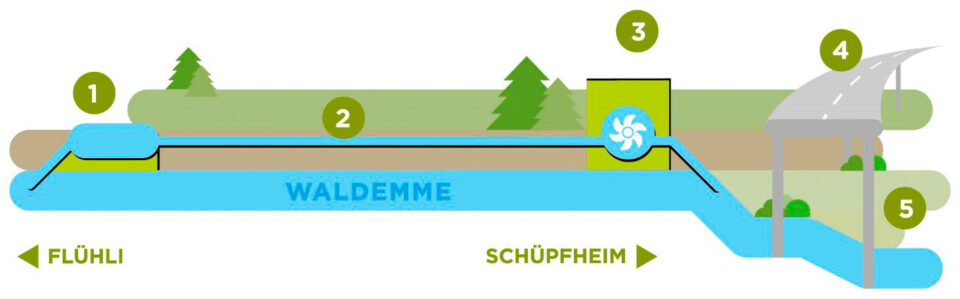
Electricity for 1500 households The roughly one-year construction phase begins with the ground-breaking ceremony. The water intake is at the hamlet of Matzenbach in Flühli. From this location, part of the water from the Waldemme is routed via a 2.1-kilometer-long underground pressure line to the power plant headquarters, where ecological electricity is produced. The power plant control center is located directly in front of the Lammschlucht at the Chrutacher Bridge. Immediately afterwards, the water is fed back into the natural course of the Waldemme and flows through the Lamm Gorge. The power plant has an output of 1.4 megawatts and produces an average of 6.5 GWh of electricity. This means that clean electricity can be generated from mid-2023, which will cover the annual needs of around 1,500 average four-person households. CKW is investing CHF 12.4 million in the power plant.
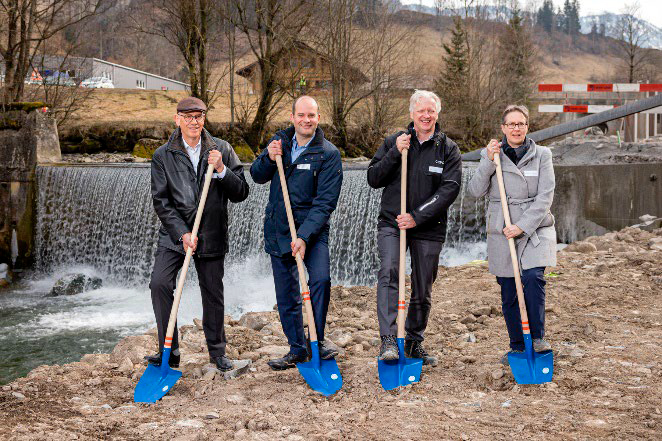
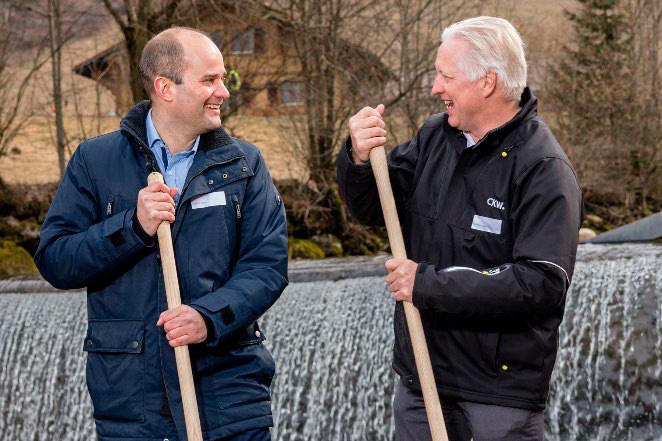
In the hamlet of Matzenbach, the water intake (1) takes part of the water from the Waldemme. In the approximately two-kilometer-long underground pressure line (2), the water is routed to the power plant center (3) at the Chrutacher Bridge (4), where it drives a turbine and generates electricity. Directly at the headquarters, the water is fed back into the natural course of the Waldemme and flows through the Lamm Gorge (5), which is untouched by the project. Breaking ground at the Waldemme: (from left) Hans Lipp, Flühli municipal mayor, Fabian Peter, member of the cantonal government and head of the building, environmental and economic departments of the canton of Lucerne, Martin Schwab, CEO of CKW and Hella Schnider-Kretzmähr, Flühli municipal president. Happy about the start of construction: Fabian Peter, member of the government and head of the building, environment and economic department of the canton of Lucerne, and Martin Schwab, CEO of CKW.
About CKW: The CKW Group is a leading Swiss provider of integrated energy and building technology solutions. For more than 125 years, the company has been supplying electricity to over 200,000 end customers in the cantons of Lucerne, Schwyz and Uri. In addition, there are innovative products and services throughout Switzerland in the fields of connectivity & IT infrastructure, electrical engineering, energy technology, IT & communication and security. The CKW Group employs over 2,100 people. With around 350 apprentices in 14 professions, it is the largest private-sector training company in Central Switzerland. In the 2020/21 financial year, CKW generated sales of CHF 916 million. With 81 percent of the shares, Axpo Holding AG is the majority shareholder of CKW. Further information at www.ckw.ch
The TBW have implemented their first project in the roof rental model on the roof of the riding hall in Wil, the city-owned energy service company informs in a press release . Specifically, a solar system with a peak output of 178 kilowatts was implemented. It will produce around 170 megawatt hours of electricity annually.
TBW will make the electricity produced on the roof of the riding hall available to its own customers, the company explains in the press release. In return, the Wil Riding Club receives rent for the roof it has provided and for other ancillary rooms used by the project. The corresponding contract has a term of 25 years.
The TBW assume that the demand for electricity from renewable energies will increase as a result of the abandonment of fossil fuels. In order to cover this, “innovative solutions such as those on the roof of the Wiler Reithalle are required,” writes the company.
The utility companies in southwestern Aargau are moving closer together. tba energie ag , EW Oftringen AG , EW Rothrist AG and StWZ Energie AG want to found the energy supplier Regionale Energie AG (REAG) and the water supplier Regionale Wasser AG (RWAG) together. The city of Zofingen is said to hold just over 50 percent of REAG. The shares of Oftringen, Rothrist and Zofingen in RWAG are said to be between 27 and 33 percent. Among other things, the merger is intended to increase regional added value and secure jobs.
The four companies expect synergies of CHF 2 million per year, they write in a statement . About half of this is to be returned to customers via the tariffs. The harmonization of tariffs will take up to ten years.
The ball is now in the hands of the boards of directors of the four companies, the five municipalities involved and ultimately the voters. The two new companies are scheduled to start operations on January 1, 2023.
Generating electricity from deep geothermal energy in Switzerland is given another chance. As announced by the Jura government, it wants to negotiate with Geo-Energie Suisse SA about a gradual resumption of the project. Additional safety requirements are to be set. In addition, an advisory committee made up of independent experts is to ensure the transparency of the project. If security is guaranteed, the government sees many advantages in the development of renewable energies, according to a statement from the canton.
The canton approved the Geo-Energie Suisse SA project in 2015. It provides for the production of electricity from deep geothermal energy for 6,000 households. A magnitude 5.4 earthquake triggered by a similar project in Pohang, South Korea, in November 2017 also sparked fears in the Haute-Sorne region. An analysis by Geo-Energie Suisse SA came to the conclusion that a scenario like that in Pohang in the Jura was “unthinkable” due to the safety requirements. However, the project actually came to a standstill.
Similar projects to generate electricity from deep geothermal heat had previously led to minor earthquakes in Basel and St.Gallen. The affected projects were then stopped.
The apartment buildings in Seebrighof store solar power in the form of hydrogen. Dr. Martin Nicklas, Head of Energy Contracting at EKZ, explains the revolutionary power-to-gas concept: “On summer days, the solar system on the roof of the Seebrighof will produce more electricity than the residents can use. The so-called power-to-gas plant turns this into hydrogen. In winter the energy requirement is higher. Then the stored hydrogen is converted into energy. Around 55 percent of this is used to generate electricity in the system’s fuel cells. The remaining 45 percent of the energy escapes as waste heat, which is used to heat the building. ” The hydrogen is produced from tap water that is processed directly in the plant. Oxygen is created as a quasi waste product, which escapes into the ambient air. This is environmentally friendly because in winter the hydrogen is converted back into water and renewable energy with oxygen from the air. This closes the cycle. The system only uses locally produced solar power for production, and the public power grid is relieved.
EKZ as a pioneer With a battery in the house, short-term fluctuations in solar power production in the summer are absorbed and, for example, solar power is stored for the night. The P2G system constantly converts the excess remaining free into hydrogen. As a result, it can be implemented more cost-effectively and operated more efficiently. For Nicklas, EKZ is taking on a pioneering role in the conversion to renewable energy supply: “For the first time in Switzerland, a P2G system is being implemented that can also be used cost-effectively in other properties of different sizes – even in existing buildings. With the system, we are testing the potential of seasonal energy storage from solar power for the winter. ” There are a few properties with hydrogen systems in Switzerland, including in the canton of Zurich. The difference in the project in the Seebrighof is the standardized concept, which can be easily and inexpensively applied to other buildings.
Power-to-gas system But it gets even better: thanks to the power-to-gas system, most of the solar power can be used locally. The electrical efficiency of the P2G system is around 30 to 35 percent across all processes. The rest is generated as waste heat, which is used for hot water heating in summer and for heating in winter. Would you be able to supply yourself with energy completely independently at the Seebrighof? – «This would be technically possible and is already being done in this way in individual properties. However, this would be very costly and was therefore not the aim of this project. “
Safe hydrogen storage Appropriate safety precautions must be taken when storing flammable and potentially explosive gases such as natural gas or hydrogen. These measures are checked by the authorities to ensure safe installations. Hydrogen is usually stored outdoors, with any leakage gas quickly volatilizing and thus preventing an explosive mixture. In the current case, according to Nicklas, the H2 is stored in commercially available gas cylinders that fully meet Swiss safety standards and norms.
When is a P2G system worthwhile? The answer depends on many factors and must always relate to the specific building project and the requirements of the client, as Nicklas explains: “The fundamental question is how often the hydrogen storage tank can be charged per year. Because with each charging cycle, the system generates a contribution margin that contributes to amortization. We are also testing this potential with the system and are further developing the concept accordingly. ” The client of the Seebrighof is also demonstrating a pioneering spirit with the project. In this way, she does not only have the system installed from a purely monetary point of view. One would like to lead the way here and make a contribution to reducing the supply gap in winter – making society more independent of energy imports from fossil sources. The facility at Seebrighof can be financed well thanks to its cost-effective implementation, says Nicklas. She makes a significant contribution to research into seasonal storage technologies: “How economically effective the technology is is the subject of our investigations. In the next few years, however, we expect another significant price reduction on the hydrogen market, which could give the technology a boost.
Energy strategy 2050 In the Federal Council’s Energy Strategy 2050, storage technologies based on gases and liquids have a high priority. With the first standardized power-to-gas system, EKZ has reached an important milestone that could serve as an example for future developments. Nicklas concludes: “If we want to fully feed heat and power supply as well as mobility with renewable energy sources, we need efforts in all areas. Hydrogen as a storage medium can help to defuse the challenges of power supply in winter ».
Around 5 percent of annual electricity consumption in Switzerland is currently covered by domestically produced solar electricity, explains Swissolar in a press release . In the standard electricity products of the energy suppliers, however, the proportion of solar electricity is only 1.85 percent on average. The Association of the Swiss Solar Energy Industry is working together with the power comparison service myNewEnergy to increase the solar proportion of standard products to this 5 percent in a first step.
“This value should be increased annually by at least the amount of additional construction in question,” Swissolar managing director David Stickelberger is quoted in the announcement. “Around 1 percent would correspond to the necessary expansion of photovoltaic systems.”
The majority of households do not choose a special electricity product and therefore receive the standard offer from the respective energy supplier, explains Swissolar in the press release. If the proportion of solar power in the standard product is increased to the proportion of power consumption, the comparatively expensive power is divided among a large number of consumers, argues Swissolar. This keeps the product price low and opens up new sales markets for providers of solar power who have been “sitting on their clean electricity” up to now.
“It is important that these certificates come exclusively from Swiss solar systems, because only such certificates make an effective contribution to a safe and clean power supply in our country,” explains Stickelberger. “To replace the nuclear power plant alone, we need 20 terawatt hours of solar power.”
Kebag in Zuchwil disposes of 221,000 tons of waste annually and supplies the region with district heating and electricity. It is the third largest waste recycling company in Switzerland. 85 percent of the waste comes from the 1,178 municipalities in the cantons of Bern and Solothurn. However, the plant will be 50 years old in 2025 – and will thus reach its age limit. In order to ensure environmentally friendly disposal in the future, a new system is essential. Because with increasing age, failures increase, which lead to expensive business interruptions and disposal bottlenecks, as the company writes on its website.
The company in Emmenspitz is already the largest electricity producer in the region. Throughout Switzerland, the largest proportion of electrical energy is obtained from the rubbish. The planned plant, called Kebag Enova, will in future be able to generate up to 15 percent more energy from the same amount of waste thanks to the latest technology. A special fabric filter and multi-stage flue gas cleaning lead to an almost complete reduction in pollutants. The investment costs amount to between CHF 450 and 500 million. But the new building cannot be implemented without any compromises: 11,000 square meters of forest had to be cleared. As compensation, Kebag is providing the same amount of replacement afforestation at other locations in the canton of Solothurn. The company TBF + Partner AG from Zurich was commissioned with the planning mandate. Penzel Valier AG won the architecture competition in 2017. The Kebag Enova will have two instead of four incineration lines. Larger furnace lines are planned for this, which ensure greater energy efficiency. The building envelope is fitted with solar panels, making it currently the largest photovoltaic facade system in Switzerland. The chimney is attached to the side of the building and rises 80 meters in height. There is a viewing room at the top of this concrete shaft.
One or the other challenge had to be overcome beforehand: A significant change had to be made in 2018 to the cooling. The kebag has always used river water cooling. Cooling is essential so that electricity can be generated and the steam required for this can be used. Due to the revised Water Protection Ordinance, which came into force in mid-2018, the decision was made to use air instead of river water cooling for the new building. In addition, a test showed that the subsoil was not stable enough for the Kebag Enova. Thanks to a pile and slab foundation, this problem could also be solved.
The planning application was finally submitted in 2019. The groundbreaking took place on May 7, 2020. Commissioning is planned for the beginning of 2025.
The Riverside Zuchwil represents the sustainability strategy of the Swiss Prime Investment Foundation and the energy-efficient, future-oriented energy policy of the energy city of Zuchwil, which has been awarded gold status: "We have a district heating pipe at this location to which all existing buildings are attached," explains Markus Hauri from mha GmbH the energy concept. “In 2014 it turned out that this area could easily be developed into a 2000-watt district. Because in addition to district heating, we have river and groundwater here. In addition, in 2015 we put one of the largest photovoltaic systems (PV systems) into operation on an industrial hall. It has an area of around 37,000 square meters and marks the sustainable development of the area. " Newly built and renovated buildings all have a PV system, which in some cases is even built into the facade. There are also groundwater heat pumps, which also increase comfort during the summer months. For example, the groundwater can be used for free cooling by means of pumping operations in order to lower the internal temperature by two to three degrees.
Clean electricity for the price of dirty electricity For several years, the development team under the leadership of Swiss Prime Site Solutions AG has been looking for an energy concept with the highest possible self-consumption value. The cleanly generated electricity should be made available to the residents and users of the quarter directly. This is possible with the help of its own medium-voltage network, called RiverGrid, which the Sulzer company previously operated on the site. "Thanks to this internal power grid, we can primarily distribute the clean PV electricity to our tenants and thus perhaps one day supply the entire area with energy", says Hauri, formulating the energy strategy of the Swiss Prime Investment Foundation. In order to be able to guarantee this throughout the year, it must be possible to store the excess PV energy not only for a short time, but also for a long time. In addition to license / ion and salt water batteries, alternative solutions based on hydrogen or with compressed air are also being tested. “Our goal is to be able to supply the tenants on the riverside with 'clean electricity' at a cheap price from 'dirty electricity' at all times,” concludes Hauri, following the slogan “Less” formulated by Solothurn rocker Chris von Rohr and Greenpeace Dräck ».
The properties of the Federal Department of Defense, CivilProtection and Sport (DDPS ) used by the armed forces only use electricity that is generated from renewable energies, especially hydropower, the DDPS informs in a message on the current sustainability report of the Federal Office of Armaments (armasuisse ). According to her, the CO2 emissions caused by the VBS properties have also been significantly reduced compared to the previous year. Specifically, 36,600 tons of CO2 were emitted last year.
The current sustainability report shows "how armasuisse real estate builds resource-intensive military infrastructures sustainably and operates them economically over the entire life cycle," the press release goes on to say. The report also provides important key figures. One example is the share of expenditure on planning and construction work that is attributable to local suppliers. It is estimated in the communication at 85 percent.
In addition, the report contains a conversation with division general Thomas Kaiser, is further explained in the communication. In this, the head of the army's logistics base presented “his vision of a sustainable future for the army's logistics base”.
The Federal Council wants to strengthen the security of the electricity supply. To this end, it passed the message on the federal law on a secure electricity supply with renewable energies. According to a statement by the Federal Council, this provides, among other things, for promoting the expansion of domestic renewable energies more strongly than previously planned. In particular, he wants to strengthen security of supply in winter.
According to the message, 17 terawatt hours of electricity are to be generated from renewable sources in 2035, 14 terawatt hours of which from photovoltaics. So far, the target value was 11.4 terawatt hours. In 2050, production is expected to be 39 terawatt hours; the previous target was 24.2 terawatt hours.
In order to secure the supply in winter, 2 terawatt hours of climate-neutral electricity are to be generated by 2040 in addition to the previous target values, which must be safely available in winter. This is to be achieved primarily through large storage power plants, which are compensated through a winter surcharge. In addition, a strategic energy reserve is to be established that will also secure the power supply towards the end of winter.
The Federal Council wants to extend the financing of the current funding instruments, which are limited to the end of 2022 and 2030, until 2035. The amount of the network surcharge should be 2.3 cents per kilowatt hour.
In addition, the electricity market is to be opened up completely, thereby strengthening decentralized electricity production. A basic supply that continues to exist is intended to protect small end consumers.
Researchers at the Federal Materials Testing and Research Institute ( Empa ) investigated the question: How much does Switzerland consume? The basis was the mass and energy flows for the year 2018. According to the press release , this means that domestic material consumption is 87 million tonnes net per year. That is the mass of material needed to keep the Swiss economy running. This includes, for example, buildings, streets, cars and electricity.
As an example of outflowing masses, the announcement mentions that 12 million tons end up in the final disposal. The export in the research year 2018 amounted to 18 million tons. A large part of the incoming material remains in the system and allows the "warehouse" to grow by 52 million tons per year (as of 2018). The total weight of the “material warehouse” in Switzerland is around 3.2 billion tons.
The study is the fourth part of the MatCH project. The abbreviation stands for "Material and energy resources and associated environmental impacts in Switzerland". The project was launched in 2013 on behalf of the Federal Office for the Environment (FOEN) and extended over several stages. The first part recorded all material and energy flows in the construction sector; the second covered mobility. And part three was devoted to the production and consumption of the other goods that are imported, obtained domestically and exported.
The work now presented is part four, which brings a synthesis of the findings from the three previous ones. The team also analyzed how the behavior of the population affects greenhouse gas emissions. In addition to per capita consumption data, the researchers also analyzed personal behavior. The message states that if all residents behaved like the fifth of the population with the most exemplary lifestyle, Switzerland's total greenhouse gas emissions could be reduced by 16 percent. If, on the other hand, everyone behaved like the fifth with the least ecological lifestyle, emissions would rise by 17 percent.
In its first, not quite full year of operation, the Schächen hydropower plant produced 14.8 million kilowatt hours of electricity to supply around 3,300 households. In full operation there will be 3,600 households. The new power plant will thus make an important contribution to the CO2-free supply of electricity from renewable sources, emphasized Werner Jauch, Chairman of the Board of Directors, at the general meeting of KW Schächen AG .
According to a press release, he also highlighted that two of the three machine groups of the power plant commissioned in November 2019 started work six weeks ahead of schedule. This was not a matter of course, especially in Corona times. "This enabled us to make optimal use of the good water supply in winter and spring 2020."
In general, the construction work in the middle of the lively Uri basin was “a great challenge”, says Jauch: “The project experienced many ups and downs in a planning and approval marathon of around eight years, and the construction phase was also very demanding.” It turned out to be very demanding however, "definitely worth it to accept and successfully master all challenges up to and including the corona pandemic at KW Schächen".
With tenant electricity systems, homeowners could supply their tenants with cheap electricity from renewable energy sources and, in return, amortize their systems faster, writes Smart-red GmbH ( smartRED ) in a press release . The requirements for billing tenant electricity specified in the German Energy Industry Act, however, discouraged many German homeowners from setting up tenant electricity systems. The joint venture between Zug-based smart-me AG and the German company ABM-Mess Service has provided a remedy here.
With the cloud-based tenant electricity solution from SmartRED "effortlessly automated invoices" could be created, writes the company in the press release. For this, the tenant electricity systems are connected to the cloud via a WiFi interface or cellular network. The intelligent meters then provide you with real-time data for the control and optimization of the system and the creation of the billing.
“One of the most important points in tenant electricity projects is billing in accordance with the law,” Bernd Bosch, managing director of Smart-Red GmbH, is quoted in the message. "It is also important to reduce the administrative effort as much as possible." The digital billing tool from SmartRED should enable both.
A team of researchers from the Group of Energy Materials ( GEM ) in Sion, which is part of the Swiss Federal Institute of Technology in Lausanne ( EPFL ), conducted a two-year study on the optimal configuration of biomass systems. As EPFL is now reporting , they have developed a method by means of which local biomass flows can be integrated into power grids and gas pipelines.
Your system can be used to generate and store electricity and natural gas. It can be particularly useful in conjunction with other local but weather-dependent renewable energy systems such as solar panels and wind farms by closing any gaps in electricity production. Their models were calculated on the basis of a Danish and an Italian case study.
“Our goal was to develop an effective approach to grid balancing that relies more on renewable energies,” explains study leader Maria Perez Fortes. “Electricity is consumed when the supply is high (to store it as gas) and generated when the supply is low.” This is why the team decided to use reversible solid oxide cells, “the only technology that seamlessly between Can switch electricity and gas generation ".
The GEM scientists specialize in this technology, which can both store electricity as methane (Power2Gas) and convert the methane back into electricity – with high yields in both directions. As stated in the communication, their method could optimize electricity and gas distribution networks and their coupling, ensure a continuous power supply and enable utilities to manage their systems more efficiently.
The Aare power plant in Klingnau produced a total of 202 million kilowatt hours of electricity last year, according to a media release . This corresponds roughly to the consumption of 45,000 four-person households. Production was higher than in the previous year due to slightly higher discharge volumes. At that time, the power plant had produced 186 million kilowatt hours of electricity.
The Aare power plant in Klingnau is 60 percent owned by the Baden-based energy company Axpo . The remaining shares belong to AEW Energie AG , based in Aarau. The annual costs borne by the partners in 2020 totaled 9.7 million francs, which is slightly below the costs of the previous year (10 million francs). The production costs were around 4.78 cents per kilowatt hour.
The Board of Directors of Aarekraftwerk Klingnau AG has approved the annual report and the accounts for the 2019/20 financial year, according to the information, at the beginning of the week for the attention of the General Meeting. This will take place on March 12th.
Verkehrsbetriebe Zürich ( VBZ ) and the municipal energy supplier ewz tested the use of new LED lighting at several stops in the first half of 2020. These are built in with motion sensors with which the light can be weakened to a tenth of its strength when nobody is at the stop.
The tests have shown that power consumption can be reduced significantly. "Viewed across all illuminated bus stops, the average energy saving for LED lights with motion sensors is around 90 percent, with the situation-specific regulation of brightness additionally reducing light emissions," Martin Suter, head of bus stops at VBZ, is quoted in a statement from his company. In addition, the service life should be able to be more than doubled by weakening the light to 25 to 30 years, according to the announcement.
In the next five years, the previous fluorescent tubes at all bus stops are to be replaced by the new LED lighting.
CKW and Axpo are responding to the expansion of volatile renewable energies. In 2021 you will be implementing a battery storage system in Rathausen which, according to a CKW announcement , can be used for three different markets at the same time for the first time. On the one hand, the system can provide electricity when it is needed, thereby breaking the peak loads. On the other hand, it should help Swissgrid to keep the voltage in the grid stable. Ultimately, it helps to quickly balance out differences between the supply of electricity and demand at any time.
The system consists of two large batteries, each weighing 50 tons, and each housed in a 12 meter long container. It has an output of 6.25 megawatts. That is enough to supply 15,000 households with electricity for one hour.
The system will be installed from mid-2021 and integrated into CKW's medium-voltage network.
As stated in a press release from swisspower , Eniwa AG's energy concept for this quarter convinced the jury. The area with nine new multi-family houses and its 90 apartments is largely self-sufficient. The residents benefited in many ways, according to the jurors: from environmentally friendly electricity at attractive prices, charging options for electric vehicles, e-car sharing, transparent and simple billing and ultra-fast broadband internet.
Due to the corona, the award ceremony took place "in a slightly different form" in the ELFA hall in Aarau.
Wir verwenden Cookies zur Unterstützung und Verbesserung unserer Dienste. Mit der Nutzung dieser Website erklären Sie sich mit der Verwendung von Cookies einverstanden. Weitere Informationen finden Sie in unserer Datenschutzerklärung.