Tag: Verkehr

  • Federal Council plans next expansion of transport infrastructure

    Federal Council plans next expansion of transport infrastructure

    The Federal Council is preparing the next expansion of rail, road and agglomeration transport. It has instructed the Federal Department of the Environment, Transport, Energy and Communications(DETEC) to prepare a consultation draft for a first expansion phase in 2027 by the end of June 2026, the Federal Council announced in a press release. DETEC will base its work on an ETH report commissioned by the Federal Council. In this report, the university sets out which projects should be realised as a matter of urgency over the next 20 years from a technical perspective.

    By the end of January 2026, DETEC is also to draw up a proposal based on the report as to which transport infrastructure projects should be implemented by 2045. Additional revenue must be generated in the railway sector. The existing financial framework will be maintained for road expansion and the agglomeration transport programme.

    “The prioritisation by ETH Zurich and the subsequent political decision by the Federal Council should ensure an orderly, financially viable and holistically coordinated development of transport infrastructure by 2045,” the press release states. The Federal Council is sticking to a staggered expansion programme when determining the expansion stages. The consultation proposal for the first expansion phase in 2027 is intended to bundle all planned measures for rail, road and urban transport. At the same time as its presentation, the Federal Council intends to provide an outlook for the further expansion stages in 2031 and 2035.

  • Digitised road network for the district of Horgen

    Digitised road network for the district of Horgen

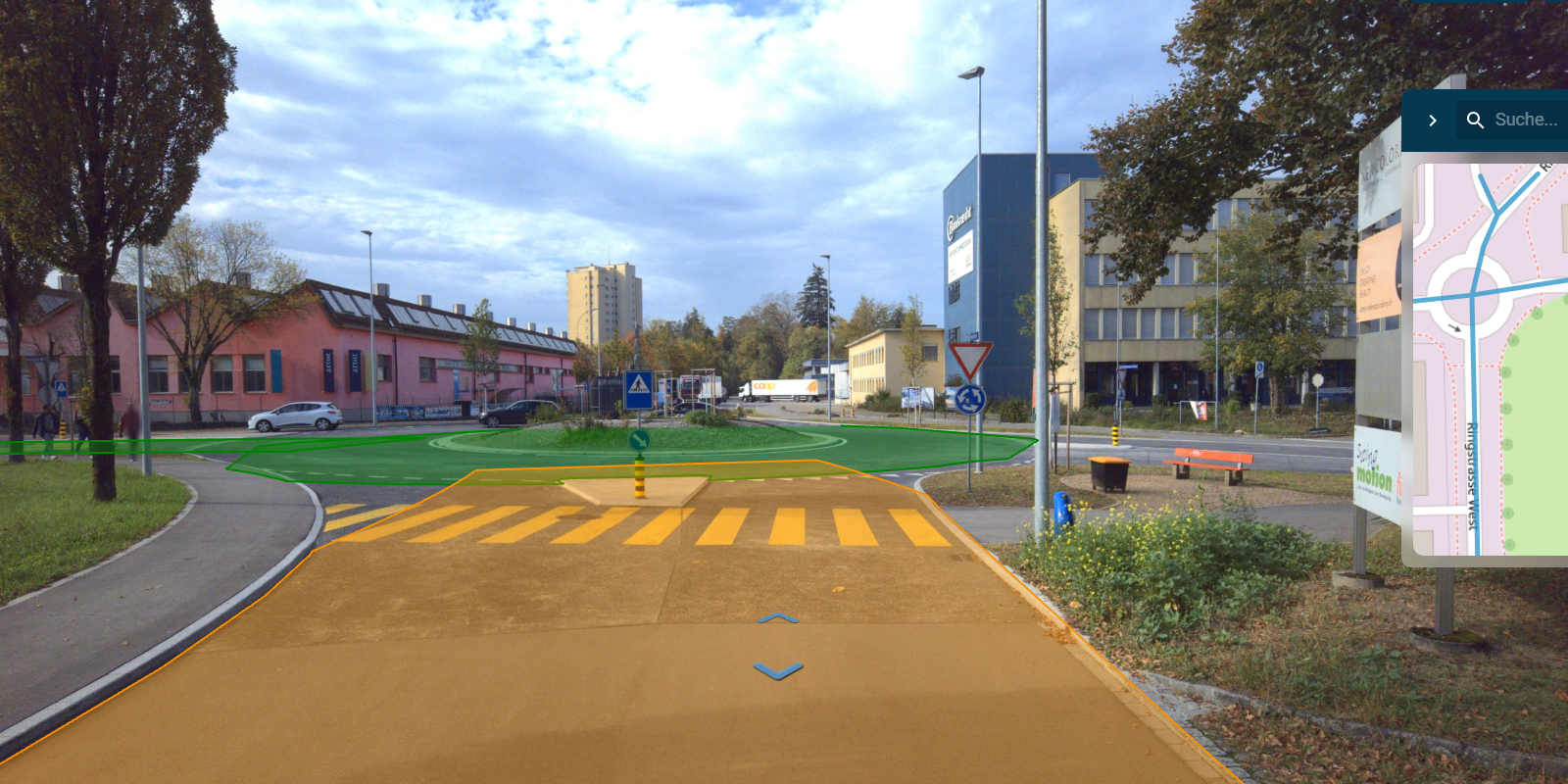
    From mid-July 2025, iNovitas from Baden will be mapping the streets in the district of Horgen. The company is creating a three-dimensional digital image of the public road network, according to a press release. The data obtained from the model is intended to form a basis for the areas of administration, utilities management and planning. The digital image reduces the time and effort required for inspection trips and inspections and should therefore provide an efficient organisation for maintenance and planning directly from the office.

    The municipal and cantonal roads of Adliswil, Kilchberg, Langnau am Albis, Rüschlikon, Thalwil and Oberrieden will be digitised. The municipality of Horgen had already commissioned iNovitas to carry out this work at an earlier stage. The data is recorded exclusively on public roads. According to the press release, people and number plates are anonymised, thereby protecting personal rights. The captured image and geodata is provided via the web-based infra3D platform and is only available to authorised specialists or administrative bodies with the appropriate authorisation.

  • Where electricity will come from in 2050

    Where electricity will come from in 2050

    For Switzerland to become CO₂-neutral by 2050, transport, heat supply and industry must be largely electrified. Today’s electricity demand of 56 terawatt hours will increase to around 75 TWh by 2050. At the same time, 23 TWh will come from nuclear energy. The necessary reorganisation of the energy system is far-reaching in technical, economic and social terms.

    Massive expansion of renewable energy
    According to the EDGE report, around 60 % of electricity must be covered by new renewable energies by 2050, specifically 45 TWh per year. This would be possible with 28 TWh from photovoltaics, 13 TWh from wind power and 4 TWh from biomass. To achieve this, photovoltaic capacity would have to be quadrupled to 26.8 GW. Wind power would need to be expanded 80-fold to 8.4 GW, especially for winter operation. According to the researchers, this is hardly realisable without strong subsidies.

    Limiting electricity imports makes the system more expensive
    The new Electricity Act limits net electricity imports in winter to 5 TWh. In order to meet this target, an additional 80 % more wind power, 11 % more gas capacity and 10 % more solar capacity would be required. This would increase electricity generation costs by 20 % and electricity prices could more than double.

    Europe remains decisive
    If European electricity trading were to be severely restricted, e.g. through a 70 % reduction in cross-border grid capacities, Switzerland would have to expand wind power by a further 20 %. Supply costs would rise by an additional 8 %. A survey by the EDGE consortium shows the conflicting priorities. 60 % of the population would like to cooperate with Europe, while at the same time 70 % want energy independence and favour domestic energy sources.

    Investments flow abroad
    Another study shows that more than half of the annual investments made by Swiss energy suppliers in large-scale renewable energy projects are channelled mainly to Germany, France and Italy. Only 1 % of these funds are invested in Switzerland. There is a lack of suitable projects or framework conditions in Switzerland. This means that Switzerland is often financing the energy transition indirectly, but not at home.

    Net zero has its price
    The cost of living could rise between 2020 and 2050, for example due to CO₂ taxes, emissions trading or higher production costs. The annual consumption loss of a household could be 0.63-0.75 %, depending on the global climate protection pathway. Without offsetting options abroad, the costs could rise to up to 1%. In the long term, however, this would be more favourable than the consequences of unchecked climate change.

    The energy transition is feasible and challenging
    A CO₂-neutral electricity supply by 2050 is technically possible if photovoltaics and wind power are massively expanded, imports are used intelligently and investments are channelled in a targeted manner. Access to the European electricity market remains crucial. At the same time, we need broad social support and an understanding that inaction will be more expensive than a bold transformation.

  • Climate fund Stadtwerk Winterthur awards grants

    Climate fund Stadtwerk Winterthur awards grants

    The Stadtwerk Winterthur climate fund is awarding 70,000 Swiss francs for environmentally friendly projects this year, according to a press release. The climate fund has been supporting climate protection, energy efficiency and CO2 reduction projects since 2007.

    Next Gas GmbH, based in Kloten, will receive a sum of 30,000 Swiss francs. It develops biogas reactors for small and medium-sized farms. This utilises the potential of liquid manure to generate decentralised heat and electricity. The funding will be channelled into a pilot project in which Next Gas’s fermentation process will be tested during ongoing operations.

    A pilot project organised by the Soily association will be supported with CHF 20,000. Here, a special compost with an ideal mixture of microorganisms is being tested on farms in the Winterthur region. A test field of 50 square metres will initially be set up for this purpose.

    SimpleTrain GmbH, based in Wallisellen, offers an online platform for international train journeys. The expanded platform will also enable bookings for routes that were previously not connected. With the support of Klimafonds Stadtwerk Winterthur, specific routes such as the one from Winterthur to Barcelona via Lyon will be offered. SimpleTrain is also receiving support totalling CHF 20,000 for the project.

    The fund is financed in part by voluntary contributions from electricity customers amounting to 2 centimes per kilowatt hour consumed. For an average household of four, this amounts to CHF 8 per month, according to the press release.

  • Zurich and Aargau plan mobile network

    Zurich and Aargau plan mobile network

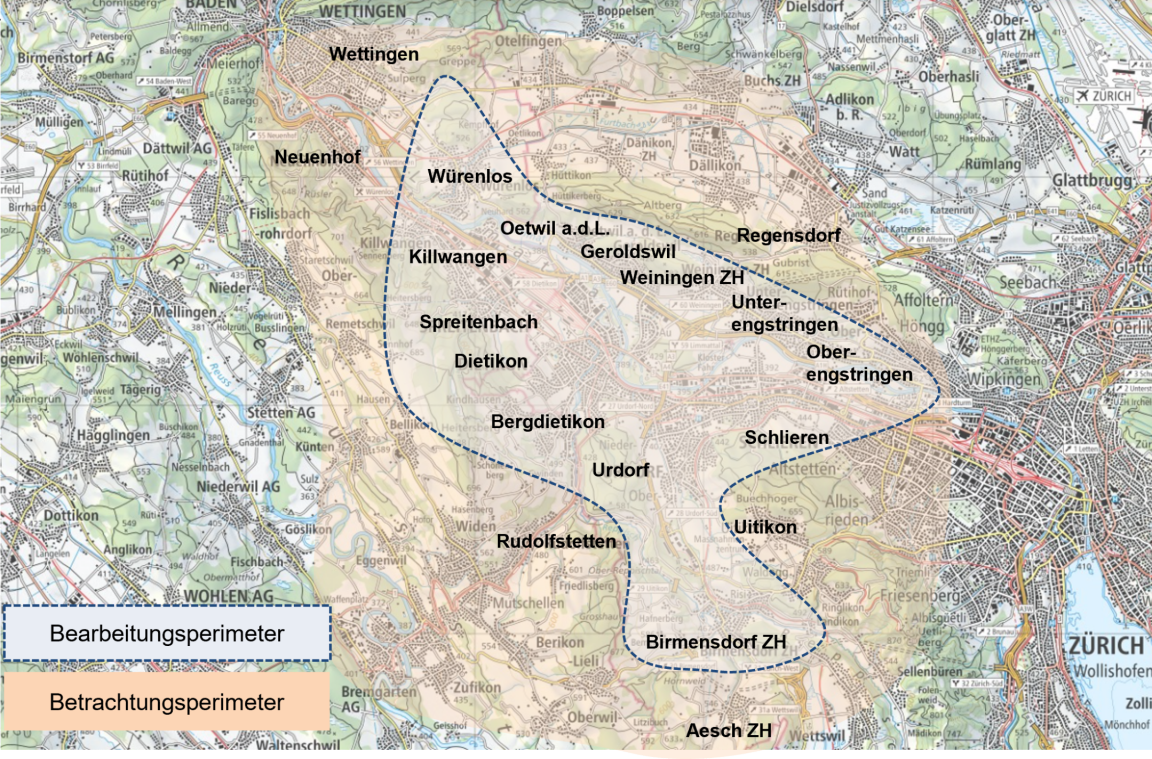
    The Limmat Valley is developing rapidly, not least thanks to new transport projects. In order to strategically address this dynamic, the cantons of Zurich and Aargau, together with three regional planning associations, are launching a cross-cantonal planning instrument:. The Limmattal regional overall transport concept.

    The concept follows the guiding principle “The Limmat Valley is fit for the future” and aims to create a sustainable, efficient and environmentally friendly balance between settlement and transport development. The planning horizon extends to the year 2050.

    Multimodal networking as a guideline
    The focus is on improving regional networking, promoting multimodal solutions and integrating logistics concepts. Neighbouring regions such as the Furttal or the city of Zurich are also included.

    The results of the concept will form the basis for future agglomeration programmes and will flow into concrete implementation in the municipalities and cantons from 2027/2028. Objectives, strategies and measures will be developed in several phases by the end of 2026.

    Structured process with regional participation
    The project will be managed by a steering group with representatives from the cantons and regional planning associations. Broad participation by the municipalities and public information events ensure transparency and acceptance.

    Project manager Sarah Hug (Canton of Zurich) and project manager Dominik Kramer (Canton of Aargau) are coordinating the participatory process. Public information events are planned on 5 November 2025 and 13 May 2026, among other dates.

    Mobility strategy with a signalling effect
    The rGVK Limmattal is a model project for intercantonal cooperation in one of Switzerland’s most economically significant development areas. It shows how regional and supra-regional interests can be united in a joint strategy for sustainable mobility.

  • Spatial concept Switzerland without substance

    Spatial concept Switzerland without substance

    The revision of the Swiss Spatial Concept was intended to provide a strategic compass for spatial development up to 2050. However, the document presented in December 2024 does not adequately address key issues such as densification, infrastructure and conflicts of use. Yet the demand for intelligently utilised space, resilient infrastructure and sustainable solutions for growing cities and regions is more urgent than ever before.

    Densification remains unresolved
    The depiction of advanced inner-city development is at odds with reality. Replacement new builds, a key means of densified construction, are still fraught with uncertainties and hurdles. There is a lack of a pragmatic implementation concept that creates clear rules, facilitates investment and accelerates site development. This is an omission with consequences for housing construction and the competitiveness of urban areas.

    Transport is blocked instead of facilitated
    A further deficit can be seen in the transport infrastructure. The spatial concept neglects the need for efficient transport routes and promotes a conflict between road and rail. However, sustainable location development requires networked mobility strategies that fulfil both economic and social requirements.

    Without political backing, everything remains theory
    In addition to its substantive weaknesses, the concept lacks clear political legitimisation. Without broad-based governance structures, the paper will remain ineffective. The Swiss Federation of Master Builders has therefore submitted amendments and rejects the draft in its current form.

    Conclusion for the property industry
    If you want to develop locations and help shape Switzerland as an attractive place to live and do business, you need solid framework conditions and a realistic planning policy. The current spatial concept offers neither. It is time for a practice-orientated model that creates planning security, facilitates investment and strengthens the attractiveness of locations in the long term.

  • Netherlands tests recycling train for sustainable road construction

    Netherlands tests recycling train for sustainable road construction

    Crushed stone, sand, gravel and petroleum-based bitumen in asphalt roads are the same materials that make up new roads. The only difference is that the asphalt has already been heated and laid.

    For this reason, Dutch officials from the Rijkswaterstaat infrastructure agency in Utrecht, part of the Ministry of Infrastructure and Water Management, have invested in the Asphalt Recycling Train (ART or Asphalt Recycling Train). This is a vehicle-like machine that reuses old roads on site instead of tearing them up and disposing of them and then using new materials and thus emitting more carbon. This allows new asphalt to be laid in the same place.

    “With the ART, we can renew roads in a far more sustainable way,” Fredy Sierra-Fernandez, who is developing the ART at the ministry, is quoted as saying in a press release. “At the moment, we are testing a single machine to see how it performs in practice.”

    ART loosens the worn surface layer of roads, heats the old asphalt, picks up the melted material, stirs and mixes it and then applies the renewed asphalt back onto the road. The machine also compacts the road to create a smooth surface.

    Fernandez is now investigating how the roads behave after this process. Since June and from October last year, a provincial road in Gelderland in the east of the Netherlands and a section of the A2 highway have been monitored after the ART was used there.

    The road in Gelderland is in good condition. The section of the A2 highway is somewhat more worn, but still adequate. “We will continue until we are 100 percent satisfied,” says Fernandez. Tests in other regions are planned for April and May 2025.

    The Dutch government hopes to have three or four ARTs in operation across the country by 2030 to create a circular economy for asphalt.

    The ART was awarded the InfraTech Innovatieprijs 2025.

  • Mobile office brings coworking to the countryside and the water

    Mobile office brings coworking to the countryside and the water

    Coworking provider Westhive from Zurich and AMAG are jointly realising an idea for mobile working in modern vintage double-decker buses, according to a press release. These have been converted into express buses and transformed into mobile workstations with a coffee bar, WLAN and power connections.

    Interested parties can book the mobile office via the Airbnb platform. The innovative offer will initially be available in Switzerland and will later be expanded internationally as part of Airbnb’s “global Live & Work Anywhere programme”.

    “Westhive Express brings the office on wheels – mobile, flexible and everywhere where there was previously no coworking offer,” it says. According to Andreas Widmer, co-founder of Westhive, the form of work stands for “freedom and movement”.

    The Westhive Express bridges the gap between classic mobility and modern working culture with a concept that is reminiscent of outdoor cafés. “In front of the bus, small tables with parasols invite you to take a creative break in the countryside – be it on the lakeshore, at a festival or in a rural community,” it says.

    For Philipp Wetzel, Managing Director AMAG Corporate Development, Innovation & Venture LAB, quoted in the press release, mobility, hospitality and productive work are combined as a “logical development of the digital lifestyle”.

    According to the press release, the first Westhive express bus will soon set off on its maiden voyage. Further mobile units are being planned.

  • SBB continues to develop Basel

    SBB continues to develop Basel

    With the “Wolf Basel” project, SBB is transforming a 160,000 square metre site in the east of the city into a lively, sustainable urban quarter. The transformation is exemplary for the intelligent densification of urban spaces. Living, working, leisure and logistics are to coexist here in a new form that conserves resources, is sustainable and integrated into the existing urban structure.

    Construction work on the western part of the site will start in 2027. SBB has sought and found top architectural and functional solutions in two competitions. The jury, consisting of independent experts and representatives of the client and the Canton of Basel-Stadt, has now recommended the projects “Janus” by ARGE Experience from Paris with M-AP Architects from Lausanne and “Binaria” by ARGE Parabase GmbH and Confirm AG from Basel for realisation. The two new ten-storey buildings will offer around 300 flats and set standards in terms of sustainability, quality of living and architectural integration.

    Sustainability meets urban innovation
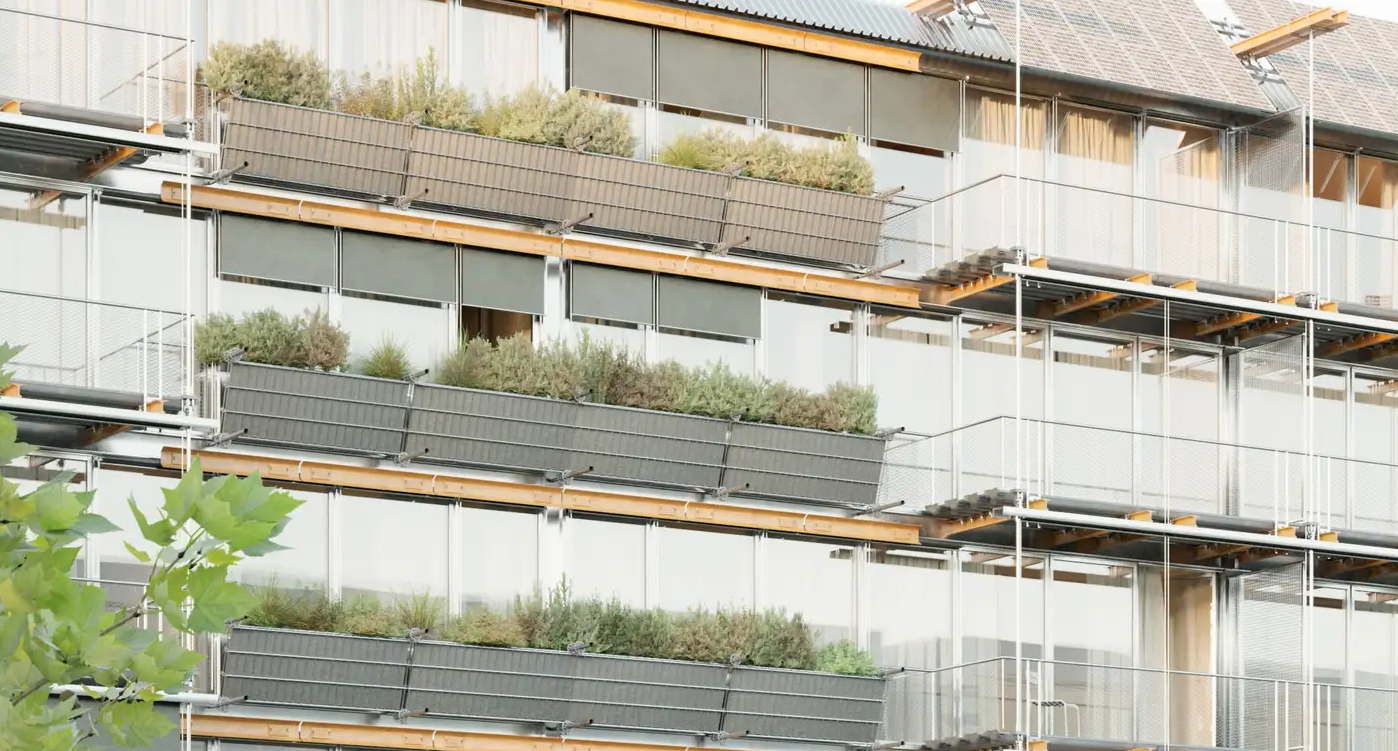
    The planned residential buildings reflect the changes in urban development. The flats are designed for different lifestyles, and communal areas in the ground floor zones promote social interaction. The roofs not only serve as a source of energy through photovoltaics, but also as water reservoirs and in some cases as accessible recreational areas. Photovoltaic elements on the façades, greenery, renewable heating systems and sophisticated systems for cooling in summer are all part of a comprehensive energy concept.

    The project also sets new standards in terms of construction. Screw connections replace adhesive joints, modular structures allow for later conversion or dismantling, making design for disassembly a reality. Wolf Basel thus presents itself not only as an urban development model, but also as a technical model for the future.

    Identity is created through dialogue
    Even before construction begins, the site will be opened up for interim uses, experiments and participation. A historic railway hall has recently been used as a temporary pickleball court, bringing movement to the centre of the development area. In addition, various spaces are available for longer-term uses in the areas of culture, leisure and catering. SBB is calling on people to submit creative ideas and play an active role in shaping the future neighbourhood.

    The opening is more than just a gesture, it is part of a strategy in which urban development is understood as a participatory process. This creates an emotional bond with the neighbourhood and its future identity at an early stage.

    Staged construction with vision
    Construction of Wolf Basel is scheduled to start in 2027. In the first phase, the residential buildings will be built in the western part of the site, including a third in the affordable segment by non-profit property developers. At the same time, the Urban Hub, a public space offering catering, sport, culture and services, will be developed in the middle section. In a second phase, expected from 2031, commercial and service buildings with around 1,000 workplaces will follow in the eastern section.

    The entire project is based on the legally binding development plan dated 2 May 2023 and is an example of the high-quality development of inner-city potential areas in Switzerland.

  • Cham-Hünenberg bypass

    Cham-Hünenberg bypass

    The Cham-Hünenberg bypass (UCH) is more than just a new road. It is the last big piece of the puzzle in the transport planning of the Canton of Zug, which not only serves to bundle transit traffic, but also to free the centre of Cham from through traffic. This ambitious project, which is being implemented by the Canton of Zug’s Department of Construction in collaboration with the Ennetsee municipalities, aims to enhance living and economic areas and improve mobility for all road users.

    Construction and location
    Construction of the UCH has already begun and is scheduled for completion in 2027. The route runs predominantly parallel to the A4 motorway, which allows for minimal land consumption and efficient use of space. This aspect is particularly important in order not to jeopardise the planned settlement and landscape development in the Ennetsee municipalities.

    Tunnelling and construction work
    The main work on the Städtlerwald road tunnel began in March 2024 with the construction of the pumping stations and settling basins. The tunnel operations centre is also being built, while the pre-cut for the Stumpen tunnel portal is being constructed in parallel. The tunnel itself will have a total length of 543 metres, the majority of which will be created underground using a roadheader.

    Progress of the preliminary work
    Preliminary construction work has been taking place along the future UCH route since 2022 and has now been completed. The first ground works along the western UCH perimeter and neighbouring N4 national roads are already in full swing. Neighbouring woodland areas have already been cleared, with the standing tree trunks being handed over to the hydraulic engineering department for later projects.

    A benefit for all road users
    The Cham-Hünenberg bypass not only promises improvements for road traffic, but also positive effects on the quality of life of local residents. By relieving the congestion in the villages of Cham and Hünenberg, a quieter and safer living environment will be created, offering space for additional leisure and recreational activities. The improved transport links will also encourage companies to settle in the region, which in turn will strengthen Zug as a business location.

  • Start of construction for the Bern West performance upgrade

    Start of construction for the Bern West performance upgrade

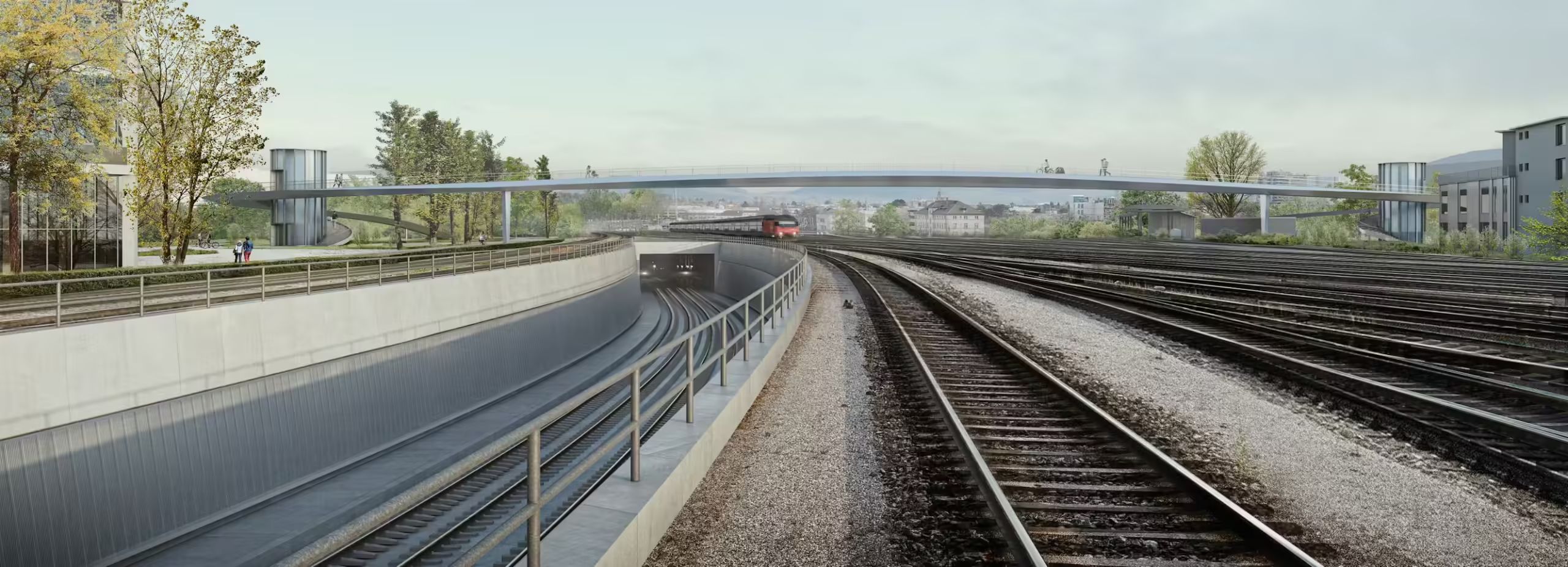
    SBB, in cooperation with the City of Bern and BLS, is launching one of the region’s most important infrastructure projects, the “Bern West performance upgrade”. The aim is to make the Bern railway junction more flexible, more stable and more efficient. The major project comprises five sub-projects, including the new Holligentunnel, the Europaplatz Nord railway station and the Steigerhubel overpass.

    A milestone for the Bern railway junction
    A particular focus is on improving regional transport. The new Holligen tunnel will allow regional trains to run without crossings, enabling stable and more frequent connections, such as the quarter-hourly service between Münsingen and Flamatt. The urban Europaplatz neighbourhood will also have a direct connection to public transport thanks to the new station and a larger subway.

    Challenges for travellers and residents
    Rail operations will be maintained during the construction period, which will last until at least 2036. Nevertheless, travellers will have to be prepared for timetable changes and replacement buses. Stöckacker station will close in December 2025 and will be replaced by tram line 8 until Europaplatz Nord opens in 2027.

    For local residents, the work will result in restrictions due to construction noise, dust and logistics traffic. However, the builders promise to minimise emissions as far as possible and to carry out replacement planting for felled trees.

    Sustainable future and financing
    The total cost of the project is around 900 million Swiss francs and will be financed by the federal government’s 2025 expansion programme. The new pedestrian subway at Europaplatz Nord, a contribution from the City of Bern, will be covered by a framework credit of CHF 60 million.

    With the completion of the “Bern West performance upgrade”, Bern’s railway infrastructure will meet the requirements of modern, sustainable mobility – a benefit for the entire region.

  • Virtual reality for urban planning

    Virtual reality for urban planning

    Researchers at ZHdK and ZHAW have developed an innovative tool for participatory urban design. Using virtual reality (VR), residents and those responsible are given the opportunity to experience planned redesigns virtually. For example, the effects of traffic-calming measures on street noise, space conditions or bicycle and pedestrian traffic can be experienced through the senses of sight and hearing.

    In the Gestalte Zürich project, the researchers support the Zurich city administration in planning sustainable spaces in the city, explains the ZHdK in the project description. Gestalte Zürich is supported by the City of Zurich‘s Department of Urban Planning, the city’s Civil Engineering Department and the Zurich Transport Authority. Other practice partners are the organisations myclimate, umverkehR and Fussverkehr Schweiz. Prototypes of the VR tool could be tried out on 20 September at Zurich Park(ing) Day. The project, which will run until next year, is funded by the digitalisation initiative. Its aim is to strengthen cooperation between Zurich’s universities on the topic of digitalisation.

  • Fire services rely on climate-friendly hydrogenated vegetable oil

    Fire services rely on climate-friendly hydrogenated vegetable oil

    GVZ is testing the use of hydrotreated vegetable oil (HVO) as a fuel for fire engines in a pilot project. “From today, Schutz & Rettung Zürich, the Kloten and Wallisellen fire brigades, the Männedorf-Uetikon fire brigade and the St.Gallen professional fire brigade will be refuelling some of their vehicles with HVO,” GVZ announced in a press release. The five fire brigades are particularly suitable for participating in the project as they have their own refuelling facilities.

    “We would like to thank the five fire services for their participation in this promising project and look forward to the initial results,” said Renato Mathys, Head of Fire Services at GVZ, in the press release. “Our aim is to make a contribution to improving the environmental footprint of fire engines.” GVZ has procured a total of 28,000 litres of HVO for the pilot project. It is also paying the difference between the price of the fossil-free fuel and the current price of diesel.

    According to the press release, hydrogenated vegetable oil has a significantly better carbon footprint than diesel and also scores highly in terms of energy density and storage stability. As the biofuel is produced from used cooking oils and fats, its production is not at the expense of food production. The GVZ cites its uncomplicated use as a further advantage: “Diesel engines do not have to be expensively converted, but can be operated and maintained according to the same plan as when running on diesel fuel.”

  • Landsgemeinde decides on Braunwald’s development

    Landsgemeinde decides on Braunwald’s development

    The future development of Braunwald will be determined by the Landsgemeinde 2025. Following intensive political and public discussions, a revision of the law on public transport will allow citizens to decide on the development option. The cantonal government favours the modernisation of the funicular railway as the most economical solution with low procedural risk and shorter construction time.

    The favoured solution
    After a long evaluation phase, the cantonal government opted for a new funicular railway, which is considered the most cost-effective and practicable option. It involves investment costs of CHF 24 million and operating costs of CHF 3 million per year. Compared to a gondola lift, which would be almost twice as expensive to build and would take up to ten years to complete, the funicular railway offers clear advantages. An automated funicular railway would also enable use independent of the timetable.

    Legal amendments to involve the Landsgemeinde
    The cantonal government has decided to include the development of Braunwald in a new article of the Public Transport Act, which will enable a discussion and vote at the Landsgemeinde 2025. This will give the population the final say on this important infrastructural decision. Should the Landsgemeinde vote in favour of an alternative gondola lift, the cantonal government would initiate the corresponding planning adjustments.

    Investments and future prospects
    The planned investments of CHF 24 million for the construction of the funicular railway and CHF 3 million for its operation will create sustainable and future-oriented access for Braunwald. The cantonal government expects that the decision of the Landsgemeinde will be an important step towards economic and environmentally friendly mobility, which will strengthen the region in the long term and promote tourism.

  • First trains travel through the west tunnel of the Gotthard Base Tunnel again

    First trains travel through the west tunnel of the Gotthard Base Tunnel again

    Following the successful completion of test operations, the first trains once again travelled through the repaired west tunnel of the Gotthard Base Tunnel on 19 August 2024. The first commercial train, an early train from Chiasso to Basel, marked this important milestone. Another goods train followed, operated by SBB Cargo International. SBB will continue to carry out test runs in the coming weeks in preparation for the full reopening on 2 September 2024.

    Gradual return to normality
    Cleaning work will take place repeatedly in the run-up to the full reopening. From 2 September, the half-hourly frequency for all InterCity and EuroCity trains between German-speaking Switzerland and Ticino will be restored. This will provide travellers with a significantly faster connection through the Gotthard Base Tunnel, reducing journey times by an hour.

    Important progress on the road to normalisation
    With the trial operation in the west tunnel and the successful tests, SBB is ensuring that the Gotthard Base Tunnel will soon be fully available again. This is of key importance not only for passenger transport, but also for freight transport. The tunnel remains one of the most important transport routes in Switzerland and Europe.

    Work on the tunnel is continuing as planned and SBB is confident that regular operations can be resumed from the beginning of September 2024.

  • Milestone at Basel railway station

    Milestone at Basel railway station

    Basel SBB railway station is facing a problem. It is reaching the limits of its capacity. The increasing number of trains and travellers, especially at peak times, requires urgent measures to avoid bottlenecks.

    From December 2025, it is planned that the S-Bahn trains between Basel and Liestal will run every quarter of an hour. This ambitious goal requires considerable investment in the railway facilities between Basel and Liestal, which the federal government is financing to the tune of around CHF 1 billion. SBB is responsible for realising these projects on behalf of the federal government, while the federal government and the cantons are jointly ordering and financing the additional S-Bahn connections.

    Most of the investments are included in the 2025 expansion phase, which is part of the “Financing and expansion of the railway infrastructure” (FABI) bill that was approved by the Swiss electorate in February 2014. These expansions not only enable the quarter-hourly S-Bahn service between Basel and Liestal, but also lay the foundation for further improvements in passenger and freight transport.

    Two main measures are required to create the capacity for the planned quarter-hourly service and the extended timetable.

    Additional stops for trains: The planned quarter-hourly frequency will increase the number of trains at Basel SBB station. Additional stopping points and platform edges are therefore required to ensure smooth operations. This is the main objective of the “Basel SBB performance enhancement” project.

    Additional crossing options for travellers: The increasing number of trains leads to more travellers and thus to higher utilisation of the Passerelle at Basel SBB station. In order to cope with this increase, the creation of additional crossing facilities is urgently required. The “Provisional Passerelle” project aims to realise this increase in capacity quickly until further crossings, such as the Margarethen platform access, can be built.

    The temporary pedestrian crossing is a temporary solution until long-term measures can be implemented. The planning and construction of further crossings are planned for the 2035 expansion phase and will also be financed by the federal government.

  • Juice equips charging station with payment terminal from Wallee

    Juice equips charging station with payment terminal from Wallee

    Juice Technology AG and the Wallee Group AG in Winterthur want to simplify the charging of electric cars. To this end, the Bachenbülach-based manufacturer of charging stations and software is equipping its Juice Charger me 3 charging station with the payment terminal from the Winterthur-based payment service provider. In future, users will be able to pay with credit and debit cards as well as contactless with Apple Pay, Google Pay or Twint thanks to the Wallee terminal. This should make other charging cards superfluous and lead to fairer tariffs, as fewer parties are involved in the earnings, according to a press release.

    “As a partner that, like Juice, comes from the canton of Zurich, we offer the perfect complement for Juice charging stations,” said Sascha Krüsi, CXO and co-founder of Wallee, in the press release. Christoph Erni, CEO and founder of Juice, sees the future of e-mobility in the combination of innovative technology and trustworthy payment services.

    The charging station can also be used by commercial providers. For example, restaurants, hotels, retailers or companies with company car parks could become providers of the stations. The Juice and Wallee system is already in use in Laax GR and the Riedmatt Centre in Rümlang ZH.

    The Juice Charger me 3 is compatible with all e-cars.

  • Successful spatial development in the canton of Neuchâtel

    Successful spatial development in the canton of Neuchâtel

    The latest data shows that the canton of Neuchâtel has experienced positive development in various areas of spatial planning. Population growth has stabilised and the number of jobs has risen steadily, indicating robust economic strength. The active involvement of the municipalities in revising their development plans to meet the requirements of the Federal Spatial Planning Act and the cantonal master plan is particularly noteworthy. By the end of 2023, 16 out of 27 municipalities had already submitted their revision files, a step that underlines the consistent adaptation to the prescribed density requirements and the reduction of underutilised building zones.

    One notable aspect of the report is the progressive densification of economic zones, which leads to a more efficient use of available land without compromising the quality of life. Exemplary neighbourhoods illustrate the potential to combine densification with a high quality of life. The availability and quality of public transport has also improved, which supports the canton’s Mobility Strategy 2030. The introduction of new parking regulations and the promotion of soft mobility are further steps towards reducing private transport and promoting more environmentally friendly modes of transport.

    These developments are particularly important for property experts, as they influence the framework conditions for investments and the development of new projects. Strategic densification and the promotion of sustainable mobility concepts offer new opportunities for the development of future-oriented property projects. In addition, measures to protect agricultural land and reduce energy consumption contribute to more sustainable development, which can increase the value of property in the long term.

    In conclusion, the report notes that despite the encouraging developments, challenges remain, particularly with regard to the ageing population and the need to develop adapted forms of housing. The ongoing revision of local development plans and the focus on sustainable neighbourhoods and high-quality public spaces will be key issues in future spatial planning. For property management professionals, this report provides a sound basis for strategic decision-making and underlines the importance of forward-looking planning in the dynamic landscape of the property market.

  • Overall transport concept for Baden and the surrounding area

    Overall transport concept for Baden and the surrounding area

    Im Rahmen des ambitionierten Gesamtverkehrskonzepts für den Raum Baden haben zehn beteiligte Gemeinden einen entscheidenden Schritt vollzogen. Diese Ziele, ausgerichtet bis zum Jahr 2040, zielen darauf ab, die Mobilität im Raum Baden effizienter, umweltschonender und zukunftsfähiger zu gestalten. Zu den Kernpunkten gehören die Förderung einer flächensparenden Mobilität, die Schaffung attraktiver Bedingungen für den Arbeits- und Bildungsverkehr und die Sicherstellung einer stabilen Erreichbarkeit für den Autoverkehr. Die Planungen unterstützen zudem eine Siedlungsentwicklung in gut mit dem öffentlichen Verkehr erschlossenen Gebieten.

    Ein besonderes Augenmerk gilt dem Transit-Schwerverkehr, für welchen spezifische Erfolgskriterien hinzugefügt wurden, um die Siedlungsgebiete zu schonen. Dies folgt einem Antrag der Gemeinde Obersiggenthal, der eine Zunahme des Transitschwerverkehrs verhindern möchte.

    Mit dem Abschluss der ersten beiden Planungsschritte hat die Behördendelegation eine solide Grundlage für die nachfolgenden Fachplanungen geschaffen. Abschließend ist es das Ziel des Kantons Aargau, in Kooperation mit den lokalen Akteuren, ein vorausschauendes und integriertes Mobilitätsangebot zu entwickeln. Die Ergebnisse der GVK-Planung sollen bis 2025 in den kantonalen Richtplan aufgenommen werden, um die Weichen für zukünftige Mobilitätsbedürfnisse rechtzeitig zu stellen.

  • Verkehrs- und Siedlungskonzept für 2025 Seeland Biel

    Verkehrs- und Siedlungskonzept für 2025 Seeland Biel

    Die Region seeland.biel/bienne arbeitet derzeit an der Aktualisierung des Regionalen Gesamtverkehrs- und Siedlungskonzepts 2025 (RGSK 2025) sowie des Agglomerationsprogramms der 5. Generation (AP5). Diese beiden Planungsinstrumente zielen darauf ab, die Siedlungs-, Landschafts- und Verkehrsplanung in der Region harmonisch aufeinander abzustimmen und stehen bis zum 11. März 2024 zur öffentlichen Mitwirkung offen.

    Die Koordination dieser Planungen über Gemeindegrenzen hinweg ist für die Region seeland.biel/bienne eine zentrale Aufgabe. Das RGSK und das AP verfolgen das gemeinsame Ziel, eine nachhaltige Entwicklung zu fördern, die sowohl den Bedürfnissen der Bevölkerung und der Wirtschaft entspricht als auch sorgsam mit dem knappen Boden umgeht und dabei die Umwelt schützt. Dies geschieht vor dem Hintergrund eines wachsenden Bevölkerungszuwachses und steigender Mobilitätsbedürfnisse.

    Das RGSK legt als regionaler Richtplan verbindliche Vorgaben für die Ortsplanungen der Gemeinden fest und fokussiert auf die räumliche und verkehrliche Entwicklung. Das AP schafft die Grundlage für die Mitfinanzierung von Verkehrsprojekten durch den Bund, wobei bereits frühere Generationen des Programms Bundesbeiträge in Millionenhöhe auslösten.

    Das RGSK 2025 wird in zwei Etappen überarbeitet, wobei die erste Etappe bis 2025 die Entwicklung eines neuen Zukunftsbildes für verschiedene Teilräume, die Überprüfung von Vorranggebieten für Siedlungserweiterungen und die Aktualisierung von Maßnahmen umfasst.

    Das AP5 setzt seinen Schwerpunkt auf die Entwicklung von öffentlichen Verkehrsmitteln, Freiräumen und Klimaschutz. Es integriert langfristige Ziele und Strategien, einschließlich des Klimawandels, und stärkt die Siedlungsentwicklung von innen.

    Bis zum 11. März 2024 haben Gemeinden, Verbände, Organisationen und alle Interessierten die Möglichkeit, sich zu beiden Programmen zu äußern. Nach einer Vorprüfung durch den Kanton im Mai 2024 werden RGSK und AP im Frühjahr 2025 der Mitgliederversammlung von seeland.biel/bienne zur Verabschiedung vorgelegt.

  • Zurich Airport has exceeded the canton’s requirements

    Zurich Airport has exceeded the canton’s requirements

    The Zurich cantonal government presented its airport report on 7 December. According to the report, Zurich Airport met the economic and transport requirements in 2022. At CHF 1,024 million, total revenue exceeded CHF 1 billion for the first time since coronavirus, an increase of 50.5 per cent. Costs rose by only 22.9 per cent to CHF 468 million. Profit amounted to 138 million francs, an increase of 149.3 per cent.

    Passenger numbers continued to recover to 23 million, with the government expecting 28 million travellers by 2023. The airport is also doing well in terms of quality: it is ranked 7th globally in terms of accessibility and 8th in terms of quality. According to the presentation by the cantonal government, the number of people affected by aircraft noise fell below the target value of 47,000 at around 43,400. The airport also remained well below 320,000 aircraft movements with 216,000 – 10,000 of which were at night.

    However, the complexity of flight operations remains high, emphasises the government council. Extending the runways, which will be put to the vote in the spring, will reduce the number of intersections in the air and on the ground. This will increase the safety margin, according to a press release on the airport report.

    The cantonal government emphasises the importance of the airport for the location. It is crucial for Switzerland’s international accessibility, an important employer and an economic driver for the canton and Switzerland as a whole.

  • Davos Dorf – future scenario with added value

    Davos Dorf – future scenario with added value

    Initial situation and partnership
    The municipality of Davos, the Rhaetian Railway, Davos Klosters Bergbahnen and the Konsum Davos property cooperative have joined forces in a project competition. The aim is to make the centre of Davos Dorf more modern, barrier-free and traffic-friendly.

    The winning project:
    “Davoser Schlitten

    The winner of the competition is the “Davoser Schlitten” design, which plans a relocation of the railway station, 550 public parking spaces in an underground car park and a barrier-free transport hub. This design is to serve as the basis for a masterplan.

    Infrastructure and living space
    The project includes a new railway station building, several bus stops, a taxi rank and space for bicycles. In the area of the current Parsenn car park, primary residences of a cooperative and warm guest beds are planned. The old railway station is to make way for residential and commercial buildings.

    Sustainability and quality of life
    The project places great emphasis on sustainability and aims to improve the quality of life of the local population by providing affordable living space. A park will be created in the area of Seehofseeli and St. Theodul Church.

    Timetable and public participation
    Further planning phases will follow based on the master plan. The people of Davos will vote on the project at the end of 2024. If the result is positive, the project planning work will continue and the sub-projects will be implemented.

    Statements and public participation
    Key stakeholders such as Reto Branschi, Davos Tourism Director, and Christian Florin, Head of RhB Infrastructure, are positive about the project. The local population is kept informed throughout the entire process and can have their needs incorporated into the planning.

  • Zurich cantonal parliament approves runway extension

    Zurich cantonal parliament approves runway extension

    Flughafen Zürich AG wants to extend Runway 28 by 400 metres to the west and Runway 32 by 280 metres to the north. With this project, the airport wants to implement the conclusions of the 2012 safety review of Zurich Airport(SÜFZ) by the Federal Office of Civil Aviation. The extension of the runways is intended to increase the stability of air traffic in all weather conditions and for all types of aircraft.

    According to a press release, the Zurich Cantonal Council approved the extension on 28 August with a narrow majority of 87 to 83 votes, with two abstentions. The SVP, FDP, Mitte and EVP voted in favour of the proposal, while the other parties rejected it.

    Zurich Airport is pleased with the decision, as it writes in a statement. The longer runways would increase braking distances and reduce crossing points on the ground and in the air. More stable operations would reduce the number of delays as well as those affected by aircraft noise. “There are no alternative measures in flight operations that would bring the same improvements in terms of safety and reduction of delays,” the statement says. The number of flight movements, on the other hand, would remain the same.

    The Zurich Chamber of Commerce(ZHK) also welcomes the decision of the cantonal council. “Zurich Airport is of great economic importance for the greater Zurich area and for the entire country,” it writes in a statement. “To ensure Zurich’s international connectivity with the world in the long term, the airport must be able to adapt to changing circumstances.” ZHK Director Regine Sauter had already campaigned in advance for approval by the cantonal parliament. “The runway extensions bring multiple benefits: Residents benefit from more peace and quiet at night, and Zurich as a business location can count on a punctual airport and reliable connections to the world in the long term,” she is now quoted as saying in the ZHK release.

    The cantonal council’s decision is subject to an optional referendum, so the electorate is likely to have the final say. Only then can the airport submit an application for planning permission to the federal government.

  • Holzbauer Strüby designs roundabout at new traffic junction

    Holzbauer Strüby designs roundabout at new traffic junction

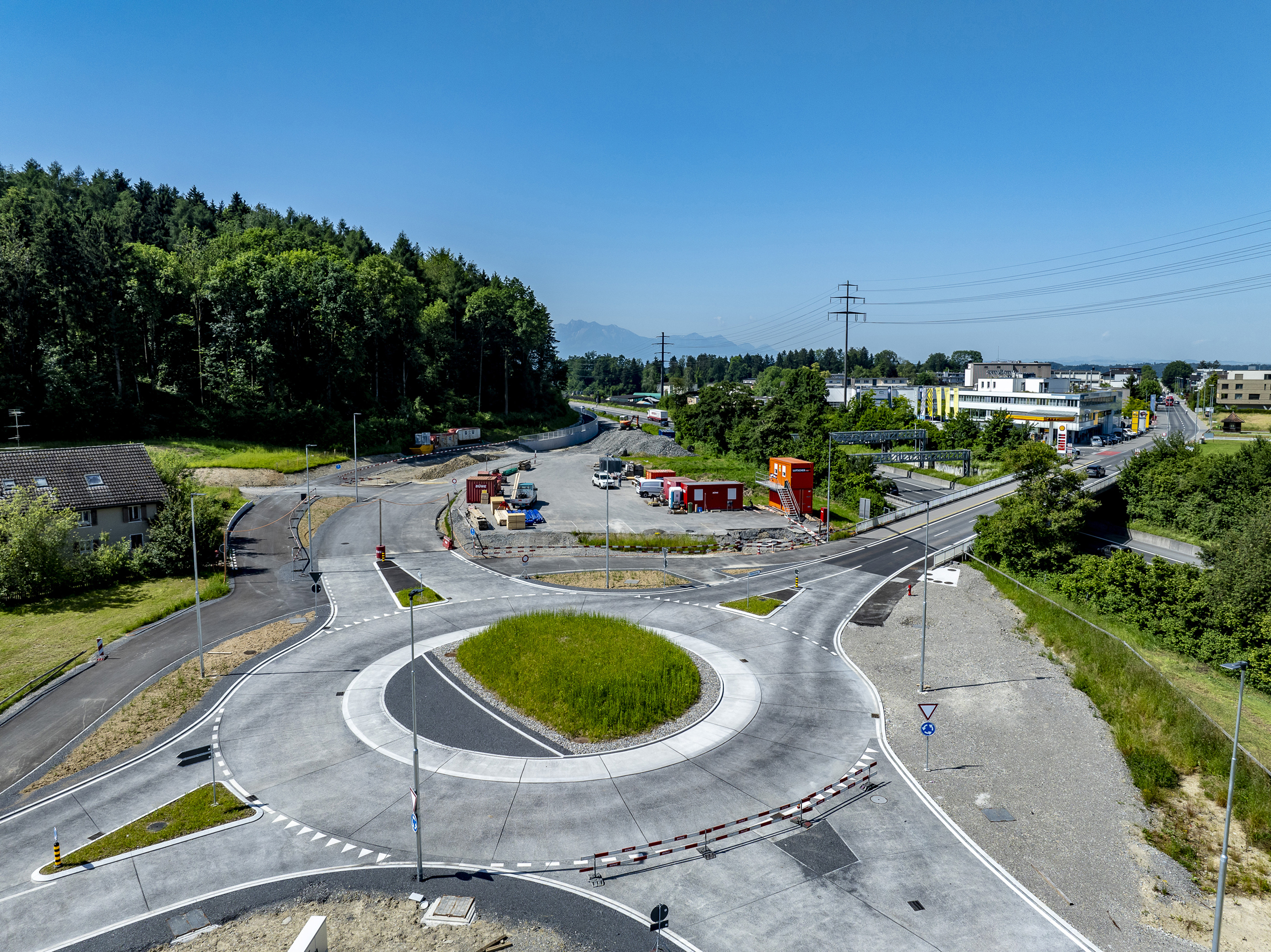
    The timber construction company Strüby, based in Seewen, has successfully completed the design of two roundabouts in its home municipality, according to its media release. Construction work for the H8 full connection on Steinerstrasse had begun at the end of November 2022 on behalf of the cantonal civil engineering office. The new traffic junction was recently ceremoniously opened after 18 years of planning.

    According to the information provided, the wooden structures installed on the two roundabouts are symbolic reminders of basic carpentry virtues. On one, the so-called Schwyz roundabout, the elements of a carpenter’s knot were set up separately. This perfect wooden connection is also found in the coats of arms of the municipality and the canton. It consists of a total of six friction-locked construction elements in the form of squared timbers of the same size but cut differently. The pavement of the Schwyz roundabout resembles the traditional cobblestones of Schwyz’s main square.

    In the second, the so-called Mythen roundabout in the direction of Steinen, the wooden elements are joined together in a cross shape. The sculpture is not only related to the Steinerstrasse and H8 crossroads, but also symbolically to the summit cross on the Gross Mythen. Like its namesake, the surface of the Mythen roundabout is made of local limestone. The signal yellow outline of both roundabouts is intended as a reminder of the many hiking trail signs in the region.

  • One app brings all means of transport together

    One app brings all means of transport together

    MixMyRide wants to promote alternatives to the privately used car and therefore networks all means of transport with a mobility app. Until now, trams, bicycles and carpooling had to be booked separately. With the help of data on public transport, dynamic data on carpooling and bikesharing, and intelligent algorithms, mobility demand and supply are now to be coordinated. The app was developed by a Switzerland-wide consortium consisting of institutes from the ZHAW School of Engineering and the Scuola universitaria professionale della Svizzera italiana (SUPSI). The WinLab of the city of Winterthur, the mobility service provider BePooler, the transport consultant Citec and the Lugano Living Lab were also involved in the development.

    Combining modes of transport optimally
    The mobility app primarily serves as a journey planning system based on artificial intelligence algorithms developed in-house. The app shows different means of transport for the desired trip by determining optimal combinations of route segments based on the available mobility services, which include walking and cycling routes – either by private bike or bikesharing – as well as e-scooters. In addition, once a ride has been found, MixMyRide also enables the booking and organisation of the ride by mediating between people looking for or offering a ride.

    Testing effectiveness in real life
    The app is available until February 2024 and covers the regions of Lugano, Geneva and Winterthur/Zurich. It is now being tested for a year. The ZHAW researchers have supported the development of the app in terms of design and functionality and are the local contact for the test phase in the Winterthur/Zurich region. They are also leading the evaluation, including conducting and analysing surveys. “The test phase enables us to evaluate the potential for behavioural change through MixMyRide and to estimate any effects on overall energy consumption and CO2 emissions,” explains Uros Tomic from the ZHAW Institute for Sustainable Development.

    Testers wanted for MixMyRide
    Anyone interested can download and test the MixMyRide app from the iOS App Store or the Android Play Store at any time. If volunteer app users also take part in the surveys and any group interviews, they will help to understand the impact of the app on mobility behaviour and may be entered into prize draws.

    Further information: mixmyride.com/en

  • Aargau department receives award for mediation

    Aargau department receives award for mediation

    For the first time, the Mediation Award of the Swiss Mediation Association (SDM) goes to a canton. The Aargau Department of Construction, Transport and the Environment(BVU) is being honoured for its consensus-oriented procedures in infrastructure projects. The procedure of the BVU shows “that living democracy with mediation and mediation-like participatory interests offers various forms that go far beyond majority decisions”, according to the SDM’s statement of reasons. Where controversies and different interests emerged, the possibilities of mediation were used. BVU, under its Secretary General Markus Büsser, plays a pioneering role in mediation in the public sector.

    The BVU is delighted with the award. “In the BVU’s areas of responsibility, conflicting goals, differences and differing perspectives are part of daily business,” Büsser is quoted as saying in a statement from the canton. “The department management therefore regularly considers how it can promote a culture of communication and conflict that enables dialogue-oriented and sustainable cooperation.” The BVU refers, for example, to the round tables on the expansion of the Mellikon quarry, the floodplains in the Rietheimer Feld and the settlement of grid usage prices for electricity.

    The Swiss Mediation Prize will be awarded for the third time in 2023. The Haus Tabea retirement centre in Horgen ZH also received an award. The prize will be presented at the SDM Congress, which will take place in Lausanne on 16 and 17 June.

  • New hub for the energy industry at the Museum of Transport Lucerne

    New hub for the energy industry at the Museum of Transport Lucerne

    The “House of Energy” at the Museum of Transport Lucerne is a new, long-term platform on the subject of energy. Not only transport and mobility are connected with energy – energy is needed for every form of locomotion. But it also plays a key role in the burning issue of climate change: transport alone accounts for more than a third of CO2 emissions in Switzerland.

    Many people still do not understand the complex interrelationships. The Swiss Museum of Transport wants to change this with its new exhibition. On an area of 600 square metres, the interrelationships and their effects on society are to be shown: How do housing and mobility interact? What might innovative solutions and Switzerland’s energy future look like in 2050? Visitors will be able to view exhibits and interactive attractions that illustrate and bring to life the past, present and future of energy. In addition, various conferences and events on the topic of energy are planned from 2023.

    The purpose-built building by Gigon Guyer Architekten from Zurich, which replaces the former “Schienenverkehr 1” hall, was designed with the latest generation of energy technology equipment: Minergie P is the standard, the energy centre runs on water, and photovoltaic systems have been installed on the roof and the façade. Thanks to this energy centre, the entire Swiss Museum of Transport will be able to run largely on renewable energy in the future. In realising the project, the Swiss Museum of Transport worked together with partners from politics, administration, science and business. The “House of Energy” is intended to serve as an educational venue for schools and universities as well as an experimental laboratory and innovation location for initiating and accompanying activities and projects in the context of sustainable mobility.

    The Swiss Museum of Transport in Lucerne, with its strong visitor numbers of 500,000 to 600,000 people per year at the museum, sees itself as a partner in the transformation process towards the targeted net-zero climate neutrality in 2050. The new energy platform is intended to promote interest in and discussion of the topics of energy and mobility with a focus on Switzerland. The goals include imparting knowledge, creating a strong connection to the everyday lives of visitors, and transparently presenting the challenges along with possible solutions and communication in relation to schools and the professional world. The interactive exhibition will open in April 2023. The new building, which does not include the energy centre and tenant improvements, cost around 37.8 million Swiss francs.

  • Lucerne bypass relieves road network

    Lucerne bypass relieves road network

    In the past ten years, traffic to and from Lucerne has increased by around 20 percent. Further growth is forecast – but the A2 and A14 are already reaching their capacity limits. At the Rotsee junction outside Lucerne, the traffic flows of the A2 north-south axis and the A14 from Zurich-Zug meet. On the city thoroughfare, regional and local destination and source traffic are added. In order to ease the situation, the federal government wants to significantly improve the traffic situation on both motorways with the Lucerne bypass. Without the bypass, alternative traffic on the subordinate road network would increase, and as a result, public transport would also be impeded.

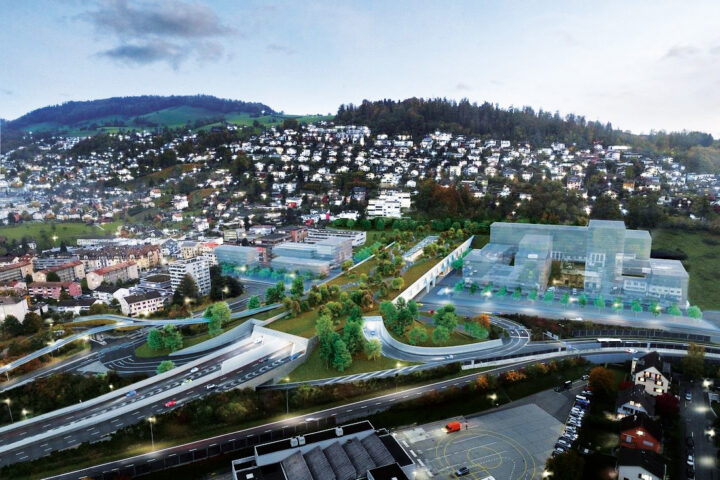
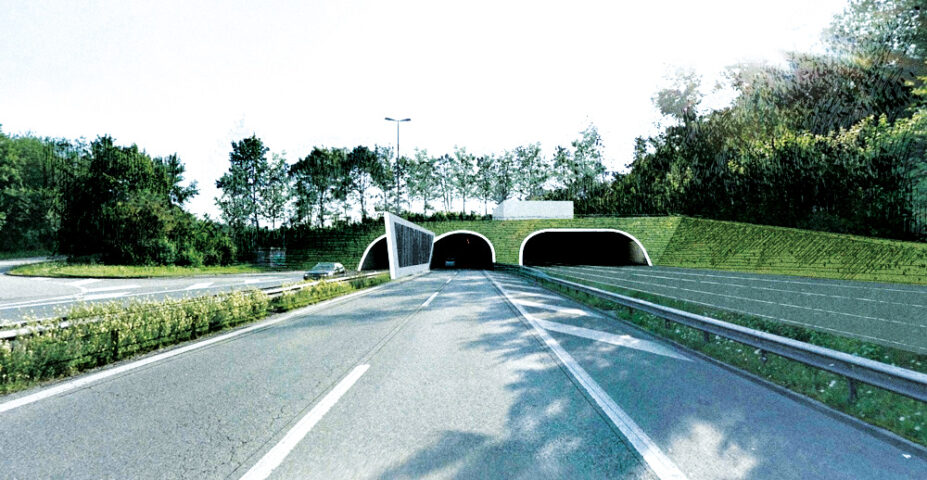
    The core element of the bypass consists of two two-lane tunnels with a length of 3760 metres in the northbound direction and 3850 metres in the southbound direction, which pass under the city of Lucerne and the Reuss river. In the north, the connection points are in the Ibach area and in the south in the Grosshof area (Lucerne-Kriens). The planned tunnel bypass is primarily intended to accommodate transit traffic.

    In addition, it is planned to expand the A14 in the north from four lanes today to six lanes in the future from the Rotsee junction to the Buchrain junction. To achieve this, the Rathausen tunnel will be extended with a third tube. The structures will be adapted at the Rotsee junction. At the Rotsee junction, the A2/A14 Basel lane will be widened to two lanes in the direction of Zug in order to eliminate the existing bottleneck.

    Between the Rotsee junction and the Lucerne-Kriens junction, the A2 will become an urban motorway serving exclusively the destinations, sources and domestic traffic of the Lucerne conurbation. Emmen Süd, Luzern-Zentrum and Luzern-Kriens are connected to it. If necessary, for example in the event of an incident or during maintenance and repair work, the urban motorway serves as an alternative route to the bypass and vice versa.

    The Grosshof bridges as the new gateway to the city of Kriens.

    In the south, the Spier tunnel between the Lucerne-Horw and Hergiswil junctions is to be re-marked with three lanes in each direction. The third lane will extend the entry and exit lanes. The new Grosshof bridges will provide the town of Kriens with a new gateway: a park with paths from Sonnenberg to Kriens, Horw and Lucerne is planned on the roof. Below the bridge, a diverse mix of uses is to be created, including cafés, shops and commercial space.

    The Lucerne bypass envisages the construction of three new road wastewater treatment plants (SABA) in Rathausen, at the Rotsee junction and at Grosshof-Kriens. Thanks to these, the wastewater from the motorway will be cleaned in an ecological way before it flows into the surrounding water bodies.

    The Bypass relief project is intended to improve the flow of traffic on the motorways and ensure the functionality of the north-south axis. It will also create alternative routes in case of accidents or maintenance work. Central Switzerland and the Lucerne agglomeration will benefit from better accessibility, and the urban motorway will be relieved of through traffic. Last but not least, safety for all road users will be increased.

    The Rathausen tunnel will be extended with a third tube.

    The total costs amount to CHF 1.8 billion and are financed by the federal government. If everything goes according to plan, the bypass should be open to traffic in about 2035 after about 12 years of construction – subject to the still pending planning permission.

  • Cantonal Council committee approves extension of airport runways

    Cantonal Council committee approves extension of airport runways

    The Zurich Cantonal Council ‘s Commission for Energy, Transport and the Environment is in favour of the planned extension of Runways 28 and 32 at Zurich Airport by eight votes to seven, the Zurich Cantonal Council informs in a statement. According to the eight commission members from SVP, FDP, Mitte and EVP, an extension of the two runways will only lead to the consolidation of flight operations during peak times and bad weather conditions. Among other things, the communication cites greater reliability and punctuality.

    The minority of SP, GLP and Greens, on the other hand, fears that an extension of the runways will also be used to expand capacities at Zurich Airport. However, they reject any growth at the airport “due to the pressing climate problems”, the statement says.

    The airport is “pleased to note” the decision, it writes in a statement. The extension of the runways was an important measure to increase the safety margin and stabilise operations. They do not lead to an increase in capacity. There is no correlation between the length of the runways and the number of aircraft landing and taking off.

    The Zurich Chamber of Commerce(ZHK) also welcomes the Commission’s decision. The existing system has proven to be “not stable enough”. Increased delays endanger “the function of Zurich Airport as Switzerland’s only intercontinental air traffic hub”, the ZHK writes in a commentary. “The runway extensions already demanded by the federal government enable the airport to function reliably and stably in all weather conditions.”

    The next step is for the cantonal council to decide. The project is subject to an optional referendum.

  • DETEC approves road construction projects

    DETEC approves road construction projects

    This year the federal government will spend a total of around CHF 2.8 billion on new or continued work on the Swiss road network. The Federal Department of the Environment, Transport, Energy and Communications(DETEC) has now approved the corresponding construction programmes.

    According to this, by far the largest part of 1.6 billion Swiss francs will be spent on the maintenance and improvement of the existing national road network. A total of 482 million Swiss francs will be available in 2023 for projects within the framework of the Strategic Development Programme for National Roads and for larger projects. According to a press release from the Federal Roads Office, these funds will be invested mainly in the second tube of the Gotthard road tunnel, the six-lane expansion of the Zurich northern bypass (A1), the Lucerne bypass (A2) and the Le Locle bypass (A20).

    In addition, around 453 million Swiss francs are earmarked for the maintenance, the so-called operational maintenance, of the national road network. This includes, among other things, winter services, greenery maintenance, removal of accident damage and cleaning.

    This year, 264 million Swiss francs are available for new constructions within the framework of the network completion, a joint task between the federal government and the cantons, which was decided in 1960. The largest credit, 111 million, was allocated to the canton of Valais. Obwalden receives 18 million, Schwyz 12 million and Uri 7 million.