Tag: Verkehr

  • Shoppi Tivoli takes over the Limmat Valley Railway station

    Shoppi Tivoli takes over the Limmat Valley Railway station

    With a ceremonial "key handover" the "Shoppi Tivoli" stop of the Limmattalbahn (LTB) was handed over to the Shoppi Tivoli shopping center by the operator Aargau Verkehr (AVA) on Monday. According to the Shoppi Tivoli media release, the management of Aargau Verkehr AG and Shoppi Tivoli Management AG and other guests, including the mayor of Spreitbach, Markus Mötteli, attended.

    For Severin Rangosch, CEO Aargau Verkehr, the realization of the Limmattalbahn is a commitment to the region. One believes in their potential, Rangosch is quoted as saying.

    Patrick Stäuble, center manager and CEO of Shoppi Tivoli, is quoted as saying that the management is "proud to be able to present the Shoppi Tivoli train station today". This is extremely important for the shopping center, but also for the adjacent facilities, including the environmental arena and the entire Tivoli Garden district with its housing, a medical center, shopping facilities and a kindergarten.

    The Shoppi Tivoli is preparing for the station by expanding its service to the special needs of travelers. There are already five new fast food restaurants at the entrance to the LTB train station. And they are still accessible after the official closing time. According to CEO Stäuble, this will also include a restaurant that is open seven days a week.

    “The stop will be directly under the CenterMall. So you get off the train, take the escalator and you're already in the Shoppi Tivoli. This connection will be a major milestone for us, because development is taking place along the Limmattalbahn," Stäuble was quoted as saying in an interview with the regional location promoter Limmatstadt AG.

  • Graubünden gets a new tourist center in Sedrun

    Graubünden gets a new tourist center in Sedrun

    Andermatt Swiss Alps AG intends to invest on the Graubünden side of the Oberalp Pass for the first time: in a unique location at the end of the valley in Sedrun/Dieni, 13 buildings with 410 hotel rooms are to be built on the site of today’s car park opposite the Dieni valley station of the Andermatt-Sedrun SkiArena by 2027 develop. Of these, 204 hostel and 206 double and triple rooms are planned. 119 additional residential units are for sale and are managed for tourism. The units vary in size from the studio to the 5.5 room apartment. Resort Dieni Development AG, which is owned by Andermatt Swiss Alps AG (ASA), has submitted a planning application for this.

    "The Dieni resort is a pioneering project that sets new standards in the region and in the canton of Graubünden," says Raphael Krucker, CEO of Andermatt Swiss Alps AG. A total of 1,800 beds are planned – as well as 478 parking spaces, 150 of which are available for guests of the SkiArena Andermatt-Sedrun. The resort also includes three restaurants, two bars, various retail areas and leisure facilities such as spa, bowling, bouldering, cinema, fitness and gaming. "Andermatt Swiss Alps AG is investing CHF 170 million in this," continues Raphael Krucker. The number of hotel beds in Surselva has increased by over 20 percent.

    With the Resort Dieni, the tourist offer in Sedrun is supplemented in the direction of inexpensive apartments and hotel rooms geared towards families/groups. The resort is designed for young families and groups. With ski-in/ski-out and the alpine experience on the mountain in Dieni/Sedrun, a new tourist center is being created in the canton of Graubünden. Mayor Martin Cavegn: “This major project is a milestone for the community of Tujetsch and the whole of Surselva. In order to be able to keep up with the competition, new hotels and managed holiday apartments are needed.»

    The new part of the village will be embedded in a spacious landscape with a view down the valley and into the mountains. The location directly on the year-round train connection Chur-Andermatt and the most modern and largest ski area in the Gotthard area as well as the year-round accessibility by road make the location unique. In addition, the municipality is creating a bus connection between Sedrun and Dieni.

    For the Dieni resort, the aim is to build and operate as sustainably as possible. This includes the choice of sustainable materials, but also state-of-the-art operation. The resort is CO 2 neutrally heated by a wood pellet heater; 50 percent of the roof area will be equipped with 1,500 m2 of photovoltaics. The developer is Resort Dieni Development AG (RDD) owned by Andermatt Swiss Alps AG (ASA), and the operator is also ASA or its partner company from the Orascom Group, Orascom Hotel Management. A third party as a joint venture partner is conceivable.

    Andermatt Swiss Alps AG will invest around CHF 350 million in its core business of real estate and tourism infrastructure over the next few years in order to implement the vision of "The Prime Alpine Destination". In addition, 149 million Swiss francs will be spent from the partnership with Vail Resorts, Inc. With their many years of experience in developing ski areas, the guest experience on the mountain is improved with new lifts, additional snowmaking and new restaurants.

  • Swarms of drones measure traffic

    Swarms of drones measure traffic

    A team led by Professor Nikolas Geroliminis, head of the Laboratory for Urban Transport Systems ( LUTS ) at the Swiss Federal Institute of Technology in Lausanne , is measuring traffic with unprecedented accuracy. It uses swarms of drones to do this. It converts the video images into algorithms and analyzes the data. “Our goal is not to monitor traffic, but to find the causes of traffic jams and offer fact-based solutions,” postdoc Manos Barmpounakis is quoted as saying in a statement .

    The LUTS tested its multidisciplinary approach in 2018 and 2019. Last summer it was tested in the monitoring and evaluation of parking areas in the port of Pully VD. In mid-May 2022, a new experiment was conducted in Nairobi, the city ranked 4th in the world in terms of congestion. It turned out that cultural peculiarities such as the minibuses called Matatus, “which drop off and pick up passengers as required in an indescribable traffic chaos” also have to be taken into account. Traditional modeling approaches are not directly applicable to this.

    For further experiments, the laboratory received a grant from the innovation agency Innosuisse . This technology, called CityDronics, is to be further developed into a marketable solution by a start-up based in Switzerland. It will be the first to integrate drones into urban mobility. With multi-sensors, the drones could also measure exposure to CO2 and noise. Several cities are already interested in CityDronics.

  • New development to reduce railway noise

    New development to reduce railway noise

    Researchers from the Swiss Federal Laboratories for Materials Testing and Research ( Empa ), the University of Economics and Engineering of the Canton of Vaud and the Swiss Federal Institute of Technology in Lausanne ( EPFL ) have jointly developed new rail pads. These components are mostly made of elastic plastic and are stuck between rails and concrete sleepers, as Empa explains in a press release . They are used to protect rails.

    However, existing rail pads have limitations. Especially if the protection of the rails is greatly increased, this leads to more noise pollution at the same time. The researchers now want to solve this challenge. After several tests in the laboratory, a part with more than 50 percent polyisobutylene (PIB) content, embedded in a shell made of a harder ethylene vinyl acetate (EVA) plastic, proved to be the most effective option. At the same time, it can reduce railway noise and protect the rails.

    In a next step, the new rail pads are to be tested on a railway line in Nottwil in March. “These rail pads are easy to make. We will need almost 400 units for the 100-metre stretch,” explains Bart van Damme from Empa’s Acoustics and Noise Reduction department. That is why a company is already on board that will take over the manufacture of the components that have already been patented.

  • A lighthouse at the gateway to Bern

    A lighthouse at the gateway to Bern

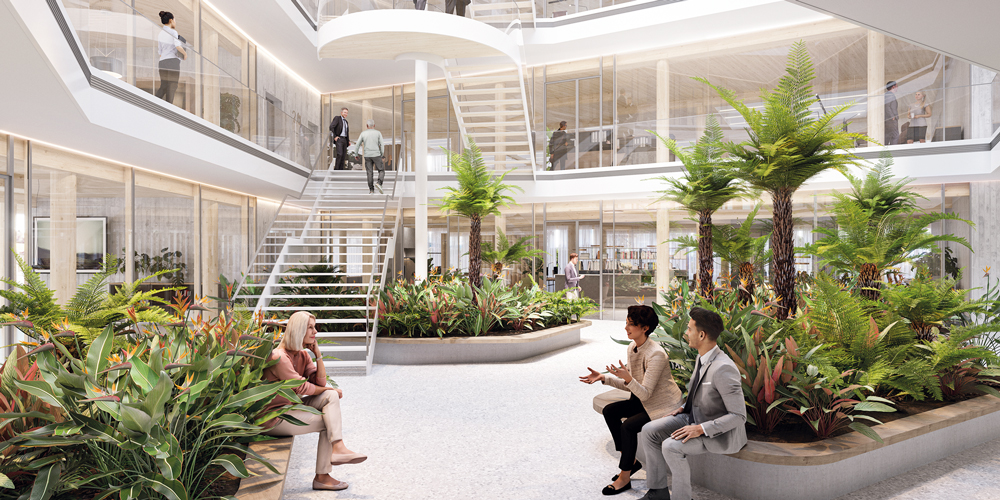
    Das neue Gewerbe- und Dienstleistungsgebäude am östlichen Tor zur Stadt Bern soll durch verschiedenste Nutzungen an Lebendigkeit gewinnen. Neben konventionellen Büroräumlichkeiten, flexibel buchbaren Büroräumen für Kleinmietende und Start-ups sowie einem zukunftsorientierten Gastronomie- und Eventbereich sind auch Gewerbeflächen für die Nutzung im Gesundheitsbereich möglich.

    BERN 131 wurde als Multispace konzipiert, wodurch grösstmögliche Flexibilität in der Innenraumgestaltung besteht. Multispace ist ein modulares Raumkonzept mit offenen Bürostrukturen und verschiedenen Sonderflächen – etwa für den Austausch, Pausen oder Rückzugsmöglichkeiten. Diese Raumvielfalt macht Multispace attraktiv und eignet sich gut für die neue, individualisierte Arbeitswelt. Gespräche mit verschiedenen Mietinteressierten sind im Gange.
    Die Architektur und die geschickte Planung von BERN 131 garantieren eine hohe Qualität des Arbeitsumfelds trotz der exponierten Lage. Der geplante Neubau profitiert von einer hohen Sichtbarkeit und der unmittelbaren Nachbarschaft zur Wankdorf City. In diesem jungen und aufstrebenden Stadtquartier sind zwei von drei Bauetappen abgeschlossen. Die SBB, die Schweizerische Post und andere Grossfirmen haben hier neue Hauptsitze bezogen. Rund um BERN 131 gibt es ausserdem verschiedene Gastronomie-Angebote, Supermärkte und Business-Unterkünfte. Der Bahnhof Wankdorf ist in rund fünf Gehminuten, diverse Autobahnanschlüsse sind in zwei Fahrminuten erreichbar.

    Das Gebäude in der Form eines Kreisbogendreiecks wird sechs Etagen haben. Die einzelnen Etagen können durch die drei Erschliessungskerne und einen Ring, der sich um das begrünte Atrium legt, erschlossen werden. Die Geschossflächen können flexibel auf verschiedenste Flächenbedürfnisse aufgeteilt werden. Das Gebäude wird grösstenteils in Skelettbauweise mit Holzstützen, Holzunterzügen und Holzhybridecken errichtet. Bei der horizontalen Aussteifung des Gebäudes setzt man auf Erschliessungskerne in Massivbauweise.

    Photovoltaik-Anlagen an der Fassade und auf dem Dach, Energieerzeugung über Erdwärmesonden, ein innovatives Lüftungskonzept mit Wärmerückgewinnung sowie die Nutzung von Regenwasser tragen zur Nachhaltigkeit und Energieeffizienz bei. Die Verwendung von Holz und Holzwerkstoffen schafft zudem eine schöne Raumqualität und ein angenehmes Raumklima.

    Mit seiner Architektur, seiner ausgewogenen Betriebsenergiebilanz sowie zahlreichen gebäudetechnischen Innovationen soll das Gebäude ein Vorzeige- und Leuchtturmprojekt in Sachen Nachhaltigkeit und Ingenieurskunst werden.

    Die Baueingabe erfolgte Mitte Mai 2021; die rechtskräftige Baubewilligung wird zeitnah erwartet. Der Baustart ist auf das zweite Quartal 2022 geplant. Im dritten Quartal 2024 soll BERN 131 bezugsbereit sein.

  • Artificial intelligence analyzes CO2 emissions from traffic

    Artificial intelligence analyzes CO2 emissions from traffic

    An analysis method developed at the Eidgenössische Materialprüfungs- und Forschungsanstalt ( Empa ) can make statements about how the consumption of a country’s vehicle fleet changes from year to year. This new method is based on math and deep learning techniques. According to a communication , it is able to show where politicians and car buyers could start to reduce CO2 emissions.

    Analyzing this has become increasingly difficult in recent years. Because vehicles can no longer be divided into classic segments such as small, medium and luxury classes due to technical innovations. In addition, new vehicles are getting bigger and heavier. In addition, the cubic capacities would decrease, while the efficiency of the engines would get better and better at the same time.

    That is why the Empa Vehicle Drive Systems department describes its analysis technology as an “important breakthrough”: It enables “CO2 emissions to be assessed separately and an accurate automatic vehicle classification to be carried out by analyzing large databases,” explains researcher Naghmeh Niroomand. “This makes it easier to analyze changes in fleets in a country or a large company.” Thanks to this new method, “subjective and expert-based factors” would be eliminated and databases from all over the world would be comparable.

    For Switzerland, the team was able to calculate the average CO2 emissions of newly registered cars. If less heavy vehicles such as SUVs were on Swiss roads, this would be the most effective way of promoting decarbonization, says Niroomand. It would also be helpful to buy vehicles with lower performance in the same vehicle class.

  • "We anticipate a trend towards urban living"

    "We anticipate a trend towards urban living"

    To person
    Stephan Attiger (FDP) has headed the Construction, Transport and Environment Department of the Canton of Aargau since 2013. At the national level, the 54-year-old represents the concerns of the canton as President of the Conference of Construction and Environment Directors (BPUK) and as a board member of the Conference of Energy Directors (ENDK). Born in Baden, he worked for a long time in the management of various Swiss companies before moving into politics. Among other things, he was Mayor of the City of Baden from 2006 to 2013 and Grand Councilor of the Canton of Aargau from 2009 to 2013.

    You are in charge of the Construction, Transport and Environment Department of the Canton of Aargau. How do you have to imagine a typical working day for you?
    In the last few months, my working days have been rather untypical due to covid: I was often in the home office, physical meetings were rare, and official events hardly took place at all. But not every day is the same, and the process depends heavily on the schedule. Basically, early in the morning I discuss the short-term issues and what is to come in the medium and long term with my closest employees. This is followed by meetings at various levels: government council, department, departments, bilateral discussions and meetings with external parties. In between I study files.

    What milestones have you reached in terms of construction so far?
    On the one hand, there are numerous larger and smaller buildings that I was allowed to inaugurate – not only in road construction, but also in the environmental sector, such as flood protection and renaturation projects. The latter also have a direct and positive effect on the residential and location attractiveness. In addition, we have created important foundations for the planning and subsequent implementation of mobility projects. With the last revision of the structure plan and the new cantonal mobility strategy mobilitätAARGAU, we want to coordinate settlement and traffic development. It therefore sets specific spatial accents and differentiated goals per room type for the individual means of transport. This in turn affects civil engineering and building construction. As a canton, we also act as a role model.

    In what way?
    For example, we are promoting more biodiversity and quality of stay in the outdoor spaces of our properties. We are looking for good solutions for how biodiversity issues can be taken into account in new buildings and in the maintenance of existing properties. Climate adaptation measures on buildings and in their surroundings make a contribution to achieving our climate policy goals. Another good example is the new building for the Office for Consumer Protection, in which we want to use wood from the Aargau forests as a sustainable building material.

    What are currently the most important construction projects in building construction?
    A major project currently underway in the area of cantonal real estate is the new construction of the police building in Telliquartier in Aarau. The units of the cantonal police, which are distributed across numerous locations, are to be brought together here. The building permit is already available. At the end of March, the canton also started the consultation process for the new location of a canton school in Fricktal. The hearings on the aforementioned new building for the Office for Consumer Protection and the project to merge the Aargau IT department into one building in Unterentfelden were concluded. All construction measures are implemented according to the principle of sustainability. During planning, special attention is paid to the gray energy bound in the building, and the time for new user requirements is coordinated with the time of repair.

    Aargau has a large number of development areas that could offer space for additional residents. What are the plans here?
    The cantonal structure plan designates 21 residential areas with areas that are predestined for high-quality settlement development. These should make a significant contribution to absorbing the expected population growth over the next 10 to 20 years in suitable, easily accessible locations. The areas should not only support the economical use of the soil with an appropriate density, but also become high-quality and attractive residential locations in the interests of sustainable development. This is the task of the municipalities, which determine the appropriate framework conditions and requirements in the land use planning. The canton supports them in this.

    Area developments often stumble over traffic problems. Are you actively helping to find a solution?
    It is effectively the case that high demands are placed on traffic planning, especially when it comes to site developments. This is because there are many unknowns about future claims. Here, traffic planning must provide a flexible framework in order to be able to react to the various requirements of investors. As far as the canton is concerned, it takes an active part or sets the framework conditions at the interfaces.

    The project to extend the Limmattalbahn from Killwangen-Spreitenbach to Baden is currently making waves. What are your arguments to try to change your mind against the opponents of extra time?
    The reporting in the media unfortunately gives a distorted picture of the general level of acceptance for this project. In the public hearing, the regional planning associations and all municipalities in the perimeter of the new tram route as well as most associations of the Limmattalbahn approved. The specifically proposed lines also received broad approval. We take the public's reservations that emerged from the hearing very seriously. For example, we have added additional variants for the lines. We will examine these and other objected points in more detail until they are determined in the structure plan and weigh them against the other cantonal interests and with the reservations mentioned.

    Urban sprawl is also a problem in Aargau. Did the municipalities make mistakes in spatial development?
    It is important to look to the future. In today's inventory, the potential that can be better used for sustainable development should be recognized. The revision of the Spatial Planning Act of 2013 has shown that the development needs of the next 20 years can be covered with the internal development of the settlement, i.e. the use of the existing reserves. We take the containment of urban sprawl very seriously. The 2015 structure plan finally defines the settlement area. The consumption of crop rotation areas has already fallen sharply.

    How well or badly does the cross-community cooperation in spatial development work?
    The regional planning associations play an important role in this cooperation. You also have to coordinate the municipal land use planning regionally in accordance with the building law. The coordination along the municipal boundaries works.

    What does an optimal use of land resources look like for you?
    The economical use of the soil is a central concern. Building upwards cannot, however, be unrestricted. The quality of the settlement and the townscape must always be taken into account. And in the case of underground structures, care must be taken to ensure that there is enough space left where large trees can be planted and water can seep away. This is crucial for avoiding heat islands in the settlement area and for the groundwater. Climate change poses great challenges for us. Optimal use of soil as a resource, sustainable settlement development and high-quality residential and workplace areas are not mutually exclusive.

    The canton of Aargau is already well positioned when it comes to digitization. What are the future plans in the construction sector?
    The digitization of construction projects with Building Information Modeling (BIM) is a big topic for us. We are currently working on around 20 BIM pilot projects. At the beginning of the year, the first master builder submission was put out to tender as part of a pilot project in the invitation process. Our goal is for BIM to be used as standard for project management in all new projects in the civil engineering department from 2025. Astra and SBB have the same “timetable”.

    Pandemics have had an impact on urban planning before. Will Corona present urban planners with new challenges in the future?
    Our villages and small towns are ideally suited for walking and cycling as places with short distances. This is a very good starting position, even in times of pandemic. In more and more places there is the possibility to work in co-working spaces. In this way, long travel times can be avoided, even if there is little space for home office. Attractive public spaces and easily accessible recreational opportunities are important. These are in great demand, and not just since Corona. I do not believe that this pandemic will completely turn city planning upside down.

    According to an analysis by Wüest & Partner, the canton of Aargau has the highest potential for new living space and development areas alongside Geneva, Vaud and Zurich. What will have changed in Aargau in 10 years?
    According to our forecast, we will get more attractive living space, especially in easily accessible locations, near train stations, in the centers of our villages and cities. Existing buildings are being converted, some of them are being built. We anticipate a trend towards urban living, not least because of the demographic development. More older people are drawn to central locations where they can benefit from services, short distances and cultural offerings. But living in the country will also remain attractive. Many of the around 100,000 single-family houses in Aargau are being renovated and brought up to date in terms of energy or even replaced by new buildings.

  • Canton approves Rai design plan in Bergdietikon

    Canton approves Rai design plan in Bergdietikon

    The design plan submitted by the municipal council for the Rai area in Bergdietikon has been approved by the Department of Construction, Transport and Environment of the Canton of Aargau. This is announced by the municipal council in a message. It contains a look back at the 40-year history of the land of Rai. It began by buying four parcels of land in the Rai area between 1980 and 1990 so as not to leave the potential building land to speculators.

    After the canton's approval, the next step will be to implement the construction project. According to the communal council, the first step is to take measures to stabilize the hillside area. Implenia Immobilien AG has to submit a planning application for the planned work to the municipality of Bergdietikon. The concept developed by Heinrich Jäckli AG and Basler & Hofmann AG suggests slowing down the slope movements by means of deep drainage ditches arranged in the direction in which the slope falls. For the future development and development of the Rai area, subsoil investigations and movement measurements were carried out between 1991 and 2005. It follows from them that the slope movements can be reduced to such an extent that development and development are possible.

    In the years since the municipality acquired the Rai area, the topic of use has repeatedly dominated the political debate, writes municipality clerk Patrick Geissmann in the report on the Rai area. Pius Achermann, mayor from 1994 to 2005, has their say. He is quoted as saying: “The importance of the Rai area achieved a high priority during my tenure. Hardly a council meeting went by without addressing the subject of Rai. Rai became a constant topic. "

    For Paul Meier, mayor from 2006 to 2009, the state of Rai was “a stimulating word during my 16 years on the parish council.” And Gerhart Isler, mayor from 2010 to 2017, is quoted as saying that the subject involved the involvement of Implenia Development AG and specific planning work has been objectified. Ralf Dörig, mayor since 2018, is quoted as saying: "I am of course very pleased that the 40-year history of the country 'Rai' can now be concluded with a legally binding design plan." Solutions have been worked out, but there have also been setbacks. The entire planning has now been successfully completed.

  • Government is slowing down traffic planning for Baden

    Government is slowing down traffic planning for Baden

    The new overall traffic concept for the Baden-Wettingen area has to go into an additional planning loop. According to a press release , the Aargau government council decided to leave the concept at the stage of the interim result. In doing so, he is responding to reservations that were expressed in the public hearing.

    In the hearing, for example, it was demanded that the Baden high bridge could also be used by cars in the future. This would also eliminate the need for a new Limmat bridge between Baden and Wettingen. In the Siggenthal a higher traffic load is feared. With the additional planning loop, the continuation of the Limmattalbahn beyond Killwangen could also be included in the planning in the future.

    However, the government council makes an exception in the overall transport concept: the Velosteg between Neuenhof and Würenlos should already be specified in the structure plan. This could secure the federal funds for the project.

    The overall traffic concept for the Brugg-Windisch area, on the other hand, is to be specified in the structure plan. These include the center relief and the bike route.

  • Switzerland signs international declaration for e-mobility

    Switzerland signs international declaration for e-mobility

    According to a press release by the Federal Office of Energy ( SFOE ), Switzerland signed an international declaration for the zero-emissions target in transport on Thursday as part of the Global e-Mobility Forum 2020 . This declaration is entitled " Katowice Partnership for E-Mobility ". She was born in December 2018 at the World Climate Conference in Katowice, Poland. Today it consists of 44 states and around three dozen sub-national administrative units, city associations and non-governmental organizations.

    According to the organizers, 38 countries from five continents as well as organizations and alliances had already joined this declaration, as well as 1,500 cities and regions and 1,200 companies. Overall, they represented over a third of the world's population. Switzerland did not sign the declaration at the time because of the “pending legislative and political work”, according to the SFOE in the communication.

    However, in December 2018, the Federal Department of the Environment, Transport, Energy and Communications ( DETEC ) and “numerous Swiss players” launched the Electromobility Roadmap 2022 “very successfully”. The aim of this roadmap is to increase the share of electric vehicles in new registrations to 15 percent by 2022. "Nothing stands in the way of signing the 'Katowice Partnership for E-Mobility'."

    It brings "no rights and obligations" with it. But the undersigned countries and organizations should promote zero-emission vehicles, set fleet targets and work together internationally. Further goals are the promotion of green public transport, the expansion of an intelligent infrastructure, the improvement of air quality as well as research and development in these areas.

  • E-buses connect Zurich's ETH locations

    E-buses connect Zurich's ETH locations

    The transport company Eurobus , based in Bassersdorf ZH, is now using three fully electric articulated buses from Mercedes-Benz . The vehicles from the eCitaro G model series, which were presented just a few weeks ago, are used on the so-called ETH link between the two locations of the Swiss Federal Institute of Technology in Zurich. They are the first to run in regular service.

    The 18.13 meter long, fully electric articulated buses run 100 percent on green Swiss water. Their capacity is 38 seated, 93 standing and two wheelchair places. They also offer public WiFi, USB charging sockets and air conditioning. With immediate effect, they will replace the previous diesel-powered shuttle buses between the center of Zurich and Hönggerberg. They fill up with new electricity at the Hönggerberg stop.

    “In addition to their environmental friendliness, the new electric buses are characterized above all by their quiet driving style, comfortable low-floor entry and attractive interior and exterior design,” said the managing director of Eurobus welti-furrer AG, Patrick Nussbaumer, in a media release from Daimler. "With this, the ETH is sending a clear signal and strengthening its position as a future-oriented educational institute."

    Armin Krieg, Head of Sales for City Buses at the Winterthur Daimler subsidiary EvoBus (Schweiz) AG , is satisfied “that with the introduction of the eCitaro G we are consistently continuing our announced timetable for e-mobility in city buses and Daimler Buses is the innovation and technology leader in the epicenter of technical and scientific research and teaching, of all places. "

  • The canton of Zurich and SBB are planning bike and bus projects together

    The canton of Zurich and SBB are planning bike and bus projects together

    The Canton of Zurich wants to work more closely with SBB on upcoming projects. According to a cantonal press release , both partners want to use synergies and save costs. For the canton of Zurich it has been shown that it makes sense to integrate the three cantonal projects to expand the bike and bus network into the major Brüttenertunnel project and to work on these projects together with the SBB.

    "The Brüttenertunnel project offers the opportunity to hand in hand the most extensive bike project to date in the Canton of Zurich and to expand public transport in the Glattal region," said Economics Director Carmen Walker Späh as quoted in the press release. According to the overall traffic concept of the Canton of Zurich, the share of bicycle traffic in the total traffic volume is to be increased continuously to 8 percent by 2030.

    The government council has therefore applied for a property loan of CHF 73.1 million from the cantonal council. The aim is to realize the pilot project of a fast bike route from Zurich-Oerlikon via Wallisellen and Dübendorf to the Zurich Oberland "barrier-free, coherent, safe and comfortable".

    A main bicycle connection from the Im Lampitzäckern quarter in Dietlikon along the SBB route in the direction of Baltenswil, a main bicycle connection, is intended as a feeder to this rapid cycle route. It is also part of this synergy project. With the redesign of Bahnhofstrasse, the cycle route in Dietlikon and Wangen-Brüttisellen is to be continuously expanded to become the main connection and the network gap in the direction of Baltenswil is to be closed.

    Finally, in the course of the construction work on the Brüttener Tunnel, the Baltensilerstrasse underpass in Bassersdorf will be removed. In addition, the canton is planning a bus lane in order to be able to prefer the bus service from Baltenswil to Bassersdorf train station.

    The planning approval process for the Brüttener Tunnel and the three accompanying projects will run from 2023 to 2025. The accompanying projects will be handed over to the public in stages before the tunnel is due to go into operation at the end of 2034 at the earliest.

  • Terra Raetica is to receive the Alpine Railway Cross

    Terra Raetica is to receive the Alpine Railway Cross

    Representatives from Graubünden, South Tyrol, Tyrol and Lombardy have agreed to improve cross-border mobility in the triangle between Switzerland, Austria and Italy, especially by rail. At a meeting in Graun im Vinschgau, they signed a letter of intent to this effect, according to a press release from the Canton of Graubünden .

    Accordingly, the four regions want to coordinate their measures to create an integrated mobility system in what is known as the Terra Raetica. With an attractive alpine railway hub and the connection to the international rail network, the transalpine road traffic is to be reduced. This also reduces the environmental impact, "which in turn brings a touristic upgrade with it", it says in the message.

    "Today we are laying the foundation for intensive cooperation and a vision for the future, a rail-alpine cross between Austria, Italy and Switzerland", the Tyrolean governor Günther Platter is quoted as saying. "The mobility of the future needs a courageous approach and this must not stop at national borders." For years, the motto has been "Boundless mobility – and that is car-free", says his deputy and Tyrolean regional traffic councilor Ingrid Felipe.

    According to the Vice President of the Graubünden government, Mario Cavigelli, this agreement will create a valuable platform for exchanging information on needs and measures in public transport across borders. In the interests of the population and the economy, transport chains and transfer options between the various public transport systems in the four neighboring regions could be coordinated “as best as possible”.

    In November, a group of experts will start planning a rail link in the Terra Raetica. It is accompanied by a steering committee made up of government representatives from the four neighboring regions.

  • ABB Switzerland modernizes SBB locomotives

    ABB Switzerland modernizes SBB locomotives

    As part of the new order, 18 SBB locomotives of the latest generation will be modernized with traction converters from ABB, according to a press release. The Zurich-based and internationally active technology group has its Swiss headquarters in Baden and manufactures traction converters in its plant in Turgi AG. In 2014, ABB received an order from SBB to modernize locomotives with traction converters. With the follow-up order now received, ABB will modernize the entire Re 460 fleet. These are the locomotives of most intercity trains.

    SBB is implementing a modernization program for the fleet, which will extend its service life by 20 years. The new traction converters and additional technical measures can save around 30 gigawatt hours of energy annually, "that's five gigawatt hours more than originally expected," says ABB. According to the report, these energy savings correspond to the “average electricity consumption of 10,000 Swiss households”. For this purpose, the power electronics based on the technology of the 90s are being replaced by energy-efficient, water-cooled IGBT traction converters (insulated-gate bipolar transistor). This retrofit and cooling systems operated with water instead of oil can reduce energy consumption.

    "We are pleased that we are a partner in this major modernization project in the Swiss home market with our drive solution and that we are working closely with SBB to ensure that the vehicles continue to be operated in an energy-efficient manner," said Robert Itschner, Country Managing Director at ABB Switzerland.

  • RVBW plans to use four e-buses

    RVBW plans to use four e-buses

    Four electric buses will be operating on RVBW Line 5 from March 2021. They will transport passengers between Baldegg via Baden train station to Ennetbaden. The new buses are equipped with innovative technology from ABB Switzerland. The canton of Aargau announced this in a media release as the customer for the public transport services.

    The project will be carried out in close cooperation with ABB. The Federal Office of Energy has classified it as a flagship project worth supporting. The drive technology is developed at the ABB site in Turgi. The charging station is also from ABB. The batteries are produced in Baden.

    A charging station will be installed at each of the two terminal stops. There buses can be charged in up to six minutes. The canton is contributing almost 1.5 million francs to the investment costs for the charging infrastructure.

    RVBW line 8 between Neuenhof and Wettingen has been operated with an electric bus on a trial basis for two years since mid-December 2019. On these two lines, the RVBW wants to gain initial operational experience with the use of e-buses. In the future, RVBW intends to operate all city bus routes electrically. The switch from internal combustion to electric motors is to take place gradually.