MoneyPark is growing in Winterthur. Last year, the company's team there was expanded from three to six consultants. Accordingly, MoneyPark has now moved into new premises. The location is at Metzggasse 20 and, according to a report, comprises six consultation rooms.
"Now we want to continue to grow and provide our customers with intensive support on everything to do with mortgages, provisioning and buying and selling real estate," Flavian Scheidegger is quoted as saying. In June he took over the management of the Winterthur branch from Andreas Leu.
Not only the branch in Winterthur is expanding. MoneyPark also recently expanded its business. In this way, customers can get advice not only on financing and provision, but also on questions relating to property searches, buying, owning and selling.
After an outstanding 2019, tourism was hit hard by the pandemic last year, explained House of Winterthur in a communication to the General Assembly on June 24th. The promotion of the location has also felt this: its income from city taxes and the sale of city guides and other services was 518,000 francs lower than the previous year, writes House of Winterthur. With income of around 2.9 million Swiss francs and the reversal of a provision of 200,000 Swiss francs, the location support posted a loss of 147,000 Swiss francs in the year under review.
The work of the location promotion is ensured by cantonal funds, explains House of Winterthur in the communication. Specifically, the cantonal council has decided to make a total of 840,000 francs available for location funding over a period of three years. The money is to be used for the recovery of tourism in the Winterthur region.
"Even during the crisis it became clear: Winterthur is full of surprising success stories – thanks to creativity, adaptability and confidence", House of Winterthur director Samuel Roth is quoted in the press release. "One of the tasks of the House of Winterthur is to track down these stories and tell them on."
Samuel Roth took over the management of House of Winterthur on August 1st last year after founding director Michael Domeisen left. With Roger Graber and Catherine Zimpfer, two more new members joined the management of House of Winterthur in 2020.
Implenia ceremoniously handed over the dialogue space, which was completed in spring, to the city of Winterthur on June 8th, the real estate company informed in a message . The name of the approximately 5,800 square meter open space in the Lokstadt district of Winterthur goes back to a wage dispute at Sulzer that was settled in 1937. Implenia writes that in the future, the dialogue space should be a central place for meeting and exchanging ideas. "We are very pleased to be able to present the residents of Lokstadt and all Winterthur residents with a great town square and meeting place that can be used in many ways", Adrian Wyss, Head of Implenia's Real Estate Division, is quoted in the press release.
Implenia developed the dialogue space, which is part of the 21,000 square meter open space in the Lokstadt district, in collaboration with the city of Winterthur. In the course of the takeover, the city will gradually be responsible for the operation and maintenance of the square. Implenia is contributing 6 million francs for future maintenance and renovation costs.
The square, which is located in a new pedestrian zone, offers a variety of opportunities to stay, meet and play, is further explained in the communication. Specifically, Implenia lists a playground, shady trees, a system for roller sports equipment (pump track), a drinking fountain, seating and a catering area.
The real estate developer Steiner AG is planning to build a new residential complex in Winterthur, according to a media release . It is to be built on the KIM site at Winterthur Neuhegi train station. The so-called Haus Weiler is to be built on a plot of 3328 square meters and comprises 80 condominiums. Twelve of these will be built as studio apartments on the ground floor with private garden terraces. A further twelve are being built as attic apartments with private roof terraces.
The design plan for the KIM area already became legally effective in September 2013. The newly emerging quarter combines living and working. It includes green areas, playgrounds and car-free zones. Grocery stores, cafes and restaurants are within walking distance. In addition, Zurich Airport can be reached in 25 minutes by car or train.
According to the announcement, the building application was submitted to the city of Winterthur on March 25th. Steiner AG expects construction work to start in summer 2022. Completion is planned for spring 2025.
Implenia uses the advantages of virtual reality (VR) at the Lokstadt site in Winterthur. This is made possible thanks to a solution from the Zurich start-up Hegias . Right from the start, users were able to immerse themselves in the virtual plaster model of the area and walk through it from different perspectives.
Thanks to the solution, concerns of monument conservationists could also be quickly dispelled, writes Hegias in a press release. They initially had reservations about a new hotel, which should have shipping containers as a room. When the concept could be experienced virtually, they were convinced that the “valuable building fabric” would be preserved and that the halls would not be crammed full.
In addition, the VR solution is also useful for marketing real estate, according to the announcement. The spatial understanding and the experience of the residential property are essential drivers in the purchase decision. Implenia has already bought a license for the Hegias software. Now she wants to expand the use of the software.
"What was missing so far for the breakthrough of VR was user-friendly software that users can use anywhere without installation and without relevant programming knowledge," Anita Eckardt, head of the Specialties Division at Implenia and member of the management board, is quoted in the press release. "The start-up Hegias made this possible with the intuitively operable solution for VR applications – a real quantum leap."
The Technikumstrasse campus of the ZHAW in Winterthur will be comprehensively renewed within 15 years, explains the building department of the Canton of Zurich in a message . New buildings and more open space are to be created in four stages. At the same time, the Eulach will be renatured in the area of the technical center. In the first phase, two new laboratory buildings are to be built and a public park is to be set up on the Eulach.
The corresponding design plan was published from April 6 to June 8, 2020. 31 objections were received against him, mainly in questions of urban integration, the scope, development and nature conservation, informs the building management. Another 18 objections related to the renaturation of the Eulach and the definition of the water area.
The design plan and the water area have been revised based on the objections and have now been set, the message continues. Both documents and the reports on the objections have been publicly available for 30 days since February 26 and can be viewed on the Internet . If no legal remedies are taken, they will come into force at the end of March this year. Then the city of Winterthur could issue the building permit for the first stage.
Vantage Data Centers is a data center operator based in California. The company is currently expanding in Europe and is investing a total of 2 billion dollars, according to a media release . One of its European locations will be in Winterthur. The company has already started building its campus there.
The three hectare campus in Winterthur will house a total of four data centers with a total area of 37,000 square meters. It will have an output of 40 megawatts. The shell has already been completed. Vantage Data Centers relies on “highly efficient cooling with integrated free cooling and minimal water consumption,” it says. A photovoltaic facade and charging stations for electric vehicles will also be installed.
Vantage Data Centers started expanding in Europe this year. To this end, it has taken over the companies Etix Everywhere from Luxembourg and Next Generation Data from Great Britain, among others. The American company built its first campus in Offenbach near Frankfurt. The second European campus is now being built in Winterthur.
"Winterthur is the first location where we literally started out on the green field", Wolfgang Zepf, Managing Director Vantage Switzerland, is quoted in the press release. "We look forward to welcoming our customers to this highly secure location with the best connectivity in the autumn of next year."
Around ten years ago, BGP built six pavilion-like residential buildings in various sizes on the Fehlmann site in Winterthur. The Zurich architecture office informs in a message that the area development has now been completed with two more buildings. From a distance, the new buildings are indistinguishable from the old superstructures.
On closer inspection, however, an important difference becomes clear, explains BGP. The facades of the buildings erected in 2010 were made of black enameled glass panels. Instead, electricity-producing photovoltaic modules were installed in the new buildings. This means that the facade can take on “a multitude of tasks”, according to the announcement. Specifically, protection, climate regulation, representation and identification are mentioned there.
Before building the development, BGP had measured the electricity demand in the existing buildings. According to the announcement, it had the distribution to be expected for a residential development with peaks in the morning and in the evening. These peaks could be better covered with modules integrated into the facade than with a system installed on the roof, explains the architecture office. In addition, a photovoltaic system was installed on the building roofs. The building complex is also equipped with charging stations for electric cars.
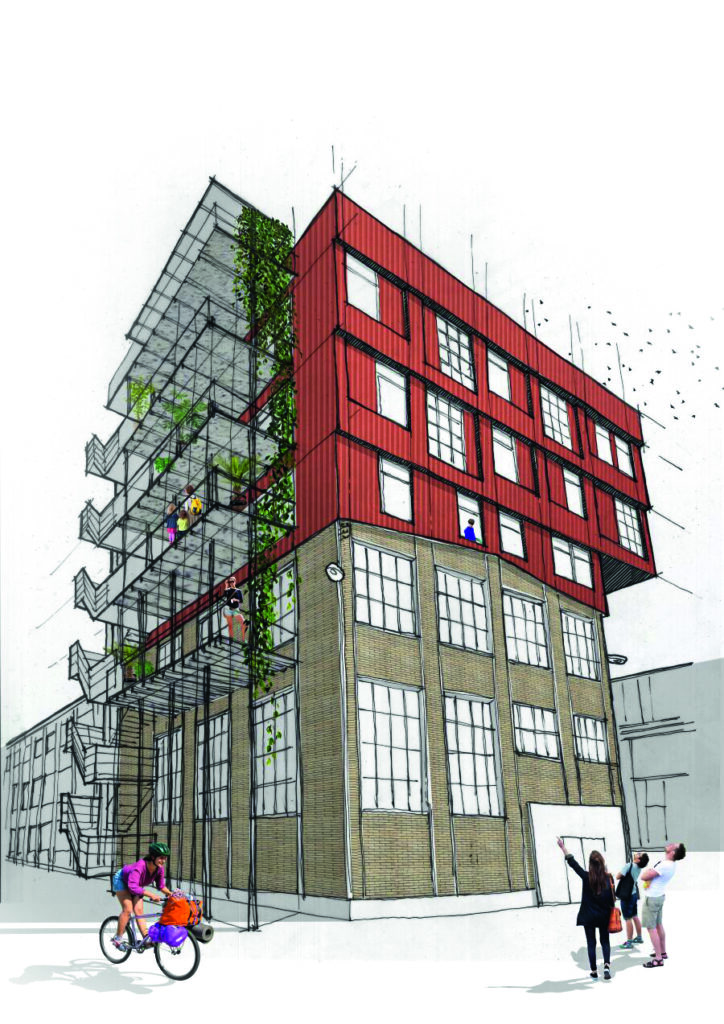
A project that could hardly be more sustainable: the extension of hall 118 on the storage area in Winterthur ZH was increased by five floors. And wherever possible with reusable building materials. The presence of such materials from demolitions in the region was decisive for the current appearance. The building is not yet completely finished: “The construction should be completed in early 2021,” says Benjamin Poignon, architect and civil engineer at “baubüro in situ”.
The Abendrot Foundation, based in Basel, bought the Lagerplatz area from Sulzer Immobilien AG in 2010. The direction of focus was quickly clear to the pension fund, which is committed to sustainability: the already existing mixed use should be further developed in cooperation with the tenants. Several new studios of up to 60 square meters for start-ups and small businesses are planned for each of the upper floors.
Although the buildings and their footprints were to be retained, they were to be further developed in terms of energy and in accordance with legal standards. The “construction office in situ” is responsible for the project. The project managers Marc Angst and Pascal Hentschel sum up the concept: «Repairing what can still be used. Remove what disturbs or is no longer suitable – and add what is new. "
Finding building materials is half the time The supporting framework consists of an used steel structure. Prefabricated facade elements made of wood, which are filled with straw insulation, are attached to this. Such simple ecological building materials as straw, excavated earth and wood accumulate in large quantities and can be processed and used with a minimal use of gray energy. They also ensure a pleasant room climate.
The slightly overhanging south facade in bright brick red-orange comes from the sheet metal facade of the former Ziegler print shop in Winterthur Grüze. The windows in the new recycling building are inconsistent, but overall they are consistent. In order for the insulation to meet today's standards, the glazing was doubled in nine windows, the others had sufficient insulation. The staircase on the east facade is over 30 years old and previously adorned the facade of the Orion office building in Zurich-West. 80 windows and facade panels made of granite, which are recycled for the balcony floors, also come from this building, which was erected in 1989. The respective components are not reprocessed – this differentiates the project from so-called downcycling, in which building materials are initially reworked in a energy-intensive manner.
The architects have already learned a lot from this unique pilot project: “It is the first time that we have reused a supporting structure. But we also noticed that there are components that are cheaper to buy than to reuse. For example, we have tried to reuse limestone sandstone. But the cleaning and preparation work was so high that we decided to buy a new one here, ”explains architect Poignon. The project also created a new job: component hunter. The “baubüro In situ” hired interns specifically for this purpose, who looked for suitable demolition objects and any reusable materials that might arise. But the architects, too, are always on the move with open eyes. Usable materials are dismantled and picked up by the architectural office with roots in Basel. The architects spend half of the time evaluating and procuring possible components. "In situ" did not have any problems finding the right material: of the approximately 7.5 million tons of construction waste that is generated in Switzerland every year, only 0.1 percent is directly reused, according to the Federal Office for the Environment (FOEN) has. «In situ» assumes that ten times more can be reused.
Book publication planned If you think about the costs at this point: 4.8 million Swiss francs have been budgeted for the project so far. One of the stated goals was to build in such a way that it does not cost more than a completely new building. “It is difficult to make direct comparisons,” says Benjamin Poignon.
In general, “in situ” always relies on the reuse of materials during construction – even if rarely on this large scale. With its uniqueness, K118 has definitely attracted interested parties: A research and teaching project at the ZHAW University of Applied Sciences in Winterthur and a case study in environmental systems science at ETH Zurich accompanied the planning. Among other things, the environmentally relevant (waste, resources, lifespan, etc.) and legal as well as those relating to the construction process are examined. A joint publication is planned in cooperation with the Federal Office for the Environment: The book is intended to comprehensively shed light on the reuse of components in building construction and to make the knowledge and experience gained publicly available. ■
This is what building K118 should look like after construction work is complete.
Intershop creates a new assembly hall for Stadler Winterthur . According to a press release , the building permit is now available. The investment volume amounts to around 16 million francs. The start of construction is planned for the current week, the completion of construction for the end of 2021. As Stadler announced after the agreement with Intershop Holding was concluded, the Zugbauer will lease the plant from the Intershop subsidiary SGI City Immobilien AG on a long-term basis. The lease has a minimum term of 15 years, according to Intershop.
With the new building, Stadler Winterthur is expanding its competence center for bogies. On around 13,250 square meters of land, additional storage and assembly areas are being built for the construction of bogies for standard and broad gauge trains as well as for trams. The commissioning of the new hall is planned for 2022. In February, Stadler announced its intention to create up to 50 new jobs with the expansion of the production facility at the Winterthur location.
Wir verwenden Cookies zur Unterstützung und Verbesserung unserer Dienste. Mit der Nutzung dieser Website erklären Sie sich mit der Verwendung von Cookies einverstanden. Weitere Informationen finden Sie in unserer Datenschutzerklärung.