The number of students at the ZHAW is expected to increase by between 0.8 and 2.0 percent annually until 2035. The ZHAW therefore needs additional space in Winterthur, the Canton of Zurich ‘s Department of Construction informs in a statement. The canton wants to coordinate the expansion of the university with the ZHAW and the city of Winter thur. Both the university staff and the city’s population should benefit from coordinated planning. A binding basis for the spatial development of the ZHAW is laid down in a declaration of intent already signed by the three partners.
According to the agreements, the expansion of the university is to be concentrated on the three sites Sulzer-Areal, Technikum and St.Georgen. On the Sulzer site, expansions can take place on the area already belonging to the university. Between the Technikum and the armouries, on the other hand, new areas are to be used. Here the city of Winterthur wants to create a knowledge quarter together with the ZHAW. To this end, it is planned to relocate current third-party uses to Teuchelweiherplatz.
At the St.Georgen site, the use of the Linde site is being examined. The SBB site, which is no longer needed for railway operations, could be considered as a possible new location for the ZHAW, writes the construction directorate. The construction directorate, the education directorate, the ZHAW and the city of Winterthur have set up an area management team to concretise and implement the plans. “This will ensure that the complex work is carried out in the long term from an overall perspective and in a coordinated manner,” the statement says.
The Zurich Opera House needs more space for its approximately 800 employees. The solid reinforced concrete extension built in 1984 is no longer sufficient. According to a statement by Opernhaus Zürich AG, there is an additional space requirement of 60 per cent. It refers to a study by the German theatre planner Kunkel Consulting.
The structural engineering office of the Canton of Zurich is examining whether the existing extension building can be raised. The study should be available in autumn. In any case, the new extension is to “attract international attention with its site-specific and visionary architecture as a model in terms of energy efficiency, sustainability and resource-saving construction methods”, according to the statement. An additional laboratory stage is also planned. Construction would take place in the first half of the 1930s at the earliest.
The opera house itself is also to be renovated. The seating and technical systems are to be renewed and barrier-free access created.
A temporary structure is to be erected on the roof of the extension building as early as summer 2024. The design comes from the Zurich architectural firm EM2N.
“One aim of the structural development is to remedy the fundamental deficiencies of the property so that the opera house can continue to fulfil its mission,” Markus Notter, Chairman of the Board of Directors Opernhaus AG, is quoted as saying in the statement. “In order to be able to maintain and expand this standard, the listed opera house and the adjacent extension building … must be renovated – in terms of energy and operations.”
In a press release , the canton of Zurich announced the pilot program for SMEs and innovation to strengthen innovative strength in SMEs. It was developed over a three-year period by the cantonal location promotion department on behalf of Economics Director Carmen Walker Späh and in conjunction with the Canton of Zurich Location Promotion Network and the Zürcher Kantonalbank , the Zurich Chamber of Commerce ( ZHK ) and the Canton of Zurich SME and Trade Association ( KGV ) . The location support program provides for SMEs to receive guidance and support from specialists, especially from the private sector, and from innovation specialists in the early stages of planned innovations, so that they can apply for national funding.
The innovative strength in companies with fewer than 100 employees harbors potential for improvement and is showing a downward trend compared to large companies and start-ups that are showing innovative activities. A lack of access to knowledge and low resources for the implementation of planned projects are given as reasons for the backlog. Many SMEs are also reluctant to join forces with other companies and universities. According to a study by the economics department in the Office for Economics and Labor in the Economics Directorate, there is also room for improvement in “networking and collaboration between SMEs”. The Corona crisis has additionally weakened the innovative power.
Economics director Carmen Walker Späh wants to ensure that SMEs make a step forward in their innovation activities and thus ensure the diversity of industries “especially in times of crisis”. “Switzerland is an SME country. It is all the more important that our SMEs continue to provide jobs and training positions,” she is quoted as saying in the media release. heg
Headsquarter will be expanded to include a third location in the Handelshof residential and commercial building on Uraniastrasse in Zurich. The Zurich-based provider of flexible offices and areas for coworking is thus placing a new facility for shared offices on an area of 2000 square meters.
A modern working environment “with a modern design concept, flexible use of space and hotel-like services” is to be created on two floors in the Handelshof business centre. In addition to 200 office workplaces, space for workshops, meetings and social events will be available from January 2023, surrounded by leisure facilities and dining options.
Mutual exchange is central to the hybrid coworking model. In contrast to the home office, the worker can benefit from social networks. Accordingly, the concept also provides for meeting zones for the team and customers. Sports offerings, culinary events and hotel-like services ranging from barista-quality coffee to a cleaning service are intended to promote the workspace experience.
Headsquarter has already settled with its premium coworking spaces at Ernst-Nobs-Platz and Talacker 4 . The company explains the addition of Uraniastrasse with the high location quality of Zurich. Cities such as Zug, Basel and Geneva are also in focus for further growth.
Patrimonium Urban Opportunity AG has been listed on the BX Swiss AG stock exchange since July 18. The listing is intended to enable the company to grow faster and increase flexibility in financing new projects, Patrimonium explained in a press release . Founding shareholders and management keep their shares.
The PATURBO portfolio currently consists of nine commercial investment properties with a total market value of CHF 222 million. Another property under construction is scheduled for completion in 2024. The real estate company focuses on commercial real estate in the catchment areas of Geneva, Lausanne and Zurich.
“We are proud to have reached this important milestone thanks to the many years of good and trusting cooperation with our investors and partners,” Christoph Syz, CEO of PATURBO, was quoted as saying in the announcement on the occasion of the company’s listing on the Bern Stock Exchange. Hanspeter Berchtold, CIO Real Estate at Patrimonium Asset Management AG, is looking forward to “further exciting projects and being able to make a positive contribution to urban development in the most important economic centers in Switzerland”. Patrimonium Asset Management AG has been entrusted with asset management by PATURBO.
Swiss Prime Site , a listed real estate company based in Zug, has identified and promoted four start-ups in its accelerator program that are rethinking existing business models in the industry: DuraMon from Zurich, Novalytica with offices in Bern and Zurich, Proximi from Helsinki and Spotr from Den Hague.
The participants had to develop relevant use cases for the real estate company and its subsidiaries, which lead to sustainableprocesses , improved efficiency and sustainable growth. Finally, the jury selected these four start-ups that were able to present themselves to the board of directors. The aim is a sustainable cooperation.
DuraMon believes in safer, more affordable and sustainable construction and repair solutions that reduce concrete infrastructure maintenance costs and carbon emissions. Novalytica supports companies in the development of clearly defined data strategies in order to generate business-relevant insights and tools.
Capable of relating any application to a specific location, Proximi’s platform provides tools for geofencing, delivers mobile content, automates IoT devices and integrates third-party interfaces. The start-up Spotr uses numerous image sources from people to satellites to analyze entire building portfolios in minutes.
“The Swiss Prime Site Accelerator is very well designed,” Yurena Seguí Femenias is quoted as saying by DuraMon. The experts asked the right questions and gave “informative and tailor-made advice”.
According to the press release, Etavis Facility Services has a strong customer service culture and many years of industry experience in the maintenance and repair of building technology systems. The specialist for building management becomes part of the Hälg branch in Zurich. The workforce will be fully taken over. “With the integration of the team in Zurich, we are gaining the expertise and network of the employees,” says Markus Haldimann, Managing Director of Hälg Facility Management AG. “We are thus further strengthening our facility management services.”
The company merger leads to a change of name: Etavis Facility Services gives up the company name. Both companies will be called Hälg Facility Management AG in the future.
Steiner is collaborating with the young company House of Lab Science , which specializes in offering and operating innovation parks for life sciences companies. As a first step, the two partners have planned the establishment of two new innovation parks in Basel and Winterthur. Steiner AG contributes its expertise in real estate development and its corresponding resources. House of Lab Science contributes its community platform and its contacts in the life sciences industry and start-up scene.
“With the base in Basel, we are making a contribution to one of the two most important life science clusters in Switzerland, which means that we benefit from significant synergy effects of these ecosystems,” Christian Hugo Hoffmann, CEO of House of Lab Science, is quoted in the press release. “In Winterthur, on the other hand, we are demonstrating our core competence of being able to successfully set up a new center even with comparatively few network effects.”
The Manufakt concept developed by Steiner is to be used in the construction of the innovation park. These are modular rooms with which areas can be divided as required. The first manufactory building was opened last summer after almost a year and a half of construction, explains Steiner in the press release.
According to the press release , the insulation specialist Swisspor AG and Madaster Services Schweiz AG will be working together in the future. The aim is to promote the use of circular insulating materials in construction. With its product and recycling expertise in the field of insulation and sealing, Swisspor, based in Steinhausen, will open up the transition to resource-saving construction, according to the statement.
Madaster is working on so-called material passports for new and existing buildings. This gives construction waste an identity and can be cataloged and reused as resources to avoid waste. The Madaster service is offered in Switzerland by Madaster Services Switzerland AG in Zurich.
With Swisspor, the Madaster network will be supplemented with many years of expertise in the development, manufacture and recycling of building products in the field of insulation and sealing, Marloes Fischer, Managing Director of Madaster Services Schweiz AG, is quoted as saying. “Together we can make the medium to long-term increasing volume of insulating materials from demolition and renovation transparent. The goal must be to use as much recyclate as possible for new products.”
“Swisspor is doing everything it can to increase the recycling rate of insulating and sealing materials,” says Marco Dalla Bona, Managing Director of Swisspor AG. With the Madaster material register, “built-in materials can be traced and later assigned to a new group of uses. If the sector manages to recycle 100 percent recyclable products, we will reduce the use of primary resources to a minimum,” Dalla Bona continues.
dr Jennifer Dreyer (48) grew up in Giessen, Hesse, and completed her studies in Darmstadt, Stuttgart and Zurich. She is a civil engineer with a second degree in business administration and an ETH doctorate in public-private partnership. dr Jennifer Dreyer has been working for IMMO since 2016: initially as head of staff, since 2019 as head of the newly founded school buildings department and as deputy director. Previously, she was a member of the management board of a Zurich consulting office for maintenance management in structural and civil engineering.
dr On November 1, 2022, Jennifer Dreyer will succeed Cornelia Mächler, who will concentrate on managing major strategic projects in the future. Cornelia Mächler will also assume the position of deputy director as of November 1st. Cornelia Mächler has worked for IMMO since it was founded in 2001 and has headed it for the past 17 years.
City councilor André Odermatt, head of the building construction department, thanks Cornelia Mächler for her great commitment to setting up and continuously developing her service department: “Today, IMMO is one of the leading public owner representations in Switzerland. This is largely thanks to Cornelia Mächler.” At the same time, he is pleased about the new appointment to the IMMO management position: “Dr. Jennifer Dreyer knows the challenges of a growing city. She has proven her competence, among other things, with the launch of the school room offensive. »
The multi-sports sports facility Witikon from the 1970s has developed into a frequently used training ground and venue for competitions. In order to meet the strong demand from sports clubs, a new building with a triple sports hall, cloakroom, audience and care infrastructure for the neighboring Looren school complex is to be built in the south-western part of the site by 2027. The project competition for general planners in the open process has ended. The team from Bur Architekten AG and Kuhn Landschaftsarchitekten GmbH from Zurich won with their “Diego” project. According to the competition program, construction costs of CHF 52.5 million are expected for the new replacement building of the sports center (BKP 1-9, excl. reserves). The cost accuracy in the competition phase is +/- 25 percent.
New sports infrastructure for Witikon The winning project convinced the jury with its stringent ecological attitude, which reduces the excavation and thus the balance of greenhouse gas emissions of the new building to an exemplary minimum. To this end, the majority of the spatial program is accommodated above ground in a high timber construction with a small footprint, including the triple sports hall on the 2nd floor. As a result, the sports facility benefits from daylight on all sides and is accessible and visible. On the ground floor are the public sports cloakrooms for the runners, the public sports bar, which can also be used as a canteen, and the separate care facilities for the students of the Looren school complex. The two existing bridges over the Stöckentobelbach ensure short and clear connections between the school area and the new day care in the sports center. The cloakrooms for those using the outdoor sports fields are located on the first floor and can be reached directly via four outside stairs and a surrounding arcade. The space in the basement, which is kept to a minimum, is used for the building services and for a water cistern, which is used to irrigate the playing fields in a circular manner.
Attractive outdoor spaces for athletes and local residents On the south side of the new sports center, an entrance square with shady trees forms an attractive prelude to the new facility. The outdoor sports fields, which are slightly shifted and twisted in relation to one another, divide the area in such a way that a network-like system of paths is created that fits harmoniously into the landscape. The paved areas are limited to the absolute minimum. Furthermore, this sustainable project is characterized by large photovoltaic surfaces on the facade and on the roof and a clever summer heat protection through clever night-time cooling as well as a concept for the implementation of the sponge city principle.
competition exhibition Saturday, July 9th to Monday, July 18th, 2022 in the Werd exhibition space, Morgartenstrasse 40, 8004 Zurich. Opening times: Mon to Fri 4 to 8 p.m.; Sat and Sun 2 p.m. to 6 p.m.
At the end of June 2022, Allreal signed two purchase contracts with a private seller for a three-parcel property with a total of 4,916 square meters in Sünikon-Steinmaur in the Zurich Unterland. Depending on contractual agreements, the transfer of ownership is expected to take place in September 2022.
The property is located on Hohlgasse/Regensberger- and Neubrunnenstrasse in the center of Sünikon and is characterized by an elevated and sunny location with a panoramic view.
Allreal plans to realize residential property; whether in the form of multi-family houses/condominiums or single-family houses is currently still open. A feasibility study is in preparation and will serve as the basis for further specification of the plans. The approximate investment volume is around CHF 35 million.
In addition, EVUlution was able to expand its shareholder base to include ewz . The city of Zurich’s energy supplier is also contributing smart grid solutions AG . The ewz subsidiary founded in 2016 has developed an innovative solution for network management. According to the Zurich-based company’s website, it is based on measuring and control devices distributed in the network that communicate with each other. It ensures the safe and economical operation of the network.
Karl Thoma, Managing Director of EVUlution, sees the round of financing as a milestone in the development of his company. “With the commitment of the existing partners and ewz as a new co-shareholder, we have laid the basis for further growth and gained valuable know-how,” he is quoted as saying in his company’s announcement.
Similarly, Roland Lüthy, Managing Director of smart grid solutions: “We are pleased to have found a strong partner in EVUlution for the further development of innovative grid management solutions.”
EVUlution has already offered a software solution for system management, a certified overall smart metering system and a customer portal.
By building up a portfolio of new residential properties, the foundation is committed to the highest level of sustainability. She has the knowledge and experience to combine high-yield real estate and environmental responsibility.
The foundation was launched by Markstein Advisory AG, which underwrites various investment vehicles. She is responsible for the overall management and the portfolio, as managing director Pierluigi Cannoletta could be won. The qualified architect and construction economist with a MAS in Real Estate (CUREM) UZH previously worked for investment foundations for 10 years and has over 40 years of experience in the real estate sector.
The foundation has already completed three acquisitions in the city of Zurich, in Bachenbülach and in Oftringen. Two further project purchases are scheduled and will be certified by the end of August 2022. This means that the capital from the initial issue is fully invested or earmarked for the construction of the projects.
For further growth, the investment foundation is already preparing a capital increase.
Google officially inaugurated its completed Europaallee campus on June 27, according to a media release. Google moved into the first parts of the campus in 2019. The complex, which consists of several buildings, is now complete.
The Californian IT giant has had a presence in Zurich since 2004. Around 5,000 people from more than 80 nations now work for Google in Switzerland. Some of them are also housed at the second Google location on the Hürlimann site. In 2023, Google intends to move into another 15,000 square meter office building on Müllerstrasse in Zurich. The Zurich branch is already the IT giant’s largest development center outside of the USA.
Federal President Ignazio Cassis was also present at the opening of the office. “I congratulate you on opening the Innovation Center for two reasons: Firstly, because you do it and you attach such great importance to innovation. And secondly, because you do it in Switzerland,” he says, according to the text of the speech . The fact that Google is investing in Zurich also underscores the fact that the location is developing from a banking metropolis into a digital hub.
Among other things, Google Switzerland is involved in the development of Internet services such as search, Google Assistant, Google Maps, Gmail and YouTube. Zurich is currently the largest headquarters of the YouTube development team next to the headquarters in San Bruno, California. In addition, Google Maps, for example, was essentially created in Switzerland. Google is also working with partners such as SBB or PubliBike to better map mobility services on Google Maps. By 2030, Google wants to operate all of its services CO2-free. Google itself has been CO2-neutral since 2007.
“Quality work is done in Zurich and that is the main reason for the sustainable, organic growth of the site. Switzerland in particular has so far offered very good framework conditions,” Google technology chief Urs Hölzle is quoted as saying. Google wants to continue growing in Zurich in the future.
Three high-performance data centers and modern office buildings are being built on an area of 46,000 m2 on the Zurich Metro campus. The campus is embedded in a natural green area and should offer all the services that characterize a leading data hub: A modern, certified data location, comprehensive networking and access to a complete cloud ecosystem. The Metro Campus wants to network IT infrastructures in the shortest possible way and ensure that companies, cloud providers and IT companies come together with their solutions. The data centers are designed for national and international companies from all sectors as well as for cloud providers and technology companies.
All buildings are planned with four floors. The building shell of the data center is to be implemented as a sandwich panel system with expanded metal cladding as the outermost layer. The material of the buildings should reflect their technical content and enable an optimal interaction with the building technology. Glass facades are planned for the office buildings in the area. The roofs and parts of the glass facade are equipped with photovoltaic systems.
Architecture, room design, technologies and systems are precisely coordinated and designed for maximum energy efficiency. Free cooling with cold ambient air minimizes the need for cooling and the use of waste heat via the initiated thermal network and contributes to sustainability. In the future, apartments and industrial companies in the region, as well as the office buildings on campus, can be heated with the waste heat from the data center.
The Zurich Metro Campus is being built in several stages. The first of three data centers is currently being fitted out. The first major customers are expected to move in in the third quarter of 2022. Further buildings are to be completed in the fourth quarter of 2022 and from 2024 onwards.
ETH Zurich comprises two main locations. One of them is the “Campus Hönggerberg”, which was originally created as an outdoor location in the local recreation area of the Käferberg. Today, almost half of all ETH members study and work here. ETH Zurich expects further growth in student numbers over the next few years. The main location “Campus Zentrum” in the city of Zurich can only be expanded to a limited extent due to the historical district and city structures. For this reason, ETH Zurich is concentrating on the “Hoenggerberg campus” when planning the space it will need in the future. In the coming decades, this is to be further developed extensively.
Together with the city and canton of Zurich, ETH Zurich developed the master plan Campus Hönggerberg 2040. This builds on the master plan of 2005 called Science City. The idea of a ring road around the campus as well as the development into a city district with offers for ETH members and visitors is being pursued further. An urban appearance with varying heights as well as gardens and squares is planned. In order to protect the environment, the campus will not be expanded in the direction of the surrounding quarters or the recreation zone, but will be compressed inwards and upwards.
ETH Zurich attaches great importance to sustainability: In the future, the energy supply should be without fossil fuels. The energy network is being expanded for this purpose. On the side of the adjoining quarters Affoltern and Höngg, a portal building with public-oriented offers is to be built at both campus entrances. Along the central Wolfgang-Pauli-Strasse, two more high-rise buildings are planned, which will offer space for teaching and research. In addition, this street is to be developed into a lively, green promenade with a range of ground floor uses. According to the study contract, this redesign allows the needs such as urban planning, traffic, open space, lighting as well as retention and drainage to be taken into account.
The existing open and green spaces will be upgraded and expanded. A new garden is planned for the central square. The development of sustainable means of transport and the expansion of bicycle connections are also planned. The credo is: We only build if there is a need for it on the part of teaching and research.
In 2013, the city of Zurich bought the Koch site at the intersection of Albisrieden and Altstetten, which had been occupied since March of the same year. In 2017, the city, together with the Zurich section of the Swiss Association of Housing Cooperatives and the consulting firm Wüst Partner, launched a concept call for tenders for the planned district. The team application of the Allgemeine Baugenossenschaft Zürich (ABZ) and Kraftwerk1 cooperatives together with the real estate developer SENN were awarded the contract.
From 2025 at the earliest, around 330 non-profit apartments for around 900 residents will be built here. In addition, generous commercial areas and a neighborhood park are planned. Grün Stadt Zürich is responsible for the park, while the two Zurich cooperatives ABZ and Kraftwerk1 and the real estate developer SENN take over the land in building rights. In the Koch district, new visions of living and working together are to be implemented and a significant contribution to the 2000-watt society is to be made.
The family company Senn is planning the commercial building called MACH, which is characterized by oversized rooms, high payloads and plenty of design freedom. The installation of gallery floors can be freely selected and ensures a high degree of flexibility. In the MACH, not only commercial and production companies are planned on 10,000 m2 of mostly double-height rental space, but also trading and service companies as well as educational and leisure facilities. Particular attention is paid to sustainability through the high adaptability, the wooden element facade, PV system, rainwater use and the vertical greening.
The Allgemeine Baugenossenschaft Zurich is building a three-part building complex with 204 apartments. This consists of an approximately 85-meter-high high-rise on Flurstrasse and an eight-story row of buildings in the Quartierpark. A mix of 2 to 5.5 room apartments is being built here. A garden of 1830 m2 and a community pavilion are planned on the 1st floor. Photovoltaic systems are installed on the roofs. The ground floor is used for various commercial and community rooms as well as a supermarket.
Living, business and culture are combined in the compact building of the building and housing cooperative Kraftwerk1. In addition to apartments, gastronomy, kindergarten and after-school care as well as the circus district with the circus Chnopf should invite the neighborhood to linger. A staircase leads from the park to the 1650 m2 terrace on the first floor. 125 apartments are planned, one third of the living space will be rented in subsidized housing. The intensively green roof serves as a place of retreat for the residents. The settlement is planned car-free and will be particularly sustainable thanks to a wood-concrete hybrid construction, photovoltaic systems and rainwater retention.
The 12,000 m2 district park will be the green heart of the new Koch district. Grün Stadt Zürich is implementing the wishes of the population with the park: many trees, biodiverse, playful – and for everyone. Planned are an open, spacious meadow and a “jardin sauvage” designed to be close to nature. Thanks to the former 2700 m2 coal storage hall, there is also an area that allows people to stay even in bad weather. Wherever possible, the material already available on site is reused: old paving slabs, for example, are turned into a dry biotope for lizards or a place to sit for guests.
A wide range of cultural offers and forms of living, trade and services will find a new home in the compact building of Kraftwerk1.
In the first half of 2022, Swiss Prime Site Immobilien doubled its lettings compared to the same period of the previous year. According to a press release from the Zurich-based company, 90,000 square meters have been newly let or re-let across the entire portfolio and across all regions. In the first half of 2021 it was 47,000 square meters.
Swiss Prime Site Immobilien AG, which belongs to the Swiss Prime Site Group based in Zug, attributes this success to the good market conditions and the associated demand for commercial space. Despite the global economic slowdown, the signals for development in Switzerland remain mostly positive, according to the statement. In the service sector, for example, 105,000 new jobs were created in the past twelve months, an increase of 2.6 percent. The 114,000 vacancies also testified to a robust Swiss labor market.
The real estate company noticed a particularly positive development in Basel, Zurich and Geneva. According to Swiss Prime Site, the two development projects currently under construction, JED in Schlieren and Stücki Park in Basel, are also enjoying brisk demand. Pre-letting rates of around 90 percent are expected there by the end of the year.
“With the strong performance of re-lettings and new leases within our portfolio and the still intact economic prospects, we are also optimistic about the low vacancy rate and positive rental income development at the end of the year,” says Martin Kaleja, CEO of Swiss Prime Site Immobilien.
Swiss Prime Site announces that it will publish the detailed half-year results for 2022 on Thursday, August 25.
The town of Illnau-Effretikon, which is located on the Zurich-Winterthur transport axis and has around 17,500 inhabitants, has big plans: after a planning phase lasting several years, the groundbreaking ceremony for the development of the center in Effretikon took place in 2022.
The basis for this is formed by the master plans “Central development of the West Station” and “Area development of the East Station”. These provide for a densification through the mixed use of apartments and commercial space and are intended to strengthen Effretikon’s function as a regional center.
With around 750 new residential units and 20,000 square meters for offices and public-facing businesses, living space and work space are being created in the immediate vicinity of the easily accessible and highly frequented train station. Among other things, this is intended to achieve the goals set out in the urban development model for increasing the number of jobs and the population. The private development projects are supplemented with public buildings such as the new city garden and smaller squares and contribute to increasing the quality of life in the center. In addition, local public transport will be optimized with the relocation and new construction of the bus station.
In a first stage, the concretely planned or already approved construction projects Rütlihof, Rütlistrasse, Rosenhof, Rosenweg including bus station, station square and city garden will be realized by 2027. In a second stage, the conversion of the Effimärt shopping center and the development of the Hinterbüel area are to take place. Most of the center development is expected to be completed by 2030.
The builders include the Bereuter Group, Mettler2Invest, R. Fuchs Partner AG / Trade Tool AG, the OASE Group, the Zurich Investment Foundation, Habitat 8000 AG and the city of Illnau-Effretikon. Siska Immobilien AG is responsible for the Effimärt shopping center.
Parallel to the structural development, the city intends to revitalize the center in Effretikon with various measures. An attractive offer of the public-oriented trade should, in connection with the above-mentioned public lounge areas, also encourage more people from outside to spend their time in Effretikon. Together with the new residential and commercial areas, the shops are likely to benefit from higher consumer potential in the future.
This is what the center of Effretikon could look like in a few years: after several years of planning, the first construction work has begun.
In cooperation with the canton of Zurich’s structural engineering department , fine arts students from the Zurich University of the Arts ( ZHdK ) have designed works of art on sports halls and a drainage aqueduct. The ZHdK announced in a press release that the results will be on display until February 27, 2023 under the title Aqueous Transmissions in the industrial district around the Klingenpark in Zurich. The vernissage will take place there on July 12th.
The building department specifically addressed its tender for art in the building near the sports halls to ZHdK fine arts students at Master’s level. The three provisional sports halls of the canton schools Freudenberg/Enge, Uetikon am See and the Irchel campus of the University of Zurich were available. “The aim was to develop a work of art at, in and around the building at each location, which underlines the young, fresh and sporty character of the place.”
The result was a total of 17 projects, from which a jury selected three. These include the works Higher Goals by Gregor Vogel for the Irchel campus, Community Show by Julia Nusser and Tereza Glazova for the Uetikon am See canton school and Bouncing Balls by Otto Szabo and Cristian Zabalaga for the Freudenberg and Enge canton schools. They deal with themes such as minority, identity, sexuality and vulnerability as well as the moment when a sports ball hits a wall.
Another eight works of art by bachelor students were created in connection with a temporary drainage aqueduct that was built for the replacement building of the construction trades school on Limmatstrasse. They can all be seen during the installation period until February 27, 2023 as an urban art parcours through the district around the Klingenpark.
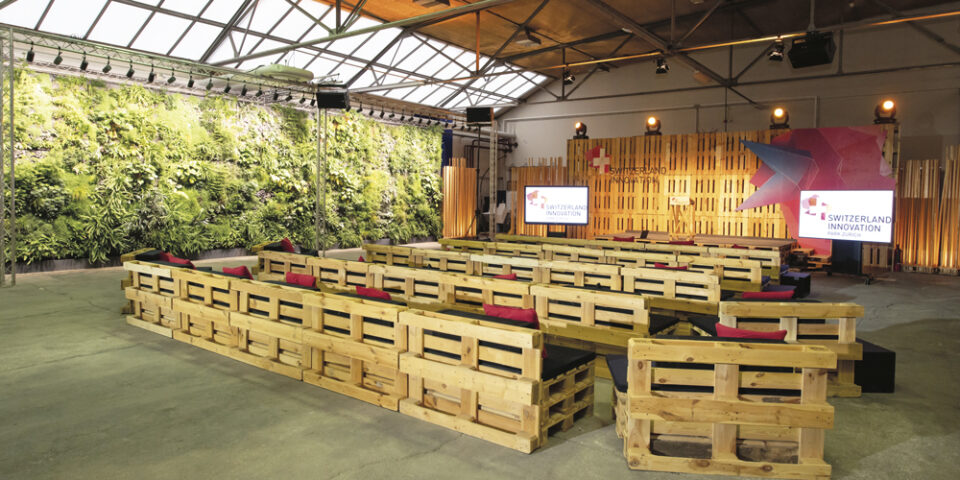
The airfield area in Dübendorf is to be developed further. Among other things, a new platform for research, development and innovation is being created here with the Zurich Innovation Park. It is intended to promote cooperation and exchange between science and business – and thus support the implementation of research results in marketable products and services. According to the BAK study, the Zurich Innovation Park should create around 10,000 jobs and an annual added value of around CHF 1.9 billion.
The Zurich Innovation Park Foundation is responsible for setting up and running it. It was founded in September 2015 by the Canton of Zurich, ETH Zurich and ZKB. The canton of Zurich, the three local communities of Dübendorf, Volketswil and Wangen-Brüttisellen and the federal government are developing the area together.
The jointly developed synthesis report of the project partners forms the basis for the development of the area. This also shows how the Dübendorf airfield area should be presented overall in the future, which uses are planned and how these are spatially distributed. The area will be divided into four sub-areas:
A first area is reserved for the Zurich Innovation Park, in which research is to be carried out in particular in the areas of mobility, robotics, aviation, space travel and advanced manufacturing & materials. In the second sub-area, the innovation park and a research, test and works airfield overlap to form an aviation cluster. In the third sub-area, the uses with high security requirements – the federal base of the Air Force and the Skyguide air traffic control center – can be further developed independently. In the fourth sub-area there are further aviation infrastructures. Nature conservation also plays a central role there. A continuous circular route around the airfield will also be created for the general public.
The government council submitted three proposals to the cantonal council for further planning and implementation work. The cantonal government is requesting 97.45 million francs for the gradual development of the innovation park and 8.2 million francs for the planning of a research, test and works airfield.
The cantonal council could decide on these templates by 2023. Renovation of the existing buildings is planned from 2023. Then the first building applications should be submitted. The implementation of the first buildings could therefore start from around 2024/2025.
The Zurich Innovation Park aims to promote cooperation and exchange between science and business.
Good things take time – there is no better way to describe the development of the Oberhauserriet in Opfikon. As early as 1952, the city separated the 67.4 hectare Oberhauserriet as an industrial zone. A district plan procedure was initiated five years later, but this was only approved in 1979. The first district plan provided for 30,000 jobs. But the project dragged on due to numerous appeals and requests for revision. In 1986, the city council of Opfikon stopped the enforcement request. Because: The planned jobs would also have meant 30,000 parking spaces. Traffic problems and environmental pollution threatened.
Interest in the planned industrial area increased sharply with the construction of the north ring road in the 1980s. In 1987, Planpartner AG was commissioned to review the planning. The planning office proposed a renewed revision of the building and zoning regulations with a significantly reduced use. New only 9700 jobs were planned. In addition, living space for 3000 people was considered for the first time, as well as a park that should cover around a third of the country in the direction of Glatt. Access to public transport rounded off the project in terms of environmental compatibility.
These adjustments found favor with the electorate in 1990. The city council of Opfikon, the city of Zurich and the interest group of landowners that had been created in the meantime also approved of the new overall plan. The then 25 landowners were closely involved in the planning by the city council. It is probably thanks to this circumstance that they were willing to make a significant financial contribution: in terms of green space or the planned “monorail” – a kind of elevated railway that should have opened up the new district.
It was spring 1996 before the first draft for the new district plan was available. Due to numerous requests, this was revised twice before the city council was finally able to set the district plan in 1999. The Government Council of the Canton of Zurich passed it on October 11, 2000, paving the way for implementation – after almost 50 years of planning.
First area marketing organization in Swiss real estate history They had agreed on living space for 6,600 people and 7,300 jobs. A 12.4-hectare green area with an artificial lake was planned for the park. A project competition was announced in 2001 for the design of the park, which the Kiefer landscape architecture office in Berlin won. Central was the elongated rectangular lake, which later received the name “Glattpark-See”.
In 2000, the city of Opfikon, the city of Zurich and the company Allreal tendered a contract for the development of a comprehensive platform for the development area. Halter Immobilien + Treuhand with the then managing director Bernhard “Beny” Ruhstaller was awarded the contract. Ruhstaller’s communication strategy envisaged making a brand out of the Oberhauserriet in order to simplify the search for investors and key tenants as well as communication with the population and image cultivation. Ruhstaller proposed area marketing empowered by all landowners.
The mission was clear: from the mass of planned individual projects, a vision of a completely new district should find its way into people’s minds. Ruhstaller already brought experience from the Limmatwest, Zurich-West and Zurich-North development areas. «It was precisely these experiences and insights that helped me with the Oberhauserriet development area. The Glattpark was of course one size bigger. On the other hand, it was almost easier to create a new identity here, since there was no inhabited area,” Ruhstaller sums up. He also remembers the founding of the new area marketing well: “The first difficulty was convincing the then many private landowners to pay money into a marketing pot, although a possible start of construction could not even be estimated.”
The real estate professional was successful together with the city of Opfikon: In December 2001, 63.64 percent of all property owners recognized the added value of joint marketing. On May 13, 2002, for the first time in Swiss real estate history, 14 of the 21 landowners founded an area marketing organization. This merger quickly bore fruit: Thanks to marketing and communication measures such as a showroom, website, trade fair appearances and intensive networking, the organization quickly became the central information and contact point for the new district, which the city of Opfikon had given the name “Glattpark” in 2001. With the increasing success of the marketing efforts, more landowners could be brought on board: in 2017, the area marketing organization had a maximum of 35 members.
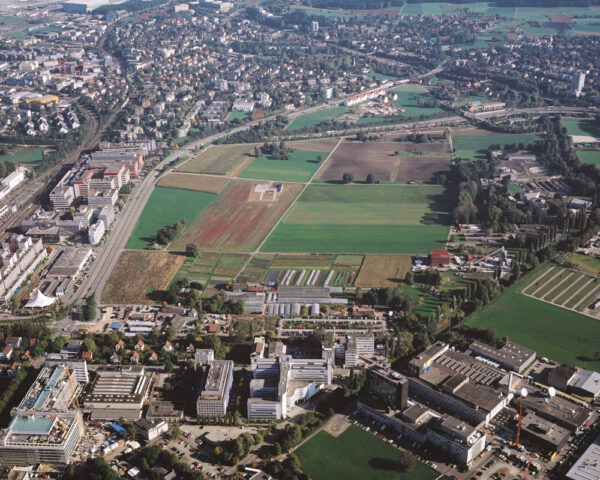
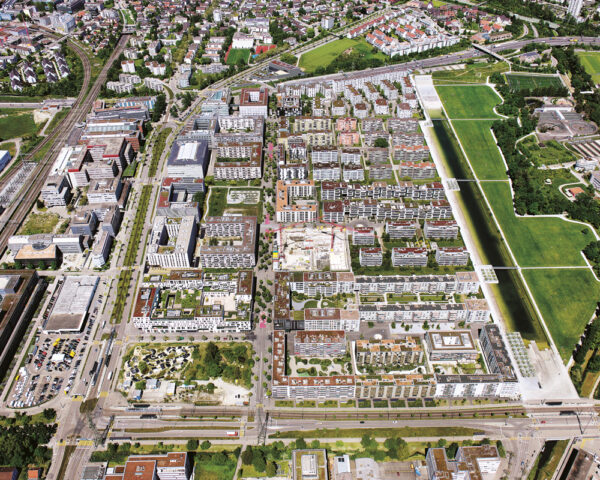
↑ The aerial photo – taken from a helicopter at the time – shows the Oberhauserriet in 2001. The city of Opfikon commissioned the company Comet Photoshopping GmbH, which specializes in aerial photos, to document the construction progress. And this is how the Glattpark looks from the air 20 years later. ↓
Thanks to the Glattpark, Opfikon is now one of the 50 largest cities in Switzerland Again and again, there were discrepancies between area marketing and the city of Opfikon: “The planning authorities involved in the Oberhauserriet district plan were not used to the fact that market and marketing issues suddenly played a role,” explains Ruhstaller and adds: “The private organization of the In the beginning, landowners might also have been perceived as a danger.” Today, cooperation between the city authorities and area marketing has normalized and can be described as mutually beneficial.
The transition from the development to the operational phase in 2016 brought with it changed tasks for area marketing. A simplification of the landowner’s contributions and the renaming to IGG Glattpark were decided. Today, the organization takes care of overarching issues. “It’s about processes that go beyond the parcel boundary of an individual property owner – such as the boulevard, parking or media work,” says Ruhstaller, who has been working as managing director of the area marketing organization for around 20 years and meanwhile from his Daughter Janina is supported. The IGG Glattpark is intended to protect and further develop the identity of the still young district. “In cooperation with the city of Opfikon, we are currently conducting a needs survey among the more than 70 businesses in the Glattpark,” Ruhstaller gives an example.
The former vision of Glattpark has become reality: the first residents moved in as early as 2006. The Monorail, which was originally planned, became the Glattalbahn, the last stage of which was inaugurated in 2010. In 2019, the majority of the second construction phase was completed. By the end of 2019, 3100 jobs were created and 5781 residents were counted. And that’s not the end of the development of the young part of the city: the hard-fought school building should be ready for occupancy in 2023/24. The often neglected 3rd stage of the Glattpark could also be in motion in the near future: “The city of Zurich, as the largest property owner, is facing an early solution together with the city of Opfikon and other private property owners,” says Ruhstaller.
The development of the Oberhauserriet – which was often referred to in the media as “the most expensive meadow in Europe” – into the Glattpark district has definitely been a success: in the past 16 years, Opfikon has grown from 13,000 to 21,000 inhabitants thanks to the Glattpark. This means that Opfikon is now one of the 50 largest cities in Switzerland.
The magazine “ Bilanz ” has published this year’s ranking of the quality of life in Swiss cities. Zurich took first place again and, according to the report , has been the undisputed leader for eleven years. The cities of Zug and Bern took second and third place, followed by Winterthur, Basel and Geneva.
The city ranking was created by the real estate experts from Wüest Partner for the business magazine “Bilanz” based on several indicators for the quality of life in cities, for example in the areas of the job market, education, leisure and shopping. A total of 162 cities were rated in this way.
According to the article by “Bilanz”, it hardly seems possible for other cities to break into the absolute top group. In the top 10, only the canton’s capital, Aarau, lost two places and fell from 6th to 8th place. When asked whether other cities even had a chance of making it into the top group, Patrick Schnorf from Wüest Partner was quoted as saying: “It’s impossible It doesn’t.” For example, St.Gallen, which currently ranks 11th, has a chance if the city could increase its educational and cultural offerings as well as its population growth.
According to Schnorf, Bassersdorf ZH is a counter-example, which has slipped back eleven places. “Compared to other cities, Bassersdorf has not developed as quickly, for example in terms of education and culture,” Schnorf is quoted as saying. According to the ranking, the two economic regions of Zurich and Lake Geneva are the most liveable.
Since there are only four cities in the top 30 from western Switzerland and Lugano, one in Ticino, it must be said that the overall quality of life in German-speaking Switzerland is higher.
The dynamic startup HEGIAS offers the world’s first automated and browser-based solution for visualization and communication with Virtual Reality (VR) for the planning, construction and real estate industries. The rapidly growing company was founded in 2017 and currently employs around 20 people at the two locations in Zurich and Lugano. “With Steiner AG, we have a strong partner at our side who supports us in realizing our growth ambitions,” says Patrik Marty, CEO of HEGIAS. Giuseppe Giglio, Chief Digital Officer at Steiner AG, adds: “The new virtual collaboration environment will enable everyone involved in the project to work on the same model at the same time and from any location.” This simplifies and accelerates previous processes and contributes to a significant reduction in errors.
Ajay Sirohi, CEO of the Steiner Group, is convinced that the cooperation will contribute to the long-term success of both companies: “The combination of HEGIAS’ digital expertise and our proven experience in the BIM and construction sectors enables us to jointly create tailor-made innovations for the market develop. With the first strategic partnership in the digital sector, we can expand our expertise in this area and actively help shape the future of the real estate industry. In the future, we are planning further collaborations with innovative start-ups in order to continue the digital transformation of our company and to grow sustainably in the field of future technologies.»
On behalf of the co-ownership, SPGI Zurich AG has rented two additional areas in the Baden connection . The Konnex building complex in the center of Baden is currently being completely renovated. According to themedia release , a “city in a city” offer will be available there by mid-2023. A total of around 35,000 square meters of space will be rented for this purpose.
According to the press release, the new tenants are Casino Davos AG and SkySale. Casino Davos has already moved in as an interim tenant and will move into its new 495 square meter space once the refurbishment is complete. SkySale Schweiz GmbH, better known under its apple box brand, is also a new tenant. It will move into around 814 square meters of space in early summer 2023.
The interest in the innovative multi-tenant concept of the Konnex is great and negotiations are currently taking place for many other areas. The city-in-city concept envisages a range of services and amenities, including restaurants, convenience stores, fitness, childcare and co-working.
SPGI Zurich AG, based in Zollikon, is a subsidiary of the Intercity Group , an independent real estate service provider with group companies in Zurich, Lucerne, Bern, Basel, St.Gallen, Olten SO and Zug. Since 1993, SPGI Zurich AG has been an alliance partner of Cushman & Wakefield , a leading global provider of real estate services with headquarters in Chicago and 53,000 employees in 60 countries worldwide.
Zurich gained two places in the European Thematic Cities Index (TCI) compared to the previous year and is now in second place. London is in first place and Stockholm is in third place. According to a press release , this index from Swiss Life Asset Managers measures 135 European cities in 28 countries. He evaluates them on five core themes that shape a city’s real estate market: Change and Disruption, Climate and Environment, Communities and Clusters, Consumers and Lifestyle, and Connectivity. He wants to offer a comparability for real estate investments.
The six Swiss cities in the ranking are all in the top 50 of the TCI. Among them, Zurich remains “the most dynamic and healthy city with the best networks”. Despite the lack of an international airport, Bern’s 9th place is now “the third most accessible city in the entire ranking”. Basel gains one place compared to the previous year and is in 7th place, Lausanne in 15th place. Geneva has gained the most with 16 places and is listed in 31st place. Due to its “less environmentally friendly mix of sectors and above-average car use”, Lucerne lost nine places and ended up in 41st place.
According to the TCI, all six Swiss cities promise little growth potential despite their stability and attractiveness. According to this analysis, they are all among the eleven worst European cities in terms of this criterion. And as in the TCI 2021, this year’s analysis rates health as the weakest issue in Swiss cities.
Tenants who wish to move must be prepared for higher rents when looking for an apartment. After several months with practically unchanged values, landlords raised their price expectations by an average of 0.7 percent in May. The correction is almost as large as the change registered over the last twelve months (0.9 percent). This is shown by the Swiss Real Estate Offer Index, which is collected by the SMG Swiss Marketplace Group in cooperation with the real estate consulting company IAZI.
However, the development of rents differs depending on the region. Apartment seekers in the greater Zurich region (1.8 percent) and in central Switzerland (1.2 percent) are confronted with a significant increase in asking rents. The surcharges are lower in the Lake Geneva region (0.5 percent) and in north-western Switzerland (0.4 percent), while in the central region (0.1 percent) and in eastern Switzerland (0.1 percent) there are practically no changes. In contrast, rents have fallen in Ticino (−0.8 percent).
Home ownership: The boom is not over The real estate market is currently in focus mainly because of the high prices for residential property. Against the background of rising mortgage interest rates, many observers expect the situation to cool down soon. However, the asking prices are still on the rise, as the analysis of the advertisements in May shows.
“For single-family houses, 1.0 percent higher values were required than in the previous month, for condominiums the price growth is 0.2 percent. The interest-related increase in financing costs does not seem to bother prospective buyers much. At least sellers are still assuming an increasing willingness to pay,” says Martin Waeber, Managing Director Real Estate, SMG Swiss Marketplace Group.
The canton of Uri is building a new regional hospital that will serve as a model. After three years of construction, the new Cantonal Hospital Uri (KSU) will open in June 2022. Uri thus sets a record: The new hospital is the largest building construction project that the canton has ever implemented as a builder. The hospital in the main town of Altdorf is a generational work that will secure and improve the health care of the population for years to come. From the architecture to the design to the execution: the new building of the KSU is geared towards the current and future needs of the canton of Uri. “With this investment, we are securing basic medical care in Uri for future generations. The workers on the construction site worked very hard. Thanks to their commitment, difficulties such as the corona pandemic could be overcome on the construction site. In addition, regular hospital operations were able to continue unhindered,” says government councilor Roger Nager.
New shell, new interior Thanks to the investment, the cantonal hospital in Uri can play its role as a medical competence center in the future. The KSU will gain in medical treatment: In the future, patients will have short distances, comfortable rooms, more privacy, modern examination rooms and good service. The team from Darlington Meier Architects, Zurich, has succeeded in creating a compact, independent and stylish building. The new building is surrounded by a large hospital park. The building carefully creates a new, strong identity. In this way, visitors or patients can find their way around quickly and easily. This is achieved through the careful use of material, light and colour. You can see daylight everywhere in the new building, even in the operating theaters you can see the imposing mountains of Uri. As an important base, the KSU also ensures emergency care along the north-south axis for people who do not live in Uri.
Huge public support On September 24, 2017, 85.5 percent of the Uri voters approved the construction loan for the conversion and new construction of the cantonal hospital. Roger Nager is convinced: “The patients and the approximately 600 employees of the cantonal hospital will feel comfortable in the new building”.
ewz is expanding its citizen participation model ewz.solarzüri . As the energy supplier announced in a press release , around 3,300 additional solar systems on public buildings in the city of Zurich are now available to its customers. In this way, tenants can also contribute to the construction of additional solar areas. The price is 250 francs per square meter, the payment on the electricity bill is 80 kilowatt hours per year for a period of 20 years.
The largest of the planned new solar systems are in Höngg: on the Lachenzelg Ost school building (1860 square meters) and on the waterfront school building (1170 square meters). 100 square meters are planned on the roof of the Dunkelhölzli residential building in Altstetten, and 165 square meters on the Altstetten train station. If 80 percent of an area is sold through this type of swarm financing, the respective system is realized by ewz.
In this case, clean electricity will be generated by ewz.solarzüri from January 2023 on over 37,000 square meters. According to ewz, further locations are in the works.
“With the solar strategy , we in the city of Zurich have the ambitious goal of producing more solar power,” City Councilor Michael Baumer, head of the industrial operations of the city of Zurich , to which ewz also belongs, is quoted in the statement. “Because only together can we make Zurich a solar city – every square meter counts!”
Wir verwenden Cookies zur Unterstützung und Verbesserung unserer Dienste. Mit der Nutzung dieser Website erklären Sie sich mit der Verwendung von Cookies einverstanden. Weitere Informationen finden Sie in unserer Datenschutzerklärung.