Tag: Zug

  • New development to reduce railway noise

    New development to reduce railway noise

    Researchers from the Swiss Federal Laboratories for Materials Testing and Research ( Empa ), the University of Economics and Engineering of the Canton of Vaud and the Swiss Federal Institute of Technology in Lausanne ( EPFL ) have jointly developed new rail pads. These components are mostly made of elastic plastic and are stuck between rails and concrete sleepers, as Empa explains in a press release . They are used to protect rails.

    However, existing rail pads have limitations. Especially if the protection of the rails is greatly increased, this leads to more noise pollution at the same time. The researchers now want to solve this challenge. After several tests in the laboratory, a part with more than 50 percent polyisobutylene (PIB) content, embedded in a shell made of a harder ethylene vinyl acetate (EVA) plastic, proved to be the most effective option. At the same time, it can reduce railway noise and protect the rails.

    In a next step, the new rail pads are to be tested on a railway line in Nottwil in March. “These rail pads are easy to make. We will need almost 400 units for the 100-metre stretch,” explains Bart van Damme from Empa’s Acoustics and Noise Reduction department. That is why a company is already on board that will take over the manufacture of the components that have already been patented.

  • Fewer apartments are empty

    Fewer apartments are empty

    As of June 1, 2021, Switzerland had a total of 71,365 vacant apartments, including single-family houses, according to the Federal Statistical Office ( FSO ) in a message . Compared to the previous year, this corresponds to a decrease of 9.5 percent. The corresponding vacancy rate fell in the same period by 0.18 percentage points to 1.54 percent. It fell for the first time in twelve years, according to the announcement.

    The FSO analysts observed a decline in vacant apartments in six of the seven major regions. Only in the greater Ticino area did the vacancy rate rise by 0.12 percentage points to 2.83 percent. Within the cantons, the analysts found the lowest vacancy rates in Zug (0.34 percent), Geneva (0.51 percent) and Zurich (0.72 percent). The highest vacancy rates were observed in the cantons of Solothurn (3.15 percent), Ticino (2.83 percent) and Appenzell Innerrhoden (2.59 percent).

    The analysts have noted a particularly high decline in vacancies for new apartments and single-family homes. As of the reporting date, 7,066 vacant properties were offered for long-term rent or for sale across Switzerland, 24.2 percent fewer than in the previous year. The number of vacant single-family houses offered for long-term rent or purchase decreased by 18.8 percent to 5940 properties in the same period.

  • Westhive is planning a new location in Zug

    Westhive is planning a new location in Zug

    The Metall Zug Group wants to create "a new piece of the city for an industrial ecosystem" on the V-Zug site. Additional industrial companies, start-ups, technology-related service providers, training facilities and apartments are also to be located on the so-called Tech Cluster Zug.

    The Zurich coworking provider Westhive also wants to be present on the area. According to a media release , he will open a new location there in late summer 2022. Members are to be offered flexible workplaces, conference rooms, a coffee bar, a team kitchen and a fitness area. Overall, the Zug location will cover an area of more than 2000 square meters.

    "We are very pleased that we have found such a suitable location in Zug", Bruno Rambaldi, co-founder of Westhive, is quoted as saying. "And with Metall Zug we have an ideal partner for the implementation."

    According to David Carnier, who is responsible for the Westhive project on the part of Tech Cluster Zug AG, Westhive's flexible workplaces fit well into the concept of the Tech Cluster Zug.

  • There are great price differences in real estate

    There are great price differences in real estate

    Homegate.ch finds big differences in the purchase price of residential properties within Switzerland. Geneva and Zug are proving to be the most expensive cantons to buy a home, as the real estate platform belonging to TX Markets AG writes in a press release. Interested parties can only buy a 1.5 room apartment there for CHF 500,000. The same amount of money can be used to buy a three-room apartment in the canton of Zurich. In the cantons of Uri, St.Gallen and Jura, the budget is even enough for a 4.5 room apartment.

    Homegate.ch also detects major differences in property prices within the individual cantons. In some municipalities in the canton of Zurich (Elgg, Gossau or Mönchaltorf), a 3.5-room apartment can be purchased for CHF 500,000. In other municipalities (City of Zurich, Horgen or Männedorf) the money is only enough for a 1.5-room apartment.

    Overall, the purchase prices for real estate have risen in all cantons over the past ten years. Real estate has risen most in price in the canton of Zug. There the prices for a 4.5-room condominium rose from CHF 900,000 in 2010 to CHF 1.3 million in 2020. That corresponds to an increase of 45 percent.

    The rental prices are also very different depending on the canton. And here, too, Geneva and Zug prove to be particularly expensive. The city of Zurich also has comparatively high rental prices. Appenzell Ausserrhoden or Jura are considered cheaper. In the past ten years, rental prices have increased less than purchase prices.

  • Shed Zug: "Every visit to us is unique"

    Shed Zug: "Every visit to us is unique"

    Can you even plan the construction and opening of a gastronomy concept like the Shedhalle in today's crisis-ridden times?
    Lina Fluri: The current situation certainly doesn't make planning the opening easy. However, we are adjusting to the originally planned opening date and are constantly watching how the situation develops. The construction was only marginally influenced by the pandemic and could therefore be carried out without major problems.

    In retrospect, what were the most important changes due to the corona pandemic?
    We recognize significant changes in the difficulty of planning certain projects and uncertainty about future developments. In addition, the home office has fundamentally shaken up the world of work. What was only possible physically in the past is now easily achieved digitally. This development will have far-reaching consequences for various industries and types of work.

    Can you give an example?
    In the catering industry in particular, people's consumer behavior has changed. Take-away food has become more important. The need of people to cultivate more social contacts again is great and will become noticeable in a rush to restaurants and bars after a relaxation. One or the other guest will probably spend an above-average amount of money to satisfy the appetite for social experiences.

    All are corona tired. Can you get something positive out of this long time without meetings and events?
    I believe that the corona pandemic caused a lot of suffering for many people. However, there are certainly branches and industries that have benefited enormously in these times of crisis. On a personal level, I notice that life has slowed down a bit, that we are increasingly focusing on the essentials again and appreciating the little things more, which is basically a very nice development.

    The Shedhalle is intended for smaller events. Is that an advantage nowadays?
    The Shed is characterized by its enormous flexibility. We can hold events for 6 to 300 people and always put together an attractive offer for the customer. However, the focus is on events between 20 and 100 people, which can be an advantage in the coming years. We close a big gap in the market with our private dining rooms, which can be booked for meetings of all kinds. The cozy rooms leave nothing to be desired and offer the customer the unique opportunity to combine business with high-quality cuisine.

    The special industrial charm of the Shedhalle is emphasized again and again. What do you mean by that?
    The Shedhalle will remain as one of two monuments from the industrial beginnings of Zug and is prepared for the next 50 to 100 years. We have tried to carry on the industrial touch with a lot of charm and passion and have created a place where industry meets contemporary and modern architecture. The industrial charm is noticeable in our attention to detail and in the respectful handling of the history of this place.

    Lina Fluri, Shedhalle project manager.
  • Unique office and commercial space on the Papieri site

    Unique office and commercial space on the Papieri site

    Tailor-made office space and studios for every business idea
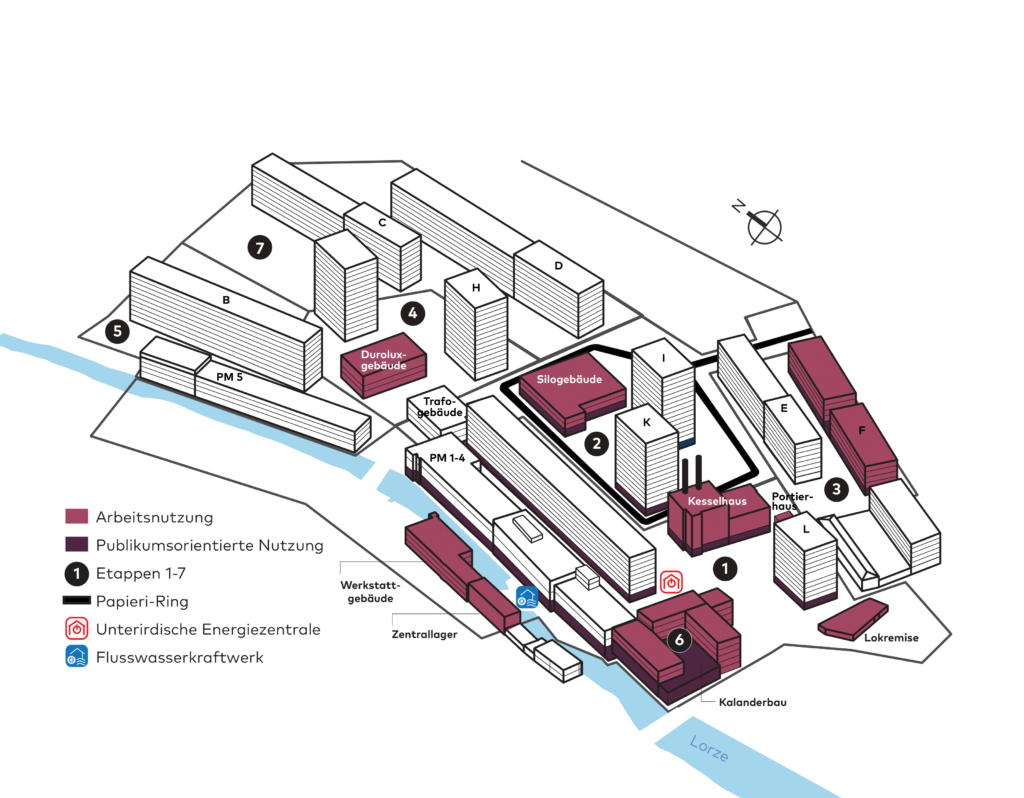
    Spread over the entire area, an extraordinary variety of areas will emerge over the next few years, which are suitable for the most varied of uses and sizes of businesses. Do you want 5m high rooms with industrial charm or something more modern in a contemporary new building with a representative appearance? Do you only need a small retreat to fine-tune your latest ideas, or as an anchor tenant would you like to play a key role in the planning process for your new headquarters? Everything is possible on the Papieri site and, thanks to the state-of-the-art infrastructure with fiber optic connections, you don't have to compromise anywhere. Areas from 50 m2 to 5,000 m2. Move-in from the end of 2022.

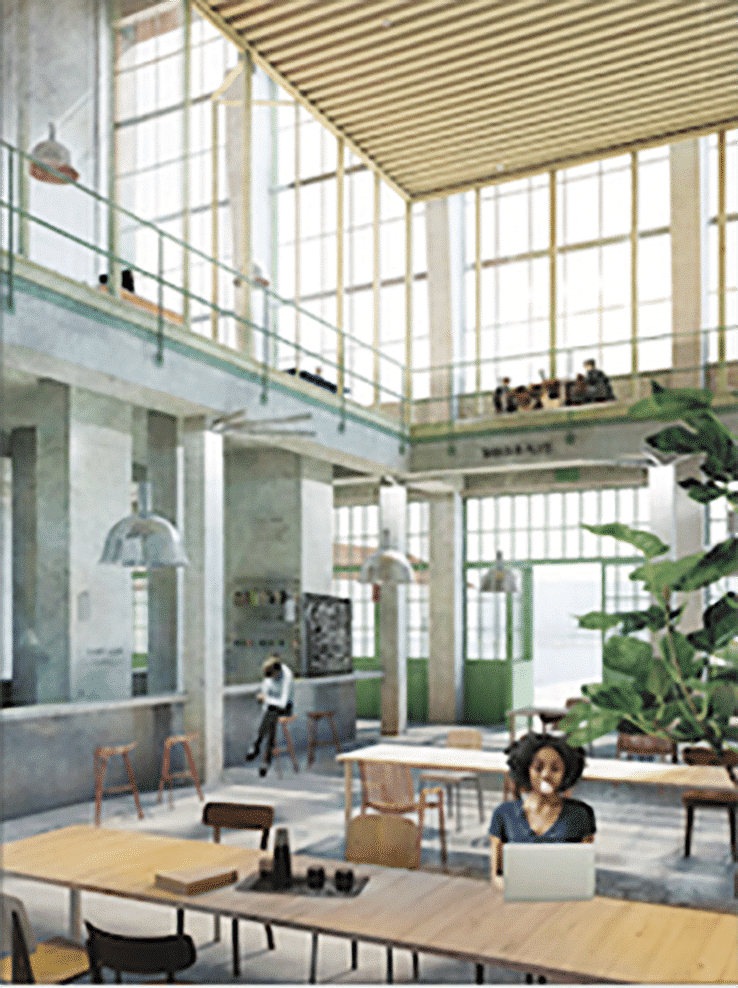
    Kesselhaus bistro with coworking.

    Lively ground floors for small businesses and services
    Lively ground floors are an important quality feature of any functioning quarter. Whether gastronomy, graphics office or physiotherapy, whether yoga room, flower shop or showroom: Innovative ideas with added value for residents and visitors are very welcome on the Papieri area. Areas from 100 to 1,000 m2. Move-in from the end of 2022.

    Sustainability is a top priority
    Thanks to our own hydropower plant on the Lorze and large-area photovoltaic systems on the roofs, all buildings are cooled and heated 100% CO2-neutrally. In addition, around a third of the electricity consumed is produced on site. All parking spaces are prepared for electromobility and are equipped as required. In addition, there are several quick charging stations available on the site. Don't own a car? Car and bike sharing offers ensure that you are still mobile.

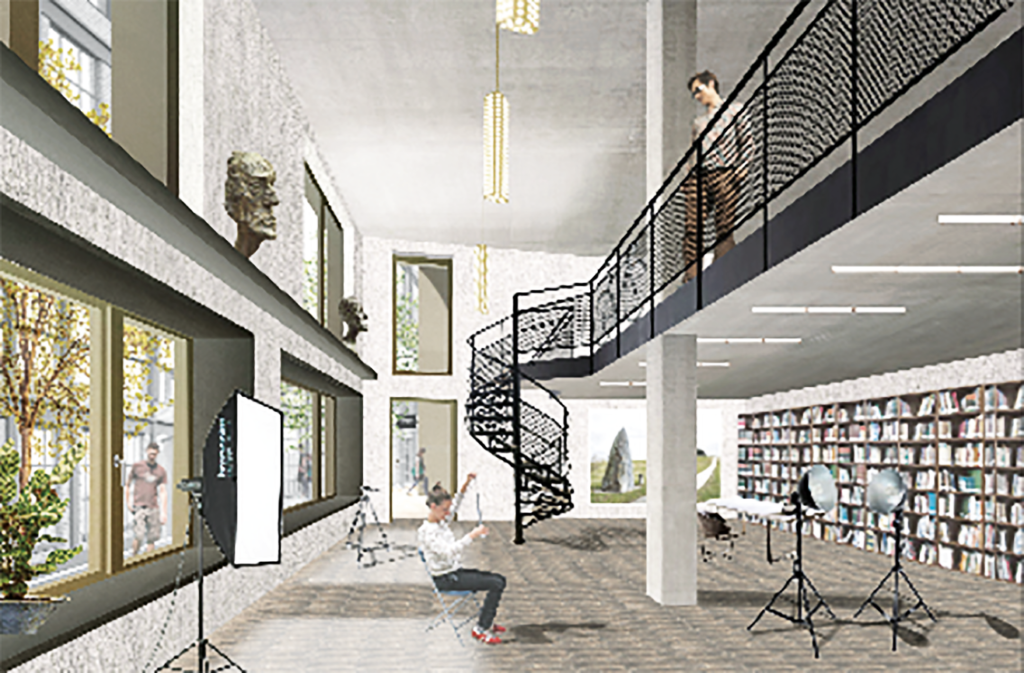
    Maisonette studios in the new building.

    Become part of a lively neighborhood
    As a tenant, you can benefit from the attractive framework conditions on the Papieri site. Do you need a room for a new employee for a few months? Book a micro apartment directly on the area! Fancy a business lunch? The future Kesselhaus bistro is only a stone's throw away. Or do you feel like jogging or jumping into the cool water to clear your head? The attractive location of the Papieri area directly on the Lorze, not far from Lake Zug and the idyllic Villette Park, offers you countless opportunities to switch off and recharge your batteries and then start over.

    Get in contact with us and convince yourself of all the possibilities that are open to you here. Grow with us!

  • "The city of Zug should become greener"

    "The city of Zug should become greener"

    To person
    Eliane Birchmeier (FDP) has been city councilor and head of the building department of the city of Zug since January 2019. The 58-year-old studied business administration and is federally certified. dipl. PR consultant and founded Birchmeier Communications AG based in Zug in 2005. She was a member of the Board of Directors of Kursaal-Casino AG from 2004 to 2017 and co-owner of C-Matrix Communications AG from 1992 to 2004.

    You are the head of the building department of the city of Zug. Where do you see your core tasks?
    Eliane Birchmeier: My core tasks include the classic areas of responsibility in construction: On the one hand, there are building permits and building projects for city-owned civil engineering and structural engineering projects. On the other hand, we deal with planning, design and legal aspects in town planning and urban planning. This is about the future development of the city of Zug in terms of urban development and spatial planning with settlement, landscape and traffic.

    The city of Zug is forecast to have around 10,000 population growth by 2040. What structural measures are planned to do justice to this development?
    The forecast growth depends on the development of the project by private owners and investors. We have already done our homework in many areas. For example, when it comes to infrastructure projects in the areas of drainage, energy and disposal. In education, we – like other communities in Switzerland – have a certain amount of catching up to do. Various plans are currently underway for expanded and new school facilities. But we also want to upgrade the green and open spaces and improve the network of footpaths and bike paths in the coming years.

    The economy should also continue to grow. Where do you see the greatest potential for new commercial buildings?
    There is still great potential for expansion for trade and services in various former industrial and urban areas. These include the technology cluster with the V-Zug area, urban areas east and west of the station such as Metalli, Baarerstrasse West and the LG area. Then there is the area on the Aa II, which is being developed by the Zuger Verkehrsbetriebe, the Hertizentrum and the outer Lorzenallmend. In the future, these areas will offer mixed, urban uses of living, leisure and work.

    Where in the canton can you find larger land reserves?
    As elsewhere in the canton, growth in the city of Zug will mainly take place in the interior through densification. In addition, there are a few construction areas that have not yet been built up, such as the outer Lorzenallmend, areas in the Herti and Unterfeld, in the Lüssi / Göbli and in a southerly direction in the Salesianum and in Oberwil. Actual zoning is not the focus of ongoing local planning.

    "We expect planning applications for the Lüssi / Göbli area and the area of the Salesianum country house soon"

    Which projects are planned there?
    In the outer Lorzenallmend, a development plan is being drawn up for a residential and work area and in Herti Süd one for a residential development. There are currently no plans in the Herti Nord, Unterfeld or Spielhof. In the Lüssi / Göbli and the Salesianum there are legally binding development plans for residential developments. We expect planning applications for this in the near future.

    What are currently the most important construction projects that you are involved in?
    City-owned projects are the construction of the recycling center and the Ökihof in the north of the city. School complexes are being planned and projected throughout the city. The project competition for the extension of the lido starts this year, and in summer the Zug population will be able to use the new emergency rooms in the Göbli district.

    The city of Zug is in the middle of the local plan revision process. Is there already an initial strategy for mobility and open space?
    The city's spatial development strategy will be drawn up in several stages and steps up to autumn 2021. The first thrusts based on the technical basis, the population survey and the first participation phase are clearly emerging: the city should become greener. In addition, a diverse and high-quality range of different open spaces should be available to the population.

    What does the population want?
    She would like the growth in mobility to be absorbed by expanding and promoting pedestrian and bicycle traffic as well as public transport. Traffic routing in the center is to be simplified and designed in a way that is compatible with settlement. Particular attention is paid to optimizing commuter traffic. In cooperation with the canton and neighboring communities, but also with employers, we are focusing on an increased shift towards public transport, which is already excellently developed, and non-motorized private transport.

  • Focus on qualitative development

    Focus on qualitative development

    Zug is one of the most popular economic and living areas. This is proven by numerous studies and rankings. The success is based on a long-term development strategy and attractive framework conditions. Zug offers a unique combination of excellent location factors such as the availability of skilled workers, stability, attractive taxation, central location, quality of life, level of education and economic friendliness.

    The Zug business center is dynamic, as evidenced by developments on the real estate market and in the transport infrastructure. The strong presence of value-added industries and service providers as well as a high concentration of high-growth sectors are important for the quality of economic development. The broadly diversified industry structure and the unique mix of small, large, local and international companies are an important driver for the innovative development of the canton. The focus of economic management by the Department of Economics is on the existing and established companies. Their growth makes the greatest contribution to the canton's economic development.

    Testimonials

    Silvia Thalmann-Gut, member of the government, economics director and governor of the canton of Zug

    The canton of Zug offers excellent location conditions for everyone. This includes the "Spirit of Zug" that is lived. The distances are short, the authorities work quickly and efficiently. Zug's success is based on a long-term strategy.

    Heini Schmid, lawyer, former Cantonal Councilor and long-time President of Zug Tourism

    Zug is in Switzerland what Switzerland is in Europe: small, surrounded by large neighbors and therefore open and adaptable. For us, changes are always an opportunity to do things differently and better. Zug is Switzerland to the power of two; it is the total package that counts.

    Matthias Rebellius, CEO Siemens Smart Infrastructure, Chairman of the Board of Directors Siemens Schweiz AG

    From Zug, we are driving digitalization at Siemens Smart Infrastructure. For us, Zug is an ideal location for our global headquarters, as we can attract and promote the best local and international talent here.

    Johanna Friedl-Naderer, President Europe, Canada & Partner Markets, Biogen

    Zug is the hub of our international headquarters. From here we coordinate our operational and administrative activities worldwide. The central location and high quality of life make Zug an attractive location for top talent.

    Contact point for the economy of the Canton of Zug
    Welcome to the canton of Zug. Our services are aimed directly at you as an entrepreneur. We are your partner and promote Zug as a business location.

    Business contact point, Aabachstrasse 5, 6300 Zug, T +41 41 728 55 04, economy@zg.ch

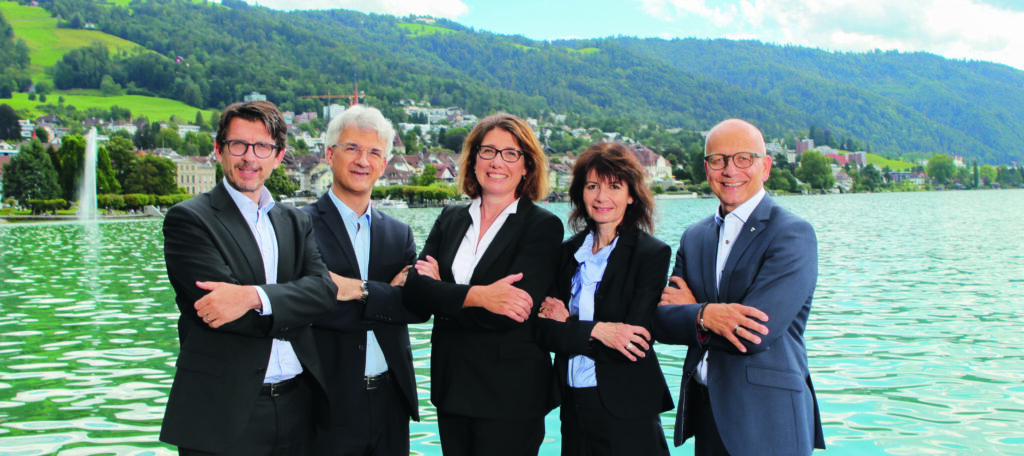
    Alberto Diaz, Deputy Ladder; Peter Müllhaupt, jur. Employee; Yvonne Valentino, assistant / back office manager; Ursula Kottmann Müller, Marketing / Communication; Beat Bachmann, Head (from left to right). Photographer: Peter Hofstetter
  • SHL Medical is building a sustainable new location

    SHL Medical is building a sustainable new location

    SHL Medical invests in a new location on the Tech Cluster Zug . This will consist of a 10,500 square meter production area and a 5,000 square meter office space. The manufacturer of injection systems plans to employ around 400 people there.

    Several architectural offices have developed concepts for the new location as part of a competition. The project by the architects Penzel Valier AG has now prevailed, according to a media release . In addition to SHL Medical, the jury also included the city of Zug, Metall Zug and experts from various disciplines.

    The project by the architects Penzel Valier relies on the use of wood as the main alternative material. The energy is supplied via a building-integrated solar energy system. Sea water is used for heating and cooling. The excess heat and energy is recovered for further use. Overall, according to the information, this enables zero CO2 emissions production.

    According to the announcement, the building application is planned for the end of 2021. Because the SHL Group is aiming for continuous growth in the coming years, the expansion of the location is planned in two construction phases and in four expansion stages. The commissioning of the four expansion stages is to take place in several stages.

    "The building architecture should provide an environment that optimally supports the activities of our employees and operations," Ulrich Faessler, CEO SHL Medical, is quoted in a separate press release. "As we at SHL are striving for continuous growth and in order to consolidate our pioneering role within the industry, we will further strengthen our global presence and our activities through global production," he adds.

    SHL Medical relocated its headquarters to Zug in Switzerland in 2018. One of his goals was to further strengthen the global partnership with his pharmaceutical customers. In addition to Switzerland, SHL Medical also has locations in Taiwan, Sweden and the USA.

    The Tech Cluster Zug is being built on the headquarters of V-ZUG AG in the city of Zug. V-ZUG wants to concentrate its production in the north of the area. Industrial companies, technology-related services, start-ups as well as research and educational institutions are to be located on the remaining parts of the area.

  • Limmat Verwaltungs AG gets a new name

    Limmat Verwaltungs AG gets a new name

    Limmat Verwaltungs AG has become Elicere Real Estate Management AG. Limmat Verwaltungs AG, founded in Schlieren in 1967, has been taken over by Elicere AG in Zug, according to a press release in 2019. The company was renamed from Limmat Bau-, Treuhand- und Verwaltungs AG to Limmat Verwaltungs AG.

    The administration is now to be continued under the new name, which refers to the new owner. The new company Elicere Real Estate Management AG is naturally based in Schlieren on Schulstrasse, at the previous address of the Limmat administration.

    Before the start with the new name, a comprehensive restructuring and especially digitization had been carried out, it says in the message. In addition to the management and valuation services already offered, there is now also the assumption of construction management.

    The new company, which was founded in December, is managed by Rikard Memaj and Roger Priester. Both are members of the Board of Directors. Its President Roger Priester is quoted as saying: "We are convinced that with the transparent and structured set-up in the company, we can lead our customers into a sustainable future with the most modern tools and motivated employees."

  • Westhive wants to expand further

    Westhive wants to expand further

    Westhive sees an increasing demand for flexible office space. The Zurich-based provider, founded in 2017, therefore plans to open new locations in Basel, Zurich-Stettbach and Zug at the beginning of 2022. Geneva is to follow a year later, Westhive writes in a statement. The location there is to be set up in the new Alto Pont-Rouge and cover an area of 4500 square meters. It will also have its own fitness center, two restaurants and an event conference center.

    A total of around 1,000 jobs will be created at the four locations on 10,000 square meters. "All locations have a high proportion of private offices, for which we are seeing the greatest demand," Westhive co-founder Andreas Widmer is quoted in the press release.

    Westhive continued to see strong growth in 2020. The number of tenants has risen by over 50 percent. "We are seeing continuous demand for flexible offices and workplaces, even now that the home office is mandatory," says Widmer. "But most of all we are pleased that we have lost practically no members."

  • Development of the area of the former canton hospital

    Development of the area of the former canton hospital

    The area to be built is only a few minutes' walk from Zug's old town and has excellent development potential, writes the building construction department of the canton of Zug in a message. There is a legally valid development plan for the area. This includes various construction areas with public uses, gastronomy and hotel uses, apartments and old-age living. In a two-stage competition process, a suitable team of investors, operators and planners is to be evaluated in order to find a competitive building lease offer and the best development concept for the area.

    Submit a binding offer
    In the current phase 1b “shortlist”, the teams selected from phase 1a “prequalification” would be given the opportunity to deepen their proposals and submit a binding offer for building permits. After the legally binding construction contract and the development agreement between the canton and the investor of the winning concept have been concluded, the latter will take responsibility for the implementation of stage 2 «architectural competition / study contract». In doing so, the project is to be evaluated, which is able to implement the framework conditions of the development plan as well as the selected development concept from the 1st stage, writes the building department. ■

    Contact

    Construction Department of the Canton of Zug
    Building Department
    Telephone +41 (0) 41 728 54 00
    Info.hba@zg.ch
    www.zg.ch/hochbauamt

  • Vision for the further development of the "Metalli living space"

    Vision for the further development of the "Metalli living space"

    For Zug Estates the starting point is clear: the area around the “Metalli” shopping center has become an important meeting place for the city of Zug. In order for the quarter to be able to meet future needs after more than thirty years of existence, it must develop further. To this end, more space is to be created for living, working and leisure. In addition, there should be free spaces and new uses that offer the Zug population real added value.

    In March of this year, Zug Estates and the city of Zug presented the first result of the joint planning process “Metalli living space”. The jury selected the study by the planning team Hosoya Schaefer Architects, NYX architectes, Lorenz Eugster Landscape Architecture and Urban Development and the Zug office of TEAMverkehr.zug for the future design. According to architect Markus Schaefer, the central idea of this further development project is to detach the "Metalli" from their island existence and to better intertwine them with their urban surroundings.

    Development process lasting several years
    Preserving the tried and tested and at the same time creating a lot of space for new things – this is how the basic idea for the future design of the 30,000 square meter living space “Metalli” in the heart of the city of Zug can be summarized. The results of the competition process are the first step in a multi-year joint development process by

    Authorities and builders.
    The urban development concept of the team around Hosoya Schaefer intends to preserve the majority of today's buildings around the shopping center. A new building is to be added, no more than seventy meters high, on the corner of Baarerstrasse and Metallstrasse. Several existing buildings will also be topped up. Overall, more space is to be created for apartments, hotels, offices, restaurants, shops and other, partly public-oriented uses. A spatial realignment and the demolition of existing buildings in places will create a new town square with space for a wide range of uses on Baarerstrasse on the Bahnhof-Metalli axis.

    Acceptance in the population
    "A defining feature of the new overall concept‹ Lebensraum Metalli ›is the upgrading of the outside space through more intensive greening across all spaces and along the connecting axes," says Deputy Head of Project Development and Overall Project Manager Florian Diener. Even the roof areas are included in the outdoor space concept and – also a concern of the Zug population – made partially accessible to the public. “The principle of the glass roofing of the shopping arcade is retained and will be expanded. The area around the Metalli shopping center is a central intersection on the Zug – Baar axis and an important functional urban space for the population of Zug. In order for it to be able to fulfill this task in the long term, it should be carefully further developed in line with the overall development of the city of Zug over the next few years. In addition to the requirements of the authorities and the landowner, concerns and wishes from the Zug population also flowed into the task for the three planning teams. “We communicate all project progress transparently, because public acceptance is the be-all and end-all of our project,” adds Diener.

    Gradual implementation over the next few years
    From the favored draft of the planning team under the leadership of Hosoya Schaefer Architects, a straightening project is created, which forms the basis for a later development plan. This process phase will take about two years. The first structural measures can therefore take place in 2023 at the earliest. "The final start of construction ultimately also depends on the will of politics and the population," emphasizes Florian Diener. ■

  • Zug is the most attractive canton for companies

    Zug is the most attractive canton for companies

    The major bank Credit Suisse has published its location quality indicator for this year. This measures the attractiveness of the cantons from the point of view of companies. The canton of Zug moved up to first place this year and was able to overtake the canton of Basel-Stadt. Credit Suisse explains this with the reduction in corporate income taxes that came into effect at the beginning of 2020. The effective maximum corporate income tax rate in Zug is now 11.91 percent – in the previous year it was 14.35 percent.

    Behind Zug and Basel-Stadt, the canton of Zurich follows in the ranking, followed by the canton of Geneva, which has moved up ten places. The fifth place is occupied by the canton of Aargau, the sixth by the canton of Schwyz.

    In addition to the tax policy of the cantons, Credit Suisse also includes the availability of highly qualified and skilled workers in its analysis. According to the economists of the big bank, the level of education of the Swiss workforce has risen sharply in recent decades. However, there is a gap between urban and rural areas when it comes to the availability of highly qualified workers. In urban regions as well as in the closer agglomeration areas, over 40 percent of potential employees have a higher education. In the city of Zurich this proportion is even 57 percent.

    Credit Suisse not only scrutinized the cantons, but also economic regions. This is because she is of the opinion that consideration at the canton level falls short of the mark, especially in larger, heterogeneous cantons. According to the results, metropolitan areas such as Zurich, Zug, Basel, Baden and Geneva and their agglomerations are among the most attractive regions for companies.