Author: immovestuser

  • Glattpark – or how a swamp becomes a city

    Glattpark – or how a swamp becomes a city

    The Oberhauserriet – today's Glattpark – has a long and eventful history behind it. The planning of the development of the former swamp and agricultural area took more than forty years. After the approval of the neighborhood plan in 2001, however, the development picked up speed: A new district of Opfikon was built on what was once a green field at a rapid pace, with currently around 5780 residents and 3100 jobs in the neighborhood plan area. Today the Glattpark has a model character in its uniqueness. A new book, which appeared in mid-September, shows challenges and solutions on the way from the meadow to the urban district and traces the individual development steps. **

    Breathe life into a vision
    The founding of an organization that was unique in Switzerland at that time contributed significantly to the success of the Glattpark: a merger of several landowners to form a superordinate area marketing department, which was responsible for the overall marketing of the Oberhauserriet. The aim was to create a common brand from which all individual projects would in turn benefit. The new organization – the Glattpark area marketing – was supposed to act as an information hub for landowners, the media and the general public on the one hand, and to provide marketing services to the individual landowners on the other. But first and foremost, it should breathe life into a vision, because offices and apartments should not simply be built in Oberhauserriet – an urban vision would be realized here. Communication with the development area therefore required a way of thinking that went beyond the mere application of individual projects.

    Marketing offensive for a meadow
    In view of the rather difficult economic environment at the time, the establishment of joint area marketing must be described as courageous. The developments at the airport and in terms of aircraft noise, the uncertain realization of the Glattalbahn – a location advantage that should not be underestimated for the new district – but also the generally difficult economic situation made "big hits" appear difficult. The area marketing Glattpark was aware of this fact from the beginning, but saw the overall quality of the area as an opportunity. The success soon proved the area marketing right: Thanks to extensive marketing and communication measures, the organization quickly developed into the central information and contact point for the new district. When marketing the area, it was initially about making the vision visible. For this purpose, the Glattpark area marketing relied on the one hand on visualizations and on the other hand on a large model that was constantly updated. In the specially set up showroom, interested parties and investors were able to get an idea of the future district. In addition, a comprehensive website offered a lot of information. Events, trade fair appearances and classic media work complemented the marketing measures. And finally the former Riet even became a town: in 2005 the Glattpark officially became a separate district with the postal address “8152 Glattpark (Opfikon)”. The process was initiated by the landowners: They were rightly convinced that the «Glattpark» postal address would contribute a lot to branding.

    Coordination between landowners and the city
    Another important success factor for the development of the Glattpark was the close cooperation between the city of Opfikon and the landowners. The complexity of the development of a new district also made it necessary for the city of Opfikon to create new forms of organization: the Glattpark area management. The new organization was commissioned by the Opfikon City Council to take over the strategic and operational management of the new district. The area management should include the needs of all administrative departments in the city that affected Glattpark in the development process. The main task of the committee, however, was the overall coordination and the exchange of information between those involved. Representatives of the authorities, administrative employees, landowners' representatives and external specialists from the areas of spatial planning, marketing, business administration and social science had a seat in the area management.

    What the urban heart desires
    With the rapid construction progress in Glattpark, the new district quickly revived – and thanks to the establishment of an active neighborhood association, the initiative of committed residents and external organizers, it developed its own neighborhood identity. The "Glattpark-Barometer" showed the concerns of the residents – and initiated various measures to improve the quality of life. So Glattpark became more and more popular with families; and the demand for a school building of their own grew correspondingly louder. After several referendums, nothing stands in the way of its realization. And so the new district will soon really offer everything that the urban heart desires: a comprehensive district supply with shops and services, optimal connections to public transport, a spacious park landscape with its own lake, crèches, kindergarten and soon a primary school. ■

    * Alexandra Vogel is the head of the office of the Swiss Association for Location Management SVSM

    ** The book “Glattpark – a city is created”, published by IGG Glattpark, can be ordered by e-mail to info@glattpark.ch or by phone on 043 211 50 10 for CHF 50 plus shipping costs. The book with high-quality hardcover binding in the format 24 x 34 cm traces the eventful history of the development area on 128 pages with texts, pictures, quotations and newspaper articles. The book has been available since mid-September.

  • «Together we can achieve more»

    «Together we can achieve more»

    The Greater Zurich Area (GZA) initially comprised the cantons of Glarus, Graubünden, Schaffhausen, Schwyz, Solothurn and Zug bordering Zurich. Uri and Ticino are new. Why did you decide to take this step?
    In the beginning it was Zurich, Schaffhausen and Graubünden, then over the years other cantons were added. Zug joined them in 2007, Uri in 2015. Ticino has been a member of the GZA since 2019. In order to become a member, an application must be submitted, which will be examined by our Board of Trustees. Cooperation should make sense for both sides. With the accession of Ticino, the Board of Trustees wanted to strengthen our technology skills in the Zurich economic area and expand the network. The technologies that are important to us, such as life sciences and mechatronics, are of particular interest. Ticino has a lot to offer here: For example, the Dalle Molle Research Institute, which deals with artificial intelligence.

    Is the name Greater Zurich Area still appropriate when it includes so many areas further away from Zurich?
    The name has long since become a brand – like «Switzerland» or «Geneva». We invented the name “Greater Zurich Area”, but it is not only used by us for a long time. The Ceneri Base Tunnel has brought Ticino closer to Zurich. Important research projects in Ticino work well beyond the Gotthard. Cantonal borders are completely irrelevant – but a functioning economic area is relevant for companies.

    So it is conceivable that other cantons will join the GZA?
    It is not planned. But if someone knocked, the same considerations would be made as with Ticino. In Switzerland a lot is voluntary. In other countries it is different: in Finland, for example, there are no regions or cantons, everything is decided in Helsinki. Of course, one can also be happy with a centralized organization. But we are organized on a federal basis, so the cantons can decide for themselves: Do you want to do location marketing in your own region? Or do you want to join forces and work with someone else? Our Chairman of the Board of Directors always emphasizes that our doors are open.

    The number of resident companies from abroad in the GZA fell to 103 in 2019. What are the reasons for that?
    Seen globally, there are developments that are anything but business-friendly. This includes the trade dispute between China and the USA or Brexit. In the last few years the uncertainty in the global economic area has increased. This worsens the investment environment. In Switzerland, we have been registering declining numbers of settlements since 2016. This development arrived with a slight delay in the Zurich economic area: the number of settlements only declined in 2019. Interestingly, the number of jobs in the GZA has risen anyway: The companies located there generated 40 percent more jobs than in the previous year. Projected over the next five years, a quarter more new jobs are planned than at the companies that settled in 2018. The quality of the projects has increased.

    "Switzerland offers stability and reliability."

    Then do you expect the numbers to continue to decline?
    Definitive. We expect the corona pandemic to further intensify this global downward trend. The Organization for Economic Cooperation and Development (OECD) estimates that the global market will collapse by 30 percent this year. There are certainly industries that are even more successful than in the past. For example, those that specialize in digital tools. For video conferencing tools like Teams or Zoom, the share price has risen tremendously during the pandemic. In general, however, Corona is of course a damper for the global economy.

    Why should a company choose its location in the GZA or in Switzerland?
    Switzerland is chosen so that European business can be carried out from here. This requires the right specialists. These can be found in Switzerland or can easily be recruited from other European countries via the Free Movement of Persons. We are already very internationally positioned: We are not the center of Europe, but we are very central, especially in Western Europe. Switzerland also has good bilateral agreements with the EU and is innovative. We can also offer stability and reliability. Corporate taxes are cheap in this country. You don't come to Switzerland to pay high wages. You come to Switzerland because there are people here who earn high wages.

    Does the GZA approach companies more or vice versa?
    We have a double function: We market the economic area, but we are also the point of contact. However, customer inquiries only make up around 11 percent of all settlements in the cantons. We are open and check everything. But of course we invest our time and resources primarily in worthwhile projects. We actively acquire around 60 percent of all settlements and around 15 percent are recommendations from the strategically maintained network, which includes partner organizations, consulting firms and business lawyers.

    Foreign companies are important as employers. How many jobs are you currently generating in the GZA?
    The pure number of jobs for the settlements from 2019 was 651. These companies will create 1676 new jobs in the next five years. That is then 24 percent more than those of companies that settled in 2018. This is the second time we have commissioned a consulting firm to prepare a comprehensive analysis in this regard: between 2009 and 2018, at least 8,618 jobs were created through location marketing.

    What other added value does the GZA create for the cantons it belongs to?
    We contribute to the fact that the innovative strength is strengthened and that we remain networked above all with the growing markets in Asia. There are also certain cantonal added value effects within the cantons. Maybe someone works in Zug, but lives in Zurich. The nine cantons come together in the GZA to jointly pursue location marketing. Together you can achieve more. A single Swiss canton is too small to survive in international competition. We bring important interfaces together and see ourselves in the role of mediator.

    How has the quality of the GZA location changed specifically in the last five years?
    The uncertainties have increased. We see reasons for this in Brexit and the EU crisis, among other things. Italian banks are still a big question mark. The trade dispute between the USA and China and the unresolved relationship between Switzerland and the EU are also causing problems. In an international comparison, however, Switzerland certainly offers very stable conditions. The laws don't change overnight, taxes are neither suddenly increased nor unreasonably decreased. The tax reform is now through, and certain areas of technology have advanced extremely. In terms of robotics and drones, Zurich does not need to shy away from comparison with Silicon Valley at the moment. In Switzerland we score with qualified specialists: We have very good graduates from our universities and at the same time offer an attractive environment for the brightest minds from all over the world.

    "The competition has increased."

    How does the corona crisis affect the GZA?
    It also triggered a surge in digitization in us. We travel less and work more virtually. This is likely to continue, or perhaps even become standard business practice. As before, we conducted webinars, but supplemented them with a question-and-answer session with experts in Korea, for example. This new format has been very well received. In general, we are doing video broadcasts at the moment instead of traveling to another country ourselves.

    What consequences do you expect in the long term?
    In the near future, more events are likely to be held in hybrid form. A two-day conference is planned in Zurich in September. This will take place virtually on the first day, and you can meet in person on the second day. The organizers don't just want to create something special for this year, they want to create something that gives you flexibility. Especially with regard to future similar scenarios.

    What other challenges does the GZA have to contend with?
    The competition has increased. When we started a good 20 years ago, there weren't that many efficient location development organizations. Today even the smallest countries and even cities have some. Another challenge: There are many foreign organizations that offer benefits. For example, grants for employment so that the recruiting process is less expensive for the company. Something like that is inconceivable in Switzerland, because tax money would have to be used for it. We also do a lot of persuasion – not everything is more expensive in Switzerland. And if someone earns $ 200,000 in the USA, he also earns it in London, Madrid or Amsterdam. In Zurich you may even have to pay less wages, because taxes here are cheaper for the individual than elsewhere.

    How does the GZA counteract the restrictions and probably also the further decline in settlements caused by the corona crisis?
    In the future, we will not only use social media channels for communication, but also for acquisition. We try to win new customers using a data-based approach.

    The most important markets for GZA are the USA, Germany, China and Italy. Which other countries / cities is the GZA still concentrating on and why?
    We have been active in Korea since 2014. In Israel we are just starting. As soon as the crisis is over, we can start with activities – everything is in place. We regularly check where we could still be active. For example, India was a focus market from 2006 to 2008. In the absence of results, however, we gave up on this again. If Russia or Brazil didn't have a recession, these markets would definitely be an option. Within the markets we serve, we select the regions according to the technology hotspots. ■

  • Vision for the further development of the "Metalli living space"

    Vision for the further development of the "Metalli living space"

    For Zug Estates the starting point is clear: the area around the “Metalli” shopping center has become an important meeting place for the city of Zug. In order for the quarter to be able to meet future needs after more than thirty years of existence, it must develop further. To this end, more space is to be created for living, working and leisure. In addition, there should be free spaces and new uses that offer the Zug population real added value.

    In March of this year, Zug Estates and the city of Zug presented the first result of the joint planning process “Metalli living space”. The jury selected the study by the planning team Hosoya Schaefer Architects, NYX architectes, Lorenz Eugster Landscape Architecture and Urban Development and the Zug office of TEAMverkehr.zug for the future design. According to architect Markus Schaefer, the central idea of this further development project is to detach the "Metalli" from their island existence and to better intertwine them with their urban surroundings.

    Development process lasting several years
    Preserving the tried and tested and at the same time creating a lot of space for new things – this is how the basic idea for the future design of the 30,000 square meter living space “Metalli” in the heart of the city of Zug can be summarized. The results of the competition process are the first step in a multi-year joint development process by

    Authorities and builders.
    The urban development concept of the team around Hosoya Schaefer intends to preserve the majority of today's buildings around the shopping center. A new building is to be added, no more than seventy meters high, on the corner of Baarerstrasse and Metallstrasse. Several existing buildings will also be topped up. Overall, more space is to be created for apartments, hotels, offices, restaurants, shops and other, partly public-oriented uses. A spatial realignment and the demolition of existing buildings in places will create a new town square with space for a wide range of uses on Baarerstrasse on the Bahnhof-Metalli axis.

    Acceptance in the population
    "A defining feature of the new overall concept‹ Lebensraum Metalli ›is the upgrading of the outside space through more intensive greening across all spaces and along the connecting axes," says Deputy Head of Project Development and Overall Project Manager Florian Diener. Even the roof areas are included in the outdoor space concept and – also a concern of the Zug population – made partially accessible to the public. “The principle of the glass roofing of the shopping arcade is retained and will be expanded. The area around the Metalli shopping center is a central intersection on the Zug – Baar axis and an important functional urban space for the population of Zug. In order for it to be able to fulfill this task in the long term, it should be carefully further developed in line with the overall development of the city of Zug over the next few years. In addition to the requirements of the authorities and the landowner, concerns and wishes from the Zug population also flowed into the task for the three planning teams. “We communicate all project progress transparently, because public acceptance is the be-all and end-all of our project,” adds Diener.

    Gradual implementation over the next few years
    From the favored draft of the planning team under the leadership of Hosoya Schaefer Architects, a straightening project is created, which forms the basis for a later development plan. This process phase will take about two years. The first structural measures can therefore take place in 2023 at the earliest. "The final start of construction ultimately also depends on the will of politics and the population," emphasizes Florian Diener. ■

  • "You have to offer your customers alternatives"

    "You have to offer your customers alternatives"

    What exactly does Swiss Circle do?
    Swiss Circle is the network for the Swiss real estate industry. We look after our around 250 members, network them with one another and support them with marketing tools. Our members want to get to know each other better, but also want to be more noticed in the industry. We also give them the opportunity to expand their know-how in special disciplines of the real estate industry.

    How exactly does that work?
    We offer various platforms: We are present at the major international real estate fairs such as MIPIM in Cannes or the Expo Real in Munich. We have been active on international stages for 25 years. At these trade fairs, we present our Swiss companies at a joint Swiss stand. In addition, we regularly organize networking events and various congresses on current real estate topics spread over the year. Online tools such as realestate-experts.ch complete our offer.

    Important trade fairs will be canceled this year due to the corona crisis. How does this affect Swiss Circle?
    We are creative and have created replacements for unusual activities. Including the online series “Real Estate Brains”. Here we produced a program online every Tuesday morning. This year we implemented the “The Marketing Round” congress entirely digitally via Zoom. We are launching the “Innovation Day” as a hybrid event: using two programs that we stream live and a print product that offers our customers another platform to present themselves. As a replacement for the Expo Real in Munich, which is not taking place, we are organizing the “Swiss Networking Circle” at Zurich Airport in October. Members who would otherwise have gone to Munich are given the opportunity to network and present themselves.

    How are registrations for the Swiss Networking Circle going in autumn?
    We have already received numerous bookings. However, we do not yet know how many guests we will actually be able to invite – that depends on the federal regulations for events in October. Certainly not everyone can take part. However, partners who are actively involved in the event will definitely receive a quota of invitations for their customers. We at the Swiss Circle will also be inviting a contingent of members. The need of our customers to meet again in person is definitely great.

    "Immo21 takes place in a larger hall."

    How are the online offers received by the members?
    “Real Estate Brains”, for example, is very well received – we have 200 to 300 viewers at a time. The speakers come from Germany, Austria and Switzerland. We usually recruit the Swiss speakers from among our members. After the summer break, we will continue this format on a monthly basis until further notice.

    How do you assess the current situation on the real estate markets?
    The situation is controversial. The retail market is critical. The corona crisis acted as a fire accelerator, the retail trade had it difficult even before the corona. Hotel properties are another loser. Office buildings are likely to give way only slightly – we have to wait and see whether and how much home office will become established and how digitalization trends will develop. The housing market is stable – at best there are still long-term effects. But of course there are also winners: for example logistics real estate.

    What feedback do you get from your members?
    Real estate service providers such as facility and property managers are hardly affected. On the other hand, there is a certain reluctance to deal with transactions; trading is currently more defensive than before the crisis. This should be reflected in the sales of marketers or lawyers.

    What long-term consequences do you expect due to the corona crisis?
    I don't expect a long-term negative effect in the real estate business. However, it is possible that business will be a bit more resinous this year due to the prevailing uncertainty and the lack of personal contact. As far as the Swiss Circle is concerned, however, I am confident that next year events and trade fairs will run almost as usual again. Which changes will remain remains to be seen. The motto of the time is: be flexible and expect different scenarios. We do that too. If you want to get out of the crisis as unscathed as possible, you have to offer your customers alternatives.

    Immo21, which is co-organized by Swiss Circle, will take place in January next year. Are there any changes due to the corona?
    We have already reacted to the situation and with Hall 550 in Oerlikon we have chosen a larger location than before. In this way, we can offer a possibly still limited number of visitors more space so that the distance rules can be adhered to. This could also prevail in the future: that you have to factor in more square meters per participant.

    What is your advice to young entrepreneurs in the real estate sector during this time?
    Of course, they very much lack contact with the established industry. Young entrepreneurs are usually looking for investors and platforms to present their new ideas – and are dependent on growing quickly and showing success. The handbrake effect is certainly more serious for start-ups than for an established company. At the Swiss Networking Circle and the Innovation Day we have special offers to involve young entrepreneurs and give them preferential access. Since the exchange between young and established will continue to gain in importance in the future, Swiss Circle and SwissPropTech will increasingly appear together in the future. I would like to extend a warm welcome to all future-oriented real estate decision-makers! ■

  • Extended tram depot including 193 rental apartments

    Extended tram depot including 193 rental apartments

    The new building project emerged as the winner of an architecture competition in 2016. The project was penned by Morger Partner Architects from Basel. The project was particularly convincing with its high space and volume efficiency, which, in addition to cost advantages, also promises energetic and operational benefits, emphasize the project managers. The building project “Tram depot and housing estate Depot Hard” includes the partial renovation of the existing, listed tram depot from 1912, the construction of a modern depot hall with a total of 25 tram parking spaces. In addition, there are provision, maintenance and repair areas as well as operating and service rooms for the Zurich transport company.

    Living space for around 550 people
    In addition, a new urban housing estate is being built with a total of 193 apartments of various sizes. It offers living space for around 550 people. In addition to apartments in the base construction on the Limmat, maisonette apartments (townhouses) are being built. They offer direct access to the courtyard. The offer is to be supplemented with apartment blocks in the two high-rise buildings. They extend to the 22nd and 23rd floors respectively. In addition, various studio, commercial and service areas as well as a public footpath and bicycle path with lounge areas are planned along the Limmat.

    Tram depot as the base of the development
    The new tram depot forms the base of the superstructure and is built over with two-storey row buildings as a geometric connection to the residential buildings of the existing complex, explain the project managers. This creates a relationship to the existing building both in terms of the height of the building and in terms of its geometry. The area between the row buildings is to be used as a spacious and versatile courtyard for the residents of the housing estate. The two high-rise residential buildings, which will be located together with the two existing high-rise buildings on the opposite side of Hardturmstrasse, mark the entrance to the Zurich-West quarter. ■

  • Thalwil: development with rail connection

    Thalwil: development with rail connection

    The “Talevo” project is to create sales and office space in the existing goods shed on the eastern part of Thalwil train station. In addition, attic apartments or offices are planned to be added. In addition to the goods shed, an architecturally and energetically high-quality residential complex is planned, which – according to the project managers – should be optimally networked with the quarters. Sales and office space are planned on the ground floor. There are also plans to plant around thirty trees on Bahnhofstrasse, creating an avenue-like character. The Thalwil voters will vote on it at one of the next community meetings. ■

  • K118: A building made from construction waste

    K118: A building made from construction waste

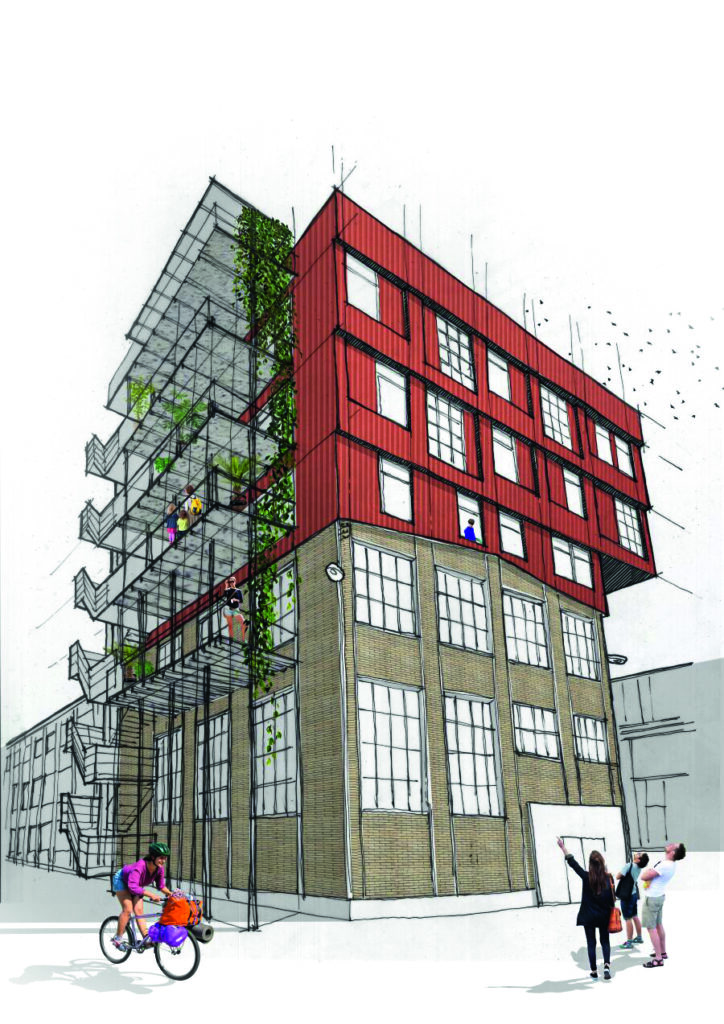
    A project that could hardly be more sustainable: the extension of hall 118 on the storage area in Winterthur ZH was increased by five floors. And wherever possible with reusable building materials. The presence of such materials from demolitions in the region was decisive for the current appearance. The building is not yet completely finished: “The construction should be completed in early 2021,” says Benjamin Poignon, architect and civil engineer at “baubüro in situ”.

    The Abendrot Foundation, based in Basel, bought the Lagerplatz area from Sulzer Immobilien AG in 2010. The direction of focus was quickly clear to the pension fund, which is committed to sustainability: the already existing mixed use should be further developed in cooperation with the tenants. Several new studios of up to 60 square meters for start-ups and small businesses are planned for each of the upper floors.

    Although the buildings and their footprints were to be retained, they were to be further developed in terms of energy and in accordance with legal standards. The “construction office in situ” is responsible for the project. The project managers Marc Angst and Pascal Hentschel sum up the concept: «Repairing what can still be used. Remove what disturbs or is no longer suitable – and add what is new. "

    Finding building materials is half the time
    The supporting framework consists of an used steel structure. Prefabricated facade elements made of wood, which are filled with straw insulation, are attached to this. Such simple ecological building materials as straw, excavated earth and wood accumulate in large quantities and can be processed and used with a minimal use of gray energy. They also ensure a pleasant room climate.

    The slightly overhanging south facade in bright brick red-orange comes from the sheet metal facade of the former Ziegler print shop in Winterthur Grüze. The windows in the new recycling building are inconsistent, but overall they are consistent. In order for the insulation to meet today's standards, the glazing was doubled in nine windows, the others had sufficient insulation. The staircase on the east facade is over 30 years old and previously adorned the facade of the Orion office building in Zurich-West. 80 windows and facade panels made of granite, which are recycled for the balcony floors, also come from this building, which was erected in 1989. The respective components are not reprocessed – this differentiates the project from so-called downcycling, in which building materials are initially reworked in a energy-intensive manner.

    The architects have already learned a lot from this unique pilot project: “It is the first time that we have reused a supporting structure. But we also noticed that there are components that are cheaper to buy than to reuse. For example, we have tried to reuse limestone sandstone. But the cleaning and preparation work was so high that we decided to buy a new one here, ”explains architect Poignon. The project also created a new job: component hunter. The “baubüro In situ” hired interns specifically for this purpose, who looked for suitable demolition objects and any reusable materials that might arise. But the architects, too, are always on the move with open eyes. Usable materials are dismantled and picked up by the architectural office with roots in Basel. The architects spend half of the time evaluating and procuring possible components. "In situ" did not have any problems finding the right material: of the approximately 7.5 million tons of construction waste that is generated in Switzerland every year, only 0.1 percent is directly reused, according to the Federal Office for the Environment (FOEN) has. «In situ» assumes that ten times more can be reused.

    Book publication planned
    If you think about the costs at this point: 4.8 million Swiss francs have been budgeted for the project so far. One of the stated goals was to build in such a way that it does not cost more than a completely new building. “It is difficult to make direct comparisons,” says Benjamin Poignon.

    In general, “in situ” always relies on the reuse of materials during construction – even if rarely on this large scale. With its uniqueness, K118 has definitely attracted interested parties: A research and teaching project at the ZHAW University of Applied Sciences in Winterthur and a case study in environmental systems science at ETH Zurich accompanied the planning. Among other things, the environmentally relevant (waste, resources, lifespan, etc.) and legal as well as those relating to the construction process are examined. A joint publication is planned in cooperation with the Federal Office for the Environment: The book is intended to comprehensively shed light on the reuse of components in building construction and to make the knowledge and experience gained publicly available. ■

    This is what building K118 should look like after construction work is complete.
  • "Stellwerk 2": In tune with the times

    "Stellwerk 2": In tune with the times

    The first stage, the “Stellwerk 1” office building, was completed in 2010 right next to the historic station building. In addition, the elongated property between the tracks and the station square remained in an exposed location, next to the Wülflingerstrasse underpass. The new "Stellwerk 2" building will be built on this centrally located open space, on which the SBB staff restaurant was formerly located and which houses an underground signal box that is to be preserved. The area forms the north-eastern end of a high-quality urban space that has undergone significant changes in recent years, emphasizes the team of architects. A new building in this exposed location will be very easy to see from many sides, which underlines its importance as an important building block in Winterthur's urban structure, according to the architects. "Stellwerk 2" is a mixed-use building with seventy apartments, two office floors, retail and catering areas on the ground floor and 500 bicycle parking spaces in the basement. ■

  • The federal government supports renovations in non-profit housing construction

    The federal government supports renovations in non-profit housing construction

    The non-profit housing developers in Switzerland have a portfolio of almost 170,000 apartments, the Federal Council informed in a message . Many of these apartments, which are mainly located in cities and agglomerations, are more than 30 years old and no longer meet today's energy requirements. A special federal program is intended to motivate non-profit housing developers to renovate their buildings sustainably.

    The program drawn up by the Federal Council provides for loans of up to CHF 50,000 per apartment to be renovated. With a term of 25 years, no interest is charged for the first ten years. The prerequisite is that the renovation work improves the condition of the building envelope to level B of the building energy certificate of the cantons ( GEAK ) or meets the Minergie standard.

    A similar program for rural areas is being launched by the Foundation for the Promotion of Home Ownership ( SFWE ), the Federal Council informs in the announcement. Here you can apply for CHF 90,000 per apartment for a maximum of three apartments. Applications for both programs can be submitted to the umbrella organizations for non-profit housing construction or the SFWE by mid-October 2023.

  • Gotthard wind farm is officially inaugurated

    Gotthard wind farm is officially inaugurated

    The Parco eolico del San Gottardo has been officially inaugurated on the Gotthard Pass. It is currently the only wind farm under construction in Switzerland. It will start its regular operation in November. According to a press release by the operator Azienda Elettrica Ticinese ( AET ), “numerous restoration and soil remediation measures” are planned for the coming summer months.

    State Councilor Claudio Zali, Director of the Territorial Department, Airolo's Mayor Franco Pedrini, the General Director of Services Industriels de Genève ( SIG ), Christian Brunier, and the Director of AET, Roberto Pronini, symbolically put the plant into operation. There were also representatives from companies and institutions involved in the project.

    The summer months of the past two years were used for the construction phase. Commissioning was planned as early as autumn 2009. However, according to an article in the “Luzerner Zeitung”, those responsible at the time “admitted that they underestimated the effort involved in the project”. As a justification, the then Chairman of the Board of Directors cited Switzerland's lack of experience with wind farms.

    There are now five instead of the originally planned seven wind turbines on the Gotthard Pass. They were supplied by the German company Enercon . The annual production of these generators of 2.35 megawatts each is estimated at between 16 and 20 gigawatt hours, according to the announcement. They can cover the electricity demand in the Leventina valley between the south portals of the Gotthard tunnel near Airolo to Biasca.

    The investment of 32 million francs was supported by the shareholders of the Gotthard wind farm: AET holds 70 percent, SIG 25 percent and the municipality of Airolo 5 percent. The system receives subsidies from the fund for the cost ceiling feed-in remuneration ( KEV ) for renewable energies for 20 years. This is a federal instrument to promote renewable energies. It is financed by a consumer levy on the electricity price.

  • Commercial real estate is likely to become cheaper

    Commercial real estate is likely to become cheaper

    KPMG 's Swiss Real Estate Sentiment Index is an indicator of expected developments in the real estate investment market. Last year the index reached an all-time high. This year it has fallen to its lowest level since measurements began in 2012. According to a statement from the consulting company, it is -13.1 points.

    Market participants' assessment of economic development contributes 20 percent to the overall index. The corresponding value fell by 60.9 points to -73.8 points. The second component is the expectation of price developments. After 43.5 points in the previous year, the value here is just above the stability axis at 2.1 points.

    In the case of residential real estate, price expectations remain positive and are close to the 2015 high. Contrary to expectations, actors in the real estate investment market are also not assuming falling prices for real estate in peripheral locations.   However, the prices of commercial real estate are likely to fall. A total of 76 percent of those surveyed assume that the demand for office space in the extended business belt will decrease as a result of the Corona crisis. Sales areas are also likely to be used far less in the future. The respondents see less need for shopping centers in particular. However, experts see more demand for real estate in the healthcare sector and for logistics space.

    The results show that the Corona year has clouded the mood on the real estate investment market. "Because of the expected effects on future demand, the market participants also see opportunities that new user segments will move into the investment focus," Beat Seger, partner and real estate expert at KPMG, is quoted as saying. In addition, residential real estate would contribute to the stability of the asset class.

  • Implenia is building a large development near Geneva

    Implenia is building a large development near Geneva

    A new urban center is to be built around the Lancy-Pont-Rouge train station. Implenia has already constructed three buildings here as a general contractor for Swiss Prime Site , the construction and real estate company from Dietlikon informs in a message . Implenia is now to build another building for the Solothurn real estate company. The order has a volume of around 132 million francs.

    Specifically, Implenia has been awarded the contract for the Alto Pont-Rouge development. It is designed as a 15-storey building plus three underground parking levels with a total floor space of 35,000 square meters. The areas are mainly intended for offices, while smaller areas are to be used as grocery stores and restaurants. The core of the building complex is a central atrium with glass facades.

    The development will "meet the highest sustainability standards and be certified at least in accordance with SNBS Gold," explains Implenia in the press release. The start of construction work is scheduled for this November, and the work should be completed in June 2023. For Jens Vollmar, Head Division Buildings, the new order "came about on the basis of a long-term and trusting relationship between Swiss Prime Site and Implenia".

  • Bellinzona gets innovative quarters

    Bellinzona gets innovative quarters

    In Bellinzona, a new model district will be built right in the center. From the five proposals submitted, a jury of experts from the city has now decided on the Porta del Ticino (Gateway to Ticino) project. It pays a lot of attention to the topics of sustainability, intergenerationality and slow mobility. In particular, an innovation park is planned there, writes the city in a media release .

    In addition, living space for 2500 people is planned, writes the Ticino newspaper “La Regione”. The urban development project described by the city in its communication as "epochal" and "profound" has now been presented to the public by the partners Bellinzona, SBB and Canton Ticino. All designs are on display in Piazza del Sole until November 7th.

    The project convinced with "its courageous urban development and landscape design approach to leave the central area of the area undeveloped in order to provide the entire population with free green space and to open up the new district as a natural and attractive addition to the city", it says on the part of the city.

    The 120,000 square meter area that is intended for the new quarter is currently still occupied by the historic SBB workshops. Once they have been relocated, they will start operating in Arbedo-Castione in 2026. Then the realization of the model quarter should be tackled. The vision for this should become reality in 20 years at the earliest, reports the online newspaper ticinonews.ch. Further development steps are planned in 30 and 40 years.

    As a video of the development project published on YouTube shows, the district is to be built around the 101-year-old so-called cathedral, the listed heart of the SBB workshops. 500 old and new locomotives are serviced there every year to this day. It is considered to be one of the most important industrial buildings in Ticino.

    This urban development project was developed by a team made up of sa_partners from Zurich, TAM associati from Venice and the Milanese landscape architect Franco Giorgetta.

    Susanne Zenker, member of the management board of SSB Immobilien , reminded “La Regione” that the workshops were “always closed to the outside”. In the future, however, this area will “open up to its population and become an attractive space. With regard to the rapprochement between private and public actors, which is particularly targeted in the technological area, the new area will be “a calling card for the Bellinzona of the future”.

  • Clean charging current can also cost a little more

    Clean charging current can also cost a little more

    The research and development department of Juice Technology AG in Cham has published a current study on charging behavior and energy use in e-cars. A survey of 5154 e-car drivers was supposed to clarify how the behavior at the charging station is and what role the origin of the charging current plays.

    Almost 50 percent of the kilometers driven are charged at home, according to the press release , and around 22 percent at work. Only 17 percent of the charging processes are carried out at so-called super chargers or quick charging stations. For 85 percent of e-car drivers, the use of clean energy is very important or important, according to the report in the study.

    They also asked about their willingness to pay a higher amount for clean energy that would be produced in real time. 87 percent answered “yes”. There were differences in the amount: 60 percent would pay up to 4.89 cents per kilowatt hour more, 27 percent up to 3.01 cents per kilowatt hour.

    The survey took place online from October 12-14, 2020 in Switzerland, Germany and Austria. A total of 5154 people were interviewed. The response was 576 responses, of which 82 percent came from Germany, 12 percent from Switzerland and 6 percent from Austria.

  • Switzerland has the best energy system

    Switzerland has the best energy system

    Taking into account the three criteria of energy security, equity and ecological sustainability, Switzerland has the most exemplary energy system in the world. As in the previous year, it thus achieved the top spot. That comes from the World Energy Trilemma Index 2020 of the World Energy Council. He created this together with the global strategy consulting firm Oliver Wyman .

    As the World Energy Council writes in a press release , this index analyzes historical trends. They are designed to enable energy policy makers and stakeholders to track their performance over time and compare it with others.

    Above all, its high share of hydropower gives Switzerland the top spot in this ranking of a total of 130 countries. It is also in the top 10 for affordability. This is thanks to the overall high level of prosperity. Only when it comes to security of supply does the country not make it into the top ten. The Swiss energy mix is not diversified enough for that. Canada holds this top position, followed by Finland and Romania. All three countries have large hydropower resources and invest heavily in solar and wind energy.

    The three countries with the biggest leap up in the overall rating are Cambodia, Myanmar and Kenya. This is primarily due to their performance in providing universal access to energy. This criterion, which the World Energy Council calls energy justice, has seen the most significant improvements since 2000, especially in developing countries.

    Instruments such as the World Energy Trilemma Index are more important than ever, according to the Secretary General of the World Energy Council, Dr. Angela Wilkinson: "The index enables individual countries to learn from each other what works and what doesn't when connecting the dots between people, planet and prosperity."

    One thing is certain, says François Austin, Partner and Global Head of Energy at Oliver Wyman: "The top performing nations achieve their energy goals by balancing politics, entrepreneurship, national resource use and changes in individual behavior with environmental issues." Giving political decision-makers and business leaders the direction for shaping the future of energy ”.

  • Zug is the most attractive canton for companies

    Zug is the most attractive canton for companies

    The major bank Credit Suisse has published its location quality indicator for this year. This measures the attractiveness of the cantons from the point of view of companies. The canton of Zug moved up to first place this year and was able to overtake the canton of Basel-Stadt. Credit Suisse explains this with the reduction in corporate income taxes that came into effect at the beginning of 2020. The effective maximum corporate income tax rate in Zug is now 11.91 percent – in the previous year it was 14.35 percent.

    Behind Zug and Basel-Stadt, the canton of Zurich follows in the ranking, followed by the canton of Geneva, which has moved up ten places. The fifth place is occupied by the canton of Aargau, the sixth by the canton of Schwyz.

    In addition to the tax policy of the cantons, Credit Suisse also includes the availability of highly qualified and skilled workers in its analysis. According to the economists of the big bank, the level of education of the Swiss workforce has risen sharply in recent decades. However, there is a gap between urban and rural areas when it comes to the availability of highly qualified workers. In urban regions as well as in the closer agglomeration areas, over 40 percent of potential employees have a higher education. In the city of Zurich this proportion is even 57 percent.

    Credit Suisse not only scrutinized the cantons, but also economic regions. This is because she is of the opinion that consideration at the canton level falls short of the mark, especially in larger, heterogeneous cantons. According to the results, metropolitan areas such as Zurich, Zug, Basel, Baden and Geneva and their agglomerations are among the most attractive regions for companies.

  • Coronavirus: Federal Council presents a monitoring report on the business rents situation

    Coronavirus: Federal Council presents a monitoring report on the business rents situation

    The report Monitoring commercial rents comes to the following results:

    • Based on a structural analysis by Wüest Partner, there are around 390,000 business leases in Switzerland with a rental volume of an estimated two billion francs per month. Around CHF 900 million of this is for office space, CHF 500 million for trade and industry, CHF 400 million for retail space and CHF 200 million for hotel and restaurant use. In addition to the 390,000 leases, around 60 percent of the companies run their business in their own property. During the period of maximum restrictions between March 17 and April 26, 2020, around 113,000 tenancies were affected by the closings by the Federal Council. The cumulative rent of the commercial properties affected by closings amounts to 530 million francs per month. This corresponds to 27 percent of the rental volume.
    • A representative survey by gfs.bern came to the conclusion that the proportion of tenants who have difficulties paying their rent in connection with the mandatory closings has risen from 6 to 33 percent in the weeks of the lockdown. This is particularly true of western Switzerland and Ticino. The survey also showed that the majority of tenants (around 60%) sought relief solutions – and the majority have found them. Agreements were reached far more often than disagreements; for the tenant side the ratio of agreements to non-agreements is 3 to 2, for the landlord 9 to 1. The vast majority of the agreements came before the parliamentary decisions of June 2020. In almost three out of four cases, the agreements involved rent reductions.
    • The economic development so far points to a rapid and strong economic recovery. The number of company bankruptcies and the number of new requests in the statistics of the arbitration authorities are currently within the usual range or below the previous year's level.
    • An international comparison shows that most European countries – like Switzerland – rely on support measures to secure the liquidity of the businesses affected by closings. There were seldom interventions in terms of tenancy law, and if so, it was an extension of payment or notice periods. There are no statutory rent reductions in the eleven European countries examined.

    On the basis of these results, the Federal Council comes to the conclusion that there is currently little evidence of comprehensive and area-wide difficulties in the area of commercial rents. However, this does not rule out the possibility that there may be unsatisfactory constellations in individual cases. Depending on how the pandemic develops, the situation can quickly worsen.

    For this reason, the Federal Council is currently refraining from taking any measures (e.g. in the legislative area). However, it instructs the Federal Housing Office to continue the commercial rents working group and to discuss any support in the area of advice and information with the cantons. Because experience has shown that regional solutions are best suited to the local situation.

  • Fischermätteli Burgdorf: Future-oriented area in the Minergie-A-Eco standard

    Fischermätteli Burgdorf: Future-oriented area in the Minergie-A-Eco standard

    In December 2019, the excavators drove into the former industrial site in Burgdorf and the new Fischermätteli district should soon come to life: the first apartments will be ready for occupancy in summer 2021. By 2024, ten apartment buildings with 169 inexpensive 2.5 to 5.5 room apartments and living spaces between 52 and 140 square meters are to be built in a total of three construction phases. Located in an idyllic location in the immediate vicinity of the forest, the buildings are grouped around a central meeting zone with five differently designed outdoor spaces.

    Largest Minergie-A-Eco quarter made with Swiss wood

    The Fischermätteli settlement will one day be the largest development in Switzerland that will not only be built with Swiss wood, but also meet the Minergie-A-Eco standard. This requires a positive energy balance and the expenditure for space and water heating, air renewal as well as for all electrical devices and lighting must be covered by renewable energies. The addition Eco focuses on the issues of health and building ecology and ensures a high level of living comfort. "Based on the positive experiences we have made so far, it was the only right decision for us in terms of ecology and sustainability to build the Fischermätteli in the Minergie-A-Eco standard," explains Bruno Kälin. He is Head of Marketing and a member of the management team at Strüby Konzept AG. The Strüby companies act both as builders and as full service providers (project development, architecture, engineering, production, implementation, customer service, customer service) and are also responsible for sales.

    For the Fischermätteli, the client relies on spruce and silver fir from Swiss forests: “There is no better building material than wood. It is available locally, is growing steadily, is CO 2 -neutral, creates jobs in the region and ensures a good and healthy indoor climate, ”explains Kälin. The wood required for construction is bought directly from the forest owners, sawn, glued and processed in the region. Long transport routes are eliminated, which means that the embodied energy is very low.

    Sophisticated energy concept

    The client had put out a tender for the energy concept, which ewz won. The energy service company is responsible for planning, financing, realizing and operating the energy supply. The contracts run until December 2044 and begin in stages according to construction stages. The ewz Energy Solutions division has developed an integral concept for the Fischermätteli district, which, in addition to a sophisticated heat and power supply, also includes ancillary costs accounting that covers all media.

    All buildings on the site are connected to an area heating network. The heart of the heat supply is the heating center with an output of 550 kW. Wood pellets from the region are used as energy sources. The quality management system of the working group QM wood heating plants ensures efficient heat production. The energy service provider finances and implements the heating center and the lines for heat distribution to the house. The client, on the other hand, builds the installations for the domestic hot water and for the fine distribution of heat in the houses. A heat pump instead of wood heating could not be considered due to the geological conditions at the site.

    100 percent renewable solar power

    In addition to the heat supply contracts, ewz agrees electricity supply contracts with the owners. These regulate the supply of electricity to a total of seven floor and site owners. Since the Minergie-A building standard requires 100 percent coverage with renewable electricity, a photovoltaic system is installed on every house roof. The ten plants in the final stage will have an output of 722 kWp. According to project manager Christian Rolli from ewz Energielösungen, the challenge was to achieve the required solar power yield and still have enough space on the roofs for maintenance and servicing of the photovoltaic modules. The solution was to choose monocrystalline high-performance modules with a higher degree of efficiency, which produce more yield in less space, but this is reflected in a higher price. Around 3200 m 2 of photovoltaic modules are installed on the site. If, for example, there is such a high overproduction during the summer holidays that not all of the electricity can be fed into the grid, production can be reduced.

    The overall concept worked out by ewz Energielösungen convinced the client: "Our specifications for an ecological and economical solution that can be implemented and maintained holistically by one partner were implemented very well by ewz," says Bruno Kälin.

  • The population of Freiburg wants wind farms

    The population of Freiburg wants wind farms

    The population of Freiburg is behind the cantonal wind power projects. This is shown by a survey that MIS Trend carried out on behalf of Groupe E in September. According to a statement from the cantonal energy supplier, 72 percent are in favor of building wind farms in the canton. 65 percent also have no concerns about the installation of the systems.

    Groupe E wants to set up wind farms at four locations. These locations are entered in the canton's structure plan, which has already been approved by the federal government. The four wind farms should allow an additional electricity production of 156 gigawatt hours of electricity per year. Two thirds of electricity production should occur in winter, when photovoltaics are less productive. Compensation measures for the benefit of biodiversity are planned for the projects.

  • Green asphalt permanently removes CO2 from the air

    Green asphalt permanently removes CO2 from the air

    In Dornbirn, as part of the expansion of the district heating network, new asphalt is being laid on a stretch of road. So-called green asphalt is used for the first time. 1.7 percent charcoal from the production of theEnergieWerk Ilg is added to the asphalt. This allows the carbon contained in the charcoal to be stored and the CO2 formed with it to be permanently removed from the atmosphere. The company is thus improving its carbon footprint.

    A first test mixture was installed on September 24th, according to a message from EnergieWerk Ilg. If this mixture meets expectations, a test section of 30 meters is to be laid on October 14th and 15th.

    If the pilot project in the state of Vorarlberg is successful, roads can become new CO2 sinks. Asphalt can contain around 5 percent of such additives on average. This means that 100,000 tons of asphalt could soon permanently remove well over 10,000 tons of CO2 from the atmosphere.

    The pilot project is supported by a number of partners. The asphalt is manufactured by Migu Asphalt in Lustenau, which intends to use it to introduce a new product and strengthen its market position. The technology for producing the charcoal comes from the Syncraft company in Schwaz in the state of Tyrol. EnergieWerk Ilg, which supplies the admixture, has already been climate-neutral and can become climate-positive with this product. The city of Dornbirn is profiling itself as a model region for the energy transition .

    Hans-Peter Schmidt from the Ithaka Institute in Arbaz VS advises the project. Carbonfuture GmbH in Freiburg i.Br. certifies carbon storage. This means that certificates for the removal of carbon from the atmosphere can be issued and the green asphalt can be co-financed.

    The project was initiated by the European Biochar Industry ( EBI ) consortium. EBI wants to create and establish new, verifiable and certifiable CO2 sinks with charcoal and biochar.

  • Grösstes MINERGIE-A-ECO-Wohnquartier  aus Schweizer Holz – Bauarbeiten im Burgdorfer «Fischermätteli» sind im Gang

    Grösstes MINERGIE-A-ECO-Wohnquartier aus Schweizer Holz – Bauarbeiten im Burgdorfer «Fischermätteli» sind im Gang

    Lebensraum aus Schweizer Holz
    Das neue Wohnquartier «Fischermätteli» entsteht im Südosten von Burgdorf, abseits der grossen Verkehrswege, in unmittelbarer Nähe zum Wald, dem Heimiswilbach und dem Naherholungsgebiet. Die Strüby Unternehmungen planen und erstellen als Bauherr zehn Mehrfamilienhäuser mit insgesamt 169 Eigentumswohnungen. Das attraktive und harmonische Quartier gewährt viel Raum für behagliches und gesundes Wohnen zu einem günstigen Preis. Das Wohnungsangebot umfasst:

    18 x 2.5-Zimmer-Wohnungen von 52 bis 71 m2 NWF ab CHF 285‘000

    84 x 3.5-Zimmer-Wohnungen von 82 bis 113 m2 NWF ab CHF 495‘000

    50 x 4.5-Zimmer-Wohnungen von 108 bis 115 m2 NWF ab CHF 610‘000

    17 x 5.5-Zimmer-Wohnungen von 132 bis 140 m2 NWF ab CHF 725‘000

    Einladende Aussenplätze
    Alle Häuser gruppieren sich um die langgezogene zentrale Begegnungszone. Fünf Aussenplätze mit verschiedenen Grössen und Stimmungen beleben die gemeinsame und einladende Erschliessung. Mehrere Spielflächen für unterschiedliche Altersstufen ergänzen das vielfältige Angebot an Aufenthalts- und Begegnungsbereichen. Die ökologische Aussengestaltung mit der Verwendung von einheimischen Pflanzenarten bietet einen idealen Lebensraum und einen Beitrag zur Erhaltung der Biodiversität im Siedlungsraum.

    Gesundes Raumklima
    Die modernen Wohnungen überzeugen durch eine zeitgemässe Architektur. Dank der ECO-Bauweise und dem Baustoff Holz entstehen schadstoffarme Innenräume mit optimaler Luftfeuchtigkeit und ein gesundes Raumklima mit einem grossen Wohlfühlfaktor. Die Einheiten zeichnen sich zudem durch ihr praktisches Raumprogramm aus, welches den heutigen Anforderungen an funktionales und zeitloses Wohnen entspricht. Küche, Ess- und Wohnzimmer verbinden sich dank einer offenen Gestaltung zu einer grosszügigen Wohnfläche. Durch die gemütliche Loggia erweitert sich der Wohnbereich hin zur Natur respektive zu den Innenhöfen und Umgebungsflächen.

    E-Mobility-Station im Quartier
    Die Wohnhäuser werden durch eine Tiefgarage unterirdisch verbunden und allesamt behindertengerecht erschlossen. Das Quartier ist ausgesprochen velofreundlich. Mehr als 300 Veloparkplätze, Veloflickbereiche und eine Velodusche werden den neuen Eigentümern zur Verfügung stehen. Auch der E-Mobilität wird Rechnung getragen, so stehen den zukünftigen Bewohnern nebst 21 Ladestationen für E-Bikes auch fünf Ladestationen für E-Autos und sogar zwei Fischermätteli-E-Autos zum Mieten zur Verfügung. Wer sich mit dem ÖV fortbewegen möchte, findet direkt bei der Einfahrt zum neuen Quartier eine Bushaltestelle.

    Hervorragende Energiebilanz
    Gebaut wird in Strüby-Qualität mit Schweizer Holz, CO2-neutral und im MINERGIE-A-ECO-Standard. Dies garantiert neben dem bereits erwähnten sehr hohen Wohnkomfort auch die beste Energiebilanz. Auf den Dächern der Mehrfamilienhäuser wird eine grosse, effiziente Photovoltaik-Anlage installiert. Die erwartete Stromproduktion deckt einen mittleren Jahres-Stromverbrauch von rund 400 Personen. Die übrige Energie wird erneuerbar mittels Pelletheizung produziert. ■

  • The Villa Langmatt Museum is to be preserved

    The Villa Langmatt Museum is to be preserved

    The Langmatt Museum in Baden is unique in the Swiss museum landscape. The art nouveau villa of the industrialist couple Sidney and Jenny Brown-Sulzer houses an exquisite art collection by French impressionists. It was put together at the beginning of the 20th century with a lot of personal passion. The unmistakable charm of the villa lies in the presentation of outstanding images from art history in historical living rooms, surrounded by an idyllic park, says Markus Stegmann, director of the Langmatt Museum, describing his “workplace”.

    The Langmatt Foundation announced in a statement that the cantonal protected property must be renovated and that the operation must be put on a financially sound basis. While the foundation is restructuring its operating finances and thus ensuring operation and maintenance, the city makes recurring contributions to the repair of the property with the help of the canton and third parties.

    Clear distribution of responsibility
    With this partnership approach, the important cultural institution could be led into the future. The strategy motto is: "Jewel for everyone." The aim of the strategy is to preserve the Langmatt as a unique institution and a living witness of industrial, social, collection and architectural history. The core of the strategy is a clear distribution of responsibility between the city and the foundation: As the founder and sole heir, the city makes a substantial contribution to the renovation of the property, which is estimated at around 17.2 million francs (+/- 25%). As the operator of the museum, the foundation is restructuring its operating finances on a sustainable basis.

    At its meeting on June 3, 2020, the residents' council of the city of Baden decided to implement the “Langmatt Future” strategy in order to secure the future of the museum. In other words: the foundation takes over the lead for the repair and the costs of the planning up to a construction project. In order to carry out the construction project, the city council and the foundation council plan to found a stock corporation in which the city will hold a substantial share. It should raise the additional financial resources to cover the operating costs.

    Sale of pictures for the necessary return on investment
    For the long-term renovation of the foundation's capital, which was too small from the start, a targeted sale of one to three works is necessary, which, however, does not affect the core of the collection, emphasize the project managers. From the proceeds of around 40 million Swiss francs, the foundation generates the capital income it needs to secure its operations in the long term. “A step that is painful, but without any alternative, that will secure the future of the museum,” emphasizes Lukas Breunig-Hollinger, President of the Langmatt Foundation. "The Langmatt will be preserved as a historical ensemble, as a place of Baden's identity and as a living witness to the history of industry, collections and architecture," says Markus Stegmann, director of the Langmatt Museum. With its regional roots, the Langmatt will strengthen its international presence in the future.

    Two-year construction planning phase
    The main innovations include the year-round museum opening, an improvement in the entrance area with cash register, shop and cloakroom, a lift for barrier-free access and a filigree pavilion for events. The next stage is a two-year construction planning phase with the aim of specifying the cost accuracy of the repair. This is a key requirement for the required referendum, which is expected in 2023. If the template is approved, the next step is to sell the pictures. Repairs to the museum could begin in 2024, and Langmatt could reopen in 2026. ■

  • An elevated railway for Silbern and the Niderfeld

    An elevated railway for Silbern and the Niderfeld

    The innovative project of the interest group (IG) Hochbahn Silbern, founded in May 2018, is campaigning for a transport solution high above the tracks between the Silbern districts that are relevant for Dietikon and Niderfeld, which is still under development. Because the SBB shunting terminal forms a barrier between the two parts of the city. The elevated railway would secure the direct connection between the S-Bahn station in Silbern and a station of the Limmattalbahn in Niderfeld. This would give the Silbernquartier a connection to the Limmattalbahn, and the approximately 2000 future residents and workers of the Niderfeld-Quartier could easily reach the shopping infrastructure and a possible S-Bahn station in Silbern.
    Behind IG Hochbahn Silbern are representatives of the Silbern and Niderfeld areas as well as Limmatstadt AG and the city of Dietikon. The IG is chaired by Beny Ruhstaller, Association of Landowners Niderfeld Dietikon (VGND). The elevated railway is to be completed in the next 8 to 15 years. The project was classified as relevant for the Limmat Valley. That is why the Silbern elevated railway was included in the Limmattal Regional Project Show as a project worthy of funding. It is already clear what the automated cable-drawn elevated railway might look like. With its possible futuristic design, the elevated railway would not only be an attraction in the Limmat Valley, but would also offer the desired cross-connection. Cable cars have also proven themselves in other places in Switzerland. For example, the Polybahn in Zurich, the Rigiblick cable car or the Lugano light rail.

    The Hochbahn Silbern has meanwhile developed from a vision to a concrete project. The feasibility was checked and classified as feasible – the route and possible stops have already been narrowed down. The route should be between 607 and 637 meters long. With a travel time of around 2 minutes, the elevated train could transport 700 to 750 people per hour. The discussions that have taken place so far with the SBB and the Garaventa cable car company, who regularly take part in the IG Hochbahn Silbern meetings, have so far been very promising. The costs are estimated at around 20 million francs. Operation should be fully automated and not require any on-site personnel.

    According to IG Hochseilbahn Silbern, support from the city authorities is now required to advance the project. In addition, the elevated railway must be integrated into the Niderfeld district plan – with a possible land separation for the stations and the tracks on both sides. In the near future, the project is to be further concretized with a potential analysis and the cost planning and technical feasibility checked. This is followed by the submission to the Federal Office of Transport. ■

  • The development on the Rietpark is larger than 17 football fields

    The development on the Rietpark is larger than 17 football fields

    On the former industrial site of the Geistlich glue factory in Schlieren, the second stage of the new quarter "amRietpark" is being built under the building contractor of Helvetia Insurance and Geistlich Immobilia AG Soccer fields. Where fabrics were once dyed and glue was produced, a total of 921 apartments and the Tertianum AG retirement center will be available from 2020. The Geistlich area alone covers 80,000 square meters and is directly adjacent to Schlieren train station.

    Between 2007 and 2015, 600 apartments, 12,600 square meters of office space and 14,600 square meters of commercial space, 330 square meters of which were for restaurants and bars, were built on the Färbi site. The Geistlich area includes the “Magnolia” project, completed in 2015, with 137 condominiums and the new buildings along Brandstrasse and Engstringerstrasse with a usable area of 55,000 square meters. The public “Rietpark” takes up around half of the new quarter: it is 600 meters long, comprises 42,000 square meters and is the heart of the development.

    Part of the project is a double kindergarten with lunchtime care at Engstringerstrasse 5. This is rented in the residential and commercial building with 84 apartments and commercial space on the ground floor realized by Geistlich lmmobilia AG. Zurich office E2A was hired as the architect. The new building consists of a U-shaped part of the building with residential use from the 1st floor and a continuous basement on the ground floor. All apartments face the park. On the roof, the tenants will find 15 roof gardens based on the former allotment gardens on the site.

    The buildings on Brandstrasse, which were occupied in 2020, were designed by two different architectural offices. Graber Pulver Architects are responsible for the building owner Geistlich Immobilia AG with four towers shifted towards each other like a chessboard at Brandstrasse 1-7. The towers merge into a unit over a two-storey base and guarantee optimal light irradiation and views from all corners of the building. The diverse housing options include classic apartments, maisonettes and cluster apartments as well as commercial and restaurant space and the retirement center for the anchor tenant Tertianum AG. Within the block, a “Rue Interieure” cut lengthways through the ground floor connects the towers.

    Gmür & Gschwentner Architects designed a building with 202 apartments for Helvetia Insurance at Brandstrasse 21. The new building divides the construction site into two structures, each placed around their own courtyards. The center is a hall that residents can use for communal events. A novelty for Schlieren is the pool on the roof with sundeck, which is freely available to the residents. Here, 3.5 to 5.5 room apartments and various commercial spaces were created along Brandstrasse. ■

  • Letzibach D: Three autonomous building parts from three different clients

    Letzibach D: Three autonomous building parts from three different clients

    The new Letzibach D building will be built in Zurich-Altstetten between 2021 and 2025. The city of Zurich acquired the 10,000 square meter area from SBB in 2014. The area has the open track field on the north side and the busy Hohlstrasse on the south side. 250 non-profit apartments are to be built here under the supervision of the property management company, the Retirement Homes Foundation and the Apartments for Large Families Foundation of the City of Zurich. The three builders are each planning a third of the construction volume. This creates three autonomous parts of the building with their own entrances.

    The area development is designed for a utilization of 318 percent. The required density can only be achieved using high-rise solutions. Gut & Schoep Architekten GmbH and Neuland Landschaft GmbH from Zurich are responsible for the plans. A 60-meter-high building with 24 floors and a memorable urban silhouette as well as an eight-story, elongated building that opens in a U-shape towards the track field is planned. A small town square will also be created at the intersection of Hohlstrasse / Flurstrasse.

    The building protrudes to the west of Hohlstrasse and continues the street space of the adjacent Letzibach C development. In the north it bends again at a right angle and thus forms the end with the high-rise. The low, contiguous eight-story part of the building houses the 53 apartments of the Apartments for Large Families Foundation and the 81 apartments of the City of Zurich properties. The apartments in the flat part of the building offer south-facing kitchens as well as north-facing living rooms – some with inner circular routes or with spacious entrances. Retracted balconies between the eat-in kitchen and living room are intended for the 131 retirement homes. These apartments of the Foundation for the City of Zurich Housing for the Elderly are to be built in the sixty-meter-high tower. The concrete facade of the building should ensure durability and economical maintenance. ■

  • "We are on course on all construction sites"

    "We are on course on all construction sites"

    The first stage of the Limmattalbahn between Zurich Farbhof and Schlieren Geissweid has been in operation for over a year. The tram is well accepted and used extensively. “There is hardly any distinction between 'old' and 'new' routes,” says Oliver Obergfell from the VBZ media office. The Grüntrassee also made a very good impression after one year of operation. On average, around 5000 people use the Schlierem stops during the week – this roughly corresponds to the number of passengers on the former bus route 31. The Limmattalbahn (LTB) AG is also satisfied with the operation. "So far we have hardly had any complaints with regard to the infrastructure," says managing director Daniel Issler.


    The second stage of the Limmattalbahn between Altstetten station and Zurich Farbhof and between Schlieren Geissweid and Killwangen-Spreitenbach has been under construction for a year. Here, too, everything is going according to plan: “The construction work is making very good progress. We are on course or even a little faster on all construction sites, ”says Issler. There are currently no signs of a cost overrun. The overall project manager also sees himself confronted with challenges: "In the second stage, construction work will take place over a length of around 10 kilometers at the same time." Then there are the large structures such as the Färberhüsli tunnel in Schlieren, the underpass at the Dreispitzkreuzung in Dietikon and the ramp structure in Killwangen.

    A bus line could not cope with the increasing number of passengers
    The construction of the Limmattalbahn is associated with restrictions and immissions for residents, entrepreneurs and road users along the route. LTB AG is aware that the construction site of the Limmattalbahn will cause some inconvenience. “We are therefore trying to build as quickly as possible in order to reduce the restrictions to a minimum. If someone contacts us with a concern, we endeavor to find individual solutions, ”says the managing director. Issler once again emphasizes the benefits of the continuous Limmattalbahn from Zurich Altstetten to Killwangen-Spreitenbach: "Public transport is being strengthened – the Limmattalbahn is a supplement to the existing S-Bahn and enables a continuous and reliable travel chain." The much-brought-up argument of the Limmattalbahn opponents – that an expansion of the existing bus networks in the region would have been enough and would have come more cheaply – is invalidated by the head of LTB AG: “The Limmattal is developing rapidly. Many innovations are still to come. A bus route could not cope with this growth. In addition, a bus always runs the risk of getting stuck in a traffic jam. "

    The announcement of the Limmattalbahn has already triggered numerous construction activities along the route. Old buildings are being renewed, new commercial and residential buildings are being built. Issler expects this trend to continue and even intensify. The growth also exacerbates the already existing traffic problem in the Limmat Valley. Can the Limmattalbahn provide a remedy here? “One of the goals of the Limmattalbahn is to absorb most of the additional traffic caused by public transport. Since measures for individual motorized traffic are also being implemented at the same time, we are confident that road traffic will also become liquid as a result, ”says Issler.

    The second stage should be completed in mid-2022. This is followed by test drives. Official operations are scheduled to begin when the timetable changes in December 2022. Then the Limmattalbahn covers a distance of 13.4 kilometers at an average speed of 22 km / h: from Zurich Altstetten via Schlieren, Urdorf, Dietikon, Spreitenbach to Killwangen. The tram stops 27 times and has a capacity for 260 passengers. The cantons of Zurich and Aargau, as well as the federal government, spent a total of 755 million francs on the first two stages.

    The Aargau government is currently working on plans for a third stage: from Killwangen-Spreitenbach to Baden. In late summer 2020, the Grand Council decided to keep the route clear and to raise the continuation of the tram route in the cantonal structure plan from the previous status of “preliminary orientation” to the level of “interim results”. The extension of the Limmattalbahn thus has a good chance – but a few hurdles still have to be overcome before a final decision can be reached. The start of operations for the last stage, if it is actually implemented, is not expected before 2032. ■

  • 50 years of Shoppi Tivoli Spreitenbach

    50 years of Shoppi Tivoli Spreitenbach

    Patrick Stäuble, the chairman of the management and center manager of the Shoppi Tivoli, is 51 years old. The Shoppi Tivoli celebrates its 50th anniversary this year. A lot has changed since 1970: “When it opened, the shopping center had 50 shops. Today over 450 brands are represented », says the boss. The leisure activities have also changed – what used to be the bowling alley is now the fitness center or the wide range of restaurants. The Shoppi Tivoli is undisputedly important for Spreitenbach: "It was like a UFO that landed 50 years ago in the middle of the farming village," says Stäuble.

    The Shoppi Tivoli was the first shopping center in Switzerland – a pioneering achievement. To understand that it was built in Spreitenbach of all places, you have to take a look at history: it was the local planner at the time, Klaus Scheifele, who in the 1950s designed the structure plan for the construction of the new Spreitenbach together with other experts. On the basis of the Athens Charter – the urban development manifesto by the Swiss architect Le Corbusier. The idea was so well received by planners, politicians and investors that it triggered a real construction boom.

    A shopping center was also included in this structure plan. Karl Schweri, the then Denner boss, secured the land intended for this through his real estate fund and was looking for an architect with experience in America. The Swiss Walter Hunziker got in touch, who had lived in the USA for ten years and obtained a diploma as an architect and urban planner there. Together with the economist Fritz Frey, he founded Transplan AG and began planning a new city center in Spreitenbach in 1962. The «Shoppi» opened eight years later. Up to this point in time the place could triple its population. “At that time Spreitenbach also attracted many couples who were not married. Cohabiting was forbidden in Zurich, but not in the canton of Aargau, ”explains Stäuble.

    Hunziker had great visions – not all of which could be implemented. The aim was to grow to 30,000 inhabitants – in 2020 there will be a little over 10,000 who will live in Spreitenbach. With its rapid development and the many high-rise buildings, the former farming village has attracted many foreign residents. "Spreitenbach has got a certain reputation," says Stäuble. The municipality can score points with a beautiful village center in the upper area and the modern high-rise buildings and of course the Shoppi Tivoli in the new part. But the signs are not bad that Spreitenbach will manage the turnaround after all – a lot is being built again at the moment. The center manager is happy about projects such as “Tivoli Garden” with 320 apartments: “That also attracts a lot of people who appreciate having the shopping center right next door.” The center manager finds it a shame that the “Neumatt” project, which would have bordered directly on the Shoppi Tivoli, was rejected: “I think this is a missed opportunity for Spreitenbach. But it is probably just a bit much for the population with the construction of the Limmattalbahn and the Tivoli Gardens. I think the project was good, only the timing was bad. "

    In general, Stäuble assumes that Spreitenbach will position itself ideally in the city on the Limmat. The Limmatstadt has the important task of connecting the Limmat Valley across the canton border. The Limmattalbahn is also important for this. “This connection is important for us as well as for the next generation. People settle where there are good public transport connections and a wide range of leisure and dining options. " And especially the younger people don't care whether they live in Aargau or Zurich now. "They want to be where life happens, where they can spend their free time the way they want." Spreitenbach offers ideal conditions for this. Not least because of the Shoppi Tivoli, which has 4.5 million visitors annually. During the week up to 15,000 visitors come every day, on a weekend that could be 38,000, says Stäuble: “We are still a weekend center. A visit to the Shoppi Tivoli is a leisure activity, you can stroll, shop and take the whole family with you. Both the CenterMall and the TivoliMall have been rebuilt or rebuilt in recent years. "Several hundred million have been invested – the Shoppi is now equipped with international brands and a large range of leisure and gastronomy options and is therefore fit for the future," Stäuble is convinced. A shopping center is never finished. The trends today would be in the direction of leisure, cosmetics and services. “This is an ongoing process and we have to face it. But it certainly no longer needs major investments, now all that is needed is all-round development. " And there will also be transformations in terms of digitization. “I think it's going to be a combination of online and offline. So, for example, that I can choose my jeans in a store, but then don't have to drag the bag home, but the pants are delivered straight to my home the next day. "

    "Shopping
    wearing a mask is not an experience. "


    The question of the future also arises with regard to the corona pandemic. This hit the Shoppi Tivoli hard. But the lockdown got off to a good start: “There are industries that have recovered practically 100 percent. But the textile industry in particular will not be able to make up for the loss, ”explains Stäuble. Severely affected tenants have been exempted from 50 percent of the rent.

    While the canton of Zurich has made it mandatory to wear a mask in shops, you can still shop mask-free in the canton of Aargau. Stäuble does not notice an increased influx of people from Zurich who prefer to go without a mask: “Nevertheless, I am very happy that we do not have to wear a mask. Shopping in this size is an experience. We sell emotions – that's just more difficult with a mask. We have over 1400 employees – and we don't have a single corona infection on the seller side. The people here are on the move and not in long contact with one another. "

    So Stäuble looks to the future with confidence. Even if he still sees a few to-do's on a political level. For example, the implementation of longer opening times and more Sunday sales. “The saleswomen therefore no longer work or no longer work, only in other shifts,” the boss disproves a counter-argument that has been put forward many times. With the continued emergence of a «Limmat city», progress is also required on a political level. The center manager could even imagine that one day the Shoppi Tivoli will be called “Shoppi Tivoli Limmatstadt”. ■

  • Coop delivers with hydrogen trucks

    Coop delivers with hydrogen trucks

    In future, Coop will increasingly supply its sales outlets with hydrogen trucks. According to a media release on Wednesday, the food cooperative put one of the world's first mass-produced fuel cell electric trucks into operation. A total of seven of these will be in use by the end of the year. Because there are no other emissions besides water vapor, Coop is assuming potential savings of 80 tonnes of CO2 per truck per year. In addition, Coop is establishing additional hydrogen filling stations in Switzerland.

    As the message goes on to say, Coop is working together with the Swiss company H2 Energy AG and the Hyundai Motor Company . Hyundai is considered a world leader in the development of hydrogen fuel cell technology. The performance, refueling time and range of their hydrogen trucks are comparable to those of conventional trucks.

    Coop has set itself the goal of being CO2-neutral in the relevant areas of the company by 2023. This is why the food wholesaler and retailer is doing “pioneering work” for electromobility with green hydrogen. In 2018, the H2 Mobility Switzerland association was founded on the initiative of Coop. It includes seven large operators of petrol stations and truck fleets.

    "The H2 Mobility Switzerland association promotes clean, CO2-free motorized individual traffic in Switzerland and implements the technology of hydrogen mobility in road traffic on a private basis," says Jörg Ackermann, member of the Coop management and president of the association. The aim of the association is to create a nationwide network of hydrogen filling stations throughout Switzerland by 2023.

  • Sustainable fuel is created from greenhouse gases

    Sustainable fuel is created from greenhouse gases

    Scientists at the Swiss Federal Institute of Technology in Zurich ( ETH ) are working on more sustainable fuels and plastics. To do this, they have developed a new type of catalyst. According to a press release , this catalyst could replace fossil hydrocarbons with more climate-friendly alternatives. A corresponding study has now been published in the journal "Nature Communications".

    This new catalyst developed by the research team led by ETH professor Christoph Müller and study author Alexey Fedorov enables the conversion of CO2 and methane into synthesis gas many times more efficiently than previous catalyst materials. Synthesis gas is an important raw material for the chemical industry. Liquid fuels can be produced from this, as can basic chemicals for the production of plastics.

    What is new about this catalyst is that it consists of extremely thin metal oxide carbides. Unlike conventional catalysts made from metal carbides, they do not oxidize when they come into contact with CO2. This means that the ETH catalyst retains its reactivity, says Christoph Müller, Professor of Energy Science and Energy Technology in the Department of Mechanical and Process Engineering .

    Since the CO2 can be extracted from the atmosphere and only the methane comes from fossil deposits that are millions of years old, such synthetic fuels and chemicals have a smaller carbon footprint than fossil fuels.

    The new reaction accelerator could possibly also replace expensive noble metal catalysts. Although there is still a long way to go before industrial application, the team hopes, according to Fedorov, “that our new catalyst material will be an attractive option for the production of synthesis gas”.

  • The Branch – For an integrated real estate world

    The Branch – For an integrated real estate world

    The digitization of the construction and real estate industry enables integrated value creation processes with new technological tools. These replace the sequential and isolated processing of the sub-phases. In particular, the clear separation between planning and execution will experience a change that is disruptive and perceptible for the participants. In professional circles, one speaks of vertical integration. Digital construction sites are inconceivable without digitally competent executing companies. It is imperative that the planning is done with the execution company in the future and no longer for them.

    On the other hand, digitization also enables horizontal integration. Thanks to digitization, challenges from the fields of economy, society and the environment can also be tackled integrally through the real estate industry. Against this background, the supposed conflict of interests between economic and social interests as well as energy and climate policy issues can be seen anew.

    New technologies and forms of collaboration
    However, new technologies and a new process landscape in the real estate world are not enough for a more needs-based, more sustainable and more productive industry. In addition, a new understanding and a new culture of cooperation are essential. The provision of market services within closed company boundaries and hierarchical organizations no longer do justice to the more complex tasks.

    Open ecosystems
    These higher demands require doing business in open
    Ecosystems that consist of a strategic network of entrepreneurially independent organizations. With regard to their business models, they complement each other, but focus clearly and competitively on the company's own core competencies.

    The decisive feature of these ecosystems is the temporary or long-term association for certain tasks and projects. This promotes an open exchange of knowledge and skills in order to continuously increase the individual competitiveness of all companies involved and thus also the joint competitiveness of the entire network in the market. Working together in such ecosystems also requires new forms of work and collaboration – and a corresponding work environment.

    The branch
    With this in mind, Halter AG has initiated The Branch, a platform for integrating the real estate world. Integration of the real estate world means understanding it as part of social, ecological and economic relationships, finding marketable answers to the respective challenges and creating offers and processes that meet customer needs. In the real estate industry, too, digitalization is the most important driver of increasing productivity and at the same time the key to solving pressing social, climate and energy policy issues. With this mission, The Branch offers a virtual and physical place to address such issues together: on the one hand with a sponsoring association, the Branch Do Tank, and on the other hand with the Branch Collab with rooms for collaboration in new ecosystems.

    Branch Do Tank
    The Branch Do Tank association sees itself as an initiator for the transformation of the construction and real estate industry initiated in the context of digitization. The core element is the establishment of an integrated value creation process through the use of the new digital possibilities and the associated replacement of the existing waterfall model, in which linear planning in project stages and the solution of isolated individual topics dominate. An integrated real estate world means transparency about the real estate life cycle as well as the effects of spatial and urban development on resource efficiency and social structures. It is a prerequisite for solutions suitable for grandchildren. Implementation is only a question of the industry's willingness to break new ground. This requires a critical mass of innovative companies and cooperation in associations.

    Branch Collab
    Branch Collab offers space for innovative and effective work and collaboration between all those involved in the construction and real estate industry. An integrated real estate world requires a new understanding and a new culture of cooperation between entrepreneurially independent companies and people with complementary business and service models that work together strategically with regard to integrated value creation processes. The decisive feature of these ecosystems is the mutual open exchange of know-how and information in order to continuously increase the individual competitiveness of all those involved and thus also that of the entire network in the market. The Branch Collab is the home base of Branch Do Tank and at the same time its training place, because it offers an open collaboration environment in which the common vision is worked on every day. ■