Category: Location Promotion

  • Research project promotes circular economy in the construction industry

    Research project promotes circular economy in the construction industry

    Researchers at the Swiss Federal Institute of Technology in Zurich(ETH) are working on the reuse of old building materials, according to a press release. In a project-based interdisciplinary course developed by Prof Dr Catherine De Wolf, prospective engineering students from fields such as architecture and computer science are looking for ways to recycle materials in the construction industry in order to save resources and use materials for longer.

    They apply their knowledge during construction site visits, workshops or in the workshop. The ETH researchers spend around 70 per cent of their time in the field. “They learn how to carefully remove materials from existing buildings, document them digitally, integrate them into new designs and finally realise them,” they say. The experience of dismantling a building and reusing this demolition material, which would otherwise end up in landfill, for new construction processes demonstrates “how sustainable construction methods can be implemented in practice”. In the Digital Creativity for Circular Construction course, teams work on realisable projects for external clients and users. Laser scanning, artificial intelligence and augmented reality are used to record the building fabric.

    The students’ work has been exhibited at the Kunsthalle Zürich, the Art Genève art fair and the Architecture Biennale in Venice and has been used by external clients and users.

  • Young adults help shape the future of a central area

    Young adults help shape the future of a central area

    In the municipality of Adelboden, young adults can contribute to the future use of the car park area. The municipality is organising a creative workshop in the Adelboden leisure and sports arena in cooperation with the Adelboden-Lenk-Kandersteg tourism organisation, Parkhaus AG and Hotel Adler AG to find ideas. On 19 June 2026, 80 young adults up to the age of 35 are invited to develop concrete proposals for a structural redesign. Interested parties can register until 5 June.

    According to a press release, approaches that go beyond the “classic planning logic” are in demand. The municipality is keen to make young people’s opinions on the future of their living environment visible. After all, “they make a valuable contribution to the long-term development of the village as a liveable residential and attractive tourist destination”. Before feasibility studies are commissioned, a “broad range of ideas” is required.

    Two options will be actively included and discussed in the “transparent, democratically supported” process: a panorama square with a view of the mountains and an adventure pool with existing development plans. There is also room for further and new concepts. The best project ideas will be professionally visualised, publicly exhibited and then examined in consultation with the local population and tourism stakeholders.

  • Lucerne knocks Zug off its throne

    Lucerne knocks Zug off its throne

    Lucerne is lowering its effective corporate tax rate from 11.91 to 11.66 per cent in 2026, overtaking Zug, which is now at 11.71 per cent. According to PwC, this makes Lucerne the canton with the lowest corporate tax rate in Switzerland for the first time.

    The difference is small, but the message is all the greater. In tax competition, it is not only the absolute amount that counts, but also the symbolic effect. Whoever is at the top sends a clear signal to mobile companies and investors.

    Switzerland keeps moving
    Eight cantons are lowering their corporate taxes slightly, while four are increasing them minimally. Overall, the 2026 tax comparison shows a country that remains active in international competition and does not simply manage its attractiveness.

    It is striking that the OECD minimum tax introduced in 2024 has hardly changed the cantonal tax rates so far. PwC speaks of a rather wait-and-see attitude towards the new global framework conditions. This is precisely why competition within Switzerland continues to gain in importance.

    Zurich and Bern are coming under pressure
    At the other end of the scale are Bern and Zurich. According to PwC, Berne has an effective rate of 20.54 per cent, while Zurich is still at 19.47 per cent despite a slight reduction. Both cantons therefore continue to be among the most expensive locations for companies in Switzerland in terms of taxes.

    This is tricky from a location perspective. After all, high economic quality, good accessibility and strong labour markets are not always enough if the fiscal difference is almost twice as high as in Lucerne. The tax factor remains a tough lever in the competition for new relocations and expansions.

    More than just a tax ranking
    According to PwC, Central Switzerland maintains its role as a particularly attractive business location. In an international comparison, Lucerne and Zug rank at the lower end of the tax burden; in the EU, only Hungary taxes companies more heavily than Lucerne.

    This makes it clear what is really at stake. It’s not just about a difference in figures between two cantons, but about the strategic positioning of entire economic areas. Lucerne has taken a small step towards the top. This is precisely what can make the difference in the competition between locations.

  • Zurich sharpens its innovation profile

    Zurich sharpens its innovation profile

    The canton of Zurich is one of the strongest economic regions in Europe. However, even a top location comes under pressure when there is a shortage of skilled labour, development costs rise and global competition becomes tougher.

    This is precisely where the cantonal government comes in. It does not want to boost the innovation centre with individual actions, but rather strengthen it with reliable framework conditions. This Zurich approach is intended to bring research, entrepreneurship and application closer together.

    Five fields with a leverage effect
    The cantonal government has defined five key areas for the years 2027 to 2030. Semiconductors, space, environmental technologies, health and venture capital. The selection is no coincidence. All five areas combine technological dynamism with real growth opportunities.

    At the same time, they show where Zurich is heading. Not in short-term trends, but in fields in which industrial strength, research expertise and new markets overlap. This makes the strategy relevant in terms of economic policy.

    From the laboratory to the market
    The focus on implementation is particularly interesting. Innovation should be applied more quickly. This is precisely where many strong research centres are losing pace.

    For semiconductors, it is about access to chip design, clean rooms and technology transfer. In aerospace, Zurich wants to facilitate the development and scaling of new applications. In the healthcare sector, digital solutions are to be tested, validated and transferred to facilities more quickly. The ambition is clear. Not only invent, but also apply.

    Sustainability is becoming a location factor
    The focus on environmental technologies is also exciting. Sustainable mobility and recyclable construction are not only seen as an ecological task, but also as an economic opportunity.

    That is an important signal. Thinking about security of supply, climate targets and location quality together shifts sustainability from a niche to the centre of location policy. For Zurich in particular, this can create a new profile with international appeal.

    Capital is crucial
    Innovative companies need more than just good ideas. In the growth phase, they need capital that enables scaling. This is why the strategy also focuses on venture capital.

    For the first stage, the Government Council is applying for a framework credit of CHF 23 million. This is not a huge amount. But it marks a political decision of direction. Zurich not only wants to manage its innovative strength, but also translate it into added value and jobs.

  • 2000 jobs are on the line in Wettingen

    2000 jobs are on the line in Wettingen

    Wettingen has moved to the centre of an economic policy decision. The Aargau cantonal council wants to amend the structure plan in the Tägerhardächer area and thus create the planning conditions for a possible Hitachi Energy campus.

    This is a big step. Because it is not just about a single building project. It is about the question of whether Aargau can retain and at the same time expand its industrial substance. In the best-case scenario, around 1000 existing jobs will remain in the canton and up to 2000 new jobs could be created.

    Why Tägerhardächer
    The location is no coincidence. Hitachi Energy is looking at several options for expanding its capacities and relocating current jobs. The Tägerhardächer area is one of the favoured options.

    From a location promotion perspective, there are many arguments in favour of Wettingen. The site is located in the Zurich, Limmattal and Baden area, has good transport links and enables a coherent, expandable campus solution. It is also close to an existing cluster of companies from the energy sector. This increases the appeal of the location far beyond the municipal boundaries.

    The price of progress
    Wherever development becomes possible, conflicts arise. 10.7 hectares of settlement area would have to be designated for the project. The area is currently located in an agricultural area and is partially overlaid by a settlement separation belt.

    This is precisely where the criticism arises. In the consultation process, the loss of cultivated land, the reduction of crop rotation areas, encroachment on the settlement separation belt and traffic issues were criticised in particular. Nevertheless, the cantonal government maintains that the project is appropriate and spatially harmonised from a cantonal perspective. At the same time, attempts should be made to upgrade agricultural land elsewhere so that the loss remains limited.

    The region is thinking further ahead than the
    factory buildingThe
    decisive factor now is whether growth and quality of life can go hand in hand. After all, a campus of this size not only has an impact on the labour market. It changes traffic flows, settlement areas and expectations of the infrastructure.

    That is why accessibility should not only work for cars. Public transport as well as pedestrian and cycle connections should be designed in such a way that the impact on neighbouring communities remains as low as possible. This is more than just background music. It is a prerequisite for economic dynamism to be accepted regionally.

    Nothing has been decided yet
    The political will is visible. Wettingen and Baden Regio also support the amendment to the structure plan. However, the company has yet to make a final decision on the location. If it decides against Wettingen, the corresponding resolutions will become null and void.

    This is the real message of this dossier. The future does not just fall from the sky. It must be planned, politically supported and regionally balanced. Wettingen now has the chance to prove just that.

  • The silent ascent south of the Gotthard

    The silent ascent south of the Gotthard

    The EU’s Regional Innovation Scoreboard 2025 confirms Ticino’s “Innovation Leader” status. Only Zurich performs better in Switzerland. There are measurable drivers behind the ranking. The USI and SUPSI universities form the academic backbone, complemented by institutes such as the IDSIA for artificial intelligence and the national supercomputing center. At the same time, SMEs in the canton invest above average in research and development.

    Three competence centers, one park
    The Switzerland Innovation Park Ticino pools forces at three locations. The Swiss Drone Base Camp at Riviera Airport tests drone technology in real airspace. In Lugano, the Lifestyle Tech Competence Center is driving forward the digitalization of fashion, food and wellness. In Bellinzona, the Life Sciences Competence Center conducts research into biomedicine and oncology. From 2032, the park will move to the Nuovo Quartiere Officine, a 120,000 square meter urban development area in the heart of the cantonal capital.

    Lugano relies on digital infrastructure
    The city of Lugano has gone its own way in the area of crypto. Over 400 businesses already accept digital means of payment, and more than 100 fintech and blockchain companies have set up shop. Phase II was launched in March 2026 in collaboration with the company Tether. Five million Swiss francs will flow into digital resilience, AI ecosystems and decentralized urban infrastructure by 2030. Lugano is thus positioning itself as Switzerland’s third-largest financial center with technological ambitions.

    cHF 60 million and a clear signal
    The Grand Council sent a clear signal at the end of 2023. A credit line of CHF 60 million will secure the promotion of innovation, research cooperation and regional economic policy until 2027. CHF 25 million will flow directly into innovation and research synergies. Fondazione Agire, the canton’s innovation agency for over 10 years, supports 20 startup ideas every year via its Boldbrain accelerator and coaches SMEs on digitalization.

    What the real estate sector needs to learn from this
    Location promotion only develops its full value when it grows beyond strategy papers. Ticino is faced with the task of developing land availability, process reliability and urban quality at the same pace as its innovation projects. For investors, this means a region on the move with high potential and a simultaneous need for patience. Anyone who has the south of Switzerland on their radar today will find a location that wants to deliver and has the means to do so.

  • Research project promotes the reuse of concrete in construction

    Research project promotes the reuse of concrete in construction

    The Materials and Structures Group of the Institut du patrimoine construit, d’architecture, de la construction et du territoire(inPACT) at the Haute école du paysage, d’ingénierie et d’architecture de Genève(HEPIA) is leading the Concrete Upcycling Techniques(CUT) research project. The project, led by Professor Maléna Bastien Masse, aims to integrate the reuse of concrete slabs into construction practice, as detailed in a press release. The aim is to reduce the industry’s CO2 footprint. The project is supported by the Swiss National Science Foundation(SNSF) and is being carried out in collaboration with Professor Corentin Fivet’s Structural Xploration Lab at the Swiss Federal Institute of Technology Lausanne(EPFL).

    The project aims to preserve concrete slabs during the demolition of buildings. The slabs are sawn up on site and then analysed by HEPIA researchers. The aim is to find out whether these slabs can be reused. The panels approved for reuse are then used in new buildings. The project is also investigating how they can be joined together during reuse. Advanced techniques and materials such as high-performance fibre-reinforced cementitious composite (CFUP) will be used.

    “The construction industry loves concrete. It is an indispensable, versatile, adaptable and cost-effective material, but it is also extremely harmful to the environment. One solution is obvious: reuse,” reads the press release. “By recovering and reusing components from existing buildings for new construction projects, concrete consumption is reduced, resulting in a lower CO2 footprint.”

    HEPIA is a Geneva-based university that specialises in education and research in the fields of engineering, architecture and the environment, particularly in the areas of materials and sustainable construction. The university is part of the University of Applied Sciences Western Switzerland(HES-SO).

  • Fuel cells to support power grids

    Fuel cells to support power grids

    Researchers from the Swiss Federal Laboratories for Materials Science and Technology(Empa) have conducted a joint project on the effect of hydrogen fuel cells in collaboration with the Hälg Group from St.Gallen, the Osterwalder Group, also based in St.Gallen, and Zurich-based H2 Energy AG. The experiment at the Empa Center in Dübendorf showed that the electrical energy generated by the fuel cells could relieve the burden on local power grids in district centers, according to a press release.

    The core of the project was to reduce the electricity consumption of heat pumps by producing electrical energy from local district energy cells using hydrogen fuel cells. This energy is fed into the grid to operate the heat pumps, thus reducing the load on the grid. At the same time, the experiment tested using special heat exchangers to supply average temperatures of around 35 degrees Celsius to the heating network of the NEST innovation building and the Empa campus in Dübendorf. The test, which ran from October 2023 to September 2025, showed that the district energy cells were able to smooth out peaks in electricity consumption and reduce the overall cost of peak load by 10 percent.

    “Our trials showed that fuel cells can effectively balance electrical and thermal peak loads in buildings. This made it clear that hydrogen-based peak load shaving is technically feasible and provides valuable insights for the control of complex energy systems,” Binod Prasad Koirala, Deputy Head of Empa’s Urban Energy Systems research department, is quoted as saying in the press release. When using green hydrogen, the fuel cells also make a contribution to reducing CO2 emissions.

  • Bellinzona dares to undertake a major renovation

    Bellinzona dares to undertake a major renovation

    There are hardly any inner-city transformation areas of this size in Switzerland. The FFS site in the heart of Bellinzona offers an opportunity that cities such as Zurich and Basel have long since lost. The new district will not be built on a greenfield site, but will interweave the historic city with the area around the railroad station and new development zones. Mixed use, biodiversity and generous open spaces are at the heart of the master plan.

    The international competition was won by the team sa_partners, TAMassociati and Franco Giorgetta. Their design breaks up the previously closed industrial area and organizes it around the “Almenda”. A 6.4 hectare central green space that structures the entire district as an ecological and social backbone. The listed “Cattedrale”, which has been a maintenance site for locomotives since 1919, will be retained as an identity-forming focal point and will become the anchor building of the new district.

    Innovation at the heart of
    The district will also be home to the Switzerland Innovation Park Ticino in future. The park was officially recognized as the location of the Switzerland Innovation Park Zurich in November 2024 and is supported by USI, SUPSI, BancaStato, the Ticino Chamber of Commerce and the employers’ association AITI. From 2032, the park and its headquarters will move to a 25,000 square meter area within the new quarter.

    Three competence centers are already active: Swiss Drone Base in Lodrino for drone technology, a hub in Bellinzona for life sciences and a location in Lugano for lifestyle tech. Together with postgraduate training courses offered by USI and SUPSI, an innovation cluster with supra-regional appeal is being created. Bellinzona is thus positioning itself as a location between administration, technology and urban quality of life and as a serious alternative to the major Swiss technology hubs.

    Setback in fall 2025
    The path is not clear. In October 2025, the cantonal administrative court annulled the municipal council’s detailed development plan from April 2023. The financial aspects were insufficiently explained, in particular the costs for the acquisition of public land and the remediation of contaminated sites, which are estimated at CHF 30 to 50 million. The planning process will have to start from scratch.

    At the same time, construction work is already underway on the new FFS plant in Arbedo-Castione, a major project costing CHF 755 million that is scheduled to open in 2028. The site will only become available once Officine has relocated. The first realization phase is expected to start between 2030 and 2035 at the earliest, and the overall transformation is likely to take 20 to 40 years. The time pressure is real and the complexity is high.

    Model for central Switzerland
    Porta del Ticino shows how medium-sized centers beyond the metropolitan areas can deal with large industrial sites. Not monofunctional overbuilding, but development as an urban transformation space with a long-term regional impact. What is being created in Bellinzona can be a benchmark for other cities of the same size. From Aarau to Chur, from Schaffhausen to Sion.

    The next few years will determine whether the planning quality can be secured for years to come, whether investments can be bundled and whether the vision can be translated into a resilient realization perspective. The real test has only just begun.

  • Zurich bundles economic development in one law

    Zurich bundles economic development in one law

    The road was long. The Department of Economic Affairs has been developing the legal basis since 2020, the consultation process began in 2022 and the Cantonal Council approved it by 114 votes to 59 in the fall of 2025. On April 30, 2026, the cantonal government put the Location Promotion and Business Relief Act into force on July 1, 2026. What was previously piecemeal now has a clear legal home.

    What the law bundles together
    The law brings together six central areas of responsibility under one roof: location development, strengthening innovative capacity, supporting established companies, attracting new businesses, location promotion and external economic relations. At the same time, the previous law on administrative relief will be repealed and fully integrated. This will put an end to a double-track race between two separate sets of regulations.

    The pressure behind it
    Energy shortages, a lack of skilled workers, the OECD minimum tax and the unresolved relationship with the EU are putting pressure on Zurich as a business location. Legally enshrined location promotion should increase the canton’s ability to react and ensure that measures can be implemented quickly and in a targeted manner. The law also provides a basis for the canton to quickly participate in federal crisis support programs.

    Business relief as the centerpiece
    The previous coordination office will be upgraded to a specialist office for business relief. In future, it will systematically examine all new and amended cantonal laws and ordinances for their impact on companies. The so-called regulatory impact assessment has a clear objective: business-friendly regulations and digitally processed enforcement that saves time and effort.

    Zurich as a role model
    Zurich is thus positioning itself as a canton that does not leave economic competitiveness to chance. Carmen Walker Späh, Director of Economic Affairs, played a key role in shaping the law, which is one of the last major projects of her twelve years in office. It will be launched on July 1, 2026, when Walker Späh is already completing her year as President of the Government.

  • Research project develops global corrosion index for construction applications

    Research project develops global corrosion index for construction applications

    Sky-Frame from Frauenfeld and the WITG are jointly investigating whether a global corrosion index can be developed on the basis of available weather and climate data. This project is being supported with an innovation cheque from Innosuisse. The maximum funding amount of CHF 15,000 from the Swiss Innovation Agency is a credit for a preliminary study. It enables ideas, idea studies and analyses of innovation and market potential to be commissioned from a Swiss research partner and collaboration with this partner to be tested.

    The WITG is contributing its expertise in corrosion and the evaluation of material properties to the project with Sky-Frame. According to a press release, the first step involves linking real project locations with available climate databases and systematically analysing existing empirical values from the application. Taking into account factors such as proximity to the sea, wind direction and project-specific microclimate conditions, this will result in an initial, scientifically sound approach to risk classification.

    “This project is an example of how innovation ideas do not have to be in the realm of ‘rocket science’ in order to be funded,” says the WITG. Instead, they should offer the company a sustainable benefit and future added value and include a risk component during implementation and thus the possibility of failure.

  • Ticino at a glance – opportunities, pressure and dynamics

    Ticino at a glance – opportunities, pressure and dynamics

    The canton, with around 360,000 inhabitants, 100 municipalities and an area of 2,812 square kilometres, has positioned itself as a research and innovation-oriented region. In the EU’s Regional Innovation Scoreboard 2025, Ticino ranks 6th out of 241 European regions, just behind Zurich in Switzerland. According to BAK Economics, the cantonal GDP grew by 0.6 per cent in 2024. An increase of around 1.1 per cent is expected for 2025. The unemployment rate as at January 2026 was 3.3 per cent, slightly above the Swiss average of 3.2 per cent.

    This development is important for the property industry because innovation alone does not guarantee a location’s attractiveness. The decisive factor is whether research, entrepreneurship and urban quality come together spatially. With USI, SUPSI, the Switzerland Innovation Park Ticino and the Boldbrain accelerator, the canton has a solid innovation infrastructure. At the same time, the construction industry and market development are under pressure. Construction output fell by 0.2 per cent across Switzerland in December 2025, with an above-average decline in Ticino. Rising construction costs, political uncertainties and complex authorisation procedures are exacerbating the pressure on supply and project calculations in the medium term.

    The property market presents a varied picture. The vacancy rate in Ticino fell from 2.08 per cent in 2024 to 1.92 per cent in June 2025, the sharpest decline of all the major regions, but still almost twice as high as the Swiss average of 1.0 per cent. At the same time, asking rents fell by 5.6 per cent in 2024/2025 according to ReMPA. The only region in Switzerland to see a decline, while the national average rose by 2.4 per cent.

    The spatial structure remains a challenge. Lugano with 63,600 inhabitants, Bellinzona with 45,300, Locarno with 16,400 and Mendrisio with 15,100 form different sub-regions with their own profiles. Topography, scarce space and demographic pressure also play a role. The FSO forecasts a decline in the labour force of 45,000 people by 2050. The approximately 78,800 cross-border commuters support the labour market, but their number has fallen slightly for the first time. Against the national trend of 411,000 cross-border commuters throughout Switzerland. If you want to invest in Ticino, you won’t get far by simply analysing from afar from Zurich or Basel. You need local partners, market knowledge and an understanding of the specific sub-regions.

    At the same time, this mixed situation offers potential. The proximity to northern Italy, the Gotthard Base Tunnel, the role as the southern portal of the Gotthard corridor and the high quality of life. At 85.2 years, Ticino has the second-highest life expectancy in Europe, creating conditions that are rarely found elsewhere. If innovation strategy, land policy, mobility and project development can be coordinated more closely, Ticino can significantly strengthen its position as an economic and property region. It is not whether the potential is there, but how consistently it is translated into reality.

  • Rethinking building, Freiburg is looking for pioneers

    Rethinking building, Freiburg is looking for pioneers

    From 2029, new limits for greenhouse gas emissions and requirements for gray energy in the construction industry will apply in Switzerland. Defined by the revision of the cantons’ model regulations in the energy sector. The pressure on the construction industry is growing. Those who do not invest in new processes and materials today risk expensive adjustments under time pressure tomorrow. The canton of Fribourg has recognized this and is acting with foresight. As early as 2023, it adopted a roadmap for the circular economy that prioritizes structural changes in the construction industry.

    Innovation along the entire value chain
    The theme of this year’s call is “Rethinking construction, towards circular and environmentally friendly systems”. We are looking for projects that reduce the ecological footprint of buildings right from the planning phase, through local bio-based materials, deconstructable construction systems or digital tools for material tracking. The Swiss Charter for Circular Construction, which is supported by twelve leading organizations from the construction and real estate industry, clearly formulates the goal: “By 2030, the proportion of non-renewable primary raw materials should fall to 50 percent of the total mass.”

    Collaboration as a prerequisite
    Lone wolves have no chance here. Each project submitted must involve at least three companies, the majority of which must be based in the canton of Fribourg. Academic partners such as the School of Engineering and Architecture HTA-FR can be involved to ensure knowledge transfer and reproducibility of the solutions. Nicolas Huet from INNOSQUARE emphasizes that the challenges of circularity must be overcome and that innovation must take place jointly.

    Funding with personal responsibility
    The NRP funding covers a maximum of 65% of the total budget, the rest is covered by the participating companies, 10% in cash and 25% as personal contributions. This structure is not an obstacle, it is the program. It ensures that only projects that the companies really support are submitted. Alain Lunghi, Deputy Director of the WIF, sees foresight as the key to the competitiveness of Fribourg companies.

    Submit now
    Projects can be submitted individually or as part of a consortium via www.promfr.ch/de/nrp. The call is supported by the Economic Development Agency WIF, the Fribourg Chamber of Commerce and Industry, the HTA-FR and the INNOSQUARE innovation platform. The deadline is September 9, 2026. Anyone who sees the construction turnaround as an opportunity still has time to act.

  • Whoever blocks, pays

    Whoever blocks, pays

    The majority of building permit procedures in Switzerland take place within reasonable time limits. However, there are exceptions and these have a serious impact. Objections and appeals can block projects for years or prevent them altogether. Today, even people who are not directly affected by a project can lodge an objection, for example because they don’t like the color of the neighbor’s planned façade. This is one of the structural weaknesses that the Federal Council is now addressing.

    Housing construction becomes a national objective
    The strongest lever in the reform package lies in the Spatial Planning Act. Housing construction as part of inward settlement development is to be enshrined there as a national interest. This sounds technical, but has a concrete effect. When weighing up interests, housing construction would be given more weight than the protection of the townscape or listed buildings. Projects that currently fail due to local protection interests would have a better chance of being realized.

    Objections with consequences
    Anyone who raises objections improperly, i.e. with the sole aim of delaying a project, should in future bear the procedural costs. The Federal Council is considering a legal obligation for the cantons to impose such costs on objectors. At the same time, the right of private individuals to appeal to the Federal Supreme Court is to be restricted. However, the Federal Council rejects flat-rate fees for rejected appeals. Access to legal protection should not depend on your wallet.

    The limits of the federal government
    Despite the political will, the federal government’s scope for intervention is limited. Building permit procedures are the responsibility of the cantons. The federal government cannot impose binding deadlines for cantonal procedures or the obligation to introduce digital approval processes. It recommends that the cantons introduce such measures on their own responsibility, as they have a demonstrably accelerating effect in the long term. The Swiss Construction Industry Association supports this approach and is calling for leaner processes while maintaining a high level of planning quality.

    Consultation
    The reform report fulfills five postulates from the National Council and Council of States and is part of the federal government’s housing shortage action plan. DETEC has now been instructed to draw up a consultation draft by the end of 2026. It is likely to be years before concrete legislative changes come into force.

  • Zurich reinvents itself

    Zurich reinvents itself

    Government Councillor Carmen Walker Späh openly stated that many good ideas never make it to the market. It is not a lack of creativity, but a lack of the right support at the right time. The canton of Zurich has therefore taken the step this year of joining the international “MIT REAP” program. The aim is to channel funding in a more targeted manner, network players more closely and systematically promote scaling. Zurich has already established itself as a hotspot in the fields of AI, robotics, life sciences and the new space economy. The task now is to secure this lead.

    Nothing works without people
    Markus Müller, Co-Head of Location Promotion, put it in a nutshell with a quote from medtech entrepreneur Andy Rihs: “Nothing works without people.” Capital alone does not build a future. What makes Zurich strong is the ability to bring together new ideas with the right know-how and the right capacities. Zurich should take on a leading role in the new space economy. According to Müller, innovation is what turns “good” into “leading” in the long term.

    You can’t think about the future alone
    Futurologist Martina Kühne gave the guests three ideas to take away with them. Think beyond tomorrow, develop visions of the future in the majority and shape the future together. Every vision of the future is like a piece of gymnastics equipment on which you can let your mind run wild. Anyone who does this can develop ideas for a possible and desirable future. Because, according to Kühne, the future doesn’t just happen.

    Collaboration as a catalyst
    The ETH spin-off Sevensense shows how this theory translates into practice. in 2021, the young start-up impressed ABB with its 3D vision technology for autonomous robots. Today, around 80 percent of the autonomous robots sold by ABB come from Sevensense. Proof of how effective the combination of established capital and fresh inventive spirit can be.

    Organs in space, muscles in the lab
    Prometheus Life Technologies is even more daring. The start-up uses weightlessness in space to grow organs in three dimensions. This was made possible by a parabolic flight program at the Innovation Park, in close collaboration with the Center for Space and Aviation at the University of Zurich. No less ambitious is Muvon, which is working with the ZHAW on an automated method for muscle regeneration using the body’s own cells. If it can be scaled up, it could be used to treat stress incontinence, which affects a significant proportion of women over 40 in Europe.

    A platform that innovates itself
    Samuel Mösle, Co-Head of Location Promotion, drew a clear line in the final discussion. The three start-ups presented are at the limits of the imaginable future. The innovation platform will become more interactive and networked in future with the support of artificial intelligence. After five years, the initiative has reached the end of its own start-up phase. Samuel Mösle sums it up precisely: “It doesn’t just say innovation on it, it also has innovation in it.”

  • Digital platform simplifies analysis and development of building constructions

    Digital platform simplifies analysis and development of building constructions

    The ZHAW has put its dkon.ch platform online. Students, specialists and interested parties can use it to analyse, compare and develop building designs themselves. According to a statement from the university, this digital tool provides them with information on the impact of individual design decisions on the environment, costs and construction methods. Users can disassemble, rotate and reassemble components in virtual space.

    This makes it possible to visualise which materials a construction is made of and how they interact. By linking this with ecological assessment data, variants can be specifically compared with each other. According to the ZHAW, this opens up new possibilities in planning: “If you want to reduce the use of concrete or test alternative materials, for example, you can directly compare different solutions. Changes in the construction become immediately visible and their effects can be understood.”

    According to the information provided, a special feature of this platform is the integration of real reference buildings. Their designs, materials and construction processes can be analysed in detail. “dkon.ch creates a direct link between teaching and application,” says Andri Gerber, Project Manager and Co-Head of the ZHAW Institute of Structural Design. “Knowledge is not taught in isolation, but can be experienced in the context of real and concrete construction projects.”

    The platform is also helpful for specialists who have to integrate complex requirements and develop sustainable solutions, Gerber continues. That is why dkon.ch is “a tool that can be used both in training and in professional practice”.

  • New head of department to drive strategic development in the economy and labour market

    New head of department to drive strategic development in the economy and labour market

    According to a press release, the government of the Canton of St. Gallen has appointed Daniel Müller as the new head of the Office for Economic Affairs and Labour, effective 1 May. He succeeds Karin Jung, who has led the office since 2018 and announced her resignation at the start of the year. Müller is currently carrying out her duties on an interim basis.

    The 50-year-old has been working for the canton since 2018. Until now, he was head of business development. A qualified audio and video electronics technician and IT specialist, he studied business administration at OST– the University of Applied Sciences of Eastern Switzerland. Before joining the Department of Economic Affairs, he worked for the University of St. Gallen, amongst other roles.

  • Location marketing attracts 264 companies to Switzerland

    Location marketing attracts 264 companies to Switzerland

    According to a statement from the Conference of Cantonal Economic Affairs Directors, location marketing organisations have attracted 264 new businesses to Switzerland in 2025. These businesses have already created 919 jobs in their first year of operation. This figure is set to rise to a total of 2,687 jobs over the next three years.

    This represents significant growth for the cantonal, regional and national location marketing organisations. In the previous year, they had attracted 231 companies, which created 716 new jobs in their first year. This figure is set to rise to 2,135 jobs by 2027. In 2023, 206 companies were newly established, creating 640 jobs in their first year.

    Of the 2,025 newly established companies, 60 per cent come from Germany, France, China and the UK. Around 80 per cent operate in the strategic key technologies agreed upon by the federal government, cantons and regions for the years 2024 to 2027. These include the future of healthcare, digital technology, automation, food and the financial sector.

    The promotion of Switzerland as a business location is a joint task between the federal government and the cantons. They have commissioned Switzerland Global Enterprise to handle national location marketing.

  • The Zurich economic region is attracting an increasing number of international companies

    The Zurich economic region is attracting an increasing number of international companies

    Greater Zurich Area AG draws a positive conclusion in its 2025 annual report. 98 foreign companies have heeded the call of the location marketing agency for the Zurich economic region and have chosen to establish a new presence within the network comprising nine cantons, the city of Zurich and the Winterthur region. 29 of them are engaged in research and development, whilst 24 intend to establish their headquarters in Switzerland. Together, they plan to create 1,295 new jobs over the next five years.

    GZA acts on behalf of the Greater Zurich Area Location Marketing Foundation, positioning the Zurich economic region internationally and supporting companies wishing to relocate here. In doing so, it focuses particularly intensively on the key ecosystems of life sciences, artificial intelligence and robotics. “Innovation determines whether good jobs, entrepreneurial know-how and industrial expertise remain anchored in our region,” says Chairman of the Board Dr Balz Hösly in his foreword. “For a high-cost location such as the Greater Zurich Area, this is not an option, but a strategic necessity.”

    With 20 new businesses, blockchain technology was the strongest focus industry in 2025, followed by biotech and pharmaceuticals (15) and artificial intelligence (8). Many of these projects are in the fields of robotics, artificial intelligence, autonomous systems and food & agritech.

    For instance, the Israeli food-tech company Aleph Farms has chosen Kemptthal (ZH) as the base for its European operations. There, it is joined by partners across the entire value chain: Givaudan, Migros Industrie and Bühler. TikTok opened an office in Zurich, where it benefits from proximity to brands, agencies, media and individuals who create content for social media. The Canadian firm Blockstream is expanding its Bitcoin infrastructure in Lugano by establishing its headquarters there and acquiring Elysium Lab. The Beijing-based company Baidu Apollo has chosen Zurich as its first European location for its robotaxis.

    International visibility is also the aim of the Zurich AI Festival, which is co-organised by the GZA and will continue in 2026. At the same time, preparations are underway for the integration of the canton of Aargau from 2027, according to GZA Managing Director Lukas Huber. He emphasises the role of the associated cantons in the development of the business location: “With their framework conditions, their clusters and their location development, they lay the foundations for this marketing to succeed. We do the promotion – the cantons are excellent product managers.”

  • New open space concept enhances quality of life and biodiversity

    New open space concept enhances quality of life and biodiversity

    According to a press release, Spreitenbach Municipal Council has adopted the open space concept. This establishes a legally binding framework for the future development of open spaces within the municipality’s built-up area. The aim is to safeguard and improve the quality and use of open and green spaces.

    The plan’s objectives include strengthening the identity of neighbourhoods, promoting biodiversity and enhancing climate resilience based on the ‘sponge city’ principle – rainwater runoff should be absorbed locally wherever possible.

    The plan also includes a catalogue of 21 specific measures. The first measures include the planning and implementation of Neumatt Park, the further development of the Ziegelei site, and the creation of temporary open spaces. Immediate measures are intended to improve the quality of the environment, whilst better signage will indicate the route connections. By the end of 2026, responsibilities are to be clarified, priorities set and initial measures prepared.

    The municipal assembly approved the commitment credit for the open space concept, amounting to 170,000 Swiss francs, on 28 November 2023. An interdisciplinary planning team subsequently developed the concept in collaboration with a broadly based steering group.

  • When cantons go from being a drag to a location factor

    When cantons go from being a drag to a location factor

    In several cantons, digital building permits are no longer a vision of the future, but part of everyday life. Building applications are submitted via central platforms, distributed digitally and reviewed in standardized processes. This relieves the burden on administrations, planners and building owners and makes procedures more transparent for all parties involved.

    Pioneers rely on clear cantonal solutions and cooperation. Shared platforms reduce costs, pool expertise and prevent isolated solutions. At the same time, digitalization is only effective if it is not thought of as an IT project, but as a change to the entire process, from submission to decision.

    Who already approves digitally
    Several cantons use canton-wide platforms to submit and process building applications electronically. Bern with “eBau”, Zurich with “eBaugesucheZH”, Graubünden with ebau.gr.ch or Valais with “eConstruction” show what a digitally managed procedure looks like, in some cases obligatory or with transitional periods. Other cantons such as Solothurn or Aargau rely on the common open source solution Inosca and are introducing their systems in stages.

    However, the degree of digitization differs significantly. In some cantons, digital submission is mandatory; in others, analog and digital channels run in parallel or there are only pilot municipalities. There is no complete, up-to-date overview across Switzerland, and not every platform already maps the process fully digitally end-to-end.

    Politics between speed and legal protection
    Politically, the building permit process is caught in the crossfire. On the one hand, there is the housing shortage, energy and climate targets, and on the other, federalism, appeal rights and complex technical specifications. Business associations are calling for shorter deadlines and more binding regulations, while municipalities and cantons are insisting on their own responsibilities and limited resources.

    Digitalization reveals these tensions. It makes it clear how many places a dossier affects, where there are snags and how different practices are between the cantons. However, it does not replace political decisions. Whether objections are restricted, procedures harmonized or deadlines shortened remains a question of power, not software.

    Costs, benefits and risks
    For administrations, the switch to digital procedures is a tour de force. New specialist applications, interfaces, training and change management cost time and money. Smaller municipalities in particular are reliant on cantonal platforms and joint solutions to carry the burden.

    On the other hand, there are tangible effects. Fewer interruptions to a process, fewer multiple entries, faster workflows. Even more important are the indirect effects. Every shortened approval week reduces project and financing costs, increases the ability to plan and makes a location more attractive. At the same time, the handling of data remains sensitive. Transparency, data protection and acceptance must be carefully balanced.

    From e-dossier to intelligent inspection
    The digitalization of building permits is only just beginning. In the short term, the aim is to introduce cantonal platforms across the board, eliminate media disruptions and manage building applications digitally throughout. At the same time, expectations are growing. Planners want digital interfaces, investors want reliable deadlines and municipalities want more control options.

    In the medium term, the focus will shift to automated plausibility and rule checks, the integration of planning and construction data and AI-supported assistance. They can speed up procedures, enforce standardization and direct resources to those cases where political or technical decisions really need to be made. Whether building permits in Switzerland go from being a drag to a strategic locational advantage will depend on how consistently politicians and administrators manage this change and whether they are prepared to shake up rules, roles and routines.

  • Zurich remains the world’s number one smart city

    Zurich remains the world’s number one smart city

    Zurich retains the top spot in the seventh edition of the IMD Smart City Index. Oslo is ranked second, ahead of Geneva, which, according to a statement, also occupies third place this year. Lausanne has climbed three places since 2025 to reach seventh place. For the index, the World Competitiveness Center (WCC) at IMD Business School surveyed citizens in a total of 148 cities.

    As the index showed, citizens also assess the quality of their city based on its political transparency and opportunities for participation. ‘Smartness’ therefore concerns not only the introduction of the latest technologies, but also a stronger perception of good urban governance and the implementation of digital services. According to the press release, cities where people feel they are being listened to perform significantly better.

    “The most progressive urban centres, where citizens feel happiest, are not necessarily those characterised by utopian skylines, visible sensor networks or pure technological sophistication,” Arturo Bris, Director of the WCC, is quoted as saying in the press release. “They are distinguished by how effectively they align administrative structures, sustainability priorities, decisions on public investment and – perhaps most importantly – citizens’ trust.”

    Behind Zurich, Oslo and Geneva, London, Copenhagen and Dubai rank fourth to sixth. Behind Lausanne, Canberra, Singapore and Abu Dhabi round off the top 10.

  • New construction project bolsters the research hub in the Bernese Oberland

    New construction project bolsters the research hub in the Bernese Oberland

    The cost of constructing the new Empa building on plot B5 of the Thun Nord site amounts to 47 million Swiss francs. According to a press release, a financing solution has now been put forward. The City of Thun states in a press release that the project will be financed through a new site development company to be established, in which four partners will hold stakes.

    Under the proposal, the City of Thun will provide a mortgage-backed, interest-free loan of 16 million Swiss francs. It will also provide a guarantee for a loan for which the Canton of Bern has issued a letter of intent under the New Regional Policy for 10 million Swiss francs. Empa is investing CHF 16 million in laboratories and the technical centre. Halter AG, as the development partner for the site, is contributing CHF 5 million. The site development company is to be transferred to investors once the project is completed.

    The Thun City Council will decide on the current proposal at its meeting on 30 April. Planning permission for the first phase on construction site B5 has already been granted. Construction is scheduled to begin in spring 2027, with completion expected by the end of 2029.

    “The City of Thun has a keen interest in the realisation of the new building,” Mayor Raphael Lanz is quoted as saying in the press release. “Empa secures long-term, highly skilled jobs in research and development, generates regional value creation and strengthens Thun as a technology and innovation hub within the Canton of Bern.”

    Empa has had a research site in Thun since 1994. Here, it conducts research in the fields of high technology and materials.

    A new district is taking shape in Thun Nord. Alongside the first concrete project on the B5 construction site, the planned Thun Nord S-Bahn station plays a central role. The total potential of the Thun Nord site encompasses around 6,500 jobs.

  • New foundation to bring SMEs forward

    New foundation to bring SMEs forward

    Lucerne performs solidly in national competitiveness rankings. In terms of innovative strength, however, the canton ranks at the bottom. Those who fail to address this shortfall risk losing out in the competition between locations in the long term. This finding is the starting point for the planned Lucerne Innovation Foundation and for the special credit that the cantonal government is now applying for.

    The foundation as the linchpin
    The new foundation is not intended to create a parallel structure, but rather to coordinate existing partner organizations and better network their offerings. The focus is on companies in the early stages of development. In other words, where the need is greatest and resources are scarcest. In addition to coordination, the foundation can also co-finance specific implementation projects such as feasibility studies. The foundation board should consist of at least five members, and a four-year performance agreement ensures planning security.

    24 million with a clear earmarking
    One million of the requested 24 million francs will flow into the foundation’s capital. The remaining CHF 23 million is earmarked for the foundation’s services in the years 2026 to 2029. Lucerne is thus positioning itself as a canton that does not wait for federal funding, but acts itself. In addition to national programs such as those of Innosuisse, which support SME innovation throughout Switzerland.

    Part of a larger reorganization
    The foundation is embedded in the canton’s broader location promotion package. In January 2026, the cantonal council approved a package of measures worth around CHF 300 million per year. This was in response to the OECD minimum taxation, which reduces previous tax advantages. The Lucerne innovation contribution alone comprises CHF 110 to 160 million per year for companies that invest in research and development. The Lucerne Innovation Foundation is therefore not an individual measure, but part of a coordinated offensive.

    Referendum in September
    The Cantonal Council has already approved the overarching Location Promotion Act. However, the voters have the final say. The vote is scheduled for September 2026, with entry into force in October 2026. However, the foundation can already be established on the basis of the current legal foundations. The go-ahead does not have to wait for the referendum.

  • The Learning Factory is forging new links between industry, research and education

    The Learning Factory is forging new links between industry, research and education

    The Swiss Federal Institute of Technology Zurich (ETH) is planning to establish the ETH Learning Factory Zug within the Tech Cluster Zug – an industrial and innovation hub operated by Metall Zug AG. According to a press release, the Learning Factory will enable students, vocational trainees and experts from research and industry to work together on real-world challenges facing industry and society.

    The project is supported by ETH, the Canton and City of Zug, and a total of nine Zug-based companies. The Learning Factory will focus on topics such as industrial automation and digitalisation, sustainable systems and digital learning. Around 20 full-time positions are planned on-site for operations, teaching and research. The new learning and working environment is set to include modern workshops, digital learning spaces and meeting areas for interdisciplinary collaboration.

    The first phase is scheduled to last ten years and will cost a total of around 110 million Swiss francs. The Canton of Zug intends to contribute 55 million Swiss francs to the funding, and the City of Zug 27.5 million Swiss francs. Further contributions will come from business partners and from services provided by ETH.

    Political decisions still need to be made before implementation can begin. In addition to resolutions by the Cantonal Council and the Grand Municipal Council, a referendum is planned in the city of Zug. If approved, the refurbishment could begin in 2027, with commissioning planned for 2029.

  • 47 million for a new heart in the Bernese Oberland

    47 million for a new heart in the Bernese Oberland

    The overall project will cost 47 million francs. Financing is being provided by a newly established site development company in which four partners are participating. The city of Thun is granting a mortgage-backed, interest-free loan of 16 million francs and is also guaranteeing a cantonal loan of 10 million francs as part of the new regional policy. Empa itself is investing CHF 16 million in laboratories and a technical center, while Halter AG is contributing CHF 5 million as a development partner. Once the project is completed, the company will be transferred to investors.

    Building permit is available
    The way was not clear. Objections delayed the process by around a year. The building permit for construction site B5 in Thun North has now been granted, with construction set to begin in spring 2027 and completion scheduled for the end of 2029. The city parliament will decide on the loan on 30 April 2026. A clear yes is needed to keep to the schedule.

    Empa in Thun since 1994
    The Swiss Federal Laboratories for Materials Science and Technology has been conducting research in the field of high technology and materials in Thun since 1994. The new building is not a relocation, but an expansion. Mayor Raphael Lanz puts it in a nutshell. Empa secures highly qualified jobs in research and development in the long term, generates regional added value and strengthens Thun as a location for technology and innovation in the Canton of Bern.

    From barracks site to urban quarter
    Thun North is the largest urban development project in the Bernese Oberland. On the 60-hectare site, research companies, businesses and housing are replacing military use. in the long term, 6,500 jobs are to be created; around 2,300 are already located there today. A new Thun Nord S-Bahn stop is included in the federal parliament’s 2035 expansion plan and will connect the district directly to long-distance transport.

    Halter as a lever
    It is no coincidence that Halter AG is contributing CHF 5 million to the project as a development partner for construction site B5. The company won the project competition in 2022 together with Bauart Architekten and Balliana Schubert Landschaftsarchitekten. The composition shows the concept. Private capital and the public sector are pulling together, and the location is sharing the risk because it is thinking about the return.

    What counts now
    April 30 is the date that decides everything. If the city parliament approves the loan, planning gets underway. If the loan fails, the entire timetable is thrown into disarray. This would be a setback for Thun North and a location issue for Empa. The city has already paid its share of the bill. Now it’s up to parliament.

  • Digital Agenda connects events in the Limmat Valley

    Digital Agenda connects events in the Limmat Valley

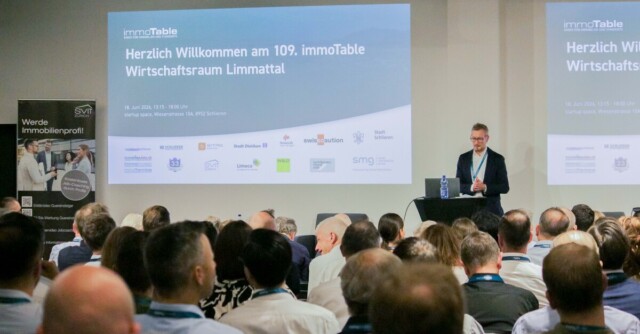
    Limmatstadt AG has launched a joint digital events calendar in collaboration with municipalities and business associations in the Limmat Valley. Events relating to business, culture, sport, clubs and municipalities are recorded centrally and then automatically published on various channels and displayed collectively on the Limmatstadt website. According to a press release, the initiative aims to raise the profile of the region, exploit synergies, reduce administrative costs and strengthen and further develop the Limmattal region as a place to live and do business.

    “With the digital event calendar, we are highlighting everything the Limmat Valley has to offer – and at the same time strengthening cooperation in the region,” said Stephanie Kiener, Managing Director of Limmatstadt, in the press release.

    The technical basis for the calendar is the guidle platform. Event organisers enter their events once in a central location. These then appear on the regional calendar and, depending on the connection, on the websites of the respective municipalities and partner and media platforms. The solution thus creates transparency and visibility and enables simpler processes and efficient use of resources without overlaps.

    The digital event agenda was supported and financed by the municipalities of Aesch, Dietikon, Geroldswil, Oetwil an der Limmat, Oberengstringen, Schlieren, Spreitenbach, Uitikon, Unterengstringen, Urdorf and Weiningen, as well as the Dietikon Industry and Trade Association and the Schlieren Chamber of Commerce.

    “The new digital event calendar brings the Limmattal region even closer together – visible, connected and strong together,” the press release states.

  • Federal government conducts consultation on location promotion

    Federal government conducts consultation on location promotion

    The Federal Council has opened a consultation process on the message on location promotion for the first time. According to a statement, it is set to run until 1 June 2026. The Federal Council is submitting five financing decisions to Parliament for the years 2028 to 2031, with a total volume of CHF 392.21 million. Location promotion is to be carried out through SME policy, tourism policy, regional policy, export promotion and location promotion.

    The focus is on three key areas of location promotion: reducing the administrative burden on SMEs through digitalisation, facilitating SMEs’ access to international markets and, finally, strengthening the regions economically. Among other things, the expansion of the EasyGov.swiss platform will create a marketplace for digital services provided by the federal government and the cantons. With regard to international markets, the federal government supports export-oriented companies with information, advice and the use of export risk insurance. In the area of regional location promotion, the federal government supports tourist destinations and economic projects in rural areas, mountain regions and border regions.

    Despite the high budget, planning shows a decline of 5.2 per cent compared with the previous period, taking into account the special Covid and recovery payments and the 2027 relief package.

  • Spatial planning is taught in a practical manner in the classroom.

    Spatial planning is taught in a practical manner in the classroom.

    Planning officials from Baden Regio initiated a spatial planning project with students from the Wettingen Cantonal School in autumn 2025. According to a recent announcement, the planners designed three lesson blocks in the specialised subject of humanities and social sciences. Working methods and planning tools were presented, and opportunities for public participation were explained.

    In practical projects, students analysed their immediate school environment and then developed proposals for the design of the western part of the monastery peninsula. In further lessons, the young people worked with their teachers to explore different housing concepts, housing needs and their influence on urban development. The focus was on social components.

    “The practical perspective and in-depth expertise of the speakers from Baden Regio opened up valuable new perspectives for both the pupils and the teachers,” said Oliver Schneider, a teacher at the Kantonsschule Wettingen, in the press release. “The lively interplay between theoretical principles and their direct application to a concrete example made the topic of spatial planning tangible and easy to understand. This aroused curiosity, promoted networked thinking and encouraged the students to look beyond their usual boundaries.”

    Those involved from Baden Regio and the teaching staff noted that it was striking how important the coexistence of people was to the pupils.

  • The way is clear for Wil West

    The way is clear for Wil West

    At the second attempt, the voters of St. Gallen say yes to Wil West. The decision is close, but clear enough to create planning security. The vote shows that the region wants to grow. Bundled, plannable and coordinated across cantonal borders.

    With the sale of the land, St. Gallen is handing over a former estate of the Wil psychiatric clinic to the canton of Thurgau. In future, the economic area will be located entirely on Thurgau soil, but will remain within the immediate sphere of influence of the Will region. This creates a clearer starting position for investments, infrastructure and long-term settlement strategies.

    Concentration instead of urban sprawl
    Wil West stands for a model that keeps many regions busy, enabling economic growth without further urban sprawl. Instead of constantly scattering new commercial zones on the outskirts of towns, the location will in future concentrate companies, services and productive jobs in a location with good transport links.

    The plan is not just any old industrial area, but a modern work location. The aim is to create high-quality businesses that generate added value and skilled jobs without taking up an excessive amount of space. The development potential of the region will thus be utilized. For spatial planning, the project is therefore also an instrument for channeling growth instead of leaving it to chance.

    Infrastructure as a driver of development
    Wil West has a particularly strong impact through its infrastructure. With the project, the federal government, cantons and region are linking the expansion of the highway, public transport and pedestrian and bicycle connections. The planned freeway link to the A1 and better rail and bus connections will make the area attractive for companies and at the same time relieve pressure on the existing town centers.

    Sustainability as a location factor
    The first version of Wil West failed due to concerns such as loss of cultural land, traffic and ecological impact. In the revised version, sustainability plays a much more visible role. More compact construction methods, more careful land use and more green and open spaces are intended to reduce the ecological footprint.
    This is precisely what is becoming a location factor for companies looking to relocate. When choosing a location, more and more companies are looking at energy and land consumption, accessibility without a car and an attractive environment for employees.
    Wil West has the opportunity to set a new standard for work zones if quality assurance, phasing and criteria for settlements are consistently implemented.

    Seize opportunities, manage expectations
    With the yes vote for the proposal, expectations are now also rising. Politics and administration must pick up the pace without falling into a hectic pace. The region needs clear guidelines: which sectors should come? What density is desired? How can development be managed over decades without having to change strategy every time the economy changes?