Category: New construction

  • One cape, one vision, 100 million francs

    One cape, one vision, 100 million francs

    Capo San Martino is one of the most spectacular lakeside locations in Switzerland. The headland south of Paradiso lies between two municipalities, has an eventful history and had been left to decay for years. When the property came up for sale, Constantin said he took immediate action. What has lain fallow for years is now to become a place to walk, linger and breathe.

    What is planned
    Around 100 beds, panoramic rooms, catering, wellness and a spa with a direct view of the lake are planned. The Lugano-based firm Mino Caggiula Architects is responsible for the design. For the architect, the aim is to revitalise a piece of landscape and history. Construction is scheduled to start in early 2027, with the opening planned for spring 2030 if everything goes according to plan.

    The hurdles are real
    Before a stone can be laid, the project requires a zoning plan amendment. This must be approved by the city parliament and the cantonal government. Historic pollution, environmental issues and public perception at such an exposed location can quickly become decisive influencing factors. Constantin is confident. However, observers describe the timetable as very optimistic.

    What the project means
    For Ticino, Capo San Martino is more than just a property project. It is revitalising the debate about Lugano as a high-quality tourism location. In a market that is increasingly focussing on international profile and quality of experience, iconic projects are a potential lever. At the same time, the pressure on all those involved is increasing. Spectacular images are not enough; viable concepts for operation, development and political acceptance are required.

    Lighthouse or castle in the air
    Whether Capo San Martino actually becomes a lighthouse project depends on more than 100 million francs. The project must prove that it can fit into a challenging topographical and political context. If it succeeds, Constantin will indeed write a new chapter for this place and Ticino will write a new chapter for its tourism.

  • New development combines residential, commercial and local services

    New development combines residential, commercial and local services

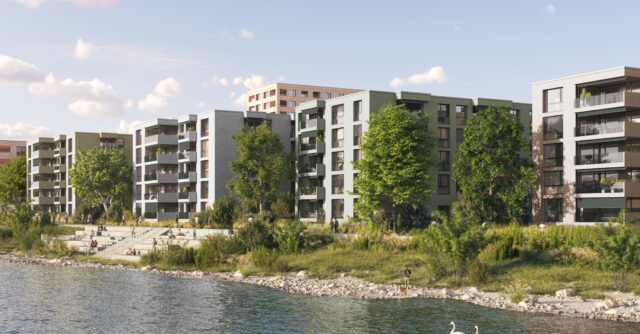
    According to a press release, Schlieren-based Halter AG completed the AuPark plannmässig development at the end of March and handed it over to the client Swiss Life Asset Managers. The project involved the construction of five apartment blocks and commercial buildings with views of Lake Zurich and the Au peninsula.

    The AuPark development comprises a total of 300 flats, including 111 condominium units, according to the project description. There will also be commercial space and a Coop, which will serve as a local supplier for the neighbourhood. The eponymous AuPark lies at the heart of the project and serves as a central meeting point and recreational space for the residents with extensive lawns.

    “As part of our total contractor services, the project was specifically densified and the housing mix optimised,” the company said in the press release. “The result: a sustainable, marketable development with a high quality of living – including in the affordable housing segment.”

  • Canton of Bern plans major construction in the Bernese Seeland

    Canton of Bern plans major construction in the Bernese Seeland

    The Road Traffic and Navigation Office has had its headquarters on Schermenweg in Bern for decades. The buildings there have structural defects and are in a condition that makes it impossible to completely renovate them without interrupting operations. In addition, there is a second location in Ostermundigen, where the canton pays over one million francs a year in rent.

    Move three times or build once
    The decision was made in favor of a new building. All three locations will be closed and the approximately 400 employees brought together in a single location. The new building on the Buechlimatt in Münchenbuchsee offers space for offices, test centers and the entire customer operations on one site. Vehicle registrations, driving tests, administrative processes: everything under one roof for the first time in decades.

    One competition, one winner, one timber construction
    in 2021, the canton announced an open project competition. Thirty teams submitted designs, and the Zurich planning team from Studiomori Architektur and KNTXT Architekten won over the jury. Their project bears the programmatic name “One for all”. It is based on a low-maintenance timber construction that blends organically into the rural outskirts of Münchenbuchsee. Not a statement made of concrete and glass, but a building that makes the Canton of Bern’s climate strategy visible. Wood as a building material reduces the CO2 balance over the entire life cycle.

    The politicians decide
    In April 2026, the Bernese government applied to the Grand Council for a commitment credit of 132.9 million francs. The latter is expected to make its decision in autumn 2026. The fact that the amount has risen from around CHF 104 million at the time to CHF 132.9 million since the 2021 competition phase is likely to raise questions in parliament. Construction costs and increased planning requirements are the main reasons. If you offset the rental costs and the renovation backlog, the business case for the new building is clear.

    Move in 2031 at the earliest
    If the parliamentary deliberations go according to plan, the building application will be submitted in mid-2026 and construction will begin in 2028, with commissioning planned for 2030 to 2031. For Münchenbuchsee, this means a new workplace center with several hundred employees on the edge of the village. For the canton of Bern, it means the end of a long period of administrative restructuring. And for the Swiss construction industry, the project exemplifies a trend that will gain momentum in 2026. Public buildings made of wood, built for the next generation.

  • Investment secures funding for a major wind energy project

    Investment secures funding for a major wind energy project

    aventron AG has acquired a significant stake in the Sur Grati wind farm in the canton of Vaud, according to a press release. The wind farm is operated by the project company VOé éole SA. In addition to aventron, the energy supplier SIE SA, based in Crissier (VD), and the Vaud municipalities of Premier, Vallorbe and Vaulion also hold stakes in the company.

    Aventron’s entry finalised the shareholder structure and the financing of the project company. This followed a positive ruling by the Federal Supreme Court in May 2025 regarding the wind farm’s building permits; the wind farm is scheduled to come online at the end of 2027.

    VOé, which has been developing the project for several years, is a regionally based energy supplier and is contributing its local networks. Aventron brings experience in the construction and operation of wind farms in several European countries. “Together, we are realising one of the largest wind energy projects in Switzerland. In doing so, we are supporting the federal government’s energy strategy and strengthening security of supply, particularly in winter,” said Eric Wagner, CEO of Aventron.

    The wind farm is located on the Jura mountain range in northern Vaud and is currently under construction. Six wind turbines with a total capacity of 25.2 megawatts are planned. The facility is expected to produce around 45 gigawatt hours of electricity annually, which corresponds to the demand of approximately 11,000 households. Once completed, Sur Grati is set to be the second-largest wind farm in Switzerland.

  • Infrastructure project boosts efficiency and safety in flight operations

    Infrastructure project boosts efficiency and safety in flight operations

    Construction of new infrastructure for general aviation in the West Zone at Zurich Airport began on 14 April. Plans include a terminal building with a hangar and a dedicated apron area. According to a press release, the facility is scheduled to open in spring 2028.

    The new facility is designed to accommodate larger aircraft types and will also provide space for passenger handling and offices. Its proximity to the heliport is also expected to reduce transfer times. In addition, car parks for staff and passengers will be built, along with access via an extended Rohrstrasse.

    Flughafen Zürich AG is investing around CHF 100 million in the project. The new building is part of the development of the approximately 16.8-hectare Zone West, which is earmarked for apron extensions, logistics, and aircraft and airport maintenance, amongst other things.

    With the new building, the airport is responding to changing requirements in the field of general aviation. The existing infrastructure in the east has reached the end of its life cycle and can no longer meet the demand for hangar space, particularly for larger aircraft.

    Furthermore, the project is linked to the planned runway realignment at Zurich Airport. This is intended to reduce the number of runway crossings by landing and taking-off aircraft, thereby enhancing flight safety.

  • New care home expands capacity in urban neighborhood

    New care home expands capacity in urban neighborhood

    Schlieremer Halter AG has handed over a new home for people in need of care in Bern’s Wyler district. The care home, which is operated by Domicil Bern as the general tenant, provides 112 new care rooms, according to a statement on LinkedIn.

    Each room has its own bathroom and balcony. The facility also has recreation and service rooms as well as publicly accessible areas. Employees have been provided with a modern working environment with optimal conditions. The completed facility was handed over to the Swiss Life Investment Foundation at the end of March.

    According to the press release, a further contract was agreed with Domicil Immobilien AG for the construction of a care home with 75 rooms, a dementia unit and a restaurant.

  • Infrastructure works tackle challenging terrain on Lake Zurich

    Infrastructure works tackle challenging terrain on Lake Zurich

    Walo Bertschinger AG, a family-run construction firm based in Dietikon, is carrying out the roadworks and civil engineering works as part of an infrastructure project in the Lake Zurich region. According to a press release, over a stretch of 1.1 kilometres between Tägerst and Buchenegg, “roads, drainage systems and numerous engineering structures are being newly constructed, reinforced or repaired.” The project is scheduled for completion by 2027.

    A central element of the project is the construction of two new Lehnen viaducts, measuring 90 and 130 metres in length. A total of 21 piers and around 240 micropiles will provide a solid foundation on the landslide-prone slope.

    “Limited space, steep terrain and a tight schedule make this project particularly challenging,” explains Walo Bertschinger AG in the press release. “We are therefore all the more pleased that the work is progressing according to plan and that the team is delivering a strong performance in their daily work.”

  • Ground-breaking ceremony marks the start of a new residential development in Baden

    Ground-breaking ceremony marks the start of a new residential development in Baden

    The first five foundation stones were laid on the Brisgi site, marking the official start of the approximately three-year construction phase. According to a statement from the City of Baden, the site will see the creation of around 220 units of sustainable and affordable housing. The symbolic laying of the foundation stones was carried out by Baden’s Mayor Markus Schneider, representatives of the non-profit developers – the Baden Housing Foundation, Logis Suisse AG and the Graphis Building and Housing Cooperative – as well as members of the local community.

    “These five stones come from the excavation and represent the core values of the future Brisgi site: together we are shaping the future with sustainable and affordable housing,” explains the City of Baden in the statement.

    By 2028, affordable flats and flexible housing options for single people, couples and families are to be built on the site. In addition, community life will be enhanced by studios, green spaces, a neighbourhood square and a playground.

    The project will be built in accordance with the Swiss Sustainable Building Standard (SNBS). “The site focuses on hybrid construction, renewable energy, biodiversity and minimal soil sealing,” the press release states. “In this way, the project demonstrates that high-quality construction, sustainability and affordable housing go hand in hand.”

  • New police headquarters sets new standards for the workplace

    New police headquarters sets new standards for the workplace

    The construction group Implenia is building the new police headquarters in Münster, Germany, on behalf of the project company PPMS Immobilien GmbH & Co. KG, to accommodate more than 1,400 staff. According to a press release, the building will provide much-needed additional space for the police force, as well as a modern headquarters featuring short walking distances and attractive new-work concepts. The project is worth more than €200 million.

    As the main contractor, Implenia is responsible for the planning and construction of a functional and administrative building designed to bring together virtually all of Münster Police’s existing departments. The turnkey new building will include modern office and laboratory workspaces, a police station, a canteen, training areas, detention facilities and an underground car park.

    According to the press release, the project is in line with the strategic focus on “large, complex and specialised property projects”. In the words of Matthias Jacob, Head of the Buildings Division Germany, Implenia is focusing on “partnership-based contract models that allow us to make optimal use of our capabilities for the benefit of our clients and Implenia”.

    Construction work is scheduled to begin in summer 2026, following the early completion of the excavation, and is expected to last until October 2029.

  • Winter electricity from the Alps is performing above average

    Winter electricity from the Alps is performing above average

    The Madrisa Solar power plant generated around 1.5 gigawatt hours of electricity during the first winter half-year, from October to March. This means that production exceeded expectations, as Repower AG states in a press release. During its first winter of operation, around 3,600 solar modules were in operation, which corresponds to approximately 20 per cent of the planned total capacity.

    The plant, which was the first alpine solar power plant in Switzerland to feed electricity into the grid, is located above Klosters at around 2,000 metres above sea level and is specifically designed for winter electricity production. Following the first snowfall, output rose by around 15 per cent thanks to the so-called albedo effect. The bifacial modules also utilise light reflected from the snow cover.

    The electricity generated is used, amongst other things, directly to power the Klosters-Madrisa mountain railways. In combination with existing installations, more energy was produced during the first winter than was required to operate the winter season. With its output to date, Madrisa Solar has comfortably met the minimum production requirement of 500 kilowatt-hours per installed kilowatt of capacity stipulated under the national Solarexpress scheme.

    The second construction phase is scheduled to begin in early May. Once completed, around 70 per cent of the plant is expected to be connected to the grid. Full commissioning is planned for the end of 2027. The developer of the alpine plant is Madrisa Solar AG, in which Repower, the Zurich Cantonal Electricity Works (EKZ) and the municipality of Klosters hold stakes.

  • Railway station heating plant switched to wood pellets

    Railway station heating plant switched to wood pellets

    Industrielle Werke Basel(IWB) is making progress with the decarbonisation of district heating. According to a press release, they tested the two new boilers of the wood pellet plant at the Bahnhof heating plant in March. With an output of 30 megawatts, it is expected to generate around 95 gigawatt hours of district heating per year.

    The switch from natural gas to wood pellets will save around 23,000 tonnes of CO2 per year. This corresponds to a 9 per cent reduction in total CO2 emissions from district heating in Basel. “With the new wood pellet plant, IWB is making an important contribution to the decarbonisation of district heating and to achieving the net-zero target of the Canton of Basel-Stadt,” said Evelyn Rubli, Head of the Heating Division, in the press release.

    The area surrounding the heating plant will be open to the public as a green space in future. The city gardening department plans to start landscaping it in the autumn.

    IWB wants to have completely converted its district heating to waste heat and renewable energy sources by 2035. The next step is to convert the Volta district heating power plant. IWB will also rely on large heat pumps in future. ProRheno’s Basel wastewater treatment plant is a possible location.

  • Hydropower project on the Grimsel enters the implementation phase

    Hydropower project on the Grimsel enters the implementation phase

    According to a press release, the Board of Directors of Kraftwerke Oberhasli AG (KWO), based in Innertkirchen, has approved an investment of 300 million Swiss francs in the construction of the new Grimsel 4 pumped-storage power station. The plant will enable the water from the two reservoirs, Räterichsboden and Grimsel, to be used to ensure grid stability. The concession and planning permission have already been granted.

    Grimsel 4 consists of an underground power station between the two lakes. Two reversible pump-turbines, each with a discharge capacity of 35 cubic metres per second and an installed capacity of 84 megawatts, pump water up into Lake Grimsel as required or use it to drive the turbines as it flows into Lake Räterichsboden. The water tunnel between the two lakes is around 1,200 metres long and has a diameter of 6 metres. The access tunnel to the power station is around 1,800 metres long.

    Construction will begin in June and is scheduled for completion in February 2032. Excavation work for the power station will commence in early 2028.

    KWO was founded in 1925. It currently operates 13 hydroelectric power stations and eight reservoirs. BKW holds a 50 per cent stake in the company. The municipal utilities of Basel (IWB), Bern (ewb) and Zurich (ewz) share the remaining half equally.

  • Former industrial site to be transformed into a mixed-use neighbourhood

    Former industrial site to be transformed into a mixed-use neighbourhood

    According to a press release, Halter AG has celebrated the topping-out ceremony at the Aebi site. The construction company, based in Schlieren, is developing extensive commercial, office and residential space on the site, with completion scheduled for early 2027. The ground-breaking ceremony took place in February 2025. The Aebi company manufactured agricultural machinery on the site until 2010. Burgdorf’s mayor, Stefan Berger, along with Marcel-Jann Blattert and Marc Weber from Halter AG, expressed their gratitude at the topping-out ceremony for the efforts of everyone involved.

    In total, the site will feature 26 owner-occupied and 79 rental apartments, as well as around 3,625 square metres of floor space for versatile commercial, office and retail premises. The usable space can be partly rented and partly purchased as freehold. According to the project description, the central location at the railway station and the proximity to Bern (ideal conditions for businesses) are particularly attractive to companies that value a strong presence, accessibility and a vibrant environment.

    Halter AG is a property and construction company operating throughout Switzerland. The company handles a construction volume of around 800 million Swiss francs per year across seven sites and currently has around 320 projects in development and under construction.

  • 80 centimeters slow down 63 million project

    80 centimeters slow down 63 million project

    The secondary school community of Arbon applied for an exemption permit for the planned Lärche school center. Specifically, this concerns the attic storey, which is 4 meters high instead of the 3.2 meters stipulated in the building regulations. The maximum permissible overall height of 16 meters is nevertheless undercut at 15.5 meters. A technical borderline case, not a fundamental problem.

    One man, one objection
    Architect Gustav Maurer has lodged an objection to the application for exemption. He describes the project, which emerged from a competition, as a “proven planning error” and considers it irresponsible in view of the global economic situation. Maurer claims that the required construction volume could be realized for CHF 43 million. This is around 20 million less than the credit of 62.9 million francs approved by the people.

    Timetable is faltering
    The secondary school authorities wanted to submit the building application in November. Due to the objection and the resulting legal uncertainty, this deadline is beginning to waver. If the process is delayed, there is a risk of follow-up costs in the millions due to rising construction prices, longer planning times and postponed building approvals.

    Clear words from the school president
    Secondary school president Robert Schwarzer finds clear words. Maurer has been opposing almost everything that is to be built in Arbon for years. The right to object is undisputed as a fundamental right, but what is being practiced here is an “expression of harassment and arbitrariness”. The objector seemed to be indifferent to the potential multi-million euro follow-up costs.

    Support from the population
    The project has democratic legitimacy. Almost 60 percent of voters were in favor of the 62.9 million loan in September 2025. The ground-breaking ceremony was planned for September 2026, with occupancy scheduled for the 2028/29 school year. Whether this timetable holds will now be decided by the Legal Service. Not at the ballot box.

  • The outlet in Landquart is set to be significantly expanded

    The outlet in Landquart is set to be significantly expanded

    Walo Bertschinger AG, based in Dietikon, is involved in the expansion of the Landquart Fashion Outlet. According to a press release, the shopping centre, which has a village-like atmosphere, is being expanded by 5,000 square metres to accommodate 14 new shops, a new restaurant and a four-storey car park. Walo is responsible for the various paving and surfacing works. The new section of the Fashion Outlet is scheduled to open in April 2026.

    According to Walo, a total of 12,900 square metres of base course and 2,600 tonnes of surfacing will be used in the underground car park and outdoor areas. In the outdoor area, 900 metres of kerbs will also be laid and 67 manhole covers installed. The bus stop will also be paved with heavy-duty paving stones over an area of 630 square metres.

    The central design element is the “high-quality paving of the pedestrian zone in the mall area, which characterises the centre’s alpine village design”, according to Walo’s press release. There, the company is laying 150 square metres of row paving, 200 square metres of edging slabs made of Onsernone granite, and 1,500 square metres of porphyry slabs.

  • Major contracts are boosting the building construction business both at home and abroad

    Major contracts are boosting the building construction business both at home and abroad

    In a press release, the property and construction services provider Implenia has announced that it has secured numerous building contracts in Switzerland and Germany. These contracts have a total value of 310 million Swiss francs and will be carried out between 2026 and 2028.

    In Vevey, Vaud, on the shores of Lake Geneva, Implenia is acting as the main contractor for the new Jardins en Ville district, building 182 owner-occupied flats. The project is complemented by commercial space, a two-storey car park and a central green space. The PEFC/FSC-certified timber structure is set to meet the Minergie-Eco and CECB A/B standards. Also in Switzerland, Implenia is building eight Minergie-certified apartment blocks in Payerne (VD) comprising 107 climate-friendly homes. The project was previously developed by Implenia and subsequently sold to investors.

    Implenia is also creating sustainable housing in Germany: in Frankfurt, twelve energy-efficient residential buildings with around 160 passive house units are being built in the city’s “first climate protection district”. In Munich, following a successful pre-construction phase, the company is building a multi-family residential building with 186 flats and complementary commercial uses as part of a joint venture. In Nuremberg, three buildings featuring 76 rental flats, as well as space for a nursery, commercial premises and an underground car park, are being constructed using a timber-hybrid construction method. In Jena, a further residential quarter is also being built using timber construction. In Mannheim, Implenia is constructing a turnkey residential complex using a timber-hybrid construction method at BUGA Park, comprising a total of 225 residential units.

    Further contracts relate to the justice sector as well as education, research and pharmaceuticals: Implenia is constructing operational and production buildings for the prison in Siegburg. In addition, the extended shell of an administration building using timber construction is being built for Flensburg University of Applied Sciences. In German-speaking Switzerland, Implenia is undertaking additional construction work, including the redevelopment of a former industrial site and projects for the pharmaceutical industry.

  • Horw is growing upwards, 14 storeys at the railway station

    Horw is growing upwards, 14 storeys at the railway station

    Three striking new buildings with inner courtyards are being built between the railway station and Ebenaustrasse. The municipality is planning an eight-storey building at the roundabout, a 14-storey high-rise to the south of it as a vertical accent and an eight-storey longitudinal building facing Ebenaustrasse. The new bus station will be located in between, closer to the railway line than today and much more convenient for all those who change buses every day.

    “Janus” favours greenery and glass
    Further east, along Ebenaustrasse and Ringstrasse, the municipality has held an architectural competition. The winning project is called “Janus” and envisages five largely glazed, six- to seven-storey apartment blocks, surrounded by trees and connected by a shared forecourt. The buildings appear bright and open, the ensemble creates urban quality without anonymity.

    Commercial yes, but how much?
    At least 20 per cent of the space in the new buildings is to be used for commercial purposes. This is envisaged by the municipality, and not just on the ground floor, but up to the third or fourth floor. The property owners take a critical view of this. They point to a lack of demand and draw on their experience with the previous “Horw centre” open space concept. The municipal council is willing to talk, but reserves the right to add further storeys if necessary.

    Part of a big picture
    The railway station project is embedded in the overall “Horw Mitte” project, which covers around 12 hectares and plans 1,000 new flats and 800 new jobs in the long term. A large part has already been realised to the west of the tracks, while the eastern part is now catching up. Over two decades, the municipality is thus developing a former peripheral area into a compact, well-developed centre.

    Residents’ Council has the floor
    The bus station was already approved by the Residents’ Council on 27 March 2026, with construction not due to start until 2028 at the earliest. The vote is still pending for the Part East development plan. This requires the approval of the cantonal government of Lucerne and a referendum-free conclusion. It is also still unclear who will bear the planning costs. So there is still a lot to be clarified before the construction cranes move in.

  • Major project to boost rail capacity in the Zurich area in the long term

    Major project to boost rail capacity in the Zurich area in the long term

    According to a press release, SBB has begun work on upgrading the line between Zurich and Winterthur to four tracks throughout. As part of the ‘MehrSpur Zurich-Winterthur’ project, SBB is constructing a new tunnel, upgrading several stations and carrying out further improvements.

    SBB and the construction firms involved have now started work on upgrading the stations at Wallisellen, Dietlikon, Bassersdorf and Winterthur Töss. This includes widening platforms, constructing new and modified underpasses, and building footbridges and bridges. Work in Bassersdorf is due to be completed by 2030, in Wallisellen and Dietlikon by 2031, and in Töss by 2034.

    The Brütten Tunnel is set to be 9 kilometres long. Tunnel boring is scheduled to begin in 2029, with the tunnel due to open in 2037.

    The expansion is expected to cost a total of 3.3 billion Swiss francs. This major project, together with other initiatives such as the expansion of Zurich Stadelhofen station, is set to significantly improve rail services in the Greater Zurich area.

  • New district heating network makes efficient use of waste heat and water from the Rhine

    New district heating network makes efficient use of waste heat and water from the Rhine

    According to a press release, energy supplier AEW Energie AG is investing 8 million Swiss francs in the construction of a district heating network in Augst, in the canton of Basel-Landschaft. According to the company, this sends “a clear signal regarding the implementation of the energy strategy and the consistent expansion of renewable heating solutions”.

    Waste heat from the generators at the existing Augst hydroelectric power station and water from the Rhine are to be used for district heating. It is stated that, via a 1.3-kilometre-long district heating network, the connected buildings will receive CO2-free energy from the start of the 2026/2027 heating season.

    Three heat storage tanks, each with a capacity of 15,000 litres, will ensure a secure supply and reliable, stable operation even during peak loads. According to the press release, the plant’s thermal output is 2 megawatts and is expected to deliver a heat output of 4,400 megawatt-hours once fully operational. This is expected to save 1,200 tonnes of CO2 annually.

    At the start of the construction project with the ground-breaking ceremony on 16 March 2026, the company announced that it was creating a replacement for the AEW Contracting plant in Pratteln, which had been operated using wood pellets and oil. “With the Augst heating network, we are making optimal use of existing energy sources from our own infrastructure and making an important contribution to the decarbonisation of the region’s heat supply,” said Dr Raffael Schubiger, Chairman of the Board of Directors of AEW Energie AG and Kraftwerk Augst AG.

    According to David Gautschi, Head of Production at AEW, the Augst heating network exemplifies how existing energy infrastructure and natural resources can be efficiently combined.

  • Swiss construction project focuses on sustainable earthen architecture abroad

    Swiss construction project focuses on sustainable earthen architecture abroad

    The go-ahead has been given for the construction of the new Swiss Embassy in the Cameroonian capital, Yaoundé, and according to a press release, Dietikon-based Oxara AG is playing a key role in the project. The public building will be constructed using pressed clay bricks. Oxara is supplying its Oxabrick Loko stabiliser for the red raw material, which is available in abundance locally.

    The design for the embassy building is by the Basel-based architectural firms Caesar Zumthor Architekten and Nord Architekten and comprises an office block, a residence and a connecting building, all grouped around a courtyard. The buildings are to be constructed sustainably using local resources.

    On its website, Oxara – a company founded in 2019 – has launched a series reporting on the progress of the construction work. “In West Africa, clay is perceived as a sign of poverty and rurality, whilst concrete dominates in cities as a status symbol,” Oxara’s project manager Jonathan Ensslin is quoted as saying there. “It therefore sends a strong signal that the new Swiss embassy is being built with clay.”

    Oxara’s non-toxic mineral activator transforms clay into a stable and water-repellent building material. According to the company, this makes clay construction faster, less labour-intensive and scalable. At the same time, it is circular and low-carbon.

    Tests in the Oxara laboratory had shown that the material is well suited for use with Oxabrick Loko. However, the laboratory results could not initially be replicated on site. With the help of local materials researcher Berardin Beauderic Kenne Diffo, who had already got to know Oxara during his PhD at the Swiss Federal Institute of Technology Zurich, the mixing ratios were adjusted. A test wall comprising around 7,000 clay bricks is currently being completed. Construction work on the new embassy is then set to begin.

  • Start of construction marks an important step for renewable electricity generation

    Start of construction marks an important step for renewable electricity generation

    According to a press release, Kraftwerk Meiental AG celebrated the start of construction of the Meiental power station in the municipality of Wassen with an official ground-breaking ceremony on 11 March. The actual construction work began back in September. Work is currently underway on the penstock and the new power station control centre.

    The power station utilises water from the Meienreuss. This is collected at an altitude of 1,317 metres and channelled through a 3,250-metre-long penstock to the new hydroelectric power station, which is situated at an altitude of 1,100 metres in Fedenbrügg. With a capacity of 10 megawatts, the power station is expected to generate around 34 gigawatt-hours of electricity per year. It is scheduled to come into operation at the end of 2028.

    A total of 40 million Swiss francs is being invested. The canton of Uri and the municipality of Wassen anticipate additional tax revenue, whilst the canton and the Corporation of Uri expect water rights fees of half a million Swiss francs per year. “We are utilising our local hydropower, strengthening regional value creation and, at the same time, making an important contribution to a climate-friendly energy supply,” Uri State Councillor and Director of Public Works Hermann Epp is quoted as saying in the press release.

    Kraftwerk Meiental AG is owned by the cantonal energy supplier energieUri AG, the canton and the Corporation of Uri, as well as the municipality of Wassen.

  • Spectacular cultural building sets new architectural trends

    Spectacular cultural building sets new architectural trends

    Nüssli, the construction services provider based in Hüttwilen, celebrated the topping-out ceremony for the extension to the Mack Pyramid in Monheim am Rhein on 8 March 2026, in the presence of the building’s namesake, Heinz Mack. With this extension, the company – which specialises in temporary event structures – is realising an “architecturally ambitious construction and cultural project”, writes Nüssli in a press release.

    Thanks to the installation of a load-bearing steel structure shortly before the topping-out ceremony, the double pyramid is already a prominent feature of the townscape. “The structure is characterised by sophisticated geometry, high design standards and complex structural engineering,” the statement says. According to the city, the building is intended to provide a culturally significant architectural landmark. Exhibition spaces for contemporary art are to be created.

    According to the press release, the Thurgau-based company is contributing its experience with complex special-purpose structures such as pavilion architecture, exhibition design, as well as façade designs, sculptures and exhibits. “At various world exhibitions, we have learnt to turn extraordinary forms and complex structures into reality. It is precisely this expertise that is now being put to full use in the Mack Pyramid,” says Udo Baader, Head of Project Management Special Projects. The opening is scheduled for June 2027.

    Alongside the progress of the construction, the day also focused on the pyramid’s namesake, Heinz Mack. The sculptor was among the visitors, celebrating his 95th birthday. “Despite all the plans, I can’t quite picture it yet. The main thing is that the light remains,” he is quoted as saying. The light is part of his artwork inside the building, the press release states.

  • New logistics centre to be built in Hunzenschwil

    New logistics centre to be built in Hunzenschwil

    ERNE AG Bauunternehmung from Laufenburg is constructing a modern logistics centre for Lagerhäuser Aarau AG in Hunzenschwil, according to a press release. The new industrial building comprises a high-bay warehouse and office space. The 130-metre-long and 100-metre-wide building has a total volume of 364,043 cubic metres.

    The schedule for the shell construction is clearly defined: completion is scheduled for 9 December 2026. Halfway through the construction period, the building must already have reached its full height in the high-bay warehouse area. In order to meet these requirements, ERNE is relying on digital construction processes and a virtual overall model (Virtual Design and Construction), which maps all construction stages in detail. This enables construction processes to be planned precisely, trades to be optimally coordinated and interfaces and potential conflicts to be identified at an early stage.

    Around 50 employees and four Wolff WK 7534 cranes are in operation every day on the large construction site. For the concreting work, around 31,000 cubic metres of concrete are produced and processed on site with the aid of a mobile concrete plant, including water drainage. Once the foundation work has been completed, the walls and ceilings of the centre will follow. Once the floor slab has been completed, one of the 120 ceiling stages, each covering an area of 300 to 350 square metres, will be concreted every other day on average. The structural connection between the new building and the existing building will complete the shell construction work.

    Once completed, the extension will not only meet the growing demand for flexible storage and logistics solutions, but will also set new standards in automation, energy efficiency and sustainable construction, according to the announcement.

  • “Insieme” education centers in Sursee

    “Insieme” education centers in Sursee

    The project competition was announced as an open, single-stage and anonymous procedure for general planning teams, with eight teams submitting proposals on time. The jury assessed them according to functionality, cost-effectiveness, sustainability, urban planning and architecture and awarded the contract to the “Insieme” project by Bob Gysin Partner from Zurich. The centerpiece is a new seven-storey building along the railroad line, which makes a clear contribution to urban densification and orients the campus more towards the station.

    Bright learning landscape
    In future, the new main entrances will be oriented more towards the railroad station, thus relieving the existing access through the adjacent residential area. All gymnasiums will be accessible via the newly defined entrance area, which will simplify routing and orientation. The arrangement of classrooms, group rooms, atriums and meeting zones creates a bright, flexible learning landscape that supports different forms of teaching and informal encounters in equal measure.

    Building sustainably, upgrading open spaces
    In terms of construction, “Insieme” relies on a combination of existing buildings and timber construction. With the exception of the basement, the existing building in Wing B is being dismantled and extended with a timber ribbed ceiling to create a six-storey building. The design of the open space responds to the climate heating by shading the existing staircase and enhancing it with additional planting and seating. The edge of the forest will have new recreational areas and loose tree planting, which will significantly increase the quality of the outdoor space.

    Next steps until commissioning
    In the first quarter of 2026, the jury’s comments will be reviewed and the competition project optimized if necessary. The extended facility is currently scheduled to open in 2035. Around CHF 97.4 million has been set aside in the cantonal financial planning for the expansion and partial renovation of the BBZG W in Sursee. An investment in future-proof vocational training and a strong educational location in the region.

  • Construction site for retirement home in Schlieren to be set up in March

    Construction site for retirement home in Schlieren to be set up in March

    From the beginning of March 2026, the construction site for the new Schlieren retirement home “Wohnen am Stadtpark”will be visible to the public. Preparatory work will then begin there. Two appeals had led to a one-year delay, but these were withdrawn in December 2025. The legal proceedings have now been concluded. According to a statement from the city of Schlieren, the construction site can now be set up and the initial construction and preparatory work can begin. The official ground-breaking ceremony is scheduled for April 2026. Construction work is expected to be completed by the end of 2028.

    As construction begins, the playground on the western edge of the city park will also be dismantled starting in early March. According to the city, a new municipal playground is already being built at Stürmeierhuus. It is scheduled to be completed in April.

    In the referendum on 12 March 2023, a loan of CHF 44.32 million for the construction of the new retirement home was clearly approved with 76.6 per cent voting in favour. As the city emphasises, it makes “an important contribution to ensuring modern, needs-based care and nursing for the elderly close to their homes”.

  • From local entrance to networked residential address

    From local entrance to networked residential address

    The Neugut site marks the southern entrance to Rickenbach and is located in the municipality’s core zone. The project proposal by Fischer Architekten and Uniola groups seven new residential buildings around two courtyards, while an existing eighth building is integrated into the neighbourhood. A new building with commercial use on the ground floor will be constructed on the site of the existing restaurant, addressing the entrance to the neighbourhood and the village.

    urban planning classification
    The alignment of the new buildings is based on the existing building and Haus Wiesental on the one hand, and on the almost parallel alignment of the surrounding village buildings on the other. This creates a settlement pattern that takes up the existing structure instead of creating a foreign body.

    A narrow stream separates the residential area from the open field and at the same time forms a clear landscape edge. The large lime tree and the position of the “Wiesental” are retained in the new concept, which strengthens the continuity of the townscape.

    interlocking landscape and settlement
    Two use-intensive courtyards form the inner backbone of the new settlement. Opposite them, green spaces are pushed into the development structure from the west, linking the landscape and settlement areas.

    Thanks to the targeted arrangement of the underground car park, the majority of the green space remains unbuilt. This improves planting, infiltration and the water cycle and is in line with the spatial planning objectives of functionally securing and enhancing green spaces.

    Neighbourhood for pedestrians and bicycles
    Garage access, deliveries and above-ground visitor parking spaces are bundled together at the southern edge of the perimeter. There, the neighbourhood opens up to the street space with a square in front of Haus Wiesental, marking the transition from traffic to the residential-oriented inner area.

    The interior of the area is reserved for pedestrians and cyclists. The project thus sends a clear signal in favour of the quality of life within the neighbourhood and a traffic-calmed residential environment.

    Timber construction and expression
    With the exception of the basement floors and stairwells, the buildings are designed as timber structures. The façade consists of an insulated timber frame construction with rear-ventilated timber cladding, thus combining energy efficiency with reduced CO₂ emissions.

    vertical double supports structure the façades primarily in terms of height, but vary depending on the building type. In this way, the material appearance remains harmonious, while the structure subtly refers to the internal spatial system and gives the ensemble a lively character.

    from study commission to design plan
    The project was preceded by a study commission with five invited teams, from which Fischer Architekten and Uniola emerged as the winners. The jury particularly recognised that the proposal “naturally” fits into the existing development structure and strengthens the character of the entrance to the town.

    The next stage is the private design plan, which is expected to become legally binding in 2027. Only then will the specific construction project be developed – with the aim of transforming the Neugut site from a specialised use with equestrian facilities to a finely networked residential quarter with a clear address at the entrance to the village.

  • New distribution centre strengthens fresh produce logistics

    New distribution centre strengthens fresh produce logistics

    Denner opened its third distribution centre for chilled products in Mägenwil on 2 February 2026. This is the food retailer’s response to the strong demand for these goods. According to a press release, it is the first chilled distribution centre to be certified according to the Minergie standard. Denner is creating 70 additional jobs there.

    The additional location will supply 250 of the 872 stores with fresh produce. Together with the three distribution centres for non-chilled goods, Denner will in future supply its branch network from six logistics locations.

    Denner is working on expanding its branch network and wants to add more fresh products to its range. The new building took two years to construct and, according to CEO Torsten Friedrich, “symbolises the growth” of Denner. The aim is to secure the logistics for the growing demand for fresh food. In addition, travel distances have been reduced. This could save 120,000 transport kilometres per year. A 10,000 square metre storage area has been created in Mägenwil. It allows more than 700 products to be stored and cooled at between 2 and 5 degrees Celsius.

    The Minergie certificate attests to the new building’s energy efficiency during operation. Waste heat from the energy-intensive operation of the cooling system is used for heating. The entire electricity requirement is generated by photovoltaic systems on the roof and on the south façade. In addition, eight charging stations for trucks and ten for passenger cars can be powered. Another new building for uncooled products is scheduled to go into operation in Aclens VD in 2027.

  • New construction of the Fröschmatt School in Pratteln

    New construction of the Fröschmatt School in Pratteln

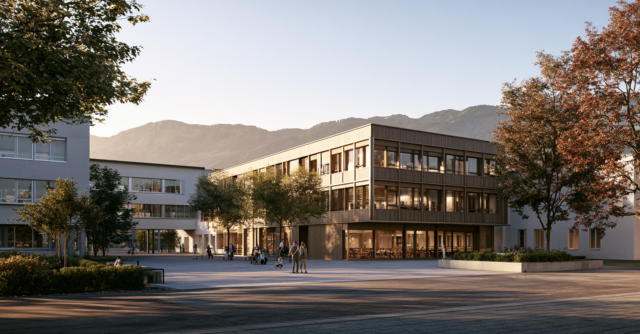
    The Fröschmatt School is Pratteln’s central secondary school and is currently undergoing a transformation. Due to a significant increase in student numbers and long-overdue renovations, it is becoming one of the largest and most modern school facilities in the canton of Basel-Landschaft. With an investment volume of just under CHF 119 million, a sustainable new building for around 36 classes and state-of-the-art educational requirements is being constructed on the existing site. The open competition was won by the winning design “Lungo” by Burckhardt Architekten AG, which integrates the school complex optimally into its park-like surroundings.

    Innovative architecture and flexible use
    The building ensemble is clearly structured. At the centre of the plot, the school building creates space for learning, meeting and development. The gyms, located in the north-east, including an all-weather area on the roof, are being built as separate pavilions. State-of-the-art hybrid timber construction and flexibly designed interiors meet the requirements for sustainability and future viability. Surrounding balconies provide protection from the sun and become lively terraces.

    Planning with the region in mind
    The schedule is ambitious. Construction of the main building will begin in 2026, with occupancy scheduled for 2029. The gyms will be completed by 2031. In the meantime, lessons will continue uninterrupted thanks to a specially constructed, sustainable temporary facility on the Hexmattwiese and in parts of the old building. The entire complex not only promotes contemporary teaching, but also enhances the attractiveness of Pratteln as a location and its development prospects.

  • New high-rise project boosts housing supply near the station

    New high-rise project boosts housing supply near the station

    Pensimo Management AG, based in Zurich, has acquired a building site from ABB in Oerlikon through its investment foundations Turidomusand Pensimo. According to a press release, the company plans to build a complex with 500 apartments, including a high-rise building and commercial premises, on the north side of Oerlikon railway station on the newly designed Max-Frisch-Platz.

    “We are very pleased with the acquisition of this property,” said Stefanie Krautzig, transaction manager at Pensimo, in the press release. “This is a very rare investment opportunity for a development project of this size in such a central location.” The building regulations for Neu-Oerlikon, which were partially revised in 2022, provide a good basis for planning and developing the area. “In order to evaluate an architectural solution for this central and prominent location that is attractive to the public and future residents, we will launch a competition among teams of planners,” said Krautzig.

    Construction is expected to begin in 2029. The seller, ABB, is also pleased with the sale of the former industrial site and is convinced that “this will contribute to the further development of Zurich Oerlikon into a lively and diverse neighbourhood,” said Nora Teuwsen, Chair of the Executive Board of ABB Switzerland.

  • New headquarters combines industrial history with modern architecture

    New headquarters combines industrial history with modern architecture

    Electrification and automation group ABBis planning a new global headquarters in Zurich Oerlikon, according to a press release. The 80 million Swiss franc project reflects the history of the company and the city of Zurich and will create a modern workplace for around 500 employees.

    The location chosen is the historic ABB building, which will be renovated and modernised in accordance with heritage protection requirements. The historic building will be complemented by a six-storey new building in the inner courtyard, replacing the Chicago Hall event venue, which is not listed.  The new building will have a brick façade in keeping with the existing architecture and will be constructed using a material-efficient wood composite construction method. Supported by ABB technologies and photovoltaic systems, low energy consumption is to be achieved. The new headquarters covers a total area of around 10,800 square metres. Plans include a 280-square-metre lobby with exhibition space and a 450-square-metre media area.

    For Morten Wierod, CEO of ABB, the choice of location is a commitment to Switzerland and the city of Zurich, “where our global headquarters have been located since the merger of BBC and Asea in 1988. One of our predecessor companies – Maschinenfabrik Oerlikon (MFO) – was also based here for many decades. The combination of a historic building and state-of-the-art facilities will create an inspiring environment for cooperation and innovation.”

    Detailed plans for the new headquarters are expected in 2026/2027. The building is scheduled to be completed and ready for occupancy by 2031. Until then, ABB will remain in the Cityport building in Zurich Oerlikon.