Category: New construction

  • Start of construction for double track expansion in Dietikon postponed to 2028

    Start of construction for double track expansion in Dietikon postponed to 2028

    There is a delay in the double-track expansion of the Bremgarten-Dietikon railway and the renovation of Bremgartnerstrasse. According to a statement by Aargau Verkehr AG, the building permit from the Federal Office of Transport (FOT), which was scheduled for the end of 2025, could not be granted due to ongoing appeal negotiations and a renewed partial suspension of the project in connection with compensation claims.

    The transport company now expects the start of construction, originally planned for summer 2026, to be postponed until summer 2028. Until then, a number of project adjustments will have to be made. This will require technical reviews and consultation with the authorities.

    According to Aargau Verkehr, the expansion is intended to increase the safety, punctuality and capacity of rail operations: “The construction of a centrally located double track will integrate the railway safely into road traffic, which will increase traffic safety and reduce traffic jams.”

    Planning approval is expected to be completed by the second quarter of 2027. Aargau Verkehr AG is in contact with the Civil Engineering Office of the Canton of Zurich, the client for the road construction project, the FOT, the city of Dietikon and affected residents to clarify outstanding issues and move the project forward.

  • New industrial building relies on modern energy and electrical engineering

    New industrial building relies on modern energy and electrical engineering

    Schlieremer Maneth Stiefel AG, with its branch in Pratteln, has taken on the project planning and construction of the electrical systems for a new high-bay warehouse at the Feldschlösschen brewery, according to a press release. The 30-metre-high building is to be constructed in the immediate vicinity of the motorway in Rheinfelden. Feldschlösschen AG, part of the Carlsberg Group, wants to use the new building to increase internal consolidation and create new storage space, the company reports.

    In addition to the lighting, low-voltage and low-current systems, Maneth Stiefel will also install the network infrastructure, including transformer stations and main distribution systems in the medium-voltage range, emergency and safety systems, and a photovoltaic system.

    Both companies emphasise that the new building represents a milestone in the development of the Rheinfelden site. Feldschlösschen is the largest employer in the town. The construction measures were planned in close consultation with the local population and will also be implemented with monument protection in mind. Feldschlösschen will celebrate its 150th anniversary in 2026.

  • New double-track line relieves congestion on the route between Zurich and Winterthur

    New double-track line relieves congestion on the route between Zurich and Winterthur

    SBB has commissioned a consortium consisting of the construction companies Implenia from Opfikon and Marti from Zurich to build a new double-track line. As part of the Zurich-Winterthur multi-track project, the Swiss Confederation and SBB are planning to build a new line and expand the stations in Dietlikon, Bassersdorf, Wallisellen and Winterthur Töss. According to a statement, Implenia and Marti will each take on 50 per cent of the construction of five of the six lots in the project. The total contract is worth around CHF 1.7 billion, with Implenia’s share amounting to around CHF 830 million. The project is expected to take around ten years to complete.

    As part of the project, Implenia and Marti will take on the construction of the Brüttener Tunnel (lot 240), the Winterthur section (lots 140 and 141), the Dietlikon section (lot 340) and the Wallisellen section (lot 540). The new double-track line through the Brüttener Tunnel is intended to eliminate the 8.3-kilometre capacity bottleneck in the rail network between Zurich and Winterthur. Part of the bottleneck is a branch line towards Zurich Airport. The underground double-track expansion will involve the construction of a single-track tunnel with a diameter of around ten metres for each direction of travel.

    According to the announcement, the infrastructure project is geared towards the mobility needs of future generations and is therefore in line with Implenia’s strategy. “We are delighted that Implenia, together with our consortium partner Marti, will be able to contribute our many years of experience and comprehensive expertise in infrastructure construction to make this important section fit for increasing frequencies and future requirements,” said Implenia CEO Jens Vollmar in the press release.

  • Zimmerberg region consolidates wastewater treatment in new plant

    Zimmerberg region consolidates wastewater treatment in new plant

    STRABAG AG is involved in the Zimmerberg wastewater treatment plant (WWTP) project. The Schlieren-based construction company is erecting the shell of the new Scheller pumping station in Horgen on the former Gasi site. According to a statement, the aim of this work is to replace the existing WWTPs in Horgen and Thalwil with a new plant.

    Both existing wastewater treatment plants are “getting on in years”. Instead of operating both pumping stations individually, which would involve high investment costs for comprehensive modernisation, both municipalities have decided to join forces and create a “joint, modern wastewater treatment plant” for the Zimmerberg region. Once the joint treatment plant is operational, the existing Horgen wastewater treatment plant will be dismantled. The resulting unused land on the lake shore will be made available for public use and urban development.

    The participating municipalities of Horgen, Oberrieden, Rüschlikon and Thalwil already joined forces in September 2020 to form the ARA Zimmerberg special-purpose association. ARA Zimmerberg expects that from 2029 onwards, it will be able to treat the wastewater of up to 78,000 residents and industry in the Zimmerberg region.

  • Modern hall solution supports specialised recycling processes

    Modern hall solution supports specialised recycling processes

    Bieri Tenta AG, a manufacturer of fabric solutions based in Grosswangen, has announced the successful completion of a warehouse project at its Susten site. The client was BOWA Recycling AG, a subsidiary of Theler AG from Raron VS that specialises in recycling contaminated soil. According to the press release, the warehouse is optimally designed to meet the requirements of modern recycling operations and is already the second project in which the companies have collaborated. In 2019, Bieri had already built a 2,700 square metre hall for BOWA Recycling AG.

    The warehouse in Susten is a gabled hall with a floor space of just under 3,000 square metres. The warehouse is equipped with six Bieri roller doors (5 x 5 metres) and six escape doors, which guarantee smooth operations and a high level of safety in everyday use. During the six-week installation process, Bieri used a mobile crane to lift the steel parts, which weighed up to 13 tonnes, to their destination. A 59 x 61 metre film weighing around 3.6 tonnes serves as the roof and covering for the membrane hall. The membrane is suitable for the installation of a photovoltaic system, allowing customers to generate sustainable energy directly on site.

    The client, BOWA Recycling AG, is a subsidiary of Theler AG and operates a soil washing plant in Leuk-Susten, but has also been operating a thermal treatment plant since 2024. According to its own information, the company achieves recycling rates of up to 99 per cent for contaminated soil material.

    The Bieri Group is a manufacturer of technical textile solutions for industries such as manufacturing, construction, transport, architecture and events. The company is divided into Bieri Tenta AG in Grosswangen and Bieri Zeltaplan GmbH, based in Leipzig, Germany.

  • Basel region calls for rapid implementation of cross-city rail link

    Basel region calls for rapid implementation of cross-city rail link

    The underground rail link between the SBB railway station and Badischer Bahnhof in Basel is essential for the expansion of the S-Bahn in the border triangle. This is stated in a declaration by the cantons of Basel-Stadt and Basel-Landschaft and the Basel Chamber of Commerce (HKBB). They are calling for the rapid implementation of this so-called cross-city line, which will make the current turning movements of trains in both stations superfluous. In return, they see potential for reductions in further rail expansion in Basel.

    The two cantons and the Chamber of Commerce refer specifically to Ulrich Weidmann, who described the new connection as undisputed and absolutely necessary for the S-Bahn system. The professor at the Swiss Federal Institute of Technology Zurich had prepared the Transport 2045 report. On the basis of this report, the Federal Council decided in October to deprioritise the Basel SBB underground station and the cross-city line.

    “The cross-city link represents a quantum leap in suburban rail services for the region,” said Esther Keller, member of the cantonal government, in the press release. “In our view, it can be realised within the next 20 to 30 years,” said the head of Basel’s Department of Construction and Transport.

    Martin Dätwyler points out the importance of eliminating bottlenecks on the roads. “With the rapid implementation of the diameter line, we will be able to make both modes of transport – road and rail – fit for the future,” the HKBB director is quoted as saying. “This will not only strengthen the Basel economic region, but also the Swiss economy as a whole, and is essential for the country’s supply.”

    Government Councillor Isaac Reber also emphasises the importance for the whole country. “The region is the gateway to Switzerland,” says the head of the Basel-Landschaft Department of Construction and Environmental Protection. “Without the construction of the cross-city link, the region will become a bottleneck. We cannot afford that – and neither can Switzerland.”

  • New cable car technology strengthens sustainable mobility in metropolitan areas

    New cable car technology strengthens sustainable mobility in metropolitan areas

    The Câble C1 urban cable car system has been in operation in the south of Paris since 13 December, using ropes and a magnetic induction monitoring system from Fatzer AG in Romanshorn. Fatzer claims to be the global market leader in the field of transport ropes and is part of the Brugg Group based in Brugg. According to a press release, the new railway is the longest urban cable car in France. In the densely populated Val-de-Marne department, which is part of the Paris metropolitan area, it is intended to relieve the public bus and metro system and reduce individual traffic. The project was realised by Doppelmayr France, a subsidiary of the Doppelmayr ropeway technology group based in Wolfurt, Austria.

    According to Fatzer, the cable car serves a 4.5 kilometre route with five stations and a journey time of 18 minutes, connecting the suburb of Créteil with the municipalities of Limeil-Brévannes, Valenton and Villeneuve-Saint-Georges. A total of 105 cabins travel over 30 supports with the help of three rope loops. Fatzer supplied three ropes with a total weight of around 90 tonnes for this project. The Performa DT rope type was used, which Fatzer developed especially for use in densely populated areas and high loads. It is characterised in particular by its long service life and quiet, smooth running.

    The rope condition is monitored using the Fatzer TRUscan solution to ensure that the operating times of 18 to 19 hours a day can be reliably guaranteed without interruption. According to the company, magneto-inductive measurements provide those responsible with real-time data. Irregularities are detected immediately, making maintenance work easier to plan.

    It is stated that the Performa-DT rope is already being used in numerous highly frequented urban installations, including in La Paz in Bolivia, Medellín in Colombia, Guayaquil in Ecuador, La Réunion and Ajaccio in France, Mexico City and, soon, Uruapan in Mexico.

  • New logistics hall increases efficiency in the national distribution network

    New logistics hall increases efficiency in the national distribution network

    Senn AG from Oftringen, which specializes in extensions, new buildings and special constructions, is building a new steel warehouse for the Migros distribution company(MVB) in Suhr. According to a press release, the new building covers an area of 7500 square meters, is more than 100 meters long and 15.5 meters high. At the heart of the modernization is a fully automated storage system, which will increase capacity and make logistics more efficient.

    A total of 1100 different components were required, which was logistically demanding and a challenge for assembly due to limited space for temporary storage. According to Senn AG, most of the assembly work was carried out using the company’s own mobile crane and two construction site cranes.

    According to the press release, the supporting structure is made of white-coated steel. a total of 530 tons of steel were used. According to the company, Senn AG processes 7,000 tons of steel and aluminium annually at its headquarters and is active in steel and metal construction, sheet metal and stainless steel centers, emergency power systems, mobile crane operations and other transport solutions.

    Construction work has been underway since the end of June. Around three quarters of the hall has been assembled and the final parts of the hall are currently being coated in the workshop and prepared for transportation. The project should be completed before the end of December.

    The realization of the warehouse is important for Migros’ supply network. As MVB writes, the retail group operates one of two national distribution centers in Suhr. The first was built more than 50 years ago in Neuendorf SO, and another site was built in Suhr more than 25 years ago.

  • Polysportive lighthouse project takes shape

    Polysportive lighthouse project takes shape

    After many years of planning, construction has now begun. A large polysport complex is being built on the Dürrbach site for around CHF 65 million, realized by HRS Real Estate AG as total contractor. The new building is set to open in fall 2026 and will mark a new sporting focal point in the Glattal.

    Over 30 sports under one roof
    The project is being supported by Zurich Tennis and the Zurich Gymnastics Association, which together unite almost 100,000 sports enthusiasts in the region. The plans include modern halls for tennis and gymnastics, specialized training areas and space for numerous other indoor sports. The offer will be complemented by sports infrastructure, overnight accommodation and facilities for sports medicine and regeneration. The sports center is designed for year-round operation of popular and elite sports.

    Campus for sport and training
    The new sports center will also be home to the Zürcher Oberland Art and Sports School. This will create a campus that combines training, school and talent development in terms of space and content. Young athletes will find ideal conditions on site to combine sporting ambitions and training.

    Beny Ruhstaller strengthens strategic management
    Beny Ruhstaller recently joined the Board of Directors of Sportzentrum Dürrbach AG. He is not joining primarily as a construction specialist, but as an expert in the world of gymnastics. Thanks to his previous activities for the Zurich and Swiss Gymnastics Associations, he brings many years of association experience, a broad network in gymnastics and tennis and a keen sense of the needs of athletes. This strengthens his ambition to develop the Zurich Sports Center into a forward-looking platform for sport, training and exercise in the region.

  • Timber construction sets new standard for cantonal buildings

    Timber construction sets new standard for cantonal buildings

    Architect Markus Schietsch has received a silver Hase Architecture Prize from “Hochparterre” for his new construction of the cantonal AVS building in Unterentfelden. The prize was awarded on December 2 at the Zurich Museum of Design. It recognizes the architectural quality of the building and the consistent implementation of sustainable construction methods.

    The new building with its laboratory and office workstations for currently 80 employees was officially opened on October 25, 2024 after two and a half years of construction. The construction work was planned and carried out by Immobilien Aargau.

    “The award confirms the path we have taken,” said Cantonal Councillor Dr. Markus Dieth in a press release. “The canton of Aargau invests in sustainable, economical and high-quality buildings that also take cost-efficient construction into account. I would like to congratulate Markus Schietsch and the Aargau Real Estate Department on this success.”

    According to Schietsch, this award shows “that careful planning, a clear architectural approach and the courage to use sustainable materials such as wood are more in demand today than ever before”. Head of office and cantonal chemist Dr. Alda Breitenmoser emphasizes that the new building offers “optimal working conditions” for consumer protection: “The architecture supports our work processes, creates a pleasant indoor climate and shows that modern administration can be ecological and functional at the same time.”

    At the beginning of November 2025, the new AVS headquarters received an award from the Pro Holz Aargau wood network for its timber construction.

  • Future area in the north of Basel creates living and working space

    Future area in the north of Basel creates living and working space

    The Klybeck site in the border triangle of Basel is to become a modern neighbourhood on the banks of the Rhine. According to a press release, the planning partners Canton Basel-Stadt, Swiss Life and Rhystadt have initiated the klybeckplus indicative project, which forms the basis for the utilisation planning.

    The approximately 30-hectare site is to become a mixed neighbourhood with residential complexes, commercial buildings and parks. The aim is to create living space for 8,500 people. According to the plans, a third of the flats will be made available to the public for rent at cost. In addition, 7500 jobs are to be created. The two owners, Swiss Life and Rhystadt, will invest 3 billion Swiss francs in the renovations, according to the press release.

    “The finalised indicative project, as it is now available, offers a good basis for realising the enormous potential of the site and creating significant and, above all, long-term added value for the population and the entire region,” Christian Mutschler from Rhystadt is quoted as saying in the press release. Jürgen Friedrichs from Swiss Life adds: “The indicative project shows how the diverse objectives from residential to open space can be combined while at the same time ensuring structural, spatial planning and economic feasibility.” District President Conradin Cramer is convinced that the project will create an “attractive new part of the city for the well-being of the population”.

  • Circular building with reeds

    Circular building with reeds

    The residential building by Marina Rosa and Jacobus van Hoorne, designed by Gilbert Berthold, architect and research assistant at BFH, deliberately stands out in a single-family housing estate on Lake Neusiedl. It combines a consistent timber construction with a striking thatched roof and thus relies on local, renewable raw materials with a low ecological footprint. The numerous awards, from the client prize of the Central Association of Austrian Architects to the architecture prize of the province of Burgenland and the newcomer prize “House of the Year”, underline the exemplary character of the project.

    Reeds as a high-performance building material
    Jacobus van Hoorne, originally a particle physicist at CERN, took over his father’s reed cutting and thatching business and developed it into an innovation laboratory. Together with Berthold, he developed a roof structure that met strict fire protection requirements and was officially approved through real fire tests. A milestone for reed in new buildings, even in densely populated areas. The gently curved roof surfaces follow the material logic. Each additional degree of inclination extends the service life of the roof, the construction makes the qualities of the natural material visible and legible.

    Geometry, material and space as a unit
    The floor plan of the house follows an S-shape resulting from the rotation of the central living space. At its heart is a two-storey, light-flooded atrium that opens onto the garden and is closely linked to the outside space via terraces. Compactly organized functional spaces create scope for spacious recreation areas. The interplay between the thatched roof and the natural oak façade connects the building and the landscape. The roof becomes a design-defining element and a contemporary interpretation of traditional craftsmanship.

    Real-life laboratory for bio-based materials
    For Gilbert Berthold, the project marked the start of his self-employment and at the same time a real testing ground for sustainable construction. Today, the house serves as a home, study object and exhibition space all in one. It provides data on energy efficiency, indoor climate and the long-term behavior of bio-based building materials. In the context of the BFH, it fits in with research into plant-based materials such as straw, flax, hemp and mycelium and shows that reeds can be used not only as an insulating material, but also in a leading architectural role.

    Symbol of a regenerative building culture
    The project illustrates how circular building with regional resources can already be implemented today. It shows students and professionals that regenerative architecture is not a vision of the future, but a built reality. With reeds as a strong symbol for a building culture that rethinks nature, technology and society.

  • Award for sustainable hospital construction

    Award for sustainable hospital construction

    Baden Cantonal Hospital(KSB) has been honored at the World Architecture Festival in Miami, Florida. The architecture of the new KSB building won a prize in the Health category, according to a press release. The World Architecture Festival was held from November 12 to 14.

    At the event at the Miami Beach Convention Center, 160 international jurors voted on 460 projects. The hospital building realized by Nickl & Partner Architekten Schweiz and other planning partners was recognized for its clear design language, sustainable construction and consistent focus on a healing environment for patients, according to the press release. “This award is an impressive confirmation of our vision: to build a hospital that combines medical excellence and efficient operation with state-of-the-art architecture,” said Pascal Cotrotzo, CEO of KSB. “We are proud that our new building in Miami has received international recognition. Our thanks go to everyone who made this major project possible.”

    KSB already received the European Healthcare Design Award in London in June 2025. In order to show off the entire new building to its full advantage, a green space will be built on the site of the old hospital to connect it to the city. The KSB refers to a complaint by the Aargau Heritage Society against the demolition of the old building and a petition with 7,000 signatures against this complaint.

  • Education cluster Polyfeld Muttenz

    Education cluster Polyfeld Muttenz

    The canton of Basel-Landschaft is combining the BBZ BL, the Muttenz grammar school and the Zentrum für Brückenangebote into a joint secondary II campus at Polyfeld. Stage 1 focuses on the dismantling and conversion of the existing tower, which has been gutted from top to bottom, decontaminated and completely dismantled in the core area. The core walls, staircases, floor slab and foundations were removed in a controlled manner over an area of around 20 by 20 meters.

    To ensure that the slender tower remained stable during the conversion and new construction, temporary bracing with heavy steel frames was installed on each floor. At the same time, the new construction of the building core and the construction of the new main staircase, which is to become a design center of the BBZ as a freely suspended prefabricated construction in exposed concrete, began.

    Exposed concrete, workshop building and triple sports hall
    All new buildings in stage 1 will be constructed in high-quality exposed concrete, with a project-specific formwork and concreting concept for uniform surfaces. The workshop building, which is around 55 meters long and 26 meters wide, is being built in three stages so that walls, columns, earthquake walls and ceilings can be constructed in parallel on each floor.

    The new triple sports hall will have a complex supporting structure made of pre-stressed prestressed concrete beams, which will be assembled in stages, provisionally supported and pre-stressed after the ceiling has been concreted. This allows the hall to be flexibly divided into three smaller units at a later date. An external spiral staircase with specially developed formwork provides an architectural accent. The adjoining assembly hall and canteen is a prefabricated construction, combining exposed concrete with a composite timber ceiling and functionally linking the different parts of the building.

    Life science training building in the Polyfeld
    Parallel to the cantonal campus project, the Polyfeld is being given an additional focus with a new life science training center. The Basel district council has approved a contribution of around two million francs for this. Around CHF 1.7 million for the construction of the new training location at Birsfelderstrasse 46 and around CHF 390,000 for special laboratory equipment. The new building will have a net floor area of around 19,500 square meters. Cantonal funding will be provided for an eligible floor space of around 1,400 square meters.

    The project is sponsored by the Aprentas training association, which intends to combine its existing locations on Lachmattstrasse and in Schweizerhalle in the new building. Aprentas, which originally emerged from the Novartis environment, offers inter-company courses for EFZ training in chemistry, biology and chemical and pharmaceutical technology. The cantonal funding strengthens Muttenz as a life science training location and complements the Polyfeld secondary school campus with a clearly profiled, practice-oriented training infrastructure for regional industry.

  • New urban quarter at Winterthur railroad station

    New urban quarter at Winterthur railroad station

    The Stellwerk 2 project is being built on a site of just 2,000 square meters right next to the train station, combining living, working and mobility in a small space. The new building comprises 66 city apartments and around 2,000 square meters of space for offices, education and healthcare. On the first floor, a spacious retail zone of 700 square meters will provide for public-oriented uses. The aim is to make optimum use of existing railroad land without additional sealing.

    Compact units with one to three and a half rooms will be created on the upper floors. Guest rooms and communal areas promote flexible forms of living and social interaction. An approach that responds to changing urban lifestyles. The project was developed by Zurich-based Esch Sintzel Architekten, which won the 2021 SBB competition in close cooperation with the city.

    Hub for two-wheelers and everyday life
    Stellwerk 2 is being built not only to live and work in, but also to facilitate movement. In the basement, 360 new bicycle parking spaces are being created with charging facilities for e-bikes, cargo bike zones and lockers. Together with 150 recently created spaces in the existing building, the capacity of the neighboring bike station will increase to around 510 units. The new building will be connected to the existing facility under Signal Box 1 via a new passageway.

    For city councillor Christa Meier, the project is emblematic of the transformation to a mobility city: the signal box will become Winterthur’s actual bicycle hub and strengthen the station’s role as a multimodal center.

    Realization in stages
    With Stellwerk 2, SBB Immobilien and the city of Winterthur are demonstrating how urban densification and the traffic turnaround can go hand in hand. A place where living, working and sustainable mobility merge into a new urban entity.

  • New ground-breaking ceremony in Bergdietikon

    New ground-breaking ceremony in Bergdietikon

    The ground-breaking ceremony for the Hintermatt retirement and care centre, the Oase, took place on 5 November, as reported by the municipality of Bergdietikon in a press release. On completion in summer 2028, the retirement centre in Bergdietikon will be able to provide 66 flats for senior citizens and 44 care places.

    The project was approved by the municipal assembly back in 2012 and the sale of the land was also authorised. However, this was followed by 13 years of planning and legal disputes. The ground-breaking ceremony is a “decisive moment” in the realisation of the project, which is now “finally being implemented after a long phase of objections and legal disputes”, according to the municipality of Bergdietikon.

    The project is particularly important for the municipality in that it not only meets the needs of the elderly population. The local infrastructure is also to be enriched by publicly accessible facilities.

  • Tenero Swimming Centre

    Tenero Swimming Centre

    The days of the old swimming facilities at the CST youth and competitive sports centre are over. The needs of young and elite aquatics athletes are constantly increasing. With the CHF 91.8 million investment approved by the Federal Assembly in 2021, Switzerland is setting an example for top-level promotion and sustainable development. The new replacement building will raise the CST to a new level as a central centre of excellence for swimming, artistic swimming, water polo, water jumping and ski freestyle.

    Modern concept
    Simply renovating the outdated facilities proved to be uneconomical and not future-proof. The planning therefore favours a complete new build in two construction phases. Firstly, a multifunctional indoor swimming pool will be built, which will define new training standards with an Olympic pool including a lifting floor, whirlpools, ice bath and comprehensive diagnostics area. This will be followed by the renovation of the outdoor facilities, including a modern training pool and landing area for freestyle skiing. Completion is scheduled for 2029, until then operations for athletes will be secured.

    Focus on sustainable and versatile infrastructure
    The Federal Office for Buildings and Logistics attaches great importance to sustainability in construction. The swimming centre is being built in accordance with SNBS and MINERGIE-ECO guidelines, optimised for life cycle costs and energy efficiency. The architecture by Studio Burkhardt and Stücheli Pestalozzi Schiratzki is characterised by its transparency, spaciousness and integration into the park landscape. Art and material aesthetics are also part of the new building, as a sensitive art-in-building concept creates identity for the location.

    A milestone for Swiss sport and the region
    With the laying of the foundation stone and prominent guests such as Olympic medallist Noè Ponti, the project promises not only international training standards, but also innovative event and training opportunities in water sports. The CST remains a pioneer in the promotion of young talent and will become a hub for cross-generational sports development in Switzerland.

  • A new research centre strengthens the Basel site.

    A new research centre strengthens the Basel site.

    Roche is embarking on the construction of a new 15-storey research and development centre at its headquarters in Basel. The foundation stone for the centre, which is specifically designed for the early phases of drug development, was laid on 29 October, the global pharmaceutical company announced in a press release. In Building 12, which will cost around 500 million Swiss francs, Roche intends to consolidate functions of the research and development department that are currently spread across the site. Work on the 72-metre-high building is due to be completed in the fourth quarter of 2029.

    “Building 12 is an essential part of our long-term vision for the Basel site,” said Jürg Erismann, Site Head Roche Basel/Kaiseraugst, in the press release. “The investment of 500 million Swiss francs is a clear commitment to Basel and underlines Roche’s long-term commitment to the research location and to Switzerland.” According to the press release, Roche has invested around 8 billion francs in its Swiss sites since 2015. A further 33 billion francs have been invested in research and development in Switzerland.

  • New residential neighbourhood brings dynamism to Spreitenbach

    New residential neighbourhood brings dynamism to Spreitenbach

    The Tivoli Garten neighbourhood is revitalising the municipality of Spreitenbach, according to a press release. People have been able to move in there since mid-July and by mid-September more than 500 residents had already taken advantage of this, according to the municipality, citing figures from the residents’ services.

    The largest group are the 226 people (45 per cent) who have moved to Tivoli Garten from the canton of Zurich. This is followed by 121 people (24 per cent) from the canton of Aargau, 89 people (18 per cent) who have moved within Spreitenbach, 49 people (10 per cent) from other cantons and 22 people (4 per cent) who have moved to Tivoli Garten from abroad.

    Tivoli Garten offers a total of 445 rental flats (1.5 to 5.5 rooms) and small commercial spaces on an area of 15,000 square metres. A communal garden with a playground serves as a meeting place for the residents.

  • Future neighbourhood with residential and commercial space in Döttingen

    Future neighbourhood with residential and commercial space in Döttingen

    The results of the study contract for the Gewerbestrasse site development in Döttingen will be exhibited in Döttingen on 18 and 19 October. The winning entry was submitted by fsp Architekten from Spreitenbach, together with LAND Suisse from Lugano and ASTOC Architects and Planners from Cologne. In the DOT project, a new neighbourhood is being created on the Birchmeier Hess Immobilien site. An area of 75,000 square metres will be home to 550 flats, while 15,000 square metres are earmarked for commercial use, as detailed in a press release.

    “With the transformation of the site, industry will become a neighbourhood. Halls become home, traces become identity. The industrial heritage is being transformed – sustainable, future-proof, mixed,” says Ivo Lenherr from fsp Architekten about the DOT project. The jury’s unanimous vote in favour of the winning project was based, among other things, on the “sophisticated urban planning strategy in dealing with the specifications of the landowner, the current building stock and the approved structure plan”. The project represents “a considerate approach to the neighbourhood and public needs and promises a harmonious and rich living and working environment for future users.”

  • New residential ensemble characterises Winterthur’s urban space

    New residential ensemble characterises Winterthur’s urban space

    Cham Swiss Properties is planning an urban ensemble with the construction of the Rocket high-rise and the three Tigerli residential buildings in Winterthur’s Lokstadt. Rocket & Tigerli, as the property company is calling the construction project, will offer space for 300 rental flats in future, 30 per cent of which will be in the affordable segment, according to a press release. The ensemble with the 100-metre high-rise building will therefore not only shape the Winterthur skyline, but also alleviate the city’s housing shortage.

    A building permit was already granted by the city of Winterthur in April 2025, albeit with several conditions. For example, the city demanded that the planned hotel use in the “Rocket” be abandoned in favour of the construction of rental flats. As a result of the revision, the construction company is now planning 5,000 square metres of extra living space and is dedicating the ground floor to publicly accessible retail and restaurant space instead of a hotel check-in. The top floor will also be converted with a viewing room and an area for events and catering.

    despite the challenges posed by the conversion, the architect is confident:

    “A public zone in a residential building brings challenges in terms of privacy and security. But we are confident that we will be able to implement a good solution so that the entire population can enjoy the view from a height of 100 metres,” Thomas Aebischer, CEO of Cham Swiss Properties, is quoted as saying in the press release.

    The sustainability concept of the high-rise building has also been improved: instead of a timber hybrid construction, Rocket will now be realised with CO2-equivalent alternatives that offer advantages in terms of cost-effectiveness, plannability and material availability. Certification according to the SNBS Gold standard remains planned.

    The building permit is expected to become legally binding in 2026, with construction scheduled to begin in mid-2027. Completion is expected in 2030.

  • Residential development in Wädenswil reaches important milestone

    Residential development in Wädenswil reaches important milestone

    Halter AG has reached an important milestone in the AuPark project in Wädenswil, the Schlieren-based property developer announced in a post on LinkedIn. Specifically, the first stage of the development was handed over to the client Swiss Life Asset Managers on schedule. The second stage should be completed by 30 March next year.

    In the AuPark project, five apartment blocks and commercial buildings with a total of 300 flats are being built around the eponymous central AuPark. The client, Swiss Life Asset Managers, is having some of the flats built as affordable housing. The first 120 flats are now available to their new residents with the completion of the first phase. A number of commercial spaces were also completed in the first phase. Coop will be setting up a branch on one of them.

  • New travel terminal strengthens Frauenfeld site

    New travel terminal strengthens Frauenfeld site

    The Twerenbold Reisen Group is having a new travel terminal built in Frauenfeld. In addition to the coach travel terminal with travel lounge and café, the new location will also house the employees of the Mittelthurgau travel agency of Excellence Cruises, the family-run company from Baden announced in a press release. “This will make our range of coach, music and bike tours with Twerenbold Reisen, boat trips with Excellence Cruises and hiking holidays with Imbach Reisen even more accessible,” Karim Twerenbold, Chairman of the Board of Directors of the Twerenbold Reisen Group and fourth-generation owner, is quoted as saying. “The terminal and office building in Frauenfeld will create an additional hub alongside the company headquarters in Baden-Rütihof.”

    Twerenbold Reisen has entrusted Strut Architekten AG with the planning of the new building. The Winterthur-based architecture firm specialises in sustainable construction. “Out of conviction”, Strut Architektur has therefore minimised the use of underground structures associated with high concrete consumption in the new travel terminal, according to the press release.

    The new building in Frauenfeld will also be air-conditioned using air-to-heat pumps. A photovoltaic system that can generate up to 120 megawatt hours of electricity per year is also planned. The water consumption of the bus wash will be largely covered by rainwater, which will be collected in a cistern.

    The city of Frauenfeld has already granted planning permission for the new travel terminal. Construction work is scheduled to begin in the first half of 2026 and be completed in 2028. No details of the investment volume are provided in the press release.

  • Development site at Zofingen railway station gains a new perspective

    Development site at Zofingen railway station gains a new perspective

    Pensimo has acquired the western part of the former Swissprinter site near Zofingen railway station through its Turidomus real estate investment foundation. The 27,636 square metres of land was owned by Ringier Areal AG. Together with the town of Zofingen and the Basel-based architectural firm Christ & Gantenbein, Ringier Areal AG had developed a strategy for converting the site into a mixed residential and working neighbourhood and was looking for an investor.

    According to a press release issued by Pensimo, a study contract will be launched next year to clarify the urban planning ideas and sharpen up the housing offer. At present, over 300 flats are planned, which will be built from 2028 and could be ready for occupancy from 2030.

    Alexander Büchel, the portfolio manager responsible at Pensimo, describes the acquisition of this “unique and strategically ideal development site” as a special opportunity. “Zofingen has an attractive location quality, is a cantonal development centre and the micro-location of the site is excellent.”

    The five building plots of the Areal-West site are to have a diverse range of flats and be certified in accordance with the Swiss Sustainable Building Standard. “We want to build on the industrial past,” says Büchel, adding that the aim is to develop a “sustainable offering”.

    The Swissprinters printing plant, like Ringier Areal a joint subsidiary of Ringier and NZZ, was closed in September 2024. The entire site covers around 55,000 square metres in a central location. According to Ringier Areal AG, it is currently pressing ahead with a development project for the eastern part of the site with the historic main building.

  • Alte Mühle residential project reaches important milestone

    Alte Mühle residential project reaches important milestone

    Swica Health Organisation Ltd. is building a new neighbourhood with a total of 136 flats on the former Huggler site in Suhr. SWICA has entrusted Halter AG from Schlieren with the realisation of the Alte Mühle residential park project as total contractor. Around a year after the foundation stone was laid, the topping-out ceremony has now been celebrated on the building site, Halter announced in a post on LinkedIn.

    In the Alte Mühle residential park project, ten apartment blocks will be grouped around the Alte Mühle in a loose building structure. Halter explains in the project description that the mill itself can be renovated without the need for heritage protection. The three to five-storey buildings should be completed by the end of 2026. Around half of the rental flats and a large proportion of the owner-occupied flats have already been reserved.

  • Schadenmühle Ost project invites public participation

    Schadenmühle Ost project invites public participation

    A consortium of three private landowners and the city of Baden is planning to transform the Schadenmühle Ost site into a place for sustainable, dense and mixed-use living. The current use of the site, which consists of individual buildings, car parks and unused areas, does not meet today’s requirements or the current building and usage regulations, the consortium explains in a press release. The Schadenmühle Ost transformation project aims to create an urban area with around 100 flats, flexible commercial space, green areas and an underground car park.

    On 16 September, the consortium presented the project and its integration into the city’s urban development plans for Baden at an information event. This marked the start of a new phase for the flagship project, according to the press release: from 22 September to 21 October, interested parties can now submit comments and suggestions on or objections to the Schadenmühle Ost design plan. The consortium is providing detailed information on the project on an information portal.

    “We are rooted in Baden and it is important to us to make the Schadenmühle Ost site attractive for the city,” Beni Schmocker, one of the four landowners, is quoted as saying in the press release. “Involving the local population is a matter of course for the landowners.”

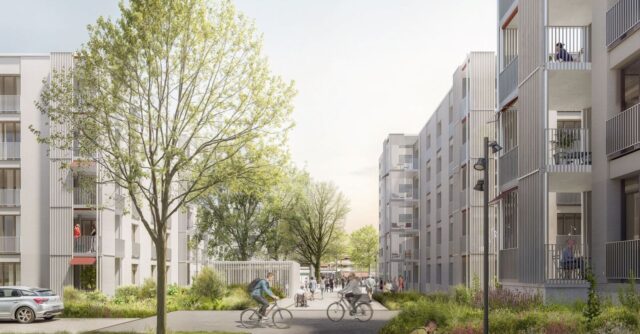
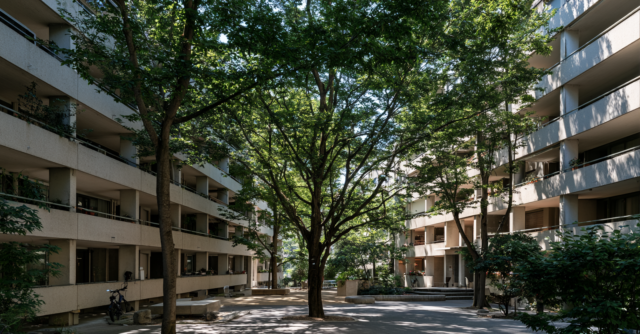
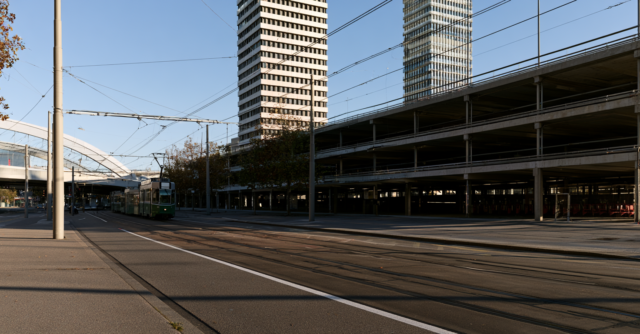
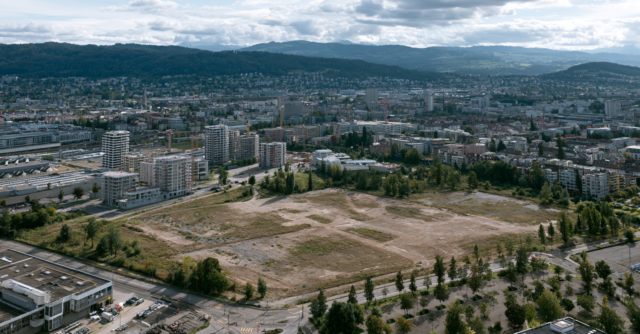
  • How the Wolf site in Basel is becoming a residential neighbourhood

    How the Wolf site in Basel is becoming a residential neighbourhood

    The relocation of freight handling to the harbour area freed up a 16-hectare site near Basel SBB station. SBB has been pursuing the vision of a mixed neighbourhood here for years, combining living, working and leisure. The urban development plan is based on a design by Christ & Gantenbein and EM2N. The central element is a large courtyard that stretches from east to west, shields against noise and links public and private uses as a green boulevard.

    Two faces “Janusproject
    The Paris-based firm Experience, together with M-AP Architects from Lausanne, won the competition for the MF02 construction site. Their “Janus” project responds to the contrasts between the railway side and the inner courtyard with two architectural languages.

    A horizontal ribbon façade with striking concrete frames stretches towards the track side, conveying a powerful image to passing trains. Towards the courtyard, a finely structured façade with staggered balconies and greenish decorated surfaces appears.
    The construction method follows a hybrid approach of concrete skeleton and timber construction. The floor plans are compactly organised, with a clear separation between bedrooms, wet rooms and spacious living areas. Only the lack of privacy in the ground-floor flats was criticised.

    Noise protection as a design element “Binariaproject
    The “Binaria” project by Basel-based ARGE Parabase and Confirm won the competition for the MF03 construction site. It counters the street noise with a robust north façade made of reused trapezoidal sheet metal and protruding acoustic elements. In contrast, a transparent, green glass façade with balconies and plant troughs opens up to the courtyard side.
    The multi-storey passageway connecting the courtyard and the street is particularly striking. The circular ventilation grille made of sound-absorbing panels makes a strong architectural statement here. Inside, linear floor plans allow for flexible living concepts from 2.5 to 5.5-room flats. Sustainability is characterised by reused beams, recycled concrete and re-used wood.

    Pilot character with high standards
    Both winning projects pursue innovative approaches to noise protection, the flexibility of the flat layouts and the use of recycled materials. The roofs are used for photovoltaics and rainwater management, the façades are partially planted or fitted with integrated solar technology. Energy is generated from renewable sources, while shading and evaporation provide thermal insulation in summer. Special attention is paid to reversible construction. Constructions are to be screwed together instead of glued in order to facilitate subsequent reutilisation or material cycles.

    Milestones and prospects
    The new buildings in the west of the site will be realised in the first stage, with construction scheduled to begin in 2028. A second stage with a city logistics hub and additional uses will follow from 2031. Even before completion, SBB will open the site for interim use. The listed 2,000 m² railway hall will be used for sports activities, for example. The Wolf site will thus become a pilot project for urban housing construction that answers questions about noise protection, sustainability and socially mixed housing on a large scale. For Basel, this is not just an urban planning experiment, but a decisive step towards more affordable living space and a higher quality of urban life.

  • Strategic milestone for Zofingen

    Strategic milestone for Zofingen

    The 27,636 square metre site near Zofingen railway station was home to the traditional Swissprinters print shop until 2024. Following its closure, Ringier Areal AG sold the western section to Turidomus, while the eastern section remains in Ringier’s ownership. In recent years, Ringier, together with the town of Zofingen and the Basel architectural firm Christ & Gantenbein, had already developed the strategic basis for the conversion. The development is now building on this.

    Diversity and sustainability in the centre
    The “Areal West” is a site of strategic importance. The location opposite the old town and directly behind the railway station offers ideal conditions for a new, urban residential district. Over 300 flats for different lifestyles and household sizes are to be built on five building plots. From compact flats to family flats.

    The project development is based on the Swiss Sustainable Building Standard. A climate-friendly neighbourhood square, green open spaces that reduce heat islands and photovoltaic systems are planned. District heating is also planned in order to keep the neighbourhood’s carbon footprint low from the outset.

    Study commission to specify
    A study commission is planned for 2026 to specify the urban integration and the specific design of the housing on offer. The aim is to create a lively neighbourhood that not only provides housing, but also creates a sense of community and identity. Depending on the process, construction could start from 2028, with first occupancy from 2030.

    Experience with transformations
    Reference projects such as the Ziegeleipark in Horw/Kriens, the Reitmen neighbourhood in Schlieren and Zwhatt in Regensdorf show that the Group understands complex transformation processes. With the “Areal West” in Zofingen, the group is continuing in this vein. The aim is to transform the industrial past into a future-proof, sustainable neighbourhood.

  • 170-metre tower sets the tone in the Quartier de l’Étoile

    170-metre tower sets the tone in the Quartier de l’Étoile

    Halter AG, based in Schlieren, and Fordinvest (Schweiz) Immobilien GmbH, based in Pfäffikon SZ, are realising the Tour de l’Étoile 3 in Geneva. According to a press release, the high-rise building will be located in the new Quartier de l’Étoile in Geneva and will offer more than 300 flats, spaces for public facilities, restaurants, shops and services as well as a top floor open to the public. With a height of 170 metres and an area of over 50,000 square metres, it is set to become an architectural landmark in Geneva.

    The background to the project is the Praille-Acacias-Vernets(PAV) spatial planning project in Geneva. As part of this project, nine new urban neighbourhoods with over 12,000 flats, 6,000 workplaces, public facilities and open and green spaces are to be built over an area of more than 140 hectares in the coming years. The signing of the planning agreement with the Fondation Praille-Acacias-Vernets and the Canton of Geneva has now paved the way for the development of two high-rise buildings.

    Together with the high-rise building planned by Rolex, Tour de l’Étoile 3 will form a central element of the PAV development project and contribute to the social and functional diversity of the l’Étoile neighbourhood. Fordinvest acquired the existing Tour de l’Étoile back in 2000 and initiated the development of the new tower block. Halter is assuming responsibility for the realisation of Tour de l’Étoile 3 as the overall provider. The company is also already present in the PAV project with one completed high-rise project and plans to build another in 2026.

  • Sport, sustainability and community under one roof

    Sport, sustainability and community under one roof

    The cycling team Tudor Pro Cycling is planning to relocate its headquarters from Schenkon to Sursee. According to a press release, construction of the new facility has now begun. The 10,000 square metre building is to be sustainably designed and will open in 2027. It is intended to support the team’s growth and redefine the standards of professional cycling. The project is supported by the municipal council and the authorities of the canton of Lucerne.

    The CHF 17 million facility was designed in collaboration with Goldbeck Rhomberg. It is to be built on Zeughausstrasse in Sursee and will provide a five-storey space where drivers, mechanics, trainers and employees can come together to prepare for upcoming races. A public area will also offer fans and supporters exclusive behind-the-scenes insights and interactive experiences.

    “Together with Goldbeck Rhomberg, we have developed a ground-breaking concept that not only fulfils the needs of a professional sports team, but also takes into account the expectations of fans and the local community,” explains Raphael Meyer, CEO of Tudor Pro Cycling, in the press release. “It also sets new standards in terms of environmental sustainability and has been awarded DGNB Gold certification– one of the highest standards that buildings can achieve.”

    Sursee and the canton of Lucerne have reportedly supported the team from the outset and made the project possible. “We are delighted that this new building, which is dedicated to sport and a healthy lifestyle, is taking shape here in our municipality,” said Sabine Beck-Pflugshaupt, Mayor of Sursee. “It is a place that will help Sursee to shine in Switzerland and beyond our borders.”