Category: Projects

  • Lucerne cantonal government plans to set up a foundation for innovation

    Lucerne cantonal government plans to set up a foundation for innovation

    The Canton of Lucerne intends to establish the Innovation Lucerne Foundation. To this end, the Cantonal Government has now submitted a request for a special grant to the Cantonal Council. This comprises CHF 1 million in endowment capital and CHF 23 million to fund the foundation’s activities between 2026 and 2029.

    This foundation forms part of Lucerne’s location strategy, which aims to strengthen the canton’s competitiveness. According to the statement, the background to this is that whilst the Canton of Lucerne ranks in the top third in national competitiveness rankings, it consistently ranks lower in terms of its innovative strength. And “without strengthening its innovative strength, the Canton of Lucerne risks further losses in competitiveness”, the analysis states.

    The foundation is intended to counteract this and focus on supporting Lucerne as a hub for innovation and start-ups, with a particular emphasis on SMEs. As a key player, it is to coordinate the established partner organisations “and ensure that their services are better integrated, become better known and achieve greater impact”. In addition, the foundation can co-fund implementation projects such as feasibility studies.

    From 2026, the Canton of Lucerne intends to invest a total of between 250 and 300 million Swiss francs annually in “business- and population-oriented measures” to promote the region. Voters will be able to vote on these regional development measures in September 2026.

  • Schlieren is modernising its maintenance depot

    Schlieren is modernising its maintenance depot

    Schlieren Town Council has allocated 2.229 million Swiss francs for the refurbishment and modernisation of its municipal works site. According to a statement from the City Council, the city’s growth and increasing demands on public services make modernisation necessary. Key parts of the facilities have become too old and need to be replaced in order to meet legal standards for fire safety and occupational safety. The modernisation will also prevent structural damage and ensure proper operation in the long term.

    The works yard site houses the waste collection, building services, gas and water supply, green space maintenance and administration departments of the Works, Supply and Facilities Division. Due to the city’s ongoing growth, it is necessary to create the conditions to meet increasing demands on public services.

    The plans include replacing the gas heating system with an environmentally friendly heat pump system and refurbishing the roof surfaces. To increase capacity, the storage areas in the green space maintenance, gas and water supply, cloakroom and staff lounge sections are to be expanded.

    Parts of the project will include the modernisation of the ventilation and summer heat protection in the administration building, as well as the expansion of the charging infrastructure for the city’s electric vehicle fleet, it is reported.

    The awarding of construction contracts by a building commission appointed by the city council has already begun. The municipal council will now decide on the installation of a high-performance photovoltaic system.

  • New police headquarters sets new standards for the workplace

    New police headquarters sets new standards for the workplace

    The construction group Implenia is building the new police headquarters in Münster, Germany, on behalf of the project company PPMS Immobilien GmbH & Co. KG, to accommodate more than 1,400 staff. According to a press release, the building will provide much-needed additional space for the police force, as well as a modern headquarters featuring short walking distances and attractive new-work concepts. The project is worth more than €200 million.

    As the main contractor, Implenia is responsible for the planning and construction of a functional and administrative building designed to bring together virtually all of Münster Police’s existing departments. The turnkey new building will include modern office and laboratory workspaces, a police station, a canteen, training areas, detention facilities and an underground car park.

    According to the press release, the project is in line with the strategic focus on “large, complex and specialised property projects”. In the words of Matthias Jacob, Head of the Buildings Division Germany, Implenia is focusing on “partnership-based contract models that allow us to make optimal use of our capabilities for the benefit of our clients and Implenia”.

    Construction work is scheduled to begin in summer 2026, following the early completion of the excavation, and is expected to last until October 2029.

  • Winter electricity from the Alps is performing above average

    Winter electricity from the Alps is performing above average

    The Madrisa Solar power plant generated around 1.5 gigawatt hours of electricity during the first winter half-year, from October to March. This means that production exceeded expectations, as Repower AG states in a press release. During its first winter of operation, around 3,600 solar modules were in operation, which corresponds to approximately 20 per cent of the planned total capacity.

    The plant, which was the first alpine solar power plant in Switzerland to feed electricity into the grid, is located above Klosters at around 2,000 metres above sea level and is specifically designed for winter electricity production. Following the first snowfall, output rose by around 15 per cent thanks to the so-called albedo effect. The bifacial modules also utilise light reflected from the snow cover.

    The electricity generated is used, amongst other things, directly to power the Klosters-Madrisa mountain railways. In combination with existing installations, more energy was produced during the first winter than was required to operate the winter season. With its output to date, Madrisa Solar has comfortably met the minimum production requirement of 500 kilowatt-hours per installed kilowatt of capacity stipulated under the national Solarexpress scheme.

    The second construction phase is scheduled to begin in early May. Once completed, around 70 per cent of the plant is expected to be connected to the grid. Full commissioning is planned for the end of 2027. The developer of the alpine plant is Madrisa Solar AG, in which Repower, the Zurich Cantonal Electricity Works (EKZ) and the municipality of Klosters hold stakes.

  • Railway station heating plant switched to wood pellets

    Railway station heating plant switched to wood pellets

    Industrielle Werke Basel(IWB) is making progress with the decarbonisation of district heating. According to a press release, they tested the two new boilers of the wood pellet plant at the Bahnhof heating plant in March. With an output of 30 megawatts, it is expected to generate around 95 gigawatt hours of district heating per year.

    The switch from natural gas to wood pellets will save around 23,000 tonnes of CO2 per year. This corresponds to a 9 per cent reduction in total CO2 emissions from district heating in Basel. “With the new wood pellet plant, IWB is making an important contribution to the decarbonisation of district heating and to achieving the net-zero target of the Canton of Basel-Stadt,” said Evelyn Rubli, Head of the Heating Division, in the press release.

    The area surrounding the heating plant will be open to the public as a green space in future. The city gardening department plans to start landscaping it in the autumn.

    IWB wants to have completely converted its district heating to waste heat and renewable energy sources by 2035. The next step is to convert the Volta district heating power plant. IWB will also rely on large heat pumps in future. ProRheno’s Basel wastewater treatment plant is a possible location.

  • Dormakaba expands in the healthcare sector

    Dormakaba expands in the healthcare sector

    Dormakaba is focussing on further growth in the healthcare sector. The provider of access solutions has reported an increased number of orders from the healthcare sector for the 2025/2026 financial year. According to a press release, dormakaba has secured projects in Norway, Germany and the USA as part of its market entry strategy.

    The Rümlang-based company, which operates worldwide in the field of locking technology, offers solutions for doors, including locks, door fittings, door automation, access control systems and mechanical locking systems, which are reportedly sold in 130 countries.

    In Norway, dormakaba has received an order for 5500 doors as part of the new New Aker hospital project. In the USA, entrance systems are being modernised and maintained and other services provided on behalf of two organisations in the healthcare sector. And in Germany, dormakaba has received an order from the m&i clinic group Enzensberg, which includes access solutions for 4500 doors. The total order volume is in the low double-digit million range.

    “These latest project successes demonstrate the growing demand for secure, efficient and innovative access solutions,” said dormakaba CEO Till Reuter. “These orders further strengthen our position in the healthcare sector and support our growth in this sector.”

  • Beer, concrete and living – Baden builds on its history

    Beer, concrete and living – Baden builds on its history

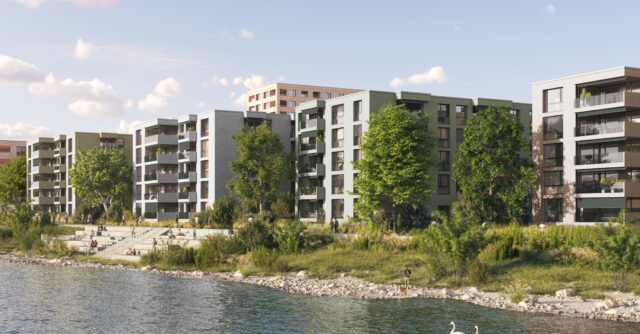
    Four new buildings are being constructed on around 8,000 square meters directly next to Baden train station, divided into two construction sites. Building site A is the responsibility of Frei Architekten AG from Aarau, building site B is the responsibility of the renowned Harry Gugger Studio from Basel. The volume is considerable: 81,888 cubic meters of enclosed space, 22,914 square meters of floor space and an investment of around 64.5 million Swiss francs. The general contractor is Gross AG from Brugg.

    Living where malt used to steam
    136 rental apartments with 1.5 to 4.5 rooms are being built in the heart of the city. On the first floor, a total of 2268 square meters of retail and restaurant space will characterize the quarter. In the inner courtyard, a 900 square meter beer garden invites you to linger. The motto of the building owner, the fourth-generation brewery H. Müller AG, sums it up: “brew – live – enjoy”.

    History remains visible
    Not everything makes way for the new building. The boiler house, brewhouse and malt silo remain as architectural witnesses to a brewing history that began in 1897. The Müllerbräu beer itself is now produced by the Falken brewery in Schaffhausen. However, there is still a specialty brewery on the site. The site’s past thus not only remains visible, it can still be experienced.

    Timetable and marketing
    The building permit dates from October 2023, with demolition starting in April 2024. The facades of the new high-rise buildings have been visible for the first time for a few days now. A milestone for the project. Marketing of the apartments is scheduled to start in summer 2026, with first occupancy planned for June 2027.

  • Laufenburg builds windmills at the train station

    Laufenburg builds windmills at the train station

    The Schützegärte site is located in a sensitive urban location. Three streets surround it, and building typologies from different decades clash all around. It is precisely this chaos that is the theme. AWW Architekten AG makes the “contrasting and bilateral” the basis of the concept. The architecture emerges from the tension of the location, not against it.

    Offset, rotated, anchored
    Two identical, four-storey buildings form the ensemble. They are not parallel, but offset and rotated in relation to each other on the slightly sloping terrain. This positioning is not an aesthetic conceit, but a precise reaction to the formation of edges and the flow of space in relation to the neighboring buildings. An ensemble that blends in while remaining independent. The total floor area is around 4,600 square meters, the building volume around 13,800 cubic meters.

    Windmill as a residential model
    The architectural concept is based on a compact four-span “windmill” building shape with a central staircase core. The projecting wings characterize the façade and make reference to typical bay window shapes in the district. Each apartment is oriented on three sides. At the heart of the building are the “four-season rooms” with spacious rooms that can be used as conservatories, studios or living and dining areas. Together with loggias, this creates a flexible range of spaces for a wide variety of lifestyles.

    Green, communal, grounded
    The open space between the houses is deliberately kept low-threshold. Accessible from inside and from the street. A green layer of native shrubs and perennials protects the first floor apartments and gives the development character. At one corner, the area opens up to a meadow-like situation with fruit trees, a reference to the local tradition of orchards close to settlements. The project considers housing and community as a unit.

    Next steps open
    The town of Laufenburg was not involved in the planning process. Town clerk Marco Waser confirms that the building authorities only clarified the building regulations in advance. The town has not yet made an assessment. The landowner Erne Immo AG has not yet commented on the time horizon for implementation.

  • DGNB certificate for deconstruction in Switzerland

    DGNB certificate for deconstruction in Switzerland

    The grain silo tower from 1939 was demolished, but its concrete was not disposed of. In the nearby concrete plant, the material was processed according to a specially developed formula and 75 to 95 percent of it was reused as recycled material in the new building. Around 60 percent of the new building consists of the old tower. The client is Gutgrün AG from Chur, which deliberately refrained from making short-term profits in order to consistently implement the sustainability concept.

    52 apartments, three certificates
    The project comprises 37 rental apartments on eleven floors in the new residential tower and 15 loft apartments in the renovated historic mill building. The architects from Ritter Schumacher have recorded all the materials used in a building resource passport. A forward-looking approach that makes future life cycles transparent today. The project was awarded three DGNB certificates for this achievement. DGNB Platinum for the demolition, DGNB Gold for the new tower and DGNB Gold for the refurbishment of the old building.

    Fire protection reinvented
    The 30-metre-high photovoltaic façade poses a problem for conventional fire protection regulations. They require partitions on every floor to prevent fire from spreading from floor to floor. This would have interrupted the façade and significantly reduced its efficiency.

    The PV surface is not interrupted anywhere by windows and is continuous from the floor to the roof. Specialist planners, contractors and the insurance company worked together to develop a tailor-made solution. Fire cannot reach the façade from the inside and the façade cannot reach the apartments.

    Alliance instead of conflict
    The project was built using the alliance model. The client, planners and contractors sat around the table together right from the start. Problems from construction practice were thus incorporated directly into the planning. The basic attitude was one of trust and fairness rather than pure risk hedging. One detail also testifies to the unconventional spirit: the graffiti that adorned the vacant building was retained as decorative elements in the stairwell.

    A signal for the industry
    There was not a single objection to the conversion project. This is unusual for a construction project of this size. Grüsch Mill shows that circular construction also works in a peripheral region and that sustainability is not a contradiction to economic viability.

  • Hydropower project on the Grimsel enters the implementation phase

    Hydropower project on the Grimsel enters the implementation phase

    According to a press release, the Board of Directors of Kraftwerke Oberhasli AG (KWO), based in Innertkirchen, has approved an investment of 300 million Swiss francs in the construction of the new Grimsel 4 pumped-storage power station. The plant will enable the water from the two reservoirs, Räterichsboden and Grimsel, to be used to ensure grid stability. The concession and planning permission have already been granted.

    Grimsel 4 consists of an underground power station between the two lakes. Two reversible pump-turbines, each with a discharge capacity of 35 cubic metres per second and an installed capacity of 84 megawatts, pump water up into Lake Grimsel as required or use it to drive the turbines as it flows into Lake Räterichsboden. The water tunnel between the two lakes is around 1,200 metres long and has a diameter of 6 metres. The access tunnel to the power station is around 1,800 metres long.

    Construction will begin in June and is scheduled for completion in February 2032. Excavation work for the power station will commence in early 2028.

    KWO was founded in 1925. It currently operates 13 hydroelectric power stations and eight reservoirs. BKW holds a 50 per cent stake in the company. The municipal utilities of Basel (IWB), Bern (ewb) and Zurich (ewz) share the remaining half equally.

  • New construction project bolsters the research hub in the Bernese Oberland

    New construction project bolsters the research hub in the Bernese Oberland

    The cost of constructing the new Empa building on plot B5 of the Thun Nord site amounts to 47 million Swiss francs. According to a press release, a financing solution has now been put forward. The City of Thun states in a press release that the project will be financed through a new site development company to be established, in which four partners will hold stakes.

    Under the proposal, the City of Thun will provide a mortgage-backed, interest-free loan of 16 million Swiss francs. It will also provide a guarantee for a loan for which the Canton of Bern has issued a letter of intent under the New Regional Policy for 10 million Swiss francs. Empa is investing CHF 16 million in laboratories and the technical centre. Halter AG, as the development partner for the site, is contributing CHF 5 million. The site development company is to be transferred to investors once the project is completed.

    The Thun City Council will decide on the current proposal at its meeting on 30 April. Planning permission for the first phase on construction site B5 has already been granted. Construction is scheduled to begin in spring 2027, with completion expected by the end of 2029.

    “The City of Thun has a keen interest in the realisation of the new building,” Mayor Raphael Lanz is quoted as saying in the press release. “Empa secures long-term, highly skilled jobs in research and development, generates regional value creation and strengthens Thun as a technology and innovation hub within the Canton of Bern.”

    Empa has had a research site in Thun since 1994. Here, it conducts research in the fields of high technology and materials.

    A new district is taking shape in Thun Nord. Alongside the first concrete project on the B5 construction site, the planned Thun Nord S-Bahn station plays a central role. The total potential of the Thun Nord site encompasses around 6,500 jobs.

  • Former industrial site to be transformed into a mixed-use neighbourhood

    Former industrial site to be transformed into a mixed-use neighbourhood

    According to a press release, Halter AG has celebrated the topping-out ceremony at the Aebi site. The construction company, based in Schlieren, is developing extensive commercial, office and residential space on the site, with completion scheduled for early 2027. The ground-breaking ceremony took place in February 2025. The Aebi company manufactured agricultural machinery on the site until 2010. Burgdorf’s mayor, Stefan Berger, along with Marcel-Jann Blattert and Marc Weber from Halter AG, expressed their gratitude at the topping-out ceremony for the efforts of everyone involved.

    In total, the site will feature 26 owner-occupied and 79 rental apartments, as well as around 3,625 square metres of floor space for versatile commercial, office and retail premises. The usable space can be partly rented and partly purchased as freehold. According to the project description, the central location at the railway station and the proximity to Bern (ideal conditions for businesses) are particularly attractive to companies that value a strong presence, accessibility and a vibrant environment.

    Halter AG is a property and construction company operating throughout Switzerland. The company handles a construction volume of around 800 million Swiss francs per year across seven sites and currently has around 320 projects in development and under construction.

  • Zurich Soft Robotics installs a Solskin façade on the KELLER Diamant building

    Zurich Soft Robotics installs a Solskin façade on the KELLER Diamant building

    Zurich Soft Robotics GmbH has deployed its Solskin technology on the KELLER Diamant building owned by KELLER Pressure AG in Winterthur, marking its largest façade project to date. A total of around 3,500 movable modules were installed, which adjust to the position of the sun. As Zurich Soft Robotics writes in a blog post, this can increase energy generation by up to 40 per cent compared to standard static solutions. At the same time, Solskin provides effective shading whilst maintaining natural light levels.

    The starting point for the project in Winterthur was the high level of solar radiation on the south-facing façade and the correspondingly increased cooling requirements within the building. The adaptive façade is designed to reduce energy consumption whilst improving working conditions.

    Installation was modular and relatively quick: individual units could be fitted in less than an hour. With this project, the company demonstrates that the technology can also be implemented on an industrial scale.

    Zurich Soft Robotics GmbH was founded in 2022 as a spin-off from the Swiss Federal Institute of Technology Zurich (ETH) and is based at Technopark Zurich.

  • Three exceptions to planning security for Bremgarten

    Three exceptions to planning security for Bremgarten

    Bremgarten began the overall revision of its land use planning over seven years ago. Regulations and documents were revised in several stages, always with the involvement of the population. In October 2024, the municipal assembly approved the revision, followed by approval from the cantonal government in December 2025. Two appeals lodged against this were both rejected.

    Rezoning as the centerpiece
    The most important measure in the settlement area is the rezoning of the Oberebene area from a pure work zone to a new residential and work zone. At the same time, a core zone for the development of the station area will be established and the Oberebene work zone will be strengthened as an economic focus of regional importance. This creates scope for investment and urban development.

    New regulations for cultural land and the old town
    The cultural land plan establishes binding overarching open spaces and water areas. This includes the water and migratory bird reserve of national importance. The regulations for building in the old town were also reviewed and clarified. An important signal for property owners and investors who need planning security.

    Three points still open
    The government council sent back three amendments. The non-protection of two properties at Birrenbergstrasse 10 and Glärnischweg 5/7 and the proposed deletion without replacement of a paragraph on roof breakthroughs in the building and usage regulations. In November 2025, the city council had already secured a loan of 200,000 francs for the reprocessing.

    Municipality to decide in June
    The municipal assembly will meet again on June 11, 2026. This is when the three rejected items are to be finally resolved. Bremgarten is nearing the end of a long planning process and the start of a new phase of urban development.

  • 80 centimeters slow down 63 million project

    80 centimeters slow down 63 million project

    The secondary school community of Arbon applied for an exemption permit for the planned Lärche school center. Specifically, this concerns the attic storey, which is 4 meters high instead of the 3.2 meters stipulated in the building regulations. The maximum permissible overall height of 16 meters is nevertheless undercut at 15.5 meters. A technical borderline case, not a fundamental problem.

    One man, one objection
    Architect Gustav Maurer has lodged an objection to the application for exemption. He describes the project, which emerged from a competition, as a “proven planning error” and considers it irresponsible in view of the global economic situation. Maurer claims that the required construction volume could be realized for CHF 43 million. This is around 20 million less than the credit of 62.9 million francs approved by the people.

    Timetable is faltering
    The secondary school authorities wanted to submit the building application in November. Due to the objection and the resulting legal uncertainty, this deadline is beginning to waver. If the process is delayed, there is a risk of follow-up costs in the millions due to rising construction prices, longer planning times and postponed building approvals.

    Clear words from the school president
    Secondary school president Robert Schwarzer finds clear words. Maurer has been opposing almost everything that is to be built in Arbon for years. The right to object is undisputed as a fundamental right, but what is being practiced here is an “expression of harassment and arbitrariness”. The objector seemed to be indifferent to the potential multi-million euro follow-up costs.

    Support from the population
    The project has democratic legitimacy. Almost 60 percent of voters were in favor of the 62.9 million loan in September 2025. The ground-breaking ceremony was planned for September 2026, with occupancy scheduled for the 2028/29 school year. Whether this timetable holds will now be decided by the Legal Service. Not at the ballot box.

  • What was considered a bargain becomes a billion-euro project

    What was considered a bargain becomes a billion-euro project

    When the city of Zurich announced the renovation of the armory on the barracks site in Zurich-Aussersihl, it still sounded like a manageable project. The initial cost estimate was around 55 million francs. Today, a figure of just under 200 million francs is on the table that makes even experienced city parliamentarians sit up and take notice. A multiplication that needs to be explained.

    Dilapidated fabric drives up costs
    The main driver is the fabric of the building itself. The historic arsenals are in a far worse condition than originally assumed. Pollutant remediation, structural interventions and monument conservation requirements add up to a cost that was simply underestimated in advance. Added to this are increased construction costs and an expanded usage concept that requires higher technical standards.

    Culture, commerce and community
    What is to be created after the renovation has substance. The city council is planning a mixture of cultural use, small businesses and publicly accessible spaces. A lively meeting place in the middle of Zurich-Aussersihl. The social mix is an explicit part of the concept. The aim is to enhance the barracks area as a whole, not just the arsenals themselves.

    Long road to opening
    The timetable is ambitious and the history of the project calls for caution. The renovated arsenals should be ready for occupation in 2034 at the earliest. Until then, the municipal council will need to approve a loan, an approved construction project and a smooth construction process. In Zurich, experience shows that these three factors rarely all work smoothly at the same time.

    Monument obliges
    The arsenals are part of the protected barracks area. An ensemble that makes the city’s history visible. Demolition is out of the question. If you want to preserve historic buildings, you have to be prepared to pay for them. The question is not whether, but how the city finances this task and communicates it transparently, comprehensibly and with clear added value for all Zurich residents.

  • Five stones, 220 apartments, one future

    Five stones, 220 apartments, one future

    The Brisgi has roots. In the 1940s, the site was home to a shanty town for up to 1500 employees of the former BBC industrial group. Many of them were guest workers with their families. In the 1960s, a high-rise building and two apartment blocks followed, which still stand today and are carefully embedded in the new development. What was once a workers’ housing estate is now becoming a modern urban building block.

    Three sponsors, one goal
    The project is backed by three non-profit organizations that are jointly developing the 6.5-hectare site: Wohnbaustiftung Baden, Logis Suisse AG and Graphis Bau- und Wohngenossenschaft. Each will take over one of the three buildings and design them independently. The rents are calculated to cover costs. Profit is not the goal, but affordable living is.

    Wood, concrete and sun
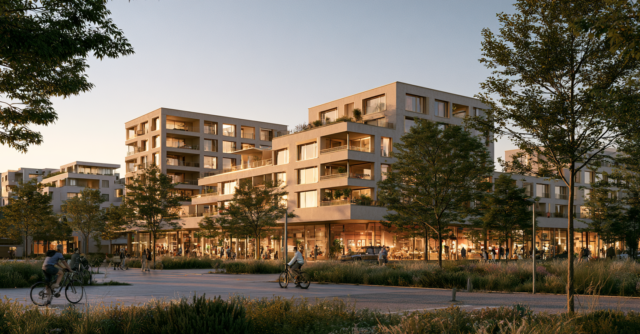
    Nine five- to six-storey buildings, pergolas, green inner courtyards and a central square will characterize the future Brisgi. The hybrid construction method combines wood and concrete. Concrete only where it is really needed. Solar panels will produce electricity on around half of the roofs and the site will be connected to the district heating network of Regionalwerke Baden. The aim is to achieve the gold certificate of the Swiss Sustainable Building Standard.

    Values carved in stone
    Five stones, found during the excavation of the building pit and engraved by a stonemason, represent the self-image of the development. Common ground, the future, sustainability, affordability and living. City President Markus Schneider, who carried the stone with the inscription “Future”, summed up the 14 years of planning work: “Now the lively Kappi is becoming even livelier. A neighborhood within a neighborhood is being created here.” The five stones will be clearly visible in the development in future.

    Milestones on schedule
    After years of objections and a planning process since 2012, things are now picking up speed. The building permit for all three courtyard buildings was granted in April 2025 and construction started on schedule in the fall of 2025. Letting will start in the second half of 2027, with occupancy scheduled for the first half of 2028. The design architects are the Baden-based firm Meier Leder Architekten together with the Zurich firm Müller Sigrist, whose “Kandalama” project was chosen as the winning project in 2016.

  • Largest solar power plant in the canton of Zurich goes into operation

    Largest solar power plant in the canton of Zurich goes into operation

    According to EKZ, the largest solar power plant in the canton of Zurich has come into operation on the roofs of the Embraport logistics centre. Since mid-March, 9,500 solar panels have been generating electricity across a roof area of around 20,000 square metres, with a total output of up to 4.5 megawatts, EKZ states in a press release. The plant is expected to produce around 4 gigawatt hours of solar power annually.

    “We are proud that we have transformed unused roof space here into the largest solar power plant in the canton of Zurich within just a few months,” Paul Sidler, Head of Renewable Energy at EKZ, is quoted as saying in the press release. “This strengthens security of supply with local, sustainable electricity.” EKZ has realised the plant as part of its solar contracting model. Under this arrangement, Zürcher Freilager AG, as the owner and operator of Embraport, merely provides the roof space. EKZ is responsible for planning, financing, construction, operation and maintenance.

    Around half of the solar power generated at Embraport is to be consumed directly within the logistics centre itself. “Our tenants benefit from CO2-free energy, which they can purchase on attractive terms, thereby making their businesses more sustainable,” says Jean-Claude Maissen, CEO of Zürcher Freilager AG, in the press release. EKZ will offer the other half to its own customers.

    The system is also set to be expanded later this year. EKZ plans to install further modules with a total capacity of around 1 megawatt on the new buildings currently under construction on the site. A large-scale battery with a capacity of 2 megawatt-hours is also planned.

  • Lake Zurich to heat university campus

    Lake Zurich to heat university campus

    Energie 360° will implement the University Campus Energy Network. From 2037, the University Hospital of Zurich, the University of Zurich, the Swiss Federal Institute of Technology Zurich and Zurich Stadelhofen railway station are to be heated and cooled using energy from Lake Zurich, according to a statement from the Zurich-based energy supplier. According to the statement, Energie 360° is investing around 40 million Swiss francs in the energy network.

    The project involves the construction of a lake water plant in the Tiefenbrunnen area. Construction of the plant is scheduled to begin in summer 2034. From there, the lake water will be channelled via the planned second Riesbach tunnel of the SBB to Zurich Stadelhofen station and the university campus. The water will then flow into the Limmat.

    “The lake serves as an energy source for climate-friendly air conditioning and heating in the university district,” Energie 360° CEO Romeo Deplazes is quoted as saying in the press release. “In this way, we are making an important contribution to the transformation of the city of Zurich from fossil fuels to renewables.”

  • Expansion of the district heating network strengthens the energy supply in Baden and Ennetbaden

    Expansion of the district heating network strengthens the energy supply in Baden and Ennetbaden

    According to a press release, Regionalwerke AG Baden is set to expand its district heating network. Construction work is set to begin in the coming months. With targeted development between Sonnenbergstrasse, Postplatz and Schlösslistrasse, a further step towards a climate-friendly heating supply will be taken. The energy supplier and the local council aim to gradually replace fossil fuels and sustainably increase energy efficiency, thereby strengthening the local infrastructure and making Ennetbaden a more attractive, forward-looking place to live.

    The connection of the municipality is to take place in two construction phases. The first phase is scheduled from 20 April to 7 June and concerns the Schiefe Brücke and the bridgeheads in Baden and Ennetbaden. The second phase of development, expected to run from 8 June to 31 October, will take place along Sonnenbergstrasse. During the construction period, there may be temporary changes to traffic routing and diversions for bus services.

    The municipality of Ennetbaden, Regionalwerke AG Baden, Regionalen Verkehrsbetriebe Baden-Wettingen, and specialist departments of the City of Baden and the Canton of Aargau have collaborated on the planning of the construction works and the traffic management plan. The heat supply is scheduled to commence this coming winter.

  • The outlet in Landquart is set to be significantly expanded

    The outlet in Landquart is set to be significantly expanded

    Walo Bertschinger AG, based in Dietikon, is involved in the expansion of the Landquart Fashion Outlet. According to a press release, the shopping centre, which has a village-like atmosphere, is being expanded by 5,000 square metres to accommodate 14 new shops, a new restaurant and a four-storey car park. Walo is responsible for the various paving and surfacing works. The new section of the Fashion Outlet is scheduled to open in April 2026.

    According to Walo, a total of 12,900 square metres of base course and 2,600 tonnes of surfacing will be used in the underground car park and outdoor areas. In the outdoor area, 900 metres of kerbs will also be laid and 67 manhole covers installed. The bus stop will also be paved with heavy-duty paving stones over an area of 630 square metres.

    The central design element is the “high-quality paving of the pedestrian zone in the mall area, which characterises the centre’s alpine village design”, according to Walo’s press release. There, the company is laying 150 square metres of row paving, 200 square metres of edging slabs made of Onsernone granite, and 1,500 square metres of porphyry slabs.

  • New housing concept combines independence with support services

    New housing concept combines independence with support services

    bonacasa AG is implementing one of its residential building management solutions for the first time in French-speaking Switzerland, in collaboration with the Vaud-based pension fund vitems and the Bern-based turnkey contractor Losinger Marazzi. The three partners have developed the Arbora estate in Crissier, comprising 63 accessible flats for older people, which is currently under construction and will be ready for occupancy in September 2026.

    According to a statement from bonacasa, no residential complex was originally planned for this site. However, thanks to the bonacasa living concept, “a satisfactory contractual solution was found in collaboration with the authorities and the owner”. Bonacasa living is one of five operational solutions offered by the Oensingen-based company. Each of these includes a basic package featuring a 24-hour emergency call system, access to a service centre and an app.

    Building on this, offers and services from the other four modules – such as an on-site social concierge available every weekday, weekly entertainment and activities, sports and health programmes, and à la carte services – can be added, as can structural adaptations in line with bonacasa’s so-called Smart Building Standards.

    According to the information provided, the new bonacasa living concept is already being implemented at other locations in Switzerland and demonstrates that age-appropriate living does not necessarily mean a care home, but can also work within the standard housing market. “Many people want to continue living independently in their own homes as they get older,” says Ivo Bracher, Chairman of the Board of Directors. “Our approach combines modern living with flexibly bookable services, thereby creating a solution that works for residents as well as for property partners and local authorities.”

    Bonacasa is one of five finalists in the Prix SVC Aargau Solothurn, which is being held for the first time this year. This means that Switzerland’s ninth most important economic region now has its own awards ceremony. The award will be presented by the SME network Swiss Venture Club (SVC) from Stettlen, Bern, on 6 April 2026 at the Emil Frey Classic Center in Safenwil, Aargau, to outstanding and forward-looking companies.

  • District heating project boosts energy supply in Adligenswil

    District heating project boosts energy supply in Adligenswil

    On 17 March, EBL Energie Rigi broke ground on the first phase of the expanded district heating network. A new main pipeline will in future connect the Halti-kon energy centre with the existing district heating network in Adligenswil, Lucerne. This will enable the outdated heating plant in Adligenswil to be replaced. According to a press release, EBL Energie Rigi is thus laying the foundations for a long-term, reliable and renewable heat supply in the region. At the same time, this is intended to meet the growing demand for new district heating connections in Adligenswil and ensure long-term security of supply for all customers. According to current plans, the construction period will be around two years.

    Those attending the ground-breaking ceremony included the Vice-Chair of the Municipal Council, Felicitas Marbach, and members of the Board of Directors of EBL Fernwärme Rigi AG. “Today’s ground-breaking ceremony is far more than the start of a construction project – it is a visible sign of a shared energy future. With the new main pipeline between Haltikon and Adligenswil, we are laying the foundations for a reliable, renewable and regionally anchored heat supply,” said Philipp Zgraggen, Managing Director of EBL Energie Rigi, according to the press release.

    EBL Energie Rigi brings together the expertise of three subsidiaries of EBL (Genossenschaft Elektra Baselland), based in Liestal: EBL Fernwärme Rigi AG supplies Küssnacht am Rigi, Greppen and Adligenswil with CO2-neutral district heating. EBL Energiezentrum Rigi AG produces electricity and heat from regional waste wood and wood residues. EBL Pellets Rigi AG manufactures wood pellets from regional wood residues.

  • Major contracts are boosting the building construction business both at home and abroad

    Major contracts are boosting the building construction business both at home and abroad

    In a press release, the property and construction services provider Implenia has announced that it has secured numerous building contracts in Switzerland and Germany. These contracts have a total value of 310 million Swiss francs and will be carried out between 2026 and 2028.

    In Vevey, Vaud, on the shores of Lake Geneva, Implenia is acting as the main contractor for the new Jardins en Ville district, building 182 owner-occupied flats. The project is complemented by commercial space, a two-storey car park and a central green space. The PEFC/FSC-certified timber structure is set to meet the Minergie-Eco and CECB A/B standards. Also in Switzerland, Implenia is building eight Minergie-certified apartment blocks in Payerne (VD) comprising 107 climate-friendly homes. The project was previously developed by Implenia and subsequently sold to investors.

    Implenia is also creating sustainable housing in Germany: in Frankfurt, twelve energy-efficient residential buildings with around 160 passive house units are being built in the city’s “first climate protection district”. In Munich, following a successful pre-construction phase, the company is building a multi-family residential building with 186 flats and complementary commercial uses as part of a joint venture. In Nuremberg, three buildings featuring 76 rental flats, as well as space for a nursery, commercial premises and an underground car park, are being constructed using a timber-hybrid construction method. In Jena, a further residential quarter is also being built using timber construction. In Mannheim, Implenia is constructing a turnkey residential complex using a timber-hybrid construction method at BUGA Park, comprising a total of 225 residential units.

    Further contracts relate to the justice sector as well as education, research and pharmaceuticals: Implenia is constructing operational and production buildings for the prison in Siegburg. In addition, the extended shell of an administration building using timber construction is being built for Flensburg University of Applied Sciences. In German-speaking Switzerland, Implenia is undertaking additional construction work, including the redevelopment of a former industrial site and projects for the pharmaceutical industry.

  • Renovation project focuses on the circular economy and reducing CO2 emissions

    Renovation project focuses on the circular economy and reducing CO2 emissions

    According to its press release, Sika is participating as a funding partner in the three project phases – Exploration (2026), Synthesis (2027) and Transfer (2028) – of ETH’s Living Lab HIL. These phases will lay the groundwork for the refurbishment, energy-efficiency upgrade and extension of the teaching and research building for architecture and civil engineering (HIL) on the Hönggerberg campus. The major project is scheduled for completion by 2035.

    According to ETH, the need for renovation and the changed spatial requirements clearly called for a complete refurbishment involving demolition down to the load-bearing structure. Instead, the university intends to treat the existing building with greater care and focus on CO2 reduction, digitalisation and the circular economy. It is developing the construction project internally, drawing on knowledge and insights from its own teaching and research and working with industry partners.

    In this “globally unique flagship project”, as Sika describes it, the Baar-based specialty chemicals company for construction and industry is contributing more than just financial support. The project’s funding also encompasses an active and close technical exchange between Sika and the ETH project teams. This is facilitated through the ETH Foundation.

    Sika aims to help “drive the transformation towards sustainable construction methods”, says Patricia Heidtman, Head of Innovation and Sustainability. “The Living Lab HIL offers a unique platform that actively links research and practice and tangibly accelerates innovation.”

    Industry and science must act together to achieve climate targets, says Mathias Kohler, ETH Professor of Architecture and Digital Fabrication. “In cooperation with Sika, we are testing new solutions in the Living Lab HIL that will be implemented during the renovation phase of the ETH building from 2030 onwards.”

  • Horw is growing upwards, 14 storeys at the railway station

    Horw is growing upwards, 14 storeys at the railway station

    Three striking new buildings with inner courtyards are being built between the railway station and Ebenaustrasse. The municipality is planning an eight-storey building at the roundabout, a 14-storey high-rise to the south of it as a vertical accent and an eight-storey longitudinal building facing Ebenaustrasse. The new bus station will be located in between, closer to the railway line than today and much more convenient for all those who change buses every day.

    “Janus” favours greenery and glass
    Further east, along Ebenaustrasse and Ringstrasse, the municipality has held an architectural competition. The winning project is called “Janus” and envisages five largely glazed, six- to seven-storey apartment blocks, surrounded by trees and connected by a shared forecourt. The buildings appear bright and open, the ensemble creates urban quality without anonymity.

    Commercial yes, but how much?
    At least 20 per cent of the space in the new buildings is to be used for commercial purposes. This is envisaged by the municipality, and not just on the ground floor, but up to the third or fourth floor. The property owners take a critical view of this. They point to a lack of demand and draw on their experience with the previous “Horw centre” open space concept. The municipal council is willing to talk, but reserves the right to add further storeys if necessary.

    Part of a big picture
    The railway station project is embedded in the overall “Horw Mitte” project, which covers around 12 hectares and plans 1,000 new flats and 800 new jobs in the long term. A large part has already been realised to the west of the tracks, while the eastern part is now catching up. Over two decades, the municipality is thus developing a former peripheral area into a compact, well-developed centre.

    Residents’ Council has the floor
    The bus station was already approved by the Residents’ Council on 27 March 2026, with construction not due to start until 2028 at the earliest. The vote is still pending for the Part East development plan. This requires the approval of the cantonal government of Lucerne and a referendum-free conclusion. It is also still unclear who will bear the planning costs. So there is still a lot to be clarified before the construction cranes move in.

  • 47 million for a new heart in the Bernese Oberland

    47 million for a new heart in the Bernese Oberland

    The overall project will cost 47 million francs. Financing is being provided by a newly established site development company in which four partners are participating. The city of Thun is granting a mortgage-backed, interest-free loan of 16 million francs and is also guaranteeing a cantonal loan of 10 million francs as part of the new regional policy. Empa itself is investing CHF 16 million in laboratories and a technical center, while Halter AG is contributing CHF 5 million as a development partner. Once the project is completed, the company will be transferred to investors.

    Building permit is available
    The way was not clear. Objections delayed the process by around a year. The building permit for construction site B5 in Thun North has now been granted, with construction set to begin in spring 2027 and completion scheduled for the end of 2029. The city parliament will decide on the loan on 30 April 2026. A clear yes is needed to keep to the schedule.

    Empa in Thun since 1994
    The Swiss Federal Laboratories for Materials Science and Technology has been conducting research in the field of high technology and materials in Thun since 1994. The new building is not a relocation, but an expansion. Mayor Raphael Lanz puts it in a nutshell. Empa secures highly qualified jobs in research and development in the long term, generates regional added value and strengthens Thun as a location for technology and innovation in the Canton of Bern.

    From barracks site to urban quarter
    Thun North is the largest urban development project in the Bernese Oberland. On the 60-hectare site, research companies, businesses and housing are replacing military use. in the long term, 6,500 jobs are to be created; around 2,300 are already located there today. A new Thun Nord S-Bahn stop is included in the federal parliament’s 2035 expansion plan and will connect the district directly to long-distance transport.

    Halter as a lever
    It is no coincidence that Halter AG is contributing CHF 5 million to the project as a development partner for construction site B5. The company won the project competition in 2022 together with Bauart Architekten and Balliana Schubert Landschaftsarchitekten. The composition shows the concept. Private capital and the public sector are pulling together, and the location is sharing the risk because it is thinking about the return.

    What counts now
    April 30 is the date that decides everything. If the city parliament approves the loan, planning gets underway. If the loan fails, the entire timetable is thrown into disarray. This would be a setback for Thun North and a location issue for Empa. The city has already paid its share of the bill. Now it’s up to parliament.

  • Major project to boost rail capacity in the Zurich area in the long term

    Major project to boost rail capacity in the Zurich area in the long term

    According to a press release, SBB has begun work on upgrading the line between Zurich and Winterthur to four tracks throughout. As part of the ‘MehrSpur Zurich-Winterthur’ project, SBB is constructing a new tunnel, upgrading several stations and carrying out further improvements.

    SBB and the construction firms involved have now started work on upgrading the stations at Wallisellen, Dietlikon, Bassersdorf and Winterthur Töss. This includes widening platforms, constructing new and modified underpasses, and building footbridges and bridges. Work in Bassersdorf is due to be completed by 2030, in Wallisellen and Dietlikon by 2031, and in Töss by 2034.

    The Brütten Tunnel is set to be 9 kilometres long. Tunnel boring is scheduled to begin in 2029, with the tunnel due to open in 2037.

    The expansion is expected to cost a total of 3.3 billion Swiss francs. This major project, together with other initiatives such as the expansion of Zurich Stadelhofen station, is set to significantly improve rail services in the Greater Zurich area.

  • New district heating network makes efficient use of waste heat and water from the Rhine

    New district heating network makes efficient use of waste heat and water from the Rhine

    According to a press release, energy supplier AEW Energie AG is investing 8 million Swiss francs in the construction of a district heating network in Augst, in the canton of Basel-Landschaft. According to the company, this sends “a clear signal regarding the implementation of the energy strategy and the consistent expansion of renewable heating solutions”.

    Waste heat from the generators at the existing Augst hydroelectric power station and water from the Rhine are to be used for district heating. It is stated that, via a 1.3-kilometre-long district heating network, the connected buildings will receive CO2-free energy from the start of the 2026/2027 heating season.

    Three heat storage tanks, each with a capacity of 15,000 litres, will ensure a secure supply and reliable, stable operation even during peak loads. According to the press release, the plant’s thermal output is 2 megawatts and is expected to deliver a heat output of 4,400 megawatt-hours once fully operational. This is expected to save 1,200 tonnes of CO2 annually.

    At the start of the construction project with the ground-breaking ceremony on 16 March 2026, the company announced that it was creating a replacement for the AEW Contracting plant in Pratteln, which had been operated using wood pellets and oil. “With the Augst heating network, we are making optimal use of existing energy sources from our own infrastructure and making an important contribution to the decarbonisation of the region’s heat supply,” said Dr Raffael Schubiger, Chairman of the Board of Directors of AEW Energie AG and Kraftwerk Augst AG.

    According to David Gautschi, Head of Production at AEW, the Augst heating network exemplifies how existing energy infrastructure and natural resources can be efficiently combined.

  • Swiss construction project focuses on sustainable earthen architecture abroad

    Swiss construction project focuses on sustainable earthen architecture abroad

    The go-ahead has been given for the construction of the new Swiss Embassy in the Cameroonian capital, Yaoundé, and according to a press release, Dietikon-based Oxara AG is playing a key role in the project. The public building will be constructed using pressed clay bricks. Oxara is supplying its Oxabrick Loko stabiliser for the red raw material, which is available in abundance locally.

    The design for the embassy building is by the Basel-based architectural firms Caesar Zumthor Architekten and Nord Architekten and comprises an office block, a residence and a connecting building, all grouped around a courtyard. The buildings are to be constructed sustainably using local resources.

    On its website, Oxara – a company founded in 2019 – has launched a series reporting on the progress of the construction work. “In West Africa, clay is perceived as a sign of poverty and rurality, whilst concrete dominates in cities as a status symbol,” Oxara’s project manager Jonathan Ensslin is quoted as saying there. “It therefore sends a strong signal that the new Swiss embassy is being built with clay.”

    Oxara’s non-toxic mineral activator transforms clay into a stable and water-repellent building material. According to the company, this makes clay construction faster, less labour-intensive and scalable. At the same time, it is circular and low-carbon.

    Tests in the Oxara laboratory had shown that the material is well suited for use with Oxabrick Loko. However, the laboratory results could not initially be replicated on site. With the help of local materials researcher Berardin Beauderic Kenne Diffo, who had already got to know Oxara during his PhD at the Swiss Federal Institute of Technology Zurich, the mixing ratios were adjusted. A test wall comprising around 7,000 clay bricks is currently being completed. Construction work on the new embassy is then set to begin.