Category: Projects

  • New production facility strengthens international industrial location

    New production facility strengthens international industrial location

    The new global Toblerone competence center in Bern now covers 90 percent of global demand for the iconic triangular chocolate. Guy Parmelin officially inaugurated the expanded plant on March 10. “We are incredibly proud of the new Toblerone production line and the modernization of logistics and infrastructure,” said plant manager Thomas Kauffmann in a press release.

    Mondelēz International, the Chicago-based parent company of Bern-based Mondelez Schweiz Production GmbH and Mondelez Schweiz GmbH in Opfikon, has invested 65 million Swiss francs in the installation of this new, state-of-the-art production line. This is one of the largest investments in the company’s chocolate production network in the past ten years.

    “If there is one product that represents Switzerland worldwide, it is chocolate,” said Parmelin in his speech, according to the press release. “And Toblerone has a very special place among Swiss chocolates.” It is “a symbol of Swiss identity and quality par excellence. Identity and quality. As President of the Swiss Confederation and Minister of Economic Affairs, I am therefore particularly pleased that around 90 percent of Toblerone production will continue to be made here in Bern on this new production line.”

    Toblerone is exported from Switzerland to more than 120 countries around the world. As Mondelēz emphasizes, the iconic 118-year-old brand is well positioned to grow globally in the premium segment, benefiting from its high brand awareness and leadership position in the World Travel Retail business. “We have always been proud to manufacture here in Switzerland,” said Iain Livingston, President for Toblerone and World Travel Retail. “The investment underlines our strong commitment to the site and is a key milestone on our journey to lead global growth in the premium chocolate segment.”

  • Historic Spa District gets a new perspective for use

    Historic Spa District gets a new perspective for use

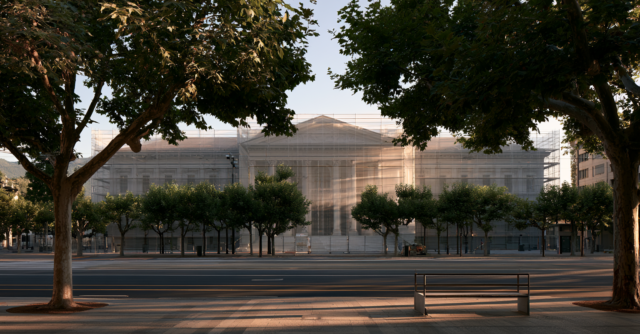
    Verenahof AG, based in Baden, wants to revitalize the building complex in Baden’s Spa District. To this end, it concluded a contract with the city on February 5. According to a press release, this forms the basis for the development and use of the complex and is intended to provide planning security.

    Verenahof AG has developed a utilization concept in collaboration with the city and the cantonal monument preservation authorities. This envisages combining assisted living for older people with cultural offerings and publicly accessible uses. The technical feasibility has already been examined. Now a building application and a cost estimate are to be drawn up within twelve months under the management of Verenahof AG.

    “The concept for services in the areas of prevention, rehabilitation and healthy ageing is a perfect fit for this historically valuable location for Baden,” said Markus Schneider, Mayor of Baden, in the press release. “The Spa District has been investing in health since Roman times – it is important for Baden and the region that this offering continues to be expanded in the future.”

    The complex has been vacant since the closure of the Verenahof, Bären and Ochsen hotels in 1987 and 2004. It has been under national protection since 2019. As the owner of Verenahof AG, the Bad Zurzach Baden Health Promotion Foundation has examined several uses, including for a rehabilitation clinic. These possible uses came up against the economic and structural framework conditions as well as the requirements for the preservation of historical monuments.

  • Spectacular cultural building sets new architectural trends

    Spectacular cultural building sets new architectural trends

    Nüssli, the construction services provider based in Hüttwilen, celebrated the topping-out ceremony for the extension to the Mack Pyramid in Monheim am Rhein on 8 March 2026, in the presence of the building’s namesake, Heinz Mack. With this extension, the company – which specialises in temporary event structures – is realising an “architecturally ambitious construction and cultural project”, writes Nüssli in a press release.

    Thanks to the installation of a load-bearing steel structure shortly before the topping-out ceremony, the double pyramid is already a prominent feature of the townscape. “The structure is characterised by sophisticated geometry, high design standards and complex structural engineering,” the statement says. According to the city, the building is intended to provide a culturally significant architectural landmark. Exhibition spaces for contemporary art are to be created.

    According to the press release, the Thurgau-based company is contributing its experience with complex special-purpose structures such as pavilion architecture, exhibition design, as well as façade designs, sculptures and exhibits. “At various world exhibitions, we have learnt to turn extraordinary forms and complex structures into reality. It is precisely this expertise that is now being put to full use in the Mack Pyramid,” says Udo Baader, Head of Project Management Special Projects. The opening is scheduled for June 2027.

    Alongside the progress of the construction, the day also focused on the pyramid’s namesake, Heinz Mack. The sculptor was among the visitors, celebrating his 95th birthday. “Despite all the plans, I can’t quite picture it yet. The main thing is that the light remains,” he is quoted as saying. The light is part of his artwork inside the building, the press release states.

  • Industrial firm stabilises turnover and invests in new sites

    Industrial firm stabilises turnover and invests in new sites

    According to a press release, the Kistler Group managed to keep its turnover stable in 2025: at 424 million Swiss francs, it fell by 1 per cent on a currency-adjusted basis and by 5 per cent in Swiss francs. The company cites the strong Swiss franc in particular as a negative factor, but also the stagnating German automotive industry and geopolitical and economic uncertainties, including those related to US tariff policy. Order intake fell short of the company’s expectations, down 2 per cent on a currency-adjusted basis and 6 per cent in Swiss francs.

    “My first year as CEO was challenging, but we have set an important course – including through adapted regional structures that enable us to respond even more flexibly to varying market conditions,” Marc Schaad is quoted as saying. He is cautiously optimistic about the 2026 financial year. “We plan to continue growing through targeted investments, particularly in Asian markets such as China.”

    For Asia, Kistler is planning a new headquarters in the Malaysian capital, Kuala Lumpur. In the US, Kistler has strengthened its management team. In Germany, the focus is on developing new applications to offset declining sales in the automotive sector. New products are also set to contribute to the Group’s growth in 2026. Nine per cent of revenue is channelled into research and development.

    In Winterthur, Kistler is pressing ahead with preparations for a new, highly automated sensor factory. “The smart factory is a long-term investment for us and a clear commitment to Winterthur as a location,” said Schaad. The company is currently “in an intensive planning and clarification phase”.

  • Intercantonal development project focuses on mobility and efficiency

    Intercantonal development project focuses on mobility and efficiency

    Voters in St. Gallen have approved the sale of two plots of land owned by the Canton of St. Gallen to the Canton of Thurgau, as well as the provision of compensation in the form of crop rotation areas. According to a statement from Regio Wil, this is a “landmark decision” for the Wil region. The plots are to form the WILWEST development area, which is intended to combine environmentally friendly mobility, energy efficiency and regional cooperation as a sustainable economic zone. At the heart of the project is a new junction with the A1 motorway, complemented by improved bus, rail and cycle connections for the entire region.

    For the Wil region, the project creates prospects for new jobs, reduced traffic congestion and coordinated, sustainable spatial development, the statement says. The decision by St. Gallen’s voters is also a strong signal for intercantonal cooperation between St. Gallen and Thurgau, as well as for the 22 municipalities of Regio Wil.

    The St. Gallen electorate had initially rejected a special loan for the WILWEST project in September 2022. The project was subsequently comprehensively revised, particularly in the area of sustainability. Among other things, land use was optimised, soil sealing reduced, and car traffic and the number of parking spaces cut.

    The priority now is to ensure sustainable implementation, to develop the area in a land-conserving manner and in phases, and to continue to take the concerns of the public into account. Regio Wil intends to remain actively involved in the process in the future.

  • Modern office location underscores strategic development

    Modern office location underscores strategic development

    The Landis Gyr Group is moving into new headquarters. The Zug-based energy management specialist, which operates worldwide, is relocating to a new state-of-the-art office building within Cham, Landis Gyr announced in a press release. The new global headquarters is located at Alte Steinhauserstrasse 14, just a few steps away from the old headquarters on the same street. This will ensure a smooth transition, the press release states.

    “With the new headquarters, we are sending a clear signal of continuity and innovation,” Landis Gyr CEO Peter Mainz is quoted as saying in the press release. “Cham remains a key location for us, where we are shaping the future together with our employees and partners.” Mayor Georges Helfenstein interprets the move within Cham, among other things, as “the result of the municipality’s forward-looking and reliable economic management”.

  • Historic hotel complex is being repositioned in stages

    Historic hotel complex is being repositioned in stages

    Halter AG aims to breathe new life into the listed Sonnenberg complex in Seelisberg. The Schlieren-based property developer is currently in the process of gradually redeveloping the historic hotel complex, Halter states in a post on LinkedIn. According to the project description, the Hotel Sonnenberg is to remain as the core building and will once again be used as a hotel upon completion.

    In the former Hotel Kuhn, which will also remain largely unchanged, Halter plans to create apartments. Further apartments are to be built in two new buildings south of the hotel. Existing additional buildings to the north will be repurposed and incorporated into the hotel complex.

    The historic hotel complex attracted international attention in the 1970s. At that time, the Sonnenberg complex had been acquired by the Transcendental Meditation movement. From 1972 onwards, and for more than three decades, the Grandhotel Sonnenberg served as the headquarters of the movement led by the guru Maharishi Mahesh Yogi. Felice Zenoni’s documentary Namaste Seelisberg, screened for the first time at the 61st Solothurn Film Festival, explores this era. Halter supported the film project and facilitated filming on the site.

  • City wants to acquire industrial building for archive and temporary uses

    City wants to acquire industrial building for archive and temporary uses

    The Biel Municipal Council is proposing to the City Council that it purchase the industrial property at Mattenstrasse 133. According to the announcement, the building is intended to serve as the new city archives from 2033 onwards. Prior to that, it will be used as a temporary gymnasium and library.

    The industrial property at Mattenstrasse 133 was built in 1959 for Maveg AG, a trading company for construction machinery. The building comprises three large halls and an administration building and is listed as worthy of preservation in the building inventory.

    From winter 2026/27, the large hall of the property is to replace the Collège des Platanes’ gymnastics facilities. Since 2024, these have only been usable to a limited extent due to structural problems. Until the gymnasiums are renovated, the city wants to create a temporary solution by simply expanding the hall.

    Later, during the planned complete renovation of the city library on Neumarktplatz starting in 2031, the property will serve as a temporary library location. There are hardly any suitable rental solutions available in the city centre for the library’s approximately 1,700 square metres of floor space.

    After the library moves out, the building will be used permanently as the city archives from 2033 onwards. The city has been looking for a new solution for this for years, as the current premises no longer meet legal requirements and the archive holdings are spread across several locations.

    The municipal council is applying to the city council for two loans totalling CHF 3.890 million for the purchase of the property and the temporary provision of the gymnasium. The city council will make its decision on 19 March.

  • Ein Quartier ohne Einsprache

    Ein Quartier ohne Einsprache

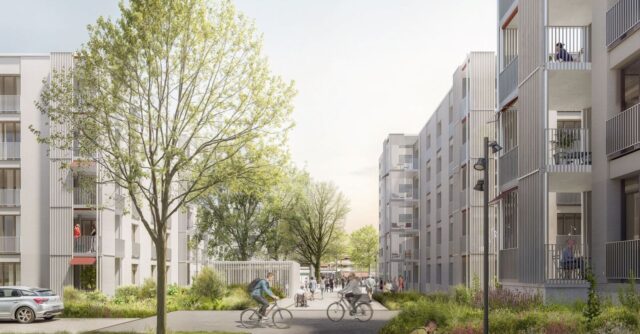
    Der Luzerner Regierungsrat genehmigte den Bebauungsplan Schützenmatt im Januar 2026. Der Emmer Einwohnerrat hatte ihn bereits am 1. Juli 2025 in zweiter Lesung einstimmig verabschiedet. Nach Ablauf der Beschwerdefrist liegt nun Rechtskraft vor, kein einziger Rekurs wurde eingereicht. Das ist bei einem Projekt dieser Grössenordnung keine Selbstverständlichkeit, sondern ein Zeichen breiter Akzeptanz.

    250 Wohnungen, 4000 Quadratmeter Leben
    Auf dem Areal entstehen rund 250 Wohnungen in verschiedenen Grössen sowie Gewerbe-, Gastronomie- und Dienstleistungsflächen von insgesamt rund 4000 Quadratmetern. Der Wohnungsmix reicht von kleineren Einheiten über Familienwohnungen bis zu Alterswohnungen . Bewusst konzipiert für alle Lebensphasen und verschiedene Einkommensstufen. Ein Teil der Wohnungen muss als preisgünstiger Wohnraum realisiert werden.

    Weniger Auto, mehr Velo
    Das Mobilitätskonzept setzt klare Prioritäten sodass Fuss, Velo und öffentlicher Verkehr Vorrang haben. Geplant sind über 970 Veloabstellplätze, darunter eine gedeckte, öffentlich zugängliche Velostation mit mindestens 300 Plätzen direkt an der Bahnhofunterführung. Für Autos stehen maximal 120 Parkplätze in der Tiefgarage bereit. Die Velohauptroute entlang der Gleise wird kreuzungsfrei geführt. Somit entfallen Konflikte mit dem Fussgängerverkehr.

    Die Stadt als Schwamm
    Das städtebauliche Konzept stammt von Fischer Architekten, deren Wettbewerbsbeitrag mit dem ersten Preis ausgezeichnet wurde. Im Zentrum steht das Schwammstadtprinzip. Sickerfähige Beläge, Bäume auf natürlichem Boden und begrünte Dachflächen speichern Regenwasser und geben es kontrolliert wieder ab. Mindestens 60 Prozent der Dachflächen werden intensiv begrünt. Das verbessert das Mikroklima und macht das Quartier klimaresilient.

    Ab 2027 wird gebaut
    Mit der Rechtskraft liegt die Umsetzung nun bei den Grundeigentümerschaften. Die Realisierung ist in vier Etappen geplant, ein Bezug der ersten Wohnungen ist ab rund 2030 realistisch. Christine Bopp, Leiterin Planung der Gemeinde Emmen, spricht von einem abgeschlossenen langen Planungsprozess, der nun Planungssicherheit für alle Beteiligten schafft. Emmenbrücke bekommt sein neues Herz und baut es mit Bedacht.

  • Regensberg fights for survival

    Regensberg fights for survival

    Regensberg has exactly 477 inhabitants at the end of 2024. Despite two tax increases in recent years, there is not enough revenue to finance the municipality’s tasks. The structural deficit threatens the independence of the medieval country town on the rocky spur above Dielsdorf. A merger with a neighboring municipality is on the cards, a scenario that many Regensberg residents want to avoid.

    A meadow as a turning point
    The impetus came in April 2024 at a Future Day, where the population openly discussed the fate of their municipality for the first time. On the agenda was the Pünt meadow, the last major building site in the village. This discussion gave rise to the idea of a cooperative. In July 2025, the Pünt Regensberg building cooperative was officially entered in the commercial register.

    40 apartments, 80 new people
    The project, a four-storey building with 41 apartments, is to be built on the Pünt, around three quarters of which will be large family apartments with 4.5 to 5.5 rooms, the rest smaller units with 2.5 to 3.5 rooms. The cooperative anticipates 60 to 80 new residents. For a community the size of Regensberg, this corresponds to a population increase of around 15 percent. A competition to find the project team was held back in 2025.

    More than taxes
    The goal is not just fiscal. Regensberg has the fourth-highest average age of all Zurich municipalities. Younger families should come and thus also secure the elementary school, because without a school there are no families and without families there is no village life. The flexible usage concept also allows older people to move from their single-family home to a suitable smaller apartment without having to leave the village.

    non-profit instead of speculative
    If the project had ended up in private hands, the apartments in the attractive location would have primarily been investment properties. In contrast, the cooperative lets on a cost-rent basis, i.e. without the intention of making a profit. The project is being financed via share certificates, member loans, state subsidies and bank mortgages, with a target equity ratio of 35 to 40 percent.

    the cranes will rise in 2028
    Because Regensberg is listed in the federal inventory of sites worthy of protection, particularly strict conditions apply to construction. The building permit is due to be issued in 2027, with construction scheduled to start in 2028. The first apartments could be occupied one or two years later. Whether the cooperative can solve the structural deficit on its own remains to be seen. But it proves that sometimes a village saves itself.

  • New factory site combines energy and network expertise

    New factory site combines energy and network expertise

    CKW AG plans to relocate business divisions from the Reussbühl district of Lucerne to Reussinsel in Emmen, where it will also establish the company’s new headquarters, according to a press release. The Axpo subsidiary intends to use this move to consolidate its activities.

    At the heart of the project, known as EnergiePark Emmen, is the construction of a new building for the Networks and Building Technology divisions. CKW’s network base, which will be built there, will be responsible for the construction, operation and maintenance of the electricity grid in the greater Lucerne area. The new building will provide modern workplaces for employees. After several years of planning, the Compact project by Penzel Valier AG from Zurich and Maurus Schifferli Landscape Architects from Bern was awarded the contract to build the new company headquarters.

    Reuss Island is the historical birthplace of CKW, where the first power plant supplied electricity to the region in 1894. “With the planned relocation of our headquarters to Emmen, we are building on these roots and committing ourselves to Emmen as a location in the long term,” said Martin Schwab, CEO of CKW, in the press release. The relocation of the business divisions and headquarters to Emmen will mean that 1,000 employees will work on Reuss Island in future, instead of the previous 600.

    In the coming years, a development plan based on the draft project will be drawn up by the municipality of Emmen. “Together with the municipalities of Emmen and Ebikon, we want to further develop the Reuss island in the interests of all parties involved,” Schwab continued. According to the current status, construction projects could be approved and implemented from 2030, according to the press release.

  • New logistics centre to be built in Hunzenschwil

    New logistics centre to be built in Hunzenschwil

    ERNE AG Bauunternehmung from Laufenburg is constructing a modern logistics centre for Lagerhäuser Aarau AG in Hunzenschwil, according to a press release. The new industrial building comprises a high-bay warehouse and office space. The 130-metre-long and 100-metre-wide building has a total volume of 364,043 cubic metres.

    The schedule for the shell construction is clearly defined: completion is scheduled for 9 December 2026. Halfway through the construction period, the building must already have reached its full height in the high-bay warehouse area. In order to meet these requirements, ERNE is relying on digital construction processes and a virtual overall model (Virtual Design and Construction), which maps all construction stages in detail. This enables construction processes to be planned precisely, trades to be optimally coordinated and interfaces and potential conflicts to be identified at an early stage.

    Around 50 employees and four Wolff WK 7534 cranes are in operation every day on the large construction site. For the concreting work, around 31,000 cubic metres of concrete are produced and processed on site with the aid of a mobile concrete plant, including water drainage. Once the foundation work has been completed, the walls and ceilings of the centre will follow. Once the floor slab has been completed, one of the 120 ceiling stages, each covering an area of 300 to 350 square metres, will be concreted every other day on average. The structural connection between the new building and the existing building will complete the shell construction work.

    Once completed, the extension will not only meet the growing demand for flexible storage and logistics solutions, but will also set new standards in automation, energy efficiency and sustainable construction, according to the announcement.

  • “Insieme” education centers in Sursee

    “Insieme” education centers in Sursee

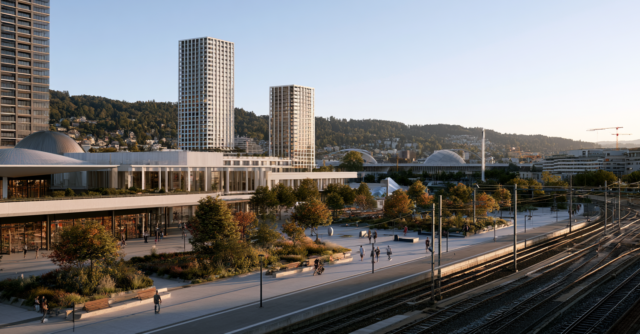
    The project competition was announced as an open, single-stage and anonymous procedure for general planning teams, with eight teams submitting proposals on time. The jury assessed them according to functionality, cost-effectiveness, sustainability, urban planning and architecture and awarded the contract to the “Insieme” project by Bob Gysin Partner from Zurich. The centerpiece is a new seven-storey building along the railroad line, which makes a clear contribution to urban densification and orients the campus more towards the station.

    Bright learning landscape
    In future, the new main entrances will be oriented more towards the railroad station, thus relieving the existing access through the adjacent residential area. All gymnasiums will be accessible via the newly defined entrance area, which will simplify routing and orientation. The arrangement of classrooms, group rooms, atriums and meeting zones creates a bright, flexible learning landscape that supports different forms of teaching and informal encounters in equal measure.

    Building sustainably, upgrading open spaces
    In terms of construction, “Insieme” relies on a combination of existing buildings and timber construction. With the exception of the basement, the existing building in Wing B is being dismantled and extended with a timber ribbed ceiling to create a six-storey building. The design of the open space responds to the climate heating by shading the existing staircase and enhancing it with additional planting and seating. The edge of the forest will have new recreational areas and loose tree planting, which will significantly increase the quality of the outdoor space.

    Next steps until commissioning
    In the first quarter of 2026, the jury’s comments will be reviewed and the competition project optimized if necessary. The extended facility is currently scheduled to open in 2035. Around CHF 97.4 million has been set aside in the cantonal financial planning for the expansion and partial renovation of the BBZG W in Sursee. An investment in future-proof vocational training and a strong educational location in the region.

  • The way is clear for Wil West

    The way is clear for Wil West

    At the second attempt, the voters of St. Gallen say yes to Wil West. The decision is close, but clear enough to create planning security. The vote shows that the region wants to grow. Bundled, plannable and coordinated across cantonal borders.

    With the sale of the land, St. Gallen is handing over a former estate of the Wil psychiatric clinic to the canton of Thurgau. In future, the economic area will be located entirely on Thurgau soil, but will remain within the immediate sphere of influence of the Will region. This creates a clearer starting position for investments, infrastructure and long-term settlement strategies.

    Concentration instead of urban sprawl
    Wil West stands for a model that keeps many regions busy, enabling economic growth without further urban sprawl. Instead of constantly scattering new commercial zones on the outskirts of towns, the location will in future concentrate companies, services and productive jobs in a location with good transport links.

    The plan is not just any old industrial area, but a modern work location. The aim is to create high-quality businesses that generate added value and skilled jobs without taking up an excessive amount of space. The development potential of the region will thus be utilized. For spatial planning, the project is therefore also an instrument for channeling growth instead of leaving it to chance.

    Infrastructure as a driver of development
    Wil West has a particularly strong impact through its infrastructure. With the project, the federal government, cantons and region are linking the expansion of the highway, public transport and pedestrian and bicycle connections. The planned freeway link to the A1 and better rail and bus connections will make the area attractive for companies and at the same time relieve pressure on the existing town centers.

    Sustainability as a location factor
    The first version of Wil West failed due to concerns such as loss of cultural land, traffic and ecological impact. In the revised version, sustainability plays a much more visible role. More compact construction methods, more careful land use and more green and open spaces are intended to reduce the ecological footprint.
    This is precisely what is becoming a location factor for companies looking to relocate. When choosing a location, more and more companies are looking at energy and land consumption, accessibility without a car and an attractive environment for employees.
    Wil West has the opportunity to set a new standard for work zones if quality assurance, phasing and criteria for settlements are consistently implemented.

    Seize opportunities, manage expectations
    With the yes vote for the proposal, expectations are now also rising. Politics and administration must pick up the pace without falling into a hectic pace. The region needs clear guidelines: which sectors should come? What density is desired? How can development be managed over decades without having to change strategy every time the economy changes?

  • Tour Invictus new face for Fribourg

    Tour Invictus new face for Fribourg

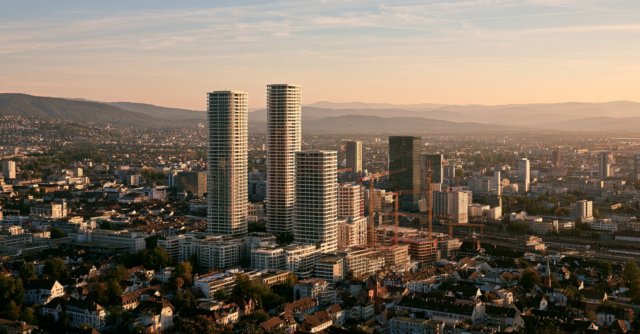
    The Tour Invictus marks a turning point in Fribourg’s urban development. It increases the density of living space upwards instead of continuing to grow outwards. The project is a response to scarce land, changing household structures and an ageing population.

    At the same time, the tower raises the question of identity. How much “high-rise” can a medium-sized Swiss city tolerate? The building will be visible from the city and from afar. It will thus become a symbol of a new phase of urban development that rebalances density, mobility and quality of life.

    New forms of housing instead of classic perimeter blocks
    The mix of uses is clearly geared towards housing, but is finely graduated internally. On the lower floors, there will be apartments suitable for the elderly with assisted living facilities. On the upper floors are privately financed condominiums with expansive views and a high quality of living.

    This vertical mix replaces the classic perimeter block with separate buildings for different target groups. It brings people with different lifestyles together in the same building. For operators, owners and urban planners, this opens up new options for services, neighborhood connections and community building.

    Creating quality of stay
    A tower of this height always provokes the same question. Will density become a burden or a quality? The decisive factor is the design of the transitions. The street level, first floor and surroundings must maintain the scale for pedestrians. Green outdoor spaces, a clear address and legible entrances determine whether the tower is perceived as a foreign body or as a natural part of the neighborhood.

    What counts inside is the sense of spaciousness. Daylight, room heights, private outdoor spaces and views are the counterbalance to the large number of units. Where open spaces are deliberately moved indoors, for example with communal rooms, roof terraces or usable arcades, identification is created instead of anonymity.

    Opportunities for the city
    For the city of Fribourg, the Tour Invictus is both an opportunity and a test case. It shows how investors, planners and authorities deal with densification targets. The handling of traffic, development, shading and the neighborhood will be closely monitored. If the project is successful, it will strengthen the acceptance of further vertical densification.

    At the same time, the area of tension remains visible. A high-rise triggers discussions about the skyline, character and social mix. Managers in administration and the real estate industry are called upon to actively moderate this debate. Clear narratives are needed as to why density does not mean sacrifice, but rather enables new forms of urbanity.

  • Urban change on the Wellis site

    Urban change on the Wellis site

    One of the region’s most exciting transformation areas is located between the railroad station and the old town. Halls, warehouses and work yards are being transformed into an urban quarter with its own character. The area thus plays a key role as the gateway to Willisau.

    The area is roughly the same size as the historic old town. The previously closed production site is being transformed into an open piece of town. Paths, squares and open spaces will connect the station, the old town and the district. The previous barrier will become an urban interface.

    Mixture instead of monofunction
    The development clearly focuses on a mixture of uses. Several hundred apartments of different sizes and typologies are planned, supplemented by areas for commerce, services and local amenities. Living, working, shopping and leisure are moving closer together.

    It creates frequency throughout the day, increases the utilization of the infrastructure and reduces dependency on a single type of use. At the same time, it opens up scope for new forms of work, small-scale service providers and local suppliers.

    Identity from the industrial past
    The Wellisareal remains recognizable as a place. Parts of the existing building fabric will be preserved and used for new purposes. The industrial character not only provides history, but also identity. It clearly distinguishes the district from green meadow developments on the outskirts of the town.

    New buildings complement the existing buildings without covering them up. A high point marks the area in the silhouette of Willisau. The decisive factor here is not the height alone, but the effect in the urban space. This creates an image that remains anchored in the perception of residents, visitors and investors.

    Open space as a location factor
    The project consistently combines density with open space. Generous green spaces, trees, squares and paths structure the quarter and ensure a quality of stay. Instead of the inner courtyard as a residual area, the open space is at the center of the concept.

    For future users, this is more than just a matter of comfort. Shaded recreational areas, well thought-out outdoor spaces and differentiated microclimates are becoming hard location factors. They influence rentability, image and long-term value development. A robust open space concept also supports the adaptability of the neighborhood over its life cycle.

    Rebalancing mobility
    The location directly next to the train station and close to the old town allows for a low-traffic approach. Priority is given to pedestrians and cyclists, with public transport services within walking distance. The project deliberately reduces the number of parking spaces and focuses on alternative forms of mobility.

    For local authorities and investors, this means less land consumption for cars, more space for value creation and quality of life. At the same time, there is increasing pressure to think of mobility as an integrated offer. From sharing solutions to logistics and neighborhood services.

  • New CKW headquarters strengthens Emmen

    New CKW headquarters strengthens Emmen

    With the “EnergiePark Emmen” project, CKW intends to further develop its existing site on the Reussinsel. The centerpiece is a new plant building for the Grids and Building Technology divisions, including a grid base for the construction, operation and maintenance of the electricity grid in the greater Lucerne area. The employees previously based in Reussbühl will thus have modern workplaces in Emmen, and processes will be bundled in terms of space and organization.

    Commitment to Emmen and more jobs
    The Reussinsel is CKW’s historic place of origin, where the first power plant went into operation in 1894. With the planned relocation of its headquarters, CKW is building on these roots and making a long-term commitment to the Emmen site. The number of employees on the Reussinsel will increase from around 600 today to around 1,000, which will generate additional tax revenue and strengthen the economic development of the municipality.

    Careful planning and inward densification
    The guideline project was developed in a planning process lasting several years with the municipality of Emmen and a study contract with five planning teams. The “Compakt” project by Penzel Valier AG with Maurus Schifferli Landschaftsarchitekten was selected for its urban planning quality and sensitive integration into the landscape. The project consistently focuses on inward densification. The valuable natural space on the Reussinsel remains untouched and additional buildings are only planned as a long-term reserve.

    Traffic, development and next steps
    An important part of the project is the development and traffic management. Mobility measures are planned together with Emmen and Ebikon, including a new bus stop in the Rathausen area, adjustments to the road infrastructure and mobility management with trip caps and balanced traffic distribution. Based on the indicative project, the municipality of Emmen is now drawing up the development plan with the active involvement of the local population. According to the current timetable, concrete construction projects could be approved and implemented from 2030.

  • Society for affordable housing aims to create permanently affordable living space

    Society for affordable housing aims to create permanently affordable living space

    The new real estate company GEW aims to raise private capital for permanently affordable housing for people with low to medium incomes in Switzerland. GEW was founded in December 2025 against the backdrop of an increasing shortage of affordable housing in Switzerland, according to a press release. It will develop, build, acquire and operate residential properties with rents in the affordable segment of the local market, which are to be below the 50th percentile in the respective municipality.

    GEW aims to contribute to social stability in Switzerland through its work. Rising rents, a lack of building land reserves, restrictive regulations and high land and construction costs have meant that housing production can no longer keep pace with demand. “When housing becomes a concern, new answers are needed,” said Reto Brüesch, Managing Director of GEW, in the press release. “We are convinced that the private sector can and must take on part of the responsibility with entrepreneurial thinking and a clear focus on the common good.”

    The GEW model is based on three pillars: efficient development and construction, cost-effective operation and low capital costs due to low risk. This creates an economically viable approach that combines affordable rents with entrepreneurially responsible investments. “Investing in GEW creates affordable housing in Switzerland while also generating a fair return and a positive social impact,” explains Daniel Kusio, Chairman of the Board of Directors of GEW. He is supported on the Board of Directors by real estate economist Donato Scognamiglio and Balz Halter, Chairman of the Board of Directors of the Halter Group.

    While municipalities can use GEW to create affordable housing without excessive financial burden, owners benefit from transparent models such as sale, building rights or contributions in kind. Investors, in turn, gain access to a long-term investment with a stable income structure.

  • Property portfolio grows despite stable income

    Property portfolio grows despite stable income

    The real estate company PSP Swiss Property has announced its 2025 business results. Property income reached 349.2 million, down 0.2 per cent on the previous year’s result. On a like-for-like basis, however, growth of 1.3 per cent was achieved, mainly due to index adjustments. Profit excluding property gains amounted to 225.4 million, or 4.91 Swiss francs per share. Net profit rose by 8.9 per cent to CHF 408.5 million, mainly as a result of higher portfolio revaluations of CHF 231.1 million. Earnings per share increased to CHF 8.91 and the dividend per share to CHF 3.95.

    The portfolio value rose to CHF 10.1 billion at the end of 2025, with 150 investment properties and ten development properties. The revaluation was mainly driven by successful lettings in high-street retail in Zurich and rising market tenant expectations in prime locations. The vacancy rate was 3.5 per cent. The average remaining term of leases (WAULT) was 4.9 years, and 5.3 years for the largest tenants.

    Overall, the Swiss market for commercial properties remained stable, according to the report. In 2025, high-quality office space in central locations was in particular demand. In Geneva and Zurich, demand for city centre locations remained high, while the markets in Bern and Lausanne remained stable. In Basel, the oversupply of office space continued. The investment market picked up over the course of the year thanks to moderately falling interest rates and improved financing conditions.

    PSP expects the market to continue to develop positively in 2026, with stable rental demand in its core business. According to the company, low interest rates are likely to support the transaction market, while high-quality properties remain in short supply. The company therefore intends to invest selectively, exploit opportunities with long-term value growth potential and continue its shareholder-friendly dividend policy.

  • Thun North is developing into a new district

    Thun North is developing into a new district

    The future new district of Thun North is one of the four most important cantonal development priorities and the most important in the Bernese Oberland, according to a statement from the city of Thun. A future-oriented urban quarter and a business location with supra-regional appeal is to be created here on a 60-hectare site. The area will be accessed via a new S-Bahn station.

    Half of the site belongs to Armasuisse Real Estateand half to RUAG Real Estate AG. In 2025, the city of Thun conducted a so-called workshop process with them and BLS for the core area around the planned railway station. Three interdisciplinary teams worked with experts and various stakeholders to develop proposals. From these, an advisory committee derived key parameters for further development.

    The basic framework of the new district is to be formed by open spaces. This will be characterised by the Aare river, the roads, the railway area and the townscape. The existing shed roof hall will form the backbone of the complex. The two landowners want to concentrate their closed industrial sites on the area west of the Alpine Bridge and on the grounds of the textile centre. Mixed uses are planned outside these areas. The Swiss Federal Laboratories for Materials Testing and Research (Empa) will also be one of the key players with its new campus.

    The results of the workshop process will be on display at Thun Town Hall until 6 March.

  • Foundation stone laid for mixed-use building in Frenkendorf

    Foundation stone laid for mixed-use building in Frenkendorf

    According to a statement, Halter AG has laid the foundation stone for the Park3project. Also involved were the client Zurimo “B” Immobilien AG, represented by UBS Fund Management (Switzerland) AG, representatives of Reuter Architekten, the municipality of Frenkendorf and the planning, marketing and implementation teams involved.

    The mixed-use residential and commercial building will be a five-storey structure with an attic, combining living, working and commercial space under one roof. The plot size is 2,607 square metres and the construction costs amount to 14 million Swiss francs. Flexible commercial space will be created on the ground floor, with modern office units on the first floor. The upper floors will feature 22 apartments with 2.5 and 3.5-room floor plans. The project is being developed in an area with good infrastructure connections, which is increasingly gaining urban quality as part of urban development. The site is currently used primarily for commercial purposes.

    The building plans for the project, a UBS annual report and the current issue of the Halter Group’s KOMPLEX magazine were placed in the foundation stone as contemporary documents and permanently anchored in the foundations.

    The focus is now on the construction of the shell, which is scheduled for completion by the summer. The project is scheduled for completion in spring 2027.

    Halter AG is a real estate and construction company operating throughout Switzerland. The company handles a construction volume of around CHF 800 million per year at seven locations and currently has around 320 projects in development and execution.

  • Construction site for retirement home in Schlieren to be set up in March

    Construction site for retirement home in Schlieren to be set up in March

    From the beginning of March 2026, the construction site for the new Schlieren retirement home “Wohnen am Stadtpark”will be visible to the public. Preparatory work will then begin there. Two appeals had led to a one-year delay, but these were withdrawn in December 2025. The legal proceedings have now been concluded. According to a statement from the city of Schlieren, the construction site can now be set up and the initial construction and preparatory work can begin. The official ground-breaking ceremony is scheduled for April 2026. Construction work is expected to be completed by the end of 2028.

    As construction begins, the playground on the western edge of the city park will also be dismantled starting in early March. According to the city, a new municipal playground is already being built at Stürmeierhuus. It is scheduled to be completed in April.

    In the referendum on 12 March 2023, a loan of CHF 44.32 million for the construction of the new retirement home was clearly approved with 76.6 per cent voting in favour. As the city emphasises, it makes “an important contribution to ensuring modern, needs-based care and nursing for the elderly close to their homes”.

  • Canton Zurich creates interface with innovation park

    Canton Zurich creates interface with innovation park

    According to a statement, the canton of Zurich has created the Zurich Innovation Park specialist unit. This implements a decision by the cantonal government in April 2025 to transform the coordination unit, which was previously managed by an external mandate, into a regular organisation. The specialist unit is based in the Office for Economic Affairs and began operations at the start of the year.

    The centre is responsible for ensuring the division of tasks between the Department of Economic Affairs, the Innovation Park Foundation, IPZ Property AG and IPZ Operations AG. It coordinates cantonal projects and involves various stakeholders in the local communities, the federal government, the business community and other partners.

    In addition to the Innovation Park as the most important area development project in the canton, the specialist unit will also focus on the active development of commercial space as a key location factor. This involves space for the growth, transformation and establishment of companies, particularly in or around the Innovation Park, but also throughout the canton.

    Benjamin Grimm is the first head of the specialist unit. The geographer has a Master’s degree in Spatial Development and Infrastructure Systems from the Swiss Federal Institute of Technology Zurich and a Master of Advanced Studies in Real Estate from the University of Zurich. He has worked for the Federal Office for Spatial Development and the Office for Spatial Development of the Canton of Zurich, among others.

  • Relocation marks new stage of development

    Relocation marks new stage of development

    HKGhas decided to relocate within Baden-Dättwil. According to a press release, the engineering and consulting firm will be located at Täfernstrasse 14A in Baden-Dättwil from 1 March 2026. The new location offers more space than the previous address at Im Langacker 20.

    For HKG, this marks “a new chapter in the further development of the location,” according to the company. The relocation will create space for further growth and the future of the electrical engineering, building technology and energy consulting provider, which was founded in 1978 according to its own information.

    The additional space will create a better working environment “for creative ideas, efficient collaboration and future-oriented work”. Employees will be able to develop their full potential in a “modern home” and implement projects even more successfully.

  • Thun North forms a new urban neighbourhood

    Thun North forms a new urban neighbourhood

    The cantonal development centre Thun North is considered the most important business location in the Bernese Oberland and is one of the four premium locations in the canton of Bern. The area between Selve and Lerchenfeld, which is still heavily characterised by military use, is to be gradually opened up for new uses. This will create space for working, living and mobility, linked by a new public access route.

    Workshop process as a milestone
    In 2025, the city of Thun conducted a workshop process together with Armasuisse Immobilien, Ruag Real Estate AG and BLS. It marked an important milestone in the transformation of the area. The task was to identify ways in which the site could develop into a modern, networked urban district. In addition to the future Thun Nord S-Bahn station, the creation of a lively urban environment is at the centre of the project.

    Open spaces as a basic framework
    The planning considerations focus on open spaces as a connecting element between the closed military areas to the south of the site. The three interdisciplinary teams developed several approaches in dialogue with experts, owners and interest groups. Despite different concepts, a common core emerged. The open space, Aare, Alpenbrücke and Allmendstrasse form the supporting framework to which future neighbourhood structures will connect. The new railway station also makes reference to the existing buildings. The striking shed roof hall will serve as the backbone and identity carrier.

    From idea to realisation
    The next phase is now starting. In a so-called synthesis, the city, owners and project partners are working on further refining the open space and neighbourhood structure. This forms the basis for the next, harmonised plans, such as infrastructure projects or the necessary planning instruments. Thun North is thus taking shape as a forward-looking neighbourhood that combines economic strength and spatial quality.

  • New investor for Werkmatt Uri

    New investor for Werkmatt Uri

    On 25 February 2026, Director of Economic Affairs Urban Camenzind and Risa Immobilien SA signed the purchase agreement for construction site 11 on Werkmatt Uri. This is based on a purchase rights agreement concluded in 2024 between the Canton of Uri and IG Innovationspark Gotthard. In recent years, the IG has developed the project idea for a functional, sustainably built and architecturally impressive commercial and service building. In October 2025, the municipality of Altdorf granted planning permission for a four-storey building with around 4,000 square metres of floor space and room for around 140 workplaces.

    Marcus Weber backs the Uri location
    Risa Immobilien SA is backed by Marcus Weber, an investor with a high profile in Switzerland in the property, tourism and Alpine infrastructure sectors. He has been involved in Sedrun/Disentis for many years and, as Chairman of the Board of Directors and main shareholder of Bergbahnen Disentis AG, is involved in the expansion of the tourism offering there. Weber is also already present in the canton of Uri, for example with investments in the ski lift, mountain restaurant and accompanying infrastructure on the Brüsti in Attinghausen. By investing in Werkmatt Uri, he is expanding his involvement with another forward-looking project in the Alpine region.

    Project enters the implementation phase
    The planned office and commercial building is being built on the northern edge of Werkmatt Uri, within walking distance of the Altdorf cantonal railway station and close to the future A2 motorway junction. Construction is scheduled to start in autumn 2026, with occupation scheduled for 2028, and the investor wants to push ahead with the implementation quickly. This will create attractive, flexible space in a central location for companies that want to utilise Uri’s locational advantages.

    Werkmatt Uri offers further potential
    At around twelve hectares, Werkmatt Uri is the last large land reserve in the Uri valley floor and has excellent access between the cantonal railway station and the A2 motorway. The site is intended to provide over 1,000 jobs in the long term and be developed specifically for industrial, commercial and service companies. In addition to construction site 11, around eight hectares are still available for sale or the granting of building rights, handled by the canton of Uri. Companies interested in sites can find further information online on the Werkmatt Uri platform.

  • Multiple use of private car parks efficiently utilised

    Multiple use of private car parks efficiently utilised

    Many private car parks remain unused for hours at a time, during the day in residential neighbourhoods and at night at work or shopping locations. With multiple use, owners make their car parks available when they do not need them themselves. This reduces the pressure on public car parks, while cities gain space for more greenery, cycle connections and quality of life. The basis for this is a management concept commissioned by the Department of Construction and Transport, which aims to make more efficient use of private parking facilities.

    Four pilot projects demonstrate the potential
    Since the beginning of this year, four projects have been running in which owners are working together with the car park brokers ShareP and Parcandi. PSP Swiss Property is providing around fifty underground car park spaces for multiple use at Hochstrasse 16. Lonza AG opens its company car park on the Lindenhof site to residents at night and at weekends. There are further offers in the St. Alban suburb at the Goldener Löwen and at Dornacherstrasse 8/10, with solutions for residents and commuters alike. The projects will be monitored and analysed for two years and form the basis for further implementation.

    Flexible offers for different needs
    The new parking models are aimed at different user groups. Commuters can book fixed or recurring parking spaces during the week. Residents benefit from secure parking spaces at night and at weekends. Season tickets are available for regular users, while short-term offers are available for spontaneous journeys. The result is a parking system that adapts to people’s everyday lives instead of creating additional space requirements.

    Advice for owners and supplementary neighbourhood parking
    Owners of parking facilities can now obtain advice free of charge. The initial consultation shows how car parks can be managed more efficiently without a great deal of effort. Multiple-use models can also be used without advice and without authorisation procedures. At the same time, the canton is promoting additional neighbourhood car parks. By taking over the Horburg multi-storey car park, it will create over 300 rentable parking spaces for residents from April 2026, thus strengthening the overall offer in the neighbourhood.

  • Industrial site makes way for hotel and modern office space

    Industrial site makes way for hotel and modern office space

    According to a statement, HGC, a building materials supplier operating throughout Switzerland, is relocating its Lucerne site. This move is in response to the development of the former industrial area of Tribschen into a central urban district.

    HGC already relocated its regional transport business to its new site in Inwil last September. The company will also serve all its regional customers from there over the next two years.

    The old site in Tribschen is being converted. The old building at Tribschenstrasse 7/9 was demolished last year. The new Boutiquehotel 6000 is being built here. The new headquarters of the Central Swiss Builders’ Association will be located in the attic.

    The building on the neighbouring property at Tribschentrasse 11 will be converted using the existing supporting structure. The upper five floors will be rented out as offices under the name Tribschen Office. Half of the space has already found tenants. A commercial enterprise and the HGC collection business will be set up on the ground floor.

    HGC has been using the Tribschen site since the early 1920s. The complete renovation and conversion will allow it to benefit from the development of the neighbourhood.

    HGC was founded as a cooperative in 1899 and has its headquarters in Zurich. It trades in building materials and related products. It belongs to its more than 3,000 cooperative members in all construction sectors.

  • How Basel-Landschaft creates spaces for innovation and living

    How Basel-Landschaft creates spaces for innovation and living

    Basel-Landschaft is building for the future. Former industrial sites are being transformed into innovative campuses, flexible business parks and urban neighbourhoods. Dreispitz combines art, education and high-tech on the cantonal border and creates space for 4,000 jobs, research and sustainable architecture at the highest level. Uptown Basel in Arlesheim is positioning itself as a hotspot for Industry 4.0 and medtech with quantum computing pioneers and an ecological beacon character. New neighbourhoods in Muttenz, BusinessCity and AM SCHÄNZLI combine living and working spaces, green open spaces and climate-friendly mobility, further enhancing the location’s profile as a centre of knowledge and innovation.

    In Pratteln, Bredella, the Campus der Wirtschaft and Zentrale Pratteln are creating modern urban living spaces that focus on sustainable development, smart infrastructure and flexible usage concepts. In Allschwil, Bachgraben is developing into a leading life sciences location with the Switzerland Innovation Park Basel Area, where biotech, medtech and pharmaceutical companies are driving forward cutting-edge research and high-tech innovations. The Laufen Industrial Park and Ziegelei Ost in Allschwil are creating momentum for regional production, craftsmanship and community, with a focus on the circular economy and CO² reduction. GETEC PARK is a growth engine for chemistry and life sciences, driven by decarbonisation and ESG standards.

    Basel-Land thus demonstrates how diversity, sustainability and innovative strength are driving transformation.

    Dreispitz
    Dreispitz in Münchenstein (Basel-Landschaft) is one of the most diverse areas in the Basel region. It combines art, education and business. Over 380 companies and around 4,000 jobs characterise the Dreispitz business park, flanked by universities such as the FHNW and creative clusters. The intercantonal site offers space for innovative companies, start-ups, culture and modern educational institutions. A vital location for the future of the entire region.

    uptownBasel
    uptownBasel is currently building the future. Since 2019, a state-of-the-art innovation campus has been under construction for the jobs of the coming decades. The world-renowned dental implant manufacturer Straumann will relocate a total of 1,000 jobs to the forward-looking development area by 2028. Arlesheim will thus become the most important hotspot for medical technology in Switzerland. The campus, which is being rapidly developed by the Staehelin family and Fankhauser Arealentwicklungen, features several buildings already under construction with sustainable architecture of the highest standard. The roof deck has attracted worldwide attention and, together with the seminar and event rooms, is helping to make the site the state-of-the-art centrepiece of the Baselland industrial location.

    Laufen Industrial Park
    The Laufen Industrial Park is located on the former tile factory site of Keramik Laufen AG on the south-eastern edge of the city and has been owned by the Abendrot Foundation since 2017. Following the major fire in 2020, which destroyed around 80% of the building, the commercial site will be rebuilt between 2025 and 2027 as single-storey timber frame buildings. The aim is to create a modern, affordable offering for small regional businesses, craftsmen and creative professionals, with flexible rental spaces and individual expansion options. A network of commercial streets ensures good access, lighting and promotes networking among users. Densification and multi-storey extensions are possible in order to respond flexibly to regional demand. The focus is on sustainability. The concept is characterised by the reuse of building components, wood instead of concrete and renewable energy. An area association is to strengthen cohesion. The overall result will be a regionally relevant, versatile and sustainable commercial centre.

    AM SCHÄNZLI
    The new AM SCHÄNZLI district in Muttenz marks an urban reinterpretation of living, working and leisure at the gateway to Basel. By 2029, three high-rise buildings with 385 apartments and 14,000 m² of commercial space will be built on the 74,000 m² “Hagnau Ost” site. A central square and intensive greening lend urban density a quality of life right next to the Birs recreation area. The focus is on resource-saving construction, energy efficiency (SNBS Gold), photovoltaics and optimised mobility for pedestrians and cyclists. AM SCHÄNZLI stands for modern location development and the sustainable integration of city and nature.

    BaseLink site
    The Bachgraben site in Allschwil has developed into a driver of innovation in Basel. The location combines international life science companies, state-of-the-art research and sustainable urban development. Projects such as the BaseLink site and new public transport and cycling initiatives are creating attractive jobs and an urban environment. Close cooperation between the canton, municipality and business community ensures dynamism and makes the area a showcase project in the tri-national region.

    Business campus
    The new business campus is located directly next to the railway station in Pratteln and is developing into one of the most important event and work locations in the Basel area. By 2028, the H² building will become a state-of-the-art centrepiece. Six floors offer over 10,000 m² of flexible laboratory, event and office space, complemented by a congress hall for up to 1,900 people and a total of more than 6,000 m² of event space. The campus is aimed at companies from industry, research and services, with sustainable architecture, optimal accessibility, infrastructure from a single source and synergies with the Bredella district. The development strengthens the region’s competitiveness and positions Pratteln as an international centre for innovation, exchange and major events.

    GETEC PARK.MUTTENZ
    GETEC PARK.MUTTENZ is the leading industrial cluster in north-western Switzerland for chemicals, pharmaceuticals and life sciences. It combines state-of-the-art infrastructure, secure laboratory and logistics space, and sustainable energy and resource concepts on 50 hectares. The park, which emerged from Infrapark Baselland and Schweizerhalle, is home to global corporations and numerous SMEs. Innovative solutions such as Waste2Value and ESG-based processes make GETEC a growth engine for the industry.

    Pratteln headquarters
    The Pratteln headquarters project is transforming the former Coop site north of the railway station into a lively, ecologically and socially oriented neighbourhood. By 2026, around 480 cooperative apartments for 1,200 people will be built, complemented by a new school, around 15,000 m² of commercial space and a variety of open spaces. Construction and planning are consistently focused on preserving existing structures, reusing building components and sustainable energy supply. Historic industrial buildings such as the sugar silo will be preserved. The cooperation of six developers and the innovative utilisation concept make Pratteln Headquarters a showcase project for non-profit and sustainable neighbourhood development in the Basel region.

    Bredella in Pratteln
    Bredella in Pratteln represents the large-scale transformation of a central industrial area into an innovative urban quarter. In the immediate vicinity of the railway station, 87,000 m² of diverse residential, work and leisure facilities are being created, interspersed with green spaces and renovated industrial buildings. The master plan and neighbourhood plans focus on gradual development, sustainable mobility and a high quality of life. With a perimeter block, high-rise buildings, commercial and studio space, car-free areas and lively ground floors, a model for urban living in the Basel area is being created. Bredella boldly combines modernity, history and sustainable development.

    Ziegelei Ost
    Ziegelei Ost in Allschwil is undergoing a comprehensive transformation into a lively, mixed-use neighbourhood. Historic buildings are being carefully preserved and combined with new uses for living, working and recreation. The neighbourhood is characterised by large green spaces, diverse public spaces and a finely meshed network of paths connecting three central squares: Kulturplatz, Quartierplatz and Lettenwiese. The industrial tradition remains evident through the preservation of the brickworks halls and their integration into modern structures. The project focuses on circularity, the reuse of building components and flexible new buildings to ensure climate protection, sustainability and a high quality of life.

  • European network opens up new opportunities for Baden in health tourism

    European network opens up new opportunities for Baden in health tourism

    The city of Baden has become a new member of the European Historic Thermal Towns Association (EHTTA). According to a statement, its aim is not only to raise awareness of the importance of Baden’s thermal springs, which date back to Roman times, at a European level, but also to foster exchanges with other spas.

    Membership facilitates joint projects in cultural, health and medical tourism. With its membership, Baden is positioning itself “clearly as a modern cultural and spa town with international appeal,” Mayor Markus Schneider is quoted as saying in the press release.

    TourismusRegion Baden AG is responsible for the operational implementation. “EHTTA membership is much more than just a label for Baden,” Andrea Portmann is quoted as saying. “It is a strategic tool for further developing our positioning in the international market and establishing new partnerships in the field of medical and health tourism,” says the managing director of TourismusRegion Baden.

    The EHTTA is delighted to welcome Baden as a new member. “Baden is an important spa town with a strong history and a clear vision for the future,” says Riccardo Mortandello, EHTTA President and Mayor of Montegrotto Terme.

    The more than 50EHTTA members in 20 countries now include Baden-Baden and Baden bei Wien, as well as Budapest, Karlsbad, Spa, Vichy and Viterbo.