The district building in Baden has been refurbished since March with ongoing operations. According to the media release, all natural stone and artificial stone components are being restored and the facade base plaster partially replaced. The construction work will be completed in October 2021. Under the project management of the real estate department of the city of Baden as the client, the work is strictly based on the historical model. The construction project is being accompanied by Heiko Dobler, building consultant for the cantonal monument preservation department.
The model for the renovation of the former schoolhouse, which was built in 1856/57, is the facade of the renovated Ochsen branch in the spa district. In the course of the renovation work, the existing plastic-contaminated plaster was completely milled off and a new lime plaster was applied based on the historical model. The facade was then given a new coat of paint and all 108 wooden windows were replaced. Both the planned construction time and the budget can presumably be adhered to, according to the statement from the city of Baden.
During the renovation work, two special factors had to be taken into account. On the one hand, there are nesting sites for the protected swifts and alpine swifts. The upper part of the scaffolding was designed accordingly by mid-April. "This meant that suitable nesting sites were available to the birds returning from the south in good time," the city councilor in charge Philippe Ramseier is quoted as saying.
Furthermore, special security requirements of the canton police and the district prison as tenants of the district building had to be met. For example, a three-meter-high board wall and a barbed wire at the end were installed.
Swiss people rarely move. And when they do, in half of all relocations the new place of residence is only five kilometers away from the old one. The average distance is 13 kilometers. This is shown by a representative survey of the house and living situation in Switzerland by Swiss Life .
As the life insurance group explains in a press release , almost 60 percent of homeowners and 25 percent of tenants have been living in their current home for ten years or more. At the same time, however, for around 30 percent of those surveyed, the desire to live in the countryside or at least with a terrace increased during the pandemic.
Around two thirds of homeowners have felt more quality of life and more self-determination since buying their own home. 37 percent said that they were completely satisfied with their current living situation, especially those who owned their own home. 15 percent are moderately or not at all satisfied. Most of them lack space or a garden, or they are bothered by noise and environmental pollution.
Over 60 percent of those who can imagine buying their own home in the next five years expect that this would improve their quality of life. But only 21 percent of them are actively looking for a home of their own.
Requirements for the ideal place to live in terms of costs, equipment and security vary depending on the language region. In addition, a garden is central in the country, and there is a connection to local public transport in the city. If this is perceived as good, the willingness of commuters to move decreases.
A new unit went into operation on Tuesday in the NEST research and innovation building of the Federal Materials Testing and Research Institute ( Empa ) and the ETH Domain's water research institute ( Eawag). As Empa in a message emphasized the office module called is Sprint was completed in just ten months. This demonstrates that building with reused materials and components is “a viable alternative to building with new material”. It “meets the market requirements for flexible and fast building”.
The entire unit follows the so-called design for disassembly approach. If necessary, the flexible partitions could be dismantled. This enables flexible use of space and the recycling of built-in materials.
The still existing skepticism of the construction industry about the reuse of materials is unjustified. Contrary to initial concerns about the tight schedule, "we were even able to find the re-use materials faster than new material," is quoted from Kerstin Müller, architect and business service member at the Basel construction office in situ , which planned the sprint unit.
In addition, reuse is not yet cheaper given the current market situation. However, that will change as soon as a competitive market has developed, believes component hunter Oliver Seidel from in situ. In addition, there is a need for CO2 taxation, "which relieves the cost of new materials and used materials in order to be able to quantify the ecological added value."
Hilcona has created a 1200 square meter roof meadow on the first completed new building at the company’s headquarters in Schaan. According to a press release, the roofs of the five-year expansion will also be planted in an “ecologically valuable” way. “The green areas provide more infiltration areas than concrete-sealed areas, relieve the sewage system and offer essential protection against heavy rain events,” says the Head of Technical Service, Peter Ritzer, in explanation.
As Hilcona further explains, green roofs are able to hold back and store water. Therefore, when building the new company building, care was taken to seal as little area as possible. They also absorb pollutants such as CO2 and clean water and air. On the other hand, the water on sealed surfaces such as conventional roofs, tar and concrete surfaces immediately drains into the sewer system and onto open floors. That causes floods and floods. The green roofs could cushion this.
In addition, they heat up less than gravel roofs, for example. They are also more durable and easy to care for. “With the roof meadow we want to give back as much as possible to nature,” says Ritzer.
A project group set up by the government council of the canton of Zurich has been creating an overview of the Dübendorf airfield area since September 2020. The state chancellery of the Canton of Zurich informs in a statement that the members of the delegation of authorities have now signed the synthesis report. The airfield area is to be used as an innovation park, airfield and for military purposes.
“For reasons of economy and sustainability” and “with consideration for the population”, “only what is needed will be built in stages,” explains the State Chancellery. According to her, the project should become “a beacon for innovative urban development, especially in the areas of environmental compatibility, sustainability and careful use of resources”.
Specifically, the overall view provides for the area to be subdivided into four sub-areas. The innovation park with a focus on mobility, robotics, aviation, space travel as well as modern production technology and materials research is to be built in sub-area A. In sub-area B, the innovation park and a research and works airfield will combine to form an aviation cluster. Area C is reserved for uses with high security requirements. The aviation infrastructures are located in sub-area D, in which nature conservation will play a central role. A circular airfield path is intended to make the area usable for recreation and leisure for the population.
In the next step, planning rights are to be created for all sub-areas, according to the communication. Specifically, a cantonal and a regional structure plan as well as the communal structure and land use planning are named there. The cantonal structure plan will be made public from September 6th to November 5th.
The Zurich Chamber of Commerce ( ZHK ) welcomes the commitment to triple use as an innovation park, civil and military airfield. The vision of an internationally leading location for research and development on mobility solutions is worth supporting, she writes in a press release . However, she regrets the renunciation of business aviation. This is important for the attractiveness of the economic area. Therefore, the doors should not be permanently closed for them.
Schilliger Holz AG from Küssnacht is planning to build a new production plant for wood fiber insulation panels in Perlen. According to a media release, this is to be built on the Perlen Papier AG factory site. The CPH Group , to which Perlen Papier AG belongs, will hand over a land area of 20,000 square meters to the wood processing company with building rights.
Schilliger Holz AG is one of the main suppliers of wood chips to Perlen Papier AG. One of their sawmills is already located right next to the paper mill in Perlen. Thanks to the new plant, the two companies will work even more closely together: Perlen Papier AG will supply the new plant with electricity, process steam, fresh water and fully demineralized water. In addition, it will treat the waste water produced in the company’s own sewage treatment plant.
“We are pleased to be able to realize synergies in industrial wood processing together with Schilliger Holz AG at the Perlen location. In this way, Perlen will become the center for sustainable recycling of the important resource wood in Switzerland ”, Peter Schildknecht, CEO of the CPH Group, is quoted in a press release from his company.
According to Schilliger Holz AG, there has been “no more insulation board production in Switzerland for a long time”. With the implementation of the new plant, the company therefore wants to close a “large gap in the Swiss wood processing chain”. Wood fiber insulation boards are used, for example, for the thermal insulation of the outer shell surfaces of buildings.
The project is currently in the planning phase. Commissioning is scheduled for 2023.
This year, the focus of the Blickpunkt conference organized by the arv Baustoffrecycling association was the quality assurance of the recycling and processing of building materials, even in smaller companies, as well as the requirements for the building products created with them. According to a press release , Blickpunkt 2021 took place digitally on Wednesday.
National Councilor Isabelle Chevalley spoke at the French-speaking digital Blickpunkt, the “Point de Mire”, in a lecture on strengthening the circular economy with regard to building materials. The importance of recycling building materials to conserve natural resources and scarce landfill volumes has meanwhile also been recognized politically and included in the deliberations of parliament. The Commission for the Environment, Spatial Planning and Energy (UREK) is working on measures to promote the recycling of building materials, she is quoted as saying. Still, more efforts are needed, according to Chevalley. Companies should offer building owners such products in a targeted manner. Measures are also necessary in procurement.
Quality assurance is central here. The lecturing experts provided information about the implementation of in-house production controls as well as the reuse of reclaimed asphalt. The standards for this are currently being revised. Here, the association arv Baustoffrecycling Switzerland is committed to promoting recycling and for greater acceptance by all stakeholders, according to the media release.
The results of the first working phase of the model city project were noted and discussed by the representatives of the 13 participating municipalities. According to a media release from the city of Baden , the municipalities' figures and data compiled in four working groups were analyzed and assessed. The further procedure in the 2nd project phase was also decided.
The 13 municipalities of the model city include Baden, Birmenstorf, Ehrendingen, Ennetbaden, Fislisbach, Gibstorf, Mägenwil, Mellingen, Neuenhof, Oberrohrdorf, Obersiggenthal, Turgi and Wettingen.
In the discussion on authorities, administration and organization, considerable differences between the municipalities were found, according to the press release. In the area of finance, it was determined, among other things, that the tax income per inhabitant in the model city in 2019 was 14 percent above the Aargau average. It is also assumed that the debt in the model city communities will increase significantly on average in the financial planning period up to 2025 due to high investments.
In the case of health, society and social affairs, simple and immediate reorganization or reorganization are hardly possible due to the complexity. But cooperation is feasible. The analysis of settlement development, spatial planning and mobility showed that the consolidation of the municipalities would not contribute to a cost reduction overall. Increased efficiency is also possible today.
For the second phase of the project, it was decided to continue working on three topics from phase 1. In cooperation with the University of Applied Sciences and Arts Northwestern Switzerland (FHNW), a “talent pool” is to be developed which enables learners to continue to be employed in one of the 13 model communities after completing their apprenticeship. The other projects are regionalization of tax offices and the development of a joint solution for refugee care. In the second phase, there will be a joint IT infrastructure, model planning for a sub-area of land use planning, and coordination of the development prognoses for the number of pupils as well as school space planning and school buildings.
A new quarter is to create the connection between Suhr Süd and the center. In addition to a twelve-story high-rise, three four- to six-story buildings are being built. Schlieremer Halter AG is responsible for project development and implementation, according to a media release . The foundation stone was laid on Wednesday.
The quarter is being built on an area formerly used by Ferroflex AG. There will be areas for living, services and commerce. Public open spaces with paths and squares, a children's play area and a barbecue area are planned between the buildings. In the high-rise and in the so-called garden house, 59 apartments with 2.5 to 5.5 rooms will be built as residential property. 143 rental apartments are being built in the other two buildings.
The development project will be implemented according to the objectives of the 2000 Watt Society. District heating from the Buchs AG waste incineration plant is used to generate heat. Solar systems will provide some of the electrical energy required.
The building permit for the new housing estate called Unity in the municipality of Menziken has become legally binding. Steiner AG can then start construction work.
As the Zurich developer as well as a total or general contractor notifies , six apartment buildings with 47 condominiums and 51 parking spaces will be created close to the station as a whole. The canton-protected Villa Zur Eintracht, which was built in 1811/12, will blend in harmoniously with the overall situation.
Steiner is thus making a contribution to the promotion of affordable housing. A functional design can be built in a cost-optimized manner. Among other things, uniform windows in all buildings, minimized living space and standardized wet rooms in all apartments contribute to this.
The design plan for the Obertor area was drawn up in a cooperative process with the participation of interest groups from the old town, representatives from the people's initiative for Obertor, the landowners, the city council and the city administration, the administration of the city of Winterthur informs in a message . According to her, the city council of Winterthur has now approved the design plan. Objections can be raised until October 12th.
Shops, offices and apartments are to be built on the approximately 6,500 square meter area in the old town. The design plan provides for different uses for the individual properties. Shops on the ground floor and apartments on the upper floors are planned for the buildings at Obertor 11 and 13. The historical inventory of the building at Obertor 17 is intended to be used to furnish offices. In the court properties Obertor 15 and 17a, the establishment of an innovative mixed use of residential and commercial is planned.
At Badgasse 6, the concept aims to use wellness based on what was once the so-called bathtub mosque, is further explained in the communication. If this turns out to be impractical in practice, renting a health center, for example, will be considered as an alternative. The inner courtyard between Obertor and Badgasse is to be made accessible to the public as a “green island”.
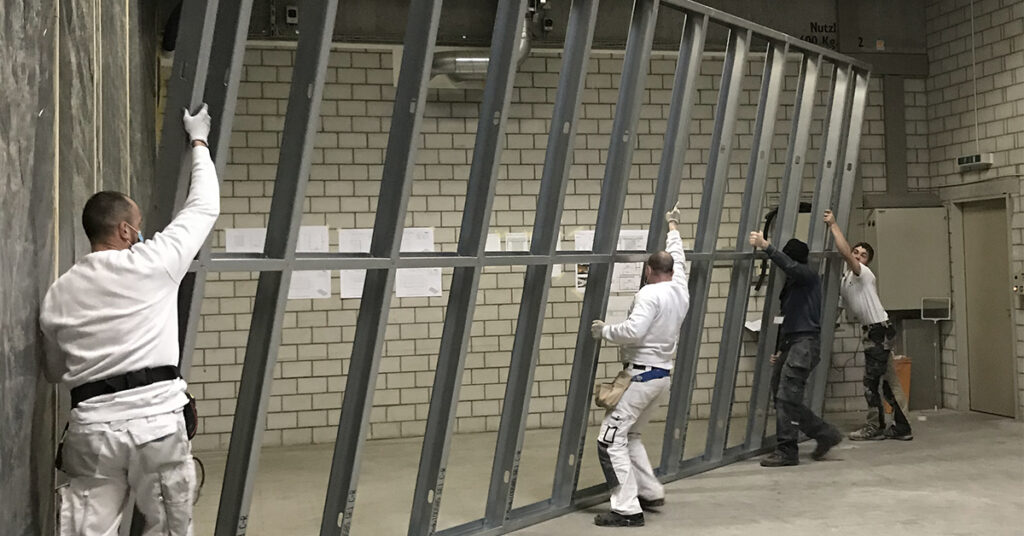
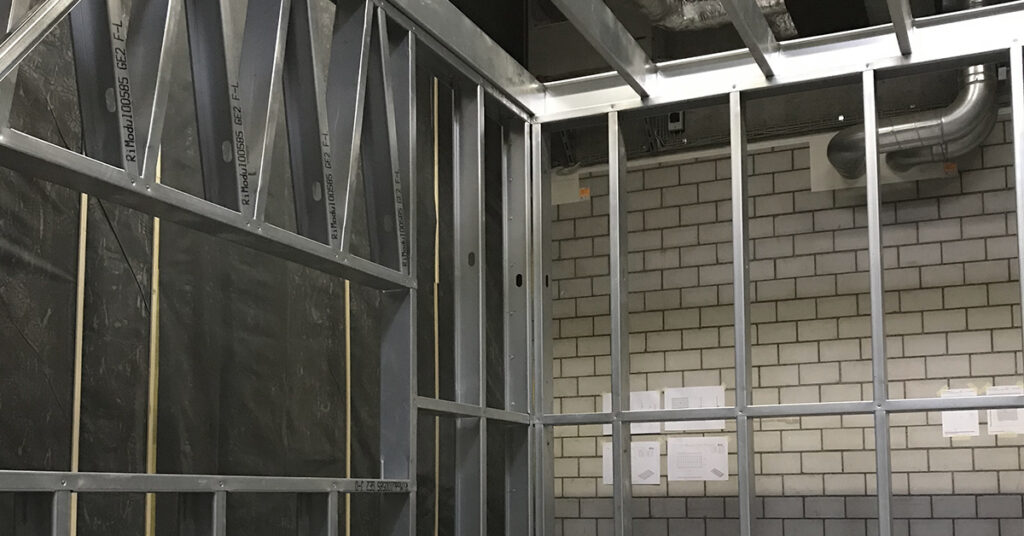
The made-to-measure and numbered steel profiles are assembled like a modular system.
Set up within a very short time: the substructure was up in just half a day.
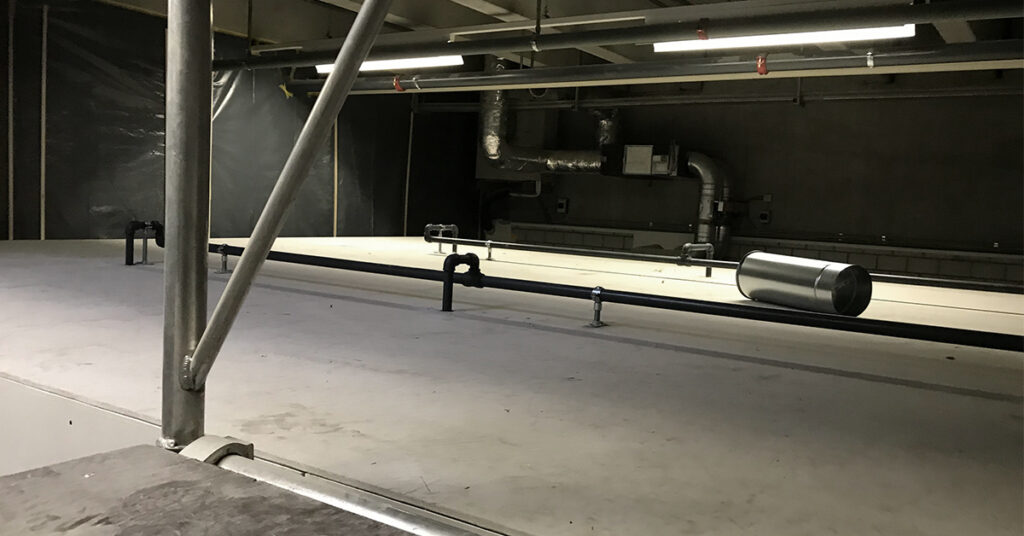
View of the walk-in ceiling of the lounge. Thanks to RiModul®, the area can also be used.
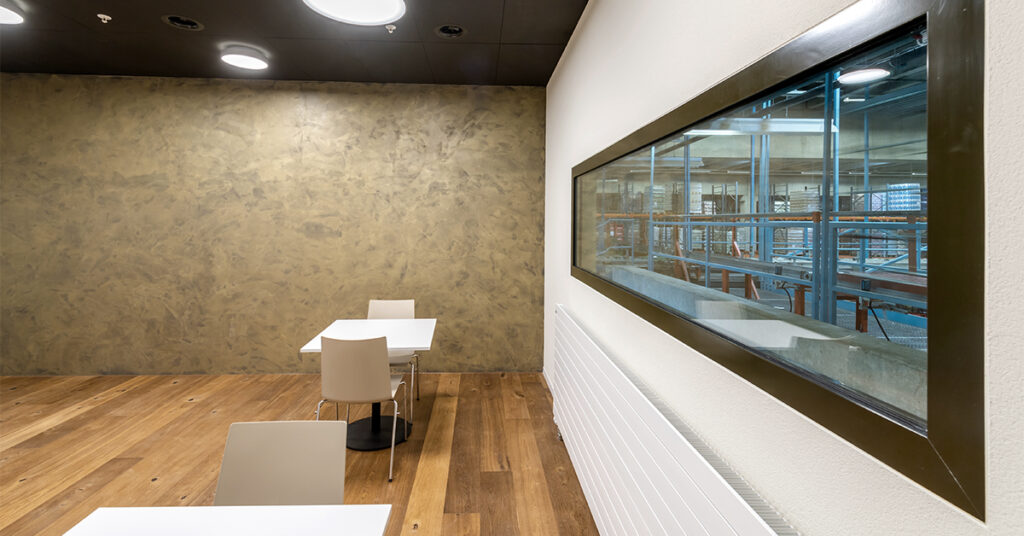
View from the new lounge into the high-bay warehouse.
In a short time, an optimally used room was created that meets the highest noise and fire protection requirements.
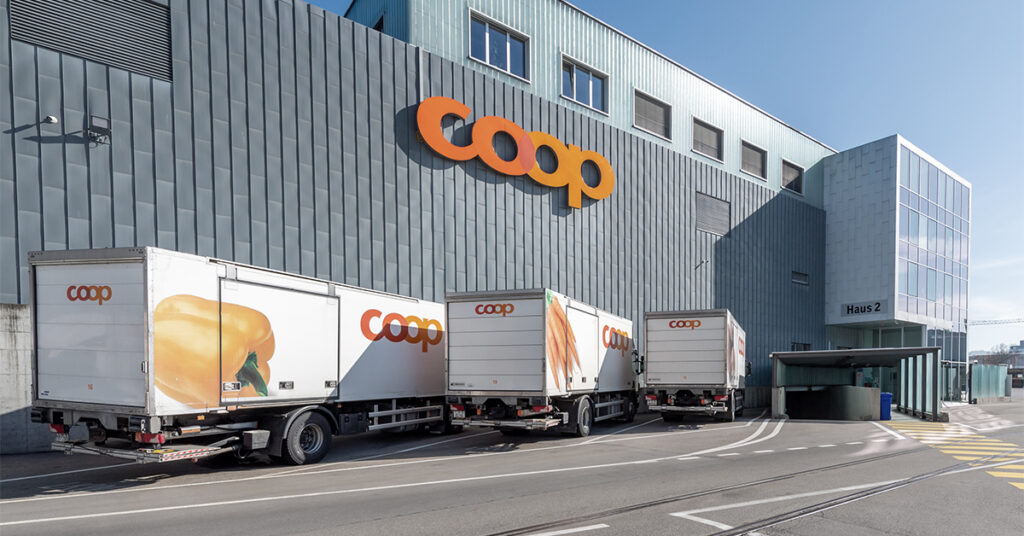
In the Coop distribution center in Gossau, employees now have a comfortable lounge.
The drywall builder was challenged: an extensive electrical and ventilation installation as well as a sprinkler system were to be integrated. A fire protection value of REI60 was also required. Since he had already completed product training at Rigips AG and knew the advantages of the new system, the case was clear: RiModul ® . The architect was also quickly convinced: "We had also checked the wood variant, but we reached the limits of the spans and would not have complied with fire protection," says Peter Fässler from MFW Architects. In addition, the slim wall constructions provide more usable space.
Walk-in room-in-room solution Coop had been considering building a comfortable lounge for its employees for a long time. A good 5 meter high room, a kind of gallery, which is also adjacent to other rooms, was ideal for this purpose. But it would have been much too big, with its sand-lime brick walls, not comfortable and not heated. A room-in-room solution therefore offered itself, which could be implemented quickly, without a lot of dirt, but in compliance with all statics and fire protection requirements. Because the assembly took place while the high-bay warehouse was in operation, everything had to be well prepared and done quickly.
Only half a day for the substructure As with all construction systems with a high degree of prefabrication, precise planning data and error-free transmission to the manufacturer were decisive. All steel profiles were cut to size and provided with the screw and punch holes to facilitate on-site assembly. The individual profiles could be efficiently screwed together using numbers and an assembly plan. Thanks to the corresponding planking, the entire construction has a fire protection rating of REI60. Plasterer Hansjörg Alder was enthusiastic: "The steel structure was in the distribution center in just half a day, and within three days it was planked and ready for expansion." You don't notice the stylish room and its quality of stay that it was delivered as a kit and set up within a very short time.
Like lightweight construction, simply much more stable RiModul ® is actually nothing more than lightweight construction with stronger profiles. They achieve the best possible ratio of strength to weight, which among other things leads to dimensionally stable constructions – that is, walkable and resilient ceilings with additional usable area – and increased seismic resistance (earthquake security). And the system is based on the principle of prefabrication, which can reduce the overall construction time by up to 60%. RiModul ® lightweight steel construction systems also result in significantly lower loads on the foundations than conventional construction methods. Complex objects in new construction and renovation can thus be realized safely, economically and with almost unlimited design flexibility. The RiModul ® lightweight steel construction systems are particularly suitable for additional storeys, extensions and, as in the case of Coop, room-in-room constructions. It also makes sense to use it as an external wall system for infilling in hybrid buildings.
In individual parts, prefabricated or pre-assembled Customers can choose from three pre-production stages according to which delivery should take place. You order RiModul ® flat if you want the individual parts and want to assemble them yourself. The profiles are numbered after processing and delivered bundled for each wall or ceiling element. With the help of an assembly plan, they can be easily assembled on the construction site or in an interim storage facility. With RiModul ® frame, the profiles are pre-assembled into frame elements in the production plant and delivered to the construction site. Planking and insulation are then carried out on site. Finally, with RiModul ® frameX, the frame elements are already planked with high-quality panels. It is advisable to make the choice of the degree of prefabrication specific to the property and already in the planning phase. Rigips designs the project in 3D based on the customer's plans and creates static dimensions and measurements. This includes, in particular, the definition of the connection and knot technology for the cold-formed steel structure. The plans for production in the factory are created on the basis of these documents.
The four existing main buildings and other auxiliary buildings in the Läbespark retirement home in Biberist are getting on in years: they were built between 1969 and 1995. In order to improve the quality of life for around 100 residents, the cooperative had a refurbishment project drawn up. Phalt Architekten AG, Wam Planer und Ingenieure AG and Neuland ArchitekturLandschaft GmbH were commissioned for this. A committee consisting of representatives of the Biberist community, the responsible cooperative and various experts accompanied the process.
The alignment project forms the basis for the design plan process and the further project elaboration. The oldest house at Blümlisalpstrasse 12 will be replaced by a new building. The height of this is based on the existing building. Compact small apartments based on the Bonacasa building standard are planned. The 1.5 to 3.5 room apartments will have a wet room with a laundry tower and a loggia facing the park-like inner courtyard. A reduit complements the larger apartments. «The existing restaurant / café Pintli will move into the new building. To do this, we are revitalizing the premises of the former Pintli with commercial and service uses, ”says Ronny Fluri from Bonainvest AG, which takes on the building owner function for the cooperative. A common room is also planned, which should also promote social contact among the residents. The new building will have a parking garage.
So the previous parking lot can give way to a piazza. “We are thus creating another meeting zone and upgrading the area. Our green park with a small pond will have a herb garden, more seating and various exercise elements that are intended to provide incentives for the residents, ”explains Fluri. The surrounding quarter will be better networked by footpaths. But there is still one problem to be solved: “The building that is being replaced has heating for two more houses. We would like to work with geothermal probes in the future. However, various investigations are still ongoing, ”says Fluri. When this has happened, the other buildings can at least be refurbished in terms of energy. There is still some time until construction begins: work is scheduled to start in 2023. The new building should be ready for occupancy at the end of 2024.
In three consecutive winters, the Solothurn outdoor pool is transformed into a construction site. In the first winter, 2019/20, the sports pool at Badi Solothurn was renovated. In the second and third winter, it is the turn of the outdoor swimming pool to be built.
The two stages of renovation of the buildings were preceded by a municipal council decision, a municipal assembly decision and a referendum. In the latter case, the people approved the restructuring loan of 7.8 million francs in February 2020 with 86.7 percent yes-votes.
The renovation is intended to remedy safety deficiencies, the swimming pool is to be made more accessible, processes are to be optimized and visitor flows are to be unbundled, and there should be more showers and toilets. Overall, the outdoor pool should offer guests more comfort after the renovation. Since it is a listed building, the visible changes must be subtle.
With the start of the 2021 bathing season in mid-May, the first phase of renovation in the Solothurn outdoor pool was completed. In this first phase of renovation, underground technical work was the main task. The building structure was repaired and safety deficiencies were corrected. In addition, the northern parts of the extension from 1964, where the entrance area and cloakrooms are located, were renewed in this phase. The construction of new showers and a new cloakroom area also started, which will continue in the second stage.
The second stage of the building construction will begin this year after the end of the bathing season in September 2021. Then the southern part of the extension building with a restaurant, kiosk, cloakrooms, showers and toilets will be renewed. A new lift will enable people with walking difficulties to access the restaurant.
Some preparation and follow-up work may overlap with the end or the start of the bathing season. The outdoor swimming pool should always be possible. The renovated Solothurn outdoor pool is due to go into operation in mid-May 2022.
The Tschopp Holzindustrie AG is a milestone in the construction of its new sawmill at its headquarters in Buttisholz known . The civil engineering work in the saw hall area was thus completed. Now the building construction work is to begin. The building should have a length of 125 meters, a width of 50 meters and a height of 20 meters.
The new sawmill is scheduled to start operations in spring 2023. Tschopp Holzindustrie is investing a total of 75 million francs in the expansion. It is the largest investment in the company's 100-year history to date.
Tschopp Holzindustrie specializes in the production of formwork panels for the construction industry. Since 2005, pellets have been produced from the waste wood for the energy industry. After the new sawmill has gone into operation, timber construction companies will also be offered products that have not yet been manufactured at home or not industrially manufactured in Germany and therefore have to be imported from abroad, such as three-layer natural wood panels.
Lucas Buschauer has received recognition from the Swiss Association of Engineers and Architects ( SIA) for his semester thesis. This has the technical college Grisons now informed . The graduate of architecture studies at the University of Applied Sciences in Graubünden is planning a revival as a brewery for some unused Crotti in Bondo in Graubünden.
The SIA specialist group for the preservation of buildings awards diploma and semester theses throughout Switzerland that present outstanding concepts for the exemplary handling of existing buildings and their preservation. This year a total of eleven works were selected.
Buschauer's semester thesis provides for the renewed use of some Crotti that were spared from the landslide in 2017. These little houses on the shady hillside were once used as natural refrigerators. He wants to convert it into a brewery and a meeting place for the village. Different uses are planned for the individual Crotti. For example, the first crotto would catch the spring water flowing by, and two more would be converted into malthouses. Four of these crotti are intended for the brewing process. He has also planned an inn and a master brewer's apartment.
"Lucas Buschauer's semester thesis impresses with its careful research, a captivating concept idea, which was implemented carefully and in detail and is presented convincingly," said the jury's explanation. As head of the study Christian Auer emphasizes, in addition to the architectural design, “the clarification of constructive and economic issues is one of the educational objectives of our architecture course. It was precisely this know-how that was required for this task. I am very pleased that the Graubünden University of Applied Sciences is competitive throughout Switzerland with its range of courses. "
The Wydeneck was a closed area for over 100 years and was used exclusively by the "Schweizerische Metallwerke AG Dornach" for metal processing. Swissmetal still produces today and uses around half of the area. Small craft businesses and manufacturing SMEs also work.
In 2015, Hiag acquired the area in Dornach and began planning its future use. In close cooperation with the canton and municipality, the owner developed a coherent basis for the transformation of Wydeneck. The leading office for the test planning process was the Zurich urban planning office Feddersen & Klostermann in collaboration with Brühlmann Loetscher. 90 interested residents brought their wishes and suggestions into the planning process during a two-day participation process. On this basis, the master plan was drawn up and approved by the municipal council in 2018. In this context, the new name was also announced: Wydeneck – Metalli im Wandel.
The area-specific sub-zone plan revision and the development of a sustainable mobility concept are currently on the agenda. Central topics are the development of the quarter with a bus line, its own S-Bahn stop and the integration of the feeder to the A18 motorway. Building land is to be re-zoned along the Birs and the river basin is to be revitalized.
The opening of the aeral will initially take place through transitional uses. This creates space for business, leisure and culture. The offers are intended to attract customers and visitors. With the start of the first construction phase, these uses will be successively replaced or relocated. Several hundred apartments as well as commercial and service-oriented offers will be built in the next 20 to 25 years. Some of the existing historical buildings will be renovated and will remain as a contemporary witness of industrial history.
The Wydeneck is to become a lively, mixed and urban district. Around 1,800 residents and a wide range of commercial and service offerings with up to 400 jobs are planned. The publicly accessible riverside park and the preservation of the historical substance also ensure the special flair.
An open day will take place on September 4th to mark the opening of the KREIS House . From 1 p.m. to 6 p.m., the Synergy Village in Feldbach, on which the research project of the Zurich University of Applied Sciences ( ZHAW ) is located, is accessible to all interested parties. You can try out the construction techniques of the KREIS house yourself. There will also be a market with sustainable local products.
Efficient resource-to build the climate and sufficiency building was in May this year started . With this project, the ZHAW Department of Life Sciences and Facility Management ( LSFM ) wants to show how circular economy can be implemented on a reduced living space of 40 square meters. As the ZHAW writes in its invitation, everything in this house is in circulation – from the building materials to the nutrients from the wastewater for fertilizing the roof garden.
Research is constantly developing new, recyclable technologies, materials and concepts for use in buildings, according to the LSFM project description. But the path from basic research to broad application is a long one. Therefore, the KREIS house is providing a room to try out these new technologies and materials. With their feedback, visitors contribute to improving it.
In future, the ZHAW will be offering regular visits. They can be viewed online, as can dates for regular workshops on specific cycle issues. The overnight stays in the KREIS Haus are currently fully booked. The LSFM is also available for individual and cycle-oriented construction advice.
The Institute for Spatial Development (IRAP) of the OST – Ostschweizer Fachhochschule has published a free step-by-step guide for questions about redensification in small communities. It is intended to support communities with fewer than 10,000 inhabitants to prepare their own settlement strategy, according to a media release .
A total of 95 percent of the municipalities in Switzerland have fewer than 10,000 inhabitants. The correspondingly small administrations often do not employ any specialist staff for spatial planning. According to a press release, this means that nobody cares about high-quality settlement densification. Since the revision of the Spatial Planning Act 2014, however, localities have only been allowed to develop within their existing area in order to prevent urban sprawl.
The free guide of the IRAP is intended to give you a start. The paper comprises seven chapters on 40 pages and is intended to answer questions such as "how much growth can our community expect?", "Where in our building zones makes the most sense of densification?" And "how do we launch these projects?".
"With this methodology, qualified spatial planners should be able to work out an interior development strategy for the entire municipality within a maximum of 200 to 300 hours for communities with up to 10,000 inhabitants, and thus for less than CHF 50,000" -Professor Andreas Schneider quoted in the press release.
The complete method manual is available online for download free of charge.
In mid-2012, Hiag acquired the premises of the former paper mill in Biberist. The area with around 277,000 m² of industrial space was used for paper production for a good 150 years. Accordingly, it is very well anchored as an industrial location in the region and is considered a development area of cantonal importance. The area is strategically located along the A1 and A5, between the metropolitan areas of Zurich, Basel and Bassin lémanique. Within the Solothurn industrial cluster, the Papieri area benefits from the networking with numerous companies and research institutions as well as a unique, high-performance infrastructure on the area. In addition to the largely commercial-industrial use, places are to be created on the area where work, culture and leisure uses as well as living can be found.
The Papieri area is ideally located and should become a destination in the suburban country.
Revitalization of the area In cooperation with the municipality and the canton, work is being carried out on the transition to a binding sub-zone plan: "The sub-zone plan is currently being revised, which will encompass the entire area perimeter," says the responsible site developer Michele Muccioli to Immo! Nvest. “We expect 12 to 18 months before the zoning plan becomes legally binding. After three complete lines of paper machines have been sold in the past few years, the remaining lines are currently being sold. In addition, the settlement and provision of usable space will continue to be promoted. " Around 20 companies are currently located on the site, and around 120 people have their workplaces on the paper. Companies from a wide variety of areas are located here. The next step is the partial opening of the area in the area of the Biberist Ost train station. The aim is to activate and revitalize the area. According to Muccioli, this is now possible because the sales and dismantling of the large machines have now been completed.
The Emmenhof is located in the center of Derendingen and looks back on a varied history: It began 150 years ago with the establishment of a cotton spinning mill. In 1897 a girls' home was also built. In 1932 there was another change of ownership: when Scolari AG moved in, the Emmenhof served as a pasta production facility until 1973. From then on, various SMEs settled on the 50,000 m² area. Even today there are around 100 companies that have their offices or warehouse here. The area, which has so far only been built on in the southern part, is characterized by its own hydropower plant, the striking factory and the former manufacturer's villa.
Emmenhof Immobilien AG has planned a fundamental transformation of the area: by 2030, a new quarter with residential offers, leisure facilities, various office and commercial space as well as a catering concept is to be built here. In addition to the preservation of some detached historical buildings, several new buildings are planned. A total of 270 apartments are planned, the construction of which is based on the history of the area. Access to the new quarter is marked on the south side by the “Wollturm” with ten floors, an underground car park entrance and a visitor parking lot in front of it. This entrance is followed by the “cotton yard”, which is framed by two buildings and closed off by the historic factory building. The “Garnwerk”, “Turbinenhaus” and “Därberei” buildings are being built in the north of the site. Generous green areas and direct access to the Emmen Canal and the Schluchtbach give the quarter a natural character.
The development of the area is planned in six stages. The first stage has already been completed and includes the “Spindelgut” project in the southwest. The new building, designed by the architects Liechti Graf Zumsteg, consists of three wings with 14 apartments.
Emmenhof Energie AG is the area's electricity producer. This enables tenants and owners to obtain sustainable energy: from photovoltaic systems that are installed on the roofs of the new buildings and from hydropower. Hot water and heating get into the houses by means of district heating.
The Riverside in Zuchwil combines the best of both worlds: urban amenities and rural tranquility. The owner is the Swiss Prime Investment Foundation, which not only attaches great importance to careful treatment of the environment, not only in this sensitive development. "For us, a holistic, sustainable development of this former Sulzer industrial area also includes regular exchange with the surrounding area and the community in order to be able to respond to the current needs of society in the further development of the existing master plan," says Tobias Hossfeld, Head Development at of Swiss Prime Site Solutions AG, the asset management team of the investment foundation. Markus Hauri, a genuine Solothurn native and his team from mha GmbH, is responsible for the structural developments. At the same time, Andreas Brunner and his team from Wincasa MUSM are working on the best possible management and marketing of the new quarter, which offers space for a wide variety of uses such as living, leisure and business. Seen in this way, around 20 people are permanently busy with the riverside area.
Lots of momentum Last year the RiverYard garden pub was created in an industrial look, which not only received a lot of popularity from the region, but also works wonderfully as a marketing tool. Many guests were already interested in renting an apartment, even though the shell was not even finished. "We did not expect such a rapid momentum of its own", says Leo Smeets, Head Letting at Swiss Prime Site Solutions AG. He believes this development will continue in the future. The restaurateur would also like to stay on the site for the long term and is already working on new ideas with the development team. In the area of living, too, development is being advanced with care and continuity. Various projects are being worked out in line with ongoing demand and will be implemented in the coming years.
Proximity to the quarter Riverside management is currently looking forward to inquiries from other interested parties, for example from the retail and service sectors or the catering industry. Seen in this way, the development from a former industrial area to a lively, diverse quarter is working very well. According to Hauri, more and more people are recognizing the qualities of the area and are able to establish a closeness. The effects of the pandemic have also resulted in only a few changes in rental inquiries.
Kebag in Zuchwil disposes of 221,000 tons of waste annually and supplies the region with district heating and electricity. It is the third largest waste recycling company in Switzerland. 85 percent of the waste comes from the 1,178 municipalities in the cantons of Bern and Solothurn. However, the plant will be 50 years old in 2025 – and will thus reach its age limit. In order to ensure environmentally friendly disposal in the future, a new system is essential. Because with increasing age, failures increase, which lead to expensive business interruptions and disposal bottlenecks, as the company writes on its website.
The company in Emmenspitz is already the largest electricity producer in the region. Throughout Switzerland, the largest proportion of electrical energy is obtained from the rubbish. The planned plant, called Kebag Enova, will in future be able to generate up to 15 percent more energy from the same amount of waste thanks to the latest technology. A special fabric filter and multi-stage flue gas cleaning lead to an almost complete reduction in pollutants. The investment costs amount to between CHF 450 and 500 million. But the new building cannot be implemented without any compromises: 11,000 square meters of forest had to be cleared. As compensation, Kebag is providing the same amount of replacement afforestation at other locations in the canton of Solothurn. The company TBF + Partner AG from Zurich was commissioned with the planning mandate. Penzel Valier AG won the architecture competition in 2017. The Kebag Enova will have two instead of four incineration lines. Larger furnace lines are planned for this, which ensure greater energy efficiency. The building envelope is fitted with solar panels, making it currently the largest photovoltaic facade system in Switzerland. The chimney is attached to the side of the building and rises 80 meters in height. There is a viewing room at the top of this concrete shaft.
One or the other challenge had to be overcome beforehand: A significant change had to be made in 2018 to the cooling. The kebag has always used river water cooling. Cooling is essential so that electricity can be generated and the steam required for this can be used. Due to the revised Water Protection Ordinance, which came into force in mid-2018, the decision was made to use air instead of river water cooling for the new building. In addition, a test showed that the subsoil was not stable enough for the Kebag Enova. Thanks to a pile and slab foundation, this problem could also be solved.
The planning application was finally submitted in 2019. The groundbreaking took place on May 7, 2020. Commissioning is planned for the beginning of 2025.
The Attisholz-Nord area is very large and has massive industrial buildings from bygone times. Cellulose was produced industrially on the Attisholz site for 130 years. Over the next 20 years, the area is to become a lively place for living, working, business, education, research, living, experiencing and enjoying. «There will be offers for all population groups with the most varied of needs in find all phases of life », says Andreas Campi from the real estate developer Halter AG. “The area has huge development potential for the realization of a new living space in an intact landscape with diverse typologies, renovated factory buildings and new buildings. In addition, the city of Solothurn with its high density of cultural offerings is located a short distance away. "
The former factory halls can be used as an event location.
Start of construction in autumn 2023 The public edition of the land use planning has just been completed. As the next planning step, study orders are carried out, which form the basis for the subsequent design plan and the building permit process. In fact, the pandemic had no impact on the planning: “Since we made the relevant information available digitally and online, the planning could take place as originally scheduled. Video presentations made comprehensive information possible. This was also possible thanks to the good cooperation with the municipality of Riedholz. " The planned start of construction for the first stage is now in autumn 2023.
Olten train station is one of the busiest train hubs in Switzerland. The square in front of it is an important traffic hub and has a high volume of car traffic, buses, pedestrians and bicycles. He is also an important figurehead for the city.
The Bahnhofplatz is showing its age, however – it is becoming less and less able to meet the growing demands. Therefore, the project Neuer Bahnhofplatz Olten nbo provides for a comprehensive reorganization and redesign.
The square and its adjacent streets should meet the various mobility needs of the city and region – with sufficient capacity for traffic, an expanded bus station, a large bicycle station, underground parking and separate areas for taxis, short-term parking and “kiss and ride”. A large roof following the platform will mark the entrance area to the train station and give it a new face.
Continuous terraces on both sides of the station bridge should invite you to linger. A new footbridge is intended to act as a tension band bridge for pedestrians and bicycles, providing direct access from the left bank of the river to the train station and the new bicycle station. With the extension of the Hardegg pedestrian underpass, a new, direct access from the train station to the Aare area will be created.
In 2012, the canton of Solothurn, the city of Olten and SBB Immobilien joined forces to form a builders' association. In 2019 they presented the project to the population as part of a public participation. The tender for the master builder work is to take place in 2024. The phased realization of the new station square with ongoing operations is planned for the period 2025 to 2028.
In 2022, the Trimbach community will say goodbye to its longstanding figurehead: the Wernli biscuit factory. Since the beginning of the 20th century, they have been making their biscuits, which are known throughout Switzerland, on the Breiti site.
Following the takeover of Wernli AG by Hug AG in 2008, the production site will soon be relocated to the new owner's headquarters in Malters, Lucerne. This frees up the space in the best location in the center of Trimbach for a new use.
The new owner of the area, Aare Liegenschaften AG, is developing a new residential area in close cooperation with the municipality. In order to determine the most coherent concept, a study contract was awarded. The Rykart Architekten AG project emerged as the winner from the proposals submitted. The architects won over the jury with an overall urban planning concept that provides for a residential complex with around 150 apartments. The few, compact buildings fit harmoniously into the existing structure of the district.
Four 4- to 6-storey buildings are planned for the front, flatter part of the site. Three higher buildings with up to 9 storeys will be erected in the rear part along the edge of the forest. Thanks to the different heights, the various buildings fit smoothly into their surroundings. Condominiums are planned in the three rear buildings and rental apartments in the four front buildings. An underground car park and bicycle parking spaces are also planned. The “Wernli-Haus” on Baslerstrasse has been preserved as a witness of the industrial past and forms the entrance to the development. A place with trees, which is also available to the surrounding quarters, serves as a meeting place. The future residents are to have their own square in the center of the settlement in the upper area. To the side of this there are two tree groves, a playground and a lawn. The exposed Gämpfibach flows through the entire site.
Public-oriented commercial uses are planned on the ground floors along the streets. Thanks to its location right in the center, the new quarter already offers optimal connections to public and private transport. The area itself remains car-free and is characterized by a well-developed network of paths.
The winning project is currently being further developed and revised. At the same time, the development and layout plan is drawn up. The planning work should be completed in mid-2022.
According to the real estate barometer of Zürcher Kantonalbank ( ZKB ) for the second quarter of 2021, the number of projected apartments in planning applications has decreased by 23 percent compared to 2018. According to the ZKB analysts, this is related to high vacancy rates in peripheral regions, to which investors would have reacted accordingly. In urban centers with low vacancy rates, construction activity is picking up again in some cases, according to the barometer.
Lausanne and Zurich are cited as examples. In the cantons of Geneva and Basel-Stadt, however, the analysts have observed a decline in construction activity. They attribute this to the high regulatory hurdles typical of urban areas and the scarcity of building land. Overall, however, the analysts state that “new apartments are increasingly being planned where the demand for living space is high”.
In the canton of Zurich, the desire for one's own four walls, which has been intensified by the pandemic, is further explained in the barometer. According to him, house prices have increased by 5.5 percent over the previous year and 2.9 percent over the previous quarter. At the same time, the analysts see a shrinking of the offers advertised on real estate portals. They explain this with the fact that many properties are marketed by regional brokers or are already sold before construction begins. For this year and the following, the analysts are assuming excess demand in the residential property market across Switzerland.
The electrical company Jaisli-Xamax from Dietikon carries out all electrical installations for the overall renovation and expansion of the Stämpbach school complex in Vechigen. According to a report in the employee newspaper Brilli's News , the work will be carried out during the three implementation phases while the school is still running. “One of the challenges was to carry out the work while the school was still in operation,” the construction fitter Adrian Thürig is quoted as saying. Nevertheless, it was possible to "produce a clean performance".
The work will be carried out in three stages. According to Jaisli-Xamax, the new construction of the kindergarten, the day school, the special wing and the intermediate wing as well as the renovation of the two gyms were realized in the first construction phase. The renovation of the east class wing and the expansion of the group rooms were implemented in the second construction phase. The work on the third construction phase is still ongoing. The West class wing will be renovated.
According to project manager Luciano Matturro from Jaisli-Xamax, the cooperation with everyone involved in the construction and with the school went smoothly. Matturro was quoted as saying that he was proud that the on-site team did its job well while the school was in operation. Matturro: “We are now on the final spurt to successfully complete the third construction phase.” Two apprentices from Jaisli-Xamax also worked on the project in the canton of Bern.
SV Hotel is continuing its growth strategy in one of the most important and strongest hotel markets in Germany. In the Hamburg city center, directly on the famous Mönckebergstrasse, SV Hotel will implement two concepts in a new building. "It is a unique project that we were able to develop in this prominent location with our partner Redevco," Beat Kuhn, Managing Director of SV Hotel, is quoted in a press release.
The real estate investment manager Redevco is replacing the current C&A building with a climate-neutral new building with mixed use for hotels, retail and catering. It was designed by the renowned London architecture firm Sergison Bates . It had won the architecture competition announced by Redevco and the city of Hamburg.
On eight floors, the building combines a Hyatt Centricboutique hotel with the so-called Stay KooooK extended stay concept developed by SV Hotel itself. The Hyatt Centric's 185 elegant rooms and suites will occupy the second through eighth floors. The roof terrace and hotel bar offer a view of the harbor. To this end, SV Hotel becomes the new franchisee of the Hyatt Hotels Corporation . Beat Kuhn sees this as an “ideal addition” to the SV Hotel portfolio: “We share common values with Hyatt and the understanding that good hospitality can be experienced through the quality of design and service.”
The 85 studios of the Stay KoooK concept are located on the fifth to eighth floors. Long-term guests as well as business and leisure travelers will find a sharing solution with the service of a good hotel, including a roof terrace with a view of the town hall and the Inner Alster.
According to Volker Thamm, Director Business Development SV Hotel, the cooperation with all those involved was so “professional and efficient” that SV Hotel could “very well” imagine “developing further projects together”.
Striatus is part of the “ Time Space Existence ” exhibition. It will be shown by the European Cultural Center as part of the Biennale. Its name (Latin: ribbed, grooved, striped) reflects the structural logic and the manufacturing process of the bridge, said Philippe Block from ETH in a press release from Holcim. “In arched and vaulted structures, the material is placed in such a way that the forces can be transferred to the supports in pure compression. The strength is generated by the geometry, whereby only a fraction of the materials are used that are used in conventional beams. ”This opens up a multitude of possibilities for building with lower strength and environmentally friendly.
"Striatus stands on the shoulders of giants," says Shajay Bhooshan of Zaha Hadid Architects. “It revives ancient techniques of the past.” Its “tactile quality, aesthetics and strength” reflected the vision “that beauty is a promise of performance”. The joint work makes the striatus bridge "greater than the sum of its individual parts", says Johannes Megens, co-founder of incremental3D. According to Holcim CEO Jan Jenisch, the digital and circular design of the bridge uses "concrete at its best, with minimal use of materials and blocks that can be reassembled and reused infinitely".
Holcim claims to be working on a range of 3D printing applications, from complex infrastructure to affordable housing for Africa. In Malawi, Holcim has put the world's first school made of 3D concrete printing into operation. The construction of the walls took only 18 hours and consumed 70 percent less material than with conventional construction methods.
Wir verwenden Cookies zur Unterstützung und Verbesserung unserer Dienste. Mit der Nutzung dieser Website erklären Sie sich mit der Verwendung von Cookies einverstanden. Weitere Informationen finden Sie in unserer Datenschutzerklärung.