Category: Projects

  • ImmoScout24 launches platform for new construction projects

    ImmoScout24 launches platform for new construction projects

    A platform with a clear focus on the specific marketing needs of new construction projects has so far been lacking in the Swiss real estate market. ImmoScout24 closes this gap: From June 1, 2021, real estate professionals and seekers will have a dedicated area for new construction projects on ImmoScout24.ch/Neubau. The company is thus offering all of its marketing strengths for advertising new Swiss buildings.

    Targeted addressing of interested parties

    The platform guarantees advertisers maximum visibility and targeted prospecting. Searchers benefit from finding suitable offers more quickly. The menu item “New building” is visible to visitors of immoscout24.ch at first glance and refers to the platform for new buildings. New buildings also stand out in the regular search results list with a label. In this way, complete new construction projects or individual residential units can be found even faster and thus sold and rented out more easily. Martin Waeber, COO of Scout24, knows that there is a particular need for the new platform among advertisers: “ImmoScout24 is a strong, trustworthy brand. When customers use our marketing and rental processes, they benefit directly from our reach, ”says Waeber.

    Stronger lead performance through AI push

    The ImmoScout24.ch/Neubau page strengthens the lead performance of the properties with the latest technology and artificial intelligence. From the start, a data-driven recommendation engine from ImmoScout24's cooperation partner Homsters works in the background. The insertion takes place via the customer's CRM interfaces. To this end, the platform works together with the subsidiary CASASOFT.

    Waeber is certain that the project will be crowned with success: “We are accelerating the marketing process, making it more cost-efficient and ensuring transparency. New building developers and agencies have the opportunity to publish an entire project, including individual project websites. In this way, your brand awareness can be expanded in a targeted manner. "

    New advisory team for new construction projects

    In order to promote the new building platform, ImmoScout24 relies on a strong sales team that was specifically created for the project. «We are very pleased to have Daniel Bruckhoff on board as Head of Sales New Building since April 1, 2021. In this role, Daniel Bruckhoff will be responsible for sales in the area of new buildings, ”said Waeber. As a proven real estate specialist, Bruckhoff has many years of experience in online marketing and most recently worked as a business developer. He leads a sales team of two people. Thanks to the new platform, four jobs have been created so far, and more will follow.

  • JED wins design award

    JED wins design award

    The real estate development JED in Schlieren was able to convince in an international architecture competition. She received the Silver Award at theA 'Design Award and Comeptition . As part of the global competition, 2094 winners from 108 countries and in 104 design disciplines were chosen.

    JED was honored for its interior design, according to a message from real estate developer Swiss Prime Site on LinkedIn. In addition to Swiss Prime Site, the Zurich architecture firm Evolution Design is behind the design.

    JED was created on the former printing center of the “Neue Zürcher Zeitung” in Schlieren. The development offers space for workplaces and events. JED sees itself as a “center for knowledge transfer, innovation and entrepreneurship”.

    "The project shows how industrial premises can be transformed into attractive destinations that revitalize local (economic) activities and create a platform for entrepreneurship," said the jury of the A 'Design Award and Competition. The architectural concept emphasizes the special features of the individual halls and gives the original structure a contemporary profile. The jury also praised the rooms in such a way that they enable knowledge transfer, creativity and innovation.

    The aim of the A 'Design Award and Competition is to make special architectural projects from all over the world known. This is intended to inspire new projects.

  • "Gupfengarten" in Niederweningen receives building permit

    "Gupfengarten" in Niederweningen receives building permit

    The building permit for the Gupfengarten residential development in Niederweningen is now legally binding. According to a media release, construction on a well-developed area south of the 3,000-inhabitant village should begin in late summer. The project is being implemented by the Zurich project developer Steiner AG on behalf of Evostate Immobilien AG.

    The Gupfengarten project comprises 36 single-family houses and three multi-family houses with 21 condominiums. It should be completed by the 3rd quarter of 2023. Graf Biscioni Architekten AG is responsible for the architecture.

    Othmar Ulrich, Head of Real Estate Development in the Eastern Region at Steiner AG, points out in the press release that the marketing of the apartments began last year. "With the legally binding building permit, another important milestone has now been reached," said Ulrich. The 36 row single-family houses with 4.5 and 5.5 rooms have their own private garden and are child-friendly. The 21 condominium apartments with 2.5 to 4.5 rooms have a covered outdoor area. The traffic-free settlement has an underground car park with direct access to the residential units.

    The Gupfengarten project focuses on sustainability with heat generation using a heat pump and photovoltaic system. The building envelope is made of wood for optimal thermal insulation values. The Gupfengarten development is within walking distance of the train station. From there it is 35 minutes by train to the center of Zurich.

  • The most modern Swiss sawmill is under construction

    The most modern Swiss sawmill is under construction

    Tschopp Holzindustrie AG in Buttisholz is investing 75 million francs to replace its now 21-year-old and overloaded sawmill. According to the company, the most modern sawmill in Switzerland is to be built on an area of 20,000 square meters. The company is run in the third generation by the brothers Ronald and Daniel Tschopp.

    With this investment, Tschopp Holzindustrie AG is setting an important example for the domestic wood industry, according to a media release. This means that more wood-based materials made from Swiss wood could be made available to the market in the long term.

    The new plant is designed for 300,000 cubic meters of logs. They should be managed from the log yard in one-shift operation and from the sawing line, including the sorting plant and stacking systems, in a maximum of two shifts. The wood species spruce / fir from local forests would also be processed in the future. Tschopp continues to rely on the "long-term and professional partnership with the proven raw wood suppliers".

    Tschopp Holzindustrie AG specializes in the manufacture of formwork panels for the construction industry. Since 2005, pellets have been produced from the waste wood for the energy industry. Tschopp is the market leader in Switzerland in both areas.

    After the new sawmill has gone into operation, timber construction companies will also be offered products that have not yet been manufactured at home or not industrially manufactured in Germany and therefore have to be imported from abroad, such as three-layer natural wood panels.

  • Implenia is building an underground station in Stockholm

    Implenia is building an underground station in Stockholm

    Implenia AG has been commissioned by the Stockholm region to expand Stockholm's blue metro line. The construction and real estate service provider is to build the new Sofia subway station with associated elevator shafts, two single-track tunnels for the subway and a parallel service tunnel, according to a media release . The order is worth around CHF 110 million.

    The new Sofia subway station near Stigbergsparken is one of the deepest subway stations in the world with its location around 100 meters underground. Eight high-speed elevators will take commuters to the platforms and exits in 30 seconds. Construction work is scheduled to begin this summer and continue until the end of 2025.

    For Implenia, the new order is a continuation of the London Viaduct tunnel, the construction of which the company was entrusted with by the Stockholm region in 2019. Work is currently underway and paving the way for the future main tunnels in Sofia. "It is an honor to take on another tunnel project of this magnitude – a complex, multidisciplinary project that fits perfectly with our expertise," Per Linden, President of the Implenia branch in Sweden, is quoted in the press release.

    With the preparatory work on the London Viaduct, the tunneling experts could ensure that Sofia would be built safely and efficiently. Implenia is primarily responsible for the implementation work and the planning of the concrete work. The Stockholm client is responsible for the overall planning.

  • Circulit concrete is being delivered for the first time

    Circulit concrete is being delivered for the first time

    In Stadel, the recyclable concrete was delivered circulit for the first time. This will create three apartment buildings on Hinterdorfstrasse. “The circular age begins with the delivery of the first cubic meters of circular concrete,” writes the newly founded company , which calls itself just like its product, in its press release .

    Thanks to the use of 1850 cubic meters of circular concrete, the builder EBI Immobilien saves 3260 primary raw materials. It also reduces the construction project's carbon footprint by 18,500 kilograms. This is achieved by using a “new type of technology” to store CO2 in the concrete.

    This building material "gives me the opportunity to achieve a significant reduction in the biggest influencing factor, concrete," Sarah Heinle from EBI Immobilien is quoted in the press release. "We hope that other clients will follow suit so that we can achieve the ambitious environmental goals together."

    Theoretically, according to Circulit, the construction industry can remove 7.5 million tons of construction waste annually and at the same time store over 42 million kilograms of CO2 in the concrete. The technology is ready for the market and the national expansion has started.

  • Genome researchers at the Irchel campus get a new laboratory

    Genome researchers at the Irchel campus get a new laboratory

    The Functional Genomics Center Zurich (FGCZ) of the University of Zurich (UZH) and the Swiss Federal Institute of Technology Zurich (ETH) is getting a new building on the Irchel campus. The groundbreaking is in May. As general contractor, Implenia AG Switzerland and SAM Architects AG Zurich are responsible for the planning and implementation. With their project, they won a selection procedure from the cantonal building construction office in Zurich in March, according to a media release .

    Accordingly, a new laboratory building of 1300 square meters is planned. This offers space for 20 different room types. This should accommodate high-tech devices that have different requirements in terms of room climate, temperature, power consumption and availability.

    In addition to the laboratories, a new type of office concept is also being created, which offers different opportunities for community and privacy. This new working environment is intended to make work easier for genome researchers and external users, according to the press release. If everything goes according to plan, the 80 employees at the Functional Genomics Center Zurich could move in summer 2022.

    The old building of the genome researchers on the Irchel campus is meanwhile being cleared for temporary use. From 2023, three secondary schools in the canton of Zurich are to move in there. After about ten years, the buildings are to be renovated and handed over again for university purposes.

    Accordingly, the new laboratory building is a temporary solution. It consists of modules that can easily be dismantled and recycled. Because: After 15 years, the scientists should move back into their traditional building.

  • St.Gallen gets a new hotel

    St.Gallen gets a new hotel

    HRS Real Estate AG will start work on the renovation of the Villa Wiesental and a new hotel building on April 26, according to a media release . The building permit was recently received by HRS and the City of St.Gallen Pension Fund. Since the symbolic groundbreaking ceremony will not take place due to the corona situation, the initiators are planning a ceremonial laying of the foundation stone for June.

    The combination of Villa Wiesental renovation and new hotel building is an "excellent urban development solution", according to HRS Real Estate. Both the historical building and the urban development in the Bahnhof Nord district are taken into account. After the renovation, the Pension Fund Stadt St.Gallen would like to offer representative office space in the Villa Wiesental.

    After the planned construction period of two years, the new hotel will be operated by Hotel Wiesental St.Gallen AG. It will have around 100 rooms. Both the hotel's parking area and the publicly accessible ground floor should contribute to the revitalization and upgrading of the quarter.

  • Hotel Rotbuche: energy efficiency, ecology and comfort

    Hotel Rotbuche: energy efficiency, ecology and comfort

    The groundbreaking ceremony for the Hotel Rotbuche in Rapperswil-Jona took place in mid-February of last year. The three requirements and specifications for the energy supply and the energy system for the new hotel were clear: energy efficiency, ecology and comfort. In order to implement these requirements, geothermal probes were drilled as an energy source for the heat pump and a sustainable energy concept was developed in cooperation with Energie Zürichsee Linth (EZL). EZL will also operate and maintain the building technology as a contractor.

    Heat recovery measures
    "The reversible heat pump can be used to provide heat for heating purposes and for domestic hot water," explains Roman Fausch, project manager for energy services at EZL. In summer there is the possibility of cooling the building in an energy-efficient way using geothermal probes, according to the expert. If there is a high need for cooling, there is also the option of using cold from the reversible heat pump. Various heat recovery measures are also installed and, thanks to an intelligent control system, also regulated as required. "In connection with energy and sustainability, it is one of the most sustainable hotel projects that we have been able to plan and implement," says Stefano Ghisleni, general planner at Ghisleni Partner AG, based in Rapperswil, Zurich, St. Gallen and Zug.

    At the Moxy Hotel Rotbuche, the natural heat comes from a depth of around 200 to 250 meters. The 23 probes, distributed over the entire construction area, withdraw 10 to 15 degrees from the ground. The heat is fed into the heat pump in the building using a carrier fluid and converted. This is how it gets into the hotel's heating and air conditioning system. The entire length of the geothermal probe control system is more than five kilometers.

    Reduction of the room temperature by up to four degrees
    Those responsible for the project emphasize that the basic need for room cooling in the warmer seasons in the Hotel Rotbuche can be covered with the environmentally friendly free cooling system. This means that the room temperature can be reduced by up to four degrees. This has a positive side effect: the dissipated heat is in turn temporarily stored in the geothermal probes and can be used for hot water preparation or in winter for heat supply. A photovoltaic system is installed on the roof to operate the heat pump. With around thirty percent, it should provide sufficient coverage to cover part of the electricity demand. "The moderately controlled balancing of heat and cold makes a continuous room climate possible without massive temperature fluctuations," says project manager Roman Fausch. The first guests will be able to feel this for themselves from the coming autumn. At this point in time, the new “Rotbuche” hotel with its 86 rooms is due to open. ■

  • Sonova inaugurates zero-energy building

    Sonova inaugurates zero-energy building

    Sonova Holding AG has realized one of the first zero-energy company buildings in Murten, Freiburg, writes the hearing aid manufacturer from Stäfa in a press release . The new Wireless Competence Center will accommodate 180 employees from the Phonak Communications subsidiary and serve the development of miniaturized communication and hearing protection systems. The new building is part of Sonova's sustainability program. By the end of the year, the hearing aid manufacturer wants to have made all of its business operations CO2-neutral.

    “As one of the first zero-energy company buildings in Switzerland”, the new building in Murten “also belongs to the first generation of CO2-neutral buildings worldwide,” Sonova CEO Arnd Kaldowski is quoted in the press release. According to her, the building adapts to the respective outside climate, so that the temperature inside is always between 21 and 26 degrees. High and perfectly adapted window areas guarantee maximum natural light incidence and regulate the air renewal via controllable ventilation blades. The humidity is regulated by walls and ceilings plastered with lime.

    A photovoltaic system installed on the roof of the building will generate around 260,000 kilowatt hours of electricity per year, the press release further explains. This is more than Sonova needs to run its Competence Center. The excess electricity is to be fed into the power grid.

  • JED gets neon and icons

    JED gets neon and icons

    The JED in Schlieren is to be supplemented by art in architecture, informs a corresponding report on the website of the center in Schlieren. Art in architecture creates identity and meaning and shows the way, it says at the beginning. The owner Swiss Prime Site hired the artists Roland Ammann and Gregory Gilbert-Lodge to realize the works of art in JED.

    Glassblower Roland Amman comes from Neonhaus Ammann and has dedicated himself to the creation of three-dimensional works of art from neon after the lighting industry switched from neon to LED. For the JED he will create three oversized letters, a J, an E and a D. Amman has already installed the first work of art on the ceiling of the Jake barista bar. At first glance, the object, which looks like a fragile shining ball, turns out to be a J on closer inspection, says the report. “I like it when my art has several levels and the hidden only becomes recognizable at a second or third glance,” artist Ammann is quoted there.

    On the wall of the barista bar, visitors can already see the first work of art by Gregory Gilbert-Lodge in the JED. The independent illustrator has provided the bar with an oversized portrait of its namesake Jake in green. Jake is supposed to represent building J and give the bar “a face”, it says in the report.

    Gilbert-Lodge designed portraits of Eve and Didi for buildings E and D. “The fictional characters in the JED should act as icons,” explains the artist in the report. The values and ideas embodied by them, "even an attitude towards life", are what the icons give to the individual buildings, says Gilbert-Lodge.

  • Implenia is renovating the St.Gallen city motorway

    Implenia is renovating the St.Gallen city motorway

    The Federal Roads Office has commissioned ARGE Stadtautobahn with the renovation of the St.Gallen urban motorway between the St.Gallen West and St.Gallen East connections, Implenia explains in a press release . The construction and real estate company from Dietlikon has a 30 percent stake in ARGE Stadtautobahn. In addition to construction work, Implenia will take over the commercial management of the project for the renovation of the St.Gallen city motorway.

    The repair work should start at the end of May and be completed by the end of 2024, Implenia further explains in the communication. During this period, coverings, drainage, edge closures and noise barriers will be renewed and some bridges, galleries, support structures and the Stephanshorn tunnel will be renovated. In addition, the construction of a new passerelle is planned.

    "The renovation of the St.Gallen city motorway is a complex, large-scale project," Christian Späth is quoted as saying in the communication. The Head Civil Engineering Division Implenia is looking forward to being able to “combine Implenia's accumulated expertise in bridge, tunnel and road construction with our extensive experience in managing large infrastructure projects”.

  • ETH Zurich helps with the construction of the Zug wooden high-rise

    ETH Zurich helps with the construction of the Zug wooden high-rise

    A ten-story office building with wooden components is to be built on the Suurstoffi site in Risch Rotkreuz. With a height of 80 meters, it will be one of the tallest wooden houses ever, as the Swiss Federal Institute of Technology Zurich ( ETH ) writes in an article. A lot of basic research is also required for the construction. Due to fire protection, this type of construction has only been allowed in Switzerland since 2015.

    According to the article, basic research for the new building is being carried out in the ETH building hall on the Hönggerberg. There, for example, it is simulated how the timber structure would behave in strong winds. Computer models are not always sufficient for such simulations. This is why experiments are carried out in the ETH building hall. "For us, testing something usually means loading it until it is destroyed," explains Dominik Werne, head of the construction hall, in the article. In the case of innovations in particular, computer models have to be validated through tests, adds Andrea Frangi, Professor of Timber Construction at the Institute for Structural Analysis at ETH.

    Tests on the structure of the Zug high-rise are currently being carried out in the building hall. This is planned by the Zurich engineering firm WaltGalmarini and built by the general contractor Implenia . After the tests at the ETH, the researchers decide together with engineers from WaltGalmarini which systems Implenia should use during construction.

  • City of Baden starts revision of land use planning

    City of Baden starts revision of land use planning

    With the opening event on Saturday, May 29, the participation of the people of Baden in the revision of the land use planning of the city of Baden begins. According to the press release, this revision should take place in several phases and bring a result by 2025, which will then be submitted to the residents' council and the government council for approval.

    After 25 years in which various partial revisions have taken place, it is time to undertake an overall revision, the message says. It is about the structural development in view of the expected growth and the effects on settlement, traffic and open space. The guideline for the overall revision is the spatial development concept 2040 of the city of Baden. The structure plan of the canton of Aargau predicts a population growth of plus 34 percent or 6330 people for the city of Baden from 2013 to 2040. At the same time, Baden is listed on the structure plan map as an economic development focus of cantonal importance.

    The public should be actively involved in the revision of the land use planning, according to the announcement. Information events, dialogue events, walks and workshops take place regularly under the motto “Baden will”. All information on participation can be found on the wiewird.baden.ch website, which was activated on Wednesday.

    The revision of the land-use planning is currently in the first phase, which will determine the process and basis this spring. In the second, a good two-year phase, the draft of the new land use plan is drawn up. In the third phase from 2023 the formal participation and public edition will take place, with the possibility of submitting entries and objections. The third phase will be completed by the city council approving the land use planning revision, is explained in the press release. In phase four, the residents' council and the government council approve the revised land use plan.

  • Winning project from study contract for further development of Aeschbachquartier Aarau

    Winning project from study contract for further development of Aeschbachquartier Aarau

    Winning project known from the Rockwell site study contract

    The Rockwell area belongs to the western part of the Torfeld Süd and was acquired by Mobimo in 2001. Rockwell Automation GmbH intends to discontinue production at the Aarau location at the beginning of 2022. Only the research and development areas will remain at the long-standing headquarters. This will free a large part of the area – and the further development of the Aeschbach district can be tackled.

    As of today, the Aeschbachquartier comprises 167 rental apartments, 92 condominiums, the Aeschbachhalle, the Oehlerpark and commercial space. The urban planning guidelines designed by the renowned Dutch architect and retired ETH professor Kees Christiaanse and the associated vision of the “Urban Village” – an urban village – with diverse uses should also shape the further development steps.

    Mobimo has invited five renowned architecture firms to take part in a study. In addition to the high demands on the sustainability of the project – it should be made of wood and meet the SNBS Gold standard – the results of the participation process from 2020 were also part of the task package.

    The proposal by Baumberger & Stegmeier Architects from Zurich in collaboration with Hoffmann Müller landscape architects and Pirmin Jung timber construction engineers particularly impressed the jury and was chosen as the winning project. Your project envisages an increase in the historical Hall 5 and a new wooden building (see visualization). In addition to the ecological construction method, the winning project is characterized by many green areas with large trees. The project envisages 110 rental apartments of various sizes and suitable for families and senior citizens. Alternative forms of living such as cluster apartments are also to be created.

    Mobimo will invest around CHF 50 million (amount excluding land value). Realization can probably begin in mid-2023, which means that completion would be possible in mid-2025.

    Quote from project manager Thomas Schaz: “We are delighted to be able to open a new chapter in the Aeschbach district. Rockwell Automation remains an important and valued user of the quarter in a reduced space. "

  • Shed Zug: "Every visit to us is unique"

    Shed Zug: "Every visit to us is unique"

    Can you even plan the construction and opening of a gastronomy concept like the Shedhalle in today's crisis-ridden times?
    Lina Fluri: The current situation certainly doesn't make planning the opening easy. However, we are adjusting to the originally planned opening date and are constantly watching how the situation develops. The construction was only marginally influenced by the pandemic and could therefore be carried out without major problems.

    In retrospect, what were the most important changes due to the corona pandemic?
    We recognize significant changes in the difficulty of planning certain projects and uncertainty about future developments. In addition, the home office has fundamentally shaken up the world of work. What was only possible physically in the past is now easily achieved digitally. This development will have far-reaching consequences for various industries and types of work.

    Can you give an example?
    In the catering industry in particular, people's consumer behavior has changed. Take-away food has become more important. The need of people to cultivate more social contacts again is great and will become noticeable in a rush to restaurants and bars after a relaxation. One or the other guest will probably spend an above-average amount of money to satisfy the appetite for social experiences.

    All are corona tired. Can you get something positive out of this long time without meetings and events?
    I believe that the corona pandemic caused a lot of suffering for many people. However, there are certainly branches and industries that have benefited enormously in these times of crisis. On a personal level, I notice that life has slowed down a bit, that we are increasingly focusing on the essentials again and appreciating the little things more, which is basically a very nice development.

    The Shedhalle is intended for smaller events. Is that an advantage nowadays?
    The Shed is characterized by its enormous flexibility. We can hold events for 6 to 300 people and always put together an attractive offer for the customer. However, the focus is on events between 20 and 100 people, which can be an advantage in the coming years. We close a big gap in the market with our private dining rooms, which can be booked for meetings of all kinds. The cozy rooms leave nothing to be desired and offer the customer the unique opportunity to combine business with high-quality cuisine.

    The special industrial charm of the Shedhalle is emphasized again and again. What do you mean by that?
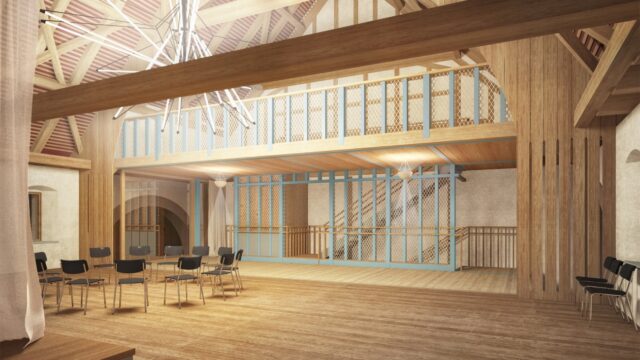
    The Shedhalle will remain as one of two monuments from the industrial beginnings of Zug and is prepared for the next 50 to 100 years. We have tried to carry on the industrial touch with a lot of charm and passion and have created a place where industry meets contemporary and modern architecture. The industrial charm is noticeable in our attention to detail and in the respectful handling of the history of this place.

    Lina Fluri, Shedhalle project manager.
  • New life for the old spinning mill

    New life for the old spinning mill

    "The winning project was selected on the one hand because of the urban development strategy on the northern area, and on the other hand because of the respectful handling of the listed old buildings", says the lead architect Urs Oechslin from Zurich-based Lilin Architects. The two new building ensembles in the foreground of the spinning mill, which are intended for different uses, create a reference to the context through their urban planning anchored in place. The volumetric differentiation is derived from the existing settlement pattern of the urbanized village. The sub-volumes are staggered in terms of depth and height and allow different views of the spinning mill. The building typology thus mediates with great independence between the individual village buildings and the large-scale spinning mill building. In this way, the spinning mill area is given a new, urban face in which the various identities of the building history are superimposed.

    Desired longevity
    Immediately after the study contract, the overall project was concretized, accompanied by the client, the building authorities, the preservation of monuments and representatives from the assessment committee and the neighborhood: "We are about to submit the draft of the development plan and the guideline project to a first round of official consultation" , so Oechslin. It is not easy to build a building park around the spinning mill that can keep up with the quality of the monument and whose beauty and benefits guarantee the desired longevity. In the immediate vicinity of such a monument, the demands on the architectural quality are very high. The cultural acceptance associated with aesthetics is more decisive for the value of the property than some technical innovations. What is no longer publicly pleasing will sooner or later be torn down. What, on the other hand, enjoys a social and cultural status, remains. The real meaning of a house ultimately lies in the contribution it makes to public life in the long term. Urs Oechslin: “If the population, the Baar community and the owners are successful in promising a place of great attraction, then the project will be approved by all authorities. It will have a political majority and will be supported by the broader population. "

    Sustainable renewal
    For some time now, the «Spinni» has not served the purpose for which it was originally built. Since the end of production, a wide variety of uses have established themselves in the rooms. The clear and simple building structure of the spinning mill building is functionally sustainable because user extensions integrated in it can be easily adapted to changes. The high quality longevity of the basic structure achieved in this way is also aimed at for the new buildings. That is why it is being adapted for the new mixed-use buildings. As a result, the proposed building structure is not tied to a specific use and will survive future renovation processes.

    A coherent whole
    The historically and structurally established strong identity of the area is a large fund from which any number of ideas can be realized. Time and again it is important to find suitable means to further develop, reinterpret and supplement this identity. In this way, the high level of social acceptance that the area enjoys today is to be further expanded. "Our motivation is to design a new, staggered part of the settlement with the intelligent combination of architectural, landscape-architectural and usage-specific interventions on the area of the old spinning mill on the Lorze", says Oechslin. And further: “This takes over the existing qualities and complements them adequately and respectfully. The demanding cultural, social, economic, ecological and building law requirements should be combined in a coherent whole in the interests of all those involved. "

    The new use of «Spinni» needs to be carefully considered and planned.
  • From paper to quarters

    From paper to quarters

    “The construction progress of the five buildings of the first construction phase is on schedule despite the pandemic,” says the person responsible for communication, Kathrin Sonderegger. In the southernmost high-rise building with condominiums (Papieri-Suites), the shell is already up to the fifth floor. In the former PM1-4 paper machine halls, new staircases, floor ceilings and apartment partition walls are being installed, as well as the renovation of the facade for the spacious loft apartments and studios (Papieri-Lofts). The new building with 160 rental apartments running parallel to this – 30 of them in the inexpensive range – is also well advanced in terms of shell construction. The Maschinengasse that is emerging between the two buildings is also slowly becoming recognizable. This will be animated at the end of 2022 by the various users of the one or two-story adjoining studios. Underground car parks 1 and 2 are currently under construction, and their parking spaces can be equipped with charging stations for electric cars in a future-proof manner.

    Planning of the second construction phase is well advanced
    The newly renovated and listed Lokremise was handed over to its new owner at the end of the year. Sonderegger says: "After the renovation of the workshop building, the second commercial conversion of a historic building on the site became a reality." At the end of the year, the construction of the new Ringstrasse (Papieri-Ring) began, which is part of the main development of the area and encircles the buildings of the second construction phase. As part of the second construction phase, in addition to the commercially used replacement building for the silo building, two high-rise residential buildings with 61 owner-occupied and 36 rental apartments will be built. Commercial space and a day-care center are planned on the ground floors. 64 micro-apartments complete the housing offer.

    CO2-neutral energy system
    Those responsible for the site development pursue the goals of the 2000 Watt Society. It is worth mentioning the sustainable energy supply of the Papieri area with a self-sufficient, CO2-neutral heating and cooling supply. A significant amount of electricity is generated by the company's own river power plant and photovoltaic systems on the building roofs. The construction of the energy center has been completed and the installation of the technical systems is in full swing. Also as part of the energy system, around 100 geothermal probes have already been drilled and installed to a depth of 320 meters. The energy system will be put into operation in autumn 2021, so that the existing houses and the buildings under construction can already be supplied with sustainable heat this winter. “In addition to the building permit, the canton's concession for the operation of the run-of-river power plant is available, the renovation of which will start in early summer 2021. The area of the former wastewater treatment plant (ARA) will be completely renatured, landscaped and supplemented with a small river arm ”, says Sonderegger.

    Huge interest
    The Cham Group is already seeing a great deal of interest from the population: "The residents find out what is happening on the site and we try to get updates accordingly," says Sonderegger. Unfortunately, the corona pandemic is currently making events such as the open construction site day in 2019 for residents and interested parties impossible. The reactions at the time were overwhelming. “The same thing can also be seen in sales: there is great confidence in our site development and the quarter that is being created here. The first apartments that came on the market at the end of 2019 were reserved within a week. Over 3000 people have subscribed to our newsletter. » One reason for the trust is that the Cham Group will be there as the owner and builder. The team has its offices on the site and is on the pulse of what's happening. Suggestions can be reacted to, feedback and inputs flow directly, and any reservations are defused.

    On June 4, 2020, when the foundation stone was laid, a time capsule was filled with objects typical of the time and built into the foundation of the first construction phase. It should document the building project for future generations. What was the most special item? Sonderegger explains with a laugh: “In view of the fact that we can't even have lunch in a restaurant at the moment, and many people miss this time together in the team, the current menu cards from the surrounding restaurants are items of particular relevance. Who knows whether meat will still be eaten in 100 years' time – then minced meat tats might be part of a forgotten meal. "

  • Suurstoffi: Area development with a model character

    Suurstoffi: Area development with a model character

    «The Suurstoffi offers everything we need for our work. We can no longer be taken away so quickly here, ”says Sanofi Aventis CEO Andrea Meyer. A nice compliment for Zug Estates, which in the last ten years has developed a district in Rotkreuz that impresses with its architecture, greenery and energy efficiency. The once unattractive area has been revitalized. "The Rotkreuz community has an excellent macro location and is easily accessible by public transport," says Martin Jöri, Head of Strategic Site Management at Zug Estates. “The area is right next to the train station, but can also be easily reached by motorized private transport. The quarter is a kind of village within the village, and the campus concept is omnipresent. "

    A healthy mix
    All in all, Jöri appreciates the mix of living, business, research, school and gastronomy. He also likes the typical district infrastructure with a hairdresser or doctor. According to the latest construction status, the area is practically completed: “A construction site with two office buildings (Suurstoffi p. 18/19) has not yet been developed – but the building permit is available. The construction will be triggered in accordance with demand if sufficient occupancy has been achieved beforehand. " Looking back, Jöri regards the high construction speed with the aim of on-time commissioning as the greatest hurdle that had to be overcome.

    “Zero-Zero” goal
    The Suurstoffi is breaking new ground with an exemplary energy concept. On the site, solar use, several dynamic underground storage facilities and an anergy network form the basis for achieving the “zero-zero” goal. That means: the around 165,000 square meter Suurstoffi area is CO2-neutral. The energy for heating and cooling is generated by underground storage and building waste heat, electricity is provided by various solar power systems. The aim is complete self-sufficiency with primary energy for heating and water treatment. It was precisely this ambitious energy concept that particularly appealed to Jöri about the building: “It is a future-oriented vision of a CO2-free quarter with as much energy as possible, which is provided from our own production. But the architecture is also great. There is no uniformity here. Each construction site has a varied design. We also attached great importance to a green and high-quality outdoor space. "

  • The development of the Metalli is going according to plan

    The development of the Metalli is going according to plan

    The Metalli development is located in the core zone of Zug and is to be redesigned. Urban development projects are known to be protracted projects. Interventions in urban structures change the appearance of a city and affect many people accordingly. «We are aware of our responsibility. It is therefore important to find out what the needs of the population, residents and all other users of Metalli are, ”says Peter Wicki, Project Development Manager at Zug Estates. Politicians, interest groups and other groups or people also bring their concerns to the table. The aim is to create an intensely greened, sustainable and ecological metal. The building should have architectural and urban highlights. The current qualities and the wide range of products are to be retained. The interest groups advocate a meeting place where non-commercial activities are also possible. What is wanted is a new town square that will enliven the center near the train station between Zug and Baar, which has grown significantly in recent years. The existing glass passage is valued and should be retained in the same or a similar form. The aim is to expand non-motorized traffic – as well as affordable living space, more pop-up stores and other spontaneous or temporary uses of space.

    Dialogue with everyone
    "This balancing act of involving the various interest groups and yet developing a clear and strong idea that supports this place, which is so important for Zug and makes the city even more livable, is a great challenge and will remain so until the end," says Wicki. Two other key questions particularly stimulate him in this project: “How can we continue to grow without using up more land and still maintaining or even increasing the quality of today's settlement areas? At its core, it is about sustainable, high-quality interior compression ”. Just as important to Wicki is how the inner cities change as shopping behavior changes. "In the new Metalli habitat, we have to find an answer to these two central questions." This is an extremely relevant and exciting task.

    More sustainable and greener
    Nowadays, urban living spaces are designed differently than in the past. The Metalli was never developed as a pure shopping center, as the project development manager explains. Therefore, the area already brings numerous qualities of a modern living space with it. “Today it is already a lively quarter with a wide variety of uses and quality of stay. We want to further strengthen these qualities. " With the new Metalli-Platz, the district is being networked even further with the surrounding city. “The climatic conditions and awareness of sustainability have changed significantly in recent years. The new living space Metalli will become more sustainable and green. " Particular attention is paid to planting more trees and improving the quality of stay outdoors. The usage concept of the new living space should adapt to the current requirements of the Metalli visitors. «The trade will continue to change. The worlds of online and offline will merge. Companies have to find new ways to address consumers, ”summarizes Wicki. Metalli offers an ideal platform for this. In addition, they want to offer more products from the region.

    Last autumn, the structural project by Hosoya Schaefer Architects with Nyx Architects and the landscape architect Lorenz Eugster was submitted to the city of Zug. This project emerged as the winner of the urban planning competition. The development plan is currently being drawn up. A period of two years is planned for this phase. At the same time, the tender for the project competition is being prepared. "If everything continues to go according to plan, we will be able to start construction work in 2025," says Wicki.

  • Vogelwinkel: Family-friendly residential development in a preferred location in Baar

    Vogelwinkel: Family-friendly residential development in a preferred location in Baar

    The "Libelle" project is being implemented on the hillside, in Vogelwinkel, below the Himmelrich in Baar. The Zurich Park Architects were able to win the architecture competition with their four trumpet-like structures. Your project impressed the jury with its four finely graduated, two- to four-story buildings, which are integrated in a star shape into the topography of the rising slope. Seen from above, the new building resembles the wings of a dragonfly.

    The outside space opens up like a funnel into the center of the area. The new buildings are cubic so that they enter into dialogue with the existing buildings. The facade is striking: it should be kept in a brightly flamed shade of red. An underground car park connects the four buildings and offers 141 parking spaces. Instead of corridors, the 2.5 to 5.5 room rental apartments have a set of rooms that are offset at right angles. Construction is scheduled to start in early 2022. The first tenants are expected to move in in 2025.

    Thanks to its topography and traffic situation, the Himmelrich district in Baar is a sought-after place to live as well as a much sought-after local recreation destination. For this reason, the integration of the landscape into the Vogelwinkel development was a major concern for the client. A sustainable energy strategy has also been taken into account: the heat is generated using geothermal probes and solar collectors. Only proven, durable and ecological materials are used throughout the construction process. All apartments are designed to be barrier-free.

  • “Lindenpark” development: mixed living in the center

    “Lindenpark” development: mixed living in the center

    The area between Erliweg and Birkenhaldenstrasse in Steinhausen is one of the last plots in the village center that can be built on. The landowner Viktor Jans – landlord of the Gasthaus zur Linde – has commissioned the architects Mächler und Töngi from Rotkreuz with the "Lindenpark" development. Since 2020, five buildings have been erected here, arranged in an oval shape. A green space is planned in the middle.

    The tallest building with seven storeys and the largest with 757 square meters is located in the south of the plot on Bahnhofstrasse. 26 apartments are being built here. The buildings are reduced in every dimension towards the north. Houses 2 and 3 still have five floors and houses 4 and 5 have four floors. This is a conscious reaction to the surrounding environment. Thanks to the staggered height, the structures are optimally fitted into the existing picture, and at the same time the tradition of large-scale buildings along Bahnhofstrasse is taken up. The facades are bent several times so that the new buildings appear softer and less angular. In addition, the entire development is given a dynamic movement towards the edge.

    Mostly small apartments are planned. Some larger apartments are intended to create new living space for families. The attic apartments are located in the southern area of the building. In this way they support the sloping movement of the buildings to the north. The project includes 148 parking spaces. A green courtyard with a play and lounge area and an open area with a garden restaurant to the south are planned in the center of the development. Photovoltaic systems on the roofs ensure an environmentally friendly power supply. The facades are uniformly materialized with a glued stone facade with a clinker look. In this way, they blend in harmoniously with the “Dreiklang” development on the opposite side.

    The existing barn, which is located in the south-eastern area of the "Lindenpark", is being converted into a multifunctional cultural space with a restaurant. Further public uses are planned on the ground floor level in the area facing Bahnhofstrasse.

    The planned development from above.
  • A new business center for Neuhof-Baar

    A new business center for Neuhof-Baar

    The Neuhof business district is the second and final stage of the Neufeld project. A modern, five-storey building with an area of around 5750 m² is being built between Zug and Baar. The demolition of the existing building is expected to begin in April 2021. Completion is planned for 2023.

    The first stage of the new field project comprised the construction of the European headquarters of Emerson Process Management. The second building and the proximity to the A4 motorway junction and Baar Neufeld train station are intended to attract further international companies. HCI International Corporate Architects are responsible for both stages. In the basement of the new business center on the second stage there is a parking garage with charging stations for e-cars and e-bikes. A roof terrace is planned for the second stage as a relaxation area for the employees.

    The interior is bright and the entire construction is environmentally friendly. The Minergie-certified building will have a triple-glazed facade, energy-efficient air conditioning, raised floors and a fully automatic LED lighting system. Future tenants can plan tailor-made areas such as reception areas, C-Suite and conference rooms – the construction costs are financed by the owner as part of the rental package.

  • Live and work in stackable towers

    Live and work in stackable towers

    The plans of the association Vision Zukunft Bösch are ambitious: 3000 jobs for 600 companies are to be created on 30 hectares in Hünenberg on the Bösch site. The aim is to upgrade the area and make it a leading location for innovative SMEs in the service, trade and industry sectors. Keeas designed the first development model in 2018 on behalf of the Zugwest Economic Region Association. At the same time the club was
    Vision of the future of Bösch founded.

    The challenge in developing the area: space is limited. So that numerous companies can still settle, three high-rise buildings are to be built. These are not classic high-rise buildings, but stackable towers: Energy self-sufficient boxes are attached to large lifts. Companies could easily grow taller here: Additional boxes can be flexibly stacked.

    Creative SMEs in particular are likely to feel addressed by this location: there are slides instead of stairs. But the topics of energy and sustainability are also taken into account. Due to its high daily consumption, Bösch offers optimal conditions for the installation of photovoltaic systems on the roofs. The waste heat from the nearby Perlen paper mill could be used as heating and cooling energy.

    A range of e-cars, car sharing and e-bikes through to pooled company and visitor parking spaces is conceivable. The so-called energy and mobility hub works with large batteries. These optimize the energy consumption of the solar systems and charge electric vehicles at the same time. Truck and commercial ramps are to be built around existing commercial buildings. In addition, an autonomous bus is planned that will provide direct access to the IT campus and the Rotkreuz train station.

    The municipality of Hünenberg owns a piece of land in the immediate vicinity of the International School im Bösch, which it would make available for the construction of a reference company. This future “Campus Bösch” is likely to lay the foundation for the overall project. The vision is constantly being developed.

  • Second stage of the Quadrolith activated in Baar

    Second stage of the Quadrolith activated in Baar

    You cannot overlook it: the Quadrolith in Baar immediately catches the eye with its golden facade. The plans of the real estate company Alfred Müller based in Baar envisage two modern commercial buildings with space for 1000 workplaces on 30,000 square meters. The first building alone, which was completed in 2018, takes up 12,600 square meters. From the beginning, the aim was to build it in two stages.

    The remaining 17,250 square meters are currently being built on. The reference date is set for September 30, 2021. Marketing is already in progress. Companies of all sizes should be addressed with a flexible usage concept. The areas can be divided up and expanded individually. The U-shaped new building is then directly adjacent to the headquarters of Alfred Müller AG.
    The office complex has a modular structure and a functional architecture. Thanks to the design, the overall depth of both buildings, each with six floors above ground, could be deliberately kept low. This ensures optimal lighting conditions and space efficiency. Gold-colored, vertical metal strips give the facade its striking color. The overhang of the top two floors creates a futuristic appearance. Numerous trees and two green inner courtyards also characterize the exterior.

    Inside, the stairwells and toilet facilities are made of natural stone. The floors of the terraces on the 3rd and 5th floors are made of porcelain stoneware tiles. The height of the room varies from 2.40 to 2.54 meters depending on the floor. The windows are room high. An environmentally friendly heat pump heating system with energy piles and support from natural gas heating ensures reduced operating costs and reduced CO2 emissions. The concrete energy piles connected to the subsurface are provided with plastic pipes in order to exchange heat or cold with the subsoil. In addition, there are charging stations for electric vehicles in the open air and in the garage.

  • Tech Cluster Zug: A signal for the future

    Tech Cluster Zug: A signal for the future

    The Tech Cluster Zug (TCZ) is a commitment to Switzerland as an industrial location: "Currently, four large new buildings have already been built for the consolidation of V-ZUG or are in the process of being developed," says CEO Beat Weiss, not without pride. There were a number of hurdles to overcome: “On the one hand, there are building law restrictions. The industry often has to react quickly to new circumstances. On the other hand, we also want to be attractive to third parties, although they don't want to wait five years for building permits. But the high utilization and high density on the area also presented us with some challenges. " Every new building must be compatible with the city, neighborhood and neighborhood.

    So far, this has been an excellent success, especially since the development plan for the Zug Tech Cluster has been accepted without dissenting votes in the Grand City Council. There were no objections later either. The road to this goal was long: "It took five years to get the current planning law – from 2013 to 2018. But to this day, every new building application is, in spite of everything, a productive discussion with neighbors, the Zug Cityscape Commission and urban planning." Cooperation with well-known architects such as Diener & Diener from Basel, who, among other things, have realized the entrance building on the Novartis Campus, is definitely beneficial.

    Three new major customers in Zug
    For Weiss, it is exciting to bring all of the different interests under one roof: “A current key element is the Mobility Hub, which we are currently building. These include a multi-storey car park with around 600 potential electric parking spaces with options to switch to public transport or non-motorized traffic as well as shops and bistro space. This new infrastructure is located on the northern periphery of the city of Zug, which will be developed via the new connection axis to the motorway from mid-2021. " Such traffic management also contributes to the urban location advantages, which in turn attract more and more skilled workers to central Switzerland. The small area, the proximity to nature, but also the uncomplicated way of solving problems would make the city of Zug particularly attractive. This is also reflected in three new major projects that are being implemented for third parties: “There is SHL, for example. So far, it has exclusively produced in Taiwan and now wants to set up European production – not least because of the coronavirus. " It manufactures auto-injectors for insulin pumps and until now only had its main office in Zug. The second project concerns VZ DepotBank, which is part of the asset center in Zurich and accommodates a large part of its workplaces, particularly in the IT services sector, in the tech cluster. “Finally, we have the co-working space provider Westhive, who, after Zurich and other cities, is now also actively involved in our work,” says Weiss happily.

  • Green light for the Unterfeld project in Baar

    Green light for the Unterfeld project in Baar

    The subfield is one of the last large contiguous building land reserves and has been declared a cantonal agglomeration area. The location directly on the municipal boundary between Baar and Zug is adjacent to the Lorze recreation zone and offers a lot of development potential. But sometimes such comprehensive concepts need more than one try. This is also the case with the Unterfeld area planning: After the population of Baar had spoken out against cross-border planning in spring 2017, the “Unterfeld Süd” project was waved through in September 2020 in the second attempt by the voters with 65 percent yes-votes.

    The project was redeveloped under the leadership of the Baar municipality and in a team of 50. The team consisted of experts from the fields of urban development and landscape architecture, representatives of the authorities and landowners as well as residents, supporters and opponents of the earlier project, members of specialist committees and associations as well as local parties.

    Building on the district design plan, the zoning plan and the building regulations have been coordinated. An agreement has been reached on the construction of a sustainable quarter that enables new ways of living, living and working. Four building sites are being built over in stages. Rental apartments and condominiums are planned. The creation of office and service areas as well as public-oriented uses on some of the ground floors are also planned. A neighborhood square, a spacious boulevard for non-motorized traffic and a lot of green space ensure sufficient open space. Three high-rise buildings with heights of 60, 50 and 40 meters are to be built.

    The architecture competition for the first construction phase has already started. The Baar municipal assembly is expected to decide on the development plan in 2022. The first groundbreaking is unlikely to take place before summer 2023. First of all, the 60-meter high-rise near the Lindenpark S-Bahn station and the neighboring office building are to be built. The other construction areas are being developed further in parallel.

    The owners are Implenia Immobilien AG, Ina Invest AG and the Stocker heirs. Implenia is responsible for the site development. The company is developing plots 1A and 4 as the owner and plots 1B and 3 on behalf of Ina Invest. The two local housing cooperatives, the Baar family and the Liberale Baar cooperative, continue to show interest. The Zug corporation is planning a project in the city of Zug independently of the other landowners. How this will look is still open.

  • Unterfeld Nord: New headquarters for Partners Group Zug

    Unterfeld Nord: New headquarters for Partners Group Zug

    In the north subfield – it is functionally independent from the south subfield – the Partners Group Zug is planning a new headquarters building, which is to be relocated from Zugerstrasse to the Unterfeld. The north subfield covers an area of around 37,920 square meters.

    Three commercial buildings connected by bridges and a parking garage with 225 parking spaces on a total area of 21,000 square meters are planned on two plots. The straightening project was penned by Axess Architekten AG. The new headquarters of the asset manager will consist of three office complexes, two of which are designed as traditional factory buildings with brick facades. The “Entry Factory” leads on to the “Big Factory”. Both buildings have high windows that are reminiscent of a train station hall.

    The third building is planned as a “green building”: the green terraced house with seven floors has neither corners nor edges, but rather resembles a cake with several layers that extends along Nordstrasse to the roundabout. In the simple development plan it is referred to as "organically curved". The individual floors of the eye-catching building are stepped like a staircase towards the south, as can be seen in the building application. Not only the shape, but also the planned intensive greening should one day attract attention. The “Greenbuilding” is connected to the “Entry Factory” by a bridge. It has an extension with a chimney to further emphasize the industrial character of the building.

    In addition to office space, internal training rooms, a restaurant and recreational opportunities for employees are planned for the “green building”. A daycare center for the employees' children is planned in the factory to the east. All building types are conceptually based on the American headquarters in Denver and thus preserve the asset manager's corporate identity.

    A new north-south connection is planned between the factory buildings. At a later date, a new bus line is to be built here, which will connect the Unterfeld area to the train stations in Zug and Baar. For this reason, the street is built so wide that a bus line can later be set up without any problems. However, the structure plan must be awaited for the specific line to be drawn up.

  • New development at the Städtler Allmend

    New development at the Städtler Allmend

    The plans for the 30,000 square meter property owned by Coop Immobilien AG and Heinz Häusler Immobilien AG have now been finalized in the Städtler Allmend industrial estate. CST Architects and Iten Landscape Architects were able to win the project competition by invitation.

    Your project plans to supplement the existing office and commercial buildings in Städtler-Allmend with three new office buildings from Heinz Häusler AG. The development is intended to serve as the center of the Hinterberg area. For this purpose, a central, public square is planned as the heart of the new development. The buildings are arranged around it. The aim is to create a well-developed work and shopping district.

    The buildings of different sizes fit harmoniously into the existing buildings of the area. In the center of the new development there is a high-rise that is deliberately set apart from the Alpenblick development. The headquarters for possible new companies will be set back slightly at the Alpenblick junction. This creates a green area in front of the intersection. On the ground floors of the buildings directly on the square, public-oriented uses are planned.

    The Coop restaurant and the restaurants in the office buildings are also facing the square. Another restaurant with a bar could be set up in the high-rise building. The ground floors of the commercial buildings have freely divisible areas that are suitable for service providers. The buildings are accessed via the central square. This is characterized by two pergolas and two tree hills with swamp oaks.

    Coop will expand the existing specialist store: with a Coop Construction & Hobby, a Coop Livique supermarket, a fitness studio, a petrol station and a large outdoor car park. The Holcim AG concrete plant is being relocated to another location.

  • «Alpha»: a novelty in the canton of Zug

    «Alpha»: a novelty in the canton of Zug

    The windows of the Alpha office building, which has been under construction in Baar since summer 2020, are a novelty in the canton of Zug. Stephan Häusler, owner and CEO of Stephan Häusler AG and owner of Alpha, says: “We are foregoing classic sun blinds and relying on the SageGlass product for the glass facade. This adapts to the respective conditions depending on the amount of sunlight. " The glass darkens automatically, preventing the interior from heating up. Nevertheless, you can enjoy the view without restriction at any time. “This saves us energy as well as the maintenance and repair costs that are regularly incurred with classic sun blinds. The windows are a first in our canton. "

    The Alpha office building also has a lot to offer: An ideal location, a beautiful entrance area and timeless architecture. But these attributes alone are no longer enough to score points with the targeted clientele. Häusler: “In the Alpha, tenants benefit from exclusive advantages. There is, for example, the large garden, which is also ideal for outdoor meetings. There are also two cozy loggias on each floor, which are more familiar from apartments. " On the ground floor there is a lounge with direct access to the outside area. In addition, the construction of a larger meeting room is planned. This can be reserved selectively and is suitable for events with up to 30 guests.

    Fresh air thanks to ventilation blades
    The interior design of the individual office complexes can be freely designed. Two showers are already planned in the basement – if the employees want to jog, fit or bike over lunch and then continue working after having showered. Häusler emphasizes the careful interior design: “For example, we manufacture the interior doors that lead into the offices from high-quality wood. This looks homely and differs from the run-of-the-mill office groove. We value beautiful colors and shapes. " The entire planning is based on the “New Work” working model: Everyone works differently. “New Work” enables more independent and freer doing and letting go. New forms of creative activities are possible in the Alpha. And if your heads do smoke, fresh air can be supplied without any problems: “Thanks to the built-in ventilation blades, the facade windows can be opened manually. This is something that people really appreciate. You don't feel like you're in an office glass box in the Alpha. "