Category: Refurbishment

  • Hächler Group makes Baden city tower future-proof

    Hächler Group makes Baden city tower future-proof

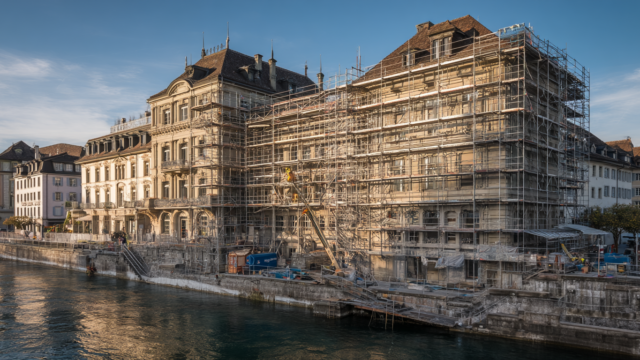
    Specialists in the renovation of historic and listed buildings belonging to the Hächler Group have repaired water damage to the city tower in Baden. According to a press release from the Wettingen construction company, the damage was caused at a height of 30 meters and the entire tufa brickwork was saturated with water.

    In order to avoid such water damage in the future after the repair is complete, the most modern technology will be used on the historic building. Every year there will be a control of the drains by means of a drone, it says in the message.

    Reto Schwitter – foreman, remodeling and renovation of historic buildings at Hächler – reports on the course of events in the media release. On December 22nd, the remodeling and renovation department of Hächler AG received an emergency message with the information that pieces of plaster were falling from the Baden city tower. The damage was examined the next morning with the help of the turntable ladders of the Baden fire brigade at a height of 30 meters.

    The damaged area had been cleaned, but the heavy snow and rain in the following three weeks, followed by night frost, worsened the damage and more pieces of plaster fell off, reports the foreman. A protective net had to be installed in January. In March, the Hächler specialists scaffolded the city tower for the renovation of historical and listed buildings. The historic building material that was soaked in water was identified. After a period of drying out, it was possible to rebuild, reports Polier Schwitter. Now a new gutter has to be installed and then it is necessary to regularly check the Baden city tower at a height of 30 meters – by drone.

  • JED gets neon and icons

    JED gets neon and icons

    The JED in Schlieren is to be supplemented by art in architecture, informs a corresponding report on the website of the center in Schlieren. Art in architecture creates identity and meaning and shows the way, it says at the beginning. The owner Swiss Prime Site hired the artists Roland Ammann and Gregory Gilbert-Lodge to realize the works of art in JED.

    Glassblower Roland Amman comes from Neonhaus Ammann and has dedicated himself to the creation of three-dimensional works of art from neon after the lighting industry switched from neon to LED. For the JED he will create three oversized letters, a J, an E and a D. Amman has already installed the first work of art on the ceiling of the Jake barista bar. At first glance, the object, which looks like a fragile shining ball, turns out to be a J on closer inspection, says the report. “I like it when my art has several levels and the hidden only becomes recognizable at a second or third glance,” artist Ammann is quoted there.

    On the wall of the barista bar, visitors can already see the first work of art by Gregory Gilbert-Lodge in the JED. The independent illustrator has provided the bar with an oversized portrait of its namesake Jake in green. Jake is supposed to represent building J and give the bar “a face”, it says in the report.

    Gilbert-Lodge designed portraits of Eve and Didi for buildings E and D. “The fictional characters in the JED should act as icons,” explains the artist in the report. The values and ideas embodied by them, "even an attitude towards life", are what the icons give to the individual buildings, says Gilbert-Lodge.

  • Implenia is renovating the St.Gallen city motorway

    Implenia is renovating the St.Gallen city motorway

    The Federal Roads Office has commissioned ARGE Stadtautobahn with the renovation of the St.Gallen urban motorway between the St.Gallen West and St.Gallen East connections, Implenia explains in a press release . The construction and real estate company from Dietlikon has a 30 percent stake in ARGE Stadtautobahn. In addition to construction work, Implenia will take over the commercial management of the project for the renovation of the St.Gallen city motorway.

    The repair work should start at the end of May and be completed by the end of 2024, Implenia further explains in the communication. During this period, coverings, drainage, edge closures and noise barriers will be renewed and some bridges, galleries, support structures and the Stephanshorn tunnel will be renovated. In addition, the construction of a new passerelle is planned.

    "The renovation of the St.Gallen city motorway is a complex, large-scale project," Christian Späth is quoted as saying in the communication. The Head Civil Engineering Division Implenia is looking forward to being able to “combine Implenia's accumulated expertise in bridge, tunnel and road construction with our extensive experience in managing large infrastructure projects”.

  • New life for the old spinning mill

    New life for the old spinning mill

    "The winning project was selected on the one hand because of the urban development strategy on the northern area, and on the other hand because of the respectful handling of the listed old buildings", says the lead architect Urs Oechslin from Zurich-based Lilin Architects. The two new building ensembles in the foreground of the spinning mill, which are intended for different uses, create a reference to the context through their urban planning anchored in place. The volumetric differentiation is derived from the existing settlement pattern of the urbanized village. The sub-volumes are staggered in terms of depth and height and allow different views of the spinning mill. The building typology thus mediates with great independence between the individual village buildings and the large-scale spinning mill building. In this way, the spinning mill area is given a new, urban face in which the various identities of the building history are superimposed.

    Desired longevity
    Immediately after the study contract, the overall project was concretized, accompanied by the client, the building authorities, the preservation of monuments and representatives from the assessment committee and the neighborhood: "We are about to submit the draft of the development plan and the guideline project to a first round of official consultation" , so Oechslin. It is not easy to build a building park around the spinning mill that can keep up with the quality of the monument and whose beauty and benefits guarantee the desired longevity. In the immediate vicinity of such a monument, the demands on the architectural quality are very high. The cultural acceptance associated with aesthetics is more decisive for the value of the property than some technical innovations. What is no longer publicly pleasing will sooner or later be torn down. What, on the other hand, enjoys a social and cultural status, remains. The real meaning of a house ultimately lies in the contribution it makes to public life in the long term. Urs Oechslin: “If the population, the Baar community and the owners are successful in promising a place of great attraction, then the project will be approved by all authorities. It will have a political majority and will be supported by the broader population. "

    Sustainable renewal
    For some time now, the «Spinni» has not served the purpose for which it was originally built. Since the end of production, a wide variety of uses have established themselves in the rooms. The clear and simple building structure of the spinning mill building is functionally sustainable because user extensions integrated in it can be easily adapted to changes. The high quality longevity of the basic structure achieved in this way is also aimed at for the new buildings. That is why it is being adapted for the new mixed-use buildings. As a result, the proposed building structure is not tied to a specific use and will survive future renovation processes.

    A coherent whole
    The historically and structurally established strong identity of the area is a large fund from which any number of ideas can be realized. Time and again it is important to find suitable means to further develop, reinterpret and supplement this identity. In this way, the high level of social acceptance that the area enjoys today is to be further expanded. "Our motivation is to design a new, staggered part of the settlement with the intelligent combination of architectural, landscape-architectural and usage-specific interventions on the area of the old spinning mill on the Lorze", says Oechslin. And further: “This takes over the existing qualities and complements them adequately and respectfully. The demanding cultural, social, economic, ecological and building law requirements should be combined in a coherent whole in the interests of all those involved. "

    The new use of «Spinni» needs to be carefully considered and planned.
  • Coop turns a Basel department store into a luxury hotel

    Coop turns a Basel department store into a luxury hotel

    The BâleHotels group, which belongs to Coop, is opening a 4-star boutique hotel in the middle of Basel's old town. The Hotel Märthof will open its doors on July 28, 2021. The renovation of the historic building began in 2019. Its neo-baroque facade will be preserved and will be combined with generous window fronts, according to a message from Coop . From 1983 a department store was housed in the complex.

    In the Märthof there will be space for 68 high-quality rooms as well as the Bohemia restaurant with a spacious bar and a terrace directly on the market square. The hotel also has a fitness and wellness area, a banquet room and a roof terrace.

    The BâleHotels Group is thus continuing to invest in the Basel location, according to Coop. The BâleHotels Group operates five hotels in Basel, Muttenz BL and Bern.

  • Renovation of the Mandarin Oriental Palace Lucerne is making progress

    Renovation of the Mandarin Oriental Palace Lucerne is making progress

    The Hotel Palace Luzern is currently being extensively renovated. It is to be reopened next spring as the Mandarin Oriental Palace Lucerne.

    The modernization is progressing, according to a press release . Invita Hospitality Projects, which belongs to Bündner Baulink AG , has now been commissioned to handle FF&E (Furniture, Fixtures & Equipment) and SOE (Small Operating Equipment).

    Specifically, Invita will be responsible for purchasing loose furnishings for the 146 rooms and suites and redesigning the public areas. In the spa and fitness area, the Baulink subsidiary even received the entire specialist coordination contract. She also coordinates the redesign of the public areas, which include the catering area as well as conference and meeting rooms.

    The interior design is meanwhile taken over by the London office Jestico & Whiles. Architecturally, the project is being accompanied by Iwan Bühler Architects from Lucerne.

    The hotel is located in the middle of the city of Lucerne, directly on the shores of Lake Lucerne.

  • Domat / Ems station area is being converted

    Domat / Ems station area is being converted

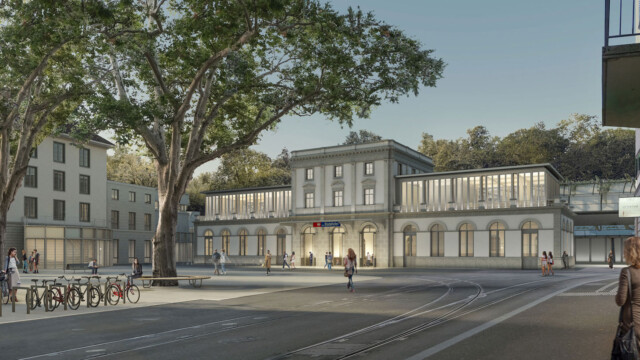
    The Rhaetian Railway (RhB ) wrote in a press release that the Domat / Ems station area is getting "a new face". According to her, the Graubünden railway company will renew the Domat / Ems station and make it accessible for the disabled. "We are building a modern train station that is adapted to the needs of our customers and to those of the community," RhB director Renato Fasciati is quoted in the announcement.

    Specifically, the RhB wants to extend both platforms at the station and partially cover them. In addition, a pedestrian underpass is to be built and equipped with handicapped-accessible ramps and stairs. The municipality of Domat / Ems contributes two passenger lifts. In addition, the RhB plans to equip sidewalks and streets with a continuous separation at the three secured level crossings.

    At the same time, the municipality of Domat / Ems is tackling extensive changes in the station area. The heart of the building plans is a new commercial and residential building directly on the platform. The four-storey building will have space for public use on the ground floor and living and office space on the other three floors, according to the announcement. In addition, a new space is planned on the south side of the station. The number of bicycle parking spaces available at the station will be increased to around 300. All construction work planned by the municipality and the railway company should be completed in summer 2023.

    "Good transport links are central to the community of Domat / Ems – for the numerous commuters, but also as an important commercial and industrial location," said Mayor Erich Kohler (CVP) in the message. "The overall project creates a modern, functional train station area that optimally meets high requirements for user-friendliness and audience-oriented uses."

  • Hirslanden Klinik St. Anna is being renewed

    Hirslanden Klinik St. Anna is being renewed

    The Hirslanden Klinik St. Anna in Lucerne will start renovating its infrastructure in March. This emerges from a message from the clinic on LinkedIn. Initially, work is being carried out on an extension (wing G), which will be located in the area of today's inner courtyard between the car park and the clinic. Among other things, the Institute for Radiology and Nuclear Medicine will be located there.

    From 2023, as part of a second phase, the demolition of two parts of the building is to start, some of which date from the early days of the clinic. These parts of the building will be replaced by a new building (wing A +). This is to become the new heart of future clinic operations.

    The entire construction project should be completed in 2027. According to an article in the “Luzerner Zeitung”, Hirslanden is investing a total of more than 100 million francs in the renovation.

    "With the construction project we are building a bridge to the future," said clinic director Martin Nufer in the article in the "Luzerner Zeitung". The investment also makes it possible to close supply gaps. “In oncology, for example, thanks to the renovation, we can finally also offer radiotherapy, which requires special equipment and facilities. We simply didn't have enough space in today's building, ”says Nufer.

    The St. Anna Clinic in Lucerne was founded in 1911 by the St. Anna Sisters community and has been part of the Hirslanden Private Clinic Group since 2005.

  • Jaisli-Xamax is rebuilding the traditional Beyer company in Zurich

    Jaisli-Xamax is rebuilding the traditional Beyer company in Zurich

    The employee newspaper Brilli's News of Jaisli-Xamax AG in Dietikon took the renovation of the traditional Zurich company Beyer Uhren & Juwelen for its 260th anniversary as an opportunity for an interview with Managing Director René Beyer. Under the title “Time for something new”, Beyer reports on the good cooperation with the construction management from Palmieri and the team from Jaisli-Xamax responsible for all electrical aspects. This “well-rehearsed team” carried out an initial renovation nine years ago and has now completed the renovation for the company's anniversary in the summer.

    Beyer is quoted as saying: “This is not the first conversion with the Jaisli-Xamax AG team. Not only for renovations, but also for various maintenance work during the year, I can count on the reliable specialists in your company. ”What he appreciates about the cooperation is that he knows all of the specialists personally. At Jaisli-Xamax AG there is a family atmosphere and togetherness. "It is important to me to have a competent partner on board who also 'ieferet' and not just 'laferet'", Beyer continues.

    As to the motivation for the total renovation, Beyer says that he has to think about handing over the business to the next generation and therefore wanted to equip the watch and jewelery boutique with a special feel-good atmosphere. Beyer: "That may sound like a flat marketing strategy, but in the end it is really what we can offer customers in contrast to the numerous online providers."

  • Agricultural Center Salez wins architecture award

    Agricultural Center Salez wins architecture award

    Constructive Alps is awarded to projects that are convincing in terms of sustainable building and renovation in the Alps. Switzerland and Liechtenstein have now awarded this prize for the fifth time, according to a media release . A total of almost 330 projects were submitted. A jury selected ten entries, of which the first three received a total of 50,000 francs. The Salez Agricultural Center took first place.

    The Agricultural Center Salez is one of the projects that show that architecture can combine aesthetics and climate protection, as stated in the communication from the Federal Office for Spatial Development (ARE). The building of the center relies on the simplest possible construction and a long lifespan. Canton and architect Andy Senn would have set new standards in terms of climate efficiency. An assembly hall in Vorarlberg and a mountain inn in Glarus made it into second and third place. In addition to seven recognition prizes, an audience award has also been determined for the first time.

    The Agricultural Center Salez consists of a conference center, farm, state farm and orchard. It is operated by the Agricultural Center SG (LZSG) together with the practical trial plots in Flawil. This also has advice centers in Kaltbrunn and Sargans.

  • Implenia is building a large development near Geneva

    Implenia is building a large development near Geneva

    A new urban center is to be built around the Lancy-Pont-Rouge train station. Implenia has already constructed three buildings here as a general contractor for Swiss Prime Site , the construction and real estate company from Dietlikon informs in a message . Implenia is now to build another building for the Solothurn real estate company. The order has a volume of around 132 million francs.

    Specifically, Implenia has been awarded the contract for the Alto Pont-Rouge development. It is designed as a 15-storey building plus three underground parking levels with a total floor space of 35,000 square meters. The areas are mainly intended for offices, while smaller areas are to be used as grocery stores and restaurants. The core of the building complex is a central atrium with glass facades.

    The development will "meet the highest sustainability standards and be certified at least in accordance with SNBS Gold," explains Implenia in the press release. The start of construction work is scheduled for this November, and the work should be completed in June 2023. For Jens Vollmar, Head Division Buildings, the new order "came about on the basis of a long-term and trusting relationship between Swiss Prime Site and Implenia".

  • The Villa Langmatt Museum is to be preserved

    The Villa Langmatt Museum is to be preserved

    The Langmatt Museum in Baden is unique in the Swiss museum landscape. The art nouveau villa of the industrialist couple Sidney and Jenny Brown-Sulzer houses an exquisite art collection by French impressionists. It was put together at the beginning of the 20th century with a lot of personal passion. The unmistakable charm of the villa lies in the presentation of outstanding images from art history in historical living rooms, surrounded by an idyllic park, says Markus Stegmann, director of the Langmatt Museum, describing his “workplace”.

    The Langmatt Foundation announced in a statement that the cantonal protected property must be renovated and that the operation must be put on a financially sound basis. While the foundation is restructuring its operating finances and thus ensuring operation and maintenance, the city makes recurring contributions to the repair of the property with the help of the canton and third parties.

    Clear distribution of responsibility
    With this partnership approach, the important cultural institution could be led into the future. The strategy motto is: "Jewel for everyone." The aim of the strategy is to preserve the Langmatt as a unique institution and a living witness of industrial, social, collection and architectural history. The core of the strategy is a clear distribution of responsibility between the city and the foundation: As the founder and sole heir, the city makes a substantial contribution to the renovation of the property, which is estimated at around 17.2 million francs (+/- 25%). As the operator of the museum, the foundation is restructuring its operating finances on a sustainable basis.

    At its meeting on June 3, 2020, the residents' council of the city of Baden decided to implement the “Langmatt Future” strategy in order to secure the future of the museum. In other words: the foundation takes over the lead for the repair and the costs of the planning up to a construction project. In order to carry out the construction project, the city council and the foundation council plan to found a stock corporation in which the city will hold a substantial share. It should raise the additional financial resources to cover the operating costs.

    Sale of pictures for the necessary return on investment
    For the long-term renovation of the foundation's capital, which was too small from the start, a targeted sale of one to three works is necessary, which, however, does not affect the core of the collection, emphasize the project managers. From the proceeds of around 40 million Swiss francs, the foundation generates the capital income it needs to secure its operations in the long term. “A step that is painful, but without any alternative, that will secure the future of the museum,” emphasizes Lukas Breunig-Hollinger, President of the Langmatt Foundation. "The Langmatt will be preserved as a historical ensemble, as a place of Baden's identity and as a living witness to the history of industry, collections and architecture," says Markus Stegmann, director of the Langmatt Museum. With its regional roots, the Langmatt will strengthen its international presence in the future.

    Two-year construction planning phase
    The main innovations include the year-round museum opening, an improvement in the entrance area with cash register, shop and cloakroom, a lift for barrier-free access and a filigree pavilion for events. The next stage is a two-year construction planning phase with the aim of specifying the cost accuracy of the repair. This is a key requirement for the required referendum, which is expected in 2023. If the template is approved, the next step is to sell the pictures. Repairs to the museum could begin in 2024, and Langmatt could reopen in 2026. ■

  • The development on the Rietpark is larger than 17 football fields

    The development on the Rietpark is larger than 17 football fields

    On the former industrial site of the Geistlich glue factory in Schlieren, the second stage of the new quarter "amRietpark" is being built under the building contractor of Helvetia Insurance and Geistlich Immobilia AG Soccer fields. Where fabrics were once dyed and glue was produced, a total of 921 apartments and the Tertianum AG retirement center will be available from 2020. The Geistlich area alone covers 80,000 square meters and is directly adjacent to Schlieren train station.

    Between 2007 and 2015, 600 apartments, 12,600 square meters of office space and 14,600 square meters of commercial space, 330 square meters of which were for restaurants and bars, were built on the Färbi site. The Geistlich area includes the “Magnolia” project, completed in 2015, with 137 condominiums and the new buildings along Brandstrasse and Engstringerstrasse with a usable area of 55,000 square meters. The public “Rietpark” takes up around half of the new quarter: it is 600 meters long, comprises 42,000 square meters and is the heart of the development.

    Part of the project is a double kindergarten with lunchtime care at Engstringerstrasse 5. This is rented in the residential and commercial building with 84 apartments and commercial space on the ground floor realized by Geistlich lmmobilia AG. Zurich office E2A was hired as the architect. The new building consists of a U-shaped part of the building with residential use from the 1st floor and a continuous basement on the ground floor. All apartments face the park. On the roof, the tenants will find 15 roof gardens based on the former allotment gardens on the site.

    The buildings on Brandstrasse, which were occupied in 2020, were designed by two different architectural offices. Graber Pulver Architects are responsible for the building owner Geistlich Immobilia AG with four towers shifted towards each other like a chessboard at Brandstrasse 1-7. The towers merge into a unit over a two-storey base and guarantee optimal light irradiation and views from all corners of the building. The diverse housing options include classic apartments, maisonettes and cluster apartments as well as commercial and restaurant space and the retirement center for the anchor tenant Tertianum AG. Within the block, a “Rue Interieure” cut lengthways through the ground floor connects the towers.

    Gmür & Gschwentner Architects designed a building with 202 apartments for Helvetia Insurance at Brandstrasse 21. The new building divides the construction site into two structures, each placed around their own courtyards. The center is a hall that residents can use for communal events. A novelty for Schlieren is the pool on the roof with sundeck, which is freely available to the residents. Here, 3.5 to 5.5 room apartments and various commercial spaces were created along Brandstrasse. ■

  • New thermal baths for bathing and redesign of the Verenahof district

    New thermal baths for bathing and redesign of the Verenahof district

    The aim is to upgrade the pool area as a whole. The naturally existing thermal spring water should attract attention again and bring sustainable benefits. The wide range includes thermal baths, wellness and gastronomy geared towards health and relaxation. The new building in the Limmatknie offers living space and space for additional uses. The renovated Verenahof square completes the range of uses of the new buildings in the healthcare sector. An underground car park and the landscaping in the Mättelipark, Limmatpromenade and Ochsengarten areas are also part of the project.

    Doctors and residential building
    A building for medical use is planned right next to the bathroom. The elbow bath and the Roman apse will also be integrated into the new building. In addition to this, there is also the thermal spring in the spa district. The residential building comprises 2½ and 3½ room apartments as well as attic apartments. The apartments are expected to be ready for occupancy in 2021. The project also includes a private clinic with seventy single rooms and various rehabilitation areas.

    The Verenahof square
    One sub-project is the redesign of the Verenahof district with the old spa hotels Verenahof, Bären and Ochsen. It is under integral monument protection. The hotel area is being converted into a prevention and rehabilitation clinic by the Basel architects Villa Nova Architekten AG. A public restaurant rounds off the offer. The Verenahofviert will be connected underground with the thermal bath building and will share infrastructures like kitchen or parking garage with it. RehaClinic AG will act as the future operator.

    Redesign of public space, core area bathrooms
    The public space in the core area of the bathrooms is being redesigned. This presents itself in addition to the new thermal baths and residential and medical center as well as the Verenahof area, which has been revitalized with a rehabilitation clinic. The implementation planning, tendering and awarding of the work will take place in 2019. The construction work in the Verenahofviert with the private construction projects in the baths should be implemented by autumn 2021. The planning team consists of Vogt landscape architects, Scheidegger + Partner AG. Client: City of Baden, planning and construction.

    Art also finds its place
    In the bathrooms, the relocation of art objects is in the foreground. Those responsible for the project emphasize that these should be placed in the context of the historical heritage and the spa culture. They should work in the sense of their purpose and at the same time enrich the public space as design elements ideally and materially and contribute to the marketing of the bathrooms and to the added value on site. An artistic specialist is entrusted with this task and is accompanied by the Planning and Construction and Culture departments in cooperation with the Art Commission of the City of Baden. ■

  • The new “LimmiCura” care center is under construction

    The new “LimmiCura” care center is under construction

    On the site where the high-rise building of the old Limmattal Hospital from 1970 stood until the end of 2019, the new “LimmiCura” care center will be built from 2020 to 2023. In order for the Limmattal Hospital Association to begin implementing the project, the consent of the population was required. This approved the required loan of 65 million francs. The care center, including the day center, three long-term care wards with palliative beds and a rehabilitation floor, is to have 116 rooms: 73 single and 43 double rooms. The new building will have five floors and will be implemented by the architects' office fsp in Spreitenbach. Architecturally, “LimmiCura” is based on the Limmattal Hospital, which was newly opened at the end of 2018. A dementia department with its own garden and a rehabilitation station on the 5th floor with 48 beds are planned. The day center will be located on the ground floor next to the dementia department. The inner courtyards will be accessible. The nursing department is located on floors 2-4. The "LimmiCura" should open in the first quarter of 2023. ■

  • A city quarter including the Limmattalbahn

    A city quarter including the Limmattalbahn

    “Where Zurich has a future” is Schlieren's slogan. This also applies to the new Reitmen district, where 177 rental apartments for different generations and needs will be built in five buildings. All apartments would offer sophisticated floor plans, carefully selected materials and spacious balconies. Each of the five houses has its own character and its own color concept can be read on the homepage on which the project is presented. The urban development stands for the modern Schlieren, emphasize those responsible for the project. The settlement is to become a place with a high quality of life that offers contemporary living and commercial space for a wide audience. In addition, there is 1,500 square meters of commercial space, a spacious park and, from 2022, the stop of the new Limmattalbahn directly in front of the door. ■

  • The “Pfaffechappe” school house will be transformed into a primary school

    The “Pfaffechappe” school house will be transformed into a primary school

    A look back at the past: The “Pfaffechappe” school complex was built in 1973/74 as one of the largest school buildings in the Baden elementary school. The “Pfaffechappe” school house is to be extensively renovated in the summer of 2021 after the secondary school has moved to the new secondary school center in Burghalde and converted into a purely primary school building.

    The architects describe the renovation of the outer shell of the “Pfaffechappe” school complex as follows: “The closure of the two currently covered entrance / break areas and
    The relocation of the entrances to the place of the three stair towers clarifies the relationship between the school and its surroundings and creates an inviting, attractive and clear entrance area. In addition, the new entrance situation is integrated into the spatial sequence from the school building above.
    area up to the river basin integrated. "

    The work will be completed by summer 2023. At the meeting on December 11, 2018, the city of Baden wrote in a press release that the project loan for the renovation and renovation of the “Pfaffechappe” schoolhouse was approved. The residents' council will rule on the construction loan in December 2020, and in March 2021 the people will vote on the "Pfaffechappe" construction loan. ■

  • “Tivoli Garden”: An identity-defining project

    “Tivoli Garden”: An identity-defining project

    A look back: The major project in Spreitenbach is marked by years of delays. For example, VCS Aargau defended the project in 2012 and submitted an objection. He demanded an expansion of the environmental impact assessment, which covers the entire area, including the shopping center.
    rums “Shoppi Tivoli”, the Limmatpark and the parking spaces available to the “Shoppi Tivoli” in the environmental arena. After the revised design plan, the VCS filed another complaint, this time because of the parking space management, which did not go far enough for the traffic club. Those involved were finally able to agree on a compromise solution in January 2019 – and nothing stood in the way of the project.

    Identifying feature
    With the “Tivoli Garten” development, five houses with a total of 445 rental apartments, a double kindergarten, an Obi hardware store and a stop for the Limmattalbahn are now being built in the immediate vicinity of the “Shoppi Tivoli” shopping center. The proposed mix of apartments consists of 1½ to 5½ room apartments. The generous private outdoor spaces are intended to meet the needs of the various tenant groups, i.e. families, singles and pensioners, for example.

    Base construction with two towers
    The superstructure consists of a base building with the Obi hardware store and the Limmattalbahn stop, from which two high-rise buildings and three up to seven-storey long buildings extend. The project managers emphasize that the two high-rise buildings act as an identity-defining feature of the development. They also interact with the two existing high-rise apartment buildings in the “Shoppi Tivoli” area from the 1960s. The spacious outdoor areas are located in the private courtyard of the "Tivoli Garden". Eiffage Suisse, Zurich office, was entrusted with the implementation of the major project. Solid construction strives for the Minergie / greenproperty standard.

    Direct access to the "Shoppi Tivoli"
    A public pedestrian level with direct access to the “Shoppi Tivoli” is planned on the base building. The passerelle concept of the municipality of Spreitenbach allows further connections to the surrounding parcels at this level, and at street level a new transfer hub for public transport with the Limmattalbahn and various bus routes is designed.

    The major project was developed jointly by the Migros Aare cooperative and Credit Suisse Asset Management. The owner is MEG Tivoli Garten, which consists of two real estate funds from Credit Suisse Asset Management. ■

  • Elderly apartments in Bergdietikon are to be modernized

    Elderly apartments in Bergdietikon are to be modernized

    The Foundation for Age-Appropriate Living in Bergdietikon (AGW) built the facility in Schlittental 25 years ago according to the then modern standards of equipment and technology. The Bergdietikon municipality made the area available at the time. Today demands and needs have evolved. That is why the Board of Trustees wants to analyze the situation by examining not only the mix of apartments and the standard of construction, but also the question of pricing and, last but not least, the individual types of housing that are particularly suitable for handicapped people, as stated in a communication . A proposal for the renovation of the building to meet contemporary needs should be available by the end of the year.

    The rental apartments, which, unlike in old people's homes, are offered without services, are "a little old" and no longer meet today's standards. Some of the total of 18 apartments could therefore no longer be rented out despite the overall clear demand.

    In order to determine the real needs, residents and interested parties should be asked about their ideas. But one thing is certain: services such as those offered in old people's homes or larger institutions are not economically viable.

    The residential building for age-appropriate living is located directly in the center of Bergdietikon. The post office, the center, the Volg store, the cemetery and the bus stop can be reached in a few minutes, the foundation describes the property. And adds: With a distant view of the Limmat Valley and a view of the hilly landscape on the mountain side.

  • Intershop starts building an assembly hall for Stadler

    Intershop starts building an assembly hall for Stadler

    Intershop creates a new assembly hall for Stadler Winterthur . According to a press release , the building permit is now available. The investment volume amounts to around 16 million francs. The start of construction is planned for the current week, the completion of construction for the end of 2021. As Stadler announced after the agreement with Intershop Holding was concluded, the Zugbauer will lease the plant from the Intershop subsidiary SGI City Immobilien AG on a long-term basis. The lease has a minimum term of 15 years, according to Intershop.

    With the new building, Stadler Winterthur is expanding its competence center for bogies. On around 13,250 square meters of land, additional storage and assembly areas are being built for the construction of bogies for standard and broad gauge trains as well as for trams. The commissioning of the new hall is planned for 2022. In February, Stadler announced its intention to create up to 50 new jobs with the expansion of the production facility at the Winterthur location.

  • A lifestyle brand is stirring up the hotel industry in Zurich

    A lifestyle brand is stirring up the hotel industry in Zurich

    The German hotel company Althoff Hotels will take over the traditional hotel “Bellerive au Lac” in Zurich towards the end of the year. The historic building at Utoquai 47 has been completely rebuilt since January of this year and then opened as the third AMERON hotel in Switzerland – two hotels are located in Davos and Lucerne – and the first AMERON boutique hotel in Switzerland. "The size and the spatial plan are perfect for the conversion into an AMERON boutique hotel", Thomas H. Althoff, founder and owner of Althoff Hotels, is quoted in various media.

    High quality hotel design
    As an interior concept, Monoplan – an architecture firm based in Zurich specializing in the hotel industry – has developed a modern interpretation of the existing hotel design, which can be read on their website. This mainly includes interior design, implementation planning and creative management. “A World of Many Worlds” – that is the hotel group's credo. All hotels are characterized by a cosmopolitan interior design, which at the same time has an individual character in each house. The house will have 61 rooms and suites, an event restaurant and various conference rooms. If everything goes according to plan, the four-star hotel is due to open this winter. ■

  • From commercial building to design hotel

    From commercial building to design hotel

    On Beatenplatz, not far from Zurich's main train station, a budget design hotel of the Munich hotel group Ruby with 208 rooms and a restaurant operated by Candrian Catering is being built in the listed former “Haus Du Pont” commercial building. For more than 100 years, the building housed the ABC cinema from 1913. Historically, the “Haus Du Pont” by Zurich architects Jakob Haller and Karl Schindler has been referred to as a palace-like building. Indeed: the comparison is appropriate.

    Simple and representative appearance
    Now a look into the future: In the course of the conversion, the largely listed building will be completely renovated. This includes its supporting structure, stairwells, facade and roof structures. In order to achieve an elegant, simple and at the same time representative appearance, classic means are used, emphasize the project managers. These include, for example, a surrounding wall frieze. That means a linear, horizontal style element. This narrow strip, delimits, divides and decorates parts of the building. There are also structured wall surfaces, a terrazzo floor and seating niches in the lobby. The philosophy of the hotel group is "Lean Luxury – luxury in a small area".

    The Zurich architects Monoplan are responsible for the architecture, the interior design, the overall planning and the construction management. The owner and builder of the historic building is PSP Swiss Property, which is investing 45 million francs in the total renovation. If everything goes according to plan, the two-year construction work will be completed by the end of 2021. ■

  • Nancy's Art Nouveau landmark

    Nancy's Art Nouveau landmark

    Under leadership, the company flourished and opened branches in Paris, London and Berlin, among others.

    The Frenchman, born in 1859, was only 39 years old and was able to commission the construction of a magnificent villa. He relied on the then 26-year-old architect Henri Sauvage (1873–1932). The two gentlemen met in the house of their mutual friend – the sculptor Alexandra Charpentier. Sauvage had never worked on a project like this before. The only experience Sauvage could boast was working for a few months with the Brussels architect Paul Saintenoy. Majorelle liked the youthfulness and boldness of the architect as well as his good network in the art world. He preferred Sauvage to the experienced Nancy-based architect Lucien Weissenburger. Weissenburger was allowed to carry out the project on site.

    The Majorelle family's photo album provided important information
    In the years 1901–1902 the villa was built according to Sauvage's plans. It was the first completely Art Nouveau house in Nancy and is considered a prime example. Sauvage did not build the villa single-handedly: he called on other renowned artists. For example his Paris friends, the ceramic artist Alexandre Bigot and the painter Francis Jourdain. Bigot carried out the ceramics, Jourdain designed the decorative paintings in the dining room. The furniture comes from Majorelle's own production. The landlord also took care of the ironwork and the railings. The stained glass windows in the main rooms (staircase, dining room, living room and bedroom) were designed by the master glazier Jacques Gruber. The majority of these artists belonged to the Ecole de Nancy, which Emile Gallé co-founded in 1901.

    For four years, the Villa Majorelle was repaired internally and externally through extensive restoration work. The building, completely in Art Nouveau style, was commissioned in 1898 by Louis Majorelle, himself a cabinet maker, designer and blacksmith. Majorelle actually wanted to be a painter and studied at a young age at the School of Fine Arts in Paris. After the death of his father, he had to return to his hometown Nancy (F) early to take over the family business. He had modern furniture made and was inspired by nature and Emile Gallé. Gallé specialized in the material glass and did pioneering work in this area. He is one of the founders of Art Nouveau. Louis Majorelle's floral elements run from the facade to the interior of the house: they can be found in ornaments, carvings, mosaics and enamel work. Architect Sauvage arranged the windows and exterior doors to match the logic of the interior layout, breaking with the tradition of the horizontally symmetrical building. Flowing forms and decorative motifs run through the entire architecture. Sauvage played with the opposites: the bare Euville stone contrasts with the polychromy of bricks, stoneware, wood and ironwork. The constant presence of wood runs like a red thread through the interior design and creates a connection with the exterior of the villa.

    The Villa Majorelle is considered a unique experimental work. Henri Sauvage later said: “I worked there for two years and I am deeply grateful to my first client for the incredible freedom he has given me. Despite my young age, he never imposed any budget restrictions on me or his personal ideas. " After completion, Louis Majorelle lived there with his wife Jane Kratz and their son Jacques. The building is also known under the name «Villa Jika» – after the initials of Jane Kratz.

    Louis Majorelle died in 1926, the villa was inherited by his son, who sold the house to the state. He initially had offices built there. The gradual rediscovery of Art Nouveau led to the villa being classified as a historic monument in 1975 and finally a listed building in 1996. The city of Nancy has owned the villa since 2003. In the last few years the villa has been repeatedly renovated. In the most recent and most extensive renovation, the villa was returned to its 1926 state. The renovation work was carried out by the Atelier Grégoire André. Articles and publications from the time the villa was built provided important information about the original appearance of the house. The Majorelle family's photo album also served as a valuable source of information.

    Some changes made afterwards were removed this time: For example, a bay window on the north facade was removed and the chimney hoods that were removed a few years ago for safety reasons were reinstalled on the roof. The facade was cleaned and damaged masonry replaced. The work on the outer facade and the roof only took two years.

    Original Gruber window destroyed in bombing
    But the interior of the building was also completely restored in close collaboration with the Musée de l'Ecole de Nancy and a committee made up of Art Nouveau specialists and art historians. In order to create adequate reception areas for visitors, the cash register, cloakroom and souvenir shop are located in the kitchen and pantry area. A new elevator was installed, otherwise the wooden and mosaic floors as well as the glass work were completely redesigned.

    The living room has an elaborate stucco decor with a pine cone motif, which can also be found on the furniture and the fireplace. The same motif was also used on Jacques Gruber's stained glass window. However, the Gruber window was destroyed in the bombing of Nancy in 1916 and replaced by another oriental-style window that can still be seen today.

    Almost 100 pieces of furniture, paintings and art objects then found their way from the Musée de l'Ecole to the villa. Most of the furniture is original. Works were selected that were designed by Louis Majorelle and / or by companies with whom he had worked (Manufacture Daum, Manufacture Keller et Guérin, the ceramic workshops de Rambervillers and Frères Mougin). The choice depended mainly on the similarity to the objects visible in the old photos. In the same way, the museum has also selected from its collection paintings made by Louis Majorelle or his son Jacques.

    Between 2021 and 2022, minor renovations will be carried out inside the villa, but these will not require the house to be closed. The works include recreating the bathrooms, creating teaching and educational areas on the first floor, and renovating Louis Majorelle's studio on the second floor. The costs so far amount to 2.5 million euros. ■

  • From a listed school building to a private hotel

    From a listed school building to a private hotel

    The vision: A hotel is to be converted from a former school building, in which the original character of use and the original substance are to be retained. The Berlin hotelier Kurt Hermandung and his partner Marc Konopatzki have realized their dream of their own small private hotel. This is close to Düsseldorf, Cologne and the Ruhr metropolises. "We wanted a small, fine house with character that we can make something very special," say the owners. "After a long search, we came across this former elementary school – and an investor who could imagine turning it into a hotel and the former gymnasium into a restaurant." In terms of design and concept, the former schoolhouse from 1915 and the gymnasium added in 1980 were based on the original use of the building.

    Classrooms became elegant hotel rooms
    The local architecture firm Wilde and Wehnau implemented this ambitious conversion concept, from the design to the implementation planning and construction management. Their services also included the concept of the monument protection concept, the planning of the interior design and the lighting design. The exterior facade with its typical slate shingles, the representative bay window and the green rain gutters were restored and preserved under the watchful eye of the listed building. The former classrooms of the primary school have been transformed into elegantly furnished single and double rooms with oak parquet and spacious bathrooms. A junior suite was installed in the attic. The minibars that used to be in the rooms are a thing of the past. The alternative is much more original and ecologically more sensible: A central “school kiosk” on the ground floor offers a variety of drinks.

    A special feature in the house is the restored historical fountain with fresh drinking water, which extends over two floors, emphasize the hotel owners. Old certificates and photos are reminiscent of the earlier school days. You can find yourself in the whole building. Gym boxes serve as luggage racks in the rooms. The gym's old rung climbing wall was also given a new function. It serves as a partition to the stairs in the restaurant.

    Former gym as a restaurant
    The rather unadorned gymnasium was completely dismantled in the course of the renovation work. The result is a modern building which now houses the “Die Turnhalle” restaurant, the lounge and the bar. In the historic school building, a lift provides barrier-free access to all floors and connects the hotel rooms with the restaurant. The latter is also open to the public. A newly installed ceiling divides the former gymnasium into two floors. This enabled the area to be doubled to 800 square meters. This made space for four conference rooms and a small bar for catering in the conference area. The extension with its large glass surfaces is a successful contrast to the old and lovingly restored school building and complements it in an ideal way. ■

  • From the former rectory to the gently renovated holiday apartment

    From the former rectory to the gently renovated holiday apartment

    Bringing building culture to life is the maxim of the Foundation for Monument Holidays. From 2021, for example, the renovation work on a former rectory in Valais, which is being converted into a holiday apartment, is to begin. The former rectory – called "Kaplanei" – is located in the Valais village of 400 people, Ernen. It was built in 1776 and used as a rectory until 1952. Since then, the property has been largely empty and is becoming increasingly dilapidated. That will now change because the Foundation Holidays in Monument was able to take over the building under construction law at the end of 2018.

    The chaplaincy suffered from the long vacancy, says Nancy Wolf, who is responsible for marketing and communication at the foundation. Although the owners, in cooperation with the preservation of monuments, restored the outer facade, including the windows and the roof, there are neither modern kitchen facilities nor up-to-date sanitary and heating installations.

    Building with its own house chapel
    The plan is to concentrate on the maintenance of the existing substance during the extensive renovation work – this mainly includes the repair of the interior. Only the fixtures in the kitchen and bathroom should be implemented cautiously in a contemporary design language. The well-proportioned pre-protection house is particularly impressive due to the alternation of wood and stone on its eaves and the doors and windows framed with red tuff stone. Those responsible for the project emphasize that they radiate wealth and dignity. Characteristic of this type of building, the rear part of the house with the kitchen was made of stone. Inside there is also its own house chapel. When entering the reception room, the benefice's parlor, one notices the neatly worked, strongly curved paneling with the deep bevelled edges, of which there are not many today, can be read in the project description. The cube-shaped stove shows Saint George on a horse, the patron saint of the church and the parish, as well as Saint Catherine with the wheel.

    H out with a manorial character
    On the first and second floors you can find religious inscriptions in Latin, with which the residents probably wanted to give practical instructions on how to live, the preservationists suspect. One room on the upper floor has a vaulted plaster ceiling. In the middle is a painting. Painted, tulip-shaped flowers on the consoles and the arched portals to the cellar give the house its stately character. Future vacation home owners will soon be able to marvel at these treasures. ■

  • Renovation and extension: Hospiz Zentralschweiz Luzern

    Renovation and extension: Hospiz Zentralschweiz Luzern

    Building worthy of protection: medical practice with residential building in Littau
    The original building – a residential building with an integrated doctor’s practice – was built by the Lucerne architect Josef Gasser in 1959. He was inspired by the well-known American architect Frank Lloyd Wright: In particular, by the prairie style influenced by Wright, which refers to the broad, flat landscape in the American Midwest. Accordingly, the architecture is characterized by an open room design, a horizontal, two-dimensional orientation and the use of natural materials. In cooperation with the Monument Preservation of the Canton of Lucerne, a prudent way of dealing with the building worthy of protection was found.

    Clinker brick building inspired by Frank Lloyd Wright is being gently renovated
    Little was changed during the renovation of the external appearance of the existing clinker building. Interventions in the external appearance of the house were only carried out in the direction of the garden, in which the foundation had the extension built. The room layout and use was adapted for the necessary communal, administration, practice and care rooms. Work rooms, guest rooms and a “room of silence” were created on the existing upper floor. The whole house is now accessible with a lift.

    Pavilion-like wooden structure for inpatient hospice
    A single-storey wooden pavilion with 12 rooms was created in the inner courtyard. Each room has its own wet room and a view of the garden. The two buildings are connected by a corridor that surrounds the new inner courtyard. The pavilion has a basement and is connected to the existing building underground. For a harmonious appearance, the new building was realized with a clinker brick and wooden facade and a roof edge made of pre-patinated copper.

    Renggli AG supported the Central Switzerland Hospice Foundation as general planner. As part of the planning team, she helped design the architecture and coordinated the demanding specialist areas and partners involved. Renggli AG also acted as general contractor in the project. ■

  • Ein neues Kleid für das Grand Hôtel & Centre Thermal Yverdon-les-Bains

    Ein neues Kleid für das Grand Hôtel & Centre Thermal Yverdon-les-Bains

    Seit Herbst 2019 wird das historische Hotel mit 116 Zimmern und Suiten während drei Jahren umgebaut. Das Gesamtbudget von rund 32 Millionen Franken enthält die Kosten für die vollständige Renovierung der Innenräume und des Aussenbereiches sowie des Thermalbades und des Grand Hôtels. Im Grand Hôtel werden die Zimmer und Bäder, die Küche und der Aussenbereich inklusive Schwimmbad renoviert. Der Eingang zu den Thermalbädern wird neu ausgestaltet und mit Geschäftsflächen und Restaurants erweitert. Die Umkleidekabinen werden renoviert.

    Ein neues Café wird nur von den Bädern aus zugänglich sein. Die Zone um die Aussenschwimmbecken wird mit einem 350 m2 grossen Wellnessbereich mit Hamam und Sauna ergänzt. Der Fitnessbereich umfasst neu 700 m2. Während der gesamten Bauzeit wird das Thermalbad den normalen Betrieb aufrechterhalten. BCO SA, eine Tochter der BOAS-Gruppe, leitet die Bauarbeiten; das Architekturbüro Richter Dahl Rocha mit Sitz in Lausanne hat das Projekt ausgearbeitet.

    Das Thermalbad von Yverdon-les-Bains besteht aktuell aus verschiedenen, zum Teil dreistöckigen Gebäuden, die untereinander verbunden sind. Im Aussenbereich stehen zwei grosse Schwimmbecken zur Verfügung. Das 4-Sterne-Superior-Hotel liegt inmitten eines prächtigen Parks mit altem Baumbestand. Aufgrund seiner langjährigen Geschichte strahlen die verschiedenen Räumlichkeiten des Grand Hôtels jeweils ihren eigenen, ganz besonderen Charme aus. So zum Beispiel die sogenannte Rotunde (kreisförmiger Bauteil), in der sich das Restaurant und die Lounge-Bar befinden oder der vor kurzem renovierte «Belle Epoque»-Saal und insbesondere auch das zum Hotel gehörende Schloss. Über einen Glastunnel ist das Hotel mit den Thermalbädern verbunden.

    Neues Seedorf und neue Einrichtungen
    Der erste Schritt des gross angelegten Renovationsprojektes ist der Bau des Seedorfes im Park vor dem Hotel – am Ufer eines neu angelegten Weihers. Drei Holzbrücken führen die Besucher übers Wasser zu den Häusern, die verschiedene Wellnessbereiche wie Hamam, Sauna und Ruheräume beherbergen. Ein Barfussweg wird ebenfalls entstehen. Die bereits heute für die Physiotherapie und Arztpraxen genutzten Räumlichkeiten werden durch zwei Einheiten ergänzt: Entstehen soll ein Zentrum für Sportmedizin mit einem separaten Eingang. Weiter ist vorgesehen, die medizinischen Infrastrukturen räumlich zu konzentrieren, sodass die Patienten über eine grössere Privatsphäre verfügen.
    Durch die Verlegung des Thermalbadeingangs entsteht ein attraktiver, lebendiger Raum, durch den der Gast vom Hotel direkt zur Bäderzone gelangt.

    Dieser Bereich umfasst 900 m2 und umfasst eine Empfangshalle, eine Boutique, ein Restaurant und ein Café. Der bislang für den Übergang genutzte, wenig ansprechende Glastunnel wird abgebaut. Renoviert werden zudem Küche und Restaurationsbereich. Die Fassaden und Dächer der Thermalbad-Gebäude werden abgerissen. Stattdessen wird einer äusseren Einfassung Platz gemacht, die den ganzen Komplex umfasst und vereinheitlicht. Die gesamte Fläche wird um eine Etage aufgestockt. Damit entsteht Raum für moderne, besser durchdachte, architektonisch homogen und stilvoll integrierte Inf-
    rastrukturen. Auch die Infrastruktur des Thermalzentrums wird optimiert: Das Hallenbad wird komplett renoviert und um ein neues Schwimmbad mit Spielbereich erweitert.

    Infrastruktur des Neubaus in der Übersicht:
    Erdgeschoss
    Neuer Eingang, 600 m2
    Boutiquen, Café / Restaurant, 360 m2
    Bäder-Restaurant
    Bereich Physiotherapie (960 m2) mit unabhängigem Rehabilitationsbecken
    Neue Umkleideräume und Duschen
    Neues Innen-Schwimmbecken
    (Unterricht und Erholung)
    Inneres Becken vollständig renoviert
    Zwei Aussen-Schwimmbecken

    Erste Etage
    Fitness-Raum, 700 m2
    Schönheitspflege, 340 m2
    Sportmedizinisches Zentrum (1160 m2) mit Anbindung an den Physiotherapiebereich und neuem separatem Eingang

    Über BOAS Swiss Hotels
    Boas Swiss Hotels ist eine private Hotelgruppe mit Sitz in Crissier / Lausanne. Zur Gruppe gehören zehn Beherbergungsbetriebe in den Kantonen Wallis, Waadt und Genf. Die Hotels gehören mehrheitlich zur Kategorie der 3- und 4-Sterne-Superior-Betriebe. ■

  • La Margna becomes the Grace Hotel St. Moritz

    La Margna becomes the Grace Hotel St. Moritz

    The renovation work has been underway since September 2016: In St. Moritz, the former Hotel La Margna on Via Serlas is becoming the Grace Hotel. The owner is the internationally active Grace Hotel Group. She has the building carefully renovated and expanded with an annex. The opening was originally planned for 2017, was then postponed to autumn 2019 and is now to take place in 2022. The reason for the delay: the project was modified and expanded again after construction began. The number of hotel rooms was increased by a third to 56, as a correspondingly high demand is expected.

    Upon completion, the hotel will include the historic “La Margna Wing” and the modern, newly built “Grace Wing”. In the "Grace Wing" an underground car park, a spa area as well as hotel rooms and suites are being built. In the “La Margna Wing”, the rooms on the upper floors are being completely renovated. The rooms on the lower floors are being restored so that the historical building fabric is preserved. Here guests will discover vaults, arches and other architectural features of Art Nouveau.

    Art Nouveau meets modernity
    The former Hotel Margna was built in 1906 and 1907 according to plans by the architect Nicolaus Hartmann in the Engadin style. In 1911 the east wing was increased by three storeys. After that, renovations and renovations took place again and again, but the external appearance was never significantly changed. The striking facade is to be retained even after the current renovation.

    The drafts for the project come from the pen of the architect Nikolas Travasaros from Divercity Architects. For him, the main challenge was to freshen up the original architecture and at the same time create a modern extension for additional rooms and a spa. In addition to taking into account the strict building regulations and the given restrictions due to the sloping terrain, Travasaros had to plan hotel rooms that can also be converted into long-term apartments.

    His plans combine old and new by expanding the base of the existing building. The extension follows the natural gradient and fits seamlessly into the landscape. The new wing is deliberately kept discreet and does not overshadow the traditional architecture and the breathtaking alpine surroundings. Panoramic windows and adaptable, open interiors create a feeling of light and space.

    Blarer & Reber Architects in Samedan are responsible for the planning and implementation on site. The preservation of monuments in Graubünden was included in the project development so that the greatest possible preservation of the historically valuable building fabric is guaranteed. The STW AG for spatial planning based in Chur was also included in the project team.

    All rooms and suites of the boutique hotel Grace St. Moritz will offer lake or panoramic views. Three restaurants and a spacious spa area with swimming pool as well as a fitness center on over 800 square meters are planned. The hotel has a private car park and is just a 2-minute walk from the train station and the bus stop. A ski shop and ski room are also planned. Serviced apartments are also to be offered for sale in both wings. ■

  • "Because of the Corona crisis, all investment projects will probably be put on hold"

    "Because of the Corona crisis, all investment projects will probably be put on hold"

    Mr. Allemann, there has been a structural change in the Swiss hotel industry for a long time, with a trend towards larger hotels. Nevertheless, almost 90 percent of the hotels have fewer than 55 beds. How are these companies responding to this change?

    The biggest problem are businesses with ten to twenty rooms and 15 to 30 beds. These houses are struggling to be profitable. Many small businesses, however, have a very large share of the catering industry, some of which generate over eighty percent of sales. The hotel industry is not part of the main business there.

    Hotel guests are becoming more and more demanding. How can the aging hotels keep up with this trend?

    This is actually a problem. We have many plants in Switzerland that were built at the end of the 19th century and the beginning of the 20th century. These often have fewer than thirty rooms and are very entertaining. If you are in destinations that are no longer as attractive today, such as transit routes, this is an aggravating circumstance. Missing frequencies then automatically lead to profitability problems and pent-up maintenance.

    Does the operation of a hotel require high investments?

    Yes, because the hotel industry is very investment-intensive. A hotel should be completely renovated after thirty to forty years. Depending on how trend-oriented or traditionally timeless a hotel is architecturally positioned with its furnishings in the market, shorter renewal cycles are necessary, especially for the rooms.

    Do the hotels generally have the necessary financial resources to carry out the necessary renovations and refurbishments?

    In principle, investments should be financed from cash flow. In recent decades this has become increasingly difficult for many companies, also because of the various crises. At the moment, of course, especially because of the Corona crisis. In the luxury sector, there are often patrons who have either fallen in love with the house or with the region and are ready to invest in hotel properties. They see the motivation of their investments not only in economic terms, but as an «A-fonds-perdu-contribution. In this way, their hotel operations achieve their extraordinary positioning in the market. I see the critical segment in the middle-class hotels, which because of insufficient occupancy or insufficient positioning are unable to make the necessary investments or can only generate them through borrowing.

    Does your association financially support the renovation of hotels?

    No, this is not the association's task; we would not have the resources to do so either. The association has the competence to offer and supports its members to be competitive. We have built up a network of specialized consulting firms that can support our members in a wide variety of subject areas. We also work very closely with the Swiss Hotel Association (SGH), which has the specific financing expertise.

    This means?

    The SGH is a federal instrument to promote the accommodation industry. Subordinate to the banks and subsidiary to private donors, it can grant loans for investment projects to hotels in tourist areas and health resorts.

    What other challenges need to be tackled?

    Succession arrangements are particularly difficult for companies with an investment backlog and / or over-indebtedness. This is practically impossible within the family or cannot be expected of the children. Since the second home initiative was adopted, it is practically no longer possible to convert hotel properties. Demolition is not an option, especially for listed properties. Complete renovations or partial re-use are also very costly due to the requirements of monument protection. So there is still hope of finding a patron. Unfortunately, these are not just in front of the door. If the substance of the house is still intact and there is potential for demand in the destination, I see the merger of several companies as an alternative to cross-company cooperation as an opportunity out of this dilemma. For example, by bundling purchasing, costs can be saved and more sales can be achieved with joint marketing activities.

    What advice would you give a hotelier: renovate, demolish or try to get a loan?

    Look, one criterion is the existing building fabric, especially for hotels from the turn of the century. However, if only the shell is historical, this hotel hardly offers guests any incentives to stay here. Keeping a house steeped in history alive takes a lot of personal commitment. First of all, it is important to deal with the era of hotel construction. This requires a certain affinity with the history of the hotel. This also has to be told. So you need someone who is willing to renovate the establishment of the company gently and with great sensitivity and to bring it up to the state of today's guest needs. ■

  • Coop verwandelt den Basler Märthof in ein Boutique-Hotel

    Coop verwandelt den Basler Märthof in ein Boutique-Hotel

    Im ersten Halbjahr 2021 soll im historischen Gebäude des Märthofs in Basel das Boutique-Hotel Märthof eröffnen. Die Eigentümerin, die Coop Immobilien AG, hat das Architekturbüro Burckhardt + Partner mit der umfassenden Renovation beauftragt. Geführt wird das Hotel nach der Eröffnung von der zu Coop gehörenden Bâle Hotelgruppe. Sie betreibt bereits die Hotels Pullman Basel Europa an der Clarastrasse sowie das Victoria am Centralbahnplatz und das Hotel Baslertor in Basel-Muttenz.

    Das Gebäude des Märthofs entstammt dem 19. Jahrhundert und bestand ursprünglich aus fünf einzelnen Häusern, die 1981 zu einem Gebäudekomplex zusammengeführt wurden. Die freiwillige Denkmalpflege Basel wehrte sich Anfang der 70er-Jahre gegen den geplanten Warenhaus-Neubau, der anstelle des alten Gebäudes vorgesehen war. Der Abbruch wurde 1976 in einer Volksabstimmung abgelehnt. Nun soll ein Hotel der oberen 4-Sterne-Kategorie entstehen, wobei die Fassade mit einem neuen Anstrich in ihrer jetzigen Form erhalten bleibt. Das Mauerwerk selber bleibt unverändert – auch die Natursteinpartien werden nur gereinigt.

    Laut Coop-Mediensprecherin Rebecca Veiga sollen im neuen Boutique-Hotel die Stilepochen der ehemals fünf bestehenden Gebäude unverkrampft und spielerisch vermischt werden. «Verspielte Motive des Neubarocks und die funktionale Gestaltung der Geschäftsfassade aus dem Jahre 1927 treffen im Inneren des Gebäudes auf die lineare 80er-Jahre-Struktur», sagt Veiga.

    Offene Übergänge und eine freundliche Atmosphäre
    Auf die insgesamt 68 geplanten Zimmer, davon acht Suiten und acht Juniorsuiten, werden Stehleuchten, Wandleuchten, Sessel und weiteres Mobiliar individuell verteilt – kein Zimmer wird exakt wie das andere aussehen. Die Zimmer erhalten unterschiedliche Farbschemen und widerspiegeln die Geschichte vom jeweiligen Gebäudeteil, in dem sie sich befinden. Die Farben sind abwechslungsreich und sollen nicht polarisieren – sodass sie das ganze Jahr hindurch auf die Gäste angenehm wirken.

    Des Weiteren sind ein Fitnessraum, eine Bibliothek, ein Res-
    taurant sowie eine Bar auf der Dachterrasse im 6. Stock mit 55 Sitzplätzen vorgesehen – und eine weitere im Erdgeschoss. Alle funktionalen Räumlichkeiten sind analog einer starken Wirbelsäule um den Erschliessungskern des Hauses angeordnet und stossen von innen nach allen drei Aussenseiten. Die Übergänge der unterschiedlichen Nutzungsflächen im Erdgeschoss sind offen gestaltet, sodass es als Fläche ohne Unterbrüche wahrgenommen wird.

    Eine helle und freundliche Atmosphäre empfängt den Gast im Standardzimmer. Der Raum wird mit Ausnahme der abgeschlossenen Dusche und einem separaten WC grosszügig offen gestaltet. Nebst der eingebauten Schrankzeile im Eingang sind alle Möbelstücke freistehend. Sanfte Rundungen gemäss dem Gesamtkonzept des Hauses werden auch im Zimmer durchdekliniert.
    Die Aussenbestuhlung und die grossen Fenster verbinden das Gebäude mit dem Marktplatz. «Die einmalige Lage und das lebendige Geschehen am Marktplatz soll nach innen spielen und umgekehrt», sagt Veiga. Das Boutique-Hotel will internationale wie auch lokale Gäste ansprechen und durch Restaurant und Bar entlang der Eisengasse als Treffpunkt für die lokale Bevölkerung und die Hotelgäste dienen. ■