Category: Aargau

  • 2000 jobs are on the line in Wettingen

    2000 jobs are on the line in Wettingen

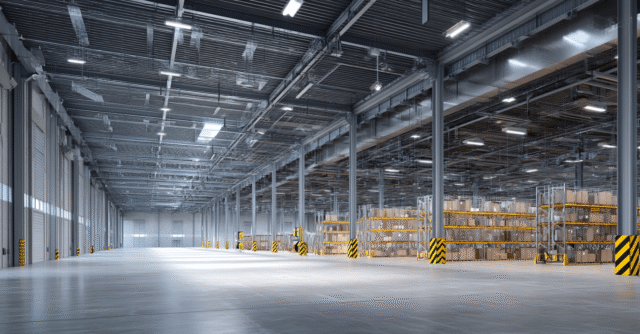
    Wettingen has moved to the centre of an economic policy decision. The Aargau cantonal council wants to amend the structure plan in the Tägerhardächer area and thus create the planning conditions for a possible Hitachi Energy campus.

    This is a big step. Because it is not just about a single building project. It is about the question of whether Aargau can retain and at the same time expand its industrial substance. In the best-case scenario, around 1000 existing jobs will remain in the canton and up to 2000 new jobs could be created.

    Why Tägerhardächer
    The location is no coincidence. Hitachi Energy is looking at several options for expanding its capacities and relocating current jobs. The Tägerhardächer area is one of the favoured options.

    From a location promotion perspective, there are many arguments in favour of Wettingen. The site is located in the Zurich, Limmattal and Baden area, has good transport links and enables a coherent, expandable campus solution. It is also close to an existing cluster of companies from the energy sector. This increases the appeal of the location far beyond the municipal boundaries.

    The price of progress
    Wherever development becomes possible, conflicts arise. 10.7 hectares of settlement area would have to be designated for the project. The area is currently located in an agricultural area and is partially overlaid by a settlement separation belt.

    This is precisely where the criticism arises. In the consultation process, the loss of cultivated land, the reduction of crop rotation areas, encroachment on the settlement separation belt and traffic issues were criticised in particular. Nevertheless, the cantonal government maintains that the project is appropriate and spatially harmonised from a cantonal perspective. At the same time, attempts should be made to upgrade agricultural land elsewhere so that the loss remains limited.

    The region is thinking further ahead than the
    factory buildingThe
    decisive factor now is whether growth and quality of life can go hand in hand. After all, a campus of this size not only has an impact on the labour market. It changes traffic flows, settlement areas and expectations of the infrastructure.

    That is why accessibility should not only work for cars. Public transport as well as pedestrian and cycle connections should be designed in such a way that the impact on neighbouring communities remains as low as possible. This is more than just background music. It is a prerequisite for economic dynamism to be accepted regionally.

    Nothing has been decided yet
    The political will is visible. Wettingen and Baden Regio also support the amendment to the structure plan. However, the company has yet to make a final decision on the location. If it decides against Wettingen, the corresponding resolutions will become null and void.

    This is the real message of this dossier. The future does not just fall from the sky. It must be planned, politically supported and regionally balanced. Wettingen now has the chance to prove just that.

  • Where others park, you soon live

    Where others park, you soon live

    Christoph Schoop didn’t have to look far. The real estate investor from Baden looked out of his office window at the Dättwil industrial estate and recognized the obvious: huge flat roofs, completely unused. On the roof of the factory arcade at Mellingerstrasse 208, where McDonald’s, Spar and a bakery now provide for everyday life, eight so-called Wikkelhäuser are to be built from spring 2027.

    A new world on the roof
    The Wikkelhouse concept originated in Amsterdam and is now coming to Switzerland. Compact wooden housing units that are delivered ready-made by truck and erected with minimal effort. Each unit offers 30 to 35 square meters, its own terrace and ceiling heights of up to 3.5 meters. Architect Andreas Zehnder, who designed the project for Baden, clearly formulates the added value. Instead of adding another storey, an independent living space has been created on the roof.

    Swiss wood, Uri factory
    The houses are not produced on the building site, but in the company’s own factory in Flüelen UR on the shores of Lake Lucerne. The raw material is Swiss wood from sustainable forestry. Schoop is a co-founder and supporter of Wikkelhouse Switzerland and promotes the concept as a circular economy model. A unit costs from CHF 200,000 ex works; transportation and assembly are additional costs.

    Inexpensive, sunny, connected
    By Baden standards, rents should remain low. There is already a waiting list and, according to Schoop, inquiries have come from “a wide range of people”, including those of AHV age. And although the industrial area is not considered a residential location, the roof offers all-day sunshine and a direct public transport connection. The building itself provides noise protection.

    Pilot with scaling potential
    The project in Dättwil is explicitly designed as a pilot project. Schoop sees space for 50 to 70 Wikkel houses in the industrial area alone. The city of Baden is currently reviewing the suitability for planning permission. If everything goes according to plan, the first residents will move in in spring 2027. What sounds like a curiosity today could set a precedent tomorrow.

  • Beer, concrete and living – Baden builds on its history

    Beer, concrete and living – Baden builds on its history

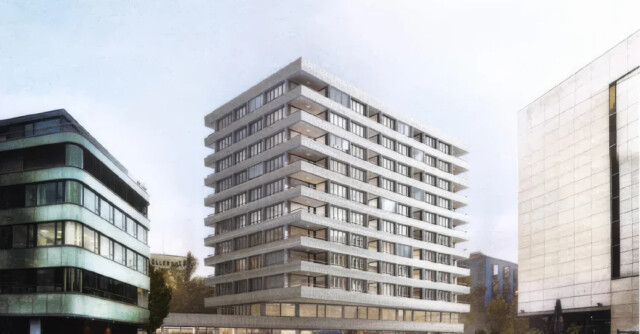
    Four new buildings are being constructed on around 8,000 square meters directly next to Baden train station, divided into two construction sites. Building site A is the responsibility of Frei Architekten AG from Aarau, building site B is the responsibility of the renowned Harry Gugger Studio from Basel. The volume is considerable: 81,888 cubic meters of enclosed space, 22,914 square meters of floor space and an investment of around 64.5 million Swiss francs. The general contractor is Gross AG from Brugg.

    Living where malt used to steam
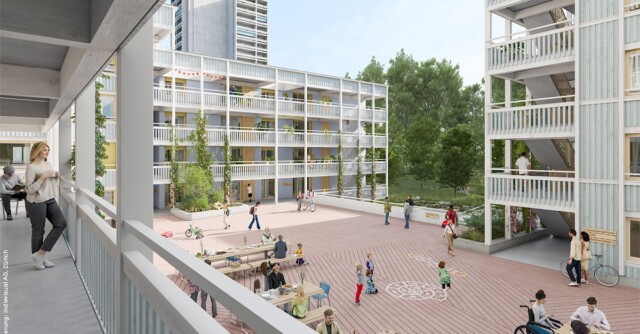
    136 rental apartments with 1.5 to 4.5 rooms are being built in the heart of the city. On the first floor, a total of 2268 square meters of retail and restaurant space will characterize the quarter. In the inner courtyard, a 900 square meter beer garden invites you to linger. The motto of the building owner, the fourth-generation brewery H. Müller AG, sums it up: “brew – live – enjoy”.

    History remains visible
    Not everything makes way for the new building. The boiler house, brewhouse and malt silo remain as architectural witnesses to a brewing history that began in 1897. The Müllerbräu beer itself is now produced by the Falken brewery in Schaffhausen. However, there is still a specialty brewery on the site. The site’s past thus not only remains visible, it can still be experienced.

    Timetable and marketing
    The building permit dates from October 2023, with demolition starting in April 2024. The facades of the new high-rise buildings have been visible for the first time for a few days now. A milestone for the project. Marketing of the apartments is scheduled to start in summer 2026, with first occupancy planned for June 2027.

  • Laufenburg builds windmills at the train station

    Laufenburg builds windmills at the train station

    The Schützegärte site is located in a sensitive urban location. Three streets surround it, and building typologies from different decades clash all around. It is precisely this chaos that is the theme. AWW Architekten AG makes the “contrasting and bilateral” the basis of the concept. The architecture emerges from the tension of the location, not against it.

    Offset, rotated, anchored
    Two identical, four-storey buildings form the ensemble. They are not parallel, but offset and rotated in relation to each other on the slightly sloping terrain. This positioning is not an aesthetic conceit, but a precise reaction to the formation of edges and the flow of space in relation to the neighboring buildings. An ensemble that blends in while remaining independent. The total floor area is around 4,600 square meters, the building volume around 13,800 cubic meters.

    Windmill as a residential model
    The architectural concept is based on a compact four-span “windmill” building shape with a central staircase core. The projecting wings characterize the façade and make reference to typical bay window shapes in the district. Each apartment is oriented on three sides. At the heart of the building are the “four-season rooms” with spacious rooms that can be used as conservatories, studios or living and dining areas. Together with loggias, this creates a flexible range of spaces for a wide variety of lifestyles.

    Green, communal, grounded
    The open space between the houses is deliberately kept low-threshold. Accessible from inside and from the street. A green layer of native shrubs and perennials protects the first floor apartments and gives the development character. At one corner, the area opens up to a meadow-like situation with fruit trees, a reference to the local tradition of orchards close to settlements. The project considers housing and community as a unit.

    Next steps open
    The town of Laufenburg was not involved in the planning process. Town clerk Marco Waser confirms that the building authorities only clarified the building regulations in advance. The town has not yet made an assessment. The landowner Erne Immo AG has not yet commented on the time horizon for implementation.

  • Three exceptions to planning security for Bremgarten

    Three exceptions to planning security for Bremgarten

    Bremgarten began the overall revision of its land use planning over seven years ago. Regulations and documents were revised in several stages, always with the involvement of the population. In October 2024, the municipal assembly approved the revision, followed by approval from the cantonal government in December 2025. Two appeals lodged against this were both rejected.

    Rezoning as the centerpiece
    The most important measure in the settlement area is the rezoning of the Oberebene area from a pure work zone to a new residential and work zone. At the same time, a core zone for the development of the station area will be established and the Oberebene work zone will be strengthened as an economic focus of regional importance. This creates scope for investment and urban development.

    New regulations for cultural land and the old town
    The cultural land plan establishes binding overarching open spaces and water areas. This includes the water and migratory bird reserve of national importance. The regulations for building in the old town were also reviewed and clarified. An important signal for property owners and investors who need planning security.

    Three points still open
    The government council sent back three amendments. The non-protection of two properties at Birrenbergstrasse 10 and Glärnischweg 5/7 and the proposed deletion without replacement of a paragraph on roof breakthroughs in the building and usage regulations. In November 2025, the city council had already secured a loan of 200,000 francs for the reprocessing.

    Municipality to decide in June
    The municipal assembly will meet again on June 11, 2026. This is when the three rejected items are to be finally resolved. Bremgarten is nearing the end of a long planning process and the start of a new phase of urban development.

  • Five stones, 220 apartments, one future

    Five stones, 220 apartments, one future

    The Brisgi has roots. In the 1940s, the site was home to a shanty town for up to 1500 employees of the former BBC industrial group. Many of them were guest workers with their families. In the 1960s, a high-rise building and two apartment blocks followed, which still stand today and are carefully embedded in the new development. What was once a workers’ housing estate is now becoming a modern urban building block.

    Three sponsors, one goal
    The project is backed by three non-profit organizations that are jointly developing the 6.5-hectare site: Wohnbaustiftung Baden, Logis Suisse AG and Graphis Bau- und Wohngenossenschaft. Each will take over one of the three buildings and design them independently. The rents are calculated to cover costs. Profit is not the goal, but affordable living is.

    Wood, concrete and sun
    Nine five- to six-storey buildings, pergolas, green inner courtyards and a central square will characterize the future Brisgi. The hybrid construction method combines wood and concrete. Concrete only where it is really needed. Solar panels will produce electricity on around half of the roofs and the site will be connected to the district heating network of Regionalwerke Baden. The aim is to achieve the gold certificate of the Swiss Sustainable Building Standard.

    Values carved in stone
    Five stones, found during the excavation of the building pit and engraved by a stonemason, represent the self-image of the development. Common ground, the future, sustainability, affordability and living. City President Markus Schneider, who carried the stone with the inscription “Future”, summed up the 14 years of planning work: “Now the lively Kappi is becoming even livelier. A neighborhood within a neighborhood is being created here.” The five stones will be clearly visible in the development in future.

    Milestones on schedule
    After years of objections and a planning process since 2012, things are now picking up speed. The building permit for all three courtyard buildings was granted in April 2025 and construction started on schedule in the fall of 2025. Letting will start in the second half of 2027, with occupancy scheduled for the first half of 2028. The design architects are the Baden-based firm Meier Leder Architekten together with the Zurich firm Müller Sigrist, whose “Kandalama” project was chosen as the winning project in 2016.

  • Historic Spa District gets a new perspective for use

    Historic Spa District gets a new perspective for use

    Verenahof AG, based in Baden, wants to revitalize the building complex in Baden’s Spa District. To this end, it concluded a contract with the city on February 5. According to a press release, this forms the basis for the development and use of the complex and is intended to provide planning security.

    Verenahof AG has developed a utilization concept in collaboration with the city and the cantonal monument preservation authorities. This envisages combining assisted living for older people with cultural offerings and publicly accessible uses. The technical feasibility has already been examined. Now a building application and a cost estimate are to be drawn up within twelve months under the management of Verenahof AG.

    “The concept for services in the areas of prevention, rehabilitation and healthy ageing is a perfect fit for this historically valuable location for Baden,” said Markus Schneider, Mayor of Baden, in the press release. “The Spa District has been investing in health since Roman times – it is important for Baden and the region that this offering continues to be expanded in the future.”

    The complex has been vacant since the closure of the Verenahof, Bären and Ochsen hotels in 1987 and 2004. It has been under national protection since 2019. As the owner of Verenahof AG, the Bad Zurzach Baden Health Promotion Foundation has examined several uses, including for a rehabilitation clinic. These possible uses came up against the economic and structural framework conditions as well as the requirements for the preservation of historical monuments.

  • View into the fire zone

    View into the fire zone

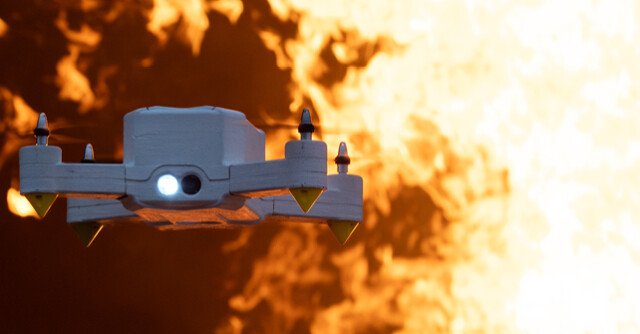
    Fires in large buildings, tunnels or industrial plants are a race against time. Emergency services often have to venture into smoke-filled, unstable structures without knowing exactly what to expect. The FireDrone is designed to close this gap and, as a heat-resistant reconnaissance platform, flies into hazardous areas and delivers situation information to the screen in real time.

    Instead of sending people into areas at risk of collapse, the flying robot takes over the reconnaissance. It detects hazardous substances, helps to locate missing persons and shows sources of fire where visibility and access are limited. This reduces the risk for emergency services and increases the quality of decisions.

    Greater safety for fire departments and industry
    Toxic smoke, collapsing components and explosions are among the greatest risks in fire operations. Searching complex structures such as multi-storey parking lots, industrial halls or tunnels is particularly difficult and dangerous. This is where the drone comes into its own, as it can fly over such areas quickly and precisely without causing any damage.

    The heat-resistant drone also opens up new options in industry. Today, plants with furnaces, refineries or thermal processes often have to be shut down for hours or days before an inspection is possible. The drone should be able to inspect cement or steel plants as well as waste incineration plants during operation. This shortens downtimes, reduces costs and saves energy.

    Aerogel shell for 200 degrees
    Where conventional drones fail at around 40 degrees Celsius, this one stays in the air. Its core is a patented insulation made of ultra-light aerogel. This material consists almost entirely of air, embedded in a heat-resistant polyimide structure, and protects the sensitive electronics from temperatures of up to 200 degrees Celsius.

    The new generation dispenses with complex composite structures with glass fibers and relies on a pure polyimide aerogel that can be cast into three-dimensional shapes. This means that the shell is practically cast in one piece and fits snugly around the components.

    The new aerogel variant combines high heat resistance with mechanical flexibility and is supplemented by an internal temperature management system that actively monitors and cools the electronics.

    Thermal images in real time even without GPS
    When in use, the drone delivers high-resolution thermal images directly to the remote control. An infrared camera makes sources of fire, heat pockets or hidden people visible, even through thick smoke. Several emergency crews can follow the images at the same time and thus get a picture of the situation independently of the first team in the building.

    The drone can be modularly equipped with additional cameras or sensors. It can also measure outside temperatures or detect gases produced by fires. Another highlight is its use indoors. As GPS often fails in buildings, tunnels or covered industrial facilities, the system works with specially developed assistance and localization functions that ensure stable flights even without a satellite signal.

    From laboratory to operational vehicle
    The path from prototype to operational solution leads through tests under real conditions. The drone has already been tested on training grounds for firefighters and in operating industrial plants, including the Siggenthal cement works. The aim is for pilots to be able to use the drone safely in extreme situations after minimal training.

    With the planned FireDrone Nest, the spin-off is going one step further. The mobile, thermally insulated docking and maintenance station is to be integrated into fire engines or modern fire protection systems. After a mission, the drone lands automatically, is secured, checked and prepared for the next flight. This turns a research project into a reliable system for everyday use by fire departments and industry.

    Spin-off with a tailwind
    The drone represents a line of development that began in the Empa laboratories for “Sustainability Robotics” and “Building Energy Materials and Components”. Today, a spin-off from Empa and EPFL is driving the technology towards market application. The team is supported by various funding programs and foundations that enable the transition from idea to product.

    For the researchers, it is clear that the combination of new material technology, robotics and practical testing opens up a new chapter in firefighting. The task now is to take the drone from the test environment to real operations so that in future it can fly to places where it is better for people to keep their distance.

  • New logistics hall increases efficiency in the national distribution network

    New logistics hall increases efficiency in the national distribution network

    Senn AG from Oftringen, which specializes in extensions, new buildings and special constructions, is building a new steel warehouse for the Migros distribution company(MVB) in Suhr. According to a press release, the new building covers an area of 7500 square meters, is more than 100 meters long and 15.5 meters high. At the heart of the modernization is a fully automated storage system, which will increase capacity and make logistics more efficient.

    A total of 1100 different components were required, which was logistically demanding and a challenge for assembly due to limited space for temporary storage. According to Senn AG, most of the assembly work was carried out using the company’s own mobile crane and two construction site cranes.

    According to the press release, the supporting structure is made of white-coated steel. a total of 530 tons of steel were used. According to the company, Senn AG processes 7,000 tons of steel and aluminium annually at its headquarters and is active in steel and metal construction, sheet metal and stainless steel centers, emergency power systems, mobile crane operations and other transport solutions.

    Construction work has been underway since the end of June. Around three quarters of the hall has been assembled and the final parts of the hall are currently being coated in the workshop and prepared for transportation. The project should be completed before the end of December.

    The realization of the warehouse is important for Migros’ supply network. As MVB writes, the retail group operates one of two national distribution centers in Suhr. The first was built more than 50 years ago in Neuendorf SO, and another site was built in Suhr more than 25 years ago.

  • Timber construction sets new standard for cantonal buildings

    Timber construction sets new standard for cantonal buildings

    Architect Markus Schietsch has received a silver Hase Architecture Prize from “Hochparterre” for his new construction of the cantonal AVS building in Unterentfelden. The prize was awarded on December 2 at the Zurich Museum of Design. It recognizes the architectural quality of the building and the consistent implementation of sustainable construction methods.

    The new building with its laboratory and office workstations for currently 80 employees was officially opened on October 25, 2024 after two and a half years of construction. The construction work was planned and carried out by Immobilien Aargau.

    “The award confirms the path we have taken,” said Cantonal Councillor Dr. Markus Dieth in a press release. “The canton of Aargau invests in sustainable, economical and high-quality buildings that also take cost-efficient construction into account. I would like to congratulate Markus Schietsch and the Aargau Real Estate Department on this success.”

    According to Schietsch, this award shows “that careful planning, a clear architectural approach and the courage to use sustainable materials such as wood are more in demand today than ever before”. Head of office and cantonal chemist Dr. Alda Breitenmoser emphasizes that the new building offers “optimal working conditions” for consumer protection: “The architecture supports our work processes, creates a pleasant indoor climate and shows that modern administration can be ecological and functional at the same time.”

    At the beginning of November 2025, the new AVS headquarters received an award from the Pro Holz Aargau wood network for its timber construction.

  • Startups provide impetus for a sustainable energy future

    Startups provide impetus for a sustainable energy future

    The Energy Startup Day took place on November 19 at the Kultur & Kongresshaus Aarau. The event offered start-ups the opportunity to present themselves and make contacts. Several presentations were also on the program. And finally, five start-ups were awarded prizes.

    Borobotics AG, based in Technopark Winterthur, won the Jury Award and with it an Energate PR & Event Package. The company is working on a new type of geothermal drill for use in urban areas. The first of two Swissolar Awards went to SmartHelio from Prilly VD for its artificial intelligence-based software for the use of photovoltaic systems. The start-up won a Swissolar Marketing & Event Package. The second Swissolar Award, and with it a Swissolar Event Package, went to Synergi Solutions from Helsinki. The Finnish start-up has developed an app to optimize energy consumption.

    Voltiris from Epalinges VD won the Audience Award and with it a Communication Package from Zurich University of Applied Sciences (ZHAW), Electrosuisse and Swisspower. Voltiris develops modules for agrivoltaics in greenhouses. And the Investor Award went to SensorXSolutions, which won the SICTIC (Swiss ICT Investor Club) prize, which is equivalent to an invitation to an investor event. The young company from Sarnen has developed intelligent systems for detecting and handling gases such as methane in order to curb the greenhouse effect.

    The organizers welcomed a total of around 230 participants. ZHAW, Electrosuisse and Swisspower organized the event and were supported by numerous partners.

  • New building to replace outdated shopping center

    New building to replace outdated shopping center

    A feasibility and potential study has shown that the Migros shopping center in the “Im Funken” area in Zofingen is outdated in terms of use and operation. According to a statement from the town of Zofingen, partial preservation is not an option, so a new replacement building is now to be planned. This new building is at the heart of the plans for a “mixed quarter for shopping, living and working”, which is being planned by Migros Aare, the city of Zofingen and the real estate company Zofimmo AG.

    Now that a “first milestone” has been reached with the study, “viable and concrete projects” are to be developed by several teams through a study contract. In a subsequent step, these are then to be legally secured through corresponding municipal planning instruments or a design plan.

    The results of the study commission should be available by the end of 2026, with construction starting in 2029 at the earliest. During the possible construction phase, a temporary facility would allow shopping to continue. On completion of the work, residential space is to be created on the existing parking lot by the railroad tracks. In addition to commercial space, residential space is also planned for the green part of the site opposite the old town – but the green character is to be retained.

  • Renewable gas strengthens local supply

    Renewable gas strengthens local supply

    Since October, some of the sewage gas from the wastewater treatment plant (WWTP) of the Aargau and Surroundings Wastewater Association(AVAU) in Telli in Aarau has also been used to supply heat locally. According to a press release, Green Power Aarau AG processes the gas, which is then fed into the natural gas network of Eniwa AG.

    This replaces fossil natural gas with renewable gas. According to the press release, the quantities are currently still manageable. However, they should be significantly increased with the ARA expansion.

    “With this project, we are demonstrating how the by-product sewage gas can be turned into a valuable energy source,” said Hans-Kaspar Scherrer, CEO of Eniwa and Chairman of the Board of Directors of Green Power Aarau AG, in the press release. “The collaboration between AVAU, Green Power Aarau and Eniwa is a strong example of how the circular economy works in practice in the region.” According to Scherrer, the three companies are jointly contributing to a sustainable energy supply and the reduction of CO2 emissions, as well as strengthening local value creation.

  • Award for sustainable hospital construction

    Award for sustainable hospital construction

    Baden Cantonal Hospital(KSB) has been honored at the World Architecture Festival in Miami, Florida. The architecture of the new KSB building won a prize in the Health category, according to a press release. The World Architecture Festival was held from November 12 to 14.

    At the event at the Miami Beach Convention Center, 160 international jurors voted on 460 projects. The hospital building realized by Nickl & Partner Architekten Schweiz and other planning partners was recognized for its clear design language, sustainable construction and consistent focus on a healing environment for patients, according to the press release. “This award is an impressive confirmation of our vision: to build a hospital that combines medical excellence and efficient operation with state-of-the-art architecture,” said Pascal Cotrotzo, CEO of KSB. “We are proud that our new building in Miami has received international recognition. Our thanks go to everyone who made this major project possible.”

    KSB already received the European Healthcare Design Award in London in June 2025. In order to show off the entire new building to its full advantage, a green space will be built on the site of the old hospital to connect it to the city. The KSB refers to a complaint by the Aargau Heritage Society against the demolition of the old building and a petition with 7,000 signatures against this complaint.

  • New tracker makes the Swiss power-to-X landscape visible

    New tracker makes the Swiss power-to-X landscape visible

    Renewable electricity can be stored in chemical energy carriers such as hydrogen, synthetic fuel and methane (Power-to-X). According to a press release from the Swiss Power-to-X Collaborative Innovation Network SPIN, more than 50 projects in this area are already underway in Switzerland.

    Together with the Coalition for Green Energy & Storage(CGES), SPIN is therefore launching a tracker that provides an overview of known projects in Switzerland. The resulting map makes visible those projects that have gone beyond laboratory tests and have already become demonstration projects or even commercial applications. SPIN collects the data, CGES visualizes it.

    “The tracker facilitates collaboration by providing a structured database that promotes synergies between stakeholders and supports decision-making,” Christoph Sutter and Antonello Nesci, co-directors of CGES, are quoted as saying in the press release.

    Martin Bäumle sees power-to-X technologies as the key to defossilizing the economy. “With the tracker, we are creating transparency, strengthening collaboration and helping to turn promising ideas into scalable solutions,” said the National Councillor (Green Liberal/ZH) and Co-President of SPIN. “Reliable data can help policy makers to adapt regulations and investors to identify new opportunities.”

    The map will be presented at the CGES annual event, which will take place on November 21 at Swissgrid in Aarau. CGES is a coalition of partners from business, academia and the public sector for green energy, founded by the ETH Domain.

  • Alte Mühle residential project reaches important milestone

    Alte Mühle residential project reaches important milestone

    Swica Health Organisation Ltd. is building a new neighbourhood with a total of 136 flats on the former Huggler site in Suhr. SWICA has entrusted Halter AG from Schlieren with the realisation of the Alte Mühle residential park project as total contractor. Around a year after the foundation stone was laid, the topping-out ceremony has now been celebrated on the building site, Halter announced in a post on LinkedIn.

    In the Alte Mühle residential park project, ten apartment blocks will be grouped around the Alte Mühle in a loose building structure. Halter explains in the project description that the mill itself can be renovated without the need for heritage protection. The three to five-storey buildings should be completed by the end of 2026. Around half of the rental flats and a large proportion of the owner-occupied flats have already been reserved.

  • Investment in modern workplaces and training

    Investment in modern workplaces and training

    The Ferrum Group has inaugurated its new ferruBase extension at its Schafisheim site, according to a press release. With the new building, the mechanical engineering company has realised a vertical production structure that creates space for 240 new office workstations, fully equipped production rooms and a future-oriented training workshop on around 14,000 square metres of floor space. More than 1,000 guests attended the opening and were able to gain an insight into the new building during expert tours.

    According to the press release, the new building seamlessly combines modern production processes with ergonomic office design and a training workshop. During the guided tours, employees, family members and guests were able to gain an initial insight into the architecture, construction method and new machinery. Catering was also provided at the opening ceremony and a varied entertainment programme was offered.

    For Ferrum, the new building is an investment in the future viability of the company and is intended to secure jobs in Aargau in the long term. At the same time, it also demonstrates how tradition and modern technology can be successfully combined.

  • Photovoltaic system on company roofs in Aarau

    Photovoltaic system on company roofs in Aarau

    Over the next six weeks, HKG Engineering AG will be installing a photovoltaic system on the roofs of its own company buildings at the Aarau site. According to a press release, 184 high-efficiency modules are planned there, which will generate 93,000 kilowatt hours of electricity per year.

    The energy generated will be sufficient to cover the company’s own requirements in the offices and for charging electric vehicles. The system will also reduce the load on the neighboring Aarhof property, which is currently under construction.

    With this investment, HKG is sending out a clear signal for sustainable action. The aim is to reduce CO2 emissions in the building sector and reduce dependence on external energy.

  • Clear the stage for the best projects in the industry

    Clear the stage for the best projects in the industry

    When the doors of Trafo Baden open on October 2, 2025, the who’s who of the Swiss real estate, construction and finance world will gather for the Real Estate Award 2025 ceremony. In addition to the festive gala with dinner, the focus will be on inspiring impulses, networking and discussions about the future of the industry.

    A special highlight is entrepreneur and visionary Samih Sawiris, who will provide personal insights during the fireside chat, a conversation that promises new perspectives on entrepreneurial thinking and location development.

    Four categories, twelve finalists
    The start of ticket sales also marked the opening of public online voting. Until August 17, 2025, one vote can be cast daily in four forward-looking categories, each with three finalists.

    Digital: Evorest, Optiml, Quanthome

    Sustainability: IAZI CIFI, Mobimo, Neustark

    Project Development & Innovation: Element, UmweltArena, Xania

    Marketing: Avendo, maison.work, tRaumplaner

    The winners will be awarded live at the gala evening and jointly determined by the jury and the audience.

  • Aargau shapes the future with a development model

    Aargau shapes the future with a development model

    The canton of Aargau is a dynamic region with a high quality of life and economic attractiveness. In order to secure this strength in the long term, the cantonal government has adopted the 2025-2034 development model (ELB). This formulates clear goals and lines of action that respond to the key challenges of our time: population growth, climate change, digitalisation and a shortage of skilled workers.

    The focus is on actively shaping the further development of the canton in close cooperation with municipalities, companies, research institutions and the population. The guiding principle “Together for Aargau” summarises this collaborative approach. The ambitions in the areas of economy, society, environment and administration can only be successfully realised by working together.

    Three strategic priorities for a strong region
    Think holistically and intensify economic development
    Aargau wants to continue to position itself as an attractive location for companies, research and innovation. To this end, targeted framework conditions are being created to maintain and expand value creation and employment in the canton.

    Shaping space, securing foundations
    In the area of conflict between living, working, mobility and nature, intelligent spatial planning is essential. The aim is to proactively manage conflicts of use and protect natural resources.

    Strengthening efficient municipal structures
    The public sector should act in an efficient, cooperative and citizen-centred manner. Municipal mergers, inter-municipal cooperation and digitally supported services form the basis for this.

    These priorities are underpinned by 30 specific areas of focus that are integrated into the task and finance plan and are reviewed annually.

    Sustainability requires room for manoeuvre
    The financial framework for implementing the strategy is secure. Even if structural deficits are expected from 2026, the well-filled equalisation reserve will allow the continuation of all planned measures until 2034. Tax relief will be reviewed depending on the situation and with a view to the overall financial situation. This ensures that the canton’s room for manoeuvre is also maintained in the long term.

    From vision to implementation
    The EFA will be implemented in stages and is closely linked to medium-term planning. Numerous projects are already underway as part of the existing development agenda, from energy-efficient construction and innovation promotion to integrative housing models. New projects will be initiated, prioritised and provided with suitable resources in future.

    Progress will be reported transparently on an annual basis. This is an important step towards a fact-based and trustworthy location policy. The cantonal government is thus committed to agile, dialogue-oriented management of cantonal development in close coordination with all relevant stakeholders.

    The 2025-2034 development model is much more than a political planning instrument. It is a powerful promise to a population that prioritises quality of life. To companies that are looking for reliability and innovation and to municipalities that want to help shape their future with confidence. Aargau is thus positioning itself as a modern canton with a clear compass. Economically strong, ecologically responsible and socially anchored.

  • Zurich and Aargau plan mobile network

    Zurich and Aargau plan mobile network

    The Limmat Valley is developing rapidly, not least thanks to new transport projects. In order to strategically address this dynamic, the cantons of Zurich and Aargau, together with three regional planning associations, are launching a cross-cantonal planning instrument:. The Limmattal regional overall transport concept.

    The concept follows the guiding principle “The Limmat Valley is fit for the future” and aims to create a sustainable, efficient and environmentally friendly balance between settlement and transport development. The planning horizon extends to the year 2050.

    Multimodal networking as a guideline
    The focus is on improving regional networking, promoting multimodal solutions and integrating logistics concepts. Neighbouring regions such as the Furttal or the city of Zurich are also included.

    The results of the concept will form the basis for future agglomeration programmes and will flow into concrete implementation in the municipalities and cantons from 2027/2028. Objectives, strategies and measures will be developed in several phases by the end of 2026.

    Structured process with regional participation
    The project will be managed by a steering group with representatives from the cantons and regional planning associations. Broad participation by the municipalities and public information events ensure transparency and acceptance.

    Project manager Sarah Hug (Canton of Zurich) and project manager Dominik Kramer (Canton of Aargau) are coordinating the participatory process. Public information events are planned on 5 November 2025 and 13 May 2026, among other dates.

    Mobility strategy with a signalling effect
    The rGVK Limmattal is a model project for intercantonal cooperation in one of Switzerland’s most economically significant development areas. It shows how regional and supra-regional interests can be united in a joint strategy for sustainable mobility.

  • Smart City Aarau networked, user-centered and environmentally friendly

    Smart City Aarau networked, user-centered and environmentally friendly

    Aarau is facing complex social and technological developments. In order to respond to this in a future-oriented manner, the city is pursuing a networked, creative and efficient approach with its Smart City strategy. The focus is on concrete benefits for the target groups and environmentally friendly processes. Digital technologies are only used where they create real added value.

    Five basic principles for smart impact
    Based on experience from the first strategy period from 2021 to 2025 and proven models from other cities, Aarau has defined five high-impact approaches.

    Networking: Projects interlock across departments and are implemented collaboratively.

    Meeting needs: Solutions that are actually needed are developed in dialog with the population.

    Testing: Innovation also means trying things out. Pilot tests help to minimize risks and make ideas practicable.

    Environmental protection: Sustainability is a must. All projects take environmental aspects into account and rely on renewable resources.

    Technology as a means to an end: Technology is used in a targeted manner and only if it contributes to the solution.

    Smart City Team as enabler
    The municipal Smart City Team supports employees in the idea and project phase. It helps to identify target groups, hone project ideas and develop testable solutions. Formats such as kick-off meetings, workshops or support for complex projects through to implementation are available. The motto: implement projects with real benefits for Aarau or consciously reject them.

    Targeted support and smart vessels
    The Smart City Team also works in the background. It monitors trends, networks stakeholders and promotes knowledge transfer via formats such as the “Smart City Newsroom”. It also supports projects financially via the Smart City Investment Loan and helps to create participatory vessels.

    Measuring impact and learning
    The strategy is based on the IOOI impact model and measures not only outputs but also outcomes and long-term impacts. The aim is for all municipal specialists to apply user-centered methods, plan their projects in a networked manner, implement them in a resource-efficient way and integrate digital technologies in a meaningful way by 2034.

    Smart City Aarau thinks ahead
    The city of Aarau is reinterpreting Smart City as a method for developing sustainable, liveable urbanity. The focus is on people, not technology. This turns complexity into innovation and ideas into concrete future solutions for Aarau.

  • Pioneering project: Greenhouse solar system utilises light twice

    Pioneering project: Greenhouse solar system utilises light twice

    The start-up Voltiris from Epalinges has installed its largest solar system to date on a greenhouse belonging to Meier Gemüse AG in Rütihof, according to a press release from the canton of Aargau. The solar system is based on a filter technology in which light waves used to generate electricity are filtered out and redirected to a solar panel, while the light required for photosynthesis can enter the greenhouse unhindered. In this way, plants can be grown without any loss of yield and renewable energy can be generated at the same time. The canton of Aargau subsidised the solar system with CHF 50,000.

    The solar plant in Rütihof covers an area of around one hectare and generates around 234 kilowatts of electricity with around 1,730 solar panels. “As a Swiss startup, we are proud that the first and world’s largest plant with our spectral AGRI-PV system has gone into operation here in the canton of Aargau,” said Dominik Blaser, Chief Product Engineer and co-founder of Voltiris, in the press release.

    Thanks to the filter technology, Voltiris’ photovoltaic modules can be used inside greenhouses without casting shadows, unlike conventional solar systems. The concave arrangement of the filter also concentrates the light, allowing it to hit the photovoltaic module with four times the intensity. In this way, a higher energy yield can be achieved than with conventional solar radiation.

    The solar installation is also in line with the cantonal energy strategy, which aims to achieve the net-zero target by 2050 and strengthen security of supply.

    “This plant is an example of how agriculture and energy production can be combined in a meaningful way,” Markus Dieth, member of the cantonal government and Director of Agriculture, is quoted as saying in the press release.

  • Smart City Aarau Strategy 2034

    Smart City Aarau Strategy 2034

    With “Smart Aarau 2034”, the city is pursuing a forward-looking approach. The strategy does not rely on technological impetus alone, but sees digitalisation as a tool for solving complex challenges. The focus is on the needs of the population, cooperation between departments and resource-efficient implementation. Aarau is orientated towards the city’s existing development goals and integrates smart thinking into all urban projects.

    A methodological framework for real progress
    The change in strategy also means a rethink in terms of implementation. In future, projects will no longer be planned in secret, but developed in dialogue with those affected. A municipal team will provide methodical support to employees. From the initial idea to the actual tested project. Experience from the Smart City period to date shows that this approach is effective if it is applied consistently.

    Smart means networked and usable
    The new strategy puts an end to isolated islands of innovation. Instead, projects should be systemically conceived and networked across the city in future. The goal is a city that utilises its resources efficiently, can react to changes and introduces new solutions where they are actually needed. Digital tools will only be used if they contribute to quality of life or efficiency.

    Effectiveness instead of symbolic politics
    Aarau measures success not by the number of digital projects, but by their impact. The new strategic framework focuses on measurable progress. This applies to implementation, behaviour, awareness and everyday use. This makes smart thinking the new basis for urban development – comprehensible, user-centred and climate-friendly.

  • Economic development as a bridge between municipalities and companies

    Economic development as a bridge between municipalities and companies

    The Unteres Bünztal region now has its own specialist office to promote the regional economy. The Bünztal Economic Development Agency commenced its activities at the beginning of April, the new agency announced in a press release. “With the new economic development agency, we are strengthening our region in the long term and sending out an important signal for future-oriented economic development,” said Arsène Perroud, President of the Lower Bünztal Regional Planning Association.

    Claudia Heger will take over the management of the Bünztal Economic Development Agency. The 37-year-old business economist studied public and non-profit management in particular. Heger has gained extensive experience in location promotion in previous roles, including for Wirtschaftsregion ZUGWEST and IDEE SEETAL, according to the press release. “I am looking forward to working with the municipalities, companies and partner organizations to further develop the economic potential of the Bünztal region and make it visible,” the new Head of Economic Development Bünztal is quoted as saying.

    Bünztal Economic Development is to act as a “bridge builder between the economy, authorities and educational institutions”. Current tasks relate to the cantonal development focus Wohlen-Villmergen and the Wil/Huebächer business park. The Unteres Bünztal region includes the Aargau municipalities of Büttikon, Dintikon, Dottikon, Hägglingen, Hendschiken, Othmarsingen, Sarmenstorf, Uezwil, Villmergen, Waltenschwil and Wohlen.

  • Rosengarten tunnel and Casino bridge in Brugg to be renovated

    Rosengarten tunnel and Casino bridge in Brugg to be renovated

    The Rosengarten tunnel and the Casino bridge in Brugg are being renovated. According to a press release from the Canton of Aargau, the two structures are to be upgraded so that they can be used for the next 50 years. The cantonal government has approved a loan of CHF 13.6 million for both construction projects.

    The refurbishment will start in 2027 at the earliest. Prior to this, the project submission, approval procedure, land acquisition, tendering and awarding of work must be completed. The work is expected to take a year. The Brugg central bypass with the 205 metre-long Rosengarten tunnel was opened in 1981. The Casino Bridge was built in 1980 and carries the K117 over the River Aare.

    According to a statement from the Department of Construction, Transport and Environment, the supporting structure of the tunnel is intact. However, the tunnel must be adapted to meet current safety requirements. The tunnel walls, fire protection and environmental protection are to be improved, as are the tunnel safety systems. In addition, the control centre at the north portal will be expanded and the operating and safety systems will be brought up to current standards.

    The bridge surface on the Casino Bridge has reached the end of its service life. The kerbstones, the waterproofing and the mastic asphalt covering of the carriageway and pavement will therefore be replaced, according to the press release. Defects in the bridge structure, abutment boxes and piers will be repaired. The corrosion protection will be renewed on the bearings, shaft gratings and railings, among other things. The expansion profiles of the carriageway expansion joints will also be replaced.

    The costs for the repair of the Rosengarten tunnel and the Casino bridge will be borne by the canton.

  • 10 years of the Digital Real Estate Summit

    10 years of the Digital Real Estate Summit

    Prof. Dr Donato Scognamiglio from IAZI AG kicked off the summit with a provocative presentation on the profiteers of digitalisation. He shed light on how digital technologies not only optimise processes, but also create completely new business models. His analysis encouraged people to question traditional ways of thinking and actively utilise the opportunities offered by digital transformation

    Visions for a networked property world
    Later in the summit, leading industry representatives shared their perspectives on the digital future. Jens Vollmar from Implenia emphasised the importance of digital solutions for increasing efficiency in the construction industry. Beatrice Bichsel from SBB explained how the digitalisation of real estate portfolios contributes to the future viability of infrastructure. Helmut Ruhl from AMAG presented innovative approaches to the use of data in property development, while Tanja Vainio from Schneider Electric emphasised the role of digital technologies in creating energy-efficient buildings

    Deepening current industry topics
    The workshops and parallel sessions at the summit offered in-depth insights into current trends and challenges. The focus was on topics such as smart buildings, big data & AI, international developments, digital platforms & ecosystems, digital twins and data-driven sustainability. These sessions enabled participants to engage intensively with the latest developments and evaluate their relevance for their own company

    Experience innovations up close
    An exhibition with around 30 exhibitors offered guests the opportunity to experience the industry’s latest technologies and solutions first-hand. This exchange not only promoted an understanding of current market trends, but also networking among industry experts. The combination of specialist presentations, practical workshops and a lively exhibition made DRES a comprehensive and inspiring experience

    A look to the future
    The 10th Digital Real Estate Summit impressively demonstrated how digitalisation is transforming the real estate industry and what potential can still be exploited. With an eye on future developments and a willingness to take innovative paths, the DRES remains a central platform for exchanging ideas and shaping the digital future of the property industry

    Save the Date
    The next Digital Real Estate Summit will take place again on 5 March 2026 at Trafo Baden. Industry experts and managers are cordially invited to save this date in order to experience the latest innovations and trends in the property industry again next year

  • Sustainable energy supply for Frick

    Sustainable energy supply for Frick

    The Basel-based energy supplier IWB has announced the commissioning of the Frick heating network. In addition to the new heating centre with two wood-fired boilers and two heat storage tanks, a 2.1-kilometre-long heating network has also been put into operation, according to a press release. The expansion of the final sections in the first construction phase is to begin on 4 March.

    This will supply private households and businesses in some neighbourhoods of Frick with renewable district heating. The wood-fired boilers will be fuelled with regional wood chips from the Thiersteinberg forestry operation.

    Due to the high demand, IWB is already examining the expansion of the supply area in the Ob em Dorf and Chilmet districts. Both the current and future constructions are associated with a number of traffic restrictions, which will be adapted by the municipality and canton as required. IWB invites you to an open day on the site of the heating centre on 5 April 2025.

  • Canton Aargau approves Vinea project in Spreitenbach

    Canton Aargau approves Vinea project in Spreitenbach

    The municipality of Spreitenbach can realise the Vinea design plan for the construction of flats at the entrance to the village. The Department of Construction, Transport and Environment(BVU) of the Canton of Aargau has approved the design plan, according to a press release. It forms the planning basis for the realisation of a development with around 37 flats on the previously commercially used site south of the Landstrasse and Wigartestrasse junction.

    According to the municipality, the planned development comprises three buildings. A four-storey building is to be constructed along Landstrasse, a three-storey building on Wigartestrasse and a two-storey building directly facing the village stream.

    A traffic-free inner courtyard is to be created between the buildings, which will be available to residents. The underground car park is intended to increase the quality of living and contribute to sustainable development.

    Vinea is based on the indicative project by Hunziker Architekten AG in Baden-Dättwil and SKK Landschaftsarchitekten AG in Wettingen AG. Metron AG in Brugg AG drew up the design plan together with the client and the municipality of Spreitenbach. The Vinea site is currently built on with a commercial development. A development study was prepared by Hunziker Architekten back in 2018. After weighing up various options, the municipality decided in favour of a longitudinally oriented development along the road in order to “create optimal urban planning conditions”.

  • Work begins on extension to Baden cantonal school

    Work begins on extension to Baden cantonal school

    Preparations for the extension of the Baden cantonal school have begun with clearing work on the construction site. According to a press release from the Canton of Aargau, this preparatory work will be carried out during the sports holidays from 3 to 14 February. This involves removing shrubbery and felling trees in the Schönaustrasse area in Baden. This work must be carried out before construction work on the extension begins in July 2025.

    The early start is necessary because the tree felling must be carried out outside the bird breeding season from the beginning of March to the end of September. New trees will be planted across the entire site once the extension has been completed. According to the press release, this will once again take greater account of biodiversity on the grounds of Baden Cantonal School.

    The building permit for the extension to the cantonal school has been valid since the end of October 2024. The extension will include an additional wing for maths, IT, natural sciences and technology (STEM subjects) and a sports wing including a double sports hall.

    In addition, the outdoor facilities and sports pitches will be redesigned. The planned extension represents the final expansion of the site based on the current school planning, according to the canton’s press release.